
A English
Mix Examples - Heron’s Formula Questions in English
Class 9 Mathematics · Heron’s Formula · Mix Examples - Heron’s Formula
114+
Questions
English
Language
100%
With Solutions
Showing 50 of 114 questions in English
1
MediumMCQ
The base of a right triangle is $8 \, cm$ and its hypotenuse is $10 \, cm$. Its area will be (in $cm^2$):
A
$24$
B
$40$
C
$48$
D
$80$
Solution
(A) Let the right triangle be $\triangle ABC$ where $\angle B = 90^{\circ}$.
Given: Base $BC = 8 \, cm$ and hypotenuse $AC = 10 \, cm$.
According to the Pythagorean theorem: $AC^2 = AB^2 + BC^2$.
Substituting the values: $10^2 = AB^2 + 8^2$.
$100 = AB^2 + 64$.
$AB^2 = 100 - 64 = 36$.
$AB = \sqrt{36} = 6 \, cm$.
The area of a right triangle is given by the formula: $\text{Area} = \frac{1}{2} \times \text{base} \times \text{height}$.
$\text{Area} = \frac{1}{2} \times 8 \times 6 = 24 \, cm^2$.
Given: Base $BC = 8 \, cm$ and hypotenuse $AC = 10 \, cm$.
According to the Pythagorean theorem: $AC^2 = AB^2 + BC^2$.
Substituting the values: $10^2 = AB^2 + 8^2$.
$100 = AB^2 + 64$.
$AB^2 = 100 - 64 = 36$.
$AB = \sqrt{36} = 6 \, cm$.
The area of a right triangle is given by the formula: $\text{Area} = \frac{1}{2} \times \text{base} \times \text{height}$.
$\text{Area} = \frac{1}{2} \times 8 \times 6 = 24 \, cm^2$.
0 likes
View Solution2
MediumMCQ
An isosceles right triangle has an area of $8 \, cm^{2}$. The length of its hypotenuse is
A
$4 \, cm$
B
$\sqrt{32} \, cm$
C
$\sqrt{48} \, cm$
D
$\sqrt{24} \, cm$
Solution
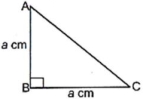
(B) Let the two equal sides of the isosceles right triangle be $a \, cm$.
The area of the triangle is given by $\frac{1}{2} \times \text{base} \times \text{height}$.
Since it is an isosceles right triangle,base $= a$ and height $= a$.
Therefore,$\frac{1}{2} \times a \times a = 8$.
$a^{2} = 16$,which gives $a = 4 \, cm$.
By the Pythagorean theorem,the hypotenuse $h$ is given by $h = \sqrt{a^{2} + a^{2}} = \sqrt{4^{2} + 4^{2}} = \sqrt{16 + 16} = \sqrt{32} \, cm$.
The area of the triangle is given by $\frac{1}{2} \times \text{base} \times \text{height}$.
Since it is an isosceles right triangle,base $= a$ and height $= a$.
Therefore,$\frac{1}{2} \times a \times a = 8$.
$a^{2} = 16$,which gives $a = 4 \, cm$.
By the Pythagorean theorem,the hypotenuse $h$ is given by $h = \sqrt{a^{2} + a^{2}} = \sqrt{4^{2} + 4^{2}} = \sqrt{16 + 16} = \sqrt{32} \, cm$.
0 likes
View Solution3
EasyMCQ
The perimeter of an equilateral triangle is $60 \, m$. The area is
A
$10 \sqrt{3} \, m^{2}$
B
$15 \sqrt{3} \, m^{2}$
C
$100 \sqrt{3} \, m^{2}$
D
$20 \sqrt{3} \, m^{2}$
Solution
(C) The perimeter of an equilateral triangle is given by $P = 3a$,where $a$ is the side length.
Given $3a = 60 \, m$,we find the side length $a = 60 / 3 = 20 \, m$.
The area of an equilateral triangle is calculated using the formula $\text{Area} = \frac{\sqrt{3}}{4} a^2$.
Substituting $a = 20 \, m$ into the formula:
$\text{Area} = \frac{\sqrt{3}}{4} \times (20)^2 = \frac{\sqrt{3}}{4} \times 400 = 100 \sqrt{3} \, m^2$.
Given $3a = 60 \, m$,we find the side length $a = 60 / 3 = 20 \, m$.
The area of an equilateral triangle is calculated using the formula $\text{Area} = \frac{\sqrt{3}}{4} a^2$.
Substituting $a = 20 \, m$ into the formula:
$\text{Area} = \frac{\sqrt{3}}{4} \times (20)^2 = \frac{\sqrt{3}}{4} \times 400 = 100 \sqrt{3} \, m^2$.
0 likes
View Solution4
MediumMCQ
The sides of a triangle are $56 \ cm$,$60 \ cm$,and $52 \ cm$ long. Then the area of the triangle is (in $cm^2$)
A
$1322$
B
$1311$
C
$1392$
D
$1344$
Solution
(D) Given,the three sides of the triangle are $a = 56 \ cm$,$b = 60 \ cm$,and $c = 52 \ cm$.
First,calculate the semi-perimeter $(s)$ of the triangle:
$s = \frac{a + b + c}{2} = \frac{56 + 60 + 52}{2} = \frac{168}{2} = 84 \ cm$.
Using Heron's formula,the area of the triangle is given by $\sqrt{s(s-a)(s-b)(s-c)}$.
Area $= \sqrt{84(84 - 56)(84 - 60)(84 - 52)}$
Area $= \sqrt{84 \times 28 \times 24 \times 32}$
Area $= \sqrt{(4 \times 3 \times 7) \times (4 \times 7) \times (8 \times 3) \times (8 \times 4)}$
Area $= \sqrt{4^4 \times 7^2 \times 3^2 \times 8^2} = 4^2 \times 7 \times 3 \times 8 = 16 \times 168 = 1344 \ cm^2$.
Thus,the area of the triangle is $1344 \ cm^2$.
First,calculate the semi-perimeter $(s)$ of the triangle:
$s = \frac{a + b + c}{2} = \frac{56 + 60 + 52}{2} = \frac{168}{2} = 84 \ cm$.
Using Heron's formula,the area of the triangle is given by $\sqrt{s(s-a)(s-b)(s-c)}$.
Area $= \sqrt{84(84 - 56)(84 - 60)(84 - 52)}$
Area $= \sqrt{84 \times 28 \times 24 \times 32}$
Area $= \sqrt{(4 \times 3 \times 7) \times (4 \times 7) \times (8 \times 3) \times (8 \times 4)}$
Area $= \sqrt{4^4 \times 7^2 \times 3^2 \times 8^2} = 4^2 \times 7 \times 3 \times 8 = 16 \times 168 = 1344 \ cm^2$.
Thus,the area of the triangle is $1344 \ cm^2$.
0 likes
View Solution5
EasyMCQ
The area of an equilateral triangle with side $2 \sqrt{3} \, cm$ is (in $cm^2$):
A
$5.196$
B
$0.866$
C
$3.496$
D
$1.732$
Solution
(A) The area of an equilateral triangle is given by the formula: $\text{Area} = \frac{\sqrt{3}}{4} \times (\text{side})^2$.
Given the side length is $2\sqrt{3} \, cm$.
Substituting the value into the formula:
$\text{Area} = \frac{\sqrt{3}}{4} \times (2\sqrt{3})^2$
$= \frac{\sqrt{3}}{4} \times (4 \times 3)$
$= \frac{\sqrt{3}}{4} \times 12$
$= 3\sqrt{3} \, cm^2$.
Using the value $\sqrt{3} \approx 1.732$:
$\text{Area} = 3 \times 1.732 = 5.196 \, cm^2$.
Given the side length is $2\sqrt{3} \, cm$.
Substituting the value into the formula:
$\text{Area} = \frac{\sqrt{3}}{4} \times (2\sqrt{3})^2$
$= \frac{\sqrt{3}}{4} \times (4 \times 3)$
$= \frac{\sqrt{3}}{4} \times 12$
$= 3\sqrt{3} \, cm^2$.
Using the value $\sqrt{3} \approx 1.732$:
$\text{Area} = 3 \times 1.732 = 5.196 \, cm^2$.
0 likes
View Solution6
EasyMCQ
The length of each side of an equilateral triangle having an area of $9 \sqrt{3} \text{ cm}^2$ is (in $\text{cm}$):
A
$8$
B
$6$
C
$36$
D
$4$
Solution
(B) The area of an equilateral triangle is given by the formula: $\text{Area} = \frac{\sqrt{3}}{4} \times (\text{side})^2$.
Given that the area is $9 \sqrt{3} \text{ cm}^2$,we set up the equation:
$9 \sqrt{3} = \frac{\sqrt{3}}{4} \times (\text{side})^2$.
Dividing both sides by $\sqrt{3}$,we get:
$9 = \frac{1}{4} \times (\text{side})^2$.
Multiplying both sides by $4$,we get:
$(\text{side})^2 = 36$.
Taking the square root of both sides,we find:
$\text{side} = \sqrt{36} = 6 \text{ cm}$.
Given that the area is $9 \sqrt{3} \text{ cm}^2$,we set up the equation:
$9 \sqrt{3} = \frac{\sqrt{3}}{4} \times (\text{side})^2$.
Dividing both sides by $\sqrt{3}$,we get:
$9 = \frac{1}{4} \times (\text{side})^2$.
Multiplying both sides by $4$,we get:
$(\text{side})^2 = 36$.
Taking the square root of both sides,we find:
$\text{side} = \sqrt{36} = 6 \text{ cm}$.
0 likes
View Solution7
MediumMCQ
If the area of an equilateral triangle is $16 \sqrt{3} \, cm^{2}$,then the perimeter of the triangle is (in $cm$)
A
$48$
B
$12$
C
$24$
D
$36$
Solution
(C) The area of an equilateral triangle is given by the formula: $\text{Area} = \frac{\sqrt{3}}{4} \times (\text{side})^2$.
Given that the area is $16 \sqrt{3} \, cm^{2}$,we have:
$16 \sqrt{3} = \frac{\sqrt{3}}{4} \times (\text{side})^2$.
Dividing both sides by $\sqrt{3}$:
$16 = \frac{1}{4} \times (\text{side})^2$.
Multiplying by $4$:
$(\text{side})^2 = 16 \times 4 = 64$.
Taking the square root:
$\text{side} = \sqrt{64} = 8 \, cm$.
The perimeter of an equilateral triangle is $3 \times \text{side}$:
$\text{Perimeter} = 3 \times 8 = 24 \, cm$.
Given that the area is $16 \sqrt{3} \, cm^{2}$,we have:
$16 \sqrt{3} = \frac{\sqrt{3}}{4} \times (\text{side})^2$.
Dividing both sides by $\sqrt{3}$:
$16 = \frac{1}{4} \times (\text{side})^2$.
Multiplying by $4$:
$(\text{side})^2 = 16 \times 4 = 64$.
Taking the square root:
$\text{side} = \sqrt{64} = 8 \, cm$.
The perimeter of an equilateral triangle is $3 \times \text{side}$:
$\text{Perimeter} = 3 \times 8 = 24 \, cm$.
0 likes
View Solution8
MediumMCQ
The sides of a triangle are $35 \text{ cm}$,$54 \text{ cm}$,and $61 \text{ cm}$,respectively. The length of its longest altitude is:
A
$16 \sqrt{5} \text{ cm}$
B
$10 \sqrt{5} \text{ cm}$
C
$28 \text{ cm}$
D
$24 \sqrt{5} \text{ cm}$
Solution
(D) The sides of the triangle are $a = 35 \text{ cm}$,$b = 54 \text{ cm}$,and $c = 61 \text{ cm}$.
First,calculate the semi-perimeter $s$:
$s = \frac{35 + 54 + 61}{2} = \frac{150}{2} = 75 \text{ cm}$.
Using Heron's formula,the area of the triangle is:
$\text{Area} = \sqrt{s(s-a)(s-b)(s-c)} = \sqrt{75(75-35)(75-54)(75-61)}$
$= \sqrt{75 \times 40 \times 21 \times 14} = \sqrt{(25 \times 3) \times (8 \times 5) \times (3 \times 7) \times (2 \times 7)}$
$= \sqrt{25 \times 3^2 \times 7^2 \times 16 \times 5} = 5 \times 3 \times 7 \times 4 \sqrt{5} = 420 \sqrt{5} \text{ cm}^2$.
The longest altitude corresponds to the smallest side of the triangle.
Since the smallest side is $35 \text{ cm}$,the longest altitude $h$ is given by:
$\text{Area} = \frac{1}{2} \times \text{base} \times \text{height} \implies 420 \sqrt{5} = \frac{1}{2} \times 35 \times h$.
$h = \frac{420 \sqrt{5} \times 2}{35} = 12 \times 2 \sqrt{5} = 24 \sqrt{5} \text{ cm}$.
First,calculate the semi-perimeter $s$:
$s = \frac{35 + 54 + 61}{2} = \frac{150}{2} = 75 \text{ cm}$.
Using Heron's formula,the area of the triangle is:
$\text{Area} = \sqrt{s(s-a)(s-b)(s-c)} = \sqrt{75(75-35)(75-54)(75-61)}$
$= \sqrt{75 \times 40 \times 21 \times 14} = \sqrt{(25 \times 3) \times (8 \times 5) \times (3 \times 7) \times (2 \times 7)}$
$= \sqrt{25 \times 3^2 \times 7^2 \times 16 \times 5} = 5 \times 3 \times 7 \times 4 \sqrt{5} = 420 \sqrt{5} \text{ cm}^2$.
The longest altitude corresponds to the smallest side of the triangle.
Since the smallest side is $35 \text{ cm}$,the longest altitude $h$ is given by:
$\text{Area} = \frac{1}{2} \times \text{base} \times \text{height} \implies 420 \sqrt{5} = \frac{1}{2} \times 35 \times h$.
$h = \frac{420 \sqrt{5} \times 2}{35} = 12 \times 2 \sqrt{5} = 24 \sqrt{5} \text{ cm}$.
0 likes
View Solution9
MediumMCQ
The area of an isosceles triangle having base $2 \, cm$ and the length of one of the equal sides $4 \, cm$ is
A
$\sqrt{15} \, cm^2$
B
$\sqrt{15/2} \, cm^2$
C
$2 \sqrt{15} \, cm^2$
D
$4 \sqrt{15} \, cm^2$
Solution
(A) The sides of the isosceles triangle are $a = 4 \, cm$,$b = 4 \, cm$,and $c = 2 \, cm$.
The semi-perimeter $s$ is calculated as:
$s = \frac{a + b + c}{2} = \frac{4 + 4 + 2}{2} = \frac{10}{2} = 5 \, cm$.
Using Heron's formula,the area of the triangle is:
$\text{Area} = \sqrt{s(s - a)(s - b)(s - c)}$
Substituting the values:
$\text{Area} = \sqrt{5(5 - 4)(5 - 4)(5 - 2)}$
$\text{Area} = \sqrt{5 \times 1 \times 1 \times 3}$
$\text{Area} = \sqrt{15} \, cm^2$.
The semi-perimeter $s$ is calculated as:
$s = \frac{a + b + c}{2} = \frac{4 + 4 + 2}{2} = \frac{10}{2} = 5 \, cm$.
Using Heron's formula,the area of the triangle is:
$\text{Area} = \sqrt{s(s - a)(s - b)(s - c)}$
Substituting the values:
$\text{Area} = \sqrt{5(5 - 4)(5 - 4)(5 - 2)}$
$\text{Area} = \sqrt{5 \times 1 \times 1 \times 3}$
$\text{Area} = \sqrt{15} \, cm^2$.
0 likes
View Solution10
MediumMCQ
The edges of a triangular board are $6 \, cm$,$8 \, cm$,and $10 \, cm$. The cost of painting it at the rate of $9$ paise per $cm^2$ is:
A
$Rs \, 2.00$
B
$Rs \, 2.16$
C
$Rs \, 2.48$
D
$Rs \, 3.00$
Solution
(B) The sides of the triangle are $a = 6 \, cm$,$b = 8 \, cm$,and $c = 10 \, cm$.
First,calculate the semi-perimeter $s$:
$s = \frac{a + b + c}{2} = \frac{6 + 8 + 10}{2} = \frac{24}{2} = 12 \, cm$.
Using Heron's formula,the area of the triangle is:
$Area = \sqrt{s(s - a)(s - b)(s - c)}$
$Area = \sqrt{12(12 - 6)(12 - 8)(12 - 10)}$
$Area = \sqrt{12 \times 6 \times 4 \times 2}$
$Area = \sqrt{576} = 24 \, cm^2$.
The cost of painting is $9$ paise per $cm^2$,which is $Rs \, 0.09$ per $cm^2$.
Total cost $= 24 \times 0.09 = Rs \, 2.16$.
First,calculate the semi-perimeter $s$:
$s = \frac{a + b + c}{2} = \frac{6 + 8 + 10}{2} = \frac{24}{2} = 12 \, cm$.
Using Heron's formula,the area of the triangle is:
$Area = \sqrt{s(s - a)(s - b)(s - c)}$
$Area = \sqrt{12(12 - 6)(12 - 8)(12 - 10)}$
$Area = \sqrt{12 \times 6 \times 4 \times 2}$
$Area = \sqrt{576} = 24 \, cm^2$.
The cost of painting is $9$ paise per $cm^2$,which is $Rs \, 0.09$ per $cm^2$.
Total cost $= 24 \times 0.09 = Rs \, 2.16$.
0 likes
View Solution11
EasyMCQ
Write True or False and justify your answer.
If $a, b, c$ are the lengths of three sides of a triangle, then area of a triangle $= \sqrt{s(s-a)(s-b)(s-c)}$, where $s = \text{perimeter of triangle}$.
If $a, b, c$ are the lengths of three sides of a triangle, then area of a triangle $= \sqrt{s(s-a)(s-b)(s-c)}$, where $s = \text{perimeter of triangle}$.
A
True
B
False
C
Cannot be determined
D
None of these
Solution
(B) The statement is False.
According to Heron's formula, the area of a triangle with sides $a, b, c$ is given by $\sqrt{s(s-a)(s-b)(s-c)}$, where $s$ is the semi-perimeter of the triangle.
The semi-perimeter $s$ is defined as $s = \frac{a+b+c}{2}$, which is equal to half of the perimeter of the triangle.
In the given statement, $s$ is incorrectly defined as the perimeter of the triangle instead of the semi-perimeter.
According to Heron's formula, the area of a triangle with sides $a, b, c$ is given by $\sqrt{s(s-a)(s-b)(s-c)}$, where $s$ is the semi-perimeter of the triangle.
The semi-perimeter $s$ is defined as $s = \frac{a+b+c}{2}$, which is equal to half of the perimeter of the triangle.
In the given statement, $s$ is incorrectly defined as the perimeter of the triangle instead of the semi-perimeter.
0 likes
View Solution12
Easy
Write True or False and justify your answer.
The area of a triangle with base $4 \, \text{cm}$ and height $6 \, \text{cm}$ is $24 \, \text{cm}^2$.
The area of a triangle with base $4 \, \text{cm}$ and height $6 \, \text{cm}$ is $24 \, \text{cm}^2$.
Solution
(B) The area of a triangle is given by the formula: $\text{Area} = \frac{1}{2} \times \text{base} \times \text{height}$.
Given,$\text{base} = 4 \, \text{cm}$ and $\text{height} = 6 \, \text{cm}$.
Substituting these values into the formula: $\text{Area} = \frac{1}{2} \times 4 \, \text{cm} \times 6 \, \text{cm} = 12 \, \text{cm}^2$.
Since the calculated area is $12 \, \text{cm}^2$ and not $24 \, \text{cm}^2$,the statement is False.
Given,$\text{base} = 4 \, \text{cm}$ and $\text{height} = 6 \, \text{cm}$.
Substituting these values into the formula: $\text{Area} = \frac{1}{2} \times 4 \, \text{cm} \times 6 \, \text{cm} = 12 \, \text{cm}^2$.
Since the calculated area is $12 \, \text{cm}^2$ and not $24 \, \text{cm}^2$,the statement is False.
0 likes
View Solution13
Easy
State whether the following statement is True or False and justify your answer:
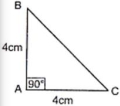
The area of $\Delta ABC$ is $8 \, cm^2$ in which $AB = AC = 4 \, cm$ and $\angle A = 90^{\circ}$.
The area of $\Delta ABC$ is $8 \, cm^2$ in which $AB = AC = 4 \, cm$ and $\angle A = 90^{\circ}$.
Solution
(TRUE) Given that $\Delta ABC$ is a right-angled triangle with $\angle A = 90^{\circ}$,$AB = 4 \, cm$,and $AC = 4 \, cm$.
The area of a right-angled triangle is given by the formula:
Area $= \frac{1}{2} \times \text{base} \times \text{height}$
Here,we can take $AC$ as the base and $AB$ as the height.
Area $= \frac{1}{2} \times 4 \, cm \times 4 \, cm$
Area $= \frac{1}{2} \times 16 \, cm^2 = 8 \, cm^2$
Since the calculated area is $8 \, cm^2$,the given statement is True.
The area of a right-angled triangle is given by the formula:
Area $= \frac{1}{2} \times \text{base} \times \text{height}$
Here,we can take $AC$ as the base and $AB$ as the height.
Area $= \frac{1}{2} \times 4 \, cm \times 4 \, cm$
Area $= \frac{1}{2} \times 16 \, cm^2 = 8 \, cm^2$
Since the calculated area is $8 \, cm^2$,the given statement is True.
0 likes
View Solution14
Medium
Write True or False and justify your answer.
The area of the isosceles triangle is $\frac{5}{4} \sqrt{11} \, cm^2$,if the perimeter is $11 \, cm$ and the base is $5 \, cm$.
The area of the isosceles triangle is $\frac{5}{4} \sqrt{11} \, cm^2$,if the perimeter is $11 \, cm$ and the base is $5 \, cm$.
Solution
(TRUE) Let the equal sides of the isosceles triangle be $a$ and the base be $b = 5 \, cm$.
The perimeter of the triangle is given as $11 \, cm$.
So,$a + a + 5 = 11$.
$2a = 11 - 5 = 6$.
$a = 3 \, cm$.
The area of an isosceles triangle is given by the formula $\text{Area} = \frac{b}{4} \sqrt{4a^2 - b^2}$.
Substituting the values: $\text{Area} = \frac{5}{4} \sqrt{4(3)^2 - 5^2} = \frac{5}{4} \sqrt{4(9) - 25} = \frac{5}{4} \sqrt{36 - 25} = \frac{5}{4} \sqrt{11} \, cm^2$.
Since the calculated area matches the given value,the statement is True.
The perimeter of the triangle is given as $11 \, cm$.
So,$a + a + 5 = 11$.
$2a = 11 - 5 = 6$.
$a = 3 \, cm$.
The area of an isosceles triangle is given by the formula $\text{Area} = \frac{b}{4} \sqrt{4a^2 - b^2}$.
Substituting the values: $\text{Area} = \frac{5}{4} \sqrt{4(3)^2 - 5^2} = \frac{5}{4} \sqrt{4(9) - 25} = \frac{5}{4} \sqrt{36 - 25} = \frac{5}{4} \sqrt{11} \, cm^2$.
Since the calculated area matches the given value,the statement is True.
0 likes
View Solution15
Medium
Write True or False and justify your answer.
The area of an equilateral triangle is $20 \sqrt{3} \text{ cm}^2$ whose each side is $8 \text{ cm}$.
The area of an equilateral triangle is $20 \sqrt{3} \text{ cm}^2$ whose each side is $8 \text{ cm}$.
Solution
(B) The formula for the area of an equilateral triangle is $\text{Area} = \frac{\sqrt{3}}{4} \times (\text{side})^2$.
Given that the side of the triangle is $8 \text{ cm}$,we substitute this value into the formula:
$\text{Area} = \frac{\sqrt{3}}{4} \times (8)^2$
$\text{Area} = \frac{\sqrt{3}}{4} \times 64$
$\text{Area} = 16 \sqrt{3} \text{ cm}^2$.
Since the calculated area $16 \sqrt{3} \text{ cm}^2$ is not equal to the given area $20 \sqrt{3} \text{ cm}^2$,the statement is False.
Given that the side of the triangle is $8 \text{ cm}$,we substitute this value into the formula:
$\text{Area} = \frac{\sqrt{3}}{4} \times (8)^2$
$\text{Area} = \frac{\sqrt{3}}{4} \times 64$
$\text{Area} = 16 \sqrt{3} \text{ cm}^2$.
Since the calculated area $16 \sqrt{3} \text{ cm}^2$ is not equal to the given area $20 \sqrt{3} \text{ cm}^2$,the statement is False.
0 likes
View Solution16
Difficult
Write True or False and justify your answer.
If the side of a rhombus is $10 \, cm$ and one diagonal is $16 \, cm$,the area of the rhombus is $96 \, cm^2$.
If the side of a rhombus is $10 \, cm$ and one diagonal is $16 \, cm$,the area of the rhombus is $96 \, cm^2$.
Solution
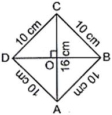
(A) Let $ABCD$ be the rhombus whose one diagonal $AC$ is $16 \, cm$. Each side of the rhombus is $10 \, cm$.
We know that the diagonals of a rhombus bisect each other at right angles,so
$OA = OC = 8 \, cm$ and $OB = OD$.
In $\Delta AOB$,we have $\angle AOB = 90^{\circ}$.
Therefore,$AB^2 = OA^2 + OB^2$
$\Rightarrow OB^2 = AB^2 - OA^2$
$= (10)^2 - 8^2 = 100 - 64 = 36$
$OB = \sqrt{36} = 6 \, cm$.
$DB = 2(OB) = 2 \times 6 = 12 \, cm$.
Hence,the area of the rhombus $= \frac{1}{2} \times \text{Product of diagonals}$
$= \frac{1}{2} \times 16 \times 12 = 96 \, cm^2$.
Hence,the given statement is true.
We know that the diagonals of a rhombus bisect each other at right angles,so
$OA = OC = 8 \, cm$ and $OB = OD$.
In $\Delta AOB$,we have $\angle AOB = 90^{\circ}$.
Therefore,$AB^2 = OA^2 + OB^2$
$\Rightarrow OB^2 = AB^2 - OA^2$
$= (10)^2 - 8^2 = 100 - 64 = 36$
$OB = \sqrt{36} = 6 \, cm$.
$DB = 2(OB) = 2 \times 6 = 12 \, cm$.
Hence,the area of the rhombus $= \frac{1}{2} \times \text{Product of diagonals}$
$= \frac{1}{2} \times 16 \times 12 = 96 \, cm^2$.
Hence,the given statement is true.
0 likes
View Solution17
Medium
Write True or False and justify your answer.
The base and the corresponding altitude of a parallelogram are $10 \text{ cm}$ and $3.5 \text{ cm}$,respectively. The area of the parallelogram is $30 \text{ cm}^2$.
The base and the corresponding altitude of a parallelogram are $10 \text{ cm}$ and $3.5 \text{ cm}$,respectively. The area of the parallelogram is $30 \text{ cm}^2$.
Solution
(B) The base of the parallelogram is $10 \text{ cm}$ and the corresponding altitude is $3.5 \text{ cm}$.
The area of a parallelogram is calculated using the formula: $\text{Area} = \text{base} \times \text{corresponding altitude}$.
Substituting the given values: $\text{Area} = 10 \text{ cm} \times 3.5 \text{ cm} = 35 \text{ cm}^2$.
Since the calculated area is $35 \text{ cm}^2$ and not $30 \text{ cm}^2$,the given statement is False.
The area of a parallelogram is calculated using the formula: $\text{Area} = \text{base} \times \text{corresponding altitude}$.
Substituting the given values: $\text{Area} = 10 \text{ cm} \times 3.5 \text{ cm} = 35 \text{ cm}^2$.
Since the calculated area is $35 \text{ cm}^2$ and not $30 \text{ cm}^2$,the given statement is False.
0 likes
View Solution18
Medium
State whether the following statement is True or False and justify your answer:
The area of a regular hexagon of side $a$ is the sum of the areas of the five equilateral triangles with side $a$.
The area of a regular hexagon of side $a$ is the sum of the areas of the five equilateral triangles with side $a$.
Solution
(FALSE) The statement is False.
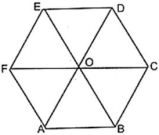
A regular hexagon can be divided into six equilateral triangles by joining its center to each of its vertices.
Since each of these six triangles is an equilateral triangle with side $a$, the total area of the regular hexagon is equal to the sum of the areas of these six equilateral triangles.
Therefore, the area of a regular hexagon of side $a$ is $6 \times (\text{Area of an equilateral triangle of side } a)$, not the sum of the areas of five such triangles.
A regular hexagon can be divided into six equilateral triangles by joining its center to each of its vertices.
Since each of these six triangles is an equilateral triangle with side $a$, the total area of the regular hexagon is equal to the sum of the areas of these six equilateral triangles.
Therefore, the area of a regular hexagon of side $a$ is $6 \times (\text{Area of an equilateral triangle of side } a)$, not the sum of the areas of five such triangles.
0 likes
View Solution19
Medium
Write True or False and justify your answer.
The cost of levelling the ground in the form of a triangle having the sides $51 \, m$,$37 \, m$,and $20 \, m$ at the rate of $Rs \, 3$ per $m^2$ is $Rs \, 918$.
The cost of levelling the ground in the form of a triangle having the sides $51 \, m$,$37 \, m$,and $20 \, m$ at the rate of $Rs \, 3$ per $m^2$ is $Rs \, 918$.
Solution
(TRUE) The sides of the triangle are $a = 51 \, m$,$b = 37 \, m$,and $c = 20 \, m$.
The semi-perimeter $s$ is calculated as:
$s = \frac{a + b + c}{2} = \frac{51 + 37 + 20}{2} = \frac{108}{2} = 54 \, m$.
Using Heron's formula,the area of the triangle is:
$\text{Area} = \sqrt{s(s-a)(s-b)(s-c)}$
$= \sqrt{54(54-51)(54-37)(54-20)}$
$= \sqrt{54 \times 3 \times 17 \times 34}$
$= \sqrt{(2 \times 3^3) \times 3 \times 17 \times (2 \times 17)}$
$= \sqrt{2^2 \times 3^4 \times 17^2} = 2 \times 3^2 \times 17 = 2 \times 9 \times 17 = 306 \, m^2$.
The cost of levelling the ground is $\text{Area} \times \text{Rate} = 306 \, m^2 \times Rs \, 3/m^2 = Rs \, 918$.
Since the calculated cost matches the given value,the statement is True.
The semi-perimeter $s$ is calculated as:
$s = \frac{a + b + c}{2} = \frac{51 + 37 + 20}{2} = \frac{108}{2} = 54 \, m$.
Using Heron's formula,the area of the triangle is:
$\text{Area} = \sqrt{s(s-a)(s-b)(s-c)}$
$= \sqrt{54(54-51)(54-37)(54-20)}$
$= \sqrt{54 \times 3 \times 17 \times 34}$
$= \sqrt{(2 \times 3^3) \times 3 \times 17 \times (2 \times 17)}$
$= \sqrt{2^2 \times 3^4 \times 17^2} = 2 \times 3^2 \times 17 = 2 \times 9 \times 17 = 306 \, m^2$.
The cost of levelling the ground is $\text{Area} \times \text{Rate} = 306 \, m^2 \times Rs \, 3/m^2 = Rs \, 918$.
Since the calculated cost matches the given value,the statement is True.
0 likes
View Solution20
Medium
Write True or False and justify your answer.
In a triangle,the sides are given as $11 \, cm$,$12 \, cm$,and $13 \, cm$. The length of the altitude corresponding to the side of length $12 \, cm$ is $10.25 \, cm$.
In a triangle,the sides are given as $11 \, cm$,$12 \, cm$,and $13 \, cm$. The length of the altitude corresponding to the side of length $12 \, cm$ is $10.25 \, cm$.
Solution
(A) Let the sides of the triangle be $a = 11 \, cm$,$b = 12 \, cm$,and $c = 13 \, cm$.
The semi-perimeter $s$ is calculated as:
$s = \frac{a + b + c}{2} = \frac{11 + 12 + 13}{2} = \frac{36}{2} = 18 \, cm$.
Using Heron's formula,the area of the triangle is:
$\text{Area} = \sqrt{s(s-a)(s-b)(s-c)} = \sqrt{18(18-11)(18-12)(18-13)}$
$= \sqrt{18 \times 7 \times 6 \times 5} = \sqrt{3780} = \sqrt{36 \times 105} = 6\sqrt{105} \, cm^2$.
We know that $\text{Area} = \frac{1}{2} \times \text{base} \times \text{altitude}$.
Given the base is $12 \, cm$,let the altitude be $h$:
$6\sqrt{105} = \frac{1}{2} \times 12 \times h$
$6\sqrt{105} = 6h$
$h = \sqrt{105} \, cm$.
Since $\sqrt{100} = 10$ and $\sqrt{121} = 11$,$\sqrt{105} \approx 10.2469 \, cm$,which is approximately $10.25 \, cm$.
Thus,the given statement is True.
The semi-perimeter $s$ is calculated as:
$s = \frac{a + b + c}{2} = \frac{11 + 12 + 13}{2} = \frac{36}{2} = 18 \, cm$.
Using Heron's formula,the area of the triangle is:
$\text{Area} = \sqrt{s(s-a)(s-b)(s-c)} = \sqrt{18(18-11)(18-12)(18-13)}$
$= \sqrt{18 \times 7 \times 6 \times 5} = \sqrt{3780} = \sqrt{36 \times 105} = 6\sqrt{105} \, cm^2$.
We know that $\text{Area} = \frac{1}{2} \times \text{base} \times \text{altitude}$.
Given the base is $12 \, cm$,let the altitude be $h$:
$6\sqrt{105} = \frac{1}{2} \times 12 \times h$
$6\sqrt{105} = 6h$
$h = \sqrt{105} \, cm$.
Since $\sqrt{100} = 10$ and $\sqrt{121} = 11$,$\sqrt{105} \approx 10.2469 \, cm$,which is approximately $10.25 \, cm$.
Thus,the given statement is True.
0 likes
View Solution21
MediumMCQ
The sides of a triangular field are $41\, m$,$40\, m$,and $9\, m$. Find the number of rose beds that can be prepared in the field,if each rose bed,on an average,needs $900\, cm^2$ space.
A
$2000$
B
$1800$
C
$2200$
D
$1500$
Solution
(A) Let the sides of the triangular field be $a = 41\, m$,$b = 40\, m$,and $c = 9\, m$.
The semi-perimeter $s$ is given by $s = \frac{a + b + c}{2} = \frac{41 + 40 + 9}{2} = \frac{90}{2} = 45\, m$.
Using Heron's formula,the area of the triangular field is $\sqrt{s(s - a)(s - b)(s - c)}$.
Area $= \sqrt{45(45 - 41)(45 - 40)(45 - 9)} = \sqrt{45 \times 4 \times 5 \times 36}$.
Area $= \sqrt{9 \times 5 \times 4 \times 5 \times 36} = \sqrt{32400} = 180\, m^2$.
Each rose bed needs $900\, cm^2$ space. Converting this to square meters: $900\, cm^2 = \frac{900}{10000}\, m^2 = 0.09\, m^2$.
The number of rose beds $= \frac{\text{Total Area}}{\text{Area per bed}} = \frac{180}{0.09} = 2000$.
The semi-perimeter $s$ is given by $s = \frac{a + b + c}{2} = \frac{41 + 40 + 9}{2} = \frac{90}{2} = 45\, m$.
Using Heron's formula,the area of the triangular field is $\sqrt{s(s - a)(s - b)(s - c)}$.
Area $= \sqrt{45(45 - 41)(45 - 40)(45 - 9)} = \sqrt{45 \times 4 \times 5 \times 36}$.
Area $= \sqrt{9 \times 5 \times 4 \times 5 \times 36} = \sqrt{32400} = 180\, m^2$.
Each rose bed needs $900\, cm^2$ space. Converting this to square meters: $900\, cm^2 = \frac{900}{10000}\, m^2 = 0.09\, m^2$.
The number of rose beds $= \frac{\text{Total Area}}{\text{Area per bed}} = \frac{180}{0.09} = 2000$.
0 likes
View Solution22
Difficult
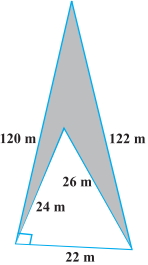
Calculate the area of the shaded region in the figure.
Solution
(N/A) The figure consists of two triangles. The shaded area is the difference between the area of the larger triangle and the smaller triangle.
$1$. For the larger triangle with sides $a = 122 \ m$,$b = 120 \ m$,and $c = 22 \ m$:
Semi-perimeter $s = \frac{122 + 120 + 22}{2} = \frac{264}{2} = 132 \ m$.
Area $= \sqrt{s(s-a)(s-b)(s-c)} = \sqrt{132(132-122)(132-120)(132-22)}$
$= \sqrt{132 \times 10 \times 12 \times 110} = \sqrt{1742400} = 1320 \ m^2$.
$2$. For the smaller triangle with sides $a = 24 \ m$,$b = 26 \ m$,and $c = 22 \ m$:
Since it is a right-angled triangle (as indicated in the figure),we can use the formula: Area $= \frac{1}{2} \times \text{base} \times \text{height}$.
Area $= \frac{1}{2} \times 24 \times 10 = 120 \ m^2$.
(Note: Using Heron's formula also yields the same result: $s = \frac{24+26+22}{2} = 36$. Area $= \sqrt{36(36-24)(36-26)(36-22)} = \sqrt{36 \times 12 \times 10 \times 14} = \sqrt{60480} \approx 245.9 \ m^2$. However,given the right angle symbol,the base-height method is more accurate).
$3$. Area of the shaded region $= \text{Area of larger triangle} - \text{Area of smaller triangle}$
$= 1320 \ m^2 - 120 \ m^2 = 1200 \ m^2$.
$1$. For the larger triangle with sides $a = 122 \ m$,$b = 120 \ m$,and $c = 22 \ m$:
Semi-perimeter $s = \frac{122 + 120 + 22}{2} = \frac{264}{2} = 132 \ m$.
Area $= \sqrt{s(s-a)(s-b)(s-c)} = \sqrt{132(132-122)(132-120)(132-22)}$
$= \sqrt{132 \times 10 \times 12 \times 110} = \sqrt{1742400} = 1320 \ m^2$.
$2$. For the smaller triangle with sides $a = 24 \ m$,$b = 26 \ m$,and $c = 22 \ m$:
Since it is a right-angled triangle (as indicated in the figure),we can use the formula: Area $= \frac{1}{2} \times \text{base} \times \text{height}$.
Area $= \frac{1}{2} \times 24 \times 10 = 120 \ m^2$.
(Note: Using Heron's formula also yields the same result: $s = \frac{24+26+22}{2} = 36$. Area $= \sqrt{36(36-24)(36-26)(36-22)} = \sqrt{36 \times 12 \times 10 \times 14} = \sqrt{60480} \approx 245.9 \ m^2$. However,given the right angle symbol,the base-height method is more accurate).
$3$. Area of the shaded region $= \text{Area of larger triangle} - \text{Area of smaller triangle}$
$= 1320 \ m^2 - 120 \ m^2 = 1200 \ m^2$.
0 likes
View Solution23
MediumMCQ
Find the cost of laying grass in a triangular field of sides $50 \, m$,$65 \, m$,and $65 \, m$ at the rate of $Rs \, 7$ per $m^2$ (in $Rs$).
A
$12500$
B
$11256$
C
$10500$
D
$10000$
Solution
(C) The sides of the triangular field are $a = 50 \, m$,$b = 65 \, m$,and $c = 65 \, m$.
First,we calculate the semi-perimeter $s$:
$s = \frac{a + b + c}{2} = \frac{50 + 65 + 65}{2} = \frac{180}{2} = 90 \, m$.
Using Heron's formula,the area of the triangle is:
$\text{Area} = \sqrt{s(s-a)(s-b)(s-c)}$
$= \sqrt{90(90-50)(90-65)(90-65)}$
$= \sqrt{90 \times 40 \times 25 \times 25}$
$= \sqrt{3600 \times 625} = 60 \times 25 = 1500 \, m^2$.
The cost of laying grass is given by the product of the area and the rate:
$\text{Cost} = 1500 \, m^2 \times 7 \, Rs/m^2 = 10,500 \, Rs$.
First,we calculate the semi-perimeter $s$:
$s = \frac{a + b + c}{2} = \frac{50 + 65 + 65}{2} = \frac{180}{2} = 90 \, m$.
Using Heron's formula,the area of the triangle is:
$\text{Area} = \sqrt{s(s-a)(s-b)(s-c)}$
$= \sqrt{90(90-50)(90-65)(90-65)}$
$= \sqrt{90 \times 40 \times 25 \times 25}$
$= \sqrt{3600 \times 625} = 60 \times 25 = 1500 \, m^2$.
The cost of laying grass is given by the product of the area and the rate:
$\text{Cost} = 1500 \, m^2 \times 7 \, Rs/m^2 = 10,500 \, Rs$.
0 likes
View Solution24
DifficultMCQ
The triangular side walls of a flyover have been used for advertisements. The sides of the walls are $13 \, m$,$14 \, m$,and $15 \, m$. The advertisements yield an earning of $Rs \, 2000$ per $m^2$ a year. $A$ company hired one of its walls for $6$ months. How much rent did it pay? (in $Rs$)
A
$79000$
B
$85000$
C
$70000$
D
$84000$
Solution
(D) The sides of the triangular side walls of the flyover are $a = 13 \, m$,$b = 14 \, m$,and $c = 15 \, m$.
First,we calculate the semi-perimeter $s$:
$s = \frac{a + b + c}{2} = \frac{13 + 14 + 15}{2} = \frac{42}{2} = 21 \, m$.
Using Heron's formula,the area of the triangle is:
$\text{Area} = \sqrt{s(s - a)(s - b)(s - c)} = \sqrt{21(21 - 13)(21 - 14)(21 - 15)}$
$= \sqrt{21 \times 8 \times 7 \times 6} = \sqrt{(3 \times 7) \times (2^3) \times 7 \times (2 \times 3)}$
$= \sqrt{7^2 \times 3^2 \times 2^4} = 7 \times 3 \times 2^2 = 84 \, m^2$.
The annual rent is $Rs \, 2000$ per $m^2$.
The rent for $1 \, m^2$ for $6$ months (half a year) is $Rs \, \frac{2000}{2} = Rs \, 1000$.
Therefore,the total rent for $84 \, m^2$ for $6$ months is $84 \times 1000 = Rs \, 84,000$.
First,we calculate the semi-perimeter $s$:
$s = \frac{a + b + c}{2} = \frac{13 + 14 + 15}{2} = \frac{42}{2} = 21 \, m$.
Using Heron's formula,the area of the triangle is:
$\text{Area} = \sqrt{s(s - a)(s - b)(s - c)} = \sqrt{21(21 - 13)(21 - 14)(21 - 15)}$
$= \sqrt{21 \times 8 \times 7 \times 6} = \sqrt{(3 \times 7) \times (2^3) \times 7 \times (2 \times 3)}$
$= \sqrt{7^2 \times 3^2 \times 2^4} = 7 \times 3 \times 2^2 = 84 \, m^2$.
The annual rent is $Rs \, 2000$ per $m^2$.
The rent for $1 \, m^2$ for $6$ months (half a year) is $Rs \, \frac{2000}{2} = Rs \, 1000$.
Therefore,the total rent for $84 \, m^2$ for $6$ months is $84 \times 1000 = Rs \, 84,000$.
0 likes
View Solution25
Difficult
From a point in the interior of an equilateral triangle,perpendiculars are drawn on the three sides. The lengths of the perpendiculars are $14 \, cm$,$10 \, cm$,and $6 \, cm$. Find the area of the triangle.
Solution
(D) Let $ABC$ be an equilateral triangle with side length $a$. Let $O$ be an interior point,and let the perpendiculars from $O$ to the sides $AB$,$BC$,and $AC$ be $h_1 = 14 \, cm$,$h_2 = 10 \, cm$,and $h_3 = 6 \, cm$ respectively.
The area of $\Delta ABC$ is the sum of the areas of $\Delta OAB$,$\Delta OBC$,and $\Delta OAC$.
Area of $\Delta OAB = \frac{1}{2} \times a \times 14 = 7a \, cm^2$.
Area of $\Delta OBC = \frac{1}{2} \times a \times 10 = 5a \, cm^2$.
Area of $\Delta OAC = \frac{1}{2} \times a \times 6 = 3a \, cm^2$.
Total Area $= 7a + 5a + 3a = 15a \, cm^2$.
We know the area of an equilateral triangle is given by $\frac{\sqrt{3}}{4} a^2$.
Equating the two expressions for the area:
$\frac{\sqrt{3}}{4} a^2 = 15a$
Since $a \neq 0$,we divide by $a$:
$\frac{\sqrt{3}}{4} a = 15$
$a = \frac{15 \times 4}{\sqrt{3}} = \frac{60}{\sqrt{3}} = 20\sqrt{3} \, cm$.
Now,substitute $a = 20\sqrt{3}$ into the area formula:
Area $= 15 \times (20\sqrt{3}) = 300\sqrt{3} \, cm^2$.
Thus,the area of the equilateral triangle is $300\sqrt{3} \, cm^2$.
The area of $\Delta ABC$ is the sum of the areas of $\Delta OAB$,$\Delta OBC$,and $\Delta OAC$.
Area of $\Delta OAB = \frac{1}{2} \times a \times 14 = 7a \, cm^2$.
Area of $\Delta OBC = \frac{1}{2} \times a \times 10 = 5a \, cm^2$.
Area of $\Delta OAC = \frac{1}{2} \times a \times 6 = 3a \, cm^2$.
Total Area $= 7a + 5a + 3a = 15a \, cm^2$.
We know the area of an equilateral triangle is given by $\frac{\sqrt{3}}{4} a^2$.
Equating the two expressions for the area:
$\frac{\sqrt{3}}{4} a^2 = 15a$
Since $a \neq 0$,we divide by $a$:
$\frac{\sqrt{3}}{4} a = 15$
$a = \frac{15 \times 4}{\sqrt{3}} = \frac{60}{\sqrt{3}} = 20\sqrt{3} \, cm$.
Now,substitute $a = 20\sqrt{3}$ into the area formula:
Area $= 15 \times (20\sqrt{3}) = 300\sqrt{3} \, cm^2$.
Thus,the area of the equilateral triangle is $300\sqrt{3} \, cm^2$.
0 likes
View Solution26
Difficult
The perimeter of an isosceles triangle is $32 \, cm$. The ratio of the equal side to its base is $3:2$. Find the area of the triangle.
Solution
(D) Let the equal sides of the isosceles triangle be $3x$ and $3x$,and the base be $2x$.
The perimeter of the triangle is the sum of its sides: $3x + 3x + 2x = 8x$.
Given that the perimeter is $32 \, cm$,we have $8x = 32$,which gives $x = 4$.
Thus,the sides of the triangle are $12 \, cm, 12 \, cm$,and $8 \, cm$.
The semi-perimeter $s$ is given by $s = \frac{12 + 12 + 8}{2} = \frac{32}{2} = 16 \, cm$.
Using Heron's formula,Area $= \sqrt{s(s-a)(s-b)(s-c)}$.
Area $= \sqrt{16(16-12)(16-12)(16-8)} = \sqrt{16 \times 4 \times 4 \times 8}$.
Area $= \sqrt{16 \times 16 \times 8} = 16 \sqrt{8} = 16 \times 2\sqrt{2} = 32\sqrt{2} \, cm^2$.
The perimeter of the triangle is the sum of its sides: $3x + 3x + 2x = 8x$.
Given that the perimeter is $32 \, cm$,we have $8x = 32$,which gives $x = 4$.
Thus,the sides of the triangle are $12 \, cm, 12 \, cm$,and $8 \, cm$.
The semi-perimeter $s$ is given by $s = \frac{12 + 12 + 8}{2} = \frac{32}{2} = 16 \, cm$.
Using Heron's formula,Area $= \sqrt{s(s-a)(s-b)(s-c)}$.
Area $= \sqrt{16(16-12)(16-12)(16-8)} = \sqrt{16 \times 4 \times 4 \times 8}$.
Area $= \sqrt{16 \times 16 \times 8} = 16 \sqrt{8} = 16 \times 2\sqrt{2} = 32\sqrt{2} \, cm^2$.
0 likes
View Solution27
Difficult
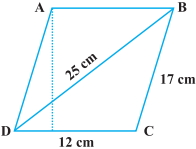
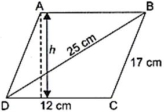
Find the area of the parallelogram given in the figure. Also,find the length of the altitude from vertex $A$ on the side $DC.$
Solution
(N/A) The sides of $\Delta BCD$ are $a = 12 \text{ cm}, b = 17 \text{ cm},$ and $c = 25 \text{ cm}.$
$\therefore$ The semi-perimeter $(s)$ of $\Delta BCD$ is:
$s = \frac{a + b + c}{2} = \frac{12 + 17 + 25}{2} = \frac{54}{2} = 27 \text{ cm}.$
$\therefore$ Area of $\Delta BCD = \sqrt{s(s - a)(s - b)(s - c)}$ [By Heron's formula]
$= \sqrt{27(27 - 12)(27 - 17)(27 - 25)}$
$= \sqrt{27 \times 15 \times 10 \times 2}$
$= \sqrt{(9 \times 3) \times (3 \times 5) \times (5 \times 2) \times 2}$
$= \sqrt{9 \times 9 \times 25 \times 4} = 3 \times 3 \times 5 \times 2 = 90 \text{ cm}^2.$
Since a diagonal divides a parallelogram into two triangles of equal area:
Area of parallelogram $ABCD = 2 \times \text{Area of } \Delta BCD = 2 \times 90 = 180 \text{ cm}^2.$
Let the altitude from vertex $A$ to side $DC$ be $h.$
Area of parallelogram $ABCD = \text{Base} \times \text{Altitude}$
$180 = DC \times h$
$180 = 12 \times h$
$h = \frac{180}{12} = 15 \text{ cm}.$
Hence,the area of the parallelogram is $180 \text{ cm}^2$ and the length of the altitude is $15 \text{ cm}.$
$\therefore$ The semi-perimeter $(s)$ of $\Delta BCD$ is:
$s = \frac{a + b + c}{2} = \frac{12 + 17 + 25}{2} = \frac{54}{2} = 27 \text{ cm}.$
$\therefore$ Area of $\Delta BCD = \sqrt{s(s - a)(s - b)(s - c)}$ [By Heron's formula]
$= \sqrt{27(27 - 12)(27 - 17)(27 - 25)}$
$= \sqrt{27 \times 15 \times 10 \times 2}$
$= \sqrt{(9 \times 3) \times (3 \times 5) \times (5 \times 2) \times 2}$
$= \sqrt{9 \times 9 \times 25 \times 4} = 3 \times 3 \times 5 \times 2 = 90 \text{ cm}^2.$
Since a diagonal divides a parallelogram into two triangles of equal area:
Area of parallelogram $ABCD = 2 \times \text{Area of } \Delta BCD = 2 \times 90 = 180 \text{ cm}^2.$
Let the altitude from vertex $A$ to side $DC$ be $h.$
Area of parallelogram $ABCD = \text{Base} \times \text{Altitude}$
$180 = DC \times h$
$180 = 12 \times h$
$h = \frac{180}{12} = 15 \text{ cm}.$
Hence,the area of the parallelogram is $180 \text{ cm}^2$ and the length of the altitude is $15 \text{ cm}.$
0 likes
View Solution28
Difficult
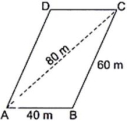
$A$ field in the form of a parallelogram has sides $60 \, m$ and $40 \, m$ and one of its diagonals is $80 \, m$ long. Find the area of the parallelogram.
Solution
(N/A) Let the field be $ABCD.$
Area of the parallelogram $ABCD = 2 \times (\text{Area of } \Delta ABC) \quad ...(1)$
Now,the sides of $\Delta ABC$ are $a = 40 \, m, b = 60 \, m$ and $c = 80 \, m$.
Semi-perimeter of $\Delta ABC$,$s = \frac{a+b+c}{2} = \frac{40+60+80}{2} = \frac{180}{2} = 90 \, m$.
Using Heron's Formula,Area of $\Delta ABC = \sqrt{s(s-a)(s-b)(s-c)}$
$= \sqrt{90(90-40)(90-60)(90-80)}$
$= \sqrt{90 \times 50 \times 30 \times 10}$
$= \sqrt{1350000} = 300\sqrt{15} \, m^2 \approx 1161.895 \, m^2$.
From equation $(1)$,
Area of parallelogram $ABCD = 2 \times 300\sqrt{15} = 600\sqrt{15} \, m^2 \approx 2323.79 \, m^2$.
Area of the parallelogram $ABCD = 2 \times (\text{Area of } \Delta ABC) \quad ...(1)$
Now,the sides of $\Delta ABC$ are $a = 40 \, m, b = 60 \, m$ and $c = 80 \, m$.
Semi-perimeter of $\Delta ABC$,$s = \frac{a+b+c}{2} = \frac{40+60+80}{2} = \frac{180}{2} = 90 \, m$.
Using Heron's Formula,Area of $\Delta ABC = \sqrt{s(s-a)(s-b)(s-c)}$
$= \sqrt{90(90-40)(90-60)(90-80)}$
$= \sqrt{90 \times 50 \times 30 \times 10}$
$= \sqrt{1350000} = 300\sqrt{15} \, m^2 \approx 1161.895 \, m^2$.
From equation $(1)$,
Area of parallelogram $ABCD = 2 \times 300\sqrt{15} = 600\sqrt{15} \, m^2 \approx 2323.79 \, m^2$.
0 likes
View Solution29
DifficultMCQ
The perimeter of a triangular field is $420\, m$ and its sides are in the ratio $6: 7: 8$. Find the area of the triangular field (in $m^2$).
A
$8133.265$
B
$85123.245$
C
$8212.356$
D
$8025.253$
Solution
(A) Let the sides of the triangle be $6x, 7x,$ and $8x$ meters.
Given that the perimeter is $420\, m$,we have:
$6x + 7x + 8x = 420$
$21x = 420$
$x = 20$
Thus,the sides are $a = 120\, m, b = 140\, m, c = 160\, m$.
The semi-perimeter $s$ is given by $s = \frac{420}{2} = 210\, m$.
Using Heron's formula,the area is $\sqrt{s(s-a)(s-b)(s-c)}$.
Area $= \sqrt{210(210-120)(210-140)(210-160)}$
Area $= \sqrt{210 \times 90 \times 70 \times 50}$
Area $= \sqrt{66150000} \approx 8133.265\, m^2$.
Given that the perimeter is $420\, m$,we have:
$6x + 7x + 8x = 420$
$21x = 420$
$x = 20$
Thus,the sides are $a = 120\, m, b = 140\, m, c = 160\, m$.
The semi-perimeter $s$ is given by $s = \frac{420}{2} = 210\, m$.
Using Heron's formula,the area is $\sqrt{s(s-a)(s-b)(s-c)}$.
Area $= \sqrt{210(210-120)(210-140)(210-160)}$
Area $= \sqrt{210 \times 90 \times 70 \times 50}$
Area $= \sqrt{66150000} \approx 8133.265\, m^2$.
0 likes
View Solution30
DifficultMCQ
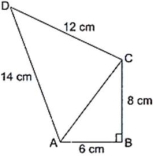
The sides of a quadrilateral $ABCD$ are $6 \, cm$,$8 \, cm$,$12 \, cm$,and $14 \, cm$ (taken in order) respectively,and the angle between the first two sides is a right angle. Find its area in $cm^2$.
A
$80.562$
B
$82.787$
C
$85.221$
D
$85.231$
Solution
(B) To find the area of quadrilateral $ABCD$,we divide it into two triangles: $\Delta ABC$ and $\Delta ACD$.
Since $\angle B = 90^\circ$,$\Delta ABC$ is a right-angled triangle.
By Pythagoras theorem in $\Delta ABC$:
$AC = \sqrt{AB^2 + BC^2} = \sqrt{6^2 + 8^2} = \sqrt{36 + 64} = \sqrt{100} = 10 \, cm$.
Area of $\Delta ABC = \frac{1}{2} \times \text{base} \times \text{height} = \frac{1}{2} \times 6 \times 8 = 24 \, cm^2$.
Now,for $\Delta ACD$,the sides are $a = 10 \, cm$,$b = 12 \, cm$,and $c = 14 \, cm$.
The semi-perimeter $s = \frac{a + b + c}{2} = \frac{10 + 12 + 14}{2} = \frac{36}{2} = 18 \, cm$.
Using Heron's formula,Area of $\Delta ACD = \sqrt{s(s-a)(s-b)(s-c)} = \sqrt{18(18-10)(18-12)(18-14)} = \sqrt{18 \times 8 \times 6 \times 4} = \sqrt{3456} \approx 58.787 \, cm^2$.
Total area of quadrilateral $ABCD = \text{Area}(\Delta ABC) + \text{Area}(\Delta ACD) = 24 + 58.787 = 82.787 \, cm^2$.
Since $\angle B = 90^\circ$,$\Delta ABC$ is a right-angled triangle.
By Pythagoras theorem in $\Delta ABC$:
$AC = \sqrt{AB^2 + BC^2} = \sqrt{6^2 + 8^2} = \sqrt{36 + 64} = \sqrt{100} = 10 \, cm$.
Area of $\Delta ABC = \frac{1}{2} \times \text{base} \times \text{height} = \frac{1}{2} \times 6 \times 8 = 24 \, cm^2$.
Now,for $\Delta ACD$,the sides are $a = 10 \, cm$,$b = 12 \, cm$,and $c = 14 \, cm$.
The semi-perimeter $s = \frac{a + b + c}{2} = \frac{10 + 12 + 14}{2} = \frac{36}{2} = 18 \, cm$.
Using Heron's formula,Area of $\Delta ACD = \sqrt{s(s-a)(s-b)(s-c)} = \sqrt{18(18-10)(18-12)(18-14)} = \sqrt{18 \times 8 \times 6 \times 4} = \sqrt{3456} \approx 58.787 \, cm^2$.
Total area of quadrilateral $ABCD = \text{Area}(\Delta ABC) + \text{Area}(\Delta ACD) = 24 + 58.787 = 82.787 \, cm^2$.
0 likes
View Solution31
DifficultMCQ
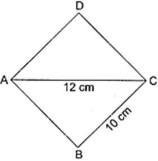
$A$ rhombus-shaped sheet with a perimeter of $40 \, cm$ and one diagonal of $12 \, cm$ is painted on both sides at the rate of $Rs \, 5$ per $cm^2$. Find the cost of painting (in $Rs$).
A
$985$
B
$990$
C
$960$
D
$980$
Solution
(C) The perimeter of the rhombus is $40 \, cm$.
Since all sides of a rhombus are equal,the side length is $\frac{40}{4} = 10 \, cm$.
The diagonal divides the rhombus into two congruent triangles with sides $10 \, cm, 10 \, cm,$ and $12 \, cm$.
Using Heron's formula for one triangle:
Semi-perimeter $s = \frac{10 + 10 + 12}{2} = \frac{32}{2} = 16 \, cm$.
Area of one triangle $= \sqrt{s(s-a)(s-b)(s-c)} = \sqrt{16(16-10)(16-10)(16-12)} = \sqrt{16 \times 6 \times 6 \times 4} = \sqrt{2304} = 48 \, cm^2$.
Area of the rhombus $= 2 \times 48 = 96 \, cm^2$.
Since both sides are painted,the total area to be painted is $2 \times 96 = 192 \, cm^2$.
The cost of painting at the rate of $Rs \, 5$ per $cm^2$ is $192 \times 5 = Rs \, 960$.
Since all sides of a rhombus are equal,the side length is $\frac{40}{4} = 10 \, cm$.
The diagonal divides the rhombus into two congruent triangles with sides $10 \, cm, 10 \, cm,$ and $12 \, cm$.
Using Heron's formula for one triangle:
Semi-perimeter $s = \frac{10 + 10 + 12}{2} = \frac{32}{2} = 16 \, cm$.
Area of one triangle $= \sqrt{s(s-a)(s-b)(s-c)} = \sqrt{16(16-10)(16-10)(16-12)} = \sqrt{16 \times 6 \times 6 \times 4} = \sqrt{2304} = 48 \, cm^2$.
Area of the rhombus $= 2 \times 48 = 96 \, cm^2$.
Since both sides are painted,the total area to be painted is $2 \times 96 = 192 \, cm^2$.
The cost of painting at the rate of $Rs \, 5$ per $cm^2$ is $192 \times 5 = Rs \, 960$.
0 likes
View Solution32
MediumMCQ
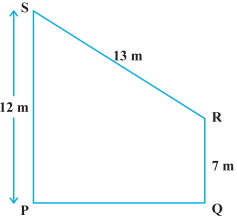
Find the area of the trapezium $PQRS$ with height $PQ$ given in the figure (in $m^2$).
A
$114$
B
$22$
C
$18$
D
$11$
Solution
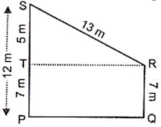
(A) Draw $RT \perp SP$. From the figure,it is clear that $RT = PQ = 7 \ m$ and $PT = QR = 7 \ m$.
Since $SP = 12 \ m$,we have $ST = SP - PT = 12 \ m - 7 \ m = 5 \ m$.
Now,in the right-angled triangle $STR$,by Pythagoras theorem:
$SR^2 = ST^2 + RT^2$
$13^2 = 5^2 + RT^2$
$169 = 25 + RT^2$
$RT^2 = 169 - 25 = 144$
$RT = 12 \ m$.
Thus,the height of the trapezium is $12 \ m$.
The area of trapezium $PQRS = \frac{1}{2} \times (SP + QR) \times PQ$
$= \frac{1}{2} \times (12 \ m + 7 \ m) \times 12 \ m$
$= \frac{1}{2} \times 19 \ m \times 12 \ m = 19 \times 6 \ m^2 = 114 \ m^2$.
Since $SP = 12 \ m$,we have $ST = SP - PT = 12 \ m - 7 \ m = 5 \ m$.
Now,in the right-angled triangle $STR$,by Pythagoras theorem:
$SR^2 = ST^2 + RT^2$
$13^2 = 5^2 + RT^2$
$169 = 25 + RT^2$
$RT^2 = 169 - 25 = 144$
$RT = 12 \ m$.
Thus,the height of the trapezium is $12 \ m$.
The area of trapezium $PQRS = \frac{1}{2} \times (SP + QR) \times PQ$
$= \frac{1}{2} \times (12 \ m + 7 \ m) \times 12 \ m$
$= \frac{1}{2} \times 19 \ m \times 12 \ m = 19 \times 6 \ m^2 = 114 \ m^2$.
0 likes
View Solution33
DifficultMCQ
If each side of a triangle is doubled,then find the ratio of the area of the new triangle thus formed to the area of the given triangle.
A
$2:1$
B
$4:1$
C
$5:6$
D
$4:9$
Solution
(B) Let $a, b, c$ be the sides of the given triangle and $s$ be its semi-perimeter.
Then,$s = \frac{a+b+c}{2}$,which implies $2s = a+b+c$ $...(1)$.
The area of the given triangle is $\Delta = \sqrt{s(s-a)(s-b)(s-c)}$.
According to the problem,the sides of the new triangle are $2a, 2b$,and $2c$.
Let $S$ be the semi-perimeter of the new triangle.
$S = \frac{2a+2b+2c}{2} = a+b+c = 2s$ $...(2)$.
The area of the new triangle is $\Delta' = \sqrt{S(S-2a)(S-2b)(S-2c)}$.
Substituting $S = 2s$ into the formula:
$\Delta' = \sqrt{2s(2s-2a)(2s-2b)(2s-2c)}$
$\Delta' = \sqrt{2s \cdot 2(s-a) \cdot 2(s-b) \cdot 2(s-c)}$
$\Delta' = \sqrt{16s(s-a)(s-b)(s-c)}$
$\Delta' = 4\sqrt{s(s-a)(s-b)(s-c)} = 4\Delta$.
Thus,the ratio of the area of the new triangle to the given triangle is $\frac{\Delta'}{\Delta} = \frac{4\Delta}{\Delta} = 4:1$.
Then,$s = \frac{a+b+c}{2}$,which implies $2s = a+b+c$ $...(1)$.
The area of the given triangle is $\Delta = \sqrt{s(s-a)(s-b)(s-c)}$.
According to the problem,the sides of the new triangle are $2a, 2b$,and $2c$.
Let $S$ be the semi-perimeter of the new triangle.
$S = \frac{2a+2b+2c}{2} = a+b+c = 2s$ $...(2)$.
The area of the new triangle is $\Delta' = \sqrt{S(S-2a)(S-2b)(S-2c)}$.
Substituting $S = 2s$ into the formula:
$\Delta' = \sqrt{2s(2s-2a)(2s-2b)(2s-2c)}$
$\Delta' = \sqrt{2s \cdot 2(s-a) \cdot 2(s-b) \cdot 2(s-c)}$
$\Delta' = \sqrt{16s(s-a)(s-b)(s-c)}$
$\Delta' = 4\sqrt{s(s-a)(s-b)(s-c)} = 4\Delta$.
Thus,the ratio of the area of the new triangle to the given triangle is $\frac{\Delta'}{\Delta} = \frac{4\Delta}{\Delta} = 4:1$.
0 likes
View Solution34
DifficultMCQ
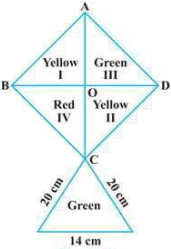
How much paper of each shade is needed to make a kite as shown in the figure,where $ABCD$ is a square with diagonal $44 \, cm$? (in $cm^2$)
A
$125.36$
B
$139.25$
C
$373.15$
D
$126.31$
Solution
(C) The kite consists of a square $ABCD$ and an isosceles triangle at the bottom.
Given that the diagonal of the square is $44 \, cm$.
The area of a square can be calculated using the diagonal $d$ as $\text{Area} = \frac{1}{2} d^2$.
$\text{Area of square } ABCD = \frac{1}{2} \times 44 \times 44 = 968 \, cm^2$.
The square is divided into four equal triangles by its diagonals. Each triangle has an area of $\frac{968}{4} = 242 \, cm^2$.
From the figure:
- Red shade (part $IV$) $= 242 \, cm^2$.
- Yellow shade (parts $I$ and $II$) $= 242 + 242 = 484 \, cm^2$.
- Green shade (part $III$ and the bottom triangle).
For the bottom triangle with sides $20 \, cm, 20 \, cm, 14 \, cm$:
Semi-perimeter $s = \frac{20+20+14}{2} = 27 \, cm$.
Area $= \sqrt{s(s-a)(s-b)(s-c)} = \sqrt{27(27-20)(27-20)(27-14)} = \sqrt{27 \times 7 \times 7 \times 13} = 21 \sqrt{39} \approx 21 \times 6.245 = 131.15 \, cm^2$.
Total Green shade $= 242 + 131.15 = 373.15 \, cm^2$.
Given that the diagonal of the square is $44 \, cm$.
The area of a square can be calculated using the diagonal $d$ as $\text{Area} = \frac{1}{2} d^2$.
$\text{Area of square } ABCD = \frac{1}{2} \times 44 \times 44 = 968 \, cm^2$.
The square is divided into four equal triangles by its diagonals. Each triangle has an area of $\frac{968}{4} = 242 \, cm^2$.
From the figure:
- Red shade (part $IV$) $= 242 \, cm^2$.
- Yellow shade (parts $I$ and $II$) $= 242 + 242 = 484 \, cm^2$.
- Green shade (part $III$ and the bottom triangle).
For the bottom triangle with sides $20 \, cm, 20 \, cm, 14 \, cm$:
Semi-perimeter $s = \frac{20+20+14}{2} = 27 \, cm$.
Area $= \sqrt{s(s-a)(s-b)(s-c)} = \sqrt{27(27-20)(27-20)(27-14)} = \sqrt{27 \times 7 \times 7 \times 13} = 21 \sqrt{39} \approx 21 \times 6.245 = 131.15 \, cm^2$.
Total Green shade $= 242 + 131.15 = 373.15 \, cm^2$.
0 likes
View Solution35
Medium
The perimeter of a triangle is $50 \, cm$. One side of a triangle is $4 \, cm$ longer than the smaller side and the third side is $6 \, cm$ less than twice the smaller side. Find the area of the triangle.
Solution
(D) Let the smaller side of the triangle be $x \, cm$. Therefore,the second side is $(x + 4) \, cm$ and the third side is $(2x - 6) \, cm$.
The perimeter of the triangle is the sum of its sides:
$x + (x + 4) + (2x - 6) = 50$
$4x - 2 = 50$
$4x = 52$
$x = 13 \, cm$.
The three sides are $13 \, cm$,$17 \, cm$,and $20 \, cm$.
The semi-perimeter $s = \frac{13 + 17 + 20}{2} = \frac{50}{2} = 25 \, cm$.
Using Heron's formula,the area of the triangle is $\sqrt{s(s - a)(s - b)(s - c)}$:
Area $= \sqrt{25(25 - 13)(25 - 17)(25 - 20)}$
$= \sqrt{25 \times 12 \times 8 \times 5}$
$= \sqrt{25 \times (4 \times 3) \times (4 \times 2) \times 5}$
$= 5 \times 4 \times \sqrt{3 \times 2 \times 5}$
$= 20 \sqrt{30} \, cm^2$.
The perimeter of the triangle is the sum of its sides:
$x + (x + 4) + (2x - 6) = 50$
$4x - 2 = 50$
$4x = 52$
$x = 13 \, cm$.
The three sides are $13 \, cm$,$17 \, cm$,and $20 \, cm$.
The semi-perimeter $s = \frac{13 + 17 + 20}{2} = \frac{50}{2} = 25 \, cm$.
Using Heron's formula,the area of the triangle is $\sqrt{s(s - a)(s - b)(s - c)}$:
Area $= \sqrt{25(25 - 13)(25 - 17)(25 - 20)}$
$= \sqrt{25 \times 12 \times 8 \times 5}$
$= \sqrt{25 \times (4 \times 3) \times (4 \times 2) \times 5}$
$= 5 \times 4 \times \sqrt{3 \times 2 \times 5}$
$= 20 \sqrt{30} \, cm^2$.
0 likes
View Solution36
MediumMCQ
The area of a trapezium is $475 \, cm^2$ and the height is $19 \, cm$. Find the lengths of its two parallel sides if one side is $4 \, cm$ greater than the other.
A
$23 \, cm, 27 \, cm$
B
$21 \, cm, 25 \, cm$
C
$25 \, cm, 29 \, cm$
D
$19 \, cm, 23 \, cm$
Solution
(A) The area of a trapezium is given by the formula: $\text{Area} = \frac{1}{2} \times (\text{sum of parallel sides}) \times \text{height}$.
Let the length of one parallel side be $x \, cm$.
Then,the length of the other parallel side is $(x + 4) \, cm$.
Given,$\text{Area} = 475 \, cm^2$ and $\text{height} = 19 \, cm$.
Substituting these values into the formula:
$475 = \frac{1}{2} \times (x + x + 4) \times 19$
$475 = \frac{1}{2} \times (2x + 4) \times 19$
$475 = (x + 2) \times 19$
$x + 2 = \frac{475}{19} = 25$
$x = 25 - 2 = 23 \, cm$.
Therefore,the two parallel sides are $23 \, cm$ and $(23 + 4) \, cm$,which are $23 \, cm$ and $27 \, cm$.
Let the length of one parallel side be $x \, cm$.
Then,the length of the other parallel side is $(x + 4) \, cm$.
Given,$\text{Area} = 475 \, cm^2$ and $\text{height} = 19 \, cm$.
Substituting these values into the formula:
$475 = \frac{1}{2} \times (x + x + 4) \times 19$
$475 = \frac{1}{2} \times (2x + 4) \times 19$
$475 = (x + 2) \times 19$
$x + 2 = \frac{475}{19} = 25$
$x = 25 - 2 = 23 \, cm$.
Therefore,the two parallel sides are $23 \, cm$ and $(23 + 4) \, cm$,which are $23 \, cm$ and $27 \, cm$.
0 likes
View Solution37
MediumMCQ
$A$ rectangular plot is given for constructing a house, having a measurement of $40 \, m$ long and $15 \, m$ in the front. According to the laws, a minimum of $3 \, m$ wide space should be left in the front and back each, and $2 \, m$ wide space on each of the other sides. Find the largest area where the house can be constructed (in $m^2$).
A
$368$
B
$374$
C
$359$
D
$387$
Solution
(B) The length of the rectangular plot is $40 \, m$ and the width (breadth) is $15 \, m$.
According to the rules, a space of $3 \, m$ must be left at the front and back, and a space of $2 \, m$ must be left on each of the other two sides.
The new length of the construction area $= 40 - (3 + 3) = 40 - 6 = 34 \, m$.
The new width of the construction area $= 15 - (2 + 2) = 15 - 4 = 11 \, m$.
The largest area where the house can be constructed $= \text{Length} \times \text{Width} = 34 \, m \times 11 \, m = 374 \, m^2$.
According to the rules, a space of $3 \, m$ must be left at the front and back, and a space of $2 \, m$ must be left on each of the other two sides.
The new length of the construction area $= 40 - (3 + 3) = 40 - 6 = 34 \, m$.
The new width of the construction area $= 15 - (2 + 2) = 15 - 4 = 11 \, m$.
The largest area where the house can be constructed $= \text{Length} \times \text{Width} = 34 \, m \times 11 \, m = 374 \, m^2$.
0 likes
View Solution38
DifficultMCQ
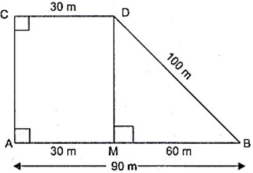
$A$ field is in the shape of a trapezium having parallel sides $90 \, m$ and $30 \, m$. These sides meet the third side at right angles. The length of the fourth side is $100 \, m$. If it costs $\operatorname{Rs} 4$ to plough $1 \, m^2$ of the field,find the total cost of ploughing the field (in $\operatorname{Rs}$).
A
$19200$
B
$19562$
C
$19800$
D
$18900$
Solution
(A) Let the trapezium be $ABCD$ with parallel sides $AB = 90 \, m$ and $CD = 30 \, m$. The side $AC$ is perpendicular to both $AB$ and $CD$.
Draw $DM \perp AB$. Since $ACDM$ forms a rectangle,$AM = CD = 30 \, m$ and $DM = AC$.
Now,$MB = AB - AM = 90 \, m - 30 \, m = 60 \, m$.
In the right-angled triangle $\triangle DMB$,by Pythagoras theorem:
$DM^2 = DB^2 - MB^2 = (100)^2 - (60)^2$
$DM^2 = 10000 - 3600 = 6400$
$DM = \sqrt{6400} = 80 \, m$.
Thus,the height of the trapezium is $80 \, m$.
The area of the trapezium $ABCD = \frac{1}{2} \times (\text{sum of parallel sides}) \times \text{height}$
$= \frac{1}{2} \times (90 + 30) \times 80 = \frac{1}{2} \times 120 \times 80 = 4800 \, m^2$.
Total cost of ploughing = $\text{Area} \times \text{Rate} = 4800 \times 4 = \operatorname{Rs} 19,200$.
Draw $DM \perp AB$. Since $ACDM$ forms a rectangle,$AM = CD = 30 \, m$ and $DM = AC$.
Now,$MB = AB - AM = 90 \, m - 30 \, m = 60 \, m$.
In the right-angled triangle $\triangle DMB$,by Pythagoras theorem:
$DM^2 = DB^2 - MB^2 = (100)^2 - (60)^2$
$DM^2 = 10000 - 3600 = 6400$
$DM = \sqrt{6400} = 80 \, m$.
Thus,the height of the trapezium is $80 \, m$.
The area of the trapezium $ABCD = \frac{1}{2} \times (\text{sum of parallel sides}) \times \text{height}$
$= \frac{1}{2} \times (90 + 30) \times 80 = \frac{1}{2} \times 120 \times 80 = 4800 \, m^2$.
Total cost of ploughing = $\text{Area} \times \text{Rate} = 4800 \times 4 = \operatorname{Rs} 19,200$.
0 likes
View Solution39
DifficultMCQ
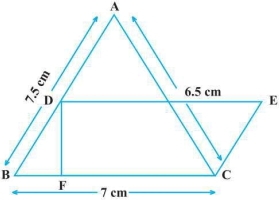
In the figure,$\Delta ABC$ has sides $AB = 7.5\, cm$,$AC = 6.5\, cm$,and $BC = 7\, cm$. On base $BC$,a parallelogram $DBCE$ of the same area as that of $\Delta ABC$ is constructed. Find the height $DF$ of the parallelogram (in $cm$).
A
$1$
B
$3$
C
$8$
D
$13$
Solution
(B) The sides of $\Delta ABC$ are $a = 6.5\, cm$,$b = 7\, cm$,and $c = 7.5\, cm$.
The semi-perimeter $s$ of $\Delta ABC$ is:
$s = \frac{6.5 + 7 + 7.5}{2} = \frac{21}{2} = 10.5\, cm$.
Using Heron's formula,the area of $\Delta ABC$ is:
$\text{Area} = \sqrt{s(s-a)(s-b)(s-c)}$
$= \sqrt{10.5(10.5 - 6.5)(10.5 - 7)(10.5 - 7.5)}$
$= \sqrt{10.5 \times 4 \times 3.5 \times 3}$
$= \sqrt{441} = 21\, cm^2$.
Since the parallelogram $DBCE$ is constructed on the same base $BC$ and has the same area as $\Delta ABC$:
$\text{Area of parallelogram } DBCE = \text{Area of } \Delta ABC = 21\, cm^2$.
The area of a parallelogram is given by $\text{base} \times \text{height}$.
$BC \times DF = 21\, cm^2$
$7\, cm \times DF = 21\, cm^2$
$DF = \frac{21}{7} = 3\, cm$.
Thus,the height $DF$ of the parallelogram is $3\, cm$.
The semi-perimeter $s$ of $\Delta ABC$ is:
$s = \frac{6.5 + 7 + 7.5}{2} = \frac{21}{2} = 10.5\, cm$.
Using Heron's formula,the area of $\Delta ABC$ is:
$\text{Area} = \sqrt{s(s-a)(s-b)(s-c)}$
$= \sqrt{10.5(10.5 - 6.5)(10.5 - 7)(10.5 - 7.5)}$
$= \sqrt{10.5 \times 4 \times 3.5 \times 3}$
$= \sqrt{441} = 21\, cm^2$.
Since the parallelogram $DBCE$ is constructed on the same base $BC$ and has the same area as $\Delta ABC$:
$\text{Area of parallelogram } DBCE = \text{Area of } \Delta ABC = 21\, cm^2$.
The area of a parallelogram is given by $\text{base} \times \text{height}$.
$BC \times DF = 21\, cm^2$
$7\, cm \times DF = 21\, cm^2$
$DF = \frac{21}{7} = 3\, cm$.
Thus,the height $DF$ of the parallelogram is $3\, cm$.
0 likes
View Solution40
Difficult
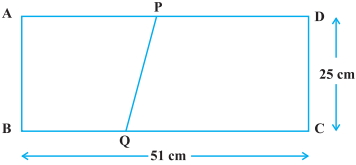
The dimensions of a rectangle $ABCD$ are $51 \, cm \times 25 \, cm$. $A$ trapezium $PQCD$ with its parallel sides $QC$ and $PD$ in the ratio $9:8$ is cut off from the rectangle as shown in the figure. If the area of the trapezium $PQCD$ is $\frac{5}{6}$ th part of the area of the rectangle,find the lengths $QC$ and $PD$.
Solution
(N/A) $ABCD$ is a rectangle in which $AB = 51 \, cm$ and $BC = 25 \, cm$.
Since the parallel sides $QC$ and $PD$ are in the ratio $9:8$,let $QC = 9x$ and $PD = 8x$.
The height of the trapezium $PQCD$ is the same as the width of the rectangle,which is $25 \, cm$.
The area of the trapezium $PQCD = \frac{1}{2} \times (QC + PD) \times \text{height} = \frac{1}{2} \times (9x + 8x) \times 25 = \frac{1}{2} \times 17x \times 25$.
The area of the rectangle $ABCD = \text{length} \times \text{width} = 51 \times 25$.
It is given that the area of the trapezium $PQCD = \frac{5}{6} \times \text{Area of rectangle } ABCD$.
Therefore,$\frac{1}{2} \times 17x \times 25 = \frac{5}{6} \times 51 \times 25$.
Dividing both sides by $25$ and multiplying by $2$,we get $17x = \frac{5}{6} \times 51 \times 2 = \frac{5}{3} \times 51 = 5 \times 17 = 85$.
Thus,$x = \frac{85}{17} = 5$.
Hence,the length $QC = 9x = 9 \times 5 = 45 \, cm$.
And the length $PD = 8x = 8 \times 5 = 40 \, cm$.
Since the parallel sides $QC$ and $PD$ are in the ratio $9:8$,let $QC = 9x$ and $PD = 8x$.
The height of the trapezium $PQCD$ is the same as the width of the rectangle,which is $25 \, cm$.
The area of the trapezium $PQCD = \frac{1}{2} \times (QC + PD) \times \text{height} = \frac{1}{2} \times (9x + 8x) \times 25 = \frac{1}{2} \times 17x \times 25$.
The area of the rectangle $ABCD = \text{length} \times \text{width} = 51 \times 25$.
It is given that the area of the trapezium $PQCD = \frac{5}{6} \times \text{Area of rectangle } ABCD$.
Therefore,$\frac{1}{2} \times 17x \times 25 = \frac{5}{6} \times 51 \times 25$.
Dividing both sides by $25$ and multiplying by $2$,we get $17x = \frac{5}{6} \times 51 \times 2 = \frac{5}{3} \times 51 = 5 \times 17 = 85$.
Thus,$x = \frac{85}{17} = 5$.
Hence,the length $QC = 9x = 9 \times 5 = 45 \, cm$.
And the length $PD = 8x = 8 \times 5 = 40 \, cm$.
0 likes
View Solution41
Difficult
$A$ design is made on a rectangular tile of dimensions $50\, cm \times 70\, cm$ as shown in the figure. The design shows $8$ triangles,each with sides $26\, cm, 17\, cm$,and $25\, cm$. Find the total area of the design and the remaining area of the tile.
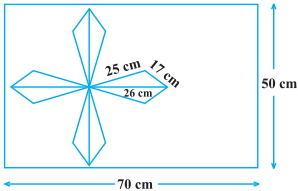
Solution
(N/A) Given,the dimensions of the rectangular tile are $50\, cm \times 70\, cm$.
Area of the rectangular tile $= 50\, cm \times 70\, cm = 3500\, cm^2$.
The sides of each triangle are $a = 25\, cm, b = 17\, cm$,and $c = 26\, cm$.
Now,the semi-perimeter $s$ is given by $s = \frac{a + b + c}{2}$.
$s = \frac{25 + 17 + 26}{2} = \frac{68}{2} = 34\, cm$.
Using Heron's formula,the area of one triangle is $\sqrt{s(s - a)(s - b)(s - c)}$.
Area $= \sqrt{34(34 - 25)(34 - 17)(34 - 26)} = \sqrt{34 \times 9 \times 17 \times 8}$.
Area $= \sqrt{(17 \times 2) \times 3^2 \times 17 \times (2^3)} = \sqrt{17^2 \times 2^4 \times 3^2} = 17 \times 4 \times 3 = 204\, cm^2$.
Total area of $8$ triangles $= 8 \times 204\, cm^2 = 1632\, cm^2$.
Thus,the total area of the design is $1632\, cm^2$.
Remaining area of the tile $=$ Area of the rectangle $-$ Area of the design.
Remaining area $= 3500\, cm^2 - 1632\, cm^2 = 1868\, cm^2$.
Hence,the total area of the design is $1632\, cm^2$ and the remaining area of the tile is $1868\, cm^2$.
Area of the rectangular tile $= 50\, cm \times 70\, cm = 3500\, cm^2$.
The sides of each triangle are $a = 25\, cm, b = 17\, cm$,and $c = 26\, cm$.
Now,the semi-perimeter $s$ is given by $s = \frac{a + b + c}{2}$.
$s = \frac{25 + 17 + 26}{2} = \frac{68}{2} = 34\, cm$.
Using Heron's formula,the area of one triangle is $\sqrt{s(s - a)(s - b)(s - c)}$.
Area $= \sqrt{34(34 - 25)(34 - 17)(34 - 26)} = \sqrt{34 \times 9 \times 17 \times 8}$.
Area $= \sqrt{(17 \times 2) \times 3^2 \times 17 \times (2^3)} = \sqrt{17^2 \times 2^4 \times 3^2} = 17 \times 4 \times 3 = 204\, cm^2$.
Total area of $8$ triangles $= 8 \times 204\, cm^2 = 1632\, cm^2$.
Thus,the total area of the design is $1632\, cm^2$.
Remaining area of the tile $=$ Area of the rectangle $-$ Area of the design.
Remaining area $= 3500\, cm^2 - 1632\, cm^2 = 1868\, cm^2$.
Hence,the total area of the design is $1632\, cm^2$ and the remaining area of the tile is $1868\, cm^2$.
0 likes
View Solution42
MediumMCQ
The measurements of the sides of a triangle are $12 \, cm$,$17 \, cm$,and $25 \, cm$. Find the area of this triangle. (in $, cm^2$)
A
$89$
B
$90$
C
$92$
D
$95$
Solution
(B) Let the sides of the given triangle be $a = 12 \, cm$,$b = 17 \, cm$,and $c = 25 \, cm$.
First,calculate the semi-perimeter $(s)$:
$s = \frac{a + b + c}{2} = \frac{12 + 17 + 25}{2} = \frac{54}{2} = 27 \, cm$.
Now,calculate the differences:
$s - a = 27 - 12 = 15 \, cm$
$s - b = 27 - 17 = 10 \, cm$
$s - c = 27 - 25 = 2 \, cm$
Using Heron's formula,the area of the triangle is:
$\text{Area} = \sqrt{s(s - a)(s - b)(s - c)}$
$\text{Area} = \sqrt{27 \times 15 \times 10 \times 2} \, cm^2$
$\text{Area} = \sqrt{(9 \times 3) \times (3 \times 5) \times (5 \times 2) \times 2} \, cm^2$
$\text{Area} = \sqrt{9 \times 9 \times 25 \times 4} \, cm^2$
$\text{Area} = 3 \times 3 \times 5 \times 2 = 90 \, cm^2$.
First,calculate the semi-perimeter $(s)$:
$s = \frac{a + b + c}{2} = \frac{12 + 17 + 25}{2} = \frac{54}{2} = 27 \, cm$.
Now,calculate the differences:
$s - a = 27 - 12 = 15 \, cm$
$s - b = 27 - 17 = 10 \, cm$
$s - c = 27 - 25 = 2 \, cm$
Using Heron's formula,the area of the triangle is:
$\text{Area} = \sqrt{s(s - a)(s - b)(s - c)}$
$\text{Area} = \sqrt{27 \times 15 \times 10 \times 2} \, cm^2$
$\text{Area} = \sqrt{(9 \times 3) \times (3 \times 5) \times (5 \times 2) \times 2} \, cm^2$
$\text{Area} = \sqrt{9 \times 9 \times 25 \times 4} \, cm^2$
$\text{Area} = 3 \times 3 \times 5 \times 2 = 90 \, cm^2$.
0 likes
View Solution43
MediumMCQ
The shape of a field is a triangle. The measurements of the sides of the field are $51 \,m$,$52 \,m$ and $53 \,m$. Find its area. (in $,m^2$)
A
$1520$
B
$1270$
C
$1170$
D
$1720$
Solution
(C) For a triangular field,the side lengths are $a = 51 \,m$,$b = 52 \,m$,and $c = 53 \,m$.
First,calculate the semi-perimeter $(s)$:
$s = \frac{a + b + c}{2} = \frac{51 + 52 + 53}{2} = \frac{156}{2} = 78 \,m$.
Now,calculate the differences:
$s - a = 78 - 51 = 27 \,m$
$s - b = 78 - 52 = 26 \,m$
$s - c = 78 - 53 = 25 \,m$
Using Heron's formula,the area of the triangle is:
$\text{Area} = \sqrt{s(s - a)(s - b)(s - c)}$
$= \sqrt{78 \times 27 \times 26 \times 25}$
$= \sqrt{(13 \times 6) \times (9 \times 3) \times (13 \times 2) \times 25}$
$= \sqrt{13^2 \times 6 \times 27 \times 25}$
$= \sqrt{13^2 \times (2 \times 3) \times (3^3) \times 5^2}$
$= \sqrt{13^2 \times 2 \times 3^4 \times 5^2}$
$= 13 \times 3^2 \times 5 \times \sqrt{2}$
Wait,let's re-calculate the prime factorization:
$78 = 2 \times 3 \times 13$
$27 = 3^3$
$26 = 2 \times 13$
$25 = 5^2$
$\text{Area} = \sqrt{(2 \times 3 \times 13) \times (3^3) \times (2 \times 13) \times 5^2}$
$= \sqrt{2^2 \times 3^4 \times 13^2 \times 5^2}$
$= 2 \times 3^2 \times 13 \times 5$
$= 2 \times 9 \times 13 \times 5 = 1170 \,m^2$.
First,calculate the semi-perimeter $(s)$:
$s = \frac{a + b + c}{2} = \frac{51 + 52 + 53}{2} = \frac{156}{2} = 78 \,m$.
Now,calculate the differences:
$s - a = 78 - 51 = 27 \,m$
$s - b = 78 - 52 = 26 \,m$
$s - c = 78 - 53 = 25 \,m$
Using Heron's formula,the area of the triangle is:
$\text{Area} = \sqrt{s(s - a)(s - b)(s - c)}$
$= \sqrt{78 \times 27 \times 26 \times 25}$
$= \sqrt{(13 \times 6) \times (9 \times 3) \times (13 \times 2) \times 25}$
$= \sqrt{13^2 \times 6 \times 27 \times 25}$
$= \sqrt{13^2 \times (2 \times 3) \times (3^3) \times 5^2}$
$= \sqrt{13^2 \times 2 \times 3^4 \times 5^2}$
$= 13 \times 3^2 \times 5 \times \sqrt{2}$
Wait,let's re-calculate the prime factorization:
$78 = 2 \times 3 \times 13$
$27 = 3^3$
$26 = 2 \times 13$
$25 = 5^2$
$\text{Area} = \sqrt{(2 \times 3 \times 13) \times (3^3) \times (2 \times 13) \times 5^2}$
$= \sqrt{2^2 \times 3^4 \times 13^2 \times 5^2}$
$= 2 \times 3^2 \times 13 \times 5$
$= 2 \times 9 \times 13 \times 5 = 1170 \,m^2$.
0 likes
View Solution44
DifficultMCQ
The sides of a triangular plot are in the ratio of $4: 7: 9$ and its perimeter is $500 \, m$. Find its area.
A
$3750 \sqrt{5} \, m^2$
B
$3650 \sqrt{5} \, m^2$
C
$3570 \sqrt{5} \, m^2$
D
$3470 \sqrt{5} \, m^2$
Solution
(A) Let the sides of the triangle be $4x, 7x,$ and $9x$ meters.
The perimeter of the triangle is given as $500 \, m$.
Therefore,$4x + 7x + 9x = 500$.
$20x = 500 \implies x = 25$.
The sides are $a = 4 \times 25 = 100 \, m$,$b = 7 \times 25 = 175 \, m$,and $c = 9 \times 25 = 225 \, m$.
The semi-perimeter $s = \frac{a+b+c}{2} = \frac{500}{2} = 250 \, m$.
Using Heron's formula,Area $= \sqrt{s(s-a)(s-b)(s-c)}$.
$s-a = 250 - 100 = 150 \, m$.
$s-b = 250 - 175 = 75 \, m$.
$s-c = 250 - 225 = 25 \, m$.
Area $= \sqrt{250 \times 150 \times 75 \times 25} = \sqrt{(25 \times 10) \times (15 \times 10) \times (25 \times 3) \times 25}$.
Area $= \sqrt{25^2 \times 10^2 \times 3 \times 5 \times 3 \times 5} = \sqrt{25^2 \times 10^2 \times 3^2 \times 5^2} = 25 \times 10 \times 3 \times 5 \sqrt{5} = 3750 \sqrt{5} \, m^2$.
The perimeter of the triangle is given as $500 \, m$.
Therefore,$4x + 7x + 9x = 500$.
$20x = 500 \implies x = 25$.
The sides are $a = 4 \times 25 = 100 \, m$,$b = 7 \times 25 = 175 \, m$,and $c = 9 \times 25 = 225 \, m$.
The semi-perimeter $s = \frac{a+b+c}{2} = \frac{500}{2} = 250 \, m$.
Using Heron's formula,Area $= \sqrt{s(s-a)(s-b)(s-c)}$.
$s-a = 250 - 100 = 150 \, m$.
$s-b = 250 - 175 = 75 \, m$.
$s-c = 250 - 225 = 25 \, m$.
Area $= \sqrt{250 \times 150 \times 75 \times 25} = \sqrt{(25 \times 10) \times (15 \times 10) \times (25 \times 3) \times 25}$.
Area $= \sqrt{25^2 \times 10^2 \times 3 \times 5 \times 3 \times 5} = \sqrt{25^2 \times 10^2 \times 3^2 \times 5^2} = 25 \times 10 \times 3 \times 5 \sqrt{5} = 3750 \sqrt{5} \, m^2$.
0 likes
View Solution45
MediumMCQ
Find the area of the equilateral triangle having length of each side $50\, cm$.
A
$625 \sqrt{3} \, cm^2$
B
$627 \sqrt{2} \, cm^2$
C
$565 \sqrt{2} \, cm^2$
D
$562 \sqrt{3} \, cm^2$
Solution
(A) The area of an equilateral triangle with side length $a$ is given by the formula: $\text{Area} = \frac{\sqrt{3}}{4} a^2$.
Given the side length $a = 50 \, cm$.
Substituting the value of $a$ in the formula:
$\text{Area} = \frac{\sqrt{3}}{4} \times (50)^2$
$\text{Area} = \frac{\sqrt{3}}{4} \times 2500$
$\text{Area} = 625 \sqrt{3} \, cm^2$.
Thus,the correct option is $A$.
Given the side length $a = 50 \, cm$.
Substituting the value of $a$ in the formula:
$\text{Area} = \frac{\sqrt{3}}{4} \times (50)^2$
$\text{Area} = \frac{\sqrt{3}}{4} \times 2500$
$\text{Area} = 625 \sqrt{3} \, cm^2$.
Thus,the correct option is $A$.
0 likes
View Solution46
MediumMCQ
Find the area of the triangle with the length of the sides $9 \, cm$,$10 \, cm$,and $17 \, cm$. (in $, cm^2$)
A
$36$
B
$38$
C
$40$
D
$42$
Solution
(A) To find the area of a triangle with sides $a = 9 \, cm$,$b = 10 \, cm$,and $c = 17 \, cm$,we use Heron's formula.
First,calculate the semi-perimeter $s$:
$s = \frac{a + b + c}{2} = \frac{9 + 10 + 17}{2} = \frac{36}{2} = 18 \, cm$.
Now,use the area formula $\text{Area} = \sqrt{s(s - a)(s - b)(s - c)}$:
$\text{Area} = \sqrt{18(18 - 9)(18 - 10)(18 - 17)}$
$\text{Area} = \sqrt{18 \times 9 \times 8 \times 1}$
$\text{Area} = \sqrt{1296} = 36 \, cm^2$.
First,calculate the semi-perimeter $s$:
$s = \frac{a + b + c}{2} = \frac{9 + 10 + 17}{2} = \frac{36}{2} = 18 \, cm$.
Now,use the area formula $\text{Area} = \sqrt{s(s - a)(s - b)(s - c)}$:
$\text{Area} = \sqrt{18(18 - 9)(18 - 10)(18 - 17)}$
$\text{Area} = \sqrt{18 \times 9 \times 8 \times 1}$
$\text{Area} = \sqrt{1296} = 36 \, cm^2$.
0 likes
View Solution47
MediumMCQ
Find the area of the triangular field with the length of the sides $360 \, m$,$450 \, m$,and $450 \, m$.
A
$14750 \sqrt{15} \, m^2$
B
$15700 \sqrt{20} \, m^2$
C
$16200 \sqrt{21} \, m^2$
D
$17450 \sqrt{21} \, m^2$
Solution
(C) Given sides of the triangle are $a = 360 \, m$,$b = 450 \, m$,and $c = 450 \, m$.
First,calculate the semi-perimeter $(s)$:
$s = \frac{a + b + c}{2} = \frac{360 + 450 + 450}{2} = \frac{1260}{2} = 630 \, m$.
Using Heron's formula,Area = $\sqrt{s(s - a)(s - b)(s - c)}$.
Area = $\sqrt{630(630 - 360)(630 - 450)(630 - 450)}$.
Area = $\sqrt{630 \times 270 \times 180 \times 180}$.
Area = $180 \times \sqrt{630 \times 270}$.
Area = $180 \times \sqrt{(90 \times 7) \times (90 \times 3)}$.
Area = $180 \times 90 \times \sqrt{7 \times 3}$.
Area = $16200 \sqrt{21} \, m^2$.
First,calculate the semi-perimeter $(s)$:
$s = \frac{a + b + c}{2} = \frac{360 + 450 + 450}{2} = \frac{1260}{2} = 630 \, m$.
Using Heron's formula,Area = $\sqrt{s(s - a)(s - b)(s - c)}$.
Area = $\sqrt{630(630 - 360)(630 - 450)(630 - 450)}$.
Area = $\sqrt{630 \times 270 \times 180 \times 180}$.
Area = $180 \times \sqrt{630 \times 270}$.
Area = $180 \times \sqrt{(90 \times 7) \times (90 \times 3)}$.
Area = $180 \times 90 \times \sqrt{7 \times 3}$.
Area = $16200 \sqrt{21} \, m^2$.
0 likes
View Solution48
MediumMCQ
There is a triangular party plot with side lengths of $200\,m$,$210\,m$,and $290\,m$. Calculate the cost of raising a lawn in that plot at the rate of Rs. $5/m^2$.
A
$189540$
B
$115890$
C
$105700$
D
$105000$
Solution
(D) The sides of the triangular plot are $a = 200\,m$,$b = 210\,m$,and $c = 290\,m$.
First,calculate the semi-perimeter $(s)$:
$s = \frac{a + b + c}{2} = \frac{200 + 210 + 290}{2} = \frac{700}{2} = 350\,m$.
Using Heron's formula,the area $(A)$ is:
$A = \sqrt{s(s-a)(s-b)(s-c)}$
$A = \sqrt{350(350-200)(350-210)(350-290)}$
$A = \sqrt{350 \times 150 \times 140 \times 60}$
$A = \sqrt{35 \times 10 \times 15 \times 10 \times 14 \times 10 \times 6 \times 10}$
$A = \sqrt{35 \times 15 \times 14 \times 6 \times 10000}$
$A = \sqrt{(5 \times 7) \times (3 \times 5) \times (2 \times 7) \times (2 \times 3) \times 10000}$
$A = \sqrt{2^2 \times 3^2 \times 5^2 \times 7^2 \times 100^2} = 2 \times 3 \times 5 \times 7 \times 100 = 21000\,m^2$.
The cost of raising the lawn is $Area \times Rate = 21000 \times 5 = \text{Rs. } 105000$.
First,calculate the semi-perimeter $(s)$:
$s = \frac{a + b + c}{2} = \frac{200 + 210 + 290}{2} = \frac{700}{2} = 350\,m$.
Using Heron's formula,the area $(A)$ is:
$A = \sqrt{s(s-a)(s-b)(s-c)}$
$A = \sqrt{350(350-200)(350-210)(350-290)}$
$A = \sqrt{350 \times 150 \times 140 \times 60}$
$A = \sqrt{35 \times 10 \times 15 \times 10 \times 14 \times 10 \times 6 \times 10}$
$A = \sqrt{35 \times 15 \times 14 \times 6 \times 10000}$
$A = \sqrt{(5 \times 7) \times (3 \times 5) \times (2 \times 7) \times (2 \times 3) \times 10000}$
$A = \sqrt{2^2 \times 3^2 \times 5^2 \times 7^2 \times 100^2} = 2 \times 3 \times 5 \times 7 \times 100 = 21000\,m^2$.
The cost of raising the lawn is $Area \times Rate = 21000 \times 5 = \text{Rs. } 105000$.
0 likes
View Solution49
MediumMCQ
Find the area of a triangle,two sides of which are $15\,cm$ and $28\,cm$ and the perimeter is $84\,cm$. (in $,cm^2$)
A
$126$
B
$128$
C
$130$
D
$124$
Solution
(A) Given sides are $a = 15\,cm$ and $b = 28\,cm$. The perimeter $P = 84\,cm$.
The third side $c = P - (a + b) = 84 - (15 + 28) = 84 - 43 = 41\,cm$.
Semi-perimeter $s = P / 2 = 84 / 2 = 42\,cm$.
Using Heron's formula,Area $= \sqrt{s(s-a)(s-b)(s-c)}$.
Area $= \sqrt{42(42-15)(42-28)(42-41)}$.
Area $= \sqrt{42 \times 27 \times 14 \times 1}$.
Area $= \sqrt{(14 \times 3) \times (9 \times 3) \times 14 \times 1} = \sqrt{14^2 \times 3^2 \times 3^2} = 14 \times 3 \times 3 = 126\,cm^2$.
The third side $c = P - (a + b) = 84 - (15 + 28) = 84 - 43 = 41\,cm$.
Semi-perimeter $s = P / 2 = 84 / 2 = 42\,cm$.
Using Heron's formula,Area $= \sqrt{s(s-a)(s-b)(s-c)}$.
Area $= \sqrt{42(42-15)(42-28)(42-41)}$.
Area $= \sqrt{42 \times 27 \times 14 \times 1}$.
Area $= \sqrt{(14 \times 3) \times (9 \times 3) \times 14 \times 1} = \sqrt{14^2 \times 3^2 \times 3^2} = 14 \times 3 \times 3 = 126\,cm^2$.
0 likes
View Solution50
MediumMCQ
An isosceles triangle has a perimeter of $50\,cm$ and each of the equal sides is $17\,cm$. Find the area of the triangle. (in $,cm^2$)
A
$132$
B
$120$
C
$127$
D
$123$
Solution
(B) Let the equal sides be $a = 17\,cm$ and $b = 17\,cm$.
The perimeter of the triangle is $P = 50\,cm$.
Let the third side be $c$. Then,$a + b + c = 50$.
$17 + 17 + c = 50 \implies 34 + c = 50 \implies c = 16\,cm$.
The semi-perimeter $s = P / 2 = 50 / 2 = 25\,cm$.
Using Heron's formula,Area $= \sqrt{s(s-a)(s-b)(s-c)}$.
Area $= \sqrt{25(25-17)(25-17)(25-16)}$.
Area $= \sqrt{25 \times 8 \times 8 \times 9}$.
Area $= 5 \times 8 \times 3 = 120\,cm^2$.
The perimeter of the triangle is $P = 50\,cm$.
Let the third side be $c$. Then,$a + b + c = 50$.
$17 + 17 + c = 50 \implies 34 + c = 50 \implies c = 16\,cm$.
The semi-perimeter $s = P / 2 = 50 / 2 = 25\,cm$.
Using Heron's formula,Area $= \sqrt{s(s-a)(s-b)(s-c)}$.
Area $= \sqrt{25(25-17)(25-17)(25-16)}$.
Area $= \sqrt{25 \times 8 \times 8 \times 9}$.
Area $= 5 \times 8 \times 3 = 120\,cm^2$.
0 likes
View SolutionHeron’s Formula — Mix Examples - Heron’s Formula · Frequently Asked Questions
1Are these Heron’s Formula questions useful for JEE and NEET?
Yes. All questions in this section are mapped to JEE Main and NEET exam patterns. Previous year questions from JEE Main, NEET, GUJCET and state-level exams are included with full solutions.
2Can I switch to Hindi or Gujarati for these questions?
Yes. Use the language tabs in the hero section or the sidebar to view the same questions and solutions in English, Hindi or Gujarati.
3How do I generate a question paper from this subtopic?
Use the Vedclass Exam Paper Generator — select the chapter and subtopic, set difficulty, and generate Sets A, B, C, D automatically. First 3 chapters of every subject are free.
Vedclass Products
For Students
Vedclass Test Series
Mock tests in real JEE/NEET style with performance analysis. 5-day free trial.
Start Free TrialFor Teachers
Exam Paper Generator
Generate Set A/B/C/D papers from this chapter in 2 minutes. 3 chapters free.
Try FreeFor Institutes
Online Exam Module
Live online exams with unlimited students, 360° analytics & white-label branding.
See DemoFor Teachers & Institutes
Generate a Heron’s Formula Exam Paper in 2 Minutes
Select subtopic & difficulty — Sets A, B, C, D auto-generated with No Repeat logic.
First 3 chapters of every subject are free — no payment required.