
A English
Textbook - Heron’s Formula Questions in English
Class 9 Mathematics · Heron’s Formula · Textbook - Heron’s Formula
21+
Questions
English
Language
100%
With Solutions
Showing 21 of 21 questions in English
1
MediumMCQ
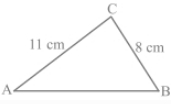
Find the area of a triangle,two sides of which are $8 \, cm$ and $11 \, cm$ and the perimeter is $32 \, cm$.
A
$8 \sqrt{30} \, cm^2$
B
$7 \sqrt{30} \, cm^2$
C
$6 \sqrt{30} \, cm^2$
D
$5 \sqrt{30} \, cm^2$
Solution
(A) Given,the perimeter of the triangle is $32 \, cm$. Let the sides be $a = 8 \, cm$ and $b = 11 \, cm$.
The third side $c$ is calculated as:
$c = 32 \, cm - (8 + 11) \, cm = 32 \, cm - 19 \, cm = 13 \, cm$.
The semi-perimeter $s$ is:
$s = \frac{\text{Perimeter}}{2} = \frac{32}{2} \, cm = 16 \, cm$.
Now,calculate $(s - a)$,$(s - b)$,and $(s - c)$:
$s - a = 16 - 8 = 8 \, cm$
$s - b = 16 - 11 = 5 \, cm$
$s - c = 16 - 13 = 3 \, cm$
Using Heron's formula,the area of the triangle is:
$\text{Area} = \sqrt{s(s - a)(s - b)(s - c)}$
$\text{Area} = \sqrt{16 \times 8 \times 5 \times 3} \, cm^2$
$\text{Area} = \sqrt{16 \times 120} \, cm^2$
$\text{Area} = 4 \times \sqrt{4 \times 30} \, cm^2$
$\text{Area} = 4 \times 2 \sqrt{30} \, cm^2 = 8 \sqrt{30} \, cm^2$.
The third side $c$ is calculated as:
$c = 32 \, cm - (8 + 11) \, cm = 32 \, cm - 19 \, cm = 13 \, cm$.
The semi-perimeter $s$ is:
$s = \frac{\text{Perimeter}}{2} = \frac{32}{2} \, cm = 16 \, cm$.
Now,calculate $(s - a)$,$(s - b)$,and $(s - c)$:
$s - a = 16 - 8 = 8 \, cm$
$s - b = 16 - 11 = 5 \, cm$
$s - c = 16 - 13 = 3 \, cm$
Using Heron's formula,the area of the triangle is:
$\text{Area} = \sqrt{s(s - a)(s - b)(s - c)}$
$\text{Area} = \sqrt{16 \times 8 \times 5 \times 3} \, cm^2$
$\text{Area} = \sqrt{16 \times 120} \, cm^2$
$\text{Area} = 4 \times \sqrt{4 \times 30} \, cm^2$
$\text{Area} = 4 \times 2 \sqrt{30} \, cm^2 = 8 \sqrt{30} \, cm^2$.
0 likes
View Solution2
MediumMCQ
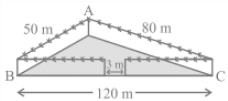
$A$ triangular park $ABC$ has sides $120\,m, 80\,m$ and $50\,m$ (see Fig.). $A$ gardener Dhania has to put a fence all around it and also plant grass inside. How much area does she need to plant? Find the cost of fencing it with barbed wire at the rate of $Rs. 20$ per metre leaving a space $3\,m$ wide for a gate on one side.
A
$Rs. 5640$
B
$Rs. 4940$
C
$Rs. 4922$
D
$Rs. 4850$
Solution
(B) To find the area of the park,we use Heron's formula.
First,calculate the semi-perimeter $s$:
$2s = 50\,m + 80\,m + 120\,m = 250\,m$
$s = 125\,m$
Now,calculate the differences:
$s - a = 125\,m - 120\,m = 5\,m$
$s - b = 125\,m - 80\,m = 45\,m$
$s - c = 125\,m - 50\,m = 75\,m$
Area of the park $= \sqrt{s(s-a)(s-b)(s-c)}$
$= \sqrt{125 \times 5 \times 45 \times 75}\,m^2$
$= \sqrt{2109375}\,m^2 = 375\sqrt{15}\,m^2$
Next,calculate the cost of fencing:
Perimeter of the park $= 250\,m$
Length of wire needed $= 250\,m - 3\,m = 247\,m$
Cost of fencing $= 247\,m \times Rs. 20/m = Rs. 4940$
First,calculate the semi-perimeter $s$:
$2s = 50\,m + 80\,m + 120\,m = 250\,m$
$s = 125\,m$
Now,calculate the differences:
$s - a = 125\,m - 120\,m = 5\,m$
$s - b = 125\,m - 80\,m = 45\,m$
$s - c = 125\,m - 50\,m = 75\,m$
Area of the park $= \sqrt{s(s-a)(s-b)(s-c)}$
$= \sqrt{125 \times 5 \times 45 \times 75}\,m^2$
$= \sqrt{2109375}\,m^2 = 375\sqrt{15}\,m^2$
Next,calculate the cost of fencing:
Perimeter of the park $= 250\,m$
Length of wire needed $= 250\,m - 3\,m = 247\,m$
Cost of fencing $= 247\,m \times Rs. 20/m = Rs. 4940$
0 likes
View Solution3
MediumMCQ
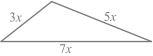
The sides of a triangular plot are in the ratio of $3 : 5 : 7$ and its perimeter is $300\, m$. Find its area.
A
$1300\sqrt{3}\, m^2$
B
$1100\sqrt{3}\, m^2$
C
$1500\sqrt{3}\, m^2$
D
$1800\sqrt{3}\, m^2$
Solution
(C) Let the sides of the triangle be $3x, 5x$ and $7x$ meters.
The perimeter of the triangle is given as $300\, m$.
Therefore,$3x + 5x + 7x = 300$.
$15x = 300$,which gives $x = 20$.
Thus,the sides of the triangle are $3 \times 20 = 60\, m$,$5 \times 20 = 100\, m$,and $7 \times 20 = 140\, m$.
Using Heron's formula,the semi-perimeter $s$ is:
$s = \frac{60 + 100 + 140}{2} = \frac{300}{2} = 150\, m$.
The area of the triangle is $\sqrt{s(s-a)(s-b)(s-c)}$.
Area $= \sqrt{150(150 - 60)(150 - 100)(150 - 140)}\, m^2$.
Area $= \sqrt{150 \times 90 \times 50 \times 10}\, m^2$.
Area $= \sqrt{6750000}\, m^2$.
Area $= 1500\sqrt{3}\, m^2$.
The perimeter of the triangle is given as $300\, m$.
Therefore,$3x + 5x + 7x = 300$.
$15x = 300$,which gives $x = 20$.
Thus,the sides of the triangle are $3 \times 20 = 60\, m$,$5 \times 20 = 100\, m$,and $7 \times 20 = 140\, m$.
Using Heron's formula,the semi-perimeter $s$ is:
$s = \frac{60 + 100 + 140}{2} = \frac{300}{2} = 150\, m$.
The area of the triangle is $\sqrt{s(s-a)(s-b)(s-c)}$.
Area $= \sqrt{150(150 - 60)(150 - 100)(150 - 140)}\, m^2$.
Area $= \sqrt{150 \times 90 \times 50 \times 10}\, m^2$.
Area $= \sqrt{6750000}\, m^2$.
Area $= 1500\sqrt{3}\, m^2$.
0 likes
View Solution4
MediumMCQ
$A$ traffic signal board,indicating '$SCHOOL$ $AHEAD$',is an equilateral triangle with side 'a'. Find the area of the signal board,using Heron's formula. If its perimeter is $180 \, cm$,what will be the area of the signal board?
A
$600 \sqrt{3} \, cm^2$
B
$700 \sqrt{3} \, cm^2$
C
$800 \sqrt{3} \, cm^2$
D
$900 \sqrt{3} \, cm^2$
Solution
(D) For an equilateral triangle with side $a$,the area is given by $\frac{\sqrt{3}}{4} a^2$.
Given that the perimeter of the equilateral triangle is $180 \, cm$.
Since all three sides are equal,$3a = 180 \, cm$,which gives $a = 60 \, cm$.
Using Heron's formula,the semi-perimeter $s = \frac{\text{Perimeter}}{2} = \frac{180}{2} = 90 \, cm$.
The area of the triangle is $\sqrt{s(s-a)(s-b)(s-c)}$.
Substituting the values: $\text{Area} = \sqrt{90(90-60)(90-60)(90-60)} \, cm^2$.
$\text{Area} = \sqrt{90 \times 30 \times 30 \times 30} \, cm^2$.
$\text{Area} = \sqrt{3 \times 30 \times 30 \times 30 \times 30} \, cm^2$.
$\text{Area} = \sqrt{3 \times (30)^2 \times (30)^2} \, cm^2$.
$\text{Area} = 30 \times 30 \times \sqrt{3} \, cm^2 = 900 \sqrt{3} \, cm^2$.
Given that the perimeter of the equilateral triangle is $180 \, cm$.
Since all three sides are equal,$3a = 180 \, cm$,which gives $a = 60 \, cm$.
Using Heron's formula,the semi-perimeter $s = \frac{\text{Perimeter}}{2} = \frac{180}{2} = 90 \, cm$.
The area of the triangle is $\sqrt{s(s-a)(s-b)(s-c)}$.
Substituting the values: $\text{Area} = \sqrt{90(90-60)(90-60)(90-60)} \, cm^2$.
$\text{Area} = \sqrt{90 \times 30 \times 30 \times 30} \, cm^2$.
$\text{Area} = \sqrt{3 \times 30 \times 30 \times 30 \times 30} \, cm^2$.
$\text{Area} = \sqrt{3 \times (30)^2 \times (30)^2} \, cm^2$.
$\text{Area} = 30 \times 30 \times \sqrt{3} \, cm^2 = 900 \sqrt{3} \, cm^2$.
0 likes
View Solution5
DifficultMCQ
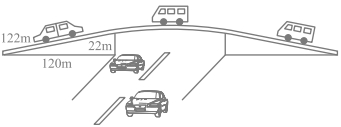
The triangular side walls of a flyover have been used for advertisements. The sides of the walls are $122\, m, 22\, m$ and $120\, m$ (see Fig.). The advertisements yield an earning of $Rs. 5000$ per $m^2$ per year. $A$ company hired one of its walls for $3$ months. How much rent did it pay?
A
$16,50,000$
B
$14,50,000$
C
$11,50,000$
D
$13,50,000$
Solution
(A) The sides of the triangular wall are $a = 122\, m, b = 120\, m, c = 22\, m$.
The semi-perimeter $s$ is given by:
$s = \frac{a + b + c}{2} = \frac{122 + 120 + 22}{2}\, m = \frac{264}{2}\, m = 132\, m$.
The area of the triangle using Heron's formula is $\sqrt{s(s-a)(s-b)(s-c)}$.
Area $= \sqrt{132(132 - 122)(132 - 120)(132 - 22)}\, m^2$
$= \sqrt{132 \times 10 \times 12 \times 110}\, m^2$
$= \sqrt{12 \times 11 \times 10 \times 12 \times 11 \times 10}\, m^2$
$= \sqrt{12^2 \times 11^2 \times 10^2}\, m^2 = 12 \times 11 \times 10\, m^2 = 1320\, m^2$.
Rent for $1$ year ($12$ months) per $m^2 = Rs. 5000$.
Rent for $3$ months per $m^2 = Rs. 5000 \times \frac{3}{12} = Rs. 1250$.
Total rent for $1320\, m^2$ for $3$ months $= 1320 \times 1250 = Rs. 16,50,000$.
The semi-perimeter $s$ is given by:
$s = \frac{a + b + c}{2} = \frac{122 + 120 + 22}{2}\, m = \frac{264}{2}\, m = 132\, m$.
The area of the triangle using Heron's formula is $\sqrt{s(s-a)(s-b)(s-c)}$.
Area $= \sqrt{132(132 - 122)(132 - 120)(132 - 22)}\, m^2$
$= \sqrt{132 \times 10 \times 12 \times 110}\, m^2$
$= \sqrt{12 \times 11 \times 10 \times 12 \times 11 \times 10}\, m^2$
$= \sqrt{12^2 \times 11^2 \times 10^2}\, m^2 = 12 \times 11 \times 10\, m^2 = 1320\, m^2$.
Rent for $1$ year ($12$ months) per $m^2 = Rs. 5000$.
Rent for $3$ months per $m^2 = Rs. 5000 \times \frac{3}{12} = Rs. 1250$.
Total rent for $1320\, m^2$ for $3$ months $= 1320 \times 1250 = Rs. 16,50,000$.
0 likes
View Solution6
MediumMCQ
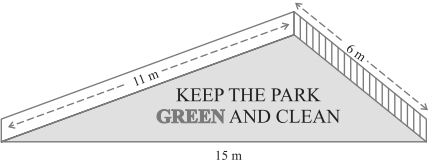
There is a slide in a park. One of its side walls has been painted in some colour with a message "$KEEP$ $THE$ $PARK$ $GREEN$ $AND$ $CLEAN$". If the sides of the wall are $15 \, m$,$11 \, m$ and $6 \, m$,find the area painted in colour.
A
$90 \sqrt{2} \, m^2$
B
$20 \sqrt{2} \, m^2$
C
$30 \sqrt{2} \, m^2$
D
$40 \sqrt{2} \, m^2$
Solution
(B) The sides of the triangular wall are $a = 15 \, m$,$b = 11 \, m$,and $c = 6 \, m$.
First,we calculate the semi-perimeter $(s)$:
$s = \frac{a + b + c}{2} = \frac{15 + 11 + 6}{2} \, m = \frac{32}{2} \, m = 16 \, m$.
Now,using Heron's formula,the area of the triangular surface is:
Area $= \sqrt{s(s - a)(s - b)(s - c)}$
$= \sqrt{16(16 - 15)(16 - 11)(16 - 6)} \, m^2$
$= \sqrt{16 \times 1 \times 5 \times 10} \, m^2$
$= \sqrt{16 \times 50} \, m^2$
$= \sqrt{800} \, m^2$
$= \sqrt{400 \times 2} \, m^2 = 20 \sqrt{2} \, m^2$.
Thus,the required area painted in colour is $20 \sqrt{2} \, m^2$.
First,we calculate the semi-perimeter $(s)$:
$s = \frac{a + b + c}{2} = \frac{15 + 11 + 6}{2} \, m = \frac{32}{2} \, m = 16 \, m$.
Now,using Heron's formula,the area of the triangular surface is:
Area $= \sqrt{s(s - a)(s - b)(s - c)}$
$= \sqrt{16(16 - 15)(16 - 11)(16 - 6)} \, m^2$
$= \sqrt{16 \times 1 \times 5 \times 10} \, m^2$
$= \sqrt{16 \times 50} \, m^2$
$= \sqrt{800} \, m^2$
$= \sqrt{400 \times 2} \, m^2 = 20 \sqrt{2} \, m^2$.
Thus,the required area painted in colour is $20 \sqrt{2} \, m^2$.
0 likes
View Solution7
MediumMCQ
Find the area of a triangle two sides of which are $18 \, cm$ and $10 \, cm$ and the perimeter is $42 \, cm$.
A
$25 \sqrt{11} \, cm^2$
B
$85 \sqrt{11} \, cm^2$
C
$21 \sqrt{11} \, cm^2$
D
$21 \sqrt{51} \, cm^2$
Solution
(C) Let the sides of the triangle be $a = 18 \, cm$,$b = 10 \, cm$,and $c$ be the third side.
Given that the perimeter $(2s) = 42 \, cm$.
Therefore,the semi-perimeter $s = \frac{42}{2} = 21 \, cm$.
The third side $c = 42 - (18 + 10) = 42 - 28 = 14 \, cm$.
Using Heron's formula,the area of a triangle $= \sqrt{s(s-a)(s-b)(s-c)}$.
Substituting the values: Area $= \sqrt{21(21-18)(21-10)(21-14)} \, cm^2$.
Area $= \sqrt{21 \times 3 \times 11 \times 7} \, cm^2$.
Area $= \sqrt{(3 \times 7) \times 3 \times 11 \times 7} \, cm^2 = \sqrt{3^2 \times 7^2 \times 11} \, cm^2$.
Area $= 3 \times 7 \sqrt{11} \, cm^2 = 21 \sqrt{11} \, cm^2$.
Given that the perimeter $(2s) = 42 \, cm$.
Therefore,the semi-perimeter $s = \frac{42}{2} = 21 \, cm$.
The third side $c = 42 - (18 + 10) = 42 - 28 = 14 \, cm$.
Using Heron's formula,the area of a triangle $= \sqrt{s(s-a)(s-b)(s-c)}$.
Substituting the values: Area $= \sqrt{21(21-18)(21-10)(21-14)} \, cm^2$.
Area $= \sqrt{21 \times 3 \times 11 \times 7} \, cm^2$.
Area $= \sqrt{(3 \times 7) \times 3 \times 11 \times 7} \, cm^2 = \sqrt{3^2 \times 7^2 \times 11} \, cm^2$.
Area $= 3 \times 7 \sqrt{11} \, cm^2 = 21 \sqrt{11} \, cm^2$.
0 likes
View Solution8
DifficultMCQ
Sides of a triangle are in the ratio of $12 : 17 : 25$ and its perimeter is $540 \, cm$. Find its area.
A
$1,000 \, cm^2$
B
$5,000 \, cm^2$
C
$6,000 \, cm^2$
D
$9,000 \, cm^2$
Solution
(D) Perimeter of the triangle $= 540 \, cm$.
Semi-perimeter $s = \frac{540}{2} = 270 \, cm$.
Let the sides be $12x, 17x,$ and $25x$.
$12x + 17x + 25x = 540 \Rightarrow 54x = 540 \Rightarrow x = 10$.
Thus,the sides are $a = 120 \, cm, b = 170 \, cm, c = 250 \, cm$.
Using Heron's formula: Area $= \sqrt{s(s-a)(s-b)(s-c)}$.
$s-a = 270 - 120 = 150 \, cm$.
$s-b = 270 - 170 = 100 \, cm$.
$s-c = 270 - 250 = 20 \, cm$.
Area $= \sqrt{270 \times 150 \times 100 \times 20} = \sqrt{81,000,000} = 9,000 \, cm^2$.
Semi-perimeter $s = \frac{540}{2} = 270 \, cm$.
Let the sides be $12x, 17x,$ and $25x$.
$12x + 17x + 25x = 540 \Rightarrow 54x = 540 \Rightarrow x = 10$.
Thus,the sides are $a = 120 \, cm, b = 170 \, cm, c = 250 \, cm$.
Using Heron's formula: Area $= \sqrt{s(s-a)(s-b)(s-c)}$.
$s-a = 270 - 120 = 150 \, cm$.
$s-b = 270 - 170 = 100 \, cm$.
$s-c = 270 - 250 = 20 \, cm$.
Area $= \sqrt{270 \times 150 \times 100 \times 20} = \sqrt{81,000,000} = 9,000 \, cm^2$.
0 likes
View Solution9
DifficultMCQ
An isosceles triangle has a perimeter of $30 \, cm$ and each of the equal sides is $12 \, cm$. Find the area of the triangle.
A
$9 \sqrt{15} \, cm^2$
B
$12 \sqrt{15} \, cm^2$
C
$15 \sqrt{15} \, cm^2$
D
$19 \sqrt{15} \, cm^2$
Solution
(A) The equal sides of the triangle are $12 \, cm$ each.
Let the third side be $x \, cm$.
Since the perimeter is $30 \, cm$,we have:
$12 \, cm + 12 \, cm + x \, cm = 30 \, cm$
$24 \, cm + x = 30 \, cm$
$x = 30 - 24 = 6 \, cm$.
Now,the semi-perimeter $s = \frac{\text{Perimeter}}{2} = \frac{30}{2} = 15 \, cm$.
Using Heron's formula,the area of the triangle is:
$\text{Area} = \sqrt{s(s-a)(s-b)(s-c)}$
$\text{Area} = \sqrt{15(15-12)(15-12)(15-6)} \, cm^2$
$\text{Area} = \sqrt{15 \times 3 \times 3 \times 9} \, cm^2$
$\text{Area} = \sqrt{15 \times 9 \times 9} \, cm^2 = 9 \sqrt{15} \, cm^2$.
Thus,the area of the triangle is $9 \sqrt{15} \, cm^2$.
Let the third side be $x \, cm$.
Since the perimeter is $30 \, cm$,we have:
$12 \, cm + 12 \, cm + x \, cm = 30 \, cm$
$24 \, cm + x = 30 \, cm$
$x = 30 - 24 = 6 \, cm$.
Now,the semi-perimeter $s = \frac{\text{Perimeter}}{2} = \frac{30}{2} = 15 \, cm$.
Using Heron's formula,the area of the triangle is:
$\text{Area} = \sqrt{s(s-a)(s-b)(s-c)}$
$\text{Area} = \sqrt{15(15-12)(15-12)(15-6)} \, cm^2$
$\text{Area} = \sqrt{15 \times 3 \times 3 \times 9} \, cm^2$
$\text{Area} = \sqrt{15 \times 9 \times 9} \, cm^2 = 9 \sqrt{15} \, cm^2$.
Thus,the area of the triangle is $9 \sqrt{15} \, cm^2$.
0 likes
View Solution10
DifficultMCQ
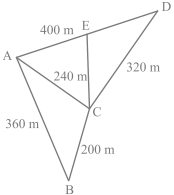
Kamla has a triangular field with sides $240 \, m, 200 \, m, 360 \, m$,where she grew wheat. In another triangular field with sides $240 \, m, 320 \, m, 400 \, m$ adjacent to the previous field,she wanted to grow potatoes and onions. She divided the field in two parts by joining the mid-point of the longest side to the opposite vertex and grew potatoes in one part and onions in the other part. How much area (in hectares) has been used for wheat,potatoes and onions? $(1 \, \text{hectare} = 10000 \, m^2)$
A
$2.26 \, \text{hectares for wheat, } 1.92 \, \text{hectares for potatoes, } 1.92 \, \text{hectares for onions}$
B
$1.92 \, \text{hectares for wheat, } 2.26 \, \text{hectares for potatoes, } 2.26 \, \text{hectares for onions}$
C
$31.92 \, \text{hectares for wheat, } 1.92 \, \text{hectares for potatoes, } 1.92 \, \text{hectares for onions}$
D
$51.92 \, \text{hectares for wheat, } 2.26 \, \text{hectares for potatoes, } 2.26 \, \text{hectares for onions}$
Solution
(A) For the triangular field with sides $a = 200 \, m, b = 240 \, m, c = 360 \, m$:
Semi-perimeter $s = \frac{200 + 240 + 360}{2} = 400 \, m$.
Area of the wheat field = $\sqrt{400(400-200)(400-240)(400-360)} = \sqrt{400 \times 200 \times 160 \times 40} = \sqrt{512000000} = 16000\sqrt{2} \, m^2 \approx 22627.4 \, m^2 \approx 2.26 \, \text{hectares}$.
For the second triangular field with sides $240 \, m, 320 \, m, 400 \, m$:
Semi-perimeter $s = \frac{240 + 320 + 400}{2} = 480 \, m$.
Area of the second field = $\sqrt{480(480-240)(480-320)(480-400)} = \sqrt{480 \times 240 \times 160 \times 80} = \sqrt{1474560000} = 38400 \, m^2 = 3.84 \, \text{hectares}$.
The median divides the triangle into two triangles of equal area.
Area for potatoes = Area for onions = $\frac{3.84}{2} = 1.92 \, \text{hectares}$ each.
Semi-perimeter $s = \frac{200 + 240 + 360}{2} = 400 \, m$.
Area of the wheat field = $\sqrt{400(400-200)(400-240)(400-360)} = \sqrt{400 \times 200 \times 160 \times 40} = \sqrt{512000000} = 16000\sqrt{2} \, m^2 \approx 22627.4 \, m^2 \approx 2.26 \, \text{hectares}$.
For the second triangular field with sides $240 \, m, 320 \, m, 400 \, m$:
Semi-perimeter $s = \frac{240 + 320 + 400}{2} = 480 \, m$.
Area of the second field = $\sqrt{480(480-240)(480-320)(480-400)} = \sqrt{480 \times 240 \times 160 \times 80} = \sqrt{1474560000} = 38400 \, m^2 = 3.84 \, \text{hectares}$.
The median divides the triangle into two triangles of equal area.
Area for potatoes = Area for onions = $\frac{3.84}{2} = 1.92 \, \text{hectares}$ each.
0 likes
View Solution11
DifficultMCQ
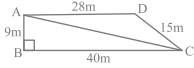
Students of a school staged a rally for a cleanliness campaign. They walked through the lanes in two groups. One group walked through the lanes $AB, BC$ and $CA$; while the other through $AC, CD$ and $DA$ (see Fig.). Then they cleaned the area enclosed within their lanes. If $AB = 9 \, m, BC = 40 \, m, CD = 15 \, m, DA = 28 \, m$ and $\angle B = 90^{\circ}$,which group cleaned more area and by how much (in $, m^2$)? Find the total area cleaned by the students (neglecting the width of the lanes).
A
$415$
B
$310$
C
$306$
D
$450$
Solution
(C) Since $AB = 9 \, m$ and $BC = 40 \, m$ with $\angle B = 90^{\circ}$,we use the Pythagorean theorem to find $AC$:
$AC = \sqrt{AB^2 + BC^2} = \sqrt{9^2 + 40^2} = \sqrt{81 + 1600} = \sqrt{1681} = 41 \, m$.
The first group cleans the area of the right-angled triangle $ABC$:
Area of $\Delta ABC = \frac{1}{2} \times \text{base} \times \text{height} = \frac{1}{2} \times 40 \times 9 = 180 \, m^2$.
The second group cleans the area of triangle $ACD$ with sides $41 \, m, 15 \, m$ and $28 \, m$. Using Heron's formula,the semi-perimeter $s = \frac{41 + 15 + 28}{2} = \frac{84}{2} = 42 \, m$.
Area of $\Delta ACD = \sqrt{s(s - a)(s - b)(s - c)} = \sqrt{42(42 - 41)(42 - 15)(42 - 28)} = \sqrt{42 \times 1 \times 27 \times 14} = \sqrt{15876} = 126 \, m^2$.
The first group cleaned $180 \, m^2$ and the second group cleaned $126 \, m^2$. The first group cleaned more area by $(180 - 126) = 54 \, m^2$.
Total area cleaned by the students $= 180 + 126 = 306 \, m^2$.
$AC = \sqrt{AB^2 + BC^2} = \sqrt{9^2 + 40^2} = \sqrt{81 + 1600} = \sqrt{1681} = 41 \, m$.
The first group cleans the area of the right-angled triangle $ABC$:
Area of $\Delta ABC = \frac{1}{2} \times \text{base} \times \text{height} = \frac{1}{2} \times 40 \times 9 = 180 \, m^2$.
The second group cleans the area of triangle $ACD$ with sides $41 \, m, 15 \, m$ and $28 \, m$. Using Heron's formula,the semi-perimeter $s = \frac{41 + 15 + 28}{2} = \frac{84}{2} = 42 \, m$.
Area of $\Delta ACD = \sqrt{s(s - a)(s - b)(s - c)} = \sqrt{42(42 - 41)(42 - 15)(42 - 28)} = \sqrt{42 \times 1 \times 27 \times 14} = \sqrt{15876} = 126 \, m^2$.
The first group cleaned $180 \, m^2$ and the second group cleaned $126 \, m^2$. The first group cleaned more area by $(180 - 126) = 54 \, m^2$.
Total area cleaned by the students $= 180 + 126 = 306 \, m^2$.
0 likes
View Solution12
DifficultMCQ
$A$ park,in the shape of a quadrilateral $ABCD$,has $\angle C = 90^{\circ}$,$AB = 9 \, m$,$BC = 12 \, m$,$CD = 5 \, m$,and $AD = 8 \, m$. How much area does it occupy (in $, m^{2}$)?
A
$80.5$
B
$75.5$
C
$70.1$
D
$65.5$
Solution
(D) Join $B$ and $D$ to divide the quadrilateral $ABCD$ into two triangles: $\Delta BCD$ and $\Delta ABD$.
$1$. In the right-angled $\Delta BCD$ (since $\angle C = 90^{\circ}$):
Area of $\Delta BCD = \frac{1}{2} \times \text{base} \times \text{height} = \frac{1}{2} \times 12 \times 5 = 30 \, m^{2}$.
$2$. Calculate the length of the diagonal $BD$ using the Pythagoras theorem:
$BD^{2} = BC^{2} + CD^{2} = 12^{2} + 5^{2} = 144 + 25 = 169$.
$BD = \sqrt{169} = 13 \, m$.
$3$. For $\Delta ABD$,the sides are $a = 9 \, m$,$b = 8 \, m$,and $c = 13 \, m$.
Semi-perimeter $s = \frac{9 + 8 + 13}{2} = \frac{30}{2} = 15 \, m$.
Using Heron's formula,Area of $\Delta ABD = \sqrt{s(s-a)(s-b)(s-c)} = \sqrt{15(15-9)(15-8)(15-13)} = \sqrt{15 \times 6 \times 7 \times 2} = \sqrt{1260} = 6\sqrt{35} \, m^{2}$.
Using $\sqrt{35} \approx 5.916$,Area $\approx 6 \times 5.916 = 35.496 \approx 35.5 \, m^{2}$.
$4$. Total area of quadrilateral $ABCD = \text{Area}(\Delta BCD) + \text{Area}(\Delta ABD) = 30 + 35.5 = 65.5 \, m^{2}$.
$1$. In the right-angled $\Delta BCD$ (since $\angle C = 90^{\circ}$):
Area of $\Delta BCD = \frac{1}{2} \times \text{base} \times \text{height} = \frac{1}{2} \times 12 \times 5 = 30 \, m^{2}$.
$2$. Calculate the length of the diagonal $BD$ using the Pythagoras theorem:
$BD^{2} = BC^{2} + CD^{2} = 12^{2} + 5^{2} = 144 + 25 = 169$.
$BD = \sqrt{169} = 13 \, m$.
$3$. For $\Delta ABD$,the sides are $a = 9 \, m$,$b = 8 \, m$,and $c = 13 \, m$.
Semi-perimeter $s = \frac{9 + 8 + 13}{2} = \frac{30}{2} = 15 \, m$.
Using Heron's formula,Area of $\Delta ABD = \sqrt{s(s-a)(s-b)(s-c)} = \sqrt{15(15-9)(15-8)(15-13)} = \sqrt{15 \times 6 \times 7 \times 2} = \sqrt{1260} = 6\sqrt{35} \, m^{2}$.
Using $\sqrt{35} \approx 5.916$,Area $\approx 6 \times 5.916 = 35.496 \approx 35.5 \, m^{2}$.
$4$. Total area of quadrilateral $ABCD = \text{Area}(\Delta BCD) + \text{Area}(\Delta ABD) = 30 + 35.5 = 65.5 \, m^{2}$.
0 likes
View Solution13
DifficultMCQ
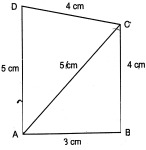
Find the area of a quadrilateral $ABCD$ in which $AB = 3 \, cm, BC = 4 \, cm, CD = 4 \, cm, DA = 5 \, cm$ and $AC = 5 \, cm$. (in $, cm^2$)
A
$15.2$
B
$27.8$
C
$55.2$
D
$25.2$
Solution
(A) The quadrilateral $ABCD$ is divided into two triangles,$\Delta ABC$ and $\Delta ACD$,by the diagonal $AC$.
For $\Delta ABC$:
The sides are $a = 3 \, cm, b = 4 \, cm, c = 5 \, cm$.
Semi-perimeter $s_1 = \frac{3 + 4 + 5}{2} = 6 \, cm$.
Area of $\Delta ABC = \sqrt{s_1(s_1 - a)(s_1 - b)(s_1 - c)} = \sqrt{6(6 - 3)(6 - 4)(6 - 5)} = \sqrt{6 \times 3 \times 2 \times 1} = \sqrt{36} = 6 \, cm^2$.
For $\Delta ACD$:
The sides are $a = 5 \, cm, b = 4 \, cm, c = 5 \, cm$.
Semi-perimeter $s_2 = \frac{5 + 4 + 5}{2} = 7 \, cm$.
Area of $\Delta ACD = \sqrt{s_2(s_2 - a)(s_2 - b)(s_2 - c)} = \sqrt{7(7 - 5)(7 - 4)(7 - 5)} = \sqrt{7 \times 2 \times 3 \times 2} = \sqrt{84} = 2\sqrt{21} \, cm^2$.
Using $\sqrt{21} \approx 4.58$,Area $\approx 2 \times 4.58 = 9.16 \, cm^2$.
Total area of quadrilateral $ABCD = \text{Area}(\Delta ABC) + \text{Area}(\Delta ACD) = 6 + 9.16 = 15.16 \, cm^2 \approx 15.2 \, cm^2$.
For $\Delta ABC$:
The sides are $a = 3 \, cm, b = 4 \, cm, c = 5 \, cm$.
Semi-perimeter $s_1 = \frac{3 + 4 + 5}{2} = 6 \, cm$.
Area of $\Delta ABC = \sqrt{s_1(s_1 - a)(s_1 - b)(s_1 - c)} = \sqrt{6(6 - 3)(6 - 4)(6 - 5)} = \sqrt{6 \times 3 \times 2 \times 1} = \sqrt{36} = 6 \, cm^2$.
For $\Delta ACD$:
The sides are $a = 5 \, cm, b = 4 \, cm, c = 5 \, cm$.
Semi-perimeter $s_2 = \frac{5 + 4 + 5}{2} = 7 \, cm$.
Area of $\Delta ACD = \sqrt{s_2(s_2 - a)(s_2 - b)(s_2 - c)} = \sqrt{7(7 - 5)(7 - 4)(7 - 5)} = \sqrt{7 \times 2 \times 3 \times 2} = \sqrt{84} = 2\sqrt{21} \, cm^2$.
Using $\sqrt{21} \approx 4.58$,Area $\approx 2 \times 4.58 = 9.16 \, cm^2$.
Total area of quadrilateral $ABCD = \text{Area}(\Delta ABC) + \text{Area}(\Delta ACD) = 6 + 9.16 = 15.16 \, cm^2 \approx 15.2 \, cm^2$.
0 likes
View Solution14
DifficultMCQ
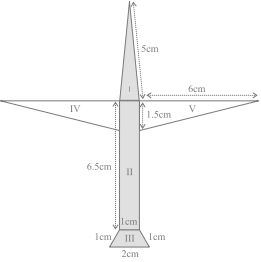
Radha made a picture of an aeroplane with coloured paper as shown in the figure. Find the total area of the paper used. (in $, cm^{2}$)
A
$29.3$
B
$19.3$
C
$32.3$
D
$45.3$
Solution
(B) Area of surface $I$:
It is an isosceles triangle with sides $a = 5\, cm, b = 5\, cm, c = 1\, cm$.
Semi-perimeter $s = \frac{5+5+1}{2} = 5.5\, cm$.
Area $= \sqrt{s(s-a)(s-b)(s-c)} = \sqrt{5.5(5.5-5)(5.5-5)(5.5-1)} = \sqrt{5.5 \times 0.5 \times 0.5 \times 4.5} = \sqrt{6.1875} \approx 2.48\, cm^{2}$.
Area of surface $II$:
It is a rectangle with length $6.5\, cm$ and breadth $1\, cm$.
Area $= 6.5 \times 1 = 6.5\, cm^{2}$.
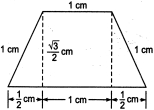
Area of surface $III$:
It is a trapezium with parallel sides $1\, cm$ and $2\, cm$. The height $h$ is calculated using Pythagoras theorem: $h = \sqrt{1^{2} - (0.5)^{2}} = \sqrt{0.75} \approx 0.866\, cm$.
Area $= \frac{1}{2} \times (1 + 2) \times 0.866 = 1.5 \times 0.866 \approx 1.3\, cm^{2}$.
Area of surface $IV$ and $V$:
These are two congruent right-angled triangles with base $6\, cm$ and height $1.5\, cm$.
Area of $IV = \frac{1}{2} \times 6 \times 1.5 = 4.5\, cm^{2}$.
Area of $V = 4.5\, cm^{2}$.
Total area $= 2.48 + 6.5 + 1.3 + 4.5 + 4.5 = 19.28\, cm^{2} \approx 19.3\, cm^{2}$.
It is an isosceles triangle with sides $a = 5\, cm, b = 5\, cm, c = 1\, cm$.
Semi-perimeter $s = \frac{5+5+1}{2} = 5.5\, cm$.
Area $= \sqrt{s(s-a)(s-b)(s-c)} = \sqrt{5.5(5.5-5)(5.5-5)(5.5-1)} = \sqrt{5.5 \times 0.5 \times 0.5 \times 4.5} = \sqrt{6.1875} \approx 2.48\, cm^{2}$.
Area of surface $II$:
It is a rectangle with length $6.5\, cm$ and breadth $1\, cm$.
Area $= 6.5 \times 1 = 6.5\, cm^{2}$.
Area of surface $III$:
It is a trapezium with parallel sides $1\, cm$ and $2\, cm$. The height $h$ is calculated using Pythagoras theorem: $h = \sqrt{1^{2} - (0.5)^{2}} = \sqrt{0.75} \approx 0.866\, cm$.
Area $= \frac{1}{2} \times (1 + 2) \times 0.866 = 1.5 \times 0.866 \approx 1.3\, cm^{2}$.
Area of surface $IV$ and $V$:
These are two congruent right-angled triangles with base $6\, cm$ and height $1.5\, cm$.
Area of $IV = \frac{1}{2} \times 6 \times 1.5 = 4.5\, cm^{2}$.
Area of $V = 4.5\, cm^{2}$.
Total area $= 2.48 + 6.5 + 1.3 + 4.5 + 4.5 = 19.28\, cm^{2} \approx 19.3\, cm^{2}$.
0 likes
View Solution15
MediumMCQ
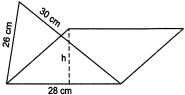
$A$ triangle and a parallelogram have the same base and the same area. If the sides of the triangle are $26 \, cm$,$28 \, cm$,and $30 \, cm$,and the parallelogram stands on the base $28 \, cm$,find the height of the parallelogram. (in $, cm$)
A
$29$
B
$22$
C
$12$
D
$10$
Solution
(C) For the given triangle,the sides are $a = 28 \, cm$,$b = 30 \, cm$,and $c = 26 \, cm$.
The semi-perimeter $s$ is calculated as:
$s = \frac{a + b + c}{2} = \frac{28 + 30 + 26}{2} \, cm = \frac{84}{2} = 42 \, cm$.
Using Heron's formula,the area of the triangle is:
$\text{Area} = \sqrt{s(s - a)(s - b)(s - c)} = \sqrt{42(42 - 28)(42 - 30)(42 - 26)} \, cm^2$
$= \sqrt{42 \times 14 \times 12 \times 16} \, cm^2$
$= \sqrt{(6 \times 7) \times (2 \times 7) \times (6 \times 2) \times 16} \, cm^2$
$= \sqrt{6^2 \times 7^2 \times 2^2 \times 4^2} \, cm^2 = 6 \times 7 \times 2 \times 4 \, cm^2 = 336 \, cm^2$.
Since the area of the parallelogram is equal to the area of the triangle:
$\text{Area of the parallelogram} = 336 \, cm^2$.
The formula for the area of a parallelogram is $\text{base} \times \text{height}$.
$28 \, cm \times h = 336 \, cm^2$
$h = \frac{336}{28} \, cm = 12 \, cm$.
Thus,the height of the parallelogram is $12 \, cm$.
The semi-perimeter $s$ is calculated as:
$s = \frac{a + b + c}{2} = \frac{28 + 30 + 26}{2} \, cm = \frac{84}{2} = 42 \, cm$.
Using Heron's formula,the area of the triangle is:
$\text{Area} = \sqrt{s(s - a)(s - b)(s - c)} = \sqrt{42(42 - 28)(42 - 30)(42 - 26)} \, cm^2$
$= \sqrt{42 \times 14 \times 12 \times 16} \, cm^2$
$= \sqrt{(6 \times 7) \times (2 \times 7) \times (6 \times 2) \times 16} \, cm^2$
$= \sqrt{6^2 \times 7^2 \times 2^2 \times 4^2} \, cm^2 = 6 \times 7 \times 2 \times 4 \, cm^2 = 336 \, cm^2$.
Since the area of the parallelogram is equal to the area of the triangle:
$\text{Area of the parallelogram} = 336 \, cm^2$.
The formula for the area of a parallelogram is $\text{base} \times \text{height}$.
$28 \, cm \times h = 336 \, cm^2$
$h = \frac{336}{28} \, cm = 12 \, cm$.
Thus,the height of the parallelogram is $12 \, cm$.
0 likes
View Solution16
DifficultMCQ
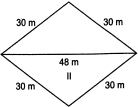
$A$ rhombus shaped field has green grass for $18$ cows to graze. If each side of the rhombus is $30\, m$ and its longer diagonal is $48\, m$,how much area of grass field will each cow be getting (in $, m^{2}$)?
A
$25$
B
$38$
C
$50$
D
$48$
Solution
(D) Here,each side of the rhombus $= 30\, m$.
One of the diagonals $= 48\, m$.
Since a diagonal divides the rhombus into two congruent triangles,the sides of the first triangle are $a = 30\, m, b = 30\, m, c = 48\, m$.
The semi-perimeter $s = \frac{a + b + c}{2} = \frac{30 + 30 + 48}{2}\, m = \frac{108}{2} = 54\, m$.
Area of triangle $I = \sqrt{s(s - a)(s - b)(s - c)} = \sqrt{54(54 - 30)(54 - 30)(54 - 48)}\, m^{2}$.
$= \sqrt{54 \times 24 \times 24 \times 6}\, m^{2} = \sqrt{(9 \times 6) \times 24 \times 24 \times 6}\, m^{2} = \sqrt{9 \times 36 \times 24^{2}}\, m^{2} = 3 \times 6 \times 24\, m^{2} = 432\, m^{2}$.
Area of the second triangle is also $432\, m^{2}$.
Total area of the rhombus $= 432\, m^{2} + 432\, m^{2} = 864\, m^{2}$.
Thus,the area of grass for $18$ cows $= 864\, m^{2}$.
Area of grass for $1$ cow $= \frac{864}{18}\, m^{2} = 48\, m^{2}$.
One of the diagonals $= 48\, m$.
Since a diagonal divides the rhombus into two congruent triangles,the sides of the first triangle are $a = 30\, m, b = 30\, m, c = 48\, m$.
The semi-perimeter $s = \frac{a + b + c}{2} = \frac{30 + 30 + 48}{2}\, m = \frac{108}{2} = 54\, m$.
Area of triangle $I = \sqrt{s(s - a)(s - b)(s - c)} = \sqrt{54(54 - 30)(54 - 30)(54 - 48)}\, m^{2}$.
$= \sqrt{54 \times 24 \times 24 \times 6}\, m^{2} = \sqrt{(9 \times 6) \times 24 \times 24 \times 6}\, m^{2} = \sqrt{9 \times 36 \times 24^{2}}\, m^{2} = 3 \times 6 \times 24\, m^{2} = 432\, m^{2}$.
Area of the second triangle is also $432\, m^{2}$.
Total area of the rhombus $= 432\, m^{2} + 432\, m^{2} = 864\, m^{2}$.
Thus,the area of grass for $18$ cows $= 864\, m^{2}$.
Area of grass for $1$ cow $= \frac{864}{18}\, m^{2} = 48\, m^{2}$.
0 likes
View Solution17
Medium
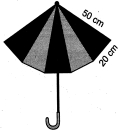
An umbrella is made by stitching $10$ triangular pieces of cloth of two different colours (see figure),each piece measuring $20\, cm, 50\, cm$ and $50\, cm$. How much cloth of each colour is required for the umbrella?
Solution
(N/A) The sides of each triangular piece are $a = 20\, cm$,$b = 50\, cm$,and $c = 50\, cm$.
The semi-perimeter $s$ is calculated as:
$s = \frac{a + b + c}{2} = \frac{20 + 50 + 50}{2}\, cm = \frac{120}{2}\, cm = 60\, cm$.
Using Heron's formula,the area of each triangular piece is:
Area $= \sqrt{s(s - a)(s - b)(s - c)} = \sqrt{60(60 - 20)(60 - 50)(60 - 50)}\, cm^2$
$= \sqrt{60 \times 40 \times 10 \times 10}\, cm^2 = \sqrt{240000}\, cm^2 = 200\sqrt{6}\, cm^2$.
Since there are $10$ triangular pieces in total,there are $5$ pieces of each colour.
Area of cloth required for each colour $= 5 \times 200\sqrt{6}\, cm^2 = 1000\sqrt{6}\, cm^2$.
The semi-perimeter $s$ is calculated as:
$s = \frac{a + b + c}{2} = \frac{20 + 50 + 50}{2}\, cm = \frac{120}{2}\, cm = 60\, cm$.
Using Heron's formula,the area of each triangular piece is:
Area $= \sqrt{s(s - a)(s - b)(s - c)} = \sqrt{60(60 - 20)(60 - 50)(60 - 50)}\, cm^2$
$= \sqrt{60 \times 40 \times 10 \times 10}\, cm^2 = \sqrt{240000}\, cm^2 = 200\sqrt{6}\, cm^2$.
Since there are $10$ triangular pieces in total,there are $5$ pieces of each colour.
Area of cloth required for each colour $= 5 \times 200\sqrt{6}\, cm^2 = 1000\sqrt{6}\, cm^2$.
0 likes
View Solution18
Difficult
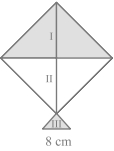
$A$ kite in the shape of a square with a diagonal $32\, cm$ and an isosceles triangle of base $8\, cm$ and sides $6\, cm$ each is to be made of three different shades as shown in the figure. How much paper of each shade has been used in it?
Solution
(N/A) Area of triangle $I$:
Diagonal $= 32\, cm$.
Since the diagonals of a square bisect each other at $90^\circ$,the height of triangle $I$ (which is half the diagonal) $= \frac{1}{2} \times 32\, cm = 16\, cm$.
The base of the triangle is the other diagonal of the square,which is also $32\, cm$.
Area of triangle $I = \frac{1}{2} \times \text{base} \times \text{height} = \frac{1}{2} \times 32\, cm \times 16\, cm = 256\, cm^2$.
Area of triangle $II$:
Since the diagonal of a square divides it into two congruent triangles,the area of triangle $II$ is equal to the area of triangle $I$.
Area of triangle $II = 256\, cm^2$.
Area of triangle $III$:
The triangle at the base has sides $a = 8\, cm, b = 6\, cm, c = 6\, cm$.
Semi-perimeter $s = \frac{a + b + c}{2} = \frac{8 + 6 + 6}{2} = 10\, cm$.
Using Heron's formula,Area $= \sqrt{s(s-a)(s-b)(s-c)}$.
Area $= \sqrt{10(10-8)(10-6)(10-6)} = \sqrt{10 \times 2 \times 4 \times 4} = \sqrt{320} = 8\sqrt{5}\, cm^2$.
Taking $\sqrt{5} \approx 2.24$,Area $\approx 8 \times 2.24 = 17.92\, cm^2$.
Thus,the area of paper used for each shade is:
Shade $I = 256\, cm^2$,Shade $II = 256\, cm^2$,Shade $III = 17.92\, cm^2$.
Diagonal $= 32\, cm$.
Since the diagonals of a square bisect each other at $90^\circ$,the height of triangle $I$ (which is half the diagonal) $= \frac{1}{2} \times 32\, cm = 16\, cm$.
The base of the triangle is the other diagonal of the square,which is also $32\, cm$.
Area of triangle $I = \frac{1}{2} \times \text{base} \times \text{height} = \frac{1}{2} \times 32\, cm \times 16\, cm = 256\, cm^2$.
Area of triangle $II$:
Since the diagonal of a square divides it into two congruent triangles,the area of triangle $II$ is equal to the area of triangle $I$.
Area of triangle $II = 256\, cm^2$.
Area of triangle $III$:
The triangle at the base has sides $a = 8\, cm, b = 6\, cm, c = 6\, cm$.
Semi-perimeter $s = \frac{a + b + c}{2} = \frac{8 + 6 + 6}{2} = 10\, cm$.
Using Heron's formula,Area $= \sqrt{s(s-a)(s-b)(s-c)}$.
Area $= \sqrt{10(10-8)(10-6)(10-6)} = \sqrt{10 \times 2 \times 4 \times 4} = \sqrt{320} = 8\sqrt{5}\, cm^2$.
Taking $\sqrt{5} \approx 2.24$,Area $\approx 8 \times 2.24 = 17.92\, cm^2$.
Thus,the area of paper used for each shade is:
Shade $I = 256\, cm^2$,Shade $II = 256\, cm^2$,Shade $III = 17.92\, cm^2$.
0 likes
View Solution19
MediumMCQ
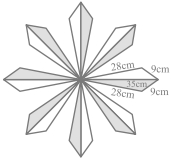
$A$ floral design on a floor is made up of $16$ tiles which are triangular,the sides of the triangle being $9\, cm, 28\, cm$ and $35\, cm$ (see Fig.). Find the cost of polishing the tiles at the rate of $50p$ per $cm^2$.
A
$Rs. 735.60$
B
$Rs. 105.60$
C
$Rs. 705.60$
D
$Rs. 955.60$
Solution
(C) There are $16$ equal triangular tiles.
Sides of the triangle are $a = 9\, cm, b = 28\, cm, c = 35\, cm$.
Semi-perimeter $s = \frac{a + b + c}{2} = \frac{9 + 28 + 35}{2} = \frac{72}{2} = 36\, cm$.
Area of one triangle using Heron's formula $= \sqrt{s(s - a)(s - b)(s - c)}$.
Area $= \sqrt{36(36 - 9)(36 - 28)(36 - 35)} = \sqrt{36 \times 27 \times 8 \times 1} = \sqrt{7776} = 36\sqrt{6}\, cm^2$.
Using $\sqrt{6} \approx 2.449$,Area $\approx 36 \times 2.449 = 88.164\, cm^2$.
Total area of $16$ tiles $= 16 \times 88.164 = 1410.624\, cm^2$.
Cost of polishing at $50p$ (or $Rs. 0.50$) per $cm^2$ $= 1410.624 \times 0.50 = Rs. 705.312$.
Rounding to the nearest value provided in the options,the cost is $Rs. 705.60$.
Sides of the triangle are $a = 9\, cm, b = 28\, cm, c = 35\, cm$.
Semi-perimeter $s = \frac{a + b + c}{2} = \frac{9 + 28 + 35}{2} = \frac{72}{2} = 36\, cm$.
Area of one triangle using Heron's formula $= \sqrt{s(s - a)(s - b)(s - c)}$.
Area $= \sqrt{36(36 - 9)(36 - 28)(36 - 35)} = \sqrt{36 \times 27 \times 8 \times 1} = \sqrt{7776} = 36\sqrt{6}\, cm^2$.
Using $\sqrt{6} \approx 2.449$,Area $\approx 36 \times 2.449 = 88.164\, cm^2$.
Total area of $16$ tiles $= 16 \times 88.164 = 1410.624\, cm^2$.
Cost of polishing at $50p$ (or $Rs. 0.50$) per $cm^2$ $= 1410.624 \times 0.50 = Rs. 705.312$.
Rounding to the nearest value provided in the options,the cost is $Rs. 705.60$.
0 likes
View Solution20
DifficultMCQ
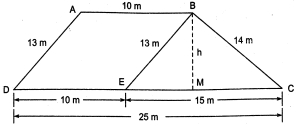
$A$ field is in the shape of a trapezium whose parallel sides are $25\, m$ and $10\, m$. The non-parallel sides are $14\, m$ and $13\, m$. Find the area of the field. (in $, m^{2}$)
A
$205$
B
$106$
C
$186$
D
$196$
Solution
(D) The given field is in the form of a trapezium $ABCD$ such that parallel sides are $AB = 10\, m$ and $DC = 25\, m$.
Non-parallel sides are $AD = 13\, m$ and $BC = 14\, m$.
Draw $BE \parallel AD$,such that $E$ lies on $DC$. Then $ABED$ is a parallelogram.
$DE = AB = 10\, m$,so $EC = DC - DE = 25\, m - 10\, m = 15\, m$.
In $\Delta BCE$,the sides are $a = 13\, m$,$b = 14\, m$,and $c = 15\, m$.
Semi-perimeter $s = \frac{13 + 14 + 15}{2} = \frac{42}{2} = 21\, m$.
Area of $\Delta BCE = \sqrt{s(s-a)(s-b)(s-c)} = \sqrt{21(21-13)(21-14)(21-15)} = \sqrt{21 \times 8 \times 7 \times 6} = \sqrt{7056} = 84\, m^{2}$.
Let $h$ be the height of $\Delta BCE$ corresponding to base $EC = 15\, m$.
Area of $\Delta BCE = \frac{1}{2} \times \text{base} \times \text{height} = 84\, m^{2}$.
$\frac{1}{2} \times 15 \times h = 84 \Rightarrow h = \frac{168}{15} = 11.2\, m$.
Area of parallelogram $ABED = \text{base} \times \text{height} = AB \times h = 10 \times 11.2 = 112\, m^{2}$.
Total area of the field = Area of $\Delta BCE +$ Area of parallelogram $ABED = 84 + 112 = 196\, m^{2}$.
Non-parallel sides are $AD = 13\, m$ and $BC = 14\, m$.
Draw $BE \parallel AD$,such that $E$ lies on $DC$. Then $ABED$ is a parallelogram.
$DE = AB = 10\, m$,so $EC = DC - DE = 25\, m - 10\, m = 15\, m$.
In $\Delta BCE$,the sides are $a = 13\, m$,$b = 14\, m$,and $c = 15\, m$.
Semi-perimeter $s = \frac{13 + 14 + 15}{2} = \frac{42}{2} = 21\, m$.
Area of $\Delta BCE = \sqrt{s(s-a)(s-b)(s-c)} = \sqrt{21(21-13)(21-14)(21-15)} = \sqrt{21 \times 8 \times 7 \times 6} = \sqrt{7056} = 84\, m^{2}$.
Let $h$ be the height of $\Delta BCE$ corresponding to base $EC = 15\, m$.
Area of $\Delta BCE = \frac{1}{2} \times \text{base} \times \text{height} = 84\, m^{2}$.
$\frac{1}{2} \times 15 \times h = 84 \Rightarrow h = \frac{168}{15} = 11.2\, m$.
Area of parallelogram $ABED = \text{base} \times \text{height} = AB \times h = 10 \times 11.2 = 112\, m^{2}$.
Total area of the field = Area of $\Delta BCE +$ Area of parallelogram $ABED = 84 + 112 = 196\, m^{2}$.
0 likes
View Solution21
MediumMCQ
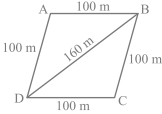
Sanya has a piece of land which is in the shape of a rhombus (see figure). She wants her one daughter and one son to work on the land and produce different crops. She divided the land into two equal parts. If the perimeter of the land is $400\, m$ and one of the diagonals is $160\, m$,how much area will each of them get for their crops (in $, m^2$)?
A
$4800$
B
$6300$
C
$5000$
D
$9800$
Solution
(A) Let $ABCD$ be the rhombus-shaped field.
Perimeter of the rhombus $= 400\, m$.
Since all sides of a rhombus are equal,each side $= 400\, m / 4 = 100\, m$.
Thus,$AB = BC = CD = DA = 100\, m$.
Let the diagonal $BD = 160\, m$.
The diagonal divides the rhombus into two congruent triangles,$\triangle ABD$ and $\triangle BCD$.
For $\triangle ABD$,the sides are $a = 100\, m$,$b = 100\, m$,and $c = 160\, m$.
The semi-perimeter $s$ is given by:
$s = (100 + 100 + 160) / 2 = 360 / 2 = 180\, m$.
Using Heron's formula,the area of $\triangle ABD$ is:
Area $= \sqrt{s(s-a)(s-b)(s-c)}$
Area $= \sqrt{180(180-100)(180-100)(180-160)}$
Area $= \sqrt{180 \times 80 \times 80 \times 20}$
Area $= \sqrt{180 \times 20 \times 80^2}$
Area $= \sqrt{3600 \times 6400}$
Area $= 60 \times 80 = 4800\, m^2$.
Since the land is divided into two equal parts,each of them will get an area of $4800\, m^2$.
Perimeter of the rhombus $= 400\, m$.
Since all sides of a rhombus are equal,each side $= 400\, m / 4 = 100\, m$.
Thus,$AB = BC = CD = DA = 100\, m$.
Let the diagonal $BD = 160\, m$.
The diagonal divides the rhombus into two congruent triangles,$\triangle ABD$ and $\triangle BCD$.
For $\triangle ABD$,the sides are $a = 100\, m$,$b = 100\, m$,and $c = 160\, m$.
The semi-perimeter $s$ is given by:
$s = (100 + 100 + 160) / 2 = 360 / 2 = 180\, m$.
Using Heron's formula,the area of $\triangle ABD$ is:
Area $= \sqrt{s(s-a)(s-b)(s-c)}$
Area $= \sqrt{180(180-100)(180-100)(180-160)}$
Area $= \sqrt{180 \times 80 \times 80 \times 20}$
Area $= \sqrt{180 \times 20 \times 80^2}$
Area $= \sqrt{3600 \times 6400}$
Area $= 60 \times 80 = 4800\, m^2$.
Since the land is divided into two equal parts,each of them will get an area of $4800\, m^2$.
0 likes
View SolutionHeron’s Formula — Textbook - Heron’s Formula · Frequently Asked Questions
1Are these Heron’s Formula questions useful for JEE and NEET?
Yes. All questions in this section are mapped to JEE Main and NEET exam patterns. Previous year questions from JEE Main, NEET, GUJCET and state-level exams are included with full solutions.
2Can I switch to Hindi or Gujarati for these questions?
Yes. Use the language tabs in the hero section or the sidebar to view the same questions and solutions in English, Hindi or Gujarati.
3How do I generate a question paper from this subtopic?
Use the Vedclass Exam Paper Generator — select the chapter and subtopic, set difficulty, and generate Sets A, B, C, D automatically. First 3 chapters of every subject are free.
Vedclass Products
For Students
Vedclass Test Series
Mock tests in real JEE/NEET style with performance analysis. 5-day free trial.
Start Free TrialFor Teachers
Exam Paper Generator
Generate Set A/B/C/D papers from this chapter in 2 minutes. 3 chapters free.
Try FreeFor Institutes
Online Exam Module
Live online exams with unlimited students, 360° analytics & white-label branding.
See DemoFor Teachers & Institutes
Generate a Heron’s Formula Exam Paper in 2 Minutes
Select subtopic & difficulty — Sets A, B, C, D auto-generated with No Repeat logic.
First 3 chapters of every subject are free — no payment required.