
A English
Spectral Series of Hydrogen Atom Questions in English
Class 12 Physics · Atoms · Spectral Series of Hydrogen Atom
242+
Questions
English
Language
100%
With Solutions
Showing 42 of 242 questions in English
201
MediumMCQ
The ratio of the wavelengths of the first Lyman line and the second Balmer line of the hydrogen atom is
A
$3: 4$
B
$1: 4$
C
$2: 3$
D
$1: 3$
Solution
(B) The wavelength $\lambda$ for a transition in a hydrogen atom is given by the Rydberg formula: $\frac{1}{\lambda} = R \left( \frac{1}{n_1^2} - \frac{1}{n_2^2} \right)$,where $R$ is the Rydberg constant.
$1$. For the first Lyman line,the transition is from $n_2 = 2$ to $n_1 = 1$:
$\frac{1}{\lambda_L} = R \left( \frac{1}{1^2} - \frac{1}{2^2} \right) = R \left( 1 - \frac{1}{4} \right) = \frac{3R}{4} \implies \lambda_L = \frac{4}{3R}$.
$2$. For the second Balmer line,the transition is from $n_2 = 4$ to $n_1 = 2$:
$\frac{1}{\lambda_B} = R \left( \frac{1}{2^2} - \frac{1}{4^2} \right) = R \left( \frac{1}{4} - \frac{1}{16} \right) = R \left( \frac{4-1}{16} \right) = \frac{3R}{16} \implies \lambda_B = \frac{16}{3R}$.
$3$. The ratio of the wavelengths is:
$\frac{\lambda_L}{\lambda_B} = \frac{4/3R}{16/3R} = \frac{4}{16} = \frac{1}{4}$.
Thus,the ratio is $1: 4$.
$1$. For the first Lyman line,the transition is from $n_2 = 2$ to $n_1 = 1$:
$\frac{1}{\lambda_L} = R \left( \frac{1}{1^2} - \frac{1}{2^2} \right) = R \left( 1 - \frac{1}{4} \right) = \frac{3R}{4} \implies \lambda_L = \frac{4}{3R}$.
$2$. For the second Balmer line,the transition is from $n_2 = 4$ to $n_1 = 2$:
$\frac{1}{\lambda_B} = R \left( \frac{1}{2^2} - \frac{1}{4^2} \right) = R \left( \frac{1}{4} - \frac{1}{16} \right) = R \left( \frac{4-1}{16} \right) = \frac{3R}{16} \implies \lambda_B = \frac{16}{3R}$.
$3$. The ratio of the wavelengths is:
$\frac{\lambda_L}{\lambda_B} = \frac{4/3R}{16/3R} = \frac{4}{16} = \frac{1}{4}$.
Thus,the ratio is $1: 4$.
0 likes
View Solution202
MediumMCQ
The ratio of the shortest wavelengths of Bracket and Balmer series of hydrogen atom is
A
$2: 1$
B
$3: 2$
C
$4: 1$
D
$6: 5$
Solution
(C) The wavelength $\lambda$ for a hydrogen atom transition is given by the Rydberg formula: $\frac{1}{\lambda} = R \left( \frac{1}{n_1^2} - \frac{1}{n_2^2} \right)$.
For the shortest wavelength,the transition occurs from $n_2 = \infty$ to $n_1$.
Thus,$\frac{1}{\lambda} = \frac{R}{n_1^2}$,or $\lambda = \frac{n_1^2}{R}$.
For the Balmer series,$n_1 = 2$,so $\lambda_{Balmer} = \frac{2^2}{R} = \frac{4}{R}$.
For the Bracket series,$n_1 = 4$,so $\lambda_{Bracket} = \frac{4^2}{R} = \frac{16}{R}$.
The ratio of the shortest wavelength of the Bracket series to the Balmer series is $\frac{\lambda_{Bracket}}{\lambda_{Balmer}} = \frac{16/R}{4/R} = \frac{16}{4} = 4:1$.
For the shortest wavelength,the transition occurs from $n_2 = \infty$ to $n_1$.
Thus,$\frac{1}{\lambda} = \frac{R}{n_1^2}$,or $\lambda = \frac{n_1^2}{R}$.
For the Balmer series,$n_1 = 2$,so $\lambda_{Balmer} = \frac{2^2}{R} = \frac{4}{R}$.
For the Bracket series,$n_1 = 4$,so $\lambda_{Bracket} = \frac{4^2}{R} = \frac{16}{R}$.
The ratio of the shortest wavelength of the Bracket series to the Balmer series is $\frac{\lambda_{Bracket}}{\lambda_{Balmer}} = \frac{16/R}{4/R} = \frac{16}{4} = 4:1$.
0 likes
View Solution203
MediumMCQ
The ratio of minimum wavelength of Balmer series to maximum wavelength in Brackett series in hydrogen spectrum is
A
$25$:$16$
B
$4$:$36$
C
$9$:$100$
D
$100$:$9$
Solution
(C) For hydrogen atom,the Rydberg formula is $\frac{1}{\lambda} = R \left( \frac{1}{n_1^2} - \frac{1}{n_2^2} \right)$.
For the Balmer series,$n_1 = 2$. The minimum wavelength corresponds to $n_2 = \infty$.
$\frac{1}{\lambda_{\text{min, Balmer}}} = R \left( \frac{1}{2^2} - \frac{1}{\infty^2} \right) = \frac{R}{4} \Rightarrow \lambda_{\text{min, Balmer}} = \frac{4}{R}$.
For the Brackett series,$n_1 = 4$. The maximum wavelength corresponds to $n_2 = 5$.
$\frac{1}{\lambda_{\text{max, Brackett}}} = R \left( \frac{1}{4^2} - \frac{1}{5^2} \right) = R \left( \frac{1}{16} - \frac{1}{25} \right) = R \left( \frac{25 - 16}{400} \right) = \frac{9R}{400}$.
$\lambda_{\text{max, Brackett}} = \frac{400}{9R}$.
The ratio is $\frac{\lambda_{\text{min, Balmer}}}{\lambda_{\text{max, Brackett}}} = \frac{4/R}{400/9R} = \frac{4}{R} \times \frac{9R}{400} = \frac{36}{400} = \frac{9}{100}$.
For the Balmer series,$n_1 = 2$. The minimum wavelength corresponds to $n_2 = \infty$.
$\frac{1}{\lambda_{\text{min, Balmer}}} = R \left( \frac{1}{2^2} - \frac{1}{\infty^2} \right) = \frac{R}{4} \Rightarrow \lambda_{\text{min, Balmer}} = \frac{4}{R}$.
For the Brackett series,$n_1 = 4$. The maximum wavelength corresponds to $n_2 = 5$.
$\frac{1}{\lambda_{\text{max, Brackett}}} = R \left( \frac{1}{4^2} - \frac{1}{5^2} \right) = R \left( \frac{1}{16} - \frac{1}{25} \right) = R \left( \frac{25 - 16}{400} \right) = \frac{9R}{400}$.
$\lambda_{\text{max, Brackett}} = \frac{400}{9R}$.
The ratio is $\frac{\lambda_{\text{min, Balmer}}}{\lambda_{\text{max, Brackett}}} = \frac{4/R}{400/9R} = \frac{4}{R} \times \frac{9R}{400} = \frac{36}{400} = \frac{9}{100}$.
0 likes
View Solution204
EasyMCQ
The transition of an electron in a hydrogen atom that emits a photon whose wavelength lies in the ultraviolet region of the electromagnetic spectrum is
A
$5 \rightarrow 4$
B
$4 \rightarrow 3$
C
$3 \rightarrow 2$
D
$2 \rightarrow 1$
Solution
(D) The spectral lines of the hydrogen atom are categorized into series based on the final energy level $n_f$ of the electron transition.
For the Lyman series,the electron transitions to the ground state,$n_f = 1$.
The energy of the emitted photon is given by $\Delta E = 13.6 \left( \frac{1}{n_f^2} - \frac{1}{n_i^2} \right) \text{ eV}$.
Transitions to $n_f = 1$ result in high-energy photons that fall within the ultraviolet region of the electromagnetic spectrum.
Among the given options,the transition $2 \rightarrow 1$ belongs to the Lyman series and thus emits a photon in the ultraviolet region.
For the Lyman series,the electron transitions to the ground state,$n_f = 1$.
The energy of the emitted photon is given by $\Delta E = 13.6 \left( \frac{1}{n_f^2} - \frac{1}{n_i^2} \right) \text{ eV}$.
Transitions to $n_f = 1$ result in high-energy photons that fall within the ultraviolet region of the electromagnetic spectrum.
Among the given options,the transition $2 \rightarrow 1$ belongs to the Lyman series and thus emits a photon in the ultraviolet region.
0 likes
View Solution205
DifficultMCQ
In the hydrogen spectrum,the shortest wavelengths of the Lyman and Balmer series are $\lambda_1$ and $\lambda_2$ respectively. The Rydberg constant of hydrogen is
A
$\frac{\lambda_1+\lambda_2}{2}$
B
$\frac{4(\lambda_2-\lambda_1)}{3 \lambda_1 \lambda_2}$
C
$\frac{3(\lambda_2-\lambda_1)}{4 \lambda_1 \lambda_2}$
D
$\frac{2(\lambda_2-\lambda_1)}{3 \lambda_1 \lambda_2}$
Solution
(B) For the Lyman series,the shortest wavelength corresponds to the transition from $n_2 = \infty$ to $n_1 = 1$. Using the Rydberg formula $\frac{1}{\lambda} = R_H \left( \frac{1}{n_1^2} - \frac{1}{n_2^2} \right)$,we get:
$\frac{1}{\lambda_1} = R_H \left( \frac{1}{1^2} - \frac{1}{\infty^2} \right) = R_H$ ...$(1)$
For the Balmer series,the shortest wavelength corresponds to the transition from $n_2 = \infty$ to $n_1 = 2$. Using the Rydberg formula,we get:
$\frac{1}{\lambda_2} = R_H \left( \frac{1}{2^2} - \frac{1}{\infty^2} \right) = \frac{R_H}{4}$ ...$(2)$
From equation $(1)$,$R_H = \frac{1}{\lambda_1}$. Substituting this into equation $(2)$,we have $\frac{1}{\lambda_2} = \frac{1}{4\lambda_1}$. However,the question asks for the expression of $R_H$ in terms of $\lambda_1$ and $\lambda_2$.
Subtracting the equations: $\frac{1}{\lambda_1} - \frac{1}{\lambda_2} = R_H - \frac{R_H}{4} = \frac{3R_H}{4}$.
Therefore,$R_H = \frac{4}{3} \left( \frac{1}{\lambda_1} - \frac{1}{\lambda_2} \right) = \frac{4(\lambda_2 - \lambda_1)}{3 \lambda_1 \lambda_2}$.
$\frac{1}{\lambda_1} = R_H \left( \frac{1}{1^2} - \frac{1}{\infty^2} \right) = R_H$ ...$(1)$
For the Balmer series,the shortest wavelength corresponds to the transition from $n_2 = \infty$ to $n_1 = 2$. Using the Rydberg formula,we get:
$\frac{1}{\lambda_2} = R_H \left( \frac{1}{2^2} - \frac{1}{\infty^2} \right) = \frac{R_H}{4}$ ...$(2)$
From equation $(1)$,$R_H = \frac{1}{\lambda_1}$. Substituting this into equation $(2)$,we have $\frac{1}{\lambda_2} = \frac{1}{4\lambda_1}$. However,the question asks for the expression of $R_H$ in terms of $\lambda_1$ and $\lambda_2$.
Subtracting the equations: $\frac{1}{\lambda_1} - \frac{1}{\lambda_2} = R_H - \frac{R_H}{4} = \frac{3R_H}{4}$.
Therefore,$R_H = \frac{4}{3} \left( \frac{1}{\lambda_1} - \frac{1}{\lambda_2} \right) = \frac{4(\lambda_2 - \lambda_1)}{3 \lambda_1 \lambda_2}$.
0 likes
View Solution206
EasyMCQ
The shortest wavelength in the Paschen series of the Hydrogen spectrum is (Rydberg constant of hydrogen $R_H = 1.097 \times 10^7 \ m^{-1}$). (in $nm$)
A
$91.2$
B
$364.6$
C
$820.4$
D
$2278.9$
Solution
(C) The wavelength $\lambda$ for the hydrogen spectrum is given by the Rydberg formula: $\frac{1}{\lambda} = R_H \left( \frac{1}{n_1^2} - \frac{1}{n_2^2} \right)$.
For the Paschen series,the transition occurs to the $n_1 = 3$ energy level.
The shortest wavelength corresponds to the transition from the highest energy level,$n_2 = \infty$.
Substituting these values into the formula:
$\frac{1}{\lambda_S} = R_H \left( \frac{1}{3^2} - \frac{1}{\infty^2} \right) = R_H \left( \frac{1}{9} - 0 \right) = \frac{R_H}{9}$.
Therefore,$\lambda_S = \frac{9}{R_H}$.
Given $R_H = 1.097 \times 10^7 \ m^{-1}$,we have:
$\lambda_S = \frac{9}{1.097 \times 10^7} \ m \approx 8.204 \times 10^{-7} \ m$.
Converting to nanometers $(1 \ nm = 10^{-9} \ m)$:
$\lambda_S = 820.4 \ nm$.
For the Paschen series,the transition occurs to the $n_1 = 3$ energy level.
The shortest wavelength corresponds to the transition from the highest energy level,$n_2 = \infty$.
Substituting these values into the formula:
$\frac{1}{\lambda_S} = R_H \left( \frac{1}{3^2} - \frac{1}{\infty^2} \right) = R_H \left( \frac{1}{9} - 0 \right) = \frac{R_H}{9}$.
Therefore,$\lambda_S = \frac{9}{R_H}$.
Given $R_H = 1.097 \times 10^7 \ m^{-1}$,we have:
$\lambda_S = \frac{9}{1.097 \times 10^7} \ m \approx 8.204 \times 10^{-7} \ m$.
Converting to nanometers $(1 \ nm = 10^{-9} \ m)$:
$\lambda_S = 820.4 \ nm$.
0 likes
View Solution207
EasyMCQ
The wavelength of the first spectral line of the Lyman series of the hydrogen spectrum is
A
$912 \mathring A$
B
$1215 \mathring A$
C
$1512 \mathring A$
D
$6563 \mathring A$
Solution
(B) The Rydberg formula for the wavelength of spectral lines is given by $\frac{1}{\lambda} = R \left( \frac{1}{n_1^2} - \frac{1}{n_2^2} \right) Z^2$.
For the Lyman series,the electron transitions to the ground state,so $n_1 = 1$.
The first spectral line of the Lyman series corresponds to the transition from the first excited state to the ground state,so $n_2 = 2$.
For hydrogen,the atomic number $Z = 1$.
Substituting these values into the formula:
$\frac{1}{\lambda} = R \left( \frac{1}{1^2} - \frac{1}{2^2} \right) (1)^2 = R \left( 1 - \frac{1}{4} \right) = R \left( \frac{3}{4} \right)$.
Therefore,$\lambda = \frac{4}{3R}$.
Given that $\frac{1}{R} \approx 911.6 \mathring A$ (often approximated as $912 \mathring A$),we have:
$\lambda = \frac{4}{3} \times 911.6 \mathring A \approx 1215.5 \mathring A$.
Rounding to the nearest option,the wavelength is $1215 \mathring A$.
For the Lyman series,the electron transitions to the ground state,so $n_1 = 1$.
The first spectral line of the Lyman series corresponds to the transition from the first excited state to the ground state,so $n_2 = 2$.
For hydrogen,the atomic number $Z = 1$.
Substituting these values into the formula:
$\frac{1}{\lambda} = R \left( \frac{1}{1^2} - \frac{1}{2^2} \right) (1)^2 = R \left( 1 - \frac{1}{4} \right) = R \left( \frac{3}{4} \right)$.
Therefore,$\lambda = \frac{4}{3R}$.
Given that $\frac{1}{R} \approx 911.6 \mathring A$ (often approximated as $912 \mathring A$),we have:
$\lambda = \frac{4}{3} \times 911.6 \mathring A \approx 1215.5 \mathring A$.
Rounding to the nearest option,the wavelength is $1215 \mathring A$.
0 likes
View Solution208
MediumMCQ
Ionisation potential of hydrogen atom is $13.6 eV$. When hydrogen atoms in ground state are excited by a supply of $12.1 eV$,then the number of spectral lines emitted by hydrogen atoms according to Bohr's theory is
A
$2$
B
$3$
C
$1$
D
$4$
Solution
(B) The energy of the ground state of a hydrogen atom is $E_1 = -13.6 eV$.
When energy $\Delta E = 12.1 eV$ is supplied,the electron is excited to a higher energy level $n$ such that $E_n = E_1 + \Delta E$.
$E_n = -13.6 eV + 12.1 eV = -1.5 eV$.
Using the formula $E_n = -\frac{13.6}{n^2} eV$,we have $-\frac{13.6}{n^2} = -1.5$.
$n^2 = \frac{13.6}{1.5} \approx 9.07$,which implies $n = 3$.
The electron is excited to the second excited state $(n = 3)$.
The number of spectral lines emitted when an electron transitions from state $n$ to the ground state is given by $N = \frac{n(n-1)}{2}$.
Substituting $n = 3$,we get $N = \frac{3(3-1)}{2} = \frac{3 \times 2}{2} = 3$ lines.
When energy $\Delta E = 12.1 eV$ is supplied,the electron is excited to a higher energy level $n$ such that $E_n = E_1 + \Delta E$.
$E_n = -13.6 eV + 12.1 eV = -1.5 eV$.
Using the formula $E_n = -\frac{13.6}{n^2} eV$,we have $-\frac{13.6}{n^2} = -1.5$.
$n^2 = \frac{13.6}{1.5} \approx 9.07$,which implies $n = 3$.
The electron is excited to the second excited state $(n = 3)$.
The number of spectral lines emitted when an electron transitions from state $n$ to the ground state is given by $N = \frac{n(n-1)}{2}$.
Substituting $n = 3$,we get $N = \frac{3(3-1)}{2} = \frac{3 \times 2}{2} = 3$ lines.
0 likes
View Solution209
EasyMCQ
When an electron in a hydrogen atom jumps to the innermost orbit,the radiation emitted belongs to which one of the following series?
A
Paschen
B
Balmer
C
Lyman
D
Brackett
Solution
(C) According to the Bohr model of the hydrogen atom,the energy levels are denoted by the principal quantum number $n$.
The innermost orbit corresponds to the ground state,where $n=1$.
When an electron transitions from any higher energy level $(n_2 > 1)$ to the ground state $(n_1 = 1)$,the emitted electromagnetic radiation falls in the ultraviolet region of the spectrum.
This specific set of spectral lines is known as the Lyman series.
The innermost orbit corresponds to the ground state,where $n=1$.
When an electron transitions from any higher energy level $(n_2 > 1)$ to the ground state $(n_1 = 1)$,the emitted electromagnetic radiation falls in the ultraviolet region of the spectrum.
This specific set of spectral lines is known as the Lyman series.
0 likes
View Solution210
MediumMCQ
The second line of the Balmer series has a wavelength of $4861 Å$. The wavelength of the first line of the Balmer series is: (in $Å$)
A
$1216$
B
$6563$
C
$4340$
D
$4101$
Solution
(B) The wavelength of the spectral lines in the Balmer series is given by the Rydberg formula: $\frac{1}{\lambda} = R \left( \frac{1}{2^2} - \frac{1}{n^2} \right)$,where $n = 3, 4, 5, \dots$
For the second line of the Balmer series,$n = 4$. Given $\lambda_2 = 4861 Å$:
$\frac{1}{4861} = R \left( \frac{1}{4} - \frac{1}{16} \right) = R \left( \frac{3}{16} \right) \implies R = \frac{16}{3 \times 4861} \dots (i)$
For the first line of the Balmer series,$n = 3$:
$\frac{1}{\lambda_1} = R \left( \frac{1}{2^2} - \frac{1}{3^2} \right) = R \left( \frac{1}{4} - \frac{1}{9} \right) = R \left( \frac{5}{36} \right)$
Substituting the value of $R$ from equation $(i)$:
$\frac{1}{\lambda_1} = \left( \frac{16}{3 \times 4861} \right) \times \left( \frac{5}{36} \right) = \frac{80}{108 \times 4861} = \frac{20}{27 \times 4861}$
$\lambda_1 = \frac{27 \times 4861}{20} = \frac{131247}{20} = 6562.35 Å \approx 6563 Å$.
For the second line of the Balmer series,$n = 4$. Given $\lambda_2 = 4861 Å$:
$\frac{1}{4861} = R \left( \frac{1}{4} - \frac{1}{16} \right) = R \left( \frac{3}{16} \right) \implies R = \frac{16}{3 \times 4861} \dots (i)$
For the first line of the Balmer series,$n = 3$:
$\frac{1}{\lambda_1} = R \left( \frac{1}{2^2} - \frac{1}{3^2} \right) = R \left( \frac{1}{4} - \frac{1}{9} \right) = R \left( \frac{5}{36} \right)$
Substituting the value of $R$ from equation $(i)$:
$\frac{1}{\lambda_1} = \left( \frac{16}{3 \times 4861} \right) \times \left( \frac{5}{36} \right) = \frac{80}{108 \times 4861} = \frac{20}{27 \times 4861}$
$\lambda_1 = \frac{27 \times 4861}{20} = \frac{131247}{20} = 6562.35 Å \approx 6563 Å$.
0 likes
View Solution211
EasyMCQ
The wavelength of the first line of Balmer series of hydrogen atom is $\lambda$. What will be the wavelength of the same line in doubly ionized lithium?
A
$\frac{\lambda}{2}$
B
$\frac{\lambda}{9}$
C
$\frac{\lambda}{8}$
D
$\frac{\lambda}{27}$
Solution
(B) The Rydberg formula for the wavelength of a spectral line is given by $\frac{1}{\lambda} = R Z^2 \left( \frac{1}{n_1^2} - \frac{1}{n_2^2} \right)$.
For the first line of the Balmer series,$n_1 = 2$ and $n_2 = 3$.
For hydrogen atom $(H)$,$Z = 1$. Thus,$\frac{1}{\lambda} = R (1)^2 \left( \frac{1}{2^2} - \frac{1}{3^2} \right) = R \left( \frac{1}{4} - \frac{1}{9} \right) = R \left( \frac{5}{36} \right)$.
For doubly ionized lithium $(Li^{2+})$,$Z = 3$. Let the wavelength be $\lambda'$.
Then,$\frac{1}{\lambda'} = R (3)^2 \left( \frac{1}{2^2} - \frac{1}{3^2} \right) = 9 R \left( \frac{5}{36} \right)$.
Comparing the two equations,$\frac{1}{\lambda'} = 9 \left( \frac{1}{\lambda} \right)$,which implies $\lambda' = \frac{\lambda}{9}$.
For the first line of the Balmer series,$n_1 = 2$ and $n_2 = 3$.
For hydrogen atom $(H)$,$Z = 1$. Thus,$\frac{1}{\lambda} = R (1)^2 \left( \frac{1}{2^2} - \frac{1}{3^2} \right) = R \left( \frac{1}{4} - \frac{1}{9} \right) = R \left( \frac{5}{36} \right)$.
For doubly ionized lithium $(Li^{2+})$,$Z = 3$. Let the wavelength be $\lambda'$.
Then,$\frac{1}{\lambda'} = R (3)^2 \left( \frac{1}{2^2} - \frac{1}{3^2} \right) = 9 R \left( \frac{5}{36} \right)$.
Comparing the two equations,$\frac{1}{\lambda'} = 9 \left( \frac{1}{\lambda} \right)$,which implies $\lambda' = \frac{\lambda}{9}$.
0 likes
View Solution212
EasyMCQ
If $\Delta \lambda_L$ is the difference between the shortest and longest wavelengths of the Lyman series and $\Delta \lambda_B$ is the difference between the shortest and longest wavelengths of the Balmer series,then $\frac{\Delta \lambda_B}{\Delta \lambda_L} = $
A
$2.4$
B
$4.8$
C
$7.2$
D
$9.6$
Solution
(D) For the Lyman series,the wavelengths are given by $\frac{1}{\lambda} = R \left( \frac{1}{1^2} - \frac{1}{n^2} \right)$ where $n = 2, 3, 4, \dots$.
Shortest wavelength $(\lambda_{L, min})$ occurs at $n = \infty$: $\frac{1}{\lambda_{L, min}} = R \implies \lambda_{L, min} = \frac{1}{R}$.
Longest wavelength $(\lambda_{L, max})$ occurs at $n = 2$: $\frac{1}{\lambda_{L, max}} = R \left( 1 - \frac{1}{4} \right) = \frac{3R}{4} \implies \lambda_{L, max} = \frac{4}{3R}$.
$\Delta \lambda_L = \lambda_{L, max} - \lambda_{L, min} = \frac{4}{3R} - \frac{1}{R} = \frac{1}{3R}$.
For the Balmer series,the wavelengths are given by $\frac{1}{\lambda} = R \left( \frac{1}{2^2} - \frac{1}{n^2} \right)$ where $n = 3, 4, 5, \dots$.
Shortest wavelength $(\lambda_{B, min})$ occurs at $n = \infty$: $\frac{1}{\lambda_{B, min}} = \frac{R}{4} \implies \lambda_{B, min} = \frac{4}{R}$.
Longest wavelength $(\lambda_{B, max})$ occurs at $n = 3$: $\frac{1}{\lambda_{B, max}} = R \left( \frac{1}{4} - \frac{1}{9} \right) = \frac{5R}{36} \implies \lambda_{B, max} = \frac{36}{5R}$.
$\Delta \lambda_B = \lambda_{B, max} - \lambda_{B, min} = \frac{36}{5R} - \frac{4}{R} = \frac{36 - 20}{5R} = \frac{16}{5R}$.
Therefore,$\frac{\Delta \lambda_B}{\Delta \lambda_L} = \frac{16/5R}{1/3R} = \frac{16}{5} \times 3 = \frac{48}{5} = 9.6$.
Shortest wavelength $(\lambda_{L, min})$ occurs at $n = \infty$: $\frac{1}{\lambda_{L, min}} = R \implies \lambda_{L, min} = \frac{1}{R}$.
Longest wavelength $(\lambda_{L, max})$ occurs at $n = 2$: $\frac{1}{\lambda_{L, max}} = R \left( 1 - \frac{1}{4} \right) = \frac{3R}{4} \implies \lambda_{L, max} = \frac{4}{3R}$.
$\Delta \lambda_L = \lambda_{L, max} - \lambda_{L, min} = \frac{4}{3R} - \frac{1}{R} = \frac{1}{3R}$.
For the Balmer series,the wavelengths are given by $\frac{1}{\lambda} = R \left( \frac{1}{2^2} - \frac{1}{n^2} \right)$ where $n = 3, 4, 5, \dots$.
Shortest wavelength $(\lambda_{B, min})$ occurs at $n = \infty$: $\frac{1}{\lambda_{B, min}} = \frac{R}{4} \implies \lambda_{B, min} = \frac{4}{R}$.
Longest wavelength $(\lambda_{B, max})$ occurs at $n = 3$: $\frac{1}{\lambda_{B, max}} = R \left( \frac{1}{4} - \frac{1}{9} \right) = \frac{5R}{36} \implies \lambda_{B, max} = \frac{36}{5R}$.
$\Delta \lambda_B = \lambda_{B, max} - \lambda_{B, min} = \frac{36}{5R} - \frac{4}{R} = \frac{36 - 20}{5R} = \frac{16}{5R}$.
Therefore,$\frac{\Delta \lambda_B}{\Delta \lambda_L} = \frac{16/5R}{1/3R} = \frac{16}{5} \times 3 = \frac{48}{5} = 9.6$.
0 likes
View Solution213
DifficultMCQ
The ratio of longest wavelength lines in the Balmer and Paschen series of hydrogen spectrum is
A
$\frac{5}{36}$
B
$\frac{7}{20}$
C
$\frac{7}{144}$
D
$\frac{5}{27}$
Solution
(B) The Rydberg formula for the wavelength $\lambda$ of a spectral line is given by $\frac{1}{\lambda} = R \left( \frac{1}{n_1^2} - \frac{1}{n_2^2} \right)$.
For the longest wavelength line,the transition occurs between adjacent energy levels,i.e.,$n_2 = n_1 + 1$.
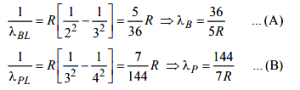
For the Balmer series,$n_1 = 2$,so $n_2 = 3$. The longest wavelength $\lambda_{BL}$ is:
$\frac{1}{\lambda_{BL}} = R \left( \frac{1}{2^2} - \frac{1}{3^2} \right) = R \left( \frac{1}{4} - \frac{1}{9} \right) = R \left( \frac{5}{36} \right) \implies \lambda_{BL} = \frac{36}{5R} \quad ... (A)$
For the Paschen series,$n_1 = 3$,so $n_2 = 4$. The longest wavelength $\lambda_{PL}$ is:
$\frac{1}{\lambda_{PL}} = R \left( \frac{1}{3^2} - \frac{1}{4^2} \right) = R \left( \frac{1}{9} - \frac{1}{16} \right) = R \left( \frac{7}{144} \right) \implies \lambda_{PL} = \frac{144}{7R} \quad ... (B)$
Taking the ratio of the longest wavelengths:
$\frac{\lambda_{BL}}{\lambda_{PL}} = \frac{36}{5R} \times \frac{7R}{144} = \frac{36 \times 7}{5 \times 144} = \frac{7}{5 \times 4} = \frac{7}{20}$.
For the longest wavelength line,the transition occurs between adjacent energy levels,i.e.,$n_2 = n_1 + 1$.
For the Balmer series,$n_1 = 2$,so $n_2 = 3$. The longest wavelength $\lambda_{BL}$ is:
$\frac{1}{\lambda_{BL}} = R \left( \frac{1}{2^2} - \frac{1}{3^2} \right) = R \left( \frac{1}{4} - \frac{1}{9} \right) = R \left( \frac{5}{36} \right) \implies \lambda_{BL} = \frac{36}{5R} \quad ... (A)$
For the Paschen series,$n_1 = 3$,so $n_2 = 4$. The longest wavelength $\lambda_{PL}$ is:
$\frac{1}{\lambda_{PL}} = R \left( \frac{1}{3^2} - \frac{1}{4^2} \right) = R \left( \frac{1}{9} - \frac{1}{16} \right) = R \left( \frac{7}{144} \right) \implies \lambda_{PL} = \frac{144}{7R} \quad ... (B)$
Taking the ratio of the longest wavelengths:
$\frac{\lambda_{BL}}{\lambda_{PL}} = \frac{36}{5R} \times \frac{7R}{144} = \frac{36 \times 7}{5 \times 144} = \frac{7}{5 \times 4} = \frac{7}{20}$.
0 likes
View Solution214
MediumMCQ
The difference between the frequencies of the first and second Lyman lines of the hydrogen atom is (where $R$ is the Rydberg constant and $c$ is the speed of light in vacuum).
A
$\frac{9 Rc}{28}$
B
$\frac{7 Rc}{12}$
C
$\frac{3 Rc}{8}$
D
$\frac{5 Rc}{36}$
Solution
(D) The frequency $\nu$ of a spectral line in the hydrogen atom is given by $\nu = c \cdot \bar{\nu} = Rc \left( \frac{1}{n_1^2} - \frac{1}{n_2^2} \right)$.
For the Lyman series,$n_1 = 1$.
The first Lyman line corresponds to the transition from $n_2 = 2$ to $n_1 = 1$:
$\nu_1 = Rc \left( \frac{1}{1^2} - \frac{1}{2^2} \right) = Rc \left( 1 - \frac{1}{4} \right) = \frac{3Rc}{4}$.
The second Lyman line corresponds to the transition from $n_2 = 3$ to $n_1 = 1$:
$\nu_2 = Rc \left( \frac{1}{1^2} - \frac{1}{3^2} \right) = Rc \left( 1 - \frac{1}{9} \right) = \frac{8Rc}{9}$.
The difference between the frequencies is $\Delta \nu = \nu_2 - \nu_1 = \frac{8Rc}{9} - \frac{3Rc}{4}$.
Taking the common denominator as $36$:
$\Delta \nu = \frac{32Rc - 27Rc}{36} = \frac{5Rc}{36}$.
For the Lyman series,$n_1 = 1$.
The first Lyman line corresponds to the transition from $n_2 = 2$ to $n_1 = 1$:
$\nu_1 = Rc \left( \frac{1}{1^2} - \frac{1}{2^2} \right) = Rc \left( 1 - \frac{1}{4} \right) = \frac{3Rc}{4}$.
The second Lyman line corresponds to the transition from $n_2 = 3$ to $n_1 = 1$:
$\nu_2 = Rc \left( \frac{1}{1^2} - \frac{1}{3^2} \right) = Rc \left( 1 - \frac{1}{9} \right) = \frac{8Rc}{9}$.
The difference between the frequencies is $\Delta \nu = \nu_2 - \nu_1 = \frac{8Rc}{9} - \frac{3Rc}{4}$.
Taking the common denominator as $36$:
$\Delta \nu = \frac{32Rc - 27Rc}{36} = \frac{5Rc}{36}$.
0 likes
View Solution215
MediumMCQ
The difference between the frequencies of the second and first Paschen lines of the hydrogen atom is (where $R$ is the Rydberg constant and $c$ is the speed of light in vacuum).
A
$\frac{9 Rc}{16}$
B
$\frac{16 R c}{25}$
C
$\frac{9 R c}{400}$
D
$\frac{3 R c}{200}$
Solution
(C) The frequency of a spectral line in the hydrogen atom is given by the formula: $\nu = Rc \left( \frac{1}{n_1^2} - \frac{1}{n_2^2} \right)$.
For the Paschen series,the lower energy level is $n_1 = 3$.
The first Paschen line corresponds to the transition from $n_2 = 4$ to $n_1 = 3$. Its frequency is $\nu_1 = Rc \left( \frac{1}{3^2} - \frac{1}{4^2} \right) = Rc \left( \frac{1}{9} - \frac{1}{16} \right) = Rc \left( \frac{16 - 9}{144} \right) = \frac{7Rc}{144}$.
The second Paschen line corresponds to the transition from $n_2 = 5$ to $n_1 = 3$. Its frequency is $\nu_2 = Rc \left( \frac{1}{3^2} - \frac{1}{5^2} \right) = Rc \left( \frac{1}{9} - \frac{1}{25} \right) = Rc \left( \frac{25 - 9}{225} \right) = \frac{16Rc}{225}$.
The difference between the frequencies is $\Delta \nu = \nu_2 - \nu_1 = Rc \left( \frac{16}{225} - \frac{7}{144} \right)$.
Calculating the common denominator: $225 = 3^2 \times 5^2$ and $144 = 3^2 \times 4^2$. The $LCM$ is $3^2 \times 5^2 \times 4^2 = 9 \times 25 \times 16 = 3600$.
$\Delta \nu = Rc \left( \frac{16 \times 16 - 7 \times 25}{3600} \right) = Rc \left( \frac{256 - 175}{3600} \right) = Rc \left( \frac{81}{3600} \right) = \frac{9Rc}{400}$.
For the Paschen series,the lower energy level is $n_1 = 3$.
The first Paschen line corresponds to the transition from $n_2 = 4$ to $n_1 = 3$. Its frequency is $\nu_1 = Rc \left( \frac{1}{3^2} - \frac{1}{4^2} \right) = Rc \left( \frac{1}{9} - \frac{1}{16} \right) = Rc \left( \frac{16 - 9}{144} \right) = \frac{7Rc}{144}$.
The second Paschen line corresponds to the transition from $n_2 = 5$ to $n_1 = 3$. Its frequency is $\nu_2 = Rc \left( \frac{1}{3^2} - \frac{1}{5^2} \right) = Rc \left( \frac{1}{9} - \frac{1}{25} \right) = Rc \left( \frac{25 - 9}{225} \right) = \frac{16Rc}{225}$.
The difference between the frequencies is $\Delta \nu = \nu_2 - \nu_1 = Rc \left( \frac{16}{225} - \frac{7}{144} \right)$.
Calculating the common denominator: $225 = 3^2 \times 5^2$ and $144 = 3^2 \times 4^2$. The $LCM$ is $3^2 \times 5^2 \times 4^2 = 9 \times 25 \times 16 = 3600$.
$\Delta \nu = Rc \left( \frac{16 \times 16 - 7 \times 25}{3600} \right) = Rc \left( \frac{256 - 175}{3600} \right) = Rc \left( \frac{81}{3600} \right) = \frac{9Rc}{400}$.
0 likes
View Solution216
MediumMCQ
The ratio of the wavelengths of the spectral lines emitted due to transitions $3 \rightarrow 2$ and $2 \rightarrow 1$ orbits in the hydrogen atom is
A
$3 :1$
B
$9 :17$
C
$27 :5$
D
$25 :9$
Solution
(C) The wavelength $\lambda$ of a spectral line emitted during a transition from orbit $n_i$ to $n_f$ is given by the Rydberg formula: $\frac{1}{\lambda} = R \left( \frac{1}{n_f^2} - \frac{1}{n_i^2} \right)$,where $R$ is the Rydberg constant.
For the transition $3 \rightarrow 2$: $\frac{1}{\lambda_1} = R \left( \frac{1}{2^2} - \frac{1}{3^2} \right) = R \left( \frac{1}{4} - \frac{1}{9} \right) = R \left( \frac{9-4}{36} \right) = \frac{5R}{36}$. Thus,$\lambda_1 = \frac{36}{5R}$.
For the transition $2 \rightarrow 1$: $\frac{1}{\lambda_2} = R \left( \frac{1}{1^2} - \frac{1}{2^2} \right) = R \left( 1 - \frac{1}{4} \right) = \frac{3R}{4}$. Thus,$\lambda_2 = \frac{4}{3R}$.
The ratio of the wavelengths is $\frac{\lambda_1}{\lambda_2} = \frac{36/5R}{4/3R} = \frac{36}{5R} \times \frac{3R}{4} = \frac{9 \times 3}{5} = \frac{27}{5}$.
For the transition $3 \rightarrow 2$: $\frac{1}{\lambda_1} = R \left( \frac{1}{2^2} - \frac{1}{3^2} \right) = R \left( \frac{1}{4} - \frac{1}{9} \right) = R \left( \frac{9-4}{36} \right) = \frac{5R}{36}$. Thus,$\lambda_1 = \frac{36}{5R}$.
For the transition $2 \rightarrow 1$: $\frac{1}{\lambda_2} = R \left( \frac{1}{1^2} - \frac{1}{2^2} \right) = R \left( 1 - \frac{1}{4} \right) = \frac{3R}{4}$. Thus,$\lambda_2 = \frac{4}{3R}$.
The ratio of the wavelengths is $\frac{\lambda_1}{\lambda_2} = \frac{36/5R}{4/3R} = \frac{36}{5R} \times \frac{3R}{4} = \frac{9 \times 3}{5} = \frac{27}{5}$.
0 likes
View Solution217
MediumMCQ
If the difference in the frequencies of the first and second lines of Lyman series of hydrogen atom is $f$,then the difference in frequencies of the first and second lines of Balmer series of hydrogen atom is
A
$\frac{3 f}{4}$
B
$f$
C
$\frac{7 f}{20}$
D
$\frac{5 f}{27}$
Solution
(C) The frequency of a spectral line in the hydrogen atom is given by $f = R c \left( \frac{1}{n_1^2} - \frac{1}{n_2^2} \right)$,where $R$ is the Rydberg constant and $c$ is the speed of light.
For the Lyman series,$n_1 = 1$. The first line is $n_2 = 2$ and the second line is $n_2 = 3$.
$f_1 = R c \left( \frac{1}{1^2} - \frac{1}{2^2} \right) = R c \left( 1 - \frac{1}{4} \right) = \frac{3}{4} R c$
$f_2 = R c \left( \frac{1}{1^2} - \frac{1}{3^2} \right) = R c \left( 1 - \frac{1}{9} \right) = \frac{8}{9} R c$
The difference is $f = f_2 - f_1 = R c \left( \frac{8}{9} - \frac{3}{4} \right) = R c \left( \frac{32 - 27}{36} \right) = \frac{5}{36} R c$. Thus,$R c = \frac{36 f}{5}$.
For the Balmer series,$n_1 = 2$. The first line is $n_2 = 3$ and the second line is $n_2 = 4$.
$f'_1 = R c \left( \frac{1}{2^2} - \frac{1}{3^2} \right) = R c \left( \frac{1}{4} - \frac{1}{9} \right) = \frac{5}{36} R c$
$f'_2 = R c \left( \frac{1}{2^2} - \frac{1}{4^2} \right) = R c \left( \frac{1}{4} - \frac{1}{16} \right) = \frac{3}{16} R c$
The difference is $f' = f'_2 - f'_1 = R c \left( \frac{3}{16} - \frac{5}{36} \right) = R c \left( \frac{27 - 20}{144} \right) = \frac{7}{144} R c$.
Substituting $R c = \frac{36 f}{5}$,we get $f' = \frac{7}{144} \times \frac{36 f}{5} = \frac{7 f}{4 \times 5} = \frac{7 f}{20}$.
For the Lyman series,$n_1 = 1$. The first line is $n_2 = 2$ and the second line is $n_2 = 3$.
$f_1 = R c \left( \frac{1}{1^2} - \frac{1}{2^2} \right) = R c \left( 1 - \frac{1}{4} \right) = \frac{3}{4} R c$
$f_2 = R c \left( \frac{1}{1^2} - \frac{1}{3^2} \right) = R c \left( 1 - \frac{1}{9} \right) = \frac{8}{9} R c$
The difference is $f = f_2 - f_1 = R c \left( \frac{8}{9} - \frac{3}{4} \right) = R c \left( \frac{32 - 27}{36} \right) = \frac{5}{36} R c$. Thus,$R c = \frac{36 f}{5}$.
For the Balmer series,$n_1 = 2$. The first line is $n_2 = 3$ and the second line is $n_2 = 4$.
$f'_1 = R c \left( \frac{1}{2^2} - \frac{1}{3^2} \right) = R c \left( \frac{1}{4} - \frac{1}{9} \right) = \frac{5}{36} R c$
$f'_2 = R c \left( \frac{1}{2^2} - \frac{1}{4^2} \right) = R c \left( \frac{1}{4} - \frac{1}{16} \right) = \frac{3}{16} R c$
The difference is $f' = f'_2 - f'_1 = R c \left( \frac{3}{16} - \frac{5}{36} \right) = R c \left( \frac{27 - 20}{144} \right) = \frac{7}{144} R c$.
Substituting $R c = \frac{36 f}{5}$,we get $f' = \frac{7}{144} \times \frac{36 f}{5} = \frac{7 f}{4 \times 5} = \frac{7 f}{20}$.
0 likes
View Solution218
MediumMCQ
The ratio of wavelengths of the second line in the Balmer series and the first line in the Lyman series of a hydrogen atom is:
A
$2: 1$
B
$9: 4$
C
$4: 1$
D
$3: 2$
Solution
(C) The wavelength $\lambda$ for a transition in a hydrogen atom is given by the Rydberg formula: $\frac{1}{\lambda} = R \left( \frac{1}{n_1^2} - \frac{1}{n_2^2} \right)$,where $R$ is the Rydberg constant.
For the second line of the Balmer series,$n_1 = 2$ and $n_2 = 4$. Thus,$\frac{1}{\lambda_B} = R \left( \frac{1}{2^2} - \frac{1}{4^2} \right) = R \left( \frac{1}{4} - \frac{1}{16} \right) = R \left( \frac{3}{16} \right)$. So,$\lambda_B = \frac{16}{3R}$.
For the first line of the Lyman series,$n_1 = 1$ and $n_2 = 2$. Thus,$\frac{1}{\lambda_L} = R \left( \frac{1}{1^2} - \frac{1}{2^2} \right) = R \left( 1 - \frac{1}{4} \right) = R \left( \frac{3}{4} \right)$. So,$\lambda_L = \frac{4}{3R}$.
The ratio of the wavelengths is $\frac{\lambda_B}{\lambda_L} = \frac{16/3R}{4/3R} = \frac{16}{4} = 4:1$.
For the second line of the Balmer series,$n_1 = 2$ and $n_2 = 4$. Thus,$\frac{1}{\lambda_B} = R \left( \frac{1}{2^2} - \frac{1}{4^2} \right) = R \left( \frac{1}{4} - \frac{1}{16} \right) = R \left( \frac{3}{16} \right)$. So,$\lambda_B = \frac{16}{3R}$.
For the first line of the Lyman series,$n_1 = 1$ and $n_2 = 2$. Thus,$\frac{1}{\lambda_L} = R \left( \frac{1}{1^2} - \frac{1}{2^2} \right) = R \left( 1 - \frac{1}{4} \right) = R \left( \frac{3}{4} \right)$. So,$\lambda_L = \frac{4}{3R}$.
The ratio of the wavelengths is $\frac{\lambda_B}{\lambda_L} = \frac{16/3R}{4/3R} = \frac{16}{4} = 4:1$.
0 likes
View Solution219
EasyMCQ
At room temperature, gaseous hydrogen is bombarded with a beam of electrons of $13.6 \ eV$ energy. The series to which the emitted spectral line belongs is:
A
Lyman series
B
Balmer series
C
Paschen series
D
Pfund series
Solution
(A) The energy of an electron in the $n^{th}$ orbit of a hydrogen atom is given by $E_n = -\frac{13.6}{n^2} \ eV$.
At room temperature, hydrogen atoms are in the ground state $(n=1)$, where the energy is $E_1 = -13.6 \ eV$.
When the atom is bombarded with electrons of $13.6 \ eV$ energy, the atom can absorb this energy and be excited to the ionization limit $(n = \infty)$ or any intermediate state.
However, the question asks for the series of the emitted spectral line. When an excited electron returns to the ground state $(n=1)$ from any higher energy level $(n > 1)$, the emitted radiation falls in the Lyman series.
Since the electrons can excite the hydrogen atoms to higher states and they eventually decay to the ground state, the emitted spectral lines belong to the Lyman series.
At room temperature, hydrogen atoms are in the ground state $(n=1)$, where the energy is $E_1 = -13.6 \ eV$.
When the atom is bombarded with electrons of $13.6 \ eV$ energy, the atom can absorb this energy and be excited to the ionization limit $(n = \infty)$ or any intermediate state.
However, the question asks for the series of the emitted spectral line. When an excited electron returns to the ground state $(n=1)$ from any higher energy level $(n > 1)$, the emitted radiation falls in the Lyman series.
Since the electrons can excite the hydrogen atoms to higher states and they eventually decay to the ground state, the emitted spectral lines belong to the Lyman series.
0 likes
View Solution220
EasyMCQ
The ratio of the wavelengths of radiation emitted when an electron in the hydrogen atom jumps from the $4^{th}$ orbit to the $2^{nd}$ orbit and from the $3^{rd}$ orbit to the $2^{nd}$ orbit is:
A
$27: 25$
B
$20: 27$
C
$20: 25$
D
$25: 27$
Solution
(B) The wavelength of radiation emitted from a hydrogen atom is given by the Rydberg formula: $\frac{1}{\lambda} = R \left[ \frac{1}{n_1^2} - \frac{1}{n_2^2} \right]$.
For the first case ($n_2 = 4$ to $n_1 = 2$):
$\frac{1}{\lambda_1} = R \left[ \frac{1}{2^2} - \frac{1}{4^2} \right] = R \left[ \frac{1}{4} - \frac{1}{16} \right] = R \left[ \frac{4-1}{16} \right] = \frac{3R}{16}$.
For the second case ($n_2 = 3$ to $n_1 = 2$):
$\frac{1}{\lambda_2} = R \left[ \frac{1}{2^2} - \frac{1}{3^2} \right] = R \left[ \frac{1}{4} - \frac{1}{9} \right] = R \left[ \frac{9-4}{36} \right] = \frac{5R}{36}$.
Now,taking the ratio of the wavelengths:
$\frac{\lambda_1}{\lambda_2} = \frac{1/\lambda_2}{1/\lambda_1} = \frac{5R/36}{3R/16} = \frac{5}{36} \times \frac{16}{3} = \frac{5 \times 4}{9 \times 3} = \frac{20}{27}$.
Thus,the ratio is $20:27$.
For the first case ($n_2 = 4$ to $n_1 = 2$):
$\frac{1}{\lambda_1} = R \left[ \frac{1}{2^2} - \frac{1}{4^2} \right] = R \left[ \frac{1}{4} - \frac{1}{16} \right] = R \left[ \frac{4-1}{16} \right] = \frac{3R}{16}$.
For the second case ($n_2 = 3$ to $n_1 = 2$):
$\frac{1}{\lambda_2} = R \left[ \frac{1}{2^2} - \frac{1}{3^2} \right] = R \left[ \frac{1}{4} - \frac{1}{9} \right] = R \left[ \frac{9-4}{36} \right] = \frac{5R}{36}$.
Now,taking the ratio of the wavelengths:
$\frac{\lambda_1}{\lambda_2} = \frac{1/\lambda_2}{1/\lambda_1} = \frac{5R/36}{3R/16} = \frac{5}{36} \times \frac{16}{3} = \frac{5 \times 4}{9 \times 3} = \frac{20}{27}$.
Thus,the ratio is $20:27$.
0 likes
View Solution221
EasyMCQ
In the hydrogen spectrum,the shortest and longest wavelengths of the Balmer series are $\lambda_1$ and $\lambda_2$ respectively. The Rydberg constant $R$ of hydrogen is:
A
$\frac{1}{\lambda_1}-\frac{9}{\lambda_2}$
B
$\frac{4}{\lambda_1}-\frac{9}{\lambda_2}$
C
$\frac{9}{\lambda_1}-\frac{9}{\lambda_2}$
D
$\frac{9}{\lambda_1}-\frac{4}{\lambda_2}$
Solution
(C) The Rydberg formula for the Balmer series is given by $\frac{1}{\lambda} = R \left( \frac{1}{2^2} - \frac{1}{n^2} \right)$,where $n = 3, 4, 5, \dots$.
For the shortest wavelength $\lambda_1$,$n = \infty$:
$\frac{1}{\lambda_1} = R \left( \frac{1}{4} - 0 \right) = \frac{R}{4} \implies R = \frac{4}{\lambda_1}$.
For the longest wavelength $\lambda_2$,$n = 3$:
$\frac{1}{\lambda_2} = R \left( \frac{1}{4} - \frac{1}{9} \right) = R \left( \frac{5}{36} \right) \implies R = \frac{36}{5\lambda_2}$.
To express $R$ in terms of $\lambda_1$ and $\lambda_2$,we use the relation:
$\frac{1}{\lambda_1} = \frac{R}{4}$ and $\frac{1}{\lambda_2} = \frac{5R}{36}$.
Multiplying the first by $9$: $\frac{9}{\lambda_1} = \frac{9R}{4}$.
Subtracting the second: $\frac{9}{\lambda_1} - \frac{1}{\lambda_2} = \frac{9R}{4} - \frac{5R}{36} = \frac{81R - 5R}{36} = \frac{76R}{36} = \frac{19R}{9}$.
Alternatively,using the derived values:
From $\frac{1}{\lambda_1} = \frac{R}{4}$,$R = \frac{4}{\lambda_1}$.
From $\frac{1}{\lambda_2} = \frac{5R}{36}$,$R = \frac{36}{5\lambda_2}$.
Equating or manipulating the options,we find that for $R = \frac{9}{\lambda_1} - \frac{9}{\lambda_2}$,we get $R = 9(\frac{R}{4} - \frac{5R}{36}) = 9(\frac{9R-5R}{36}) = 9(\frac{4R}{36}) = R$.
Thus,the correct expression is $R = \frac{9}{\lambda_1} - \frac{9}{\lambda_2}$.
For the shortest wavelength $\lambda_1$,$n = \infty$:
$\frac{1}{\lambda_1} = R \left( \frac{1}{4} - 0 \right) = \frac{R}{4} \implies R = \frac{4}{\lambda_1}$.
For the longest wavelength $\lambda_2$,$n = 3$:
$\frac{1}{\lambda_2} = R \left( \frac{1}{4} - \frac{1}{9} \right) = R \left( \frac{5}{36} \right) \implies R = \frac{36}{5\lambda_2}$.
To express $R$ in terms of $\lambda_1$ and $\lambda_2$,we use the relation:
$\frac{1}{\lambda_1} = \frac{R}{4}$ and $\frac{1}{\lambda_2} = \frac{5R}{36}$.
Multiplying the first by $9$: $\frac{9}{\lambda_1} = \frac{9R}{4}$.
Subtracting the second: $\frac{9}{\lambda_1} - \frac{1}{\lambda_2} = \frac{9R}{4} - \frac{5R}{36} = \frac{81R - 5R}{36} = \frac{76R}{36} = \frac{19R}{9}$.
Alternatively,using the derived values:
From $\frac{1}{\lambda_1} = \frac{R}{4}$,$R = \frac{4}{\lambda_1}$.
From $\frac{1}{\lambda_2} = \frac{5R}{36}$,$R = \frac{36}{5\lambda_2}$.
Equating or manipulating the options,we find that for $R = \frac{9}{\lambda_1} - \frac{9}{\lambda_2}$,we get $R = 9(\frac{R}{4} - \frac{5R}{36}) = 9(\frac{9R-5R}{36}) = 9(\frac{4R}{36}) = R$.
Thus,the correct expression is $R = \frac{9}{\lambda_1} - \frac{9}{\lambda_2}$.
0 likes
View Solution222
EasyMCQ
The ratio of longest wavelengths of the spectral lines in the Lyman and Balmer series of hydrogen spectrum is
A
$5/27$
B
$3/23$
C
$7/29$
D
$9/31$
Solution
(A) The longest wavelength corresponds to the transition between the closest energy levels.
For the Lyman series,the transition is from $n_2 = 2$ to $n_1 = 1$.
Using the Rydberg formula: $\frac{1}{\lambda_L} = R \left( \frac{1}{1^2} - \frac{1}{2^2} \right) = R \left( 1 - \frac{1}{4} \right) = \frac{3R}{4}$.
Thus,$\lambda_L = \frac{4}{3R}$.
For the Balmer series,the transition is from $n_2 = 3$ to $n_1 = 2$.
Using the Rydberg formula: $\frac{1}{\lambda_B} = R \left( \frac{1}{2^2} - \frac{1}{3^2} \right) = R \left( \frac{1}{4} - \frac{1}{9} \right) = \frac{5R}{36}$.
Thus,$\lambda_B = \frac{36}{5R}$.
The ratio of the longest wavelengths is $\frac{\lambda_L}{\lambda_B} = \frac{4/3R}{36/5R} = \frac{4}{3} \times \frac{5}{36} = \frac{5}{27}$.
For the Lyman series,the transition is from $n_2 = 2$ to $n_1 = 1$.
Using the Rydberg formula: $\frac{1}{\lambda_L} = R \left( \frac{1}{1^2} - \frac{1}{2^2} \right) = R \left( 1 - \frac{1}{4} \right) = \frac{3R}{4}$.
Thus,$\lambda_L = \frac{4}{3R}$.
For the Balmer series,the transition is from $n_2 = 3$ to $n_1 = 2$.
Using the Rydberg formula: $\frac{1}{\lambda_B} = R \left( \frac{1}{2^2} - \frac{1}{3^2} \right) = R \left( \frac{1}{4} - \frac{1}{9} \right) = \frac{5R}{36}$.
Thus,$\lambda_B = \frac{36}{5R}$.
The ratio of the longest wavelengths is $\frac{\lambda_L}{\lambda_B} = \frac{4/3R}{36/5R} = \frac{4}{3} \times \frac{5}{36} = \frac{5}{27}$.
0 likes
View Solution223
EasyMCQ
The light emitted in the transition $n = 3$ to $n = 2$ (where $n$ is the principal quantum number of the state) in hydrogen is called $H_{\alpha}$-light. Find the maximum work function that a metal can have so that $H_{\alpha}$-light can emit photoelectrons from it. (in $\text{ eV}$)
A
$1.5$
B
$2.89$
C
$1.89$
D
$3.5$
Solution
(C) The energy of the emitted photon during a transition from $n_i = 3$ to $n_f = 2$ is given by the Rydberg formula:
$E = 13.6 \left[ \frac{1}{n_f^2} - \frac{1}{n_i^2} \right] \text{ eV}$
Substituting the values $n_f = 2$ and $n_i = 3$:
$E = 13.6 \left[ \frac{1}{2^2} - \frac{1}{3^2} \right] \text{ eV}$
$E = 13.6 \left[ \frac{1}{4} - \frac{1}{9} \right] \text{ eV}$
$E = 13.6 \left[ \frac{9 - 4}{36} \right] \text{ eV}$
$E = 13.6 \times \frac{5}{36} \text{ eV} \approx 1.89 \text{ eV}$
For the photoelectric effect to occur, the energy of the incident photon must be greater than or equal to the work function $(\Phi)$ of the metal.
Therefore, the maximum work function is $\Phi_{\text{max}} = 1.89 \text{ eV}$.
$E = 13.6 \left[ \frac{1}{n_f^2} - \frac{1}{n_i^2} \right] \text{ eV}$
Substituting the values $n_f = 2$ and $n_i = 3$:
$E = 13.6 \left[ \frac{1}{2^2} - \frac{1}{3^2} \right] \text{ eV}$
$E = 13.6 \left[ \frac{1}{4} - \frac{1}{9} \right] \text{ eV}$
$E = 13.6 \left[ \frac{9 - 4}{36} \right] \text{ eV}$
$E = 13.6 \times \frac{5}{36} \text{ eV} \approx 1.89 \text{ eV}$
For the photoelectric effect to occur, the energy of the incident photon must be greater than or equal to the work function $(\Phi)$ of the metal.
Therefore, the maximum work function is $\Phi_{\text{max}} = 1.89 \text{ eV}$.
0 likes
View Solution224
DifficultMCQ
If the series limit frequency of the Balmer series is $\nu_{B}$,then the series limit frequency of the Brackett series is
A
$\frac{4 \nu_{B}}{25}$
B
$\frac{\nu_{B}}{9}$
C
$\frac{\nu_{B}}{4}$
D
$\frac{9 \nu_{B}}{4}$
Solution
(C) The frequency $\nu$ of emitted radiation for a transition in a hydrogen atom is given by $\nu = cR \left[ \frac{1}{n_1^2} - \frac{1}{n_2^2} \right]$.
For the series limit,the transition occurs from $n_2 = \infty$ to $n_1$.
For the Balmer series,$n_1 = 2$,so $\nu_{B} = cR \left[ \frac{1}{2^2} - \frac{1}{\infty^2} \right] = \frac{cR}{4}$.
For the Brackett series,$n_1 = 4$,so $\nu' = cR \left[ \frac{1}{4^2} - \frac{1}{\infty^2} \right] = \frac{cR}{16}$.
Dividing the two expressions: $\frac{\nu'}{\nu_{B}} = \frac{cR/16}{cR/4} = \frac{4}{16} = \frac{1}{4}$.
Therefore,$\nu' = \frac{\nu_{B}}{4}$.
For the series limit,the transition occurs from $n_2 = \infty$ to $n_1$.
For the Balmer series,$n_1 = 2$,so $\nu_{B} = cR \left[ \frac{1}{2^2} - \frac{1}{\infty^2} \right] = \frac{cR}{4}$.
For the Brackett series,$n_1 = 4$,so $\nu' = cR \left[ \frac{1}{4^2} - \frac{1}{\infty^2} \right] = \frac{cR}{16}$.
Dividing the two expressions: $\frac{\nu'}{\nu_{B}} = \frac{cR/16}{cR/4} = \frac{4}{16} = \frac{1}{4}$.
Therefore,$\nu' = \frac{\nu_{B}}{4}$.
0 likes
View Solution225
EasyMCQ
The difference in the wavelength between the maximum and minimum of Balmer series [Use $R_{H} = 1 \times 10^7 \ m^{-1}$]. (in $Å$)
A
$1600$
B
$3200$
C
$4000$
D
$4800$
Solution
(B) The Rydberg formula for the Balmer series is given by $\frac{1}{\lambda} = R_H \left( \frac{1}{2^2} - \frac{1}{n^2} \right)$,where $n = 3, 4, 5, \dots$
For the maximum wavelength (minimum energy),we take $n = 3$:
$\frac{1}{\lambda_{max}} = 10^7 \left( \frac{1}{4} - \frac{1}{9} \right) = 10^7 \left( \frac{5}{36} \right) \implies \lambda_{max} = \frac{36}{5} \times 10^{-7} \ m = 7.2 \times 10^{-7} \ m = 7200 \ Å$.
For the minimum wavelength (maximum energy),we take $n = \infty$:
$\frac{1}{\lambda_{min}} = 10^7 \left( \frac{1}{4} - 0 \right) = 10^7 \left( \frac{1}{4} \right) \implies \lambda_{min} = 4 \times 10^{-7} \ m = 4000 \ Å$.
The difference in wavelength is $\Delta \lambda = \lambda_{max} - \lambda_{min} = 7200 \ Å - 4000 \ Å = 3200 \ Å$.
For the maximum wavelength (minimum energy),we take $n = 3$:
$\frac{1}{\lambda_{max}} = 10^7 \left( \frac{1}{4} - \frac{1}{9} \right) = 10^7 \left( \frac{5}{36} \right) \implies \lambda_{max} = \frac{36}{5} \times 10^{-7} \ m = 7.2 \times 10^{-7} \ m = 7200 \ Å$.
For the minimum wavelength (maximum energy),we take $n = \infty$:
$\frac{1}{\lambda_{min}} = 10^7 \left( \frac{1}{4} - 0 \right) = 10^7 \left( \frac{1}{4} \right) \implies \lambda_{min} = 4 \times 10^{-7} \ m = 4000 \ Å$.
The difference in wavelength is $\Delta \lambda = \lambda_{max} - \lambda_{min} = 7200 \ Å - 4000 \ Å = 3200 \ Å$.
0 likes
View Solution226
EasyMCQ
In hydrogen atom spectra,if the ratio of wavelengths corresponding to the first line of the Lyman series and the first line of the Balmer series is $9 \alpha$,the value of $\alpha$ is
A
$0.5$
B
$0.8$
C
$0.6$
D
$0.021$
Solution
(D) According to Bohr's model,the wavelength $\lambda$ of the emitted radiation when an electron jumps from orbit $n_2$ to $n_1$ is given by the Rydberg formula:
$\frac{1}{\lambda} = R \left( \frac{1}{n_1^2} - \frac{1}{n_2^2} \right)$
For the first line of the Lyman series,$n_1 = 1$ and $n_2 = 2$:
$\frac{1}{\lambda_1} = R \left( \frac{1}{1^2} - \frac{1}{2^2} \right) = R \left( 1 - \frac{1}{4} \right) = \frac{3R}{4} \implies \lambda_1 = \frac{4}{3R}$
For the first line of the Balmer series,$n_1 = 2$ and $n_2 = 3$:
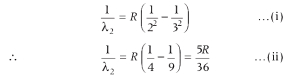
$\frac{1}{\lambda_2} = R \left( \frac{1}{2^2} - \frac{1}{3^2} \right) = R \left( \frac{1}{4} - \frac{1}{9} \right) = R \left( \frac{9-4}{36} \right) = \frac{5R}{36} \implies \lambda_2 = \frac{36}{5R}$
The ratio of the wavelengths is given as $\frac{\lambda_1}{\lambda_2} = 9 \alpha$:
$\frac{\lambda_1}{\lambda_2} = \left( \frac{4}{3R} \right) \times \left( \frac{5R}{36} \right) = \frac{4 \times 5}{3 \times 36} = \frac{20}{108} = \frac{5}{27}$
Given $\frac{\lambda_1}{\lambda_2} = 9 \alpha$,we have:
$9 \alpha = \frac{5}{27} \implies \alpha = \frac{5}{27 \times 9} = \frac{5}{243} \approx 0.02057 \approx 0.021$
$\frac{1}{\lambda} = R \left( \frac{1}{n_1^2} - \frac{1}{n_2^2} \right)$
For the first line of the Lyman series,$n_1 = 1$ and $n_2 = 2$:
$\frac{1}{\lambda_1} = R \left( \frac{1}{1^2} - \frac{1}{2^2} \right) = R \left( 1 - \frac{1}{4} \right) = \frac{3R}{4} \implies \lambda_1 = \frac{4}{3R}$
For the first line of the Balmer series,$n_1 = 2$ and $n_2 = 3$:
$\frac{1}{\lambda_2} = R \left( \frac{1}{2^2} - \frac{1}{3^2} \right) = R \left( \frac{1}{4} - \frac{1}{9} \right) = R \left( \frac{9-4}{36} \right) = \frac{5R}{36} \implies \lambda_2 = \frac{36}{5R}$
The ratio of the wavelengths is given as $\frac{\lambda_1}{\lambda_2} = 9 \alpha$:
$\frac{\lambda_1}{\lambda_2} = \left( \frac{4}{3R} \right) \times \left( \frac{5R}{36} \right) = \frac{4 \times 5}{3 \times 36} = \frac{20}{108} = \frac{5}{27}$
Given $\frac{\lambda_1}{\lambda_2} = 9 \alpha$,we have:
$9 \alpha = \frac{5}{27} \implies \alpha = \frac{5}{27 \times 9} = \frac{5}{243} \approx 0.02057 \approx 0.021$
0 likes
View Solution227
MediumMCQ
In the hydrogen spectrum,if the shortest wavelength in the Balmer series is $\lambda$,then the shortest wavelength in the Brackett series is:
A
$\lambda$
B
$\lambda / 2$
C
$4 \lambda$
D
$9 \lambda$
Solution
(C) The Rydberg formula for the wavelength $\lambda$ of spectral lines in the hydrogen atom is given by $\frac{1}{\lambda} = R \left( \frac{1}{n_1^2} - \frac{1}{n_2^2} \right)$,where $R$ is the Rydberg constant.
For the Balmer series,$n_1 = 2$. The shortest wavelength occurs when $n_2 = \infty$.
$\frac{1}{\lambda} = R \left( \frac{1}{2^2} - \frac{1}{\infty^2} \right) = \frac{R}{4} \implies \lambda = \frac{4}{R} \quad \dots (i)$
For the Brackett series,$n_1 = 4$. The shortest wavelength occurs when $n_2 = \infty$.
$\frac{1}{\lambda_{\text{Brackett}}} = R \left( \frac{1}{4^2} - \frac{1}{\infty^2} \right) = \frac{R}{16}$
$\lambda_{\text{Brackett}} = \frac{16}{R}$
Substituting $\frac{1}{R} = \frac{\lambda}{4}$ from equation $(i)$:
$\lambda_{\text{Brackett}} = 16 \times \left( \frac{\lambda}{4} \right) = 4 \lambda$.
For the Balmer series,$n_1 = 2$. The shortest wavelength occurs when $n_2 = \infty$.
$\frac{1}{\lambda} = R \left( \frac{1}{2^2} - \frac{1}{\infty^2} \right) = \frac{R}{4} \implies \lambda = \frac{4}{R} \quad \dots (i)$
For the Brackett series,$n_1 = 4$. The shortest wavelength occurs when $n_2 = \infty$.
$\frac{1}{\lambda_{\text{Brackett}}} = R \left( \frac{1}{4^2} - \frac{1}{\infty^2} \right) = \frac{R}{16}$
$\lambda_{\text{Brackett}} = \frac{16}{R}$
Substituting $\frac{1}{R} = \frac{\lambda}{4}$ from equation $(i)$:
$\lambda_{\text{Brackett}} = 16 \times \left( \frac{\lambda}{4} \right) = 4 \lambda$.
0 likes
View Solution228
EasyMCQ
The ratio of maximum to minimum wavelength in the Balmer series of a hydrogen atom is
A
$\frac{9}{5}$
B
$\frac{12}{7}$
C
$\frac{9}{7}$
D
$\frac{14}{9}$
Solution
(A) The wavelength of spectral lines for a hydrogen atom is given by the Rydberg formula:
$\frac{1}{\lambda} = R \left( \frac{1}{n_1^2} - \frac{1}{n_2^2} \right)$
For the Balmer series,$n_1 = 2$ and $n_2 = 3, 4, 5, \ldots$.
For the minimum wavelength (series limit),$n_2 = \infty$:
$\frac{1}{\lambda_{\min}} = R \left( \frac{1}{2^2} - \frac{1}{\infty^2} \right) = R \left( \frac{1}{4} - 0 \right) = \frac{R}{4}$
$\lambda_{\min} = \frac{4}{R}$
For the maximum wavelength,$n_2 = 3$:
$\frac{1}{\lambda_{\max}} = R \left( \frac{1}{2^2} - \frac{1}{3^2} \right) = R \left( \frac{1}{4} - \frac{1}{9} \right) = R \left( \frac{9 - 4}{36} \right) = \frac{5R}{36}$
$\lambda_{\max} = \frac{36}{5R}$
Now,the ratio of maximum to minimum wavelength is:
$\frac{\lambda_{\max}}{\lambda_{\min}} = \frac{36 / 5R}{4 / R} = \frac{36}{5R} \times \frac{R}{4} = \frac{9}{5}$
$\frac{1}{\lambda} = R \left( \frac{1}{n_1^2} - \frac{1}{n_2^2} \right)$
For the Balmer series,$n_1 = 2$ and $n_2 = 3, 4, 5, \ldots$.
For the minimum wavelength (series limit),$n_2 = \infty$:
$\frac{1}{\lambda_{\min}} = R \left( \frac{1}{2^2} - \frac{1}{\infty^2} \right) = R \left( \frac{1}{4} - 0 \right) = \frac{R}{4}$
$\lambda_{\min} = \frac{4}{R}$
For the maximum wavelength,$n_2 = 3$:
$\frac{1}{\lambda_{\max}} = R \left( \frac{1}{2^2} - \frac{1}{3^2} \right) = R \left( \frac{1}{4} - \frac{1}{9} \right) = R \left( \frac{9 - 4}{36} \right) = \frac{5R}{36}$
$\lambda_{\max} = \frac{36}{5R}$
Now,the ratio of maximum to minimum wavelength is:
$\frac{\lambda_{\max}}{\lambda_{\min}} = \frac{36 / 5R}{4 / R} = \frac{36}{5R} \times \frac{R}{4} = \frac{9}{5}$

0 likes
View Solution229
EasyMCQ
The wavelength of a spectral line emitted by a hydrogen atom in the Balmer series is $\frac{16}{3 R}$ ($R$ is the Rydberg constant). What is the value of the principal quantum number of the state from which the transition takes place?
A
$2$
B
$3$
C
$4$
D
$5$
Solution
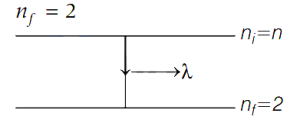
(C) The wavelength of a spectral line in the hydrogen atom is given by the Rydberg formula: $\frac{1}{\lambda} = R \left( \frac{1}{n_f^2} - \frac{1}{n_i^2} \right)$.
For the Balmer series,the final state is $n_f = 2$.
Substituting the values,we have: $\frac{1}{\lambda} = R \left( \frac{1}{2^2} - \frac{1}{n_i^2} \right) = R \left( \frac{1}{4} - \frac{1}{n_i^2} \right)$.
Given that $\lambda = \frac{16}{3 R}$,we substitute this into the equation:
$\frac{1}{(16 / 3 R)} = R \left( \frac{1}{4} - \frac{1}{n_i^2} \right) \Rightarrow \frac{3 R}{16} = R \left( \frac{1}{4} - \frac{1}{n_i^2} \right)$.
Dividing both sides by $R$,we get: $\frac{3}{16} = \frac{1}{4} - \frac{1}{n_i^2}$.
Rearranging the terms to solve for $n_i^2$: $\frac{1}{n_i^2} = \frac{1}{4} - \frac{3}{16} = \frac{4 - 3}{16} = \frac{1}{16}$.
Therefore,$n_i^2 = 16$,which gives $n_i = 4$.
For the Balmer series,the final state is $n_f = 2$.
Substituting the values,we have: $\frac{1}{\lambda} = R \left( \frac{1}{2^2} - \frac{1}{n_i^2} \right) = R \left( \frac{1}{4} - \frac{1}{n_i^2} \right)$.
Given that $\lambda = \frac{16}{3 R}$,we substitute this into the equation:
$\frac{1}{(16 / 3 R)} = R \left( \frac{1}{4} - \frac{1}{n_i^2} \right) \Rightarrow \frac{3 R}{16} = R \left( \frac{1}{4} - \frac{1}{n_i^2} \right)$.
Dividing both sides by $R$,we get: $\frac{3}{16} = \frac{1}{4} - \frac{1}{n_i^2}$.
Rearranging the terms to solve for $n_i^2$: $\frac{1}{n_i^2} = \frac{1}{4} - \frac{3}{16} = \frac{4 - 3}{16} = \frac{1}{16}$.
Therefore,$n_i^2 = 16$,which gives $n_i = 4$.
0 likes
View Solution230
DifficultMCQ
The shortest wavelength in the Lyman series is $912 \ \text{Å}$. Then, the longest wavelength in the series must be (in $\text{Å}$)
A
$9120$
B
$1824$
C
$1216$
D
$2432$
Solution
(C) For the $H$-atom, the Rydberg formula for the Lyman series is given by:
$\frac{1}{\lambda} = R \left( \frac{1}{1^2} - \frac{1}{n_2^2} \right)$
For the shortest wavelength, $n_2 = \infty$:
$\frac{1}{\lambda_{\text{min}}} = R \left( \frac{1}{1^2} - \frac{1}{\infty^2} \right) = R(1 - 0) = R$
Given $\lambda_{\text{min}} = 912 \ \text{Å}$, so $R = \frac{1}{912} \ \text{Å}^{-1}$.
For the longest wavelength, the transition occurs from the nearest energy level, i.e., $n_2 = 2$:
$\frac{1}{\lambda_{\text{max}}} = R \left( \frac{1}{1^2} - \frac{1}{2^2} \right) = R \left( 1 - \frac{1}{4} \right) = R \left( \frac{3}{4} \right)$
Substituting the value of $R$:
$\frac{1}{\lambda_{\text{max}}} = \frac{1}{912} \times \frac{3}{4} = \frac{3}{3648} = \frac{1}{1216}$
Therefore, $\lambda_{\text{max}} = 1216 \ \text{Å}$.
$\frac{1}{\lambda} = R \left( \frac{1}{1^2} - \frac{1}{n_2^2} \right)$
For the shortest wavelength, $n_2 = \infty$:
$\frac{1}{\lambda_{\text{min}}} = R \left( \frac{1}{1^2} - \frac{1}{\infty^2} \right) = R(1 - 0) = R$
Given $\lambda_{\text{min}} = 912 \ \text{Å}$, so $R = \frac{1}{912} \ \text{Å}^{-1}$.
For the longest wavelength, the transition occurs from the nearest energy level, i.e., $n_2 = 2$:
$\frac{1}{\lambda_{\text{max}}} = R \left( \frac{1}{1^2} - \frac{1}{2^2} \right) = R \left( 1 - \frac{1}{4} \right) = R \left( \frac{3}{4} \right)$
Substituting the value of $R$:
$\frac{1}{\lambda_{\text{max}}} = \frac{1}{912} \times \frac{3}{4} = \frac{3}{3648} = \frac{1}{1216}$
Therefore, $\lambda_{\text{max}} = 1216 \ \text{Å}$.

0 likes
View Solution231
EasyMCQ
If the first line in the Lyman series has wavelength $\lambda$,then the first line in the Balmer series has the wavelength
A
$\frac{27}{5} \lambda$
B
$\frac{32}{27} \lambda$
C
$\frac{28}{21} \lambda$
D
$\frac{15}{4} \lambda$
Solution
(A) The wavelength for the Lyman series is given by the Rydberg formula: $\frac{1}{\lambda} = R \left( \frac{1}{1^2} - \frac{1}{n^2} \right)$.
For the first line of the Lyman series,the transition is from $n = 2$ to $n = 1$.
Substituting these values: $\frac{1}{\lambda} = R \left( \frac{1}{1} - \frac{1}{4} \right) = R \left( \frac{3}{4} \right)$.
Thus,$R = \frac{4}{3\lambda}$ (Equation $i$).
The wavelength for the Balmer series is given by: $\frac{1}{\lambda^{\prime}} = R \left( \frac{1}{2^2} - \frac{1}{n^2} \right)$.
For the first line of the Balmer series,the transition is from $n = 3$ to $n = 2$.
Substituting these values: $\frac{1}{\lambda^{\prime}} = R \left( \frac{1}{4} - \frac{1}{9} \right) = R \left( \frac{9 - 4}{36} \right) = R \left( \frac{5}{36} \right)$.
Substituting the value of $R$ from Equation $i$: $\frac{1}{\lambda^{\prime}} = \left( \frac{4}{3\lambda} \right) \left( \frac{5}{36} \right) = \frac{20}{108\lambda} = \frac{5}{27\lambda}$.
Therefore,$\lambda^{\prime} = \frac{27}{5} \lambda$.
For the first line of the Lyman series,the transition is from $n = 2$ to $n = 1$.
Substituting these values: $\frac{1}{\lambda} = R \left( \frac{1}{1} - \frac{1}{4} \right) = R \left( \frac{3}{4} \right)$.
Thus,$R = \frac{4}{3\lambda}$ (Equation $i$).
The wavelength for the Balmer series is given by: $\frac{1}{\lambda^{\prime}} = R \left( \frac{1}{2^2} - \frac{1}{n^2} \right)$.
For the first line of the Balmer series,the transition is from $n = 3$ to $n = 2$.
Substituting these values: $\frac{1}{\lambda^{\prime}} = R \left( \frac{1}{4} - \frac{1}{9} \right) = R \left( \frac{9 - 4}{36} \right) = R \left( \frac{5}{36} \right)$.
Substituting the value of $R$ from Equation $i$: $\frac{1}{\lambda^{\prime}} = \left( \frac{4}{3\lambda} \right) \left( \frac{5}{36} \right) = \frac{20}{108\lambda} = \frac{5}{27\lambda}$.
Therefore,$\lambda^{\prime} = \frac{27}{5} \lambda$.

0 likes
View Solution232
MediumMCQ
Let $\lambda_P$ and $\lambda_L$ be the longest wavelengths observed in the Paschen and Lyman series respectively. Choose the correct option.
A
$4 < \frac{\lambda_P}{\lambda_L} < 6$
B
$7 < \frac{\lambda_P}{\lambda_L} < 8$
C
$15 < \frac{\lambda_P}{\lambda_L} < 16$
D
$30 < \frac{\lambda_P}{\lambda_L} < 32$
Solution
(C) The Rydberg formula for the wavelength $\lambda$ of a spectral line is given by $\frac{1}{\lambda} = R \left[ \frac{1}{n_1^2} - \frac{1}{n_2^2} \right]$.
For the Paschen series,$n_1 = 3$. The longest wavelength corresponds to the transition from $n_2 = 4$.
$\frac{1}{\lambda_P} = R \left[ \frac{1}{3^2} - \frac{1}{4^2} \right] = R \left[ \frac{1}{9} - \frac{1}{16} \right] = R \left[ \frac{16 - 9}{144} \right] = \frac{7R}{144}$.
Thus,$\lambda_P = \frac{144}{7R}$.
For the Lyman series,$n_1 = 1$. The longest wavelength corresponds to the transition from $n_2 = 2$.
$\frac{1}{\lambda_L} = R \left[ \frac{1}{1^2} - \frac{1}{2^2} \right] = R \left[ 1 - \frac{1}{4} \right] = \frac{3R}{4}$.
Thus,$\lambda_L = \frac{4}{3R}$.
Now,calculating the ratio $\frac{\lambda_P}{\lambda_L}$:
$\frac{\lambda_P}{\lambda_L} = \frac{144 / 7R}{4 / 3R} = \frac{144}{7R} \times \frac{3R}{4} = \frac{36 \times 3}{7} = \frac{108}{7} \approx 15.42$.
Since $15 < 15.42 < 16$,the correct option is $C$.
For the Paschen series,$n_1 = 3$. The longest wavelength corresponds to the transition from $n_2 = 4$.
$\frac{1}{\lambda_P} = R \left[ \frac{1}{3^2} - \frac{1}{4^2} \right] = R \left[ \frac{1}{9} - \frac{1}{16} \right] = R \left[ \frac{16 - 9}{144} \right] = \frac{7R}{144}$.
Thus,$\lambda_P = \frac{144}{7R}$.
For the Lyman series,$n_1 = 1$. The longest wavelength corresponds to the transition from $n_2 = 2$.
$\frac{1}{\lambda_L} = R \left[ \frac{1}{1^2} - \frac{1}{2^2} \right] = R \left[ 1 - \frac{1}{4} \right] = \frac{3R}{4}$.
Thus,$\lambda_L = \frac{4}{3R}$.
Now,calculating the ratio $\frac{\lambda_P}{\lambda_L}$:
$\frac{\lambda_P}{\lambda_L} = \frac{144 / 7R}{4 / 3R} = \frac{144}{7R} \times \frac{3R}{4} = \frac{36 \times 3}{7} = \frac{108}{7} \approx 15.42$.
Since $15 < 15.42 < 16$,the correct option is $C$.
0 likes
View Solution233
EasyMCQ
In a hydrogen sample,if the atoms are excited to states with principal quantum number $n = 20$,then the number of different wavelengths which may be observed in the spectrum is:
A
$100$
B
$140$
C
$190$
D
$230$
Solution
(C) When atoms are excited from the ground state to an excited state with principal quantum number $n = 20$,the number of possible spectral lines is given by the formula:
$N = \frac{n(n - 1)}{2}$
where $n$ is the principal quantum number.
Substituting the value $n = 20$ into the formula:
$N = \frac{20(20 - 1)}{2}$
$N = \frac{20 \times 19}{2}$
$N = 10 \times 19 = 190$
Therefore,the number of different wavelengths that may be observed in the spectrum is $190$.
$N = \frac{n(n - 1)}{2}$
where $n$ is the principal quantum number.
Substituting the value $n = 20$ into the formula:
$N = \frac{20(20 - 1)}{2}$
$N = \frac{20 \times 19}{2}$
$N = 10 \times 19 = 190$
Therefore,the number of different wavelengths that may be observed in the spectrum is $190$.
0 likes
View Solution234
MediumMCQ
If the first line of Lyman series has a wavelength $1215.4 \text{ Å}$, the first line of Balmer series is approximately (in $\text{ Å}$)
A
$4864$
B
$1025.5$
C
$6563$
D
$6400$
Solution
(C) From the hydrogen spectrum, when an electron transitions from $n_2$ orbit to $n_1$ orbit, the emitted wavelength $\lambda$ is given by the Rydberg formula: $\frac{1}{\lambda} = R Z^2 \left( \frac{1}{n_1^2} - \frac{1}{n_2^2} \right)$.
For the Lyman series, $n_1 = 1$. The first line corresponds to $n_2 = 2$. Thus, $\frac{1}{\lambda_L} = R Z^2 \left( \frac{1}{1^2} - \frac{1}{2^2} \right) = R Z^2 \left( 1 - \frac{1}{4} \right) = \frac{3}{4} R Z^2$.
For the Balmer series, $n_1 = 2$. The first line corresponds to $n_2 = 3$. Thus, $\frac{1}{\lambda_B} = R Z^2 \left( \frac{1}{2^2} - \frac{1}{3^2} \right) = R Z^2 \left( \frac{1}{4} - \frac{1}{9} \right) = R Z^2 \left( \frac{5}{36} \right)$.
Dividing the expression for $\frac{1}{\lambda_L}$ by $\frac{1}{\lambda_B}$, we get: $\frac{\lambda_B}{\lambda_L} = \frac{3/4}{5/36} = \frac{3}{4} \times \frac{36}{5} = \frac{27}{5} = 5.4$.
Given $\lambda_L = 1215.4 \text{ Å}$, we have $\lambda_B = 5.4 \times 1215.4 \text{ Å} = 6563.16 \text{ Å} \approx 6563 \text{ Å}$.
For the Lyman series, $n_1 = 1$. The first line corresponds to $n_2 = 2$. Thus, $\frac{1}{\lambda_L} = R Z^2 \left( \frac{1}{1^2} - \frac{1}{2^2} \right) = R Z^2 \left( 1 - \frac{1}{4} \right) = \frac{3}{4} R Z^2$.
For the Balmer series, $n_1 = 2$. The first line corresponds to $n_2 = 3$. Thus, $\frac{1}{\lambda_B} = R Z^2 \left( \frac{1}{2^2} - \frac{1}{3^2} \right) = R Z^2 \left( \frac{1}{4} - \frac{1}{9} \right) = R Z^2 \left( \frac{5}{36} \right)$.
Dividing the expression for $\frac{1}{\lambda_L}$ by $\frac{1}{\lambda_B}$, we get: $\frac{\lambda_B}{\lambda_L} = \frac{3/4}{5/36} = \frac{3}{4} \times \frac{36}{5} = \frac{27}{5} = 5.4$.
Given $\lambda_L = 1215.4 \text{ Å}$, we have $\lambda_B = 5.4 \times 1215.4 \text{ Å} = 6563.16 \text{ Å} \approx 6563 \text{ Å}$.
0 likes
View Solution235
EasyMCQ
The shortest wavelength in the Balmer series of the hydrogen atom spectrum is approximately equal to (use $R_{H} = 1.097 \times 10^7 \ \text{m}^{-1}$) (in $\text{Å}$)
A
$3646$
B
$912$
C
$364.6$
D
$91.2$
Solution
(A) For the shortest wavelength in the Balmer series, the transition occurs from $n_{i} = \infty$ to $n_{f} = 2$.
Using the Rydberg formula: $\frac{1}{\lambda} = R_{H} \left( \frac{1}{n_{f}^2} - \frac{1}{n_{i}^2} \right)$.
Substituting the values: $\frac{1}{\lambda} = 1.097 \times 10^7 \left( \frac{1}{2^2} - \frac{1}{\infty^2} \right)$.
$\frac{1}{\lambda} = 1.097 \times 10^7 \times \frac{1}{4} = 2742500 \ \text{m}^{-1}$.
$\lambda = \frac{1}{2742500} \ \text{m} \approx 3.646 \times 10^{-7} \ \text{m}$.
Converting to $\text{Å}$: $\lambda = 3.646 \times 10^{-7} \times 10^{10} \ \text{Å} = 3646 \ \text{Å}$.
Using the Rydberg formula: $\frac{1}{\lambda} = R_{H} \left( \frac{1}{n_{f}^2} - \frac{1}{n_{i}^2} \right)$.
Substituting the values: $\frac{1}{\lambda} = 1.097 \times 10^7 \left( \frac{1}{2^2} - \frac{1}{\infty^2} \right)$.
$\frac{1}{\lambda} = 1.097 \times 10^7 \times \frac{1}{4} = 2742500 \ \text{m}^{-1}$.
$\lambda = \frac{1}{2742500} \ \text{m} \approx 3.646 \times 10^{-7} \ \text{m}$.
Converting to $\text{Å}$: $\lambda = 3.646 \times 10^{-7} \times 10^{10} \ \text{Å} = 3646 \ \text{Å}$.
0 likes
View Solution236
MediumMCQ
$A$ hydrogen atom emits a photon corresponding to an electron transition from $n=5$ to $n=1$. If $R$ is the Rydberg constant,then the wavelength of the emitted photon is
A
$\frac{25}{24 R}$
B
$\frac{24 R}{25}$
C
$\frac{4}{5 R}$
D
$\frac{5 R}{4}$
Solution
(A) From Rydberg's equation,the wavelength $\lambda$ for an electron transition is given by:
$\frac{1}{\lambda} = R \left( \frac{1}{n_f^2} - \frac{1}{n_i^2} \right)$
Here,the transition is from $n_i = 5$ to $n_f = 1$.
Substituting the values:
$\frac{1}{\lambda} = R \left( \frac{1}{1^2} - \frac{1}{5^2} \right)$
$\frac{1}{\lambda} = R \left( 1 - \frac{1}{25} \right)$
$\frac{1}{\lambda} = R \left( \frac{25 - 1}{25} \right)$
$\frac{1}{\lambda} = \frac{24 R}{25}$
Therefore,the wavelength is $\lambda = \frac{25}{24 R}$.
$\frac{1}{\lambda} = R \left( \frac{1}{n_f^2} - \frac{1}{n_i^2} \right)$
Here,the transition is from $n_i = 5$ to $n_f = 1$.
Substituting the values:
$\frac{1}{\lambda} = R \left( \frac{1}{1^2} - \frac{1}{5^2} \right)$
$\frac{1}{\lambda} = R \left( 1 - \frac{1}{25} \right)$
$\frac{1}{\lambda} = R \left( \frac{25 - 1}{25} \right)$
$\frac{1}{\lambda} = \frac{24 R}{25}$
Therefore,the wavelength is $\lambda = \frac{25}{24 R}$.
0 likes
View Solution237
MediumMCQ
The minimum wavelength of Lyman series lines is $P$. What is the maximum wavelength of these lines?
A
$\frac{4 P}{3}$
B
$2 P$
C
$\frac{2 P}{3}$
D
$\infty$
Solution
(A) For the Lyman series,the wavelength $\lambda$ is given by the Rydberg formula: $\frac{1}{\lambda} = R \left( \frac{1}{1^2} - \frac{1}{n^2} \right)$,where $n = 2, 3, 4, \dots$
$1$. The minimum wavelength $(\lambda_{\min})$ occurs for the transition from $n = \infty$ to $n = 1$:
$\frac{1}{\lambda_{\min}} = R \left( \frac{1}{1^2} - \frac{1}{\infty^2} \right) = R$
Given $\lambda_{\min} = P$,we have $P = \frac{1}{R}$.
$2$. The maximum wavelength $(\lambda_{\max})$ occurs for the transition from $n = 2$ to $n = 1$:
$\frac{1}{\lambda_{\max}} = R \left( \frac{1}{1^2} - \frac{1}{2^2} \right) = R \left( 1 - \frac{1}{4} \right) = R \left( \frac{3}{4} \right)$
$3$. Substituting $R = \frac{1}{P}$ into the equation:
$\frac{1}{\lambda_{\max}} = \frac{1}{P} \cdot \frac{3}{4}$
$\lambda_{\max} = \frac{4 P}{3}$.
$1$. The minimum wavelength $(\lambda_{\min})$ occurs for the transition from $n = \infty$ to $n = 1$:
$\frac{1}{\lambda_{\min}} = R \left( \frac{1}{1^2} - \frac{1}{\infty^2} \right) = R$
Given $\lambda_{\min} = P$,we have $P = \frac{1}{R}$.
$2$. The maximum wavelength $(\lambda_{\max})$ occurs for the transition from $n = 2$ to $n = 1$:
$\frac{1}{\lambda_{\max}} = R \left( \frac{1}{1^2} - \frac{1}{2^2} \right) = R \left( 1 - \frac{1}{4} \right) = R \left( \frac{3}{4} \right)$
$3$. Substituting $R = \frac{1}{P}$ into the equation:
$\frac{1}{\lambda_{\max}} = \frac{1}{P} \cdot \frac{3}{4}$
$\lambda_{\max} = \frac{4 P}{3}$.
0 likes
View Solution238
MediumMCQ
If $R$ is the Rydberg constant in $cm^{-1}$,then the hydrogen atom does not emit any radiation of wavelength in the range of
A
$\frac{1}{R}$ to $\frac{4}{3R} \ cm$
B
$\frac{7}{5R}$ to $\frac{19}{5R} \ cm$
C
$\frac{4}{R}$ to $\frac{36}{5R} \ cm$
D
$\frac{9}{R}$ to $\frac{144}{7R} \ cm$
Solution
(B) The wavelength $\lambda$ of radiation emitted by a hydrogen atom is given by the Rydberg formula: $\frac{1}{\lambda} = R \left[ \frac{1}{n_f^2} - \frac{1}{n_i^2} \right]$.
For each spectral series,the range of wavelengths is determined by the transition from $n_i = n_f + 1$ to $n_i = \infty$.
$1$. Lyman series $(n_f = 1)$: $\lambda$ ranges from $\frac{1}{R}$ to $\frac{4}{3R}$.
$2$. Balmer series $(n_f = 2)$: $\lambda$ ranges from $\frac{4}{R}$ to $\frac{36}{5R}$.
$3$. Paschen series $(n_f = 3)$: $\lambda$ ranges from $\frac{9}{R}$ to $\frac{144}{7R}$.
Comparing the given options,the range $\frac{7}{5R}$ to $\frac{19}{5R}$ does not correspond to any of the spectral series of the hydrogen atom.
For each spectral series,the range of wavelengths is determined by the transition from $n_i = n_f + 1$ to $n_i = \infty$.
$1$. Lyman series $(n_f = 1)$: $\lambda$ ranges from $\frac{1}{R}$ to $\frac{4}{3R}$.
$2$. Balmer series $(n_f = 2)$: $\lambda$ ranges from $\frac{4}{R}$ to $\frac{36}{5R}$.
$3$. Paschen series $(n_f = 3)$: $\lambda$ ranges from $\frac{9}{R}$ to $\frac{144}{7R}$.
Comparing the given options,the range $\frac{7}{5R}$ to $\frac{19}{5R}$ does not correspond to any of the spectral series of the hydrogen atom.
0 likes
View Solution239
MediumMCQ
The wavelength of the second Balmer line in the hydrogen spectrum is $600 \ nm$. The wavelength for its third line in the Lyman series is:
A
$800 \ nm$
B
$600 \ nm$
C
$400 \ nm$
D
None of the above
Solution
(D) The Rydberg formula is given by $\frac{1}{\lambda} = R \left[ \frac{1}{n_1^2} - \frac{1}{n_2^2} \right]$.
For the Balmer series,$n_1 = 2$. The first line corresponds to $n_2 = 3$,and the second line corresponds to $n_2 = 4$.
$\frac{1}{\lambda_B} = R \left[ \frac{1}{2^2} - \frac{1}{4^2} \right] = R \left[ \frac{1}{4} - \frac{1}{16} \right] = R \left( \frac{3}{16} \right)$.
Given $\lambda_B = 600 \ nm$,so $\frac{1}{600} = R \left( \frac{3}{16} \right) \implies R = \frac{16}{1800} \ nm^{-1}$.
For the Lyman series,$n_1 = 1$. The third line corresponds to $n_2 = 4$ (since $n_2 = 2, 3, 4, \dots$).
$\frac{1}{\lambda_L} = R \left[ \frac{1}{1^2} - \frac{1}{4^2} \right] = R \left[ 1 - \frac{1}{16} \right] = R \left( \frac{15}{16} \right)$.
Substituting the value of $R$:
$\frac{1}{\lambda_L} = \left( \frac{16}{1800} \right) \left( \frac{15}{16} \right) = \frac{15}{1800} = \frac{1}{120}$.
Therefore,$\lambda_L = 120 \ nm$.
Since $120 \ nm$ is not among the options,the correct choice is $D$.
For the Balmer series,$n_1 = 2$. The first line corresponds to $n_2 = 3$,and the second line corresponds to $n_2 = 4$.
$\frac{1}{\lambda_B} = R \left[ \frac{1}{2^2} - \frac{1}{4^2} \right] = R \left[ \frac{1}{4} - \frac{1}{16} \right] = R \left( \frac{3}{16} \right)$.
Given $\lambda_B = 600 \ nm$,so $\frac{1}{600} = R \left( \frac{3}{16} \right) \implies R = \frac{16}{1800} \ nm^{-1}$.
For the Lyman series,$n_1 = 1$. The third line corresponds to $n_2 = 4$ (since $n_2 = 2, 3, 4, \dots$).
$\frac{1}{\lambda_L} = R \left[ \frac{1}{1^2} - \frac{1}{4^2} \right] = R \left[ 1 - \frac{1}{16} \right] = R \left( \frac{15}{16} \right)$.
Substituting the value of $R$:
$\frac{1}{\lambda_L} = \left( \frac{16}{1800} \right) \left( \frac{15}{16} \right) = \frac{15}{1800} = \frac{1}{120}$.
Therefore,$\lambda_L = 120 \ nm$.
Since $120 \ nm$ is not among the options,the correct choice is $D$.
0 likes
View Solution240
DifficultMCQ
The smallest wavelength of the Lyman series is $91 \ nm$. The difference between the largest wavelengths of the Paschen and Balmer series is nearly . . . . . . $nm$.
A
$1875$
B
$1550$
C
$1217$
D
$1784$
Solution
(C) The Rydberg formula is given by $\frac{1}{\lambda} = R \left( \frac{1}{n_1^2} - \frac{1}{n_2^2} \right)$.
For the Lyman series,the smallest wavelength corresponds to $n_1 = 1$ and $n_2 = \infty$.
$\frac{1}{\lambda_{L,min}} = R \left( \frac{1}{1^2} - \frac{1}{\infty^2} \right) = R = \frac{1}{91} \ nm^{-1}$.
For the Balmer series,the largest wavelength corresponds to $n_1 = 2$ and $n_2 = 3$.
$\frac{1}{\lambda_{B,max}} = R \left( \frac{1}{2^2} - \frac{1}{3^2} \right) = \frac{1}{91} \left( \frac{1}{4} - \frac{1}{9} \right) = \frac{1}{91} \left( \frac{5}{36} \right)$.
$\lambda_{B,max} = \frac{91 \times 36}{5} = 655.2 \ nm$.
For the Paschen series,the largest wavelength corresponds to $n_1 = 3$ and $n_2 = 4$.
$\frac{1}{\lambda_{P,max}} = R \left( \frac{1}{3^2} - \frac{1}{4^2} \right) = \frac{1}{91} \left( \frac{1}{9} - \frac{1}{16} \right) = \frac{1}{91} \left( \frac{7}{144} \right)$.
$\lambda_{P,max} = \frac{91 \times 144}{7} = 1872 \ nm$.
The difference is $\Delta\lambda = \lambda_{P,max} - \lambda_{B,max} = 1872 - 655.2 = 1216.8 \ nm \approx 1217 \ nm$.
For the Lyman series,the smallest wavelength corresponds to $n_1 = 1$ and $n_2 = \infty$.
$\frac{1}{\lambda_{L,min}} = R \left( \frac{1}{1^2} - \frac{1}{\infty^2} \right) = R = \frac{1}{91} \ nm^{-1}$.
For the Balmer series,the largest wavelength corresponds to $n_1 = 2$ and $n_2 = 3$.
$\frac{1}{\lambda_{B,max}} = R \left( \frac{1}{2^2} - \frac{1}{3^2} \right) = \frac{1}{91} \left( \frac{1}{4} - \frac{1}{9} \right) = \frac{1}{91} \left( \frac{5}{36} \right)$.
$\lambda_{B,max} = \frac{91 \times 36}{5} = 655.2 \ nm$.
For the Paschen series,the largest wavelength corresponds to $n_1 = 3$ and $n_2 = 4$.
$\frac{1}{\lambda_{P,max}} = R \left( \frac{1}{3^2} - \frac{1}{4^2} \right) = \frac{1}{91} \left( \frac{1}{9} - \frac{1}{16} \right) = \frac{1}{91} \left( \frac{7}{144} \right)$.
$\lambda_{P,max} = \frac{91 \times 144}{7} = 1872 \ nm$.
The difference is $\Delta\lambda = \lambda_{P,max} - \lambda_{B,max} = 1872 - 655.2 = 1216.8 \ nm \approx 1217 \ nm$.
0 likes
View Solution241
DifficultMCQ
In the hydrogen atom spectrum,($R$ is Rydberg's constant):
$A$. The maximum wavelength of the radiation of the Lyman series is $\frac{4}{3R}$.
$B$. The Balmer series lies in the visible region of the spectrum.
$C$. The minimum wavelength of the radiation of the Paschen series is $\frac{9}{R}$.
$D$. The minimum wavelength of the Lyman series is $\frac{5}{4R}$.
Choose the correct answer from the options given below:
$A$. The maximum wavelength of the radiation of the Lyman series is $\frac{4}{3R}$.
$B$. The Balmer series lies in the visible region of the spectrum.
$C$. The minimum wavelength of the radiation of the Paschen series is $\frac{9}{R}$.
$D$. The minimum wavelength of the Lyman series is $\frac{5}{4R}$.
Choose the correct answer from the options given below:
A
$B, D$ Only
B
$A, B$ and $C$ Only
C
$A, B$ and $D$ Only
D
$A, B$ Only
Solution
(B) The wavelength $\lambda$ for a transition is given by $\frac{1}{\lambda} = R \left( \frac{1}{n_f^2} - \frac{1}{n_i^2} \right)$.
For the Lyman series $(n_f = 1)$,the maximum wavelength occurs at $n_i = 2$: $\frac{1}{\lambda_{max}} = R \left( 1 - \frac{1}{4} \right) = \frac{3R}{4} \implies \lambda_{max} = \frac{4}{3R}$. Thus,statement $A$ is correct.
The Balmer series $(n_f = 2)$ corresponds to the visible region. Thus,statement $B$ is correct.
For the Paschen series $(n_f = 3)$,the minimum wavelength occurs at $n_i = \infty$: $\frac{1}{\lambda_{min}} = R \left( \frac{1}{3^2} - 0 \right) = \frac{R}{9} \implies \lambda_{min} = \frac{9}{R}$. Thus,statement $C$ is correct.
For the Lyman series $(n_f = 1)$,the minimum wavelength occurs at $n_i = \infty$: $\frac{1}{\lambda_{min}} = R \left( 1 - 0 \right) = R \implies \lambda_{min} = \frac{1}{R}$. Thus,statement $D$ is incorrect.
Therefore,statements $A, B,$ and $C$ are correct.
For the Lyman series $(n_f = 1)$,the maximum wavelength occurs at $n_i = 2$: $\frac{1}{\lambda_{max}} = R \left( 1 - \frac{1}{4} \right) = \frac{3R}{4} \implies \lambda_{max} = \frac{4}{3R}$. Thus,statement $A$ is correct.
The Balmer series $(n_f = 2)$ corresponds to the visible region. Thus,statement $B$ is correct.
For the Paschen series $(n_f = 3)$,the minimum wavelength occurs at $n_i = \infty$: $\frac{1}{\lambda_{min}} = R \left( \frac{1}{3^2} - 0 \right) = \frac{R}{9} \implies \lambda_{min} = \frac{9}{R}$. Thus,statement $C$ is correct.
For the Lyman series $(n_f = 1)$,the minimum wavelength occurs at $n_i = \infty$: $\frac{1}{\lambda_{min}} = R \left( 1 - 0 \right) = R \implies \lambda_{min} = \frac{1}{R}$. Thus,statement $D$ is incorrect.
Therefore,statements $A, B,$ and $C$ are correct.
0 likes
View Solution242
DifficultMCQ
The ratio of momentum of the photons of the 1st and 2nd line of Balmer series of Hydrogen atoms is $\alpha/\beta$. The possible values of $\alpha$ and $\beta$ are:-
A
$27$ and $20$
B
$3$ and $16$
C
$5$ and $36$
D
$20$ and $27$
Solution
(D) The Balmer series corresponds to $n_f = 2$.
The 1st line corresponds to $n_i = 3$,and the 2nd line corresponds to $n_i = 4$.
Momentum $p = E/c = (h\nu)/c = h/\lambda$.
Since $1/\lambda = R(1/2^2 - 1/n_i^2)$,we have $p \propto (1/4 - 1/n_i^2)$.
For the 1st line,$p_1 \propto (1/4 - 1/9) = 5/36$.
For the 2nd line,$p_2 \propto (1/4 - 1/16) = 3/16$.
The ratio $p_1/p_2 = (5/36) / (3/16) = (5/36) \times (16/3) = (5 \times 4) / (9 \times 3) = 20/27$.
Thus,$\alpha = 20$ and $\beta = 27$.
The 1st line corresponds to $n_i = 3$,and the 2nd line corresponds to $n_i = 4$.
Momentum $p = E/c = (h\nu)/c = h/\lambda$.
Since $1/\lambda = R(1/2^2 - 1/n_i^2)$,we have $p \propto (1/4 - 1/n_i^2)$.
For the 1st line,$p_1 \propto (1/4 - 1/9) = 5/36$.
For the 2nd line,$p_2 \propto (1/4 - 1/16) = 3/16$.
The ratio $p_1/p_2 = (5/36) / (3/16) = (5/36) \times (16/3) = (5 \times 4) / (9 \times 3) = 20/27$.
Thus,$\alpha = 20$ and $\beta = 27$.
0 likes
View SolutionAtoms — Spectral Series of Hydrogen Atom · Frequently Asked Questions
1Are these Atoms questions useful for JEE and NEET?
Yes. All questions in this section are mapped to JEE Main and NEET exam patterns. Previous year questions from JEE Main, NEET, GUJCET and state-level exams are included with full solutions.
2Can I switch to Hindi or Gujarati for these questions?
Yes. Use the language tabs in the hero section or the sidebar to view the same questions and solutions in English, Hindi or Gujarati.
3How do I generate a question paper from this subtopic?
Use the Vedclass Exam Paper Generator — select the chapter and subtopic, set difficulty, and generate Sets A, B, C, D automatically. First 3 chapters of every subject are free.
Vedclass Products
For Students
Vedclass Test Series
Mock tests in real JEE/NEET style with performance analysis. 5-day free trial.
Start Free TrialFor Teachers
Exam Paper Generator
Generate Set A/B/C/D papers from this chapter in 2 minutes. 3 chapters free.
Try FreeFor Institutes
Online Exam Module
Live online exams with unlimited students, 360° analytics & white-label branding.
See DemoFor Teachers & Institutes
Generate a Atoms Exam Paper in 2 Minutes
Select subtopic & difficulty — Sets A, B, C, D auto-generated with No Repeat logic.
First 3 chapters of every subject are free — no payment required.