
A English
Bohr's Model of Hydrogen Atom Questions in English
Class 12 Physics · Atoms · Bohr's Model of Hydrogen Atom
574+
Questions
English
Language
100%
With Solutions
Showing 48 of 574 questions in English
451
EasyMCQ
The orbital acceleration of an electron in a hydrogen atom is given by:
A
$\frac{n^{2} h^{2}}{4 \pi^{2} m^{2} r^{3}}$
B
$\frac{n^{2} h^{2}}{2 \pi^{2} m^{2} r^{3}}$
C
$\frac{4 n^{2} h^{2}}{\pi^{2} m^{2} r^{3}}$
D
$\frac{n^{2} h^{2}}{4 \pi^{2} m r^{3}}$
Solution
(A) According to Bohr's quantization condition,the angular momentum of an electron is given by: $mvr = \frac{nh}{2\pi}$.
From this,the velocity $v$ is: $v = \frac{nh}{2\pi mr}$.
The orbital acceleration (centripetal acceleration) of the electron is given by: $a = \frac{v^2}{r}$.
Substituting the expression for $v$: $a = \frac{(\frac{nh}{2\pi mr})^2}{r} = \frac{n^2 h^2}{4\pi^2 m^2 r^2 \cdot r} = \frac{n^2 h^2}{4\pi^2 m^2 r^3}$.
From this,the velocity $v$ is: $v = \frac{nh}{2\pi mr}$.
The orbital acceleration (centripetal acceleration) of the electron is given by: $a = \frac{v^2}{r}$.
Substituting the expression for $v$: $a = \frac{(\frac{nh}{2\pi mr})^2}{r} = \frac{n^2 h^2}{4\pi^2 m^2 r^2 \cdot r} = \frac{n^2 h^2}{4\pi^2 m^2 r^3}$.
0 likes
View Solution452
EasyMCQ
The orbital frequency of an electron in the hydrogen atom is proportional to
A
$n^{3}$
B
$n^{-3}$
C
$n^{1}$
D
$n^{-1}$
Solution
(B) The time period $T$ of an electron in the $n^{th}$ orbit of a hydrogen atom is given by the formula: $T = \frac{4 \varepsilon_{0}^{2} n^{3} h^{3}}{m Z^{2} e^{4}}$.
Since the orbital frequency $f$ is the reciprocal of the time period $(f = 1/T)$, we have:
$f \propto \frac{1}{n^{3}}$.
Therefore, the orbital frequency is proportional to $n^{-3}$.
Since the orbital frequency $f$ is the reciprocal of the time period $(f = 1/T)$, we have:
$f \propto \frac{1}{n^{3}}$.
Therefore, the orbital frequency is proportional to $n^{-3}$.
0 likes
View Solution453
MediumMCQ
The product of linear momentum and angular momentum of an electron of the hydrogen atom is proportional to $n^{x}$,where $x$ is
A
$0$
B
$1$
C
$-2$
D
$2$
Solution
(A) The linear momentum $p$ of an electron in the $n^{th}$ orbit of a hydrogen atom is given by $p = mv = \frac{mZe^2}{2 \epsilon_0 nh}$. Since $Z=1$ for hydrogen,$p \propto \frac{1}{n}$.
The angular momentum $L$ of an electron in the $n^{th}$ orbit is given by Bohr's quantization condition: $L = \frac{nh}{2\pi}$. Thus,$L \propto n$.
The product of linear momentum and angular momentum is $p \times L \propto \left(\frac{1}{n}\right) \times n = n^0$.
Comparing this with $n^x$,we get $x = 0$.
The angular momentum $L$ of an electron in the $n^{th}$ orbit is given by Bohr's quantization condition: $L = \frac{nh}{2\pi}$. Thus,$L \propto n$.
The product of linear momentum and angular momentum is $p \times L \propto \left(\frac{1}{n}\right) \times n = n^0$.
Comparing this with $n^x$,we get $x = 0$.
0 likes
View Solution454
EasyMCQ
For the Bohr's first orbit of circumference $2 \pi r$,the de-Broglie wavelength of the revolving electron will be
A
$2 \pi r$
B
$\pi r$
C
$\frac{1}{2 \pi r}$
D
$\frac{1}{4 \pi r}$
Solution
(A) According to Bohr's quantization condition,the angular momentum of an electron is given by $mvr = \frac{nh}{2\pi}$.
Rearranging this,we get $2\pi r = n \left( \frac{h}{mv} \right)$.
Since the de-Broglie wavelength is defined as $\lambda = \frac{h}{mv}$,we can substitute this into the equation to get $2\pi r = n\lambda$.
For the first orbit,$n = 1$.
Therefore,the wavelength $\lambda = 2\pi r$.
Rearranging this,we get $2\pi r = n \left( \frac{h}{mv} \right)$.
Since the de-Broglie wavelength is defined as $\lambda = \frac{h}{mv}$,we can substitute this into the equation to get $2\pi r = n\lambda$.
For the first orbit,$n = 1$.
Therefore,the wavelength $\lambda = 2\pi r$.
0 likes
View Solution455
MediumMCQ
The radius of a hydrogen atom in its ground state is $5.3 \times 10^{-11} \ m$. After collision with an electron,it is found to have a radius of $21.2 \times 10^{-11} \ m$. What is the principal quantum number $n$ of the final state of the atom?
A
$n=4$
B
$n=2$
C
$n=16$
D
$n=3$
Solution
(B) The radius of an orbit in a hydrogen atom is given by $r_n = a_0 n^2$,where $a_0$ is the Bohr radius $(5.3 \times 10^{-11} \ m)$ and $n$ is the principal quantum number.
Since $r \propto n^2$,we have the ratio:
$\frac{r_f}{r_i} = \left(\frac{n_f}{n_i}\right)^2$
Given $r_i = 5.3 \times 10^{-11} \ m$ (for $n_i = 1$) and $r_f = 21.2 \times 10^{-11} \ m$:
$\frac{21.2 \times 10^{-11}}{5.3 \times 10^{-11}} = \left(\frac{n}{1}\right)^2$
$4 = n^2$
$n = 2$
Therefore,the principal quantum number of the final state is $n=2$.
Since $r \propto n^2$,we have the ratio:
$\frac{r_f}{r_i} = \left(\frac{n_f}{n_i}\right)^2$
Given $r_i = 5.3 \times 10^{-11} \ m$ (for $n_i = 1$) and $r_f = 21.2 \times 10^{-11} \ m$:
$\frac{21.2 \times 10^{-11}}{5.3 \times 10^{-11}} = \left(\frac{n}{1}\right)^2$
$4 = n^2$
$n = 2$
Therefore,the principal quantum number of the final state is $n=2$.
0 likes
View Solution456
EasyMCQ
When the electron orbiting in a hydrogen atom in its ground state moves to the third excited state,the de-Broglie wavelength associated with it
A
becomes zero.
B
remains unchanged.
C
will decrease.
D
will increase.
Solution
(D) The de-Broglie wavelength $\lambda$ is given by $\lambda = \frac{h}{p}$,where $p$ is the momentum of the electron.
For an electron in the $n^{th}$ orbit of a hydrogen atom,the velocity $v$ is inversely proportional to the principal quantum number $n$ $(v \propto \frac{1}{n})$.
Since momentum $p = mv$,we have $p \propto \frac{1}{n}$.
Substituting this into the de-Broglie relation,we get $\lambda = \frac{h}{p} \propto n$.
The ground state corresponds to $n = 1$. The third excited state corresponds to $n = 4$.
Since the principal quantum number $n$ increases from $1$ to $4$,the de-Broglie wavelength $\lambda$ will increase.
For an electron in the $n^{th}$ orbit of a hydrogen atom,the velocity $v$ is inversely proportional to the principal quantum number $n$ $(v \propto \frac{1}{n})$.
Since momentum $p = mv$,we have $p \propto \frac{1}{n}$.
Substituting this into the de-Broglie relation,we get $\lambda = \frac{h}{p} \propto n$.
The ground state corresponds to $n = 1$. The third excited state corresponds to $n = 4$.
Since the principal quantum number $n$ increases from $1$ to $4$,the de-Broglie wavelength $\lambda$ will increase.
0 likes
View Solution457
EasyMCQ
The radius of the first orbit in an $H$-atom is '$a_0$'. Then,the de-Broglie wavelength of the electron in the third orbit is: (in $\pi a_0$)
A
$3$
B
$6$
C
$9$
D
$12$
Solution
(B) The radius of the $n^{\text{th}}$ orbit is given by $r_n = a_0 n^2$.
For the third orbit $(n=3)$,the radius is $r_3 = a_0 \times 3^2 = 9 a_0$.
According to Bohr's quantization condition,the angular momentum is $mvr = \frac{nh}{2\pi}$.
Rearranging for momentum $mv$,we get $mv = \frac{nh}{2\pi r}$.
Substituting $n=3$ and $r=9a_0$:
$mv = \frac{3h}{2\pi(9a_0)} = \frac{h}{6\pi a_0}$.
The de-Broglie wavelength is $\lambda = \frac{h}{mv}$.
Substituting the value of $mv$:
$\lambda = \frac{h}{h / (6\pi a_0)} = 6\pi a_0$.
For the third orbit $(n=3)$,the radius is $r_3 = a_0 \times 3^2 = 9 a_0$.
According to Bohr's quantization condition,the angular momentum is $mvr = \frac{nh}{2\pi}$.
Rearranging for momentum $mv$,we get $mv = \frac{nh}{2\pi r}$.
Substituting $n=3$ and $r=9a_0$:
$mv = \frac{3h}{2\pi(9a_0)} = \frac{h}{6\pi a_0}$.
The de-Broglie wavelength is $\lambda = \frac{h}{mv}$.
Substituting the value of $mv$:
$\lambda = \frac{h}{h / (6\pi a_0)} = 6\pi a_0$.
0 likes
View Solution458
MediumMCQ
When an electron orbiting in a hydrogen atom in its ground state jumps to a higher excited state, the de-Broglie wavelength associated with it
A
will become zero.
B
will remain same.
C
will decrease.
D
will increase.
Solution
(D) The velocity of an electron in the $n^{th}$ orbit of a hydrogen atom is given by $v \propto \frac{1}{n}$.
Since the momentum $p = mv$, we have $p \propto \frac{1}{n}$.
The de-Broglie wavelength is given by the relation $\lambda = \frac{h}{p}$.
Substituting the proportionality for momentum, we get $\lambda \propto n$.
As the electron jumps to a higher excited state, the principal quantum number $n$ increases.
Therefore, the de-Broglie wavelength $\lambda$ will increase.
Since the momentum $p = mv$, we have $p \propto \frac{1}{n}$.
The de-Broglie wavelength is given by the relation $\lambda = \frac{h}{p}$.
Substituting the proportionality for momentum, we get $\lambda \propto n$.
As the electron jumps to a higher excited state, the principal quantum number $n$ increases.
Therefore, the de-Broglie wavelength $\lambda$ will increase.
0 likes
View Solution459
MediumMCQ
If the radius of the first Bohr orbit is $r$,then the de-Broglie wavelength of the electron in the $4^{\text{th}}$ orbit will be:
A
$4 \pi r$
B
$6 \pi r$
C
$8 \pi r$
D
$\frac{\pi r}{4}$
Solution
(C) According to Bohr's second postulate,the angular momentum is given by $\frac{nh}{2 \pi} = mvr_n$.
From this,the de-Broglie wavelength $\lambda_n$ is $\lambda_n = \frac{h}{mv} = \frac{2 \pi r_n}{n}$.
We know that the radius of the $n^{\text{th}}$ Bohr orbit is given by $r_n = r_1 \times n^2$,where $r_1 = r$.
For the $4^{\text{th}}$ orbit $(n = 4)$,the radius is $r_4 = r \times 4^2 = 16r$.
Substituting these values into the wavelength formula:
$\lambda_4 = \frac{2 \pi r_4}{4} = \frac{2 \pi \times (16r)}{4} = 8 \pi r$.
From this,the de-Broglie wavelength $\lambda_n$ is $\lambda_n = \frac{h}{mv} = \frac{2 \pi r_n}{n}$.
We know that the radius of the $n^{\text{th}}$ Bohr orbit is given by $r_n = r_1 \times n^2$,where $r_1 = r$.
For the $4^{\text{th}}$ orbit $(n = 4)$,the radius is $r_4 = r \times 4^2 = 16r$.
Substituting these values into the wavelength formula:
$\lambda_4 = \frac{2 \pi r_4}{4} = \frac{2 \pi \times (16r)}{4} = 8 \pi r$.
0 likes
View Solution460
MediumMCQ
When an electron in a hydrogen atom jumps from the third excited state to the ground state,the de-Broglie wavelength associated with the electron becomes
A
$1/32$
B
$1/4$
C
$1/8$
D
$1/16$
Solution
(B) The de-Broglie wavelength is given by $\lambda = \frac{h}{p}$,where $h$ is Planck's constant and $p$ is the momentum of the electron.
Since $p = mv$ and kinetic energy $E_K = \frac{p^2}{2m}$,we have $p = \sqrt{2mE_K}$.
In a hydrogen atom,the kinetic energy of an electron in the $n^{th}$ orbit is proportional to $\frac{1}{n^2}$,i.e.,$E_K \propto \frac{1}{n^2}$.
Therefore,the momentum $p = \sqrt{2mE_K} \propto \sqrt{\frac{1}{n^2}} = \frac{1}{n}$.
Since $\lambda = \frac{h}{p}$,it follows that $\lambda \propto n$.
When the electron jumps from the third excited state $(n = 4)$ to the ground state $(n = 1)$,the ratio of the new wavelength $\lambda_{final}$ to the initial wavelength $\lambda_{initial}$ is $\frac{\lambda_{final}}{\lambda_{initial}} = \frac{n_{final}}{n_{initial}} = \frac{1}{4}$.
Thus,the de-Broglie wavelength becomes $\frac{1}{4}$ of its initial value.
Since $p = mv$ and kinetic energy $E_K = \frac{p^2}{2m}$,we have $p = \sqrt{2mE_K}$.
In a hydrogen atom,the kinetic energy of an electron in the $n^{th}$ orbit is proportional to $\frac{1}{n^2}$,i.e.,$E_K \propto \frac{1}{n^2}$.
Therefore,the momentum $p = \sqrt{2mE_K} \propto \sqrt{\frac{1}{n^2}} = \frac{1}{n}$.
Since $\lambda = \frac{h}{p}$,it follows that $\lambda \propto n$.
When the electron jumps from the third excited state $(n = 4)$ to the ground state $(n = 1)$,the ratio of the new wavelength $\lambda_{final}$ to the initial wavelength $\lambda_{initial}$ is $\frac{\lambda_{final}}{\lambda_{initial}} = \frac{n_{final}}{n_{initial}} = \frac{1}{4}$.
Thus,the de-Broglie wavelength becomes $\frac{1}{4}$ of its initial value.
0 likes
View Solution461
MediumMCQ
The de-Broglie wavelength of an electron moving in the $n^{\text{th}}$ Bohr orbit of radius $r$ is
A
$\frac{n r}{2 \pi}$
B
$\frac{2 \pi r}{n}$
C
$\frac{n r}{\pi}$
D
$n \pi r$
Solution
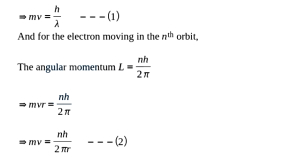
(B) According to the de-Broglie hypothesis,the wavelength $\lambda$ of a particle is given by $\lambda = \frac{h}{mv}$,where $h$ is Planck's constant,$m$ is the mass,and $v$ is the velocity of the electron.
Rearranging this,we get $mv = \frac{h}{\lambda} \quad --- (1)$.
According to Bohr's postulate for the quantization of angular momentum,the angular momentum $L$ of an electron in the $n^{\text{th}}$ orbit is given by $L = mvr = \frac{nh}{2\pi}$.
Rearranging this for $mv$,we get $mv = \frac{nh}{2\pi r} \quad --- (2)$.
Equating the expressions for $mv$ from equation $(1)$ and $(2)$:
$\frac{h}{\lambda} = \frac{nh}{2\pi r}$.
Canceling $h$ from both sides,we get $\frac{1}{\lambda} = \frac{n}{2\pi r}$.
Therefore,the de-Broglie wavelength is $\lambda = \frac{2\pi r}{n}$.
Rearranging this,we get $mv = \frac{h}{\lambda} \quad --- (1)$.
According to Bohr's postulate for the quantization of angular momentum,the angular momentum $L$ of an electron in the $n^{\text{th}}$ orbit is given by $L = mvr = \frac{nh}{2\pi}$.
Rearranging this for $mv$,we get $mv = \frac{nh}{2\pi r} \quad --- (2)$.
Equating the expressions for $mv$ from equation $(1)$ and $(2)$:
$\frac{h}{\lambda} = \frac{nh}{2\pi r}$.
Canceling $h$ from both sides,we get $\frac{1}{\lambda} = \frac{n}{2\pi r}$.
Therefore,the de-Broglie wavelength is $\lambda = \frac{2\pi r}{n}$.
0 likes
View Solution462
EasyMCQ
The de-Broglie wavelength of an electron in the ground state of the hydrogen atom is
A
$\pi r^{2}$
B
$2 \pi r$
C
$\pi r$
D
$\sqrt{2 \pi r}$
Solution
(B) According to Bohr's quantization postulate,the angular momentum of an electron in a stationary orbit is given by:
$mvr = \frac{nh}{2\pi}$
Rearranging this equation,we get:
$2\pi r = \frac{nh}{mv}$
Since the de-Broglie wavelength is defined as $\lambda = \frac{h}{mv}$,we can substitute this into the equation:
$2\pi r = n\lambda$
For the ground state of the hydrogen atom,the principal quantum number is $n = 1$.
Substituting $n = 1$ into the equation,we get:
$\lambda = 2\pi r$
$mvr = \frac{nh}{2\pi}$
Rearranging this equation,we get:
$2\pi r = \frac{nh}{mv}$
Since the de-Broglie wavelength is defined as $\lambda = \frac{h}{mv}$,we can substitute this into the equation:
$2\pi r = n\lambda$
For the ground state of the hydrogen atom,the principal quantum number is $n = 1$.
Substituting $n = 1$ into the equation,we get:
$\lambda = 2\pi r$
0 likes
View Solution463
DifficultMCQ
An excited hydrogen atom emits a photon of wavelength $\lambda$ in returning to the ground state. The quantum number $n$ of the excited state is ($R=$ Rydberg's constant).
A
$\sqrt{\lambda R(\lambda R-1)}$
B
$\sqrt{\frac{\lambda R}{\lambda R-1}}$
C
$\sqrt{\frac{\lambda R-1}{\lambda R}}$
D
$\sqrt{\frac{1}{\lambda R(\lambda R-1)}}$
Solution
(B) Using Rydberg's formula for the hydrogen atom transition to the ground state $(m=1)$:
$\frac{1}{\lambda} = R \left[ \frac{1}{1^2} - \frac{1}{n^2} \right]$
$\frac{1}{\lambda R} = 1 - \frac{1}{n^2}$
$\frac{1}{n^2} = 1 - \frac{1}{\lambda R}$
$\frac{1}{n^2} = \frac{\lambda R - 1}{\lambda R}$
Taking the reciprocal on both sides:
$n^2 = \frac{\lambda R}{\lambda R - 1}$
Therefore,the quantum number of the excited state is:
$n = \sqrt{\frac{\lambda R}{\lambda R - 1}}$
$\frac{1}{\lambda} = R \left[ \frac{1}{1^2} - \frac{1}{n^2} \right]$
$\frac{1}{\lambda R} = 1 - \frac{1}{n^2}$
$\frac{1}{n^2} = 1 - \frac{1}{\lambda R}$
$\frac{1}{n^2} = \frac{\lambda R - 1}{\lambda R}$
Taking the reciprocal on both sides:
$n^2 = \frac{\lambda R}{\lambda R - 1}$
Therefore,the quantum number of the excited state is:
$n = \sqrt{\frac{\lambda R}{\lambda R - 1}}$
0 likes
View Solution464
MediumMCQ
Ionization potential of a hydrogen atom is $13.6 \text{ eV}$. Hydrogen atoms in the ground state are excited by monochromatic radiation of photon energy $12.1 \text{ eV}$. According to Bohr's theory,the number of spectral lines emitted by the hydrogen atoms will be:
A
two
B
three
C
four
D
one
Solution
(B) The energy of the electron in the ground state $(n=1)$ is $E_1 = -13.6 \text{ eV}$.
When the atom absorbs a photon of energy $12.1 \text{ eV}$,the new energy level $E_n$ is given by:
$E_n = E_1 + 12.1 \text{ eV} = -13.6 \text{ eV} + 12.1 \text{ eV} = -1.5 \text{ eV}$.
Using the Bohr formula $E_n = -\frac{13.6}{n^2} \text{ eV}$:
$-1.5 = -\frac{13.6}{n^2} \implies n^2 = \frac{13.6}{1.5} \approx 9.06 \approx 9$.
Thus,$n = 3$.
The electron is excited to the $n=3$ state. The possible transitions for the electron to return to the ground state are:
$1$. From $n=3$ to $n=2$
$2$. From $n=3$ to $n=1$
$3$. From $n=2$ to $n=1$
The number of spectral lines is given by the formula $N = \frac{n(n-1)}{2} = \frac{3(3-1)}{2} = 3$.
Therefore,$3$ spectral lines are emitted.
When the atom absorbs a photon of energy $12.1 \text{ eV}$,the new energy level $E_n$ is given by:
$E_n = E_1 + 12.1 \text{ eV} = -13.6 \text{ eV} + 12.1 \text{ eV} = -1.5 \text{ eV}$.
Using the Bohr formula $E_n = -\frac{13.6}{n^2} \text{ eV}$:
$-1.5 = -\frac{13.6}{n^2} \implies n^2 = \frac{13.6}{1.5} \approx 9.06 \approx 9$.
Thus,$n = 3$.
The electron is excited to the $n=3$ state. The possible transitions for the electron to return to the ground state are:
$1$. From $n=3$ to $n=2$
$2$. From $n=3$ to $n=1$
$3$. From $n=2$ to $n=1$
The number of spectral lines is given by the formula $N = \frac{n(n-1)}{2} = \frac{3(3-1)}{2} = 3$.
Therefore,$3$ spectral lines are emitted.
0 likes
View Solution465
DifficultMCQ
If an electron is revolving around the hydrogen nucleus at a distance of $0.1 \,nm$, what should be its speed?
A
$2.188 \times 10^{6} \,ms^{-1}$
B
$1.094 \times 10^{6} \,ms^{-1}$
C
$4.376 \times 10^{6} \,ms^{-1}$
D
$1.59 \times 10^{6} \,ms^{-1}$
Solution
(D) The electrostatic force between the nucleus and the electron provides the necessary centripetal force for circular motion.
Electrostatic force $=$ Centripetal force
$\frac{1}{4 \pi \varepsilon_{0}} \frac{Z e^{2}}{r^{2}} = \frac{m v^{2}}{r}$
Solving for velocity $v$:
$v = \sqrt{\frac{1}{4 \pi \varepsilon_{0}} \frac{Z e^{2}}{m r}}$
Given values: $Z = 1$, $e = 1.6 \times 10^{-19} \,C$, $r = 0.1 \times 10^{-9} \,m$, $m = 9.1 \times 10^{-31} \,kg$, and $\frac{1}{4 \pi \varepsilon_{0}} = 9 \times 10^{9} \,N \cdot m^{2} \cdot C^{-2}$.
Substituting these values:
$v = \sqrt{\frac{9 \times 10^{9} \times 1 \times (1.6 \times 10^{-19})^{2}}{9.1 \times 10^{-31} \times 0.1 \times 10^{-9}}}$
$v = \sqrt{\frac{9 \times 10^{9} \times 2.56 \times 10^{-38}}{9.1 \times 10^{-41}}}$
$v = \sqrt{\frac{23.04 \times 10^{-29}}{9.1 \times 10^{-41}}} = \sqrt{2.53 \times 10^{12}} \approx 1.59 \times 10^{6} \,ms^{-1}$.
Electrostatic force $=$ Centripetal force
$\frac{1}{4 \pi \varepsilon_{0}} \frac{Z e^{2}}{r^{2}} = \frac{m v^{2}}{r}$
Solving for velocity $v$:
$v = \sqrt{\frac{1}{4 \pi \varepsilon_{0}} \frac{Z e^{2}}{m r}}$
Given values: $Z = 1$, $e = 1.6 \times 10^{-19} \,C$, $r = 0.1 \times 10^{-9} \,m$, $m = 9.1 \times 10^{-31} \,kg$, and $\frac{1}{4 \pi \varepsilon_{0}} = 9 \times 10^{9} \,N \cdot m^{2} \cdot C^{-2}$.
Substituting these values:
$v = \sqrt{\frac{9 \times 10^{9} \times 1 \times (1.6 \times 10^{-19})^{2}}{9.1 \times 10^{-31} \times 0.1 \times 10^{-9}}}$
$v = \sqrt{\frac{9 \times 10^{9} \times 2.56 \times 10^{-38}}{9.1 \times 10^{-41}}}$
$v = \sqrt{\frac{23.04 \times 10^{-29}}{9.1 \times 10^{-41}}} = \sqrt{2.53 \times 10^{12}} \approx 1.59 \times 10^{6} \,ms^{-1}$.
0 likes
View Solution466
MediumMCQ
Magnetic field at the centre of the hydrogen atom due to the motion of an electron in the $n^{\text{th}}$ orbit is proportional to:
A
$n^4$
B
$n^{-3}$
C
$n^3$
D
$n^{-5}$
Solution
(D) The radius of the $n^{\text{th}}$ Bohr orbit is given by $r_n \propto n^2$.
The velocity of the electron in the $n^{\text{th}}$ orbit is $v_n \propto \frac{1}{n}$.
The angular velocity is $\omega_n = \frac{v_n}{r_n} \propto \frac{1/n}{n^2} = \frac{1}{n^3}$.
The current $I_n$ produced by the revolving electron is $I_n = \frac{e}{T_n} = \frac{e \omega_n}{2 \pi} \propto \omega_n \propto \frac{1}{n^3}$.
The magnetic field at the centre of the orbit is $B_n = \frac{\mu_0 I_n}{2 r_n}$.
Substituting the proportionalities: $B_n \propto \frac{I_n}{r_n} \propto \frac{1/n^3}{n^2} = \frac{1}{n^5}$.
Therefore,$B_n \propto n^{-5}$.
The velocity of the electron in the $n^{\text{th}}$ orbit is $v_n \propto \frac{1}{n}$.
The angular velocity is $\omega_n = \frac{v_n}{r_n} \propto \frac{1/n}{n^2} = \frac{1}{n^3}$.
The current $I_n$ produced by the revolving electron is $I_n = \frac{e}{T_n} = \frac{e \omega_n}{2 \pi} \propto \omega_n \propto \frac{1}{n^3}$.
The magnetic field at the centre of the orbit is $B_n = \frac{\mu_0 I_n}{2 r_n}$.
Substituting the proportionalities: $B_n \propto \frac{I_n}{r_n} \propto \frac{1/n^3}{n^2} = \frac{1}{n^5}$.
Therefore,$B_n \propto n^{-5}$.
0 likes
View Solution467
DifficultMCQ
Assuming the atom is in the ground state, the expression for the magnetic field at the nucleus in a hydrogen atom due to the circular motion of the electron is [$\mu_0 =$ permeability of free space, $m =$ mass of electron, $\epsilon_0 =$ permittivity of free space, $h =$ Planck's constant].
A
$\frac{\mu_0 e^7 \pi m^2}{8 \epsilon_0^3 h^5}$
B
$\frac{\mu_0 e^5 \pi^2 m^2}{8 \epsilon_0^2 h^4}$
C
$\frac{\mu_0 e^5 \pi m^3}{8 \epsilon_0^3 h^5}$
D
$\frac{\mu_0 e^7 \pi^2 m^2}{8 \epsilon_0^3 h^5}$
Solution
(A) The magnetic field $B$ at the center of a circular current loop is given by $B = \frac{\mu_0 I}{2r}$.
Since the electron revolves with period $T$, the equivalent current is $I = \frac{e}{T}$.
Given $T = \frac{2\pi r}{v}$, we have $I = \frac{ev}{2\pi r}$.
Substituting this into the magnetic field formula: $B = \frac{\mu_0 (ev/2\pi r)}{2r} = \frac{\mu_0 ev}{4\pi r^2}$.
For a hydrogen atom in the ground state $(n=1)$, the velocity $v$ and radius $r$ are given by Bohr's theory:
$v = \frac{e^2}{2\epsilon_0 h}$ and $r = \frac{\epsilon_0 h^2}{\pi m e^2}$.
Substituting these into the expression for $B$:
$B = \frac{\mu_0 e}{4\pi} \cdot \left( \frac{e^2}{2\epsilon_0 h} \right) \cdot \left( \frac{\pi m e^2}{\epsilon_0 h^2} \right)^2$
$B = \frac{\mu_0 e^3}{8\pi \epsilon_0 h} \cdot \frac{\pi^2 m^2 e^4}{\epsilon_0^2 h^4} = \frac{\mu_0 e^7 \pi m^2}{8 \epsilon_0^3 h^5}$.
Since the electron revolves with period $T$, the equivalent current is $I = \frac{e}{T}$.
Given $T = \frac{2\pi r}{v}$, we have $I = \frac{ev}{2\pi r}$.
Substituting this into the magnetic field formula: $B = \frac{\mu_0 (ev/2\pi r)}{2r} = \frac{\mu_0 ev}{4\pi r^2}$.
For a hydrogen atom in the ground state $(n=1)$, the velocity $v$ and radius $r$ are given by Bohr's theory:
$v = \frac{e^2}{2\epsilon_0 h}$ and $r = \frac{\epsilon_0 h^2}{\pi m e^2}$.
Substituting these into the expression for $B$:
$B = \frac{\mu_0 e}{4\pi} \cdot \left( \frac{e^2}{2\epsilon_0 h} \right) \cdot \left( \frac{\pi m e^2}{\epsilon_0 h^2} \right)^2$
$B = \frac{\mu_0 e^3}{8\pi \epsilon_0 h} \cdot \frac{\pi^2 m^2 e^4}{\epsilon_0^2 h^4} = \frac{\mu_0 e^7 \pi m^2}{8 \epsilon_0^3 h^5}$.
0 likes
View Solution468
EasyMCQ
The relation between the magnetic moment '$M$' of a revolving electron and the principal quantum number '$n$' is:
A
$M \propto \frac{1}{n}$
B
$M \propto n$
C
$M \propto n^2$
D
$M \propto n^3$
Solution
(B) According to Bohr's theory,the angular momentum '$L$' of an electron in the '$n^{th}$' orbit is given by $L = \frac{nh}{2\pi}$.
The magnetic moment '$M$' associated with a revolving electron is given by $M = \frac{e}{2m_e} L$.
Substituting the value of '$L$' into the equation for '$M$':
$M = \frac{e}{2m_e} \left( \frac{nh}{2\pi} \right) = \frac{enh}{4\pi m_e}$.
Since '$e$','$h$','$m_e$',and '$\pi$' are constants,we have $M \propto n$.
The magnetic moment '$M$' associated with a revolving electron is given by $M = \frac{e}{2m_e} L$.
Substituting the value of '$L$' into the equation for '$M$':
$M = \frac{e}{2m_e} \left( \frac{nh}{2\pi} \right) = \frac{enh}{4\pi m_e}$.
Since '$e$','$h$','$m_e$',and '$\pi$' are constants,we have $M \propto n$.
0 likes
View Solution469
DifficultMCQ
In the Bohr model,an electron moves in a circular orbit around the nucleus. Considering an orbiting electron to be a circular current loop,the magnetic moment of the hydrogen atom,when the electron is in the $n^{th}$ excited state,is ($e=$ electronic charge,$m_{e}=$ mass of the electron,$h=$ Planck's constant).
A
$\left(\frac{e}{m_{e}}\right) \frac{nh}{2 \pi}$
B
$\left(\frac{e}{m_{e}}\right) \frac{n^2 h}{2 \pi}$
C
$\left(\frac{e}{2 m_{e}}\right) \frac{n^2 h}{2 \pi}$
D
$\left(\frac{e}{2 m_{e}}\right) \frac{nh}{2 \pi}$
Solution
(D) The current $i$ produced by an electron moving in a circular orbit is given by $i = \frac{e}{T}$,where $T$ is the time period of revolution. Since $T = \frac{2 \pi r}{v}$,we have $i = \frac{ev}{2 \pi r}$.
The magnetic moment $M$ of a current loop is $M = iA$,where $A = \pi r^2$ is the area of the orbit.
Substituting the values,$M = \left(\frac{ev}{2 \pi r}\right) (\pi r^2) = \frac{evr}{2}$.
Multiplying and dividing by the mass of the electron $m_{e}$,we get $M = \frac{e}{2 m_{e}} (m_{e}vr)$.
According to Bohr's quantization condition,the angular momentum $L = m_{e}vr = \frac{nh}{2 \pi}$.
Substituting this into the expression for $M$,we get $M = \frac{e}{2 m_{e}} \left(\frac{nh}{2 \pi}\right)$.
The magnetic moment $M$ of a current loop is $M = iA$,where $A = \pi r^2$ is the area of the orbit.
Substituting the values,$M = \left(\frac{ev}{2 \pi r}\right) (\pi r^2) = \frac{evr}{2}$.
Multiplying and dividing by the mass of the electron $m_{e}$,we get $M = \frac{e}{2 m_{e}} (m_{e}vr)$.
According to Bohr's quantization condition,the angular momentum $L = m_{e}vr = \frac{nh}{2 \pi}$.
Substituting this into the expression for $M$,we get $M = \frac{e}{2 m_{e}} \left(\frac{nh}{2 \pi}\right)$.
0 likes
View Solution470
DifficultMCQ
The ratio of the total energy of the $2^{\text{nd}}$ orbit electron for the hydrogen atom $(_1H^1)$ to that of the helium ion $(He^+)$ $(_2^4He)$ is:
A
$4$
B
$\frac{1}{2}$
C
$2$
D
$\frac{1}{4}$
Solution
(D) The total energy $E$ of an electron in the $n^{\text{th}}$ orbit of a hydrogen-like atom with atomic number $Z$ is given by the formula: $E_n = -13.6 \frac{Z^2}{n^2} \text{ eV}$.
For the hydrogen atom $(_1H^1)$,$Z_H = 1$ and $n = 2$. Thus,$E_H = -13.6 \frac{1^2}{2^2} = -13.6 \times \frac{1}{4} \text{ eV}$.
For the helium ion $(He^+)$,$Z_{He} = 2$ and $n = 2$. Thus,$E_{He} = -13.6 \frac{2^2}{2^2} = -13.6 \times 1 \text{ eV}$.
The ratio of the total energy of the hydrogen atom to that of the helium ion is: $\frac{E_H}{E_{He}} = \frac{-13.6 \times (1/4)}{-13.6 \times 1} = \frac{1}{4}$.
For the hydrogen atom $(_1H^1)$,$Z_H = 1$ and $n = 2$. Thus,$E_H = -13.6 \frac{1^2}{2^2} = -13.6 \times \frac{1}{4} \text{ eV}$.
For the helium ion $(He^+)$,$Z_{He} = 2$ and $n = 2$. Thus,$E_{He} = -13.6 \frac{2^2}{2^2} = -13.6 \times 1 \text{ eV}$.
The ratio of the total energy of the hydrogen atom to that of the helium ion is: $\frac{E_H}{E_{He}} = \frac{-13.6 \times (1/4)}{-13.6 \times 1} = \frac{1}{4}$.
0 likes
View Solution471
EasyMCQ
The ratio of the radii of the second and third orbits of an $H$-atom is . . . . . . .
A
$3: 2$
B
$2: 3$
C
$9: 4$
D
$4: 9$
Solution
(D) The radius of the $n^{th}$ orbit is given by $r_{n} \propto \frac{n^{2}}{Z}$.
For an $H$-atom,the atomic number $Z = 1$.
Therefore,the radius is proportional to the square of the principal quantum number: $r_{n} \propto n^{2}$.
For the second orbit $(n_{2} = 2)$ and the third orbit $(n_{3} = 3)$:
$\frac{r_{2}}{r_{3}} = \left(\frac{n_{2}}{n_{3}}\right)^{2} = \left(\frac{2}{3}\right)^{2} = \frac{4}{9}$.
Thus,the ratio is $4: 9$.
For an $H$-atom,the atomic number $Z = 1$.
Therefore,the radius is proportional to the square of the principal quantum number: $r_{n} \propto n^{2}$.
For the second orbit $(n_{2} = 2)$ and the third orbit $(n_{3} = 3)$:
$\frac{r_{2}}{r_{3}} = \left(\frac{n_{2}}{n_{3}}\right)^{2} = \left(\frac{2}{3}\right)^{2} = \frac{4}{9}$.
Thus,the ratio is $4: 9$.
0 likes
View Solution472
EasyMCQ
In a hydrogen atom,an electron makes a transition from the $5^{\text{th}}$ orbit to the $3^{\text{rd}}$ orbit. The change in the angular momentum for this electron is . . . . . . .
A
$\frac{5 h}{\pi}$
B
$\frac{h}{\pi}$
C
$\frac{3 h}{\pi}$
D
$\frac{h}{2 \pi}$
Solution
(B) According to Bohr's postulate,the angular momentum $L$ of an electron in the $n^{\text{th}}$ orbit is given by $L = \frac{nh}{2\pi}$.
For the $5^{\text{th}}$ orbit $(n_1 = 5)$,the angular momentum is $L_5 = \frac{5h}{2\pi}$.
For the $3^{\text{rd}}$ orbit $(n_2 = 3)$,the angular momentum is $L_3 = \frac{3h}{2\pi}$.
The change in angular momentum $\Delta L$ is given by:
$\Delta L = L_5 - L_3$
$\Delta L = \frac{5h}{2\pi} - \frac{3h}{2\pi}$
$\Delta L = \frac{h}{2\pi} (5 - 3)$
$\Delta L = \frac{2h}{2\pi} = \frac{h}{\pi}$.
For the $5^{\text{th}}$ orbit $(n_1 = 5)$,the angular momentum is $L_5 = \frac{5h}{2\pi}$.
For the $3^{\text{rd}}$ orbit $(n_2 = 3)$,the angular momentum is $L_3 = \frac{3h}{2\pi}$.
The change in angular momentum $\Delta L$ is given by:
$\Delta L = L_5 - L_3$
$\Delta L = \frac{5h}{2\pi} - \frac{3h}{2\pi}$
$\Delta L = \frac{h}{2\pi} (5 - 3)$
$\Delta L = \frac{2h}{2\pi} = \frac{h}{\pi}$.
0 likes
View Solution473
EasyMCQ
The radius of the innermost electron orbit of a hydrogen atom is $5.3 \times 10^{-11} \ m$. What is the radius of the $n=4$ state?
A
$8.48 \times 10^{-10} \ m$
B
$4.24 \times 10^{-10} \ m$
C
$2.12 \times 10^{-10} \ m$
D
$10.6 \times 10^{-10} \ m$
Solution
(A) The radius of an electron orbit in a hydrogen-like atom is given by the formula: $r_n = n^2 a_0$,where $n$ is the principal quantum number and $a_0$ is the Bohr radius $(5.3 \times 10^{-11} \ m)$.
For the $n=4$ state,we substitute the values into the formula:
$r_4 = (4)^2 \times (5.3 \times 10^{-11} \ m)$
$r_4 = 16 \times 5.3 \times 10^{-11} \ m$
$r_4 = 84.8 \times 10^{-11} \ m$
$r_4 = 8.48 \times 10^{-10} \ m$
Therefore,the correct option is $A$.
For the $n=4$ state,we substitute the values into the formula:
$r_4 = (4)^2 \times (5.3 \times 10^{-11} \ m)$
$r_4 = 16 \times 5.3 \times 10^{-11} \ m$
$r_4 = 84.8 \times 10^{-11} \ m$
$r_4 = 8.48 \times 10^{-10} \ m$
Therefore,the correct option is $A$.
0 likes
View Solution474
EasyMCQ
The ground state energy of a hydrogen atom is $-13.6 \text{ eV}$. What is the kinetic energy of the electron in this state (in $\text{ eV}$)?
A
$27.2$
B
$-13.6$
C
$13.6$
D
$-27.2$
Solution
(C) The total energy $E$ of an electron in a hydrogen atom is given by the sum of its kinetic energy $K$ and potential energy $U$.
For a hydrogen atom, the total energy $E$ is related to the kinetic energy $K$ by the relation $E = -K$.
Given that the ground state energy $E = -13.6 \text{ eV}$.
Therefore, the kinetic energy $K = -E = -(-13.6 \text{ eV}) = 13.6 \text{ eV}$.
Thus, the correct option is $C$.
For a hydrogen atom, the total energy $E$ is related to the kinetic energy $K$ by the relation $E = -K$.
Given that the ground state energy $E = -13.6 \text{ eV}$.
Therefore, the kinetic energy $K = -E = -(-13.6 \text{ eV}) = 13.6 \text{ eV}$.
Thus, the correct option is $C$.
0 likes
View Solution475
EasyMCQ
Kinetic energy of the electron in a hydrogen atom is $\frac{e^{2}}{8 \pi \varepsilon_{0} r}$. Then its potential energy is . . . . . . .
A
$\frac{e^{2}}{4 \pi \varepsilon_{0} r}$
B
$-\frac{e^{2}}{4 \pi \varepsilon_{0} r}$
C
$\frac{e^{2}}{8 \pi \varepsilon_{0} r}$
D
$-\frac{e^{2}}{8 \pi \varepsilon_{0} r}$
Solution
(B) For an electron in a hydrogen atom,the electrostatic potential energy $U$ and kinetic energy $K$ are related by the virial theorem.
$U = -2K$
Given that the kinetic energy $K = \frac{e^{2}}{8 \pi \varepsilon_{0} r}$.
Substituting this value into the relation:
$U = -2 \times \left( \frac{e^{2}}{8 \pi \varepsilon_{0} r} \right)$
$U = -\frac{e^{2}}{4 \pi \varepsilon_{0} r}$
Thus,the potential energy is $-\frac{e^{2}}{4 \pi \varepsilon_{0} r}$.
$U = -2K$
Given that the kinetic energy $K = \frac{e^{2}}{8 \pi \varepsilon_{0} r}$.
Substituting this value into the relation:
$U = -2 \times \left( \frac{e^{2}}{8 \pi \varepsilon_{0} r} \right)$
$U = -\frac{e^{2}}{4 \pi \varepsilon_{0} r}$
Thus,the potential energy is $-\frac{e^{2}}{4 \pi \varepsilon_{0} r}$.
0 likes
View Solution476
EasyMCQ
The ground state energy of a hydrogen atom is $-13.6 \ eV$. In this state,the potential energy is . . . . . . $eV$.
A
-$27.2$
B
-$23.6$
C
-$13.6$
D
-$31.6$
Solution
(A) The total energy $(E)$ of an electron in a hydrogen atom is the sum of its kinetic energy $(K)$ and potential energy $(U)$.
For a hydrogen atom,the relationship between total energy $(E)$,kinetic energy $(K)$,and potential energy $(U)$ is given by $E = -K = U/2$.
Given the ground state energy $E = -13.6 \ eV$.
Therefore,the potential energy $U = 2 \times E$.
$U = 2 \times (-13.6 \ eV) = -27.2 \ eV$.
Thus,the correct option is $A$.
For a hydrogen atom,the relationship between total energy $(E)$,kinetic energy $(K)$,and potential energy $(U)$ is given by $E = -K = U/2$.
Given the ground state energy $E = -13.6 \ eV$.
Therefore,the potential energy $U = 2 \times E$.
$U = 2 \times (-13.6 \ eV) = -27.2 \ eV$.
Thus,the correct option is $A$.
0 likes
View Solution477
EasyMCQ
Kinetic energy of an electron in one of the orbits of a hydrogen atom is $x$. Then, its total energy is . . . . . . .
A
$-x$
B
$-2x$
C
$-\frac{x}{2}$
D
$-\frac{x}{8}$
Solution
(A) In the Bohr model of a hydrogen atom, the kinetic energy $(K)$, potential energy $(U)$, and total energy $(E)$ of an electron in an orbit are related as follows:
$K = -E$
$U = 2E$
$K = -\frac{U}{2}$
Given that the kinetic energy is $K = x$.
Since $K = -E$, we have $x = -E$, which implies $E = -x$.
Therefore, the total energy of the electron is $-x$.
$K = -E$
$U = 2E$
$K = -\frac{U}{2}$
Given that the kinetic energy is $K = x$.
Since $K = -E$, we have $x = -E$, which implies $E = -x$.
Therefore, the total energy of the electron is $-x$.
0 likes
View Solution478
EasyMCQ
In accordance with the Bohr model,the quantum number that characterizes the Earth's revolution around the Sun in an orbit of radius $1.5 \times 10^{11} \ m$ with an orbital speed of $3 \times 10^{4} \ m/s$ is . . . . . . .
[Mass of the Earth is $6.0 \times 10^{24} \ kg$,$h = 6.625 \times 10^{-34} \ J \ s$]
[Mass of the Earth is $6.0 \times 10^{24} \ kg$,$h = 6.625 \times 10^{-34} \ J \ s$]
A
$2.6 \times 10^{72}$
B
$2.6 \times 10^{39}$
C
$2.6 \times 10^{74}$
D
$2.6 \times 10^{73}$
Solution
(C) According to Bohr's quantization condition for angular momentum,the orbital angular momentum $L$ is given by:
$L = mvr = \frac{nh}{2\pi}$
Where:
$m = 6.0 \times 10^{24} \ kg$ (Mass of the Earth)
$v = 3 \times 10^{4} \ m/s$ (Orbital speed)
$r = 1.5 \times 10^{11} \ m$ (Orbital radius)
$h = 6.625 \times 10^{-34} \ J \ s$ (Planck's constant)
Rearranging the formula to solve for the quantum number $n$:
$n = \frac{2\pi mvr}{h}$
Substituting the values:
$n = \frac{2 \times 3.14159 \times (6.0 \times 10^{24}) \times (3 \times 10^{4}) \times (1.5 \times 10^{11})}{6.625 \times 10^{-34}}$
$n = \frac{169.646 \times 10^{39}}{6.625 \times 10^{-34}}$
$n \approx 25.6 \times 10^{73} = 2.56 \times 10^{74} \approx 2.6 \times 10^{74}$
Thus,the quantum number is $2.6 \times 10^{74}$.
$L = mvr = \frac{nh}{2\pi}$
Where:
$m = 6.0 \times 10^{24} \ kg$ (Mass of the Earth)
$v = 3 \times 10^{4} \ m/s$ (Orbital speed)
$r = 1.5 \times 10^{11} \ m$ (Orbital radius)
$h = 6.625 \times 10^{-34} \ J \ s$ (Planck's constant)
Rearranging the formula to solve for the quantum number $n$:
$n = \frac{2\pi mvr}{h}$
Substituting the values:
$n = \frac{2 \times 3.14159 \times (6.0 \times 10^{24}) \times (3 \times 10^{4}) \times (1.5 \times 10^{11})}{6.625 \times 10^{-34}}$
$n = \frac{169.646 \times 10^{39}}{6.625 \times 10^{-34}}$
$n \approx 25.6 \times 10^{73} = 2.56 \times 10^{74} \approx 2.6 \times 10^{74}$
Thus,the quantum number is $2.6 \times 10^{74}$.
0 likes
View Solution479
EasyMCQ
If the radius of a hydrogen atom in its first orbit is $a_{0}$,then its radius in the third excited state is . . . . . . . (in $a_{0}$)
A
$3$
B
$9$
C
$4$
D
$16$
Solution
(D) The radius of the $n^{th}$ orbit of a hydrogen atom is given by $r_{n} = n^{2} a_{0}$,where $a_{0}$ is the Bohr radius.
For the first orbit,$n = 1$,so $r_{1} = (1)^{2} a_{0} = a_{0}$.
The third excited state corresponds to $n = 4$ (since ground state is $n=1$,first excited is $n=2$,second excited is $n=3$,and third excited is $n=4$).
Therefore,the radius in the third excited state is $r_{4} = (4)^{2} a_{0} = 16 a_{0}$.
For the first orbit,$n = 1$,so $r_{1} = (1)^{2} a_{0} = a_{0}$.
The third excited state corresponds to $n = 4$ (since ground state is $n=1$,first excited is $n=2$,second excited is $n=3$,and third excited is $n=4$).
Therefore,the radius in the third excited state is $r_{4} = (4)^{2} a_{0} = 16 a_{0}$.
0 likes
View Solution480
EasyMCQ
What is the angular momentum of an electron in the $n=5$ orbit of a $Be^{+3}$ ion?
A
$6.6 \times 10^{-34} \text{ J s}$
B
$5.3 \times 10^{-34} \text{ J s}$
C
$3.3 \times 10^{-34} \text{ J s}$
D
$1.3 \times 10^{-34} \text{ J s}$
Solution
(B) According to Bohr's postulate,the angular momentum $L$ of an electron in an orbit $n$ is given by the formula:
$L = \frac{nh}{2\pi}$
Given that $n = 5$ and Planck's constant $h \approx 6.63 \times 10^{-34} \text{ J s}$:
$L = \frac{5 \times 6.63 \times 10^{-34}}{2 \times 3.14}$
$L = \frac{33.15 \times 10^{-34}}{6.28}$
$L \approx 5.278 \times 10^{-34} \text{ J s}$
Rounding to two significant figures,we get $L \approx 5.3 \times 10^{-34} \text{ J s}$.
$L = \frac{nh}{2\pi}$
Given that $n = 5$ and Planck's constant $h \approx 6.63 \times 10^{-34} \text{ J s}$:
$L = \frac{5 \times 6.63 \times 10^{-34}}{2 \times 3.14}$
$L = \frac{33.15 \times 10^{-34}}{6.28}$
$L \approx 5.278 \times 10^{-34} \text{ J s}$
Rounding to two significant figures,we get $L \approx 5.3 \times 10^{-34} \text{ J s}$.
0 likes
View Solution481
EasyMCQ
When an electron jumps from the $n = 4$ level to the $n = 1$ level,the angular momentum of the electron changes by:
A
$\frac{h}{2 \pi}$
B
$\frac{2 h}{2 \pi}$
C
$\frac{3 h}{2 \pi}$
D
$\frac{4 h}{2 \pi}$
Solution
(C) According to Bohr's postulate,the angular momentum $L$ of an electron in an orbit $n$ is given by $L = n \frac{h}{2 \pi}$.
For the initial state $n_i = 4$,the angular momentum is $L_i = 4 \frac{h}{2 \pi}$.
For the final state $n_f = 1$,the angular momentum is $L_f = 1 \frac{h}{2 \pi}$.
The change in angular momentum $\Delta L$ is given by $\Delta L = L_i - L_f$.
Substituting the values,$\Delta L = \frac{4 h}{2 \pi} - \frac{1 h}{2 \pi} = \frac{3 h}{2 \pi}$.
For the initial state $n_i = 4$,the angular momentum is $L_i = 4 \frac{h}{2 \pi}$.
For the final state $n_f = 1$,the angular momentum is $L_f = 1 \frac{h}{2 \pi}$.
The change in angular momentum $\Delta L$ is given by $\Delta L = L_i - L_f$.
Substituting the values,$\Delta L = \frac{4 h}{2 \pi} - \frac{1 h}{2 \pi} = \frac{3 h}{2 \pi}$.
0 likes
View Solution482
MediumMCQ
When an electron jumps from the orbit $n=2$ to $n=4$,the wavelength of the radiation absorbed will be ($R$ is Rydberg's constant).
A
$\frac{16}{3 R}$
B
$\frac{16}{5 R}$
C
$\frac{5 R}{16}$
D
$\frac{3 R}{16}$
Solution
(A) The wavelength $\lambda$ of the radiation absorbed when an electron transitions from orbit $n_1$ to $n_2$ is given by the Rydberg formula:
$\frac{1}{\lambda} = R \left[ \frac{1}{n_1^2} - \frac{1}{n_2^2} \right]$
Given $n_1 = 2$ and $n_2 = 4$:
$\frac{1}{\lambda} = R \left[ \frac{1}{2^2} - \frac{1}{4^2} \right]$
$\frac{1}{\lambda} = R \left[ \frac{1}{4} - \frac{1}{16} \right]$
$\frac{1}{\lambda} = R \left[ \frac{4 - 1}{16} \right]$
$\frac{1}{\lambda} = \frac{3 R}{16}$
Therefore,the wavelength is $\lambda = \frac{16}{3 R}$.
$\frac{1}{\lambda} = R \left[ \frac{1}{n_1^2} - \frac{1}{n_2^2} \right]$
Given $n_1 = 2$ and $n_2 = 4$:
$\frac{1}{\lambda} = R \left[ \frac{1}{2^2} - \frac{1}{4^2} \right]$
$\frac{1}{\lambda} = R \left[ \frac{1}{4} - \frac{1}{16} \right]$
$\frac{1}{\lambda} = R \left[ \frac{4 - 1}{16} \right]$
$\frac{1}{\lambda} = \frac{3 R}{16}$
Therefore,the wavelength is $\lambda = \frac{16}{3 R}$.
0 likes
View Solution483
DifficultMCQ
Electrons in a certain energy level $n=n_{1}$ can emit $3$ spectral lines. When they are in another energy level $n=n_{2}$,they can emit $6$ spectral lines. The orbital speed of the electrons in these orbits are in the ratio:
A
$4:3$
B
$3:4$
C
$2:1$
D
$1:2$
Solution
(A) The number of spectral lines emitted when an electron transitions from energy level $n$ to lower levels is given by $N = \frac{n(n-1)}{2}$.
For the first case,$N = 3$:
$3 = \frac{n_{1}(n_{1}-1)}{2} \Rightarrow n_{1}^2 - n_{1} - 6 = 0 \Rightarrow (n_{1}-3)(n_{1}+2) = 0$.
Since $n_{1} > 0$,we have $n_{1} = 3$.
For the second case,$N = 6$:
$6 = \frac{n_{2}(n_{2}-1)}{2} \Rightarrow n_{2}^2 - n_{2} - 12 = 0 \Rightarrow (n_{2}-4)(n_{2}+3) = 0$.
Since $n_{2} > 0$,we have $n_{2} = 4$.
The orbital speed of an electron in the $n$-th orbit is given by $v_n = \frac{Ze^2}{2\varepsilon_0 hn}$,which implies $v \propto \frac{1}{n}$.
Therefore,the ratio of the speeds is $\frac{v_1}{v_2} = \frac{n_2}{n_1} = \frac{4}{3}$.
For the first case,$N = 3$:
$3 = \frac{n_{1}(n_{1}-1)}{2} \Rightarrow n_{1}^2 - n_{1} - 6 = 0 \Rightarrow (n_{1}-3)(n_{1}+2) = 0$.
Since $n_{1} > 0$,we have $n_{1} = 3$.
For the second case,$N = 6$:
$6 = \frac{n_{2}(n_{2}-1)}{2} \Rightarrow n_{2}^2 - n_{2} - 12 = 0 \Rightarrow (n_{2}-4)(n_{2}+3) = 0$.
Since $n_{2} > 0$,we have $n_{2} = 4$.
The orbital speed of an electron in the $n$-th orbit is given by $v_n = \frac{Ze^2}{2\varepsilon_0 hn}$,which implies $v \propto \frac{1}{n}$.
Therefore,the ratio of the speeds is $\frac{v_1}{v_2} = \frac{n_2}{n_1} = \frac{4}{3}$.
0 likes
View Solution484
MediumMCQ
The ionisation energy of $Li^{2+}$ is equal to
A
$9 h c R$
B
$6 h c R$
C
$2 h c R$
D
$h c R$
Solution
(A) The ionization energy of a hydrogen-like ion is given by the formula $E = R c h Z^2$,where $R$ is the Rydberg constant,$c$ is the speed of light,$h$ is Planck's constant,and $Z$ is the atomic number.
For the lithium ion $Li^{2+}$,the atomic number $Z = 3$.
Substituting the value of $Z$ into the formula:
$E = R c h (3)^2 = 9 R c h$.
Therefore,the ionization energy of $Li^{2+}$ is $9 h c R$.
For the lithium ion $Li^{2+}$,the atomic number $Z = 3$.
Substituting the value of $Z$ into the formula:
$E = R c h (3)^2 = 9 R c h$.
Therefore,the ionization energy of $Li^{2+}$ is $9 h c R$.
0 likes
View Solution485
EasyMCQ
If the radius of the first Bohr orbit is $r$, then the radius of the second Bohr orbit will be
A
$8 r$
B
$4 r$
C
$2 \sqrt{2} r$
D
$2 r$
Solution
(B) The radius of the $n^{th}$ Bohr orbit is given by the formula $r_n = n^2 r_1$, where $r_1$ is the radius of the first orbit $(r_1 = r)$.
For the second Bohr orbit, $n = 2$.
Substituting the value of $n$ into the formula:
$r_2 = (2)^2 \times r$
$r_2 = 4 r$
Therefore, the radius of the second Bohr orbit is $4 r$.
For the second Bohr orbit, $n = 2$.
Substituting the value of $n$ into the formula:
$r_2 = (2)^2 \times r$
$r_2 = 4 r$
Therefore, the radius of the second Bohr orbit is $4 r$.
0 likes
View Solution486
EasyMCQ
The ratio of the area of the first excited state to the ground state orbit of a hydrogen atom is:
A
$1: 16$
B
$1: 4$
C
$4: 1$
D
$16: 1$
Solution
(D) The radius of the $n^{th}$ orbit of a hydrogen atom is given by $r_n \propto n^2$.
Since the area $A$ of the orbit is $A = \pi r_n^2$,we have $A_n \propto (n^2)^2 = n^4$.
For the ground state,$n_1 = 1$.
For the first excited state,$n_2 = 2$.
The ratio of the area of the first excited state $(A_2)$ to the ground state $(A_1)$ is:
$\frac{A_2}{A_1} = \left(\frac{n_2}{n_1}\right)^4 = \left(\frac{2}{1}\right)^4 = 16$.
Therefore,the ratio is $16: 1$.
Since the area $A$ of the orbit is $A = \pi r_n^2$,we have $A_n \propto (n^2)^2 = n^4$.
For the ground state,$n_1 = 1$.
For the first excited state,$n_2 = 2$.
The ratio of the area of the first excited state $(A_2)$ to the ground state $(A_1)$ is:
$\frac{A_2}{A_1} = \left(\frac{n_2}{n_1}\right)^4 = \left(\frac{2}{1}\right)^4 = 16$.
Therefore,the ratio is $16: 1$.
0 likes
View Solution487
DifficultMCQ
The radius of a hydrogen atom in the ground state is $0.53 \ Å$. After collision with an electron,it is found to have a radius of $2.12 \ Å$. The principal quantum number $n$ of the final state of the atom is:
A
$n=2$
B
$n=3$
C
$n=4$
D
$n=1$
Solution
(A) The radius of a hydrogen atom is given by the formula $r_n = a_0 n^2$,where $a_0 = 0.53 \ Å$ is the Bohr radius and $n$ is the principal quantum number.
Given,the ground state radius $r_1 = 0.53 \ Å$ (for $n_1 = 1$).
The radius of the excited state is $r_2 = 2.12 \ Å$ (for $n_2 = n$).
Using the relation $r \propto n^2$,we have:
$\frac{r_2}{r_1} = \left(\frac{n_2}{n_1}\right)^2$
Substituting the values:
$\frac{2.12}{0.53} = \left(\frac{n}{1}\right)^2$
$4 = n^2$
$n = \sqrt{4} = 2$
Therefore,the principal quantum number of the final state is $n=2$.
Given,the ground state radius $r_1 = 0.53 \ Å$ (for $n_1 = 1$).
The radius of the excited state is $r_2 = 2.12 \ Å$ (for $n_2 = n$).
Using the relation $r \propto n^2$,we have:
$\frac{r_2}{r_1} = \left(\frac{n_2}{n_1}\right)^2$
Substituting the values:
$\frac{2.12}{0.53} = \left(\frac{n}{1}\right)^2$
$4 = n^2$
$n = \sqrt{4} = 2$
Therefore,the principal quantum number of the final state is $n=2$.
0 likes
View Solution488
DifficultMCQ
In accordance with Bohr's model,the quantum number that characterizes the Earth's revolution around the Sun in an orbit of radius $1.5 \times 10^{11} \ m$ with orbital speed $3 \times 10^4 \ m/s$ is (given,mass of Earth $= 6 \times 10^{24} \ kg$):
A
$2.57 \times 10^{38}$
B
$8.57 \times 10^{64}$
C
$2.57 \times 10^{74}$
D
$5.98 \times 10^{86}$
Solution
(C) Given:
Orbital speed $v = 3 \times 10^4 \ m/s$
Radius $r = 1.5 \times 10^{11} \ m$
Mass of Earth $m_e = 6 \times 10^{24} \ kg$
Planck's constant $h = 6.626 \times 10^{-34} \ J \cdot s$
According to Bohr's quantization condition for angular momentum:
$L = m_e v r = \frac{n h}{2 \pi}$
Rearranging for the quantum number $n$:
$n = \frac{2 \pi m_e v r}{h}$
Substituting the values:
$n = \frac{2 \times 3.14159 \times (6 \times 10^{24}) \times (3 \times 10^4) \times (1.5 \times 10^{11})}{6.626 \times 10^{-34}}$
$n = \frac{169.646 \times 10^{39}}{6.626 \times 10^{-34}}$
$n \approx 25.603 \times 10^{73} \approx 2.56 \times 10^{74}$
Rounding to the nearest provided option,$n = 2.57 \times 10^{74}$.
Orbital speed $v = 3 \times 10^4 \ m/s$
Radius $r = 1.5 \times 10^{11} \ m$
Mass of Earth $m_e = 6 \times 10^{24} \ kg$
Planck's constant $h = 6.626 \times 10^{-34} \ J \cdot s$
According to Bohr's quantization condition for angular momentum:
$L = m_e v r = \frac{n h}{2 \pi}$
Rearranging for the quantum number $n$:
$n = \frac{2 \pi m_e v r}{h}$
Substituting the values:
$n = \frac{2 \times 3.14159 \times (6 \times 10^{24}) \times (3 \times 10^4) \times (1.5 \times 10^{11})}{6.626 \times 10^{-34}}$
$n = \frac{169.646 \times 10^{39}}{6.626 \times 10^{-34}}$
$n \approx 25.603 \times 10^{73} \approx 2.56 \times 10^{74}$
Rounding to the nearest provided option,$n = 2.57 \times 10^{74}$.
0 likes
View Solution489
EasyMCQ
If an electron is revolving in its Bohr orbit having Bohr radius of $0.529 Å$,then the radius of the third orbit is
A
$4496 Å$
B
$4.761 Å$
C
$5125 nm$
D
$4234 nm$
Solution
(B) The radius of an electron in the $n$th orbit of a hydrogen-like atom is given by the formula $r_n = n^2 r_1$,where $r_1$ is the Bohr radius (radius of the first orbit).
Given,$r_1 = 0.529 Å$.
We need to find the radius of the third orbit,so $n = 3$.
Substituting the values into the formula:
$r_3 = 3^2 \times r_1$
$r_3 = 9 \times 0.529 Å$
$r_3 = 4.761 Å$.
Given,$r_1 = 0.529 Å$.
We need to find the radius of the third orbit,so $n = 3$.
Substituting the values into the formula:
$r_3 = 3^2 \times r_1$
$r_3 = 9 \times 0.529 Å$
$r_3 = 4.761 Å$.
0 likes
View Solution490
MediumMCQ
An electron in an excited state of $Li^{2+}$ ion has angular momentum $\frac{3 h}{2 \pi}$. The de-Broglie wavelength of the electron in this state is $p \pi a_{0}$ (where, $a_{0} = \text{Bohr radius}$). The value of $p$ is
A
$3$
B
$2$
C
$1$
D
$4$
Solution
(B) According to Bohr's postulate, the angular momentum $L$ is given by $L = \frac{n h}{2 \pi}$.
Given $L = \frac{3 h}{2 \pi}$, we get $n = 3$.
The de-Broglie wavelength $\lambda$ is given by $\lambda = \frac{h}{mv}$.
From the angular momentum quantization, $mvr = \frac{nh}{2\pi} = \frac{3h}{2\pi}$, so $mv = \frac{3h}{2\pi r}$.
Substituting this into the wavelength formula: $\lambda = \frac{h}{mv} = \frac{h \cdot 2\pi r}{3h} = \frac{2}{3} \pi r$.
The radius of the $n$-th orbit for a hydrogen-like ion is $r = a_{0} \frac{n^2}{Z}$.
For $Li^{2+}$, $Z = 3$ and $n = 3$, so $r = a_{0} \frac{3^2}{3} = 3 a_{0}$.
Substituting $r$ into the expression for $\lambda$: $\lambda = \frac{2}{3} \pi (3 a_{0}) = 2 \pi a_{0}$.
Comparing this with the given form $p \pi a_{0}$, we find $p = 2$.
Given $L = \frac{3 h}{2 \pi}$, we get $n = 3$.
The de-Broglie wavelength $\lambda$ is given by $\lambda = \frac{h}{mv}$.
From the angular momentum quantization, $mvr = \frac{nh}{2\pi} = \frac{3h}{2\pi}$, so $mv = \frac{3h}{2\pi r}$.
Substituting this into the wavelength formula: $\lambda = \frac{h}{mv} = \frac{h \cdot 2\pi r}{3h} = \frac{2}{3} \pi r$.
The radius of the $n$-th orbit for a hydrogen-like ion is $r = a_{0} \frac{n^2}{Z}$.
For $Li^{2+}$, $Z = 3$ and $n = 3$, so $r = a_{0} \frac{3^2}{3} = 3 a_{0}$.
Substituting $r$ into the expression for $\lambda$: $\lambda = \frac{2}{3} \pi (3 a_{0}) = 2 \pi a_{0}$.
Comparing this with the given form $p \pi a_{0}$, we find $p = 2$.
0 likes
View Solution491
DifficultMCQ
The de-Broglie wavelength associated with an electron of a hydrogen atom in its ground state is (in $\text{ Å}$)
A
$0.3$
B
$3.3$
C
$6.26$
D
$10$
Solution
(B) The angular momentum of an electron in an orbit of radius $r$ is given by Bohr's quantization condition:
$mvr = \frac{nh}{2\pi}$
For the ground state $(n=1)$,the momentum $p = mv$ is:
$p = \frac{h}{2\pi r}$
The de-Broglie wavelength $\lambda$ is defined as:
$\lambda = \frac{h}{p}$
Substituting the value of $p$ from the angular momentum equation:
$\lambda = \frac{h}{(h / 2\pi r)} = 2\pi r$
In the ground state of a hydrogen atom,the Bohr radius $r = 0.53 \text{ Å}$.
Therefore,$\lambda = 2 \times 3.14 \times 0.53 \text{ Å} \approx 3.33 \text{ Å}$.
Thus,the correct option is $3.3 \text{ Å}$.
$mvr = \frac{nh}{2\pi}$
For the ground state $(n=1)$,the momentum $p = mv$ is:
$p = \frac{h}{2\pi r}$
The de-Broglie wavelength $\lambda$ is defined as:
$\lambda = \frac{h}{p}$
Substituting the value of $p$ from the angular momentum equation:
$\lambda = \frac{h}{(h / 2\pi r)} = 2\pi r$
In the ground state of a hydrogen atom,the Bohr radius $r = 0.53 \text{ Å}$.
Therefore,$\lambda = 2 \times 3.14 \times 0.53 \text{ Å} \approx 3.33 \text{ Å}$.
Thus,the correct option is $3.3 \text{ Å}$.
0 likes
View Solution492
EasyMCQ
The period of revolution of an electron revolving in $n^{th}$ orbit of $H$-atom is proportional to
A
$n^{2}$
B
$1/n$
C
$n^{3}$
D
independent of $n$
Solution
(C) The time period of revolution $T$ of an electron in the $n^{th}$ orbit is defined as the ratio of the circumference of the orbit to the orbital velocity of the electron: $T = \frac{2 \pi r_{n}}{v_{n}}$.
According to Bohr's theory,the radius of the $n^{th}$ orbit is $r_{n} \propto n^{2}$ and the velocity of the electron in the $n^{th}$ orbit is $v_{n} \propto \frac{1}{n}$.
Substituting these proportionalities into the formula for the time period:
$T_{n} \propto \frac{r_{n}}{v_{n}} \propto \frac{n^{2}}{1/n} = n^{3}$.
Thus,the time period of revolution is proportional to $n^{3}$.
According to Bohr's theory,the radius of the $n^{th}$ orbit is $r_{n} \propto n^{2}$ and the velocity of the electron in the $n^{th}$ orbit is $v_{n} \propto \frac{1}{n}$.
Substituting these proportionalities into the formula for the time period:
$T_{n} \propto \frac{r_{n}}{v_{n}} \propto \frac{n^{2}}{1/n} = n^{3}$.
Thus,the time period of revolution is proportional to $n^{3}$.
0 likes
View Solution493
MediumMCQ
The frequency of revolution of an electron revolving in the $n^{th}$ orbit of an $H$-atom is proportional to:
A
Independent of $n$
B
$1/n^2$
C
$1/n^3$
D
$n$
Solution
(C) According to Bohr's model,the velocity of an electron in the $n^{th}$ orbit is $v \propto 1/n$.
The radius of the $n^{th}$ orbit is $r \propto n^2$.
The frequency of revolution $f$ is given by $f = v / (2 \pi r)$.
Substituting the proportionalities: $f \propto (1/n) / n^2 = 1/n^3$.
Therefore,the frequency of revolution is proportional to $1/n^3$.
The radius of the $n^{th}$ orbit is $r \propto n^2$.
The frequency of revolution $f$ is given by $f = v / (2 \pi r)$.
Substituting the proportionalities: $f \propto (1/n) / n^2 = 1/n^3$.
Therefore,the frequency of revolution is proportional to $1/n^3$.
0 likes
View Solution494
MediumMCQ
$A$ hydrogen atom in the ground state absorbs $ 10.2 \text{ eV} $ of energy. The orbital angular momentum of the electron is increased by:
A
$ 3.16 \times 10^{-34} \text{ Js} $
B
$ 1.05 \times 10^{-34} \text{ Js} $
C
$ 4.22 \times 10^{-34} \text{ Js} $
D
$ 2.11 \times 10^{-34} \text{ Js} $
Solution
(B) The energy of the $ n $-th orbit in a hydrogen atom is given by $ E_n = -\frac{13.6}{n^2} \text{ eV} $.
For the ground state $( n_1 = 1 )$,$ E_1 = -13.6 \text{ eV} $.
When the atom absorbs $ 10.2 \text{ eV} $,the new energy is $ E_2 = -13.6 + 10.2 = -3.4 \text{ eV} $.
Since $ E_2 = -\frac{13.6}{n_2^2} = -3.4 \text{ eV} $,we find $ n_2^2 = 4 $,so $ n_2 = 2 $.
The orbital angular momentum is given by $ L = \frac{nh}{2\pi} $.
The increase in angular momentum is $ \Delta L = L_2 - L_1 = \frac{n_2 h}{2\pi} - \frac{n_1 h}{2\pi} = \frac{(n_2 - n_1)h}{2\pi} $.
Substituting $ n_2 = 2 $,$ n_1 = 1 $,and $ h = 6.626 \times 10^{-34} \text{ Js} $:
$ \Delta L = \frac{(2 - 1) \times 6.626 \times 10^{-34}}{2 \times 3.14159} \approx 1.054 \times 10^{-34} \text{ Js} $.
Thus,the increase is $ 1.05 \times 10^{-34} \text{ Js} $.
For the ground state $( n_1 = 1 )$,$ E_1 = -13.6 \text{ eV} $.
When the atom absorbs $ 10.2 \text{ eV} $,the new energy is $ E_2 = -13.6 + 10.2 = -3.4 \text{ eV} $.
Since $ E_2 = -\frac{13.6}{n_2^2} = -3.4 \text{ eV} $,we find $ n_2^2 = 4 $,so $ n_2 = 2 $.
The orbital angular momentum is given by $ L = \frac{nh}{2\pi} $.
The increase in angular momentum is $ \Delta L = L_2 - L_1 = \frac{n_2 h}{2\pi} - \frac{n_1 h}{2\pi} = \frac{(n_2 - n_1)h}{2\pi} $.
Substituting $ n_2 = 2 $,$ n_1 = 1 $,and $ h = 6.626 \times 10^{-34} \text{ Js} $:
$ \Delta L = \frac{(2 - 1) \times 6.626 \times 10^{-34}}{2 \times 3.14159} \approx 1.054 \times 10^{-34} \text{ Js} $.
Thus,the increase is $ 1.05 \times 10^{-34} \text{ Js} $.
0 likes
View Solution495
MediumMCQ
The period of revolution of an electron in the ground state of a hydrogen atom is $T$. The period of revolution of the electron in the first excited state is
A
$2T$
B
$4T$
C
$T$
D
$8T$
Solution
(D) The time period of revolution of an electron in a Bohr orbit is given by $T = \frac{2\pi r}{v}$.
We know that the radius of the orbit $r \propto n^2$ and the velocity of the electron $v \propto \frac{1}{n}$.
Substituting these relations into the time period formula: $T \propto \frac{n^2}{1/n} = n^3$.
For the ground state $(n_1 = 1)$,the time period is $T_1 = T$.
For the first excited state $(n_2 = 2)$,the time period is $T_2$.
Using the proportionality $T \propto n^3$,we have $\frac{T_2}{T_1} = \left(\frac{n_2}{n_1}\right)^3$.
$\frac{T_2}{T} = \left(\frac{2}{1}\right)^3 = 8$.
Therefore,$T_2 = 8T$.
We know that the radius of the orbit $r \propto n^2$ and the velocity of the electron $v \propto \frac{1}{n}$.
Substituting these relations into the time period formula: $T \propto \frac{n^2}{1/n} = n^3$.
For the ground state $(n_1 = 1)$,the time period is $T_1 = T$.
For the first excited state $(n_2 = 2)$,the time period is $T_2$.
Using the proportionality $T \propto n^3$,we have $\frac{T_2}{T_1} = \left(\frac{n_2}{n_1}\right)^3$.
$\frac{T_2}{T} = \left(\frac{2}{1}\right)^3 = 8$.
Therefore,$T_2 = 8T$.
0 likes
View Solution496
DifficultMCQ
In a hydrogen atom,an electron excites from the ground state to a higher energy state,and its orbital velocity is reduced to $\frac{1}{3}$ of its initial value. The radius of the orbit in the ground state is $R$. The radius of the orbit in that higher energy state is: (in $R$)
A
$9$
B
$2$
C
$3$
D
$27$
Solution
(C) According to Bohr's theory,the angular momentum of an electron in an orbit is quantized as $mvr = \frac{nh}{2\pi}$.
This implies that the orbital velocity $v$ is inversely proportional to the radius $r$,i.e.,$v \propto \frac{1}{r}$.
Let $v_1$ and $r_1$ be the velocity and radius in the ground state,and $v_2$ and $r_2$ be the velocity and radius in the excited state.
Given $v_1 = v$,$r_1 = R$,and $v_2 = \frac{v}{3}$.
Using the relation $\frac{v_1}{v_2} = \frac{r_2}{r_1}$,we get $\frac{v}{v/3} = \frac{r_2}{R}$.
Solving for $r_2$,we find $3 = \frac{r_2}{R}$,which gives $r_2 = 3R$.
This implies that the orbital velocity $v$ is inversely proportional to the radius $r$,i.e.,$v \propto \frac{1}{r}$.
Let $v_1$ and $r_1$ be the velocity and radius in the ground state,and $v_2$ and $r_2$ be the velocity and radius in the excited state.
Given $v_1 = v$,$r_1 = R$,and $v_2 = \frac{v}{3}$.
Using the relation $\frac{v_1}{v_2} = \frac{r_2}{r_1}$,we get $\frac{v}{v/3} = \frac{r_2}{R}$.
Solving for $r_2$,we find $3 = \frac{r_2}{R}$,which gives $r_2 = 3R$.
0 likes
View Solution497
DifficultMCQ
An electron is moving in an orbit of a hydrogen atom from which there can be a maximum of six transitions. An electron is moving in an orbit of another hydrogen atom from which there can be a maximum of three transitions. The ratio of the velocities of the electron in these two orbits is
A
$1/2$
B
$2/1$
C
$5/4$
D
$3/4$
Solution
(D) The number of spectral lines $N$ obtained due to transitions of electrons from the $n$th orbit to lower orbits is given by the formula: $N = \frac{n(n-1)}{2}$.
For the first case,$N = 6$:
$6 = \frac{n_1(n_1-1)}{2} \Rightarrow n_1^2 - n_1 - 12 = 0 \Rightarrow (n_1-4)(n_1+3) = 0$. Since $n > 0$,we have $n_1 = 4$.
For the second case,$N = 3$:
$3 = \frac{n_2(n_2-1)}{2} \Rightarrow n_2^2 - n_2 - 6 = 0 \Rightarrow (n_2-3)(n_2+2) = 0$. Since $n > 0$,we have $n_2 = 3$.
The velocity of an electron in the $n$th orbit of a hydrogen atom is given by $v_n \propto \frac{1}{n}$.
Therefore,the ratio of the velocities is:
$\frac{v_1}{v_2} = \frac{n_2}{n_1} = \frac{3}{4}$.
For the first case,$N = 6$:
$6 = \frac{n_1(n_1-1)}{2} \Rightarrow n_1^2 - n_1 - 12 = 0 \Rightarrow (n_1-4)(n_1+3) = 0$. Since $n > 0$,we have $n_1 = 4$.
For the second case,$N = 3$:
$3 = \frac{n_2(n_2-1)}{2} \Rightarrow n_2^2 - n_2 - 6 = 0 \Rightarrow (n_2-3)(n_2+2) = 0$. Since $n > 0$,we have $n_2 = 3$.
The velocity of an electron in the $n$th orbit of a hydrogen atom is given by $v_n \propto \frac{1}{n}$.
Therefore,the ratio of the velocities is:
$\frac{v_1}{v_2} = \frac{n_2}{n_1} = \frac{3}{4}$.
0 likes
View Solution498
MediumMCQ
In the Bohr model of the hydrogen atom, the electron is pictured to rotate in a circular orbit of radius $5 \times 10^{-11} \, m$, at a speed of $2.2 \times 10^{6} \, m/s$. What is the current associated with the electron's motion (in $ \, mA$)?
A
$1.12$
B
$3$
C
$0.75$
D
$2.25$
Solution
(A) The frequency of revolution of the electron is given by $f = \frac{v}{2 \pi r}$.
Substituting the given values: $f = \frac{2.2 \times 10^{6}}{2 \pi (5 \times 10^{-11})} \approx 7.0 \times 10^{15} \, Hz$.
The current $i$ associated with the motion of the electron is $i = qf$, where $q$ is the charge of the electron $(1.6 \times 10^{-19} \, C)$.
$i = (1.6 \times 10^{-19} \, C) \times (7.0 \times 10^{15} \, Hz) = 11.2 \times 10^{-4} \, A$.
Converting to milliamperes: $i = 1.12 \times 10^{-3} \, A = 1.12 \, mA$.
Substituting the given values: $f = \frac{2.2 \times 10^{6}}{2 \pi (5 \times 10^{-11})} \approx 7.0 \times 10^{15} \, Hz$.
The current $i$ associated with the motion of the electron is $i = qf$, where $q$ is the charge of the electron $(1.6 \times 10^{-19} \, C)$.
$i = (1.6 \times 10^{-19} \, C) \times (7.0 \times 10^{15} \, Hz) = 11.2 \times 10^{-4} \, A$.
Converting to milliamperes: $i = 1.12 \times 10^{-3} \, A = 1.12 \, mA$.
0 likes
View SolutionAtoms — Bohr's Model of Hydrogen Atom · Frequently Asked Questions
1Are these Atoms questions useful for JEE and NEET?
Yes. All questions in this section are mapped to JEE Main and NEET exam patterns. Previous year questions from JEE Main, NEET, GUJCET and state-level exams are included with full solutions.
2Can I switch to Hindi or Gujarati for these questions?
Yes. Use the language tabs in the hero section or the sidebar to view the same questions and solutions in English, Hindi or Gujarati.
3How do I generate a question paper from this subtopic?
Use the Vedclass Exam Paper Generator — select the chapter and subtopic, set difficulty, and generate Sets A, B, C, D automatically. First 3 chapters of every subject are free.
Vedclass Products
For Students
Vedclass Test Series
Mock tests in real JEE/NEET style with performance analysis. 5-day free trial.
Start Free TrialFor Teachers
Exam Paper Generator
Generate Set A/B/C/D papers from this chapter in 2 minutes. 3 chapters free.
Try FreeFor Institutes
Online Exam Module
Live online exams with unlimited students, 360° analytics & white-label branding.
See DemoFor Teachers & Institutes
Generate a Atoms Exam Paper in 2 Minutes
Select subtopic & difficulty — Sets A, B, C, D auto-generated with No Repeat logic.
First 3 chapters of every subject are free — no payment required.