
A English
Vector or Cross product of two vectors and its applications Questions in English
Class 12 Mathematics · Vector Algebra · Vector or Cross product of two vectors and its applications
469+
Questions
English
Language
100%
With Solutions
Showing 47 of 469 questions in English
101
DifficultMCQ
Let $\vec{u} = \hat{i} + \hat{j}$,$\vec{v} = \hat{i} - \hat{j}$,and $\vec{w} = \hat{i} + 2\hat{j} + 3\hat{k}$. If $\hat{n}$ is a unit vector such that $\vec{u} \cdot \hat{n} = 0$ and $\vec{v} \cdot \hat{n} = 0$,then $|\vec{w} \cdot \hat{n}| = ....$
A
$3$
B
$0$
C
$1$
D
$2$
Solution
(A) Given $\vec{u} \cdot \hat{n} = 0$ and $\vec{v} \cdot \hat{n} = 0$,it implies that $\hat{n}$ is perpendicular to both $\vec{u}$ and $\vec{v}$.
Therefore,$\hat{n}$ must be parallel to the cross product $\vec{u} \times \vec{v}$.
$\vec{u} \times \vec{v} = (\hat{i} + \hat{j}) \times (\hat{i} - \hat{j}) = -\hat{i} \times \hat{j} + \hat{j} \times \hat{i} = -\hat{k} - \hat{k} = -2\hat{k}$.
The unit vector $\hat{n}$ is given by $\hat{n} = \pm \frac{\vec{u} \times \vec{v}}{|\vec{u} \times \vec{v}|} = \pm \frac{-2\hat{k}}{2} = \pm \hat{k}$.
Now,we calculate $|\vec{w} \cdot \hat{n}| = |(\hat{i} + 2\hat{j} + 3\hat{k}) \cdot (\pm \hat{k})| = |\pm 3| = 3$.
Therefore,$\hat{n}$ must be parallel to the cross product $\vec{u} \times \vec{v}$.
$\vec{u} \times \vec{v} = (\hat{i} + \hat{j}) \times (\hat{i} - \hat{j}) = -\hat{i} \times \hat{j} + \hat{j} \times \hat{i} = -\hat{k} - \hat{k} = -2\hat{k}$.
The unit vector $\hat{n}$ is given by $\hat{n} = \pm \frac{\vec{u} \times \vec{v}}{|\vec{u} \times \vec{v}|} = \pm \frac{-2\hat{k}}{2} = \pm \hat{k}$.
Now,we calculate $|\vec{w} \cdot \hat{n}| = |(\hat{i} + 2\hat{j} + 3\hat{k}) \cdot (\pm \hat{k})| = |\pm 3| = 3$.
0 likes
View Solution102
EasyMCQ
If $a = i + j + 2k$ and $b = 3i + j + k$,then the value of $a \times b$ is:
A
$-i + 5j - 2k$
B
$2i + 7j + 2k$
C
$3i + 7j - 2k$
D
$-i - 5j + 5k$
Solution
(A) Given vectors are $a = i + j + 2k$ and $b = 3i + j + k$.
The cross product $a \times b$ is calculated using the determinant:
$a \times b = \begin{vmatrix} i & j & k \\ 1 & 1 & 2 \\ 3 & 1 & 1 \end{vmatrix}$
Expanding the determinant along the first row:
$a \times b = i(1 \times 1 - 2 \times 1) - j(1 \times 1 - 2 \times 3) + k(1 \times 1 - 1 \times 3)$
$a \times b = i(1 - 2) - j(1 - 6) + k(1 - 3)$
$a \times b = -i - j(-5) + k(-2)$
$a \times b = -i + 5j - 2k$
The cross product $a \times b$ is calculated using the determinant:
$a \times b = \begin{vmatrix} i & j & k \\ 1 & 1 & 2 \\ 3 & 1 & 1 \end{vmatrix}$
Expanding the determinant along the first row:
$a \times b = i(1 \times 1 - 2 \times 1) - j(1 \times 1 - 2 \times 3) + k(1 \times 1 - 1 \times 3)$
$a \times b = i(1 - 2) - j(1 - 6) + k(1 - 3)$
$a \times b = -i - j(-5) + k(-2)$
$a \times b = -i + 5j - 2k$
0 likes
View Solution103
MediumMCQ
For a triangle $\Delta ABC$,if $\vec{BC} = \vec{a}$,$\vec{CA} = \vec{b}$,and $\vec{AB} = \vec{c}$,then which of the following is true?
A
$\vec{a} \cdot \vec{b} + \vec{b} \cdot \vec{c} + \vec{c} \cdot \vec{a} = 0$
B
$\vec{a} \times \vec{b} = \vec{b} \times \vec{c} = \vec{c} \times \vec{a}$
C
$\vec{a} \cdot \vec{b} = \vec{b} \cdot \vec{c} = \vec{c} \cdot \vec{a}$
D
$(\vec{a} \times \vec{b}) + (\vec{b} \times \vec{c}) + (\vec{c} \times \vec{a}) = \vec{0}$
Solution
(B) In $\Delta ABC$,by the triangle law of vector addition,we have $\vec{BC} + \vec{CA} + \vec{AB} = \vec{0}$.
Given $\vec{BC} = \vec{a}$,$\vec{CA} = \vec{b}$,and $\vec{AB} = \vec{c}$,we have $\vec{a} + \vec{b} + \vec{c} = \vec{0}$.
Taking the cross product with $\vec{a}$ on both sides: $\vec{a} \times (\vec{a} + \vec{b} + \vec{c}) = \vec{a} \times \vec{0}$.
Since $\vec{a} \times \vec{a} = \vec{0}$,we get $\vec{a} \times \vec{b} + \vec{a} \times \vec{c} = \vec{0}$,which implies $\vec{a} \times \vec{b} = \vec{c} \times \vec{a}$.
Similarly,taking the cross product with $\vec{b}$ on both sides: $\vec{b} \times (\vec{a} + \vec{b} + \vec{c}) = \vec{b} \times \vec{0}$.
This gives $\vec{b} \times \vec{a} + \vec{b} \times \vec{c} = \vec{0}$,which implies $\vec{b} \times \vec{c} = \vec{a} \times \vec{b}$.
Therefore,$\vec{a} \times \vec{b} = \vec{b} \times \vec{c} = \vec{c} \times \vec{a}$.
Given $\vec{BC} = \vec{a}$,$\vec{CA} = \vec{b}$,and $\vec{AB} = \vec{c}$,we have $\vec{a} + \vec{b} + \vec{c} = \vec{0}$.
Taking the cross product with $\vec{a}$ on both sides: $\vec{a} \times (\vec{a} + \vec{b} + \vec{c}) = \vec{a} \times \vec{0}$.
Since $\vec{a} \times \vec{a} = \vec{0}$,we get $\vec{a} \times \vec{b} + \vec{a} \times \vec{c} = \vec{0}$,which implies $\vec{a} \times \vec{b} = \vec{c} \times \vec{a}$.
Similarly,taking the cross product with $\vec{b}$ on both sides: $\vec{b} \times (\vec{a} + \vec{b} + \vec{c}) = \vec{b} \times \vec{0}$.
This gives $\vec{b} \times \vec{a} + \vec{b} \times \vec{c} = \vec{0}$,which implies $\vec{b} \times \vec{c} = \vec{a} \times \vec{b}$.
Therefore,$\vec{a} \times \vec{b} = \vec{b} \times \vec{c} = \vec{c} \times \vec{a}$.
0 likes
View Solution104
MediumMCQ
If $\hat{u}$ and $\hat{v}$ are unit vectors and $\theta$ is the acute angle between them,then for what value of $\theta$ is $2\hat{u} \times 3\hat{v}$ a unit vector?
A
For exactly two values of $\theta$
B
For more than two values of $\theta$
C
For no value of $\theta$
D
For exactly one value of $\theta$
Solution
(D) Given that $\hat{u}$ and $\hat{v}$ are unit vectors,so $|\hat{u}| = 1$ and $|\hat{v}| = 1$.
Let $\vec{w} = 2\hat{u} \times 3\hat{v} = 6(\hat{u} \times \hat{v})$.
We are given that $\vec{w}$ is a unit vector,so $|\vec{w}| = 1$.
Therefore,$|6(\hat{u} \times \hat{v})| = 1$.
$6|\hat{u}||\hat{v}|\sin\theta = 1$,where $\theta$ is the angle between $\hat{u}$ and $\hat{v}$.
Since $|\hat{u}| = 1$ and $|\hat{v}| = 1$,we have $6(1)(1)\sin\theta = 1$.
$6\sin\theta = 1$,which implies $\sin\theta = \frac{1}{6}$.
Since $\theta$ is an acute angle,$\sin\theta$ is positive,and there is exactly one value of $\theta$ in the interval $(0, \frac{\pi}{2})$ such that $\sin\theta = \frac{1}{6}$,which is $\theta = \arcsin(\frac{1}{6})$.
Thus,there is exactly one value of $\theta$.
Let $\vec{w} = 2\hat{u} \times 3\hat{v} = 6(\hat{u} \times \hat{v})$.
We are given that $\vec{w}$ is a unit vector,so $|\vec{w}| = 1$.
Therefore,$|6(\hat{u} \times \hat{v})| = 1$.
$6|\hat{u}||\hat{v}|\sin\theta = 1$,where $\theta$ is the angle between $\hat{u}$ and $\hat{v}$.
Since $|\hat{u}| = 1$ and $|\hat{v}| = 1$,we have $6(1)(1)\sin\theta = 1$.
$6\sin\theta = 1$,which implies $\sin\theta = \frac{1}{6}$.
Since $\theta$ is an acute angle,$\sin\theta$ is positive,and there is exactly one value of $\theta$ in the interval $(0, \frac{\pi}{2})$ such that $\sin\theta = \frac{1}{6}$,which is $\theta = \arcsin(\frac{1}{6})$.
Thus,there is exactly one value of $\theta$.
0 likes
View Solution105
EasyMCQ
Find a vector that is perpendicular to both vectors $\hat{i} + \hat{j} + \hat{k}$ and $\hat{i} + \hat{j}$.
A
$\hat{i} + \hat{j}$
B
$\hat{i} - \hat{j}$
C
$c(\hat{i} - \hat{j})$,where $c$ is a scalar
D
None of these
Solution
(C) Let $\vec{a} = \hat{i} + \hat{j} + \hat{k}$ and $\vec{b} = \hat{i} + \hat{j}$.
$A$ vector perpendicular to both $\vec{a}$ and $\vec{b}$ is given by their cross product $\vec{a} \times \vec{b}$.
$\vec{a} \times \vec{b} = \begin{vmatrix} \hat{i} & \hat{j} & \hat{k} \\ 1 & 1 & 1 \\ 1 & 1 & 0 \end{vmatrix}$
$= \hat{i}(0 - 1) - \hat{j}(0 - 1) + \hat{k}(1 - 1)$
$= -\hat{i} + \hat{j} + 0\hat{k} = -(\hat{i} - \hat{j})$.
Any vector perpendicular to both is a scalar multiple of this vector,which can be written as $c(\hat{i} - \hat{j})$ for some scalar $c$.
$A$ vector perpendicular to both $\vec{a}$ and $\vec{b}$ is given by their cross product $\vec{a} \times \vec{b}$.
$\vec{a} \times \vec{b} = \begin{vmatrix} \hat{i} & \hat{j} & \hat{k} \\ 1 & 1 & 1 \\ 1 & 1 & 0 \end{vmatrix}$
$= \hat{i}(0 - 1) - \hat{j}(0 - 1) + \hat{k}(1 - 1)$
$= -\hat{i} + \hat{j} + 0\hat{k} = -(\hat{i} - \hat{j})$.
Any vector perpendicular to both is a scalar multiple of this vector,which can be written as $c(\hat{i} - \hat{j})$ for some scalar $c$.
0 likes
View Solution106
EasyMCQ
Find a unit vector perpendicular to both vectors $3i + 2j - k$ and $12i + 5j - 5k$.
A
$\frac{5i - 3j + 9k}{\sqrt{115}}$
B
$\frac{5i + 3j - 9k}{\sqrt{115}}$
C
$\frac{-5i + 3j - 9k}{\sqrt{115}}$
D
$\frac{5i + 3j + 9k}{\sqrt{115}}$
Solution
(C) Let $\vec{a} = 3i + 2j - k$ and $\vec{b} = 12i + 5j - 5k$.
$A$ vector perpendicular to both $\vec{a}$ and $\vec{b}$ is given by their cross product $\vec{a} \times \vec{b}$.
$\vec{a} \times \vec{b} = \begin{vmatrix} i & j & k \\ 3 & 2 & -1 \\ 12 & 5 & -5 \end{vmatrix}$
$= i(2(-5) - (-1)(5)) - j(3(-5) - (-1)(12)) + k(3(5) - 2(12))$
$= i(-10 + 5) - j(-15 + 12) + k(15 - 24)$
$= -5i + 3j - 9k$.
The magnitude of this vector is $|\vec{a} \times \vec{b}| = \sqrt{(-5)^2 + 3^2 + (-9)^2} = \sqrt{25 + 9 + 81} = \sqrt{115}$.
The unit vector perpendicular to both is $\pm \frac{\vec{a} \times \vec{b}}{|\vec{a} \times \vec{b}|} = \pm \frac{-5i + 3j - 9k}{\sqrt{115}}$.
Comparing with the given options,the correct option is $\frac{-5i + 3j - 9k}{\sqrt{115}}$.
$A$ vector perpendicular to both $\vec{a}$ and $\vec{b}$ is given by their cross product $\vec{a} \times \vec{b}$.
$\vec{a} \times \vec{b} = \begin{vmatrix} i & j & k \\ 3 & 2 & -1 \\ 12 & 5 & -5 \end{vmatrix}$
$= i(2(-5) - (-1)(5)) - j(3(-5) - (-1)(12)) + k(3(5) - 2(12))$
$= i(-10 + 5) - j(-15 + 12) + k(15 - 24)$
$= -5i + 3j - 9k$.
The magnitude of this vector is $|\vec{a} \times \vec{b}| = \sqrt{(-5)^2 + 3^2 + (-9)^2} = \sqrt{25 + 9 + 81} = \sqrt{115}$.
The unit vector perpendicular to both is $\pm \frac{\vec{a} \times \vec{b}}{|\vec{a} \times \vec{b}|} = \pm \frac{-5i + 3j - 9k}{\sqrt{115}}$.
Comparing with the given options,the correct option is $\frac{-5i + 3j - 9k}{\sqrt{115}}$.
0 likes
View Solution107
DifficultMCQ
If vectors $a, b,$ and $c$ represent the sides $BC, CA,$ and $AB$ of a triangle $ABC$ respectively,then which of the following is true?
A
$a + b + c = 0$
B
$a \times b = b \times c = c \times a$
C
$a \cdot b = b \cdot c = c \cdot a$
D
$a \cdot b + b \cdot c + c \cdot a = 0$
Solution
(B) In a triangle $ABC$,the sides are represented by vectors $\vec{BC} = a$,$\vec{CA} = b$,and $\vec{AB} = c$.
By the triangle law of vector addition,the sum of vectors representing the sides of a triangle taken in order is zero.
Thus,$\vec{BC} + \vec{CA} + \vec{AB} = 0$,which implies $a + b + c = 0$.
Taking the cross product of this equation with $a$:
$a \times (a + b + c) = a \times 0$
$a \times a + a \times b + a \times c = 0$
Since $a \times a = 0$,we get $a \times b = c \times a$.
Similarly,taking the cross product with $b$:
$b \times (a + b + c) = b \times 0$
$b \times a + b \times b + b \times c = 0$
$b \times a + b \times c = 0 \implies a \times b = b \times c$.
Therefore,$a \times b = b \times c = c \times a$.
By the triangle law of vector addition,the sum of vectors representing the sides of a triangle taken in order is zero.
Thus,$\vec{BC} + \vec{CA} + \vec{AB} = 0$,which implies $a + b + c = 0$.
Taking the cross product of this equation with $a$:
$a \times (a + b + c) = a \times 0$
$a \times a + a \times b + a \times c = 0$
Since $a \times a = 0$,we get $a \times b = c \times a$.
Similarly,taking the cross product with $b$:
$b \times (a + b + c) = b \times 0$
$b \times a + b \times b + b \times c = 0$
$b \times a + b \times c = 0 \implies a \times b = b \times c$.
Therefore,$a \times b = b \times c = c \times a$.
0 likes
View Solution108
DifficultMCQ
If non-zero vectors $\vec{a}$ and $\vec{b}$ are perpendicular to each other,then the solution of the equation $\vec{r} \times \vec{a} = \vec{b}$ is:
A
$\vec{r} = x\vec{a} + \frac{1}{\vec{a} \cdot \vec{a}} (\vec{a} \times \vec{b})$
B
$\vec{r} = x\vec{b} + \frac{1}{\vec{b} \cdot \vec{b}} (\vec{a} \times \vec{b})$
C
$\vec{r} = x (\vec{a} \times \vec{b})$
D
$\vec{r} = x (\vec{b} \times \vec{a})$
Solution
(A) Given $\vec{r} \times \vec{a} = \vec{b}$.
Since $\vec{a}$ and $\vec{b}$ are perpendicular,$\vec{a} \cdot \vec{b} = 0$.
We can express $\vec{r}$ as a linear combination of $\vec{a}$,$\vec{b}$,and $\vec{a} \times \vec{b}$:
$\vec{r} = x\vec{a} + y\vec{b} + z(\vec{a} \times \vec{b})$ for some scalars $x, y, z$.
Taking the cross product with $\vec{a}$ on both sides:
$(\vec{r} \times \vec{a}) = (x\vec{a} + y\vec{b} + z(\vec{a} \times \vec{b})) \times \vec{a}$
$\vec{b} = x(\vec{a} \times \vec{a}) + y(\vec{b} \times \vec{a}) + z((\vec{a} \times \vec{b}) \times \vec{a})$
Since $\vec{a} \times \vec{a} = 0$ and $(\vec{a} \times \vec{b}) \times \vec{a} = (\vec{a} \cdot \vec{a})\vec{b} - (\vec{b} \cdot \vec{a})\vec{a}$:
$\vec{b} = y(\vec{b} \times \vec{a}) + z((\vec{a} \cdot \vec{a})\vec{b} - 0)$
$\vec{b} = -y(\vec{a} \times \vec{b}) + z(\vec{a} \cdot \vec{a})\vec{b}$
Comparing coefficients of $\vec{b}$ and $(\vec{a} \times \vec{b})$:
$-y = 0 \implies y = 0$
$z(\vec{a} \cdot \vec{a}) = 1 \implies z = \frac{1}{\vec{a} \cdot \vec{a}}$
Substituting these into the expression for $\vec{r}$:
$\vec{r} = x\vec{a} + \frac{1}{\vec{a} \cdot \vec{a}} (\vec{a} \times \vec{b})$.
Since $\vec{a}$ and $\vec{b}$ are perpendicular,$\vec{a} \cdot \vec{b} = 0$.
We can express $\vec{r}$ as a linear combination of $\vec{a}$,$\vec{b}$,and $\vec{a} \times \vec{b}$:
$\vec{r} = x\vec{a} + y\vec{b} + z(\vec{a} \times \vec{b})$ for some scalars $x, y, z$.
Taking the cross product with $\vec{a}$ on both sides:
$(\vec{r} \times \vec{a}) = (x\vec{a} + y\vec{b} + z(\vec{a} \times \vec{b})) \times \vec{a}$
$\vec{b} = x(\vec{a} \times \vec{a}) + y(\vec{b} \times \vec{a}) + z((\vec{a} \times \vec{b}) \times \vec{a})$
Since $\vec{a} \times \vec{a} = 0$ and $(\vec{a} \times \vec{b}) \times \vec{a} = (\vec{a} \cdot \vec{a})\vec{b} - (\vec{b} \cdot \vec{a})\vec{a}$:
$\vec{b} = y(\vec{b} \times \vec{a}) + z((\vec{a} \cdot \vec{a})\vec{b} - 0)$
$\vec{b} = -y(\vec{a} \times \vec{b}) + z(\vec{a} \cdot \vec{a})\vec{b}$
Comparing coefficients of $\vec{b}$ and $(\vec{a} \times \vec{b})$:
$-y = 0 \implies y = 0$
$z(\vec{a} \cdot \vec{a}) = 1 \implies z = \frac{1}{\vec{a} \cdot \vec{a}}$
Substituting these into the expression for $\vec{r}$:
$\vec{r} = x\vec{a} + \frac{1}{\vec{a} \cdot \vec{a}} (\vec{a} \times \vec{b})$.
0 likes
View Solution109
EasyMCQ
Find the unit vector perpendicular to the plane containing the vectors $\vec{a} = 2\hat{i} - 6\hat{j} - 3\hat{k}$ and $\vec{b} = 4\hat{i} + 3\hat{j} - \hat{k}$.
A
$\frac{4\hat{i} + 3\hat{j} - \hat{k}}{\sqrt{26}}$
B
$\frac{2\hat{i} - 6\hat{j} - 3\hat{k}}{7}$
C
$\frac{3\hat{i} - 2\hat{j} + 6\hat{k}}{7}$
D
$\frac{2\hat{i} - 3\hat{j} - 6\hat{k}}{7}$
Solution
(C) The unit vector $\hat{n}$ perpendicular to the plane containing vectors $\vec{a}$ and $\vec{b}$ is given by $\hat{n} = \pm \frac{\vec{a} \times \vec{b}}{|\vec{a} \times \vec{b}|}$.
First,calculate the cross product $\vec{a} \times \vec{b}$:
$\vec{a} \times \vec{b} = \begin{vmatrix} \hat{i} & \hat{j} & \hat{k} \\ 2 & -6 & -3 \\ 4 & 3 & -1 \end{vmatrix}$
$= \hat{i}((-6)(-1) - (-3)(3)) - \hat{j}((2)(-1) - (-3)(4)) + \hat{k}((2)(3) - (-6)(4))$
$= \hat{i}(6 + 9) - \hat{j}(-2 + 12) + \hat{k}(6 + 24)$
$= 15\hat{i} - 10\hat{j} + 30\hat{k}$.
Now,find the magnitude $|\vec{a} \times \vec{b}| = \sqrt{15^2 + (-10)^2 + 30^2} = \sqrt{225 + 100 + 900} = \sqrt{1225} = 35$.
The unit vector is $\pm \frac{15\hat{i} - 10\hat{j} + 30\hat{k}}{35} = \pm \frac{3\hat{i} - 2\hat{j} + 6\hat{k}}{7}$.
Comparing this with the given options,option $C$ is $\frac{3\hat{i} - 2\hat{j} + 6\hat{k}}{7}$.
First,calculate the cross product $\vec{a} \times \vec{b}$:
$\vec{a} \times \vec{b} = \begin{vmatrix} \hat{i} & \hat{j} & \hat{k} \\ 2 & -6 & -3 \\ 4 & 3 & -1 \end{vmatrix}$
$= \hat{i}((-6)(-1) - (-3)(3)) - \hat{j}((2)(-1) - (-3)(4)) + \hat{k}((2)(3) - (-6)(4))$
$= \hat{i}(6 + 9) - \hat{j}(-2 + 12) + \hat{k}(6 + 24)$
$= 15\hat{i} - 10\hat{j} + 30\hat{k}$.
Now,find the magnitude $|\vec{a} \times \vec{b}| = \sqrt{15^2 + (-10)^2 + 30^2} = \sqrt{225 + 100 + 900} = \sqrt{1225} = 35$.
The unit vector is $\pm \frac{15\hat{i} - 10\hat{j} + 30\hat{k}}{35} = \pm \frac{3\hat{i} - 2\hat{j} + 6\hat{k}}{7}$.
Comparing this with the given options,option $C$ is $\frac{3\hat{i} - 2\hat{j} + 6\hat{k}}{7}$.
0 likes
View Solution110
MediumMCQ
If $\theta$ is the angle between the vectors $\vec{a} = \hat{i} - 2\hat{j} + 3\hat{k}$ and $\vec{b} = 2\hat{i} + \hat{j} + \hat{k}$,find the value of $\sin \theta$.
A
$5/\sqrt{7}$
B
$5/21$
C
$5/(2\sqrt{7})$
D
$3/\sqrt{14}$
Solution
(C) The formula for the sine of the angle $\theta$ between two vectors $\vec{a}$ and $\vec{b}$ is given by $\sin \theta = \frac{|\vec{a} \times \vec{b}|}{|\vec{a}| |\vec{b}|}$.
First,calculate the cross product $\vec{a} \times \vec{b}$:
$\vec{a} \times \vec{b} = \begin{vmatrix} \hat{i} & \hat{j} & \hat{k} \\ 1 & -2 & 3 \\ 2 & 1 & 1 \end{vmatrix} = \hat{i}(-2 - 3) - \hat{j}(1 - 6) + \hat{k}(1 - (-4)) = -5\hat{i} + 5\hat{j} + 5\hat{k}$.
Next,find the magnitude of the cross product:
$|\vec{a} \times \vec{b}| = \sqrt{(-5)^2 + 5^2 + 5^2} = \sqrt{25 + 25 + 25} = \sqrt{75} = 5\sqrt{3}$.
Now,find the magnitudes of vectors $\vec{a}$ and $\vec{b}$:
$|\vec{a}| = \sqrt{1^2 + (-2)^2 + 3^2} = \sqrt{1 + 4 + 9} = \sqrt{14}$.
$|\vec{b}| = \sqrt{2^2 + 1^2 + 1^2} = \sqrt{4 + 1 + 1} = \sqrt{6}$.
Finally,substitute these values into the formula:
$\sin \theta = \frac{5\sqrt{3}}{\sqrt{14} \cdot \sqrt{6}} = \frac{5\sqrt{3}}{\sqrt{84}} = \frac{5\sqrt{3}}{2\sqrt{21}} = \frac{5\sqrt{3}}{2\sqrt{7}\sqrt{3}} = \frac{5}{2\sqrt{7}}$.
First,calculate the cross product $\vec{a} \times \vec{b}$:
$\vec{a} \times \vec{b} = \begin{vmatrix} \hat{i} & \hat{j} & \hat{k} \\ 1 & -2 & 3 \\ 2 & 1 & 1 \end{vmatrix} = \hat{i}(-2 - 3) - \hat{j}(1 - 6) + \hat{k}(1 - (-4)) = -5\hat{i} + 5\hat{j} + 5\hat{k}$.
Next,find the magnitude of the cross product:
$|\vec{a} \times \vec{b}| = \sqrt{(-5)^2 + 5^2 + 5^2} = \sqrt{25 + 25 + 25} = \sqrt{75} = 5\sqrt{3}$.
Now,find the magnitudes of vectors $\vec{a}$ and $\vec{b}$:
$|\vec{a}| = \sqrt{1^2 + (-2)^2 + 3^2} = \sqrt{1 + 4 + 9} = \sqrt{14}$.
$|\vec{b}| = \sqrt{2^2 + 1^2 + 1^2} = \sqrt{4 + 1 + 1} = \sqrt{6}$.
Finally,substitute these values into the formula:
$\sin \theta = \frac{5\sqrt{3}}{\sqrt{14} \cdot \sqrt{6}} = \frac{5\sqrt{3}}{\sqrt{84}} = \frac{5\sqrt{3}}{2\sqrt{21}} = \frac{5\sqrt{3}}{2\sqrt{7}\sqrt{3}} = \frac{5}{2\sqrt{7}}$.
0 likes
View Solution111
DifficultMCQ
Find the magnitude of the torque of a couple formed by a force $\vec{F} = 3\hat{i} + 2\hat{j} - \hat{k}$ acting at the point $\hat{i} - \hat{j} + \hat{k}$ and the force $-\vec{F}$ acting at the point $2\hat{i} - 3\hat{j} - \hat{k}$.
A
$7\sqrt{5}$
B
$3\sqrt{5}$
C
$5\sqrt{5}$
D
$5\sqrt{15}$
Solution
(C) Let the position vectors of the points be $\vec{r}_1 = \hat{i} - \hat{j} + \hat{k}$ and $\vec{r}_2 = 2\hat{i} - 3\hat{j} - \hat{k}$.
The force $\vec{F} = 3\hat{i} + 2\hat{j} - \hat{k}$ acts at $\vec{r}_1$ and $-\vec{F}$ acts at $\vec{r}_2$.
The torque $\vec{\tau}$ of the couple is given by $\vec{\tau} = \vec{r} \times \vec{F}$,where $\vec{r} = \vec{r}_1 - \vec{r}_2$.
$\vec{r} = (\hat{i} - \hat{j} + \hat{k}) - (2\hat{i} - 3\hat{j} - \hat{k}) = -\hat{i} + 2\hat{j} + 2\hat{k}$.
$\vec{\tau} = \begin{vmatrix} \hat{i} & \hat{j} & \hat{k} \\ -1 & 2 & 2 \\ 3 & 2 & -1 \end{vmatrix} = \hat{i}(-2 - 4) - \hat{j}(1 - 6) + \hat{k}(-2 - 6) = -6\hat{i} + 5\hat{j} - 8\hat{k}$.
The magnitude of the torque is $|\vec{\tau}| = \sqrt{(-6)^2 + 5^2 + (-8)^2} = \sqrt{36 + 25 + 64} = \sqrt{125} = 5\sqrt{5}$.
The force $\vec{F} = 3\hat{i} + 2\hat{j} - \hat{k}$ acts at $\vec{r}_1$ and $-\vec{F}$ acts at $\vec{r}_2$.
The torque $\vec{\tau}$ of the couple is given by $\vec{\tau} = \vec{r} \times \vec{F}$,where $\vec{r} = \vec{r}_1 - \vec{r}_2$.
$\vec{r} = (\hat{i} - \hat{j} + \hat{k}) - (2\hat{i} - 3\hat{j} - \hat{k}) = -\hat{i} + 2\hat{j} + 2\hat{k}$.
$\vec{\tau} = \begin{vmatrix} \hat{i} & \hat{j} & \hat{k} \\ -1 & 2 & 2 \\ 3 & 2 & -1 \end{vmatrix} = \hat{i}(-2 - 4) - \hat{j}(1 - 6) + \hat{k}(-2 - 6) = -6\hat{i} + 5\hat{j} - 8\hat{k}$.
The magnitude of the torque is $|\vec{\tau}| = \sqrt{(-6)^2 + 5^2 + (-8)^2} = \sqrt{36 + 25 + 64} = \sqrt{125} = 5\sqrt{5}$.
0 likes
View Solution112
MediumMCQ
Find the unit vector perpendicular to the plane containing the points $(1, -1, 2), (2, 0, -1),$ and $(0, 2, 1)$.
A
$\pm \frac{1}{\sqrt{6}}(2i + j + k)$
B
$\frac{1}{\sqrt{6}}(i + 2j + k)$
C
$\frac{1}{\sqrt{6}}(i + j + k)$
D
$\frac{1}{\sqrt{6}}(2i - j - k)$
Solution
(A) Let the points be $A(1, -1, 2)$,$B(2, 0, -1)$,and $C(0, 2, 1)$.
We find two vectors in the plane:
$\vec{AB} = (2-1)i + (0-(-1))j + (-1-2)k = i + j - 3k$
$\vec{AC} = (0-1)i + (2-(-1))j + (1-2)k = -i + 3j - k$
The vector perpendicular to the plane is given by the cross product $\vec{n} = \vec{AB} \times \vec{AC}$.
$\vec{n} = \begin{vmatrix} i & j & k \\ 1 & 1 & -3 \\ -1 & 3 & -1 \end{vmatrix} = i(-1 - (-9)) - j(-1 - 3) + k(3 - (-1)) = 8i + 4j + 4k$.
The unit vector perpendicular to the plane is $\hat{n} = \pm \frac{\vec{n}}{|\vec{n}|}$.
$|\vec{n}| = \sqrt{8^2 + 4^2 + 4^2} = \sqrt{64 + 16 + 16} = \sqrt{96} = 4\sqrt{6}$.
$\hat{n} = \pm \frac{8i + 4j + 4k}{4\sqrt{6}} = \pm \frac{2i + j + k}{\sqrt{6}}$.
We find two vectors in the plane:
$\vec{AB} = (2-1)i + (0-(-1))j + (-1-2)k = i + j - 3k$
$\vec{AC} = (0-1)i + (2-(-1))j + (1-2)k = -i + 3j - k$
The vector perpendicular to the plane is given by the cross product $\vec{n} = \vec{AB} \times \vec{AC}$.
$\vec{n} = \begin{vmatrix} i & j & k \\ 1 & 1 & -3 \\ -1 & 3 & -1 \end{vmatrix} = i(-1 - (-9)) - j(-1 - 3) + k(3 - (-1)) = 8i + 4j + 4k$.
The unit vector perpendicular to the plane is $\hat{n} = \pm \frac{\vec{n}}{|\vec{n}|}$.
$|\vec{n}| = \sqrt{8^2 + 4^2 + 4^2} = \sqrt{64 + 16 + 16} = \sqrt{96} = 4\sqrt{6}$.
$\hat{n} = \pm \frac{8i + 4j + 4k}{4\sqrt{6}} = \pm \frac{2i + j + k}{\sqrt{6}}$.
0 likes
View Solution113
DifficultMCQ
Let $\overline{OA} = \vec{a}$,$\overline{OB} = 10\vec{a} + 2\vec{b}$,and $\overline{OC} = \vec{b}$,where $O, A, C$ are non-collinear. Let $p$ be the area of the quadrilateral $OABC$ and $q$ be the area of the parallelogram with adjacent sides $OA$ and $OC$. Then $p/q = \dots$
A
$4$
B
$6$
C
$\frac{1}{2} \frac{|\vec{a} - \vec{b}|}{|\vec{a}|}$
D
None of these
Solution
(B) The area of the quadrilateral $OABC$ can be calculated as the sum of the areas of $\triangle OAB$ and $\triangle OBC$.
Area of $\triangle OAB = \frac{1}{2} |\overline{OA} \times \overline{OB}| = \frac{1}{2} |\vec{a} \times (10\vec{a} + 2\vec{b})| = \frac{1}{2} |10(\vec{a} \times \vec{a}) + 2(\vec{a} \times \vec{b})| = \frac{1}{2} |0 + 2(\vec{a} \times \vec{b})| = |\vec{a} \times \vec{b}|$.
Area of $\triangle OBC = \frac{1}{2} |\overline{OB} \times \overline{OC}| = \frac{1}{2} |(10\vec{a} + 2\vec{b}) \times \vec{b}| = \frac{1}{2} |10(\vec{a} \times \vec{b}) + 2(\vec{b} \times \vec{b})| = \frac{1}{2} |10(\vec{a} \times \vec{b}) + 0| = 5|\vec{a} \times \vec{b}|$.
Thus,$p = |\vec{a} \times \vec{b}| + 5|\vec{a} \times \vec{b}| = 6|\vec{a} \times \vec{b}|$.
The area $q$ of the parallelogram with adjacent sides $OA$ and $OC$ is given by $q = |\vec{a} \times \vec{b}|$.
Therefore,$p/q = \frac{6|\vec{a} \times \vec{b}|}{|\vec{a} \times \vec{b}|} = 6$.
Area of $\triangle OAB = \frac{1}{2} |\overline{OA} \times \overline{OB}| = \frac{1}{2} |\vec{a} \times (10\vec{a} + 2\vec{b})| = \frac{1}{2} |10(\vec{a} \times \vec{a}) + 2(\vec{a} \times \vec{b})| = \frac{1}{2} |0 + 2(\vec{a} \times \vec{b})| = |\vec{a} \times \vec{b}|$.
Area of $\triangle OBC = \frac{1}{2} |\overline{OB} \times \overline{OC}| = \frac{1}{2} |(10\vec{a} + 2\vec{b}) \times \vec{b}| = \frac{1}{2} |10(\vec{a} \times \vec{b}) + 2(\vec{b} \times \vec{b})| = \frac{1}{2} |10(\vec{a} \times \vec{b}) + 0| = 5|\vec{a} \times \vec{b}|$.
Thus,$p = |\vec{a} \times \vec{b}| + 5|\vec{a} \times \vec{b}| = 6|\vec{a} \times \vec{b}|$.
The area $q$ of the parallelogram with adjacent sides $OA$ and $OC$ is given by $q = |\vec{a} \times \vec{b}|$.
Therefore,$p/q = \frac{6|\vec{a} \times \vec{b}|}{|\vec{a} \times \vec{b}|} = 6$.
0 likes
View Solution114
EasyMCQ
If $\vec{a} = 2\hat{i} + 2\hat{j} - \hat{k}$ and $\vec{b} = 6\hat{i} - 3\hat{j} + 2\hat{k}$,find $\vec{a} \times \vec{b}$.
A
$2\hat{i} - 2\hat{j} - \hat{k}$
B
$\hat{i} - 10\hat{j} - 18\hat{k}$
C
$\hat{i} + \hat{j} + \hat{k}$
D
$6\hat{i} - 3\hat{j} + 2\hat{k}$
Solution
(B) The cross product $\vec{a} \times \vec{b}$ is given by the determinant of the matrix formed by the unit vectors and the components of the vectors:
$\vec{a} \times \vec{b} = \begin{vmatrix} \hat{i} & \hat{j} & \hat{k} \\ 2 & 2 & -1 \\ 6 & -3 & 2 \end{vmatrix}$
Expanding the determinant along the first row:
$= \hat{i} ((2)(2) - (-1)(-3)) - \hat{j} ((2)(2) - (-1)(6)) + \hat{k} ((2)(-3) - (2)(6))$
$= \hat{i} (4 - 3) - \hat{j} (4 + 6) + \hat{k} (-6 - 12)$
$= \hat{i} (1) - \hat{j} (10) + \hat{k} (-18)$
$= \hat{i} - 10\hat{j} - 18\hat{k}$
$\vec{a} \times \vec{b} = \begin{vmatrix} \hat{i} & \hat{j} & \hat{k} \\ 2 & 2 & -1 \\ 6 & -3 & 2 \end{vmatrix}$
Expanding the determinant along the first row:
$= \hat{i} ((2)(2) - (-1)(-3)) - \hat{j} ((2)(2) - (-1)(6)) + \hat{k} ((2)(-3) - (2)(6))$
$= \hat{i} (4 - 3) - \hat{j} (4 + 6) + \hat{k} (-6 - 12)$
$= \hat{i} (1) - \hat{j} (10) + \hat{k} (-18)$
$= \hat{i} - 10\hat{j} - 18\hat{k}$
0 likes
View Solution115
MediumMCQ
If the points $P(1, -1, 2)$,$Q(2, 0, -1)$,and $R(0, 2, 1)$ are coplanar,find the unit vector perpendicular to the plane containing these points.
A
$\frac{2\hat{i} - \hat{j} + \hat{k}}{\sqrt{6}}$
B
$\frac{2\hat{i} + \hat{j} + \hat{k}}{\sqrt{6}}$
C
$\frac{-2\hat{i} + \hat{j} + \hat{k}}{\sqrt{6}}$
D
$\frac{2\hat{i} + \hat{j} - \hat{k}}{\sqrt{6}}$
Solution
(B) To find the unit vector perpendicular to the plane containing points $P(1, -1, 2)$,$Q(2, 0, -1)$,and $R(0, 2, 1)$,we first find two vectors lying in the plane:
$\vec{PQ} = (2-1)\hat{i} + (0-(-1))\hat{j} + (-1-2)\hat{k} = \hat{i} + \hat{j} - 3\hat{k}$
$\vec{PR} = (0-1)\hat{i} + (2-(-1))\hat{j} + (1-2)\hat{k} = -\hat{i} + 3\hat{j} - \hat{k}$
Now,find the cross product $\vec{n} = \vec{PQ} \times \vec{PR}$:
$\vec{n} = \begin{vmatrix} \hat{i} & \hat{j} & \hat{k} \\ 1 & 1 & -3 \\ -1 & 3 & -1 \end{vmatrix} = \hat{i}(-1 - (-9)) - \hat{j}(-1 - 3) + \hat{k}(3 - (-1)) = 8\hat{i} + 4\hat{j} + 4\hat{k}$
Simplifying the vector by dividing by $4$,we get a vector parallel to the normal: $2\hat{i} + \hat{j} + \hat{k}$.
The magnitude is $\sqrt{2^2 + 1^2 + 1^2} = \sqrt{4+1+1} = \sqrt{6}$.
Thus,the unit vector is $\frac{2\hat{i} + \hat{j} + \hat{k}}{\sqrt{6}}$.
$\vec{PQ} = (2-1)\hat{i} + (0-(-1))\hat{j} + (-1-2)\hat{k} = \hat{i} + \hat{j} - 3\hat{k}$
$\vec{PR} = (0-1)\hat{i} + (2-(-1))\hat{j} + (1-2)\hat{k} = -\hat{i} + 3\hat{j} - \hat{k}$
Now,find the cross product $\vec{n} = \vec{PQ} \times \vec{PR}$:
$\vec{n} = \begin{vmatrix} \hat{i} & \hat{j} & \hat{k} \\ 1 & 1 & -3 \\ -1 & 3 & -1 \end{vmatrix} = \hat{i}(-1 - (-9)) - \hat{j}(-1 - 3) + \hat{k}(3 - (-1)) = 8\hat{i} + 4\hat{j} + 4\hat{k}$
Simplifying the vector by dividing by $4$,we get a vector parallel to the normal: $2\hat{i} + \hat{j} + \hat{k}$.
The magnitude is $\sqrt{2^2 + 1^2 + 1^2} = \sqrt{4+1+1} = \sqrt{6}$.
Thus,the unit vector is $\frac{2\hat{i} + \hat{j} + \hat{k}}{\sqrt{6}}$.
0 likes
View Solution116
DifficultMCQ
Let $a = 2i + j - 2k$ and $b = i + j$. If $c$ is a vector such that $a \cdot c = |c|$,$|c - a| = 2\sqrt{2}$,and the angle between $(a \times b)$ and $c$ is $30^{\circ}$,then $|(a \times b) \times c| = \dots$
A
$2/3$
B
$3/2$
C
$2$
D
$3$
Solution
(B) First,calculate the cross product $a \times b$:
$a \times b = \begin{vmatrix} i & j & k \\ 2 & 1 & -2 \\ 1 & 1 & 0 \end{vmatrix} = i(0 - (-2)) - j(0 - (-2)) + k(2 - 1) = 2i - 2j + k$.
The magnitude is $|a \times b| = \sqrt{2^2 + (-2)^2 + 1^2} = \sqrt{4 + 4 + 1} = 3$.
Given $|c - a| = 2\sqrt{2}$,squaring both sides gives $|c - a|^2 = 8$.
$|c|^2 - 2(a \cdot c) + |a|^2 = 8$.
Since $a \cdot c = |c|$ and $|a|^2 = 2^2 + 1^2 + (-2)^2 = 9$,we have:
$|c|^2 - 2|c| + 9 = 8 \implies |c|^2 - 2|c| + 1 = 0 \implies (|c| - 1)^2 = 0 \implies |c| = 1$.
Finally,the magnitude of the cross product is:
$|(a \times b) \times c| = |a \times b| |c| \sin(30^{\circ}) = 3 \times 1 \times \frac{1}{2} = \frac{3}{2}$.
$a \times b = \begin{vmatrix} i & j & k \\ 2 & 1 & -2 \\ 1 & 1 & 0 \end{vmatrix} = i(0 - (-2)) - j(0 - (-2)) + k(2 - 1) = 2i - 2j + k$.
The magnitude is $|a \times b| = \sqrt{2^2 + (-2)^2 + 1^2} = \sqrt{4 + 4 + 1} = 3$.
Given $|c - a| = 2\sqrt{2}$,squaring both sides gives $|c - a|^2 = 8$.
$|c|^2 - 2(a \cdot c) + |a|^2 = 8$.
Since $a \cdot c = |c|$ and $|a|^2 = 2^2 + 1^2 + (-2)^2 = 9$,we have:
$|c|^2 - 2|c| + 9 = 8 \implies |c|^2 - 2|c| + 1 = 0 \implies (|c| - 1)^2 = 0 \implies |c| = 1$.
Finally,the magnitude of the cross product is:
$|(a \times b) \times c| = |a \times b| |c| \sin(30^{\circ}) = 3 \times 1 \times \frac{1}{2} = \frac{3}{2}$.
0 likes
View Solution117
EasyMCQ
Find the unit vector perpendicular to both vectors $\vec{a}$ and $\vec{b}$.
A
$\vec{a} \times \vec{b}$
B
$\frac{\vec{a} \times \vec{b}}{\vec{a} \cdot \vec{b}}$
C
$\frac{\vec{a} \times \vec{b}}{|\vec{a} \times \vec{b}|}$
D
$\frac{\vec{a} \cdot \vec{b}}{|\vec{a}| |\vec{b}|}$
Solution
(C) The vector product (cross product) of two vectors $\vec{a}$ and $\vec{b}$,denoted by $\vec{a} \times \vec{b}$,results in a vector that is perpendicular to the plane containing both $\vec{a}$ and $\vec{b}$.
To find a unit vector perpendicular to both,we divide this cross product by its magnitude.
The formula for the unit vector $\hat{n}$ perpendicular to both $\vec{a}$ and $\vec{b}$ is given by:
$\hat{n} = \pm \frac{\vec{a} \times \vec{b}}{|\vec{a} \times \vec{b}|}$.
Comparing this with the given options,the correct expression is $\frac{\vec{a} \times \vec{b}}{|\vec{a} \times \vec{b}|}$.
To find a unit vector perpendicular to both,we divide this cross product by its magnitude.
The formula for the unit vector $\hat{n}$ perpendicular to both $\vec{a}$ and $\vec{b}$ is given by:
$\hat{n} = \pm \frac{\vec{a} \times \vec{b}}{|\vec{a} \times \vec{b}|}$.
Comparing this with the given options,the correct expression is $\frac{\vec{a} \times \vec{b}}{|\vec{a} \times \vec{b}|}$.
0 likes
View Solution118
EasyMCQ
If $|a| = 4$,$|b| = 2$ and the angle between $a$ and $b$ is $\pi/6$,then find $|a \times b|^{2}$.
A
$48$
B
$16$
C
$8$
D
None of these
Solution
(B) The magnitude of the cross product of two vectors $a$ and $b$ is given by $|a \times b| = |a| |b| \sin(\theta)$,where $\theta$ is the angle between the vectors.
Given $|a| = 4$,$|b| = 2$,and $\theta = \pi/6$.
Substituting these values,we get $|a \times b| = 4 \times 2 \times \sin(\pi/6)$.
Since $\sin(\pi/6) = 1/2$,we have $|a \times b| = 4 \times 2 \times (1/2) = 4$.
Therefore,$|a \times b|^{2} = (4)^{2} = 16$.
Given $|a| = 4$,$|b| = 2$,and $\theta = \pi/6$.
Substituting these values,we get $|a \times b| = 4 \times 2 \times \sin(\pi/6)$.
Since $\sin(\pi/6) = 1/2$,we have $|a \times b| = 4 \times 2 \times (1/2) = 4$.
Therefore,$|a \times b|^{2} = (4)^{2} = 16$.
0 likes
View Solution119
MediumMCQ
If the position vectors of three points $A, B, C$ are $\hat{i} + \hat{j} + \hat{k}$,$2\hat{i} + 3\hat{j} - 4\hat{k}$,and $7\hat{i} + 4\hat{j} + 9\hat{k}$ respectively,then find the unit vector perpendicular to the plane of triangle $ABC$.
A
$31\hat{i} - 18\hat{j} - 9\hat{k}$
B
$\frac{31\hat{i} - 38\hat{j} - 9\hat{k}}{\sqrt{2486}}$
C
$\frac{31\hat{i} + 38\hat{j} + 9\hat{k}}{\sqrt{2486}}$
D
None of these
Solution
(B) Let the position vectors be $\vec{a} = \hat{i} + \hat{j} + \hat{k}$,$\vec{b} = 2\hat{i} + 3\hat{j} - 4\hat{k}$,and $\vec{c} = 7\hat{i} + 4\hat{j} + 9\hat{k}$.
Two vectors in the plane are $\vec{AB} = \vec{b} - \vec{a} = (2-1)\hat{i} + (3-1)\hat{j} + (-4-1)\hat{k} = \hat{i} + 2\hat{j} - 5\hat{k}$ and $\vec{AC} = \vec{c} - \vec{a} = (7-1)\hat{i} + (4-1)\hat{j} + (9-1)\hat{k} = 6\hat{i} + 3\hat{j} + 8\hat{k}$.
$A$ vector perpendicular to the plane is $\vec{n} = \vec{AB} \times \vec{AC} = \begin{vmatrix} \hat{i} & \hat{j} & \hat{k} \\ 1 & 2 & -5 \\ 6 & 3 & 8 \end{vmatrix}$.
$\vec{n} = \hat{i}(16 - (-15)) - \hat{j}(8 - (-30)) + \hat{k}(3 - 12) = 31\hat{i} - 38\hat{j} - 9\hat{k}$.
The magnitude is $|\vec{n}| = \sqrt{31^2 + (-38)^2 + (-9)^2} = \sqrt{961 + 1444 + 81} = \sqrt{2486}$.
The unit vector is $\hat{n} = \pm \frac{\vec{n}}{|\vec{n}|} = \pm \frac{31\hat{i} - 38\hat{j} - 9\hat{k}}{\sqrt{2486}}$.
Comparing with the options,option $B$ is correct.
Two vectors in the plane are $\vec{AB} = \vec{b} - \vec{a} = (2-1)\hat{i} + (3-1)\hat{j} + (-4-1)\hat{k} = \hat{i} + 2\hat{j} - 5\hat{k}$ and $\vec{AC} = \vec{c} - \vec{a} = (7-1)\hat{i} + (4-1)\hat{j} + (9-1)\hat{k} = 6\hat{i} + 3\hat{j} + 8\hat{k}$.
$A$ vector perpendicular to the plane is $\vec{n} = \vec{AB} \times \vec{AC} = \begin{vmatrix} \hat{i} & \hat{j} & \hat{k} \\ 1 & 2 & -5 \\ 6 & 3 & 8 \end{vmatrix}$.
$\vec{n} = \hat{i}(16 - (-15)) - \hat{j}(8 - (-30)) + \hat{k}(3 - 12) = 31\hat{i} - 38\hat{j} - 9\hat{k}$.
The magnitude is $|\vec{n}| = \sqrt{31^2 + (-38)^2 + (-9)^2} = \sqrt{961 + 1444 + 81} = \sqrt{2486}$.
The unit vector is $\hat{n} = \pm \frac{\vec{n}}{|\vec{n}|} = \pm \frac{31\hat{i} - 38\hat{j} - 9\hat{k}}{\sqrt{2486}}$.
Comparing with the options,option $B$ is correct.
0 likes
View Solution120
DifficultMCQ
$A$ non-zero vector $\vec{a}$ is parallel to the line of intersection of the planes defined by the vectors $\vec{i}, \vec{i} + \vec{j}$ and $\vec{i} - \vec{j}, \vec{i} + \vec{k}$. The angle between $\vec{a}$ and the vector $\vec{i} - 2\vec{j} + 2\vec{k}$ is .....
A
$\frac{\pi}{4}$ or $\frac{3\pi}{4}$
B
$\frac{2\pi}{4}$ or $\frac{3\pi}{4}$
C
$\frac{\pi}{2}$ or $\frac{3\pi}{2}$
D
None of these
Solution
(A) The first plane is defined by vectors $\vec{n}_1 = \vec{i}$ and $\vec{n}_2 = \vec{i} + \vec{j}$. The normal to this plane is $\vec{N}_1 = \vec{n}_1 \times \vec{n}_2 = \vec{i} \times (\vec{i} + \vec{j}) = \vec{k}$.
The second plane is defined by vectors $\vec{n}_3 = \vec{i} - \vec{j}$ and $\vec{n}_4 = \vec{i} + \vec{k}$. The normal to this plane is $\vec{N}_2 = \vec{n}_3 \times \vec{n}_4 = (\vec{i} - \vec{j}) \times (\vec{i} + \vec{k}) = \vec{i} \times \vec{i} + \vec{i} \times \vec{k} - \vec{j} \times \vec{i} - \vec{j} \times \vec{k} = 0 - \vec{j} + \vec{k} - \vec{i} = -\vec{i} - \vec{j} + \vec{k}$.
The vector $\vec{a}$ is parallel to the line of intersection,so $\vec{a}$ is parallel to $\vec{N}_1 \times \vec{N}_2 = \vec{k} \times (-\vec{i} - \vec{j} + \vec{k}) = -(\vec{k} \times \vec{i}) - (\vec{k} \times \vec{j}) + (\vec{k} \times \vec{k}) = -\vec{j} + \vec{i} + 0 = \vec{i} - \vec{j}$.
Let $\vec{b} = \vec{i} - 2\vec{j} + 2\vec{k}$. The angle $\theta$ between $\vec{a}$ and $\vec{b}$ is given by $\cos \theta = \frac{|\vec{a} \cdot \vec{b}|}{|\vec{a}| |\vec{b}|}$.
$\vec{a} \cdot \vec{b} = (1)(1) + (-1)(-2) + (0)(2) = 1 + 2 = 3$.
$|\vec{a}| = \sqrt{1^2 + (-1)^2} = \sqrt{2}$.
$|\vec{b}| = \sqrt{1^2 + (-2)^2 + 2^2} = \sqrt{1 + 4 + 4} = 3$.
$\cos \theta = \frac{3}{\sqrt{2} \cdot 3} = \frac{1}{\sqrt{2}}$.
Thus,$\theta = \frac{\pi}{4}$. Since the vector $\vec{a}$ could be in the opposite direction,the angle could also be $\pi - \frac{\pi}{4} = \frac{3\pi}{4}$.
The second plane is defined by vectors $\vec{n}_3 = \vec{i} - \vec{j}$ and $\vec{n}_4 = \vec{i} + \vec{k}$. The normal to this plane is $\vec{N}_2 = \vec{n}_3 \times \vec{n}_4 = (\vec{i} - \vec{j}) \times (\vec{i} + \vec{k}) = \vec{i} \times \vec{i} + \vec{i} \times \vec{k} - \vec{j} \times \vec{i} - \vec{j} \times \vec{k} = 0 - \vec{j} + \vec{k} - \vec{i} = -\vec{i} - \vec{j} + \vec{k}$.
The vector $\vec{a}$ is parallel to the line of intersection,so $\vec{a}$ is parallel to $\vec{N}_1 \times \vec{N}_2 = \vec{k} \times (-\vec{i} - \vec{j} + \vec{k}) = -(\vec{k} \times \vec{i}) - (\vec{k} \times \vec{j}) + (\vec{k} \times \vec{k}) = -\vec{j} + \vec{i} + 0 = \vec{i} - \vec{j}$.
Let $\vec{b} = \vec{i} - 2\vec{j} + 2\vec{k}$. The angle $\theta$ between $\vec{a}$ and $\vec{b}$ is given by $\cos \theta = \frac{|\vec{a} \cdot \vec{b}|}{|\vec{a}| |\vec{b}|}$.
$\vec{a} \cdot \vec{b} = (1)(1) + (-1)(-2) + (0)(2) = 1 + 2 = 3$.
$|\vec{a}| = \sqrt{1^2 + (-1)^2} = \sqrt{2}$.
$|\vec{b}| = \sqrt{1^2 + (-2)^2 + 2^2} = \sqrt{1 + 4 + 4} = 3$.
$\cos \theta = \frac{3}{\sqrt{2} \cdot 3} = \frac{1}{\sqrt{2}}$.
Thus,$\theta = \frac{\pi}{4}$. Since the vector $\vec{a}$ could be in the opposite direction,the angle could also be $\pi - \frac{\pi}{4} = \frac{3\pi}{4}$.
0 likes
View Solution121
MediumMCQ
Let the lines $L_1: \frac{x + 1}{3} = \frac{y + 2}{1} = \frac{z + 1}{2}$ and $L_2: \frac{x - 2}{1} = \frac{y + 2}{2} = \frac{z - 3}{3}$. The unit vector perpendicular to both $L_1$ and $L_2$ is:
A
$\frac{-\hat{i} + 7\hat{j} + 7\hat{k}}{\sqrt{99}}$
B
$\frac{-\hat{i} - 7\hat{j} + 5\hat{k}}{5\sqrt{3}}$
C
$\frac{-\hat{i} + 7\hat{j} + 5\hat{k}}{5\sqrt{3}}$
D
$\frac{7\hat{i} - 7\hat{j} - \hat{k}}{\sqrt{99}}$
Solution
(B) The direction vectors of lines $L_1$ and $L_2$ are $\vec{v_1} = 3\hat{i} + \hat{j} + 2\hat{k}$ and $\vec{v_2} = \hat{i} + 2\hat{j} + 3\hat{k}$ respectively.
$A$ vector perpendicular to both $L_1$ and $L_2$ is given by the cross product $\vec{n} = \vec{v_1} \times \vec{v_2}$.
$\vec{n} = \begin{vmatrix} \hat{i} & \hat{j} & \hat{k} \\ 3 & 1 & 2 \\ 1 & 2 & 3 \end{vmatrix} = \hat{i}(3 - 4) - \hat{j}(9 - 2) + \hat{k}(6 - 1) = -\hat{i} - 7\hat{j} + 5\hat{k}$.
The magnitude of this vector is $|\vec{n}| = \sqrt{(-1)^2 + (-7)^2 + 5^2} = \sqrt{1 + 49 + 25} = \sqrt{75} = 5\sqrt{3}$.
The unit vector perpendicular to both lines is $\pm \frac{\vec{n}}{|\vec{n}|} = \pm \frac{-\hat{i} - 7\hat{j} + 5\hat{k}}{5\sqrt{3}}$.
$A$ vector perpendicular to both $L_1$ and $L_2$ is given by the cross product $\vec{n} = \vec{v_1} \times \vec{v_2}$.
$\vec{n} = \begin{vmatrix} \hat{i} & \hat{j} & \hat{k} \\ 3 & 1 & 2 \\ 1 & 2 & 3 \end{vmatrix} = \hat{i}(3 - 4) - \hat{j}(9 - 2) + \hat{k}(6 - 1) = -\hat{i} - 7\hat{j} + 5\hat{k}$.
The magnitude of this vector is $|\vec{n}| = \sqrt{(-1)^2 + (-7)^2 + 5^2} = \sqrt{1 + 49 + 25} = \sqrt{75} = 5\sqrt{3}$.
The unit vector perpendicular to both lines is $\pm \frac{\vec{n}}{|\vec{n}|} = \pm \frac{-\hat{i} - 7\hat{j} + 5\hat{k}}{5\sqrt{3}}$.
0 likes
View Solution122
MediumMCQ
If $\vec{u}$ and $\vec{v}$ are unit vectors and $\theta$ is the acute angle between them,then $2\vec{u} \times 3\vec{v}$ is a unit vector for
A
exactly one value of $\theta$
B
exactly two values of $\theta$
C
more than two values of $\theta$
D
no value of $\theta$
Solution
(A) Given that $2\vec{u} \times 3\vec{v}$ is a unit vector,its magnitude must be $1$.
Thus,$|2\vec{u} \times 3\vec{v}| = 1$.
Since $\vec{u}$ and $\vec{v}$ are unit vectors,we have $|\vec{u}| = 1$ and $|\vec{v}| = 1$.
Using the property of the cross product,$|2\vec{u} \times 3\vec{v}| = 6|\vec{u}||\vec{v}|\sin\theta = 6(1)(1)\sin\theta = 6\sin\theta$.
According to the problem,$6\sin\theta = 1$,which implies $\sin\theta = \frac{1}{6}$.
Since $\theta$ is an acute angle,there exists exactly one value of $\theta$ such that $\theta = \arcsin(\frac{1}{6})$.
Thus,$|2\vec{u} \times 3\vec{v}| = 1$.
Since $\vec{u}$ and $\vec{v}$ are unit vectors,we have $|\vec{u}| = 1$ and $|\vec{v}| = 1$.
Using the property of the cross product,$|2\vec{u} \times 3\vec{v}| = 6|\vec{u}||\vec{v}|\sin\theta = 6(1)(1)\sin\theta = 6\sin\theta$.
According to the problem,$6\sin\theta = 1$,which implies $\sin\theta = \frac{1}{6}$.
Since $\theta$ is an acute angle,there exists exactly one value of $\theta$ such that $\theta = \arcsin(\frac{1}{6})$.
0 likes
View Solution123
MediumMCQ
Let $\vec{a} = \vec{j} - \vec{k}$ and $\vec{c} = \vec{i} - \vec{j} - \vec{k}$. Find the vector $\vec{b}$ satisfying $\vec{a} \times \vec{b} + \vec{c} = 0$ and $\vec{a} \cdot \vec{b} = 3$.
A
$2\vec{i} - \vec{j} + 2\vec{k}$
B
$\vec{i} - \vec{j} - 2\vec{k}$
C
$\vec{i} + \vec{j} - 2\vec{k}$
D
$-\vec{i} + \vec{j} - 2\vec{k}$
Solution
(D) Let $\vec{b} = x\vec{i} + y\vec{j} + z\vec{k}$.
Given $\vec{a} \cdot \vec{b} = 3$,where $\vec{a} = 0\vec{i} + 1\vec{j} - 1\vec{k}$.
So,$(0)(x) + (1)(y) + (-1)(z) = 3 \Rightarrow y - z = 3 \quad \dots(1)$.
Also,$\vec{a} \times \vec{b} = -\vec{c}$.
$\vec{a} \times \vec{b} = \begin{vmatrix} \vec{i} & \vec{j} & \vec{k} \\ 0 & 1 & -1 \\ x & y & z \end{vmatrix} = \vec{i}(z + y) - \vec{j}(z) + \vec{k}(-x) = (y + z)\vec{i} - z\vec{j} - x\vec{k}$.
Given $\vec{a} \times \vec{b} = -\vec{c} = -(\vec{i} - \vec{j} - \vec{k}) = -\vec{i} + \vec{j} + \vec{k}$.
Comparing components:
$y + z = -1 \quad \dots(2)$
$-z = 1 \Rightarrow z = -1$
$-x = 1 \Rightarrow x = -1$
From $(1)$,$y - (-1) = 3 \Rightarrow y + 1 = 3 \Rightarrow y = 2$.
Wait,checking the cross product again: $\vec{a} \times \vec{b} = (z + y)\vec{i} - (z)\vec{j} - (x)\vec{k}$.
Given $\vec{a} \times \vec{b} = -\vec{c} = -\vec{i} + \vec{j} + \vec{k}$.
$y + z = -1$,$-z = 1 \Rightarrow z = -1$,$-x = 1 \Rightarrow x = -1$.
Then $y - 1 = -1 \Rightarrow y = 0$. Check $\vec{a} \cdot \vec{b} = y - z = 0 - (-1) = 1 \neq 3$.
Re-evaluating: $\vec{a} \times \vec{b} + \vec{c} = 0 \Rightarrow \vec{a} \times \vec{b} = -\vec{c} = -\vec{i} + \vec{j} + \vec{k}$.
Correct calculation: $\vec{a} \times \vec{b} = (z+y)\vec{i} - (z)\vec{j} - (x)\vec{k}$.
Equating: $z+y = -1$,$-z = 1 \Rightarrow z = -1$,$-x = 1 \Rightarrow x = -1$.
$y - 1 = -1 \Rightarrow y = 0$. This contradicts $\vec{a} \cdot \vec{b} = 3$.
Let's re-read the cross product: $\vec{a} \times \vec{b} = \begin{vmatrix} \vec{i} & \vec{j} & \vec{k} \\ 0 & 1 & -1 \\ x & y & z \end{vmatrix} = (z+y)\vec{i} - (z)\vec{j} - (x)\vec{k}$.
If $\vec{a} \times \vec{b} = -\vec{c} = -\vec{i} + \vec{j} + \vec{k}$,then $z+y = -1, -z = 1, -x = 1$. Result $\vec{b} = -\vec{i} + 0\vec{j} - \vec{k}$.
Given the options,let's check $\vec{b} = -\vec{i} + \vec{j} - 2\vec{k}$ (Option $D$).
$\vec{a} \cdot \vec{b} = (1)(1) + (-1)(-2) = 1 + 2 = 3$. (Matches)
$\vec{a} \times \vec{b} = \begin{vmatrix} \vec{i} & \vec{j} & \vec{k} \\ 0 & 1 & -1 \\ -1 & 1 & -2 \end{vmatrix} = \vec{i}(-2 + 1) - \vec{j}(0 - 1) + \vec{k}(0 - (-1)) = -\vec{i} + \vec{j} + \vec{k}$.
$\vec{a} \times \vec{b} + \vec{c} = (-\vec{i} + \vec{j} + \vec{k}) + (\vec{i} - \vec{j} - \vec{k}) = 0$. (Matches)
Thus,$\vec{b} = -\vec{i} + \vec{j} - 2\vec{k}$.
Given $\vec{a} \cdot \vec{b} = 3$,where $\vec{a} = 0\vec{i} + 1\vec{j} - 1\vec{k}$.
So,$(0)(x) + (1)(y) + (-1)(z) = 3 \Rightarrow y - z = 3 \quad \dots(1)$.
Also,$\vec{a} \times \vec{b} = -\vec{c}$.
$\vec{a} \times \vec{b} = \begin{vmatrix} \vec{i} & \vec{j} & \vec{k} \\ 0 & 1 & -1 \\ x & y & z \end{vmatrix} = \vec{i}(z + y) - \vec{j}(z) + \vec{k}(-x) = (y + z)\vec{i} - z\vec{j} - x\vec{k}$.
Given $\vec{a} \times \vec{b} = -\vec{c} = -(\vec{i} - \vec{j} - \vec{k}) = -\vec{i} + \vec{j} + \vec{k}$.
Comparing components:
$y + z = -1 \quad \dots(2)$
$-z = 1 \Rightarrow z = -1$
$-x = 1 \Rightarrow x = -1$
From $(1)$,$y - (-1) = 3 \Rightarrow y + 1 = 3 \Rightarrow y = 2$.
Wait,checking the cross product again: $\vec{a} \times \vec{b} = (z + y)\vec{i} - (z)\vec{j} - (x)\vec{k}$.
Given $\vec{a} \times \vec{b} = -\vec{c} = -\vec{i} + \vec{j} + \vec{k}$.
$y + z = -1$,$-z = 1 \Rightarrow z = -1$,$-x = 1 \Rightarrow x = -1$.
Then $y - 1 = -1 \Rightarrow y = 0$. Check $\vec{a} \cdot \vec{b} = y - z = 0 - (-1) = 1 \neq 3$.
Re-evaluating: $\vec{a} \times \vec{b} + \vec{c} = 0 \Rightarrow \vec{a} \times \vec{b} = -\vec{c} = -\vec{i} + \vec{j} + \vec{k}$.
Correct calculation: $\vec{a} \times \vec{b} = (z+y)\vec{i} - (z)\vec{j} - (x)\vec{k}$.
Equating: $z+y = -1$,$-z = 1 \Rightarrow z = -1$,$-x = 1 \Rightarrow x = -1$.
$y - 1 = -1 \Rightarrow y = 0$. This contradicts $\vec{a} \cdot \vec{b} = 3$.
Let's re-read the cross product: $\vec{a} \times \vec{b} = \begin{vmatrix} \vec{i} & \vec{j} & \vec{k} \\ 0 & 1 & -1 \\ x & y & z \end{vmatrix} = (z+y)\vec{i} - (z)\vec{j} - (x)\vec{k}$.
If $\vec{a} \times \vec{b} = -\vec{c} = -\vec{i} + \vec{j} + \vec{k}$,then $z+y = -1, -z = 1, -x = 1$. Result $\vec{b} = -\vec{i} + 0\vec{j} - \vec{k}$.
Given the options,let's check $\vec{b} = -\vec{i} + \vec{j} - 2\vec{k}$ (Option $D$).
$\vec{a} \cdot \vec{b} = (1)(1) + (-1)(-2) = 1 + 2 = 3$. (Matches)
$\vec{a} \times \vec{b} = \begin{vmatrix} \vec{i} & \vec{j} & \vec{k} \\ 0 & 1 & -1 \\ -1 & 1 & -2 \end{vmatrix} = \vec{i}(-2 + 1) - \vec{j}(0 - 1) + \vec{k}(0 - (-1)) = -\vec{i} + \vec{j} + \vec{k}$.
$\vec{a} \times \vec{b} + \vec{c} = (-\vec{i} + \vec{j} + \vec{k}) + (\vec{i} - \vec{j} - \vec{k}) = 0$. (Matches)
Thus,$\vec{b} = -\vec{i} + \vec{j} - 2\vec{k}$.
0 likes
View Solution124
DifficultMCQ
Let $\vec a = 2\hat i + \hat j - 2\hat k$ and $\vec b = \hat i + \hat j$. Let $\vec c$ be a vector such that $|\vec c - \vec a| = 3$,$|(\vec a \times \vec b) \times \vec c| = 3$,and the angle between $\vec c$ and $\vec a \times \vec b$ is $30^\circ$. Then $\vec a \cdot \vec c$ is equal to:
A
$\frac{1}{8}$
B
$\frac{25}{8}$
C
$2$
D
$5$
Solution
(C) Given $\vec a = 2\hat i + \hat j - 2\hat k$ and $\vec b = \hat i + \hat j$.
First,calculate the magnitude of $\vec a$: $|\vec a| = \sqrt{2^2 + 1^2 + (-2)^2} = \sqrt{4+1+4} = 3$.
Next,calculate the cross product $\vec a \times \vec b$:
$\vec a \times \vec b = \begin{vmatrix} \hat i & \hat j & \hat k \\ 2 & 1 & -2 \\ 1 & 1 & 0 \end{vmatrix} = \hat i(0 - (-2)) - \hat j(0 - (-2)) + \hat k(2 - 1) = 2\hat i - 2\hat j + \hat k$.
The magnitude is $|\vec a \times \vec b| = \sqrt{2^2 + (-2)^2 + 1^2} = \sqrt{4+4+1} = 3$.
Given $|(\vec a \times \vec b) \times \vec c| = 3$ and the angle between $\vec c$ and $\vec a \times \vec b$ is $30^\circ$,we use the formula $|\vec u \times \vec v| = |\vec u||\vec v| \sin \theta$:
$|\vec a \times \vec b||\vec c| \sin 30^\circ = 3 \implies 3 \cdot |\vec c| \cdot \frac{1}{2} = 3 \implies |\vec c| = 2$.
Now,use the condition $|\vec c - \vec a| = 3$. Squaring both sides:
$|\vec c - \vec a|^2 = 3^2 \implies |\vec c|^2 + |\vec a|^2 - 2(\vec a \cdot \vec c) = 9$.
Substitute the known values $|\vec c| = 2$ and $|\vec a| = 3$:
$2^2 + 3^2 - 2(\vec a \cdot \vec c) = 9 \implies 4 + 9 - 2(\vec a \cdot \vec c) = 9 \implies 13 - 2(\vec a \cdot \vec c) = 9$.
$2(\vec a \cdot \vec c) = 4 \implies \vec a \cdot \vec c = 2$.
First,calculate the magnitude of $\vec a$: $|\vec a| = \sqrt{2^2 + 1^2 + (-2)^2} = \sqrt{4+1+4} = 3$.
Next,calculate the cross product $\vec a \times \vec b$:
$\vec a \times \vec b = \begin{vmatrix} \hat i & \hat j & \hat k \\ 2 & 1 & -2 \\ 1 & 1 & 0 \end{vmatrix} = \hat i(0 - (-2)) - \hat j(0 - (-2)) + \hat k(2 - 1) = 2\hat i - 2\hat j + \hat k$.
The magnitude is $|\vec a \times \vec b| = \sqrt{2^2 + (-2)^2 + 1^2} = \sqrt{4+4+1} = 3$.
Given $|(\vec a \times \vec b) \times \vec c| = 3$ and the angle between $\vec c$ and $\vec a \times \vec b$ is $30^\circ$,we use the formula $|\vec u \times \vec v| = |\vec u||\vec v| \sin \theta$:
$|\vec a \times \vec b||\vec c| \sin 30^\circ = 3 \implies 3 \cdot |\vec c| \cdot \frac{1}{2} = 3 \implies |\vec c| = 2$.
Now,use the condition $|\vec c - \vec a| = 3$. Squaring both sides:
$|\vec c - \vec a|^2 = 3^2 \implies |\vec c|^2 + |\vec a|^2 - 2(\vec a \cdot \vec c) = 9$.
Substitute the known values $|\vec c| = 2$ and $|\vec a| = 3$:
$2^2 + 3^2 - 2(\vec a \cdot \vec c) = 9 \implies 4 + 9 - 2(\vec a \cdot \vec c) = 9 \implies 13 - 2(\vec a \cdot \vec c) = 9$.
$2(\vec a \cdot \vec c) = 4 \implies \vec a \cdot \vec c = 2$.
0 likes
View Solution125
MediumMCQ
If $a = (1, 1, 1)$ and $c = (0, 1, -1)$ are two vectors and $b$ is a vector such that $a \times b = c$ and $a \cdot b = 3$,then $b$ is equal to
A
$\left( \frac{2}{3}, \frac{2}{3}, \frac{5}{3} \right)$
B
$\left( \frac{2}{3}, \frac{5}{3}, \frac{2}{3} \right)$
C
$(5, 2, 2)$
D
$\left( \frac{5}{3}, \frac{2}{3}, \frac{2}{3} \right)$
Solution
(D) Let $b = b_1 i + b_2 j + b_3 k$.
Given $a \cdot b = 3$,we have $b_1 + b_2 + b_3 = 3$ ......$(i)$.
Given $a \times b = c$,where $a = (1, 1, 1)$ and $c = (0, 1, -1)$,we calculate the cross product:
$a \times b = \begin{vmatrix} i & j & k \\ 1 & 1 & 1 \\ b_1 & b_2 & b_3 \end{vmatrix} = (b_3 - b_2)i + (b_1 - b_3)j + (b_2 - b_1)k$.
Comparing this with $c = (0, 1, -1)$,we get:
$b_3 - b_2 = 0$ ......$(ii)$
$b_1 - b_3 = 1$ ......$(iii)$
$b_2 - b_1 = -1$ ......$(iv)$
From $(ii)$,$b_2 = b_3$. Substituting into $(i)$,$b_1 + 2b_2 = 3$.
From $(iii)$,$b_1 = 1 + b_3 = 1 + b_2$.
Substituting $b_1$ into $b_1 + 2b_2 = 3$,we get $(1 + b_2) + 2b_2 = 3$,so $3b_2 = 2$,which means $b_2 = \frac{2}{3}$.
Then $b_3 = \frac{2}{3}$ and $b_1 = 1 + \frac{2}{3} = \frac{5}{3}$.
Thus,$b = \left( \frac{5}{3}, \frac{2}{3}, \frac{2}{3} \right)$.
Given $a \cdot b = 3$,we have $b_1 + b_2 + b_3 = 3$ ......$(i)$.
Given $a \times b = c$,where $a = (1, 1, 1)$ and $c = (0, 1, -1)$,we calculate the cross product:
$a \times b = \begin{vmatrix} i & j & k \\ 1 & 1 & 1 \\ b_1 & b_2 & b_3 \end{vmatrix} = (b_3 - b_2)i + (b_1 - b_3)j + (b_2 - b_1)k$.
Comparing this with $c = (0, 1, -1)$,we get:
$b_3 - b_2 = 0$ ......$(ii)$
$b_1 - b_3 = 1$ ......$(iii)$
$b_2 - b_1 = -1$ ......$(iv)$
From $(ii)$,$b_2 = b_3$. Substituting into $(i)$,$b_1 + 2b_2 = 3$.
From $(iii)$,$b_1 = 1 + b_3 = 1 + b_2$.
Substituting $b_1$ into $b_1 + 2b_2 = 3$,we get $(1 + b_2) + 2b_2 = 3$,so $3b_2 = 2$,which means $b_2 = \frac{2}{3}$.
Then $b_3 = \frac{2}{3}$ and $b_1 = 1 + \frac{2}{3} = \frac{5}{3}$.
Thus,$b = \left( \frac{5}{3}, \frac{2}{3}, \frac{2}{3} \right)$.
0 likes
View Solution126
MediumMCQ
$a = 3i - 5j$ and $b = 6i + 3j$ are two vectors and $c$ is a vector such that $c = a \times b$,then $|a|:|b|:|c|$ is
A
$\sqrt{34} : \sqrt{45} : \sqrt{39}$
B
$\sqrt{34} : \sqrt{45} : 39$
C
$34 : 39 : 45$
D
$39 : 35 : 34$
Solution
(B) Given vectors are $a = 3i - 5j$ and $b = 6i + 3j$.
First,we calculate the cross product $c = a \times b$:
$c = \begin{vmatrix} i & j & k \\ 3 & -5 & 0 \\ 6 & 3 & 0 \end{vmatrix} = i(0 - 0) - j(0 - 0) + k(9 - (-30)) = 39k$.
Now,we find the magnitudes of the vectors:
$|a| = \sqrt{3^2 + (-5)^2} = \sqrt{9 + 25} = \sqrt{34}$.
$|b| = \sqrt{6^2 + 3^2} = \sqrt{36 + 9} = \sqrt{45}$.
$|c| = \sqrt{0^2 + 0^2 + 39^2} = 39$.
Therefore,the ratio $|a|:|b|:|c|$ is $\sqrt{34} : \sqrt{45} : 39$.
First,we calculate the cross product $c = a \times b$:
$c = \begin{vmatrix} i & j & k \\ 3 & -5 & 0 \\ 6 & 3 & 0 \end{vmatrix} = i(0 - 0) - j(0 - 0) + k(9 - (-30)) = 39k$.
Now,we find the magnitudes of the vectors:
$|a| = \sqrt{3^2 + (-5)^2} = \sqrt{9 + 25} = \sqrt{34}$.
$|b| = \sqrt{6^2 + 3^2} = \sqrt{36 + 9} = \sqrt{45}$.
$|c| = \sqrt{0^2 + 0^2 + 39^2} = 39$.
Therefore,the ratio $|a|:|b|:|c|$ is $\sqrt{34} : \sqrt{45} : 39$.
0 likes
View Solution127
DifficultMCQ
$A$ non-zero vector $a$ is parallel to the line of intersection of the plane determined by the vectors $i, i + j$ and the plane determined by the vectors $i - j, i + k.$ The angle between $a$ and the vector $i - 2j + 2k$ is
A
$\frac{\pi}{4}$ or $\frac{3\pi}{4}$
B
$\frac{2\pi}{4}$ or $\frac{3\pi}{4}$
C
$\frac{\pi}{2}$ or $\frac{3\pi}{2}$
D
None of these
Solution
(A) The plane containing vectors $i$ and $i + j$ has a normal vector $n_1 = i \times (i + j) = i \times i + i \times j = 0 + k = k.$ The equation of this plane is $r \cdot k = 0,$ which implies $z = 0.$
The plane containing vectors $i - j$ and $i + k$ has a normal vector $n_2 = (i - j) \times (i + k) = i \times i + i \times k - j \times i - j \times k = 0 - j + k - i = -i - j + k.$ The equation of this plane is $r \cdot (-i - j + k) = 0,$ which implies $-x - y + z = 0$ or $x + y - z = 0.$
The vector $a$ is parallel to the line of intersection of these two planes,so $a$ must be parallel to the cross product of the normals $n_1$ and $n_2$: $v = n_1 \times n_2 = k \times (-i - j + k) = -(k \times i) - (k \times j) + (k \times k) = -j + i + 0 = i - j.$
Thus,$a$ is parallel to $i - j.$
Let $\theta$ be the angle between $a = i - j$ and $b = i - 2j + 2k.$
$\cos \theta = \frac{a \cdot b}{|a| |b|} = \frac{(1)(1) + (-1)(-2) + (0)(2)}{\sqrt{1^2 + (-1)^2} \sqrt{1^2 + (-2)^2 + 2^2}} = \frac{1 + 2}{\sqrt{2} \sqrt{1 + 4 + 4}} = \frac{3}{\sqrt{2} \cdot 3} = \frac{1}{\sqrt{2}}.$
Since $a$ can be in the direction of $i - j$ or $-(i - j)$,the angle $\theta$ satisfies $\cos \theta = \pm \frac{1}{\sqrt{2}}.$
Therefore,$\theta = \frac{\pi}{4}$ or $\theta = \frac{3\pi}{4}$.
The plane containing vectors $i - j$ and $i + k$ has a normal vector $n_2 = (i - j) \times (i + k) = i \times i + i \times k - j \times i - j \times k = 0 - j + k - i = -i - j + k.$ The equation of this plane is $r \cdot (-i - j + k) = 0,$ which implies $-x - y + z = 0$ or $x + y - z = 0.$
The vector $a$ is parallel to the line of intersection of these two planes,so $a$ must be parallel to the cross product of the normals $n_1$ and $n_2$: $v = n_1 \times n_2 = k \times (-i - j + k) = -(k \times i) - (k \times j) + (k \times k) = -j + i + 0 = i - j.$
Thus,$a$ is parallel to $i - j.$
Let $\theta$ be the angle between $a = i - j$ and $b = i - 2j + 2k.$
$\cos \theta = \frac{a \cdot b}{|a| |b|} = \frac{(1)(1) + (-1)(-2) + (0)(2)}{\sqrt{1^2 + (-1)^2} \sqrt{1^2 + (-2)^2 + 2^2}} = \frac{1 + 2}{\sqrt{2} \sqrt{1 + 4 + 4}} = \frac{3}{\sqrt{2} \cdot 3} = \frac{1}{\sqrt{2}}.$
Since $a$ can be in the direction of $i - j$ or $-(i - j)$,the angle $\theta$ satisfies $\cos \theta = \pm \frac{1}{\sqrt{2}}.$
Therefore,$\theta = \frac{\pi}{4}$ or $\theta = \frac{3\pi}{4}$.
0 likes
View Solution128
AdvancedMCQ
Let $2\hat{a} = \hat{b} \times \hat{c} + 2\hat{b}$. Then the sum of possible value$(s)$ of $\left| 2\hat{a} + \hat{b} + \hat{c} \right|$ is:
A
$2$
B
$4$
C
$6$
D
$8$
Solution
(C) Given $2\hat{a} = \hat{b} \times \hat{c} + 2\hat{b}$.
Taking the dot product with $\hat{b}$ on both sides:
$2(\hat{a} \cdot \hat{b}) = (\hat{b} \times \hat{c}) \cdot \hat{b} + 2(\hat{b} \cdot \hat{b})$
Since $(\hat{b} \times \hat{c}) \cdot \hat{b} = 0$ and $\hat{b} \cdot \hat{b} = 1$,we get $2(\hat{a} \cdot \hat{b}) = 2$,so $\hat{a} \cdot \hat{b} = 1$.
Since $\hat{a}$ and $\hat{b}$ are unit vectors,$\hat{a} \cdot \hat{b} = 1$ implies $\hat{a} = \hat{b}$.
Substituting $\hat{a} = \hat{b}$ into the original equation: $2\hat{b} = \hat{b} \times \hat{c} + 2\hat{b}$,which implies $\hat{b} \times \hat{c} = 0$.
This means $\hat{c} = \hat{b}$ or $\hat{c} = -\hat{b}$.
Case $1$: If $\hat{c} = \hat{b}$,then $|2\hat{a} + \hat{b} + \hat{c}| = |2\hat{b} + \hat{b} + \hat{b}| = |4\hat{b}| = 4$.
Case $2$: If $\hat{c} = -\hat{b}$,then $|2\hat{a} + \hat{b} + \hat{c}| = |2\hat{b} + \hat{b} - \hat{b}| = |2\hat{b}| = 2$.
The sum of possible values is $4 + 2 = 6$.
Taking the dot product with $\hat{b}$ on both sides:
$2(\hat{a} \cdot \hat{b}) = (\hat{b} \times \hat{c}) \cdot \hat{b} + 2(\hat{b} \cdot \hat{b})$
Since $(\hat{b} \times \hat{c}) \cdot \hat{b} = 0$ and $\hat{b} \cdot \hat{b} = 1$,we get $2(\hat{a} \cdot \hat{b}) = 2$,so $\hat{a} \cdot \hat{b} = 1$.
Since $\hat{a}$ and $\hat{b}$ are unit vectors,$\hat{a} \cdot \hat{b} = 1$ implies $\hat{a} = \hat{b}$.
Substituting $\hat{a} = \hat{b}$ into the original equation: $2\hat{b} = \hat{b} \times \hat{c} + 2\hat{b}$,which implies $\hat{b} \times \hat{c} = 0$.
This means $\hat{c} = \hat{b}$ or $\hat{c} = -\hat{b}$.
Case $1$: If $\hat{c} = \hat{b}$,then $|2\hat{a} + \hat{b} + \hat{c}| = |2\hat{b} + \hat{b} + \hat{b}| = |4\hat{b}| = 4$.
Case $2$: If $\hat{c} = -\hat{b}$,then $|2\hat{a} + \hat{b} + \hat{c}| = |2\hat{b} + \hat{b} - \hat{b}| = |2\hat{b}| = 2$.
The sum of possible values is $4 + 2 = 6$.
0 likes
View Solution129
AdvancedMCQ
Let $\vec{a}$ and $\vec{b}$ be two vectors of length $\sqrt{2}$ such that $|\vec{a} + \vec{b}| = \sqrt{5}$. If $\vec{c} = \vec{a} + 2\vec{b} + 2(\vec{a} \times \vec{b})$,then $|\vec{c}|$ is
A
$3$
B
$3\sqrt{3}$
C
$9$
D
$12$
Solution
(B) Given $|\vec{a}| = |\vec{b}| = \sqrt{2}$ and $|\vec{a} + \vec{b}| = \sqrt{5}$.
Squaring both sides,$|\vec{a}|^2 + |\vec{b}|^2 + 2(\vec{a} \cdot \vec{b}) = 5$.
$2 + 2 + 2(\vec{a} \cdot \vec{b}) = 5 \Rightarrow 2(\vec{a} \cdot \vec{b}) = 1 \Rightarrow \vec{a} \cdot \vec{b} = \frac{1}{2}$.
Now,$|\vec{a} \times \vec{b}|^2 = |\vec{a}|^2 |\vec{b}|^2 - (\vec{a} \cdot \vec{b})^2 = (2)(2) - (\frac{1}{2})^2 = 4 - \frac{1}{4} = \frac{15}{4}$.
Given $\vec{c} = \vec{a} + 2\vec{b} + 2(\vec{a} \times \vec{b})$.
Since $\vec{a} \times \vec{b}$ is perpendicular to both $\vec{a}$ and $\vec{b}$,we have $\vec{c} \cdot (\vec{a} \times \vec{b}) = 2|\vec{a} \times \vec{b}|^2 = 2(\frac{15}{4}) = \frac{15}{2}$.
$|\vec{c}|^2 = |\vec{a} + 2\vec{b}|^2 + |2(\vec{a} \times \vec{b})|^2 = |\vec{a}|^2 + 4|\vec{b}|^2 + 4(\vec{a} \cdot \vec{b}) + 4|\vec{a} \times \vec{b}|^2$.
$|\vec{c}|^2 = 2 + 4(2) + 4(\frac{1}{2}) + 4(\frac{15}{4}) = 2 + 8 + 2 + 15 = 27$.
$|\vec{c}| = \sqrt{27} = 3\sqrt{3}$.
Squaring both sides,$|\vec{a}|^2 + |\vec{b}|^2 + 2(\vec{a} \cdot \vec{b}) = 5$.
$2 + 2 + 2(\vec{a} \cdot \vec{b}) = 5 \Rightarrow 2(\vec{a} \cdot \vec{b}) = 1 \Rightarrow \vec{a} \cdot \vec{b} = \frac{1}{2}$.
Now,$|\vec{a} \times \vec{b}|^2 = |\vec{a}|^2 |\vec{b}|^2 - (\vec{a} \cdot \vec{b})^2 = (2)(2) - (\frac{1}{2})^2 = 4 - \frac{1}{4} = \frac{15}{4}$.
Given $\vec{c} = \vec{a} + 2\vec{b} + 2(\vec{a} \times \vec{b})$.
Since $\vec{a} \times \vec{b}$ is perpendicular to both $\vec{a}$ and $\vec{b}$,we have $\vec{c} \cdot (\vec{a} \times \vec{b}) = 2|\vec{a} \times \vec{b}|^2 = 2(\frac{15}{4}) = \frac{15}{2}$.
$|\vec{c}|^2 = |\vec{a} + 2\vec{b}|^2 + |2(\vec{a} \times \vec{b})|^2 = |\vec{a}|^2 + 4|\vec{b}|^2 + 4(\vec{a} \cdot \vec{b}) + 4|\vec{a} \times \vec{b}|^2$.
$|\vec{c}|^2 = 2 + 4(2) + 4(\frac{1}{2}) + 4(\frac{15}{4}) = 2 + 8 + 2 + 15 = 27$.
$|\vec{c}| = \sqrt{27} = 3\sqrt{3}$.
0 likes
View Solution130
AdvancedMCQ
Consider $P(1, 2, -3)$,$Q(-2, 1, -4)$,and $R(3, 4, -2)$. Let $\vec{B} = A_x \hat{i} + A_y \hat{j} + A_z \hat{k}$,where $A_x, A_y$,and $A_z$ are the projections of the area of triangle $PQR$ on the $yz, zx$,and $xy$ planes,respectively. Then,the value of $|\vec{B}|^2$ is:
A
$18$
B
$9$
C
$24$
D
$\frac{9}{2}$
Solution
(D) The vector $\vec{B}$ is defined as $\vec{B} = A_x \hat{i} + A_y \hat{j} + A_z \hat{k}$,where $A_x, A_y, A_z$ are the areas of the projections of $\Delta PQR$ on the $yz, zx, xy$ planes respectively.
By the property of vector areas,$\vec{B} = \frac{1}{2} (\vec{PQ} \times \vec{PR})$.
Given $P(1, 2, -3)$,$Q(-2, 1, -4)$,and $R(3, 4, -2)$,we have:
$\vec{PQ} = (-2-1)\hat{i} + (1-2)\hat{j} + (-4 - (-3))\hat{k} = -3\hat{i} - \hat{j} - \hat{k}$.
$\vec{PR} = (3-1)\hat{i} + (4-2)\hat{j} + (-2 - (-3))\hat{k} = 2\hat{i} + 2\hat{j} + \hat{k}$.
Now,$\vec{PQ} \times \vec{PR} = \begin{vmatrix} \hat{i} & \hat{j} & \hat{k} \\ -3 & -1 & -1 \\ 2 & 2 & 1 \end{vmatrix} = \hat{i}(-1 - (-2)) - \hat{j}(-3 - (-2)) + \hat{k}(-6 - (-2)) = \hat{i} + \hat{j} - 4\hat{k}$.
Thus,$\vec{B} = \frac{1}{2} (\hat{i} + \hat{j} - 4\hat{k})$.
Then,$|\vec{B}|^2 = \left( \frac{1}{2} \right)^2 (1^2 + 1^2 + (-4)^2) = \frac{1}{4} (1 + 1 + 16) = \frac{18}{4} = \frac{9}{2}$.
By the property of vector areas,$\vec{B} = \frac{1}{2} (\vec{PQ} \times \vec{PR})$.
Given $P(1, 2, -3)$,$Q(-2, 1, -4)$,and $R(3, 4, -2)$,we have:
$\vec{PQ} = (-2-1)\hat{i} + (1-2)\hat{j} + (-4 - (-3))\hat{k} = -3\hat{i} - \hat{j} - \hat{k}$.
$\vec{PR} = (3-1)\hat{i} + (4-2)\hat{j} + (-2 - (-3))\hat{k} = 2\hat{i} + 2\hat{j} + \hat{k}$.
Now,$\vec{PQ} \times \vec{PR} = \begin{vmatrix} \hat{i} & \hat{j} & \hat{k} \\ -3 & -1 & -1 \\ 2 & 2 & 1 \end{vmatrix} = \hat{i}(-1 - (-2)) - \hat{j}(-3 - (-2)) + \hat{k}(-6 - (-2)) = \hat{i} + \hat{j} - 4\hat{k}$.
Thus,$\vec{B} = \frac{1}{2} (\hat{i} + \hat{j} - 4\hat{k})$.
Then,$|\vec{B}|^2 = \left( \frac{1}{2} \right)^2 (1^2 + 1^2 + (-4)^2) = \frac{1}{4} (1 + 1 + 16) = \frac{18}{4} = \frac{9}{2}$.
0 likes
View Solution131
AdvancedMCQ
The vector $x\hat{i} + y\hat{j} + z\hat{k}$ makes an acute angle $\cot^{-1} \sqrt{2}$ with the plane containing the vectors $(2, 3, -1)$ and $(1, -1, 2)$. Then,
A
$y(x + z) = zx$
B
$z(x + y) = xy$
C
$x(y + z) = yz$
D
$(x + y + z) = xyz$
Solution
(C) Let $\vec{v} = x\hat{i} + y\hat{j} + z\hat{k}$ and the two vectors defining the plane be $\vec{a} = 2\hat{i} + 3\hat{j} - \hat{k}$ and $\vec{b} = \hat{i} - \hat{j} + 2\hat{k}$.
The normal vector $\vec{n}$ to the plane is given by $\vec{a} \times \vec{b}$:
$\vec{n} = \begin{vmatrix} \hat{i} & \hat{j} & \hat{k} \\ 2 & 3 & -1 \\ 1 & -1 & 2 \end{vmatrix} = \hat{i}(6 - 1) - \hat{j}(4 + 1) + \hat{k}(-2 - 3) = 5\hat{i} - 5\hat{j} - 5\hat{k}$.
We can take the normal vector as $\vec{n} = \hat{i} - \hat{j} - \hat{k}$.
Let $\theta$ be the angle between the vector $\vec{v}$ and the plane. Then the angle between $\vec{v}$ and the normal $\vec{n}$ is $90^{\circ} - \theta$.
Given $\cot \theta = \sqrt{2}$,we have $\tan \theta = \frac{1}{\sqrt{2}}$,so $\sin \theta = \frac{1}{\sqrt{3}}$ and $\cos \theta = \sqrt{\frac{2}{3}}$.
Using the dot product formula: $\cos(90^{\circ} - \theta) = \sin \theta = \frac{|\vec{v} \cdot \vec{n}|}{|\vec{v}| |\vec{n}|}$.
$\frac{1}{\sqrt{3}} = \frac{|x - y - z|}{\sqrt{x^2 + y^2 + z^2} \sqrt{1^2 + (-1)^2 + (-1)^2}}$.
$\frac{1}{\sqrt{3}} = \frac{|x - y - z|}{\sqrt{x^2 + y^2 + z^2} \sqrt{3}}$.
Squaring both sides: $\frac{1}{3} = \frac{(x - y - z)^2}{3(x^2 + y^2 + z^2)}$.
$x^2 + y^2 + z^2 = x^2 + y^2 + z^2 - 2xy + 2yz - 2zx$.
$0 = -2xy + 2yz - 2zx$.
$xy + zx = yz$,which is $x(y + z) = yz$.
The normal vector $\vec{n}$ to the plane is given by $\vec{a} \times \vec{b}$:
$\vec{n} = \begin{vmatrix} \hat{i} & \hat{j} & \hat{k} \\ 2 & 3 & -1 \\ 1 & -1 & 2 \end{vmatrix} = \hat{i}(6 - 1) - \hat{j}(4 + 1) + \hat{k}(-2 - 3) = 5\hat{i} - 5\hat{j} - 5\hat{k}$.
We can take the normal vector as $\vec{n} = \hat{i} - \hat{j} - \hat{k}$.
Let $\theta$ be the angle between the vector $\vec{v}$ and the plane. Then the angle between $\vec{v}$ and the normal $\vec{n}$ is $90^{\circ} - \theta$.
Given $\cot \theta = \sqrt{2}$,we have $\tan \theta = \frac{1}{\sqrt{2}}$,so $\sin \theta = \frac{1}{\sqrt{3}}$ and $\cos \theta = \sqrt{\frac{2}{3}}$.
Using the dot product formula: $\cos(90^{\circ} - \theta) = \sin \theta = \frac{|\vec{v} \cdot \vec{n}|}{|\vec{v}| |\vec{n}|}$.
$\frac{1}{\sqrt{3}} = \frac{|x - y - z|}{\sqrt{x^2 + y^2 + z^2} \sqrt{1^2 + (-1)^2 + (-1)^2}}$.
$\frac{1}{\sqrt{3}} = \frac{|x - y - z|}{\sqrt{x^2 + y^2 + z^2} \sqrt{3}}$.
Squaring both sides: $\frac{1}{3} = \frac{(x - y - z)^2}{3(x^2 + y^2 + z^2)}$.
$x^2 + y^2 + z^2 = x^2 + y^2 + z^2 - 2xy + 2yz - 2zx$.
$0 = -2xy + 2yz - 2zx$.
$xy + zx = yz$,which is $x(y + z) = yz$.
0 likes
View Solution132
AdvancedMCQ
Let $\vec a = 2\hat i + \hat j - 2\hat k$ and $\vec b = \hat i + \hat j$. If $\vec c$ is a vector such that $\vec a \cdot \vec c + 2|\vec c| = 0$ and $|\vec c - \vec a| = \sqrt{14}$,and the angle between $\vec a \times \vec b$ and $\vec c$ is $30^o$,then $|(\vec a \times \vec b) \times \vec c|$ is:
A
$\frac{3}{2}$
B
$\frac{2}{3}$
C
$2$
D
$\frac{\sqrt{3}}{2}$
Solution
(A) Given $|\vec c - \vec a| = \sqrt{14}$. Squaring both sides,we get $|\vec c|^2 + |\vec a|^2 - 2(\vec c \cdot \vec a) = 14$.
Since $\vec a = 2\hat i + \hat j - 2\hat k$,$|\vec a| = \sqrt{2^2 + 1^2 + (-2)^2} = \sqrt{9} = 3$.
Thus,$|\vec c|^2 + 9 - 2(\vec c \cdot \vec a) = 14$,which implies $|\vec c|^2 - 2(\vec c \cdot \vec a) = 5$ ........$(1)$.
Given $\vec a \cdot \vec c + 2|\vec c| = 0$,so $\vec a \cdot \vec c = -2|\vec c|$.
Substituting this into $(1)$,we get $|\vec c|^2 - 2(-2|\vec c|) = 5$,which simplifies to $|\vec c|^2 + 4|\vec c| - 5 = 0$.
Factoring gives $(|\vec c| + 5)(|\vec c| - 1) = 0$. Since $|\vec c| > 0$,we have $|\vec c| = 1$.
Now,$\vec a \times \vec b = \begin{vmatrix} \hat i & \hat j & \hat k \\ 2 & 1 & -2 \\ 1 & 1 & 0 \end{vmatrix} = \hat i(0 - (-2)) - \hat j(0 - (-2)) + \hat k(2 - 1) = 2\hat i - 2\hat j + \hat k$.
The magnitude $|\vec a \times \vec b| = \sqrt{2^2 + (-2)^2 + 1^2} = \sqrt{9} = 3$.
The magnitude of the cross product is $|(\vec a \times \vec b) \times \vec c| = |\vec a \times \vec b| |\vec c| \sin(30^o) = 3 \times 1 \times \frac{1}{2} = \frac{3}{2}$.
Since $\vec a = 2\hat i + \hat j - 2\hat k$,$|\vec a| = \sqrt{2^2 + 1^2 + (-2)^2} = \sqrt{9} = 3$.
Thus,$|\vec c|^2 + 9 - 2(\vec c \cdot \vec a) = 14$,which implies $|\vec c|^2 - 2(\vec c \cdot \vec a) = 5$ ........$(1)$.
Given $\vec a \cdot \vec c + 2|\vec c| = 0$,so $\vec a \cdot \vec c = -2|\vec c|$.
Substituting this into $(1)$,we get $|\vec c|^2 - 2(-2|\vec c|) = 5$,which simplifies to $|\vec c|^2 + 4|\vec c| - 5 = 0$.
Factoring gives $(|\vec c| + 5)(|\vec c| - 1) = 0$. Since $|\vec c| > 0$,we have $|\vec c| = 1$.
Now,$\vec a \times \vec b = \begin{vmatrix} \hat i & \hat j & \hat k \\ 2 & 1 & -2 \\ 1 & 1 & 0 \end{vmatrix} = \hat i(0 - (-2)) - \hat j(0 - (-2)) + \hat k(2 - 1) = 2\hat i - 2\hat j + \hat k$.
The magnitude $|\vec a \times \vec b| = \sqrt{2^2 + (-2)^2 + 1^2} = \sqrt{9} = 3$.
The magnitude of the cross product is $|(\vec a \times \vec b) \times \vec c| = |\vec a \times \vec b| |\vec c| \sin(30^o) = 3 \times 1 \times \frac{1}{2} = \frac{3}{2}$.
0 likes
View Solution133
AdvancedMCQ
Let $a$,$b$,and $c$ be real numbers such that $a^2 + b^2 + c^2 = 1$. Then the maximum value of $(4b - 3c)^2 + (4a - 2c)^2 + (3a - 2b)^2$ is:
A
$29$
B
$25$
C
$20$
D
$13$
Solution
(A) Let $\vec{r}_1 = a\hat{i} + b\hat{j} + c\hat{k}$ and $\vec{r}_2 = 2\hat{i} + 3\hat{j} + 4\hat{k}$.
Given $a^2 + b^2 + c^2 = 1$,we have $|\vec{r}_1| = 1$.
The cross product is given by $\vec{r}_1 \times \vec{r}_2 = \begin{vmatrix} \hat{i} & \hat{j} & \hat{k} \\ a & b & c \\ 2 & 3 & 4 \end{vmatrix} = \hat{i}(4b - 3c) - \hat{j}(4a - 2c) + \hat{k}(3a - 2b)$.
The square of the magnitude is $|\vec{r}_1 \times \vec{r}_2|^2 = (4b - 3c)^2 + (4a - 2c)^2 + (3a - 2b)^2$.
Using the property $|\vec{r}_1 \times \vec{r}_2| = |\vec{r}_1| |\vec{r}_2| \sin \theta$,where $\theta$ is the angle between the vectors.
Since $|\vec{r}_1| = 1$ and $|\vec{r}_2| = \sqrt{2^2 + 3^2 + 4^2} = \sqrt{4 + 9 + 16} = \sqrt{29}$,we have $|\vec{r}_1 \times \vec{r}_2| = \sqrt{29} \sin \theta$.
Therefore,$|\vec{r}_1 \times \vec{r}_2|^2 = 29 \sin^2 \theta$.
The maximum value of $\sin^2 \theta$ is $1$,so the maximum value of the expression is $29 \times 1 = 29$.
Given $a^2 + b^2 + c^2 = 1$,we have $|\vec{r}_1| = 1$.
The cross product is given by $\vec{r}_1 \times \vec{r}_2 = \begin{vmatrix} \hat{i} & \hat{j} & \hat{k} \\ a & b & c \\ 2 & 3 & 4 \end{vmatrix} = \hat{i}(4b - 3c) - \hat{j}(4a - 2c) + \hat{k}(3a - 2b)$.
The square of the magnitude is $|\vec{r}_1 \times \vec{r}_2|^2 = (4b - 3c)^2 + (4a - 2c)^2 + (3a - 2b)^2$.
Using the property $|\vec{r}_1 \times \vec{r}_2| = |\vec{r}_1| |\vec{r}_2| \sin \theta$,where $\theta$ is the angle between the vectors.
Since $|\vec{r}_1| = 1$ and $|\vec{r}_2| = \sqrt{2^2 + 3^2 + 4^2} = \sqrt{4 + 9 + 16} = \sqrt{29}$,we have $|\vec{r}_1 \times \vec{r}_2| = \sqrt{29} \sin \theta$.
Therefore,$|\vec{r}_1 \times \vec{r}_2|^2 = 29 \sin^2 \theta$.
The maximum value of $\sin^2 \theta$ is $1$,so the maximum value of the expression is $29 \times 1 = 29$.
0 likes
View Solution134
AdvancedMCQ
If $\vec{x}$ is a unit vector such that $\vec{x} \times (\hat{i} - 2\hat{j} + \hat{k}) = -\hat{i} + \hat{k}$,then $\vec{x}$ is:
A
$-\hat{i}$
B
$-\frac{1}{3}(2\hat{i} - \hat{j} + 2\hat{k})$
C
$\frac{1}{\sqrt{3}}(\hat{i} - \hat{j} + \hat{k})$
D
$\frac{1}{3}(2\hat{i} + \hat{j} + 2\hat{k})$
Solution
(B) Let $\vec{x} = a\hat{i} + b\hat{j} + c\hat{k}$.
Since $\vec{x}$ is a unit vector,$a^2 + b^2 + c^2 = 1$.
The cross product is given by:
$\vec{x} \times (\hat{i} - 2\hat{j} + \hat{k}) = \begin{vmatrix} \hat{i} & \hat{j} & \hat{k} \\ a & b & c \\ 1 & -2 & 1 \end{vmatrix} = (b+2c)\hat{i} - (a-c)\hat{j} + (-2a-b)\hat{k}$.
Equating this to $-\hat{i} + \hat{k}$,we get:
$b + 2c = -1$,$a - c = 0$,and $-2a - b = 1$.
From $a = c$,substituting into the other equations: $b + 2a = -1$ and $-2a - b = 1$,which are the same equation.
Using $a^2 + b^2 + c^2 = 1$,we get $a^2 + (-1-2a)^2 + a^2 = 1$.
$a^2 + 1 + 4a + 4a^2 + a^2 = 1 \Rightarrow 6a^2 + 4a = 0$.
So,$2a(3a + 2) = 0$,which gives $a = 0$ or $a = -\frac{2}{3}$.
If $a = 0$,then $c = 0$ and $b = -1$,so $\vec{x} = -\hat{j}$.
If $a = -\frac{2}{3}$,then $c = -\frac{2}{3}$ and $b = -1 - 2(-\frac{2}{3}) = -1 + \frac{4}{3} = \frac{1}{3}$.
Thus,$\vec{x} = -\frac{2}{3}\hat{i} + \frac{1}{3}\hat{j} - \frac{2}{3}\hat{k} = -\frac{1}{3}(2\hat{i} - \hat{j} + 2\hat{k})$.
Since $\vec{x}$ is a unit vector,$a^2 + b^2 + c^2 = 1$.
The cross product is given by:
$\vec{x} \times (\hat{i} - 2\hat{j} + \hat{k}) = \begin{vmatrix} \hat{i} & \hat{j} & \hat{k} \\ a & b & c \\ 1 & -2 & 1 \end{vmatrix} = (b+2c)\hat{i} - (a-c)\hat{j} + (-2a-b)\hat{k}$.
Equating this to $-\hat{i} + \hat{k}$,we get:
$b + 2c = -1$,$a - c = 0$,and $-2a - b = 1$.
From $a = c$,substituting into the other equations: $b + 2a = -1$ and $-2a - b = 1$,which are the same equation.
Using $a^2 + b^2 + c^2 = 1$,we get $a^2 + (-1-2a)^2 + a^2 = 1$.
$a^2 + 1 + 4a + 4a^2 + a^2 = 1 \Rightarrow 6a^2 + 4a = 0$.
So,$2a(3a + 2) = 0$,which gives $a = 0$ or $a = -\frac{2}{3}$.
If $a = 0$,then $c = 0$ and $b = -1$,so $\vec{x} = -\hat{j}$.
If $a = -\frac{2}{3}$,then $c = -\frac{2}{3}$ and $b = -1 - 2(-\frac{2}{3}) = -1 + \frac{4}{3} = \frac{1}{3}$.
Thus,$\vec{x} = -\frac{2}{3}\hat{i} + \frac{1}{3}\hat{j} - \frac{2}{3}\hat{k} = -\frac{1}{3}(2\hat{i} - \hat{j} + 2\hat{k})$.
0 likes
View Solution135
AdvancedMCQ
If $2\vec{a} + 3\vec{b} + \vec{c} = \vec{0}$,then $\vec{a} \times \vec{b} + \vec{b} \times \vec{c} + \vec{c} \times \vec{a}$ is equal to
A
$6(\vec{b} \times \vec{c})$
B
$3(\vec{b} \times \vec{c})$
C
$2(\vec{b} \times \vec{c})$
D
$\vec{0}$
Solution
(B) Given,$2\vec{a} + 3\vec{b} + \vec{c} = \vec{0}$.
From the given equation,we have $\vec{c} = -(2\vec{a} + 3\vec{b})$.
Now,consider the expression $\vec{a} \times \vec{b} + \vec{b} \times \vec{c} + \vec{c} \times \vec{a}$.
Substitute $\vec{c} = -(2\vec{a} + 3\vec{b})$ into the expression:
$= \vec{a} \times \vec{b} + \vec{b} \times (-(2\vec{a} + 3\vec{b})) + (-(2\vec{a} + 3\vec{b})) \times \vec{a}$
Using the distributive property of the cross product:
$= \vec{a} \times \vec{b} - 2(\vec{b} \times \vec{a}) - 3(\vec{b} \times \vec{b}) - 2(\vec{a} \times \vec{a}) - 3(\vec{b} \times \vec{a})$
Since $\vec{x} \times \vec{x} = \vec{0}$ and $\vec{b} \times \vec{a} = -(\vec{a} \times \vec{b})$:
$= \vec{a} \times \vec{b} - 2(-(\vec{a} \times \vec{b})) - 3(\vec{0}) - 2(\vec{0}) - 3(-(\vec{a} \times \vec{b}))$
$= \vec{a} \times \vec{b} + 2(\vec{a} \times \vec{b}) + 3(\vec{a} \times \vec{b})$
$= 6(\vec{a} \times \vec{b})$.
Alternatively,from $2\vec{a} + 3\vec{b} + \vec{c} = \vec{0}$,taking cross product with $\vec{b}$:
$2(\vec{a} \times \vec{b}) + 3(\vec{b} \times \vec{b}) + (\vec{c} \times \vec{b}) = \vec{0} \Rightarrow 2(\vec{a} \times \vec{b}) = \vec{b} \times \vec{c} \Rightarrow \vec{a} \times \vec{b} = \frac{1}{2}(\vec{b} \times \vec{c})$.
Substituting this into $6(\vec{a} \times \vec{b})$ gives $6 \times \frac{1}{2}(\vec{b} \times \vec{c}) = 3(\vec{b} \times \vec{c})$.
From the given equation,we have $\vec{c} = -(2\vec{a} + 3\vec{b})$.
Now,consider the expression $\vec{a} \times \vec{b} + \vec{b} \times \vec{c} + \vec{c} \times \vec{a}$.
Substitute $\vec{c} = -(2\vec{a} + 3\vec{b})$ into the expression:
$= \vec{a} \times \vec{b} + \vec{b} \times (-(2\vec{a} + 3\vec{b})) + (-(2\vec{a} + 3\vec{b})) \times \vec{a}$
Using the distributive property of the cross product:
$= \vec{a} \times \vec{b} - 2(\vec{b} \times \vec{a}) - 3(\vec{b} \times \vec{b}) - 2(\vec{a} \times \vec{a}) - 3(\vec{b} \times \vec{a})$
Since $\vec{x} \times \vec{x} = \vec{0}$ and $\vec{b} \times \vec{a} = -(\vec{a} \times \vec{b})$:
$= \vec{a} \times \vec{b} - 2(-(\vec{a} \times \vec{b})) - 3(\vec{0}) - 2(\vec{0}) - 3(-(\vec{a} \times \vec{b}))$
$= \vec{a} \times \vec{b} + 2(\vec{a} \times \vec{b}) + 3(\vec{a} \times \vec{b})$
$= 6(\vec{a} \times \vec{b})$.
Alternatively,from $2\vec{a} + 3\vec{b} + \vec{c} = \vec{0}$,taking cross product with $\vec{b}$:
$2(\vec{a} \times \vec{b}) + 3(\vec{b} \times \vec{b}) + (\vec{c} \times \vec{b}) = \vec{0} \Rightarrow 2(\vec{a} \times \vec{b}) = \vec{b} \times \vec{c} \Rightarrow \vec{a} \times \vec{b} = \frac{1}{2}(\vec{b} \times \vec{c})$.
Substituting this into $6(\vec{a} \times \vec{b})$ gives $6 \times \frac{1}{2}(\vec{b} \times \vec{c}) = 3(\vec{b} \times \vec{c})$.
0 likes
View Solution136
DifficultMCQ
Let $\vec{a}$ be a unit vector and $\vec{b}$ be a nonzero vector not parallel to $\vec{a}$. The angles of the triangle,two of whose sides are represented by $\sqrt{3}(\vec{a} \times \vec{b})$ and $\vec{b} - (\vec{a} \cdot \vec{b})\vec{a}$,are
A
$\frac{\pi}{4}, \frac{\pi}{4}, \frac{\pi}{2}$
B
$\frac{\pi}{4}, \frac{\pi}{3}, \frac{5\pi}{12}$
C
$\frac{\pi}{6}, \frac{\pi}{3}, \frac{\pi}{2}$
D
None
Solution
(C) Let $\vec{u} = \sqrt{3}(\vec{a} \times \vec{b})$ and $\vec{v} = \vec{b} - (\vec{a} \cdot \vec{b})\vec{a}$.
We know that $\vec{v} = \vec{a} \times (\vec{b} \times \vec{a})$.
Since $\vec{a} \times \vec{b}$ is perpendicular to $\vec{a}$ and $\vec{b}$,and $\vec{a} \times (\vec{b} \times \vec{a})$ is also perpendicular to $\vec{a}$,we observe that $\vec{u} \perp \vec{v}$.
Thus,the triangle is a right-angled triangle with one angle equal to $\frac{\pi}{2}$.
Now,$|\vec{u}| = \sqrt{3}|\vec{a} \times \vec{b}| = \sqrt{3}|\vec{a}||\vec{b}|\sin \theta = \sqrt{3}|\vec{b}|\sin \theta$,where $\theta$ is the angle between $\vec{a}$ and $\vec{b}$.
Also,$|\vec{v}| = |\vec{a} \times (\vec{b} \times \vec{a})| = |\vec{a}| |\vec{b} \times \vec{a}| \sin(90^{\circ}) = |\vec{b}|\sin \theta$.
In the right-angled triangle,let $\alpha$ be the angle between the sides $\vec{u}$ and $\vec{v}$.
Then $\tan \alpha = \frac{|\vec{u}|}{|\vec{v}|} = \frac{\sqrt{3}|\vec{b}|\sin \theta}{|\vec{b}|\sin \theta} = \sqrt{3}$.
Therefore,$\alpha = \frac{\pi}{3}$.
The third angle is $\pi - \frac{\pi}{2} - \frac{\pi}{3} = \frac{\pi}{6}$.
Thus,the angles are $\frac{\pi}{6}, \frac{\pi}{3}, \frac{\pi}{2}$.
We know that $\vec{v} = \vec{a} \times (\vec{b} \times \vec{a})$.
Since $\vec{a} \times \vec{b}$ is perpendicular to $\vec{a}$ and $\vec{b}$,and $\vec{a} \times (\vec{b} \times \vec{a})$ is also perpendicular to $\vec{a}$,we observe that $\vec{u} \perp \vec{v}$.
Thus,the triangle is a right-angled triangle with one angle equal to $\frac{\pi}{2}$.
Now,$|\vec{u}| = \sqrt{3}|\vec{a} \times \vec{b}| = \sqrt{3}|\vec{a}||\vec{b}|\sin \theta = \sqrt{3}|\vec{b}|\sin \theta$,where $\theta$ is the angle between $\vec{a}$ and $\vec{b}$.
Also,$|\vec{v}| = |\vec{a} \times (\vec{b} \times \vec{a})| = |\vec{a}| |\vec{b} \times \vec{a}| \sin(90^{\circ}) = |\vec{b}|\sin \theta$.
In the right-angled triangle,let $\alpha$ be the angle between the sides $\vec{u}$ and $\vec{v}$.
Then $\tan \alpha = \frac{|\vec{u}|}{|\vec{v}|} = \frac{\sqrt{3}|\vec{b}|\sin \theta}{|\vec{b}|\sin \theta} = \sqrt{3}$.
Therefore,$\alpha = \frac{\pi}{3}$.
The third angle is $\pi - \frac{\pi}{2} - \frac{\pi}{3} = \frac{\pi}{6}$.
Thus,the angles are $\frac{\pi}{6}, \frac{\pi}{3}, \frac{\pi}{2}$.
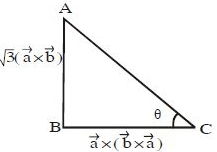
0 likes
View Solution137
MediumMCQ
The area (in sq. units) of the parallelogram whose diagonals are along the vectors $8\hat{i} - 6\hat{j}$ and $3\hat{i} + 4\hat{j} - 12\hat{k}$ is:
A
$26$
B
$65$
C
$20$
D
$52$
Solution
(B) Let the diagonals be $\vec{d_1} = 8\hat{i} - 6\hat{j} + 0\hat{k}$ and $\vec{d_2} = 3\hat{i} + 4\hat{j} - 12\hat{k}$.
The area of a parallelogram with diagonals $\vec{d_1}$ and $\vec{d_2}$ is given by the formula $\text{Area} = \frac{1}{2} |\vec{d_1} \times \vec{d_2}|$.
First,calculate the cross product $\vec{d_1} \times \vec{d_2}$:
$\vec{d_1} \times \vec{d_2} = \begin{vmatrix} \hat{i} & \hat{j} & \hat{k} \\ 8 & -6 & 0 \\ 3 & 4 & -12 \end{vmatrix}$
$= \hat{i}((-6)(-12) - (0)(4)) - \hat{j}((8)(-12) - (0)(3)) + \hat{k}((8)(4) - (-6)(3))$
$= \hat{i}(72 - 0) - \hat{j}(-96 - 0) + \hat{k}(32 + 18)$
$= 72\hat{i} + 96\hat{j} + 50\hat{k}$.
Now,find the magnitude of the cross product:
$|\vec{d_1} \times \vec{d_2}| = \sqrt{72^2 + 96^2 + 50^2}$
$= \sqrt{5184 + 9216 + 2500}$
$= \sqrt{16900} = 130$.
Therefore,the area of the parallelogram is $\frac{1}{2} \times 130 = 65$ sq. units.
The area of a parallelogram with diagonals $\vec{d_1}$ and $\vec{d_2}$ is given by the formula $\text{Area} = \frac{1}{2} |\vec{d_1} \times \vec{d_2}|$.
First,calculate the cross product $\vec{d_1} \times \vec{d_2}$:
$\vec{d_1} \times \vec{d_2} = \begin{vmatrix} \hat{i} & \hat{j} & \hat{k} \\ 8 & -6 & 0 \\ 3 & 4 & -12 \end{vmatrix}$
$= \hat{i}((-6)(-12) - (0)(4)) - \hat{j}((8)(-12) - (0)(3)) + \hat{k}((8)(4) - (-6)(3))$
$= \hat{i}(72 - 0) - \hat{j}(-96 - 0) + \hat{k}(32 + 18)$
$= 72\hat{i} + 96\hat{j} + 50\hat{k}$.
Now,find the magnitude of the cross product:
$|\vec{d_1} \times \vec{d_2}| = \sqrt{72^2 + 96^2 + 50^2}$
$= \sqrt{5184 + 9216 + 2500}$
$= \sqrt{16900} = 130$.
Therefore,the area of the parallelogram is $\frac{1}{2} \times 130 = 65$ sq. units.
0 likes
View Solution138
DifficultMCQ
If the vector $\vec{b} = 3\hat{j} + 4\hat{k}$ is written as the sum of a vector $\vec{b_1}$,parallel to $\vec{a} = \hat{i} + \hat{j}$ and a vector $\vec{b_2}$,perpendicular to $\vec{a}$,then $\vec{b_1} \times \vec{b_2}$ is equal to
A
$-3\hat{i} + 3\hat{j} - 9\hat{k}$
B
$6\hat{i} - 6\hat{j} + \frac{9}{2}\hat{k}$
C
$-6\hat{i} + 6\hat{j} - \frac{9}{2}\hat{k}$
D
$3\hat{i} - 3\hat{j} + 9\hat{k}$
Solution
(B) Given $\vec{b} = 3\hat{j} + 4\hat{k}$ and $\vec{a} = \hat{i} + \hat{j}$.
$\vec{b_1}$ is parallel to $\vec{a}$,so $\vec{b_1} = \text{proj}_{\vec{a}} \vec{b} = \left( \frac{\vec{b} \cdot \vec{a}}{|\vec{a}|^2} \right) \vec{a}$.
$\vec{b} \cdot \vec{a} = (3\hat{j} + 4\hat{k}) \cdot (\hat{i} + \hat{j}) = 3$.
$|\vec{a}|^2 = |\hat{i} + \hat{j}|^2 = 1^2 + 1^2 = 2$.
Thus,$\vec{b_1} = \frac{3}{2}(\hat{i} + \hat{j}) = \frac{3}{2}\hat{i} + \frac{3}{2}\hat{j}$.
Since $\vec{b} = \vec{b_1} + \vec{b_2}$,we have $\vec{b_2} = \vec{b} - \vec{b_1} = (3\hat{j} + 4\hat{k}) - (\frac{3}{2}\hat{i} + \frac{3}{2}\hat{j}) = -\frac{3}{2}\hat{i} + \frac{3}{2}\hat{j} + 4\hat{k}$.
Now,calculate the cross product $\vec{b_1} \times \vec{b_2}$:
$\vec{b_1} \times \vec{b_2} = \begin{vmatrix} \hat{i} & \hat{j} & \hat{k} \\ 3/2 & 3/2 & 0 \\ -3/2 & 3/2 & 4 \end{vmatrix}$.
$= \hat{i} \left( (3/2)(4) - (0)(3/2) \right) - \hat{j} \left( (3/2)(4) - (0)(-3/2) \right) + \hat{k} \left( (3/2)(3/2) - (3/2)(-3/2) \right)$.
$= \hat{i}(6) - \hat{j}(6) + \hat{k}(9/4 + 9/4) = 6\hat{i} - 6\hat{j} + \frac{9}{2}\hat{k}$.
$\vec{b_1}$ is parallel to $\vec{a}$,so $\vec{b_1} = \text{proj}_{\vec{a}} \vec{b} = \left( \frac{\vec{b} \cdot \vec{a}}{|\vec{a}|^2} \right) \vec{a}$.
$\vec{b} \cdot \vec{a} = (3\hat{j} + 4\hat{k}) \cdot (\hat{i} + \hat{j}) = 3$.
$|\vec{a}|^2 = |\hat{i} + \hat{j}|^2 = 1^2 + 1^2 = 2$.
Thus,$\vec{b_1} = \frac{3}{2}(\hat{i} + \hat{j}) = \frac{3}{2}\hat{i} + \frac{3}{2}\hat{j}$.
Since $\vec{b} = \vec{b_1} + \vec{b_2}$,we have $\vec{b_2} = \vec{b} - \vec{b_1} = (3\hat{j} + 4\hat{k}) - (\frac{3}{2}\hat{i} + \frac{3}{2}\hat{j}) = -\frac{3}{2}\hat{i} + \frac{3}{2}\hat{j} + 4\hat{k}$.
Now,calculate the cross product $\vec{b_1} \times \vec{b_2}$:
$\vec{b_1} \times \vec{b_2} = \begin{vmatrix} \hat{i} & \hat{j} & \hat{k} \\ 3/2 & 3/2 & 0 \\ -3/2 & 3/2 & 4 \end{vmatrix}$.
$= \hat{i} \left( (3/2)(4) - (0)(3/2) \right) - \hat{j} \left( (3/2)(4) - (0)(-3/2) \right) + \hat{k} \left( (3/2)(3/2) - (3/2)(-3/2) \right)$.
$= \hat{i}(6) - \hat{j}(6) + \hat{k}(9/4 + 9/4) = 6\hat{i} - 6\hat{j} + \frac{9}{2}\hat{k}$.
0 likes
View Solution139
DifficultMCQ
Let $\vec a = 2\hat i + \hat j - 2\hat k$ and $\vec b = \hat i + \hat j$. If $\vec c$ is a vector such that $\vec a \cdot \vec c = |\vec c|$,$|\vec c - \vec a| = 2\sqrt 2$,and the angle between $\vec a \times \vec b$ and $\vec c$ is $30^o$,then $|(\vec a \times \vec b) \times \vec c|$ equals:
A
$\frac{1}{2}$
B
$\frac{3\sqrt 3}{2}$
C
$3$
D
$\frac{3}{2}$
Solution
(D) Given $\vec a = 2\hat i + \hat j - 2\hat k$ and $\vec b = \hat i + \hat j$.
First,calculate the magnitude of $\vec a$: $|\vec a| = \sqrt{2^2 + 1^2 + (-2)^2} = \sqrt{4 + 1 + 4} = 3$.
Next,calculate the cross product $\vec a \times \vec b$:
$\vec a \times \vec b = \begin{vmatrix} \hat i & \hat j & \hat k \\ 2 & 1 & -2 \\ 1 & 1 & 0 \end{vmatrix} = \hat i(0 - (-2)) - \hat j(0 - (-2)) + \hat k(2 - 1) = 2\hat i - 2\hat j + \hat k$.
The magnitude is $|\vec a \times \vec b| = \sqrt{2^2 + (-2)^2 + 1^2} = \sqrt{4 + 4 + 1} = 3$.
Given $|\vec c - \vec a| = 2\sqrt 2$,squaring both sides gives $|\vec c - \vec a|^2 = 8$.
Expanding this,we get $|\vec c|^2 + |\vec a|^2 - 2(\vec c \cdot \vec a) = 8$.
Substituting $|\vec a| = 3$ and $\vec a \cdot \vec c = |\vec c|$,we have $|\vec c|^2 + 9 - 2|\vec c| = 8$.
This simplifies to $|\vec c|^2 - 2|\vec c| + 1 = 0$,which is $(|\vec c| - 1)^2 = 0$,so $|\vec c| = 1$.
Finally,the magnitude of the cross product is $|(\vec a \times \vec b) \times \vec c| = |\vec a \times \vec b| |\vec c| \sin 30^o$.
Substituting the values: $3 \times 1 \times \frac{1}{2} = \frac{3}{2}$.
First,calculate the magnitude of $\vec a$: $|\vec a| = \sqrt{2^2 + 1^2 + (-2)^2} = \sqrt{4 + 1 + 4} = 3$.
Next,calculate the cross product $\vec a \times \vec b$:
$\vec a \times \vec b = \begin{vmatrix} \hat i & \hat j & \hat k \\ 2 & 1 & -2 \\ 1 & 1 & 0 \end{vmatrix} = \hat i(0 - (-2)) - \hat j(0 - (-2)) + \hat k(2 - 1) = 2\hat i - 2\hat j + \hat k$.
The magnitude is $|\vec a \times \vec b| = \sqrt{2^2 + (-2)^2 + 1^2} = \sqrt{4 + 4 + 1} = 3$.
Given $|\vec c - \vec a| = 2\sqrt 2$,squaring both sides gives $|\vec c - \vec a|^2 = 8$.
Expanding this,we get $|\vec c|^2 + |\vec a|^2 - 2(\vec c \cdot \vec a) = 8$.
Substituting $|\vec a| = 3$ and $\vec a \cdot \vec c = |\vec c|$,we have $|\vec c|^2 + 9 - 2|\vec c| = 8$.
This simplifies to $|\vec c|^2 - 2|\vec c| + 1 = 0$,which is $(|\vec c| - 1)^2 = 0$,so $|\vec c| = 1$.
Finally,the magnitude of the cross product is $|(\vec a \times \vec b) \times \vec c| = |\vec a \times \vec b| |\vec c| \sin 30^o$.
Substituting the values: $3 \times 1 \times \frac{1}{2} = \frac{3}{2}$.
0 likes
View Solution140
DifficultMCQ
$A$ unit vector which is perpendicular to the vector $2\hat{i} - \hat{j} + 2\hat{k}$ and is coplanar with the vectors $\hat{i} + \hat{j} - \hat{k}$ and $2\hat{i} + 2\hat{j} - \hat{k}$ is
A
$\frac{2\hat{j} + \hat{k}}{\sqrt{5}}$
B
$\frac{3\hat{i} + 2\hat{j} - 2\hat{k}}{\sqrt{17}}$
C
$\frac{3\hat{i} + 2\hat{j} + 2\hat{k}}{\sqrt{17}}$
D
$\frac{2\hat{i} + 2\hat{j} - \hat{k}}{3}$
Solution
(D) Let $\vec{v} = x\hat{i} + y\hat{j} + z\hat{k}$ be the required unit vector.
Since $\vec{v}$ is perpendicular to $\vec{a} = 2\hat{i} - \hat{j} + 2\hat{k}$,we have $\vec{v} \cdot \vec{a} = 0$.
$2x - y + 2z = 0$ ...... $(i)$
Since $\vec{v}$ is coplanar with $\vec{b} = \hat{i} + \hat{j} - \hat{k}$ and $\vec{c} = 2\hat{i} + 2\hat{j} - \hat{k}$,$\vec{v}$ can be written as a linear combination of $\vec{b}$ and $\vec{c}$.
$\vec{v} = p(\hat{i} + \hat{j} - \hat{k}) + q(2\hat{i} + 2\hat{j} - \hat{k}) = (p + 2q)\hat{i} + (p + 2q)\hat{j} - (p + q)\hat{k}$.
Comparing components,$x = p + 2q$,$y = p + 2q$,$z = -(p + q)$.
Substitute into $(i)$: $2(p + 2q) - (p + 2q) + 2(-p - q) = 0$.
$2p + 4q - p - 2q - 2p - 2q = 0 \Rightarrow -p = 0 \Rightarrow p = 0$.
Thus,$x = 2q, y = 2q, z = -q$.
Since $\vec{v}$ is a unit vector,$x^2 + y^2 + z^2 = 1$.
$(2q)^2 + (2q)^2 + (-q)^2 = 1 \Rightarrow 4q^2 + 4q^2 + q^2 = 1 \Rightarrow 9q^2 = 1 \Rightarrow q = \pm \frac{1}{3}$.
For $q = \frac{1}{3}$,$\vec{v} = \frac{2}{3}\hat{i} + \frac{2}{3}\hat{j} - \frac{1}{3}\hat{k} = \frac{2\hat{i} + 2\hat{j} - \hat{k}}{3}$.
This matches option $D$.
Since $\vec{v}$ is perpendicular to $\vec{a} = 2\hat{i} - \hat{j} + 2\hat{k}$,we have $\vec{v} \cdot \vec{a} = 0$.
$2x - y + 2z = 0$ ...... $(i)$
Since $\vec{v}$ is coplanar with $\vec{b} = \hat{i} + \hat{j} - \hat{k}$ and $\vec{c} = 2\hat{i} + 2\hat{j} - \hat{k}$,$\vec{v}$ can be written as a linear combination of $\vec{b}$ and $\vec{c}$.
$\vec{v} = p(\hat{i} + \hat{j} - \hat{k}) + q(2\hat{i} + 2\hat{j} - \hat{k}) = (p + 2q)\hat{i} + (p + 2q)\hat{j} - (p + q)\hat{k}$.
Comparing components,$x = p + 2q$,$y = p + 2q$,$z = -(p + q)$.
Substitute into $(i)$: $2(p + 2q) - (p + 2q) + 2(-p - q) = 0$.
$2p + 4q - p - 2q - 2p - 2q = 0 \Rightarrow -p = 0 \Rightarrow p = 0$.
Thus,$x = 2q, y = 2q, z = -q$.
Since $\vec{v}$ is a unit vector,$x^2 + y^2 + z^2 = 1$.
$(2q)^2 + (2q)^2 + (-q)^2 = 1 \Rightarrow 4q^2 + 4q^2 + q^2 = 1 \Rightarrow 9q^2 = 1 \Rightarrow q = \pm \frac{1}{3}$.
For $q = \frac{1}{3}$,$\vec{v} = \frac{2}{3}\hat{i} + \frac{2}{3}\hat{j} - \frac{1}{3}\hat{k} = \frac{2\hat{i} + 2\hat{j} - \hat{k}}{3}$.
This matches option $D$.
0 likes
View Solution141
DifficultMCQ
$A$ tetrahedron has vertices $P(1, 2, 1)$,$Q(2, 1, 3)$,$R(-1, 1, 2)$ and $O(0, 0, 0)$. The angle between the faces $OPQ$ and $PQR$ is
A
$\cos^{-1}\left(\frac{17}{31}\right)$
B
$\cos^{-1}\left(\frac{19}{35}\right)$
C
$\cos^{-1}\left(\frac{9}{35}\right)$
D
$\cos^{-1}\left(\frac{7}{31}\right)$
Solution
(B) Let the vertices be $O(0, 0, 0)$,$P(1, 2, 1)$,$Q(2, 1, 3)$,and $R(-1, 1, 2)$.
To find the angle between faces $OPQ$ and $PQR$,we find the normal vectors to these faces.
For face $OPQ$,the normal vector $\vec{n_1} = \vec{OP} \times \vec{OQ} = \begin{vmatrix} \hat{i} & \hat{j} & \hat{k} \\ 1 & 2 & 1 \\ 2 & 1 & 3 \end{vmatrix} = \hat{i}(6-1) - \hat{j}(3-2) + \hat{k}(1-4) = 5\hat{i} - \hat{j} - 3\hat{k}$.
For face $PQR$,the normal vector $\vec{n_2} = \vec{PQ} \times \vec{PR}$.
$\vec{PQ} = (2-1)\hat{i} + (1-2)\hat{j} + (3-1)\hat{k} = \hat{i} - \hat{j} + 2\hat{k}$.
$\vec{PR} = (-1-1)\hat{i} + (1-2)\hat{j} + (2-1)\hat{k} = -2\hat{i} - \hat{j} + \hat{k}$.
$\vec{n_2} = \begin{vmatrix} \hat{i} & \hat{j} & \hat{k} \\ 1 & -1 & 2 \\ -2 & -1 & 1 \end{vmatrix} = \hat{i}(-1+2) - \hat{j}(1+4) + \hat{k}(-1-2) = \hat{i} - 5\hat{j} - 3\hat{k}$.
The angle $\theta$ between the faces is given by $\cos \theta = \frac{|\vec{n_1} \cdot \vec{n_2}|}{|\vec{n_1}| |\vec{n_2}|}$.
$|\vec{n_1}| = \sqrt{5^2 + (-1)^2 + (-3)^2} = \sqrt{25+1+9} = \sqrt{35}$.
$|\vec{n_2}| = \sqrt{1^2 + (-5)^2 + (-3)^2} = \sqrt{1+25+9} = \sqrt{35}$.
$\vec{n_1} \cdot \vec{n_2} = (5)(1) + (-1)(-5) + (-3)(-3) = 5 + 5 + 9 = 19$.
$\cos \theta = \frac{19}{\sqrt{35} \cdot \sqrt{35}} = \frac{19}{35}$.
Therefore,$\theta = \cos^{-1}\left(\frac{19}{35}\right)$.
To find the angle between faces $OPQ$ and $PQR$,we find the normal vectors to these faces.
For face $OPQ$,the normal vector $\vec{n_1} = \vec{OP} \times \vec{OQ} = \begin{vmatrix} \hat{i} & \hat{j} & \hat{k} \\ 1 & 2 & 1 \\ 2 & 1 & 3 \end{vmatrix} = \hat{i}(6-1) - \hat{j}(3-2) + \hat{k}(1-4) = 5\hat{i} - \hat{j} - 3\hat{k}$.
For face $PQR$,the normal vector $\vec{n_2} = \vec{PQ} \times \vec{PR}$.
$\vec{PQ} = (2-1)\hat{i} + (1-2)\hat{j} + (3-1)\hat{k} = \hat{i} - \hat{j} + 2\hat{k}$.
$\vec{PR} = (-1-1)\hat{i} + (1-2)\hat{j} + (2-1)\hat{k} = -2\hat{i} - \hat{j} + \hat{k}$.
$\vec{n_2} = \begin{vmatrix} \hat{i} & \hat{j} & \hat{k} \\ 1 & -1 & 2 \\ -2 & -1 & 1 \end{vmatrix} = \hat{i}(-1+2) - \hat{j}(1+4) + \hat{k}(-1-2) = \hat{i} - 5\hat{j} - 3\hat{k}$.
The angle $\theta$ between the faces is given by $\cos \theta = \frac{|\vec{n_1} \cdot \vec{n_2}|}{|\vec{n_1}| |\vec{n_2}|}$.
$|\vec{n_1}| = \sqrt{5^2 + (-1)^2 + (-3)^2} = \sqrt{25+1+9} = \sqrt{35}$.
$|\vec{n_2}| = \sqrt{1^2 + (-5)^2 + (-3)^2} = \sqrt{1+25+9} = \sqrt{35}$.
$\vec{n_1} \cdot \vec{n_2} = (5)(1) + (-1)(-5) + (-3)(-3) = 5 + 5 + 9 = 19$.
$\cos \theta = \frac{19}{\sqrt{35} \cdot \sqrt{35}} = \frac{19}{35}$.
Therefore,$\theta = \cos^{-1}\left(\frac{19}{35}\right)$.
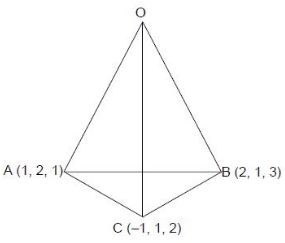
0 likes
View Solution142
DifficultMCQ
Let $\vec{a}, \vec{b},$ and $\vec{c}$ be three unit vectors,out of which vectors $\vec{b}$ and $\vec{c}$ are non-parallel. If $\alpha$ and $\beta$ are the angles which vector $\vec{a}$ makes with vectors $\vec{b}$ and $\vec{c}$ respectively and $\vec{a} \times (\vec{b} \times \vec{c}) = \frac{1}{2} \vec{b},$ then $|\alpha - \beta|$ is equal to .............. $^o$
A
$30$
B
$90$
C
$60$
D
$45$
Solution
(A) Given that $\vec{a}, \vec{b},$ and $\vec{c}$ are unit vectors,so $|\vec{a}| = |\vec{b}| = |\vec{c}| = 1.$
Using the vector triple product formula,$\vec{a} \times (\vec{b} \times \vec{c}) = (\vec{a} \cdot \vec{c}) \vec{b} - (\vec{a} \cdot \vec{b}) \vec{c}.$
Given $\vec{a} \times (\vec{b} \times \vec{c}) = \frac{1}{2} \vec{b},$ we have $(\vec{a} \cdot \vec{c}) \vec{b} - (\vec{a} \cdot \vec{b}) \vec{c} = \frac{1}{2} \vec{b}.$
Since $\vec{b}$ and $\vec{c}$ are non-parallel,they are linearly independent. Comparing the coefficients of $\vec{b}$ and $\vec{c},$ we get $\vec{a} \cdot \vec{c} = \frac{1}{2}$ and $\vec{a} \cdot \vec{b} = 0.$
We know $\vec{a} \cdot \vec{b} = |\vec{a}| |\vec{b}| \cos \alpha = 1 \cdot 1 \cdot \cos \alpha = 0 \implies \alpha = 90^{\circ}.$
We know $\vec{a} \cdot \vec{c} = |\vec{a}| |\vec{c}| \cos \beta = 1 \cdot 1 \cdot \cos \beta = \frac{1}{2} \implies \beta = 60^{\circ}.$
Thus,$|\alpha - \beta| = |90^{\circ} - 60^{\circ}| = 30^{\circ}.$
Using the vector triple product formula,$\vec{a} \times (\vec{b} \times \vec{c}) = (\vec{a} \cdot \vec{c}) \vec{b} - (\vec{a} \cdot \vec{b}) \vec{c}.$
Given $\vec{a} \times (\vec{b} \times \vec{c}) = \frac{1}{2} \vec{b},$ we have $(\vec{a} \cdot \vec{c}) \vec{b} - (\vec{a} \cdot \vec{b}) \vec{c} = \frac{1}{2} \vec{b}.$
Since $\vec{b}$ and $\vec{c}$ are non-parallel,they are linearly independent. Comparing the coefficients of $\vec{b}$ and $\vec{c},$ we get $\vec{a} \cdot \vec{c} = \frac{1}{2}$ and $\vec{a} \cdot \vec{b} = 0.$
We know $\vec{a} \cdot \vec{b} = |\vec{a}| |\vec{b}| \cos \alpha = 1 \cdot 1 \cdot \cos \alpha = 0 \implies \alpha = 90^{\circ}.$
We know $\vec{a} \cdot \vec{c} = |\vec{a}| |\vec{c}| \cos \beta = 1 \cdot 1 \cdot \cos \beta = \frac{1}{2} \implies \beta = 60^{\circ}.$
Thus,$|\alpha - \beta| = |90^{\circ} - 60^{\circ}| = 30^{\circ}.$
0 likes
View Solution143
DifficultMCQ
The magnitude of the projection of the vector $2\hat{i} + 3\hat{j} + \hat{k}$ on the vector perpendicular to the plane containing the vectors $\hat{i} + \hat{j} + \hat{k}$ and $\hat{i} + 2\hat{j} + 3\hat{k}$ is
A
$3\sqrt{6}$
B
$\frac{\sqrt{3}}{2}$
C
$\sqrt{6}$
D
$\sqrt{\frac{3}{2}}$
Solution
(D) Let $\vec{a} = \hat{i} + \hat{j} + \hat{k}$ and $\vec{b} = \hat{i} + 2\hat{j} + 3\hat{k}$.
The vector perpendicular to the plane containing $\vec{a}$ and $\vec{b}$ is given by $\vec{n} = \vec{a} \times \vec{b}$.
$\vec{n} = \begin{vmatrix} \hat{i} & \hat{j} & \hat{k} \\ 1 & 1 & 1 \\ 1 & 2 & 3 \end{vmatrix} = \hat{i}(3-2) - \hat{j}(3-1) + \hat{k}(2-1) = \hat{i} - 2\hat{j} + \hat{k}$.
The magnitude of the projection of vector $\vec{v} = 2\hat{i} + 3\hat{j} + \hat{k}$ on vector $\vec{n}$ is given by $\frac{|\vec{v} \cdot \vec{n}|}{|\vec{n}|}$.
$\vec{v} \cdot \vec{n} = (2)(1) + (3)(-2) + (1)(1) = 2 - 6 + 1 = -3$.
$|\vec{n}| = \sqrt{1^2 + (-2)^2 + 1^2} = \sqrt{1 + 4 + 1} = \sqrt{6}$.
Therefore,the magnitude of the projection is $\frac{|-3|}{\sqrt{6}} = \frac{3}{\sqrt{6}} = \sqrt{\frac{9}{6}} = \sqrt{\frac{3}{2}}$.
The vector perpendicular to the plane containing $\vec{a}$ and $\vec{b}$ is given by $\vec{n} = \vec{a} \times \vec{b}$.
$\vec{n} = \begin{vmatrix} \hat{i} & \hat{j} & \hat{k} \\ 1 & 1 & 1 \\ 1 & 2 & 3 \end{vmatrix} = \hat{i}(3-2) - \hat{j}(3-1) + \hat{k}(2-1) = \hat{i} - 2\hat{j} + \hat{k}$.
The magnitude of the projection of vector $\vec{v} = 2\hat{i} + 3\hat{j} + \hat{k}$ on vector $\vec{n}$ is given by $\frac{|\vec{v} \cdot \vec{n}|}{|\vec{n}|}$.
$\vec{v} \cdot \vec{n} = (2)(1) + (3)(-2) + (1)(1) = 2 - 6 + 1 = -3$.
$|\vec{n}| = \sqrt{1^2 + (-2)^2 + 1^2} = \sqrt{1 + 4 + 1} = \sqrt{6}$.
Therefore,the magnitude of the projection is $\frac{|-3|}{\sqrt{6}} = \frac{3}{\sqrt{6}} = \sqrt{\frac{9}{6}} = \sqrt{\frac{3}{2}}$.
0 likes
View Solution144
DifficultMCQ
Let $\vec{a} = 3\hat{i} + 2\hat{j} + x\hat{k}$ and $\vec{b} = \hat{i} - \hat{j} + \hat{k}$,for some real $x$. Then $|\vec{a} \times \vec{b}| = r$ is possible if
A
$r \geq 5\sqrt{\frac{3}{2}}$
B
$3\sqrt{\frac{3}{2}} < r < 5\sqrt{\frac{3}{2}}$
C
$\sqrt{\frac{3}{2}} < r \leq 3\sqrt{\frac{3}{2}}$
D
$0 < r \leq \sqrt{\frac{3}{2}}$
Solution
(A) First,calculate the cross product $\vec{a} \times \vec{b}$:
$\vec{a} \times \vec{b} = \begin{vmatrix} \hat{i} & \hat{j} & \hat{k} \\ 3 & 2 & x \\ 1 & -1 & 1 \end{vmatrix} = \hat{i}(2 + x) - \hat{j}(3 - x) + \hat{k}(-3 - 2) = (x + 2)\hat{i} + (x - 3)\hat{j} - 5\hat{k}$.
Next,find the magnitude $r = |\vec{a} \times \vec{b}|$:
$r^2 = (x + 2)^2 + (x - 3)^2 + (-5)^2$
$r^2 = (x^2 + 4x + 4) + (x^2 - 6x + 9) + 25$
$r^2 = 2x^2 - 2x + 38 = 2(x^2 - x + 19)$.
Complete the square for the expression inside the parenthesis:
$r^2 = 2\left((x - \frac{1}{2})^2 + 19 - \frac{1}{4}\right) = 2\left((x - \frac{1}{2})^2 + \frac{75}{4}\right) = 2(x - \frac{1}{2})^2 + \frac{75}{2}$.
Since $(x - \frac{1}{2})^2 \geq 0$,the minimum value of $r^2$ is $\frac{75}{2}$.
Therefore,$r^2 \geq \frac{75}{2} \implies r \geq \sqrt{\frac{75}{2}} = \sqrt{\frac{25 \times 3}{2}} = 5\sqrt{\frac{3}{2}}$.
Thus,the condition is $r \geq 5\sqrt{\frac{3}{2}}$.
$\vec{a} \times \vec{b} = \begin{vmatrix} \hat{i} & \hat{j} & \hat{k} \\ 3 & 2 & x \\ 1 & -1 & 1 \end{vmatrix} = \hat{i}(2 + x) - \hat{j}(3 - x) + \hat{k}(-3 - 2) = (x + 2)\hat{i} + (x - 3)\hat{j} - 5\hat{k}$.
Next,find the magnitude $r = |\vec{a} \times \vec{b}|$:
$r^2 = (x + 2)^2 + (x - 3)^2 + (-5)^2$
$r^2 = (x^2 + 4x + 4) + (x^2 - 6x + 9) + 25$
$r^2 = 2x^2 - 2x + 38 = 2(x^2 - x + 19)$.
Complete the square for the expression inside the parenthesis:
$r^2 = 2\left((x - \frac{1}{2})^2 + 19 - \frac{1}{4}\right) = 2\left((x - \frac{1}{2})^2 + \frac{75}{4}\right) = 2(x - \frac{1}{2})^2 + \frac{75}{2}$.
Since $(x - \frac{1}{2})^2 \geq 0$,the minimum value of $r^2$ is $\frac{75}{2}$.
Therefore,$r^2 \geq \frac{75}{2} \implies r \geq \sqrt{\frac{75}{2}} = \sqrt{\frac{25 \times 3}{2}} = 5\sqrt{\frac{3}{2}}$.
Thus,the condition is $r \geq 5\sqrt{\frac{3}{2}}$.
0 likes
View Solution145
DifficultMCQ
Let $\vec \alpha = 3\hat i + \hat j$ and $\vec \beta = 2\hat i - \hat j + 3\hat k.$ If $\vec \beta = \vec \beta _1 - \vec \beta _2,$ where $\vec \beta _1$ is parallel to $\vec \alpha$ and $\vec \beta _2$ is perpendicular to $\vec \alpha,$ then $\vec \beta _1 \times \vec \beta _2$ is equal to
A
$\frac{1}{2}(-3\hat i + 9\hat j + 5\hat k)$
B
$\frac{1}{2}(3\hat i - 9\hat j + 5\hat k)$
C
$-3\hat i + 9\hat j + 5\hat k$
D
$3\hat i - 9\hat j - 5\hat k$
Solution
(A) Given $\vec{\alpha} = 3\hat{i} + \hat{j}$ and $\vec{\beta} = 2\hat{i} - \hat{j} + 3\hat{k}.$
Since $\vec{\beta}_1$ is parallel to $\vec{\alpha},$ we have $\vec{\beta}_1 = \lambda \vec{\alpha} = \lambda(3\hat{i} + \hat{j}).$
Given $\vec{\beta} = \vec{\beta}_1 - \vec{\beta}_2,$ we have $\vec{\beta}_2 = \vec{\beta}_1 - \vec{\beta} = \lambda(3\hat{i} + \hat{j}) - (2\hat{i} - \hat{j} + 3\hat{k}) = (3\lambda - 2)\hat{i} + (\lambda + 1)\hat{j} - 3\hat{k}.$
Since $\vec{\beta}_2$ is perpendicular to $\vec{\alpha},$ $\vec{\beta}_2 \cdot \vec{\alpha} = 0.$
$((3\lambda - 2)\hat{i} + (\lambda + 1)\hat{j} - 3\hat{k}) \cdot (3\hat{i} + \hat{j}) = 0.$
$3(3\lambda - 2) + 1(\lambda + 1) = 0 \implies 9\lambda - 6 + \lambda + 1 = 0 \implies 10\lambda = 5 \implies \lambda = \frac{1}{2}.$
Thus,$\vec{\beta}_1 = \frac{3}{2}\hat{i} + \frac{1}{2}\hat{j}$ and $\vec{\beta}_2 = (\frac{3}{2} - 2)\hat{i} + (\frac{1}{2} + 1)\hat{j} - 3\hat{k} = -\frac{1}{2}\hat{i} + \frac{3}{2}\hat{j} - 3\hat{k}.$
Now,$\vec{\beta}_1 \times \vec{\beta}_2 = \begin{vmatrix} \hat{i} & \hat{j} & \hat{k} \\ \frac{3}{2} & \frac{1}{2} & 0 \\ -\frac{1}{2} & \frac{3}{2} & -3 \end{vmatrix}.$
$= \hat{i}(-\frac{3}{2} - 0) - \hat{j}(-\frac{9}{2} - 0) + \hat{k}(\frac{9}{4} - (-\frac{1}{4})) = -\frac{3}{2}\hat{i} + \frac{9}{2}\hat{j} + \frac{10}{4}\hat{k} = -\frac{3}{2}\hat{i} + \frac{9}{2}\hat{j} + \frac{5}{2}\hat{k}.$
$= \frac{1}{2}(-3\hat{i} + 9\hat{j} + 5\hat{k}).$
Since $\vec{\beta}_1$ is parallel to $\vec{\alpha},$ we have $\vec{\beta}_1 = \lambda \vec{\alpha} = \lambda(3\hat{i} + \hat{j}).$
Given $\vec{\beta} = \vec{\beta}_1 - \vec{\beta}_2,$ we have $\vec{\beta}_2 = \vec{\beta}_1 - \vec{\beta} = \lambda(3\hat{i} + \hat{j}) - (2\hat{i} - \hat{j} + 3\hat{k}) = (3\lambda - 2)\hat{i} + (\lambda + 1)\hat{j} - 3\hat{k}.$
Since $\vec{\beta}_2$ is perpendicular to $\vec{\alpha},$ $\vec{\beta}_2 \cdot \vec{\alpha} = 0.$
$((3\lambda - 2)\hat{i} + (\lambda + 1)\hat{j} - 3\hat{k}) \cdot (3\hat{i} + \hat{j}) = 0.$
$3(3\lambda - 2) + 1(\lambda + 1) = 0 \implies 9\lambda - 6 + \lambda + 1 = 0 \implies 10\lambda = 5 \implies \lambda = \frac{1}{2}.$
Thus,$\vec{\beta}_1 = \frac{3}{2}\hat{i} + \frac{1}{2}\hat{j}$ and $\vec{\beta}_2 = (\frac{3}{2} - 2)\hat{i} + (\frac{1}{2} + 1)\hat{j} - 3\hat{k} = -\frac{1}{2}\hat{i} + \frac{3}{2}\hat{j} - 3\hat{k}.$
Now,$\vec{\beta}_1 \times \vec{\beta}_2 = \begin{vmatrix} \hat{i} & \hat{j} & \hat{k} \\ \frac{3}{2} & \frac{1}{2} & 0 \\ -\frac{1}{2} & \frac{3}{2} & -3 \end{vmatrix}.$
$= \hat{i}(-\frac{3}{2} - 0) - \hat{j}(-\frac{9}{2} - 0) + \hat{k}(\frac{9}{4} - (-\frac{1}{4})) = -\frac{3}{2}\hat{i} + \frac{9}{2}\hat{j} + \frac{10}{4}\hat{k} = -\frac{3}{2}\hat{i} + \frac{9}{2}\hat{j} + \frac{5}{2}\hat{k}.$
$= \frac{1}{2}(-3\hat{i} + 9\hat{j} + 5\hat{k}).$
0 likes
View Solution146
DifficultMCQ
Let $\vec{a} = 3\hat{i} + 2\hat{j} + 2\hat{k}$ and $\vec{b} = \hat{i} + 2\hat{j} - 2\hat{k}$ be two vectors. If a vector perpendicular to both the vectors $\vec{a} + \vec{b}$ and $\vec{a} - \vec{b}$ has the magnitude $12$,then one such vector is
A
$4(2\hat{i} - 2\hat{j} - \hat{k})$
B
$4(2\hat{i} - 2\hat{j} + \hat{k})$
C
$4(2\hat{i} + 2\hat{j} + \hat{k})$
D
$4(2\hat{i} + 2\hat{j} - \hat{k})$
Solution
(A) First,calculate $\vec{a} + \vec{b} = (3+1)\hat{i} + (2+2)\hat{j} + (2-2)\hat{k} = 4\hat{i} + 4\hat{j}$.
Next,calculate $\vec{a} - \vec{b} = (3-1)\hat{i} + (2-2)\hat{j} + (2-(-2))\hat{k} = 2\hat{i} + 4\hat{k}$.
$A$ vector perpendicular to both $\vec{a} + \vec{b}$ and $\vec{a} - \vec{b}$ is given by their cross product:
$\vec{v} = (\vec{a} + \vec{b}) \times (\vec{a} - \vec{b}) = \begin{vmatrix} \hat{i} & \hat{j} & \hat{k} \\ 4 & 4 & 0 \\ 2 & 0 & 4 \end{vmatrix} = \hat{i}(16 - 0) - \hat{j}(16 - 0) + \hat{k}(0 - 8) = 16\hat{i} - 16\hat{j} - 8\hat{k}$.
Simplify the vector: $8(2\hat{i} - 2\hat{j} - \hat{k})$.
The magnitude of this vector is $8 \sqrt{2^2 + (-2)^2 + (-1)^2} = 8 \sqrt{4+4+1} = 8 \times 3 = 24$.
We need a vector with magnitude $12$,which is half of the magnitude of $\vec{v}$.
Thus,the required vector is $\pm \frac{12}{24} \times 8(2\hat{i} - 2\hat{j} - \hat{k}) = \pm 4(2\hat{i} - 2\hat{j} - \hat{k})$.
Comparing with the options,$4(2\hat{i} - 2\hat{j} - \hat{k})$ is the correct choice.
Next,calculate $\vec{a} - \vec{b} = (3-1)\hat{i} + (2-2)\hat{j} + (2-(-2))\hat{k} = 2\hat{i} + 4\hat{k}$.
$A$ vector perpendicular to both $\vec{a} + \vec{b}$ and $\vec{a} - \vec{b}$ is given by their cross product:
$\vec{v} = (\vec{a} + \vec{b}) \times (\vec{a} - \vec{b}) = \begin{vmatrix} \hat{i} & \hat{j} & \hat{k} \\ 4 & 4 & 0 \\ 2 & 0 & 4 \end{vmatrix} = \hat{i}(16 - 0) - \hat{j}(16 - 0) + \hat{k}(0 - 8) = 16\hat{i} - 16\hat{j} - 8\hat{k}$.
Simplify the vector: $8(2\hat{i} - 2\hat{j} - \hat{k})$.
The magnitude of this vector is $8 \sqrt{2^2 + (-2)^2 + (-1)^2} = 8 \sqrt{4+4+1} = 8 \times 3 = 24$.
We need a vector with magnitude $12$,which is half of the magnitude of $\vec{v}$.
Thus,the required vector is $\pm \frac{12}{24} \times 8(2\hat{i} - 2\hat{j} - \hat{k}) = \pm 4(2\hat{i} - 2\hat{j} - \hat{k})$.
Comparing with the options,$4(2\hat{i} - 2\hat{j} - \hat{k})$ is the correct choice.
0 likes
View Solution147
DifficultMCQ
Let $\vec{a}=\hat{i}-2\hat{j}+\hat{k}$ and $\vec{b}=\hat{i}-\hat{j}+\hat{k}$ be two vectors. If $\vec{c}$ is a vector such that $\vec{b} \times \vec{c}=\vec{b} \times \vec{a}$ and $\vec{c} \cdot \vec{a}=0,$ then $\vec{c} \cdot \vec{b}$ is equal to
A
$\frac{1}{2}$
B
$-1$
C
$-\frac{1}{2}$
D
$-\frac{3}{2}$
Solution
(C) Given $\vec{b} \times \vec{c} = \vec{b} \times \vec{a}$,we can write $\vec{b} \times (\vec{c} - \vec{a}) = \vec{0}$.
This implies that $\vec{c} - \vec{a}$ is parallel to $\vec{b}$,so $\vec{c} - \vec{a} = k\vec{b}$ for some scalar $k$.
Thus,$\vec{c} = \vec{a} + k\vec{b}$.
Given $\vec{c} \cdot \vec{a} = 0$,we substitute $\vec{c}$:
$(\vec{a} + k\vec{b}) \cdot \vec{a} = 0 \Rightarrow |\vec{a}|^2 + k(\vec{b} \cdot \vec{a}) = 0$.
Calculating magnitudes and dot products:
$|\vec{a}|^2 = 1^2 + (-2)^2 + 1^2 = 6$.
$\vec{b} \cdot \vec{a} = (1)(1) + (-1)(-2) + (1)(1) = 1 + 2 + 1 = 4$.
Substituting these values: $6 + k(4) = 0 \Rightarrow 4k = -6 \Rightarrow k = -\frac{3}{2}$.
Now,$\vec{c} \cdot \vec{b} = (\vec{a} + k\vec{b}) \cdot \vec{b} = \vec{a} \cdot \vec{b} + k|\vec{b}|^2$.
$|\vec{b}|^2 = 1^2 + (-1)^2 + 1^2 = 3$.
$\vec{c} \cdot \vec{b} = 4 + (-\frac{3}{2})(3) = 4 - \frac{9}{2} = \frac{8-9}{2} = -\frac{1}{2}$.
This implies that $\vec{c} - \vec{a}$ is parallel to $\vec{b}$,so $\vec{c} - \vec{a} = k\vec{b}$ for some scalar $k$.
Thus,$\vec{c} = \vec{a} + k\vec{b}$.
Given $\vec{c} \cdot \vec{a} = 0$,we substitute $\vec{c}$:
$(\vec{a} + k\vec{b}) \cdot \vec{a} = 0 \Rightarrow |\vec{a}|^2 + k(\vec{b} \cdot \vec{a}) = 0$.
Calculating magnitudes and dot products:
$|\vec{a}|^2 = 1^2 + (-2)^2 + 1^2 = 6$.
$\vec{b} \cdot \vec{a} = (1)(1) + (-1)(-2) + (1)(1) = 1 + 2 + 1 = 4$.
Substituting these values: $6 + k(4) = 0 \Rightarrow 4k = -6 \Rightarrow k = -\frac{3}{2}$.
Now,$\vec{c} \cdot \vec{b} = (\vec{a} + k\vec{b}) \cdot \vec{b} = \vec{a} \cdot \vec{b} + k|\vec{b}|^2$.
$|\vec{b}|^2 = 1^2 + (-1)^2 + 1^2 = 3$.
$\vec{c} \cdot \vec{b} = 4 + (-\frac{3}{2})(3) = 4 - \frac{9}{2} = \frac{8-9}{2} = -\frac{1}{2}$.
0 likes
View SolutionVector Algebra — Vector or Cross product of two vectors and its applications · Frequently Asked Questions
1Are these Vector Algebra questions useful for JEE and NEET?
Yes. All questions in this section are mapped to JEE Main and NEET exam patterns. Previous year questions from JEE Main, NEET, GUJCET and state-level exams are included with full solutions.
2Can I switch to Hindi or Gujarati for these questions?
Yes. Use the language tabs in the hero section or the sidebar to view the same questions and solutions in English, Hindi or Gujarati.
3How do I generate a question paper from this subtopic?
Use the Vedclass Exam Paper Generator — select the chapter and subtopic, set difficulty, and generate Sets A, B, C, D automatically. First 3 chapters of every subject are free.
Vedclass Products
For Students
Vedclass Test Series
Mock tests in real JEE/NEET style with performance analysis. 5-day free trial.
Start Free TrialFor Teachers
Exam Paper Generator
Generate Set A/B/C/D papers from this chapter in 2 minutes. 3 chapters free.
Try FreeFor Institutes
Online Exam Module
Live online exams with unlimited students, 360° analytics & white-label branding.
See DemoFor Teachers & Institutes
Generate a Vector Algebra Exam Paper in 2 Minutes
Select subtopic & difficulty — Sets A, B, C, D auto-generated with No Repeat logic.
First 3 chapters of every subject are free — no payment required.