
A English
Scalar or Dot product of two vectors and its applications Questions in English
Class 12 Mathematics · Vector Algebra · Scalar or Dot product of two vectors and its applications
923+
Questions
English
Language
100%
With Solutions
Showing 50 of 923 questions in English
601
MediumMCQ
If $|a|=2$ and $|b|=3$ and the angle between $a$ and $b$ is $120^{\circ}$,then the length of the vector $\left|\frac{a}{2}-\frac{b}{3}\right|$ is
A
$2$
B
$\sqrt{3}$
C
$1/6$
D
$1$
Solution
(NONE) We know that the dot product of two vectors is given by $a \cdot b = |a| |b| \cos \theta$.
Given $|a|=2$,$|b|=3$,and $\theta = 120^{\circ}$.
$a \cdot b = (2)(3) \cos 120^{\circ} = 6 \times (-1/2) = -3$.
Now,we need to find the magnitude $\left|\frac{a}{2} - \frac{b}{3}\right|$.
Let $X = \left|\frac{a}{2} - \frac{b}{3}\right|$. Then $X^2 = \left(\frac{a}{2} - \frac{b}{3}\right) \cdot \left(\frac{a}{2} - \frac{b}{3}\right)$.
$X^2 = \frac{1}{4}|a|^2 + \frac{1}{9}|b|^2 - 2 \left(\frac{1}{2} \cdot \frac{1}{3}\right) (a \cdot b)$.
$X^2 = \frac{1}{4}(2)^2 + \frac{1}{9}(3)^2 - \frac{1}{3} (a \cdot b)$.
$X^2 = \frac{1}{4}(4) + \frac{1}{9}(9) - \frac{1}{3}(-3)$.
$X^2 = 1 + 1 + 1 = 3$.
Therefore,$X = \sqrt{3}$.
Given $|a|=2$,$|b|=3$,and $\theta = 120^{\circ}$.
$a \cdot b = (2)(3) \cos 120^{\circ} = 6 \times (-1/2) = -3$.
Now,we need to find the magnitude $\left|\frac{a}{2} - \frac{b}{3}\right|$.
Let $X = \left|\frac{a}{2} - \frac{b}{3}\right|$. Then $X^2 = \left(\frac{a}{2} - \frac{b}{3}\right) \cdot \left(\frac{a}{2} - \frac{b}{3}\right)$.
$X^2 = \frac{1}{4}|a|^2 + \frac{1}{9}|b|^2 - 2 \left(\frac{1}{2} \cdot \frac{1}{3}\right) (a \cdot b)$.
$X^2 = \frac{1}{4}(2)^2 + \frac{1}{9}(3)^2 - \frac{1}{3} (a \cdot b)$.
$X^2 = \frac{1}{4}(4) + \frac{1}{9}(9) - \frac{1}{3}(-3)$.
$X^2 = 1 + 1 + 1 = 3$.
Therefore,$X = \sqrt{3}$.
0 likes
View Solution602
EasyMCQ
If $|a \times b|^2 + |a \cdot b|^2 = 36$ and $|a| = 3$,then $|b|$ is equal to
A
$9$
B
$36$
C
$4$
D
$2$
Solution
(D) We are given the identity $|a \times b|^2 + |a \cdot b|^2 = |a|^2 |b|^2$.
Given that $|a \times b|^2 + |a \cdot b|^2 = 36$ and $|a| = 3$.
Substituting these values into the identity:
$|a|^2 |b|^2 = 36$
$(3)^2 |b|^2 = 36$
$9 |b|^2 = 36$
$|b|^2 = \frac{36}{9} = 4$
$|b| = \sqrt{4} = 2$.
Thus,the value of $|b|$ is $2$.
Given that $|a \times b|^2 + |a \cdot b|^2 = 36$ and $|a| = 3$.
Substituting these values into the identity:
$|a|^2 |b|^2 = 36$
$(3)^2 |b|^2 = 36$
$9 |b|^2 = 36$
$|b|^2 = \frac{36}{9} = 4$
$|b| = \sqrt{4} = 2$.
Thus,the value of $|b|$ is $2$.
0 likes
View Solution603
EasyMCQ
If $a \cdot b = 0$ and $a + b$ makes an angle $60^{\circ}$ with $a$,then
A
$|a| = 2|b|$
B
$2|a| = |b|$
C
$|a| = \sqrt{3}|b|$
D
$\sqrt{3}|a| = |b|$
Solution
(D) Given,$a \cdot b = 0$ and $(a + b)$ makes a $60^{\circ}$ angle with $a$.
Using the formula for the angle between two vectors:
$\cos 60^{\circ} = \frac{(a + b) \cdot a}{|a + b||a|}$
$\Rightarrow \frac{1}{2} = \frac{a \cdot a + b \cdot a}{|a + b||a|}$
Since $a \cdot b = 0$,we have $b \cdot a = 0$.
$\Rightarrow \frac{1}{2} = \frac{|a|^2}{|a + b||a|} = \frac{|a|}{|a + b|}$
$\Rightarrow |a + b| = 2|a|$
Squaring both sides:
$|a + b|^2 = 4|a|^2$
$|a|^2 + |b|^2 + 2(a \cdot b) = 4|a|^2$
Since $a \cdot b = 0$:
$|a|^2 + |b|^2 = 4|a|^2$
$|b|^2 = 3|a|^2$
$|b| = \sqrt{3}|a|$
Using the formula for the angle between two vectors:
$\cos 60^{\circ} = \frac{(a + b) \cdot a}{|a + b||a|}$
$\Rightarrow \frac{1}{2} = \frac{a \cdot a + b \cdot a}{|a + b||a|}$
Since $a \cdot b = 0$,we have $b \cdot a = 0$.
$\Rightarrow \frac{1}{2} = \frac{|a|^2}{|a + b||a|} = \frac{|a|}{|a + b|}$
$\Rightarrow |a + b| = 2|a|$
Squaring both sides:
$|a + b|^2 = 4|a|^2$
$|a|^2 + |b|^2 + 2(a \cdot b) = 4|a|^2$
Since $a \cdot b = 0$:
$|a|^2 + |b|^2 = 4|a|^2$
$|b|^2 = 3|a|^2$
$|b| = \sqrt{3}|a|$
0 likes
View Solution604
MediumMCQ
If $|\vec{a}|=16$ and $|\vec{b}|=4$,then find the value of $\sqrt{|\vec{a} \times \vec{b}|^{2}+|\vec{a} \cdot \vec{b}|^{2}}$.
A
$8$
B
$64$
C
$4$
D
$16$
Solution
(B) We know that for any two vectors $\vec{a}$ and $\vec{b}$,the Lagrange's identity states that $|\vec{a} \times \vec{b}|^{2} + |\vec{a} \cdot \vec{b}|^{2} = |\vec{a}|^{2} |\vec{b}|^{2}$.
Given $|\vec{a}| = 16$ and $|\vec{b}| = 4$.
Substituting these values into the identity:
$\sqrt{|\vec{a} \times \vec{b}|^{2} + |\vec{a} \cdot \vec{b}|^{2}} = \sqrt{|\vec{a}|^{2} |\vec{b}|^{2}}$
$= |\vec{a}| |\vec{b}|$
$= (16) \times (4)$
$= 64$.
Given $|\vec{a}| = 16$ and $|\vec{b}| = 4$.
Substituting these values into the identity:
$\sqrt{|\vec{a} \times \vec{b}|^{2} + |\vec{a} \cdot \vec{b}|^{2}} = \sqrt{|\vec{a}|^{2} |\vec{b}|^{2}}$
$= |\vec{a}| |\vec{b}|$
$= (16) \times (4)$
$= 64$.
0 likes
View Solution605
EasyMCQ
If the angle between $\vec{a}$ and $\vec{b}$ is $\frac{2\pi}{3}$ and the projection of $\vec{a}$ in the direction of $\vec{b}$ is $-2$,then find $|\vec{a}|$.
A
$3$
B
$11$
C
$4$
D
$12$
Solution
(C) Given that the angle $\theta$ between $\vec{a}$ and $\vec{b}$ is $\frac{2\pi}{3}$.
The projection of $\vec{a}$ in the direction of $\vec{b}$ is given by the formula $\frac{\vec{a} \cdot \vec{b}}{|\vec{b}|} = -2$.
We know that $\vec{a} \cdot \vec{b} = |\vec{a}| |\vec{b}| \cos \theta$.
Substituting this into the projection formula:
$\frac{|\vec{a}| |\vec{b}| \cos \theta}{|\vec{b}|} = -2$
$|\vec{a}| \cos \theta = -2$
Substitute $\theta = \frac{2\pi}{3}$:
$|\vec{a}| \cos \left(\frac{2\pi}{3}\right) = -2$
$|\vec{a}| \left(-\frac{1}{2}\right) = -2$
$|\vec{a}| = (-2) \times (-2)$
$|\vec{a}| = 4$
Thus,the correct option is $C$.
The projection of $\vec{a}$ in the direction of $\vec{b}$ is given by the formula $\frac{\vec{a} \cdot \vec{b}}{|\vec{b}|} = -2$.
We know that $\vec{a} \cdot \vec{b} = |\vec{a}| |\vec{b}| \cos \theta$.
Substituting this into the projection formula:
$\frac{|\vec{a}| |\vec{b}| \cos \theta}{|\vec{b}|} = -2$
$|\vec{a}| \cos \theta = -2$
Substitute $\theta = \frac{2\pi}{3}$:
$|\vec{a}| \cos \left(\frac{2\pi}{3}\right) = -2$
$|\vec{a}| \left(-\frac{1}{2}\right) = -2$
$|\vec{a}| = (-2) \times (-2)$
$|\vec{a}| = 4$
Thus,the correct option is $C$.
0 likes
View Solution606
DifficultMCQ
If $|\vec{a} \times \vec{b}|^{2}+|\vec{a} \cdot \vec{b}|^{2}=144$ and $|\vec{a}|=4$,then the value of $|\vec{b}|$ is
A
$11$
B
$12$
C
$3$
D
$4$
Solution
(C) Given that,$|\vec{a} \times \vec{b}|^{2}+|\vec{a} \cdot \vec{b}|^{2}=144$ and $|\vec{a}|=4$.
We know the Lagrange's identity for vectors:
$|\vec{a} \times \vec{b}|^{2}+|\vec{a} \cdot \vec{b}|^{2}=|\vec{a}|^{2} |\vec{b}|^{2} \sin^{2} \theta + |\vec{a}|^{2} |\vec{b}|^{2} \cos^{2} \theta$.
Factoring out $|\vec{a}|^{2} |\vec{b}|^{2}$,we get:
$|\vec{a}|^{2} |\vec{b}|^{2} (\sin^{2} \theta + \cos^{2} \theta) = |\vec{a}|^{2} |\vec{b}|^{2}$.
Therefore,$|\vec{a} \times \vec{b}|^{2}+|\vec{a} \cdot \vec{b}|^{2}=|\vec{a}|^{2} |\vec{b}|^{2}$.
Substituting the given values:
$144 = (4)^{2} |\vec{b}|^{2}$.
$144 = 16 |\vec{b}|^{2}$.
$|\vec{b}|^{2} = \frac{144}{16} = 9$.
Taking the square root,we get $|\vec{b}| = 3$.
We know the Lagrange's identity for vectors:
$|\vec{a} \times \vec{b}|^{2}+|\vec{a} \cdot \vec{b}|^{2}=|\vec{a}|^{2} |\vec{b}|^{2} \sin^{2} \theta + |\vec{a}|^{2} |\vec{b}|^{2} \cos^{2} \theta$.
Factoring out $|\vec{a}|^{2} |\vec{b}|^{2}$,we get:
$|\vec{a}|^{2} |\vec{b}|^{2} (\sin^{2} \theta + \cos^{2} \theta) = |\vec{a}|^{2} |\vec{b}|^{2}$.
Therefore,$|\vec{a} \times \vec{b}|^{2}+|\vec{a} \cdot \vec{b}|^{2}=|\vec{a}|^{2} |\vec{b}|^{2}$.
Substituting the given values:
$144 = (4)^{2} |\vec{b}|^{2}$.
$144 = 16 |\vec{b}|^{2}$.
$|\vec{b}|^{2} = \frac{144}{16} = 9$.
Taking the square root,we get $|\vec{b}| = 3$.
0 likes
View Solution607
MediumMCQ
If $\bar{a}$ and $\bar{b}$ are mutually perpendicular unit vectors,then $(3\bar{a}+2\bar{b}) \cdot (5\bar{a}-6\bar{b}) = $
A
$3$
B
$0$
C
$6$
D
$12$
Solution
(A) Given that $\bar{a}$ and $\bar{b}$ are mutually perpendicular unit vectors.
This implies $|\bar{a}| = 1$,$|\bar{b}| = 1$,and $\bar{a} \cdot \bar{b} = 0$.
We need to evaluate the dot product:
$(3\bar{a} + 2\bar{b}) \cdot (5\bar{a} - 6\bar{b}) = 3\bar{a} \cdot (5\bar{a} - 6\bar{b}) + 2\bar{b} \cdot (5\bar{a} - 6\bar{b})$
$= 15(\bar{a} \cdot \bar{a}) - 18(\bar{a} \cdot \bar{b}) + 10(\bar{b} \cdot \bar{a}) - 12(\bar{b} \cdot \bar{b})$
$= 15|\bar{a}|^2 - 18(0) + 10(0) - 12|\bar{b}|^2$
$= 15(1)^2 - 12(1)^2$
$= 15 - 12 = 3$.
This implies $|\bar{a}| = 1$,$|\bar{b}| = 1$,and $\bar{a} \cdot \bar{b} = 0$.
We need to evaluate the dot product:
$(3\bar{a} + 2\bar{b}) \cdot (5\bar{a} - 6\bar{b}) = 3\bar{a} \cdot (5\bar{a} - 6\bar{b}) + 2\bar{b} \cdot (5\bar{a} - 6\bar{b})$
$= 15(\bar{a} \cdot \bar{a}) - 18(\bar{a} \cdot \bar{b}) + 10(\bar{b} \cdot \bar{a}) - 12(\bar{b} \cdot \bar{b})$
$= 15|\bar{a}|^2 - 18(0) + 10(0) - 12|\bar{b}|^2$
$= 15(1)^2 - 12(1)^2$
$= 15 - 12 = 3$.
0 likes
View Solution608
EasyMCQ
If $ 2 \vec{a} \cdot \vec{b} = |\vec{a}| |\vec{b}| $,then the angle between $ \vec{a} $ and $ \vec{b} $ is: (in $^{\circ}$)
A
$30$
B
$0$
C
$90$
D
$60$
Solution
(D) Given that,$ 2 \vec{a} \cdot \vec{b} = |\vec{a}| |\vec{b}| $.
We know that the dot product of two vectors is defined as $ \vec{a} \cdot \vec{b} = |\vec{a}| |\vec{b}| \cos \theta $,where $ \theta $ is the angle between the vectors.
Substituting this into the given equation:
$ 2 (|\vec{a}| |\vec{b}| \cos \theta) = |\vec{a}| |\vec{b}| $.
Dividing both sides by $ |\vec{a}| |\vec{b}| $ (assuming non-zero vectors):
$ 2 \cos \theta = 1 $.
$ \cos \theta = \frac{1}{2} $.
Since $ \cos 60^{\circ} = \frac{1}{2} $,the angle $ \theta = 60^{\circ} $.
We know that the dot product of two vectors is defined as $ \vec{a} \cdot \vec{b} = |\vec{a}| |\vec{b}| \cos \theta $,where $ \theta $ is the angle between the vectors.
Substituting this into the given equation:
$ 2 (|\vec{a}| |\vec{b}| \cos \theta) = |\vec{a}| |\vec{b}| $.
Dividing both sides by $ |\vec{a}| |\vec{b}| $ (assuming non-zero vectors):
$ 2 \cos \theta = 1 $.
$ \cos \theta = \frac{1}{2} $.
Since $ \cos 60^{\circ} = \frac{1}{2} $,the angle $ \theta = 60^{\circ} $.
0 likes
View Solution609
EasyMCQ
If $a \perp b$ and $(a+b) \perp (a+mb)$,then $m$ is equal to
A
$-1$
B
$1$
C
$-\frac{|a|^{2}}{|b|^{2}}$
D
$0$
Solution
(C) Given that $a \perp b$,therefore the dot product $a \cdot b = 0$.
Since $(a+b) \perp (a+mb)$,their dot product must be zero:
$(a+b) \cdot (a+mb) = 0$
Expanding the dot product:
$a \cdot a + m(a \cdot b) + (b \cdot a) + m(b \cdot b) = 0$
Substituting $a \cdot b = 0$ and $b \cdot a = 0$:
$|a|^{2} + m(0) + 0 + m|b|^{2} = 0$
$|a|^{2} + m|b|^{2} = 0$
Solving for $m$:
$m|b|^{2} = -|a|^{2}$
$m = -\frac{|a|^{2}}{|b|^{2}}$
Since $(a+b) \perp (a+mb)$,their dot product must be zero:
$(a+b) \cdot (a+mb) = 0$
Expanding the dot product:
$a \cdot a + m(a \cdot b) + (b \cdot a) + m(b \cdot b) = 0$
Substituting $a \cdot b = 0$ and $b \cdot a = 0$:
$|a|^{2} + m(0) + 0 + m|b|^{2} = 0$
$|a|^{2} + m|b|^{2} = 0$
Solving for $m$:
$m|b|^{2} = -|a|^{2}$
$m = -\frac{|a|^{2}}{|b|^{2}}$
0 likes
View Solution610
EasyMCQ
If $a, b$ and $c$ are unit vectors such that $a+b+c=0$,then $a \cdot b+b \cdot c+c \cdot a$ is equal to
A
$\frac{3}{2}$
B
$-\frac{3}{2}$
C
$\frac{2}{3}$
D
$\frac{1}{2}$
Solution
(B) Given that $a, b$ and $c$ are unit vectors.
Therefore,$|a| = |b| = |c| = 1 \dots (i) $
We are given the equation $a+b+c = 0$.
Squaring both sides,we get:
$|a+b+c|^2 = |0|^2$
$|a|^2 + |b|^2 + |c|^2 + 2(a \cdot b + b \cdot c + c \cdot a) = 0$
Substituting the values from $(i)$:
$1 + 1 + 1 + 2(a \cdot b + b \cdot c + c \cdot a) = 0$
$3 + 2(a \cdot b + b \cdot c + c \cdot a) = 0$
$2(a \cdot b + b \cdot c + c \cdot a) = -3$
$a \cdot b + b \cdot c + c \cdot a = -\frac{3}{2}$
Therefore,$|a| = |b| = |c| = 1 \dots (i) $
We are given the equation $a+b+c = 0$.
Squaring both sides,we get:
$|a+b+c|^2 = |0|^2$
$|a|^2 + |b|^2 + |c|^2 + 2(a \cdot b + b \cdot c + c \cdot a) = 0$
Substituting the values from $(i)$:
$1 + 1 + 1 + 2(a \cdot b + b \cdot c + c \cdot a) = 0$
$3 + 2(a \cdot b + b \cdot c + c \cdot a) = 0$
$2(a \cdot b + b \cdot c + c \cdot a) = -3$
$a \cdot b + b \cdot c + c \cdot a = -\frac{3}{2}$
0 likes
View Solution611
EasyMCQ
If $(a \times b)^{2} + (a \cdot b)^{2} = 144$ and $|a| = 4$,then $|b|$ is equal to
A
$16$
B
$8$
C
$3$
D
$12$
Solution
(C) We know that for any two vectors $a$ and $b$,$(a \times b)^{2} + (a \cdot b)^{2} = |a|^{2} |b|^{2} \sin^{2} \theta + |a|^{2} |b|^{2} \cos^{2} \theta$.
Since $\sin^{2} \theta + \cos^{2} \theta = 1$,this simplifies to $|a|^{2} |b|^{2}$.
Given the equation $(a \times b)^{2} + (a \cdot b)^{2} = 144$,we have $|a|^{2} |b|^{2} = 144$.
Given $|a| = 4$,we substitute $|a|^{2} = 16$ into the equation:
$16 |b|^{2} = 144$.
Dividing both sides by $16$,we get $|b|^{2} = 9$.
Taking the square root,we find $|b| = 3$.
Since $\sin^{2} \theta + \cos^{2} \theta = 1$,this simplifies to $|a|^{2} |b|^{2}$.
Given the equation $(a \times b)^{2} + (a \cdot b)^{2} = 144$,we have $|a|^{2} |b|^{2} = 144$.
Given $|a| = 4$,we substitute $|a|^{2} = 16$ into the equation:
$16 |b|^{2} = 144$.
Dividing both sides by $16$,we get $|b|^{2} = 9$.
Taking the square root,we find $|b| = 3$.
0 likes
View Solution612
MediumMCQ
If $\overrightarrow{a}, \overrightarrow{b}$ and $\overrightarrow{c}$ are unit vectors such that $\overrightarrow{a}+\overrightarrow{b}+\overrightarrow{c}=\overrightarrow{0}$,then the value of $3 \overrightarrow{a} \cdot \overrightarrow{b}+2 \overrightarrow{b} \cdot \overrightarrow{c}+\overrightarrow{c} \cdot \overrightarrow{a}$ is
A
$-1$
B
$1$
C
$-3$
D
$3$
Solution
(C) Given that $\overrightarrow{a}, \overrightarrow{b}, \overrightarrow{c}$ are unit vectors,so $|\overrightarrow{a}|=|\overrightarrow{b}|=|\overrightarrow{c}|=1$.
Given $\overrightarrow{a}+\overrightarrow{b}+\overrightarrow{c}=\overrightarrow{0}$.
Squaring both sides:
$(\overrightarrow{a}+\overrightarrow{b}+\overrightarrow{c}) \cdot (\overrightarrow{a}+\overrightarrow{b}+\overrightarrow{c}) = 0$.
$|\overrightarrow{a}|^2+|\overrightarrow{b}|^2+|\overrightarrow{c}|^2+2(\overrightarrow{a} \cdot \overrightarrow{b}+\overrightarrow{b} \cdot \overrightarrow{c}+\overrightarrow{c} \cdot \overrightarrow{a}) = 0$.
$1+1+1+2(\overrightarrow{a} \cdot \overrightarrow{b}+\overrightarrow{b} \cdot \overrightarrow{c}+\overrightarrow{c} \cdot \overrightarrow{a}) = 0$.
$3+2(\overrightarrow{a} \cdot \overrightarrow{b}+\overrightarrow{b} \cdot \overrightarrow{c}+\overrightarrow{c} \cdot \overrightarrow{a}) = 0 \implies \overrightarrow{a} \cdot \overrightarrow{b}+\overrightarrow{b} \cdot \overrightarrow{c}+\overrightarrow{c} \cdot \overrightarrow{a} = -3/2$.
Since $\overrightarrow{a}+\overrightarrow{b}+\overrightarrow{c}=\overrightarrow{0}$,the vectors form an equilateral triangle,so the angle between any two vectors is $120^{\circ}$.
Thus,$\overrightarrow{a} \cdot \overrightarrow{b} = \overrightarrow{b} \cdot \overrightarrow{c} = \overrightarrow{c} \cdot \overrightarrow{a} = 1 \times 1 \times \cos(120^{\circ}) = -1/2$.
Substituting these values:
$3(-1/2)+2(-1/2)+(-1/2) = -3/2 - 2/2 - 1/2 = -6/2 = -3$.
Given $\overrightarrow{a}+\overrightarrow{b}+\overrightarrow{c}=\overrightarrow{0}$.
Squaring both sides:
$(\overrightarrow{a}+\overrightarrow{b}+\overrightarrow{c}) \cdot (\overrightarrow{a}+\overrightarrow{b}+\overrightarrow{c}) = 0$.
$|\overrightarrow{a}|^2+|\overrightarrow{b}|^2+|\overrightarrow{c}|^2+2(\overrightarrow{a} \cdot \overrightarrow{b}+\overrightarrow{b} \cdot \overrightarrow{c}+\overrightarrow{c} \cdot \overrightarrow{a}) = 0$.
$1+1+1+2(\overrightarrow{a} \cdot \overrightarrow{b}+\overrightarrow{b} \cdot \overrightarrow{c}+\overrightarrow{c} \cdot \overrightarrow{a}) = 0$.
$3+2(\overrightarrow{a} \cdot \overrightarrow{b}+\overrightarrow{b} \cdot \overrightarrow{c}+\overrightarrow{c} \cdot \overrightarrow{a}) = 0 \implies \overrightarrow{a} \cdot \overrightarrow{b}+\overrightarrow{b} \cdot \overrightarrow{c}+\overrightarrow{c} \cdot \overrightarrow{a} = -3/2$.
Since $\overrightarrow{a}+\overrightarrow{b}+\overrightarrow{c}=\overrightarrow{0}$,the vectors form an equilateral triangle,so the angle between any two vectors is $120^{\circ}$.
Thus,$\overrightarrow{a} \cdot \overrightarrow{b} = \overrightarrow{b} \cdot \overrightarrow{c} = \overrightarrow{c} \cdot \overrightarrow{a} = 1 \times 1 \times \cos(120^{\circ}) = -1/2$.
Substituting these values:
$3(-1/2)+2(-1/2)+(-1/2) = -3/2 - 2/2 - 1/2 = -6/2 = -3$.
0 likes
View Solution613
MediumMCQ
If $\hat{i}, \hat{j}, \hat{k}$ are unit vectors along the positive direction of $x, y$ and $z$-axes,then which of the following is a false statement?
A
$\sum \hat{i} \times(\hat{j}+\hat{k})=\vec{0}$
B
$\sum \hat{i} \times(\hat{j} \times \hat{k})=\vec{0}$
C
$\sum \hat{i} \cdot(\hat{j} \times \hat{k})=\vec{0}$
D
$\sum \hat{i} \cdot(\hat{j}+\hat{k})=\vec{0}$
Solution
(C) Given that $\hat{i}, \hat{j}, \hat{k}$ are unit vectors along the positive $x, y, z$-axes respectively.
$(a)$ $\sum \hat{i} \times(\hat{j}+\hat{k}) = \hat{i} \times(\hat{j}+\hat{k}) + \hat{j} \times(\hat{k}+\hat{i}) + \hat{k} \times(\hat{i}+\hat{j})$
$= (\hat{k} - \hat{j}) + (\hat{i} - \hat{k}) + (\hat{j} - \hat{i}) = \vec{0}$. This is true.
$(b)$ $\sum \hat{i} \times(\hat{j} \times \hat{k}) = \hat{i} \times \hat{i} + \hat{j} \times \hat{j} + \hat{k} \times \hat{k} = \vec{0} + \vec{0} + \vec{0} = \vec{0}$. This is true.
$(c)$ $\sum \hat{i} \cdot(\hat{j} \times \hat{k}) = \hat{i} \cdot \hat{i} + \hat{j} \cdot \hat{j} + \hat{k} \cdot \hat{k} = 1 + 1 + 1 = 3$. This is false as it is not equal to $\vec{0}$.
$(d)$ $\sum \hat{i} \cdot(\hat{j}+\hat{k}) = (\hat{i} \cdot \hat{j} + \hat{i} \cdot \hat{k}) + (\hat{j} \cdot \hat{k} + \hat{j} \cdot \hat{i}) + (\hat{k} \cdot \hat{i} + \hat{k} \cdot \hat{j}) = 0 + 0 + 0 = 0$. This is true.
$(a)$ $\sum \hat{i} \times(\hat{j}+\hat{k}) = \hat{i} \times(\hat{j}+\hat{k}) + \hat{j} \times(\hat{k}+\hat{i}) + \hat{k} \times(\hat{i}+\hat{j})$
$= (\hat{k} - \hat{j}) + (\hat{i} - \hat{k}) + (\hat{j} - \hat{i}) = \vec{0}$. This is true.
$(b)$ $\sum \hat{i} \times(\hat{j} \times \hat{k}) = \hat{i} \times \hat{i} + \hat{j} \times \hat{j} + \hat{k} \times \hat{k} = \vec{0} + \vec{0} + \vec{0} = \vec{0}$. This is true.
$(c)$ $\sum \hat{i} \cdot(\hat{j} \times \hat{k}) = \hat{i} \cdot \hat{i} + \hat{j} \cdot \hat{j} + \hat{k} \cdot \hat{k} = 1 + 1 + 1 = 3$. This is false as it is not equal to $\vec{0}$.
$(d)$ $\sum \hat{i} \cdot(\hat{j}+\hat{k}) = (\hat{i} \cdot \hat{j} + \hat{i} \cdot \hat{k}) + (\hat{j} \cdot \hat{k} + \hat{j} \cdot \hat{i}) + (\hat{k} \cdot \hat{i} + \hat{k} \cdot \hat{j}) = 0 + 0 + 0 = 0$. This is true.
0 likes
View Solution614
MediumMCQ
If $\overrightarrow{a} \cdot \hat{i} = \overrightarrow{a} \cdot (\hat{i} + \hat{j}) = \overrightarrow{a} \cdot (\hat{i} + \hat{j} + \hat{k}) = 1$,then $\overrightarrow{a}$ is equal to
A
$\hat{i} + \hat{j}$
B
$\hat{i} - \hat{k}$
C
$\hat{i}$
D
$\hat{i} + \hat{j} - \hat{k}$
Solution
(C) Let $\overrightarrow{a} = a_{1} \hat{i} + a_{2} \hat{j} + a_{3} \hat{k}$.
Given that $\overrightarrow{a} \cdot \hat{i} = 1$,we have $a_{1} = 1$.
Given that $\overrightarrow{a} \cdot (\hat{i} + \hat{j}) = 1$,we have $a_{1} + a_{2} = 1$. Substituting $a_{1} = 1$,we get $1 + a_{2} = 1$,which implies $a_{2} = 0$.
Given that $\overrightarrow{a} \cdot (\hat{i} + \hat{j} + \hat{k}) = 1$,we have $a_{1} + a_{2} + a_{3} = 1$. Substituting $a_{1} = 1$ and $a_{2} = 0$,we get $1 + 0 + a_{3} = 1$,which implies $a_{3} = 0$.
Therefore,$\overrightarrow{a} = 1 \hat{i} + 0 \hat{j} + 0 \hat{k} = \hat{i}$.
Given that $\overrightarrow{a} \cdot \hat{i} = 1$,we have $a_{1} = 1$.
Given that $\overrightarrow{a} \cdot (\hat{i} + \hat{j}) = 1$,we have $a_{1} + a_{2} = 1$. Substituting $a_{1} = 1$,we get $1 + a_{2} = 1$,which implies $a_{2} = 0$.
Given that $\overrightarrow{a} \cdot (\hat{i} + \hat{j} + \hat{k}) = 1$,we have $a_{1} + a_{2} + a_{3} = 1$. Substituting $a_{1} = 1$ and $a_{2} = 0$,we get $1 + 0 + a_{3} = 1$,which implies $a_{3} = 0$.
Therefore,$\overrightarrow{a} = 1 \hat{i} + 0 \hat{j} + 0 \hat{k} = \hat{i}$.
0 likes
View Solution615
MediumMCQ
The projection of $\overrightarrow{a} = 3 \hat{i} - \hat{j} + 5 \hat{k}$ on $\overrightarrow{b} = 2 \hat{i} + 3 \hat{j} + \hat{k}$ is
A
$\frac{8}{\sqrt{35}}$
B
$\frac{8}{\sqrt{39}}$
C
$\frac{8}{\sqrt{14}}$
D
$\sqrt{14}$
Solution
(C) Given vectors are $\overrightarrow{a} = 3 \hat{i} - \hat{j} + 5 \hat{k}$ and $\overrightarrow{b} = 2 \hat{i} + 3 \hat{j} + \hat{k}$.
The formula for the projection of vector $\overrightarrow{a}$ on vector $\overrightarrow{b}$ is given by $\frac{\overrightarrow{a} \cdot \overrightarrow{b}}{|\overrightarrow{b}|}$.
First,calculate the dot product $\overrightarrow{a} \cdot \overrightarrow{b}$:
$\overrightarrow{a} \cdot \overrightarrow{b} = (3)(2) + (-1)(3) + (5)(1) = 6 - 3 + 5 = 8$.
Next,calculate the magnitude of vector $\overrightarrow{b}$:
$|\overrightarrow{b}| = \sqrt{2^{2} + 3^{2} + 1^{2}} = \sqrt{4 + 9 + 1} = \sqrt{14}$.
Therefore,the projection is $\frac{8}{\sqrt{14}}$.
The formula for the projection of vector $\overrightarrow{a}$ on vector $\overrightarrow{b}$ is given by $\frac{\overrightarrow{a} \cdot \overrightarrow{b}}{|\overrightarrow{b}|}$.
First,calculate the dot product $\overrightarrow{a} \cdot \overrightarrow{b}$:
$\overrightarrow{a} \cdot \overrightarrow{b} = (3)(2) + (-1)(3) + (5)(1) = 6 - 3 + 5 = 8$.
Next,calculate the magnitude of vector $\overrightarrow{b}$:
$|\overrightarrow{b}| = \sqrt{2^{2} + 3^{2} + 1^{2}} = \sqrt{4 + 9 + 1} = \sqrt{14}$.
Therefore,the projection is $\frac{8}{\sqrt{14}}$.
0 likes
View Solution616
EasyMCQ
$OA$ and $OB$ are two vectors of magnitudes $5$ and $6$ respectively. If $\angle BOA = 60^{\circ}$,then $OA \cdot OB$ is equal to
A
$0$
B
$15$
C
$-15$
D
$15 \sqrt{3}$
Solution
(B) Given the magnitudes of vectors $OA$ and $OB$ are $|OA| = 5$ and $|OB| = 6$ respectively.
The angle between the two vectors is $\theta = \angle BOA = 60^{\circ}$.
The dot product of two vectors is given by the formula: $OA \cdot OB = |OA| |OB| \cos \theta$.
Substituting the given values:
$OA \cdot OB = 5 \times 6 \times \cos 60^{\circ}$.
Since $\cos 60^{\circ} = \frac{1}{2}$,we have:
$OA \cdot OB = 30 \times \frac{1}{2} = 15$.
Thus,the value of $OA \cdot OB$ is $15$.
The angle between the two vectors is $\theta = \angle BOA = 60^{\circ}$.
The dot product of two vectors is given by the formula: $OA \cdot OB = |OA| |OB| \cos \theta$.
Substituting the given values:
$OA \cdot OB = 5 \times 6 \times \cos 60^{\circ}$.
Since $\cos 60^{\circ} = \frac{1}{2}$,we have:
$OA \cdot OB = 30 \times \frac{1}{2} = 15$.
Thus,the value of $OA \cdot OB$ is $15$.
0 likes
View Solution617
EasyMCQ
If $a$ and $b$ are unit vectors and $\theta$ is the angle between $a$ and $b$,then $\sin \frac{\theta}{2}$ is equal to
A
$|a+b|$
B
$\frac{|a+b|}{2}$
C
$\frac{|a-b|}{2}$
D
$|a-b|$
Solution
(C) Given that $a$ and $b$ are unit vectors,we have $|a| = 1$ and $|b| = 1$.
We know that $|a-b|^2 = (a-b) \cdot (a-b) = |a|^2 - 2(a \cdot b) + |b|^2$.
Since $a \cdot b = |a||b| \cos \theta$,we have $|a-b|^2 = 1^2 - 2(1)(1) \cos \theta + 1^2 = 2 - 2 \cos \theta$.
Using the trigonometric identity $1 - \cos \theta = 2 \sin^2 \frac{\theta}{2}$,we get $|a-b|^2 = 2(2 \sin^2 \frac{\theta}{2}) = 4 \sin^2 \frac{\theta}{2}$.
Taking the square root on both sides,we get $|a-b| = 2 \sin \frac{\theta}{2}$.
Therefore,$\sin \frac{\theta}{2} = \frac{|a-b|}{2}$.
We know that $|a-b|^2 = (a-b) \cdot (a-b) = |a|^2 - 2(a \cdot b) + |b|^2$.
Since $a \cdot b = |a||b| \cos \theta$,we have $|a-b|^2 = 1^2 - 2(1)(1) \cos \theta + 1^2 = 2 - 2 \cos \theta$.
Using the trigonometric identity $1 - \cos \theta = 2 \sin^2 \frac{\theta}{2}$,we get $|a-b|^2 = 2(2 \sin^2 \frac{\theta}{2}) = 4 \sin^2 \frac{\theta}{2}$.
Taking the square root on both sides,we get $|a-b| = 2 \sin \frac{\theta}{2}$.
Therefore,$\sin \frac{\theta}{2} = \frac{|a-b|}{2}$.
0 likes
View Solution618
EasyMCQ
If $|a+b|^{2}+|a \cdot b|^{2}=144$ and $|a|=6$,then $|b|$ is equal to
A
$6$
B
$3$
C
$2$
D
$4$
Solution
(C) Given that $|a+b|^{2}+|a \cdot b|^{2}=144$ and $|a|=6$.
We know the identity $|a+b|^{2} + |a-b|^{2} = 2(|a|^{2} + |b|^{2})$,but here we use the property related to vectors.
Actually,the expression $|a+b|^{2} + |a \cdot b|^{2}$ is not a standard identity.
Assuming the intended expression is $|a+b|^{2} + |a-b|^{2} = 2(|a|^{2} + |b|^{2})$ or similar,let us re-evaluate the given equation $|a+b|^{2} + |a \cdot b|^{2} = 144$.
If we assume the question implies $|a|^{2}|b|^{2} = 144$,then $|6|^{2}|b|^{2} = 144$.
$36|b|^{2} = 144$.
$|b|^{2} = \frac{144}{36} = 4$.
Therefore,$|b| = 2$.
We know the identity $|a+b|^{2} + |a-b|^{2} = 2(|a|^{2} + |b|^{2})$,but here we use the property related to vectors.
Actually,the expression $|a+b|^{2} + |a \cdot b|^{2}$ is not a standard identity.
Assuming the intended expression is $|a+b|^{2} + |a-b|^{2} = 2(|a|^{2} + |b|^{2})$ or similar,let us re-evaluate the given equation $|a+b|^{2} + |a \cdot b|^{2} = 144$.
If we assume the question implies $|a|^{2}|b|^{2} = 144$,then $|6|^{2}|b|^{2} = 144$.
$36|b|^{2} = 144$.
$|b|^{2} = \frac{144}{36} = 4$.
Therefore,$|b| = 2$.
0 likes
View Solution619
EasyMCQ
If $\vec{a}$ and $\vec{b}$ are unit vectors,then the angle between $\vec{a}$ and $\vec{b}$ for $\sqrt{3}\vec{a}-\vec{b}$ to be a unit vector is (in $^{\circ}$)
A
$30$
B
$45$
C
$60$
D
$90$
Solution
(A) Given that $\vec{a}$ and $\vec{b}$ are unit vectors,so $|\vec{a}| = 1$ and $|\vec{b}| = 1$.
We are given that $\sqrt{3}\vec{a}-\vec{b}$ is also a unit vector,so $|\sqrt{3}\vec{a}-\vec{b}| = 1$.
Squaring both sides,we get $|\sqrt{3}\vec{a}-\vec{b}|^2 = 1^2$.
Using the property $|\vec{u}-\vec{v}|^2 = |\vec{u}|^2 + |\vec{v}|^2 - 2(\vec{u} \cdot \vec{v})$,we have:
$3|\vec{a}|^2 + |\vec{b}|^2 - 2\sqrt{3}(\vec{a} \cdot \vec{b}) = 1$.
Substituting $|\vec{a}| = 1$ and $|\vec{b}| = 1$:
$3(1)^2 + (1)^2 - 2\sqrt{3}(|\vec{a}||\vec{b}|\cos \theta) = 1$.
$3 + 1 - 2\sqrt{3}(1)(1)\cos \theta = 1$.
$4 - 2\sqrt{3}\cos \theta = 1$.
$2\sqrt{3}\cos \theta = 3$.
$\cos \theta = \frac{3}{2\sqrt{3}} = \frac{\sqrt{3}}{2}$.
Since $\cos \theta = \frac{\sqrt{3}}{2}$,the angle $\theta = 30^{\circ}$.
We are given that $\sqrt{3}\vec{a}-\vec{b}$ is also a unit vector,so $|\sqrt{3}\vec{a}-\vec{b}| = 1$.
Squaring both sides,we get $|\sqrt{3}\vec{a}-\vec{b}|^2 = 1^2$.
Using the property $|\vec{u}-\vec{v}|^2 = |\vec{u}|^2 + |\vec{v}|^2 - 2(\vec{u} \cdot \vec{v})$,we have:
$3|\vec{a}|^2 + |\vec{b}|^2 - 2\sqrt{3}(\vec{a} \cdot \vec{b}) = 1$.
Substituting $|\vec{a}| = 1$ and $|\vec{b}| = 1$:
$3(1)^2 + (1)^2 - 2\sqrt{3}(|\vec{a}||\vec{b}|\cos \theta) = 1$.
$3 + 1 - 2\sqrt{3}(1)(1)\cos \theta = 1$.
$4 - 2\sqrt{3}\cos \theta = 1$.
$2\sqrt{3}\cos \theta = 3$.
$\cos \theta = \frac{3}{2\sqrt{3}} = \frac{\sqrt{3}}{2}$.
Since $\cos \theta = \frac{\sqrt{3}}{2}$,the angle $\theta = 30^{\circ}$.
0 likes
View Solution620
MediumMCQ
In quadrilateral $ABCD$,$AB=a$,$BC=b$,$AD=b-a$. If $M$ is the midpoint of $BC$ and $N$ is a point on $DM$ such that $DN=\left(\frac{4}{5}\right) DM$,then $5 AN=$
A
$AC$
B
$2 AC$
C
$3 AC$
D
$4 AC$
Solution
(C) Given that for a quadrilateral $ABCD$,$AB=a$,$BC=b$,$AD=b-a$.
Since $M$ is the midpoint of $BC$,$BM = \frac{b}{2}$.
Using the section formula for point $N$ on $DM$ where $DN = \frac{4}{5} DM$,we have $DN:NM = 4:1$.
Using the vector representation or coordinate geometry approach,the position vector of $N$ is given by $\vec{N} = \frac{1 \cdot \vec{D} + 4 \cdot \vec{M}}{5}$.
Multiplying by $5$,we get $5\vec{N} = \vec{D} + 4\vec{M}$.
Since $\vec{M} = \vec{B} + \frac{1}{2}\vec{BC} = \vec{B} + \frac{b}{2}$ and $\vec{D} = \vec{A} + (b-a)$,we substitute these values.
$5\vec{AN} = 4\vec{AM} + \vec{AD} = 4(a + \frac{b}{2}) + (b-a) = 4a + 2b + b - a = 3(a+b) = 3AC$.
Thus,$5 AN = 3 AC$.
Since $M$ is the midpoint of $BC$,$BM = \frac{b}{2}$.
Using the section formula for point $N$ on $DM$ where $DN = \frac{4}{5} DM$,we have $DN:NM = 4:1$.
Using the vector representation or coordinate geometry approach,the position vector of $N$ is given by $\vec{N} = \frac{1 \cdot \vec{D} + 4 \cdot \vec{M}}{5}$.
Multiplying by $5$,we get $5\vec{N} = \vec{D} + 4\vec{M}$.
Since $\vec{M} = \vec{B} + \frac{1}{2}\vec{BC} = \vec{B} + \frac{b}{2}$ and $\vec{D} = \vec{A} + (b-a)$,we substitute these values.
$5\vec{AN} = 4\vec{AM} + \vec{AD} = 4(a + \frac{b}{2}) + (b-a) = 4a + 2b + b - a = 3(a+b) = 3AC$.
Thus,$5 AN = 3 AC$.
0 likes
View Solution621
EasyMCQ
If $4 \hat{i}+7 \hat{j}+8 \hat{k}$,$2 \hat{i}+3 \hat{j}+4 \hat{k}$,and $2 \hat{i}+5 \hat{j}+7 \hat{k}$ are respectively the position vectors of the vertices $A, B, C$ of $\triangle ABC$,then the position vector of the point where the bisector of angle $A$ meets $BC$ is
A
$2 \hat{i}+\frac{13}{3} \hat{j}+2 \hat{k}$
B
$2 \hat{i}-\frac{13}{3} \hat{j}+6 \hat{k}$
C
$2 \hat{i}+13 \hat{j}+6 \hat{k}$
D
$2 \hat{i}+\frac{13}{3} \hat{j}+6 \hat{k}$
Solution
(D) The angle bisector theorem states that the bisector of $\angle A$ divides the opposite side $BC$ in the ratio of the lengths of the adjacent sides $AB$ and $AC$,i.e.,in the ratio $c:b$,where $c = |AB|$ and $b = |AC|$.
First,calculate the lengths of sides $AB$ and $AC$:
$AB = |(2-4)\hat{i} + (3-7)\hat{j} + (4-8)\hat{k}| = |-2\hat{i} - 4\hat{j} - 4\hat{k}| = \sqrt{(-2)^2 + (-4)^2 + (-4)^2} = \sqrt{4 + 16 + 16} = \sqrt{36} = 6$.
$AC = |(2-4)\hat{i} + (5-7)\hat{j} + (7-8)\hat{k}| = |-2\hat{i} - 2\hat{j} - 1\hat{k}| = \sqrt{(-2)^2 + (-2)^2 + (-1)^2} = \sqrt{4 + 4 + 1} = \sqrt{9} = 3$.
Thus,the ratio is $6:3 = 2:1$.
The position vector of the point $D$ dividing $BC$ in ratio $2:1$ is given by the section formula:
$\vec{D} = \frac{2\vec{C} + 1\vec{B}}{2+1} = \frac{2(2\hat{i} + 5\hat{j} + 7\hat{k}) + 1(2\hat{i} + 3\hat{j} + 4\hat{k})}{3}$.
$\vec{D} = \frac{(4+2)\hat{i} + (10+3)\hat{j} + (14+4)\hat{k}}{3} = \frac{6\hat{i} + 13\hat{j} + 18\hat{k}}{3} = 2\hat{i} + \frac{13}{3}\hat{j} + 6\hat{k}$.
Therefore,the correct option is $D$.
First,calculate the lengths of sides $AB$ and $AC$:
$AB = |(2-4)\hat{i} + (3-7)\hat{j} + (4-8)\hat{k}| = |-2\hat{i} - 4\hat{j} - 4\hat{k}| = \sqrt{(-2)^2 + (-4)^2 + (-4)^2} = \sqrt{4 + 16 + 16} = \sqrt{36} = 6$.
$AC = |(2-4)\hat{i} + (5-7)\hat{j} + (7-8)\hat{k}| = |-2\hat{i} - 2\hat{j} - 1\hat{k}| = \sqrt{(-2)^2 + (-2)^2 + (-1)^2} = \sqrt{4 + 4 + 1} = \sqrt{9} = 3$.
Thus,the ratio is $6:3 = 2:1$.
The position vector of the point $D$ dividing $BC$ in ratio $2:1$ is given by the section formula:
$\vec{D} = \frac{2\vec{C} + 1\vec{B}}{2+1} = \frac{2(2\hat{i} + 5\hat{j} + 7\hat{k}) + 1(2\hat{i} + 3\hat{j} + 4\hat{k})}{3}$.
$\vec{D} = \frac{(4+2)\hat{i} + (10+3)\hat{j} + (14+4)\hat{k}}{3} = \frac{6\hat{i} + 13\hat{j} + 18\hat{k}}{3} = 2\hat{i} + \frac{13}{3}\hat{j} + 6\hat{k}$.
Therefore,the correct option is $D$.
0 likes
View Solution622
EasyMCQ
If $\vec{OA} = 2\hat{i} + 2\hat{j} + \hat{k}$,$\vec{OB} = 2\hat{i} + 4\hat{j} + 4\hat{k}$ and the length of the internal bisector of $\angle BOA$ of triangle $AOB$ is $k$,then $9k^2 =$
A
$225$
B
$136$
C
$712$
D
$20$
Solution
(B) Given vectors $\vec{OA} = 2\hat{i} + 2\hat{j} + \hat{k}$ and $\vec{OB} = 2\hat{i} + 4\hat{j} + 4\hat{k}$.
First,calculate the magnitudes:
$|\vec{OA}| = \sqrt{2^2 + 2^2 + 1^2} = \sqrt{4 + 4 + 1} = 3$.
$|\vec{OB}| = \sqrt{2^2 + 4^2 + 4^2} = \sqrt{4 + 16 + 16} = 6$.
Let $\vec{a} = \frac{\vec{OA}}{|\vec{OA}|} = \frac{2}{3}\hat{i} + \frac{2}{3}\hat{j} + \frac{1}{3}\hat{k}$ and $\vec{b} = \frac{\vec{OB}}{|\vec{OB}|} = \frac{2}{6}\hat{i} + \frac{4}{6}\hat{j} + \frac{4}{6}\hat{k} = \frac{1}{3}\hat{i} + \frac{2}{3}\hat{j} + \frac{2}{3}\hat{k}$.
The internal angle bisector vector $\vec{OP}$ is along the direction of $(\vec{a} + \vec{b})$.
$\vec{a} + \vec{b} = (\frac{2}{3} + \frac{1}{3})\hat{i} + (\frac{2}{3} + \frac{2}{3})\hat{j} + (\frac{1}{3} + \frac{2}{3})\hat{k} = 1\hat{i} + \frac{4}{3}\hat{j} + 1\hat{k}$.
The length of the angle bisector $k$ is the magnitude of the vector $\vec{OP} = \lambda(\vec{a} + \vec{b})$. Using the section formula,the bisector vector is $\vec{OP} = \frac{|\vec{OB}|\vec{OA} + |\vec{OA}|\vec{OB}}{|\vec{OA}| + |\vec{OB}|} = \frac{6\vec{OA} + 3\vec{OB}}{9} = \frac{2\vec{OA} + \vec{OB}}{3}$.
$\vec{OP} = \frac{2(2\hat{i} + 2\hat{j} + \hat{k}) + (2\hat{i} + 4\hat{j} + 4\hat{k})}{3} = \frac{6\hat{i} + 8\hat{j} + 6\hat{k}}{3} = 2\hat{i} + \frac{8}{3}\hat{j} + 2\hat{k}$.
$k^2 = |\vec{OP}|^2 = 2^2 + (\frac{8}{3})^2 + 2^2 = 4 + \frac{64}{9} + 4 = 8 + \frac{64}{9} = \frac{72 + 64}{9} = \frac{136}{9}$.
Therefore,$9k^2 = 136$.
First,calculate the magnitudes:
$|\vec{OA}| = \sqrt{2^2 + 2^2 + 1^2} = \sqrt{4 + 4 + 1} = 3$.
$|\vec{OB}| = \sqrt{2^2 + 4^2 + 4^2} = \sqrt{4 + 16 + 16} = 6$.
Let $\vec{a} = \frac{\vec{OA}}{|\vec{OA}|} = \frac{2}{3}\hat{i} + \frac{2}{3}\hat{j} + \frac{1}{3}\hat{k}$ and $\vec{b} = \frac{\vec{OB}}{|\vec{OB}|} = \frac{2}{6}\hat{i} + \frac{4}{6}\hat{j} + \frac{4}{6}\hat{k} = \frac{1}{3}\hat{i} + \frac{2}{3}\hat{j} + \frac{2}{3}\hat{k}$.
The internal angle bisector vector $\vec{OP}$ is along the direction of $(\vec{a} + \vec{b})$.
$\vec{a} + \vec{b} = (\frac{2}{3} + \frac{1}{3})\hat{i} + (\frac{2}{3} + \frac{2}{3})\hat{j} + (\frac{1}{3} + \frac{2}{3})\hat{k} = 1\hat{i} + \frac{4}{3}\hat{j} + 1\hat{k}$.
The length of the angle bisector $k$ is the magnitude of the vector $\vec{OP} = \lambda(\vec{a} + \vec{b})$. Using the section formula,the bisector vector is $\vec{OP} = \frac{|\vec{OB}|\vec{OA} + |\vec{OA}|\vec{OB}}{|\vec{OA}| + |\vec{OB}|} = \frac{6\vec{OA} + 3\vec{OB}}{9} = \frac{2\vec{OA} + \vec{OB}}{3}$.
$\vec{OP} = \frac{2(2\hat{i} + 2\hat{j} + \hat{k}) + (2\hat{i} + 4\hat{j} + 4\hat{k})}{3} = \frac{6\hat{i} + 8\hat{j} + 6\hat{k}}{3} = 2\hat{i} + \frac{8}{3}\hat{j} + 2\hat{k}$.
$k^2 = |\vec{OP}|^2 = 2^2 + (\frac{8}{3})^2 + 2^2 = 4 + \frac{64}{9} + 4 = 8 + \frac{64}{9} = \frac{72 + 64}{9} = \frac{136}{9}$.
Therefore,$9k^2 = 136$.
0 likes
View Solution623
DifficultMCQ
Let the position vectors of the vertices of a triangle $ABC$ be $\bar{a}, \bar{b}, \bar{c}$. If on the plane of the triangle,$P$ is a point having position vector $\bar{x}$ such that $\bar{x} \cdot (\bar{c} - \bar{b}) = \bar{a} \cdot \bar{c} - \bar{a} \cdot \bar{b}$ and $\bar{x} \cdot (\bar{a} - \bar{c}) = \bar{a} \cdot \bar{b} - \bar{b} \cdot \bar{c}$,then for the triangle $ABC$,$P$ is the
A
Centroid
B
Circumcentre
C
Incentre
D
Orthocentre
Solution
(D) Given the equations for the position vector $\bar{x}$ of point $P$:
$1$) $\bar{x} \cdot (\bar{c} - \bar{b}) = \bar{a} \cdot \bar{c} - \bar{a} \cdot \bar{b} \implies (\bar{x} - \bar{a}) \cdot (\bar{c} - \bar{b}) = 0$.
This implies that the vector $\vec{AP}$ is perpendicular to the side $BC$.
$2$) $\bar{x} \cdot (\bar{a} - \bar{c}) = \bar{a} \cdot \bar{b} - \bar{b} \cdot \bar{c} \implies (\bar{x} - \bar{b}) \cdot (\bar{a} - \bar{c}) = 0$.
This implies that the vector $\vec{BP}$ is perpendicular to the side $AC$.
Since $P$ is a point such that $\vec{AP} \perp BC$ and $\vec{BP} \perp AC$,$P$ is the intersection of the altitudes of the triangle $ABC$.
Therefore,$P$ is the orthocentre of the triangle $ABC$.
$1$) $\bar{x} \cdot (\bar{c} - \bar{b}) = \bar{a} \cdot \bar{c} - \bar{a} \cdot \bar{b} \implies (\bar{x} - \bar{a}) \cdot (\bar{c} - \bar{b}) = 0$.
This implies that the vector $\vec{AP}$ is perpendicular to the side $BC$.
$2$) $\bar{x} \cdot (\bar{a} - \bar{c}) = \bar{a} \cdot \bar{b} - \bar{b} \cdot \bar{c} \implies (\bar{x} - \bar{b}) \cdot (\bar{a} - \bar{c}) = 0$.
This implies that the vector $\vec{BP}$ is perpendicular to the side $AC$.
Since $P$ is a point such that $\vec{AP} \perp BC$ and $\vec{BP} \perp AC$,$P$ is the intersection of the altitudes of the triangle $ABC$.
Therefore,$P$ is the orthocentre of the triangle $ABC$.
0 likes
View Solution624
MediumMCQ
If the angles between the sides of the triangle $ABC$ formed by $A(2,3,5)$,$B(-1,3,2)$ and $C(3,5,-2)$ are $\alpha, \beta$ and $\gamma$,then $\sin^2 \alpha + \sin^2 \beta + \sin^2 \gamma = $
A
$1$
B
$2$
C
$\frac{3}{2}$
D
$\frac{1}{2}$
Solution
(B) Let the vertices be $A(2,3,5)$,$B(-1,3,2)$,and $C(3,5,-2)$.
Calculate the vectors representing the sides:
$\vec{AB} = B - A = (-1-2, 3-3, 2-5) = (-3, 0, -3)$.
$\vec{BC} = C - B = (3-(-1), 5-3, -2-2) = (4, 2, -4)$.
$\vec{CA} = A - C = (2-3, 3-5, 5-(-2)) = (-1, -2, 7)$.
Calculate the magnitudes:
$|\vec{AB}| = \sqrt{(-3)^2 + 0^2 + (-3)^2} = \sqrt{9+9} = \sqrt{18} = 3\sqrt{2}$.
$|\vec{BC}| = \sqrt{4^2 + 2^2 + (-4)^2} = \sqrt{16+4+16} = \sqrt{36} = 6$.
$|\vec{CA}| = \sqrt{(-1)^2 + (-2)^2 + 7^2} = \sqrt{1+4+49} = \sqrt{54} = 3\sqrt{6}$.
Using the Law of Cosines: $\cos \alpha = \frac{|\vec{AB}|^2 + |\vec{AC}|^2 - |\vec{BC}|^2}{2|\vec{AB}||\vec{AC}|}$.
Note that $\vec{AC} = -\vec{CA} = (1, 2, -7)$,so $|\vec{AC}| = 3\sqrt{6}$.
$\cos \alpha = \frac{18 + 54 - 36}{2(3\sqrt{2})(3\sqrt{6})} = \frac{36}{18\sqrt{12}} = \frac{36}{36\sqrt{3}} = \frac{1}{\sqrt{3}}$.
Then $\sin^2 \alpha = 1 - \cos^2 \alpha = 1 - \frac{1}{3} = \frac{2}{3}$.
Similarly,$\cos \beta = \frac{|\vec{BA}|^2 + |\vec{BC}|^2 - |\vec{AC}|^2}{2|\vec{BA}||\vec{BC}|} = \frac{18 + 36 - 54}{2(3\sqrt{2})(6)} = 0$.
So $\beta = 90^\circ$ and $\sin^2 \beta = 1$.
Finally,$\sin^2 \gamma = 1 - \sin^2 \alpha - \sin^2 \beta$ is not correct,but $\gamma = 180^\circ - (\alpha + \beta)$.
Since $\cos \beta = 0$,$\beta = 90^\circ$,then $\alpha + \gamma = 90^\circ$,so $\gamma = 90^\circ - \alpha$.
Thus $\sin^2 \gamma = \sin^2(90^\circ - \alpha) = \cos^2 \alpha = \frac{1}{3}$.
Sum $= \sin^2 \alpha + \sin^2 \beta + \sin^2 \gamma = \frac{2}{3} + 1 + \frac{1}{3} = 2$.
Calculate the vectors representing the sides:
$\vec{AB} = B - A = (-1-2, 3-3, 2-5) = (-3, 0, -3)$.
$\vec{BC} = C - B = (3-(-1), 5-3, -2-2) = (4, 2, -4)$.
$\vec{CA} = A - C = (2-3, 3-5, 5-(-2)) = (-1, -2, 7)$.
Calculate the magnitudes:
$|\vec{AB}| = \sqrt{(-3)^2 + 0^2 + (-3)^2} = \sqrt{9+9} = \sqrt{18} = 3\sqrt{2}$.
$|\vec{BC}| = \sqrt{4^2 + 2^2 + (-4)^2} = \sqrt{16+4+16} = \sqrt{36} = 6$.
$|\vec{CA}| = \sqrt{(-1)^2 + (-2)^2 + 7^2} = \sqrt{1+4+49} = \sqrt{54} = 3\sqrt{6}$.
Using the Law of Cosines: $\cos \alpha = \frac{|\vec{AB}|^2 + |\vec{AC}|^2 - |\vec{BC}|^2}{2|\vec{AB}||\vec{AC}|}$.
Note that $\vec{AC} = -\vec{CA} = (1, 2, -7)$,so $|\vec{AC}| = 3\sqrt{6}$.
$\cos \alpha = \frac{18 + 54 - 36}{2(3\sqrt{2})(3\sqrt{6})} = \frac{36}{18\sqrt{12}} = \frac{36}{36\sqrt{3}} = \frac{1}{\sqrt{3}}$.
Then $\sin^2 \alpha = 1 - \cos^2 \alpha = 1 - \frac{1}{3} = \frac{2}{3}$.
Similarly,$\cos \beta = \frac{|\vec{BA}|^2 + |\vec{BC}|^2 - |\vec{AC}|^2}{2|\vec{BA}||\vec{BC}|} = \frac{18 + 36 - 54}{2(3\sqrt{2})(6)} = 0$.
So $\beta = 90^\circ$ and $\sin^2 \beta = 1$.
Finally,$\sin^2 \gamma = 1 - \sin^2 \alpha - \sin^2 \beta$ is not correct,but $\gamma = 180^\circ - (\alpha + \beta)$.
Since $\cos \beta = 0$,$\beta = 90^\circ$,then $\alpha + \gamma = 90^\circ$,so $\gamma = 90^\circ - \alpha$.
Thus $\sin^2 \gamma = \sin^2(90^\circ - \alpha) = \cos^2 \alpha = \frac{1}{3}$.
Sum $= \sin^2 \alpha + \sin^2 \beta + \sin^2 \gamma = \frac{2}{3} + 1 + \frac{1}{3} = 2$.
0 likes
View Solution625
MediumMCQ
$P$ is the circumcentre of $\triangle ABC$. If the position vectors of $A, B, C$ and $P$ are $\bar{a}, \bar{b}, \bar{c}$ and $\frac{\bar{a}+\bar{b}+\bar{c}}{4}$ respectively,then the position vector of the orthocentre of this triangle is
A
$\bar{a}+\bar{b}+\bar{c}$
B
$\frac{\bar{a}+\bar{b}+\bar{c}}{2}$
C
$-\left(\frac{\bar{a}+\bar{b}+\bar{c}}{2}\right)$
D
$\overline{0}$
Solution
(B) Let the position vector of the orthocentre be $\bar{h}$.
We know that for any triangle,the centroid $G$ divides the line segment joining the orthocentre $H$ and the circumcentre $P$ in the ratio $2:1$.
The position vector of the centroid $G$ is given by $\bar{g} = \frac{\bar{a}+\bar{b}+\bar{c}}{3}$.
Using the section formula,$\bar{g} = \frac{1(\bar{h}) + 2(\bar{p})}{1+2} = \frac{\bar{h} + 2\bar{p}}{3}$.
Equating the two expressions for $\bar{g}$:
$\frac{\bar{a}+\bar{b}+\bar{c}}{3} = \frac{\bar{h} + 2\bar{p}}{3}$.
$\bar{h} + 2\bar{p} = \bar{a}+\bar{b}+\bar{c}$.
Given $\bar{p} = \frac{\bar{a}+\bar{b}+\bar{c}}{4}$,substitute this into the equation:
$\bar{h} + 2\left(\frac{\bar{a}+\bar{b}+\bar{c}}{4}\right) = \bar{a}+\bar{b}+\bar{c}$.
$\bar{h} + \frac{\bar{a}+\bar{b}+\bar{c}}{2} = \bar{a}+\bar{b}+\bar{c}$.
$\bar{h} = (\bar{a}+\bar{b}+\bar{c}) - \frac{\bar{a}+\bar{b}+\bar{c}}{2} = \frac{\bar{a}+\bar{b}+\bar{c}}{2}$.
We know that for any triangle,the centroid $G$ divides the line segment joining the orthocentre $H$ and the circumcentre $P$ in the ratio $2:1$.
The position vector of the centroid $G$ is given by $\bar{g} = \frac{\bar{a}+\bar{b}+\bar{c}}{3}$.
Using the section formula,$\bar{g} = \frac{1(\bar{h}) + 2(\bar{p})}{1+2} = \frac{\bar{h} + 2\bar{p}}{3}$.
Equating the two expressions for $\bar{g}$:
$\frac{\bar{a}+\bar{b}+\bar{c}}{3} = \frac{\bar{h} + 2\bar{p}}{3}$.
$\bar{h} + 2\bar{p} = \bar{a}+\bar{b}+\bar{c}$.
Given $\bar{p} = \frac{\bar{a}+\bar{b}+\bar{c}}{4}$,substitute this into the equation:
$\bar{h} + 2\left(\frac{\bar{a}+\bar{b}+\bar{c}}{4}\right) = \bar{a}+\bar{b}+\bar{c}$.
$\bar{h} + \frac{\bar{a}+\bar{b}+\bar{c}}{2} = \bar{a}+\bar{b}+\bar{c}$.
$\bar{h} = (\bar{a}+\bar{b}+\bar{c}) - \frac{\bar{a}+\bar{b}+\bar{c}}{2} = \frac{\bar{a}+\bar{b}+\bar{c}}{2}$.
0 likes
View Solution626
MediumMCQ
$\vec{c}$ is a vector along the bisector of the internal angle between the vectors $\vec{a}=4 \hat{i}+7 \hat{j}-4 \hat{k}$ and $\vec{b}=12 \hat{i}-3 \hat{j}+4 \hat{k}$. If the magnitude of $\vec{c}$ is $3 \sqrt{13}$,then $\vec{c}=$
A
$5 \hat{i}-8 \hat{j}+2 \sqrt{2} \hat{k}$
B
$10 \hat{i}+4 \hat{j}-\hat{k}$
C
$\hat{i}-10 \hat{j}+4 \hat{k}$
D
$2 \sqrt{2} \hat{i}+5 \hat{j}-8 \hat{k}$
Solution
(B) First,find the unit vectors along $\vec{a}$ and $\vec{b}$.
$|\vec{a}| = \sqrt{4^2 + 7^2 + (-4)^2} = \sqrt{16 + 49 + 16} = \sqrt{81} = 9$.
$|\vec{b}| = \sqrt{12^2 + (-3)^2 + 4^2} = \sqrt{144 + 9 + 16} = \sqrt{169} = 13$.
Unit vectors are $\hat{a} = \frac{4 \hat{i} + 7 \hat{j} - 4 \hat{k}}{9}$ and $\hat{b} = \frac{12 \hat{i} - 3 \hat{j} + 4 \hat{k}}{13}$.
The vector along the internal angle bisector is given by $\vec{v} = \lambda(\hat{a} + \hat{b})$.
$\hat{a} + \hat{b} = \frac{13(4 \hat{i} + 7 \hat{j} - 4 \hat{k}) + 9(12 \hat{i} - 3 \hat{j} + 4 \hat{k})}{117} = \frac{(52 + 108) \hat{i} + (91 - 27) \hat{j} + (-52 + 36) \hat{k}}{117} = \frac{160 \hat{i} + 64 \hat{j} - 16 \hat{k}}{117} = \frac{16}{117}(10 \hat{i} + 4 \hat{j} - \hat{k})$.
Let $\vec{c} = k(10 \hat{i} + 4 \hat{j} - \hat{k})$. The magnitude is $|\vec{c}| = |k| \sqrt{10^2 + 4^2 + (-1)^2} = |k| \sqrt{100 + 16 + 1} = |k| \sqrt{117} = |k| \sqrt{9 \times 13} = 3|k| \sqrt{13}$.
Given $|\vec{c}| = 3 \sqrt{13}$,we have $3|k| \sqrt{13} = 3 \sqrt{13}$,so $k = 1$.
Thus,$\vec{c} = 10 \hat{i} + 4 \hat{j} - \hat{k}$.
$|\vec{a}| = \sqrt{4^2 + 7^2 + (-4)^2} = \sqrt{16 + 49 + 16} = \sqrt{81} = 9$.
$|\vec{b}| = \sqrt{12^2 + (-3)^2 + 4^2} = \sqrt{144 + 9 + 16} = \sqrt{169} = 13$.
Unit vectors are $\hat{a} = \frac{4 \hat{i} + 7 \hat{j} - 4 \hat{k}}{9}$ and $\hat{b} = \frac{12 \hat{i} - 3 \hat{j} + 4 \hat{k}}{13}$.
The vector along the internal angle bisector is given by $\vec{v} = \lambda(\hat{a} + \hat{b})$.
$\hat{a} + \hat{b} = \frac{13(4 \hat{i} + 7 \hat{j} - 4 \hat{k}) + 9(12 \hat{i} - 3 \hat{j} + 4 \hat{k})}{117} = \frac{(52 + 108) \hat{i} + (91 - 27) \hat{j} + (-52 + 36) \hat{k}}{117} = \frac{160 \hat{i} + 64 \hat{j} - 16 \hat{k}}{117} = \frac{16}{117}(10 \hat{i} + 4 \hat{j} - \hat{k})$.
Let $\vec{c} = k(10 \hat{i} + 4 \hat{j} - \hat{k})$. The magnitude is $|\vec{c}| = |k| \sqrt{10^2 + 4^2 + (-1)^2} = |k| \sqrt{100 + 16 + 1} = |k| \sqrt{117} = |k| \sqrt{9 \times 13} = 3|k| \sqrt{13}$.
Given $|\vec{c}| = 3 \sqrt{13}$,we have $3|k| \sqrt{13} = 3 \sqrt{13}$,so $k = 1$.
Thus,$\vec{c} = 10 \hat{i} + 4 \hat{j} - \hat{k}$.
0 likes
View Solution627
EasyMCQ
Let $|\vec{a}|=2, |\vec{b}|=3$ and the angle between $\vec{a}$ and $\vec{b}$ be $\frac{\pi}{3}$. If a parallelogram is constructed with adjacent sides $2\vec{a}+3\vec{b}$ and $\vec{a}-\vec{b}$,then its shorter diagonal is of length
A
$108$
B
$172$
C
$6\sqrt{3}$
D
$2\sqrt{43}$
Solution
(C) Given $|\vec{a}|=2, |\vec{b}|=3$ and $\theta = \frac{\pi}{3}$.
First,calculate the dot product: $\vec{a} \cdot \vec{b} = |\vec{a}||\vec{b}| \cos(\frac{\pi}{3}) = 2 \times 3 \times \frac{1}{2} = 3$.
Let the adjacent sides be $\vec{p} = 2\vec{a} + 3\vec{b}$ and $\vec{q} = \vec{a} - \vec{b}$.
The diagonals are $\vec{d_1} = \vec{p} + \vec{q} = (2\vec{a} + 3\vec{b}) + (\vec{a} - \vec{b}) = 3\vec{a} + 2\vec{b}$ and $\vec{d_2} = \vec{p} - \vec{q} = (2\vec{a} + 3\vec{b}) - (\vec{a} - \vec{b}) = \vec{a} + 4\vec{b}$.
Calculate the squared lengths:
$|\vec{d_1}|^2 = |3\vec{a} + 2\vec{b}|^2 = 9|\vec{a}|^2 + 4|\vec{b}|^2 + 12(\vec{a} \cdot \vec{b}) = 9(4) + 4(9) + 12(3) = 36 + 36 + 36 = 108$.
$|\vec{d_1}| = \sqrt{108} = 6\sqrt{3}$.
$|\vec{d_2}|^2 = |\vec{a} + 4\vec{b}|^2 = |\vec{a}|^2 + 16|\vec{b}|^2 + 8(\vec{a} \cdot \vec{b}) = 4 + 16(9) + 8(3) = 4 + 144 + 24 = 172$.
$|\vec{d_2}| = \sqrt{172} = 2\sqrt{43}$.
Comparing the lengths,$6\sqrt{3} = \sqrt{108} \approx 10.39$ and $2\sqrt{43} = \sqrt{172} \approx 13.11$.
The shorter diagonal is $6\sqrt{3}$.
First,calculate the dot product: $\vec{a} \cdot \vec{b} = |\vec{a}||\vec{b}| \cos(\frac{\pi}{3}) = 2 \times 3 \times \frac{1}{2} = 3$.
Let the adjacent sides be $\vec{p} = 2\vec{a} + 3\vec{b}$ and $\vec{q} = \vec{a} - \vec{b}$.
The diagonals are $\vec{d_1} = \vec{p} + \vec{q} = (2\vec{a} + 3\vec{b}) + (\vec{a} - \vec{b}) = 3\vec{a} + 2\vec{b}$ and $\vec{d_2} = \vec{p} - \vec{q} = (2\vec{a} + 3\vec{b}) - (\vec{a} - \vec{b}) = \vec{a} + 4\vec{b}$.
Calculate the squared lengths:
$|\vec{d_1}|^2 = |3\vec{a} + 2\vec{b}|^2 = 9|\vec{a}|^2 + 4|\vec{b}|^2 + 12(\vec{a} \cdot \vec{b}) = 9(4) + 4(9) + 12(3) = 36 + 36 + 36 = 108$.
$|\vec{d_1}| = \sqrt{108} = 6\sqrt{3}$.
$|\vec{d_2}|^2 = |\vec{a} + 4\vec{b}|^2 = |\vec{a}|^2 + 16|\vec{b}|^2 + 8(\vec{a} \cdot \vec{b}) = 4 + 16(9) + 8(3) = 4 + 144 + 24 = 172$.
$|\vec{d_2}| = \sqrt{172} = 2\sqrt{43}$.
Comparing the lengths,$6\sqrt{3} = \sqrt{108} \approx 10.39$ and $2\sqrt{43} = \sqrt{172} \approx 13.11$.
The shorter diagonal is $6\sqrt{3}$.
0 likes
View Solution628
MediumMCQ
If $7 \hat{i}-4 \hat{j}+5 \hat{k}$ is the position vector of the vertex $A$ of a tetrahedron $ABCD$ and $-\hat{i}+4 \hat{j}-3 \hat{k}$ is the position vector of the centroid of the triangle $BCD$,then the position vector of the centroid of the tetrahedron $ABCD$ is
A
$-\hat{i}+4 \hat{j}-3 \hat{k}$
B
$-\frac{1}{2} \hat{i}+4 \hat{j}-3 \hat{k}$
C
$\hat{i}+2 \hat{j}-\hat{k}$
D
$-\hat{i}-2 \hat{j}+\hat{k}$
Solution
(C) Let $\vec{A} = 7 \hat{i}-4 \hat{j}+5 \hat{k}$ be the position vector of vertex $A$.
Let $\vec{G}_{BCD} = \frac{\vec{B}+\vec{C}+\vec{D}}{3} = -\hat{i}+4 \hat{j}-3 \hat{k}$ be the position vector of the centroid of triangle $BCD$.
The centroid $\vec{G}$ of the tetrahedron $ABCD$ is given by the formula:
$\vec{G} = \frac{\vec{A}+\vec{B}+\vec{C}+\vec{D}}{4}$
We can rewrite this as:
$\vec{G} = \frac{1}{4} [\vec{A} + 3(\frac{\vec{B}+\vec{C}+\vec{D}}{3})] = \frac{1}{4} [\vec{A} + 3 \vec{G}_{BCD}]$
Substituting the given values:
$\vec{G} = \frac{1}{4} [(7 \hat{i}-4 \hat{j}+5 \hat{k}) + 3(-\hat{i}+4 \hat{j}-3 \hat{k})]$
$\vec{G} = \frac{1}{4} [7 \hat{i}-4 \hat{j}+5 \hat{k} - 3 \hat{i} + 12 \hat{j} - 9 \hat{k}]$
$\vec{G} = \frac{1}{4} [4 \hat{i} + 8 \hat{j} - 4 \hat{k}]$
$\vec{G} = \hat{i} + 2 \hat{j} - \hat{k}$
Let $\vec{G}_{BCD} = \frac{\vec{B}+\vec{C}+\vec{D}}{3} = -\hat{i}+4 \hat{j}-3 \hat{k}$ be the position vector of the centroid of triangle $BCD$.
The centroid $\vec{G}$ of the tetrahedron $ABCD$ is given by the formula:
$\vec{G} = \frac{\vec{A}+\vec{B}+\vec{C}+\vec{D}}{4}$
We can rewrite this as:
$\vec{G} = \frac{1}{4} [\vec{A} + 3(\frac{\vec{B}+\vec{C}+\vec{D}}{3})] = \frac{1}{4} [\vec{A} + 3 \vec{G}_{BCD}]$
Substituting the given values:
$\vec{G} = \frac{1}{4} [(7 \hat{i}-4 \hat{j}+5 \hat{k}) + 3(-\hat{i}+4 \hat{j}-3 \hat{k})]$
$\vec{G} = \frac{1}{4} [7 \hat{i}-4 \hat{j}+5 \hat{k} - 3 \hat{i} + 12 \hat{j} - 9 \hat{k}]$
$\vec{G} = \frac{1}{4} [4 \hat{i} + 8 \hat{j} - 4 \hat{k}]$
$\vec{G} = \hat{i} + 2 \hat{j} - \hat{k}$
0 likes
View Solution629
EasyMCQ
If $\overrightarrow{a}=\hat{i}+3 \hat{j}+13 \hat{k}$ and $\overrightarrow{b}=2 \hat{i}-4 \hat{j}+3 \hat{k}$ are two vectors,then the component vector of $\vec{a}$ perpendicular to $\vec{b}$ is
A
$\hat{i}-\hat{j}-2 \hat{k}$
B
$3 \hat{i}+3 \hat{j}+2 \hat{k}$
C
$-\hat{i}+7 \hat{j}+10 \hat{k}$
D
$4 \hat{i}+5 \hat{j}+4 \hat{k}$
Solution
(C) The component of vector $\vec{a}$ along $\vec{b}$ is given by $\vec{p} = \left( \frac{\vec{a} \cdot \vec{b}}{|\vec{b}|^2} \right) \vec{b}$.
First,calculate the dot product $\vec{a} \cdot \vec{b} = (1)(2) + (3)(-4) + (13)(3) = 2 - 12 + 39 = 29$.
Next,calculate the magnitude squared $|\vec{b}|^2 = (2)^2 + (-4)^2 + (3)^2 = 4 + 16 + 9 = 29$.
So,the component of $\vec{a}$ along $\vec{b}$ is $\vec{p} = \left( \frac{29}{29} \right) \vec{b} = \vec{b} = 2\hat{i} - 4\hat{j} + 3\hat{k}$.
The component of $\vec{a}$ perpendicular to $\vec{b}$ is $\vec{x} = \vec{a} - \vec{p} = \vec{a} - \vec{b}$.
$\vec{x} = (\hat{i} + 3\hat{j} + 13\hat{k}) - (2\hat{i} - 4\hat{j} + 3\hat{k}) = (1-2)\hat{i} + (3+4)\hat{j} + (13-3)\hat{k} = -\hat{i} + 7\hat{j} + 10\hat{k}$.
First,calculate the dot product $\vec{a} \cdot \vec{b} = (1)(2) + (3)(-4) + (13)(3) = 2 - 12 + 39 = 29$.
Next,calculate the magnitude squared $|\vec{b}|^2 = (2)^2 + (-4)^2 + (3)^2 = 4 + 16 + 9 = 29$.
So,the component of $\vec{a}$ along $\vec{b}$ is $\vec{p} = \left( \frac{29}{29} \right) \vec{b} = \vec{b} = 2\hat{i} - 4\hat{j} + 3\hat{k}$.
The component of $\vec{a}$ perpendicular to $\vec{b}$ is $\vec{x} = \vec{a} - \vec{p} = \vec{a} - \vec{b}$.
$\vec{x} = (\hat{i} + 3\hat{j} + 13\hat{k}) - (2\hat{i} - 4\hat{j} + 3\hat{k}) = (1-2)\hat{i} + (3+4)\hat{j} + (13-3)\hat{k} = -\hat{i} + 7\hat{j} + 10\hat{k}$.
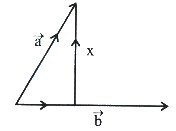
0 likes
View Solution630
EasyMCQ
Let $\vec{a}, \vec{b}, \vec{c}$ be three vectors such that $\vec{a}$ is perpendicular to $\vec{b}$ and $\vec{b}$ is perpendicular to $\vec{c}$. If $|\vec{a}|=2, |\vec{b}|=3, |\vec{c}|=5$ and $|\vec{a}+\vec{b}+\vec{c}|=4 \sqrt{3}$,then the angle between $\vec{a}$ and $\vec{c}$ is
A
$\cos^{-1} \frac{2}{5}$
B
$\frac{\pi}{3}$
C
$\cos^{-1} \left(\frac{2}{3}\right)$
D
$\frac{\pi}{6}$
Solution
(B) Given that $\vec{a} \cdot \vec{b} = 0$,$\vec{b} \cdot \vec{c} = 0$,$|\vec{a}| = 2$,$|\vec{b}| = 3$,$|\vec{c}| = 5$ and $|\vec{a} + \vec{b} + \vec{c}| = 4 \sqrt{3}$.
We know that $|\vec{a} + \vec{b} + \vec{c}|^2 = |\vec{a}|^2 + |\vec{b}|^2 + |\vec{c}|^2 + 2(\vec{a} \cdot \vec{b} + \vec{b} \cdot \vec{c} + \vec{c} \cdot \vec{a})$.
Substituting the given values:
$(4 \sqrt{3})^2 = 2^2 + 3^2 + 5^2 + 2(0 + 0 + |\vec{c}| |\vec{a}| \cos \theta)$.
$48 = 4 + 9 + 25 + 2(5)(2) \cos \theta$.
$48 = 38 + 20 \cos \theta$.
$10 = 20 \cos \theta$.
$\cos \theta = \frac{10}{20} = \frac{1}{2}$.
Therefore,$\theta = \cos^{-1} \left(\frac{1}{2}\right) = \frac{\pi}{3}$.
We know that $|\vec{a} + \vec{b} + \vec{c}|^2 = |\vec{a}|^2 + |\vec{b}|^2 + |\vec{c}|^2 + 2(\vec{a} \cdot \vec{b} + \vec{b} \cdot \vec{c} + \vec{c} \cdot \vec{a})$.
Substituting the given values:
$(4 \sqrt{3})^2 = 2^2 + 3^2 + 5^2 + 2(0 + 0 + |\vec{c}| |\vec{a}| \cos \theta)$.
$48 = 4 + 9 + 25 + 2(5)(2) \cos \theta$.
$48 = 38 + 20 \cos \theta$.
$10 = 20 \cos \theta$.
$\cos \theta = \frac{10}{20} = \frac{1}{2}$.
Therefore,$\theta = \cos^{-1} \left(\frac{1}{2}\right) = \frac{\pi}{3}$.
0 likes
View Solution631
MediumMCQ
In quadrilateral $ABCD$,$\overrightarrow{AB}=\vec{a}$,$\overrightarrow{BC}=\vec{b}$,$\overrightarrow{DA}=\vec{a}-\vec{b}$. $M$ is the midpoint of $BC$ and $X$ is a point on $DM$ such that $\overrightarrow{DX}=\frac{4}{5} \overrightarrow{DM}$. Then the points $A, X$ and $C$:
A
form an equilateral triangle
B
are collinear
C
form an isosceles triangle
D
form a right angled triangle
Solution
(B) In $\triangle ABC$,$\overrightarrow{AC} = \overrightarrow{AB} + \overrightarrow{BC} = \vec{a} + \vec{b} \dots (i)$
In $\triangle ADC$,$\overrightarrow{AD} + \overrightarrow{DC} = \overrightarrow{AC}$. Given $\overrightarrow{DA} = \vec{a} - \vec{b}$,so $\overrightarrow{AD} = -(\vec{a} - \vec{b}) = \vec{b} - \vec{a}$.
Thus,$\overrightarrow{DC} = \overrightarrow{AC} - \overrightarrow{AD} = (\vec{a} + \vec{b}) - (\vec{b} - \vec{a}) = 2\vec{a}$.
$M$ is the midpoint of $BC$,so $\overrightarrow{BM} = \frac{1}{2}\overrightarrow{BC} = \frac{\vec{b}}{2}$.
In $\triangle BDM$,$\overrightarrow{DM} = \overrightarrow{BM} - \overrightarrow{BD}$. Since $\overrightarrow{BD} = \overrightarrow{BC} + \overrightarrow{CD} = \vec{b} - 2\vec{a}$,we have $\overrightarrow{DM} = \frac{\vec{b}}{2} - (\vec{b} - 2\vec{a}) = 2\vec{a} - \frac{\vec{b}}{2} = \frac{4\vec{a} - \vec{b}}{2}$.
Given $\overrightarrow{DX} = \frac{4}{5}\overrightarrow{DM} = \frac{4}{5} \left( \frac{4\vec{a} - \vec{b}}{2} \right) = \frac{8\vec{a} - 2\vec{b}}{5}$.
Now,$\overrightarrow{AX} = \overrightarrow{AD} + \overrightarrow{DX} = (\vec{b} - \vec{a}) + \frac{8\vec{a} - 2\vec{b}}{5} = \frac{5\vec{b} - 5\vec{a} + 8\vec{a} - 2\vec{b}}{5} = \frac{3\vec{a} + 3\vec{b}}{5} = \frac{3}{5}(\vec{a} + \vec{b})$.
Since $\overrightarrow{AX} = \frac{3}{5}\overrightarrow{AC}$,the vectors $\overrightarrow{AX}$ and $\overrightarrow{AC}$ are parallel and share a common point $A$.
Therefore,the points $A, X$ and $C$ are collinear.
In $\triangle ADC$,$\overrightarrow{AD} + \overrightarrow{DC} = \overrightarrow{AC}$. Given $\overrightarrow{DA} = \vec{a} - \vec{b}$,so $\overrightarrow{AD} = -(\vec{a} - \vec{b}) = \vec{b} - \vec{a}$.
Thus,$\overrightarrow{DC} = \overrightarrow{AC} - \overrightarrow{AD} = (\vec{a} + \vec{b}) - (\vec{b} - \vec{a}) = 2\vec{a}$.
$M$ is the midpoint of $BC$,so $\overrightarrow{BM} = \frac{1}{2}\overrightarrow{BC} = \frac{\vec{b}}{2}$.
In $\triangle BDM$,$\overrightarrow{DM} = \overrightarrow{BM} - \overrightarrow{BD}$. Since $\overrightarrow{BD} = \overrightarrow{BC} + \overrightarrow{CD} = \vec{b} - 2\vec{a}$,we have $\overrightarrow{DM} = \frac{\vec{b}}{2} - (\vec{b} - 2\vec{a}) = 2\vec{a} - \frac{\vec{b}}{2} = \frac{4\vec{a} - \vec{b}}{2}$.
Given $\overrightarrow{DX} = \frac{4}{5}\overrightarrow{DM} = \frac{4}{5} \left( \frac{4\vec{a} - \vec{b}}{2} \right) = \frac{8\vec{a} - 2\vec{b}}{5}$.
Now,$\overrightarrow{AX} = \overrightarrow{AD} + \overrightarrow{DX} = (\vec{b} - \vec{a}) + \frac{8\vec{a} - 2\vec{b}}{5} = \frac{5\vec{b} - 5\vec{a} + 8\vec{a} - 2\vec{b}}{5} = \frac{3\vec{a} + 3\vec{b}}{5} = \frac{3}{5}(\vec{a} + \vec{b})$.
Since $\overrightarrow{AX} = \frac{3}{5}\overrightarrow{AC}$,the vectors $\overrightarrow{AX}$ and $\overrightarrow{AC}$ are parallel and share a common point $A$.
Therefore,the points $A, X$ and $C$ are collinear.
0 likes
View Solution632
MediumMCQ
Three vectors of magnitudes $a, 2a, 3a$ are along the directions of the diagonals of $3$ adjacent faces of a cube that meet at a point. The magnitude of the sum of these vectors is: (in $a$)
A
$4$
B
$5$
C
$6$
D
$8$
Solution
(B) Let the vectors of magnitude $a, 2a, 3a$ be along the diagonals of three adjacent faces of a cube meeting at the origin $O$.
Let the cube edges be along the coordinate axes. The diagonals of the three adjacent faces can be represented as vectors along $(\hat{i}+\hat{j})$,$(\hat{j}+\hat{k})$,and $(\hat{k}+\hat{i})$.
Normalizing these directions,the vectors are:
$\vec{v_1} = a \frac{\hat{i}+\hat{j}}{\sqrt{2}}$,$\vec{v_2} = 2a \frac{\hat{j}+\hat{k}}{\sqrt{2}}$,$\vec{v_3} = 3a \frac{\hat{k}+\hat{i}}{\sqrt{2}}$.
The resultant vector $\vec{R} = \vec{v_1} + \vec{v_2} + \vec{v_3}$ is:
$\vec{R} = \frac{a}{\sqrt{2}} [(\hat{i}+\hat{j}) + 2(\hat{j}+\hat{k}) + 3(\hat{k}+\hat{i})] = \frac{a}{\sqrt{2}} (4\hat{i} + 3\hat{j} + 5\hat{k})$.
The magnitude $|\vec{R}|$ is:
$|\vec{R}| = \frac{a}{\sqrt{2}} \sqrt{4^2 + 3^2 + 5^2} = \frac{a}{\sqrt{2}} \sqrt{16 + 9 + 25} = \frac{a}{\sqrt{2}} \sqrt{50} = \frac{a}{\sqrt{2}} (5\sqrt{2}) = 5a$.
Let the cube edges be along the coordinate axes. The diagonals of the three adjacent faces can be represented as vectors along $(\hat{i}+\hat{j})$,$(\hat{j}+\hat{k})$,and $(\hat{k}+\hat{i})$.
Normalizing these directions,the vectors are:
$\vec{v_1} = a \frac{\hat{i}+\hat{j}}{\sqrt{2}}$,$\vec{v_2} = 2a \frac{\hat{j}+\hat{k}}{\sqrt{2}}$,$\vec{v_3} = 3a \frac{\hat{k}+\hat{i}}{\sqrt{2}}$.
The resultant vector $\vec{R} = \vec{v_1} + \vec{v_2} + \vec{v_3}$ is:
$\vec{R} = \frac{a}{\sqrt{2}} [(\hat{i}+\hat{j}) + 2(\hat{j}+\hat{k}) + 3(\hat{k}+\hat{i})] = \frac{a}{\sqrt{2}} (4\hat{i} + 3\hat{j} + 5\hat{k})$.
The magnitude $|\vec{R}|$ is:
$|\vec{R}| = \frac{a}{\sqrt{2}} \sqrt{4^2 + 3^2 + 5^2} = \frac{a}{\sqrt{2}} \sqrt{16 + 9 + 25} = \frac{a}{\sqrt{2}} \sqrt{50} = \frac{a}{\sqrt{2}} (5\sqrt{2}) = 5a$.
0 likes
View Solution633
EasyMCQ
$M$ and $N$ are the midpoints of the sides $BC$ and $CD$ of a parallelogram $ABCD$ respectively,then $\overline{AM} + \overline{AN} =$
A
$\frac{1}{3} \overline{AC}$
B
$\frac{2}{3} \overline{AC}$
C
$\frac{3}{4} \overline{AC}$
D
$\frac{3}{2} \overline{AC}$
Solution
(D) Let the position vectors of $A, B, C, D$ be $\vec{0}, \vec{b}, \vec{c}, \vec{d}$ respectively.
Since $ABCD$ is a parallelogram,we have $\vec{b} + \vec{d} = \vec{c}$.
$M$ is the midpoint of $BC$,so $\vec{M} = \frac{\vec{b} + \vec{c}}{2}$.
$N$ is the midpoint of $CD$,so $\vec{N} = \frac{\vec{c} + \vec{d}}{2}$.
Now,$\overline{AM} + \overline{AN} = \vec{M} + \vec{N} = \frac{\vec{b} + \vec{c}}{2} + \frac{\vec{c} + \vec{d}}{2}$.
$= \frac{\vec{b} + \vec{d} + 2\vec{c}}{2}$.
Substituting $\vec{b} + \vec{d} = \vec{c}$,we get:
$= \frac{\vec{c} + 2\vec{c}}{2} = \frac{3\vec{c}}{2} = \frac{3}{2} \overline{AC}$.
Since $ABCD$ is a parallelogram,we have $\vec{b} + \vec{d} = \vec{c}$.
$M$ is the midpoint of $BC$,so $\vec{M} = \frac{\vec{b} + \vec{c}}{2}$.
$N$ is the midpoint of $CD$,so $\vec{N} = \frac{\vec{c} + \vec{d}}{2}$.
Now,$\overline{AM} + \overline{AN} = \vec{M} + \vec{N} = \frac{\vec{b} + \vec{c}}{2} + \frac{\vec{c} + \vec{d}}{2}$.
$= \frac{\vec{b} + \vec{d} + 2\vec{c}}{2}$.
Substituting $\vec{b} + \vec{d} = \vec{c}$,we get:
$= \frac{\vec{c} + 2\vec{c}}{2} = \frac{3\vec{c}}{2} = \frac{3}{2} \overline{AC}$.
0 likes
View Solution634
MediumMCQ
In a trapezium $ABCD$,$\vec{BC} = \lambda \vec{AD}$ and $\vec{x} = \vec{AC} + \vec{BD}$. If $\vec{x} = p \vec{AD}$,then $p =$
A
$\lambda - 1$
B
$\lambda + 1$
C
$1 - \lambda$
D
$2 \lambda - 1$
Solution
(B) Let the position vectors of $A, B, C,$ and $D$ be $\vec{a}, \vec{b}, \vec{c},$ and $\vec{d}$ respectively.
Given $\vec{BC} = \lambda \vec{AD}$,we have $\vec{c} - \vec{b} = \lambda(\vec{d} - \vec{a}) \dots (i)$.
We are given $\vec{x} = \vec{AC} + \vec{BD}$.
Substituting the position vectors,$\vec{x} = (\vec{c} - \vec{a}) + (\vec{d} - \vec{b})$.
Rearranging the terms,$\vec{x} = (\vec{c} - \vec{b}) + (\vec{d} - \vec{a})$.
Using equation $(i)$,$\vec{x} = \lambda(\vec{d} - \vec{a}) + 1(\vec{d} - \vec{a})$.
Thus,$\vec{x} = (\lambda + 1)(\vec{d} - \vec{a})$.
Since $\vec{AD} = \vec{d} - \vec{a}$,we have $\vec{x} = (\lambda + 1) \vec{AD}$.
Comparing this with $\vec{x} = p \vec{AD}$,we get $p = \lambda + 1$.
Given $\vec{BC} = \lambda \vec{AD}$,we have $\vec{c} - \vec{b} = \lambda(\vec{d} - \vec{a}) \dots (i)$.
We are given $\vec{x} = \vec{AC} + \vec{BD}$.
Substituting the position vectors,$\vec{x} = (\vec{c} - \vec{a}) + (\vec{d} - \vec{b})$.
Rearranging the terms,$\vec{x} = (\vec{c} - \vec{b}) + (\vec{d} - \vec{a})$.
Using equation $(i)$,$\vec{x} = \lambda(\vec{d} - \vec{a}) + 1(\vec{d} - \vec{a})$.
Thus,$\vec{x} = (\lambda + 1)(\vec{d} - \vec{a})$.
Since $\vec{AD} = \vec{d} - \vec{a}$,we have $\vec{x} = (\lambda + 1) \vec{AD}$.
Comparing this with $\vec{x} = p \vec{AD}$,we get $p = \lambda + 1$.
0 likes
View Solution635
EasyMCQ
In a $\triangle ABC$,$|CB|=a$,$|CA|=b$,$|AB|=c$ and $CD$ is the median through the vertex $C$. Then,$CA \cdot CD=$
A
$\frac{1}{4}(3a^2+b^2-c^2)$
B
$\frac{1}{4}(a^2+3b^2-c^2)$
C
$\frac{1}{4}(a^2+b^2-3c^2)$
D
$\frac{1}{4}(-3a^2-b^2+c^2)$
Solution
(B) Since $D$ is the midpoint of $AB$,we have $\vec{AD} = \frac{1}{2} \vec{AB}$.
Using the triangle law of vector addition in $\triangle CAD$,we have $\vec{CD} = \vec{CA} + \vec{AD} = \vec{CA} + \frac{1}{2} \vec{AB}$.
Now,we calculate the dot product $\vec{CA} \cdot \vec{CD}$:
$\vec{CA} \cdot \vec{CD} = \vec{CA} \cdot (\vec{CA} + \frac{1}{2} \vec{AB})$
$= |\vec{CA}|^2 + \frac{1}{2} (\vec{CA} \cdot \vec{AB})$
$= b^2 + \frac{1}{2} |\vec{CA}| |\vec{AB}| \cos(\pi - A)$
$= b^2 - \frac{1}{2} bc \cos A$
Using the cosine rule in $\triangle ABC$,$\cos A = \frac{b^2 + c^2 - a^2}{2bc}$.
Substituting this value:
$= b^2 - \frac{1}{2} bc \left( \frac{b^2 + c^2 - a^2}{2bc} \right)$
$= b^2 - \frac{b^2 + c^2 - a^2}{4}$
$= \frac{4b^2 - b^2 - c^2 + a^2}{4}$
$= \frac{1}{4}(a^2 + 3b^2 - c^2)$.
Using the triangle law of vector addition in $\triangle CAD$,we have $\vec{CD} = \vec{CA} + \vec{AD} = \vec{CA} + \frac{1}{2} \vec{AB}$.
Now,we calculate the dot product $\vec{CA} \cdot \vec{CD}$:
$\vec{CA} \cdot \vec{CD} = \vec{CA} \cdot (\vec{CA} + \frac{1}{2} \vec{AB})$
$= |\vec{CA}|^2 + \frac{1}{2} (\vec{CA} \cdot \vec{AB})$
$= b^2 + \frac{1}{2} |\vec{CA}| |\vec{AB}| \cos(\pi - A)$
$= b^2 - \frac{1}{2} bc \cos A$
Using the cosine rule in $\triangle ABC$,$\cos A = \frac{b^2 + c^2 - a^2}{2bc}$.
Substituting this value:
$= b^2 - \frac{1}{2} bc \left( \frac{b^2 + c^2 - a^2}{2bc} \right)$
$= b^2 - \frac{b^2 + c^2 - a^2}{4}$
$= \frac{4b^2 - b^2 - c^2 + a^2}{4}$
$= \frac{1}{4}(a^2 + 3b^2 - c^2)$.
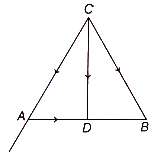
0 likes
View Solution636
EasyMCQ
$a$ and $b$ are non-collinear vectors,$|a|=2 \sqrt{2}$,$|b|=3$ and the angle between $a$ and $b$ is $45^{\circ}$. Then,the lengths of the diagonals of the parallelogram whose adjacent sides are represented by the vectors $5a+2b$ and $a-3b$ are
A
$15, 593$
B
$15, \sqrt{593}$
C
$225, \sqrt{593}$
D
$225, 593$
Solution
(B) Let the adjacent sides of the parallelogram be $p = 5a + 2b$ and $q = a - 3b$.
The diagonals of the parallelogram are given by $d_1 = p + q$ and $d_2 = p - q$.
$d_1 = (5a + 2b) + (a - 3b) = 6a - b$
$d_2 = (5a + 2b) - (a - 3b) = 4a + 5b$
Given $|a| = 2\sqrt{2}$,$|b| = 3$,and the angle $\theta = 45^{\circ}$ between $a$ and $b$,we have $a \cdot b = |a||b| \cos 45^{\circ} = (2\sqrt{2})(3)(\frac{1}{\sqrt{2}}) = 6$.
Now,the length of the first diagonal is:
$|d_1| = |6a - b| = \sqrt{(6a - b) \cdot (6a - b)} = \sqrt{36|a|^2 + |b|^2 - 12(a \cdot b)}$
$|d_1| = \sqrt{36(8) + 9 - 12(6)} = \sqrt{288 + 9 - 72} = \sqrt{225} = 15$.
Now,the length of the second diagonal is:
$|d_2| = |4a + 5b| = \sqrt{(4a + 5b) \cdot (4a + 5b)} = \sqrt{16|a|^2 + 25|b|^2 + 40(a \cdot b)}$
$|d_2| = \sqrt{16(8) + 25(9) + 40(6)} = \sqrt{128 + 225 + 240} = \sqrt{593}$.
Thus,the lengths of the diagonals are $15$ and $\sqrt{593}$.
The diagonals of the parallelogram are given by $d_1 = p + q$ and $d_2 = p - q$.
$d_1 = (5a + 2b) + (a - 3b) = 6a - b$
$d_2 = (5a + 2b) - (a - 3b) = 4a + 5b$
Given $|a| = 2\sqrt{2}$,$|b| = 3$,and the angle $\theta = 45^{\circ}$ between $a$ and $b$,we have $a \cdot b = |a||b| \cos 45^{\circ} = (2\sqrt{2})(3)(\frac{1}{\sqrt{2}}) = 6$.
Now,the length of the first diagonal is:
$|d_1| = |6a - b| = \sqrt{(6a - b) \cdot (6a - b)} = \sqrt{36|a|^2 + |b|^2 - 12(a \cdot b)}$
$|d_1| = \sqrt{36(8) + 9 - 12(6)} = \sqrt{288 + 9 - 72} = \sqrt{225} = 15$.
Now,the length of the second diagonal is:
$|d_2| = |4a + 5b| = \sqrt{(4a + 5b) \cdot (4a + 5b)} = \sqrt{16|a|^2 + 25|b|^2 + 40(a \cdot b)}$
$|d_2| = \sqrt{16(8) + 25(9) + 40(6)} = \sqrt{128 + 225 + 240} = \sqrt{593}$.
Thus,the lengths of the diagonals are $15$ and $\sqrt{593}$.
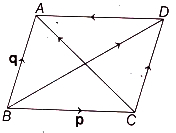
0 likes
View Solution637
MediumMCQ
If $\overline{e_1}, \overline{e_2}$ are two non-collinear unit vectors such that $|\overline{e_1}+\overline{e_2}|=\sqrt{3}$,then $(2 \overline{e_1}-5 \overline{e_2}) \cdot (3 \overline{e_1}+\overline{e_2}) = $
A
$\frac{11}{2}$
B
$\frac{-11}{2}$
C
$\frac{9}{2}$
D
$\frac{-9}{2}$
Solution
(B) Given that $\overline{e_1}$ and $\overline{e_2}$ are unit vectors,we have $|\overline{e_1}| = 1$ and $|\overline{e_2}| = 1$.
Given $|\overline{e_1} + \overline{e_2}| = \sqrt{3}$.
Squaring both sides,we get $|\overline{e_1} + \overline{e_2}|^2 = 3$.
$(\overline{e_1} + \overline{e_2}) \cdot (\overline{e_1} + \overline{e_2}) = 3$.
$|\overline{e_1}|^2 + |\overline{e_2}|^2 + 2(\overline{e_1} \cdot \overline{e_2}) = 3$.
$1 + 1 + 2(\overline{e_1} \cdot \overline{e_2}) = 3$.
$2(\overline{e_1} \cdot \overline{e_2}) = 1 \implies \overline{e_1} \cdot \overline{e_2} = \frac{1}{2}$.
Now,we calculate the dot product $(2 \overline{e_1} - 5 \overline{e_2}) \cdot (3 \overline{e_1} + \overline{e_2})$:
$= 6(\overline{e_1} \cdot \overline{e_1}) + 2(\overline{e_1} \cdot \overline{e_2}) - 15(\overline{e_2} \cdot \overline{e_1}) - 5(\overline{e_2} \cdot \overline{e_2})$.
$= 6|\overline{e_1}|^2 - 13(\overline{e_1} \cdot \overline{e_2}) - 5|\overline{e_2}|^2$.
$= 6(1) - 13(\frac{1}{2}) - 5(1)$.
$= 6 - 6.5 - 5 = -5.5 = -\frac{11}{2}$.
Given $|\overline{e_1} + \overline{e_2}| = \sqrt{3}$.
Squaring both sides,we get $|\overline{e_1} + \overline{e_2}|^2 = 3$.
$(\overline{e_1} + \overline{e_2}) \cdot (\overline{e_1} + \overline{e_2}) = 3$.
$|\overline{e_1}|^2 + |\overline{e_2}|^2 + 2(\overline{e_1} \cdot \overline{e_2}) = 3$.
$1 + 1 + 2(\overline{e_1} \cdot \overline{e_2}) = 3$.
$2(\overline{e_1} \cdot \overline{e_2}) = 1 \implies \overline{e_1} \cdot \overline{e_2} = \frac{1}{2}$.
Now,we calculate the dot product $(2 \overline{e_1} - 5 \overline{e_2}) \cdot (3 \overline{e_1} + \overline{e_2})$:
$= 6(\overline{e_1} \cdot \overline{e_1}) + 2(\overline{e_1} \cdot \overline{e_2}) - 15(\overline{e_2} \cdot \overline{e_1}) - 5(\overline{e_2} \cdot \overline{e_2})$.
$= 6|\overline{e_1}|^2 - 13(\overline{e_1} \cdot \overline{e_2}) - 5|\overline{e_2}|^2$.
$= 6(1) - 13(\frac{1}{2}) - 5(1)$.
$= 6 - 6.5 - 5 = -5.5 = -\frac{11}{2}$.
0 likes
View Solution638
EasyMCQ
If $\vec{a}=\frac{3}{2} \hat{k}$ and $\vec{b}=\frac{2 \hat{i}+2 \hat{j}-\hat{k}}{2}$,then the angle between $\vec{a}+\vec{b}$ and $\vec{a}-\vec{b}$ is: (in $^{\circ}$)
A
$45$
B
$90$
C
$30$
D
$60$
Solution
(B) Given that,$\vec{a}=\frac{3}{2} \hat{k}$ and $\vec{b}=\frac{2 \hat{i}+2 \hat{j}-\hat{k}}{2} = \hat{i}+\hat{j}-\frac{1}{2} \hat{k}$.
First,calculate $\vec{a}+\vec{b} = \hat{i}+\hat{j}+(\frac{3}{2}-\frac{1}{2}) \hat{k} = \hat{i}+\hat{j}+\hat{k}$.
Next,calculate $\vec{a}-\vec{b} = -\hat{i}-\hat{j}+(\frac{3}{2}+\frac{1}{2}) \hat{k} = -\hat{i}-\hat{j}+2 \hat{k}$.
Let $\vec{u} = \vec{a}+\vec{b}$ and $\vec{v} = \vec{a}-\vec{b}$.
The dot product $\vec{u} \cdot \vec{v} = (1)(-1) + (1)(-1) + (1)(2) = -1 - 1 + 2 = 0$.
Since the dot product is $0$,the vectors are perpendicular.
Therefore,the angle $\theta$ between them is $90^{\circ}$.
First,calculate $\vec{a}+\vec{b} = \hat{i}+\hat{j}+(\frac{3}{2}-\frac{1}{2}) \hat{k} = \hat{i}+\hat{j}+\hat{k}$.
Next,calculate $\vec{a}-\vec{b} = -\hat{i}-\hat{j}+(\frac{3}{2}+\frac{1}{2}) \hat{k} = -\hat{i}-\hat{j}+2 \hat{k}$.
Let $\vec{u} = \vec{a}+\vec{b}$ and $\vec{v} = \vec{a}-\vec{b}$.
The dot product $\vec{u} \cdot \vec{v} = (1)(-1) + (1)(-1) + (1)(2) = -1 - 1 + 2 = 0$.
Since the dot product is $0$,the vectors are perpendicular.
Therefore,the angle $\theta$ between them is $90^{\circ}$.
0 likes
View Solution639
MediumMCQ
Let $\vec{u} = 2 \hat{i} + \hat{j}$ and $\vec{v} = 3 \hat{i} - 5 \hat{j}$. Consider three points $P, Q,$ and $R$ having the position vectors $\left(\frac{5}{2}\right) \hat{i} - 2 \hat{j}, \left(\frac{7}{3}\right) \hat{i} - \hat{j},$ and $\left(\frac{9}{4}\right) \hat{i}$ respectively. Among these,the points on the line passing through $\vec{u}$ and $\vec{v}$ are
A
Only $P$ and $Q$
B
Only $P$ and $R$
C
Only $Q$ and $R$
D
All $P, Q,$ and $R$
Solution
(A) The position vectors of points $u$ and $v$ are given as $(2, 1)$ and $(3, -5)$ respectively.
The equation of the line passing through points $(x_1, y_1) = (2, 1)$ and $(x_2, y_2) = (3, -5)$ is given by $y - y_1 = \frac{y_2 - y_1}{x_2 - x_1}(x - x_1)$.
Substituting the values: $y - 1 = \frac{-5 - 1}{3 - 2}(x - 2) \Rightarrow y - 1 = -6(x - 2) \Rightarrow y - 1 = -6x + 12 \Rightarrow 6x + y = 13$.
Now,we check which points satisfy the equation $6x + y = 13$:
For $P\left(\frac{5}{2}, -2\right)$: $6\left(\frac{5}{2}\right) + (-2) = 15 - 2 = 13$. (Satisfies)
For $Q\left(\frac{7}{3}, -1\right)$: $6\left(\frac{7}{3}\right) + (-1) = 14 - 1 = 13$. (Satisfies)
For $R\left(\frac{9}{4}, 0\right)$: $6\left(\frac{9}{4}\right) + 0 = \frac{27}{2} = 13.5 \neq 13$. (Does not satisfy)
Thus,only points $P$ and $Q$ lie on the line.
The equation of the line passing through points $(x_1, y_1) = (2, 1)$ and $(x_2, y_2) = (3, -5)$ is given by $y - y_1 = \frac{y_2 - y_1}{x_2 - x_1}(x - x_1)$.
Substituting the values: $y - 1 = \frac{-5 - 1}{3 - 2}(x - 2) \Rightarrow y - 1 = -6(x - 2) \Rightarrow y - 1 = -6x + 12 \Rightarrow 6x + y = 13$.
Now,we check which points satisfy the equation $6x + y = 13$:
For $P\left(\frac{5}{2}, -2\right)$: $6\left(\frac{5}{2}\right) + (-2) = 15 - 2 = 13$. (Satisfies)
For $Q\left(\frac{7}{3}, -1\right)$: $6\left(\frac{7}{3}\right) + (-1) = 14 - 1 = 13$. (Satisfies)
For $R\left(\frac{9}{4}, 0\right)$: $6\left(\frac{9}{4}\right) + 0 = \frac{27}{2} = 13.5 \neq 13$. (Does not satisfy)
Thus,only points $P$ and $Q$ lie on the line.
0 likes
View Solution640
MediumMCQ
If $\theta$ is the angle between the unit vectors $a$ and $b$,then $\sin \frac{\theta}{2}$ is equal to
A
$\left|\frac{a-b}{a+b}\right|$
B
$|a+b|$
C
$|a-b|$
D
$\frac{1}{2}|a-b|$
Solution
(D) Given that $a$ and $b$ are unit vectors,so $|a| = 1$ and $|b| = 1$.
Consider the expression $|a - b|^2$:
$|a - b|^2 = |a|^2 + |b|^2 - 2(a \cdot b)$
Since $a \cdot b = |a||b| \cos \theta = 1 \times 1 \times \cos \theta = \cos \theta$,we have:
$|a - b|^2 = 1^2 + 1^2 - 2 \cos \theta$
$|a - b|^2 = 2 - 2 \cos \theta$
$|a - b|^2 = 2(1 - \cos \theta)$
Using the trigonometric identity $1 - \cos \theta = 2 \sin^2 \frac{\theta}{2}$:
$|a - b|^2 = 2(2 \sin^2 \frac{\theta}{2})$
$|a - b|^2 = 4 \sin^2 \frac{\theta}{2}$
Taking the square root on both sides:
$|a - b| = 2 \sin \frac{\theta}{2}$
Therefore,$\sin \frac{\theta}{2} = \frac{1}{2} |a - b|$.
Consider the expression $|a - b|^2$:
$|a - b|^2 = |a|^2 + |b|^2 - 2(a \cdot b)$
Since $a \cdot b = |a||b| \cos \theta = 1 \times 1 \times \cos \theta = \cos \theta$,we have:
$|a - b|^2 = 1^2 + 1^2 - 2 \cos \theta$
$|a - b|^2 = 2 - 2 \cos \theta$
$|a - b|^2 = 2(1 - \cos \theta)$
Using the trigonometric identity $1 - \cos \theta = 2 \sin^2 \frac{\theta}{2}$:
$|a - b|^2 = 2(2 \sin^2 \frac{\theta}{2})$
$|a - b|^2 = 4 \sin^2 \frac{\theta}{2}$
Taking the square root on both sides:
$|a - b| = 2 \sin \frac{\theta}{2}$
Therefore,$\sin \frac{\theta}{2} = \frac{1}{2} |a - b|$.
0 likes
View Solution641
EasyMCQ
$a$ and $b$ are unit vectors such that $a+2b$ is also a unit vector. If $\theta$ is the angle between $a$ and $b$,then $\sin \theta + \cos^3 \theta + \tan^5 \theta$ is equal to
A
$3$
B
$5$
C
$\frac{3}{\sqrt{2}}+1$
D
$-1$
Solution
(D) Given that $a$ and $b$ are unit vectors,we have $|a| = 1$ and $|b| = 1$.
Also,$a+2b$ is a unit vector,so $|a+2b| = 1$.
Squaring both sides,we get $|a+2b|^2 = 1^2 = 1$.
Expanding the dot product,we have $|a|^2 + 4|b|^2 + 4(a \cdot b) = 1$.
Substituting the values,$1^2 + 4(1)^2 + 4|a||b| \cos \theta = 1$.
$1 + 4 + 4 \cos \theta = 1$.
$5 + 4 \cos \theta = 1$,which implies $4 \cos \theta = -4$,so $\cos \theta = -1$.
This means $\theta = \pi$.
Now,we evaluate the expression $\sin \theta + \cos^3 \theta + \tan^5 \theta$.
Substituting $\theta = \pi$: $\sin \pi + \cos^3 \pi + \tan^5 \pi = 0 + (-1)^3 + 0 = -1$.
Also,$a+2b$ is a unit vector,so $|a+2b| = 1$.
Squaring both sides,we get $|a+2b|^2 = 1^2 = 1$.
Expanding the dot product,we have $|a|^2 + 4|b|^2 + 4(a \cdot b) = 1$.
Substituting the values,$1^2 + 4(1)^2 + 4|a||b| \cos \theta = 1$.
$1 + 4 + 4 \cos \theta = 1$.
$5 + 4 \cos \theta = 1$,which implies $4 \cos \theta = -4$,so $\cos \theta = -1$.
This means $\theta = \pi$.
Now,we evaluate the expression $\sin \theta + \cos^3 \theta + \tan^5 \theta$.
Substituting $\theta = \pi$: $\sin \pi + \cos^3 \pi + \tan^5 \pi = 0 + (-1)^3 + 0 = -1$.
0 likes
View Solution642
MediumMCQ
Let $a$,$b$,and $c$ be $3$ non-zero vectors such that no $2$ of these are collinear. If vector $a + 2b$ is collinear with $c$ and $b + 3c$ is collinear with $a$,then $a + 2b + 6c$ equals:
A
$\lambda a$
B
$\lambda b$
C
$\lambda c$
D
$0$
Solution
(D) Given that $a$,$b$,and $c$ are non-zero vectors such that no two of these are collinear.
Since $a + 2b$ is collinear with $c$,we have $a + 2b = m c$ for some non-zero scalar $m$ $(i)$.
Since $b + 3c$ is collinear with $a$,we have $b + 3c = n a$ for some non-zero scalar $n$ $(ii)$.
From $(ii)$,we have $b = n a - 3c$.
Substitute this into $(i)$:
$a + 2(n a - 3c) = m c$
$a + 2n a - 6c = m c$
$(1 + 2n) a = (m + 6) c$
Since $a$ and $c$ are non-collinear,the coefficients must be zero:
$1 + 2n = 0 \Rightarrow n = -\frac{1}{2}$
$m + 6 = 0 \Rightarrow m = -6$
Substituting $m = -6$ into equation $(i)$:
$a + 2b = -6c$
$a + 2b + 6c = 0$.
Since $a + 2b$ is collinear with $c$,we have $a + 2b = m c$ for some non-zero scalar $m$ $(i)$.
Since $b + 3c$ is collinear with $a$,we have $b + 3c = n a$ for some non-zero scalar $n$ $(ii)$.
From $(ii)$,we have $b = n a - 3c$.
Substitute this into $(i)$:
$a + 2(n a - 3c) = m c$
$a + 2n a - 6c = m c$
$(1 + 2n) a = (m + 6) c$
Since $a$ and $c$ are non-collinear,the coefficients must be zero:
$1 + 2n = 0 \Rightarrow n = -\frac{1}{2}$
$m + 6 = 0 \Rightarrow m = -6$
Substituting $m = -6$ into equation $(i)$:
$a + 2b = -6c$
$a + 2b + 6c = 0$.
0 likes
View Solution643
EasyMCQ
Let $u$ and $v$ be two non-zero vectors. If $|u+v|=|u-v|$,then:
A
$u$ and $v$ have the same direction
B
$u$ and $v$ are perpendicular
C
$u$ and $v$ have the opposite direction
D
Data is insufficient
Solution
(B) Given $|u+v|=|u-v|$.
Squaring both sides,we get:
$|u+v|^2 = |u-v|^2$
$(u+v) \cdot (u+v) = (u-v) \cdot (u-v)$
$|u|^2 + |v|^2 + 2(u \cdot v) = |u|^2 + |v|^2 - 2(u \cdot v)$
$2(u \cdot v) = -2(u \cdot v)$
$4(u \cdot v) = 0$
$u \cdot v = 0$
Since the dot product of two non-zero vectors is zero,the vectors $u$ and $v$ are perpendicular.
Hence,option $B$ is correct.
Squaring both sides,we get:
$|u+v|^2 = |u-v|^2$
$(u+v) \cdot (u+v) = (u-v) \cdot (u-v)$
$|u|^2 + |v|^2 + 2(u \cdot v) = |u|^2 + |v|^2 - 2(u \cdot v)$
$2(u \cdot v) = -2(u \cdot v)$
$4(u \cdot v) = 0$
$u \cdot v = 0$
Since the dot product of two non-zero vectors is zero,the vectors $u$ and $v$ are perpendicular.
Hence,option $B$ is correct.
0 likes
View Solution644
EasyMCQ
If $a$ and $b$ are unit vectors such that $a+b$ is also a unit vector,then the angle between $a$ and $b$ is . . . . . . (in $^{\circ}$)
A
$60$
B
$90$
C
$30$
D
$120$
Solution
(D) Given that $a$ and $b$ are unit vectors,we have $|a| = 1$ and $|b| = 1$.
Also,$a+b$ is a unit vector,so $|a+b| = 1$.
Squaring both sides,we get $|a+b|^2 = 1^2 = 1$.
Using the property $|a+b|^2 = |a|^2 + |b|^2 + 2(a \cdot b)$,we have:
$1^2 + 1^2 + 2(a \cdot b) = 1$
$1 + 1 + 2(a \cdot b) = 1$
$2 + 2(a \cdot b) = 1$
$2(a \cdot b) = -1$
$a \cdot b = -\frac{1}{2}$.
Since $a \cdot b = |a||b| \cos \theta$,where $\theta$ is the angle between $a$ and $b$:
$(1)(1) \cos \theta = -\frac{1}{2}$
$\cos \theta = -\frac{1}{2}$.
Therefore,$\theta = 120^{\circ}$.
Hence,option $D$ is correct.
Also,$a+b$ is a unit vector,so $|a+b| = 1$.
Squaring both sides,we get $|a+b|^2 = 1^2 = 1$.
Using the property $|a+b|^2 = |a|^2 + |b|^2 + 2(a \cdot b)$,we have:
$1^2 + 1^2 + 2(a \cdot b) = 1$
$1 + 1 + 2(a \cdot b) = 1$
$2 + 2(a \cdot b) = 1$
$2(a \cdot b) = -1$
$a \cdot b = -\frac{1}{2}$.
Since $a \cdot b = |a||b| \cos \theta$,where $\theta$ is the angle between $a$ and $b$:
$(1)(1) \cos \theta = -\frac{1}{2}$
$\cos \theta = -\frac{1}{2}$.
Therefore,$\theta = 120^{\circ}$.
Hence,option $D$ is correct.
0 likes
View Solution645
EasyMCQ
If $a$ and $b$ are two unit vectors and $\theta$ is the angle between them,then the unit vector along the angular bisector of $a$ and $b$ is given by
A
$\frac{a+b}{2 \sin (\theta / 2)}$
B
$\frac{a+b}{2 \cos (\theta / 2)}$
C
$\frac{a-b}{2 \cos (\theta / 2)}$
D
$\frac{a+b}{\cos (\theta / 2)}$
Solution
(B) Let $p$ be the unit vector along the angular bisector of $a$ and $b$. Since $a$ and $b$ are unit vectors,the vector $a+b$ lies along the angular bisector of $a$ and $b$.
Thus,$p = \lambda(a+b)$ for some scalar $\lambda$.
Since $p$ is a unit vector,$|p| = 1$.
$|p|^2 = \lambda^2 |a+b|^2 = 1$.
$|a+b|^2 = |a|^2 + |b|^2 + 2(a \cdot b) = 1 + 1 + 2 \cos \theta = 2(1 + \cos \theta) = 4 \cos^2 (\theta / 2)$.
So,$\lambda^2 (4 \cos^2 (\theta / 2)) = 1$.
$\lambda = \frac{1}{2 \cos (\theta / 2)}$.
Therefore,$p = \frac{a+b}{2 \cos (\theta / 2)}$.
Thus,$p = \lambda(a+b)$ for some scalar $\lambda$.
Since $p$ is a unit vector,$|p| = 1$.
$|p|^2 = \lambda^2 |a+b|^2 = 1$.
$|a+b|^2 = |a|^2 + |b|^2 + 2(a \cdot b) = 1 + 1 + 2 \cos \theta = 2(1 + \cos \theta) = 4 \cos^2 (\theta / 2)$.
So,$\lambda^2 (4 \cos^2 (\theta / 2)) = 1$.
$\lambda = \frac{1}{2 \cos (\theta / 2)}$.
Therefore,$p = \frac{a+b}{2 \cos (\theta / 2)}$.
0 likes
View Solution646
MediumMCQ
The scalar product of the vector $\vec{a} = \hat{i} + \hat{j} + \hat{k}$ with a unit vector along the sum of the vectors $\vec{b} = 2 \hat{i} + 4 \hat{j} - 5 \hat{k}$ and $\vec{c} = \lambda \hat{i} + 2 \hat{j} + 3 \hat{k}$ is equal to $1$. Then,$\lambda =$
A
$-1$
B
$1$
C
$-2$
D
$2$
Solution
(B) Given vectors are $\vec{a} = \hat{i} + \hat{j} + \hat{k}$,$\vec{b} = 2 \hat{i} + 4 \hat{j} - 5 \hat{k}$,and $\vec{c} = \lambda \hat{i} + 2 \hat{j} + 3 \hat{k}$.
Let $\vec{v} = \vec{b} + \vec{c} = (\lambda + 2) \hat{i} + 6 \hat{j} - 2 \hat{k}$.
The unit vector along $\vec{v}$ is $\hat{u} = \frac{\vec{v}}{|\vec{v}|} = \frac{(\lambda + 2) \hat{i} + 6 \hat{j} - 2 \hat{k}}{\sqrt{(\lambda + 2)^2 + 6^2 + (-2)^2}} = \frac{(\lambda + 2) \hat{i} + 6 \hat{j} - 2 \hat{k}}{\sqrt{(\lambda + 2)^2 + 40}}$.
The scalar product of $\vec{a}$ and $\hat{u}$ is $1$,so $\vec{a} \cdot \hat{u} = 1$.
$\frac{(\lambda + 2)(1) + (6)(1) + (-2)(1)}{\sqrt{(\lambda + 2)^2 + 40}} = 1$.
$\frac{\lambda + 2 + 6 - 2}{\sqrt{(\lambda + 2)^2 + 40}} = 1$.
$\frac{\lambda + 6}{\sqrt{(\lambda + 2)^2 + 40}} = 1$.
$\lambda + 6 = \sqrt{(\lambda + 2)^2 + 40}$.
Squaring both sides: $(\lambda + 6)^2 = (\lambda + 2)^2 + 40$.
$\lambda^2 + 12\lambda + 36 = \lambda^2 + 4\lambda + 4 + 40$.
$12\lambda + 36 = 4\lambda + 44$.
$8\lambda = 8$.
$\lambda = 1$.
Let $\vec{v} = \vec{b} + \vec{c} = (\lambda + 2) \hat{i} + 6 \hat{j} - 2 \hat{k}$.
The unit vector along $\vec{v}$ is $\hat{u} = \frac{\vec{v}}{|\vec{v}|} = \frac{(\lambda + 2) \hat{i} + 6 \hat{j} - 2 \hat{k}}{\sqrt{(\lambda + 2)^2 + 6^2 + (-2)^2}} = \frac{(\lambda + 2) \hat{i} + 6 \hat{j} - 2 \hat{k}}{\sqrt{(\lambda + 2)^2 + 40}}$.
The scalar product of $\vec{a}$ and $\hat{u}$ is $1$,so $\vec{a} \cdot \hat{u} = 1$.
$\frac{(\lambda + 2)(1) + (6)(1) + (-2)(1)}{\sqrt{(\lambda + 2)^2 + 40}} = 1$.
$\frac{\lambda + 2 + 6 - 2}{\sqrt{(\lambda + 2)^2 + 40}} = 1$.
$\frac{\lambda + 6}{\sqrt{(\lambda + 2)^2 + 40}} = 1$.
$\lambda + 6 = \sqrt{(\lambda + 2)^2 + 40}$.
Squaring both sides: $(\lambda + 6)^2 = (\lambda + 2)^2 + 40$.
$\lambda^2 + 12\lambda + 36 = \lambda^2 + 4\lambda + 4 + 40$.
$12\lambda + 36 = 4\lambda + 44$.
$8\lambda = 8$.
$\lambda = 1$.
0 likes
View Solution647
MediumMCQ
Let $ABC$ be a triangle. Let $u = \overrightarrow{AB}$ and $v = \overrightarrow{AC}$. If $D$ is the midpoint of $BC$,then the length of the median of $\triangle ABD$ through the vertex $B$ is:
A
$\frac{|u-3v|}{2}$
B
$\frac{|v-3u|}{2}$
C
$\frac{|u-3v|}{4}$
D
$\frac{|v-3u|}{4}$
Solution
(D) Let the origin be at $A$. Then $\vec{A} = 0$,$\vec{B} = u$,and $\vec{C} = v$.
Since $D$ is the midpoint of $BC$,the position vector of $D$ is $\vec{D} = \frac{u+v}{2}$.
In $\triangle ABD$,let $M$ be the midpoint of $AD$. The median through vertex $B$ is the segment $BM$.
The position vector of $M$ is $\vec{M} = \frac{\vec{A} + \vec{D}}{2} = \frac{0 + \frac{u+v}{2}}{2} = \frac{u+v}{4}$.
The vector $\overrightarrow{BM} = \vec{M} - \vec{B} = \frac{u+v}{4} - u = \frac{u+v-4u}{4} = \frac{v-3u}{4}$.
The length of the median is $|\overrightarrow{BM}| = |\frac{v-3u}{4}| = \frac{|v-3u|}{4}$.
Since $D$ is the midpoint of $BC$,the position vector of $D$ is $\vec{D} = \frac{u+v}{2}$.
In $\triangle ABD$,let $M$ be the midpoint of $AD$. The median through vertex $B$ is the segment $BM$.
The position vector of $M$ is $\vec{M} = \frac{\vec{A} + \vec{D}}{2} = \frac{0 + \frac{u+v}{2}}{2} = \frac{u+v}{4}$.
The vector $\overrightarrow{BM} = \vec{M} - \vec{B} = \frac{u+v}{4} - u = \frac{u+v-4u}{4} = \frac{v-3u}{4}$.
The length of the median is $|\overrightarrow{BM}| = |\frac{v-3u}{4}| = \frac{|v-3u|}{4}$.
0 likes
View Solution648
MediumMCQ
Given three vectors $a=2 \hat{i}-\hat{j}+\hat{k}$,$b=\hat{i}+2 \hat{j}-\hat{k}$,and $c=\hat{i}+\hat{j}-2 \hat{k}$,a vector in the plane of $b$ and $c$ whose projection on $a$ is of magnitude $\sqrt{\frac{2}{3}}$ is
A
$-2 \hat{i}-\hat{j}+5 \hat{k}$
B
$2 \hat{i}+3 \hat{j}+3 \hat{k}$
C
$2 \hat{i}+\hat{j}+5 \hat{k}$
D
$2 \hat{i}-3 \hat{j}+3 \hat{k}$
Solution
(A) Let the required vector $d$ be in the plane of $b$ and $c$. Thus,$d = b + \lambda c$ for some scalar $\lambda$.
Substituting the given vectors:
$d = (\hat{i} + 2\hat{j} - \hat{k}) + \lambda(\hat{i} + \hat{j} - 2\hat{k}) = (1 + \lambda)\hat{i} + (2 + \lambda)\hat{j} - (1 + 2\lambda)\hat{k}$.
The projection of $d$ on $a$ is given by $\frac{|d \cdot a|}{|a|} = \sqrt{\frac{2}{3}}$.
First,calculate $a \cdot d$:
$a \cdot d = 2(1 + \lambda) - 1(2 + \lambda) + 1(-1 - 2\lambda) = 2 + 2\lambda - 2 - \lambda - 1 - 2\lambda = -\lambda - 1$.
Next,calculate $|a| = \sqrt{2^2 + (-1)^2 + 1^2} = \sqrt{4 + 1 + 1} = \sqrt{6}$.
So,$\frac{|-\lambda - 1|}{\sqrt{6}} = \sqrt{\frac{2}{3}} = \frac{\sqrt{2}}{\sqrt{3}} = \frac{\sqrt{2} \cdot \sqrt{2}}{\sqrt{3} \cdot \sqrt{2}} = \frac{2}{\sqrt{6}}$.
Thus,$|-\lambda - 1| = 2$,which implies $-\lambda - 1 = 2$ or $-\lambda - 1 = -2$.
If $-\lambda - 1 = 2$,then $\lambda = -3$.
Substituting $\lambda = -3$ into $d$:
$d = (1 - 3)\hat{i} + (2 - 3)\hat{j} - (1 - 6)\hat{k} = -2\hat{i} - \hat{j} + 5\hat{k}$.
This matches option $A$.
Substituting the given vectors:
$d = (\hat{i} + 2\hat{j} - \hat{k}) + \lambda(\hat{i} + \hat{j} - 2\hat{k}) = (1 + \lambda)\hat{i} + (2 + \lambda)\hat{j} - (1 + 2\lambda)\hat{k}$.
The projection of $d$ on $a$ is given by $\frac{|d \cdot a|}{|a|} = \sqrt{\frac{2}{3}}$.
First,calculate $a \cdot d$:
$a \cdot d = 2(1 + \lambda) - 1(2 + \lambda) + 1(-1 - 2\lambda) = 2 + 2\lambda - 2 - \lambda - 1 - 2\lambda = -\lambda - 1$.
Next,calculate $|a| = \sqrt{2^2 + (-1)^2 + 1^2} = \sqrt{4 + 1 + 1} = \sqrt{6}$.
So,$\frac{|-\lambda - 1|}{\sqrt{6}} = \sqrt{\frac{2}{3}} = \frac{\sqrt{2}}{\sqrt{3}} = \frac{\sqrt{2} \cdot \sqrt{2}}{\sqrt{3} \cdot \sqrt{2}} = \frac{2}{\sqrt{6}}$.
Thus,$|-\lambda - 1| = 2$,which implies $-\lambda - 1 = 2$ or $-\lambda - 1 = -2$.
If $-\lambda - 1 = 2$,then $\lambda = -3$.
Substituting $\lambda = -3$ into $d$:
$d = (1 - 3)\hat{i} + (2 - 3)\hat{j} - (1 - 6)\hat{k} = -2\hat{i} - \hat{j} + 5\hat{k}$.
This matches option $A$.
0 likes
View Solution649
DifficultMCQ
Let $a, b$ and $c$ be three non-coplanar vectors. The vector equation of a line which passes through the point of intersection of two lines,one joining the points $a+2b-5c$ and $-a-2b-3c$,and the other joining the points $-4c$ and $6a-4b+4c$,is
A
$r=2a-4b+3c+\mu(a-6b+4c)$
B
$r=3a+6b-c+\mu(a+2b+c)$
C
$r=2a+3b-c+\mu(a+b-c)$
D
$r=-2b+3c+\mu(a-4b+3c)$
Solution
(B) The equation of the line passing through points $A(a+2b-5c)$ and $B(-a-2b-3c)$ is given by $r = A + \lambda_1(B-A)$.
$r = (a+2b-5c) + \lambda_1(-2a-4b+2c) = (a+2b-5c) + \lambda_1'(a+2b-c)$ where $\lambda_1' = -2\lambda_1$.
For simplicity,let $r = (a+2b-5c) + \lambda_1(a+2b-c)$ $(i)$.
The equation of the line passing through points $C(-4c)$ and $D(6a-4b+4c)$ is $r = C + \lambda_2(D-C)$.
$r = -4c + \lambda_2(6a-4b+8c) = -4c + 2\lambda_2(3a-2b+4c)$ (ii).
Equating $(i)$ and (ii) for the intersection point:
$(1+\lambda_1)a + (2+2\lambda_1)b + (-5-\lambda_1)c = (6\lambda_2)a + (-4\lambda_2)b + (-4+8\lambda_2)c$.
Comparing coefficients of $a, b, c$:
$1+\lambda_1 = 6\lambda_2$,$2+2\lambda_1 = -4\lambda_2$,$-5-\lambda_1 = -4+8\lambda_2$.
From the first two equations: $2(1+\lambda_1) = 2+2\lambda_1 = -4\lambda_2$,so $2(6\lambda_2) = -4\lambda_2 \implies 16\lambda_2 = 0 \implies \lambda_2 = 0$.
Then $\lambda_1 = -1$. The intersection point is $r = -4c + 0 = -4c$.
Checking the options,for $\mu = -3$,option $B$ gives $r = (3a+6b-c) - 3(a+2b+c) = 3a+6b-c-3a-6b-3c = -4c$. Thus,the line in option $B$ passes through the intersection point.
$r = (a+2b-5c) + \lambda_1(-2a-4b+2c) = (a+2b-5c) + \lambda_1'(a+2b-c)$ where $\lambda_1' = -2\lambda_1$.
For simplicity,let $r = (a+2b-5c) + \lambda_1(a+2b-c)$ $(i)$.
The equation of the line passing through points $C(-4c)$ and $D(6a-4b+4c)$ is $r = C + \lambda_2(D-C)$.
$r = -4c + \lambda_2(6a-4b+8c) = -4c + 2\lambda_2(3a-2b+4c)$ (ii).
Equating $(i)$ and (ii) for the intersection point:
$(1+\lambda_1)a + (2+2\lambda_1)b + (-5-\lambda_1)c = (6\lambda_2)a + (-4\lambda_2)b + (-4+8\lambda_2)c$.
Comparing coefficients of $a, b, c$:
$1+\lambda_1 = 6\lambda_2$,$2+2\lambda_1 = -4\lambda_2$,$-5-\lambda_1 = -4+8\lambda_2$.
From the first two equations: $2(1+\lambda_1) = 2+2\lambda_1 = -4\lambda_2$,so $2(6\lambda_2) = -4\lambda_2 \implies 16\lambda_2 = 0 \implies \lambda_2 = 0$.
Then $\lambda_1 = -1$. The intersection point is $r = -4c + 0 = -4c$.
Checking the options,for $\mu = -3$,option $B$ gives $r = (3a+6b-c) - 3(a+2b+c) = 3a+6b-c-3a-6b-3c = -4c$. Thus,the line in option $B$ passes through the intersection point.
0 likes
View Solution650
MediumMCQ
In $\triangle PQR$,$M$ is the mid-point of $QR$ and $C$ is the mid-point of $PM$. If $QC$ when extended meets $PR$ at $N$,then $\frac{|\overrightarrow{QN}|}{|\overrightarrow{CN}|}=$
A
$1$
B
$2$
C
$3$
D
$4$
Solution
(D) Let the position vectors of $P, Q, R$ be $\vec{p}, \vec{q}, \vec{r}$ respectively.
Since $M$ is the mid-point of $QR$,the position vector of $M$ is $\vec{m} = \frac{\vec{q} + \vec{r}}{2}$.
Since $C$ is the mid-point of $PM$,the position vector of $C$ is $\vec{c} = \frac{\vec{p} + \vec{m}}{2} = \frac{\vec{p} + \frac{\vec{q} + \vec{r}}{2}}{2} = \frac{2\vec{p} + \vec{q} + \vec{r}}{4}$.
The line $QC$ passes through $Q$ and $C$. The vector equation of line $QC$ is $\vec{r} = \vec{q} + t(\vec{c} - \vec{q}) = \vec{q} + t(\frac{2\vec{p} + \vec{q} + \vec{r}}{4} - \vec{q}) = \vec{q} + t(\frac{2\vec{p} - 3\vec{q} + \vec{r}}{4})$.
The line $PR$ passes through $P$ and $R$. The vector equation of line $PR$ is $\vec{r} = \vec{p} + s(\vec{r} - \vec{p}) = (1-s)\vec{p} + s\vec{r}$.
Equating the coefficients of $\vec{p}, \vec{q}, \vec{r}$ for the intersection point $N$,we find $t = \frac{4}{3}$ and $s = \frac{1}{3}$.
Thus,$\vec{n} = (1 - \frac{1}{3})\vec{p} + \frac{1}{3}\vec{r} = \frac{2\vec{p} + \vec{r}}{3}$.
Since $\vec{n} = \vec{q} + \frac{4}{3}(\frac{2\vec{p} - 3\vec{q} + \vec{r}}{4}) = \vec{q} + \frac{2\vec{p} - 3\vec{q} + \vec{r}}{3} = \frac{2\vec{p} + \vec{r}}{3}$,the point $N$ lies on $PR$.
Using the section formula,$N$ divides $QC$ in the ratio $t : (1-t) = \frac{4}{3} : (1 - \frac{4}{3}) = \frac{4}{3} : -\frac{1}{3} = 4 : -1$.
Thus,$\overrightarrow{QN} = 4\overrightarrow{QC}$,which implies $\frac{|\overrightarrow{QN}|}{|\overrightarrow{CN}|} = 4$.
Since $M$ is the mid-point of $QR$,the position vector of $M$ is $\vec{m} = \frac{\vec{q} + \vec{r}}{2}$.
Since $C$ is the mid-point of $PM$,the position vector of $C$ is $\vec{c} = \frac{\vec{p} + \vec{m}}{2} = \frac{\vec{p} + \frac{\vec{q} + \vec{r}}{2}}{2} = \frac{2\vec{p} + \vec{q} + \vec{r}}{4}$.
The line $QC$ passes through $Q$ and $C$. The vector equation of line $QC$ is $\vec{r} = \vec{q} + t(\vec{c} - \vec{q}) = \vec{q} + t(\frac{2\vec{p} + \vec{q} + \vec{r}}{4} - \vec{q}) = \vec{q} + t(\frac{2\vec{p} - 3\vec{q} + \vec{r}}{4})$.
The line $PR$ passes through $P$ and $R$. The vector equation of line $PR$ is $\vec{r} = \vec{p} + s(\vec{r} - \vec{p}) = (1-s)\vec{p} + s\vec{r}$.
Equating the coefficients of $\vec{p}, \vec{q}, \vec{r}$ for the intersection point $N$,we find $t = \frac{4}{3}$ and $s = \frac{1}{3}$.
Thus,$\vec{n} = (1 - \frac{1}{3})\vec{p} + \frac{1}{3}\vec{r} = \frac{2\vec{p} + \vec{r}}{3}$.
Since $\vec{n} = \vec{q} + \frac{4}{3}(\frac{2\vec{p} - 3\vec{q} + \vec{r}}{4}) = \vec{q} + \frac{2\vec{p} - 3\vec{q} + \vec{r}}{3} = \frac{2\vec{p} + \vec{r}}{3}$,the point $N$ lies on $PR$.
Using the section formula,$N$ divides $QC$ in the ratio $t : (1-t) = \frac{4}{3} : (1 - \frac{4}{3}) = \frac{4}{3} : -\frac{1}{3} = 4 : -1$.
Thus,$\overrightarrow{QN} = 4\overrightarrow{QC}$,which implies $\frac{|\overrightarrow{QN}|}{|\overrightarrow{CN}|} = 4$.
0 likes
View SolutionVector Algebra — Scalar or Dot product of two vectors and its applications · Frequently Asked Questions
1Are these Vector Algebra questions useful for JEE and NEET?
Yes. All questions in this section are mapped to JEE Main and NEET exam patterns. Previous year questions from JEE Main, NEET, GUJCET and state-level exams are included with full solutions.
2Can I switch to Hindi or Gujarati for these questions?
Yes. Use the language tabs in the hero section or the sidebar to view the same questions and solutions in English, Hindi or Gujarati.
3How do I generate a question paper from this subtopic?
Use the Vedclass Exam Paper Generator — select the chapter and subtopic, set difficulty, and generate Sets A, B, C, D automatically. First 3 chapters of every subject are free.
Vedclass Products
For Students
Vedclass Test Series
Mock tests in real JEE/NEET style with performance analysis. 5-day free trial.
Start Free TrialFor Teachers
Exam Paper Generator
Generate Set A/B/C/D papers from this chapter in 2 minutes. 3 chapters free.
Try FreeFor Institutes
Online Exam Module
Live online exams with unlimited students, 360° analytics & white-label branding.
See DemoFor Teachers & Institutes
Generate a Vector Algebra Exam Paper in 2 Minutes
Select subtopic & difficulty — Sets A, B, C, D auto-generated with No Repeat logic.
First 3 chapters of every subject are free — no payment required.