
A English
Mix Examples-Co-ordinate Geometry of Three Dimensions Questions in English
Class 12 Mathematics · THREE DIMENSIONAL GEOMETRY · Mix Examples-Co-ordinate Geometry of Three Dimensions
73+
Questions
English
Language
100%
With Solutions
Showing 23 of 73 questions in English
51
MediumMCQ
Consider the tetrahedron with the vertices $A(3,2,4)$,$B(x_1, y_1, 0)$,$C(x_2, y_2, 0)$,and $D(x_3, y_3, 0)$. If the triangle $BCD$ is formed by the lines $y=x$,$x+y=6$,and $y=1$,then the centroid of the tetrahedron is
A
$\left(\frac{9}{4}, \frac{7}{4}, 1\right)$
B
$\left(\frac{11}{4}, \frac{5}{4}, 1\right)$
C
$\left(3, \frac{7}{4}, 1\right)$
D
$(3,2,1)$
Solution
(C) The vertices of the tetrahedron are $A(3,2,4)$,$B(x_1, y_1, 0)$,$C(x_2, y_2, 0)$,and $D(x_3, y_3, 0)$.
Triangle $BCD$ is formed by the intersection of lines $y=x$,$x+y=6$,and $y=1$.
Solving for the intersection points:
$1$) $y=x$ and $y=1 \Rightarrow x=1$. Vertex $B = (1,1,0)$.
$2$) $x+y=6$ and $y=1 \Rightarrow x=5$. Vertex $D = (5,1,0)$.
$3$) $y=x$ and $x+y=6 \Rightarrow 2x=6 \Rightarrow x=3, y=3$. Vertex $C = (3,3,0)$.
The centroid $G$ of a tetrahedron with vertices $(x_1, y_1, z_1), (x_2, y_2, z_2), (x_3, y_3, z_3), (x_4, y_4, z_4)$ is given by $\left(\frac{\sum x_i}{4}, \frac{\sum y_i}{4}, \frac{\sum z_i}{4}\right)$.
$G = \left(\frac{3+1+3+5}{4}, \frac{2+1+3+1}{4}, \frac{4+0+0+0}{4}\right) = \left(\frac{12}{4}, \frac{7}{4}, \frac{4}{4}\right) = \left(3, \frac{7}{4}, 1\right)$.
Triangle $BCD$ is formed by the intersection of lines $y=x$,$x+y=6$,and $y=1$.
Solving for the intersection points:
$1$) $y=x$ and $y=1 \Rightarrow x=1$. Vertex $B = (1,1,0)$.
$2$) $x+y=6$ and $y=1 \Rightarrow x=5$. Vertex $D = (5,1,0)$.
$3$) $y=x$ and $x+y=6 \Rightarrow 2x=6 \Rightarrow x=3, y=3$. Vertex $C = (3,3,0)$.
The centroid $G$ of a tetrahedron with vertices $(x_1, y_1, z_1), (x_2, y_2, z_2), (x_3, y_3, z_3), (x_4, y_4, z_4)$ is given by $\left(\frac{\sum x_i}{4}, \frac{\sum y_i}{4}, \frac{\sum z_i}{4}\right)$.
$G = \left(\frac{3+1+3+5}{4}, \frac{2+1+3+1}{4}, \frac{4+0+0+0}{4}\right) = \left(\frac{12}{4}, \frac{7}{4}, \frac{4}{4}\right) = \left(3, \frac{7}{4}, 1\right)$.
0 likes
View Solution52
EasyMCQ
The length of the internal bisector of angle $A$ in $\triangle ABC$ with vertices $A(4,7,8)$,$B(2,3,4)$ and $C(2,5,7)$ is
A
$\frac{1}{3} \sqrt{29}$
B
$\frac{2}{3} \sqrt{29}$
C
$\frac{2}{3} \sqrt{34}$
D
$\frac{4}{3} \sqrt{34}$
Solution
(C) Let $AD$ be the internal bisector of $\angle A$ meeting $BC$ at $D$.
According to the Angle Bisector Theorem,$D$ divides the side $BC$ in the ratio of the adjacent sides $AB:AC$.
First,calculate the lengths of sides $AB$ and $AC$:
$AB = \sqrt{(2-4)^2 + (3-7)^2 + (4-8)^2} = \sqrt{(-2)^2 + (-4)^2 + (-4)^2} = \sqrt{4 + 16 + 16} = \sqrt{36} = 6$.
$AC = \sqrt{(2-4)^2 + (5-7)^2 + (7-8)^2} = \sqrt{(-2)^2 + (-2)^2 + (-1)^2} = \sqrt{4 + 4 + 1} = \sqrt{9} = 3$.
The ratio $AB:AC = 6:3 = 2:1$.
Using the section formula,the coordinates of $D$ are:
$D = \left( \frac{2(2) + 1(2)}{2+1}, \frac{2(5) + 1(3)}{2+1}, \frac{2(7) + 1(4)}{2+1} \right) = \left( \frac{4+2}{3}, \frac{10+3}{3}, \frac{14+4}{3} \right) = \left( 2, \frac{13}{3}, 6 \right)$.
Now,calculate the length of $AD$:
$AD = \sqrt{(2-4)^2 + (\frac{13}{3} - 7)^2 + (6-8)^2} = \sqrt{(-2)^2 + (-\frac{8}{3})^2 + (-2)^2} = \sqrt{4 + \frac{64}{9} + 4} = \sqrt{8 + \frac{64}{9}} = \sqrt{\frac{72+64}{9}} = \sqrt{\frac{136}{9}} = \frac{\sqrt{4 \times 34}}{3} = \frac{2\sqrt{34}}{3}$.
According to the Angle Bisector Theorem,$D$ divides the side $BC$ in the ratio of the adjacent sides $AB:AC$.
First,calculate the lengths of sides $AB$ and $AC$:
$AB = \sqrt{(2-4)^2 + (3-7)^2 + (4-8)^2} = \sqrt{(-2)^2 + (-4)^2 + (-4)^2} = \sqrt{4 + 16 + 16} = \sqrt{36} = 6$.
$AC = \sqrt{(2-4)^2 + (5-7)^2 + (7-8)^2} = \sqrt{(-2)^2 + (-2)^2 + (-1)^2} = \sqrt{4 + 4 + 1} = \sqrt{9} = 3$.
The ratio $AB:AC = 6:3 = 2:1$.
Using the section formula,the coordinates of $D$ are:
$D = \left( \frac{2(2) + 1(2)}{2+1}, \frac{2(5) + 1(3)}{2+1}, \frac{2(7) + 1(4)}{2+1} \right) = \left( \frac{4+2}{3}, \frac{10+3}{3}, \frac{14+4}{3} \right) = \left( 2, \frac{13}{3}, 6 \right)$.
Now,calculate the length of $AD$:
$AD = \sqrt{(2-4)^2 + (\frac{13}{3} - 7)^2 + (6-8)^2} = \sqrt{(-2)^2 + (-\frac{8}{3})^2 + (-2)^2} = \sqrt{4 + \frac{64}{9} + 4} = \sqrt{8 + \frac{64}{9}} = \sqrt{\frac{72+64}{9}} = \sqrt{\frac{136}{9}} = \frac{\sqrt{4 \times 34}}{3} = \frac{2\sqrt{34}}{3}$.
0 likes
View Solution53
MediumMCQ
The angle between a diagonal of a cube and a diagonal of one of its faces,which are coterminus,is:
A
$\frac{\pi}{2}$
B
$\operatorname{Cos}^{-1}\left(\sqrt{\frac{2}{3}}\right)$
C
$\operatorname{Cos}^{-1}\left(\frac{1}{\sqrt{3}}\right)$
D
$\operatorname{Cos}^{-1}\left(\frac{\sqrt{3}}{2}\right)$
Solution
(B) Let the cube have side length $a$. Place the cube in a coordinate system such that its vertices are at $(0,0,0), (a,0,0), (0,a,0), (0,0,a), (a,a,0), (a,0,a), (0,a,a),$ and $(a,a,a)$.
Consider the diagonal of the cube starting from the origin $(0,0,0)$ to $(a,a,a)$. The vector representing this diagonal is $\vec{d_1} = a\hat{i} + a\hat{j} + a\hat{k}$.
Consider a face diagonal starting from the same origin $(0,0,0)$ to $(a,a,0)$. The vector representing this diagonal is $\vec{d_2} = a\hat{i} + a\hat{j} + 0\hat{k}$.
The angle $\theta$ between these two vectors is given by $\cos \theta = \frac{\vec{d_1} \cdot \vec{d_2}}{|\vec{d_1}| |\vec{d_2}|}$.
Calculating the dot product: $\vec{d_1} \cdot \vec{d_2} = (a)(a) + (a)(a) + (a)(0) = 2a^2$.
Calculating the magnitudes: $|\vec{d_1}| = \sqrt{a^2 + a^2 + a^2} = a\sqrt{3}$ and $|\vec{d_2}| = \sqrt{a^2 + a^2 + 0} = a\sqrt{2}$.
Thus,$\cos \theta = \frac{2a^2}{(a\sqrt{3})(a\sqrt{2})} = \frac{2}{\sqrt{6}} = \frac{\sqrt{4}}{\sqrt{6}} = \sqrt{\frac{2}{3}}$.
Therefore,$\theta = \operatorname{Cos}^{-1}\left(\sqrt{\frac{2}{3}}\right)$.
Consider the diagonal of the cube starting from the origin $(0,0,0)$ to $(a,a,a)$. The vector representing this diagonal is $\vec{d_1} = a\hat{i} + a\hat{j} + a\hat{k}$.
Consider a face diagonal starting from the same origin $(0,0,0)$ to $(a,a,0)$. The vector representing this diagonal is $\vec{d_2} = a\hat{i} + a\hat{j} + 0\hat{k}$.
The angle $\theta$ between these two vectors is given by $\cos \theta = \frac{\vec{d_1} \cdot \vec{d_2}}{|\vec{d_1}| |\vec{d_2}|}$.
Calculating the dot product: $\vec{d_1} \cdot \vec{d_2} = (a)(a) + (a)(a) + (a)(0) = 2a^2$.
Calculating the magnitudes: $|\vec{d_1}| = \sqrt{a^2 + a^2 + a^2} = a\sqrt{3}$ and $|\vec{d_2}| = \sqrt{a^2 + a^2 + 0} = a\sqrt{2}$.
Thus,$\cos \theta = \frac{2a^2}{(a\sqrt{3})(a\sqrt{2})} = \frac{2}{\sqrt{6}} = \frac{\sqrt{4}}{\sqrt{6}} = \sqrt{\frac{2}{3}}$.
Therefore,$\theta = \operatorname{Cos}^{-1}\left(\sqrt{\frac{2}{3}}\right)$.
0 likes
View Solution54
MediumMCQ
If $A(0,0,0), B(3,4,0), C(0,12,5)$ are the vertices of a triangle $ABC$,then the $x$-coordinate of its incentre is
A
$\frac{25}{18+7 \sqrt{2}}$
B
$\frac{25}{26}$
C
$\frac{39}{18+7 \sqrt{2}}$
D
$\frac{39}{26}$
Solution
(C) Let the vertices be $A(0,0,0)$,$B(3,4,0)$,and $C(0,12,5)$.
First,we calculate the lengths of the sides opposite to the vertices $A, B, C$ denoted by $a, b, c$ respectively.
$a = BC = \sqrt{(0-3)^2 + (12-4)^2 + (5-0)^2} = \sqrt{(-3)^2 + 8^2 + 5^2} = \sqrt{9 + 64 + 25} = \sqrt{98} = 7\sqrt{2}$.
$b = AC = \sqrt{(0-0)^2 + (12-0)^2 + (5-0)^2} = \sqrt{0^2 + 12^2 + 5^2} = \sqrt{144 + 25} = \sqrt{169} = 13$.
$c = AB = \sqrt{(3-0)^2 + (4-0)^2 + (0-0)^2} = \sqrt{3^2 + 4^2 + 0^2} = \sqrt{9 + 16} = \sqrt{25} = 5$.
The $x$-coordinate of the incentre $I(x, y, z)$ is given by the formula $x = \frac{ax_A + bx_B + cx_C}{a+b+c}$.
Substituting the values: $x = \frac{(7\sqrt{2})(0) + (13)(3) + (5)(0)}{7\sqrt{2} + 13 + 5} = \frac{0 + 39 + 0}{18 + 7\sqrt{2}} = \frac{39}{18 + 7\sqrt{2}}$.
First,we calculate the lengths of the sides opposite to the vertices $A, B, C$ denoted by $a, b, c$ respectively.
$a = BC = \sqrt{(0-3)^2 + (12-4)^2 + (5-0)^2} = \sqrt{(-3)^2 + 8^2 + 5^2} = \sqrt{9 + 64 + 25} = \sqrt{98} = 7\sqrt{2}$.
$b = AC = \sqrt{(0-0)^2 + (12-0)^2 + (5-0)^2} = \sqrt{0^2 + 12^2 + 5^2} = \sqrt{144 + 25} = \sqrt{169} = 13$.
$c = AB = \sqrt{(3-0)^2 + (4-0)^2 + (0-0)^2} = \sqrt{3^2 + 4^2 + 0^2} = \sqrt{9 + 16} = \sqrt{25} = 5$.
The $x$-coordinate of the incentre $I(x, y, z)$ is given by the formula $x = \frac{ax_A + bx_B + cx_C}{a+b+c}$.
Substituting the values: $x = \frac{(7\sqrt{2})(0) + (13)(3) + (5)(0)}{7\sqrt{2} + 13 + 5} = \frac{0 + 39 + 0}{18 + 7\sqrt{2}} = \frac{39}{18 + 7\sqrt{2}}$.
0 likes
View Solution55
DifficultMCQ
If $A(0,1,2)$,$B(2,-1,3)$,and $C(1,-3,1)$ are the vertices of a triangle,then the distance between its circumcentre and orthocentre is
A
$\frac{3}{\sqrt{2}}$
B
$\frac{3}{2}$
C
$3$
D
$\frac{9}{2}$
Solution
(A) First,calculate the side lengths of $\triangle ABC$:
$AB^2 = (2-0)^2 + (-1-1)^2 + (3-2)^2 = 4 + 4 + 1 = 9 \implies AB = 3$.
$BC^2 = (1-2)^2 + (-3+1)^2 + (1-3)^2 = 1 + 4 + 4 = 9 \implies BC = 3$.
$AC^2 = (1-0)^2 + (-3-1)^2 + (1-2)^2 = 1 + 16 + 1 = 18 \implies AC = 3\sqrt{2}$.
Since $AB^2 + BC^2 = 9 + 9 = 18 = AC^2$,the triangle is a right-angled triangle with the right angle at $B$.
In a right-angled triangle,the orthocentre $(H)$ is the vertex containing the right angle,so $H = B(2,-1,3)$.
The circumcentre $(O)$ is the midpoint of the hypotenuse $AC$.
$O = \left( \frac{0+1}{2}, \frac{1-3}{2}, \frac{2+1}{2} \right) = \left( \frac{1}{2}, -1, \frac{3}{2} \right)$.
The distance $OH$ is given by $\sqrt{(2 - 1/2)^2 + (-1 - (-1))^2 + (3 - 3/2)^2}$.
$OH = \sqrt{(3/2)^2 + 0^2 + (3/2)^2} = \sqrt{9/4 + 9/4} = \sqrt{18/4} = \frac{3\sqrt{2}}{2} = \frac{3}{\sqrt{2}}$.
$AB^2 = (2-0)^2 + (-1-1)^2 + (3-2)^2 = 4 + 4 + 1 = 9 \implies AB = 3$.
$BC^2 = (1-2)^2 + (-3+1)^2 + (1-3)^2 = 1 + 4 + 4 = 9 \implies BC = 3$.
$AC^2 = (1-0)^2 + (-3-1)^2 + (1-2)^2 = 1 + 16 + 1 = 18 \implies AC = 3\sqrt{2}$.
Since $AB^2 + BC^2 = 9 + 9 = 18 = AC^2$,the triangle is a right-angled triangle with the right angle at $B$.
In a right-angled triangle,the orthocentre $(H)$ is the vertex containing the right angle,so $H = B(2,-1,3)$.
The circumcentre $(O)$ is the midpoint of the hypotenuse $AC$.
$O = \left( \frac{0+1}{2}, \frac{1-3}{2}, \frac{2+1}{2} \right) = \left( \frac{1}{2}, -1, \frac{3}{2} \right)$.
The distance $OH$ is given by $\sqrt{(2 - 1/2)^2 + (-1 - (-1))^2 + (3 - 3/2)^2}$.
$OH = \sqrt{(3/2)^2 + 0^2 + (3/2)^2} = \sqrt{9/4 + 9/4} = \sqrt{18/4} = \frac{3\sqrt{2}}{2} = \frac{3}{\sqrt{2}}$.
0 likes
View Solution56
MediumMCQ
The point in the $xy$-plane which is equidistant from the points $A(2,0,3)$,$B(0,3,2)$,and $C(0,0,1)$ has the coordinates
A
$(3,2,0)$
B
$(2,3,0)$
C
$(2,0,8)$
D
$(0,3,1)$
Solution
(A) Let the point in the $xy$-plane be $P(x, y, 0)$.
Since $P$ is equidistant from $A(2, 0, 3)$,$B(0, 3, 2)$,and $C(0, 0, 1)$,we have $PA^2 = PB^2 = PC^2$.
$PA^2 = (x-2)^2 + (y-0)^2 + (0-3)^2 = x^2 - 4x + 4 + y^2 + 9 = x^2 + y^2 - 4x + 13$.
$PB^2 = (x-0)^2 + (y-3)^2 + (0-2)^2 = x^2 + y^2 - 6y + 9 + 4 = x^2 + y^2 - 6y + 13$.
$PC^2 = (x-0)^2 + (y-0)^2 + (0-1)^2 = x^2 + y^2 + 1$.
Equating $PA^2 = PC^2$: $x^2 + y^2 - 4x + 13 = x^2 + y^2 + 1 \implies -4x = -12 \implies x = 3$.
Equating $PB^2 = PC^2$: $x^2 + y^2 - 6y + 13 = x^2 + y^2 + 1 \implies -6y = -12 \implies y = 2$.
Thus,the coordinates of the point $P$ are $(3, 2, 0)$.
Since $P$ is equidistant from $A(2, 0, 3)$,$B(0, 3, 2)$,and $C(0, 0, 1)$,we have $PA^2 = PB^2 = PC^2$.
$PA^2 = (x-2)^2 + (y-0)^2 + (0-3)^2 = x^2 - 4x + 4 + y^2 + 9 = x^2 + y^2 - 4x + 13$.
$PB^2 = (x-0)^2 + (y-3)^2 + (0-2)^2 = x^2 + y^2 - 6y + 9 + 4 = x^2 + y^2 - 6y + 13$.
$PC^2 = (x-0)^2 + (y-0)^2 + (0-1)^2 = x^2 + y^2 + 1$.
Equating $PA^2 = PC^2$: $x^2 + y^2 - 4x + 13 = x^2 + y^2 + 1 \implies -4x = -12 \implies x = 3$.
Equating $PB^2 = PC^2$: $x^2 + y^2 - 6y + 13 = x^2 + y^2 + 1 \implies -6y = -12 \implies y = 2$.
Thus,the coordinates of the point $P$ are $(3, 2, 0)$.
0 likes
View Solution57
EasyMCQ
For $a \neq 0$,if the sum of the distances of a point $P(x, y, z)$ from the points $F_1(a, 0, 0)$ and $F_2(-a, 0, 0)$ is a constant $2k$,then the locus of that point is
A
$x^2+k^2(y^2+z^2)=k^2$
B
$\frac{x^2}{k^2}+\frac{y^2+z^2}{k^2-a^2}=1$
C
$\frac{x^2}{k^2}+\frac{y^2+z^2}{k^2-a^2}=1$
D
$x^2+y^2+z^2=\frac{1}{k^2+1}$
Solution
(B) Let the point be $P(x, y, z)$. The given points are $F_1(a, 0, 0)$ and $F_2(-a, 0, 0)$.
According to the problem,$PF_1 + PF_2 = 2k$.
Using the distance formula: $\sqrt{(x-a)^2 + y^2 + z^2} + \sqrt{(x+a)^2 + y^2 + z^2} = 2k$.
Let $d^2 = y^2 + z^2$. Then $\sqrt{(x-a)^2 + d^2} = 2k - \sqrt{(x+a)^2 + d^2}$.
Squaring both sides: $(x-a)^2 + d^2 = 4k^2 + (x+a)^2 + d^2 - 4k\sqrt{(x+a)^2 + d^2}$.
$x^2 - 2ax + a^2 = 4k^2 + x^2 + 2ax + a^2 - 4k\sqrt{(x+a)^2 + d^2}$.
$-4ax - 4k^2 = -4k\sqrt{(x+a)^2 + d^2}$.
$ax + k^2 = k\sqrt{(x+a)^2 + d^2}$.
Squaring again: $a^2x^2 + 2axk^2 + k^4 = k^2(x^2 + 2ax + a^2 + y^2 + z^2)$.
$a^2x^2 + 2axk^2 + k^4 = k^2x^2 + 2axk^2 + k^2a^2 + k^2(y^2 + z^2)$.
$x^2(a^2 - k^2) + k^2(y^2 + z^2) = k^2a^2 - k^4 = -k^2(k^2 - a^2)$.
Dividing by $-k^2(k^2 - a^2)$: $\frac{x^2(a^2 - k^2)}{-k^2(k^2 - a^2)} + \frac{k^2(y^2 + z^2)}{-k^2(k^2 - a^2)} = 1$.
$\frac{x^2}{k^2} + \frac{y^2 + z^2}{k^2 - a^2} = 1$.
According to the problem,$PF_1 + PF_2 = 2k$.
Using the distance formula: $\sqrt{(x-a)^2 + y^2 + z^2} + \sqrt{(x+a)^2 + y^2 + z^2} = 2k$.
Let $d^2 = y^2 + z^2$. Then $\sqrt{(x-a)^2 + d^2} = 2k - \sqrt{(x+a)^2 + d^2}$.
Squaring both sides: $(x-a)^2 + d^2 = 4k^2 + (x+a)^2 + d^2 - 4k\sqrt{(x+a)^2 + d^2}$.
$x^2 - 2ax + a^2 = 4k^2 + x^2 + 2ax + a^2 - 4k\sqrt{(x+a)^2 + d^2}$.
$-4ax - 4k^2 = -4k\sqrt{(x+a)^2 + d^2}$.
$ax + k^2 = k\sqrt{(x+a)^2 + d^2}$.
Squaring again: $a^2x^2 + 2axk^2 + k^4 = k^2(x^2 + 2ax + a^2 + y^2 + z^2)$.
$a^2x^2 + 2axk^2 + k^4 = k^2x^2 + 2axk^2 + k^2a^2 + k^2(y^2 + z^2)$.
$x^2(a^2 - k^2) + k^2(y^2 + z^2) = k^2a^2 - k^4 = -k^2(k^2 - a^2)$.
Dividing by $-k^2(k^2 - a^2)$: $\frac{x^2(a^2 - k^2)}{-k^2(k^2 - a^2)} + \frac{k^2(y^2 + z^2)}{-k^2(k^2 - a^2)} = 1$.
$\frac{x^2}{k^2} + \frac{y^2 + z^2}{k^2 - a^2} = 1$.
0 likes
View Solution58
MediumMCQ
If the orthocentre and the centroid of a triangle are $(-3,5,2)$ and $(3,3,4)$ respectively,then its circumcentre is
A
$(6,2,5)$
B
$(6,2,-5)$
C
$(6,-2,5)$
D
$(6,-2,-5)$
Solution
(A) We know that in any triangle,the circumcentre $(S)$,centroid $(G)$,and orthocentre $(O)$ are collinear,and the centroid divides the line segment joining the circumcentre and the orthocentre in the ratio $1:2$.
Let the circumcentre be $S(x, y, z)$. Given $O(-3, 5, 2)$ and $G(3, 3, 4)$.
Using the section formula,the centroid $G$ is given by:
$G = \left(\frac{1 \cdot O + 2 \cdot S}{1+2}\right) = \left(\frac{-3+2x}{3}, \frac{5+2y}{3}, \frac{2+2z}{3}\right)$
Equating this to the given centroid $(3, 3, 4)$:
$\frac{-3+2x}{3} = 3 \Rightarrow -3+2x = 9 \Rightarrow 2x = 12 \Rightarrow x = 6$
$\frac{5+2y}{3} = 3 \Rightarrow 5+2y = 9 \Rightarrow 2y = 4 \Rightarrow y = 2$
$\frac{2+2z}{3} = 4 \Rightarrow 2+2z = 12 \Rightarrow 2z = 10 \Rightarrow z = 5$
Thus,the circumcentre is $(6, 2, 5)$.
Let the circumcentre be $S(x, y, z)$. Given $O(-3, 5, 2)$ and $G(3, 3, 4)$.
Using the section formula,the centroid $G$ is given by:
$G = \left(\frac{1 \cdot O + 2 \cdot S}{1+2}\right) = \left(\frac{-3+2x}{3}, \frac{5+2y}{3}, \frac{2+2z}{3}\right)$
Equating this to the given centroid $(3, 3, 4)$:
$\frac{-3+2x}{3} = 3 \Rightarrow -3+2x = 9 \Rightarrow 2x = 12 \Rightarrow x = 6$
$\frac{5+2y}{3} = 3 \Rightarrow 5+2y = 9 \Rightarrow 2y = 4 \Rightarrow y = 2$
$\frac{2+2z}{3} = 4 \Rightarrow 2+2z = 12 \Rightarrow 2z = 10 \Rightarrow z = 5$
Thus,the circumcentre is $(6, 2, 5)$.
0 likes
View Solution59
EasyMCQ
$A(3,2,-1), B(4,1,1), C(6,2,5)$ and $D(3,3,3)$ are four points. $G_1, G_2, G_3$ and $G_4$ are the centroids of the triangles $\triangle BCD, \triangle CDA, \triangle DAB$ and $\triangle ABC$ respectively. The point of concurrence of the lines $AG_1, BG_2, CG_3$ and $DG_4$ is
A
$(4, 2, 2)$
B
$(2, 4, 2)$
C
$(2, 2, 4)$
D
$(2, 2, 2)$
Solution
(A) The centroid $G$ of a tetrahedron with vertices $A, B, C, D$ is given by $G = \left(\frac{x_1+x_2+x_3+x_4}{4}, \frac{y_1+y_2+y_3+y_4}{4}, \frac{z_1+z_2+z_3+z_4}{4}\right)$.
For the given points $A(3,2,-1), B(4,1,1), C(6,2,5), D(3,3,3)$,the centroid $G$ is:
$G = \left(\frac{3+4+6+3}{4}, \frac{2+1+2+3}{4}, \frac{-1+1+5+3}{4}\right) = \left(\frac{16}{4}, \frac{8}{4}, \frac{8}{4}\right) = (4, 2, 2)$.
The lines joining a vertex of a tetrahedron to the centroid of the opposite face are concurrent at the centroid of the tetrahedron.
Thus,the lines $AG_1, BG_2, CG_3$ and $DG_4$ are concurrent at the point $(4, 2, 2)$.
For the given points $A(3,2,-1), B(4,1,1), C(6,2,5), D(3,3,3)$,the centroid $G$ is:
$G = \left(\frac{3+4+6+3}{4}, \frac{2+1+2+3}{4}, \frac{-1+1+5+3}{4}\right) = \left(\frac{16}{4}, \frac{8}{4}, \frac{8}{4}\right) = (4, 2, 2)$.
The lines joining a vertex of a tetrahedron to the centroid of the opposite face are concurrent at the centroid of the tetrahedron.
Thus,the lines $AG_1, BG_2, CG_3$ and $DG_4$ are concurrent at the point $(4, 2, 2)$.
0 likes
View Solution60
MediumMCQ
Let $ABCD$ be a tetrahedron in which the coordinates of each of its vertices are in arithmetic progression with the same common difference. If the centroid $G$ of the tetrahedron is $(2, 3, k)$,then the distance of $G$ from the origin is
A
$\sqrt{38}$
B
$7$
C
$\sqrt{22}$
D
$\sqrt{29}$
Solution
(D) Let the coordinates of the vertices of the tetrahedron be $A(a_1-d, a_1, a_1+d)$,$B(a_2-d, a_2, a_2+d)$,$C(a_3-d, a_3, a_3+d)$,and $D(a_4-d, a_4, a_4+d)$.
The centroid $G$ is given by the average of the coordinates of the vertices:
$G = \left(\frac{\sum a_i - 4d}{4}, \frac{\sum a_i}{4}, \frac{\sum a_i + 4d}{4}\right) = (2, 3, k)$.
Equating the coordinates,we get:
$1) \frac{\sum a_i - 4d}{4} = 2 \implies \sum a_i - 4d = 8$
$2) \frac{\sum a_i}{4} = 3 \implies \sum a_i = 12$
$3) \frac{\sum a_i + 4d}{4} = k \implies \sum a_i + 4d = 4k$
Substituting $\sum a_i = 12$ into the first equation: $12 - 4d = 8 \implies 4d = 4 \implies d = 1$.
Substituting $\sum a_i = 12$ and $d = 1$ into the third equation: $12 + 4(1) = 4k \implies 16 = 4k \implies k = 4$.
Thus,the centroid $G$ is $(2, 3, 4)$.
The distance of $G$ from the origin $(0, 0, 0)$ is $\sqrt{2^2 + 3^2 + 4^2} = \sqrt{4 + 9 + 16} = \sqrt{29}$.
The centroid $G$ is given by the average of the coordinates of the vertices:
$G = \left(\frac{\sum a_i - 4d}{4}, \frac{\sum a_i}{4}, \frac{\sum a_i + 4d}{4}\right) = (2, 3, k)$.
Equating the coordinates,we get:
$1) \frac{\sum a_i - 4d}{4} = 2 \implies \sum a_i - 4d = 8$
$2) \frac{\sum a_i}{4} = 3 \implies \sum a_i = 12$
$3) \frac{\sum a_i + 4d}{4} = k \implies \sum a_i + 4d = 4k$
Substituting $\sum a_i = 12$ into the first equation: $12 - 4d = 8 \implies 4d = 4 \implies d = 1$.
Substituting $\sum a_i = 12$ and $d = 1$ into the third equation: $12 + 4(1) = 4k \implies 16 = 4k \implies k = 4$.
Thus,the centroid $G$ is $(2, 3, 4)$.
The distance of $G$ from the origin $(0, 0, 0)$ is $\sqrt{2^2 + 3^2 + 4^2} = \sqrt{4 + 9 + 16} = \sqrt{29}$.
0 likes
View Solution61
EasyMCQ
$A(1,1,1), B(1,-4,3), C(2,-2,0)$ and $D(8,1,4)$ are the vertices of a tetrahedron. $G_1, G_2, G_3$ and $G_4$ are the centroids of the faces $ABC, BCD, CDA$ and $DAB$. Then the centroid of the tetrahedron having $G_1, G_2, G_3, G_4$ as its vertices is
A
$(12,-4,8)$
B
$\left(4, \frac{-4}{3}, \frac{8}{3}\right)$
C
$\left(2, \frac{-2}{3}, \frac{4}{3}\right)$
D
$(3,-1,2)$
Solution
(D) The centroid of a tetrahedron with vertices $A, B, C, D$ is given by $G = \frac{A+B+C+D}{4}$.
Given $A(1,1,1), B(1,-4,3), C(2,-2,0), D(8,1,4)$.
The centroid of the tetrahedron $ABCD$ is $G = \left(\frac{1+1+2+8}{4}, \frac{1-4-2+1}{4}, \frac{1+3+0+4}{4}\right) = \left(\frac{12}{4}, \frac{-4}{4}, \frac{8}{4}\right) = (3,-1,2)$.
It is a known property that the centroid of the tetrahedron formed by the centroids of the faces of a tetrahedron is the same as the centroid of the original tetrahedron.
Therefore,the centroid of the tetrahedron with vertices $G_1, G_2, G_3, G_4$ is the same as the centroid of $ABCD$,which is $(3,-1,2)$.
Thus,option $D$ is correct.
Given $A(1,1,1), B(1,-4,3), C(2,-2,0), D(8,1,4)$.
The centroid of the tetrahedron $ABCD$ is $G = \left(\frac{1+1+2+8}{4}, \frac{1-4-2+1}{4}, \frac{1+3+0+4}{4}\right) = \left(\frac{12}{4}, \frac{-4}{4}, \frac{8}{4}\right) = (3,-1,2)$.
It is a known property that the centroid of the tetrahedron formed by the centroids of the faces of a tetrahedron is the same as the centroid of the original tetrahedron.
Therefore,the centroid of the tetrahedron with vertices $G_1, G_2, G_3, G_4$ is the same as the centroid of $ABCD$,which is $(3,-1,2)$.
Thus,option $D$ is correct.
0 likes
View Solution62
EasyMCQ
If the orthocentre and the centroid of a triangle are at $(5,2,-6)$ and $(9,6,-4)$ respectively,then its circumcentre is
A
$(11,8,-3)$
B
$(8,8,-3)$
C
$(11,8,3)$
D
$(11,-8,-3)$
Solution
(A) We know that the centroid of a triangle divides the line segment joining the orthocentre and the circumcentre in the ratio $2:1$.
Let the orthocentre be $O(5, 2, -6)$,the centroid be $G(9, 6, -4)$,and the circumcentre be $C(x, y, z)$.
Using the section formula,the centroid $G$ is given by:
$G = \left( \frac{2x + 1(5)}{2+1}, \frac{2y + 1(2)}{2+1}, \frac{2z + 1(-6)}{2+1} \right) = (9, 6, -4)$.
Equating the coordinates:
$9 = \frac{2x + 5}{3} \implies 27 = 2x + 5 \implies 2x = 22 \implies x = 11$.
$6 = \frac{2y + 2}{3} \implies 18 = 2y + 2 \implies 2y = 16 \implies y = 8$.
$-4 = \frac{2z - 6}{3} \implies -12 = 2z - 6 \implies 2z = -6 \implies z = -3$.
Therefore,the circumcentre is $(11, 8, -3)$.
Let the orthocentre be $O(5, 2, -6)$,the centroid be $G(9, 6, -4)$,and the circumcentre be $C(x, y, z)$.
Using the section formula,the centroid $G$ is given by:
$G = \left( \frac{2x + 1(5)}{2+1}, \frac{2y + 1(2)}{2+1}, \frac{2z + 1(-6)}{2+1} \right) = (9, 6, -4)$.
Equating the coordinates:
$9 = \frac{2x + 5}{3} \implies 27 = 2x + 5 \implies 2x = 22 \implies x = 11$.
$6 = \frac{2y + 2}{3} \implies 18 = 2y + 2 \implies 2y = 16 \implies y = 8$.
$-4 = \frac{2z - 6}{3} \implies -12 = 2z - 6 \implies 2z = -6 \implies z = -3$.
Therefore,the circumcentre is $(11, 8, -3)$.
0 likes
View Solution63
DifficultMCQ
The number of values of $k$ for which the points $A(-4, 9, k)$,$B(-1, 6, k)$,and $C(0, 7, 10)$ form a right-angled isosceles triangle is:
A
$0$
B
$1$
C
$2$
D
$4$
Solution
(C) Let the points be $A(-4, 9, k)$,$B(-1, 6, k)$,and $C(0, 7, 10)$.
Calculate the squared distances between the points:
$AB^2 = (-1 - (-4))^2 + (6 - 9)^2 + (k - k)^2 = 3^2 + (-3)^2 + 0^2 = 9 + 9 = 18$.
$BC^2 = (0 - (-1))^2 + (7 - 6)^2 + (10 - k)^2 = 1^2 + 1^2 + (10 - k)^2 = 2 + (10 - k)^2$.
$AC^2 = (0 - (-4))^2 + (7 - 9)^2 + (10 - k)^2 = 4^2 + (-2)^2 + (10 - k)^2 = 16 + 4 + (10 - k)^2 = 20 + (10 - k)^2$.
For a right-angled isosceles triangle,two sides must be equal and the Pythagorean theorem must hold.
Case $1$: $AB = BC$.
$18 = 2 + (10 - k)^2 \implies (10 - k)^2 = 16 \implies 10 - k = \pm 4 \implies k = 6$ or $k = 14$.
If $k = 6$,$AB^2 = 18$,$BC^2 = 18$,$AC^2 = 20 + 16 = 36$. Since $18 + 18 = 36$,$AB^2 + BC^2 = AC^2$,so it is a right-angled isosceles triangle.
If $k = 14$,$AB^2 = 18$,$BC^2 = 18$,$AC^2 = 20 + 16 = 36$. Since $18 + 18 = 36$,it is a right-angled isosceles triangle.
Case $2$: $AB = AC$.
$18 = 20 + (10 - k)^2 \implies (10 - k)^2 = -2$,which is impossible.
Case $3$: $BC = AC$.
$2 + (10 - k)^2 = 20 + (10 - k)^2 \implies 2 = 20$,which is impossible.
Thus,there are $2$ possible values for $k$.
Calculate the squared distances between the points:
$AB^2 = (-1 - (-4))^2 + (6 - 9)^2 + (k - k)^2 = 3^2 + (-3)^2 + 0^2 = 9 + 9 = 18$.
$BC^2 = (0 - (-1))^2 + (7 - 6)^2 + (10 - k)^2 = 1^2 + 1^2 + (10 - k)^2 = 2 + (10 - k)^2$.
$AC^2 = (0 - (-4))^2 + (7 - 9)^2 + (10 - k)^2 = 4^2 + (-2)^2 + (10 - k)^2 = 16 + 4 + (10 - k)^2 = 20 + (10 - k)^2$.
For a right-angled isosceles triangle,two sides must be equal and the Pythagorean theorem must hold.
Case $1$: $AB = BC$.
$18 = 2 + (10 - k)^2 \implies (10 - k)^2 = 16 \implies 10 - k = \pm 4 \implies k = 6$ or $k = 14$.
If $k = 6$,$AB^2 = 18$,$BC^2 = 18$,$AC^2 = 20 + 16 = 36$. Since $18 + 18 = 36$,$AB^2 + BC^2 = AC^2$,so it is a right-angled isosceles triangle.
If $k = 14$,$AB^2 = 18$,$BC^2 = 18$,$AC^2 = 20 + 16 = 36$. Since $18 + 18 = 36$,it is a right-angled isosceles triangle.
Case $2$: $AB = AC$.
$18 = 20 + (10 - k)^2 \implies (10 - k)^2 = -2$,which is impossible.
Case $3$: $BC = AC$.
$2 + (10 - k)^2 = 20 + (10 - k)^2 \implies 2 = 20$,which is impossible.
Thus,there are $2$ possible values for $k$.
0 likes
View Solution64
MediumMCQ
The equation of the locus of a point whose distance from the $XY$-plane is twice its distance from the $Z$-axis is:
A
$2x^2 + 2y^2 - z^2 = 0$
B
$2y^2 + 2z^2 - x^2 = 0$
C
$4y^2 + 4z^2 - x^2 = 0$
D
$4x^2 + 4y^2 - z^2 = 0$
Solution
(D) Let the point be $P(x, y, z)$.
The distance of point $P(x, y, z)$ from the $XY$-plane is given by $|z|$.
The distance of point $P(x, y, z)$ from the $Z$-axis is given by $\sqrt{x^2 + y^2}$.
According to the problem,the distance from the $XY$-plane is twice the distance from the $Z$-axis:
$|z| = 2 \sqrt{x^2 + y^2}$.
Squaring both sides,we get:
$z^2 = 4(x^2 + y^2)$.
$z^2 = 4x^2 + 4y^2$.
Rearranging the terms,we get:
$4x^2 + 4y^2 - z^2 = 0$.
Thus,the correct option is $D$.
The distance of point $P(x, y, z)$ from the $XY$-plane is given by $|z|$.
The distance of point $P(x, y, z)$ from the $Z$-axis is given by $\sqrt{x^2 + y^2}$.
According to the problem,the distance from the $XY$-plane is twice the distance from the $Z$-axis:
$|z| = 2 \sqrt{x^2 + y^2}$.
Squaring both sides,we get:
$z^2 = 4(x^2 + y^2)$.
$z^2 = 4x^2 + 4y^2$.
Rearranging the terms,we get:
$4x^2 + 4y^2 - z^2 = 0$.
Thus,the correct option is $D$.
0 likes
View Solution65
MediumMCQ
Let $A(1, 2, 3)$,$B(-1, 4, 6)$,$C(0, -6, 4)$,and $D(1, 1, 1)$ be the vertices of a tetrahedron. Let $G$ be its centroid and $G_1$ be the centroid of its face $BCD$. Then $\frac{AG_1}{AG} =$
A
$\frac{5}{3}$
B
$\frac{4}{3}$
C
$\frac{7}{6}$
D
$\frac{5}{4}$
Solution
(B) The centroid $G$ of a tetrahedron with vertices $A(x_1, y_1, z_1)$,$B(x_2, y_2, z_2)$,$C(x_3, y_3, z_3)$,and $D(x_4, y_4, z_4)$ is given by $\left(\frac{x_1+x_2+x_3+x_4}{4}, \frac{y_1+y_2+y_3+y_4}{4}, \frac{z_1+z_2+z_3+z_4}{4}\right)$.
For the given vertices $A(1, 2, 3)$,$B(-1, 4, 6)$,$C(0, -6, 4)$,and $D(1, 1, 1)$,the centroid $G$ is $\left(\frac{1-1+0+1}{4}, \frac{2+4-6+1}{4}, \frac{3+6+4+1}{4}\right) = \left(\frac{1}{4}, \frac{1}{4}, \frac{14}{4}\right)$.
The centroid $G_1$ of the face $BCD$ is given by $\left(\frac{x_2+x_3+x_4}{3}, \frac{y_2+y_3+y_4}{3}, \frac{z_2+z_3+z_4}{3}\right) = \left(\frac{-1+0+1}{3}, \frac{4-6+1}{3}, \frac{6+4+1}{3}\right) = \left(0, -\frac{1}{3}, \frac{11}{3}\right)$.
In a tetrahedron,the centroid $G$ divides the line segment joining a vertex to the centroid of the opposite face in the ratio $3:1$. Specifically,$G$ lies on the median $AG_1$ such that $AG : GG_1 = 3 : 1$.
This implies $AG = \frac{3}{4} AG_1$,or $\frac{AG_1}{AG} = \frac{4}{3}$.
For the given vertices $A(1, 2, 3)$,$B(-1, 4, 6)$,$C(0, -6, 4)$,and $D(1, 1, 1)$,the centroid $G$ is $\left(\frac{1-1+0+1}{4}, \frac{2+4-6+1}{4}, \frac{3+6+4+1}{4}\right) = \left(\frac{1}{4}, \frac{1}{4}, \frac{14}{4}\right)$.
The centroid $G_1$ of the face $BCD$ is given by $\left(\frac{x_2+x_3+x_4}{3}, \frac{y_2+y_3+y_4}{3}, \frac{z_2+z_3+z_4}{3}\right) = \left(\frac{-1+0+1}{3}, \frac{4-6+1}{3}, \frac{6+4+1}{3}\right) = \left(0, -\frac{1}{3}, \frac{11}{3}\right)$.
In a tetrahedron,the centroid $G$ divides the line segment joining a vertex to the centroid of the opposite face in the ratio $3:1$. Specifically,$G$ lies on the median $AG_1$ such that $AG : GG_1 = 3 : 1$.
This implies $AG = \frac{3}{4} AG_1$,or $\frac{AG_1}{AG} = \frac{4}{3}$.
0 likes
View Solution66
EasyMCQ
Let $A=(1,2,0)$,$B=(2,0,-1)$,$C=(0,-2,3)$ and $D=(-1,2,-3)$ be four points in space. Let $G_1$ be the centroid of triangle $ABC$ and $G_2$ be the centroid of tetrahedron $ABCD$. If $P$ divides $G_1G_2$ in the ratio $4:3$ internally,then $P=$
A
$\left(\frac{5}{7}, \frac{2}{7}, \frac{1}{7}\right)$
B
$\left(\frac{1}{7}, \frac{2}{7}, \frac{3}{7}\right)$
C
$\left(\frac{4}{7}, \frac{-2}{7}, \frac{1}{7}\right)$
D
$\left(\frac{1}{7}, \frac{-3}{7}, \frac{5}{7}\right)$
Solution
(A) The centroid $G_1$ of triangle $ABC$ is given by $\left(\frac{1+2+0}{3}, \frac{2+0-2}{3}, \frac{0-1+3}{3}\right) = \left(1, 0, \frac{2}{3}\right)$.
The centroid $G_2$ of tetrahedron $ABCD$ is given by $\left(\frac{1+2+0-1}{4}, \frac{2+0-2+2}{4}, \frac{0-1+3-3}{4}\right) = \left(\frac{2}{4}, \frac{2}{4}, \frac{-1}{4}\right) = \left(\frac{1}{2}, \frac{1}{2}, -\frac{1}{4}\right)$.
Point $P$ divides $G_1G_2$ in the ratio $4:3$ internally. Using the section formula $\left(\frac{mx_2+nx_1}{m+n}, \frac{my_2+ny_1}{m+n}, \frac{mz_2+nz_1}{m+n}\right)$ with $m=4, n=3$:
$x = \frac{4(1/2) + 3(1)}{4+3} = \frac{2+3}{7} = \frac{5}{7}$.
$y = \frac{4(1/2) + 3(0)}{4+3} = \frac{2+0}{7} = \frac{2}{7}$.
$z = \frac{4(-1/4) + 3(2/3)}{4+3} = \frac{-1+2}{7} = \frac{1}{7}$.
Thus,$P = \left(\frac{5}{7}, \frac{2}{7}, \frac{1}{7}\right)$.
The centroid $G_2$ of tetrahedron $ABCD$ is given by $\left(\frac{1+2+0-1}{4}, \frac{2+0-2+2}{4}, \frac{0-1+3-3}{4}\right) = \left(\frac{2}{4}, \frac{2}{4}, \frac{-1}{4}\right) = \left(\frac{1}{2}, \frac{1}{2}, -\frac{1}{4}\right)$.
Point $P$ divides $G_1G_2$ in the ratio $4:3$ internally. Using the section formula $\left(\frac{mx_2+nx_1}{m+n}, \frac{my_2+ny_1}{m+n}, \frac{mz_2+nz_1}{m+n}\right)$ with $m=4, n=3$:
$x = \frac{4(1/2) + 3(1)}{4+3} = \frac{2+3}{7} = \frac{5}{7}$.
$y = \frac{4(1/2) + 3(0)}{4+3} = \frac{2+0}{7} = \frac{2}{7}$.
$z = \frac{4(-1/4) + 3(2/3)}{4+3} = \frac{-1+2}{7} = \frac{1}{7}$.
Thus,$P = \left(\frac{5}{7}, \frac{2}{7}, \frac{1}{7}\right)$.
0 likes
View Solution67
EasyMCQ
If $\left(\frac{9}{4}, \frac{5}{4}, \frac{15}{4}\right)$ is the centroid of a tetrahedron whose vertices are $(a, 2, 1), (1, b, 4), (4, 0, c)$ and $(1, 1, 7)$,then
A
$a=b=c$
B
$a=b=c+1$
C
$b=c=a+1$
D
$a=c=b+1$
Solution
(D) The centroid of a tetrahedron with vertices $(x_1, y_1, z_1), (x_2, y_2, z_2), (x_3, y_3, z_3)$ and $(x_4, y_4, z_4)$ is given by $\left(\frac{x_1+x_2+x_3+x_4}{4}, \frac{y_1+y_2+y_3+y_4}{4}, \frac{z_1+z_2+z_3+z_4}{4}\right)$.
Given vertices are $(a, 2, 1), (1, b, 4), (4, 0, c)$ and $(1, 1, 7)$.
So,the centroid is $\left(\frac{a+1+4+1}{4}, \frac{2+b+0+1}{4}, \frac{1+4+c+7}{4}\right) = \left(\frac{a+6}{4}, \frac{b+3}{4}, \frac{c+12}{4}\right)$.
Equating this to the given centroid $\left(\frac{9}{4}, \frac{5}{4}, \frac{15}{4}\right)$:
For $x$-coordinate: $\frac{a+6}{4} = \frac{9}{4} \Rightarrow a+6 = 9 \Rightarrow a = 3$.
For $y$-coordinate: $\frac{b+3}{4} = \frac{5}{4} \Rightarrow b+3 = 5 \Rightarrow b = 2$.
For $z$-coordinate: $\frac{c+12}{4} = \frac{15}{4} \Rightarrow c+12 = 15 \Rightarrow c = 3$.
Thus,$a=3, b=2, c=3$. Comparing these values,we get $a=c=b+1$ (since $3=3=2+1$).
Given vertices are $(a, 2, 1), (1, b, 4), (4, 0, c)$ and $(1, 1, 7)$.
So,the centroid is $\left(\frac{a+1+4+1}{4}, \frac{2+b+0+1}{4}, \frac{1+4+c+7}{4}\right) = \left(\frac{a+6}{4}, \frac{b+3}{4}, \frac{c+12}{4}\right)$.
Equating this to the given centroid $\left(\frac{9}{4}, \frac{5}{4}, \frac{15}{4}\right)$:
For $x$-coordinate: $\frac{a+6}{4} = \frac{9}{4} \Rightarrow a+6 = 9 \Rightarrow a = 3$.
For $y$-coordinate: $\frac{b+3}{4} = \frac{5}{4} \Rightarrow b+3 = 5 \Rightarrow b = 2$.
For $z$-coordinate: $\frac{c+12}{4} = \frac{15}{4} \Rightarrow c+12 = 15 \Rightarrow c = 3$.
Thus,$a=3, b=2, c=3$. Comparing these values,we get $a=c=b+1$ (since $3=3=2+1$).
0 likes
View Solution68
DifficultMCQ
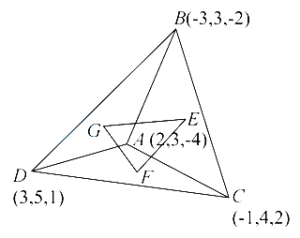
$A(2,3,-4), B(-3,3,-2), C(-1,4,2)$ and $D(3,5,1)$ are the vertices of a tetrahedron. If $E, F, G$ are the centroids of its faces containing the point $A$,then the centroid of the triangle $EFG$ is
A
$\left(\frac{1}{9}, \frac{15}{9}, \frac{-3}{9}\right)$
B
$\left(\frac{1}{4}, \frac{15}{4}, \frac{-3}{4}\right)$
C
$\left(\frac{4}{9}, \frac{11}{3}, \frac{-10}{9}\right)$
D
$\left(\frac{-1}{9}, \frac{12}{9}, \frac{1}{9}\right)$
Solution
(C) Point $E$ is the centroid of face $ABC$ (which is a triangle).
$\text{Centroid} = \left[\frac{x_1+x_2+x_3}{3}, \frac{y_1+y_2+y_3}{3}, \frac{z_1+z_2+z_3}{3}\right]$
$E = \left[\frac{2+(-3)+(-1)}{3}, \frac{3+3+4}{3}, \frac{-4+(-2)+2}{3}\right] = \left[\frac{-2}{3}, \frac{10}{3}, \frac{-4}{3}\right]$
Point $F$ is the centroid of face $ACD$.
$F = \left[\frac{2+(-1)+3}{3}, \frac{3+4+5}{3}, \frac{-4+2+1}{3}\right] = \left[\frac{4}{3}, \frac{12}{3}, \frac{-1}{3}\right] = \left[\frac{4}{3}, 4, \frac{-1}{3}\right]$
Point $G$ is the centroid of face $ABD$.
$G = \left[\frac{2+(-3)+3}{3}, \frac{3+3+5}{3}, \frac{-4+(-2)+1}{3}\right] = \left[\frac{2}{3}, \frac{11}{3}, \frac{-5}{3}\right]$
Now,$E, F, G$ form a triangle. The centroid of $\triangle EFG$ is given by the average of the coordinates of $E, F,$ and $G$.
$\text{Centroid of } \triangle EFG = \left[\frac{\frac{-2}{3}+\frac{4}{3}+\frac{2}{3}}{3}, \frac{\frac{10}{3}+4+\frac{11}{3}}{3}, \frac{\frac{-4}{3}+\left(\frac{-1}{3}\right)+\left(\frac{-5}{3}\right)}{3}\right]$
$= \left[\frac{\frac{4}{3}}{3}, \frac{\frac{10+12+11}{3}}{3}, \frac{\frac{-10}{3}}{3}\right] = \left[\frac{4}{9}, \frac{33}{9}, \frac{-10}{9}\right] = \left[\frac{4}{9}, \frac{11}{3}, \frac{-10}{9}\right]$
$\text{Centroid} = \left[\frac{x_1+x_2+x_3}{3}, \frac{y_1+y_2+y_3}{3}, \frac{z_1+z_2+z_3}{3}\right]$
$E = \left[\frac{2+(-3)+(-1)}{3}, \frac{3+3+4}{3}, \frac{-4+(-2)+2}{3}\right] = \left[\frac{-2}{3}, \frac{10}{3}, \frac{-4}{3}\right]$
Point $F$ is the centroid of face $ACD$.
$F = \left[\frac{2+(-1)+3}{3}, \frac{3+4+5}{3}, \frac{-4+2+1}{3}\right] = \left[\frac{4}{3}, \frac{12}{3}, \frac{-1}{3}\right] = \left[\frac{4}{3}, 4, \frac{-1}{3}\right]$
Point $G$ is the centroid of face $ABD$.
$G = \left[\frac{2+(-3)+3}{3}, \frac{3+3+5}{3}, \frac{-4+(-2)+1}{3}\right] = \left[\frac{2}{3}, \frac{11}{3}, \frac{-5}{3}\right]$
Now,$E, F, G$ form a triangle. The centroid of $\triangle EFG$ is given by the average of the coordinates of $E, F,$ and $G$.
$\text{Centroid of } \triangle EFG = \left[\frac{\frac{-2}{3}+\frac{4}{3}+\frac{2}{3}}{3}, \frac{\frac{10}{3}+4+\frac{11}{3}}{3}, \frac{\frac{-4}{3}+\left(\frac{-1}{3}\right)+\left(\frac{-5}{3}\right)}{3}\right]$
$= \left[\frac{\frac{4}{3}}{3}, \frac{\frac{10+12+11}{3}}{3}, \frac{\frac{-10}{3}}{3}\right] = \left[\frac{4}{9}, \frac{33}{9}, \frac{-10}{9}\right] = \left[\frac{4}{9}, \frac{11}{3}, \frac{-10}{9}\right]$
0 likes
View Solution69
EasyMCQ
Assertion $(A):$ If $(-1,3,2)$ and $(5,3,2)$ are respectively the orthocentre and circumcentre of a triangle,then $(3,3,2)$ is its centroid.
Reason $(R):$ Centroid of the triangle divides the line segment joining the orthocentre and the circumcentre in the ratio $1: 2$.
Which one of the following is true?
Reason $(R):$ Centroid of the triangle divides the line segment joining the orthocentre and the circumcentre in the ratio $1: 2$.
Which one of the following is true?
A
$A$ and $R$ are true and $R$ is the correct explanation to $A$
B
$A$ and $R$ are true but $R$ is not the correct explanation to $A$
C
$A$ is true,$R$ is false
D
$A$ is false,$R$ is true
Solution
(C) In any triangle,the centroid divides the line segment joining the orthocentre and the circumcentre in the ratio $2: 1$.
Let the orthocentre be $O(-1, 3, 2)$ and the circumcentre be $C(5, 3, 2)$.
The centroid $G$ divides the line segment $OC$ in the ratio $2: 1$.
Using the section formula,the coordinates of $G$ are:
$G = \left( \frac{2(5) + 1(-1)}{2+1}, \frac{2(3) + 1(3)}{2+1}, \frac{2(2) + 1(2)}{2+1} \right)$
$G = \left( \frac{10-1}{3}, \frac{6+3}{3}, \frac{4+2}{3} \right)$
$G = \left( \frac{9}{3}, \frac{9}{3}, \frac{6}{3} \right) = (3, 3, 2)$.
Thus,Assertion $(A)$ is true.
Reason $(R)$ states that the ratio is $1: 2$,which is incorrect because the correct ratio is $2: 1$.
Therefore,$(A)$ is true and $(R)$ is false.
Let the orthocentre be $O(-1, 3, 2)$ and the circumcentre be $C(5, 3, 2)$.
The centroid $G$ divides the line segment $OC$ in the ratio $2: 1$.
Using the section formula,the coordinates of $G$ are:
$G = \left( \frac{2(5) + 1(-1)}{2+1}, \frac{2(3) + 1(3)}{2+1}, \frac{2(2) + 1(2)}{2+1} \right)$
$G = \left( \frac{10-1}{3}, \frac{6+3}{3}, \frac{4+2}{3} \right)$
$G = \left( \frac{9}{3}, \frac{9}{3}, \frac{6}{3} \right) = (3, 3, 2)$.
Thus,Assertion $(A)$ is true.
Reason $(R)$ states that the ratio is $1: 2$,which is incorrect because the correct ratio is $2: 1$.
Therefore,$(A)$ is true and $(R)$ is false.
0 likes
View Solution70
MediumMCQ
If $\alpha$ is the angle between any two diagonals of a cube and $\beta$ is the angle between a diagonal of a cube and a diagonal of its face,which intersects this diagonal of the cube,then $\cos \alpha + \cos^2 \beta =$
A
$\frac{5}{9}$
B
$\frac{2}{9}$
C
$1$
D
$\frac{2}{3}$
Solution
(C) Let the vertices of the cube be $(0,0,0), (a,0,0), (0,a,0), (0,0,a), (a,a,0), (a,0,a), (0,a,a), (a,a,a)$.
Consider two diagonals of the cube,for example,the vectors $\vec{d_1} = (a,a,a)$ and $\vec{d_2} = (-a,a,a)$.
The angle $\alpha$ between them is given by $\cos \alpha = \frac{\vec{d_1} \cdot \vec{d_2}}{|\vec{d_1}| |\vec{d_2}|} = \frac{-a^2+a^2+a^2}{3a^2} = \frac{1}{3}$.
Now,consider a diagonal of the cube $\vec{d_1} = (a,a,a)$ and a diagonal of a face that intersects it,for example,$\vec{f} = (a,a,0)$.
The angle $\beta$ between them is given by $\cos \beta = \frac{\vec{d_1} \cdot \vec{f}}{|\vec{d_1}| |\vec{f}|} = \frac{a^2+a^2+0}{\sqrt{3a^2} \sqrt{2a^2}} = \frac{2a^2}{a^2\sqrt{6}} = \sqrt{\frac{2}{3}}$.
Thus,$\cos^2 \beta = \frac{2}{3}$.
Finally,$\cos \alpha + \cos^2 \beta = \frac{1}{3} + \frac{2}{3} = 1$.
Consider two diagonals of the cube,for example,the vectors $\vec{d_1} = (a,a,a)$ and $\vec{d_2} = (-a,a,a)$.
The angle $\alpha$ between them is given by $\cos \alpha = \frac{\vec{d_1} \cdot \vec{d_2}}{|\vec{d_1}| |\vec{d_2}|} = \frac{-a^2+a^2+a^2}{3a^2} = \frac{1}{3}$.
Now,consider a diagonal of the cube $\vec{d_1} = (a,a,a)$ and a diagonal of a face that intersects it,for example,$\vec{f} = (a,a,0)$.
The angle $\beta$ between them is given by $\cos \beta = \frac{\vec{d_1} \cdot \vec{f}}{|\vec{d_1}| |\vec{f}|} = \frac{a^2+a^2+0}{\sqrt{3a^2} \sqrt{2a^2}} = \frac{2a^2}{a^2\sqrt{6}} = \sqrt{\frac{2}{3}}$.
Thus,$\cos^2 \beta = \frac{2}{3}$.
Finally,$\cos \alpha + \cos^2 \beta = \frac{1}{3} + \frac{2}{3} = 1$.
0 likes
View Solution71
MediumMCQ
If the ratio of the perpendicular distances of a variable point $P(x, y, z)$ from the $X$-axis and from the $YZ$-plane is $2:3$,then the equation of the locus of $P$ is
A
$4x^2 - 9y^2 - 9z^2 = 0$
B
$9x^2 - 4y^2 - 4z^2 = 0$
C
$4x^2 - 4y^2 - 9z^2 = 0$
D
$9x^2 - 9y^2 - 4z^2 = 0$
Solution
(A) The perpendicular distance of a point $P(x, y, z)$ from the $X$-axis is given by $d_1 = \sqrt{y^2 + z^2}$.
The perpendicular distance of the point $P(x, y, z)$ from the $YZ$-plane is given by $d_2 = |x|$.
According to the problem,the ratio of these distances is $d_1 : d_2 = 2 : 3$.
Therefore,$\frac{\sqrt{y^2 + z^2}}{|x|} = \frac{2}{3}$.
Squaring both sides,we get $\frac{y^2 + z^2}{x^2} = \frac{4}{9}$.
Cross-multiplying,we obtain $9(y^2 + z^2) = 4x^2$.
Rearranging the terms,we get $4x^2 - 9y^2 - 9z^2 = 0$.
The perpendicular distance of the point $P(x, y, z)$ from the $YZ$-plane is given by $d_2 = |x|$.
According to the problem,the ratio of these distances is $d_1 : d_2 = 2 : 3$.
Therefore,$\frac{\sqrt{y^2 + z^2}}{|x|} = \frac{2}{3}$.
Squaring both sides,we get $\frac{y^2 + z^2}{x^2} = \frac{4}{9}$.
Cross-multiplying,we obtain $9(y^2 + z^2) = 4x^2$.
Rearranging the terms,we get $4x^2 - 9y^2 - 9z^2 = 0$.
0 likes
View Solution72
EasyMCQ
$A(27, -243, 81)$ is a point in space. $B, C, D$ are images of $A$ with respect to $XY, YZ$,and $ZX$ planes respectively. If the centroid of the triangle $BCD$ is $(\alpha, \beta, \gamma)$,then $\alpha + \beta + \gamma =$
A
-$25$
B
$45$
C
$25$
D
-$45$
Solution
(D) The coordinates of point $A$ are $(x, y, z) = (27, -243, 81)$.
The image of a point $(x, y, z)$ with respect to the $XY$-plane is $(x, y, -z)$. Thus,$B = (27, -243, -81)$.
The image of a point $(x, y, z)$ with respect to the $YZ$-plane is $(-x, y, z)$. Thus,$C = (-27, -243, 81)$.
The image of a point $(x, y, z)$ with respect to the $ZX$-plane is $(x, -y, z)$. Thus,$D = (27, 243, 81)$.
The centroid $(\alpha, \beta, \gamma)$ of triangle $BCD$ is given by the average of the coordinates of its vertices:
$\alpha = \frac{27 - 27 + 27}{3} = \frac{27}{3} = 9$
$\beta = \frac{-243 - 243 + 243}{3} = \frac{-243}{3} = -81$
$\gamma = \frac{-81 + 81 + 81}{3} = \frac{81}{3} = 27$
Therefore,$\alpha + \beta + \gamma = 9 - 81 + 27 = -45$.
The image of a point $(x, y, z)$ with respect to the $XY$-plane is $(x, y, -z)$. Thus,$B = (27, -243, -81)$.
The image of a point $(x, y, z)$ with respect to the $YZ$-plane is $(-x, y, z)$. Thus,$C = (-27, -243, 81)$.
The image of a point $(x, y, z)$ with respect to the $ZX$-plane is $(x, -y, z)$. Thus,$D = (27, 243, 81)$.
The centroid $(\alpha, \beta, \gamma)$ of triangle $BCD$ is given by the average of the coordinates of its vertices:
$\alpha = \frac{27 - 27 + 27}{3} = \frac{27}{3} = 9$
$\beta = \frac{-243 - 243 + 243}{3} = \frac{-243}{3} = -81$
$\gamma = \frac{-81 + 81 + 81}{3} = \frac{81}{3} = 27$
Therefore,$\alpha + \beta + \gamma = 9 - 81 + 27 = -45$.
0 likes
View Solution73
EasyMCQ
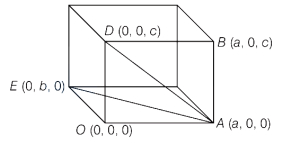
$\Pi_1, \Pi_2, \Pi_3$ are three planes which are respectively parallel to the $YZ, ZX$ and $XY$ planes at distances $a, b$ and $c$ forming a rectangular parallelopiped. $d_1$ is a diagonal of the face of $XY$-plane not passing through the origin and $d_2$ is a diagonal of the plane $\Pi_2$ coterminous with $d_1$. If none of the coordinates of the vertices of the parallelopiped are negative,then the angle between $d_1$ and $d_2$ is
A
$\cos ^{-1}\left(\frac{a^2}{\sqrt{a^2+b^2} \sqrt{a^2+c^2}}\right)$
B
$\cos ^{-1}\left(\frac{a}{a^2+b^2+c^2}\right)$
C
$\frac{\pi}{2}$
D
$\sin ^{-1}\left(\frac{a^2}{\sqrt{a^2+b^2} \sqrt{b^2+c^2}}\right)$
Solution
(A) Let the origin be $O(0, 0, 0)$. The vertices of the rectangular parallelopiped are $O(0, 0, 0)$,$A(a, 0, 0)$,$E(0, b, 0)$,$D(0, 0, c)$,and others.
$d_1$ is a diagonal of the face in the $XY$-plane not passing through the origin. The vertices of this face are $(0, 0, 0), (a, 0, 0), (0, b, 0), (a, b, 0)$. The diagonal not passing through the origin is the line segment connecting $(a, 0, 0)$ and $(0, b, 0)$,i.e.,$AE$.
The vector along $d_1$ is $\vec{v_1} = (0-a)\hat{i} + (b-0)\hat{j} + (0-0)\hat{k} = -a\hat{i} + b\hat{j}$.
$d_2$ is a diagonal of the plane $\Pi_2$ (which is parallel to $ZX$ plane at distance $b$) coterminous with $d_1$. The plane $\Pi_2$ contains points $(0, b, 0), (a, b, 0), (0, b, c), (a, b, c)$. The diagonal coterminous with $d_1$ (which starts at $A(a, 0, 0)$) is $AD$,where $D$ is $(0, 0, c)$.
Wait,looking at the provided image,$d_1$ is $AE$ and $d_2$ is $AD$.
The vector $\vec{AE} = (0-a)\hat{i} + (b-0)\hat{j} + (0-0)\hat{k} = -a\hat{i} + b\hat{j}$.
The vector $\vec{AD} = (0-a)\hat{i} + (0-0)\hat{j} + (c-0)\hat{k} = -a\hat{i} + c\hat{k}$.
The angle $\theta$ between them is given by $\cos \theta = \frac{\vec{AE} \cdot \vec{AD}}{|\vec{AE}| |\vec{AD}|}$.
$\vec{AE} \cdot \vec{AD} = (-a)(-a) + (b)(0) + (0)(c) = a^2$.
$|\vec{AE}| = \sqrt{(-a)^2 + b^2} = \sqrt{a^2+b^2}$.
$|\vec{AD}| = \sqrt{(-a)^2 + c^2} = \sqrt{a^2+c^2}$.
Thus,$\cos \theta = \frac{a^2}{\sqrt{a^2+b^2} \sqrt{a^2+c^2}}$.
Therefore,$\theta = \cos ^{-1}\left(\frac{a^2}{\sqrt{a^2+b^2} \sqrt{a^2+c^2}}\right)$.
$d_1$ is a diagonal of the face in the $XY$-plane not passing through the origin. The vertices of this face are $(0, 0, 0), (a, 0, 0), (0, b, 0), (a, b, 0)$. The diagonal not passing through the origin is the line segment connecting $(a, 0, 0)$ and $(0, b, 0)$,i.e.,$AE$.
The vector along $d_1$ is $\vec{v_1} = (0-a)\hat{i} + (b-0)\hat{j} + (0-0)\hat{k} = -a\hat{i} + b\hat{j}$.
$d_2$ is a diagonal of the plane $\Pi_2$ (which is parallel to $ZX$ plane at distance $b$) coterminous with $d_1$. The plane $\Pi_2$ contains points $(0, b, 0), (a, b, 0), (0, b, c), (a, b, c)$. The diagonal coterminous with $d_1$ (which starts at $A(a, 0, 0)$) is $AD$,where $D$ is $(0, 0, c)$.
Wait,looking at the provided image,$d_1$ is $AE$ and $d_2$ is $AD$.
The vector $\vec{AE} = (0-a)\hat{i} + (b-0)\hat{j} + (0-0)\hat{k} = -a\hat{i} + b\hat{j}$.
The vector $\vec{AD} = (0-a)\hat{i} + (0-0)\hat{j} + (c-0)\hat{k} = -a\hat{i} + c\hat{k}$.
The angle $\theta$ between them is given by $\cos \theta = \frac{\vec{AE} \cdot \vec{AD}}{|\vec{AE}| |\vec{AD}|}$.
$\vec{AE} \cdot \vec{AD} = (-a)(-a) + (b)(0) + (0)(c) = a^2$.
$|\vec{AE}| = \sqrt{(-a)^2 + b^2} = \sqrt{a^2+b^2}$.
$|\vec{AD}| = \sqrt{(-a)^2 + c^2} = \sqrt{a^2+c^2}$.
Thus,$\cos \theta = \frac{a^2}{\sqrt{a^2+b^2} \sqrt{a^2+c^2}}$.
Therefore,$\theta = \cos ^{-1}\left(\frac{a^2}{\sqrt{a^2+b^2} \sqrt{a^2+c^2}}\right)$.
0 likes
View SolutionTHREE DIMENSIONAL GEOMETRY — Mix Examples-Co-ordinate Geometry of Three Dimensions · Frequently Asked Questions
1Are these THREE DIMENSIONAL GEOMETRY questions useful for JEE and NEET?
Yes. All questions in this section are mapped to JEE Main and NEET exam patterns. Previous year questions from JEE Main, NEET, GUJCET and state-level exams are included with full solutions.
2Can I switch to Hindi or Gujarati for these questions?
Yes. Use the language tabs in the hero section or the sidebar to view the same questions and solutions in English, Hindi or Gujarati.
3How do I generate a question paper from this subtopic?
Use the Vedclass Exam Paper Generator — select the chapter and subtopic, set difficulty, and generate Sets A, B, C, D automatically. First 3 chapters of every subject are free.
Vedclass Products
For Students
Vedclass Test Series
Mock tests in real JEE/NEET style with performance analysis. 5-day free trial.
Start Free TrialFor Teachers
Exam Paper Generator
Generate Set A/B/C/D papers from this chapter in 2 minutes. 3 chapters free.
Try FreeFor Institutes
Online Exam Module
Live online exams with unlimited students, 360° analytics & white-label branding.
See DemoFor Teachers & Institutes
Generate a THREE DIMENSIONAL GEOMETRY Exam Paper in 2 Minutes
Select subtopic & difficulty — Sets A, B, C, D auto-generated with No Repeat logic.
First 3 chapters of every subject are free — no payment required.