
A English
Type of Functions based on Mapping Questions in English
Class 12 Mathematics · Relation and Function · Type of Functions based on Mapping
263+
Questions
English
Language
100%
With Solutions
Showing 43 of 263 questions in English
201
DifficultMCQ
Let $A = \{1, 2, 3, 4, 5, 6\}$. The number of functions $f: A \to A$ such that $f(m) + f(n) = 7$ whenever $m + n = 7$ is:
A
$525$
B
$216$
C
$200$
D
$729$
Solution
(B) Given $A = \{1, 2, 3, 4, 5, 6\}$.
We are given the condition $f(m) + f(n) = 7$ whenever $m + n = 7$.
The pairs $(m, n)$ such that $m + n = 7$ are $(1, 6), (2, 5), (3, 4), (4, 3), (5, 2), (6, 1)$.
This implies the following constraints:
$f(1) + f(6) = 7$
$f(2) + f(5) = 7$
$f(3) + f(4) = 7$
For each pair,say $(f(1), f(6))$,the possible values for $f(1)$ are $\{1, 2, 3, 4, 5, 6\}$.
If $f(1) = 1$,then $f(6) = 6$.
If $f(1) = 2$,then $f(6) = 5$.
If $f(1) = 3$,then $f(6) = 4$.
If $f(1) = 4$,then $f(6) = 3$.
If $f(1) = 5$,then $f(6) = 2$.
If $f(1) = 6$,then $f(6) = 1$.
There are $6$ possible choices for each pair $(f(1), f(6)), (f(2), f(5)),$ and $(f(3), f(4))$.
Since there are $3$ such independent pairs,the total number of functions is $6 \times 6 \times 6 = 6^3 = 216$.
We are given the condition $f(m) + f(n) = 7$ whenever $m + n = 7$.
The pairs $(m, n)$ such that $m + n = 7$ are $(1, 6), (2, 5), (3, 4), (4, 3), (5, 2), (6, 1)$.
This implies the following constraints:
$f(1) + f(6) = 7$
$f(2) + f(5) = 7$
$f(3) + f(4) = 7$
For each pair,say $(f(1), f(6))$,the possible values for $f(1)$ are $\{1, 2, 3, 4, 5, 6\}$.
If $f(1) = 1$,then $f(6) = 6$.
If $f(1) = 2$,then $f(6) = 5$.
If $f(1) = 3$,then $f(6) = 4$.
If $f(1) = 4$,then $f(6) = 3$.
If $f(1) = 5$,then $f(6) = 2$.
If $f(1) = 6$,then $f(6) = 1$.
There are $6$ possible choices for each pair $(f(1), f(6)), (f(2), f(5)),$ and $(f(3), f(4))$.
Since there are $3$ such independent pairs,the total number of functions is $6 \times 6 \times 6 = 6^3 = 216$.
0 likes
View Solution202
EasyMCQ
If $f(x)$ is the signum function,then in terms of $f(x)$,the constant function $g(x)=1, \forall x \in R$ is
A
$g(x)= \begin{cases}2-f(x), & x < 0 \\ f(x), & x \geq 0\end{cases}$
B
$g(x)= \begin{cases}f(x)+f(-x), & x < 0 \\ f(x) f(-x), & x \geq 0\end{cases}$
C
$g(x)= \begin{cases}1+f(x), & x>0 \\ 1-f(x), & x \leq 0\end{cases}$
D
$g(x)= \begin{cases}f(x)+2, & x < 0 \\ 1+f(x), & x=0 \\ f(x), & x>0\end{cases}$
Solution
(D) Given $g(x)=1, \forall x \in R$ and the signum function $f(x)= \begin{cases}-1, & x < 0 \\ 0, & x=0 \\ 1, & x>0\end{cases}$.
For $x < 0$,$f(x)=-1$,so $g(x)=1 = 2+(-1) = 2+f(x)$.
For $x=0$,$f(x)=0$,so $g(x)=1 = 1+0 = 1+f(x)$.
For $x>0$,$f(x)=1$,so $g(x)=1 = 0+1 = 0+f(x) = f(x)$.
Thus,$g(x)= \begin{cases}f(x)+2, & x < 0 \\ 1+f(x), & x=0 \\ f(x), & x>0\end{cases}$.
For $x < 0$,$f(x)=-1$,so $g(x)=1 = 2+(-1) = 2+f(x)$.
For $x=0$,$f(x)=0$,so $g(x)=1 = 1+0 = 1+f(x)$.
For $x>0$,$f(x)=1$,so $g(x)=1 = 0+1 = 0+f(x) = f(x)$.
Thus,$g(x)= \begin{cases}f(x)+2, & x < 0 \\ 1+f(x), & x=0 \\ f(x), & x>0\end{cases}$.
0 likes
View Solution203
MediumMCQ
If the function $f:[-1,1] \rightarrow R$ is defined by $f(x) = \begin{cases} 2^x+1, & \text{for } x \in [-1,0) \\ 1, & \text{for } x=0 \\ 2^x-1, & \text{for } x \in (0,1] \end{cases}$,then in $[-1,1]$,$f(x)$ has
A
a maximum
B
a minimum
C
both maximum and minimum
D
neither maximum nor minimum
Solution
(D) The function $f(x)$ is defined on the interval $[-1, 1]$.
For $x \in [-1, 0)$,$f(x) = 2^x + 1$. As $x \to 0^-$,$f(x) \to 2^0 + 1 = 2$. Since $2^x$ is strictly increasing,$f(x)$ increases from $f(-1) = 2^{-1} + 1 = 1.5$ to $2$.
At $x = 0$,$f(0) = 1$.
For $x \in (0, 1]$,$f(x) = 2^x - 1$. As $x \to 0^+$,$f(x) \to 2^0 - 1 = 0$. Since $2^x$ is strictly increasing,$f(x)$ increases from $0$ to $f(1) = 2^1 - 1 = 1$.
The range of the function is $[1.5, 2) \cup \{1\} \cup (0, 1]$.
Combining these,the range is $(0, 1] \cup [1.5, 2)$.
Since the range is not a closed interval and the function values do not attain a supremum or infimum within the domain (the values approach $2$ but never reach it,and approach $0$ but never reach it),the function has neither a maximum nor a minimum value on $[-1, 1]$.
For $x \in [-1, 0)$,$f(x) = 2^x + 1$. As $x \to 0^-$,$f(x) \to 2^0 + 1 = 2$. Since $2^x$ is strictly increasing,$f(x)$ increases from $f(-1) = 2^{-1} + 1 = 1.5$ to $2$.
At $x = 0$,$f(0) = 1$.
For $x \in (0, 1]$,$f(x) = 2^x - 1$. As $x \to 0^+$,$f(x) \to 2^0 - 1 = 0$. Since $2^x$ is strictly increasing,$f(x)$ increases from $0$ to $f(1) = 2^1 - 1 = 1$.
The range of the function is $[1.5, 2) \cup \{1\} \cup (0, 1]$.
Combining these,the range is $(0, 1] \cup [1.5, 2)$.
Since the range is not a closed interval and the function values do not attain a supremum or infimum within the domain (the values approach $2$ but never reach it,and approach $0$ but never reach it),the function has neither a maximum nor a minimum value on $[-1, 1]$.
0 likes
View Solution204
EasyMCQ
Let $f: R \rightarrow R$ be a function defined by $f(x) = \begin{cases} x^2 - 4x + 3, & \text{if } x < 2 \\ x - 3, & \text{if } x \geq 2 \end{cases}$. Then the number of real numbers $x$ for which $f(x) = 8$ is:
A
$1$
B
$2$
C
$3$
D
$4$
Solution
(B) We are given $f(x) = 8$.
Case $1$: For $x < 2$,$f(x) = x^2 - 4x + 3$.
Setting $x^2 - 4x + 3 = 8$,we get $x^2 - 4x - 5 = 0$.
Factoring gives $(x - 5)(x + 1) = 0$,so $x = 5$ or $x = -1$.
Since the condition is $x < 2$,only $x = -1$ is a valid solution.
Case $2$: For $x \geq 2$,$f(x) = x - 3$.
Setting $x - 3 = 8$,we get $x = 11$.
Since $11 \geq 2$,this is a valid solution.
Thus,the solutions are $x = -1$ and $x = 11$.
The total number of real numbers $x$ for which $f(x) = 8$ is $2$.
Case $1$: For $x < 2$,$f(x) = x^2 - 4x + 3$.
Setting $x^2 - 4x + 3 = 8$,we get $x^2 - 4x - 5 = 0$.
Factoring gives $(x - 5)(x + 1) = 0$,so $x = 5$ or $x = -1$.
Since the condition is $x < 2$,only $x = -1$ is a valid solution.
Case $2$: For $x \geq 2$,$f(x) = x - 3$.
Setting $x - 3 = 8$,we get $x = 11$.
Since $11 \geq 2$,this is a valid solution.
Thus,the solutions are $x = -1$ and $x = 11$.
The total number of real numbers $x$ for which $f(x) = 8$ is $2$.
0 likes
View Solution205
EasyMCQ
Let $[\cdot]$ denote the greatest integer function. If $f(x) = [x]$ and $g(x) = 3[\frac{x}{3}]$,then the set of all real $x$ such that $f(x) = g(x)$ is
A
$R$
B
$\{x \in R : x = 3k, k \in Z\}$
C
$\{x \in R : 3k - 1 < x \leq 3k, k \in Z\}$
D
$\{x \in R : 3k \leq x < 3k + 1, k \in Z\}$
Solution
(D) We are given $f(x) = [x]$ and $g(x) = 3[\frac{x}{3}]$.
Setting $f(x) = g(x)$,we have $[x] = 3[\frac{x}{3}]$.
Let $[\frac{x}{3}] = k$,where $k \in Z$.
Then,by the definition of the greatest integer function,$k \leq \frac{x}{3} < k + 1$,which implies $3k \leq x < 3k + 3$.
Also,we have $[x] = 3k$.
By the definition of the greatest integer function,$[x] = 3k$ implies $3k \leq x < 3k + 1$.
Since $3k \leq x < 3k + 1$ is a subset of $3k \leq x < 3k + 3$,the condition $[x] = 3[\frac{x}{3}]$ is satisfied for all $x$ in the interval $[3k, 3k + 1)$ for any integer $k$.
Thus,the set of all such real $x$ is $\{x \in R : 3k \leq x < 3k + 1, k \in Z\}$.
Setting $f(x) = g(x)$,we have $[x] = 3[\frac{x}{3}]$.
Let $[\frac{x}{3}] = k$,where $k \in Z$.
Then,by the definition of the greatest integer function,$k \leq \frac{x}{3} < k + 1$,which implies $3k \leq x < 3k + 3$.
Also,we have $[x] = 3k$.
By the definition of the greatest integer function,$[x] = 3k$ implies $3k \leq x < 3k + 1$.
Since $3k \leq x < 3k + 1$ is a subset of $3k \leq x < 3k + 3$,the condition $[x] = 3[\frac{x}{3}]$ is satisfied for all $x$ in the interval $[3k, 3k + 1)$ for any integer $k$.
Thus,the set of all such real $x$ is $\{x \in R : 3k \leq x < 3k + 1, k \in Z\}$.
0 likes
View Solution206
MediumMCQ
Let $f: R \rightarrow R$ be defined by $f(x) = 5^{-|x|} + \operatorname{sgn}(5^{-x})$,where $\operatorname{sgn}(x)$ denotes the signum function of $x$. Then $f$ is
A
one-one but not onto
B
onto but not one-one
C
both one-one and onto
D
neither one-one nor onto
Solution
(D) The function is defined as $f(x) = 5^{-|x|} + \operatorname{sgn}(5^{-x})$.
Since $5^{-x} > 0$ for all $x \in R$,the signum function $\operatorname{sgn}(5^{-x}) = 1$ for all $x \in R$.
Thus,the function simplifies to $f(x) = 5^{-|x|} + 1$.
For $x \geq 0$,$f(x) = 5^{-x} + 1$,which is a strictly decreasing function with range $(1, 2]$.
For $x < 0$,$f(x) = 5^{x} + 1$,which is a strictly increasing function with range $(1, 2)$.
Since $f(x) = f(-x)$ for all $x$,the function is many-one.
Also,the range of the function is $(1, 2]$,which is a proper subset of the codomain $R$,so the function is not onto.
Therefore,$f$ is neither one-one nor onto.
Since $5^{-x} > 0$ for all $x \in R$,the signum function $\operatorname{sgn}(5^{-x}) = 1$ for all $x \in R$.
Thus,the function simplifies to $f(x) = 5^{-|x|} + 1$.
For $x \geq 0$,$f(x) = 5^{-x} + 1$,which is a strictly decreasing function with range $(1, 2]$.
For $x < 0$,$f(x) = 5^{x} + 1$,which is a strictly increasing function with range $(1, 2)$.
Since $f(x) = f(-x)$ for all $x$,the function is many-one.
Also,the range of the function is $(1, 2]$,which is a proper subset of the codomain $R$,so the function is not onto.
Therefore,$f$ is neither one-one nor onto.
0 likes
View Solution207
MediumMCQ
Which one of the following functions is a bijection?
A
$f: R \setminus Z \rightarrow [0,1]$ defined by $f(x) = \sqrt{x-[x]}$. (Here $[x]$ represents the greatest integer function)
B
$f: R \rightarrow (-\infty, 1]$ defined by $f(x) = 4x-x^2-3$
C
$f: (5, \infty) \rightarrow R \setminus \{0\}$ defined by $f(x) = \frac{1}{\sqrt{x-5}}$
D
$f: [0,4] \rightarrow [0,4]$ defined by $f(x) = \sqrt{16-x^2}$
Solution
(D) function is a bijection if it is both one-to-one (injective) and onto (surjective).
$(a)$ $f(x) = \sqrt{\{x\}}$. Since $\{x\}$ is periodic with period $1$,$f(0.1) = f(1.1)$,so it is many-to-one.
$(b)$ $f(x) = -(x^2-4x+4)+1 = 1-(x-2)^2$. This is a parabola opening downwards,which is many-to-one.
$(c)$ $f(x) = \frac{1}{\sqrt{x-5}}$. The range is $(0, \infty)$,which is not equal to the codomain $R \setminus \{0\}$,so it is into.
$(d)$ $f(x) = \sqrt{16-x^2}$. For $x \in [0,4]$,$f(x)$ is strictly decreasing from $4$ to $0$. Thus,it is one-to-one and onto. Hence,it is a bijection.
$(a)$ $f(x) = \sqrt{\{x\}}$. Since $\{x\}$ is periodic with period $1$,$f(0.1) = f(1.1)$,so it is many-to-one.
$(b)$ $f(x) = -(x^2-4x+4)+1 = 1-(x-2)^2$. This is a parabola opening downwards,which is many-to-one.
$(c)$ $f(x) = \frac{1}{\sqrt{x-5}}$. The range is $(0, \infty)$,which is not equal to the codomain $R \setminus \{0\}$,so it is into.
$(d)$ $f(x) = \sqrt{16-x^2}$. For $x \in [0,4]$,$f(x)$ is strictly decreasing from $4$ to $0$. Thus,it is one-to-one and onto. Hence,it is a bijection.
0 likes
View Solution208
EasyMCQ
If $f: R \rightarrow R$ is defined by $f(x) = x + 2|x + 1| + 2|x - 1|$,then the element in the co-domain,which has a unique pre-image in the domain is
A
$3$
B
$1$
C
$2$
D
$5$
Solution
(A) We have $f(x) = x + 2|x + 1| + 2|x - 1|$.
Breaking the function into intervals:
For $x \leq -1$: $f(x) = x + 2(-x - 1) + 2(-x + 1) = x - 2x - 2 - 2x + 2 = -3x$.
For $-1 < x < 1$: $f(x) = x + 2(x + 1) + 2(-x + 1) = x + 2x + 2 - 2x + 2 = x + 4$.
For $x \geq 1$: $f(x) = x + 2(x + 1) + 2(x - 1) = x + 2x + 2 + 2x - 2 = 5x$.
The function is defined as:
$f(x) = \begin{cases} -3x, & x \leq -1 \\ x + 4, & -1 < x < 1 \\ 5x, & x \geq 1 \end{cases}$
At $x = -1$,$f(-1) = 3$. For $x < -1$,$f(x) > 3$. For $-1 < x < 1$,$f(x)$ ranges from $3$ to $5$. At $x = 1$,$f(1) = 5$. For $x > 1$,$f(x) > 5$.
The value $3$ is attained at $x = -1$ and as $x \to -1^+$,$f(x) \to 3$. However,looking at the graph,the function is continuous. The value $3$ is the minimum value of the function,occurring at $x = -1$. Since the function is strictly decreasing for $x < -1$ and strictly increasing for $x > -1$,the value $3$ is the unique minimum,thus it has a unique pre-image.
Breaking the function into intervals:
For $x \leq -1$: $f(x) = x + 2(-x - 1) + 2(-x + 1) = x - 2x - 2 - 2x + 2 = -3x$.
For $-1 < x < 1$: $f(x) = x + 2(x + 1) + 2(-x + 1) = x + 2x + 2 - 2x + 2 = x + 4$.
For $x \geq 1$: $f(x) = x + 2(x + 1) + 2(x - 1) = x + 2x + 2 + 2x - 2 = 5x$.
The function is defined as:
$f(x) = \begin{cases} -3x, & x \leq -1 \\ x + 4, & -1 < x < 1 \\ 5x, & x \geq 1 \end{cases}$
At $x = -1$,$f(-1) = 3$. For $x < -1$,$f(x) > 3$. For $-1 < x < 1$,$f(x)$ ranges from $3$ to $5$. At $x = 1$,$f(1) = 5$. For $x > 1$,$f(x) > 5$.
The value $3$ is attained at $x = -1$ and as $x \to -1^+$,$f(x) \to 3$. However,looking at the graph,the function is continuous. The value $3$ is the minimum value of the function,occurring at $x = -1$. Since the function is strictly decreasing for $x < -1$ and strictly increasing for $x > -1$,the value $3$ is the unique minimum,thus it has a unique pre-image.
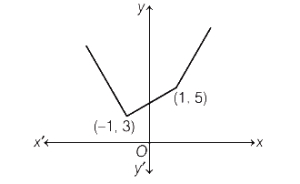
0 likes
View Solution209
MediumMCQ
Let $f: R \rightarrow R$ be defined by $f(x) = \begin{cases} x + 2, & x \leq -1 \\ x^2, & -1 < x < 1 \\ 2 - x, & x \geq 1 \end{cases}$. Then the value of $f(-1.75) + f(0.5) + f(1.5)$ is
A
$0$
B
$1$
C
$2$
D
$-1$
Solution
(B) Given the function $f(x)$ defined in pieces:
Step $1$: Calculate $f(-1.75)$. Since $-1.75 \leq -1$,we use $f(x) = x + 2$.
$f(-1.75) = -1.75 + 2 = 0.25$.
Step $2$: Calculate $f(0.5)$. Since $-1 < 0.5 < 1$,we use $f(x) = x^2$.
$f(0.5) = (0.5)^2 = 0.25$.
Step $3$: Calculate $f(1.5)$. Since $1.5 \geq 1$,we use $f(x) = 2 - x$.
$f(1.5) = 2 - 1.5 = 0.5$.
Step $4$: Sum the values:
$f(-1.75) + f(0.5) + f(1.5) = 0.25 + 0.25 + 0.5 = 1$.
Step $1$: Calculate $f(-1.75)$. Since $-1.75 \leq -1$,we use $f(x) = x + 2$.
$f(-1.75) = -1.75 + 2 = 0.25$.
Step $2$: Calculate $f(0.5)$. Since $-1 < 0.5 < 1$,we use $f(x) = x^2$.
$f(0.5) = (0.5)^2 = 0.25$.
Step $3$: Calculate $f(1.5)$. Since $1.5 \geq 1$,we use $f(x) = 2 - x$.
$f(1.5) = 2 - 1.5 = 0.5$.
Step $4$: Sum the values:
$f(-1.75) + f(0.5) + f(1.5) = 0.25 + 0.25 + 0.5 = 1$.
0 likes
View Solution210
MediumMCQ
$f(x)=ax^2+bx+c$ is an even function and $g(x)=px^3+qx^2+rx$ is an odd function. If $h(x)=f(x)+g(x)$ and $h(-2)=0$,then $8p+4q+2r=$
A
$4a+3b+2c$
B
$a+b+c$
C
$4a+2b+c$
D
$8a+4b+2c$
Solution
(C) Given that $f(x) = ax^2 + bx + c$ is an even function,$f(x) = f(-x)$.
$ax^2 + bx + c = a(-x)^2 + b(-x) + c = ax^2 - bx + c$.
Comparing coefficients,we get $b = 0$.
Given that $g(x) = px^3 + qx^2 + rx$ is an odd function,$g(-x) = -g(x)$.
$p(-x)^3 + q(-x)^2 + r(-x) = -(px^3 + qx^2 + rx)$.
$-px^3 + qx^2 - rx = -px^3 - qx^2 - rx$.
Comparing coefficients,we get $q = 0$.
Now,$h(x) = f(x) + g(x) = ax^2 + bx + c + px^3 + qx^2 + rx$.
Since $b = 0$ and $q = 0$,$h(x) = px^3 + ax^2 + rx + c$.
We are given $h(-2) = 0$.
$p(-2)^3 + a(-2)^2 + r(-2) + c = 0$.
$-8p + 4a - 2r + c = 0$.
$4a + c = 8p + 2r$.
Since $b = 0$,$4a + 2b + c = 4a + 2(0) + c = 4a + c$.
Thus,$8p + 2r = 4a + 2b + c$.
$ax^2 + bx + c = a(-x)^2 + b(-x) + c = ax^2 - bx + c$.
Comparing coefficients,we get $b = 0$.
Given that $g(x) = px^3 + qx^2 + rx$ is an odd function,$g(-x) = -g(x)$.
$p(-x)^3 + q(-x)^2 + r(-x) = -(px^3 + qx^2 + rx)$.
$-px^3 + qx^2 - rx = -px^3 - qx^2 - rx$.
Comparing coefficients,we get $q = 0$.
Now,$h(x) = f(x) + g(x) = ax^2 + bx + c + px^3 + qx^2 + rx$.
Since $b = 0$ and $q = 0$,$h(x) = px^3 + ax^2 + rx + c$.
We are given $h(-2) = 0$.
$p(-2)^3 + a(-2)^2 + r(-2) + c = 0$.
$-8p + 4a - 2r + c = 0$.
$4a + c = 8p + 2r$.
Since $b = 0$,$4a + 2b + c = 4a + 2(0) + c = 4a + c$.
Thus,$8p + 2r = 4a + 2b + c$.
0 likes
View Solution211
EasyMCQ
The function $f(x) = \log (x + \sqrt{x^2 + 1})$ is
A
An odd function
B
$A$ periodic function
C
Neither an even nor an odd function
D
An even function
Solution
(A) To check if the function is even or odd,we evaluate $f(-x)$.
$f(-x) = \log (-x + \sqrt{(-x)^2 + 1}) = \log (-x + \sqrt{x^2 + 1})$.
Now,multiply and divide by $(x + \sqrt{x^2 + 1})$ inside the logarithm:
$f(-x) = \log \left( \frac{(\sqrt{x^2 + 1} - x)(\sqrt{x^2 + 1} + x)}{\sqrt{x^2 + 1} + x} \right)$.
Using the identity $(a-b)(a+b) = a^2 - b^2$:
$f(-x) = \log \left( \frac{(x^2 + 1) - x^2}{\sqrt{x^2 + 1} + x} \right) = \log \left( \frac{1}{x + \sqrt{x^2 + 1}} \right)$.
Using the property $\log(1/a) = -\log(a)$:
$f(-x) = -\log(x + \sqrt{x^2 + 1}) = -f(x)$.
Since $f(-x) = -f(x)$,the function is an odd function.
$f(-x) = \log (-x + \sqrt{(-x)^2 + 1}) = \log (-x + \sqrt{x^2 + 1})$.
Now,multiply and divide by $(x + \sqrt{x^2 + 1})$ inside the logarithm:
$f(-x) = \log \left( \frac{(\sqrt{x^2 + 1} - x)(\sqrt{x^2 + 1} + x)}{\sqrt{x^2 + 1} + x} \right)$.
Using the identity $(a-b)(a+b) = a^2 - b^2$:
$f(-x) = \log \left( \frac{(x^2 + 1) - x^2}{\sqrt{x^2 + 1} + x} \right) = \log \left( \frac{1}{x + \sqrt{x^2 + 1}} \right)$.
Using the property $\log(1/a) = -\log(a)$:
$f(-x) = -\log(x + \sqrt{x^2 + 1}) = -f(x)$.
Since $f(-x) = -f(x)$,the function is an odd function.
0 likes
View Solution212
EasyMCQ
$A$ function $f: R - \{ 0 \} \rightarrow R$ is defined as $f(x) = \begin{cases} x^2 + 3x - 7, & x > 0 \\ h(x), & x < 0 \end{cases}$ If $f(x)$ is an odd function,then $h(x) =$
A
$x^2 + 3x + 7$
B
$x^2 + 3x - 7$
C
$-x^2 + 3x + 7$
D
$-x^2 - 3x + 7$
Solution
(C) Given that $f(x)$ is an odd function,it must satisfy the condition $f(-x) = -f(x)$ for all $x$ in the domain.
For $x < 0$,we have $-x > 0$.
Since $f(x) = x^2 + 3x - 7$ for $x > 0$,we can find $f(-x)$ by substituting $-x$ into this expression:
$f(-x) = (-x)^2 + 3(-x) - 7 = x^2 - 3x - 7$.
Using the property of the odd function,$f(x) = -f(-x)$ for $x < 0$:
$h(x) = -(x^2 - 3x - 7) = -x^2 + 3x + 7$.
Thus,the correct option is $C$.
For $x < 0$,we have $-x > 0$.
Since $f(x) = x^2 + 3x - 7$ for $x > 0$,we can find $f(-x)$ by substituting $-x$ into this expression:
$f(-x) = (-x)^2 + 3(-x) - 7 = x^2 - 3x - 7$.
Using the property of the odd function,$f(x) = -f(-x)$ for $x < 0$:
$h(x) = -(x^2 - 3x - 7) = -x^2 + 3x + 7$.
Thus,the correct option is $C$.
0 likes
View Solution213
MediumMCQ
Let $Z$ denote the set of integers. Define $f: Z \rightarrow Z$ by $f(x) = \begin{cases} \frac{x}{2}, & x \text{ is even} \\ 0, & x \text{ is odd} \end{cases}$. Then $f$ is:
A
onto but not one-one
B
one-one but not onto
C
one-one and onto
D
neither one-one nor onto
Solution
(D) To check for one-one: $A$ function is one-one if $f(x_1) = f(x_2) \implies x_1 = x_2$. Consider $f(1) = 0$ and $f(3) = 0$. Since $f(1) = f(3)$ but $1 \neq 3$,the function is not one-one.
To check for onto: $A$ function is onto if for every $y \in Z$,there exists $x \in Z$ such that $f(x) = y$. For any odd integer $y$ (where $y \neq 0$),there is no $x \in Z$ such that $f(x) = y$,because the range of $f$ only contains $0$ and even integers divided by $2$. Thus,the function is not onto.
Therefore,$f$ is neither one-one nor onto.
To check for onto: $A$ function is onto if for every $y \in Z$,there exists $x \in Z$ such that $f(x) = y$. For any odd integer $y$ (where $y \neq 0$),there is no $x \in Z$ such that $f(x) = y$,because the range of $f$ only contains $0$ and even integers divided by $2$. Thus,the function is not onto.
Therefore,$f$ is neither one-one nor onto.
0 likes
View Solution214
MediumMCQ
If $f: R \rightarrow R$ is defined by $f(x)=x-[x]-\frac{1}{2}$ for $x \in R$,where $[x]$ is the greatest integer not exceeding $x$,then $\{x \in R: f(x)=\frac{1}{2}\}$ is equal to :
A
$Z$,the set of all integers
B
$N$,the set of all natural numbers
C
$\phi$,the empty set
D
$R$
Solution
(C) Given the function $f(x) = x - [x] - \frac{1}{2}$.
We know that the fractional part of $x$ is defined as $\{x\} = x - [x]$.
Thus,$f(x) = \{x\} - \frac{1}{2}$.
We are given $f(x) = \frac{1}{2}$,so $\{x\} - \frac{1}{2} = \frac{1}{2}$.
This implies $\{x\} = 1$.
However,by definition,the fractional part $\{x\}$ always satisfies $0 \le \{x\} < 1$.
Since $\{x\}$ can never be equal to $1$,there is no value of $x$ that satisfies the equation.
Therefore,the set $\{x \in R: f(x) = \frac{1}{2}\}$ is the empty set,denoted by $\phi$.
We know that the fractional part of $x$ is defined as $\{x\} = x - [x]$.
Thus,$f(x) = \{x\} - \frac{1}{2}$.
We are given $f(x) = \frac{1}{2}$,so $\{x\} - \frac{1}{2} = \frac{1}{2}$.
This implies $\{x\} = 1$.
However,by definition,the fractional part $\{x\}$ always satisfies $0 \le \{x\} < 1$.
Since $\{x\}$ can never be equal to $1$,there is no value of $x$ that satisfies the equation.
Therefore,the set $\{x \in R: f(x) = \frac{1}{2}\}$ is the empty set,denoted by $\phi$.
0 likes
View Solution215
MediumMCQ
If $f(x) = \begin{cases} [x], & -3 < x \leq -1 \\ |x|, & -1 < x < 1 \\ |[x]|, & 1 \leq x < 3 \end{cases}$ then the set $\{x : f(x) \geq 0\}$ is equal to
A
$(-1, 3)$
B
$[-1, 3)$
C
$(-1, 3]$
D
$[0, 3)$
Solution
(A) Given the function $f(x) = \begin{cases} [x], & -3 < x \leq -1 \\ |x|, & -1 < x < 1 \\ |[x]|, & 1 \leq x < 3 \end{cases}$.
Case $1$: For $-3 < x \leq -1$,$f(x) = [x]$. Since $x \leq -1$,$[x] \leq -1$,so $f(x) < 0$.
Case $2$: For $-1 < x < 1$,$f(x) = |x|$. Since the absolute value is always non-negative,$f(x) \geq 0$ for all $x \in (-1, 1)$.
Case $3$: For $1 \leq x < 3$,$f(x) = |[x]|$. Since the absolute value of the greatest integer function is always non-negative,$f(x) \geq 0$ for all $x \in [1, 3)$.
Combining the intervals from Case $2$ and Case $3$,we get $(-1, 1) \cup [1, 3) = (-1, 3)$.
Thus,the set $\{x : f(x) \geq 0\}$ is $(-1, 3)$.
Case $1$: For $-3 < x \leq -1$,$f(x) = [x]$. Since $x \leq -1$,$[x] \leq -1$,so $f(x) < 0$.
Case $2$: For $-1 < x < 1$,$f(x) = |x|$. Since the absolute value is always non-negative,$f(x) \geq 0$ for all $x \in (-1, 1)$.
Case $3$: For $1 \leq x < 3$,$f(x) = |[x]|$. Since the absolute value of the greatest integer function is always non-negative,$f(x) \geq 0$ for all $x \in [1, 3)$.
Combining the intervals from Case $2$ and Case $3$,we get $(-1, 1) \cup [1, 3) = (-1, 3)$.
Thus,the set $\{x : f(x) \geq 0\}$ is $(-1, 3)$.
0 likes
View Solution216
EasyMCQ
If $f: N \rightarrow Z$ is defined by $f(n)=\begin{cases} 2 & \text{if } n=3k, k \in Z \\ 10 & \text{if } n=3k+1, k \in Z \\ 0 & \text{if } n=3k+2, k \in Z \end{cases}$,then $\{n \in N: f(n)>2\}$ is equal to
A
$\{3, 6, 4\}$
B
$\{1, 4, 7, \dots\}$
C
$\{4, 7, \dots\}$
D
$\{7, 10, \dots\}$
Solution
(B) Given the function $f: N \rightarrow Z$ defined as:
$f(n) = \begin{cases} 2 & \text{if } n=3k, k \in Z \\ 10 & \text{if } n=3k+1, k \in Z \\ 0 & \text{if } n=3k+2, k \in Z \end{cases}$
We want to find the set $\{n \in N: f(n) > 2\}$.
Looking at the definition,$f(n) > 2$ only when $f(n) = 10$.
This occurs when $n = 3k + 1$ for $k \in Z$.
Since $n \in N$ (natural numbers),we consider $k \geq 0$ (assuming $N = \{1, 2, 3, \dots\}$):
For $k=0, n = 3(0) + 1 = 1$.
For $k=1, n = 3(1) + 1 = 4$.
For $k=2, n = 3(2) + 1 = 7$.
Thus,the set is $\{1, 4, 7, \dots\}$.
$f(n) = \begin{cases} 2 & \text{if } n=3k, k \in Z \\ 10 & \text{if } n=3k+1, k \in Z \\ 0 & \text{if } n=3k+2, k \in Z \end{cases}$
We want to find the set $\{n \in N: f(n) > 2\}$.
Looking at the definition,$f(n) > 2$ only when $f(n) = 10$.
This occurs when $n = 3k + 1$ for $k \in Z$.
Since $n \in N$ (natural numbers),we consider $k \geq 0$ (assuming $N = \{1, 2, 3, \dots\}$):
For $k=0, n = 3(0) + 1 = 1$.
For $k=1, n = 3(1) + 1 = 4$.
For $k=2, n = 3(2) + 1 = 7$.
Thus,the set is $\{1, 4, 7, \dots\}$.
0 likes
View Solution217
MediumMCQ
$A$ function $f: R \rightarrow R$ defined by $f(x) = \begin{cases} 2x+3, & x \leq \frac{4}{3} \\ -3x^2+8x, & x > \frac{4}{3} \end{cases}$ is
A
One-one function
B
not onto
C
a bijective function
D
constant function
Solution
(B) To determine the nature of the function $f(x)$,we analyze its behavior in two intervals.
For $x \leq \frac{4}{3}$,$f(x) = 2x+3$. This is a strictly increasing linear function. The range for this part is $(-\infty, 2(\frac{4}{3})+3] = (-\infty, \frac{17}{3}]$.
For $x > \frac{4}{3}$,$f(x) = -3x^2+8x$. This is a downward-opening parabola with vertex at $x = -\frac{b}{2a} = -\frac{8}{2(-3)} = \frac{4}{3}$. Since the interval is $x > \frac{4}{3}$,the function is strictly decreasing in this domain. The value at $x = \frac{4}{3}$ is $-3(\frac{16}{9}) + 8(\frac{4}{3}) = -\frac{16}{3} + \frac{32}{3} = \frac{16}{3}$. As $x \rightarrow \infty$,$f(x) \rightarrow -\infty$. Thus,the range for this part is $(-\infty, \frac{16}{3})$.
Combining these,the function is not one-one because the value $\frac{16}{3}$ is attained at $x = \frac{4}{3}$ and also at some $x > \frac{4}{3}$ (since the parabola decreases from $\frac{16}{3}$).
Since the range is $(-\infty, \frac{17}{3}]$,which is not equal to the codomain $R$,the function is not onto. Therefore,it is not bijective. The correct description is that it is not onto.
For $x \leq \frac{4}{3}$,$f(x) = 2x+3$. This is a strictly increasing linear function. The range for this part is $(-\infty, 2(\frac{4}{3})+3] = (-\infty, \frac{17}{3}]$.
For $x > \frac{4}{3}$,$f(x) = -3x^2+8x$. This is a downward-opening parabola with vertex at $x = -\frac{b}{2a} = -\frac{8}{2(-3)} = \frac{4}{3}$. Since the interval is $x > \frac{4}{3}$,the function is strictly decreasing in this domain. The value at $x = \frac{4}{3}$ is $-3(\frac{16}{9}) + 8(\frac{4}{3}) = -\frac{16}{3} + \frac{32}{3} = \frac{16}{3}$. As $x \rightarrow \infty$,$f(x) \rightarrow -\infty$. Thus,the range for this part is $(-\infty, \frac{16}{3})$.
Combining these,the function is not one-one because the value $\frac{16}{3}$ is attained at $x = \frac{4}{3}$ and also at some $x > \frac{4}{3}$ (since the parabola decreases from $\frac{16}{3}$).
Since the range is $(-\infty, \frac{17}{3}]$,which is not equal to the codomain $R$,the function is not onto. Therefore,it is not bijective. The correct description is that it is not onto.
0 likes
View Solution218
MediumMCQ
If $f: R \rightarrow R$ is defined by $f(x)=2x+\sin x, x \in R$,then $f$ is
A
one-one and onto
B
one-one but not onto
C
onto but not one-one
D
neither one-one nor onto
Solution
(A) Given the function $f(x) = 2x + \sin x$.
To check for one-one,we find the derivative: $f'(x) = 2 + \cos x$.
Since $-1 \leq \cos x \leq 1$,it follows that $f'(x) = 2 + \cos x \geq 2 - 1 = 1 > 0$.
Since $f'(x) > 0$ for all $x \in R$,the function $f(x)$ is strictly increasing,which implies $f(x)$ is one-one.
To check for onto,we observe the range of $f(x)$. As $x \to \infty$,$f(x) \to \infty$,and as $x \to -\infty$,$f(x) \to -\infty$.
Since $f(x)$ is a continuous function,by the Intermediate Value Theorem,its range is $(-\infty, \infty) = R$.
Therefore,$f(x)$ is onto.
Thus,$f$ is one-one and onto.
To check for one-one,we find the derivative: $f'(x) = 2 + \cos x$.
Since $-1 \leq \cos x \leq 1$,it follows that $f'(x) = 2 + \cos x \geq 2 - 1 = 1 > 0$.
Since $f'(x) > 0$ for all $x \in R$,the function $f(x)$ is strictly increasing,which implies $f(x)$ is one-one.
To check for onto,we observe the range of $f(x)$. As $x \to \infty$,$f(x) \to \infty$,and as $x \to -\infty$,$f(x) \to -\infty$.
Since $f(x)$ is a continuous function,by the Intermediate Value Theorem,its range is $(-\infty, \infty) = R$.
Therefore,$f(x)$ is onto.
Thus,$f$ is one-one and onto.
0 likes
View Solution219
EasyMCQ
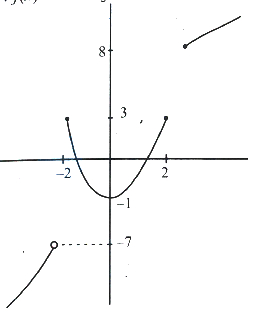
If the function $f: R \rightarrow R$ is defined by $f(x) = \begin{cases} 2x-3, & \text{if } x < -2 \\ x^2-1, & \text{if } -2 \leq x \leq 2 \\ 3x+2, & \text{if } x > 2 \end{cases}$ then $f$ is
A
an injection but not a surjection
B
a surjection but not an injection
C
a bijection
D
neither injection nor surjection
Solution
(D) The function is defined as $f(x) = \begin{cases} 2x-3, & x < -2 \\ x^2-1, & -2 \leq x \leq 2 \\ 3x+2, & x > 2 \end{cases}$.
$1$. Checking for Injectivity (One-to-One):
$A$ function is injective if $f(x_1) = f(x_2) \implies x_1 = x_2$.
Consider the interval $[-2, 2]$,where $f(x) = x^2 - 1$.
We observe that $f(-1) = (-1)^2 - 1 = 0$ and $f(1) = (1)^2 - 1 = 0$.
Since $f(-1) = f(1)$ but $-1 \neq 1$,the function is not injective.
$2$. Checking for Surjectivity (Onto):
$A$ function is surjective if its range equals its codomain $(R)$.
- For $x < -2$,$f(x) < 2(-2) - 3 = -7$. So,$f(x) \in (-\infty, -7)$.
- For $-2 \leq x \leq 2$,$f(x) = x^2 - 1$. The minimum value is $-1$ (at $x=0$) and the maximum is $f(-2) = f(2) = 3$. So,$f(x) \in [-1, 3]$.
- For $x > 2$,$f(x) > 3(2) + 2 = 8$. So,$f(x) \in (8, \infty)$.
The range of $f$ is $(-\infty, -7) \cup [-1, 3] \cup (8, \infty)$.
Since the range is not equal to the codomain $R$,the function is not surjective.
Conclusion: The function is neither injective nor surjective.
$1$. Checking for Injectivity (One-to-One):
$A$ function is injective if $f(x_1) = f(x_2) \implies x_1 = x_2$.
Consider the interval $[-2, 2]$,where $f(x) = x^2 - 1$.
We observe that $f(-1) = (-1)^2 - 1 = 0$ and $f(1) = (1)^2 - 1 = 0$.
Since $f(-1) = f(1)$ but $-1 \neq 1$,the function is not injective.
$2$. Checking for Surjectivity (Onto):
$A$ function is surjective if its range equals its codomain $(R)$.
- For $x < -2$,$f(x) < 2(-2) - 3 = -7$. So,$f(x) \in (-\infty, -7)$.
- For $-2 \leq x \leq 2$,$f(x) = x^2 - 1$. The minimum value is $-1$ (at $x=0$) and the maximum is $f(-2) = f(2) = 3$. So,$f(x) \in [-1, 3]$.
- For $x > 2$,$f(x) > 3(2) + 2 = 8$. So,$f(x) \in (8, \infty)$.
The range of $f$ is $(-\infty, -7) \cup [-1, 3] \cup (8, \infty)$.
Since the range is not equal to the codomain $R$,the function is not surjective.
Conclusion: The function is neither injective nor surjective.
0 likes
View Solution220
MediumMCQ
Let $R$ be the set of all real numbers. Statement $I$: The function $f: \left(-\frac{\pi}{2}, \frac{\pi}{2}\right) \rightarrow R$ defined by $f(x) = \sec x + \tan x$ is a one-one function. Statement $II$: The function $f: [0, \infty) \rightarrow R$ defined by $f(x) = x^2$ is a one-one function. Which of the above statements is(are) true?
A
Statement $I$ is true,but Statement $II$ is false
B
Statement $II$ is true,but Statement $I$ is false
C
Both Statement $I$ and Statement $II$ are true
D
Both Statement $I$ and Statement $II$ are false
Solution
(C) For Statement $I$: Given $f(x) = \sec x + \tan x$ on $\left(-\frac{\pi}{2}, \frac{\pi}{2}\right)$.
$f'(x) = \sec x \tan x + \sec^2 x = \sec x(\tan x + \sec x)$.
Since $\sec x + \tan x = \frac{1+\sin x}{\cos x} = \frac{(\cos(x/2) + \sin(x/2))^2}{\cos^2(x/2) - \sin^2(x/2)} = \frac{\cos(x/2) + \sin(x/2)}{\cos(x/2) - \sin(x/2)} = \tan(\frac{\pi}{4} + \frac{x}{2})$.
For $x \in \left(-\frac{\pi}{2}, \frac{\pi}{2}\right)$,$\frac{x}{2} \in \left(-\frac{\pi}{4}, \frac{\pi}{4}\right)$,so $\frac{\pi}{4} + \frac{x}{2} \in (0, \frac{\pi}{2})$.
In this interval,$\sec x > 0$ and $\tan(\frac{\pi}{4} + \frac{x}{2}) > 0$,so $f'(x) > 0$. Thus,$f(x)$ is strictly increasing and one-one.
For Statement $II$: Given $f(x) = x^2$ on $[0, \infty)$.
If $f(x_1) = f(x_2)$,then $x_1^2 = x_2^2$. Since $x_1, x_2 \geq 0$,this implies $x_1 = x_2$.
Thus,$f(x)$ is one-one.
Both statements are true.
$f'(x) = \sec x \tan x + \sec^2 x = \sec x(\tan x + \sec x)$.
Since $\sec x + \tan x = \frac{1+\sin x}{\cos x} = \frac{(\cos(x/2) + \sin(x/2))^2}{\cos^2(x/2) - \sin^2(x/2)} = \frac{\cos(x/2) + \sin(x/2)}{\cos(x/2) - \sin(x/2)} = \tan(\frac{\pi}{4} + \frac{x}{2})$.
For $x \in \left(-\frac{\pi}{2}, \frac{\pi}{2}\right)$,$\frac{x}{2} \in \left(-\frac{\pi}{4}, \frac{\pi}{4}\right)$,so $\frac{\pi}{4} + \frac{x}{2} \in (0, \frac{\pi}{2})$.
In this interval,$\sec x > 0$ and $\tan(\frac{\pi}{4} + \frac{x}{2}) > 0$,so $f'(x) > 0$. Thus,$f(x)$ is strictly increasing and one-one.
For Statement $II$: Given $f(x) = x^2$ on $[0, \infty)$.
If $f(x_1) = f(x_2)$,then $x_1^2 = x_2^2$. Since $x_1, x_2 \geq 0$,this implies $x_1 = x_2$.
Thus,$f(x)$ is one-one.
Both statements are true.
0 likes
View Solution221
MediumMCQ
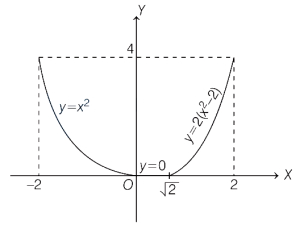
$f:[-2,2] \rightarrow[-2,2]$ and $g:[-2,2] \rightarrow[0,4]$ are two functions defined as $f(x)=\begin{cases} -2, & -2 \leq x \leq 0 \\ x^2-2, & 0 \leq x \leq 2 \end{cases}$ and $g(x)=|f(x)|+f(|x|)$,then
A
$f$ and $g$ are injective mappings
B
$f$ and $g$ are surjective mappings
C
$f$ is bijective mapping and $g$ is injective mapping
D
$f$ is not bijective mapping and $g$ is surjective mapping
Solution
(D) Given $f(x) = \begin{cases} -2, & -2 \leq x \leq 0 \\ x^2-2, & 0 \leq x \leq 2 \end{cases}$.
For $f(x)$,the range is $[-2, 2]$. Since $f(x) = -2$ for all $x \in [-2, 0]$,$f$ is not injective. Thus,$f$ is not bijective.
Now,$g(x) = |f(x)| + f(|x|)$.
If $-2 \leq x \leq 0$,then $|x| \in [0, 2]$,so $f(|x|) = |x|^2 - 2 = x^2 - 2$. Also $f(x) = -2$,so $|f(x)| = 2$. Thus $g(x) = 2 + x^2 - 2 = x^2$.
If $0 \leq x \leq 2$,then $|x| = x$,so $f(|x|) = f(x) = x^2 - 2$. Thus $g(x) = |x^2 - 2| + x^2 - 2$.
For $0 \leq x \leq \sqrt{2}$,$x^2 - 2 \leq 0$,so $g(x) = -(x^2 - 2) + x^2 - 2 = 0$.
For $\sqrt{2} < x \leq 2$,$x^2 - 2 > 0$,so $g(x) = (x^2 - 2) + x^2 - 2 = 2(x^2 - 2)$.
Thus,$g(x) = \begin{cases} x^2, & -2 \leq x \leq 0 \\ 0, & 0 \leq x \leq \sqrt{2} \\ 2(x^2-2), & \sqrt{2} < x \leq 2 \end{cases}$.
The range of $g(x)$ is $[0, 4]$,which is equal to the codomain,so $g$ is surjective. Since $g(x) = 0$ for $x \in [0, \sqrt{2}]$,$g$ is not injective.
For $f(x)$,the range is $[-2, 2]$. Since $f(x) = -2$ for all $x \in [-2, 0]$,$f$ is not injective. Thus,$f$ is not bijective.
Now,$g(x) = |f(x)| + f(|x|)$.
If $-2 \leq x \leq 0$,then $|x| \in [0, 2]$,so $f(|x|) = |x|^2 - 2 = x^2 - 2$. Also $f(x) = -2$,so $|f(x)| = 2$. Thus $g(x) = 2 + x^2 - 2 = x^2$.
If $0 \leq x \leq 2$,then $|x| = x$,so $f(|x|) = f(x) = x^2 - 2$. Thus $g(x) = |x^2 - 2| + x^2 - 2$.
For $0 \leq x \leq \sqrt{2}$,$x^2 - 2 \leq 0$,so $g(x) = -(x^2 - 2) + x^2 - 2 = 0$.
For $\sqrt{2} < x \leq 2$,$x^2 - 2 > 0$,so $g(x) = (x^2 - 2) + x^2 - 2 = 2(x^2 - 2)$.
Thus,$g(x) = \begin{cases} x^2, & -2 \leq x \leq 0 \\ 0, & 0 \leq x \leq \sqrt{2} \\ 2(x^2-2), & \sqrt{2} < x \leq 2 \end{cases}$.
The range of $g(x)$ is $[0, 4]$,which is equal to the codomain,so $g$ is surjective. Since $g(x) = 0$ for $x \in [0, \sqrt{2}]$,$g$ is not injective.
0 likes
View Solution222
EasyMCQ
The function $f: R \rightarrow R$ defined by $f(x)=\frac{x}{\sqrt{1+x^2}}$ is
A
surjective but not injective
B
bijective
C
injective but not surjective
D
neither injective nor surjective
Solution
(C) To check for injectivity,let $f(x_1) = f(x_2)$ for $x_1, x_2 \in R$.
$\frac{x_1}{\sqrt{1+x_1^2}} = \frac{x_2}{\sqrt{1+x_2^2}}$
Squaring both sides:
$\frac{x_1^2}{1+x_1^2} = \frac{x_2^2}{1+x_2^2}$
$x_1^2(1+x_2^2) = x_2^2(1+x_1^2)$
$x_1^2 + x_1^2x_2^2 = x_2^2 + x_1^2x_2^2$
$x_1^2 = x_2^2$
Since $f'(x) = \frac{1}{(1+x^2)^{3/2}} > 0$ for all $x \in R$,the function is strictly increasing.
Therefore,$f(x_1) = f(x_2) \implies x_1 = x_2$. Thus,$f$ is injective.
To check for surjectivity,let $y = \frac{x}{\sqrt{1+x^2}}$.
Since $x^2 < 1+x^2$,we have $\frac{|x|}{\sqrt{1+x^2}} < 1$.
Thus,the range of $f$ is $(-1, 1)$,which is not equal to the codomain $R$.
Therefore,$f$ is not surjective.
Hence,the function is injective but not surjective.
$\frac{x_1}{\sqrt{1+x_1^2}} = \frac{x_2}{\sqrt{1+x_2^2}}$
Squaring both sides:
$\frac{x_1^2}{1+x_1^2} = \frac{x_2^2}{1+x_2^2}$
$x_1^2(1+x_2^2) = x_2^2(1+x_1^2)$
$x_1^2 + x_1^2x_2^2 = x_2^2 + x_1^2x_2^2$
$x_1^2 = x_2^2$
Since $f'(x) = \frac{1}{(1+x^2)^{3/2}} > 0$ for all $x \in R$,the function is strictly increasing.
Therefore,$f(x_1) = f(x_2) \implies x_1 = x_2$. Thus,$f$ is injective.
To check for surjectivity,let $y = \frac{x}{\sqrt{1+x^2}}$.
Since $x^2 < 1+x^2$,we have $\frac{|x|}{\sqrt{1+x^2}} < 1$.
Thus,the range of $f$ is $(-1, 1)$,which is not equal to the codomain $R$.
Therefore,$f$ is not surjective.
Hence,the function is injective but not surjective.
0 likes
View Solution223
EasyMCQ
Let $f:[0,10] \rightarrow [1,20]$ be a function defined as $f(x) = \begin{cases} \frac{60-5x}{3}, & 0 \leq x \leq 6 \\ 10, & 6 \leq x \leq 7 \\ 31-3x, & 7 \leq x \leq 10 \end{cases}$. The function $f$ is:
A
bijective function
B
one-one but not onto function
C
onto but not one-one function
D
neither one-one nor onto function
Solution
(C) Given the function $f(x) = \begin{cases} \frac{60-5x}{3}, & 0 \leq x \leq 6 \\ 10, & 6 \leq x \leq 7 \\ 31-3x, & 7 \leq x \leq 10 \end{cases}$.
For $x \in [6, 7]$,$f(x) = 10$. Since the function takes the same value for all $x$ in the interval $[6, 7]$,it is not one-one.
Now,let us find the range of $f(x)$:
For $0 \leq x \leq 6$,$f(x) = \frac{60-5x}{3}$. As $x$ goes from $0$ to $6$,$f(x)$ goes from $\frac{60}{3} = 20$ to $\frac{60-30}{3} = 10$. So,the range is $[10, 20]$.
For $6 \leq x \leq 7$,$f(x) = 10$. So,the range is ${10}$.
For $7 \leq x \leq 10$,$f(x) = 31-3x$. As $x$ goes from $7$ to $10$,$f(x)$ goes from $31-21 = 10$ to $31-30 = 1$. So,the range is $[1, 10]$.
The union of these ranges is $[1, 10] \cup {10} \cup [10, 20] = [1, 20]$.
Since the range $[1, 20]$ is equal to the co-domain $[1, 20]$,the function is onto.
Thus,$f(x)$ is onto but not one-one.
For $x \in [6, 7]$,$f(x) = 10$. Since the function takes the same value for all $x$ in the interval $[6, 7]$,it is not one-one.
Now,let us find the range of $f(x)$:
For $0 \leq x \leq 6$,$f(x) = \frac{60-5x}{3}$. As $x$ goes from $0$ to $6$,$f(x)$ goes from $\frac{60}{3} = 20$ to $\frac{60-30}{3} = 10$. So,the range is $[10, 20]$.
For $6 \leq x \leq 7$,$f(x) = 10$. So,the range is ${10}$.
For $7 \leq x \leq 10$,$f(x) = 31-3x$. As $x$ goes from $7$ to $10$,$f(x)$ goes from $31-21 = 10$ to $31-30 = 1$. So,the range is $[1, 10]$.
The union of these ranges is $[1, 10] \cup {10} \cup [10, 20] = [1, 20]$.
Since the range $[1, 20]$ is equal to the co-domain $[1, 20]$,the function is onto.
Thus,$f(x)$ is onto but not one-one.
0 likes
View Solution224
MediumMCQ
For each $n \in N$,let $A_n = \{(n+1)k \mid k \in N\}$ and $X = \bigcup_{n \in N} A_n$. $A$ mapping $f: X \rightarrow N$ defined by $f(x) = x, \forall x \in X$,is
A
one-one and onto
B
one-one but not onto
C
onto but not one-one
D
neither one-one nor onto
Solution
(B) Given that $A_n = \{(n+1)k \mid k \in N\}$.
For $n=1$,$A_1 = \{2k \mid k \in N\} = \{2, 4, 6, 8, \dots\}$.
For $n=2$,$A_2 = \{3k \mid k \in N\} = \{3, 6, 9, 12, \dots\}$.
For $n=3$,$A_3 = \{4k \mid k \in N\} = \{4, 8, 12, 16, \dots\}$.
Now,$X = \bigcup_{n \in N} A_n = A_1 \cup A_2 \cup A_3 \cup \dots = \{2, 3, 4, 5, 6, \dots\}$.
Here,$f: X \rightarrow N$ is defined by $f(x) = x$ for all $x \in X$.
Since $f(x) = x$ is an identity function on the domain $X$,it is clearly one-one.
However,the codomain is $N = \{1, 2, 3, 4, \dots\}$.
For $f$ to be onto,the range must equal the codomain. Here,the range is $X = \{2, 3, 4, 5, \dots\}$.
Since $1 \in N$ but $1 \notin X$,there is no $x \in X$ such that $f(x) = 1$.
Therefore,$f$ is not onto.
For $n=1$,$A_1 = \{2k \mid k \in N\} = \{2, 4, 6, 8, \dots\}$.
For $n=2$,$A_2 = \{3k \mid k \in N\} = \{3, 6, 9, 12, \dots\}$.
For $n=3$,$A_3 = \{4k \mid k \in N\} = \{4, 8, 12, 16, \dots\}$.
Now,$X = \bigcup_{n \in N} A_n = A_1 \cup A_2 \cup A_3 \cup \dots = \{2, 3, 4, 5, 6, \dots\}$.
Here,$f: X \rightarrow N$ is defined by $f(x) = x$ for all $x \in X$.
Since $f(x) = x$ is an identity function on the domain $X$,it is clearly one-one.
However,the codomain is $N = \{1, 2, 3, 4, \dots\}$.
For $f$ to be onto,the range must equal the codomain. Here,the range is $X = \{2, 3, 4, 5, \dots\}$.
Since $1 \in N$ but $1 \notin X$,there is no $x \in X$ such that $f(x) = 1$.
Therefore,$f$ is not onto.
0 likes
View Solution225
MediumMCQ
The number of bijective functions $f: Z \rightarrow Z$ such that $f(x+y)=f(x)+f(y)$ for all $x, y \in Z$ is:
A
two
B
four
C
zero
D
infinitely many
Solution
(A) Given the functional equation $f(x+y) = f(x) + f(y)$ for all $x, y \in Z$.
Setting $x=0, y=0$,we get $f(0) = f(0) + f(0)$,which implies $f(0) = 0$.
For any $n \in Z^+$,by induction,$f(nx) = nf(x)$.
Let $f(1) = k$,where $k \in Z$. Then $f(n) = nk$ for all $n \in Z$.
Since $f(x+y) = f(x) + f(y)$,it follows that $f(x) = kx$ for all $x \in Z$.
For $f$ to be a bijection from $Z$ to $Z$,it must be both injective and surjective.
If $f(x) = kx$,then $f$ is injective if $k \neq 0$.
For $f$ to be surjective,the range of $f$ must be $Z$.
The range of $f(x) = kx$ is the set of all multiples of $k$,i.e.,$\{..., -2k, -k, 0, k, 2k, ...\}$.
For this set to be equal to $Z$,we must have $k = 1$ or $k = -1$.
If $k = 1$,$f(x) = x$,which is the identity function (bijective).
If $k = -1$,$f(x) = -x$,which is also bijective.
Thus,there are exactly two such functions.
Setting $x=0, y=0$,we get $f(0) = f(0) + f(0)$,which implies $f(0) = 0$.
For any $n \in Z^+$,by induction,$f(nx) = nf(x)$.
Let $f(1) = k$,where $k \in Z$. Then $f(n) = nk$ for all $n \in Z$.
Since $f(x+y) = f(x) + f(y)$,it follows that $f(x) = kx$ for all $x \in Z$.
For $f$ to be a bijection from $Z$ to $Z$,it must be both injective and surjective.
If $f(x) = kx$,then $f$ is injective if $k \neq 0$.
For $f$ to be surjective,the range of $f$ must be $Z$.
The range of $f(x) = kx$ is the set of all multiples of $k$,i.e.,$\{..., -2k, -k, 0, k, 2k, ...\}$.
For this set to be equal to $Z$,we must have $k = 1$ or $k = -1$.
If $k = 1$,$f(x) = x$,which is the identity function (bijective).
If $k = -1$,$f(x) = -x$,which is also bijective.
Thus,there are exactly two such functions.
0 likes
View Solution226
EasyMCQ
Given that for any $n \in N$,there exist an odd integer $q$ and a non-negative integer $r$ such that $n$ can be written uniquely as $n = q \times 2^r$. Let $f: N \rightarrow N \times N$ be a function defined by $f(n) = \left(r+1, \frac{q+1}{2}\right)$. Then,
A
$f$ is one-one but not onto
B
$f$ is onto but not one-one
C
$f$ is a bijection
D
only $f^{-1}(1,1)$ does not exist because $f$ is not a bijection
Solution
(C) We are given $f(n) = \left(r+1, \frac{q+1}{2}\right)$ where $n = q \times 2^r$,$q$ is an odd integer,and $r \geq 0$.
For one-one mapping:
Suppose $f(n_1) = f(n_2)$.
Then $\left(r_1+1, \frac{q_1+1}{2}\right) = \left(r_2+1, \frac{q_2+1}{2}\right)$.
This implies $r_1+1 = r_2+1 \Rightarrow r_1 = r_2$ and $\frac{q_1+1}{2} = \frac{q_2+1}{2} \Rightarrow q_1 = q_2$.
Since $n_1 = q_1 \times 2^{r_1}$ and $n_2 = q_2 \times 2^{r_2}$,it follows that $n_1 = n_2$. Thus,$f$ is one-one.
For onto mapping:
Let $(a, b) \in N \times N$. We need to find $n \in N$ such that $f(n) = (a, b)$.
$r+1 = a \Rightarrow r = a-1$. Since $a \in N$,$a \geq 1$,so $r \geq 0$.
$\frac{q+1}{2} = b \Rightarrow q = 2b-1$. Since $b \in N$,$b \geq 1$,so $q \geq 1$ and $q$ is odd.
Thus,for any $(a, b) \in N \times N$,there exists $n = (2b-1) \times 2^{a-1} \in N$ such that $f(n) = (a, b)$.
Therefore,$f$ is onto.
Since $f$ is both one-one and onto,$f$ is a bijection.
For one-one mapping:
Suppose $f(n_1) = f(n_2)$.
Then $\left(r_1+1, \frac{q_1+1}{2}\right) = \left(r_2+1, \frac{q_2+1}{2}\right)$.
This implies $r_1+1 = r_2+1 \Rightarrow r_1 = r_2$ and $\frac{q_1+1}{2} = \frac{q_2+1}{2} \Rightarrow q_1 = q_2$.
Since $n_1 = q_1 \times 2^{r_1}$ and $n_2 = q_2 \times 2^{r_2}$,it follows that $n_1 = n_2$. Thus,$f$ is one-one.
For onto mapping:
Let $(a, b) \in N \times N$. We need to find $n \in N$ such that $f(n) = (a, b)$.
$r+1 = a \Rightarrow r = a-1$. Since $a \in N$,$a \geq 1$,so $r \geq 0$.
$\frac{q+1}{2} = b \Rightarrow q = 2b-1$. Since $b \in N$,$b \geq 1$,so $q \geq 1$ and $q$ is odd.
Thus,for any $(a, b) \in N \times N$,there exists $n = (2b-1) \times 2^{a-1} \in N$ such that $f(n) = (a, b)$.
Therefore,$f$ is onto.
Since $f$ is both one-one and onto,$f$ is a bijection.
0 likes
View Solution227
MediumMCQ
If $f: Z \rightarrow N$ is defined by $f(n) = \begin{cases} 2n, & \text{if } n > 0 \\ 1, & \text{if } n = 0 \\ -2n-1, & \text{if } n < 0 \end{cases}$,then the function $f$ is:
A
one-one but not onto
B
onto but not one-one
C
both one-one and onto
D
neither one-one nor onto
Solution
(B) Given $f: Z \rightarrow N$ defined by $f(n) = \begin{cases} 2n, & \text{if } n > 0 \\ 1, & \text{if } n = 0 \\ -2n-1, & \text{if } n < 0 \end{cases}$.
For $n > 0$,$f(n) \in \{2, 4, 6, 8, \dots\}$.
For $n = 0$,$f(0) = 1$.
For $n < 0$,let $n = -k$ where $k > 0$. Then $f(n) = -2(-k) - 1 = 2k - 1$. As $k$ takes values $1, 2, 3, \dots$,$f(n)$ takes values $1, 3, 5, 7, \dots$.
Combining these,the range of $f$ is $\{1, 2, 3, 4, \dots\} = N$. Since Range = Codomain,$f$ is onto.
Now,check for one-one: $f(0) = 1$ and $f(-1) = -2(-1) - 1 = 2 - 1 = 1$.
Since $f(0) = f(-1)$ but $0 \neq -1$,the function is not one-one.
Therefore,$f$ is onto but not one-one.
For $n > 0$,$f(n) \in \{2, 4, 6, 8, \dots\}$.
For $n = 0$,$f(0) = 1$.
For $n < 0$,let $n = -k$ where $k > 0$. Then $f(n) = -2(-k) - 1 = 2k - 1$. As $k$ takes values $1, 2, 3, \dots$,$f(n)$ takes values $1, 3, 5, 7, \dots$.
Combining these,the range of $f$ is $\{1, 2, 3, 4, \dots\} = N$. Since Range = Codomain,$f$ is onto.
Now,check for one-one: $f(0) = 1$ and $f(-1) = -2(-1) - 1 = 2 - 1 = 1$.
Since $f(0) = f(-1)$ but $0 \neq -1$,the function is not one-one.
Therefore,$f$ is onto but not one-one.
0 likes
View Solution228
Easy
Match the functions of List-$I$ with their nature in List-$II$ and choose the correct option.
| $A$. $f: R \rightarrow R$ defined by $f(x) = \cos(112x - 37)$ | $I$. Injection but not surjection |
| $B$. $f: A \rightarrow B$ defined by $f(x) = x|x|$ when $A = [-2, 2]$ and $B = [-4, 4]$ | $II$. Surjection but not injection |
| $C$. $f: R \rightarrow R$ defined by $f(x) = (x-2)(x-3)(x-5)$ | $III$. Bijection |
| $D$. $f: N \rightarrow N$ defined by $f(n) = n+1$ | $IV$. Neither injection nor surjection |
| $V$. Composite function |
Solution
(A-IV, B-III, C-II, D-I) $f: R \rightarrow R$,$f(x) = \cos(112x - 37)$. Since $f(x)$ is a periodic function,it is many-one,hence not injective. The range is $[-1, 1]$,which is a proper subset of the codomain $R$,so it is not surjective. Thus,$A \rightarrow IV$.
$(B)$ $f: [-2, 2] \rightarrow [-4, 4]$,$f(x) = x|x|$. This can be written as $f(x) = \begin{cases} -x^2 & -2 \leq x < 0 \\ x^2 & 0 \leq x \leq 2 \end{cases}$. This function is strictly increasing on $[-2, 2]$,so it is injective. The range is $[-4, 4]$,which equals the codomain,so it is surjective. Thus,$B \rightarrow III$.
$(C)$ $f: R \rightarrow R$,$f(x) = (x-2)(x-3)(x-5)$. Since $f(2) = f(3) = f(5) = 0$,it is not injective. As it is a cubic polynomial,its range is $R$,so it is surjective. Thus,$C \rightarrow II$.
$(D)$ $f: N \rightarrow N$,$f(n) = n+1$. Since $f(n_1) = f(n_2) \implies n_1+1 = n_2+1 \implies n_1 = n_2$,it is injective. The range is ${2, 3, 4, \dots}$,which is not equal to the codomain $N$ (as $1$ is not in the range),so it is not surjective. Thus,$D \rightarrow I$.
$(B)$ $f: [-2, 2] \rightarrow [-4, 4]$,$f(x) = x|x|$. This can be written as $f(x) = \begin{cases} -x^2 & -2 \leq x < 0 \\ x^2 & 0 \leq x \leq 2 \end{cases}$. This function is strictly increasing on $[-2, 2]$,so it is injective. The range is $[-4, 4]$,which equals the codomain,so it is surjective. Thus,$B \rightarrow III$.
$(C)$ $f: R \rightarrow R$,$f(x) = (x-2)(x-3)(x-5)$. Since $f(2) = f(3) = f(5) = 0$,it is not injective. As it is a cubic polynomial,its range is $R$,so it is surjective. Thus,$C \rightarrow II$.
$(D)$ $f: N \rightarrow N$,$f(n) = n+1$. Since $f(n_1) = f(n_2) \implies n_1+1 = n_2+1 \implies n_1 = n_2$,it is injective. The range is ${2, 3, 4, \dots}$,which is not equal to the codomain $N$ (as $1$ is not in the range),so it is not surjective. Thus,$D \rightarrow I$.
0 likes
View Solution229
EasyMCQ
Let $f: R \rightarrow R$ and $g: R \rightarrow R$ be the functions defined by $f(x) = \frac{x}{1+x^2}$ and $g(x) = \frac{x^2}{1+x^2}$. Then,the correct statement$(s)$ among the following is/are:
A
Both $f$ and $g$ are one-one
B
Both $f$ and $g$ are onto
C
Both $f$ and $g$ are neither one-one nor onto
D
$f$ and $g$ are onto but not one-one
Solution
(C) Given $f(x) = \frac{x}{1+x^2}$ and $g(x) = \frac{x^2}{1+x^2}$ for $x \in R$.
For $f(x)$,$f'(x) = \frac{(1+x^2)(1) - x(2x)}{(1+x^2)^2} = \frac{1-x^2}{(1+x^2)^2}$.
Since $f'(x)$ changes sign at $x = \pm 1$,$f(x)$ is not monotonic,hence not one-one.
The range of $f(x)$ is $[-\frac{1}{2}, \frac{1}{2}]$,which is not equal to the codomain $R$,so $f(x)$ is not onto.
For $g(x)$,$g(-x) = \frac{(-x)^2}{1+(-x)^2} = \frac{x^2}{1+x^2} = g(x)$,so $g(x)$ is an even function,hence not one-one.
The range of $g(x)$ is $[0, 1)$,which is not equal to the codomain $R$,so $g(x)$ is not onto.
Therefore,both $f$ and $g$ are neither one-one nor onto.
For $f(x)$,$f'(x) = \frac{(1+x^2)(1) - x(2x)}{(1+x^2)^2} = \frac{1-x^2}{(1+x^2)^2}$.
Since $f'(x)$ changes sign at $x = \pm 1$,$f(x)$ is not monotonic,hence not one-one.
The range of $f(x)$ is $[-\frac{1}{2}, \frac{1}{2}]$,which is not equal to the codomain $R$,so $f(x)$ is not onto.
For $g(x)$,$g(-x) = \frac{(-x)^2}{1+(-x)^2} = \frac{x^2}{1+x^2} = g(x)$,so $g(x)$ is an even function,hence not one-one.
The range of $g(x)$ is $[0, 1)$,which is not equal to the codomain $R$,so $g(x)$ is not onto.
Therefore,both $f$ and $g$ are neither one-one nor onto.
0 likes
View Solution230
EasyMCQ
If $f:[0, \infty) \rightarrow[0, \infty)$ is defined by $f(x)=\frac{x}{1+x}$,then $f$ is
A
neither one-one nor onto
B
one-one but not onto
C
onto but not one-one
D
both one-one and onto
Solution
(B) We have $f(x) = \frac{x}{1+x}$ where $f: [0, \infty) \rightarrow [0, \infty)$.
For one-one:
Let $f(x_1) = f(x_2)$.
$\frac{x_1}{1+x_1} = \frac{x_2}{1+x_2}$
$x_1(1+x_2) = x_2(1+x_1)$
$x_1 + x_1x_2 = x_2 + x_1x_2$
$x_1 = x_2$.
Since $f(x_1) = f(x_2) \implies x_1 = x_2$,the function is one-one.
For onto:
Let $y = f(x) = \frac{x}{1+x}$.
$y(1+x) = x \implies y + xy = x \implies y = x(1-y) \implies x = \frac{y}{1-y}$.
Since $x \in [0, \infty)$,we must have $\frac{y}{1-y} \geq 0$.
This implies $y \in [0, 1)$.
The codomain is $[0, \infty)$,but the range is $[0, 1)$.
Since Range $\neq$ Codomain,the function is not onto.
Thus,$f$ is one-one but not onto.
For one-one:
Let $f(x_1) = f(x_2)$.
$\frac{x_1}{1+x_1} = \frac{x_2}{1+x_2}$
$x_1(1+x_2) = x_2(1+x_1)$
$x_1 + x_1x_2 = x_2 + x_1x_2$
$x_1 = x_2$.
Since $f(x_1) = f(x_2) \implies x_1 = x_2$,the function is one-one.
For onto:
Let $y = f(x) = \frac{x}{1+x}$.
$y(1+x) = x \implies y + xy = x \implies y = x(1-y) \implies x = \frac{y}{1-y}$.
Since $x \in [0, \infty)$,we must have $\frac{y}{1-y} \geq 0$.
This implies $y \in [0, 1)$.
The codomain is $[0, \infty)$,but the range is $[0, 1)$.
Since Range $\neq$ Codomain,the function is not onto.
Thus,$f$ is one-one but not onto.
0 likes
View Solution231
EasyMCQ
If $f: N \rightarrow R$ is defined by $f(1)=-1$ and $f(n+1)=3f(n)+2$ for $n \geq 1$,then $f$ is
A
one-one
B
onto
C
a constant function
D
$f(n)>0$ for $n>1$
Solution
(C) Given,$f: N \rightarrow R$ with $f(1)=-1$ and the recurrence relation $f(n+1)=3f(n)+2$ for $n \geq 1$.
For $n=1$,$f(2) = 3f(1)+2 = 3(-1)+2 = -3+2 = -1$.
For $n=2$,$f(3) = 3f(2)+2 = 3(-1)+2 = -3+2 = -1$.
By mathematical induction,if $f(k)=-1$,then $f(k+1) = 3f(k)+2 = 3(-1)+2 = -1$.
Since $f(n)=-1$ for all $n \in N$,the function $f$ maps every input to the same output $-1$.
Therefore,$f$ is a constant function.
For $n=1$,$f(2) = 3f(1)+2 = 3(-1)+2 = -3+2 = -1$.
For $n=2$,$f(3) = 3f(2)+2 = 3(-1)+2 = -3+2 = -1$.
By mathematical induction,if $f(k)=-1$,then $f(k+1) = 3f(k)+2 = 3(-1)+2 = -1$.
Since $f(n)=-1$ for all $n \in N$,the function $f$ maps every input to the same output $-1$.
Therefore,$f$ is a constant function.
0 likes
View Solution232
MediumMCQ
If $f: Z \rightarrow Z$,$f(x) = \begin{cases} \frac{x}{2}, & \text{if } x \text{ is even} \\ 0, & \text{if } x \text{ is odd} \end{cases}$,then $f$ is
A
onto but not one-to-one
B
one-to-one but not onto
C
one-to-one and onto
D
neither one-to-one nor onto
Solution
(A) Given,$f: Z \rightarrow Z$,$f(x) = \begin{cases} \frac{x}{2}, & \text{if } x \text{ is even} \\ 0, & \text{if } x \text{ is odd} \end{cases}$.
For $f$ to be one-to-one,$f(x_1) = f(x_2)$ must imply $x_1 = x_2$.
Consider $x_1 = 1$ and $x_2 = 3$. Both are odd,so $f(1) = 0$ and $f(3) = 0$.
Since $f(1) = f(3)$ but $1 \neq 3$,$f$ is not one-to-one.
For $f$ to be onto,the range must equal the codomain $Z$.
If $x$ is even,let $x = 2k$ for some $k \in Z$. Then $f(2k) = \frac{2k}{2} = k$.
Since $k$ can be any integer in $Z$,the range of $f$ is $Z$.
Thus,$f$ is onto.
Therefore,$f$ is onto but not one-to-one.
For $f$ to be one-to-one,$f(x_1) = f(x_2)$ must imply $x_1 = x_2$.
Consider $x_1 = 1$ and $x_2 = 3$. Both are odd,so $f(1) = 0$ and $f(3) = 0$.
Since $f(1) = f(3)$ but $1 \neq 3$,$f$ is not one-to-one.
For $f$ to be onto,the range must equal the codomain $Z$.
If $x$ is even,let $x = 2k$ for some $k \in Z$. Then $f(2k) = \frac{2k}{2} = k$.
Since $k$ can be any integer in $Z$,the range of $f$ is $Z$.
Thus,$f$ is onto.
Therefore,$f$ is onto but not one-to-one.
0 likes
View Solution233
MediumMCQ
The function $f: R \rightarrow R$ is defined by $f(x)=3^{-x}$. Observe the following statements about it:
$I$. $f$ is one-one
$II$. $f$ is onto
$III$. $f$ is a decreasing function
Out of these,the true statements are:
$I$. $f$ is one-one
$II$. $f$ is onto
$III$. $f$ is a decreasing function
Out of these,the true statements are:
A
Only $I, II$
B
Only $II, III$
C
Only $I, III$
D
$I, II, III$
Solution
(C) Given the function $f: R \rightarrow R$ defined by $f(x)=3^{-x}$.
$I$. For one-one check: Let $f(x_1) = f(x_2)$.
$3^{-x_1} = 3^{-x_2} \Rightarrow -x_1 = -x_2 \Rightarrow x_1 = x_2$.
Since $f(x_1) = f(x_2) \Rightarrow x_1 = x_2$,the function is one-one.
$II$. For onto check: The range of $f(x) = 3^{-x}$ is $(0, \infty)$,which is a subset of the codomain $R$. Since the range $\neq$ codomain,the function is not onto.
$III$. For decreasing check: Differentiating $f(x)$ with respect to $x$,we get $f'(x) = -3^{-x} \ln 3$. Since $3^{-x} > 0$ and $\ln 3 > 0$,$f'(x) < 0$ for all $x \in R$. Thus,the function is strictly decreasing.
Therefore,statements $I$ and $III$ are true.
$I$. For one-one check: Let $f(x_1) = f(x_2)$.
$3^{-x_1} = 3^{-x_2} \Rightarrow -x_1 = -x_2 \Rightarrow x_1 = x_2$.
Since $f(x_1) = f(x_2) \Rightarrow x_1 = x_2$,the function is one-one.
$II$. For onto check: The range of $f(x) = 3^{-x}$ is $(0, \infty)$,which is a subset of the codomain $R$. Since the range $\neq$ codomain,the function is not onto.
$III$. For decreasing check: Differentiating $f(x)$ with respect to $x$,we get $f'(x) = -3^{-x} \ln 3$. Since $3^{-x} > 0$ and $\ln 3 > 0$,$f'(x) < 0$ for all $x \in R$. Thus,the function is strictly decreasing.
Therefore,statements $I$ and $III$ are true.
0 likes
View Solution234
EasyMCQ
The function $f: C \rightarrow C$ defined by $f(x) = \frac{ax + b}{cx + d}$ for $x \in C$,where $bd \neq 0$,reduces to a constant function if:
A
$a = c$
B
$b = d$
C
$ad = bc$
D
$ab = cd$
Solution
(C) Given the function $f(x) = \frac{ax + b}{cx + d} \quad \dots(i)$
For the function to be a constant function,the derivative $f'(x)$ must be zero for all $x$ in its domain.
Using the quotient rule,$f'(x) = \frac{a(cx + d) - c(ax + b)}{(cx + d)^2} = \frac{acx + ad - acx - bc}{(cx + d)^2} = \frac{ad - bc}{(cx + d)^2}$.
For $f(x)$ to be constant,$f'(x) = 0$,which implies $ad - bc = 0$,or $ad = bc$.
Alternatively,if $ad = bc$,let $\frac{a}{c} = \frac{b}{d} = k$. Then $a = ck$ and $b = dk$.
Substituting these into the function: $f(x) = \frac{ckx + dk}{cx + d} = \frac{k(cx + d)}{cx + d} = k$,which is a constant.
For the function to be a constant function,the derivative $f'(x)$ must be zero for all $x$ in its domain.
Using the quotient rule,$f'(x) = \frac{a(cx + d) - c(ax + b)}{(cx + d)^2} = \frac{acx + ad - acx - bc}{(cx + d)^2} = \frac{ad - bc}{(cx + d)^2}$.
For $f(x)$ to be constant,$f'(x) = 0$,which implies $ad - bc = 0$,or $ad = bc$.
Alternatively,if $ad = bc$,let $\frac{a}{c} = \frac{b}{d} = k$. Then $a = ck$ and $b = dk$.
Substituting these into the function: $f(x) = \frac{ckx + dk}{cx + d} = \frac{k(cx + d)}{cx + d} = k$,which is a constant.
0 likes
View Solution235
EasyMCQ
Let $R$ be the set of all real numbers. Let $f: R \rightarrow R$ be a function defined by $f(x) = \begin{cases} 2x-5 & x < -3 \\ x+2 & -3 \leq x < 5 \\ 3x+1 & x \geq 5 \end{cases}$
Match the following:
The correct match is:
Match the following:
| List-$I$ | List-$II$ |
| $(A) f(-5)+f(0)+f(-1)$ | $(I) 16$ |
| $(B) f(f(5)+10f(-3))$ | $(II) 40$ |
| $(C) f(f(-4))$ | $(III) -31$ |
| $(D) f(f(f(1)))$ | $(IV) -12$ |
| $(V) 19$ |
The correct match is:
A
$A-IV, B-V, C-III, D-I$
B
$A-V, B-IV, C-I, D-III$
C
$A-IV, B-V, C-II, D-I$
D
$A-IV, B-V, C-III, D-I$
Solution
(A) Given $f(x) = \begin{cases} 2x-5 & x < -3 \\ x+2 & -3 \leq x < 5 \\ 3x+1 & x \geq 5 \end{cases}$
$(A) f(-5)+f(0)+f(-1) = (2(-5)-5) + (0+2) + (-1+2) = -15 + 2 + 1 = -12$. Thus $(A) \rightarrow (IV)$.
$(B) f(f(5)+10f(-3)) = f((3(5)+1) + 10(-3+2)) = f(16 - 10) = f(6) = 3(6)+1 = 19$. Thus $(B) \rightarrow (V)$.
$(C) f(f(-4)) = f(2(-4)-5) = f(-13) = 2(-13)-5 = -31$. Thus $(C) \rightarrow (III)$.
$(D) f(f(f(1))) = f(f(1+2)) = f(f(3)) = f(3+2) = f(5) = 3(5)+1 = 16$. Thus $(D) \rightarrow (I)$.
Therefore,the correct match is $A-IV, B-V, C-III, D-I$.
$(A) f(-5)+f(0)+f(-1) = (2(-5)-5) + (0+2) + (-1+2) = -15 + 2 + 1 = -12$. Thus $(A) \rightarrow (IV)$.
$(B) f(f(5)+10f(-3)) = f((3(5)+1) + 10(-3+2)) = f(16 - 10) = f(6) = 3(6)+1 = 19$. Thus $(B) \rightarrow (V)$.
$(C) f(f(-4)) = f(2(-4)-5) = f(-13) = 2(-13)-5 = -31$. Thus $(C) \rightarrow (III)$.
$(D) f(f(f(1))) = f(f(1+2)) = f(f(3)) = f(3+2) = f(5) = 3(5)+1 = 16$. Thus $(D) \rightarrow (I)$.
Therefore,the correct match is $A-IV, B-V, C-III, D-I$.
0 likes
View Solution236
EasyMCQ
Given that $f: S \rightarrow R$ is said to have a fixed point at $c \in S$ if $f(c)=c$. Let $f:[1, \infty) \rightarrow R$ be defined by $f(x)=1+\sqrt{x}$. Then:
A
$f$ has no fixed point in $[1, \infty)$
B
$f$ has a unique fixed point in $[1, \infty)$
C
$f$ has two fixed points in $[1, \infty)$
D
$f$ has infinitely many fixed points in $[1, \infty)$
Solution
(B) To find the fixed point,we set $f(c) = c$.
$1 + \sqrt{c} = c$
$\sqrt{c} = c - 1$
Squaring both sides (where $c \geq 1$):
$c = (c - 1)^2$
$c = c^2 - 2c + 1$
$c^2 - 3c + 1 = 0$
Using the quadratic formula $c = \frac{-b \pm \sqrt{b^2 - 4ac}}{2a}$:
$c = \frac{3 \pm \sqrt{9 - 4}}{2} = \frac{3 \pm \sqrt{5}}{2}$
Since $c \geq 1$,we check the values:
$\frac{3 + \sqrt{5}}{2} \approx \frac{3 + 2.236}{2} = 2.618 \geq 1$ (Valid)
$\frac{3 - \sqrt{5}}{2} \approx \frac{3 - 2.236}{2} = 0.382 < 1$ (Invalid)
Thus,there is only one fixed point in the domain $[1, \infty)$.
$1 + \sqrt{c} = c$
$\sqrt{c} = c - 1$
Squaring both sides (where $c \geq 1$):
$c = (c - 1)^2$
$c = c^2 - 2c + 1$
$c^2 - 3c + 1 = 0$
Using the quadratic formula $c = \frac{-b \pm \sqrt{b^2 - 4ac}}{2a}$:
$c = \frac{3 \pm \sqrt{9 - 4}}{2} = \frac{3 \pm \sqrt{5}}{2}$
Since $c \geq 1$,we check the values:
$\frac{3 + \sqrt{5}}{2} \approx \frac{3 + 2.236}{2} = 2.618 \geq 1$ (Valid)
$\frac{3 - \sqrt{5}}{2} \approx \frac{3 - 2.236}{2} = 0.382 < 1$ (Invalid)
Thus,there is only one fixed point in the domain $[1, \infty)$.
0 likes
View Solution237
EasyMCQ
Let $f: R \rightarrow R$ be defined by $f(x) = x^{2} - \frac{x^{2}}{1+x^{2}}$ for all $x \in R$. Then,
A
$f$ is one-one but not onto mapping
B
$f$ is onto but not one-one mapping
C
$f$ is both one-one and onto
D
$f$ is neither one-one nor onto
Solution
(D) We have,$f(x) = x^{2} - \frac{x^{2}}{1+x^{2}}$.
First,check for one-one property:
$f(-x) = (-x)^{2} - \frac{(-x)^{2}}{1+(-x)^{2}} = x^{2} - \frac{x^{2}}{1+x^{2}} = f(x)$.
Since $f(-x) = f(x)$ for all $x \in R$,the function is not one-one (it is many-one).
Next,simplify the expression for range:
$f(x) = \frac{x^{2}(1+x^{2}) - x^{2}}{1+x^{2}} = \frac{x^{2} + x^{4} - x^{2}}{1+x^{2}} = \frac{x^{4}}{1+x^{2}}$.
Since $x^{4} \ge 0$ and $1+x^{2} > 0$ for all $x \in R$,$f(x) \ge 0$.
The range of $f(x)$ is $[0, \infty)$.
Since the co-domain is $R$ and the range $[0, \infty) \neq R$,the function is not onto.
Therefore,$f$ is neither one-one nor onto.
First,check for one-one property:
$f(-x) = (-x)^{2} - \frac{(-x)^{2}}{1+(-x)^{2}} = x^{2} - \frac{x^{2}}{1+x^{2}} = f(x)$.
Since $f(-x) = f(x)$ for all $x \in R$,the function is not one-one (it is many-one).
Next,simplify the expression for range:
$f(x) = \frac{x^{2}(1+x^{2}) - x^{2}}{1+x^{2}} = \frac{x^{2} + x^{4} - x^{2}}{1+x^{2}} = \frac{x^{4}}{1+x^{2}}$.
Since $x^{4} \ge 0$ and $1+x^{2} > 0$ for all $x \in R$,$f(x) \ge 0$.
The range of $f(x)$ is $[0, \infty)$.
Since the co-domain is $R$ and the range $[0, \infty) \neq R$,the function is not onto.
Therefore,$f$ is neither one-one nor onto.
0 likes
View Solution238
MediumMCQ
The function $f(x) = \sec \left[ \log \left( x + \sqrt{1 + x^2} \right) \right]$ is
A
odd
B
even
C
neither odd nor even
D
constant
Solution
(B) To determine if the function $f(x)$ is even or odd,we check $f(-x)$.
Let $g(x) = \log \left( x + \sqrt{1 + x^2} \right)$.
Then $g(-x) = \log \left( -x + \sqrt{1 + (-x)^2} \right) = \log \left( \sqrt{1 + x^2} - x \right)$.
Multiplying and dividing by $\sqrt{1 + x^2} + x$,we get $g(-x) = \log \left( \frac{(\sqrt{1 + x^2} - x)(\sqrt{1 + x^2} + x)}{\sqrt{1 + x^2} + x} \right) = \log \left( \frac{1 + x^2 - x^2}{\sqrt{1 + x^2} + x} \right) = \log \left( \frac{1}{\sqrt{1 + x^2} + x} \right) = -\log \left( x + \sqrt{1 + x^2} \right) = -g(x)$.
Thus,$g(x)$ is an odd function.
Now,$f(x) = \sec(g(x))$.
Since $\sec(- \theta) = \sec(\theta)$,we have $f(-x) = \sec(g(-x)) = \sec(-g(x)) = \sec(g(x)) = f(x)$.
Therefore,$f(x)$ is an even function.
Let $g(x) = \log \left( x + \sqrt{1 + x^2} \right)$.
Then $g(-x) = \log \left( -x + \sqrt{1 + (-x)^2} \right) = \log \left( \sqrt{1 + x^2} - x \right)$.
Multiplying and dividing by $\sqrt{1 + x^2} + x$,we get $g(-x) = \log \left( \frac{(\sqrt{1 + x^2} - x)(\sqrt{1 + x^2} + x)}{\sqrt{1 + x^2} + x} \right) = \log \left( \frac{1 + x^2 - x^2}{\sqrt{1 + x^2} + x} \right) = \log \left( \frac{1}{\sqrt{1 + x^2} + x} \right) = -\log \left( x + \sqrt{1 + x^2} \right) = -g(x)$.
Thus,$g(x)$ is an odd function.
Now,$f(x) = \sec(g(x))$.
Since $\sec(- \theta) = \sec(\theta)$,we have $f(-x) = \sec(g(-x)) = \sec(-g(x)) = \sec(g(x)) = f(x)$.
Therefore,$f(x)$ is an even function.
0 likes
View Solution239
EasyMCQ
Let $f: R \rightarrow R$ be a function defined by $f(x) = \frac{e^{|x|} - e^{-x}}{e^x + e^{-x}}$,then
A
$f$ is both one-one and onto
B
$f$ is one-one but not onto
C
$f$ is onto but not one-one
D
$f$ is neither one-one nor onto
Solution
(D) Given the function $f(x) = \frac{e^{|x|} - e^{-x}}{e^x + e^{-x}}$.
Case $I$: If $x \geq 0$,then $|x| = x$. Thus,$f(x) = \frac{e^x - e^{-x}}{e^x + e^{-x}} = \tanh(x)$. As $x$ increases from $0$ to $\infty$,$f(x)$ increases from $0$ to $1$.
Case $II$: If $x < 0$,then $|x| = -x$. Thus,$f(x) = \frac{e^{-x} - e^{-x}}{e^x + e^{-x}} = \frac{0}{e^x + e^{-x}} = 0$.
Since $f(x) = 0$ for all $x < 0$ and $f(0) = 0$,the function is not one-one because $f(-1) = f(0) = 0$.
Since the range of $f$ is $[0, 1)$,which is a proper subset of the codomain $R$,the function is not onto.
Therefore,$f$ is neither one-one nor onto.
Case $I$: If $x \geq 0$,then $|x| = x$. Thus,$f(x) = \frac{e^x - e^{-x}}{e^x + e^{-x}} = \tanh(x)$. As $x$ increases from $0$ to $\infty$,$f(x)$ increases from $0$ to $1$.
Case $II$: If $x < 0$,then $|x| = -x$. Thus,$f(x) = \frac{e^{-x} - e^{-x}}{e^x + e^{-x}} = \frac{0}{e^x + e^{-x}} = 0$.
Since $f(x) = 0$ for all $x < 0$ and $f(0) = 0$,the function is not one-one because $f(-1) = f(0) = 0$.
Since the range of $f$ is $[0, 1)$,which is a proper subset of the codomain $R$,the function is not onto.
Therefore,$f$ is neither one-one nor onto.
0 likes
View Solution240
EasyMCQ
The function $f: R \rightarrow R$ defined by $f(x) = e^x + e^{-x}$ is
A
one-one
B
onto
C
bijective
D
not bijective
Solution
(D) Step $1$: Check for one-one property.
$f(x) = e^x + e^{-x}$.
Since $f(-x) = e^{-x} + e^{-(-x)} = e^{-x} + e^x = f(x)$, the function is an even function.
For an even function, $f(x_1) = f(x_2)$ does not imply $x_1 = x_2$ (e.g., $f(1) = f(-1)$).
Therefore, the function is not one-one.
Step $2$: Check for onto property.
We know that $e^x > 0$ for all $x \in R$.
By the Arithmetic Mean-Geometric Mean inequality, $\frac{e^x + e^{-x}}{2} \geq \sqrt{e^x \cdot e^{-x}} = 1$, which implies $e^x + e^{-x} \geq 2$.
Thus, the range of $f(x)$ is $[2, \infty)$.
Since the codomain is $R$ and the range is $[2, \infty)$, the range $\neq$ codomain.
Therefore, the function is not onto.
Conclusion: Since the function is neither one-one nor onto, it is not bijective.
$f(x) = e^x + e^{-x}$.
Since $f(-x) = e^{-x} + e^{-(-x)} = e^{-x} + e^x = f(x)$, the function is an even function.
For an even function, $f(x_1) = f(x_2)$ does not imply $x_1 = x_2$ (e.g., $f(1) = f(-1)$).
Therefore, the function is not one-one.
Step $2$: Check for onto property.
We know that $e^x > 0$ for all $x \in R$.
By the Arithmetic Mean-Geometric Mean inequality, $\frac{e^x + e^{-x}}{2} \geq \sqrt{e^x \cdot e^{-x}} = 1$, which implies $e^x + e^{-x} \geq 2$.
Thus, the range of $f(x)$ is $[2, \infty)$.
Since the codomain is $R$ and the range is $[2, \infty)$, the range $\neq$ codomain.
Therefore, the function is not onto.
Conclusion: Since the function is neither one-one nor onto, it is not bijective.
0 likes
View Solution241
MediumMCQ
For the mapping $f: R-\{1\} \rightarrow R-\{2\}$,given by $f(x)=\frac{2x}{x-1}$,which of the following is correct?
A
$f$ is one-one but not onto
B
$f$ is onto but not one-one
C
$f$ is neither one-one nor onto
D
$f$ is both one-one and onto
Solution
(D) To check for one-one: Let $f(x_1) = f(x_2)$.
$\frac{2x_1}{x_1-1} = \frac{2x_2}{x_2-1}$
$x_1(x_2-1) = x_2(x_1-1)$
$x_1x_2 - x_1 = x_1x_2 - x_2$
$-x_1 = -x_2 \Rightarrow x_1 = x_2$.
Thus,$f$ is one-one.
To check for onto: Let $y = \frac{2x}{x-1}$.
$y(x-1) = 2x \Rightarrow yx - y = 2x \Rightarrow x(y-2) = y \Rightarrow x = \frac{y}{y-2}$.
Since $y \in R-\{2\}$,$x$ is always defined and $x \neq 1$. Thus,for every $y$ in the codomain,there exists an $x$ in the domain.
Therefore,$f$ is onto.
Hence,$f$ is both one-one and onto.
$\frac{2x_1}{x_1-1} = \frac{2x_2}{x_2-1}$
$x_1(x_2-1) = x_2(x_1-1)$
$x_1x_2 - x_1 = x_1x_2 - x_2$
$-x_1 = -x_2 \Rightarrow x_1 = x_2$.
Thus,$f$ is one-one.
To check for onto: Let $y = \frac{2x}{x-1}$.
$y(x-1) = 2x \Rightarrow yx - y = 2x \Rightarrow x(y-2) = y \Rightarrow x = \frac{y}{y-2}$.
Since $y \in R-\{2\}$,$x$ is always defined and $x \neq 1$. Thus,for every $y$ in the codomain,there exists an $x$ in the domain.
Therefore,$f$ is onto.
Hence,$f$ is both one-one and onto.
0 likes
View Solution242
MediumMCQ
$f: X \rightarrow R$,where $X = \{x \mid 0 < x < 1\}$,is defined as $f(x) = \frac{2x-1}{1-|2x-1|}$. Then:
A
$f$ is only injective
B
$f$ is only surjective
C
$f$ is bijective
D
$f$ is neither injective nor surjective
Solution
(C) Let $t = 2x-1$. Since $0 < x < 1$,we have $-1 < 2x-1 < 1$,so $-1 < t < 1$.
The function becomes $f(t) = \frac{t}{1-|t|}$ for $t \in (-1, 1)$.
We can write this as:
$f(t) = \begin{cases} \frac{t}{1+t}, & -1 < t \leq 0 \\ \frac{t}{1-t}, & 0 < t < 1 \end{cases}$
Since $f$ is continuous and $\lim_{t \to -1^+} f(t) = -\infty$ and $\lim_{t \to 1^-} f(t) = +\infty$,the range of $f$ is $(-\infty, \infty) = R$. Thus,$f$ is surjective.
Now,check for injectivity by finding the derivative:
$f'(t) = \begin{cases} \frac{1}{(1+t)^2}, & -1 < t < 0 \\ \frac{1}{(1-t)^2}, & 0 < t < 1 \end{cases}$
Since $f'(t) > 0$ for all $t \in (-1, 1)$,the function is strictly increasing.
Therefore,$f$ is injective.
Since $f$ is both injective and surjective,it is bijective.
The function becomes $f(t) = \frac{t}{1-|t|}$ for $t \in (-1, 1)$.
We can write this as:
$f(t) = \begin{cases} \frac{t}{1+t}, & -1 < t \leq 0 \\ \frac{t}{1-t}, & 0 < t < 1 \end{cases}$
Since $f$ is continuous and $\lim_{t \to -1^+} f(t) = -\infty$ and $\lim_{t \to 1^-} f(t) = +\infty$,the range of $f$ is $(-\infty, \infty) = R$. Thus,$f$ is surjective.
Now,check for injectivity by finding the derivative:
$f'(t) = \begin{cases} \frac{1}{(1+t)^2}, & -1 < t < 0 \\ \frac{1}{(1-t)^2}, & 0 < t < 1 \end{cases}$
Since $f'(t) > 0$ for all $t \in (-1, 1)$,the function is strictly increasing.
Therefore,$f$ is injective.
Since $f$ is both injective and surjective,it is bijective.
0 likes
View Solution243
EasyMCQ
If $f: S \rightarrow R$ where $S$ is the set of all non-singular matrices of order $2$ over $R$ and $f\left(\begin{bmatrix} a & b \\ c & d \end{bmatrix}\right) = ad - bc$,then:
A
$f$ is a bijective mapping
B
$f$ is one-one but not onto
C
$f$ is onto but not one-one
D
$f$ is neither one-one nor onto
Solution
(D) The function $f: S \rightarrow R$ is defined by $f(A) = \det(A)$,where $A \in S$ and $S$ is the set of all non-singular matrices of order $2 \times 2$. $A$ matrix is non-singular if its determinant is non-zero. Thus,the range of $f$ is $R \setminus \{0\}$.
$1$. Check for one-one: Consider two matrices $A_1 = \begin{bmatrix} 2 & 0 \\ 0 & 2 \end{bmatrix}$ and $A_2 = \begin{bmatrix} 4 & 0 \\ 0 & 1 \end{bmatrix}$. Both $A_1, A_2 \in S$ because $\det(A_1) = 4 \neq 0$ and $\det(A_2) = 4 \neq 0$. Here,$f(A_1) = 2(2) - 0(0) = 4$ and $f(A_2) = 4(1) - 0(0) = 4$. Since $f(A_1) = f(A_2)$ but $A_1 \neq A_2$,the function $f$ is not one-one.
$2$. Check for onto: The codomain is $R$. For any $y = 0 \in R$,there exists no matrix $A \in S$ such that $f(A) = 0$,because $S$ only contains non-singular matrices (where $\det(A) \neq 0$). Thus,$f$ is not onto.
Therefore,$f$ is neither one-one nor onto.
$1$. Check for one-one: Consider two matrices $A_1 = \begin{bmatrix} 2 & 0 \\ 0 & 2 \end{bmatrix}$ and $A_2 = \begin{bmatrix} 4 & 0 \\ 0 & 1 \end{bmatrix}$. Both $A_1, A_2 \in S$ because $\det(A_1) = 4 \neq 0$ and $\det(A_2) = 4 \neq 0$. Here,$f(A_1) = 2(2) - 0(0) = 4$ and $f(A_2) = 4(1) - 0(0) = 4$. Since $f(A_1) = f(A_2)$ but $A_1 \neq A_2$,the function $f$ is not one-one.
$2$. Check for onto: The codomain is $R$. For any $y = 0 \in R$,there exists no matrix $A \in S$ such that $f(A) = 0$,because $S$ only contains non-singular matrices (where $\det(A) \neq 0$). Thus,$f$ is not onto.
Therefore,$f$ is neither one-one nor onto.
0 likes
View SolutionRelation and Function — Type of Functions based on Mapping · Frequently Asked Questions
1Are these Relation and Function questions useful for JEE and NEET?
Yes. All questions in this section are mapped to JEE Main and NEET exam patterns. Previous year questions from JEE Main, NEET, GUJCET and state-level exams are included with full solutions.
2Can I switch to Hindi or Gujarati for these questions?
Yes. Use the language tabs in the hero section or the sidebar to view the same questions and solutions in English, Hindi or Gujarati.
3How do I generate a question paper from this subtopic?
Use the Vedclass Exam Paper Generator — select the chapter and subtopic, set difficulty, and generate Sets A, B, C, D automatically. First 3 chapters of every subject are free.
Vedclass Products
For Students
Vedclass Test Series
Mock tests in real JEE/NEET style with performance analysis. 5-day free trial.
Start Free TrialFor Teachers
Exam Paper Generator
Generate Set A/B/C/D papers from this chapter in 2 minutes. 3 chapters free.
Try FreeFor Institutes
Online Exam Module
Live online exams with unlimited students, 360° analytics & white-label branding.
See DemoFor Teachers & Institutes
Generate a Relation and Function Exam Paper in 2 Minutes
Select subtopic & difficulty — Sets A, B, C, D auto-generated with No Repeat logic.
First 3 chapters of every subject are free — no payment required.