
A English
Mix Examples of Relation and Function Questions in English
Class 12 Mathematics · Relation and Function · Mix Examples of Relation and Function
168+
Questions
English
Language
100%
With Solutions
Showing 50 of 168 questions in English
101
MediumMCQ
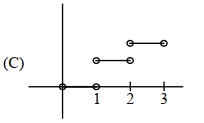
Let $S=(0,1) \cup(1,2) \cup(3,4)$ and $T=\{0,1,2,3\}$. Then which of the following statements is(are) true?
$(A)$ There are infinitely many functions from $S$ to $T$.
$(B)$ There are infinitely many strictly increasing functions from $S$ to $T$.
$(C)$ The number of continuous functions from $S$ to $T$ is at most $120$.
$(D)$ Every continuous function from $S$ to $T$ is differentiable.
$(A)$ There are infinitely many functions from $S$ to $T$.
$(B)$ There are infinitely many strictly increasing functions from $S$ to $T$.
$(C)$ The number of continuous functions from $S$ to $T$ is at most $120$.
$(D)$ Every continuous function from $S$ to $T$ is differentiable.
A
$A, C, D$
B
$A, C$
C
$A, D$
D
$A, B, C$
Solution
(A) Given $S = (0,1) \cup (1,2) \cup (3,4)$ and $T = \{0, 1, 2, 3\}$.
$(A)$ Since $S$ is an infinite set and $T$ has $4$ elements,there are $4^{|S|}$ functions from $S$ to $T$. Since $|S|$ is infinite,there are infinitely many functions. Thus,$(A)$ is true.
$(B)$ $A$ strictly increasing function $f: S \to T$ must map each connected component of $S$ to a single value because the image of a connected set under a continuous function is connected. However,$T$ is a discrete set. For $f$ to be strictly increasing,it must be constant on each component. Since $T$ is finite,there are only finitely many such functions. Thus,$(B)$ is false.
$(C)$ $A$ continuous function $f: S \to T$ must be constant on each connected component of $S$ because the image of a connected set $(0,1)$,$(1,2)$,and $(3,4)$ under $f$ must be a connected subset of $T$. The only connected subsets of $T$ are singleton sets. Thus,$f$ must take a constant value on each of the $3$ components. There are $4$ choices for each component,so there are $4 \times 4 \times 4 = 64$ such functions. Since $64 \le 120$,$(C)$ is true.
$(D)$ Any continuous function $f: S \to T$ is a constant function on each connected component of $S$. $A$ constant function is differentiable everywhere on its domain. Thus,$(D)$ is true.
Therefore,the correct statements are $(A)$,$(C)$,and $(D)$.
$(A)$ Since $S$ is an infinite set and $T$ has $4$ elements,there are $4^{|S|}$ functions from $S$ to $T$. Since $|S|$ is infinite,there are infinitely many functions. Thus,$(A)$ is true.
$(B)$ $A$ strictly increasing function $f: S \to T$ must map each connected component of $S$ to a single value because the image of a connected set under a continuous function is connected. However,$T$ is a discrete set. For $f$ to be strictly increasing,it must be constant on each component. Since $T$ is finite,there are only finitely many such functions. Thus,$(B)$ is false.
$(C)$ $A$ continuous function $f: S \to T$ must be constant on each connected component of $S$ because the image of a connected set $(0,1)$,$(1,2)$,and $(3,4)$ under $f$ must be a connected subset of $T$. The only connected subsets of $T$ are singleton sets. Thus,$f$ must take a constant value on each of the $3$ components. There are $4$ choices for each component,so there are $4 \times 4 \times 4 = 64$ such functions. Since $64 \le 120$,$(C)$ is true.
$(D)$ Any continuous function $f: S \to T$ is a constant function on each connected component of $S$. $A$ constant function is differentiable everywhere on its domain. Thus,$(D)$ is true.
Therefore,the correct statements are $(A)$,$(C)$,and $(D)$.
0 likes
View Solution102
AdvancedMCQ
Let $f: R \rightarrow (0,1)$ be a continuous function. Then,which of the following function$(s)$ has(have) the value zero at some point in the interval $(0,1)$?
A
$B, D$
B
$B, A$
C
$B, C$
D
$B, D, C$
Solution
(A) For option $[A]$,let $g(x) = e^x - \int_0^x f(t) \sin t \, dt$. Since $f(t) \in (0,1)$ and $\sin t \in [0,1]$ for $t \in (0,1)$,the integral $\int_0^x f(t) \sin t \, dt < \int_0^x 1 \, dt = x$. Thus $g(x) > e^x - x$. Since $e^x - x > 0$ for all $x$,$g(x)$ cannot be zero.
For option $[B]$,let $h(x) = x^9 - f(x)$. Since $f(x) \in (0,1)$,$h(0) = 0^9 - f(0) = -f(0) < 0$ and $h(1) = 1^9 - f(1) = 1 - f(1) > 0$. By the Intermediate Value Theorem $(IVT)$,there exists $c \in (0,1)$ such that $h(c) = 0$.
For option $[C]$,let $k(x) = f(x) + \int_0^{\pi/2} f(t) \sin t \, dt$. Since $f(x) > 0$ and the integral is positive,$k(x) > 0$ for all $x \in (0,1)$. Thus,it cannot be zero.
For option $[D]$,let $m(x) = x - \int_0^{\pi/2 - x} f(t) \cos t \, dt$. Then $m(0) = 0 - \int_0^{\pi/2} f(t) \cos t \, dt < 0$ and $m(1) = 1 - \int_0^{\pi/2 - 1} f(t) \cos t \, dt$. Since $\int_0^{\pi/2 - 1} f(t) \cos t \, dt < \int_0^{\pi/2 - 1} 1 \, dt = \pi/2 - 1 \approx 0.57 < 1$,$m(1) > 0$. By $IVT$,there exists $c \in (0,1)$ such that $m(c) = 0$.
For option $[B]$,let $h(x) = x^9 - f(x)$. Since $f(x) \in (0,1)$,$h(0) = 0^9 - f(0) = -f(0) < 0$ and $h(1) = 1^9 - f(1) = 1 - f(1) > 0$. By the Intermediate Value Theorem $(IVT)$,there exists $c \in (0,1)$ such that $h(c) = 0$.
For option $[C]$,let $k(x) = f(x) + \int_0^{\pi/2} f(t) \sin t \, dt$. Since $f(x) > 0$ and the integral is positive,$k(x) > 0$ for all $x \in (0,1)$. Thus,it cannot be zero.
For option $[D]$,let $m(x) = x - \int_0^{\pi/2 - x} f(t) \cos t \, dt$. Then $m(0) = 0 - \int_0^{\pi/2} f(t) \cos t \, dt < 0$ and $m(1) = 1 - \int_0^{\pi/2 - 1} f(t) \cos t \, dt$. Since $\int_0^{\pi/2 - 1} f(t) \cos t \, dt < \int_0^{\pi/2 - 1} 1 \, dt = \pi/2 - 1 \approx 0.57 < 1$,$m(1) > 0$. By $IVT$,there exists $c \in (0,1)$ such that $m(c) = 0$.
0 likes
View Solution103
AdvancedMCQ
Answer the following by appropriately matching the lists based on the information given in the paragraph.
Let $f(x) = \sin(\pi \cos x)$ and $g(x) = \cos(2\pi \sin x)$ be two functions defined for $x > 0$. Define the following sets whose elements are written in increasing order:
$X = \{x : f(x) = 0\}, Y = \{x : f'(x) = 0\}$
$Z = \{x : g(x) = 0\}, W = \{x : g'(x) = 0\}$
$List-I$ contains the sets $X, Y, Z$ and $W$. $List-II$ contains some information regarding these sets.
$(1)$ Which of the following is the only $CORRECT$ combination?
$(1) (II), (R), (S)$ $(2) (I), (P), (R)$ $(3) (II), (Q), (T)$ $(4) (I), (Q), (U)$
$(2)$ Which of the following is the only $CORRECT$ combination?
$(1) (IV), (Q), (T)$ $(2) (IV), (P), (R), (S)$ $(3) (III), (R), (U)$ $(4) (III), (P), (Q), (U)$
Let $f(x) = \sin(\pi \cos x)$ and $g(x) = \cos(2\pi \sin x)$ be two functions defined for $x > 0$. Define the following sets whose elements are written in increasing order:
$X = \{x : f(x) = 0\}, Y = \{x : f'(x) = 0\}$
$Z = \{x : g(x) = 0\}, W = \{x : g'(x) = 0\}$
$List-I$ contains the sets $X, Y, Z$ and $W$. $List-II$ contains some information regarding these sets.
| $List-I$ | $List-II$ |
| $(I) X$ | $(P) \supseteq \{\frac{\pi}{2}, \frac{3\pi}{2}, 4\pi, 7\pi\}$ |
| $(II) Y$ | $(Q) \text{ an arithmetic progression}$ |
| $(III) Z$ | $(R) \text{ NOT an arithmetic progression}$ |
| $(IV) W$ | $(S) \supseteq \{\frac{\pi}{6}, \frac{7\pi}{6}, \frac{13\pi}{6}\}$ |
| $(T) \supseteq \{\frac{\pi}{3}, \frac{2\pi}{3}, \pi\}$ | |
| $(U) \supseteq \{\frac{\pi}{6}, \frac{3\pi}{4}\}$ |
$(1)$ Which of the following is the only $CORRECT$ combination?
$(1) (II), (R), (S)$ $(2) (I), (P), (R)$ $(3) (II), (Q), (T)$ $(4) (I), (Q), (U)$
$(2)$ Which of the following is the only $CORRECT$ combination?
$(1) (IV), (Q), (T)$ $(2) (IV), (P), (R), (S)$ $(3) (III), (R), (U)$ $(4) (III), (P), (Q), (U)$
A
$1, 2$
B
$3, 2$
C
$1, 4$
D
$1, 3$
Solution
(C, B) For $f(x) = \sin(\pi \cos x)$,$f(x) = 0 \implies \pi \cos x = n\pi \implies \cos x = n$. Since $n \in \mathbb{Z}$ and $|\cos x| \le 1$,$n \in \{-1, 0, 1\}$. Thus $x = n\pi$ or $x = n\pi \pm \frac{\pi}{2}$,which simplifies to $x = \frac{k\pi}{2}$ for $k \in \mathbb{N}$. $X = \{\frac{k\pi}{2} : k \in \mathbb{N}\}$. This is an arithmetic progression with common difference $\frac{\pi}{2}$. Thus $(I) \to (Q)$.
For $f'(x) = \cos(\pi \cos x) \cdot (-\pi \sin x) = 0$. Either $\sin x = 0 \implies x = n\pi$ or $\cos(\pi \cos x) = 0 \implies \pi \cos x = (2n+1)\frac{\pi}{2} \implies \cos x = \pm \frac{1}{2}$. $Y = \{n\pi, n\pi \pm \frac{\pi}{3}\}$. This is not an $AP$. $Y$ contains $\{\frac{\pi}{3}, \frac{2\pi}{3}, \pi\}$. Thus $(II) \to (R), (T)$.
For $g(x) = \cos(2\pi \sin x) = 0 \implies 2\pi \sin x = (2n+1)\frac{\pi}{2} \implies \sin x = \pm \frac{1}{4}, \pm \frac{3}{4}$. This is not an $AP$. Thus $(III) \to (R)$.
For $g'(x) = -\sin(2\pi \sin x) \cdot (2\pi \cos x) = 0$. Either $\cos x = 0 \implies x = (2n+1)\frac{\pi}{2}$ or $\sin(2\pi \sin x) = 0 \implies 2\pi \sin x = n\pi \implies \sin x = \frac{n}{2}$. Thus $\sin x \in \{0, \pm \frac{1}{2}, \pm 1\}$. $W$ contains $\{\frac{\pi}{6}, \frac{7\pi}{6}, \frac{13\pi}{6}\}$. Thus $(IV) \to (S)$.
Matching: $(1)$ $(II), (R), (T)$ is not an option,but $(II), (R), (T)$ is correct. Re-evaluating options: $(1)$ $(II), (R), (S)$ is false. $(2)$ $(I), (P), (R)$ is false. $(3)$ $(II), (Q), (T)$ is false. $(4)$ $(I), (Q), (U)$ is correct as $X$ is an $AP$ and $U$ is a subset of $X$. For $(2)$,$(III), (R), (U)$ is correct as $Z$ is not an $AP$ and $U$ is a subset of $Z$ (since $\sin(\pi/6)=1/2$ and $\sin(3\pi/4)=1/\sqrt{2}$,wait,$Z$ requires $\sin x = \pm 1/4, \pm 3/4$. Re-checking $Z$: $g(x)=0 \implies \sin x = \pm 1/4, \pm 3/4$. $U$ is not a subset of $Z$. Correcting: $(IV), (P), (R), (S)$ is correct for $(2)$.
For $f'(x) = \cos(\pi \cos x) \cdot (-\pi \sin x) = 0$. Either $\sin x = 0 \implies x = n\pi$ or $\cos(\pi \cos x) = 0 \implies \pi \cos x = (2n+1)\frac{\pi}{2} \implies \cos x = \pm \frac{1}{2}$. $Y = \{n\pi, n\pi \pm \frac{\pi}{3}\}$. This is not an $AP$. $Y$ contains $\{\frac{\pi}{3}, \frac{2\pi}{3}, \pi\}$. Thus $(II) \to (R), (T)$.
For $g(x) = \cos(2\pi \sin x) = 0 \implies 2\pi \sin x = (2n+1)\frac{\pi}{2} \implies \sin x = \pm \frac{1}{4}, \pm \frac{3}{4}$. This is not an $AP$. Thus $(III) \to (R)$.
For $g'(x) = -\sin(2\pi \sin x) \cdot (2\pi \cos x) = 0$. Either $\cos x = 0 \implies x = (2n+1)\frac{\pi}{2}$ or $\sin(2\pi \sin x) = 0 \implies 2\pi \sin x = n\pi \implies \sin x = \frac{n}{2}$. Thus $\sin x \in \{0, \pm \frac{1}{2}, \pm 1\}$. $W$ contains $\{\frac{\pi}{6}, \frac{7\pi}{6}, \frac{13\pi}{6}\}$. Thus $(IV) \to (S)$.
Matching: $(1)$ $(II), (R), (T)$ is not an option,but $(II), (R), (T)$ is correct. Re-evaluating options: $(1)$ $(II), (R), (S)$ is false. $(2)$ $(I), (P), (R)$ is false. $(3)$ $(II), (Q), (T)$ is false. $(4)$ $(I), (Q), (U)$ is correct as $X$ is an $AP$ and $U$ is a subset of $X$. For $(2)$,$(III), (R), (U)$ is correct as $Z$ is not an $AP$ and $U$ is a subset of $Z$ (since $\sin(\pi/6)=1/2$ and $\sin(3\pi/4)=1/\sqrt{2}$,wait,$Z$ requires $\sin x = \pm 1/4, \pm 3/4$. Re-checking $Z$: $g(x)=0 \implies \sin x = \pm 1/4, \pm 3/4$. $U$ is not a subset of $Z$. Correcting: $(IV), (P), (R), (S)$ is correct for $(2)$.
0 likes
View Solution104
AdvancedMCQ
Let $f:[0,2] \rightarrow R$ be the function defined by $f(x)=(3-\sin(2\pi x)) \sin(\pi x-\frac{\pi}{4})-\sin(3\pi x+\frac{\pi}{4})$. If $\alpha, \beta \in[0,2]$ are such that $\{x \in[0,2]: f(x) \geq 0\}=[\alpha, \beta]$,then the value of $\beta-\alpha$ is:
A
$0$
B
$1$
C
$5$
D
$6$
Solution
(B) Let $\theta = \pi x - \frac{\pi}{4}$. Since $x \in [0, 2]$,$\theta \in [-\frac{\pi}{4}, \frac{7\pi}{4}]$.
Then $2\pi x = 2\theta + \frac{\pi}{2}$,so $\sin(2\pi x) = \cos(2\theta)$.
Also $3\pi x + \frac{\pi}{4} = 3(\theta + \frac{\pi}{4}) + \frac{\pi}{4} = 3\theta + \pi$,so $\sin(3\pi x + \frac{\pi}{4}) = \sin(3\theta + \pi) = -\sin(3\theta)$.
The inequality $f(x) \geq 0$ becomes $(3 - \cos(2\theta)) \sin \theta - (-\sin(3\theta)) \geq 0$.
$(3 - (1 - 2\sin^2 \theta)) \sin \theta + \sin(3\theta) \geq 0$.
$(2 + 2\sin^2 \theta) \sin \theta + (3\sin \theta - 4\sin^3 \theta) \geq 0$.
$2\sin \theta + 2\sin^3 \theta + 3\sin \theta - 4\sin^3 \theta \geq 0$.
$5\sin \theta - 2\sin^3 \theta \geq 0 \Rightarrow \sin \theta (5 - 2\sin^2 \theta) \geq 0$.
Since $5 - 2\sin^2 \theta > 0$ for all $\theta$,we must have $\sin \theta \geq 0$.
Thus,$\theta \in [0, \pi]$.
$0 \leq \pi x - \frac{\pi}{4} \leq \pi$ $\Rightarrow \frac{\pi}{4} \leq \pi x \leq \frac{5\pi}{4}$ $\Rightarrow x \in [\frac{1}{4}, \frac{5}{4}]$.
Therefore,$\alpha = \frac{1}{4}$ and $\beta = \frac{5}{4}$,so $\beta - \alpha = 1$.
Then $2\pi x = 2\theta + \frac{\pi}{2}$,so $\sin(2\pi x) = \cos(2\theta)$.
Also $3\pi x + \frac{\pi}{4} = 3(\theta + \frac{\pi}{4}) + \frac{\pi}{4} = 3\theta + \pi$,so $\sin(3\pi x + \frac{\pi}{4}) = \sin(3\theta + \pi) = -\sin(3\theta)$.
The inequality $f(x) \geq 0$ becomes $(3 - \cos(2\theta)) \sin \theta - (-\sin(3\theta)) \geq 0$.
$(3 - (1 - 2\sin^2 \theta)) \sin \theta + \sin(3\theta) \geq 0$.
$(2 + 2\sin^2 \theta) \sin \theta + (3\sin \theta - 4\sin^3 \theta) \geq 0$.
$2\sin \theta + 2\sin^3 \theta + 3\sin \theta - 4\sin^3 \theta \geq 0$.
$5\sin \theta - 2\sin^3 \theta \geq 0 \Rightarrow \sin \theta (5 - 2\sin^2 \theta) \geq 0$.
Since $5 - 2\sin^2 \theta > 0$ for all $\theta$,we must have $\sin \theta \geq 0$.
Thus,$\theta \in [0, \pi]$.
$0 \leq \pi x - \frac{\pi}{4} \leq \pi$ $\Rightarrow \frac{\pi}{4} \leq \pi x \leq \frac{5\pi}{4}$ $\Rightarrow x \in [\frac{1}{4}, \frac{5}{4}]$.
Therefore,$\alpha = \frac{1}{4}$ and $\beta = \frac{5}{4}$,so $\beta - \alpha = 1$.
0 likes
View Solution105
DifficultMCQ
Let the function $f:[0,1] \rightarrow \mathbb{R}$ be defined by $f(x) = \frac{4^x}{4^x+2}$. Then the value of $f\left(\frac{1}{40}\right) + f\left(\frac{2}{40}\right) + f\left(\frac{3}{40}\right) + \dots + f\left(\frac{39}{40}\right) - f\left(\frac{1}{2}\right)$ is:
A
$19$
B
$20$
C
$25$
D
$30$
Solution
(A) Consider the property $f(x) + f(1-x) = \frac{4^x}{4^x+2} + \frac{4^{1-x}}{4^{1-x}+2}$.
$= \frac{4^x}{4^x+2} + \frac{4/4^x}{4/4^x + 2} = \frac{4^x}{4^x+2} + \frac{4}{4 + 2 \cdot 4^x} = \frac{4^x}{4^x+2} + \frac{2}{2 + 4^x} = \frac{4^x+2}{4^x+2} = 1$.
Let $S = f\left(\frac{1}{40}\right) + f\left(\frac{2}{40}\right) + \dots + f\left(\frac{39}{40}\right)$.
Pairing terms $f\left(\frac{k}{40}\right) + f\left(1 - \frac{k}{40}\right) = f\left(\frac{k}{40}\right) + f\left(\frac{40-k}{40}\right) = 1$.
There are $39$ terms in the sum. The middle term is $f\left(\frac{20}{40}\right) = f\left(\frac{1}{2}\right)$.
There are $19$ pairs that sum to $1$,plus the middle term $f\left(\frac{1}{2}\right)$.
So,$S = 19 + f\left(\frac{1}{2}\right)$.
Therefore,$S - f\left(\frac{1}{2}\right) = 19 + f\left(\frac{1}{2}\right) - f\left(\frac{1}{2}\right) = 19$.
$= \frac{4^x}{4^x+2} + \frac{4/4^x}{4/4^x + 2} = \frac{4^x}{4^x+2} + \frac{4}{4 + 2 \cdot 4^x} = \frac{4^x}{4^x+2} + \frac{2}{2 + 4^x} = \frac{4^x+2}{4^x+2} = 1$.
Let $S = f\left(\frac{1}{40}\right) + f\left(\frac{2}{40}\right) + \dots + f\left(\frac{39}{40}\right)$.
Pairing terms $f\left(\frac{k}{40}\right) + f\left(1 - \frac{k}{40}\right) = f\left(\frac{k}{40}\right) + f\left(\frac{40-k}{40}\right) = 1$.
There are $39$ terms in the sum. The middle term is $f\left(\frac{20}{40}\right) = f\left(\frac{1}{2}\right)$.
There are $19$ pairs that sum to $1$,plus the middle term $f\left(\frac{1}{2}\right)$.
So,$S = 19 + f\left(\frac{1}{2}\right)$.
Therefore,$S - f\left(\frac{1}{2}\right) = 19 + f\left(\frac{1}{2}\right) - f\left(\frac{1}{2}\right) = 19$.
0 likes
View Solution106
DifficultMCQ
Let $f:(-1,1) \rightarrow \mathbb{R}$ be such that $f(\cos 4 \theta) = \frac{2}{2-\sec^2 \theta}$ for $\theta \in \left(0, \frac{\pi}{4}\right) \cup \left(\frac{\pi}{4}, \frac{\pi}{2}\right)$. Then the value$(s)$ of $f\left(\frac{1}{3}\right)$ is (are):
A
$1-\sqrt{\frac{3}{2}}$
B
$1+\sqrt{\frac{3}{2}}$
C
$1-\sqrt{\frac{2}{3}}$
D
$1+\sqrt{\frac{2}{3}}$
Solution
(AB) Given $f(\cos 4 \theta) = \frac{2}{2-\sec^2 \theta}$.
We know that $\sec^2 \theta = \frac{1}{\cos^2 \theta} = \frac{2}{1+\cos 2 \theta}$.
Substituting this into the expression for $f(\cos 4 \theta)$:
$f(\cos 4 \theta) = \frac{2}{2 - \frac{2}{1+\cos 2 \theta}} = \frac{2(1+\cos 2 \theta)}{2(1+\cos 2 \theta) - 2} = \frac{1+\cos 2 \theta}{\cos 2 \theta} = 1 + \frac{1}{\cos 2 \theta}$.
Now,let $\cos 4 \theta = \frac{1}{3}$.
Using the identity $\cos 4 \theta = 2 \cos^2 2 \theta - 1$,we have $2 \cos^2 2 \theta - 1 = \frac{1}{3} \Rightarrow 2 \cos^2 2 \theta = \frac{4}{3} \Rightarrow \cos^2 2 \theta = \frac{2}{3}$.
Thus,$\cos 2 \theta = \pm \sqrt{\frac{2}{3}}$.
Substituting this back into the expression for $f(\cos 4 \theta)$:
$f\left(\frac{1}{3}\right) = 1 + \frac{1}{\pm \sqrt{2/3}} = 1 \pm \sqrt{\frac{3}{2}}$.
Therefore,the values are $1+\sqrt{\frac{3}{2}}$ and $1-\sqrt{\frac{3}{2}}$.
We know that $\sec^2 \theta = \frac{1}{\cos^2 \theta} = \frac{2}{1+\cos 2 \theta}$.
Substituting this into the expression for $f(\cos 4 \theta)$:
$f(\cos 4 \theta) = \frac{2}{2 - \frac{2}{1+\cos 2 \theta}} = \frac{2(1+\cos 2 \theta)}{2(1+\cos 2 \theta) - 2} = \frac{1+\cos 2 \theta}{\cos 2 \theta} = 1 + \frac{1}{\cos 2 \theta}$.
Now,let $\cos 4 \theta = \frac{1}{3}$.
Using the identity $\cos 4 \theta = 2 \cos^2 2 \theta - 1$,we have $2 \cos^2 2 \theta - 1 = \frac{1}{3} \Rightarrow 2 \cos^2 2 \theta = \frac{4}{3} \Rightarrow \cos^2 2 \theta = \frac{2}{3}$.
Thus,$\cos 2 \theta = \pm \sqrt{\frac{2}{3}}$.
Substituting this back into the expression for $f(\cos 4 \theta)$:
$f\left(\frac{1}{3}\right) = 1 + \frac{1}{\pm \sqrt{2/3}} = 1 \pm \sqrt{\frac{3}{2}}$.
Therefore,the values are $1+\sqrt{\frac{3}{2}}$ and $1-\sqrt{\frac{3}{2}}$.
0 likes
View Solution107
DifficultMCQ
Let $f : \left(-\frac{\pi}{2}, \frac{\pi}{2}\right) \rightarrow \mathbb{R}$ be defined by $f(x) = (\log(\sec x + \tan x))^3$. Then:
A
$f(x)$ is an odd function
B
$f(x)$ is a non-one-one function
C
$f(x)$ is an onto function
D
$f(x)$ is an even function
Solution
(A, C) Step $1$: Check for odd/even function.
$f(-x) = (\log(\sec(-x) + \tan(-x)))^3 = (\log(\sec x - \tan x))^3$.
Since $\sec x - \tan x = \frac{1}{\sec x + \tan x}$,we have $\log(\sec x - \tan x) = \log((\sec x + \tan x)^{-1}) = -\log(\sec x + \tan x)$.
Thus,$f(-x) = (-\log(\sec x + \tan x))^3 = -(\log(\sec x + \tan x))^3 = -f(x)$.
Therefore,$f(x)$ is an odd function.
Step $2$: Check for one-one function.
$f'(x) = 3(\log(\sec x + \tan x))^2 \cdot \frac{1}{\sec x + \tan x} \cdot (\sec x \tan x + \sec^2 x) = 3(\log(\sec x + \tan x))^2 \cdot \sec x$.
Since $\sec x > 0$ for $x \in \left(-\frac{\pi}{2}, \frac{\pi}{2}\right)$ and $(\log(\sec x + \tan x))^2 \ge 0$,$f'(x) \ge 0$. The function is strictly increasing,so it is a one-one function.
Step $3$: Check for onto function.
As $x \rightarrow \frac{\pi}{2}^-$,$\sec x + \tan x \rightarrow \infty$,so $f(x) \rightarrow \infty$.
As $x \rightarrow -\frac{\pi}{2}^+$,$\sec x + \tan x \rightarrow 0^+$,so $\log(\sec x + \tan x) \rightarrow -\infty$,and $f(x) \rightarrow -\infty$.
Since the range is $(-\infty, \infty) = \mathbb{R}$,the function is onto.
Conclusion: $f(x)$ is an odd function and an onto function.
$f(-x) = (\log(\sec(-x) + \tan(-x)))^3 = (\log(\sec x - \tan x))^3$.
Since $\sec x - \tan x = \frac{1}{\sec x + \tan x}$,we have $\log(\sec x - \tan x) = \log((\sec x + \tan x)^{-1}) = -\log(\sec x + \tan x)$.
Thus,$f(-x) = (-\log(\sec x + \tan x))^3 = -(\log(\sec x + \tan x))^3 = -f(x)$.
Therefore,$f(x)$ is an odd function.
Step $2$: Check for one-one function.
$f'(x) = 3(\log(\sec x + \tan x))^2 \cdot \frac{1}{\sec x + \tan x} \cdot (\sec x \tan x + \sec^2 x) = 3(\log(\sec x + \tan x))^2 \cdot \sec x$.
Since $\sec x > 0$ for $x \in \left(-\frac{\pi}{2}, \frac{\pi}{2}\right)$ and $(\log(\sec x + \tan x))^2 \ge 0$,$f'(x) \ge 0$. The function is strictly increasing,so it is a one-one function.
Step $3$: Check for onto function.
As $x \rightarrow \frac{\pi}{2}^-$,$\sec x + \tan x \rightarrow \infty$,so $f(x) \rightarrow \infty$.
As $x \rightarrow -\frac{\pi}{2}^+$,$\sec x + \tan x \rightarrow 0^+$,so $\log(\sec x + \tan x) \rightarrow -\infty$,and $f(x) \rightarrow -\infty$.
Since the range is $(-\infty, \infty) = \mathbb{R}$,the function is onto.
Conclusion: $f(x)$ is an odd function and an onto function.
0 likes
View Solution108
AdvancedMCQ
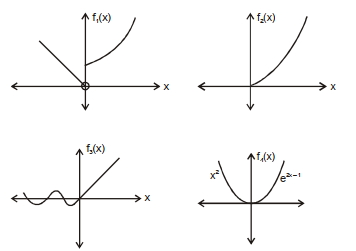
Let $f_1: R \rightarrow R$,$f_2:[0, \infty) \rightarrow R$,$f_3: R \rightarrow R$ and $f_4: R \rightarrow [0, \infty)$ be defined by:
$f_1(x) = \begin{cases} |x| & \text{if } x < 0 \\ e^x & \text{if } x \geq 0 \end{cases}$
$f_2(x) = x^2$
$f_3(x) = \begin{cases} \sin x & \text{if } x < 0 \\ x & \text{if } x \geq 0 \end{cases}$ and
$f_4(x) = \begin{cases} f_2(f_1(x)) & \text{if } x < 0 \\ f_2(f_1(x)) - 1 & \text{if } x \geq 0 \end{cases}$
Codes: $P \quad Q \quad R \quad S$
$f_1(x) = \begin{cases} |x| & \text{if } x < 0 \\ e^x & \text{if } x \geq 0 \end{cases}$
$f_2(x) = x^2$
$f_3(x) = \begin{cases} \sin x & \text{if } x < 0 \\ x & \text{if } x \geq 0 \end{cases}$ and
$f_4(x) = \begin{cases} f_2(f_1(x)) & \text{if } x < 0 \\ f_2(f_1(x)) - 1 & \text{if } x \geq 0 \end{cases}$
| List $I$ | List $II$ |
| $P. f_4$ is | $1. \text{onto but not one-one}$ |
| $Q. f_3$ is | $2. \text{neither continuous nor one-one}$ |
| $R. f_2 \circ f_1$ is | $3. \text{differentiable but not one-one}$ |
| $S. f_2$ is | $4. \text{continuous and one-one}$ |
Codes: $P \quad Q \quad R \quad S$
A
$3 \quad 1 \quad 4 \quad 2$
B
$1 \quad 3 \quad 4 \quad 2$
C
$3 \quad 1 \quad 2 \quad 4$
D
$1 \quad 3 \quad 2 \quad 4$
Solution
(D) $1$. Analyze $f_4(x)$:
$f_2(f_1(x)) = (f_1(x))^2 = \begin{cases} x^2 & x < 0 \\ e^{2x} & x \geq 0 \end{cases}$
$f_4(x) = \begin{cases} x^2 & x < 0 \\ e^{2x} - 1 & x \geq 0 \end{cases}$
At $x=0$,$f_4(0) = e^0 - 1 = 0$. $\lim_{x \to 0^-} f_4(x) = 0$. So $f_4$ is continuous. It is many-one (e.g.,$f_4(-1) = 1, f_4(\frac{1}{2}\ln 2) = 1$). Range is $[0, \infty)$,so it is onto. Thus $P \to 1$.
$2$. Analyze $f_3(x)$:
$f_3(x) = \begin{cases} \sin x & x < 0 \\ x & x \geq 0 \end{cases}$
At $x=0$,$f_3(0) = 0$. $\lim_{x \to 0^-} \sin x = 0$. Continuous. $f_3'(0^-) = \cos(0) = 1$,$f_3'(0^+) = 1$. Differentiable. It is many-one (e.g.,$f_3(-\pi) = 0, f_3(0) = 0$). Thus $Q \to 3$.
$3$. Analyze $f_2 \circ f_1(x)$:
$(f_2 \circ f_1)(x) = \begin{cases} x^2 & x < 0 \\ e^{2x} & x \geq 0 \end{cases}$
At $x=0$,$LHL = 0, RHL = 1$. Discontinuous. Thus $R \to 2$.
$4$. Analyze $f_2(x) = x^2$ on $[0, \infty)$:
It is strictly increasing,so one-one. Continuous. Thus $S \to 4$.
Matching: $P-1, Q-3, R-2, S-4$. Correct option is $(D)$.
$f_2(f_1(x)) = (f_1(x))^2 = \begin{cases} x^2 & x < 0 \\ e^{2x} & x \geq 0 \end{cases}$
$f_4(x) = \begin{cases} x^2 & x < 0 \\ e^{2x} - 1 & x \geq 0 \end{cases}$
At $x=0$,$f_4(0) = e^0 - 1 = 0$. $\lim_{x \to 0^-} f_4(x) = 0$. So $f_4$ is continuous. It is many-one (e.g.,$f_4(-1) = 1, f_4(\frac{1}{2}\ln 2) = 1$). Range is $[0, \infty)$,so it is onto. Thus $P \to 1$.
$2$. Analyze $f_3(x)$:
$f_3(x) = \begin{cases} \sin x & x < 0 \\ x & x \geq 0 \end{cases}$
At $x=0$,$f_3(0) = 0$. $\lim_{x \to 0^-} \sin x = 0$. Continuous. $f_3'(0^-) = \cos(0) = 1$,$f_3'(0^+) = 1$. Differentiable. It is many-one (e.g.,$f_3(-\pi) = 0, f_3(0) = 0$). Thus $Q \to 3$.
$3$. Analyze $f_2 \circ f_1(x)$:
$(f_2 \circ f_1)(x) = \begin{cases} x^2 & x < 0 \\ e^{2x} & x \geq 0 \end{cases}$
At $x=0$,$LHL = 0, RHL = 1$. Discontinuous. Thus $R \to 2$.
$4$. Analyze $f_2(x) = x^2$ on $[0, \infty)$:
It is strictly increasing,so one-one. Continuous. Thus $S \to 4$.
Matching: $P-1, Q-3, R-2, S-4$. Correct option is $(D)$.
0 likes
View Solution109
DifficultMCQ
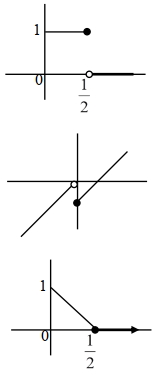
Let $f: R \rightarrow R$ and $g: R \rightarrow R$ be functions defined by
$f(x)=\begin{cases} x|x| \sin \left(\frac{1}{x}\right), & x \neq 0 \\ 0, & x=0 \end{cases}$ and $g(x)=\begin{cases} 1-2x, & 0 \leq x \leq \frac{1}{2} \\ 0, & \text{otherwise} \end{cases}$
Let $a, b, c, d \in R$. Define the function $h: R \rightarrow R$ by
$h(x)=a f(x)+b\left(g(x)+g\left(\frac{1}{2}-x\right)\right)+c(x-g(x))+d g(x), x \in R$
Match each entry in $List-I$ to the correct entry in $List-II$.
The correct option is
$f(x)=\begin{cases} x|x| \sin \left(\frac{1}{x}\right), & x \neq 0 \\ 0, & x=0 \end{cases}$ and $g(x)=\begin{cases} 1-2x, & 0 \leq x \leq \frac{1}{2} \\ 0, & \text{otherwise} \end{cases}$
Let $a, b, c, d \in R$. Define the function $h: R \rightarrow R$ by
$h(x)=a f(x)+b\left(g(x)+g\left(\frac{1}{2}-x\right)\right)+c(x-g(x))+d g(x), x \in R$
Match each entry in $List-I$ to the correct entry in $List-II$.
| $List-I$ | $List-II$ |
| $(P)$ If $a=0, b=1, c=0$ and $d=0$,then | $(1)$ $h$ is one-one |
| $(Q)$ If $a=1, b=0, c=0$ and $d=0$,then | $(2)$ $h$ is onto |
| $(R)$ If $a=0, b=0, c=1$ and $d=0$,then | $(3)$ $h$ is differentiable on $R$ |
| $(S)$ If $a=0, b=0, c=0$ and $d=1$,then | $(4)$ the range of $h$ is $[0,1]$ |
| $(5)$ the range of $h$ is $\{0,1\}$ |
The correct option is
A
$(P) \rightarrow (5), (Q) \rightarrow (3), (R) \rightarrow (2), (S) \rightarrow (4)$
B
$(P) \rightarrow (4), (Q) \rightarrow (2), (R) \rightarrow (1), (S) \rightarrow (3)$
C
$(P) \rightarrow (5), (Q) \rightarrow (2), (R) \rightarrow (4), (S) \rightarrow (3)$
D
$(P) \rightarrow (4), (Q) \rightarrow (3), (R) \rightarrow (1), (S) \rightarrow (2)$
Solution
(A) First,analyze the functions:
$f(x) = \begin{cases} x|x| \sin(1/x), & x \neq 0 \\ 0, & x=0 \end{cases}$
$g(x) = \begin{cases} 1-2x, & 0 \leq x \leq 1/2 \\ 0, & \text{otherwise} \end{cases}$
$g(1/2-x) = \begin{cases} 2x, & 0 \leq 1/2-x \leq 1/2 \\ 0, & \text{otherwise} \end{cases} = \begin{cases} 2x, & 0 \leq x \leq 1/2 \\ 0, & \text{otherwise} \end{cases}$
Thus,$g(x) + g(1/2-x) = \begin{cases} 1, & 0 \leq x \leq 1/2 \\ 0, & \text{otherwise} \end{cases}$
$(P)$ If $a=0, b=1, c=0, d=0$,then $h(x) = g(x) + g(1/2-x)$. The range is $\{0, 1\}$. Matches $(5)$.
$(Q)$ If $a=1, b=0, c=0, d=0$,then $h(x) = f(x)$. $f(x)$ is differentiable at $x=0$ because $\lim_{x \to 0} \frac{x|x| \sin(1/x) - 0}{x} = \lim_{x \to 0} |x| \sin(1/x) = 0$. Matches $(3)$.
$(R)$ If $a=0, b=0, c=1, d=0$,then $h(x) = x - g(x) = \begin{cases} x - (1-2x) = 3x-1, & 0 \leq x \leq 1/2 \\ x, & \text{otherwise} \end{cases}$. This function is onto. Matches $(2)$.
$(S)$ If $a=0, b=0, c=0, d=1$,then $h(x) = g(x) = \begin{cases} 1-2x, & 0 \leq x \leq 1/2 \\ 0, & \text{otherwise} \end{cases}$. The range is $[0, 1]$. Matches $(4)$.
Therefore,$(P) \to (5), (Q) \to (3), (R) \to (2), (S) \to (4)$.
$f(x) = \begin{cases} x|x| \sin(1/x), & x \neq 0 \\ 0, & x=0 \end{cases}$
$g(x) = \begin{cases} 1-2x, & 0 \leq x \leq 1/2 \\ 0, & \text{otherwise} \end{cases}$
$g(1/2-x) = \begin{cases} 2x, & 0 \leq 1/2-x \leq 1/2 \\ 0, & \text{otherwise} \end{cases} = \begin{cases} 2x, & 0 \leq x \leq 1/2 \\ 0, & \text{otherwise} \end{cases}$
Thus,$g(x) + g(1/2-x) = \begin{cases} 1, & 0 \leq x \leq 1/2 \\ 0, & \text{otherwise} \end{cases}$
$(P)$ If $a=0, b=1, c=0, d=0$,then $h(x) = g(x) + g(1/2-x)$. The range is $\{0, 1\}$. Matches $(5)$.
$(Q)$ If $a=1, b=0, c=0, d=0$,then $h(x) = f(x)$. $f(x)$ is differentiable at $x=0$ because $\lim_{x \to 0} \frac{x|x| \sin(1/x) - 0}{x} = \lim_{x \to 0} |x| \sin(1/x) = 0$. Matches $(3)$.
$(R)$ If $a=0, b=0, c=1, d=0$,then $h(x) = x - g(x) = \begin{cases} x - (1-2x) = 3x-1, & 0 \leq x \leq 1/2 \\ x, & \text{otherwise} \end{cases}$. This function is onto. Matches $(2)$.
$(S)$ If $a=0, b=0, c=0, d=1$,then $h(x) = g(x) = \begin{cases} 1-2x, & 0 \leq x \leq 1/2 \\ 0, & \text{otherwise} \end{cases}$. The range is $[0, 1]$. Matches $(4)$.
Therefore,$(P) \to (5), (Q) \to (3), (R) \to (2), (S) \to (4)$.
0 likes
View Solution110
AdvancedMCQ
Let the function $f: R \rightarrow R$ be defined by $f(x) = \frac{\sin x}{e^{\pi x}} \frac{(x^{2023} + 2024x + 2025)}{(x^2 - x + 3)} + \frac{2}{e^{\pi x}} \frac{(x^{2023} + 2024x + 2025)}{(x^2 - x + 3)}.$ Then the number of solutions of $f(x) = 0$ in $R$ is
A
$1$
B
$5$
C
$7$
D
$8$
Solution
(A) Given $f(x) = \frac{(x^{2023} + 2024x + 2025)}{e^{\pi x}(x^2 - x + 3)} (\sin x + 2)$.
Since $e^{\pi x} > 0$ for all $x \in R$ and the discriminant of $x^2 - x + 3$ is $D = 1 - 12 = -11 < 0$,$x^2 - x + 3$ is always positive.
Also,$-1 \leq \sin x \leq 1$,so $(\sin x + 2) \geq 1$,which means $(\sin x + 2)$ is never zero.
Thus,$f(x) = 0$ if and only if $x^{2023} + 2024x + 2025 = 0$.
Let $\phi(x) = x^{2023} + 2024x + 2025$.
Then $\phi'(x) = 2023x^{2022} + 2024$. Since $x^{2022} \geq 0$,$\phi'(x) > 0$ for all $x \in R$.
Therefore,$\phi(x)$ is a strictly increasing function.
Since $\phi(x)$ is continuous and strictly increasing,it takes every value in $R$ exactly once.
Hence,$\phi(x) = 0$ has exactly one real solution.
Therefore,the number of solutions of $f(x) = 0$ is $1$.
Since $e^{\pi x} > 0$ for all $x \in R$ and the discriminant of $x^2 - x + 3$ is $D = 1 - 12 = -11 < 0$,$x^2 - x + 3$ is always positive.
Also,$-1 \leq \sin x \leq 1$,so $(\sin x + 2) \geq 1$,which means $(\sin x + 2)$ is never zero.
Thus,$f(x) = 0$ if and only if $x^{2023} + 2024x + 2025 = 0$.
Let $\phi(x) = x^{2023} + 2024x + 2025$.
Then $\phi'(x) = 2023x^{2022} + 2024$. Since $x^{2022} \geq 0$,$\phi'(x) > 0$ for all $x \in R$.
Therefore,$\phi(x)$ is a strictly increasing function.
Since $\phi(x)$ is continuous and strictly increasing,it takes every value in $R$ exactly once.
Hence,$\phi(x) = 0$ has exactly one real solution.
Therefore,the number of solutions of $f(x) = 0$ is $1$.
0 likes
View Solution111
AdvancedMCQ
Let $S = \{1, 2, 3, 4, 5, 6\}$ and $X$ be the set of all relations $R$ from $S$ to $S$ that satisfy both the following properties:
$i$. $R$ has exactly $6$ elements.
$ii$. For each $(a, b) \in R$,we have $|a-b| \geq 2$.
Let $Y = \{R \in X : \text{The range of } R \text{ has exactly one element}\}$ and $Z = \{R \in X : R \text{ is a function from } S \text{ to } S\}$.
Let $n(A)$ denote the number of elements in a set $A$.
$(1)$ If $n(X) = {}^{m}C_{6}$,then the value of $m$ is. . . .
$(2)$ If the value of $n(Y) + n(Z)$ is $k^{2}$,then $|k|$ is. . . .
$i$. $R$ has exactly $6$ elements.
$ii$. For each $(a, b) \in R$,we have $|a-b| \geq 2$.
Let $Y = \{R \in X : \text{The range of } R \text{ has exactly one element}\}$ and $Z = \{R \in X : R \text{ is a function from } S \text{ to } S\}$.
Let $n(A)$ denote the number of elements in a set $A$.
$(1)$ If $n(X) = {}^{m}C_{6}$,then the value of $m$ is. . . .
$(2)$ If the value of $n(Y) + n(Z)$ is $k^{2}$,then $|k|$ is. . . .
A
$20, 36$
B
$20, 38$
C
$20, 40$
D
$20, 45$
Solution
(A) First,we determine the number of pairs $(a, b)$ such that $a, b \in S$ and $|a-b| \geq 2$.
For each $a \in S$,the number of possible $b$ values is:
- If $a=1$,$b \in \{3, 4, 5, 6\}$ ($4$ values)
- If $a=2$,$b \in \{4, 5, 6\}$ ($3$ values)
- If $a=3$,$b \in \{1, 5, 6\}$ ($3$ values)
- If $a=4$,$b \in \{1, 2, 6\}$ ($3$ values)
- If $a=5$,$b \in \{1, 2, 3\}$ ($3$ values)
- If $a=6$,$b \in \{1, 2, 3, 4\}$ ($4$ values)
Total number of such pairs is $4+3+3+3+3+4 = 20$.
Since $R$ must have exactly $6$ elements chosen from these $20$ pairs,$n(X) = {}^{20}C_{6}$,so $m = 20$.
For $n(Y)$,the range of $R$ has exactly one element,meaning all $6$ pairs $(a, b)$ in $R$ must have the same $b$. However,for any fixed $b$,there are at most $5$ values of $a$ such that $|a-b| \geq 2$. Thus,$n(Y) = 0$.
For $n(Z)$,$R$ is a function,meaning for each $a \in S$,there is exactly one $b$ such that $(a, b) \in R$ and $|a-b| \geq 2$. The number of choices for each $a$ is $4, 3, 3, 3, 3, 4$ respectively. Thus,$n(Z) = 4 \times 3 \times 3 \times 3 \times 3 \times 4 = 1296 = 36^{2}$.
Therefore,$n(Y) + n(Z) = 0 + 36^{2} = 36^{2}$,so $|k| = 36$.
For each $a \in S$,the number of possible $b$ values is:
- If $a=1$,$b \in \{3, 4, 5, 6\}$ ($4$ values)
- If $a=2$,$b \in \{4, 5, 6\}$ ($3$ values)
- If $a=3$,$b \in \{1, 5, 6\}$ ($3$ values)
- If $a=4$,$b \in \{1, 2, 6\}$ ($3$ values)
- If $a=5$,$b \in \{1, 2, 3\}$ ($3$ values)
- If $a=6$,$b \in \{1, 2, 3, 4\}$ ($4$ values)
Total number of such pairs is $4+3+3+3+3+4 = 20$.
Since $R$ must have exactly $6$ elements chosen from these $20$ pairs,$n(X) = {}^{20}C_{6}$,so $m = 20$.
For $n(Y)$,the range of $R$ has exactly one element,meaning all $6$ pairs $(a, b)$ in $R$ must have the same $b$. However,for any fixed $b$,there are at most $5$ values of $a$ such that $|a-b| \geq 2$. Thus,$n(Y) = 0$.
For $n(Z)$,$R$ is a function,meaning for each $a \in S$,there is exactly one $b$ such that $(a, b) \in R$ and $|a-b| \geq 2$. The number of choices for each $a$ is $4, 3, 3, 3, 3, 4$ respectively. Thus,$n(Z) = 4 \times 3 \times 3 \times 3 \times 3 \times 4 = 1296 = 36^{2}$.
Therefore,$n(Y) + n(Z) = 0 + 36^{2} = 36^{2}$,so $|k| = 36$.
0 likes
View Solution112
DifficultMCQ
Let $A = \{1, 2, 3, 4\}$ and $B = \{1, 4, 9, 16\}$. Then the number of many-one functions $f: A \rightarrow B$ such that $1 \in f(A)$ is equal to:
A
$127$
B
$151$
C
$163$
D
$139$
Solution
(B) The total number of functions from set $A$ to set $B$ is $|B|^{|A|} = 4^4 = 256$.
The number of one-one functions is $4! = 24$.
The number of many-one functions is $\text{Total} - \text{One-one} = 256 - 24 = 232$.
Now,we need to find the number of many-one functions such that $1 \in f(A)$.
This is equal to $(\text{Total many-one functions}) - (\text{Many-one functions where } 1 \notin f(A))$.
If $1 \notin f(A)$,then the range of $f$ is a subset of $\{4, 9, 16\}$.
The total number of functions from $A$ to $\{4, 9, 16\}$ is $3^4 = 81$.
Among these $81$ functions,the number of one-one functions is $0$ (since $|A| > |\{4, 9, 16\}|$).
Thus,all $81$ functions are many-one.
Therefore,the number of many-one functions such that $1 \in f(A)$ is $232 - 81 = 151$.
The number of one-one functions is $4! = 24$.
The number of many-one functions is $\text{Total} - \text{One-one} = 256 - 24 = 232$.
Now,we need to find the number of many-one functions such that $1 \in f(A)$.
This is equal to $(\text{Total many-one functions}) - (\text{Many-one functions where } 1 \notin f(A))$.
If $1 \notin f(A)$,then the range of $f$ is a subset of $\{4, 9, 16\}$.
The total number of functions from $A$ to $\{4, 9, 16\}$ is $3^4 = 81$.
Among these $81$ functions,the number of one-one functions is $0$ (since $|A| > |\{4, 9, 16\}|$).
Thus,all $81$ functions are many-one.
Therefore,the number of many-one functions such that $1 \in f(A)$ is $232 - 81 = 151$.
0 likes
View Solution113
DifficultMCQ
Let $f(x) = \frac{2^{x+2} + 16}{2^{2x+1} + 2^{x+4} + 32}$. Then the value of $8 \left( f \left( \frac{1}{15} \right) + f \left( \frac{2}{15} \right) + \dots + f \left( \frac{59}{15} \right) \right)$ is equal to
A
$118$
B
$92$
C
$102$
D
$108$
Solution
(A) Given $f(x) = \frac{2^{x+2} + 16}{2^{2x+1} + 2^{x+4} + 32} = \frac{4 \cdot 2^x + 16}{2 \cdot (2^x)^2 + 16 \cdot 2^x + 32} = \frac{4(2^x + 4)}{2((2^x)^2 + 8 \cdot 2^x + 16)} = \frac{2(2^x + 4)}{(2^x + 4)^2} = \frac{2}{2^x + 4}$.
Consider $f(4-x) = \frac{2}{2^{4-x} + 4} = \frac{2}{\frac{16}{2^x} + 4} = \frac{2 \cdot 2^x}{16 + 4 \cdot 2^x} = \frac{2^x}{8 + 2 \cdot 2^x} = \frac{2^x}{2(4 + 2^x)}$.
Then $f(x) + f(4-x) = \frac{2}{2^x + 4} + \frac{2^x}{2(2^x + 4)} = \frac{4 + 2^x}{2(2^x + 4)} = \frac{1}{2}$.
The sum is $S = \sum_{k=1}^{59} f \left( \frac{k}{15} \right)$. Note that $f(x) + f(4-x) = \frac{1}{2}$ implies $f \left( \frac{k}{15} \right) + f \left( 4 - \frac{k}{15} \right) = f \left( \frac{k}{15} \right) + f \left( \frac{60-k}{15} \right) = \frac{1}{2}$.
There are $59$ terms. The middle term is $f \left( \frac{30}{15} \right) = f(2) = \frac{2}{2^2 + 4} = \frac{2}{8} = \frac{1}{4}$.
There are $29$ pairs summing to $\frac{1}{2}$ and one middle term $\frac{1}{4}$.
$S = 29 \cdot \frac{1}{2} + \frac{1}{4} = \frac{58 + 1}{4} = \frac{59}{4}$.
The required value is $8 \cdot S = 8 \cdot \frac{59}{4} = 2 \cdot 59 = 118$.
Consider $f(4-x) = \frac{2}{2^{4-x} + 4} = \frac{2}{\frac{16}{2^x} + 4} = \frac{2 \cdot 2^x}{16 + 4 \cdot 2^x} = \frac{2^x}{8 + 2 \cdot 2^x} = \frac{2^x}{2(4 + 2^x)}$.
Then $f(x) + f(4-x) = \frac{2}{2^x + 4} + \frac{2^x}{2(2^x + 4)} = \frac{4 + 2^x}{2(2^x + 4)} = \frac{1}{2}$.
The sum is $S = \sum_{k=1}^{59} f \left( \frac{k}{15} \right)$. Note that $f(x) + f(4-x) = \frac{1}{2}$ implies $f \left( \frac{k}{15} \right) + f \left( 4 - \frac{k}{15} \right) = f \left( \frac{k}{15} \right) + f \left( \frac{60-k}{15} \right) = \frac{1}{2}$.
There are $59$ terms. The middle term is $f \left( \frac{30}{15} \right) = f(2) = \frac{2}{2^2 + 4} = \frac{2}{8} = \frac{1}{4}$.
There are $29$ pairs summing to $\frac{1}{2}$ and one middle term $\frac{1}{4}$.
$S = 29 \cdot \frac{1}{2} + \frac{1}{4} = \frac{58 + 1}{4} = \frac{59}{4}$.
The required value is $8 \cdot S = 8 \cdot \frac{59}{4} = 2 \cdot 59 = 118$.
0 likes
View Solution114
DifficultMCQ
If $f(x) = \frac{2^x}{2^x + \sqrt{2}}$,$x \in R$,then $\sum_{k=1}^{81} f\left(\frac{k}{82}\right)$ is equal to :
A
$41$
B
$\frac{81}{2}$
C
$82$
D
$81 \sqrt{2}$
Solution
(B) Given $f(x) = \frac{2^x}{2^x + \sqrt{2}}$.
Consider $f(1-x) = \frac{2^{1-x}}{2^{1-x} + \sqrt{2}} = \frac{2/2^x}{2/2^x + \sqrt{2}} = \frac{2}{2 + \sqrt{2} \cdot 2^x} = \frac{\sqrt{2}}{\sqrt{2} + 2^x}$.
Thus,$f(x) + f(1-x) = \frac{2^x}{2^x + \sqrt{2}} + \frac{\sqrt{2}}{2^x + \sqrt{2}} = \frac{2^x + \sqrt{2}}{2^x + \sqrt{2}} = 1$.
We need to evaluate $S = \sum_{k=1}^{81} f\left(\frac{k}{82}\right) = f\left(\frac{1}{82}\right) + f\left(\frac{2}{82}\right) + \dots + f\left(\frac{81}{82}\right)$.
Pairing terms $f\left(\frac{k}{82}\right) + f\left(1 - \frac{k}{82}\right) = f\left(\frac{k}{82}\right) + f\left(\frac{82-k}{82}\right) = 1$.
There are $40$ such pairs (for $k=1$ to $40$) and the middle term $f\left(\frac{41}{82}\right) = f\left(\frac{1}{2}\right)$.
$f\left(\frac{1}{2}\right) = \frac{2^{1/2}}{2^{1/2} + \sqrt{2}} = \frac{\sqrt{2}}{\sqrt{2} + \sqrt{2}} = \frac{1}{2}$.
So,$S = 40 \times 1 + \frac{1}{2} = \frac{81}{2}$.
Consider $f(1-x) = \frac{2^{1-x}}{2^{1-x} + \sqrt{2}} = \frac{2/2^x}{2/2^x + \sqrt{2}} = \frac{2}{2 + \sqrt{2} \cdot 2^x} = \frac{\sqrt{2}}{\sqrt{2} + 2^x}$.
Thus,$f(x) + f(1-x) = \frac{2^x}{2^x + \sqrt{2}} + \frac{\sqrt{2}}{2^x + \sqrt{2}} = \frac{2^x + \sqrt{2}}{2^x + \sqrt{2}} = 1$.
We need to evaluate $S = \sum_{k=1}^{81} f\left(\frac{k}{82}\right) = f\left(\frac{1}{82}\right) + f\left(\frac{2}{82}\right) + \dots + f\left(\frac{81}{82}\right)$.
Pairing terms $f\left(\frac{k}{82}\right) + f\left(1 - \frac{k}{82}\right) = f\left(\frac{k}{82}\right) + f\left(\frac{82-k}{82}\right) = 1$.
There are $40$ such pairs (for $k=1$ to $40$) and the middle term $f\left(\frac{41}{82}\right) = f\left(\frac{1}{2}\right)$.
$f\left(\frac{1}{2}\right) = \frac{2^{1/2}}{2^{1/2} + \sqrt{2}} = \frac{\sqrt{2}}{\sqrt{2} + \sqrt{2}} = \frac{1}{2}$.
So,$S = 40 \times 1 + \frac{1}{2} = \frac{81}{2}$.
0 likes
View Solution115
DifficultMCQ
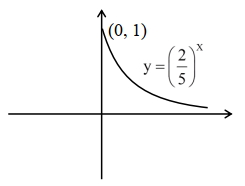
Let $S = \mathbb{N} \cup \{0\}$. Define a relation $R$ from $S$ to $\mathbb{R}$ by: $R = \{(x, y) : \log_e y = x \log_e \left(\frac{2}{5}\right), x \in S, y \in \mathbb{R}\}$. Then,the sum of all the elements in the range of $R$ is equal to
A
$\frac{5}{2}$
B
$\frac{10}{9}$
C
$\frac{3}{2}$
D
$\frac{5}{3}$
Solution
(D) Given $S = \{0, 1, 2, 3, \dots\}$.
From the relation $\log_e y = x \log_e \left(\frac{2}{5}\right)$,we have $\log_e y = \log_e \left(\left(\frac{2}{5}\right)^x\right)$.
This implies $y = \left(\frac{2}{5}\right)^x$.
Since $x \in S$,the range of $R$ is the set of values $y = \left(\frac{2}{5}\right)^x$ for $x = 0, 1, 2, \dots$.
Range $= \left\{ \left(\frac{2}{5}\right)^0, \left(\frac{2}{5}\right)^1, \left(\frac{2}{5}\right)^2, \dots \right\} = \left\{ 1, \frac{2}{5}, \left(\frac{2}{5}\right)^2, \dots \right\}$.
This is an infinite geometric progression with first term $a = 1$ and common ratio $r = \frac{2}{5}$.
The sum of the elements in the range is $S_{\infty} = \frac{a}{1 - r} = \frac{1}{1 - \frac{2}{5}} = \frac{1}{\frac{3}{5}} = \frac{5}{3}$.
From the relation $\log_e y = x \log_e \left(\frac{2}{5}\right)$,we have $\log_e y = \log_e \left(\left(\frac{2}{5}\right)^x\right)$.
This implies $y = \left(\frac{2}{5}\right)^x$.
Since $x \in S$,the range of $R$ is the set of values $y = \left(\frac{2}{5}\right)^x$ for $x = 0, 1, 2, \dots$.
Range $= \left\{ \left(\frac{2}{5}\right)^0, \left(\frac{2}{5}\right)^1, \left(\frac{2}{5}\right)^2, \dots \right\} = \left\{ 1, \frac{2}{5}, \left(\frac{2}{5}\right)^2, \dots \right\}$.
This is an infinite geometric progression with first term $a = 1$ and common ratio $r = \frac{2}{5}$.
The sum of the elements in the range is $S_{\infty} = \frac{a}{1 - r} = \frac{1}{1 - \frac{2}{5}} = \frac{1}{\frac{3}{5}} = \frac{5}{3}$.
0 likes
View Solution116
AdvancedMCQ
Let $R$ denote the set of all real numbers. Let $f: R \rightarrow R$ be a function such that $f(x) > 0$ for all $x \in R$,and $f(x+y)=f(x) f(y)$ for all $x, y \in R$. Let the real numbers $a_1, a_2, \ldots, a_{50}$ be in an arithmetic progression. If $f(a_{31})=64 f(a_{25})$,and $\sum_{i=1}^{50} f(a_i)=3(2^{25}+1)$,then the value of $\sum_{i=6}^{30} f(a_i)$ is:
A
$95$
B
$96$
C
$97$
D
$98$
Solution
(B) Given $f(x+y)=f(x)f(y)$ and $f(x)>0$,the function is of the form $f(x)=k^x$ for some $k>0$.
Since $f(a_{31})=64 f(a_{25})$,we have $k^{a+30d}=64 k^{a+24d}$,where $a$ is the first term and $d$ is the common difference.
This simplifies to $k^{6d}=64$,so $k^d=2$.
The sum $\sum_{i=1}^{50} f(a_i) = k^a + k^{a+d} + \ldots + k^{a+49d} = k^a \frac{(k^d)^{50}-1}{k^d-1} = k^a \frac{2^{50}-1}{2-1} = k^a(2^{50}-1)$.
Given $k^a(2^{50}-1) = 3(2^{25}+1)$,we have $k^a(2^{25}-1)(2^{25}+1) = 3(2^{25}+1)$,so $k^a = \frac{3}{2^{25}-1}$.
We need to find $\sum_{i=6}^{30} f(a_i) = k^{a+5d} + k^{a+6d} + \ldots + k^{a+29d} = k^{a+5d} \frac{(k^d)^{25}-1}{k^d-1} = k^a (k^d)^5 (2^{25}-1)$.
Substituting the values: $\frac{3}{2^{25}-1} \cdot 2^5 \cdot (2^{25}-1) = 3 \cdot 32 = 96$.
Since $f(a_{31})=64 f(a_{25})$,we have $k^{a+30d}=64 k^{a+24d}$,where $a$ is the first term and $d$ is the common difference.
This simplifies to $k^{6d}=64$,so $k^d=2$.
The sum $\sum_{i=1}^{50} f(a_i) = k^a + k^{a+d} + \ldots + k^{a+49d} = k^a \frac{(k^d)^{50}-1}{k^d-1} = k^a \frac{2^{50}-1}{2-1} = k^a(2^{50}-1)$.
Given $k^a(2^{50}-1) = 3(2^{25}+1)$,we have $k^a(2^{25}-1)(2^{25}+1) = 3(2^{25}+1)$,so $k^a = \frac{3}{2^{25}-1}$.
We need to find $\sum_{i=6}^{30} f(a_i) = k^{a+5d} + k^{a+6d} + \ldots + k^{a+29d} = k^{a+5d} \frac{(k^d)^{25}-1}{k^d-1} = k^a (k^d)^5 (2^{25}-1)$.
Substituting the values: $\frac{3}{2^{25}-1} \cdot 2^5 \cdot (2^{25}-1) = 3 \cdot 32 = 96$.
0 likes
View Solution117
EasyMCQ
If $f(x) = \log_{e}\left(\frac{1-x}{1+x}\right)$,$|x| < 1$,then $f\left(\frac{2x}{1+x^2}\right)$ is equal to
A
$2f(x^2)$
B
$(f(x))^2$
C
$-2f(x)$
D
$2f(x)$
Solution
(D) Given $f(x) = \log_{e}\left(\frac{1-x}{1+x}\right)$.
We need to evaluate $f\left(\frac{2x}{1+x^2}\right)$.
Substituting $\frac{2x}{1+x^2}$ for $x$ in $f(x)$:
$f\left(\frac{2x}{1+x^2}\right) = \log_{e}\left(\frac{1-\frac{2x}{1+x^2}}{1+\frac{2x}{1+x^2}}\right)$
$= \log_{e}\left(\frac{\frac{1+x^2-2x}{1+x^2}}{\frac{1+x^2+2x}{1+x^2}}\right)$
$= \log_{e}\left(\frac{(1-x)^2}{(1+x)^2}\right)$
$= \log_{e}\left(\left(\frac{1-x}{1+x}\right)^2\right)$
$= 2\log_{e}\left(\frac{1-x}{1+x}\right)$
$= 2f(x)$.
We need to evaluate $f\left(\frac{2x}{1+x^2}\right)$.
Substituting $\frac{2x}{1+x^2}$ for $x$ in $f(x)$:
$f\left(\frac{2x}{1+x^2}\right) = \log_{e}\left(\frac{1-\frac{2x}{1+x^2}}{1+\frac{2x}{1+x^2}}\right)$
$= \log_{e}\left(\frac{\frac{1+x^2-2x}{1+x^2}}{\frac{1+x^2+2x}{1+x^2}}\right)$
$= \log_{e}\left(\frac{(1-x)^2}{(1+x)^2}\right)$
$= \log_{e}\left(\left(\frac{1-x}{1+x}\right)^2\right)$
$= 2\log_{e}\left(\frac{1-x}{1+x}\right)$
$= 2f(x)$.
0 likes
View Solution118
EasyMCQ
The function $f(x) = \sec \left[ \log \left( x + \sqrt{1 + x^2} \right) \right]$ is . . . . . . function.
A
even
B
odd
C
neither even nor odd
D
square
Solution
(A) To determine if the function $f(x) = \sec \left[ \log \left( x + \sqrt{1 + x^2} \right) \right]$ is even or odd,we evaluate $f(-x)$.
First,consider the inner function $g(x) = \log \left( x + \sqrt{1 + x^2} \right)$.
$g(-x) = \log \left( -x + \sqrt{1 + (-x)^2} \right) = \log \left( \sqrt{1 + x^2} - x \right)$.
Multiply and divide by $\left( \sqrt{1 + x^2} + x \right)$:
$g(-x) = \log \left( \frac{(\sqrt{1 + x^2} - x)(\sqrt{1 + x^2} + x)}{\sqrt{1 + x^2} + x} \right) = \log \left( \frac{1 + x^2 - x^2}{\sqrt{1 + x^2} + x} \right) = \log \left( \frac{1}{\sqrt{1 + x^2} + x} \right) = -\log \left( x + \sqrt{1 + x^2} \right) = -g(x)$.
Since $g(x)$ is an odd function,we have $f(-x) = \sec(g(-x)) = \sec(-g(x))$.
Since $\sec(\theta)$ is an even function,$\sec(-g(x)) = \sec(g(x)) = f(x)$.
Therefore,$f(-x) = f(x)$,which means the function is an even function.
First,consider the inner function $g(x) = \log \left( x + \sqrt{1 + x^2} \right)$.
$g(-x) = \log \left( -x + \sqrt{1 + (-x)^2} \right) = \log \left( \sqrt{1 + x^2} - x \right)$.
Multiply and divide by $\left( \sqrt{1 + x^2} + x \right)$:
$g(-x) = \log \left( \frac{(\sqrt{1 + x^2} - x)(\sqrt{1 + x^2} + x)}{\sqrt{1 + x^2} + x} \right) = \log \left( \frac{1 + x^2 - x^2}{\sqrt{1 + x^2} + x} \right) = \log \left( \frac{1}{\sqrt{1 + x^2} + x} \right) = -\log \left( x + \sqrt{1 + x^2} \right) = -g(x)$.
Since $g(x)$ is an odd function,we have $f(-x) = \sec(g(-x)) = \sec(-g(x))$.
Since $\sec(\theta)$ is an even function,$\sec(-g(x)) = \sec(g(x)) = f(x)$.
Therefore,$f(-x) = f(x)$,which means the function is an even function.
0 likes
View Solution119
MediumMCQ
If $f(x) = \cos(\log x)$,then the value of $f(x^2) \cdot f(y^2) - \frac{1}{2} \left[ f\left(\frac{x^2}{y^2}\right) + f(x^2 y^2) \right]$ is:
A
$-2$
B
$-1$
C
$\frac{1}{2}$
D
$0$
Solution
(D) Given $f(x) = \cos(\log x)$.
We need to evaluate $f(x^2) \cdot f(y^2) - \frac{1}{2} \left[ f\left(\frac{x^2}{y^2}\right) + f(x^2 y^2) \right]$.
First,calculate the terms:
$f(x^2) = \cos(\log x^2) = \cos(2 \log x)$
$f(y^2) = \cos(\log y^2) = \cos(2 \log y)$
$f\left(\frac{x^2}{y^2}\right) = \cos(\log \frac{x^2}{y^2}) = \cos(2 \log x - 2 \log y)$
$f(x^2 y^2) = \cos(\log x^2 y^2) = \cos(2 \log x + 2 \log y)$
Let $A = 2 \log x$ and $B = 2 \log y$.
The expression becomes $\cos A \cdot \cos B - \frac{1}{2} [\cos(A - B) + \cos(A + B)]$.
Using the trigonometric identity $\cos(A - B) + \cos(A + B) = 2 \cos A \cos B$,we get:
$\cos A \cos B - \frac{1}{2} [2 \cos A \cos B] = \cos A \cos B - \cos A \cos B = 0$.
We need to evaluate $f(x^2) \cdot f(y^2) - \frac{1}{2} \left[ f\left(\frac{x^2}{y^2}\right) + f(x^2 y^2) \right]$.
First,calculate the terms:
$f(x^2) = \cos(\log x^2) = \cos(2 \log x)$
$f(y^2) = \cos(\log y^2) = \cos(2 \log y)$
$f\left(\frac{x^2}{y^2}\right) = \cos(\log \frac{x^2}{y^2}) = \cos(2 \log x - 2 \log y)$
$f(x^2 y^2) = \cos(\log x^2 y^2) = \cos(2 \log x + 2 \log y)$
Let $A = 2 \log x$ and $B = 2 \log y$.
The expression becomes $\cos A \cdot \cos B - \frac{1}{2} [\cos(A - B) + \cos(A + B)]$.
Using the trigonometric identity $\cos(A - B) + \cos(A + B) = 2 \cos A \cos B$,we get:
$\cos A \cos B - \frac{1}{2} [2 \cos A \cos B] = \cos A \cos B - \cos A \cos B = 0$.
0 likes
View Solution120
EasyMCQ
If $f(x) = \cos(\log x)$,then the value of $f(x) \cdot f(y) - \frac{1}{2} \left( f\left(\frac{x}{y}\right) + f(xy) \right)$ is:
A
$-2$
B
$-1$
C
$0$
D
$\frac{1}{2}$
Solution
(C) Given $f(x) = \cos(\log x)$.
We need to evaluate the expression $E = f(x) \cdot f(y) - \frac{1}{2} \left( f\left(\frac{x}{y}\right) + f(xy) \right)$.
Substitute the function definition:
$E = \cos(\log x) \cdot \cos(\log y) - \frac{1}{2} \left( \cos(\log(x/y)) + \cos(\log(xy)) \right)$.
Using logarithmic properties $\log(x/y) = \log x - \log y$ and $\log(xy) = \log x + \log y$:
$E = \cos(\log x) \cdot \cos(\log y) - \frac{1}{2} \left( \cos(\log x - \log y) + \cos(\log x + \log y) \right)$.
Apply the trigonometric identity $\cos(A - B) + \cos(A + B) = 2 \cos A \cos B$ where $A = \log x$ and $B = \log y$:
$E = \cos(\log x) \cdot \cos(\log y) - \frac{1}{2} \left( 2 \cos(\log x) \cos(\log y) \right)$.
$E = \cos(\log x) \cdot \cos(\log y) - \cos(\log x) \cdot \cos(\log y) = 0$.
We need to evaluate the expression $E = f(x) \cdot f(y) - \frac{1}{2} \left( f\left(\frac{x}{y}\right) + f(xy) \right)$.
Substitute the function definition:
$E = \cos(\log x) \cdot \cos(\log y) - \frac{1}{2} \left( \cos(\log(x/y)) + \cos(\log(xy)) \right)$.
Using logarithmic properties $\log(x/y) = \log x - \log y$ and $\log(xy) = \log x + \log y$:
$E = \cos(\log x) \cdot \cos(\log y) - \frac{1}{2} \left( \cos(\log x - \log y) + \cos(\log x + \log y) \right)$.
Apply the trigonometric identity $\cos(A - B) + \cos(A + B) = 2 \cos A \cos B$ where $A = \log x$ and $B = \log y$:
$E = \cos(\log x) \cdot \cos(\log y) - \frac{1}{2} \left( 2 \cos(\log x) \cos(\log y) \right)$.
$E = \cos(\log x) \cdot \cos(\log y) - \cos(\log x) \cdot \cos(\log y) = 0$.
0 likes
View Solution121
EasyMCQ
If $f(x)=3[x]+\{x+1\}$,where $[x]$ is the greatest integer function of $x$ and $\{x\}$ is the fractional part function of $x$,then $f(-1.32)=$
A
-$4.6$
B
-$2.6$
C
-$7.4$
D
-$3.4$
Solution
(B) Given $f(x)=3[x]+\{x+1\}$.
For $x=-1.32$,we have $[x]=[-1.32]=-2$.
Also,$x+1=-1.32+1=-0.32$.
We know that for any real number $y$,$y=[y]+\{y\}$,so $\{y\}=y-[y]$.
Thus,$\{x+1\} = (x+1) - [x+1] = -0.32 - [-0.32] = -0.32 - (-1) = 0.68$.
Substituting these values into the function:
$f(-1.32) = 3(-2) + 0.68$
$f(-1.32) = -6 + 0.68 = -5.32$.
Wait,checking the provided options,let us re-evaluate the expression $f(x)=3[x]+\{x+1\}$.
If the expression was $f(x)=3[x]+5\{x+1\}$ as per the provided solution logic:
$f(-1.32) = 3(-2) + 5(0.68) = -6 + 3.4 = -2.6$.
For $x=-1.32$,we have $[x]=[-1.32]=-2$.
Also,$x+1=-1.32+1=-0.32$.
We know that for any real number $y$,$y=[y]+\{y\}$,so $\{y\}=y-[y]$.
Thus,$\{x+1\} = (x+1) - [x+1] = -0.32 - [-0.32] = -0.32 - (-1) = 0.68$.
Substituting these values into the function:
$f(-1.32) = 3(-2) + 0.68$
$f(-1.32) = -6 + 0.68 = -5.32$.
Wait,checking the provided options,let us re-evaluate the expression $f(x)=3[x]+\{x+1\}$.
If the expression was $f(x)=3[x]+5\{x+1\}$ as per the provided solution logic:
$f(-1.32) = 3(-2) + 5(0.68) = -6 + 3.4 = -2.6$.
0 likes
View Solution122
EasyMCQ
If $f(x)=2\{x\}+5x$,where $\{x\}$ is the fractional part function,then $f(-1.4)$ is
A
$8.2$
B
-$8.2$
C
-$5.8$
D
-$5$
Solution
(C) We know that for any real number $x$,$x = [x] + \{x\}$,where $[x]$ is the greatest integer function and $\{x\}$ is the fractional part function.
For $x = -1.4$,the greatest integer $[x] = [-1.4] = -2$.
Thus,the fractional part is $\{x\} = x - [x] = -1.4 - (-2) = 0.6$.
Given the function $f(x) = 2\{x\} + 5x$.
Substituting $x = -1.4$ and $\{x\} = 0.6$ into the function:
$f(-1.4) = 2(0.6) + 5(-1.4)$
$f(-1.4) = 1.2 - 7.0$
$f(-1.4) = -5.8$.
For $x = -1.4$,the greatest integer $[x] = [-1.4] = -2$.
Thus,the fractional part is $\{x\} = x - [x] = -1.4 - (-2) = 0.6$.
Given the function $f(x) = 2\{x\} + 5x$.
Substituting $x = -1.4$ and $\{x\} = 0.6$ into the function:
$f(-1.4) = 2(0.6) + 5(-1.4)$
$f(-1.4) = 1.2 - 7.0$
$f(-1.4) = -5.8$.
0 likes
View Solution123
EasyMCQ
If $f(x)=\frac{2^{x}+2^{-x}}{2}$,then $f(x+y) \cdot f(x-y)$ is
A
$\frac{1}{4}[f(2 x)-f(2 y)]$
B
$\frac{1}{2}[f(2 x)-f(2 y)]$
C
$\frac{1}{4}[f(2 x)+f(2 y)]$
D
$\frac{1}{2}[f(2 x)+f(2 y)]$
Solution
(D) Given $f(x)=\frac{2^{x}+2^{-x}}{2}$.
Now,$f(x+y)=\frac{2^{x+y}+2^{-(x+y)}}{2}$ and $f(x-y)=\frac{2^{x-y}+2^{-(x-y)}}{2}$.
Therefore,$f(x+y) \cdot f(x-y) = \frac{2^{x+y}+2^{-x-y}}{2} \cdot \frac{2^{x-y}+2^{-x+y}}{2}$.
$= \frac{1}{4} [2^{x+y} \cdot 2^{x-y} + 2^{x+y} \cdot 2^{-x+y} + 2^{-x-y} \cdot 2^{x-y} + 2^{-x-y} \cdot 2^{-x+y}]$.
$= \frac{1}{4} [2^{2x} + 2^{2y} + 2^{-2y} + 2^{-2x}]$.
$= \frac{1}{4} [(2^{2x} + 2^{-2x}) + (2^{2y} + 2^{-2y})]$.
$= \frac{1}{2} [\frac{2^{2x} + 2^{-2x}}{2} + \frac{2^{2y} + 2^{-2y}}{2}]$.
$= \frac{1}{2} [f(2x) + f(2y)]$.
Now,$f(x+y)=\frac{2^{x+y}+2^{-(x+y)}}{2}$ and $f(x-y)=\frac{2^{x-y}+2^{-(x-y)}}{2}$.
Therefore,$f(x+y) \cdot f(x-y) = \frac{2^{x+y}+2^{-x-y}}{2} \cdot \frac{2^{x-y}+2^{-x+y}}{2}$.
$= \frac{1}{4} [2^{x+y} \cdot 2^{x-y} + 2^{x+y} \cdot 2^{-x+y} + 2^{-x-y} \cdot 2^{x-y} + 2^{-x-y} \cdot 2^{-x+y}]$.
$= \frac{1}{4} [2^{2x} + 2^{2y} + 2^{-2y} + 2^{-2x}]$.
$= \frac{1}{4} [(2^{2x} + 2^{-2x}) + (2^{2y} + 2^{-2y})]$.
$= \frac{1}{2} [\frac{2^{2x} + 2^{-2x}}{2} + \frac{2^{2y} + 2^{-2y}}{2}]$.
$= \frac{1}{2} [f(2x) + f(2y)]$.
0 likes
View Solution124
EasyMCQ
$ A $ is a set having $ 6 $ distinct elements. The number of distinct functions from $ A $ to $ A $ which are not bijections is
A
$ 6 ! - 6 $
B
$ 6^{6} - 6 $
C
$ 6^{6} - 6 ! $
D
$ 6 ! $
Solution
(C) Let $ A $ be a set with $ n = 6 $ elements.
Total number of functions from $ A $ to $ A $ is given by $ n^{n} = 6^{6} $.
$A$ function is a bijection if it is both one-to-one and onto. For a finite set $ A $ with $ n $ elements,the number of bijections from $ A $ to $ A $ is $ n ! = 6 ! $.
The number of functions that are not bijections is equal to the total number of functions minus the number of bijections.
Therefore,the required number of functions is $ 6^{6} - 6 ! $.
Total number of functions from $ A $ to $ A $ is given by $ n^{n} = 6^{6} $.
$A$ function is a bijection if it is both one-to-one and onto. For a finite set $ A $ with $ n $ elements,the number of bijections from $ A $ to $ A $ is $ n ! = 6 ! $.
The number of functions that are not bijections is equal to the total number of functions minus the number of bijections.
Therefore,the required number of functions is $ 6^{6} - 6 ! $.
0 likes
View Solution125
MediumMCQ
Let $f(x)=x^2+2x+2$,$g(x)=-x^2+2x-1$,and $a, b$ be the extreme values of $f(x)$ and $g(x)$ respectively. If $c$ is the extreme value of $\frac{f}{g}(x)$ (for $x \neq 1$),then $a+2b+5c+4=$
A
$2$
B
$1$
C
$4$
D
$3$
Solution
(C) Given $f(x) = x^2+2x+2 = (x+1)^2+1$. The minimum value of $f(x)$ is $a = 1$.
Given $g(x) = -(x^2-2x+1) = -(x-1)^2$. The maximum value of $g(x)$ is $b = 0$.
Let $y = \frac{f(x)}{g(x)} = \frac{x^2+2x+2}{-x^2+2x-1}$.
$y(-x^2+2x-1) = x^2+2x+2$
$-yx^2+2xy-y = x^2+2x+2$
$(1+y)x^2 + (2-2y)x + (2+y) = 0$.
For $x$ to be real,the discriminant $D \geq 0$:
$(2-2y)^2 - 4(1+y)(2+y) \geq 0$
$4(1-y)^2 - 4(y^2+3y+2) \geq 0$
$1-2y+y^2 - y^2-3y-2 \geq 0$
$-5y-1 \geq 0 \implies y \leq -\frac{1}{5}$.
The extreme value $c = -\frac{1}{5}$.
Thus,$a+2b+5c+4 = 1 + 2(0) + 5(-\frac{1}{5}) + 4 = 1 - 1 + 4 = 4$.
Given $g(x) = -(x^2-2x+1) = -(x-1)^2$. The maximum value of $g(x)$ is $b = 0$.
Let $y = \frac{f(x)}{g(x)} = \frac{x^2+2x+2}{-x^2+2x-1}$.
$y(-x^2+2x-1) = x^2+2x+2$
$-yx^2+2xy-y = x^2+2x+2$
$(1+y)x^2 + (2-2y)x + (2+y) = 0$.
For $x$ to be real,the discriminant $D \geq 0$:
$(2-2y)^2 - 4(1+y)(2+y) \geq 0$
$4(1-y)^2 - 4(y^2+3y+2) \geq 0$
$1-2y+y^2 - y^2-3y-2 \geq 0$
$-5y-1 \geq 0 \implies y \leq -\frac{1}{5}$.
The extreme value $c = -\frac{1}{5}$.
Thus,$a+2b+5c+4 = 1 + 2(0) + 5(-\frac{1}{5}) + 4 = 1 - 1 + 4 = 4$.
0 likes
View Solution126
EasyMCQ
If $f:[0,2) \rightarrow R$ is defined by $f(x)=\begin{cases} 1+\frac{2x}{k} & \text{for } 0 \leq x < 1 \\ kx & \text{for } 1 \leq x < 2 \end{cases}$ where $k>0$,and $f$ is such that $\lim_{x \rightarrow 1^{-}} f(x)=\lim_{x \rightarrow 1^{+}} f(x)$,then find the value of $k^2$.
A
$2$
B
$1$
C
$4$
D
$\frac{1}{4}$
Solution
(C) Given the function $f(x) = \begin{cases} 1+\frac{2x}{k}, & 0 \leq x < 1 \\ kx, & 1 \leq x < 2 \end{cases}$ where $k>0$.
We are given that $\lim_{x \rightarrow 1^{-}} f(x) = \lim_{x \rightarrow 1^{+}} f(x)$.
Calculating the left-hand limit:
$\lim_{x \rightarrow 1^{-}} f(x) = \lim_{x \rightarrow 1^{-}} (1+\frac{2x}{k}) = 1+\frac{2}{k}$.
Calculating the right-hand limit:
$\lim_{x \rightarrow 1^{+}} f(x) = \lim_{x \rightarrow 1^{+}} (kx) = k$.
Equating the two limits:
$1+\frac{2}{k} = k$
Multiplying by $k$ (since $k>0$):
$k+2 = k^2$
Rearranging the terms:
$k^2 - k - 2 = 0$
Factoring the quadratic equation:
$(k-2)(k+1) = 0$.
Since $k>0$,we have $k=2$.
Therefore,$k^2 = 2^2 = 4$.
We are given that $\lim_{x \rightarrow 1^{-}} f(x) = \lim_{x \rightarrow 1^{+}} f(x)$.
Calculating the left-hand limit:
$\lim_{x \rightarrow 1^{-}} f(x) = \lim_{x \rightarrow 1^{-}} (1+\frac{2x}{k}) = 1+\frac{2}{k}$.
Calculating the right-hand limit:
$\lim_{x \rightarrow 1^{+}} f(x) = \lim_{x \rightarrow 1^{+}} (kx) = k$.
Equating the two limits:
$1+\frac{2}{k} = k$
Multiplying by $k$ (since $k>0$):
$k+2 = k^2$
Rearranging the terms:
$k^2 - k - 2 = 0$
Factoring the quadratic equation:
$(k-2)(k+1) = 0$.
Since $k>0$,we have $k=2$.
Therefore,$k^2 = 2^2 = 4$.
0 likes
View Solution127
MediumMCQ
$[t]$ denotes the greatest integer function and $[t-m] = [t] - m$ when $m \in \mathbb{Z}$. If $k = 2[2x - 1] - 1$ and $3[2x - 2] + 1 = 2[2x - 1] - 1$,then the range of $f(x) = [k + 5x]$ is
A
$\{7, 8, 9\}$
B
$\{4, 5, 6\}$
C
$\{5, 6, 7\}$
D
$\{6, 7, 8\}$
Solution
(D) Given the equation $3[2x - 2] + 1 = 2[2x - 1] - 1$.
Using the property $[t - m] = [t] - m$,we have $[2x - 2] = [2x] - 2$.
Substituting this into the equation: $3([2x] - 2) + 1 = 2([2x] - 1) - 1$.
$3[2x] - 6 + 1 = 2[2x] - 2 - 1$.
$3[2x] - 5 = 2[2x] - 3$.
$[2x] = 2$.
This implies $2 \le 2x < 3$,so $1 \le x < 1.5$.
Now,$k = 2[2x - 1] - 1 = 2([2x] - 1) - 1 = 2(2 - 1) - 1 = 2(1) - 1 = 1$.
Then $f(x) = [k + 5x] = [1 + 5x]$.
Since $1 \le x < 1.5$,we have $5 \le 5x < 7.5$.
Adding $1$,we get $6 \le 1 + 5x < 8.5$.
The possible integer values for $[1 + 5x]$ are $\{6, 7, 8\}$.
Using the property $[t - m] = [t] - m$,we have $[2x - 2] = [2x] - 2$.
Substituting this into the equation: $3([2x] - 2) + 1 = 2([2x] - 1) - 1$.
$3[2x] - 6 + 1 = 2[2x] - 2 - 1$.
$3[2x] - 5 = 2[2x] - 3$.
$[2x] = 2$.
This implies $2 \le 2x < 3$,so $1 \le x < 1.5$.
Now,$k = 2[2x - 1] - 1 = 2([2x] - 1) - 1 = 2(2 - 1) - 1 = 2(1) - 1 = 1$.
Then $f(x) = [k + 5x] = [1 + 5x]$.
Since $1 \le x < 1.5$,we have $5 \le 5x < 7.5$.
Adding $1$,we get $6 \le 1 + 5x < 8.5$.
The possible integer values for $[1 + 5x]$ are $\{6, 7, 8\}$.
0 likes
View Solution128
DifficultMCQ
If $f: R \rightarrow [-1, 1]$ and $g: R \rightarrow A$ are two surjective mappings and $\sin \left(g(x) - \frac{\pi}{3}\right) = \frac{f(x)}{2} \sqrt{4 - f^2(x)}$,then $A =$
A
$\left[0, \frac{2 \pi}{3}\right]$
B
$[-1, 1]$
C
$\left(-\frac{\pi}{2}, \frac{\pi}{2}\right)$
D
$(0, \pi)$
Solution
(A) Let $f(x) = y$. Since $f: R \rightarrow [-1, 1]$ is surjective,$y$ takes all values in $[-1, 1]$.
Given $\sin \left(g(x) - \frac{\pi}{3}\right) = \frac{y}{2} \sqrt{4 - y^2}$.
Let $y = 2 \sin \theta$. Since $y \in [-1, 1]$,$\sin \theta \in \left[-\frac{1}{2}, \frac{1}{2}\right]$,so $\theta \in \left[-\frac{\pi}{6}, \frac{\pi}{6}\right]$.
Then $\frac{y}{2} \sqrt{4 - y^2} = \sin \theta \sqrt{4 - 4 \sin^2 \theta} = \sin \theta \sqrt{4 \cos^2 \theta} = 2 \sin \theta \cos \theta = \sin(2 \theta)$.
Thus,$\sin \left(g(x) - \frac{\pi}{3}\right) = \sin(2 \theta)$.
Since $\theta \in \left[-\frac{\pi}{6}, \frac{\pi}{6}\right]$,$2 \theta \in \left[-\frac{\pi}{3}, \frac{\pi}{3}\right]$.
Therefore,$g(x) - \frac{\pi}{3} = 2 \theta \in \left[-\frac{\pi}{3}, \frac{\pi}{3}\right]$.
$g(x) \in \left[-\frac{\pi}{3} + \frac{\pi}{3}, \frac{\pi}{3} + \frac{\pi}{3}\right] = \left[0, \frac{2 \pi}{3}\right]$.
Since $g$ is surjective,the codomain $A = \left[0, \frac{2 \pi}{3}\right]$.
Given $\sin \left(g(x) - \frac{\pi}{3}\right) = \frac{y}{2} \sqrt{4 - y^2}$.
Let $y = 2 \sin \theta$. Since $y \in [-1, 1]$,$\sin \theta \in \left[-\frac{1}{2}, \frac{1}{2}\right]$,so $\theta \in \left[-\frac{\pi}{6}, \frac{\pi}{6}\right]$.
Then $\frac{y}{2} \sqrt{4 - y^2} = \sin \theta \sqrt{4 - 4 \sin^2 \theta} = \sin \theta \sqrt{4 \cos^2 \theta} = 2 \sin \theta \cos \theta = \sin(2 \theta)$.
Thus,$\sin \left(g(x) - \frac{\pi}{3}\right) = \sin(2 \theta)$.
Since $\theta \in \left[-\frac{\pi}{6}, \frac{\pi}{6}\right]$,$2 \theta \in \left[-\frac{\pi}{3}, \frac{\pi}{3}\right]$.
Therefore,$g(x) - \frac{\pi}{3} = 2 \theta \in \left[-\frac{\pi}{3}, \frac{\pi}{3}\right]$.
$g(x) \in \left[-\frac{\pi}{3} + \frac{\pi}{3}, \frac{\pi}{3} + \frac{\pi}{3}\right] = \left[0, \frac{2 \pi}{3}\right]$.
Since $g$ is surjective,the codomain $A = \left[0, \frac{2 \pi}{3}\right]$.
0 likes
View Solution129
EasyMCQ
For equality of functions $f$ and $g$,which of the following conditions must be satisfied?
$(i)$ $\text{domain of } f = \text{domain of } g$
(ii) $f(x) = g(x)$ for all $x$ in the domain
(iii) $x \in \text{domain of } f$
$(i)$ $\text{domain of } f = \text{domain of } g$
(ii) $f(x) = g(x)$ for all $x$ in the domain
(iii) $x \in \text{domain of } f$
A
Both $(i)$ and (ii) are necessary
B
Both (ii) and (iii) are necessary
C
Both $(i)$ and (iii) are necessary
D
All of the above
Solution
(D) Two functions $f$ and $g$ are said to be equal if and only if:
$(i)$ The domain of $f$ is equal to the domain of $g$.
(ii) The codomain of $f$ is equal to the codomain of $g$ (usually implied).
(iii) $f(x) = g(x)$ for every $x$ in their common domain.
Since the definition requires the domains to be identical and the functional values to be equal for all $x$ within that domain,all three conditions listed are necessary for the equality of the functions.
$(i)$ The domain of $f$ is equal to the domain of $g$.
(ii) The codomain of $f$ is equal to the codomain of $g$ (usually implied).
(iii) $f(x) = g(x)$ for every $x$ in their common domain.
Since the definition requires the domains to be identical and the functional values to be equal for all $x$ within that domain,all three conditions listed are necessary for the equality of the functions.
0 likes
View Solution130
DifficultMCQ
Which of the following statements is false?
A
If $f$ is an even function from $R$ to $R$,then $f(0)$ must be equal to $0$.
B
$f: R \rightarrow R$ defined by $f(x)=x-[x]$,$\forall x \in R$,where $[x]$ is the greatest integer not greater than $x$,is a periodic function.
C
If $f: R \rightarrow R$ is an odd function,then $f(0)=0$.
D
The number of onto functions from $\{1,2,3,4,5,6\}$ to $\{1,2\}$ is $62$.
Solution
(A) If $f$ is an even function from $R$ to $R$,then $f(0)$ must be equal to $0$.
Since we know that if a function $f(x)$ is even,then $f(-x)=f(x)$.
Now,if we assume $f(x)=\cos x$,then $f(-x)=\cos(-x)=\cos x=f(x)$.
Thus,$f(x)=\cos x$ is an even function.
However,$f(0)=\cos 0=1 \neq 0$.
Therefore,the given statement is false.
$(b)$ $f: R \rightarrow R$,$f(x)=x-[x]$.
Since $x=[x]+\{x\}$,where $\{x\}$ is the fractional part function,we have $f(x)=\{x\}$.
Since $\{x\}$ is a periodic function,$f(x)$ is a periodic function.
Therefore,the given statement is true.
$(c)$ If $f: R \rightarrow R$ is an odd function,then $f(0)=0$.
Since $f(x)$ is an odd function,$f(-x)=-f(x)$.
Putting $x=0$,we get $f(0)=-f(0)$,which implies $2f(0)=0$,so $f(0)=0$.
Therefore,the given statement is true.
$(d)$ The number of onto functions from $\{1,2,3,4,5,6\}$ to $\{1,2\}$ is $62$.
Let $A=\{1,2,3,4,5,6\}$ and $B=\{1,2\}$,so $n(A)=6$ and $n(B)=2$.
The number of onto functions from a set with $m$ elements to a set with $n$ elements is $n^m - \binom{n}{1}(n-1)^m + \binom{n}{2}(n-2)^m - \dots$.
For $n=2$ and $m=6$,the number of onto functions is $2^6 - \binom{2}{1}(1)^6 = 64 - 2 = 62$.
Therefore,the given statement is true.
Since we know that if a function $f(x)$ is even,then $f(-x)=f(x)$.
Now,if we assume $f(x)=\cos x$,then $f(-x)=\cos(-x)=\cos x=f(x)$.
Thus,$f(x)=\cos x$ is an even function.
However,$f(0)=\cos 0=1 \neq 0$.
Therefore,the given statement is false.
$(b)$ $f: R \rightarrow R$,$f(x)=x-[x]$.
Since $x=[x]+\{x\}$,where $\{x\}$ is the fractional part function,we have $f(x)=\{x\}$.
Since $\{x\}$ is a periodic function,$f(x)$ is a periodic function.
Therefore,the given statement is true.
$(c)$ If $f: R \rightarrow R$ is an odd function,then $f(0)=0$.
Since $f(x)$ is an odd function,$f(-x)=-f(x)$.
Putting $x=0$,we get $f(0)=-f(0)$,which implies $2f(0)=0$,so $f(0)=0$.
Therefore,the given statement is true.
$(d)$ The number of onto functions from $\{1,2,3,4,5,6\}$ to $\{1,2\}$ is $62$.
Let $A=\{1,2,3,4,5,6\}$ and $B=\{1,2\}$,so $n(A)=6$ and $n(B)=2$.
The number of onto functions from a set with $m$ elements to a set with $n$ elements is $n^m - \binom{n}{1}(n-1)^m + \binom{n}{2}(n-2)^m - \dots$.
For $n=2$ and $m=6$,the number of onto functions is $2^6 - \binom{2}{1}(1)^6 = 64 - 2 = 62$.
Therefore,the given statement is true.
0 likes
View Solution131
EasyMCQ
Match the following:
| List-$I$ | List-$II$ |
| $A$. $\frac{x}{e^x-1} + \frac{x}{2} + 4; x \neq 0$ | $I$. is neither odd nor even function |
| $B$. $\tan^{-1}(\log|x+\sqrt{x^2+1}|), x > 0$ | $II$. is an even function |
| $C$. For $3 < x < 5, |x-2|+|x-3|+|x-5|$ | $III$. is an odd function |
| $D$. $\sin 2x + \sin^2 x + \cos 3x, \forall x \in \mathbb{R}$ | $IV$. is the identity function |
| $V$. is a constant function |
A
$A-III, B-II, C-V, D-IV$
B
$A-III, B-I, C-IV, D-II$
C
$A-II, B-III, C-IV, D-I$
D
$A-II, B-I, C-V, D-III$
Solution
(C) Step $1$: Analyze $A$. Let $f(x) = \frac{x}{e^x-1} + \frac{x}{2} + 4$. Check $f(-x) = \frac{-x}{e^{-x}-1} + \frac{-x}{2} + 4 = \frac{-x e^x}{1-e^x} - \frac{x}{2} + 4 = \frac{x e^x}{e^x-1} - \frac{x}{2} + 4$. Since $\frac{e^x}{e^x-1} = 1 + \frac{1}{e^x-1}$,$f(-x) = x(1 + \frac{1}{e^x-1}) - \frac{x}{2} + 4 = x + \frac{x}{e^x-1} - \frac{x}{2} + 4 = \frac{x}{e^x-1} + \frac{x}{2} + 4 = f(x)$. Thus,$A$ is an even function $(II)$.
Step $2$: Analyze $B$. Let $f(x) = \tan^{-1}(\log|x+\sqrt{x^2+1}|)$. Since $x > 0$,the domain is restricted. However,considering the nature of the expression,it is neither odd nor even $(I)$.
Step $3$: Analyze $C$. For $3 < x < 5$,$|x-2| = x-2$,$|x-3| = x-3$,$|x-5| = -(x-5) = 5-x$. So $f(x) = (x-2) + (x-3) + (5-x) = x$. This is the identity function $(IV)$.
Step $4$: Analyze $D$. $f(x) = \sin 2x + \sin^2 x + \cos 3x$. This is a combination of trigonometric functions and is neither odd nor even $(I)$.
Wait,re-evaluating $A$: $f(x) = \frac{x}{e^x-1} + \frac{x}{2} + 4$. This is a known even function. $C$ is identity. $B$ is neither. $D$ is neither. Checking options,$A-II$ is correct. $C-IV$ is correct. Thus,option $C$ is the correct match.
Step $2$: Analyze $B$. Let $f(x) = \tan^{-1}(\log|x+\sqrt{x^2+1}|)$. Since $x > 0$,the domain is restricted. However,considering the nature of the expression,it is neither odd nor even $(I)$.
Step $3$: Analyze $C$. For $3 < x < 5$,$|x-2| = x-2$,$|x-3| = x-3$,$|x-5| = -(x-5) = 5-x$. So $f(x) = (x-2) + (x-3) + (5-x) = x$. This is the identity function $(IV)$.
Step $4$: Analyze $D$. $f(x) = \sin 2x + \sin^2 x + \cos 3x$. This is a combination of trigonometric functions and is neither odd nor even $(I)$.
Wait,re-evaluating $A$: $f(x) = \frac{x}{e^x-1} + \frac{x}{2} + 4$. This is a known even function. $C$ is identity. $B$ is neither. $D$ is neither. Checking options,$A-II$ is correct. $C-IV$ is correct. Thus,option $C$ is the correct match.
0 likes
View Solution132
MediumMCQ
Let $g(x) = 1 + x - [x]$ and $f(x) = \begin{cases} -1, & x < 0 \\ 0, & x = 0 \\ 1, & x > 0 \end{cases}$,where $[x]$ denotes the greatest integer less than or equal to $x$. Then for all $x$,$f(g(x)) = $
A
$1$
B
$x$
C
$f(x)$
D
$g(x)$
Solution
(A) Given $g(x) = 1 + x - [x]$.
We know that the fractional part function is defined as $\{x\} = x - [x]$.
Thus,$g(x) = 1 + \{x\}$.
Since $0 \le \{x\} < 1$,it follows that $1 \le g(x) < 2$.
For any $x \in \mathbb{R}$,$g(x)$ is always greater than $0$.
Now,consider the function $f(x) = \begin{cases} -1, & x < 0 \\ 0, & x = 0 \\ 1, & x > 0 \end{cases}$.
Since $g(x) > 0$ for all $x$,we evaluate $f(g(x))$ using the condition $x > 0$ for the function $f$.
Therefore,$f(g(x)) = 1$ for all $x$.
We know that the fractional part function is defined as $\{x\} = x - [x]$.
Thus,$g(x) = 1 + \{x\}$.
Since $0 \le \{x\} < 1$,it follows that $1 \le g(x) < 2$.
For any $x \in \mathbb{R}$,$g(x)$ is always greater than $0$.
Now,consider the function $f(x) = \begin{cases} -1, & x < 0 \\ 0, & x = 0 \\ 1, & x > 0 \end{cases}$.
Since $g(x) > 0$ for all $x$,we evaluate $f(g(x))$ using the condition $x > 0$ for the function $f$.
Therefore,$f(g(x)) = 1$ for all $x$.
0 likes
View Solution133
EasyMCQ
If $f(a) = \log \left| \frac{1-a}{1+a} \right|$ for $a \neq \{-1, 1\}$,then the set of values of all $a$,for which $f\left( \frac{2a}{1+a^2} \right) > 0$ is
A
$(0, \infty) - \{1\}$
B
$(-\infty, 0) - \{-1\}$
C
$(-\infty, \infty) - \{-1, 1\}$
D
$(-1, 1)$
Solution
(B) Given $f(a) = \log \left| \frac{1-a}{1+a} \right|$.
We want to solve $f\left( \frac{2a}{1+a^2} \right) > 0$.
Substituting $x = \frac{2a}{1+a^2}$,we have $\log \left| \frac{1 - \frac{2a}{1+a^2}}{1 + \frac{2a}{1+a^2}} \right| > 0$.
This implies $\left| \frac{1+a^2-2a}{1+a^2+2a} \right| > 1$,which simplifies to $\left| \frac{(1-a)^2}{(1+a)^2} \right| > 1$.
Since both numerator and denominator are squares,we have $\left| \frac{1-a}{1+a} \right| > 1$.
Squaring both sides,$\frac{(1-a)^2}{(1+a)^2} > 1 \Rightarrow (1-a)^2 > (1+a)^2$.
$1 - 2a + a^2 > 1 + 2a + a^2$.
$-2a > 2a \Rightarrow 4a < 0 \Rightarrow a < 0$.
Also,we must satisfy the domain constraints $a \neq \pm 1$ and $\frac{2a}{1+a^2} \neq \pm 1$.
For $a < 0$,the condition $a \neq -1$ must be excluded.
Thus,the solution is $a \in (-\infty, 0) - \{-1\}$.
We want to solve $f\left( \frac{2a}{1+a^2} \right) > 0$.
Substituting $x = \frac{2a}{1+a^2}$,we have $\log \left| \frac{1 - \frac{2a}{1+a^2}}{1 + \frac{2a}{1+a^2}} \right| > 0$.
This implies $\left| \frac{1+a^2-2a}{1+a^2+2a} \right| > 1$,which simplifies to $\left| \frac{(1-a)^2}{(1+a)^2} \right| > 1$.
Since both numerator and denominator are squares,we have $\left| \frac{1-a}{1+a} \right| > 1$.
Squaring both sides,$\frac{(1-a)^2}{(1+a)^2} > 1 \Rightarrow (1-a)^2 > (1+a)^2$.
$1 - 2a + a^2 > 1 + 2a + a^2$.
$-2a > 2a \Rightarrow 4a < 0 \Rightarrow a < 0$.
Also,we must satisfy the domain constraints $a \neq \pm 1$ and $\frac{2a}{1+a^2} \neq \pm 1$.
For $a < 0$,the condition $a \neq -1$ must be excluded.
Thus,the solution is $a \in (-\infty, 0) - \{-1\}$.
0 likes
View Solution134
MediumMCQ
Suppose $f:[-2,2] \rightarrow R$ is defined by $f(x) = \begin{cases} -1, & \text{for } -2 \leq x \leq 0 \\ x-1, & \text{for } 0 < x \leq 2 \end{cases}$. The set $\{x \in [-2,2] : x \leq 0 \text{ and } f(|x|) = x\}$ is equal to:
A
$\{-1\}$
B
$0$
C
$\{-\frac{1}{2}\}$
D
$\phi$
Solution
(C) Given the function $f(x) = \begin{cases} -1, & -2 \leq x \leq 0 \\ x-1, & 0 < x \leq 2 \end{cases}$.
We need to find the set of $x$ such that $x \leq 0$ and $f(|x|) = x$.
Since $x \leq 0$,we have $|x| = -x$. Since $x \in [-2, 0]$,then $|x| \in [0, 2]$.
For $0 < |x| \leq 2$,$f(|x|) = |x| - 1 = -x - 1$.
Setting $f(|x|) = x$,we get $-x - 1 = x$,which implies $2x = -1$,so $x = -\frac{1}{2}$.
Checking the condition $x \leq 0$,we see that $x = -\frac{1}{2}$ satisfies this.
If $x = 0$,then $f(|0|) = f(0) = -1$. But $x = 0$,so $f(0) \neq 0$.
Thus,the set is $\{-\frac{1}{2}\}$.
We need to find the set of $x$ such that $x \leq 0$ and $f(|x|) = x$.
Since $x \leq 0$,we have $|x| = -x$. Since $x \in [-2, 0]$,then $|x| \in [0, 2]$.
For $0 < |x| \leq 2$,$f(|x|) = |x| - 1 = -x - 1$.
Setting $f(|x|) = x$,we get $-x - 1 = x$,which implies $2x = -1$,so $x = -\frac{1}{2}$.
Checking the condition $x \leq 0$,we see that $x = -\frac{1}{2}$ satisfies this.
If $x = 0$,then $f(|0|) = f(0) = -1$. But $x = 0$,so $f(0) \neq 0$.
Thus,the set is $\{-\frac{1}{2}\}$.
0 likes
View Solution135
MediumMCQ
Let $S$ be a finite set. Then a non-identity function $f: S \rightarrow S$ can be
A
Injective but not surjective
B
Surjective but not injective
C
Bijective but it does not have an inverse function
D
Data insufficient
Solution
(D) For a finite set $S$,a function $f: S \rightarrow S$ is a mapping from a finite set to itself.
If $f$ is injective,it must be surjective (by the Pigeonhole Principle for finite sets),and vice versa.
Since $f$ is a non-identity function,it could be a permutation (bijective) other than the identity,or it could be neither injective nor surjective.
Because the problem does not specify the properties of $f$ beyond being a non-identity function,it is impossible to determine its specific type.
Therefore,the data is insufficient to conclude whether it is injective,surjective,bijective,or none of these.
Hence,option $D$ is correct.
If $f$ is injective,it must be surjective (by the Pigeonhole Principle for finite sets),and vice versa.
Since $f$ is a non-identity function,it could be a permutation (bijective) other than the identity,or it could be neither injective nor surjective.
Because the problem does not specify the properties of $f$ beyond being a non-identity function,it is impossible to determine its specific type.
Therefore,the data is insufficient to conclude whether it is injective,surjective,bijective,or none of these.
Hence,option $D$ is correct.
0 likes
View Solution136
MediumMCQ
If the number of elements in the sets $G$ and $A$ are $3$ and $4$ respectively,then match the items of List-$I$ with those of List-$II$.
| List-$I$ | List-$II$ |
| $A$. The number of non-bijective functions from $G \times G$ to $G$ | $I$. $24$ |
| $B$. The number of bijective functions from $A$ to $A$ | $II$. $0$ |
| $C$. The number of functions from $G$ to $G \times A$ | $III$. $1728$ |
| $D$. The number of surjective functions from $A$ to $A \times A$ | $IV$. $12$ |
| $V$. $19683$ |
A
$A-V, B-I, C-III, D-II$
B
$A-V, B-III, C-IV, D-II$
C
$A-III, B-IV, C-V, D-II$
D
$A-I, B-II, C-III, D-IV$
Solution
(A) Given that,$n(G) = 3$ and $n(A) = 4$.
$(A)$ The number of functions from $G \times G$ to $G$ is $n(G)^{n(G \times G)} = 3^{(3 \times 3)} = 3^9 = 19683$. The number of bijective functions from $G \times G$ to $G$ is $0$ (since $n(G \times G) = 9 \neq n(G) = 3$). Thus,the number of non-bijective functions is $19683 - 0 = 19683$. So,$A \rightarrow V$.
$(B)$ The number of bijective functions from $A$ to $A$ is $n(A)! = 4! = 4 \times 3 \times 2 \times 1 = 24$. So,$B \rightarrow I$.
$(C)$ The number of functions from $G$ to $G \times A$ is $n(G \times A)^{n(G)} = (3 \times 4)^3 = 12^3 = 1728$. So,$C \rightarrow III$.
$(D)$ The number of surjective functions from $A$ to $A \times A$ is $0$ because $n(A) = 4$ and $n(A \times A) = 16$. Since $n(A) < n(A \times A)$,no surjective function exists. So,$D \rightarrow II$.
Therefore,the correct match is $A-V, B-I, C-III, D-II$.
$(A)$ The number of functions from $G \times G$ to $G$ is $n(G)^{n(G \times G)} = 3^{(3 \times 3)} = 3^9 = 19683$. The number of bijective functions from $G \times G$ to $G$ is $0$ (since $n(G \times G) = 9 \neq n(G) = 3$). Thus,the number of non-bijective functions is $19683 - 0 = 19683$. So,$A \rightarrow V$.
$(B)$ The number of bijective functions from $A$ to $A$ is $n(A)! = 4! = 4 \times 3 \times 2 \times 1 = 24$. So,$B \rightarrow I$.
$(C)$ The number of functions from $G$ to $G \times A$ is $n(G \times A)^{n(G)} = (3 \times 4)^3 = 12^3 = 1728$. So,$C \rightarrow III$.
$(D)$ The number of surjective functions from $A$ to $A \times A$ is $0$ because $n(A) = 4$ and $n(A \times A) = 16$. Since $n(A) < n(A \times A)$,no surjective function exists. So,$D \rightarrow II$.
Therefore,the correct match is $A-V, B-I, C-III, D-II$.
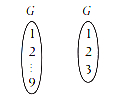
0 likes
View Solution137
EasyMCQ
If $f: R \setminus \{0\} \rightarrow R$ is defined by $f(x) = x + \frac{1}{x}$,then the value of $(f(x))^2 =$
A
$f(x) + f(0)$
B
$f(x^2) + f(2)$
C
$f(x^3) + f(0)$
D
$f(x^2) + f(1)$
Solution
(D) Given: $f(x) = x + \frac{1}{x}$
Squaring both sides,we get:
$(f(x))^2 = (x + \frac{1}{x})^2$
$(f(x))^2 = x^2 + \frac{1}{x^2} + 2 \cdot x \cdot \frac{1}{x}$
$(f(x))^2 = x^2 + \frac{1}{x^2} + 2$
Now,consider $f(x^2) = x^2 + \frac{1}{x^2}$ and $f(1) = 1 + \frac{1}{1} = 2$.
Substituting these into the expression:
$(f(x))^2 = f(x^2) + f(1)$
Squaring both sides,we get:
$(f(x))^2 = (x + \frac{1}{x})^2$
$(f(x))^2 = x^2 + \frac{1}{x^2} + 2 \cdot x \cdot \frac{1}{x}$
$(f(x))^2 = x^2 + \frac{1}{x^2} + 2$
Now,consider $f(x^2) = x^2 + \frac{1}{x^2}$ and $f(1) = 1 + \frac{1}{1} = 2$.
Substituting these into the expression:
$(f(x))^2 = f(x^2) + f(1)$
0 likes
View Solution138
EasyMCQ
Let $f : R \to R$ be a function defined by $f(x) = \frac{4^x}{4^x + 2}$. What is the value of $f(\frac{1}{4}) + 2 f(\frac{1}{2}) + f(\frac{3}{4})$?
A
$4$
B
$3$
C
$2$
D
$1$
Solution
(C) Given,$f(x) = \frac{4^x}{4^x + 2}$.
We observe that $f(1 - x) = \frac{4^{1 - x}}{4^{1 - x} + 2} = \frac{4/4^x}{4/4^x + 2} = \frac{4}{4 + 2 \cdot 4^x} = \frac{2}{2 + 4^x}$.
Also,$f(x) + f(1 - x) = \frac{4^x}{4^x + 2} + \frac{2}{4^x + 2} = \frac{4^x + 2}{4^x + 2} = 1$.
Therefore,$f(1 - x) = 1 - f(x)$.
We need to evaluate $S = f(\frac{1}{4}) + 2 f(\frac{1}{2}) + f(\frac{3}{4})$.
Since $f(\frac{1}{4}) + f(1 - \frac{1}{4}) = f(\frac{1}{4}) + f(\frac{3}{4}) = 1$,we can substitute $f(\frac{3}{4}) = 1 - f(\frac{1}{4})$.
Thus,$S = f(\frac{1}{4}) + 2 f(\frac{1}{2}) + (1 - f(\frac{1}{4})) = 1 + 2 f(\frac{1}{2})$.
Now,calculate $f(\frac{1}{2}) = \frac{4^{1/2}}{4^{1/2} + 2} = \frac{2}{2 + 2} = \frac{2}{4} = \frac{1}{2}$.
Substituting this back,$S = 1 + 2(\frac{1}{2}) = 1 + 1 = 2$.
We observe that $f(1 - x) = \frac{4^{1 - x}}{4^{1 - x} + 2} = \frac{4/4^x}{4/4^x + 2} = \frac{4}{4 + 2 \cdot 4^x} = \frac{2}{2 + 4^x}$.
Also,$f(x) + f(1 - x) = \frac{4^x}{4^x + 2} + \frac{2}{4^x + 2} = \frac{4^x + 2}{4^x + 2} = 1$.
Therefore,$f(1 - x) = 1 - f(x)$.
We need to evaluate $S = f(\frac{1}{4}) + 2 f(\frac{1}{2}) + f(\frac{3}{4})$.
Since $f(\frac{1}{4}) + f(1 - \frac{1}{4}) = f(\frac{1}{4}) + f(\frac{3}{4}) = 1$,we can substitute $f(\frac{3}{4}) = 1 - f(\frac{1}{4})$.
Thus,$S = f(\frac{1}{4}) + 2 f(\frac{1}{2}) + (1 - f(\frac{1}{4})) = 1 + 2 f(\frac{1}{2})$.
Now,calculate $f(\frac{1}{2}) = \frac{4^{1/2}}{4^{1/2} + 2} = \frac{2}{2 + 2} = \frac{2}{4} = \frac{1}{2}$.
Substituting this back,$S = 1 + 2(\frac{1}{2}) = 1 + 1 = 2$.
0 likes
View Solution139
DifficultMCQ
If $f: R \rightarrow R$ is defined as $f(x)=\frac{2020^x}{2020^x+\sqrt{2020}}$,$\forall x \in R$,then $\sum_{r=1}^{4039} 2 f\left(\frac{r}{4040}\right)=$
A
$4040$
B
$4039$
C
$2020$
D
$1010$
Solution
(B) Given $f(x) = \frac{2020^x}{2020^x + \sqrt{2020}}$.
Note that $f(1-x) = \frac{2020^{1-x}}{2020^{1-x} + \sqrt{2020}} = \frac{2020}{2020 + \sqrt{2020} \cdot 2020^x} = \frac{\sqrt{2020}}{\sqrt{2020} + 2020^x}$.
Thus,$f(x) + f(1-x) = \frac{2020^x + \sqrt{2020}}{2020^x + \sqrt{2020}} = 1$.
We need to evaluate $S = \sum_{r=1}^{4039} 2 f\left(\frac{r}{4040}\right) = 2 \sum_{r=1}^{4039} f\left(\frac{r}{4040}\right)$.
Pairing terms $f\left(\frac{r}{4040}\right)$ and $f\left(\frac{4040-r}{4040}\right)$,we have $f\left(\frac{r}{4040}\right) + f\left(1 - \frac{r}{4040}\right) = 1$.
There are $2019$ such pairs for $r=1$ to $2019$,plus the middle term $f\left(\frac{2020}{4040}\right) = f\left(\frac{1}{2}\right)$.
$f\left(\frac{1}{2}\right) = \frac{\sqrt{2020}}{\sqrt{2020} + \sqrt{2020}} = \frac{1}{2}$.
So,$\sum_{r=1}^{4039} f\left(\frac{r}{4040}\right) = 2019 \times 1 + \frac{1}{2} = 2019.5$.
Therefore,$S = 2 \times 2019.5 = 4039$.
Note that $f(1-x) = \frac{2020^{1-x}}{2020^{1-x} + \sqrt{2020}} = \frac{2020}{2020 + \sqrt{2020} \cdot 2020^x} = \frac{\sqrt{2020}}{\sqrt{2020} + 2020^x}$.
Thus,$f(x) + f(1-x) = \frac{2020^x + \sqrt{2020}}{2020^x + \sqrt{2020}} = 1$.
We need to evaluate $S = \sum_{r=1}^{4039} 2 f\left(\frac{r}{4040}\right) = 2 \sum_{r=1}^{4039} f\left(\frac{r}{4040}\right)$.
Pairing terms $f\left(\frac{r}{4040}\right)$ and $f\left(\frac{4040-r}{4040}\right)$,we have $f\left(\frac{r}{4040}\right) + f\left(1 - \frac{r}{4040}\right) = 1$.
There are $2019$ such pairs for $r=1$ to $2019$,plus the middle term $f\left(\frac{2020}{4040}\right) = f\left(\frac{1}{2}\right)$.
$f\left(\frac{1}{2}\right) = \frac{\sqrt{2020}}{\sqrt{2020} + \sqrt{2020}} = \frac{1}{2}$.
So,$\sum_{r=1}^{4039} f\left(\frac{r}{4040}\right) = 2019 \times 1 + \frac{1}{2} = 2019.5$.
Therefore,$S = 2 \times 2019.5 = 4039$.
0 likes
View Solution140
MediumMCQ
If $f: R-\{0\} \rightarrow R$ is defined by $f(x)=x+\frac{1}{x}$ and if $f^k(x)=[f(x)]^k$ for $k \geq 1$,then find the value of $f^4(x)-f(x^4)-4f^2(x)$.
A
-$2$
B
$2$
C
$1$
D
-$1$
Solution
(A) Given $f(x) = x + \frac{1}{x}$.
We need to evaluate $f^4(x) - f(x^4) - 4f^2(x)$.
First,calculate $f^2(x) = (x + \frac{1}{x})^2 = x^2 + 2 + \frac{1}{x^2}$.
Next,calculate $f^4(x) = (f^2(x))^2 = (x^2 + 2 + \frac{1}{x^2})^2 = (x^2)^2 + 2^2 + (\frac{1}{x^2})^2 + 2(x^2)(2) + 2(x^2)(\frac{1}{x^2}) + 2(2)(\frac{1}{x^2}) = x^4 + 4 + \frac{1}{x^4} + 4x^2 + 2 + \frac{4}{x^2} = x^4 + 4x^2 + 6 + \frac{4}{x^2} + \frac{1}{x^4}$.
Now,calculate $f(x^4) = x^4 + \frac{1}{x^4}$.
Also,$4f^2(x) = 4(x^2 + 2 + \frac{1}{x^2}) = 4x^2 + 8 + \frac{4}{x^2}$.
Substitute these into the expression:
$f^4(x) - f(x^4) - 4f^2(x) = (x^4 + 4x^2 + 6 + \frac{4}{x^2} + \frac{1}{x^4}) - (x^4 + \frac{1}{x^4}) - (4x^2 + 8 + \frac{4}{x^2})$.
$= x^4 + 4x^2 + 6 + \frac{4}{x^2} + \frac{1}{x^4} - x^4 - \frac{1}{x^4} - 4x^2 - 8 - \frac{4}{x^2}$.
$= 6 - 8 = -2$.
We need to evaluate $f^4(x) - f(x^4) - 4f^2(x)$.
First,calculate $f^2(x) = (x + \frac{1}{x})^2 = x^2 + 2 + \frac{1}{x^2}$.
Next,calculate $f^4(x) = (f^2(x))^2 = (x^2 + 2 + \frac{1}{x^2})^2 = (x^2)^2 + 2^2 + (\frac{1}{x^2})^2 + 2(x^2)(2) + 2(x^2)(\frac{1}{x^2}) + 2(2)(\frac{1}{x^2}) = x^4 + 4 + \frac{1}{x^4} + 4x^2 + 2 + \frac{4}{x^2} = x^4 + 4x^2 + 6 + \frac{4}{x^2} + \frac{1}{x^4}$.
Now,calculate $f(x^4) = x^4 + \frac{1}{x^4}$.
Also,$4f^2(x) = 4(x^2 + 2 + \frac{1}{x^2}) = 4x^2 + 8 + \frac{4}{x^2}$.
Substitute these into the expression:
$f^4(x) - f(x^4) - 4f^2(x) = (x^4 + 4x^2 + 6 + \frac{4}{x^2} + \frac{1}{x^4}) - (x^4 + \frac{1}{x^4}) - (4x^2 + 8 + \frac{4}{x^2})$.
$= x^4 + 4x^2 + 6 + \frac{4}{x^2} + \frac{1}{x^4} - x^4 - \frac{1}{x^4} - 4x^2 - 8 - \frac{4}{x^2}$.
$= 6 - 8 = -2$.
0 likes
View Solution141
EasyMCQ
Let $f: R \rightarrow R$ be defined by $f(x)=2x+3$. If $\alpha$ and $\beta$ are the roots of the equation $f(x^2)-2f(\frac{x}{2})-1=0$,then $\alpha^2+\beta^2=$
A
$13$
B
$25$
C
$5$
D
$18$
Solution
(C) Given $f(x) = 2x + 3$.
Substituting the function into the equation $f(x^2) - 2f(\frac{x}{2}) - 1 = 0$:
$(2x^2 + 3) - 2(2(\frac{x}{2}) + 3) - 1 = 0$
$2x^2 + 3 - 2(x + 3) - 1 = 0$
$2x^2 + 3 - 2x - 6 - 1 = 0$
$2x^2 - 2x - 4 = 0$
Dividing by $2$:
$x^2 - x - 2 = 0$
$(x - 2)(x + 1) = 0$
So,the roots are $\alpha = 2$ and $\beta = -1$.
Therefore,$\alpha^2 + \beta^2 = (2)^2 + (-1)^2 = 4 + 1 = 5$.
Substituting the function into the equation $f(x^2) - 2f(\frac{x}{2}) - 1 = 0$:
$(2x^2 + 3) - 2(2(\frac{x}{2}) + 3) - 1 = 0$
$2x^2 + 3 - 2(x + 3) - 1 = 0$
$2x^2 + 3 - 2x - 6 - 1 = 0$
$2x^2 - 2x - 4 = 0$
Dividing by $2$:
$x^2 - x - 2 = 0$
$(x - 2)(x + 1) = 0$
So,the roots are $\alpha = 2$ and $\beta = -1$.
Therefore,$\alpha^2 + \beta^2 = (2)^2 + (-1)^2 = 4 + 1 = 5$.
0 likes
View Solution142
EasyMCQ
Consider the following statements:
$(i)$ $A$ relation is a special case of a function.
$(ii)$ $A$ function is a special case of a relation.
$(iii)$ Both relation and function are the same.
$(i)$ $A$ relation is a special case of a function.
$(ii)$ $A$ function is a special case of a relation.
$(iii)$ Both relation and function are the same.
A
$(iii)$ is true,$(i)$ and $(ii)$ are false
B
$(i)$ is true,$(ii)$ and $(iii)$ are false
C
$(ii)$ is true,$(i)$ and $(iii)$ are false
D
All $(i)$,$(ii)$ and $(iii)$ are true
Solution
(C) relation is defined as a subset of the Cartesian product of two sets $A \times B$.
$A$ function is a specific type of relation where every element in the domain has exactly one image in the codomain.
Therefore,every function is a relation,but not every relation is a function.
Thus,statement $(ii)$ is true,while $(i)$ and $(iii)$ are false.
$A$ function is a specific type of relation where every element in the domain has exactly one image in the codomain.
Therefore,every function is a relation,but not every relation is a function.
Thus,statement $(ii)$ is true,while $(i)$ and $(iii)$ are false.
0 likes
View Solution143
MediumMCQ
Let $f(x) = |x|$ and $g(x) = |x| + a$,where $a > 0$. For $0 \leq x \leq b$,the set $\{(x, y) \mid g(x) \leq y \leq f(x)\}$ represents all the points in the interior of:
A
a parallelogram
B
a triangle
C
a square
D
a circle
Solution
(A) Given functions are $f(x) = |x|$ and $g(x) = |x| + a$ with $a > 0$.
For $0 \leq x \leq b$,the region is defined by $g(x) \leq y \leq f(x)$,which implies $|x| + a \leq y \leq |x|$.
However,since $a > 0$,$|x| + a$ is always greater than $|x|$. Thus,the condition $g(x) \leq y \leq f(x)$ is impossible for $a > 0$ as it implies $|x| + a \leq y \leq |x|$,which is a contradiction.
Re-evaluating the problem statement based on the provided image,the region is bounded by $x=0$,$x=b$,$y=|x|$,and $y=|x|+a$.
For $x \geq 0$,$f(x) = x$ and $g(x) = x + a$.
The region is bounded by $x=0$,$x=b$,$y=x$,and $y=x+a$.
These lines are $x=0$,$x=b$,$y-x=0$,and $y-x=a$.
The lines $y-x=0$ and $y-x=a$ are parallel,and the lines $x=0$ and $x=b$ are parallel.
Therefore,the region is a parallelogram.
For $0 \leq x \leq b$,the region is defined by $g(x) \leq y \leq f(x)$,which implies $|x| + a \leq y \leq |x|$.
However,since $a > 0$,$|x| + a$ is always greater than $|x|$. Thus,the condition $g(x) \leq y \leq f(x)$ is impossible for $a > 0$ as it implies $|x| + a \leq y \leq |x|$,which is a contradiction.
Re-evaluating the problem statement based on the provided image,the region is bounded by $x=0$,$x=b$,$y=|x|$,and $y=|x|+a$.
For $x \geq 0$,$f(x) = x$ and $g(x) = x + a$.
The region is bounded by $x=0$,$x=b$,$y=x$,and $y=x+a$.
These lines are $x=0$,$x=b$,$y-x=0$,and $y-x=a$.
The lines $y-x=0$ and $y-x=a$ are parallel,and the lines $x=0$ and $x=b$ are parallel.
Therefore,the region is a parallelogram.
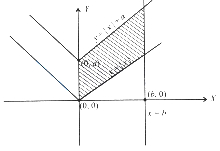
0 likes
View Solution144
DifficultMCQ
Let $N$ be the set of all natural numbers and $f: N \rightarrow N$ be such that $1990 < f(1990) < 2100$ and satisfies the equation $x-f(x)=19[\frac{x}{19}]-90[\frac{f(x)}{90}]$,where $[y]$ denotes the greatest integer less than or equal to $y$. Then the number of possible values of $f(1990)$ is
A
$1$
B
$2$
C
$3$
D
$4$
Solution
(B) Given the equation $x - f(x) = 19[\frac{x}{19}] - 90[\frac{f(x)}{90}]$.
Rearranging the terms,we get $x - 19[\frac{x}{19}] = f(x) - 90[\frac{f(x)}{90}]$.
This is equivalent to $x \pmod{19} = f(x) \pmod{90}$.
Let $x = 1990$. Then $1990 = 19 \times 104 + 14$,so $1990 \equiv 14 \pmod{19}$.
Thus,$f(1990) \equiv 14 \pmod{90}$.
This means $f(1990) = 90k + 14$ for some integer $k$.
We are given $1990 < f(1990) < 2100$.
Substituting $f(1990) = 90k + 14$,we get $1990 < 90k + 14 < 2100$.
$1976 < 90k < 2086$.
Dividing by $90$,we get $21.95 < k < 23.17$.
Since $k$ must be an integer,$k = 22$ or $k = 23$.
If $k = 22$,$f(1990) = 90(22) + 14 = 1980 + 14 = 1994$.
If $k = 23$,$f(1990) = 90(23) + 14 = 2070 + 14 = 2084$.
Both values satisfy the condition $1990 < f(1990) < 2100$.
Thus,there are $2$ possible values for $f(1990)$.
Rearranging the terms,we get $x - 19[\frac{x}{19}] = f(x) - 90[\frac{f(x)}{90}]$.
This is equivalent to $x \pmod{19} = f(x) \pmod{90}$.
Let $x = 1990$. Then $1990 = 19 \times 104 + 14$,so $1990 \equiv 14 \pmod{19}$.
Thus,$f(1990) \equiv 14 \pmod{90}$.
This means $f(1990) = 90k + 14$ for some integer $k$.
We are given $1990 < f(1990) < 2100$.
Substituting $f(1990) = 90k + 14$,we get $1990 < 90k + 14 < 2100$.
$1976 < 90k < 2086$.
Dividing by $90$,we get $21.95 < k < 23.17$.
Since $k$ must be an integer,$k = 22$ or $k = 23$.
If $k = 22$,$f(1990) = 90(22) + 14 = 1980 + 14 = 1994$.
If $k = 23$,$f(1990) = 90(23) + 14 = 2070 + 14 = 2084$.
Both values satisfy the condition $1990 < f(1990) < 2100$.
Thus,there are $2$ possible values for $f(1990)$.
0 likes
View Solution145
MediumMCQ
Let $[x]$ represent the greatest integer less than or equal to $x$,${x} = x - [x]$,$\sqrt{2} = 1.414$ and $\sqrt{3} = 1.732$. If $f(x) = \{x + [\frac{x}{1+x^2}]\}$ is a real-valued function,then $f(\sqrt{2}) + f(-\sqrt{3}) = $
A
$0.682$
B
$0.318$
C
$0.146$
D
$1.146$
Solution
(A) Given $f(x) = \{x + [\frac{x}{1+x^2}]\}$.
Since $[n + I] = [n] + I$ for any integer $I$,we have $f(x) = \{x + [\frac{x}{1+x^2}]\} = \{x\} + [\frac{x}{1+x^2}] - [\{x\} + [\frac{x}{1+x^2}]] = \{x\}$.
Thus,$f(x) = \{x\} = x - [x]$.
Now,calculate $f(\sqrt{2}) = \{\sqrt{2}\} = \sqrt{2} - [\sqrt{2}] = 1.414 - 1 = 0.414$.
Next,calculate $f(-\sqrt{3}) = \{-\sqrt{3}\} = -\sqrt{3} - [-\sqrt{3}] = -1.732 - (-2) = -1.732 + 2 = 0.268$.
Therefore,$f(\sqrt{2}) + f(-\sqrt{3}) = 0.414 + 0.268 = 0.682$.
Since $[n + I] = [n] + I$ for any integer $I$,we have $f(x) = \{x + [\frac{x}{1+x^2}]\} = \{x\} + [\frac{x}{1+x^2}] - [\{x\} + [\frac{x}{1+x^2}]] = \{x\}$.
Thus,$f(x) = \{x\} = x - [x]$.
Now,calculate $f(\sqrt{2}) = \{\sqrt{2}\} = \sqrt{2} - [\sqrt{2}] = 1.414 - 1 = 0.414$.
Next,calculate $f(-\sqrt{3}) = \{-\sqrt{3}\} = -\sqrt{3} - [-\sqrt{3}] = -1.732 - (-2) = -1.732 + 2 = 0.268$.
Therefore,$f(\sqrt{2}) + f(-\sqrt{3}) = 0.414 + 0.268 = 0.682$.
0 likes
View Solution146
DifficultMCQ
Match the items of List-$I$ with those of the items of List-$II$:
| List-$I$ | List-$II$ |
| $A$. Range of $\sec ^{-1}\left[1+\cos ^2 x\right]$,where $[.]$ denotes the greatest integer function | $I$. Odd function |
| $B$. Domain of $f(x)$ where $f\left(x+\frac{1}{x}\right)=x^2+\frac{1}{x^2}$ | $II$. $\left\{0, \frac{1}{2}\right\}$ |
| $C$. $f(x+y)=f(x)+f(y) ; f(1)=5$ | $III$. $\left\{\sec ^{-1} 5, \sec ^{-1} 4\right\}$ |
| $D$. $\sin ^{-1} x-\cos ^{-1} x+\sin ^{-1}(1-x)=0 \Rightarrow x \in$ | $IV$. $R$ |
| $V$. $\left\{\sec ^{-1} 1, \sec ^{-1} 2\right\}$ |
A
$A-V, B-IV, C-I, D-II$
B
$A-V, B-IV, C-I, D-II$
C
$A-V, B-II, C-III, D-IV$
D
$A-II, B-II, C-I, D-IV$
Solution
(A) $A)$ Range of $\cos ^2 x \in [0, 1]$.
$\Rightarrow 1+\cos ^2 x \in [1, 2]$.
$\Rightarrow [1+\cos ^2 x] \in \{1, 2\}$.
$\Rightarrow \sec ^{-1}[1+\cos ^2 x] \in \{\sec ^{-1} 1, \sec ^{-1} 2\}$. Thus,$A-V$.
$B)$ Given $f(x+\frac{1}{x}) = x^2+\frac{1}{x^2} = (x+\frac{1}{x})^2 - 2$.
Let $t = x+\frac{1}{x}$. Since $|x+\frac{1}{x}| \ge 2$,the domain of $f(t)$ is $(-\infty, -2] \cup [2, \infty)$. However,if we consider the function definition $f(t) = t^2-2$,the domain is $R$. Given the context of such problems,$f(x) = x^2-2$ is defined for all $x \in R$. Thus,$B-IV$.
$C)$ $f(x+y) = f(x)+f(y)$ is Cauchy's functional equation,so $f(x) = kx$.
Given $f(1) = 5$,we have $k(1) = 5 \Rightarrow k = 5$.
So $f(x) = 5x$,which is an odd function since $f(-x) = 5(-x) = -f(x)$. Thus,$C-I$.
$D)$ $\sin ^{-1} x - \cos ^{-1} x + \sin ^{-1}(1-x) = 0$.
For $x=0$: $\sin ^{-1}(0) - \cos ^{-1}(0) + \sin ^{-1}(1) = 0 - \frac{\pi}{2} + \frac{\pi}{2} = 0$. (Correct)
For $x=\frac{1}{2}$: $\sin ^{-1}(\frac{1}{2}) - \cos ^{-1}(\frac{1}{2}) + \sin ^{-1}(\frac{1}{2}) = \frac{\pi}{6} - \frac{\pi}{3} + \frac{\pi}{6} = 0$. (Correct)
Thus,$D-II$.
$\Rightarrow 1+\cos ^2 x \in [1, 2]$.
$\Rightarrow [1+\cos ^2 x] \in \{1, 2\}$.
$\Rightarrow \sec ^{-1}[1+\cos ^2 x] \in \{\sec ^{-1} 1, \sec ^{-1} 2\}$. Thus,$A-V$.
$B)$ Given $f(x+\frac{1}{x}) = x^2+\frac{1}{x^2} = (x+\frac{1}{x})^2 - 2$.
Let $t = x+\frac{1}{x}$. Since $|x+\frac{1}{x}| \ge 2$,the domain of $f(t)$ is $(-\infty, -2] \cup [2, \infty)$. However,if we consider the function definition $f(t) = t^2-2$,the domain is $R$. Given the context of such problems,$f(x) = x^2-2$ is defined for all $x \in R$. Thus,$B-IV$.
$C)$ $f(x+y) = f(x)+f(y)$ is Cauchy's functional equation,so $f(x) = kx$.
Given $f(1) = 5$,we have $k(1) = 5 \Rightarrow k = 5$.
So $f(x) = 5x$,which is an odd function since $f(-x) = 5(-x) = -f(x)$. Thus,$C-I$.
$D)$ $\sin ^{-1} x - \cos ^{-1} x + \sin ^{-1}(1-x) = 0$.
For $x=0$: $\sin ^{-1}(0) - \cos ^{-1}(0) + \sin ^{-1}(1) = 0 - \frac{\pi}{2} + \frac{\pi}{2} = 0$. (Correct)
For $x=\frac{1}{2}$: $\sin ^{-1}(\frac{1}{2}) - \cos ^{-1}(\frac{1}{2}) + \sin ^{-1}(\frac{1}{2}) = \frac{\pi}{6} - \frac{\pi}{3} + \frac{\pi}{6} = 0$. (Correct)
Thus,$D-II$.
0 likes
View Solution147
MediumMCQ
The number of roots of the equation $\sqrt{2}+e^{\cosh^{-1} x}-e^{\sinh^{-1} x}=0$ is
A
$0$
B
$1$
C
$2$
D
$3$
Solution
(B) Identify the Domain and Use Logarithmic Forms:
First,note that the function $\cosh^{-1} x$ is only defined for $x \geq 1$. Therefore,we must have $x \geq 1$.
We use the logarithmic definitions of inverse hyperbolic functions:
$e^{\cosh^{-1} x} = x + \sqrt{x^2 - 1}$
$e^{\sinh^{-1} x} = x + \sqrt{x^2 + 1}$
Substitute and Simplify the Equation:
Substitute these expressions back into the original equation:
$\sqrt{2} + (x + \sqrt{x^2 - 1}) - (x + \sqrt{x^2 + 1}) = 0$
The $x$ terms cancel out,leaving:
$\sqrt{2} + \sqrt{x^2 - 1} - \sqrt{x^2 + 1} = 0$
$\sqrt{2} + \sqrt{x^2 - 1} = \sqrt{x^2 + 1}$
Solve for $x$:
Square both sides of the equation to eliminate the radicals:
$(\sqrt{2} + \sqrt{x^2 - 1})^2 = (\sqrt{x^2 + 1})^2$
$2 + (x^2 - 1) + 2\sqrt{2}\sqrt{x^2 - 1} = x^2 + 1$
$x^2 + 1 + 2\sqrt{2}\sqrt{x^2 - 1} = x^2 + 1$
Subtract $x^2 + 1$ from both sides:
$2\sqrt{2}\sqrt{x^2 - 1} = 0$
$\sqrt{x^2 - 1} = 0 \implies x^2 = 1 \implies x = \pm 1$
Since the domain requires $x \geq 1$,the only valid solution is $x = 1$. Thus,there is $1$ root.
First,note that the function $\cosh^{-1} x$ is only defined for $x \geq 1$. Therefore,we must have $x \geq 1$.
We use the logarithmic definitions of inverse hyperbolic functions:
$e^{\cosh^{-1} x} = x + \sqrt{x^2 - 1}$
$e^{\sinh^{-1} x} = x + \sqrt{x^2 + 1}$
Substitute and Simplify the Equation:
Substitute these expressions back into the original equation:
$\sqrt{2} + (x + \sqrt{x^2 - 1}) - (x + \sqrt{x^2 + 1}) = 0$
The $x$ terms cancel out,leaving:
$\sqrt{2} + \sqrt{x^2 - 1} - \sqrt{x^2 + 1} = 0$
$\sqrt{2} + \sqrt{x^2 - 1} = \sqrt{x^2 + 1}$
Solve for $x$:
Square both sides of the equation to eliminate the radicals:
$(\sqrt{2} + \sqrt{x^2 - 1})^2 = (\sqrt{x^2 + 1})^2$
$2 + (x^2 - 1) + 2\sqrt{2}\sqrt{x^2 - 1} = x^2 + 1$
$x^2 + 1 + 2\sqrt{2}\sqrt{x^2 - 1} = x^2 + 1$
Subtract $x^2 + 1$ from both sides:
$2\sqrt{2}\sqrt{x^2 - 1} = 0$
$\sqrt{x^2 - 1} = 0 \implies x^2 = 1 \implies x = \pm 1$
Since the domain requires $x \geq 1$,the only valid solution is $x = 1$. Thus,there is $1$ root.
0 likes
View Solution148
MediumMCQ
Match the functions given in List-$I$ with their relevant characteristics from List-$II$.
The correct answer is
| List-$I$ | List-$II$ |
| $(A)$ $\sinh x$ | $(I)$ Domain is $(-1, 1)$,even function |
| $(B)$ $\text{sech } x$ | $(II)$ Domain is $[1, \infty)$,neither even nor odd function |
| $(C)$ $\tanh x$ | $(III)$ Even function |
| $(D)$ $\text{cosech}^{-1} x$ | $(IV)$ Range is $\mathbb{R}$,odd function |
| $(V)$ Range is $(-1, 1)$,odd function |
A
$A-II, B-III, C-IV, D-V$
B
$A-V, B-I, C-II, D-III$
C
$A-IV, B-II, C-I, D-V$
D
$A-IV, B-III, C-V, D-II$
Solution
(D) $\sinh x = \frac{e^x - e^{-x}}{2}$. Since $\sinh(-x) = \frac{e^{-x} - e^x}{2} = -\sinh x$,it is an odd function with range $\mathbb{R}$. Thus,$A-IV$.
$(B)$ $\text{sech } x = \frac{2}{e^x + e^{-x}}$. Since $\text{sech}(-x) = \frac{2}{e^{-x} + e^x} = \text{sech } x$,it is an even function. Thus,$B-III$.
$(C)$ $\tanh x = \frac{e^x - e^{-x}}{e^x + e^{-x}}$. Since $\tanh(-x) = -\tanh x$,it is an odd function with range $(-1, 1)$. Thus,$C-V$.
$(D)$ $\text{cosech}^{-1} x = \ln\left(\frac{1}{x} + \frac{\sqrt{1+x^2}}{|x|}\right)$. The domain is $x \neq 0$ and it is neither even nor odd. Thus,$D-II$.
Therefore,the correct matching is $A-IV, B-III, C-V, D-II$.
$(B)$ $\text{sech } x = \frac{2}{e^x + e^{-x}}$. Since $\text{sech}(-x) = \frac{2}{e^{-x} + e^x} = \text{sech } x$,it is an even function. Thus,$B-III$.
$(C)$ $\tanh x = \frac{e^x - e^{-x}}{e^x + e^{-x}}$. Since $\tanh(-x) = -\tanh x$,it is an odd function with range $(-1, 1)$. Thus,$C-V$.
$(D)$ $\text{cosech}^{-1} x = \ln\left(\frac{1}{x} + \frac{\sqrt{1+x^2}}{|x|}\right)$. The domain is $x \neq 0$ and it is neither even nor odd. Thus,$D-II$.
Therefore,the correct matching is $A-IV, B-III, C-V, D-II$.
0 likes
View Solution149
DifficultMCQ
If $f : R \rightarrow R$ is defined by $f(x) = \begin{cases} x + 4, & x < -4 \\ 3x + 2, & -4 \leq x < 4 \\ x - 4, & x \geq 4 \end{cases}$ then the correct matching of List-$I$ from List-$II$ is :
List-$I$
$(A) f(-5) + f(-4)$
$(B) f(|f(-8)|)$
$(C) f(f(-7) + f(3))$
$(D) f(f(f(f(0)))) + 1$
List-$II$
$(i) 14$
$(ii) 4$
$(iii) -11$
$(iv) -1$
$(v) 1$
$(vi) 0$
List-$I$
$(A) f(-5) + f(-4)$
$(B) f(|f(-8)|)$
$(C) f(f(-7) + f(3))$
$(D) f(f(f(f(0)))) + 1$
List-$II$
$(i) 14$
$(ii) 4$
$(iii) -11$
$(iv) -1$
$(v) 1$
$(vi) 0$
A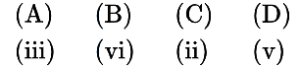
B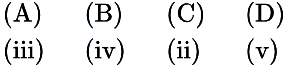
C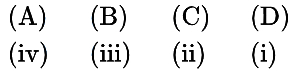
D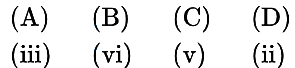
Solution
(D) Given $f(x) = \begin{cases} x + 4, & x < -4 \\ 3x + 2, & -4 \leq x < 4 \\ x - 4, & x \geq 4 \end{cases}$
$(A) f(-5) + f(-4) = (-5 + 4) + (3(-4) + 2) = -1 + (-12 + 2) = -1 - 10 = -11$. Thus,$(A) \rightarrow (iii)$.
$(B) f(|f(-8)|) = f(|-8 + 4|) = f(|-4|) = f(4) = 4 - 4 = 0$. Thus,$(B) \rightarrow (vi)$.
$(C) f(f(-7) + f(3)) = f((-7 + 4) + (3(3) + 2)) = f(-3 + 11) = f(8) = 8 - 4 = 4$. Thus,$(C) \rightarrow (ii)$.
$(D) f(f(f(f(0)))) + 1$. First,$f(0) = 3(0) + 2 = 2$. Then $f(f(0)) = f(2) = 3(2) + 2 = 8$. Then $f(f(f(0))) = f(8) = 8 - 4 = 4$. Then $f(f(f(f(0)))) = f(4) = 4 - 4 = 0$. Finally,$0 + 1 = 1$. Thus,$(D) \rightarrow (v)$.
The correct matching is $(A)-(iii), (B)-(vi), (C)-(ii), (D)-(v)$.
$(A) f(-5) + f(-4) = (-5 + 4) + (3(-4) + 2) = -1 + (-12 + 2) = -1 - 10 = -11$. Thus,$(A) \rightarrow (iii)$.
$(B) f(|f(-8)|) = f(|-8 + 4|) = f(|-4|) = f(4) = 4 - 4 = 0$. Thus,$(B) \rightarrow (vi)$.
$(C) f(f(-7) + f(3)) = f((-7 + 4) + (3(3) + 2)) = f(-3 + 11) = f(8) = 8 - 4 = 4$. Thus,$(C) \rightarrow (ii)$.
$(D) f(f(f(f(0)))) + 1$. First,$f(0) = 3(0) + 2 = 2$. Then $f(f(0)) = f(2) = 3(2) + 2 = 8$. Then $f(f(f(0))) = f(8) = 8 - 4 = 4$. Then $f(f(f(f(0)))) = f(4) = 4 - 4 = 0$. Finally,$0 + 1 = 1$. Thus,$(D) \rightarrow (v)$.
The correct matching is $(A)-(iii), (B)-(vi), (C)-(ii), (D)-(v)$.
0 likes
View Solution150
DifficultMCQ
If $e^{f(x)}=\frac{10+x}{10-x}, x \in(-10,10)$ and $f(x)=k f\left(\frac{200 x}{100+x^2}\right)$,then $k$ is equal to
A
$0.5$
B
$0.6$
C
$0.7$
D
$0.8$
Solution
(A) Given $e^{f(x)}=\frac{10+x}{10-x}$.
Taking the natural logarithm on both sides,we get $f(x)=\log \left(\frac{10+x}{10-x}\right)$.
We are given the relation $f(x)=k f\left(\frac{200 x}{100+x^2}\right)$.
Substituting the expression for $f(x)$ into the right side:
$f\left(\frac{200 x}{100+x^2}\right) = \log \left( \frac{10 + \frac{200x}{100+x^2}}{10 - \frac{200x}{100+x^2}} \right)$
$= \log \left( \frac{10(100+x^2) + 200x}{10(100+x^2) - 200x} \right)$
$= \log \left( \frac{1000 + 10x^2 + 200x}{1000 + 10x^2 - 200x} \right)$
$= \log \left( \frac{10(x^2 + 20x + 100)}{10(x^2 - 20x + 100)} \right)$
$= \log \left( \frac{(x+10)^2}{(10-x)^2} \right)$
$= 2 \log \left( \frac{10+x}{10-x} \right) = 2f(x)$.
Substituting this back into the given equation: $f(x) = k \cdot 2f(x)$.
Since $f(x) \neq 0$ for $x \in (-10, 10)$,we have $1 = 2k$,which implies $k = 0.5$.
Taking the natural logarithm on both sides,we get $f(x)=\log \left(\frac{10+x}{10-x}\right)$.
We are given the relation $f(x)=k f\left(\frac{200 x}{100+x^2}\right)$.
Substituting the expression for $f(x)$ into the right side:
$f\left(\frac{200 x}{100+x^2}\right) = \log \left( \frac{10 + \frac{200x}{100+x^2}}{10 - \frac{200x}{100+x^2}} \right)$
$= \log \left( \frac{10(100+x^2) + 200x}{10(100+x^2) - 200x} \right)$
$= \log \left( \frac{1000 + 10x^2 + 200x}{1000 + 10x^2 - 200x} \right)$
$= \log \left( \frac{10(x^2 + 20x + 100)}{10(x^2 - 20x + 100)} \right)$
$= \log \left( \frac{(x+10)^2}{(10-x)^2} \right)$
$= 2 \log \left( \frac{10+x}{10-x} \right) = 2f(x)$.
Substituting this back into the given equation: $f(x) = k \cdot 2f(x)$.
Since $f(x) \neq 0$ for $x \in (-10, 10)$,we have $1 = 2k$,which implies $k = 0.5$.
0 likes
View SolutionRelation and Function — Mix Examples of Relation and Function · Frequently Asked Questions
1Are these Relation and Function questions useful for JEE and NEET?
Yes. All questions in this section are mapped to JEE Main and NEET exam patterns. Previous year questions from JEE Main, NEET, GUJCET and state-level exams are included with full solutions.
2Can I switch to Hindi or Gujarati for these questions?
Yes. Use the language tabs in the hero section or the sidebar to view the same questions and solutions in English, Hindi or Gujarati.
3How do I generate a question paper from this subtopic?
Use the Vedclass Exam Paper Generator — select the chapter and subtopic, set difficulty, and generate Sets A, B, C, D automatically. First 3 chapters of every subject are free.
Vedclass Products
For Students
Vedclass Test Series
Mock tests in real JEE/NEET style with performance analysis. 5-day free trial.
Start Free TrialFor Teachers
Exam Paper Generator
Generate Set A/B/C/D papers from this chapter in 2 minutes. 3 chapters free.
Try FreeFor Institutes
Online Exam Module
Live online exams with unlimited students, 360° analytics & white-label branding.
See DemoFor Teachers & Institutes
Generate a Relation and Function Exam Paper in 2 Minutes
Select subtopic & difficulty — Sets A, B, C, D auto-generated with No Repeat logic.
First 3 chapters of every subject are free — no payment required.