
A English
Binomial distribution Questions in English
Class 12 Mathematics · Probability · Binomial distribution
482+
Questions
English
Language
100%
With Solutions
Showing 49 of 482 questions in English
251
DifficultMCQ
Minimum number of times a fair coin must be tossed,so that the probability of getting at least one head,is more than $99 \%$ is
A
$5$
B
$6$
C
$7$
D
$8$
Solution
(C) Let the coin be tossed $n$ times.
Probability of getting a head in a single toss is $p = \frac{1}{2}$.
Probability of not getting a head (tail) is $q = 1 - p = \frac{1}{2}$.
The probability of getting at least one head in $n$ tosses is $P(X \geq 1) = 1 - P(X = 0)$.
Given that $P(X \geq 1) > \frac{99}{100}$.
Therefore,$1 - P(X = 0) > \frac{99}{100}$.
Since $P(X = 0) = (\frac{1}{2})^n$,we have $1 - (\frac{1}{2})^n > \frac{99}{100}$.
This simplifies to $1 - \frac{99}{100} > (\frac{1}{2})^n$,which means $\frac{1}{100} > (\frac{1}{2})^n$.
Taking the reciprocal,we get $100 < 2^n$.
For $n = 6$,$2^6 = 64$,which is less than $100$.
For $n = 7$,$2^7 = 128$,which is greater than $100$.
Thus,the minimum number of tosses required is $7$.
Probability of getting a head in a single toss is $p = \frac{1}{2}$.
Probability of not getting a head (tail) is $q = 1 - p = \frac{1}{2}$.
The probability of getting at least one head in $n$ tosses is $P(X \geq 1) = 1 - P(X = 0)$.
Given that $P(X \geq 1) > \frac{99}{100}$.
Therefore,$1 - P(X = 0) > \frac{99}{100}$.
Since $P(X = 0) = (\frac{1}{2})^n$,we have $1 - (\frac{1}{2})^n > \frac{99}{100}$.
This simplifies to $1 - \frac{99}{100} > (\frac{1}{2})^n$,which means $\frac{1}{100} > (\frac{1}{2})^n$.
Taking the reciprocal,we get $100 < 2^n$.
For $n = 6$,$2^6 = 64$,which is less than $100$.
For $n = 7$,$2^7 = 128$,which is greater than $100$.
Thus,the minimum number of tosses required is $7$.
0 likes
View Solution252
MediumMCQ
The probability that a person who undergoes a bypass surgery will recover is $0.6$. The probability that of the $6$ patients who undergo similar operations,half of them will recover is:
A
$0.2762$
B
$0.1852$
C
$0.2074$
D
$0.7235$
Solution
(A) Let $X$ be the number of patients who recover. This follows a binomial distribution $B(n, p)$ where $n = 6$ and $p = 0.6$.
Here,$q = 1 - p = 1 - 0.6 = 0.4$.
We need to find the probability that half of the $6$ patients recover,which is $P(X = 3)$.
Using the binomial probability formula $P(X = k) = ^nC_k p^k q^{n-k}$:
$P(X = 3) = ^6C_3 \times (0.6)^3 \times (0.4)^{6-3}$
$P(X = 3) = \frac{6 \times 5 \times 4}{3 \times 2 \times 1} \times (0.6)^3 \times (0.4)^3$
$P(X = 3) = 20 \times 0.216 \times 0.064$
$P(X = 3) = 0.27648 \approx 0.2762$ (rounding to the given option).
Here,$q = 1 - p = 1 - 0.6 = 0.4$.
We need to find the probability that half of the $6$ patients recover,which is $P(X = 3)$.
Using the binomial probability formula $P(X = k) = ^nC_k p^k q^{n-k}$:
$P(X = 3) = ^6C_3 \times (0.6)^3 \times (0.4)^{6-3}$
$P(X = 3) = \frac{6 \times 5 \times 4}{3 \times 2 \times 1} \times (0.6)^3 \times (0.4)^3$
$P(X = 3) = 20 \times 0.216 \times 0.064$
$P(X = 3) = 0.27648 \approx 0.2762$ (rounding to the given option).
0 likes
View Solution253
MediumMCQ
One hundred identical coins,each with probability $p$ of showing up heads,are tossed once. If $0 < p < 1$ and the probability of heads showing on $50$ coins is equal to that of heads showing on $51$ coins,then the value of $p$ is
A
$\frac{1}{2}$
B
$\frac{49}{101}$
C
$\frac{50}{101}$
D
$\frac{51}{101}$
Solution
(D) Let $X$ be the number of heads,which follows a binomial distribution $B(n, p)$ with $n = 100$.
The probability of getting $k$ heads is given by $P(X=k) = {}^{n}C_{k} p^{k} (1-p)^{n-k}$.
We are given that $P(X=50) = P(X=51)$.
Substituting the values,we get:
${}^{100}C_{50} p^{50} (1-p)^{50} = {}^{100}C_{51} p^{51} (1-p)^{49}$.
Dividing both sides by $p^{50} (1-p)^{49}$,we get:
${}^{100}C_{50} (1-p) = {}^{100}C_{51} p$.
Rearranging to solve for $p$:
$\frac{1-p}{p} = \frac{{}^{100}C_{51}}{{}^{100}C_{50}} = \frac{100!}{51! 49!} \times \frac{50! 50!}{100!} = \frac{50}{51}$.
Thus,$51(1-p) = 50p$.
$51 - 51p = 50p$.
$101p = 51$.
$p = \frac{51}{101}$.
The probability of getting $k$ heads is given by $P(X=k) = {}^{n}C_{k} p^{k} (1-p)^{n-k}$.
We are given that $P(X=50) = P(X=51)$.
Substituting the values,we get:
${}^{100}C_{50} p^{50} (1-p)^{50} = {}^{100}C_{51} p^{51} (1-p)^{49}$.
Dividing both sides by $p^{50} (1-p)^{49}$,we get:
${}^{100}C_{50} (1-p) = {}^{100}C_{51} p$.
Rearranging to solve for $p$:
$\frac{1-p}{p} = \frac{{}^{100}C_{51}}{{}^{100}C_{50}} = \frac{100!}{51! 49!} \times \frac{50! 50!}{100!} = \frac{50}{51}$.
Thus,$51(1-p) = 50p$.
$51 - 51p = 50p$.
$101p = 51$.
$p = \frac{51}{101}$.
0 likes
View Solution254
MediumMCQ
In a Binomial distribution with $n=4$,if $2 P(X=3)=3 P(X=2)$,then the variance is
A
$\frac{36}{169}$
B
$\frac{144}{169}$
C
$\frac{9}{169}$
D
$\frac{16}{169}$
Solution
(B) The probability mass function for a Binomial distribution is given by $P(X=k) = { }^n C_k p^k (1-p)^{n-k}$.
Given $n=4$,we have:
$P(X=3) = { }^4 C_3 p^3 (1-p)^1 = 4p^3(1-p)$
$P(X=2) = { }^4 C_2 p^2 (1-p)^2 = 6p^2(1-p)^2$
Given the condition $2 P(X=3) = 3 P(X=2)$:
$2 \times [4p^3(1-p)] = 3 \times [6p^2(1-p)^2]$
$8p^3(1-p) = 18p^2(1-p)^2$
Dividing both sides by $2p^2(1-p)$ (assuming $p \neq 0, 1$):
$4p = 9(1-p)$
$4p = 9 - 9p$
$13p = 9 \implies p = \frac{9}{13}$
Then $q = 1 - p = 1 - \frac{9}{13} = \frac{4}{13}$.
The variance of a Binomial distribution is $npq$:
$\text{Variance} = 4 \times \frac{9}{13} \times \frac{4}{13} = \frac{144}{169}$.
Given $n=4$,we have:
$P(X=3) = { }^4 C_3 p^3 (1-p)^1 = 4p^3(1-p)$
$P(X=2) = { }^4 C_2 p^2 (1-p)^2 = 6p^2(1-p)^2$
Given the condition $2 P(X=3) = 3 P(X=2)$:
$2 \times [4p^3(1-p)] = 3 \times [6p^2(1-p)^2]$
$8p^3(1-p) = 18p^2(1-p)^2$
Dividing both sides by $2p^2(1-p)$ (assuming $p \neq 0, 1$):
$4p = 9(1-p)$
$4p = 9 - 9p$
$13p = 9 \implies p = \frac{9}{13}$
Then $q = 1 - p = 1 - \frac{9}{13} = \frac{4}{13}$.
The variance of a Binomial distribution is $npq$:
$\text{Variance} = 4 \times \frac{9}{13} \times \frac{4}{13} = \frac{144}{169}$.
0 likes
View Solution255
DifficultMCQ
For a binomial variate $X$ with $n=6$,if $P(X=4)=\frac{135}{2^{12}}$,then its variance is
A
$\frac{8}{9}$
B
$\frac{1}{4}$
C
$4$
D
$\frac{9}{8}$
Solution
(D) Given,$P(X=4) = \frac{135}{2^{12}}$.
Using the binomial probability formula $P(X=k) = {}^nC_k p^k q^{n-k}$,we have:
${}^6C_4 p^4 q^2 = \frac{135}{2^{12}}$.
Since ${}^6C_4 = 15$,we get $15 p^4 q^2 = \frac{135}{2^{12}}$.
Dividing by $15$,$p^4 q^2 = \frac{9}{2^{12}} = \frac{3^2}{(2^6)^2} = \left(\frac{3}{64}\right)^2$.
Taking the square root,$p^2 q = \frac{3}{64}$.
Substituting $q = 1-p$,we have $p^2(1-p) = \frac{3}{64}$.
By inspection,if $p = \frac{1}{4}$,then $p^2(1-p) = (\frac{1}{16})(\frac{3}{4}) = \frac{3}{64}$.
Thus,$p = \frac{1}{4}$ and $q = \frac{3}{4}$.
The variance of a binomial distribution is given by $npq$.
Variance $= 6 \times \frac{1}{4} \times \frac{3}{4} = \frac{18}{16} = \frac{9}{8}$.
Using the binomial probability formula $P(X=k) = {}^nC_k p^k q^{n-k}$,we have:
${}^6C_4 p^4 q^2 = \frac{135}{2^{12}}$.
Since ${}^6C_4 = 15$,we get $15 p^4 q^2 = \frac{135}{2^{12}}$.
Dividing by $15$,$p^4 q^2 = \frac{9}{2^{12}} = \frac{3^2}{(2^6)^2} = \left(\frac{3}{64}\right)^2$.
Taking the square root,$p^2 q = \frac{3}{64}$.
Substituting $q = 1-p$,we have $p^2(1-p) = \frac{3}{64}$.
By inspection,if $p = \frac{1}{4}$,then $p^2(1-p) = (\frac{1}{16})(\frac{3}{4}) = \frac{3}{64}$.
Thus,$p = \frac{1}{4}$ and $q = \frac{3}{4}$.
The variance of a binomial distribution is given by $npq$.
Variance $= 6 \times \frac{1}{4} \times \frac{3}{4} = \frac{18}{16} = \frac{9}{8}$.
0 likes
View Solution256
MediumMCQ
Let $X$ be a random variable having a Binomial distribution $B(7, p)$. If $P(X=3) = 5 P(X=4)$,then the variance of $X$ is:
A
$\frac{7}{6}$
B
$\frac{35}{36}$
C
$\frac{77}{36}$
D
$\frac{1}{36}$
Solution
(B) Given the Binomial distribution $B(n, p)$ with $n=7$,the probability mass function is $P(X=k) = {^nC_k} p^k q^{n-k}$,where $q = 1-p$.
Given $P(X=3) = 5 P(X=4)$.
Substituting the formula:
${^7C_3} p^3 q^4 = 5 \times {^7C_4} p^4 q^3$
Since ${^7C_3} = {^7C_4} = 35$,we can divide both sides by $35 p^3 q^3$:
$q = 5p$
Since $q = 1-p$,we have $1-p = 5p$,which implies $6p = 1$,so $p = \frac{1}{6}$.
Then $q = 1 - \frac{1}{6} = \frac{5}{6}$.
The variance of a Binomial distribution is given by $Var(X) = npq$.
$Var(X) = 7 \times \frac{1}{6} \times \frac{5}{6} = \frac{35}{36}$.
Given $P(X=3) = 5 P(X=4)$.
Substituting the formula:
${^7C_3} p^3 q^4 = 5 \times {^7C_4} p^4 q^3$
Since ${^7C_3} = {^7C_4} = 35$,we can divide both sides by $35 p^3 q^3$:
$q = 5p$
Since $q = 1-p$,we have $1-p = 5p$,which implies $6p = 1$,so $p = \frac{1}{6}$.
Then $q = 1 - \frac{1}{6} = \frac{5}{6}$.
The variance of a Binomial distribution is given by $Var(X) = npq$.
$Var(X) = 7 \times \frac{1}{6} \times \frac{5}{6} = \frac{35}{36}$.
0 likes
View Solution257
EasyMCQ
If the sum of the mean and the variance of a Binomial distribution for $5$ trials is $1.8$,then the value of $p$ is
A
$0.4$
B
$0.8$
C
$0.18$
D
$0.2$
Solution
(D) For a Binomial distribution with $n$ trials,the mean is $\mu = np$ and the variance is $\sigma^2 = npq$,where $q = 1 - p$.
Given $n = 5$ and $\mu + \sigma^2 = 1.8$.
Substituting the values,we get:
$np + npq = 1.8$
$5p + 5p(1 - p) = 1.8$
$5p + 5p - 5p^2 = 1.8$
$10p - 5p^2 = 1.8$
$5p^2 - 10p + 1.8 = 0$
Multiplying by $10$ to clear the decimal:
$50p^2 - 100p + 18 = 0$
Dividing by $2$:
$25p^2 - 50p + 9 = 0$
Using the quadratic formula $p = \frac{-b \pm \sqrt{b^2 - 4ac}}{2a}$:
$p = \frac{50 \pm \sqrt{2500 - 4(25)(9)}}{50} = \frac{50 \pm \sqrt{2500 - 900}}{50} = \frac{50 \pm \sqrt{1600}}{50} = \frac{50 \pm 40}{50}$
$p_1 = \frac{90}{50} = 1.8$ (Not possible since $0 \le p \le 1$)
$p_2 = \frac{10}{50} = 0.2$
Thus,$p = 0.2$.
Given $n = 5$ and $\mu + \sigma^2 = 1.8$.
Substituting the values,we get:
$np + npq = 1.8$
$5p + 5p(1 - p) = 1.8$
$5p + 5p - 5p^2 = 1.8$
$10p - 5p^2 = 1.8$
$5p^2 - 10p + 1.8 = 0$
Multiplying by $10$ to clear the decimal:
$50p^2 - 100p + 18 = 0$
Dividing by $2$:
$25p^2 - 50p + 9 = 0$
Using the quadratic formula $p = \frac{-b \pm \sqrt{b^2 - 4ac}}{2a}$:
$p = \frac{50 \pm \sqrt{2500 - 4(25)(9)}}{50} = \frac{50 \pm \sqrt{2500 - 900}}{50} = \frac{50 \pm \sqrt{1600}}{50} = \frac{50 \pm 40}{50}$
$p_1 = \frac{90}{50} = 1.8$ (Not possible since $0 \le p \le 1$)
$p_2 = \frac{10}{50} = 0.2$
Thus,$p = 0.2$.
0 likes
View Solution258
DifficultMCQ
$A$ bag contains $4$ red and $3$ black balls. One ball is drawn and then replaced in the bag and the process is repeated. Let $X$ denote the number of times a black ball is drawn in $3$ draws. Assuming that at each draw each ball is equally likely to be selected,then the probability distribution of $X$ is given by:
A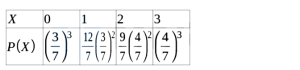
B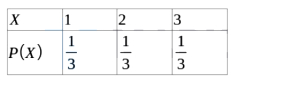
C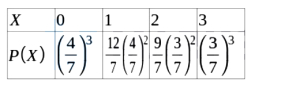
D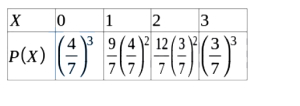
Solution
(D) Total number of balls $= 4 + 3 = 7$.
Probability of drawing a black ball,$p = \frac{3}{7}$.
Probability of drawing a red ball (not black),$q = 1 - p = 1 - \frac{3}{7} = \frac{4}{7}$.
Since the ball is replaced,the trials are independent,and we use the binomial distribution $P(X = x) = {}^nC_x p^x q^{n-x}$,where $n = 3$.
For $X = 0$: $P(X = 0) = {}^3C_0 (\frac{3}{7})^0 (\frac{4}{7})^3 = (\frac{4}{7})^3$.
For $X = 1$: $P(X = 1) = {}^3C_1 (\frac{3}{7})^1 (\frac{4}{7})^2 = 3 \times \frac{3}{7} \times (\frac{4}{7})^2 = \frac{9}{7} (\frac{4}{7})^2$.
For $X = 2$: $P(X = 2) = {}^3C_2 (\frac{3}{7})^2 (\frac{4}{7})^1 = 3 \times (\frac{3}{7})^2 \times \frac{4}{7} = \frac{12}{7} (\frac{3}{7})^2$.
For $X = 3$: $P(X = 3) = {}^3C_3 (\frac{3}{7})^3 (\frac{4}{7})^0 = (\frac{3}{7})^3$.
Comparing this with the given options,option $D$ matches the calculated distribution.
Probability of drawing a black ball,$p = \frac{3}{7}$.
Probability of drawing a red ball (not black),$q = 1 - p = 1 - \frac{3}{7} = \frac{4}{7}$.
Since the ball is replaced,the trials are independent,and we use the binomial distribution $P(X = x) = {}^nC_x p^x q^{n-x}$,where $n = 3$.
For $X = 0$: $P(X = 0) = {}^3C_0 (\frac{3}{7})^0 (\frac{4}{7})^3 = (\frac{4}{7})^3$.
For $X = 1$: $P(X = 1) = {}^3C_1 (\frac{3}{7})^1 (\frac{4}{7})^2 = 3 \times \frac{3}{7} \times (\frac{4}{7})^2 = \frac{9}{7} (\frac{4}{7})^2$.
For $X = 2$: $P(X = 2) = {}^3C_2 (\frac{3}{7})^2 (\frac{4}{7})^1 = 3 \times (\frac{3}{7})^2 \times \frac{4}{7} = \frac{12}{7} (\frac{3}{7})^2$.
For $X = 3$: $P(X = 3) = {}^3C_3 (\frac{3}{7})^3 (\frac{4}{7})^0 = (\frac{3}{7})^3$.
Comparing this with the given options,option $D$ matches the calculated distribution.
0 likes
View Solution259
MediumMCQ
It is observed that $30 \%$ of the students appearing for a certain entrance test are science students. If $5$ students are randomly selected from this group,the probability of having $2$ science students among these students is
A
$0.3087$
B
$0.2547$
C
$0.1087$
D
$0.3437$
Solution
(A) This problem follows a binomial distribution with $n = 5$ trials and probability of success $p = 0.3$ (science student). The probability of failure is $q = 1 - p = 0.7$.
The probability of having $x = 2$ science students is given by the formula $P(X = x) = {}^nC_x \cdot p^x \cdot q^{n-x}$.
Substituting the values: $P(X = 2) = {}^5C_2 \cdot (0.3)^2 \cdot (0.7)^3$.
Calculating the values:
${}^5C_2 = \frac{5 \times 4}{2 \times 1} = 10$.
$(0.3)^2 = 0.09$.
$(0.7)^3 = 0.343$.
Therefore,$P(X = 2) = 10 \times 0.09 \times 0.343 = 0.9 \times 0.343 = 0.3087$.
The probability of having $x = 2$ science students is given by the formula $P(X = x) = {}^nC_x \cdot p^x \cdot q^{n-x}$.
Substituting the values: $P(X = 2) = {}^5C_2 \cdot (0.3)^2 \cdot (0.7)^3$.
Calculating the values:
${}^5C_2 = \frac{5 \times 4}{2 \times 1} = 10$.
$(0.3)^2 = 0.09$.
$(0.7)^3 = 0.343$.
Therefore,$P(X = 2) = 10 \times 0.09 \times 0.343 = 0.9 \times 0.343 = 0.3087$.
0 likes
View Solution260
MediumMCQ
$A$ die is thrown five times. If getting an odd number is a success,then the probability of getting at least $4$ successes is
A
$\frac{13}{16}$
B
$\frac{5}{32}$
C
$\frac{1}{32}$
D
$\frac{3}{16}$
Solution
(D) Here,$n=5$,$p=\frac{1}{2}$,$q=\frac{1}{2}$.
Probability of getting at least $4$ successes is given by $P(X \ge 4) = P(X=4) + P(X=5)$.
Using the binomial distribution formula $P(X=r) = {}^nC_r p^r q^{n-r}$:
$P(X=4) = {}^5C_4 \left(\frac{1}{2}\right)^4 \left(\frac{1}{2}\right)^1 = 5 \times \frac{1}{16} \times \frac{1}{2} = \frac{5}{32}$.
$P(X=5) = {}^5C_5 \left(\frac{1}{2}\right)^5 \left(\frac{1}{2}\right)^0 = 1 \times \frac{1}{32} \times 1 = \frac{1}{32}$.
Therefore,$P(X \ge 4) = \frac{5}{32} + \frac{1}{32} = \frac{6}{32} = \frac{3}{16}$.
Probability of getting at least $4$ successes is given by $P(X \ge 4) = P(X=4) + P(X=5)$.
Using the binomial distribution formula $P(X=r) = {}^nC_r p^r q^{n-r}$:
$P(X=4) = {}^5C_4 \left(\frac{1}{2}\right)^4 \left(\frac{1}{2}\right)^1 = 5 \times \frac{1}{16} \times \frac{1}{2} = \frac{5}{32}$.
$P(X=5) = {}^5C_5 \left(\frac{1}{2}\right)^5 \left(\frac{1}{2}\right)^0 = 1 \times \frac{1}{32} \times 1 = \frac{1}{32}$.
Therefore,$P(X \ge 4) = \frac{5}{32} + \frac{1}{32} = \frac{6}{32} = \frac{3}{16}$.
0 likes
View Solution261
MediumMCQ
An unbiased die is tossed $500$ times. The standard deviation of getting sixes in these $500$ tosses is
A
$\frac{625}{9}$
B
$\sqrt{\frac{250}{3}}$
C
$\frac{25}{3}$
D
$\frac{250}{3}$
Solution
(C) For a binomial distribution,the standard deviation is given by $\sigma = \sqrt{npq}$.
Here,the number of trials $n = 500$.
The probability of getting a six in a single toss is $p = \frac{1}{6}$.
The probability of not getting a six is $q = 1 - p = 1 - \frac{1}{6} = \frac{5}{6}$.
Substituting these values into the formula:
$\sigma = \sqrt{500 \times \frac{1}{6} \times \frac{5}{6}}$
$\sigma = \sqrt{\frac{2500}{36}}$
$\sigma = \frac{50}{6} = \frac{25}{3}$.
Here,the number of trials $n = 500$.
The probability of getting a six in a single toss is $p = \frac{1}{6}$.
The probability of not getting a six is $q = 1 - p = 1 - \frac{1}{6} = \frac{5}{6}$.
Substituting these values into the formula:
$\sigma = \sqrt{500 \times \frac{1}{6} \times \frac{5}{6}}$
$\sigma = \sqrt{\frac{2500}{36}}$
$\sigma = \frac{50}{6} = \frac{25}{3}$.
0 likes
View Solution262
EasyMCQ
For a Binomial distribution,$n=6$,if $9 P(X=4)=P(X=2)$,then $q=$
A
$\frac{1}{2}$
B
$\frac{1}{4}$
C
$\frac{3}{4}$
D
$\frac{2}{5}$
Solution
(C) The probability mass function for a Binomial distribution is given by $P(X=k) = {}^nC_k p^k q^{n-k}$,where $p+q=1$.
Given $n=6$,we have $P(X=4) = {}^6C_4 p^4 q^2$ and $P(X=2) = {}^6C_2 p^2 q^4$.
According to the problem,$9 P(X=4) = P(X=2)$.
Substituting the values: $9 \times {}^6C_4 p^4 q^2 = {}^6C_2 p^2 q^4$.
Since ${}^6C_4 = \frac{6 \times 5}{2 \times 1} = 15$ and ${}^6C_2 = \frac{6 \times 5}{2 \times 1} = 15$,the equation becomes:
$9 \times 15 p^4 q^2 = 15 p^2 q^4$.
Dividing both sides by $15 p^2 q^2$ (assuming $p, q \neq 0$):
$9 p^2 = q^2$.
Taking the square root of both sides: $3p = q$.
Since $p+q=1$,we substitute $p = 1-q$:
$3(1-q) = q \Rightarrow 3 - 3q = q \Rightarrow 4q = 3 \Rightarrow q = \frac{3}{4}$.
Given $n=6$,we have $P(X=4) = {}^6C_4 p^4 q^2$ and $P(X=2) = {}^6C_2 p^2 q^4$.
According to the problem,$9 P(X=4) = P(X=2)$.
Substituting the values: $9 \times {}^6C_4 p^4 q^2 = {}^6C_2 p^2 q^4$.
Since ${}^6C_4 = \frac{6 \times 5}{2 \times 1} = 15$ and ${}^6C_2 = \frac{6 \times 5}{2 \times 1} = 15$,the equation becomes:
$9 \times 15 p^4 q^2 = 15 p^2 q^4$.
Dividing both sides by $15 p^2 q^2$ (assuming $p, q \neq 0$):
$9 p^2 = q^2$.
Taking the square root of both sides: $3p = q$.
Since $p+q=1$,we substitute $p = 1-q$:
$3(1-q) = q \Rightarrow 3 - 3q = q \Rightarrow 4q = 3 \Rightarrow q = \frac{3}{4}$.
0 likes
View Solution263
DifficultMCQ
If $X \sim B\left(8, \frac{1}{2}\right)$,then $P(|X-4| \leq 2)=$
A
$\frac{119}{128}$
B
$\frac{117}{128}$
C
$\frac{1}{2}$
D
$\frac{116}{128}$
Solution
(A) Given $X \sim B\left(8, \frac{1}{2}\right)$,we have $n=8$,$p=\frac{1}{2}$,and $q=1-p=\frac{1}{2}$.
We need to find $P(|X-4| \leq 2)$.
This inequality is equivalent to $-2 \leq X-4 \leq 2$,which simplifies to $2 \leq X \leq 6$.
Thus,$P(2 \leq X \leq 6) = P(X=2) + P(X=3) + P(X=4) + P(X=5) + P(X=6)$.
Alternatively,$P(2 \leq X \leq 6) = 1 - [P(X=0) + P(X=1) + P(X=7) + P(X=8)]$.
Using the binomial probability formula $P(X=k) = \binom{n}{k} p^k q^{n-k} = \binom{8}{k} \left(\frac{1}{2}\right)^8$:
$P(X=0) = \binom{8}{0} \left(\frac{1}{2}\right)^8 = 1 \cdot \frac{1}{256} = \frac{1}{256}$.
$P(X=1) = \binom{8}{1} \left(\frac{1}{2}\right)^8 = 8 \cdot \frac{1}{256} = \frac{8}{256}$.
$P(X=7) = \binom{8}{7} \left(\frac{1}{2}\right)^8 = 8 \cdot \frac{1}{256} = \frac{8}{256}$.
$P(X=8) = \binom{8}{8} \left(\frac{1}{2}\right)^8 = 1 \cdot \frac{1}{256} = \frac{1}{256}$.
Sum $= \frac{1+8+8+1}{256} = \frac{18}{256} = \frac{9}{128}$.
Therefore,$P(2 \leq X \leq 6) = 1 - \frac{9}{128} = \frac{119}{128}$.
We need to find $P(|X-4| \leq 2)$.
This inequality is equivalent to $-2 \leq X-4 \leq 2$,which simplifies to $2 \leq X \leq 6$.
Thus,$P(2 \leq X \leq 6) = P(X=2) + P(X=3) + P(X=4) + P(X=5) + P(X=6)$.
Alternatively,$P(2 \leq X \leq 6) = 1 - [P(X=0) + P(X=1) + P(X=7) + P(X=8)]$.
Using the binomial probability formula $P(X=k) = \binom{n}{k} p^k q^{n-k} = \binom{8}{k} \left(\frac{1}{2}\right)^8$:
$P(X=0) = \binom{8}{0} \left(\frac{1}{2}\right)^8 = 1 \cdot \frac{1}{256} = \frac{1}{256}$.
$P(X=1) = \binom{8}{1} \left(\frac{1}{2}\right)^8 = 8 \cdot \frac{1}{256} = \frac{8}{256}$.
$P(X=7) = \binom{8}{7} \left(\frac{1}{2}\right)^8 = 8 \cdot \frac{1}{256} = \frac{8}{256}$.
$P(X=8) = \binom{8}{8} \left(\frac{1}{2}\right)^8 = 1 \cdot \frac{1}{256} = \frac{1}{256}$.
Sum $= \frac{1+8+8+1}{256} = \frac{18}{256} = \frac{9}{128}$.
Therefore,$P(2 \leq X \leq 6) = 1 - \frac{9}{128} = \frac{119}{128}$.
0 likes
View Solution264
EasyMCQ
In a Binomial distribution,$n=4$ and $2 P(X=3)=3 P(X=2)$,then $q=$
A
$\frac{2}{13}$
B
$\frac{11}{13}$
C
$\frac{9}{13}$
D
$\frac{4}{13}$
Solution
(D) The probability mass function for a Binomial distribution is given by $P(X=k) = {n \choose k} p^k q^{n-k}$,where $p+q=1$.
Given $n=4$,the equation $2 P(X=3) = 3 P(X=2)$ becomes:
$2 \times {4 \choose 3} p^3 q^1 = 3 \times {4 \choose 2} p^2 q^2$
Since ${4 \choose 3} = 4$ and ${4 \choose 2} = 6$,we have:
$2 \times 4 \times p^3 q = 3 \times 6 \times p^2 q^2$
$8 p^3 q = 18 p^2 q^2$
Dividing both sides by $2 p^2 q$ (assuming $p, q \neq 0$):
$4 p = 9 q$
Since $p = 1-q$,substitute this into the equation:
$4(1-q) = 9q$
$4 - 4q = 9q$
$4 = 13q$
$q = \frac{4}{13}$
Given $n=4$,the equation $2 P(X=3) = 3 P(X=2)$ becomes:
$2 \times {4 \choose 3} p^3 q^1 = 3 \times {4 \choose 2} p^2 q^2$
Since ${4 \choose 3} = 4$ and ${4 \choose 2} = 6$,we have:
$2 \times 4 \times p^3 q = 3 \times 6 \times p^2 q^2$
$8 p^3 q = 18 p^2 q^2$
Dividing both sides by $2 p^2 q$ (assuming $p, q \neq 0$):
$4 p = 9 q$
Since $p = 1-q$,substitute this into the equation:
$4(1-q) = 9q$
$4 - 4q = 9q$
$4 = 13q$
$q = \frac{4}{13}$
0 likes
View Solution265
EasyMCQ
For a Binomial variate $X$,the mean is $2$ and the variance is $1$. Then,the odds in favor of $X=0$ are:
A
$4:1$
B
$15:1$
C
$1:15$
D
$1:4$
Solution
(C) Given that for a Binomial distribution,the mean is $np = 2$ and the variance is $npq = 1$.
Dividing the variance by the mean,we get $q = \frac{npq}{np} = \frac{1}{2}$.
Since $p + q = 1$,we have $p = 1 - \frac{1}{2} = \frac{1}{2}$.
Substituting $p = \frac{1}{2}$ into $np = 2$,we get $n(\frac{1}{2}) = 2$,so $n = 4$.
The probability $P(X=0)$ is given by the formula $P(X=k) = { }^n C_k p^k q^{n-k}$.
For $X=0$,$P(X=0) = { }^4 C_0 (\frac{1}{2})^0 (\frac{1}{2})^4 = 1 \times 1 \times \frac{1}{16} = \frac{1}{16}$.
The odds in favor of an event $E$ are given by $P(E) : (1 - P(E))$.
Therefore,the odds in favor of $X=0$ are $\frac{1}{16} : (1 - \frac{1}{16}) = \frac{1}{16} : \frac{15}{16} = 1 : 15$.
Dividing the variance by the mean,we get $q = \frac{npq}{np} = \frac{1}{2}$.
Since $p + q = 1$,we have $p = 1 - \frac{1}{2} = \frac{1}{2}$.
Substituting $p = \frac{1}{2}$ into $np = 2$,we get $n(\frac{1}{2}) = 2$,so $n = 4$.
The probability $P(X=0)$ is given by the formula $P(X=k) = { }^n C_k p^k q^{n-k}$.
For $X=0$,$P(X=0) = { }^4 C_0 (\frac{1}{2})^0 (\frac{1}{2})^4 = 1 \times 1 \times \frac{1}{16} = \frac{1}{16}$.
The odds in favor of an event $E$ are given by $P(E) : (1 - P(E))$.
Therefore,the odds in favor of $X=0$ are $\frac{1}{16} : (1 - \frac{1}{16}) = \frac{1}{16} : \frac{15}{16} = 1 : 15$.
0 likes
View Solution266
EasyMCQ
$A$ coin is tossed $100$ times. What is the probability of getting a head an odd number of times?
A
$\frac{1}{8}$
B
$\frac{1}{5}$
C
$\frac{1}{2}$
D
$\frac{3}{8}$
Solution
(C) Let $n = 100$ be the number of trials,$p = \frac{1}{2}$ be the probability of getting a head,and $q = \frac{1}{2}$ be the probability of getting a tail.
The probability of getting a head an odd number of times is given by the sum of probabilities for $r = 1, 3, 5, \dots, 99$.
$P(r \text{ is odd}) = \sum_{r \in \{1, 3, \dots, 99\}} \binom{100}{r} p^r q^{100-r}$
$P(r \text{ is odd}) = \sum_{r \in \{1, 3, \dots, 99\}} \binom{100}{r} \left(\frac{1}{2}\right)^r \left(\frac{1}{2}\right)^{100-r}$
$P(r \text{ is odd}) = \left(\frac{1}{2}\right)^{100} \sum_{r \in \{1, 3, \dots, 99\}} \binom{100}{r}$
We know that the sum of binomial coefficients for odd $r$ is $2^{n-1}$. Thus,$\sum_{r \in \{1, 3, \dots, 99\}} \binom{100}{r} = 2^{100-1} = 2^{99}$.
Therefore,$P(r \text{ is odd}) = \left(\frac{1}{2}\right)^{100} \times 2^{99} = \frac{2^{99}}{2^{100}} = \frac{1}{2}$.
The probability of getting a head an odd number of times is given by the sum of probabilities for $r = 1, 3, 5, \dots, 99$.
$P(r \text{ is odd}) = \sum_{r \in \{1, 3, \dots, 99\}} \binom{100}{r} p^r q^{100-r}$
$P(r \text{ is odd}) = \sum_{r \in \{1, 3, \dots, 99\}} \binom{100}{r} \left(\frac{1}{2}\right)^r \left(\frac{1}{2}\right)^{100-r}$
$P(r \text{ is odd}) = \left(\frac{1}{2}\right)^{100} \sum_{r \in \{1, 3, \dots, 99\}} \binom{100}{r}$
We know that the sum of binomial coefficients for odd $r$ is $2^{n-1}$. Thus,$\sum_{r \in \{1, 3, \dots, 99\}} \binom{100}{r} = 2^{100-1} = 2^{99}$.
Therefore,$P(r \text{ is odd}) = \left(\frac{1}{2}\right)^{100} \times 2^{99} = \frac{2^{99}}{2^{100}} = \frac{1}{2}$.
0 likes
View Solution267
EasyMCQ
The probability of success $p$ for the Binomial distribution satisfying the relation $4 P(X=4) = P(X=2)$ with parameter $n=6$ is
A
$\frac{1}{5}$
B
$\frac{5}{6}$
C
$\frac{1}{6}$
D
$\frac{1}{3}$
Solution
(D) For a Binomial distribution,$P(X=k) = {}^nC_k p^k q^{n-k}$,where $q = 1-p$.
Given $n=6$,the relation is $4 P(X=4) = P(X=2)$.
Substituting the formula: $4 \cdot {}^6C_4 p^4 q^{6-4} = {}^6C_2 p^2 q^{6-2}$.
$4 \cdot {}^6C_4 p^4 q^2 = {}^6C_2 p^2 q^4$.
Since ${}^6C_4 = {}^6C_2 = 15$,we have:
$4 \cdot 15 \cdot p^4 q^2 = 15 \cdot p^2 q^4$.
Dividing both sides by $15 p^2 q^2$ (assuming $p, q \neq 0$):
$4 p^2 = q^2$.
Taking the square root on both sides: $2p = q$.
Since $p + q = 1$,we substitute $q = 2p$:
$p + 2p = 1 \Rightarrow 3p = 1 \Rightarrow p = \frac{1}{3}$.
Given $n=6$,the relation is $4 P(X=4) = P(X=2)$.
Substituting the formula: $4 \cdot {}^6C_4 p^4 q^{6-4} = {}^6C_2 p^2 q^{6-2}$.
$4 \cdot {}^6C_4 p^4 q^2 = {}^6C_2 p^2 q^4$.
Since ${}^6C_4 = {}^6C_2 = 15$,we have:
$4 \cdot 15 \cdot p^4 q^2 = 15 \cdot p^2 q^4$.
Dividing both sides by $15 p^2 q^2$ (assuming $p, q \neq 0$):
$4 p^2 = q^2$.
Taking the square root on both sides: $2p = q$.
Since $p + q = 1$,we substitute $q = 2p$:
$p + 2p = 1 \Rightarrow 3p = 1 \Rightarrow p = \frac{1}{3}$.
0 likes
View Solution268
MediumMCQ
It is observed that $25 \%$ of the cases related to child labour reported to the police station are solved. If $6$ new cases are reported,then the probability that at least $5$ of them will be solved is
A
$\frac{19}{1024}$
B
$\frac{19}{4096}$
C
$\left(\frac{1}{4}\right)^6$
D
$\frac{19}{2048}$
Solution
(B) The probability of a case being solved is $p = 25 \% = \frac{1}{4}$.
Thus,the probability of a case not being solved is $q = 1 - p = \frac{3}{4}$.
Given $n = 6$ trials,we need to find the probability that at least $5$ cases are solved,which is $P(X \ge 5) = P(X = 5) + P(X = 6)$.
Using the binomial distribution formula $P(X = x) = {}^nC_x p^x q^{n-x}$:
$P(X = 5) = {}^6C_5 \left(\frac{1}{4}\right)^5 \left(\frac{3}{4}\right)^1 = 6 \times \frac{1}{4^5} \times \frac{3}{4} = \frac{18}{4^6}$.
$P(X = 6) = {}^6C_6 \left(\frac{1}{4}\right)^6 \left(\frac{3}{4}\right)^0 = 1 \times \frac{1}{4^6} \times 1 = \frac{1}{4^6}$.
Therefore,$P(X \ge 5) = \frac{18}{4^6} + \frac{1}{4^6} = \frac{19}{4^6} = \frac{19}{4096}$.
Thus,the probability of a case not being solved is $q = 1 - p = \frac{3}{4}$.
Given $n = 6$ trials,we need to find the probability that at least $5$ cases are solved,which is $P(X \ge 5) = P(X = 5) + P(X = 6)$.
Using the binomial distribution formula $P(X = x) = {}^nC_x p^x q^{n-x}$:
$P(X = 5) = {}^6C_5 \left(\frac{1}{4}\right)^5 \left(\frac{3}{4}\right)^1 = 6 \times \frac{1}{4^5} \times \frac{3}{4} = \frac{18}{4^6}$.
$P(X = 6) = {}^6C_6 \left(\frac{1}{4}\right)^6 \left(\frac{3}{4}\right)^0 = 1 \times \frac{1}{4^6} \times 1 = \frac{1}{4^6}$.
Therefore,$P(X \ge 5) = \frac{18}{4^6} + \frac{1}{4^6} = \frac{19}{4^6} = \frac{19}{4096}$.
0 likes
View Solution269
DifficultMCQ
If the mean and variance of a binomial distribution are $4$ and $2$ respectively,then the probability of getting $2$ successes is:
A
$\frac{28}{256}$
B
$\frac{37}{256}$
C
$\frac{128}{256}$
D
$\frac{219}{256}$
Solution
(A) For a binomial distribution,the mean is given by $\mu = np = 4$ and the variance is given by $\sigma^2 = npq = 2$.
Dividing the variance by the mean,we get $q = \frac{npq}{np} = \frac{2}{4} = \frac{1}{2}$.
Since $p + q = 1$,we have $p = 1 - \frac{1}{2} = \frac{1}{2}$.
Substituting $p = \frac{1}{2}$ into $np = 4$,we get $n \times \frac{1}{2} = 4$,which implies $n = 8$.
The probability of getting $x$ successes is given by $P(X=x) = { }^n C_x p^x q^{n-x}$.
For $x = 2$,$P(X=2) = { }^8 C_2 \left(\frac{1}{2}\right)^2 \left(\frac{1}{2}\right)^6 = \frac{8 \times 7}{2 \times 1} \times \left(\frac{1}{2}\right)^8$.
$P(X=2) = 28 \times \frac{1}{256} = \frac{28}{256}$.
Dividing the variance by the mean,we get $q = \frac{npq}{np} = \frac{2}{4} = \frac{1}{2}$.
Since $p + q = 1$,we have $p = 1 - \frac{1}{2} = \frac{1}{2}$.
Substituting $p = \frac{1}{2}$ into $np = 4$,we get $n \times \frac{1}{2} = 4$,which implies $n = 8$.
The probability of getting $x$ successes is given by $P(X=x) = { }^n C_x p^x q^{n-x}$.
For $x = 2$,$P(X=2) = { }^8 C_2 \left(\frac{1}{2}\right)^2 \left(\frac{1}{2}\right)^6 = \frac{8 \times 7}{2 \times 1} \times \left(\frac{1}{2}\right)^8$.
$P(X=2) = 28 \times \frac{1}{256} = \frac{28}{256}$.
0 likes
View Solution270
DifficultMCQ
The probability distribution of the number of doublets in four throws of a pair of dice is given by
A
| $X$ | $0$ | $1$ | $2$ | $3$ | $4$ |
| $P(X)$ | $\frac{1}{5}$ | $\frac{1}{5}$ | $\frac{1}{5}$ | $\frac{1}{5}$ | $\frac{1}{5}$ |
B
| $X$ | $0$ | $1$ | $2$ | $3$ | $4$ |
| $P(X)$ | $\frac{1}{4}$ | $\frac{1}{4}$ | $\frac{1}{4}$ | $\frac{1}{4}$ | $\frac{1}{4}$ |
C
| $X$ | $0$ | $1$ | $2$ | $3$ | $4$ |
| $P(X)$ | $\frac{1}{4}$ | $\frac{1}{4}$ | $\frac{1}{4}$ | $\frac{1}{4}$ | $\frac{1}{4}$ |
D
| $X$ | $0$ | $1$ | $2$ | $3$ | $4$ |
| $P(X)$ | $\frac{625}{1296}$ | $\frac{125}{324}$ | $\frac{25}{216}$ | $\frac{5}{324}$ | $\frac{1}{1296}$ |
Solution
(D) Let $p$ be the probability of getting a doublet in a single throw of a pair of dice. $A$ pair of dice has $36$ total outcomes,and there are $6$ possible doublets: $(1,1), (2,2), (3,3), (4,4), (5,5), (6,6)$.
Thus,$p = \frac{6}{36} = \frac{1}{6}$ and $q = 1 - p = 1 - \frac{1}{6} = \frac{5}{6}$.
The dice are thrown $n = 4$ times. Let $X$ be the random variable representing the number of doublets obtained. This follows a binomial distribution $B(n, p) = B(4, \frac{1}{6})$.
The probability $P(X=k)$ is given by $\binom{n}{k} p^k q^{n-k}$.
For $X=0: P(0) = \binom{4}{0} (\frac{1}{6})^0 (\frac{5}{6})^4 = 1 \times 1 \times \frac{625}{1296} = \frac{625}{1296}$.
For $X=1: P(1) = \binom{4}{1} (\frac{1}{6})^1 (\frac{5}{6})^3 = 4 \times \frac{1}{6} \times \frac{125}{216} = \frac{500}{1296} = \frac{125}{324}$.
For $X=2: P(2) = \binom{4}{2} (\frac{1}{6})^2 (\frac{5}{6})^2 = 6 \times \frac{1}{36} \times \frac{25}{36} = \frac{150}{1296} = \frac{25}{216}$.
For $X=3: P(3) = \binom{4}{3} (\frac{1}{6})^3 (\frac{5}{6})^1 = 4 \times \frac{1}{216} \times \frac{5}{6} = \frac{20}{1296} = \frac{5}{324}$.
For $X=4: P(4) = \binom{4}{4} (\frac{1}{6})^4 (\frac{5}{6})^0 = 1 \times \frac{1}{1296} \times 1 = \frac{1}{1296}$.
Thus,$p = \frac{6}{36} = \frac{1}{6}$ and $q = 1 - p = 1 - \frac{1}{6} = \frac{5}{6}$.
The dice are thrown $n = 4$ times. Let $X$ be the random variable representing the number of doublets obtained. This follows a binomial distribution $B(n, p) = B(4, \frac{1}{6})$.
The probability $P(X=k)$ is given by $\binom{n}{k} p^k q^{n-k}$.
For $X=0: P(0) = \binom{4}{0} (\frac{1}{6})^0 (\frac{5}{6})^4 = 1 \times 1 \times \frac{625}{1296} = \frac{625}{1296}$.
For $X=1: P(1) = \binom{4}{1} (\frac{1}{6})^1 (\frac{5}{6})^3 = 4 \times \frac{1}{6} \times \frac{125}{216} = \frac{500}{1296} = \frac{125}{324}$.
For $X=2: P(2) = \binom{4}{2} (\frac{1}{6})^2 (\frac{5}{6})^2 = 6 \times \frac{1}{36} \times \frac{25}{36} = \frac{150}{1296} = \frac{25}{216}$.
For $X=3: P(3) = \binom{4}{3} (\frac{1}{6})^3 (\frac{5}{6})^1 = 4 \times \frac{1}{216} \times \frac{5}{6} = \frac{20}{1296} = \frac{5}{324}$.
For $X=4: P(4) = \binom{4}{4} (\frac{1}{6})^4 (\frac{5}{6})^0 = 1 \times \frac{1}{1296} \times 1 = \frac{1}{1296}$.
0 likes
View Solution271
MediumMCQ
$A$ fair coin is tossed $100$ times. The probability of getting a head an even number of times is
A
$\frac{1}{2}$
B
$\frac{3}{8}$
C
$\frac{1}{8}$
D
$\frac{3}{4}$
Solution
(A) Let $X$ be the number of heads in $n=100$ tosses. Since the coin is fair,the probability of getting a head is $p = \frac{1}{2}$ and the probability of getting a tail is $q = \frac{1}{2}$.
$X$ follows a binomial distribution $B(n, p) = B(100, \frac{1}{2})$.
The probability of getting an even number of heads is $P(X \in \{0, 2, 4, \dots, 100\}) = \sum_{k \in \{0, 2, \dots, 100\}} \binom{100}{k} p^k q^{100-k}$.
Since $p=q=\frac{1}{2}$,this becomes $\left(\frac{1}{2}\right)^{100} \sum_{k \in \{0, 2, \dots, 100\}} \binom{100}{k}$.
We know that the sum of even binomial coefficients is $\sum_{k \text{ even}} \binom{n}{k} = 2^{n-1}$.
Thus,the probability is $\left(\frac{1}{2}\right)^{100} \times 2^{100-1} = \frac{2^{99}}{2^{100}} = \frac{1}{2}$.
$X$ follows a binomial distribution $B(n, p) = B(100, \frac{1}{2})$.
The probability of getting an even number of heads is $P(X \in \{0, 2, 4, \dots, 100\}) = \sum_{k \in \{0, 2, \dots, 100\}} \binom{100}{k} p^k q^{100-k}$.
Since $p=q=\frac{1}{2}$,this becomes $\left(\frac{1}{2}\right)^{100} \sum_{k \in \{0, 2, \dots, 100\}} \binom{100}{k}$.
We know that the sum of even binomial coefficients is $\sum_{k \text{ even}} \binom{n}{k} = 2^{n-1}$.
Thus,the probability is $\left(\frac{1}{2}\right)^{100} \times 2^{100-1} = \frac{2^{99}}{2^{100}} = \frac{1}{2}$.
0 likes
View Solution272
MediumMCQ
$A$ fair coin is tossed for a fixed number of times. If the probability of getting $7$ heads is equal to the probability of getting $9$ heads,then the probability of getting $2$ heads is:
A
$\frac{1}{15}$
B
$\frac{15}{2^{13}}$
C
$\frac{15}{2^8}$
D
$\frac{2}{15}$
Solution
(B) Let $p$ be the probability of getting a head,so $p = \frac{1}{2}$.
Let $q$ be the probability of not getting a head,so $q = 1 - p = \frac{1}{2}$.
The probability of getting $x$ heads in $n$ tosses is given by the binomial distribution formula: $P(X=x) = {}^{n}C_{x} p^x q^{n-x} = {}^{n}C_{x} (\frac{1}{2})^n$.
Given that $P(X=7) = P(X=9)$,we have:
${}^{n}C_{7} (\frac{1}{2})^n = {}^{n}C_{9} (\frac{1}{2})^n$.
This implies ${}^{n}C_{7} = {}^{n}C_{9}$.
Using the property ${}^{n}C_{r} = {}^{n}C_{n-r}$,we get $n = 7 + 9 = 16$.
Now,we need to find the probability of getting $2$ heads,which is $P(X=2)$:
$P(X=2) = {}^{16}C_{2} (\frac{1}{2})^{16} = \frac{16 \times 15}{2} \times \frac{1}{2^{16}} = 120 \times \frac{1}{2^{16}} = \frac{15 \times 8}{2^{16}} = \frac{15}{2^{13}}$.
Let $q$ be the probability of not getting a head,so $q = 1 - p = \frac{1}{2}$.
The probability of getting $x$ heads in $n$ tosses is given by the binomial distribution formula: $P(X=x) = {}^{n}C_{x} p^x q^{n-x} = {}^{n}C_{x} (\frac{1}{2})^n$.
Given that $P(X=7) = P(X=9)$,we have:
${}^{n}C_{7} (\frac{1}{2})^n = {}^{n}C_{9} (\frac{1}{2})^n$.
This implies ${}^{n}C_{7} = {}^{n}C_{9}$.
Using the property ${}^{n}C_{r} = {}^{n}C_{n-r}$,we get $n = 7 + 9 = 16$.
Now,we need to find the probability of getting $2$ heads,which is $P(X=2)$:
$P(X=2) = {}^{16}C_{2} (\frac{1}{2})^{16} = \frac{16 \times 15}{2} \times \frac{1}{2^{16}} = 120 \times \frac{1}{2^{16}} = \frac{15 \times 8}{2^{16}} = \frac{15}{2^{13}}$.
0 likes
View Solution273
EasyMCQ
If $X \sim B(4, p)$ and $2 P(X=3)=3 P(X=2)$,then the value of $p$ is:
A
$\frac{9}{13}$
B
$\frac{4}{13}$
C
$\frac{1}{13}$
D
$\frac{12}{13}$
Solution
(A) Given $X \sim B(4, p)$,where $n=4$. The probability mass function is $P(X=k) = {}^{n}C_{k} p^{k} q^{n-k}$.
Given the condition $2 P(X=3) = 3 P(X=2)$.
Substituting the values: $2 \times ({}^{4}C_{3} p^{3} q^{1}) = 3 \times ({}^{4}C_{2} p^{2} q^{2})$.
Calculating combinations: $2 \times (4 p^{3} q) = 3 \times (6 p^{2} q^{2})$.
Simplifying: $8 p^{3} q = 18 p^{2} q^{2}$.
Dividing both sides by $2 p^{2} q$ (assuming $p, q \neq 0$): $4 p = 9 q$.
Since $q = 1 - p$,we have $4 p = 9(1 - p)$.
$4 p = 9 - 9 p$.
$13 p = 9$.
Therefore,$p = \frac{9}{13}$.
Given the condition $2 P(X=3) = 3 P(X=2)$.
Substituting the values: $2 \times ({}^{4}C_{3} p^{3} q^{1}) = 3 \times ({}^{4}C_{2} p^{2} q^{2})$.
Calculating combinations: $2 \times (4 p^{3} q) = 3 \times (6 p^{2} q^{2})$.
Simplifying: $8 p^{3} q = 18 p^{2} q^{2}$.
Dividing both sides by $2 p^{2} q$ (assuming $p, q \neq 0$): $4 p = 9 q$.
Since $q = 1 - p$,we have $4 p = 9(1 - p)$.
$4 p = 9 - 9 p$.
$13 p = 9$.
Therefore,$p = \frac{9}{13}$.
0 likes
View Solution274
EasyMCQ
In a box containing $100$ bulbs,$10$ are defective. The probability that out of $20$ bulbs selected at random,none is defective is
A
$10\left(\frac{1}{10}\right)^{20}$
B
$20\left(\frac{9}{10}\right)^{20}$
C
$5\left(\frac{1}{10}\right)^{20}$
D
$\left(\frac{9}{10}\right)^{20}$
Solution
(D) Let $X$ denote the number of defective bulbs out of $20$ bulbs selected.
Given that the total number of bulbs is $100$ and $10$ are defective,the probability $p$ of selecting a defective bulb is $p = \frac{10}{100} = \frac{1}{10}$.
Consequently,the probability $q$ of selecting a non-defective bulb is $q = 1 - p = 1 - \frac{1}{10} = \frac{9}{10}$.
We are selecting $n = 20$ bulbs. The probability of getting no defective bulb is given by the binomial distribution formula $P(X = k) = {}^{n}C_{k} \cdot p^{k} \cdot q^{n-k}$.
For $k = 0$,$P(X = 0) = {}^{20}C_{0} \cdot \left(\frac{1}{10}\right)^{0} \cdot \left(\frac{9}{10}\right)^{20-0}$.
$P(X = 0) = 1 \cdot 1 \cdot \left(\frac{9}{10}\right)^{20} = \left(\frac{9}{10}\right)^{20}$.
Given that the total number of bulbs is $100$ and $10$ are defective,the probability $p$ of selecting a defective bulb is $p = \frac{10}{100} = \frac{1}{10}$.
Consequently,the probability $q$ of selecting a non-defective bulb is $q = 1 - p = 1 - \frac{1}{10} = \frac{9}{10}$.
We are selecting $n = 20$ bulbs. The probability of getting no defective bulb is given by the binomial distribution formula $P(X = k) = {}^{n}C_{k} \cdot p^{k} \cdot q^{n-k}$.
For $k = 0$,$P(X = 0) = {}^{20}C_{0} \cdot \left(\frac{1}{10}\right)^{0} \cdot \left(\frac{9}{10}\right)^{20-0}$.
$P(X = 0) = 1 \cdot 1 \cdot \left(\frac{9}{10}\right)^{20} = \left(\frac{9}{10}\right)^{20}$.
0 likes
View Solution275
MediumMCQ
If a fair coin is tossed $8$ times,then the probability that it shows heads more than tails is
A
$\frac{91}{256}$
B
$\frac{97}{256}$
C
$\frac{93}{256}$
D
$\frac{95}{256}$
Solution
(C) Let $X$ be the number of heads in $8$ tosses of a fair coin. Here,$n=8$,$p=\frac{1}{2}$,and $q=\frac{1}{2}$.
We want to find the probability that heads show more than tails,which means $X > 4$.
Since the total number of outcomes is $2^8 = 256$,and the distribution is symmetric,we have $P(X < 4) = P(X > 4)$.
We know that $\sum_{k=0}^{8} P(X=k) = 1$,so $P(X < 4) + P(X=4) + P(X > 4) = 1$.
Thus,$2P(X > 4) + P(X=4) = 1$,which implies $P(X > 4) = \frac{1 - P(X=4)}{2}$.
Calculating $P(X=4) = {}^{8}C_{4} \left(\frac{1}{2}\right)^{8} = \frac{70}{256}$.
Therefore,$P(X > 4) = \frac{1 - \frac{70}{256}}{2} = \frac{\frac{186}{256}}{2} = \frac{93}{256}$.
We want to find the probability that heads show more than tails,which means $X > 4$.
Since the total number of outcomes is $2^8 = 256$,and the distribution is symmetric,we have $P(X < 4) = P(X > 4)$.
We know that $\sum_{k=0}^{8} P(X=k) = 1$,so $P(X < 4) + P(X=4) + P(X > 4) = 1$.
Thus,$2P(X > 4) + P(X=4) = 1$,which implies $P(X > 4) = \frac{1 - P(X=4)}{2}$.
Calculating $P(X=4) = {}^{8}C_{4} \left(\frac{1}{2}\right)^{8} = \frac{70}{256}$.
Therefore,$P(X > 4) = \frac{1 - \frac{70}{256}}{2} = \frac{\frac{186}{256}}{2} = \frac{93}{256}$.
0 likes
View Solution276
EasyMCQ
The probability that a bomb will miss the target is $0.2$. Then the probability that out of $10$ bombs dropped,exactly $2$ will hit the target is:
A
$\frac{288}{5^{10}}$
B
$\frac{144}{5^{9}}$
C
$\frac{144}{5^{10}}$
D
$\frac{288}{5^{9}}$
Solution
(B) The probability of missing the target is $q = 0.2 = \frac{1}{5}$.
So,the probability of hitting the target is $p = 1 - q = 1 - 0.2 = 0.8 = \frac{4}{5}$.
Given $n = 10$ bombs are dropped,and we want exactly $r = 2$ hits.
Using the binomial distribution formula $P(X = r) = {}^{n}C_{r} p^{r} q^{n-r}$:
$P(X = 2) = {}^{10}C_{2} \times (0.8)^{2} \times (0.2)^{8}$
$P(X = 2) = \frac{10 \times 9}{2 \times 1} \times \left(\frac{4}{5}\right)^{2} \times \left(\frac{1}{5}\right)^{8}$
$P(X = 2) = 45 \times \frac{16}{25} \times \frac{1}{5^{8}}$
$P(X = 2) = 45 \times \frac{16}{5^{2} \times 5^{8}} = 45 \times \frac{16}{5^{10}}$
$P(X = 2) = (9 \times 5) \times \frac{16}{5^{10}} = \frac{9 \times 16}{5^{9}} = \frac{144}{5^{9}}$
Thus,the correct option is $B$.
So,the probability of hitting the target is $p = 1 - q = 1 - 0.2 = 0.8 = \frac{4}{5}$.
Given $n = 10$ bombs are dropped,and we want exactly $r = 2$ hits.
Using the binomial distribution formula $P(X = r) = {}^{n}C_{r} p^{r} q^{n-r}$:
$P(X = 2) = {}^{10}C_{2} \times (0.8)^{2} \times (0.2)^{8}$
$P(X = 2) = \frac{10 \times 9}{2 \times 1} \times \left(\frac{4}{5}\right)^{2} \times \left(\frac{1}{5}\right)^{8}$
$P(X = 2) = 45 \times \frac{16}{25} \times \frac{1}{5^{8}}$
$P(X = 2) = 45 \times \frac{16}{5^{2} \times 5^{8}} = 45 \times \frac{16}{5^{10}}$
$P(X = 2) = (9 \times 5) \times \frac{16}{5^{10}} = \frac{9 \times 16}{5^{9}} = \frac{144}{5^{9}}$
Thus,the correct option is $B$.
0 likes
View Solution277
EasyMCQ
Out of $100$ people selected at random,$10$ have a common cold. If five persons are selected at random from the group,then the probability that at most one person will have a common cold is
A
$0.9254$
B
$0.9185$
C
$0.9851$
D
$0.9245$
Solution
(B) Let the probability of a person having a common cold be $p = \frac{10}{100} = \frac{1}{10}$.
Then,the probability of a person not having a common cold is $q = 1 - p = \frac{9}{10}$.
We are selecting $n = 5$ persons. Let $X$ be the number of persons having a common cold. $X$ follows a binomial distribution $B(n, p) = B(5, 0.1)$.
We need to find the probability that at most one person has a common cold,which is $P(X \le 1) = P(X = 0) + P(X = 1)$.
Using the binomial probability formula $P(X = k) = {}^{n}C_{k} p^{k} q^{n-k}$:
$P(X = 0) = {}^{5}C_{0} \left(\frac{1}{10}\right)^{0} \left(\frac{9}{10}\right)^{5} = 1 \times 1 \times \frac{59049}{100000} = 0.59049$.
$P(X = 1) = {}^{5}C_{1} \left(\frac{1}{10}\right)^{1} \left(\frac{9}{10}\right)^{4} = 5 \times \frac{1}{10} \times \frac{6561}{10000} = \frac{32805}{100000} = 0.32805$.
Therefore,$P(X \le 1) = 0.59049 + 0.32805 = 0.91854$.
Rounding to four decimal places,the probability is $0.9185$.
Then,the probability of a person not having a common cold is $q = 1 - p = \frac{9}{10}$.
We are selecting $n = 5$ persons. Let $X$ be the number of persons having a common cold. $X$ follows a binomial distribution $B(n, p) = B(5, 0.1)$.
We need to find the probability that at most one person has a common cold,which is $P(X \le 1) = P(X = 0) + P(X = 1)$.
Using the binomial probability formula $P(X = k) = {}^{n}C_{k} p^{k} q^{n-k}$:
$P(X = 0) = {}^{5}C_{0} \left(\frac{1}{10}\right)^{0} \left(\frac{9}{10}\right)^{5} = 1 \times 1 \times \frac{59049}{100000} = 0.59049$.
$P(X = 1) = {}^{5}C_{1} \left(\frac{1}{10}\right)^{1} \left(\frac{9}{10}\right)^{4} = 5 \times \frac{1}{10} \times \frac{6561}{10000} = \frac{32805}{100000} = 0.32805$.
Therefore,$P(X \le 1) = 0.59049 + 0.32805 = 0.91854$.
Rounding to four decimal places,the probability is $0.9185$.
0 likes
View Solution278
EasyMCQ
Given $X \sim B(n, p)$,if $E(X) = 4$ and $\operatorname{Var}(X) = 2.4$,then $n = $
A
$20$
B
$15$
C
$5$
D
$10$
Solution
(D) For a binomial distribution $X \sim B(n, p)$,the mean is given by $E(X) = np$ and the variance is given by $\operatorname{Var}(X) = npq$,where $q = 1 - p$.
Given $E(X) = np = 4$.
Given $\operatorname{Var}(X) = npq = 2.4$.
Substituting $np = 4$ into the variance equation: $4q = 2.4$.
Solving for $q$: $q = \frac{2.4}{4} = 0.6 = \frac{3}{5}$.
Since $p = 1 - q$,we have $p = 1 - 0.6 = 0.4 = \frac{2}{5}$.
Now,substitute $p$ back into the mean equation: $n \times \frac{2}{5} = 4$.
$n = 4 \times \frac{5}{2} = 10$.
Thus,the value of $n$ is $10$.
Given $E(X) = np = 4$.
Given $\operatorname{Var}(X) = npq = 2.4$.
Substituting $np = 4$ into the variance equation: $4q = 2.4$.
Solving for $q$: $q = \frac{2.4}{4} = 0.6 = \frac{3}{5}$.
Since $p = 1 - q$,we have $p = 1 - 0.6 = 0.4 = \frac{2}{5}$.
Now,substitute $p$ back into the mean equation: $n \times \frac{2}{5} = 4$.
$n = 4 \times \frac{5}{2} = 10$.
Thus,the value of $n$ is $10$.
0 likes
View Solution279
EasyMCQ
If the sum of the mean and the variance of a binomial distribution for $5$ trials is $1 \cdot 8$,then $p=$
A
$0 \cdot 4$
B
$0 \cdot 2$
C
$0 \cdot 8$
D
$0 \cdot 18$
Solution
(B) For a binomial distribution,the mean is $\mu = np$ and the variance is $\sigma^2 = npq$,where $q = 1-p$.
Given $n = 5$ and $np + npq = 1 \cdot 8$.
Substituting the values,we get $5p + 5pq = 1 \cdot 8$.
$5p(1 + q) = 1 \cdot 8$.
Since $q = 1 - p$,we have $5p(1 + 1 - p) = 1 \cdot 8$.
$5p(2 - p) = 1 \cdot 8$.
$10p - 5p^2 = 1 \cdot 8$.
$5p^2 - 10p + 1 \cdot 8 = 0$.
Multiplying by $5$ to simplify: $25p^2 - 50p + 9 = 0$.
Using the quadratic formula $p = \frac{-b \pm \sqrt{b^2 - 4ac}}{2a}$:
$p = \frac{50 \pm \sqrt{2500 - 4(25)(9)}}{50} = \frac{50 \pm \sqrt{2500 - 900}}{50} = \frac{50 \pm \sqrt{1600}}{50} = \frac{50 \pm 40}{50}$.
$p = \frac{90}{50} = 1 \cdot 8$ (not possible as $0 \le p \le 1$) or $p = \frac{10}{50} = 0 \cdot 2$.
Thus,$p = 0 \cdot 2$.
Given $n = 5$ and $np + npq = 1 \cdot 8$.
Substituting the values,we get $5p + 5pq = 1 \cdot 8$.
$5p(1 + q) = 1 \cdot 8$.
Since $q = 1 - p$,we have $5p(1 + 1 - p) = 1 \cdot 8$.
$5p(2 - p) = 1 \cdot 8$.
$10p - 5p^2 = 1 \cdot 8$.
$5p^2 - 10p + 1 \cdot 8 = 0$.
Multiplying by $5$ to simplify: $25p^2 - 50p + 9 = 0$.
Using the quadratic formula $p = \frac{-b \pm \sqrt{b^2 - 4ac}}{2a}$:
$p = \frac{50 \pm \sqrt{2500 - 4(25)(9)}}{50} = \frac{50 \pm \sqrt{2500 - 900}}{50} = \frac{50 \pm \sqrt{1600}}{50} = \frac{50 \pm 40}{50}$.
$p = \frac{90}{50} = 1 \cdot 8$ (not possible as $0 \le p \le 1$) or $p = \frac{10}{50} = 0 \cdot 2$.
Thus,$p = 0 \cdot 2$.
0 likes
View Solution280
EasyMCQ
$A$ die is thrown $100$ times. If the success is defined as getting an even number,then the variance of the number of successes is:
A
$1.10$
B
$25$
C
$50$
D
$100$
Solution
(B) Let $X$ be the number of successes in $n = 100$ trials. This follows a binomial distribution $B(n, p)$.
Here,the probability of getting an even number in a single throw of a die is $p = \frac{3}{6} = \frac{1}{2}$.
The probability of failure is $q = 1 - p = 1 - \frac{1}{2} = \frac{1}{2}$.
The variance of a binomial distribution is given by the formula $\text{Var}(X) = npq$.
Substituting the values,we get $\text{Var}(X) = 100 \times \frac{1}{2} \times \frac{1}{2} = 100 \times \frac{1}{4} = 25$.
Therefore,the variance is $25$.
Here,the probability of getting an even number in a single throw of a die is $p = \frac{3}{6} = \frac{1}{2}$.
The probability of failure is $q = 1 - p = 1 - \frac{1}{2} = \frac{1}{2}$.
The variance of a binomial distribution is given by the formula $\text{Var}(X) = npq$.
Substituting the values,we get $\text{Var}(X) = 100 \times \frac{1}{2} \times \frac{1}{2} = 100 \times \frac{1}{4} = 25$.
Therefore,the variance is $25$.
0 likes
View Solution281
EasyMCQ
If $15$ coins are tossed,then the probability of getting $10$ heads is:
A
$\frac{511}{32768}$
B
$\frac{1001}{32768}$
C
$\frac{3003}{32768}$
D
$\frac{3005}{32768}$
Solution
(C) The probability of getting a head in a single toss is $p = \frac{1}{2}$ and the probability of getting a tail is $q = \frac{1}{2}$.
For $n = 15$ trials,the probability of getting $r = 10$ heads is given by the binomial distribution formula: $P(X = r) = {}^{n}C_{r} p^{r} q^{n-r}$.
Substituting the values,we get: $P(X = 10) = {}^{15}C_{10} \left(\frac{1}{2}\right)^{10} \left(\frac{1}{2}\right)^{5}$.
Since ${}^{15}C_{10} = {}^{15}C_{5}$,we have: $P(X = 10) = {}^{15}C_{5} \times \left(\frac{1}{2}\right)^{15}$.
Calculating the combination: ${}^{15}C_{5} = \frac{15 \times 14 \times 13 \times 12 \times 11}{5 \times 4 \times 3 \times 2 \times 1} = 3003$.
Thus,the probability is: $P(X = 10) = \frac{3003}{2^{15}} = \frac{3003}{32768}$.
For $n = 15$ trials,the probability of getting $r = 10$ heads is given by the binomial distribution formula: $P(X = r) = {}^{n}C_{r} p^{r} q^{n-r}$.
Substituting the values,we get: $P(X = 10) = {}^{15}C_{10} \left(\frac{1}{2}\right)^{10} \left(\frac{1}{2}\right)^{5}$.
Since ${}^{15}C_{10} = {}^{15}C_{5}$,we have: $P(X = 10) = {}^{15}C_{5} \times \left(\frac{1}{2}\right)^{15}$.
Calculating the combination: ${}^{15}C_{5} = \frac{15 \times 14 \times 13 \times 12 \times 11}{5 \times 4 \times 3 \times 2 \times 1} = 3003$.
Thus,the probability is: $P(X = 10) = \frac{3003}{2^{15}} = \frac{3003}{32768}$.
0 likes
View Solution282
EasyMCQ
If $X$ follows the Binomial distribution with parameters $n=6$ and $p$ and $9 P(X=4) = P(X=2)$,then $p$ is
A
$1/4$
B
$1/3$
C
$1/2$
D
$2/3$
Solution
(A) The probability mass function of a Binomial distribution is given by $P(X=k) = {}^{n}C_{k} p^{k} (1-p)^{n-k}$.
Given $n=6$,we have $P(X=4) = {}^{6}C_{4} p^{4} (1-p)^{2}$ and $P(X=2) = {}^{6}C_{2} p^{2} (1-p)^{4}$.
According to the problem,$9 P(X=4) = P(X=2)$.
Substituting the values,we get $9 \cdot {}^{6}C_{4} p^{4} (1-p)^{2} = {}^{6}C_{2} p^{2} (1-p)^{4}$.
Since ${}^{6}C_{4} = {}^{6}C_{2} = 15$,the equation simplifies to $9 p^{4} (1-p)^{2} = p^{2} (1-p)^{4}$.
Dividing both sides by $p^{2} (1-p)^{2}$ (assuming $p \neq 0, 1$),we get $9 p^{2} = (1-p)^{2}$.
Taking the square root of both sides,$3p = 1-p$ (since $p$ must be positive).
$4p = 1$,which gives $p = 1/4$.
Given $n=6$,we have $P(X=4) = {}^{6}C_{4} p^{4} (1-p)^{2}$ and $P(X=2) = {}^{6}C_{2} p^{2} (1-p)^{4}$.
According to the problem,$9 P(X=4) = P(X=2)$.
Substituting the values,we get $9 \cdot {}^{6}C_{4} p^{4} (1-p)^{2} = {}^{6}C_{2} p^{2} (1-p)^{4}$.
Since ${}^{6}C_{4} = {}^{6}C_{2} = 15$,the equation simplifies to $9 p^{4} (1-p)^{2} = p^{2} (1-p)^{4}$.
Dividing both sides by $p^{2} (1-p)^{2}$ (assuming $p \neq 0, 1$),we get $9 p^{2} = (1-p)^{2}$.
Taking the square root of both sides,$3p = 1-p$ (since $p$ must be positive).
$4p = 1$,which gives $p = 1/4$.
0 likes
View Solution283
MediumMCQ
If a random variable $X$ follows the Binomial distribution $B(33, p)$ such that $3 P(X=0) = P(X=1)$,then the variance of $X$ is
A
$\frac{11}{144}$
B
$\frac{35}{48}$
C
$\frac{121}{48}$
D
$\frac{33}{144}$
Solution
(C) For a binomial distribution $B(n, p)$,the probability mass function is given by $P(X=k) = \binom{n}{k} p^k q^{n-k}$,where $q = 1-p$ and $n = 33$.
Given $3 P(X=0) = P(X=1)$,we substitute the values:
$3 \binom{33}{0} p^0 q^{33} = \binom{33}{1} p^1 q^{32}$
$3 \times 1 \times q^{33} = 33 \times p \times q^{32}$
Since $q \neq 0$,we divide both sides by $q^{32}$:
$3q = 33p$
$q = 11p$
Since $q = 1-p$,we have $1-p = 11p$,which implies $1 = 12p$,so $p = \frac{1}{12}$.
Then $q = 1 - \frac{1}{12} = \frac{11}{12}$.
The variance of a binomial distribution is given by $Var(X) = npq$.
$Var(X) = 33 \times \frac{1}{12} \times \frac{11}{12} = \frac{33 \times 11}{144} = \frac{363}{144}$.
Simplifying by dividing by $3$: $\frac{121}{48}$.
Given $3 P(X=0) = P(X=1)$,we substitute the values:
$3 \binom{33}{0} p^0 q^{33} = \binom{33}{1} p^1 q^{32}$
$3 \times 1 \times q^{33} = 33 \times p \times q^{32}$
Since $q \neq 0$,we divide both sides by $q^{32}$:
$3q = 33p$
$q = 11p$
Since $q = 1-p$,we have $1-p = 11p$,which implies $1 = 12p$,so $p = \frac{1}{12}$.
Then $q = 1 - \frac{1}{12} = \frac{11}{12}$.
The variance of a binomial distribution is given by $Var(X) = npq$.
$Var(X) = 33 \times \frac{1}{12} \times \frac{11}{12} = \frac{33 \times 11}{144} = \frac{363}{144}$.
Simplifying by dividing by $3$: $\frac{121}{48}$.
0 likes
View Solution284
MediumMCQ
$A$ random variable $X$ has a probability mass function $P(X=x) = \frac{{}^4C_x}{2^4}$ for $x = 0, 1, 2, 3, 4$. If $\mu$ and $\sigma^2$ are the mean and variance of the random variable $X$ respectively,then:
A
$\mu = 2, \sigma^2 = 4$
B
$\mu = 2, \sigma^2 = 1$
C
$\mu = 3, \sigma^2 = 4$
D
$\mu = 2, \sigma^2 = 5$
Solution
(B) The given probability mass function is $P(X=x) = \frac{{}^4C_x}{2^4} = {}^4C_x \left(\frac{1}{2}\right)^x \left(\frac{1}{2}\right)^{4-x}$.
This is a binomial distribution $B(n, p)$ with $n = 4$ and $p = \frac{1}{2}$.
The mean $\mu$ of a binomial distribution is given by $\mu = np = 4 \times \frac{1}{2} = 2$.
The variance $\sigma^2$ of a binomial distribution is given by $\sigma^2 = npq$,where $q = 1 - p = 1 - \frac{1}{2} = \frac{1}{2}$.
Thus,$\sigma^2 = 4 \times \frac{1}{2} \times \frac{1}{2} = 1$.
Therefore,$\mu = 2$ and $\sigma^2 = 1$.
This is a binomial distribution $B(n, p)$ with $n = 4$ and $p = \frac{1}{2}$.
The mean $\mu$ of a binomial distribution is given by $\mu = np = 4 \times \frac{1}{2} = 2$.
The variance $\sigma^2$ of a binomial distribution is given by $\sigma^2 = npq$,where $q = 1 - p = 1 - \frac{1}{2} = \frac{1}{2}$.
Thus,$\sigma^2 = 4 \times \frac{1}{2} \times \frac{1}{2} = 1$.
Therefore,$\mu = 2$ and $\sigma^2 = 1$.
0 likes
View Solution285
MediumMCQ
If $X \sim B(35, p)$ such that $7 P(X=0)=P(X=1)$,then the value of $\frac{P(X=15)}{P(X=20)}$ is equal to
A
$\frac{3125}{7776}$
B
$3125$
C
$7776$
D
$\frac{625}{1296}$
Solution
(B) Given $X \sim B(n, p)$ with $n=35$. The probability mass function is $P(X=k) = \binom{n}{k} p^k q^{n-k}$,where $q = 1-p$.
Given $7 P(X=0) = P(X=1)$.
Substituting the values: $7 \binom{35}{0} p^0 q^{35} = \binom{35}{1} p^1 q^{34}$.
$7 q = 35 p \implies q = 5p$.
Since $p+q=1$,we have $p+5p=1 \implies 6p=1 \implies p = \frac{1}{6}$ and $q = \frac{5}{6}$.
Now,we need to find $\frac{P(X=15)}{P(X=20)} = \frac{\binom{35}{15} p^{15} q^{20}}{\binom{35}{20} p^{20} q^{15}} = \frac{\binom{35}{15}}{\binom{35}{20}} \cdot \frac{q^5}{p^5} = \frac{\binom{35}{15}}{\binom{35}{15}} \cdot (\frac{q}{p})^5$.
Since $\binom{35}{15} = \binom{35}{20}$,the ratio is $(q/p)^5 = (5)^5 = 3125$.
Given $7 P(X=0) = P(X=1)$.
Substituting the values: $7 \binom{35}{0} p^0 q^{35} = \binom{35}{1} p^1 q^{34}$.
$7 q = 35 p \implies q = 5p$.
Since $p+q=1$,we have $p+5p=1 \implies 6p=1 \implies p = \frac{1}{6}$ and $q = \frac{5}{6}$.
Now,we need to find $\frac{P(X=15)}{P(X=20)} = \frac{\binom{35}{15} p^{15} q^{20}}{\binom{35}{20} p^{20} q^{15}} = \frac{\binom{35}{15}}{\binom{35}{20}} \cdot \frac{q^5}{p^5} = \frac{\binom{35}{15}}{\binom{35}{15}} \cdot (\frac{q}{p})^5$.
Since $\binom{35}{15} = \binom{35}{20}$,the ratio is $(q/p)^5 = (5)^5 = 3125$.
0 likes
View Solution286
MediumMCQ
Two cards are drawn successively with replacement from a fair deck of $52$ cards. Let $X$ denote the number of kings obtained when two cards are drawn. Then $E(X^2) = $
A
$\frac{24}{169}$
B
$\frac{26}{169}$
C
$\frac{27}{169}$
D
$\frac{28}{169}$
Solution
(D) The total number of cards is $52$. The number of kings in the deck is $4$.
Since the cards are drawn with replacement,the probability of drawing a king in a single trial is $p = \frac{4}{52} = \frac{1}{13}$.
The probability of not drawing a king is $q = 1 - p = 1 - \frac{1}{13} = \frac{12}{13}$.
Let $X$ be the random variable representing the number of kings in $n = 2$ trials. $X$ follows a binomial distribution $B(n, p) = B(2, \frac{1}{13})$.
The probability distribution of $X$ is:
$P(X=0) = \binom{2}{0} p^0 q^2 = 1 \times 1 \times (\frac{12}{13})^2 = \frac{144}{169}$
$P(X=1) = \binom{2}{1} p^1 q^1 = 2 \times \frac{1}{13} \times \frac{12}{13} = \frac{24}{169}$
$P(X=2) = \binom{2}{2} p^2 q^0 = 1 \times (\frac{1}{13})^2 \times 1 = \frac{1}{169}$
We need to find $E(X^2) = \sum x^2 P(X=x)$.
$E(X^2) = (0^2 \times \frac{144}{169}) + (1^2 \times \frac{24}{169}) + (2^2 \times \frac{1}{169})$
$E(X^2) = 0 + \frac{24}{169} + \frac{4}{169} = \frac{28}{169}$.
Since the cards are drawn with replacement,the probability of drawing a king in a single trial is $p = \frac{4}{52} = \frac{1}{13}$.
The probability of not drawing a king is $q = 1 - p = 1 - \frac{1}{13} = \frac{12}{13}$.
Let $X$ be the random variable representing the number of kings in $n = 2$ trials. $X$ follows a binomial distribution $B(n, p) = B(2, \frac{1}{13})$.
The probability distribution of $X$ is:
$P(X=0) = \binom{2}{0} p^0 q^2 = 1 \times 1 \times (\frac{12}{13})^2 = \frac{144}{169}$
$P(X=1) = \binom{2}{1} p^1 q^1 = 2 \times \frac{1}{13} \times \frac{12}{13} = \frac{24}{169}$
$P(X=2) = \binom{2}{2} p^2 q^0 = 1 \times (\frac{1}{13})^2 \times 1 = \frac{1}{169}$
We need to find $E(X^2) = \sum x^2 P(X=x)$.
$E(X^2) = (0^2 \times \frac{144}{169}) + (1^2 \times \frac{24}{169}) + (2^2 \times \frac{1}{169})$
$E(X^2) = 0 + \frac{24}{169} + \frac{4}{169} = \frac{28}{169}$.
0 likes
View Solution287
DifficultMCQ
Two cards are drawn successively with replacement from a well-shuffled pack of $52$ cards. Let $X$ denote the random variable of the number of jacks obtained in the two drawn cards. Then $P(X=1) + P(X=2)$ equals
A
$\frac{24}{169}$
B
$\frac{52}{169}$
C
$\frac{25}{169}$
D
$\frac{49}{169}$
Solution
(C) The total number of cards is $52$. The number of jacks in the pack is $4$.
Since the cards are drawn with replacement,the probability of drawing a jack in a single draw is $p = \frac{4}{52} = \frac{1}{13}$,and the probability of not drawing a jack is $q = 1 - \frac{1}{13} = \frac{12}{13}$.
This follows a binomial distribution $B(n, p)$ where $n=2$ and $p=\frac{1}{13}$.
$P(X=1) = \binom{2}{1} \times p^1 \times q^1 = 2 \times \frac{1}{13} \times \frac{12}{13} = \frac{24}{169}$.
$P(X=2) = \binom{2}{2} \times p^2 \times q^0 = 1 \times \left(\frac{1}{13}\right)^2 \times 1 = \frac{1}{169}$.
Therefore,$P(X=1) + P(X=2) = \frac{24}{169} + \frac{1}{169} = \frac{25}{169}$.
Since the cards are drawn with replacement,the probability of drawing a jack in a single draw is $p = \frac{4}{52} = \frac{1}{13}$,and the probability of not drawing a jack is $q = 1 - \frac{1}{13} = \frac{12}{13}$.
This follows a binomial distribution $B(n, p)$ where $n=2$ and $p=\frac{1}{13}$.
$P(X=1) = \binom{2}{1} \times p^1 \times q^1 = 2 \times \frac{1}{13} \times \frac{12}{13} = \frac{24}{169}$.
$P(X=2) = \binom{2}{2} \times p^2 \times q^0 = 1 \times \left(\frac{1}{13}\right)^2 \times 1 = \frac{1}{169}$.
Therefore,$P(X=1) + P(X=2) = \frac{24}{169} + \frac{1}{169} = \frac{25}{169}$.
0 likes
View Solution288
DifficultMCQ
$A$ bag contains $4$ red and $3$ black balls. One ball is drawn and then replaced in the bag and the process is repeated. Let $X$ denote the number of times a black ball is drawn in $3$ draws. Assuming that at each draw each ball is equally likely to be selected,the probability distribution of $X$ is given by:
A
| $X$ | $0$ | $1$ | $2$ | $3$ |
|---|---|---|---|---|
| $P(X)$ | $(\frac{4}{7})^3$ | $\frac{9}{7} \times (\frac{4}{7})^2$ | $\frac{12}{7} \times (\frac{3}{7})^2$ | $(\frac{3}{7})^3$ |
B
| $X$ | $0$ | $1$ | $2$ | $3$ |
|---|---|---|---|---|
| $P(X)$ | $(\frac{3}{7})^3$ | $\frac{12}{7} \times (\frac{3}{7})^2$ | $\frac{9}{7} \times (\frac{4}{7})^2$ | $(\frac{4}{7})^3$ |
C
| $X$ | $0$ | $1$ | $2$ | $3$ |
|---|---|---|---|---|
| $P(X)$ | $(\frac{3}{7})^3$ | $\frac{9}{7} \times (\frac{4}{7})^2$ | $\frac{12}{7} \times (\frac{3}{7})^2$ | $(\frac{4}{7})^3$ |
D
| $X$ | $0$ | $1$ | $2$ | $3$ |
|---|---|---|---|---|
| $P(X)$ | $(\frac{4}{7})^3$ | $\frac{12}{7} \times (\frac{4}{7})^2$ | $\frac{9}{7} \times (\frac{3}{7})^2$ | $(\frac{3}{7})^3$ |
Solution
(A) Let $X$ be the number of times a black ball is drawn in $3$ independent trials. This follows a binomial distribution $B(n, p)$ where $n=3$.
The probability of drawing a black ball in a single draw is $p = \frac{3}{4+3} = \frac{3}{7}$.
The probability of not drawing a black ball is $q = 1 - p = 1 - \frac{3}{7} = \frac{4}{7}$.
The probability distribution is given by $P(X=k) = \binom{n}{k} p^k q^{n-k}$ for $k = 0, 1, 2, 3$.
For $k=0$: $P(X=0) = \binom{3}{0} (\frac{3}{7})^0 (\frac{4}{7})^3 = 1 \times 1 \times (\frac{4}{7})^3 = (\frac{4}{7})^3$.
For $k=1$: $P(X=1) = \binom{3}{1} (\frac{3}{7})^1 (\frac{4}{7})^2 = 3 \times \frac{3}{7} \times (\frac{4}{7})^2 = \frac{9}{7} \times (\frac{4}{7})^2$.
For $k=2$: $P(X=2) = \binom{3}{2} (\frac{3}{7})^2 (\frac{4}{7})^1 = 3 \times (\frac{3}{7})^2 \times \frac{4}{7} = \frac{12}{7} \times (\frac{3}{7})^2$.
For $k=3$: $P(X=3) = \binom{3}{3} (\frac{3}{7})^3 (\frac{4}{7})^0 = 1 \times (\frac{3}{7})^3 \times 1 = (\frac{3}{7})^3$.
Comparing these values with the given options,option $(A)$ is correct.
The probability of drawing a black ball in a single draw is $p = \frac{3}{4+3} = \frac{3}{7}$.
The probability of not drawing a black ball is $q = 1 - p = 1 - \frac{3}{7} = \frac{4}{7}$.
The probability distribution is given by $P(X=k) = \binom{n}{k} p^k q^{n-k}$ for $k = 0, 1, 2, 3$.
For $k=0$: $P(X=0) = \binom{3}{0} (\frac{3}{7})^0 (\frac{4}{7})^3 = 1 \times 1 \times (\frac{4}{7})^3 = (\frac{4}{7})^3$.
For $k=1$: $P(X=1) = \binom{3}{1} (\frac{3}{7})^1 (\frac{4}{7})^2 = 3 \times \frac{3}{7} \times (\frac{4}{7})^2 = \frac{9}{7} \times (\frac{4}{7})^2$.
For $k=2$: $P(X=2) = \binom{3}{2} (\frac{3}{7})^2 (\frac{4}{7})^1 = 3 \times (\frac{3}{7})^2 \times \frac{4}{7} = \frac{12}{7} \times (\frac{3}{7})^2$.
For $k=3$: $P(X=3) = \binom{3}{3} (\frac{3}{7})^3 (\frac{4}{7})^0 = 1 \times (\frac{3}{7})^3 \times 1 = (\frac{3}{7})^3$.
Comparing these values with the given options,option $(A)$ is correct.
0 likes
View Solution289
MediumMCQ
If the sum of mean and variance of a Binomial Distribution is $\frac{15}{2}$ for $10$ trials,then the variance is (in $.5$)
A
$1$
B
$2$
C
$4$
D
$3$
Solution
(B) For a Binomial Distribution,the mean is $\mu = np$ and the variance is $\sigma^2 = npq$,where $n$ is the number of trials,$p$ is the probability of success,and $q = 1-p$ is the probability of failure.
Given $n = 10$ and $\text{mean} + \text{variance} = \frac{15}{2}$.
Substituting the formulas: $np + npq = \frac{15}{2}$.
Since $q = 1-p$,we have $np + np(1-p) = \frac{15}{2}$.
$10p + 10p(1-p) = 7.5$.
$10p + 10p - 10p^2 = 7.5$.
$20p - 10p^2 = 7.5$.
Divide by $2.5$: $8p - 4p^2 = 3$.
$4p^2 - 8p + 3 = 0$.
Solving the quadratic equation: $(2p-1)(2p-3) = 0$.
This gives $p = \frac{1}{2}$ or $p = \frac{3}{2}$.
Since $0 < p < 1$,we must have $p = \frac{1}{2}$.
Then $q = 1 - \frac{1}{2} = \frac{1}{2}$.
Therefore,the variance is $\sigma^2 = npq = 10 \times \frac{1}{2} \times \frac{1}{2} = 2.5$.
Given $n = 10$ and $\text{mean} + \text{variance} = \frac{15}{2}$.
Substituting the formulas: $np + npq = \frac{15}{2}$.
Since $q = 1-p$,we have $np + np(1-p) = \frac{15}{2}$.
$10p + 10p(1-p) = 7.5$.
$10p + 10p - 10p^2 = 7.5$.
$20p - 10p^2 = 7.5$.
Divide by $2.5$: $8p - 4p^2 = 3$.
$4p^2 - 8p + 3 = 0$.
Solving the quadratic equation: $(2p-1)(2p-3) = 0$.
This gives $p = \frac{1}{2}$ or $p = \frac{3}{2}$.
Since $0 < p < 1$,we must have $p = \frac{1}{2}$.
Then $q = 1 - \frac{1}{2} = \frac{1}{2}$.
Therefore,the variance is $\sigma^2 = npq = 10 \times \frac{1}{2} \times \frac{1}{2} = 2.5$.
0 likes
View Solution290
EasyMCQ
$A$ binomial random variable $X$ satisfies $9 \cdot P(X=4) = P(X=2)$ when $n=6$. Then $p$ is equal to
A
$\frac{1}{4}$
B
$\frac{1}{2}$
C
$\frac{1}{8}$
D
$\frac{1}{5}$
Solution
(A) The probability mass function for a binomial distribution is given by $P(X=k) = {^nC_k} p^k q^{n-k}$,where $q = 1-p$.
Given $n=6$,we have $P(X=4) = {^6C_4} p^4 q^2$ and $P(X=2) = {^6C_2} p^2 q^4$.
The condition is $9 \cdot P(X=4) = P(X=2)$.
Substituting the values: $9 \cdot {^6C_4} p^4 q^2 = {^6C_2} p^2 q^4$.
Since ${^6C_4} = \frac{6 \times 5}{2 \times 1} = 15$ and ${^6C_2} = \frac{6 \times 5}{2 \times 1} = 15$,the equation becomes:
$9 \cdot 15 \cdot p^4 q^2 = 15 \cdot p^2 q^4$.
Dividing both sides by $15 p^2 q^2$ (assuming $p, q \neq 0$):
$9 p^2 = q^2$.
Taking the square root of both sides: $3p = q$.
Since $q = 1-p$,we have $3p = 1-p$.
$4p = 1$,which gives $p = \frac{1}{4}$.
Given $n=6$,we have $P(X=4) = {^6C_4} p^4 q^2$ and $P(X=2) = {^6C_2} p^2 q^4$.
The condition is $9 \cdot P(X=4) = P(X=2)$.
Substituting the values: $9 \cdot {^6C_4} p^4 q^2 = {^6C_2} p^2 q^4$.
Since ${^6C_4} = \frac{6 \times 5}{2 \times 1} = 15$ and ${^6C_2} = \frac{6 \times 5}{2 \times 1} = 15$,the equation becomes:
$9 \cdot 15 \cdot p^4 q^2 = 15 \cdot p^2 q^4$.
Dividing both sides by $15 p^2 q^2$ (assuming $p, q \neq 0$):
$9 p^2 = q^2$.
Taking the square root of both sides: $3p = q$.
Since $q = 1-p$,we have $3p = 1-p$.
$4p = 1$,which gives $p = \frac{1}{4}$.
0 likes
View Solution291
MediumMCQ
Let a random variable $X$ have a Binomial distribution with mean $8$ and variance $4$. If $P(X \leq 2) = \frac{K}{2^{16}}$,then $K$ is
A
$17$
B
$121$
C
$136$
D
$137$
Solution
(D) Let $X \sim B(n, p)$.
Given that the mean $np = 8$ and variance $npq = 4$.
Since $q = 1 - p$,we have $8q = 4$,which implies $q = \frac{1}{2}$ and $p = \frac{1}{2}$.
Substituting $p = \frac{1}{2}$ into $np = 8$,we get $n = 16$.
We need to find $P(X \leq 2) = P(X=0) + P(X=1) + P(X=2)$.
Using the formula $P(X=r) = {}^{n}C_{r} p^{r} q^{n-r}$,we have:
$P(X \leq 2) = {}^{16}C_{0} (\frac{1}{2})^{0} (\frac{1}{2})^{16} + {}^{16}C_{1} (\frac{1}{2})^{1} (\frac{1}{2})^{15} + {}^{16}C_{2} (\frac{1}{2})^{2} (\frac{1}{2})^{14}$.
$P(X \leq 2) = \frac{{}^{16}C_{0} + {}^{16}C_{1} + {}^{16}C_{2}}{2^{16}}$.
Calculating the combinations: ${}^{16}C_{0} = 1$,${}^{16}C_{1} = 16$,and ${}^{16}C_{2} = \frac{16 \times 15}{2} = 120$.
Thus,$P(X \leq 2) = \frac{1 + 16 + 120}{2^{16}} = \frac{137}{2^{16}}$.
Comparing this with $\frac{K}{2^{16}}$,we get $K = 137$.
Given that the mean $np = 8$ and variance $npq = 4$.
Since $q = 1 - p$,we have $8q = 4$,which implies $q = \frac{1}{2}$ and $p = \frac{1}{2}$.
Substituting $p = \frac{1}{2}$ into $np = 8$,we get $n = 16$.
We need to find $P(X \leq 2) = P(X=0) + P(X=1) + P(X=2)$.
Using the formula $P(X=r) = {}^{n}C_{r} p^{r} q^{n-r}$,we have:
$P(X \leq 2) = {}^{16}C_{0} (\frac{1}{2})^{0} (\frac{1}{2})^{16} + {}^{16}C_{1} (\frac{1}{2})^{1} (\frac{1}{2})^{15} + {}^{16}C_{2} (\frac{1}{2})^{2} (\frac{1}{2})^{14}$.
$P(X \leq 2) = \frac{{}^{16}C_{0} + {}^{16}C_{1} + {}^{16}C_{2}}{2^{16}}$.
Calculating the combinations: ${}^{16}C_{0} = 1$,${}^{16}C_{1} = 16$,and ${}^{16}C_{2} = \frac{16 \times 15}{2} = 120$.
Thus,$P(X \leq 2) = \frac{1 + 16 + 120}{2^{16}} = \frac{137}{2^{16}}$.
Comparing this with $\frac{K}{2^{16}}$,we get $K = 137$.
0 likes
View Solution292
MediumMCQ
Two cards are drawn successively with replacement from a well-shuffled pack of $52$ cards. Then the probability distribution of the number of jacks is:
A
| $X = x$ | $0$ | $1$ | $2$ |
| $P(X = x)$ | $\frac{144}{169}$ | $\frac{24}{169}$ | $\frac{1}{169}$ |
B
| $X = x$ | $0$ | $1$ | $2$ |
| $P(X = x)$ | $\frac{1}{169}$ | $\frac{144}{169}$ | $\frac{24}{169}$ |
C
| $X = x$ | $0$ | $1$ | $2$ |
| $P(X = x)$ | $\frac{24}{169}$ | $\frac{1}{169}$ | $\frac{144}{169}$ |
D
| $X = x$ | $0$ | $1$ | $2$ |
| $P(X = x)$ | $\frac{144}{169}$ | $\frac{1}{169}$ | $\frac{24}{169}$ |
Solution
(A) Let $X$ be the random variable representing the number of jacks drawn in $2$ trials with replacement.
The total number of cards is $52$,and the number of jacks is $4$.
The probability of drawing a jack in a single trial is $p = \frac{4}{52} = \frac{1}{13}$.
The probability of not drawing a jack is $q = 1 - p = 1 - \frac{1}{13} = \frac{12}{13}$.
Since the trials are independent (with replacement),$X$ follows a binomial distribution $B(n, p)$ where $n = 2$.
$P(X = x) = ^nC_x p^x q^{n-x}$
$P(X = 0) = ^2C_0 (\frac{1}{13})^0 (\frac{12}{13})^2 = 1 \times 1 \times \frac{144}{169} = \frac{144}{169}$
$P(X = 1) = ^2C_1 (\frac{1}{13})^1 (\frac{12}{13})^1 = 2 \times \frac{1}{13} \times \frac{12}{13} = \frac{24}{169}$
$P(X = 2) = ^2C_2 (\frac{1}{13})^2 (\frac{12}{13})^0 = 1 \times \frac{1}{169} \times 1 = \frac{1}{169}$
Thus,the probability distribution is given by option $(A)$.
The total number of cards is $52$,and the number of jacks is $4$.
The probability of drawing a jack in a single trial is $p = \frac{4}{52} = \frac{1}{13}$.
The probability of not drawing a jack is $q = 1 - p = 1 - \frac{1}{13} = \frac{12}{13}$.
Since the trials are independent (with replacement),$X$ follows a binomial distribution $B(n, p)$ where $n = 2$.
$P(X = x) = ^nC_x p^x q^{n-x}$
$P(X = 0) = ^2C_0 (\frac{1}{13})^0 (\frac{12}{13})^2 = 1 \times 1 \times \frac{144}{169} = \frac{144}{169}$
$P(X = 1) = ^2C_1 (\frac{1}{13})^1 (\frac{12}{13})^1 = 2 \times \frac{1}{13} \times \frac{12}{13} = \frac{24}{169}$
$P(X = 2) = ^2C_2 (\frac{1}{13})^2 (\frac{12}{13})^0 = 1 \times \frac{1}{169} \times 1 = \frac{1}{169}$
Thus,the probability distribution is given by option $(A)$.
0 likes
View Solution293
MediumMCQ
Two cards are drawn successively with replacement from a well-shuffled pack of $52$ cards. Then the probability distribution of the number of kings is:
A
| $X$ | $0$ | $1$ | $2$ |
|---|---|---|---|
| $P(X)$ | $\frac{1}{169}$ | $\frac{144}{169}$ | $\frac{24}{169}$ |
B
| $X$ | $0$ | $1$ | $2$ |
|---|---|---|---|
| $P(X)$ | $\frac{144}{169}$ | $\frac{1}{169}$ | $\frac{24}{169}$ |
C
| $X$ | $0$ | $1$ | $2$ |
|---|---|---|---|
| $P(X)$ | $\frac{144}{169}$ | $\frac{24}{169}$ | $\frac{1}{169}$ |
D
| $X$ | $0$ | $1$ | $2$ |
|---|---|---|---|
| $P(X)$ | $\frac{24}{169}$ | $\frac{1}{169}$ | $\frac{144}{169}$ |
Solution
(C) Let $X$ be the random variable representing the number of kings drawn.
Since the cards are drawn with replacement,the trials are independent.
Total number of cards = $52$.
Number of kings = $4$.
Probability of drawing a king in a single trial,$p = \frac{4}{52} = \frac{1}{13}$.
Probability of not drawing a king in a single trial,$q = 1 - p = 1 - \frac{1}{13} = \frac{12}{13}$.
Since there are $n = 2$ trials,$X$ follows a binomial distribution $B(n, p) = B(2, \frac{1}{13})$.
The probability distribution is given by $P(X = k) = {}^nC_k p^k q^{n-k}$.
For $X = 0$: $P(X = 0) = {}^2C_0 (\frac{1}{13})^0 (\frac{12}{13})^2 = 1 \cdot 1 \cdot \frac{144}{169} = \frac{144}{169}$.
For $X = 1$: $P(X = 1) = {}^2C_1 (\frac{1}{13})^1 (\frac{12}{13})^1 = 2 \cdot \frac{1}{13} \cdot \frac{12}{13} = \frac{24}{169}$.
For $X = 2$: $P(X = 2) = {}^2C_2 (\frac{1}{13})^2 (\frac{12}{13})^0 = 1 \cdot \frac{1}{169} \cdot 1 = \frac{1}{169}$.
Thus,the probability distribution is:
$X=0, P(X)=\frac{144}{169}$
$X=1, P(X)=\frac{24}{169}$
$X=2, P(X)=\frac{1}{169}$
Therefore,option $(C)$ is correct.
Since the cards are drawn with replacement,the trials are independent.
Total number of cards = $52$.
Number of kings = $4$.
Probability of drawing a king in a single trial,$p = \frac{4}{52} = \frac{1}{13}$.
Probability of not drawing a king in a single trial,$q = 1 - p = 1 - \frac{1}{13} = \frac{12}{13}$.
Since there are $n = 2$ trials,$X$ follows a binomial distribution $B(n, p) = B(2, \frac{1}{13})$.
The probability distribution is given by $P(X = k) = {}^nC_k p^k q^{n-k}$.
For $X = 0$: $P(X = 0) = {}^2C_0 (\frac{1}{13})^0 (\frac{12}{13})^2 = 1 \cdot 1 \cdot \frac{144}{169} = \frac{144}{169}$.
For $X = 1$: $P(X = 1) = {}^2C_1 (\frac{1}{13})^1 (\frac{12}{13})^1 = 2 \cdot \frac{1}{13} \cdot \frac{12}{13} = \frac{24}{169}$.
For $X = 2$: $P(X = 2) = {}^2C_2 (\frac{1}{13})^2 (\frac{12}{13})^0 = 1 \cdot \frac{1}{169} \cdot 1 = \frac{1}{169}$.
Thus,the probability distribution is:
$X=0, P(X)=\frac{144}{169}$
$X=1, P(X)=\frac{24}{169}$
$X=2, P(X)=\frac{1}{169}$
Therefore,option $(C)$ is correct.
0 likes
View Solution294
EasyMCQ
If $X \sim B(4, p)$ and $P(X=0)=\frac{16}{81}$,then $P(X=4)=$
A
$\frac{1}{81}$
B
$\frac{1}{16}$
C
$\frac{1}{8}$
D
$\frac{1}{27}$
Solution
(A) Given $X \sim B(n, p)$ with $n=4$. The probability mass function is $P(X=k) = {}^nC_k p^k q^{n-k}$,where $q = 1-p$.
Given $P(X=0) = \frac{16}{81}$.
Using the formula,$P(X=0) = {}^4C_0 p^0 q^4 = q^4$.
So,$q^4 = \frac{16}{81} = \left(\frac{2}{3}\right)^4$.
Thus,$q = \frac{2}{3}$,which implies $p = 1 - q = 1 - \frac{2}{3} = \frac{1}{3}$.
Now,we need to find $P(X=4) = {}^4C_4 p^4 q^0 = (1) \left(\frac{1}{3}\right)^4 (1) = \frac{1}{81}$.
Given $P(X=0) = \frac{16}{81}$.
Using the formula,$P(X=0) = {}^4C_0 p^0 q^4 = q^4$.
So,$q^4 = \frac{16}{81} = \left(\frac{2}{3}\right)^4$.
Thus,$q = \frac{2}{3}$,which implies $p = 1 - q = 1 - \frac{2}{3} = \frac{1}{3}$.
Now,we need to find $P(X=4) = {}^4C_4 p^4 q^0 = (1) \left(\frac{1}{3}\right)^4 (1) = \frac{1}{81}$.
0 likes
View Solution295
MediumMCQ
Two dice are thrown simultaneously. If $X$ denotes the number of sixes,then the expectation of $X$ is
A
$3$
B
$2$
C
$\frac{1}{3}$
D
$\frac{2}{3}$
Solution
(C) Let $p$ be the probability of getting a $6$ on a single die,so $p = \frac{1}{6}$.
Let $q$ be the probability of not getting a $6$,so $q = 1 - p = \frac{5}{6}$.
Since two dice are thrown,$X$ follows a binomial distribution $B(n, p)$ where $n = 2$ and $p = \frac{1}{6}$.
The expectation $E(X)$ of a binomial distribution is given by $E(X) = np$.
$E(X) = 2 \times \frac{1}{6} = \frac{2}{6} = \frac{1}{3}$.
Let $q$ be the probability of not getting a $6$,so $q = 1 - p = \frac{5}{6}$.
Since two dice are thrown,$X$ follows a binomial distribution $B(n, p)$ where $n = 2$ and $p = \frac{1}{6}$.
The expectation $E(X)$ of a binomial distribution is given by $E(X) = np$.
$E(X) = 2 \times \frac{1}{6} = \frac{2}{6} = \frac{1}{3}$.
0 likes
View Solution296
MediumMCQ
If $\mu$ and $\sigma^{2}$ are the mean and variance of a random variable $X$ whose probability mass function is given by $P(X=x) = \binom{6}{x} \left(\frac{1}{3}\right)^{x} \left(\frac{2}{3}\right)^{6-x}$ for $x = 0, 1, 2, \ldots, 6$,then the value of $2\mu + 12\sigma^{2}$ is:
A
$4$
B
$8$
C
$20$
D
$16$
Solution
(C) The given probability mass function is of a binomial distribution $B(n, p)$ where $n = 6$ and $p = \frac{1}{3}$.
Since $q = 1 - p = 1 - \frac{1}{3} = \frac{2}{3}$,the distribution is $P(X=x) = \binom{6}{x} \left(\frac{1}{3}\right)^{x} \left(\frac{2}{3}\right)^{6-x}$.
The mean $\mu = np = 6 \times \frac{1}{3} = 2$.
The variance $\sigma^{2} = npq = 6 \times \frac{1}{3} \times \frac{2}{3} = \frac{12}{9} = \frac{4}{3}$.
Now,we calculate $2\mu + 12\sigma^{2} = 2(2) + 12\left(\frac{4}{3}\right) = 4 + 16 = 20$.
Since $q = 1 - p = 1 - \frac{1}{3} = \frac{2}{3}$,the distribution is $P(X=x) = \binom{6}{x} \left(\frac{1}{3}\right)^{x} \left(\frac{2}{3}\right)^{6-x}$.
The mean $\mu = np = 6 \times \frac{1}{3} = 2$.
The variance $\sigma^{2} = npq = 6 \times \frac{1}{3} \times \frac{2}{3} = \frac{12}{9} = \frac{4}{3}$.
Now,we calculate $2\mu + 12\sigma^{2} = 2(2) + 12\left(\frac{4}{3}\right) = 4 + 16 = 20$.
0 likes
View Solution297
MediumMCQ
If $X \sim B\left(8, \frac{1}{2}\right)$,then $P(|X-4| \leq 2) = $
A
$\frac{119}{128}$
B
$\frac{29}{128}$
C
$\frac{238}{728}$
D
$\frac{119}{228}$
Solution
(A) Given $X \sim B\left(8, \frac{1}{2}\right)$,we have $n=8, p=\frac{1}{2}, q=\frac{1}{2}$.
We need to find $P(|X-4| \leq 2)$.
This inequality $|X-4| \leq 2$ implies $-2 \leq X-4 \leq 2$,which simplifies to $2 \leq X \leq 6$.
Thus,we need to calculate $P(X=2) + P(X=3) + P(X=4) + P(X=5) + P(X=6)$.
The probability mass function is $P(X=k) = {}^{8}C_{k} \left(\frac{1}{2}\right)^{k} \left(\frac{1}{2}\right)^{8-k} = {}^{8}C_{k} \left(\frac{1}{2}\right)^{8}$.
Summing these probabilities:
$P(2 \leq X \leq 6) = \left(\frac{1}{2}\right)^{8} \left[ {}^{8}C_{2} + {}^{8}C_{3} + {}^{8}C_{4} + {}^{8}C_{5} + {}^{8}C_{6} \right]$.
Calculating the combinations:
${}^{8}C_{2} = 28, {}^{8}C_{3} = 56, {}^{8}C_{4} = 70, {}^{8}C_{5} = 56, {}^{8}C_{6} = 28$.
Sum $= 28 + 56 + 70 + 56 + 28 = 238$.
Therefore,$P(2 \leq X \leq 6) = \frac{238}{256} = \frac{119}{128}$.
We need to find $P(|X-4| \leq 2)$.
This inequality $|X-4| \leq 2$ implies $-2 \leq X-4 \leq 2$,which simplifies to $2 \leq X \leq 6$.
Thus,we need to calculate $P(X=2) + P(X=3) + P(X=4) + P(X=5) + P(X=6)$.
The probability mass function is $P(X=k) = {}^{8}C_{k} \left(\frac{1}{2}\right)^{k} \left(\frac{1}{2}\right)^{8-k} = {}^{8}C_{k} \left(\frac{1}{2}\right)^{8}$.
Summing these probabilities:
$P(2 \leq X \leq 6) = \left(\frac{1}{2}\right)^{8} \left[ {}^{8}C_{2} + {}^{8}C_{3} + {}^{8}C_{4} + {}^{8}C_{5} + {}^{8}C_{6} \right]$.
Calculating the combinations:
${}^{8}C_{2} = 28, {}^{8}C_{3} = 56, {}^{8}C_{4} = 70, {}^{8}C_{5} = 56, {}^{8}C_{6} = 28$.
Sum $= 28 + 56 + 70 + 56 + 28 = 238$.
Therefore,$P(2 \leq X \leq 6) = \frac{238}{256} = \frac{119}{128}$.
0 likes
View Solution298
DifficultMCQ
Let $X$ be the number of successes in $n$ independent Bernoulli trials with probability of success $p = \frac{3}{4}$. The least value of $n$ so that $P(X \ge 1) \ge 0.9375$ is . . . . . .
A
$2$
B
$1$
C
$4$
D
$3$
Solution
(A) We have $p = \frac{3}{4}$,so $q = 1 - p = \frac{1}{4}$.
It is given that $P(X \ge 1) \ge 0.9375$.
Using the complement rule,$P(X \ge 1) = 1 - P(X = 0)$.
Thus,$1 - P(X = 0) \ge 0.9375$.
$1 - ^nC_0 (p^0) (q)^n \ge 0.9375$.
$1 - (\frac{1}{4})^n \ge 0.9375$.
$1 - 0.9375 \ge (\frac{1}{4})^n$.
$0.0625 \ge (\frac{1}{4})^n$.
Since $0.0625 = \frac{625}{10000} = \frac{1}{16}$,we have $\frac{1}{16} \ge (\frac{1}{4})^n$.
$(\frac{1}{4})^2 \ge (\frac{1}{4})^n$.
Since the base is less than $1$,the inequality reverses for the exponents: $n \ge 2$.
The least value of $n$ is $2$.
It is given that $P(X \ge 1) \ge 0.9375$.
Using the complement rule,$P(X \ge 1) = 1 - P(X = 0)$.
Thus,$1 - P(X = 0) \ge 0.9375$.
$1 - ^nC_0 (p^0) (q)^n \ge 0.9375$.
$1 - (\frac{1}{4})^n \ge 0.9375$.
$1 - 0.9375 \ge (\frac{1}{4})^n$.
$0.0625 \ge (\frac{1}{4})^n$.
Since $0.0625 = \frac{625}{10000} = \frac{1}{16}$,we have $\frac{1}{16} \ge (\frac{1}{4})^n$.
$(\frac{1}{4})^2 \ge (\frac{1}{4})^n$.
Since the base is less than $1$,the inequality reverses for the exponents: $n \ge 2$.
The least value of $n$ is $2$.
0 likes
View Solution299
MediumMCQ
If the standard deviation of the random variable $X$ is $\sqrt{3pq}$ and the mean is $3p$,then $E(X^2) = . . . . . . .$
A
$3pq + 3q^2$
B
$3p(1 + 2p)$
C
$3pq + 3p^2$
D
$3q(1 + 2q)$
Solution
(B) Key Idea: Use $p + q = 1$ and $Var(X) = E(X^2) - (E(X))^2$.
Given that the standard deviation of $X$ is $\sqrt{3pq}$,the variance is $Var(X) = (\sqrt{3pq})^2 = 3pq$.
Given that the mean $E(X) = 3p$.
Using the formula $Var(X) = E(X^2) - (E(X))^2$,we have:
$3pq = E(X^2) - (3p)^2$
$E(X^2) = 3pq + 9p^2$.
Since $p + q = 1$,we can substitute $q = 1 - p$:
$E(X^2) = 3p(1 - p) + 9p^2$
$E(X^2) = 3p - 3p^2 + 9p^2$
$E(X^2) = 3p + 6p^2$
$E(X^2) = 3p(1 + 2p)$.
Given that the standard deviation of $X$ is $\sqrt{3pq}$,the variance is $Var(X) = (\sqrt{3pq})^2 = 3pq$.
Given that the mean $E(X) = 3p$.
Using the formula $Var(X) = E(X^2) - (E(X))^2$,we have:
$3pq = E(X^2) - (3p)^2$
$E(X^2) = 3pq + 9p^2$.
Since $p + q = 1$,we can substitute $q = 1 - p$:
$E(X^2) = 3p(1 - p) + 9p^2$
$E(X^2) = 3p - 3p^2 + 9p^2$
$E(X^2) = 3p + 6p^2$
$E(X^2) = 3p(1 + 2p)$.
0 likes
View SolutionProbability — Binomial distribution · Frequently Asked Questions
1Are these Probability questions useful for JEE and NEET?
Yes. All questions in this section are mapped to JEE Main and NEET exam patterns. Previous year questions from JEE Main, NEET, GUJCET and state-level exams are included with full solutions.
2Can I switch to Hindi or Gujarati for these questions?
Yes. Use the language tabs in the hero section or the sidebar to view the same questions and solutions in English, Hindi or Gujarati.
3How do I generate a question paper from this subtopic?
Use the Vedclass Exam Paper Generator — select the chapter and subtopic, set difficulty, and generate Sets A, B, C, D automatically. First 3 chapters of every subject are free.
Vedclass Products
For Students
Vedclass Test Series
Mock tests in real JEE/NEET style with performance analysis. 5-day free trial.
Start Free TrialFor Teachers
Exam Paper Generator
Generate Set A/B/C/D papers from this chapter in 2 minutes. 3 chapters free.
Try FreeFor Institutes
Online Exam Module
Live online exams with unlimited students, 360° analytics & white-label branding.
See DemoFor Teachers & Institutes
Generate a Probability Exam Paper in 2 Minutes
Select subtopic & difficulty — Sets A, B, C, D auto-generated with No Repeat logic.
First 3 chapters of every subject are free — no payment required.