
A English
Application of differential equations Questions in English
Class 12 Mathematics · Differential Equations · Application of differential equations
177+
Questions
English
Language
100%
With Solutions
Showing 26 of 177 questions in English
151
EasyMCQ
The population of a city increases at the rate of $3 \%$ per year. If the population is $p$ at time $t$,then the equation of $p$ in terms of $t$ is . . . . . . .
A
$p = C e^{\frac{3t}{100}}$
B
$p = 3 e^{\frac{3t}{100}}$
C
$p = e^{\frac{3t}{100}}$
D
$p = \frac{3}{100} e^{3t}$
Solution
(A) The rate of change of population $p$ with respect to time $t$ is proportional to the population itself,given by the differential equation: $\frac{dp}{dt} = \frac{3}{100} p$.
Separating the variables,we get $\frac{dp}{p} = \frac{3}{100} dt$.
Integrating both sides,we have $\int \frac{dp}{p} = \int \frac{3}{100} dt$.
This results in $\ln(p) = \frac{3t}{100} + K$,where $K$ is the constant of integration.
Exponentiating both sides,we get $p = e^{\frac{3t}{100} + K} = e^K \cdot e^{\frac{3t}{100}}$.
Letting $C = e^K$,we obtain the equation $p = C e^{\frac{3t}{100}}$.
Separating the variables,we get $\frac{dp}{p} = \frac{3}{100} dt$.
Integrating both sides,we have $\int \frac{dp}{p} = \int \frac{3}{100} dt$.
This results in $\ln(p) = \frac{3t}{100} + K$,where $K$ is the constant of integration.
Exponentiating both sides,we get $p = e^{\frac{3t}{100} + K} = e^K \cdot e^{\frac{3t}{100}}$.
Letting $C = e^K$,we obtain the equation $p = C e^{\frac{3t}{100}}$.
0 likes
View Solution152
EasyMCQ
Any curve passes through the point $(3, -4)$. If the slope of the tangent to the curve at any point $(x, y)$ is $\frac{2y}{x}$,then the equation of the curve is . . . . . . .
A
$y = \frac{-4}{9}x^2$
B
$y = \frac{4}{9}x^2$
C
$x^2 = \frac{9}{4}y$
D
$y^2 = \frac{16}{9}x$
Solution
(A) The slope of the tangent to the curve at any point $(x, y)$ is given by $\frac{dy}{dx} = \frac{2y}{x}$.
Separating the variables,we get $\frac{dy}{y} = \frac{2dx}{x}$.
Integrating both sides,we have $\int \frac{dy}{y} = 2 \int \frac{dx}{x}$,which gives $\ln|y| = 2 \ln|x| + C$.
This simplifies to $\ln|y| = \ln|x^2| + C$,or $y = kx^2$,where $k = e^C$.
Since the curve passes through $(3, -4)$,we substitute these values: $-4 = k(3)^2$,which implies $-4 = 9k$,so $k = -\frac{4}{9}$.
Thus,the equation of the curve is $y = -\frac{4}{9}x^2$,which can be rewritten as $4x^2 + 9y = 0$.
Separating the variables,we get $\frac{dy}{y} = \frac{2dx}{x}$.
Integrating both sides,we have $\int \frac{dy}{y} = 2 \int \frac{dx}{x}$,which gives $\ln|y| = 2 \ln|x| + C$.
This simplifies to $\ln|y| = \ln|x^2| + C$,or $y = kx^2$,where $k = e^C$.
Since the curve passes through $(3, -4)$,we substitute these values: $-4 = k(3)^2$,which implies $-4 = 9k$,so $k = -\frac{4}{9}$.
Thus,the equation of the curve is $y = -\frac{4}{9}x^2$,which can be rewritten as $4x^2 + 9y = 0$.
0 likes
View Solution153
MediumMCQ
$A$ population grows at the rate of $10 \%$ of the population per year. How long does it take for the population to double?
A
$20 \log 2 \text{ yr}$
B
$10 \log 2 \text{ yr}$
C
$5 \log 2 \text{ yr}$
D
None of the Above
Solution
(D) Let the initial population be $P$ and the rate of growth be $r = 10 \% = 0.1$.
Assuming continuous growth,the population $P(t)$ at time $t$ is given by $P(t) = P_0 e^{rt}$.
For the population to double,$P(t) = 2P_0$.
$2P_0 = P_0 e^{0.1t} \Rightarrow 2 = e^{0.1t}$.
Taking the natural logarithm on both sides: $\ln 2 = 0.1t$.
$t = \frac{\ln 2}{0.1} = 10 \ln 2 \text{ years}$.
If the growth is compounded annually,$2P = P(1 + 0.1)^n \Rightarrow 2 = (1.1)^n$.
Taking $\log_{10}$ on both sides: $\log 2 = n \log 1.1$.
$n = \frac{\log 2}{\log 1.1} \approx \frac{0.3010}{0.0414} \approx 7.27 \text{ years}$.
Since the result $10 \ln 2$ or $7.27$ does not match the options provided,the correct choice is $D$.
Assuming continuous growth,the population $P(t)$ at time $t$ is given by $P(t) = P_0 e^{rt}$.
For the population to double,$P(t) = 2P_0$.
$2P_0 = P_0 e^{0.1t} \Rightarrow 2 = e^{0.1t}$.
Taking the natural logarithm on both sides: $\ln 2 = 0.1t$.
$t = \frac{\ln 2}{0.1} = 10 \ln 2 \text{ years}$.
If the growth is compounded annually,$2P = P(1 + 0.1)^n \Rightarrow 2 = (1.1)^n$.
Taking $\log_{10}$ on both sides: $\log 2 = n \log 1.1$.
$n = \frac{\log 2}{\log 1.1} \approx \frac{0.3010}{0.0414} \approx 7.27 \text{ years}$.
Since the result $10 \ln 2$ or $7.27$ does not match the options provided,the correct choice is $D$.
0 likes
View Solution154
DifficultMCQ
The number of solutions of $\frac{dy}{dx} = \frac{y+1}{x-1}$,when $y(1) = 2$ is
A
three
B
one
C
infinite
D
zero
Solution
(D) Given the differential equation: $\frac{dy}{dx} = \frac{y+1}{x-1}$.
Separating the variables,we get: $\frac{1}{y+1} dy = \frac{1}{x-1} dx$.
Integrating both sides: $\int \frac{1}{y+1} dy = \int \frac{1}{x-1} dx$.
This gives: $\ln|y+1| = \ln|x-1| + \ln|C|$,which simplifies to $y+1 = C(x-1)$.
Using the initial condition $y(1) = 2$,we substitute $x=1$ and $y=2$ into the equation:
$2+1 = C(1-1) \Rightarrow 3 = C(0)$.
This implies $3 = 0$,which is a contradiction.
Since the initial condition $y(1) = 2$ is given at a point where the derivative $\frac{dy}{dx}$ is undefined (at $x=1$),the solution does not exist.
Therefore,the number of solutions is $0$.
Separating the variables,we get: $\frac{1}{y+1} dy = \frac{1}{x-1} dx$.
Integrating both sides: $\int \frac{1}{y+1} dy = \int \frac{1}{x-1} dx$.
This gives: $\ln|y+1| = \ln|x-1| + \ln|C|$,which simplifies to $y+1 = C(x-1)$.
Using the initial condition $y(1) = 2$,we substitute $x=1$ and $y=2$ into the equation:
$2+1 = C(1-1) \Rightarrow 3 = C(0)$.
This implies $3 = 0$,which is a contradiction.
Since the initial condition $y(1) = 2$ is given at a point where the derivative $\frac{dy}{dx}$ is undefined (at $x=1$),the solution does not exist.
Therefore,the number of solutions is $0$.
0 likes
View Solution155
DifficultMCQ
The family of curves whose $x$ and $y$ intercepts of a tangent at any point are respectively double the $x$ and $y$ coordinates of that point is
A
$xy = C$
B
$x^2 + y^2 = C$
C
$x^2 - y^2 = C$
D
$\frac{y}{x} = C$
Solution
(A) Let the point on the curve be $(x, y)$.
The equation of the tangent at $(x, y)$ is given by $Y - y = \frac{dy}{dx}(X - x)$,where $(X, Y)$ are the coordinates of any point on the tangent.
The $x$-intercept is found by setting $Y = 0$: $-y = \frac{dy}{dx}(X - x) \Rightarrow X = x - y \frac{dx}{dy}$.
The $y$-intercept is found by setting $X = 0$: $Y - y = \frac{dy}{dx}(-x) \Rightarrow Y = y - x \frac{dy}{dx}$.
According to the problem,the $x$-intercept is $2x$ and the $y$-intercept is $2y$.
So,$x - y \frac{dx}{dy} = 2x \Rightarrow -y \frac{dx}{dy} = x \Rightarrow -\frac{dx}{x} = \frac{dy}{y}$.
Integrating both sides: $-\int \frac{dx}{x} = \int \frac{dy}{y} \Rightarrow -\ln|x| = \ln|y| + \ln|C|$.
This simplifies to $\ln|y| + \ln|x| = \ln|C|$,which gives $xy = C$.
The equation of the tangent at $(x, y)$ is given by $Y - y = \frac{dy}{dx}(X - x)$,where $(X, Y)$ are the coordinates of any point on the tangent.
The $x$-intercept is found by setting $Y = 0$: $-y = \frac{dy}{dx}(X - x) \Rightarrow X = x - y \frac{dx}{dy}$.
The $y$-intercept is found by setting $X = 0$: $Y - y = \frac{dy}{dx}(-x) \Rightarrow Y = y - x \frac{dy}{dx}$.
According to the problem,the $x$-intercept is $2x$ and the $y$-intercept is $2y$.
So,$x - y \frac{dx}{dy} = 2x \Rightarrow -y \frac{dx}{dy} = x \Rightarrow -\frac{dx}{x} = \frac{dy}{y}$.
Integrating both sides: $-\int \frac{dx}{x} = \int \frac{dy}{y} \Rightarrow -\ln|x| = \ln|y| + \ln|C|$.
This simplifies to $\ln|y| + \ln|x| = \ln|C|$,which gives $xy = C$.
0 likes
View Solution156
MediumMCQ
The differential equation $y \frac{dy}{dx} + x = c$ represents
A
a family of hyperbolas
B
a family of circles whose centres are on the $x$-axis
C
a family of parabolas
D
a family of circles whose centres are on the $y$-axis
Solution
(B) Given differential equation is $y \frac{dy}{dx} + x = c$.
Separating the variables,we get $y \, dy = (c - x) \, dx$.
Integrating both sides,we have $\int y \, dy = \int (c - x) \, dx$.
This gives $\frac{y^2}{2} = cx - \frac{x^2}{2} + k$,where $k$ is the constant of integration.
Multiplying by $2$,we get $y^2 = 2cx - x^2 + 2k$,which simplifies to $x^2 - 2cx + y^2 = 2k$.
Completing the square for $x$,we get $(x^2 - 2cx + c^2) + y^2 = 2k + c^2$.
Thus,$(x - c)^2 + y^2 = R^2$,where $R^2 = 2k + c^2$.
This is the equation of a family of circles with centres at $(c, 0)$,which lie on the $x$-axis.
Separating the variables,we get $y \, dy = (c - x) \, dx$.
Integrating both sides,we have $\int y \, dy = \int (c - x) \, dx$.
This gives $\frac{y^2}{2} = cx - \frac{x^2}{2} + k$,where $k$ is the constant of integration.
Multiplying by $2$,we get $y^2 = 2cx - x^2 + 2k$,which simplifies to $x^2 - 2cx + y^2 = 2k$.
Completing the square for $x$,we get $(x^2 - 2cx + c^2) + y^2 = 2k + c^2$.
Thus,$(x - c)^2 + y^2 = R^2$,where $R^2 = 2k + c^2$.
This is the equation of a family of circles with centres at $(c, 0)$,which lie on the $x$-axis.
0 likes
View Solution157
EasyMCQ
If the length of the sub-tangent at any point $P$ on a curve is proportional to the abscissa of the point $P$,then the equation of that curve is ($C$ is an arbitrary constant).
A
$y^k+x^k=C$
B
$x^{1/k} C = y$
C
$(x+y)^k = C$
D
$y = x^{1/k} C$
Solution
(D) The length of the sub-tangent at any point $(x, y)$ on a curve is given by the formula: $\text{Length of sub-tangent} = \left| \frac{y}{dy/dx} \right|$.
According to the problem,the length of the sub-tangent is proportional to the abscissa $x$. Let the constant of proportionality be $1/k$ (or simply $k$,but to match the options,we use $k$ as the proportionality constant such that $\frac{y}{dy/dx} = kx$).
Thus,$\frac{y}{dy/dx} = kx$.
Rearranging the terms to separate the variables,we get: $\frac{dy}{y} = \frac{1}{k} \frac{dx}{x}$.
Integrating both sides: $\int \frac{dy}{y} = \frac{1}{k} \int \frac{dx}{x}$.
This gives: $\ln|y| = \frac{1}{k} \ln|x| + \ln|C|$.
Using logarithmic properties: $\ln|y| = \ln|x^{1/k}| + \ln|C| = \ln|C x^{1/k}|$.
Therefore,the equation of the curve is $y = C x^{1/k}$.
According to the problem,the length of the sub-tangent is proportional to the abscissa $x$. Let the constant of proportionality be $1/k$ (or simply $k$,but to match the options,we use $k$ as the proportionality constant such that $\frac{y}{dy/dx} = kx$).
Thus,$\frac{y}{dy/dx} = kx$.
Rearranging the terms to separate the variables,we get: $\frac{dy}{y} = \frac{1}{k} \frac{dx}{x}$.
Integrating both sides: $\int \frac{dy}{y} = \frac{1}{k} \int \frac{dx}{x}$.
This gives: $\ln|y| = \frac{1}{k} \ln|x| + \ln|C|$.
Using logarithmic properties: $\ln|y| = \ln|x^{1/k}| + \ln|C| = \ln|C x^{1/k}|$.
Therefore,the equation of the curve is $y = C x^{1/k}$.
0 likes
View Solution158
MediumMCQ
If the slope of the tangent on a curve at any point $(x, y)$ is equal to $\frac{y^2-x^2}{2xy}$,then the equation of the normal at the point $\left(\frac{1}{2}, \frac{\sqrt{3}}{2}\right)$ is
A
$\sqrt{3}x + y = \sqrt{3}$
B
$x + \sqrt{3}y = \sqrt{3}$
C
$3x - \sqrt{3}y = 0$
D
$x + \sqrt{3}y = 0$
Solution
(A) Given,the slope of the tangent is $\frac{dy}{dx} = \frac{y^2-x^2}{2xy}$.
At the point $\left(\frac{1}{2}, \frac{\sqrt{3}}{2}\right)$,the slope of the tangent $m_t$ is:
$m_t = \frac{(\frac{\sqrt{3}}{2})^2 - (\frac{1}{2})^2}{2(\frac{1}{2})(\frac{\sqrt{3}}{2})} = \frac{\frac{3}{4} - \frac{1}{4}}{\frac{\sqrt{3}}{2}} = \frac{\frac{2}{4}}{\frac{\sqrt{3}}{2}} = \frac{1}{2} \times \frac{2}{\sqrt{3}} = \frac{1}{\sqrt{3}}$.
The slope of the normal $m_n$ is given by $-\frac{1}{m_t} = -\sqrt{3}$.
The equation of the normal at $\left(\frac{1}{2}, \frac{\sqrt{3}}{2}\right)$ is:
$y - \frac{\sqrt{3}}{2} = -\sqrt{3}(x - \frac{1}{2})$
$y - \frac{\sqrt{3}}{2} = -\sqrt{3}x + \frac{\sqrt{3}}{2}$
$\sqrt{3}x + y = \sqrt{3}$.
At the point $\left(\frac{1}{2}, \frac{\sqrt{3}}{2}\right)$,the slope of the tangent $m_t$ is:
$m_t = \frac{(\frac{\sqrt{3}}{2})^2 - (\frac{1}{2})^2}{2(\frac{1}{2})(\frac{\sqrt{3}}{2})} = \frac{\frac{3}{4} - \frac{1}{4}}{\frac{\sqrt{3}}{2}} = \frac{\frac{2}{4}}{\frac{\sqrt{3}}{2}} = \frac{1}{2} \times \frac{2}{\sqrt{3}} = \frac{1}{\sqrt{3}}$.
The slope of the normal $m_n$ is given by $-\frac{1}{m_t} = -\sqrt{3}$.
The equation of the normal at $\left(\frac{1}{2}, \frac{\sqrt{3}}{2}\right)$ is:
$y - \frac{\sqrt{3}}{2} = -\sqrt{3}(x - \frac{1}{2})$
$y - \frac{\sqrt{3}}{2} = -\sqrt{3}x + \frac{\sqrt{3}}{2}$
$\sqrt{3}x + y = \sqrt{3}$.
0 likes
View Solution159
EasyMCQ
The slope of the tangent at any point $(x, y)$ on the curve is equal to the product of the coordinates of that point. If the equation of the normal to the curve at the point $(\sqrt{2}, e)$ is $ax + by = 1$,then $\frac{b}{a} =$
A
$\frac{1}{\sqrt{2}e}$
B
$\frac{e}{\sqrt{2}}$
C
$\sqrt{2}e$
D
$\frac{\sqrt{2}}{e}$
Solution
(C) The slope of the tangent at any point $(x, y)$ is given by $\frac{dy}{dx} = xy$.
At the point $(\sqrt{2}, e)$,the slope of the tangent is $m = \sqrt{2}e$.
The slope of the normal at this point is $m' = -\frac{1}{m} = -\frac{1}{\sqrt{2}e}$.
The equation of the normal at $(\sqrt{2}, e)$ is given by $(y - e) = m'(x - \sqrt{2})$.
Substituting $m'$,we get $y - e = -\frac{1}{\sqrt{2}e}(x - \sqrt{2})$.
Multiplying by $\sqrt{2}e$,we get $\sqrt{2}ey - \sqrt{2}e^2 = -x + \sqrt{2}$.
Rearranging the terms,$x + \sqrt{2}ey = \sqrt{2} + \sqrt{2}e^2$.
Dividing by $\sqrt{2}(1 + e^2)$,we get $\frac{x}{\sqrt{2}(1 + e^2)} + \frac{\sqrt{2}ey}{\sqrt{2}(1 + e^2)} = 1$.
Comparing this with $ax + by = 1$,we have $a = \frac{1}{\sqrt{2}(1 + e^2)}$ and $b = \frac{\sqrt{2}e}{\sqrt{2}(1 + e^2)} = \frac{e}{1 + e^2}$.
Therefore,$\frac{b}{a} = \frac{e}{1 + e^2} \times \sqrt{2}(1 + e^2) = \sqrt{2}e$.
At the point $(\sqrt{2}, e)$,the slope of the tangent is $m = \sqrt{2}e$.
The slope of the normal at this point is $m' = -\frac{1}{m} = -\frac{1}{\sqrt{2}e}$.
The equation of the normal at $(\sqrt{2}, e)$ is given by $(y - e) = m'(x - \sqrt{2})$.
Substituting $m'$,we get $y - e = -\frac{1}{\sqrt{2}e}(x - \sqrt{2})$.
Multiplying by $\sqrt{2}e$,we get $\sqrt{2}ey - \sqrt{2}e^2 = -x + \sqrt{2}$.
Rearranging the terms,$x + \sqrt{2}ey = \sqrt{2} + \sqrt{2}e^2$.
Dividing by $\sqrt{2}(1 + e^2)$,we get $\frac{x}{\sqrt{2}(1 + e^2)} + \frac{\sqrt{2}ey}{\sqrt{2}(1 + e^2)} = 1$.
Comparing this with $ax + by = 1$,we have $a = \frac{1}{\sqrt{2}(1 + e^2)}$ and $b = \frac{\sqrt{2}e}{\sqrt{2}(1 + e^2)} = \frac{e}{1 + e^2}$.
Therefore,$\frac{b}{a} = \frac{e}{1 + e^2} \times \sqrt{2}(1 + e^2) = \sqrt{2}e$.
0 likes
View Solution160
EasyMCQ
In a bank,the principal increases continuously at the rate of $6 \%$ per year. Then the time required to double $₹ 6000$ is (in years)
A
$\frac{50}{3} \log 2$
B
$\frac{50}{3} \log 6$
C
$\frac{50}{3} \log 3$
D
$\frac{50}{3} \log 12$
Solution
(A) Let the principal be $P$. Given that the principal increases continuously at a rate of $6 \%$ per year,we have the differential equation:
$\frac{dP}{dt} = \frac{6}{100} P = 0.06 P$
Separating the variables,we get:
$\frac{dP}{P} = 0.06 dt$
Integrating both sides:
$\int \frac{dP}{P} = \int 0.06 dt$
$\log P = 0.06 t + C$
Initially,at $t = 0$,$P = 6000$. So,$\log 6000 = C$.
Thus,$\log P = 0.06 t + \log 6000$,which implies $\log(\frac{P}{6000}) = 0.06 t$.
We want to find the time $t$ when the principal doubles,i.e.,$P = 12000$.
$\log(\frac{12000}{6000}) = 0.06 t$
$\log 2 = \frac{6}{100} t$
$t = \frac{100}{6} \log 2 = \frac{50}{3} \log 2$
Therefore,the time required is $\frac{50}{3} \log 2$ years. Option $(A)$ is correct.
$\frac{dP}{dt} = \frac{6}{100} P = 0.06 P$
Separating the variables,we get:
$\frac{dP}{P} = 0.06 dt$
Integrating both sides:
$\int \frac{dP}{P} = \int 0.06 dt$
$\log P = 0.06 t + C$
Initially,at $t = 0$,$P = 6000$. So,$\log 6000 = C$.
Thus,$\log P = 0.06 t + \log 6000$,which implies $\log(\frac{P}{6000}) = 0.06 t$.
We want to find the time $t$ when the principal doubles,i.e.,$P = 12000$.
$\log(\frac{12000}{6000}) = 0.06 t$
$\log 2 = \frac{6}{100} t$
$t = \frac{100}{6} \log 2 = \frac{50}{3} \log 2$
Therefore,the time required is $\frac{50}{3} \log 2$ years. Option $(A)$ is correct.
0 likes
View Solution161
DifficultMCQ
If $y = At^2 + \frac{B}{t}$ ($A, B$ are parameters) is the general solution of the differential equation $f(t) y''(t) + g(t) y'(t) + h(t) y = 0$,then $2 f(t) + t^2 h(t) =$
A
$g(t) - h(t)$
B
$g(t) + f(t)$
C
$g(t)$
D
$0$
Solution
(D) Given the general solution $y = At^2 + Bt^{-1}$.
First derivative: $y' = 2At - Bt^{-2}$.
Second derivative: $y'' = 2A + 2Bt^{-3}$.
Substitute $y, y', y''$ into the differential equation $f(t) y'' + g(t) y' + h(t) y = 0$:
$f(t)(2A + 2Bt^{-3}) + g(t)(2At - Bt^{-2}) + h(t)(At^2 + Bt^{-1}) = 0$.
Group terms with $A$ and $B$:
$A[2f(t) + 2t g(t) + t^2 h(t)] + B[2t^{-3} f(t) - t^{-2} g(t) + t^{-1} h(t)] = 0$.
Since this holds for any $A$ and $B$,the coefficients must be zero:
$2f(t) + 2t g(t) + t^2 h(t) = 0$ $(1)$
$2t^{-3} f(t) - t^{-2} g(t) + t^{-1} h(t) = 0 \implies 2f(t) - t g(t) + t^2 h(t) = 0$ $(2)$
Subtracting $(2)$ from $(1)$: $3t g(t) = 0 \implies g(t) = 0$.
Substituting $g(t) = 0$ into $(1)$: $2f(t) + t^2 h(t) = 0$.
First derivative: $y' = 2At - Bt^{-2}$.
Second derivative: $y'' = 2A + 2Bt^{-3}$.
Substitute $y, y', y''$ into the differential equation $f(t) y'' + g(t) y' + h(t) y = 0$:
$f(t)(2A + 2Bt^{-3}) + g(t)(2At - Bt^{-2}) + h(t)(At^2 + Bt^{-1}) = 0$.
Group terms with $A$ and $B$:
$A[2f(t) + 2t g(t) + t^2 h(t)] + B[2t^{-3} f(t) - t^{-2} g(t) + t^{-1} h(t)] = 0$.
Since this holds for any $A$ and $B$,the coefficients must be zero:
$2f(t) + 2t g(t) + t^2 h(t) = 0$ $(1)$
$2t^{-3} f(t) - t^{-2} g(t) + t^{-1} h(t) = 0 \implies 2f(t) - t g(t) + t^2 h(t) = 0$ $(2)$
Subtracting $(2)$ from $(1)$: $3t g(t) = 0 \implies g(t) = 0$.
Substituting $g(t) = 0$ into $(1)$: $2f(t) + t^2 h(t) = 0$.
0 likes
View Solution162
DifficultMCQ
The family of curves in which the sub-tangent at any point to any curve is double the abscissa is given by
A
$x = C y^2$
B
$y = C x^2$
C
$x^2 = C y^2$
D
$y^2 = C x^3$
Solution
(A) The length of the sub-tangent is given by the formula $y \cdot \frac{dx}{dy}$.
Given that the sub-tangent is double the abscissa $(x)$,we have the differential equation:
$y \cdot \frac{dx}{dy} = 2x$
Rearranging the terms to separate the variables:
$\frac{dx}{x} = 2 \frac{dy}{y}$
Integrating both sides:
$\int \frac{1}{x} dx = 2 \int \frac{1}{y} dy$
$\log |x| = 2 \log |y| + \log |C|$
Using logarithmic properties:
$\log |x| = \log |C y^2|$
Taking the exponential of both sides,we get:
$x = C y^2$
Given that the sub-tangent is double the abscissa $(x)$,we have the differential equation:
$y \cdot \frac{dx}{dy} = 2x$
Rearranging the terms to separate the variables:
$\frac{dx}{x} = 2 \frac{dy}{y}$
Integrating both sides:
$\int \frac{1}{x} dx = 2 \int \frac{1}{y} dy$
$\log |x| = 2 \log |y| + \log |C|$
Using logarithmic properties:
$\log |x| = \log |C y^2|$
Taking the exponential of both sides,we get:
$x = C y^2$
0 likes
View Solution163
EasyMCQ
The solution of $\frac{d^2 y}{d x^2}=0$ represents
A
straight lines
B
a circle
C
a parabola
D
a point
Solution
(A) Given the differential equation $\frac{d^2 y}{d x^2} = 0$.
Integrating both sides with respect to $x$,we get $\frac{d y}{d x} = a$,where $a$ is an arbitrary constant.
Integrating again with respect to $x$,we get $y = ax + b$,where $b$ is another arbitrary constant.
This equation $y = ax + b$ is the general form of the equation of a straight line.
Integrating both sides with respect to $x$,we get $\frac{d y}{d x} = a$,where $a$ is an arbitrary constant.
Integrating again with respect to $x$,we get $y = ax + b$,where $b$ is another arbitrary constant.
This equation $y = ax + b$ is the general form of the equation of a straight line.
0 likes
View Solution164
DifficultMCQ
At any point $(x, y)$ on a curve,if the length of the subnormal is $(x - 1)$ and the curve passes through $(1, 2)$,then the curve is a conic. $A$ vertex of the curve is:
A
$(1, 0)$
B
$(0, 1)$
C
$(\sqrt{5}, 0)$
D
$(1, 2)$
Solution
(D) The length of the subnormal at any point $(x, y)$ is given by $y \frac{dy}{dx}$.
Given $y \frac{dy}{dx} = x - 1$.
Integrating both sides with respect to $x$:
$\int y \, dy = \int (x - 1) \, dx$
$\frac{y^2}{2} = \frac{x^2}{2} - x + C$
$y^2 = x^2 - 2x + 2C$.
Since the curve passes through $(1, 2)$,we substitute $x = 1$ and $y = 2$:
$2^2 = 1^2 - 2(1) + 2C$
$4 = 1 - 2 + 2C$
$4 = -1 + 2C \implies 2C = 5$.
Substituting $2C = 5$ into the equation:
$y^2 = x^2 - 2x + 5$
$y^2 - (x^2 - 2x + 1) = 4$
$y^2 - (x - 1)^2 = 4$
Dividing by $4$:
$\frac{y^2}{4} - \frac{(x - 1)^2}{4} = 1$.
This is a hyperbola with center $(1, 0)$.
The vertices of the hyperbola $\frac{y^2}{a^2} - \frac{(x-h)^2}{b^2} = 1$ are $(h, k \pm a)$.
Here $h = 1, k = 0, a = 2$.
Vertices are $(1, 0 \pm 2)$,i.e.,$(1, 2)$ and $(1, -2)$.
Comparing with the options,$(1, 2)$ is a vertex.
Given $y \frac{dy}{dx} = x - 1$.
Integrating both sides with respect to $x$:
$\int y \, dy = \int (x - 1) \, dx$
$\frac{y^2}{2} = \frac{x^2}{2} - x + C$
$y^2 = x^2 - 2x + 2C$.
Since the curve passes through $(1, 2)$,we substitute $x = 1$ and $y = 2$:
$2^2 = 1^2 - 2(1) + 2C$
$4 = 1 - 2 + 2C$
$4 = -1 + 2C \implies 2C = 5$.
Substituting $2C = 5$ into the equation:
$y^2 = x^2 - 2x + 5$
$y^2 - (x^2 - 2x + 1) = 4$
$y^2 - (x - 1)^2 = 4$
Dividing by $4$:
$\frac{y^2}{4} - \frac{(x - 1)^2}{4} = 1$.
This is a hyperbola with center $(1, 0)$.
The vertices of the hyperbola $\frac{y^2}{a^2} - \frac{(x-h)^2}{b^2} = 1$ are $(h, k \pm a)$.
Here $h = 1, k = 0, a = 2$.
Vertices are $(1, 0 \pm 2)$,i.e.,$(1, 2)$ and $(1, -2)$.
Comparing with the options,$(1, 2)$ is a vertex.
0 likes
View Solution165
MediumMCQ
The equation of the family of curves for which the length of the subnormal at any point $(x, y)$ is always a constant $(k)$ is
A
$y^2 = 4ax$
B
$y^2 - A = 2Kx$
C
$y^2 - K = 2x$
D
$y^2 = K(x + K)$
Solution
(B) The length of the subnormal at any point $(x, y)$ is given by $|y \frac{dy}{dx}| = k$.
This implies $y \frac{dy}{dx} = \pm k$.
Separating the variables,we get $y \, dy = \pm k \, dx$.
Integrating both sides,we obtain $\int y \, dy = \int \pm k \, dx$.
This results in $\frac{y^2}{2} = \pm kx + C$,where $C$ is the constant of integration.
Multiplying by $2$,we get $y^2 = \pm 2kx + 2C$.
Letting $A = 2C$,we have $y^2 - A = \pm 2kx$.
Thus,the equation of the family of curves is $y^2 - A = 2Kx$ (considering the positive constant form).
This implies $y \frac{dy}{dx} = \pm k$.
Separating the variables,we get $y \, dy = \pm k \, dx$.
Integrating both sides,we obtain $\int y \, dy = \int \pm k \, dx$.
This results in $\frac{y^2}{2} = \pm kx + C$,where $C$ is the constant of integration.
Multiplying by $2$,we get $y^2 = \pm 2kx + 2C$.
Letting $A = 2C$,we have $y^2 - A = \pm 2kx$.
Thus,the equation of the family of curves is $y^2 - A = 2Kx$ (considering the positive constant form).
0 likes
View Solution166
MediumMCQ
If it is mentioned that for a curve passing through $(3,4)$,the slope of the curve at any point is the reciprocal of twice the ordinate of that point,then that curve is a
A
Ellipse
B
Parabola
C
Hyperbola
D
Circle
Solution
(B) According to the given information,the slope of the curve at any point $(x, y)$ is given by $\frac{dy}{dx} = \frac{1}{2y}$.
By separating the variables,we get $2y \, dy = dx$.
Integrating both sides,we have $\int 2y \, dy = \int dx$,which gives $y^2 = x + c$.
Since the curve passes through the point $(3, 4)$,we substitute $x = 3$ and $y = 4$ into the equation: $4^2 = 3 + c$,which implies $16 = 3 + c$,so $c = 13$.
Thus,the equation of the curve is $y^2 = x + 13$.
This equation is of the form $y^2 = 4a(x - h)$,which represents a parabola.
By separating the variables,we get $2y \, dy = dx$.
Integrating both sides,we have $\int 2y \, dy = \int dx$,which gives $y^2 = x + c$.
Since the curve passes through the point $(3, 4)$,we substitute $x = 3$ and $y = 4$ into the equation: $4^2 = 3 + c$,which implies $16 = 3 + c$,so $c = 13$.
Thus,the equation of the curve is $y^2 = x + 13$.
This equation is of the form $y^2 = 4a(x - h)$,which represents a parabola.
0 likes
View Solution167
DifficultMCQ
The solution of the differential equation $\frac{dy}{dx} + \frac{x}{y} \cdot \frac{x^2+y^2-1}{2(x^2+y^2)+1} = 0$ is
A
$x^2+y^2+3 \log (x^2+y^2) = c$
B
$x^2+3xy-3 \log (x^2+y^2+2) = c$
C
$x^2+2y^2-3 \log (x^2+y^2+2) = c$
D
$-x^2-2y^2-3 \log (x^2+y^2) = c$
Solution
(C) Given the differential equation: $\frac{dy}{dx} + \frac{x(x^2+y^2-1)}{y(2(x^2+y^2)+1)} = 0$
Rearranging the terms: $y(2(x^2+y^2)+1) dy + x(x^2+y^2-1) dx = 0$
$2y(x^2+y^2) dy + y dy + x(x^2+y^2) dx - x dx = 0$
$(x^2+y^2)(2y dy + x dx) + y dy - x dx = 0$
Let $u = x^2+y^2$,then $du = 2x dx + 2y dy$.
This can be rewritten as: $(x^2+y^2+2)(2y dy + x dx) - 3x dx = 0$
Dividing by $(x^2+y^2+2)$: $2y dy + x dx = \frac{3x dx}{x^2+y^2+2}$
This is not quite right,let's use the substitution $v = x^2+y^2+2$,so $dv = 2x dx + 2y dy$.
The equation is $2y(x^2+y^2+2) dy + x(x^2+y^2+2) dx - 3x dx - 3y dy = 0$
$(x^2+y^2+2)(2y dy + x dx) = 3x dx + 3y dy = \frac{3}{2} d(x^2+y^2+2)$
Integrating both sides: $\int (x^2+y^2+2) d(x^2+y^2+2) = \int 3 d(x^2+y^2+2)$ is incorrect.
Correct approach: $\frac{2y dy + x dx}{x^2+y^2+2} = \frac{3}{2} \frac{2x dx + 2y dy}{x^2+y^2+2}$
Integrating: $x^2 + 2y^2 - 3 \log(x^2+y^2+2) = c$.
Rearranging the terms: $y(2(x^2+y^2)+1) dy + x(x^2+y^2-1) dx = 0$
$2y(x^2+y^2) dy + y dy + x(x^2+y^2) dx - x dx = 0$
$(x^2+y^2)(2y dy + x dx) + y dy - x dx = 0$
Let $u = x^2+y^2$,then $du = 2x dx + 2y dy$.
This can be rewritten as: $(x^2+y^2+2)(2y dy + x dx) - 3x dx = 0$
Dividing by $(x^2+y^2+2)$: $2y dy + x dx = \frac{3x dx}{x^2+y^2+2}$
This is not quite right,let's use the substitution $v = x^2+y^2+2$,so $dv = 2x dx + 2y dy$.
The equation is $2y(x^2+y^2+2) dy + x(x^2+y^2+2) dx - 3x dx - 3y dy = 0$
$(x^2+y^2+2)(2y dy + x dx) = 3x dx + 3y dy = \frac{3}{2} d(x^2+y^2+2)$
Integrating both sides: $\int (x^2+y^2+2) d(x^2+y^2+2) = \int 3 d(x^2+y^2+2)$ is incorrect.
Correct approach: $\frac{2y dy + x dx}{x^2+y^2+2} = \frac{3}{2} \frac{2x dx + 2y dy}{x^2+y^2+2}$
Integrating: $x^2 + 2y^2 - 3 \log(x^2+y^2+2) = c$.
0 likes
View Solution168
MediumMCQ
If the equation of the curve which passes through the point $(1,1)$ satisfies the differential equation $\frac{dy}{dx} = \frac{2x-5y+3}{5x+2y-3}$,then the equation of that curve is:
A
$x^2+5xy-y^2+3x-3y-5=0$
B
$x^2+5xy-y^2+3x+3y-11=0$
C
$x^2-5xy-y^2-3x-3y+11=0$
D
$x^2-5xy-y^2+3x+3y-1=0$
Solution
(D) Given the differential equation: $\frac{dy}{dx} = \frac{2x-5y+3}{5x+2y-3}$
Rearranging the terms: $(5x+2y-3)dy = (2x-5y+3)dx$
$(5x+2y-3)dy - (2x-5y+3)dx = 0$
$5x dy + 2y dy - 3 dy - 2x dx + 5y dx - 3 dx = 0$
Group the terms: $5(x dy + y dx) + (2y dy - 2x dx) - (3 dy + 3 dx) = 0$
This can be written as: $5 d(xy) + d(y^2) - d(x^2) - 3 d(x+y) = 0$
Integrating both sides: $5xy + y^2 - x^2 - 3(x+y) = C$
Since the curve passes through $(1,1)$,substitute $x=1$ and $y=1$:
$5(1)(1) + (1)^2 - (1)^2 - 3(1+1) = C$
$5 + 1 - 1 - 6 = C \Rightarrow C = -1$
Substituting $C$ back into the equation: $5xy + y^2 - x^2 - 3x - 3y = -1$
Rearranging: $x^2 - 5xy - y^2 + 3x + 3y - 1 = 0$
Thus,the correct option is $D$.
Rearranging the terms: $(5x+2y-3)dy = (2x-5y+3)dx$
$(5x+2y-3)dy - (2x-5y+3)dx = 0$
$5x dy + 2y dy - 3 dy - 2x dx + 5y dx - 3 dx = 0$
Group the terms: $5(x dy + y dx) + (2y dy - 2x dx) - (3 dy + 3 dx) = 0$
This can be written as: $5 d(xy) + d(y^2) - d(x^2) - 3 d(x+y) = 0$
Integrating both sides: $5xy + y^2 - x^2 - 3(x+y) = C$
Since the curve passes through $(1,1)$,substitute $x=1$ and $y=1$:
$5(1)(1) + (1)^2 - (1)^2 - 3(1+1) = C$
$5 + 1 - 1 - 6 = C \Rightarrow C = -1$
Substituting $C$ back into the equation: $5xy + y^2 - x^2 - 3x - 3y = -1$
Rearranging: $x^2 - 5xy - y^2 + 3x + 3y - 1 = 0$
Thus,the correct option is $D$.
0 likes
View Solution169
MediumMCQ
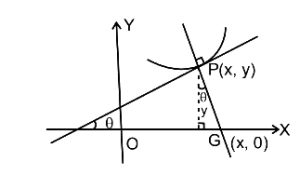
The normal to a curve at $P(x, y)$ meets the $x$-axis at $G$. If the distance of $G$ from the origin is twice the abscissa of $P$,then the curve is
A
a parabola
B
a circle
C
a hyperbola
D
an ellipse
Solution
(C) Let the point $P$ be $(x, y)$. The slope of the tangent at $P$ is $\frac{dy}{dx}$.
The slope of the normal at $P$ is $-\frac{dx}{dy}$.
The equation of the normal at $P(x, y)$ is $Y - y = -\frac{dx}{dy}(X - x)$.
To find the point $G$ where the normal meets the $x$-axis,set $Y = 0$:
$-y = -\frac{dx}{dy}(X - x) \implies y \frac{dy}{dx} = X - x \implies X = x + y \frac{dy}{dx}$.
The point $G$ is $(x + y \frac{dy}{dx}, 0)$.
The distance of $G$ from the origin is $|x + y \frac{dy}{dx}|$. Given that this distance is twice the abscissa of $P$ (which is $x$),we have:
$x + y \frac{dy}{dx} = 2x \implies y \frac{dy}{dx} = x$.
Integrating both sides with respect to $x$:
$\int y \, dy = \int x \, dx \implies \frac{y^2}{2} = \frac{x^2}{2} + C \implies y^2 - x^2 = 2C$.
This represents a rectangular hyperbola.
The slope of the normal at $P$ is $-\frac{dx}{dy}$.
The equation of the normal at $P(x, y)$ is $Y - y = -\frac{dx}{dy}(X - x)$.
To find the point $G$ where the normal meets the $x$-axis,set $Y = 0$:
$-y = -\frac{dx}{dy}(X - x) \implies y \frac{dy}{dx} = X - x \implies X = x + y \frac{dy}{dx}$.
The point $G$ is $(x + y \frac{dy}{dx}, 0)$.
The distance of $G$ from the origin is $|x + y \frac{dy}{dx}|$. Given that this distance is twice the abscissa of $P$ (which is $x$),we have:
$x + y \frac{dy}{dx} = 2x \implies y \frac{dy}{dx} = x$.
Integrating both sides with respect to $x$:
$\int y \, dy = \int x \, dx \implies \frac{y^2}{2} = \frac{x^2}{2} + C \implies y^2 - x^2 = 2C$.
This represents a rectangular hyperbola.
0 likes
View Solution170
DifficultMCQ
Given $\frac{d^2 y}{d x^2}+\cot x \frac{d y}{d x}+4 y \operatorname{cosec}^2 x=0$. Changing the independent variable $x$ to $z$ by the substitution $z=\log \tan \frac{x}{2}$,the equation is changed to
A
$\frac{d^2 y}{d z^2}+\frac{3}{y}=0$
B
$2 \frac{d^2 y}{d z^2}+e^y=0$
C
$\frac{d^2 y}{d z^2}-4 y=0$
D
$\frac{d^2 y}{d z^2}+4 y=0$
Solution
(D) Given the substitution $z = \log \tan \frac{x}{2}$.
Then,$\frac{dz}{dx} = \frac{1}{\tan(x/2)} \cdot \sec^2(x/2) \cdot \frac{1}{2} = \frac{1}{\sin x} = \operatorname{cosec} x$.
Now,$\frac{dy}{dx} = \frac{dy}{dz} \cdot \frac{dz}{dx} = \operatorname{cosec} x \frac{dy}{dz}$.
Next,$\frac{d^2 y}{dx^2} = \frac{d}{dx} \left( \operatorname{cosec} x \frac{dy}{dz} \right) = \frac{d}{dz} \left( \operatorname{cosec} x \frac{dy}{dz} \right) \cdot \frac{dz}{dx} = \left( -\operatorname{cosec} x \cot x \frac{dy}{dz} + \operatorname{cosec} x \frac{d^2 y}{dz^2} \right) \operatorname{cosec} x = \operatorname{cosec}^2 x \frac{d^2 y}{dz^2} - \operatorname{cosec} x \cot x \frac{dy}{dz}$.
Substituting these into the original equation $\frac{d^2 y}{dx^2} + \cot x \frac{dy}{dx} + 4y \operatorname{cosec}^2 x = 0$:
$\left( \operatorname{cosec}^2 x \frac{d^2 y}{dz^2} - \operatorname{cosec} x \cot x \frac{dy}{dz} \right) + \cot x (\operatorname{cosec} x \frac{dy}{dz}) + 4y \operatorname{cosec}^2 x = 0$.
$\operatorname{cosec}^2 x \frac{d^2 y}{dz^2} + 4y \operatorname{cosec}^2 x = 0$.
Dividing by $\operatorname{cosec}^2 x$,we get $\frac{d^2 y}{dz^2} + 4y = 0$.
Then,$\frac{dz}{dx} = \frac{1}{\tan(x/2)} \cdot \sec^2(x/2) \cdot \frac{1}{2} = \frac{1}{\sin x} = \operatorname{cosec} x$.
Now,$\frac{dy}{dx} = \frac{dy}{dz} \cdot \frac{dz}{dx} = \operatorname{cosec} x \frac{dy}{dz}$.
Next,$\frac{d^2 y}{dx^2} = \frac{d}{dx} \left( \operatorname{cosec} x \frac{dy}{dz} \right) = \frac{d}{dz} \left( \operatorname{cosec} x \frac{dy}{dz} \right) \cdot \frac{dz}{dx} = \left( -\operatorname{cosec} x \cot x \frac{dy}{dz} + \operatorname{cosec} x \frac{d^2 y}{dz^2} \right) \operatorname{cosec} x = \operatorname{cosec}^2 x \frac{d^2 y}{dz^2} - \operatorname{cosec} x \cot x \frac{dy}{dz}$.
Substituting these into the original equation $\frac{d^2 y}{dx^2} + \cot x \frac{dy}{dx} + 4y \operatorname{cosec}^2 x = 0$:
$\left( \operatorname{cosec}^2 x \frac{d^2 y}{dz^2} - \operatorname{cosec} x \cot x \frac{dy}{dz} \right) + \cot x (\operatorname{cosec} x \frac{dy}{dz}) + 4y \operatorname{cosec}^2 x = 0$.
$\operatorname{cosec}^2 x \frac{d^2 y}{dz^2} + 4y \operatorname{cosec}^2 x = 0$.
Dividing by $\operatorname{cosec}^2 x$,we get $\frac{d^2 y}{dz^2} + 4y = 0$.
0 likes
View Solution171
MediumMCQ
$A$ curve passes through the point $(3,2)$ for which the segment of the tangent line contained between the coordinate axes is bisected at the point of contact. The equation of the curve is
A
$y=x^2-7$
B
$x=\frac{y^2}{2}+2$
C
$xy=6$
D
$x^2+y^2-5x+7y+11=0$
Solution
(C) Let the point of contact be $(x_1, y_1)$. The equation of the tangent at $(x_1, y_1)$ is $y - y_1 = m(x - x_1)$,where $m = \frac{dy}{dx}$.
Since the segment of the tangent between the coordinate axes is bisected at $(x_1, y_1)$,the points where the tangent meets the axes are $(2x_1, 0)$ and $(0, 2y_1)$.
The slope of the tangent is $m = \frac{2y_1 - 0}{0 - 2x_1} = -\frac{y_1}{x_1}$.
Thus,$\frac{dy}{dx} = -\frac{y}{x}$.
Separating variables,we get $\frac{dy}{y} = -\frac{dx}{x}$.
Integrating both sides,$\ln y = -\ln x + C_0$,which implies $\ln(xy) = C_0$,or $xy = C$.
Since the curve passes through $(3, 2)$,we have $3 \times 2 = C$,so $C = 6$.
Therefore,the equation of the curve is $xy = 6$.
Since the segment of the tangent between the coordinate axes is bisected at $(x_1, y_1)$,the points where the tangent meets the axes are $(2x_1, 0)$ and $(0, 2y_1)$.
The slope of the tangent is $m = \frac{2y_1 - 0}{0 - 2x_1} = -\frac{y_1}{x_1}$.
Thus,$\frac{dy}{dx} = -\frac{y}{x}$.
Separating variables,we get $\frac{dy}{y} = -\frac{dx}{x}$.
Integrating both sides,$\ln y = -\ln x + C_0$,which implies $\ln(xy) = C_0$,or $xy = C$.
Since the curve passes through $(3, 2)$,we have $3 \times 2 = C$,so $C = 6$.
Therefore,the equation of the curve is $xy = 6$.
0 likes
View Solution172
DifficultMCQ
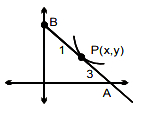
$A$ tangent is drawn at any point $P(x, y)$ on a curve,which passes through $(1, 1)$. The tangent cuts the $X$-axis and $Y$-axis at $A$ and $B$ respectively. If $AP:BP = 3:1$,then:
A
the differential equation of the curve is $3x \frac{dy}{dx} + y = 0$
B
the differential equation of the curve is $3x \frac{dy}{dx} - y = 0$
C
the curve passes through $\left(\frac{1}{8}, 2\right)$
D
the normal at $(1, 1)$ is $x + 3y = 4$
Solution
(A) Let the tangent at $P(x, y)$ be $Y - y = \frac{dy}{dx}(X - x)$.
Let $y' = \frac{dy}{dx}$. The tangent is $Y - y = y'(X - x)$.
For point $A$ ($X$-axis),set $Y = 0$: $-y = y'(X - x) \Rightarrow X = x - \frac{y}{y'}$. So,$A = \left(x - \frac{y}{y'}, 0\right)$.
For point $B$ ($Y$-axis),set $X = 0$: $Y - y = y'(-x) \Rightarrow Y = y - xy'$. So,$B = (0, y - xy')$.
Given $AP:BP = 3:1$. Using the section formula for point $P(x, y)$ dividing $AB$ in ratio $3:1$:
$x = \frac{1 \cdot (x - y/y') + 3 \cdot 0}{3 + 1} = \frac{x - y/y'}{4} \Rightarrow 4x = x - \frac{y}{y'} \Rightarrow 3x = -\frac{y}{y'} \Rightarrow 3xy' = -y \Rightarrow 3x \frac{dy}{dx} + y = 0$.
This matches option $A$.
Solving the differential equation: $\frac{3 dy}{y} + \frac{dx}{x} = 0 \Rightarrow 3 \ln|y| + \ln|x| = C \Rightarrow \ln|xy^3| = C \Rightarrow xy^3 = k$.
Since it passes through $(1, 1)$,$1(1)^3 = k \Rightarrow k = 1$. The curve is $xy^3 = 1$.
Check option $C$: If $x = 1/8$,$y^3 = 8 \Rightarrow y = 2$. So,the curve passes through $(1/8, 2)$.
Check option $D$: At $(1, 1)$,$y' = -\frac{y}{3x} = -\frac{1}{3}$. Slope of normal $= -\frac{1}{y'} = 3$.
Equation of normal: $y - 1 = 3(x - 1) \Rightarrow y - 1 = 3x - 3 \Rightarrow 3x - y = 2$. Option $D$ is incorrect.
Let $y' = \frac{dy}{dx}$. The tangent is $Y - y = y'(X - x)$.
For point $A$ ($X$-axis),set $Y = 0$: $-y = y'(X - x) \Rightarrow X = x - \frac{y}{y'}$. So,$A = \left(x - \frac{y}{y'}, 0\right)$.
For point $B$ ($Y$-axis),set $X = 0$: $Y - y = y'(-x) \Rightarrow Y = y - xy'$. So,$B = (0, y - xy')$.
Given $AP:BP = 3:1$. Using the section formula for point $P(x, y)$ dividing $AB$ in ratio $3:1$:
$x = \frac{1 \cdot (x - y/y') + 3 \cdot 0}{3 + 1} = \frac{x - y/y'}{4} \Rightarrow 4x = x - \frac{y}{y'} \Rightarrow 3x = -\frac{y}{y'} \Rightarrow 3xy' = -y \Rightarrow 3x \frac{dy}{dx} + y = 0$.
This matches option $A$.
Solving the differential equation: $\frac{3 dy}{y} + \frac{dx}{x} = 0 \Rightarrow 3 \ln|y| + \ln|x| = C \Rightarrow \ln|xy^3| = C \Rightarrow xy^3 = k$.
Since it passes through $(1, 1)$,$1(1)^3 = k \Rightarrow k = 1$. The curve is $xy^3 = 1$.
Check option $C$: If $x = 1/8$,$y^3 = 8 \Rightarrow y = 2$. So,the curve passes through $(1/8, 2)$.
Check option $D$: At $(1, 1)$,$y' = -\frac{y}{3x} = -\frac{1}{3}$. Slope of normal $= -\frac{1}{y'} = 3$.
Equation of normal: $y - 1 = 3(x - 1) \Rightarrow y - 1 = 3x - 3 \Rightarrow 3x - y = 2$. Option $D$ is incorrect.
0 likes
View Solution173
MediumMCQ
$A$ family of curves is such that the length intercepted on the $y$-axis between the origin and the tangent at any point $(x, y)$ is three times the ordinate of the point of contact. The family of curves is:
A
$x=C$,where $C$ is a constant
B
$xy^2=C$,where $C$ is a constant
C
$x^2y=C$,where $C$ is a constant
D
$x^2y^2=C$,where $C$ is a constant
Solution
(C) Let the point of contact be $(x, y)$. The equation of the tangent at $(x, y)$ is given by $(Y - y) = \frac{dy}{dx}(X - x)$.
To find the $y$-intercept,we set $X = 0$ in the tangent equation:
$Y - y = \frac{dy}{dx}(0 - x) \Rightarrow Y = y - x \frac{dy}{dx}$.
The length of the $y$-intercept is $|Y| = |y - x \frac{dy}{dx}|$. According to the problem,the $y$-intercept is $3$ times the ordinate $y$:
$y - x \frac{dy}{dx} = 3y$.
Rearranging the terms,we get $-x \frac{dy}{dx} = 2y$.
Separating the variables,we have $\frac{dy}{y} = -2 \frac{dx}{x}$.
Integrating both sides,we get $\int \frac{dy}{y} = -2 \int \frac{dx}{x} + \ln C$.
$\ln y = -2 \ln x + \ln C \Rightarrow \ln y = \ln(x^{-2}) + \ln C$.
$\ln y = \ln(C x^{-2}) \Rightarrow y = \frac{C}{x^2}$.
Thus,$x^2y = C$,where $C$ is a constant.
To find the $y$-intercept,we set $X = 0$ in the tangent equation:
$Y - y = \frac{dy}{dx}(0 - x) \Rightarrow Y = y - x \frac{dy}{dx}$.
The length of the $y$-intercept is $|Y| = |y - x \frac{dy}{dx}|$. According to the problem,the $y$-intercept is $3$ times the ordinate $y$:
$y - x \frac{dy}{dx} = 3y$.
Rearranging the terms,we get $-x \frac{dy}{dx} = 2y$.
Separating the variables,we have $\frac{dy}{y} = -2 \frac{dx}{x}$.
Integrating both sides,we get $\int \frac{dy}{y} = -2 \int \frac{dx}{x} + \ln C$.
$\ln y = -2 \ln x + \ln C \Rightarrow \ln y = \ln(x^{-2}) + \ln C$.
$\ln y = \ln(C x^{-2}) \Rightarrow y = \frac{C}{x^2}$.
Thus,$x^2y = C$,where $C$ is a constant.
0 likes
View Solution174
MediumMCQ
Let $f$ be a non-negative function defined in $[0, \pi / 2]$,$f^{\prime}$ exists and is continuous for all $x$,and $\int_0^x \sqrt{1-\left(f^{\prime}(t)\right)^2} dt = \int_0^x f(t) dt$ with $f(0) = 0$. Then
A
$f(1/2) < 1/2$ and $f(1/3) > 1/3$
B
$f(1/2) > 1/2$ and $f(1/3) < 1/3$
C
$f(4/3) < 4/3$ and $f(2/3) < 2/3$
D
$f(4/3) > 4/3$ and $f(2/3) > 2/3$
Solution
(C) Given $\int_0^x \sqrt{1-\left(f^{\prime}(t)\right)^2} dt = \int_0^x f(t) dt$.
Applying the Leibniz rule by differentiating both sides with respect to $x$,we get $\sqrt{1-\left(f^{\prime}(x)\right)^2} = f(x)$.
Squaring both sides,$1 - (f^{\prime}(x))^2 = f^2(x)$,which implies $(f^{\prime}(x))^2 = 1 - f^2(x)$.
Thus,$f^{\prime}(x) = \pm \sqrt{1 - f^2(x)}$.
Separating variables,$\int \frac{df}{\sqrt{1-f^2}} = \pm \int dx$,which gives $\sin^{-1}(f(x)) = \pm x + C$.
Since $f(0) = 0$,we have $\sin^{-1}(0) = 0 + C$,so $C = 0$.
Thus,$f(x) = \sin(x)$ or $f(x) = -\sin(x)$.
Since $f$ is non-negative on $[0, \pi/2]$,we must have $f(x) = \sin(x)$.
We know that for $x > 0$,$\sin(x) < x$.
Therefore,$f(4/3) = \sin(4/3) < 4/3$ and $f(2/3) = \sin(2/3) < 2/3$.
Applying the Leibniz rule by differentiating both sides with respect to $x$,we get $\sqrt{1-\left(f^{\prime}(x)\right)^2} = f(x)$.
Squaring both sides,$1 - (f^{\prime}(x))^2 = f^2(x)$,which implies $(f^{\prime}(x))^2 = 1 - f^2(x)$.
Thus,$f^{\prime}(x) = \pm \sqrt{1 - f^2(x)}$.
Separating variables,$\int \frac{df}{\sqrt{1-f^2}} = \pm \int dx$,which gives $\sin^{-1}(f(x)) = \pm x + C$.
Since $f(0) = 0$,we have $\sin^{-1}(0) = 0 + C$,so $C = 0$.
Thus,$f(x) = \sin(x)$ or $f(x) = -\sin(x)$.
Since $f$ is non-negative on $[0, \pi/2]$,we must have $f(x) = \sin(x)$.
We know that for $x > 0$,$\sin(x) < x$.
Therefore,$f(4/3) = \sin(4/3) < 4/3$ and $f(2/3) = \sin(2/3) < 2/3$.
0 likes
View Solution175
EasyMCQ
The slope at any point of a curve $y=f(x)$ is given by $\frac{dy}{dx}=3x^2$ and it passes through $(-1,1)$. The equation of the curve is
A
$y=x^3+2$
B
$y=-x^3-2$
C
$y=3x^3+4$
D
$y=-x^3+2$
Solution
(A) Given the differential equation for the slope of the curve: $\frac{dy}{dx} = 3x^2$.
To find the equation of the curve,we integrate both sides with respect to $x$:
$\int dy = \int 3x^2 dx$
$y = x^3 + C$,where $C$ is the constant of integration.
The curve passes through the point $(-1, 1)$. Substituting these coordinates into the equation:
$1 = (-1)^3 + C$
$1 = -1 + C$
$C = 2$.
Substituting the value of $C$ back into the general equation,we get:
$y = x^3 + 2$.
To find the equation of the curve,we integrate both sides with respect to $x$:
$\int dy = \int 3x^2 dx$
$y = x^3 + C$,where $C$ is the constant of integration.
The curve passes through the point $(-1, 1)$. Substituting these coordinates into the equation:
$1 = (-1)^3 + C$
$1 = -1 + C$
$C = 2$.
Substituting the value of $C$ back into the general equation,we get:
$y = x^3 + 2$.
0 likes
View Solution176
DifficultMCQ
Let $f$ be a twice differentiable non-negative function such that $(f(x))^2 = 25 + \int_{0}^{x} ((f(t))^2 + (f'(t))^2) dt$. Then the mean of $f(\log_e(1)), f(\log_e(2)), \ldots, f(\log_e(625))$ is equal to:
A
$1560$
B
$1565$
C
$1570$
D
$1575$
Solution
(B) Given the equation: $(f(x))^2 = 25 + \int_{0}^{x} ((f(t))^2 + (f'(t))^2) dt$.
Differentiating both sides with respect to $x$ using the Leibniz rule:
$2 f(x) f'(x) = (f(x))^2 + (f'(x))^2$.
Rearranging the terms: $(f(x))^2 - 2 f(x) f'(x) + (f'(x))^2 = 0$.
This simplifies to: $(f(x) - f'(x))^2 = 0$,which implies $f'(x) = f(x)$.
Solving this differential equation: $\frac{f'(x)}{f(x)} = 1 \Rightarrow \ln(f(x)) = x + C \Rightarrow f(x) = A e^x$.
At $x = 0$,$(f(0))^2 = 25 + 0 \Rightarrow f(0) = 5$ (since $f$ is non-negative).
Thus,$A e^0 = 5 \Rightarrow A = 5$,so $f(x) = 5 e^x$.
We need the mean of $f(\ln 1), f(\ln 2), \ldots, f(\ln 625)$.
Since $f(\ln n) = 5 e^{\ln n} = 5n$,the mean is:
$\text{Mean} = \frac{1}{625} \sum_{n=1}^{625} 5n = \frac{5}{625} \times \frac{625 \times 626}{2} = \frac{5 \times 626}{2} = 5 \times 313 = 1565$.
Differentiating both sides with respect to $x$ using the Leibniz rule:
$2 f(x) f'(x) = (f(x))^2 + (f'(x))^2$.
Rearranging the terms: $(f(x))^2 - 2 f(x) f'(x) + (f'(x))^2 = 0$.
This simplifies to: $(f(x) - f'(x))^2 = 0$,which implies $f'(x) = f(x)$.
Solving this differential equation: $\frac{f'(x)}{f(x)} = 1 \Rightarrow \ln(f(x)) = x + C \Rightarrow f(x) = A e^x$.
At $x = 0$,$(f(0))^2 = 25 + 0 \Rightarrow f(0) = 5$ (since $f$ is non-negative).
Thus,$A e^0 = 5 \Rightarrow A = 5$,so $f(x) = 5 e^x$.
We need the mean of $f(\ln 1), f(\ln 2), \ldots, f(\ln 625)$.
Since $f(\ln n) = 5 e^{\ln n} = 5n$,the mean is:
$\text{Mean} = \frac{1}{625} \sum_{n=1}^{625} 5n = \frac{5}{625} \times \frac{625 \times 626}{2} = \frac{5 \times 626}{2} = 5 \times 313 = 1565$.
0 likes
View SolutionDifferential Equations — Application of differential equations · Frequently Asked Questions
1Are these Differential Equations questions useful for JEE and NEET?
Yes. All questions in this section are mapped to JEE Main and NEET exam patterns. Previous year questions from JEE Main, NEET, GUJCET and state-level exams are included with full solutions.
2Can I switch to Hindi or Gujarati for these questions?
Yes. Use the language tabs in the hero section or the sidebar to view the same questions and solutions in English, Hindi or Gujarati.
3How do I generate a question paper from this subtopic?
Use the Vedclass Exam Paper Generator — select the chapter and subtopic, set difficulty, and generate Sets A, B, C, D automatically. First 3 chapters of every subject are free.
Vedclass Products
For Students
Vedclass Test Series
Mock tests in real JEE/NEET style with performance analysis. 5-day free trial.
Start Free TrialFor Teachers
Exam Paper Generator
Generate Set A/B/C/D papers from this chapter in 2 minutes. 3 chapters free.
Try FreeFor Institutes
Online Exam Module
Live online exams with unlimited students, 360° analytics & white-label branding.
See DemoFor Teachers & Institutes
Generate a Differential Equations Exam Paper in 2 Minutes
Select subtopic & difficulty — Sets A, B, C, D auto-generated with No Repeat logic.
First 3 chapters of every subject are free — no payment required.