
A English
Application of differential equations Questions in English
Class 12 Mathematics · Differential Equations · Application of differential equations
177+
Questions
English
Language
100%
With Solutions
Showing 49 of 177 questions in English
51
DifficultMCQ
The rate of growth of bacteria in a culture is proportional to the number of bacteria present and the bacteria count is $1000$ at initial time $t = 0$. The number of bacteria is increased by $20\%$ in $2$ hours. If the population of bacteria is $2000$ after $\frac{k}{\log_{e}\left(\frac{6}{5}\right)}$ hours,then $\left(\frac{k}{\log_{e} 2}\right)^{2}$ is equal to
A
$4$
B
$8$
C
$2$
D
$16$
Solution
(A) Let $B(t)$ be the number of bacteria at time $t$. The rate of growth is given by $\frac{dB}{dt} = \lambda B$.
Integrating this,we get $B(t) = B_0 e^{\lambda t}$,where $B_0 = 1000$.
Given that at $t = 2$,$B(2) = 1000 + 20\% \text{ of } 1000 = 1200$.
So,$1200 = 1000 e^{2\lambda} \Rightarrow e^{2\lambda} = \frac{6}{5} \Rightarrow 2\lambda = \log_{e}\left(\frac{6}{5}\right) \Rightarrow \lambda = \frac{1}{2} \log_{e}\left(\frac{6}{5}\right)$.
We are given $B(T) = 2000$ where $T = \frac{k}{\log_{e}\left(\frac{6}{5}\right)}$.
Using $B(T) = B_0 e^{\lambda T}$,we have $2000 = 1000 e^{\lambda T} \Rightarrow 2 = e^{\lambda T} \Rightarrow \log_{e} 2 = \lambda T$.
Substituting $\lambda$ and $T$: $\log_{e} 2 = \left(\frac{1}{2} \log_{e}\left(\frac{6}{5}\right)\right) \times \left(\frac{k}{\log_{e}\left(\frac{6}{5}\right)}\right) = \frac{k}{2}$.
Thus,$k = 2 \log_{e} 2$.
Finally,$\left(\frac{k}{\log_{e} 2}\right)^{2} = \left(\frac{2 \log_{e} 2}{\log_{e} 2}\right)^{2} = 2^{2} = 4$.
Integrating this,we get $B(t) = B_0 e^{\lambda t}$,where $B_0 = 1000$.
Given that at $t = 2$,$B(2) = 1000 + 20\% \text{ of } 1000 = 1200$.
So,$1200 = 1000 e^{2\lambda} \Rightarrow e^{2\lambda} = \frac{6}{5} \Rightarrow 2\lambda = \log_{e}\left(\frac{6}{5}\right) \Rightarrow \lambda = \frac{1}{2} \log_{e}\left(\frac{6}{5}\right)$.
We are given $B(T) = 2000$ where $T = \frac{k}{\log_{e}\left(\frac{6}{5}\right)}$.
Using $B(T) = B_0 e^{\lambda T}$,we have $2000 = 1000 e^{\lambda T} \Rightarrow 2 = e^{\lambda T} \Rightarrow \log_{e} 2 = \lambda T$.
Substituting $\lambda$ and $T$: $\log_{e} 2 = \left(\frac{1}{2} \log_{e}\left(\frac{6}{5}\right)\right) \times \left(\frac{k}{\log_{e}\left(\frac{6}{5}\right)}\right) = \frac{k}{2}$.
Thus,$k = 2 \log_{e} 2$.
Finally,$\left(\frac{k}{\log_{e} 2}\right)^{2} = \left(\frac{2 \log_{e} 2}{\log_{e} 2}\right)^{2} = 2^{2} = 4$.
0 likes
View Solution52
AdvancedMCQ
The slope of the tangent to a curve $C : y = y(x)$ at any point $(x, y)$ on it is $\frac{2e^{2x} - 6e^{-x} + 9}{2 + 9e^{-2x}}$. If $C$ passes through the points $(0, \frac{1}{2} + \frac{\pi}{2\sqrt{2}})$ and $(\alpha, \frac{1}{2}e^{2\alpha})$,then $e^{\alpha}$ is equal to:
A
$\frac{3+\sqrt{2}}{3-\sqrt{2}}$
B
$\frac{3}{\sqrt{2}}\left(\frac{3+\sqrt{2}}{3-\sqrt{2}}\right)$
C
$\frac{1}{\sqrt{2}}\left(\frac{\sqrt{2}+1}{\sqrt{2}-1}\right)$
D
$\frac{\sqrt{2}+1}{\sqrt{2}-1}$
Solution
(B) Given the slope of the tangent $\frac{dy}{dx} = \frac{2e^{2x} - 6e^{-x} + 9}{2 + 9e^{-2x}}$.
Multiply numerator and denominator by $e^{2x}$:
$\frac{dy}{dx} = \frac{2e^{4x} - 6e^x + 9e^{2x}}{2e^{2x} + 9}$.
This simplifies to $\frac{dy}{dx} = e^{2x} - \frac{6e^x}{2e^{2x} + 9}$.
Integrating both sides with respect to $x$:
$y = \int e^{2x} dx - \int \frac{6e^x}{2e^{2x} + 9} dx$.
Let $u = \sqrt{2}e^x$,then $du = \sqrt{2}e^x dx$,so $e^x dx = \frac{du}{\sqrt{2}}$.
$y = \frac{1}{2}e^{2x} - \int \frac{6}{\sqrt{2}(u^2 + 3^2)} du = \frac{1}{2}e^{2x} - \frac{6}{\sqrt{2} \cdot 3} \tan^{-1}(\frac{u}{3}) + C$.
$y = \frac{1}{2}e^{2x} - \sqrt{2} \tan^{-1}(\frac{\sqrt{2}e^x}{3}) + C$.
Using the point $(0, \frac{1}{2} + \frac{\pi}{2\sqrt{2}})$:
$\frac{1}{2} + \frac{\pi}{2\sqrt{2}} = \frac{1}{2} - \sqrt{2} \tan^{-1}(\frac{\sqrt{2}}{3}) + C \implies C = \frac{\pi}{2\sqrt{2}} + \sqrt{2} \tan^{-1}(\frac{\sqrt{2}}{3})$.
Using the point $(\alpha, \frac{1}{2}e^{2\alpha})$:
$\frac{1}{2}e^{2\alpha} = \frac{1}{2}e^{2\alpha} - \sqrt{2} \tan^{-1}(\frac{\sqrt{2}e^{\alpha}}{3}) + C$.
$\sqrt{2} \tan^{-1}(\frac{\sqrt{2}e^{\alpha}}{3}) = \frac{\pi}{2\sqrt{2}} + \sqrt{2} \tan^{-1}(\frac{\sqrt{2}}{3})$.
$\tan^{-1}(\frac{\sqrt{2}e^{\alpha}}{3}) = \frac{\pi}{4} + \tan^{-1}(\frac{\sqrt{2}}{3})$.
Taking $\tan$ on both sides:
$\frac{\sqrt{2}e^{\alpha}}{3} = \tan(\frac{\pi}{4} + \tan^{-1}(\frac{\sqrt{2}}{3})) = \frac{1 + \frac{\sqrt{2}}{3}}{1 - \frac{\sqrt{2}}{3}} = \frac{3+\sqrt{2}}{3-\sqrt{2}}$.
$e^{\alpha} = \frac{3}{\sqrt{2}} \left(\frac{3+\sqrt{2}}{3-\sqrt{2}}\right)$.
Multiply numerator and denominator by $e^{2x}$:
$\frac{dy}{dx} = \frac{2e^{4x} - 6e^x + 9e^{2x}}{2e^{2x} + 9}$.
This simplifies to $\frac{dy}{dx} = e^{2x} - \frac{6e^x}{2e^{2x} + 9}$.
Integrating both sides with respect to $x$:
$y = \int e^{2x} dx - \int \frac{6e^x}{2e^{2x} + 9} dx$.
Let $u = \sqrt{2}e^x$,then $du = \sqrt{2}e^x dx$,so $e^x dx = \frac{du}{\sqrt{2}}$.
$y = \frac{1}{2}e^{2x} - \int \frac{6}{\sqrt{2}(u^2 + 3^2)} du = \frac{1}{2}e^{2x} - \frac{6}{\sqrt{2} \cdot 3} \tan^{-1}(\frac{u}{3}) + C$.
$y = \frac{1}{2}e^{2x} - \sqrt{2} \tan^{-1}(\frac{\sqrt{2}e^x}{3}) + C$.
Using the point $(0, \frac{1}{2} + \frac{\pi}{2\sqrt{2}})$:
$\frac{1}{2} + \frac{\pi}{2\sqrt{2}} = \frac{1}{2} - \sqrt{2} \tan^{-1}(\frac{\sqrt{2}}{3}) + C \implies C = \frac{\pi}{2\sqrt{2}} + \sqrt{2} \tan^{-1}(\frac{\sqrt{2}}{3})$.
Using the point $(\alpha, \frac{1}{2}e^{2\alpha})$:
$\frac{1}{2}e^{2\alpha} = \frac{1}{2}e^{2\alpha} - \sqrt{2} \tan^{-1}(\frac{\sqrt{2}e^{\alpha}}{3}) + C$.
$\sqrt{2} \tan^{-1}(\frac{\sqrt{2}e^{\alpha}}{3}) = \frac{\pi}{2\sqrt{2}} + \sqrt{2} \tan^{-1}(\frac{\sqrt{2}}{3})$.
$\tan^{-1}(\frac{\sqrt{2}e^{\alpha}}{3}) = \frac{\pi}{4} + \tan^{-1}(\frac{\sqrt{2}}{3})$.
Taking $\tan$ on both sides:
$\frac{\sqrt{2}e^{\alpha}}{3} = \tan(\frac{\pi}{4} + \tan^{-1}(\frac{\sqrt{2}}{3})) = \frac{1 + \frac{\sqrt{2}}{3}}{1 - \frac{\sqrt{2}}{3}} = \frac{3+\sqrt{2}}{3-\sqrt{2}}$.
$e^{\alpha} = \frac{3}{\sqrt{2}} \left(\frac{3+\sqrt{2}}{3-\sqrt{2}}\right)$.
0 likes
View Solution53
AdvancedMCQ
Suppose a continuous function $f:(0, \infty) \rightarrow R$ satisfies $f(x)=2 \int_0^x t f(t) d t+1, \forall x \geq 0$. Then,$f(1)$ equals
A
$e$
B
$e^2$
C
$e^4$
D
$e^6$
Solution
(A) Given the continuous function $f:[0, \infty) \rightarrow R$ satisfying $f(x) = 2 \int_0^x t f(t) d t + 1, \forall x \geq 0$.
Applying the Leibniz rule for differentiation under the integral sign,we differentiate both sides with respect to $x$:
$f'(x) = 2x f(x)$.
Rearranging the terms,we get $\frac{f'(x)}{f(x)} = 2x$.
Integrating both sides with respect to $x$:
$\int \frac{f'(x)}{f(x)} dx = \int 2x dx$.
$\ln |f(x)| = x^2 + C$.
$f(x) = K e^{x^2}$,where $K = e^C$.
To find $K$,we evaluate the original equation at $x=0$:
$f(0) = 2 \int_0^0 t f(t) dt + 1 = 0 + 1 = 1$.
Substituting $x=0$ into $f(x) = K e^{x^2}$,we get $f(0) = K e^0 = K$.
Thus,$K = 1$,which gives $f(x) = e^{x^2}$.
Finally,$f(1) = e^{(1)^2} = e^1 = e$.
Applying the Leibniz rule for differentiation under the integral sign,we differentiate both sides with respect to $x$:
$f'(x) = 2x f(x)$.
Rearranging the terms,we get $\frac{f'(x)}{f(x)} = 2x$.
Integrating both sides with respect to $x$:
$\int \frac{f'(x)}{f(x)} dx = \int 2x dx$.
$\ln |f(x)| = x^2 + C$.
$f(x) = K e^{x^2}$,where $K = e^C$.
To find $K$,we evaluate the original equation at $x=0$:
$f(0) = 2 \int_0^0 t f(t) dt + 1 = 0 + 1 = 1$.
Substituting $x=0$ into $f(x) = K e^{x^2}$,we get $f(0) = K e^0 = K$.
Thus,$K = 1$,which gives $f(x) = e^{x^2}$.
Finally,$f(1) = e^{(1)^2} = e^1 = e$.
0 likes
View Solution54
AdvancedMCQ
Let $S$ be the set of real numbers $p$ such that there is no non-zero continuous function $f: \mathbb{R} \rightarrow \mathbb{R}$ satisfying $\int_0^x f(t) dt = p f(x)$ for all $x \in \mathbb{R}$. Then,$S$ is
A
the empty set
B
the set of all rational numbers
C
the set of all irrational numbers
D
the whole set $\mathbb{R}$
Solution
(D) Given the equation $\int_0^x f(t) dt = p f(x)$.
If $p = 0$,then $\int_0^x f(t) dt = 0$ for all $x \in \mathbb{R}$. Differentiating with respect to $x$,we get $f(x) = 0$ for all $x$. Thus,there is no non-zero function $f$ for $p = 0$.
If $p \neq 0$,we differentiate both sides with respect to $x$ using the Fundamental Theorem of Calculus:
$f(x) = p f'(x) \implies \frac{f'(x)}{f(x)} = \frac{1}{p}$.
Integrating both sides,we get $\ln|f(x)| = \frac{x}{p} + C$,which implies $f(x) = A e^{x/p}$ for some constant $A$.
Substituting this back into the original integral equation at $x = 0$:
$\int_0^0 f(t) dt = p f(0) \implies 0 = p A e^0 \implies p A = 0$.
Since $p \neq 0$,we must have $A = 0$,which implies $f(x) = 0$ for all $x$.
Thus,for any $p \in \mathbb{R}$,there exists no non-zero continuous function $f$ satisfying the given equation.
Therefore,$S = \mathbb{R}$.
If $p = 0$,then $\int_0^x f(t) dt = 0$ for all $x \in \mathbb{R}$. Differentiating with respect to $x$,we get $f(x) = 0$ for all $x$. Thus,there is no non-zero function $f$ for $p = 0$.
If $p \neq 0$,we differentiate both sides with respect to $x$ using the Fundamental Theorem of Calculus:
$f(x) = p f'(x) \implies \frac{f'(x)}{f(x)} = \frac{1}{p}$.
Integrating both sides,we get $\ln|f(x)| = \frac{x}{p} + C$,which implies $f(x) = A e^{x/p}$ for some constant $A$.
Substituting this back into the original integral equation at $x = 0$:
$\int_0^0 f(t) dt = p f(0) \implies 0 = p A e^0 \implies p A = 0$.
Since $p \neq 0$,we must have $A = 0$,which implies $f(x) = 0$ for all $x$.
Thus,for any $p \in \mathbb{R}$,there exists no non-zero continuous function $f$ satisfying the given equation.
Therefore,$S = \mathbb{R}$.
0 likes
View Solution55
DifficultMCQ
The number of differentiable functions $y: (-\infty, \infty) \rightarrow [0, \infty)$ satisfying $y^{\prime} = 2 \sqrt{y}$ and $y(0) = 0$ is
A
$1$
B
$2$
C
finite but more than $2$
D
infinite
Solution
(D) Given the differential equation $\frac{dy}{dx} = 2 \sqrt{y}$ with the initial condition $y(0) = 0$.
Case $I$: The trivial solution $y(x) = 0$ for all $x \in \mathbb{R}$ satisfies the equation and the initial condition.
Case $II$: For any constant $a \geq 0$,we can define a family of functions:
$y(x) = \begin{cases} 0 & x < a \\ (x-a)^2 & x \geq a \end{cases}$
Let us check the differentiability at $x = a$:
Left-hand derivative: $\lim_{h \to 0^-} \frac{y(a+h) - y(a)}{h} = \lim_{h \to 0^-} \frac{0 - 0}{h} = 0$.
Right-hand derivative: $\lim_{h \to 0^+} \frac{y(a+h) - y(a)}{h} = \lim_{h \to 0^+} \frac{(a+h-a)^2 - 0}{h} = \lim_{h \to 0^+} \frac{h^2}{h} = 0$.
Since the left-hand derivative equals the right-hand derivative,the function is differentiable at $x = a$.
For $x > a$,$y'(x) = 2(x-a) = 2\sqrt{(x-a)^2} = 2\sqrt{y(x)}$.
Since $a$ can be any non-negative real number,there are infinitely many such functions.
Case $I$: The trivial solution $y(x) = 0$ for all $x \in \mathbb{R}$ satisfies the equation and the initial condition.
Case $II$: For any constant $a \geq 0$,we can define a family of functions:
$y(x) = \begin{cases} 0 & x < a \\ (x-a)^2 & x \geq a \end{cases}$
Let us check the differentiability at $x = a$:
Left-hand derivative: $\lim_{h \to 0^-} \frac{y(a+h) - y(a)}{h} = \lim_{h \to 0^-} \frac{0 - 0}{h} = 0$.
Right-hand derivative: $\lim_{h \to 0^+} \frac{y(a+h) - y(a)}{h} = \lim_{h \to 0^+} \frac{(a+h-a)^2 - 0}{h} = \lim_{h \to 0^+} \frac{h^2}{h} = 0$.
Since the left-hand derivative equals the right-hand derivative,the function is differentiable at $x = a$.
For $x > a$,$y'(x) = 2(x-a) = 2\sqrt{(x-a)^2} = 2\sqrt{y(x)}$.
Since $a$ can be any non-negative real number,there are infinitely many such functions.
0 likes
View Solution56
DifficultMCQ
Let $f$ be a differentiable function defined on $\left[0, \frac{\pi}{2}\right]$ such that $f(x) > 0$ and $f(x)+\int \limits_0^x f(t) \sqrt{1-\left(\log _e f(t)\right)^2} d t=e, \forall x \in\left[0, \frac{\pi}{2}\right]$. Then $\left(6 \log _{ e } f \left(\frac{\pi}{6}\right)\right)^2$ is equal to $.............$
A
$25$
B
$26$
C
$23$
D
$27$
Solution
(D) Given $f(x) + \int_0^x f(t) \sqrt{1 - (\ln f(t))^2} dt = e$.
At $x=0$,$f(0) + 0 = e$,so $f(0) = e$.
Differentiating both sides with respect to $x$ using Leibniz's rule:
$f'(x) + f(x) \sqrt{1 - (\ln f(x))^2} = 0$.
Let $y = f(x)$,then $\frac{dy}{dx} = -y \sqrt{1 - (\ln y)^2}$.
Separating variables: $\int \frac{dy}{y \sqrt{1 - (\ln y)^2}} = -\int dx$.
Let $\ln y = t$,then $\frac{1}{y} dy = dt$.
$\int \frac{dt}{\sqrt{1 - t^2}} = -x + C$.
$\sin^{-1}(t) = -x + C \Rightarrow \sin^{-1}(\ln f(x)) = -x + C$.
Since $f(0) = e$,$\sin^{-1}(\ln e) = -0 + C \Rightarrow \sin^{-1}(1) = C \Rightarrow C = \frac{\pi}{2}$.
Thus,$\sin^{-1}(\ln f(x)) = \frac{\pi}{2} - x$.
For $x = \frac{\pi}{6}$,$\sin^{-1}(\ln f(\frac{\pi}{6})) = \frac{\pi}{2} - \frac{\pi}{6} = \frac{\pi}{3}$.
Therefore,$\ln f(\frac{\pi}{6}) = \sin(\frac{\pi}{3}) = \frac{\sqrt{3}}{2}$.
Finally,$(6 \ln f(\frac{\pi}{6}))^2 = (6 \times \frac{\sqrt{3}}{2})^2 = (3\sqrt{3})^2 = 27$.
At $x=0$,$f(0) + 0 = e$,so $f(0) = e$.
Differentiating both sides with respect to $x$ using Leibniz's rule:
$f'(x) + f(x) \sqrt{1 - (\ln f(x))^2} = 0$.
Let $y = f(x)$,then $\frac{dy}{dx} = -y \sqrt{1 - (\ln y)^2}$.
Separating variables: $\int \frac{dy}{y \sqrt{1 - (\ln y)^2}} = -\int dx$.
Let $\ln y = t$,then $\frac{1}{y} dy = dt$.
$\int \frac{dt}{\sqrt{1 - t^2}} = -x + C$.
$\sin^{-1}(t) = -x + C \Rightarrow \sin^{-1}(\ln f(x)) = -x + C$.
Since $f(0) = e$,$\sin^{-1}(\ln e) = -0 + C \Rightarrow \sin^{-1}(1) = C \Rightarrow C = \frac{\pi}{2}$.
Thus,$\sin^{-1}(\ln f(x)) = \frac{\pi}{2} - x$.
For $x = \frac{\pi}{6}$,$\sin^{-1}(\ln f(\frac{\pi}{6})) = \frac{\pi}{2} - \frac{\pi}{6} = \frac{\pi}{3}$.
Therefore,$\ln f(\frac{\pi}{6}) = \sin(\frac{\pi}{3}) = \frac{\sqrt{3}}{2}$.
Finally,$(6 \ln f(\frac{\pi}{6}))^2 = (6 \times \frac{\sqrt{3}}{2})^2 = (3\sqrt{3})^2 = 27$.
0 likes
View Solution57
DifficultMCQ
The area enclosed by the closed curve $C$ given by the differential equation $\frac{dy}{dx} + \frac{x+a}{y-2} = 0, y(1) = 0$ is $4\pi$. Let $P$ and $Q$ be the points of intersection of the curve $C$ and the $y$-axis. If normals at $P$ and $Q$ on the curve $C$ intersect the $x$-axis at points $R$ and $S$ respectively,then the length of the line segment $RS$ is
A
$2\sqrt{3}$
B
$\frac{2\sqrt{3}}{3}$
C
$2$
D
$\frac{4\sqrt{3}}{3}$
Solution
(D) Given the differential equation $\frac{dy}{dx} = -\frac{x+a}{y-2}$.
Integrating both sides,we get $\int (y-2) dy = -\int (x+a) dx$,which gives $\frac{(y-2)^2}{2} = -\frac{(x+a)^2}{2} + k$.
This simplifies to $(x+a)^2 + (y-2)^2 = 2k$. Since the area is $4\pi$,the radius $r = 2$,so $2k = 4$,meaning $(x+a)^2 + (y-2)^2 = 4$.
Using $y(1) = 0$,we have $(1+a)^2 + (0-2)^2 = 4$,so $(1+a)^2 = 0$,which gives $a = -1$.
The equation of the circle is $(x-1)^2 + (y-2)^2 = 4$.
For intersection with the $y$-axis,set $x=0$: $(0-1)^2 + (y-2)^2 = 4 \implies (y-2)^2 = 3 \implies y = 2 \pm \sqrt{3}$.
So $P = (0, 2+\sqrt{3})$ and $Q = (0, 2-\sqrt{3})$.
The center of the circle is $(1, 2)$. The slope of the radius to $P$ is $\frac{(2+\sqrt{3})-2}{0-1} = -\sqrt{3}$.
The slope of the normal at $P$ is the same as the slope of the radius,which is $-\sqrt{3}$.
The equation of the normal at $P$ is $y - (2+\sqrt{3}) = -\sqrt{3}(x-0) \implies y = -\sqrt{3}x + 2 + \sqrt{3}$.
Setting $y=0$ for $R$,we get $0 = -\sqrt{3}x + 2 + \sqrt{3} \implies x_R = 1 + \frac{2}{\sqrt{3}}$.
Similarly,for $Q$,the slope of the radius is $\frac{(2-\sqrt{3})-2}{0-1} = \sqrt{3}$.
The equation of the normal at $Q$ is $y - (2-\sqrt{3}) = \sqrt{3}(x-0) \implies y = \sqrt{3}x + 2 - \sqrt{3}$.
Setting $y=0$ for $S$,we get $0 = \sqrt{3}x + 2 - \sqrt{3} \implies x_S = 1 - \frac{2}{\sqrt{3}}$.
The length $RS = |x_R - x_S| = |(1 + \frac{2}{\sqrt{3}}) - (1 - \frac{2}{\sqrt{3}})| = \frac{4}{\sqrt{3}} = \frac{4\sqrt{3}}{3}$.
Integrating both sides,we get $\int (y-2) dy = -\int (x+a) dx$,which gives $\frac{(y-2)^2}{2} = -\frac{(x+a)^2}{2} + k$.
This simplifies to $(x+a)^2 + (y-2)^2 = 2k$. Since the area is $4\pi$,the radius $r = 2$,so $2k = 4$,meaning $(x+a)^2 + (y-2)^2 = 4$.
Using $y(1) = 0$,we have $(1+a)^2 + (0-2)^2 = 4$,so $(1+a)^2 = 0$,which gives $a = -1$.
The equation of the circle is $(x-1)^2 + (y-2)^2 = 4$.
For intersection with the $y$-axis,set $x=0$: $(0-1)^2 + (y-2)^2 = 4 \implies (y-2)^2 = 3 \implies y = 2 \pm \sqrt{3}$.
So $P = (0, 2+\sqrt{3})$ and $Q = (0, 2-\sqrt{3})$.
The center of the circle is $(1, 2)$. The slope of the radius to $P$ is $\frac{(2+\sqrt{3})-2}{0-1} = -\sqrt{3}$.
The slope of the normal at $P$ is the same as the slope of the radius,which is $-\sqrt{3}$.
The equation of the normal at $P$ is $y - (2+\sqrt{3}) = -\sqrt{3}(x-0) \implies y = -\sqrt{3}x + 2 + \sqrt{3}$.
Setting $y=0$ for $R$,we get $0 = -\sqrt{3}x + 2 + \sqrt{3} \implies x_R = 1 + \frac{2}{\sqrt{3}}$.
Similarly,for $Q$,the slope of the radius is $\frac{(2-\sqrt{3})-2}{0-1} = \sqrt{3}$.
The equation of the normal at $Q$ is $y - (2-\sqrt{3}) = \sqrt{3}(x-0) \implies y = \sqrt{3}x + 2 - \sqrt{3}$.
Setting $y=0$ for $S$,we get $0 = \sqrt{3}x + 2 - \sqrt{3} \implies x_S = 1 - \frac{2}{\sqrt{3}}$.
The length $RS = |x_R - x_S| = |(1 + \frac{2}{\sqrt{3}}) - (1 - \frac{2}{\sqrt{3}})| = \frac{4}{\sqrt{3}} = \frac{4\sqrt{3}}{3}$.
0 likes
View Solution58
DifficultMCQ
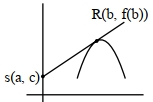
Let a curve $y=f(x), x \in(0, \infty)$ pass through the points $P\left(1, \frac{3}{2}\right)$ and $Q\left(a, \frac{1}{2}\right)$. If the tangent at any point $R(b, f(b))$ to the given curve cuts the $y$-axis at the point $S(0, c)$ such that $bc=3$,then $(PQ)^2$ is equal to $.........$.
A
$4$
B
$3$
C
$5$
D
$2$
Solution
(C) The equation of the tangent at $R(b, f(b))$ is given by:
$y - f(b) = f'(b)(x - b)$
Since this tangent passes through $S(0, c)$,we have:
$c - f(b) = f'(b)(0 - b)$
$c - f(b) = -b f'(b)$
Given $bc = 3$,we have $c = \frac{3}{b}$. Substituting this into the equation:
$\frac{3}{b} - f(b) = -b f'(b)$
$b f'(b) - f(b) = -\frac{3}{b}$
Dividing both sides by $b^2$:
$\frac{b f'(b) - f(b)}{b^2} = -\frac{3}{b^3}$
This is the derivative of $\frac{f(b)}{b}$ with respect to $b$:
$\frac{d}{db} \left( \frac{f(b)}{b} \right) = -\frac{3}{b^3}$
Integrating both sides with respect to $b$:
$\frac{f(b)}{b} = \int -3b^{-3} db = \frac{3}{2b^2} + \lambda$
$f(b) = \frac{3}{2b} + \lambda b$
Since the curve passes through $P(1, 3/2)$:
$\frac{3}{2} = \frac{3}{2(1)} + \lambda(1) \Rightarrow \lambda = 0$
Thus,$f(x) = \frac{3}{2x}$.
Since the curve passes through $Q(a, 1/2)$:
$f(a) = \frac{3}{2a} = \frac{1}{2} \Rightarrow a = 3$
So,$Q$ is $(3, 1/2)$.
The distance $PQ$ is given by:
$PQ^2 = (3 - 1)^2 + (1/2 - 3/2)^2 = 2^2 + (-1)^2 = 4 + 1 = 5$.
$y - f(b) = f'(b)(x - b)$
Since this tangent passes through $S(0, c)$,we have:
$c - f(b) = f'(b)(0 - b)$
$c - f(b) = -b f'(b)$
Given $bc = 3$,we have $c = \frac{3}{b}$. Substituting this into the equation:
$\frac{3}{b} - f(b) = -b f'(b)$
$b f'(b) - f(b) = -\frac{3}{b}$
Dividing both sides by $b^2$:
$\frac{b f'(b) - f(b)}{b^2} = -\frac{3}{b^3}$
This is the derivative of $\frac{f(b)}{b}$ with respect to $b$:
$\frac{d}{db} \left( \frac{f(b)}{b} \right) = -\frac{3}{b^3}$
Integrating both sides with respect to $b$:
$\frac{f(b)}{b} = \int -3b^{-3} db = \frac{3}{2b^2} + \lambda$
$f(b) = \frac{3}{2b} + \lambda b$
Since the curve passes through $P(1, 3/2)$:
$\frac{3}{2} = \frac{3}{2(1)} + \lambda(1) \Rightarrow \lambda = 0$
Thus,$f(x) = \frac{3}{2x}$.
Since the curve passes through $Q(a, 1/2)$:
$f(a) = \frac{3}{2a} = \frac{1}{2} \Rightarrow a = 3$
So,$Q$ is $(3, 1/2)$.
The distance $PQ$ is given by:
$PQ^2 = (3 - 1)^2 + (1/2 - 3/2)^2 = 2^2 + (-1)^2 = 4 + 1 = 5$.
0 likes
View Solution59
MediumMCQ
The temperature $T(t)$ of a body at time $t=0$ is $160^{\circ} F$ and it decreases continuously as per the differential equation $\frac{dT}{dt}=-K(T-80)$,where $K$ is a positive constant. If $T(15)=120^{\circ} F$,then $T(45)$ is equal to . . . . . . . . (in $^{\circ} F$)
A
$85$
B
$95$
C
$90$
D
$80$
Solution
(C) Given the differential equation: $\frac{dT}{dt} = -K(T-80)$.
Separate the variables and integrate: $\int_{160}^{T} \frac{dT}{T-80} = \int_{0}^{t} -K dt$.
This gives: $[ln |T-80|]_{160}^{T} = -Kt$.
$ln |T-80| - ln 80 = -Kt$.
$ln \left| \frac{T-80}{80} \right| = -Kt$,which implies $T-80 = 80e^{-Kt}$,or $T(t) = 80 + 80e^{-Kt}$.
Given $T(15) = 120$,we have $120 = 80 + 80e^{-15K}$.
$40 = 80e^{-15K} \implies e^{-15K} = \frac{40}{80} = \frac{1}{2}$.
We need to find $T(45) = 80 + 80e^{-45K}$.
$T(45) = 80 + 80(e^{-15K})^3$.
Substituting $e^{-15K} = \frac{1}{2}$: $T(45) = 80 + 80 \times (\frac{1}{2})^3$.
$T(45) = 80 + 80 \times \frac{1}{8} = 80 + 10 = 90^{\circ} F$.
Separate the variables and integrate: $\int_{160}^{T} \frac{dT}{T-80} = \int_{0}^{t} -K dt$.
This gives: $[ln |T-80|]_{160}^{T} = -Kt$.
$ln |T-80| - ln 80 = -Kt$.
$ln \left| \frac{T-80}{80} \right| = -Kt$,which implies $T-80 = 80e^{-Kt}$,or $T(t) = 80 + 80e^{-Kt}$.
Given $T(15) = 120$,we have $120 = 80 + 80e^{-15K}$.
$40 = 80e^{-15K} \implies e^{-15K} = \frac{40}{80} = \frac{1}{2}$.
We need to find $T(45) = 80 + 80e^{-45K}$.
$T(45) = 80 + 80(e^{-15K})^3$.
Substituting $e^{-15K} = \frac{1}{2}$: $T(45) = 80 + 80 \times (\frac{1}{2})^3$.
$T(45) = 80 + 80 \times \frac{1}{8} = 80 + 10 = 90^{\circ} F$.
0 likes
View Solution60
MediumMCQ
Let $\int_0^x \sqrt{1-\left(y^{\prime}(t)\right)^2} dt = \int_0^x y(t) dt, 0 \leq x \leq 3, y \geq 0$,$y(0)=0$. Then at $x=2, y^{\prime \prime}+y+1$ is equal to :
A
$1$
B
$2$
C
$\sqrt{2}$
D
$1/2$
Solution
(A) Given the equation $\int_0^x \sqrt{1-\left(y^{\prime}(t)\right)^2} dt = \int_0^x y(t) dt$.
Applying the Fundamental Theorem of Calculus by differentiating both sides with respect to $x$,we get:
$\sqrt{1-\left(y^{\prime}(x)\right)^2} = y(x)$.
Squaring both sides:
$1-\left(\frac{dy}{dx}\right)^2 = y^2$.
Rearranging the terms:
$\left(\frac{dy}{dx}\right)^2 = 1-y^2$.
Taking the square root:
$\frac{dy}{dx} = \pm \sqrt{1-y^2}$.
Since $y(0)=0$ and $y \geq 0$,we choose the positive root for $x$ near $0$:
$\frac{dy}{\sqrt{1-y^2}} = dx$.
Integrating both sides:
$\sin^{-1}(y) = x + C$.
Using the initial condition $y(0)=0$,we find $C=0$,so $\sin^{-1}(y) = x$,which implies $y = \sin(x)$.
Now,find the derivatives:
$y^{\prime} = \cos(x)$ and $y^{\prime \prime} = -\sin(x)$.
Substituting these into the expression $y^{\prime \prime} + y + 1$:
$-\sin(x) + \sin(x) + 1 = 1$.
Thus,at $x=2$,the value is $1$.
Applying the Fundamental Theorem of Calculus by differentiating both sides with respect to $x$,we get:
$\sqrt{1-\left(y^{\prime}(x)\right)^2} = y(x)$.
Squaring both sides:
$1-\left(\frac{dy}{dx}\right)^2 = y^2$.
Rearranging the terms:
$\left(\frac{dy}{dx}\right)^2 = 1-y^2$.
Taking the square root:
$\frac{dy}{dx} = \pm \sqrt{1-y^2}$.
Since $y(0)=0$ and $y \geq 0$,we choose the positive root for $x$ near $0$:
$\frac{dy}{\sqrt{1-y^2}} = dx$.
Integrating both sides:
$\sin^{-1}(y) = x + C$.
Using the initial condition $y(0)=0$,we find $C=0$,so $\sin^{-1}(y) = x$,which implies $y = \sin(x)$.
Now,find the derivatives:
$y^{\prime} = \cos(x)$ and $y^{\prime \prime} = -\sin(x)$.
Substituting these into the expression $y^{\prime \prime} + y + 1$:
$-\sin(x) + \sin(x) + 1 = 1$.
Thus,at $x=2$,the value is $1$.
0 likes
View Solution61
DifficultMCQ
The differential equation $\frac{dy}{dx} = \frac{\sqrt{1-y^2}}{y}$ determines a family of circles with
A
variable radii and a fixed centre at $(0,1)$
B
variable radii and a fixed centre at $(0,-1)$
C
fixed radius $1$ and variable centres along the $x$-axis
D
fixed radius $1$ and variable centres along the $y$-axis
Solution
(C) Given the differential equation: $\frac{dy}{dx} = \frac{\sqrt{1-y^2}}{y}$.
Separating the variables,we get: $\int \frac{y}{\sqrt{1-y^2}} dy = \int dx$.
Let $u = 1-y^2$,then $du = -2y dy$,which implies $y dy = -\frac{1}{2} du$.
The integral becomes: $-\frac{1}{2} \int u^{-1/2} du = x + C$.
$-\frac{1}{2} \cdot 2u^{1/2} = x + C \Rightarrow -\sqrt{1-y^2} = x + C$.
Squaring both sides: $1-y^2 = (x+C)^2$.
Rearranging the terms: $(x+C)^2 + y^2 = 1$.
This represents a family of circles with a fixed radius of $1$ and centres at $(-C, 0)$,which lie along the $x$-axis.
Separating the variables,we get: $\int \frac{y}{\sqrt{1-y^2}} dy = \int dx$.
Let $u = 1-y^2$,then $du = -2y dy$,which implies $y dy = -\frac{1}{2} du$.
The integral becomes: $-\frac{1}{2} \int u^{-1/2} du = x + C$.
$-\frac{1}{2} \cdot 2u^{1/2} = x + C \Rightarrow -\sqrt{1-y^2} = x + C$.
Squaring both sides: $1-y^2 = (x+C)^2$.
Rearranging the terms: $(x+C)^2 + y^2 = 1$.
This represents a family of circles with a fixed radius of $1$ and centres at $(-C, 0)$,which lie along the $x$-axis.
0 likes
View Solution62
AdvancedMCQ
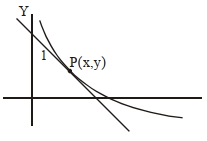
Let $\Gamma$ denote a curve $y = y(x)$ which is in the first quadrant and let the point $(1,0)$ lie on it. Let the tangent to $\Gamma$ at a point $P$ intersect the $y$-axis at $Y_p$. If $PY_p$ has length $1$ for each point $P$ on $\Gamma$,then which of the following options is/are correct?
$(1)$ $y=\ln\left(\frac{1+\sqrt{1-x^2}}{x}\right)-\sqrt{1-x^2}$
$(2)$ $xy^{\prime}+\sqrt{1-x^2}=0$
$(3)$ $y=-\ln\left(\frac{1+\sqrt{1-x^2}}{x}\right)+\sqrt{1-x^2}$
$(4)$ $xy^{\prime}-\sqrt{1-x^2}=0$
$(1)$ $y=\ln\left(\frac{1+\sqrt{1-x^2}}{x}\right)-\sqrt{1-x^2}$
$(2)$ $xy^{\prime}+\sqrt{1-x^2}=0$
$(3)$ $y=-\ln\left(\frac{1+\sqrt{1-x^2}}{x}\right)+\sqrt{1-x^2}$
$(4)$ $xy^{\prime}-\sqrt{1-x^2}=0$
A
$1,4$
B
$1,2$
C
$1,3$
D
$1,2,3$
Solution
(B) The equation of the tangent to the curve $\Gamma$ at point $P(x, y)$ is $Y-y=y^{\prime}(X-x)$.
To find the intersection with the $y$-axis,set $X=0$: $Y_p = y - xy^{\prime}$.
The point $Y_p$ is $(0, y-xy^{\prime})$. The distance $PY_p$ is given as $1$,so the distance between $(x, y)$ and $(0, y-xy^{\prime})$ is $1$.
$\sqrt{(x-0)^2 + (y - (y-xy^{\prime}))^2} = 1$
$\sqrt{x^2 + (xy^{\prime})^2} = 1 \Rightarrow x^2 + x^2(y^{\prime})^2 = 1$
$(y^{\prime})^2 = \frac{1-x^2}{x^2} \Rightarrow y^{\prime} = \pm \frac{\sqrt{1-x^2}}{x}$.
Since the curve is in the first quadrant and passes through $(1,0)$,and the tangent length is constant,the slope must be negative for the curve to decrease towards the $x$-axis. Thus,$y^{\prime} = -\frac{\sqrt{1-x^2}}{x}$.
This gives the differential equation $xy^{\prime} + \sqrt{1-x^2} = 0$,which matches option $(2)$.
Integrating $dy = -\frac{\sqrt{1-x^2}}{x} dx$:
Let $x = \sin\theta$,then $dx = \cos\theta d\theta$.
$y = -\int \frac{\cos\theta}{\sin\theta} \cos\theta d\theta = -\int \frac{\cos^2\theta}{\sin\theta} d\theta = -\int \frac{1-\sin^2\theta}{\sin\theta} d\theta = \int \sin\theta d\theta - \int \csc\theta d\theta$
$y = -\cos\theta - \ln|\csc\theta - \cot\theta| + C = -\sqrt{1-x^2} - \ln\left|\frac{1-\sqrt{1-x^2}}{x}\right| + C$
Using $y(1)=0$,we find $C=0$. Simplifying the logarithm,we get $y = \ln\left(\frac{1+\sqrt{1-x^2}}{x}\right) - \sqrt{1-x^2}$,which matches option $(1)$.
To find the intersection with the $y$-axis,set $X=0$: $Y_p = y - xy^{\prime}$.
The point $Y_p$ is $(0, y-xy^{\prime})$. The distance $PY_p$ is given as $1$,so the distance between $(x, y)$ and $(0, y-xy^{\prime})$ is $1$.
$\sqrt{(x-0)^2 + (y - (y-xy^{\prime}))^2} = 1$
$\sqrt{x^2 + (xy^{\prime})^2} = 1 \Rightarrow x^2 + x^2(y^{\prime})^2 = 1$
$(y^{\prime})^2 = \frac{1-x^2}{x^2} \Rightarrow y^{\prime} = \pm \frac{\sqrt{1-x^2}}{x}$.
Since the curve is in the first quadrant and passes through $(1,0)$,and the tangent length is constant,the slope must be negative for the curve to decrease towards the $x$-axis. Thus,$y^{\prime} = -\frac{\sqrt{1-x^2}}{x}$.
This gives the differential equation $xy^{\prime} + \sqrt{1-x^2} = 0$,which matches option $(2)$.
Integrating $dy = -\frac{\sqrt{1-x^2}}{x} dx$:
Let $x = \sin\theta$,then $dx = \cos\theta d\theta$.
$y = -\int \frac{\cos\theta}{\sin\theta} \cos\theta d\theta = -\int \frac{\cos^2\theta}{\sin\theta} d\theta = -\int \frac{1-\sin^2\theta}{\sin\theta} d\theta = \int \sin\theta d\theta - \int \csc\theta d\theta$
$y = -\cos\theta - \ln|\csc\theta - \cot\theta| + C = -\sqrt{1-x^2} - \ln\left|\frac{1-\sqrt{1-x^2}}{x}\right| + C$
Using $y(1)=0$,we find $C=0$. Simplifying the logarithm,we get $y = \ln\left(\frac{1+\sqrt{1-x^2}}{x}\right) - \sqrt{1-x^2}$,which matches option $(1)$.
0 likes
View Solution63
DifficultMCQ
Let $f:[0,2] \rightarrow R$ be a function which is continuous on $[0,2]$ and is differentiable on $(0,2)$ with $f(0)=1$. Let $F(x)=\int_0^{x^2} f(\sqrt{t}) dt$ for $x \in [0,2]$. If $F'(x)=f'(x)$ for all $x \in (0,2)$,then $F(2)$ equals
A
$e^2-1$
B
$e^4-1$
C
$e-1$
D
$e^4$
Solution
(B) Given $F(x) = \int_0^{x^2} f(\sqrt{t}) dt$. Using the Leibniz rule for differentiation under the integral sign,we get $F'(x) = f(\sqrt{x^2}) \cdot \frac{d}{dx}(x^2) = f(x) \cdot 2x$.
Given $F'(x) = f'(x)$,we have $f'(x) = 2x f(x)$.
This is a first-order linear differential equation: $\frac{f'(x)}{f(x)} = 2x$.
Integrating both sides with respect to $x$,we get $\ln|f(x)| = x^2 + C$.
Since $f(0) = 1$,we have $\ln(1) = 0^2 + C$,which implies $C = 0$.
Thus,$\ln(f(x)) = x^2$,which gives $f(x) = e^{x^2}$.
Now,$F(x) = \int_0^{x^2} e^{(\sqrt{t})^2} dt = \int_0^{x^2} e^t dt = [e^t]_0^{x^2} = e^{x^2} - e^0 = e^{x^2} - 1$.
Therefore,$F(2) = e^{2^2} - 1 = e^4 - 1$.
Given $F'(x) = f'(x)$,we have $f'(x) = 2x f(x)$.
This is a first-order linear differential equation: $\frac{f'(x)}{f(x)} = 2x$.
Integrating both sides with respect to $x$,we get $\ln|f(x)| = x^2 + C$.
Since $f(0) = 1$,we have $\ln(1) = 0^2 + C$,which implies $C = 0$.
Thus,$\ln(f(x)) = x^2$,which gives $f(x) = e^{x^2}$.
Now,$F(x) = \int_0^{x^2} e^{(\sqrt{t})^2} dt = \int_0^{x^2} e^t dt = [e^t]_0^{x^2} = e^{x^2} - e^0 = e^{x^2} - 1$.
Therefore,$F(2) = e^{2^2} - 1 = e^4 - 1$.
0 likes
View Solution64
MediumMCQ
$A$ normal is drawn at a point $P(x, y)$ of a curve $y=f(x)$. The normal meets the $X$-axis at $Q$. If the length $l(PQ) = k$,where $k$ is a constant,find the equation of the curve passing through $(0, k)$.
A
$x^2 + y^2 = k^2$
B
$(1 + k)x^2 + y^2 = k^2$
C
$x^2 + (1 + k^2)y^2 = k^2$
D
$x^2 + 2y^2 = 2k^2$
Solution
(A) Let the point $P$ be $(x, y)$. The slope of the tangent at $P$ is $\frac{dy}{dx}$. The slope of the normal at $P$ is $-\frac{dx}{dy}$.
The equation of the normal at $P(x, y)$ is $Y - y = -\frac{dx}{dy}(X - x)$.
To find the point $Q$ where the normal meets the $X$-axis,set $Y = 0$: $-y = -\frac{dx}{dy}(X - x) \implies X - x = y \frac{dy}{dx} \implies X = x + y \frac{dy}{dx}$.
Thus,$Q = (x + y \frac{dy}{dx}, 0)$.
The length $PQ$ is given by $l(PQ)^2 = (X - x)^2 + (0 - y)^2 = k^2$.
Substituting $X - x = y \frac{dy}{dx}$,we get $(y \frac{dy}{dx})^2 + y^2 = k^2$.
$y^2 ((\frac{dy}{dx})^2 + 1) = k^2 \implies (\frac{dy}{dx})^2 = \frac{k^2 - y^2}{y^2} = \frac{k^2 - y^2}{y^2}$.
$\frac{dy}{dx} = \pm \frac{\sqrt{k^2 - y^2}}{y}$.
Separating variables: $\int \frac{y}{\sqrt{k^2 - y^2}} dy = \pm \int dx$.
Let $u = k^2 - y^2$,then $du = -2y dy$. The integral becomes $-\frac{1}{2} \int u^{-1/2} du = -\sqrt{u} = -\sqrt{k^2 - y^2}$.
So,$-\sqrt{k^2 - y^2} = \pm x + C$.
Since the curve passes through $(0, k)$,we have $-\sqrt{k^2 - k^2} = 0 + C \implies C = 0$.
Thus,$\sqrt{k^2 - y^2} = |x| \implies k^2 - y^2 = x^2 \implies x^2 + y^2 = k^2$.
The equation of the normal at $P(x, y)$ is $Y - y = -\frac{dx}{dy}(X - x)$.
To find the point $Q$ where the normal meets the $X$-axis,set $Y = 0$: $-y = -\frac{dx}{dy}(X - x) \implies X - x = y \frac{dy}{dx} \implies X = x + y \frac{dy}{dx}$.
Thus,$Q = (x + y \frac{dy}{dx}, 0)$.
The length $PQ$ is given by $l(PQ)^2 = (X - x)^2 + (0 - y)^2 = k^2$.
Substituting $X - x = y \frac{dy}{dx}$,we get $(y \frac{dy}{dx})^2 + y^2 = k^2$.
$y^2 ((\frac{dy}{dx})^2 + 1) = k^2 \implies (\frac{dy}{dx})^2 = \frac{k^2 - y^2}{y^2} = \frac{k^2 - y^2}{y^2}$.
$\frac{dy}{dx} = \pm \frac{\sqrt{k^2 - y^2}}{y}$.
Separating variables: $\int \frac{y}{\sqrt{k^2 - y^2}} dy = \pm \int dx$.
Let $u = k^2 - y^2$,then $du = -2y dy$. The integral becomes $-\frac{1}{2} \int u^{-1/2} du = -\sqrt{u} = -\sqrt{k^2 - y^2}$.
So,$-\sqrt{k^2 - y^2} = \pm x + C$.
Since the curve passes through $(0, k)$,we have $-\sqrt{k^2 - k^2} = 0 + C \implies C = 0$.
Thus,$\sqrt{k^2 - y^2} = |x| \implies k^2 - y^2 = x^2 \implies x^2 + y^2 = k^2$.
0 likes
View Solution65
MediumMCQ
The rate of change of volume of a spherical balloon at any instant is directly proportional to its surface area. If initially its radius is $3 \ cm$,and after $2 \ minutes$ its radius becomes $9 \ cm$,then what is the radius of the balloon after $4 \ minutes$ (in $cm$)?
A
$12$
B
$14$
C
$15$
D
$18$
Solution
(C) Let $V$ be the volume and $S$ be the surface area of the spherical balloon with radius $r$.
We know $V = \frac{4}{3} \pi r^3$ and $S = 4 \pi r^2$.
The rate of change of volume is given by $\frac{dV}{dt} = kS$,where $k$ is a constant.
Since $\frac{dV}{dt} = \frac{dV}{dr} \cdot \frac{dr}{dt} = (4 \pi r^2) \frac{dr}{dt}$,we have $4 \pi r^2 \frac{dr}{dt} = k(4 \pi r^2)$.
This simplifies to $\frac{dr}{dt} = k$.
Integrating with respect to $t$,we get $r(t) = kt + C$.
At $t = 0$,$r = 3$,so $C = 3$.
At $t = 2$,$r = 9$,so $9 = k(2) + 3$,which gives $2k = 6$,or $k = 3$.
Thus,the radius function is $r(t) = 3t + 3$.
After $t = 4 \ minutes$,$r(4) = 3(4) + 3 = 12 + 3 = 15 \ cm$.
We know $V = \frac{4}{3} \pi r^3$ and $S = 4 \pi r^2$.
The rate of change of volume is given by $\frac{dV}{dt} = kS$,where $k$ is a constant.
Since $\frac{dV}{dt} = \frac{dV}{dr} \cdot \frac{dr}{dt} = (4 \pi r^2) \frac{dr}{dt}$,we have $4 \pi r^2 \frac{dr}{dt} = k(4 \pi r^2)$.
This simplifies to $\frac{dr}{dt} = k$.
Integrating with respect to $t$,we get $r(t) = kt + C$.
At $t = 0$,$r = 3$,so $C = 3$.
At $t = 2$,$r = 9$,so $9 = k(2) + 3$,which gives $2k = 6$,or $k = 3$.
Thus,the radius function is $r(t) = 3t + 3$.
After $t = 4 \ minutes$,$r(4) = 3(4) + 3 = 12 + 3 = 15 \ cm$.
0 likes
View Solution66
MediumMCQ
$A$ spherical metal ball at $80^{\circ} C$ cools in $5 \text{ minutes}$ to $60^{\circ} C$ in a surrounding temperature of $20^{\circ} C$. The temperature of the ball after $20 \text{ minutes}$ is approximately: (in $^{\circ} C$)
A
$8.15$
B
$11.85$
C
$28.15$
D
$31.85$
Solution
(D) Let $\theta$ be the temperature of the ball at any time $t$. According to Newton's law of cooling,$\frac{d\theta}{dt} = -k(\theta - 20)$,where $k > 0$.
Integrating both sides,we get $\ln|\theta - 20| = -kt + C$.
At $t = 0$,$\theta = 80^{\circ} C$,so $C = \ln(80 - 20) = \ln(60)$.
Thus,$\ln|\theta - 20| = -kt + \ln(60) \dots (i)$.
At $t = 5$,$\theta = 60^{\circ} C$,so $\ln(60 - 20) = -5k + \ln(60)$.
$5k = \ln(60) - \ln(40) = \ln(\frac{60}{40}) = \ln(\frac{3}{2})$.
So,$k = \frac{1}{5} \ln(\frac{3}{2})$.
For $t = 20$,substituting $k$ into equation $(i)$:
$\ln|\theta - 20| = -20 \times \frac{1}{5} \ln(\frac{3}{2}) + \ln(60) = -4 \ln(\frac{3}{2}) + \ln(60)$.
$\ln|\theta - 20| = \ln((\frac{2}{3})^4) + \ln(60) = \ln(\frac{16}{81} \times 60) = \ln(\frac{16 \times 20}{27}) = \ln(\frac{320}{27}) \approx \ln(11.85)$.
$\theta - 20 = 11.85 \implies \theta = 31.85^{\circ} C$.
Integrating both sides,we get $\ln|\theta - 20| = -kt + C$.
At $t = 0$,$\theta = 80^{\circ} C$,so $C = \ln(80 - 20) = \ln(60)$.
Thus,$\ln|\theta - 20| = -kt + \ln(60) \dots (i)$.
At $t = 5$,$\theta = 60^{\circ} C$,so $\ln(60 - 20) = -5k + \ln(60)$.
$5k = \ln(60) - \ln(40) = \ln(\frac{60}{40}) = \ln(\frac{3}{2})$.
So,$k = \frac{1}{5} \ln(\frac{3}{2})$.
For $t = 20$,substituting $k$ into equation $(i)$:
$\ln|\theta - 20| = -20 \times \frac{1}{5} \ln(\frac{3}{2}) + \ln(60) = -4 \ln(\frac{3}{2}) + \ln(60)$.
$\ln|\theta - 20| = \ln((\frac{2}{3})^4) + \ln(60) = \ln(\frac{16}{81} \times 60) = \ln(\frac{16 \times 20}{27}) = \ln(\frac{320}{27}) \approx \ln(11.85)$.
$\theta - 20 = 11.85 \implies \theta = 31.85^{\circ} C$.
0 likes
View Solution67
DifficultMCQ
If a body cools from $80^{\circ} C$ to $60^{\circ} C$ in a room temperature of $30^{\circ} C$ in $30 \text{ min}$,then the temperature of the body after one hour is (in $^{\circ} C$)
A
$42$
B
$24$
C
$48$
D
$56$
Solution
(C) Let $\theta$ be the temperature of the body at any time $t$. According to Newton's Law of Cooling,the rate of change of temperature is proportional to the difference between the body temperature and the surrounding temperature.
$\frac{d\theta}{dt} = -k(\theta - 30)$
Integrating this,we get $\ln(\theta - 30) = -kt + C$.
At $t = 0$,$\theta = 80^{\circ} C$,so $\ln(80 - 30) = C \Rightarrow C = \ln(50)$.
Thus,$\ln(\theta - 30) = -kt + \ln(50) \dots (i)$.
At $t = 30 \text{ min}$,$\theta = 60^{\circ} C$:
$\ln(60 - 30) = -k(30) + \ln(50) \Rightarrow \ln(30) - \ln(50) = -30k \Rightarrow \ln(3/5) = -30k$.
So,$k = -\frac{1}{30} \ln(3/5) = \frac{1}{30} \ln(5/3)$.
Now,for $t = 60 \text{ min}$ (one hour):
$\ln(\theta - 30) = -\left(\frac{1}{30} \ln(5/3)\right)(60) + \ln(50)$
$\ln(\theta - 30) = -2 \ln(5/3) + \ln(50) = \ln((3/5)^2 \times 50)$
$\ln(\theta - 30) = \ln(9/25 \times 50) = \ln(18)$
$\theta - 30 = 18 \Rightarrow \theta = 48^{\circ} C$.
$\frac{d\theta}{dt} = -k(\theta - 30)$
Integrating this,we get $\ln(\theta - 30) = -kt + C$.
At $t = 0$,$\theta = 80^{\circ} C$,so $\ln(80 - 30) = C \Rightarrow C = \ln(50)$.
Thus,$\ln(\theta - 30) = -kt + \ln(50) \dots (i)$.
At $t = 30 \text{ min}$,$\theta = 60^{\circ} C$:
$\ln(60 - 30) = -k(30) + \ln(50) \Rightarrow \ln(30) - \ln(50) = -30k \Rightarrow \ln(3/5) = -30k$.
So,$k = -\frac{1}{30} \ln(3/5) = \frac{1}{30} \ln(5/3)$.
Now,for $t = 60 \text{ min}$ (one hour):
$\ln(\theta - 30) = -\left(\frac{1}{30} \ln(5/3)\right)(60) + \ln(50)$
$\ln(\theta - 30) = -2 \ln(5/3) + \ln(50) = \ln((3/5)^2 \times 50)$
$\ln(\theta - 30) = \ln(9/25 \times 50) = \ln(18)$
$\theta - 30 = 18 \Rightarrow \theta = 48^{\circ} C$.
0 likes
View Solution68
DifficultMCQ
$A$ wet substance in the open air loses its moisture at a rate proportional to the moisture content. If a sheet hung in the open air loses half its moisture during the first hour,then the time $t$,in which $99 \%$ of the moisture will be lost,is
A
$\frac{2 \log 10}{\log 2}$
B
$\frac{\log 10}{\log 2}$
C
$\frac{3 \log 10}{\log 2}$
D
$\frac{1}{2} \frac{\log 10}{\log 2}$
Solution
(A) Let $y$ be the amount of moisture at time $t$.
The rate of change of moisture is proportional to the moisture content:
$\frac{dy}{dt} = -ky$ (where $k > 0$ is a constant).
Separating variables and integrating:
$\int \frac{dy}{y} = -\int k dt \Rightarrow \ln y = -kt + C$.
At $t = 0$,let the initial moisture be $y_0 = 1$ (representing $100 \%$).
Then $\ln(1) = -k(0) + C \Rightarrow C = 0$.
So,$\ln y = -kt$.
Given that at $t = 1$ hour,the sheet loses half its moisture,so $y = 0.5$ (or $1/2$):
$\ln(0.5) = -k(1) \Rightarrow k = -\ln(0.5) = \ln(2)$.
Now,we need to find $t$ when $99 \%$ of the moisture is lost,meaning $1 \%$ remains:
$y = 0.01 = \frac{1}{100} = 10^{-2}$.
Substituting into the equation $\ln y = -kt$:
$\ln(10^{-2}) = -(\ln 2)t$.
$-2 \ln(10) = -(\ln 2)t$.
$t = \frac{2 \ln 10}{\ln 2} = \frac{2 \log 10}{\log 2}$.
The rate of change of moisture is proportional to the moisture content:
$\frac{dy}{dt} = -ky$ (where $k > 0$ is a constant).
Separating variables and integrating:
$\int \frac{dy}{y} = -\int k dt \Rightarrow \ln y = -kt + C$.
At $t = 0$,let the initial moisture be $y_0 = 1$ (representing $100 \%$).
Then $\ln(1) = -k(0) + C \Rightarrow C = 0$.
So,$\ln y = -kt$.
Given that at $t = 1$ hour,the sheet loses half its moisture,so $y = 0.5$ (or $1/2$):
$\ln(0.5) = -k(1) \Rightarrow k = -\ln(0.5) = \ln(2)$.
Now,we need to find $t$ when $99 \%$ of the moisture is lost,meaning $1 \%$ remains:
$y = 0.01 = \frac{1}{100} = 10^{-2}$.
Substituting into the equation $\ln y = -kt$:
$\ln(10^{-2}) = -(\ln 2)t$.
$-2 \ln(10) = -(\ln 2)t$.
$t = \frac{2 \ln 10}{\ln 2} = \frac{2 \log 10}{\log 2}$.
0 likes
View Solution69
MediumMCQ
The population of a town increases at a rate proportional to the population at that time. If the population increases from $40,000$ to $80,000$ in $40$ years,then the population in another $40$ years will be (in $,000$)
A
$180$
B
$128$
C
$160$
D
$256$
Solution
(C) Let $p$ be the population at time $t$ years.
Given that the rate of change of population is proportional to the population:
$\frac{dp}{dt} = kp$
$\Rightarrow \frac{dp}{p} = k dt$
Integrating both sides,we get:
$\log p = kt + c$
At $t = 0$,$p = 40,000$:
$\log 40,000 = k(0) + c \Rightarrow c = \log 40,000$
So,$\log p = kt + \log 40,000 \Rightarrow \log \left(\frac{p}{40,000}\right) = kt$
At $t = 40$ years,$p = 80,000$:
$\log \left(\frac{80,000}{40,000}\right) = 40k \Rightarrow \log 2 = 40k \Rightarrow k = \frac{\log 2}{40}$
We need to find the population after another $40$ years,i.e.,at $t = 80$ years:
$\log \left(\frac{p}{40,000}\right) = \left(\frac{\log 2}{40}\right) \times 80$
$\log \left(\frac{p}{40,000}\right) = 2 \log 2 = \log 2^2 = \log 4$
$\frac{p}{40,000} = 4$
$p = 4 \times 40,000 = 160,000$
Given that the rate of change of population is proportional to the population:
$\frac{dp}{dt} = kp$
$\Rightarrow \frac{dp}{p} = k dt$
Integrating both sides,we get:
$\log p = kt + c$
At $t = 0$,$p = 40,000$:
$\log 40,000 = k(0) + c \Rightarrow c = \log 40,000$
So,$\log p = kt + \log 40,000 \Rightarrow \log \left(\frac{p}{40,000}\right) = kt$
At $t = 40$ years,$p = 80,000$:
$\log \left(\frac{80,000}{40,000}\right) = 40k \Rightarrow \log 2 = 40k \Rightarrow k = \frac{\log 2}{40}$
We need to find the population after another $40$ years,i.e.,at $t = 80$ years:
$\log \left(\frac{p}{40,000}\right) = \left(\frac{\log 2}{40}\right) \times 80$
$\log \left(\frac{p}{40,000}\right) = 2 \log 2 = \log 2^2 = \log 4$
$\frac{p}{40,000} = 4$
$p = 4 \times 40,000 = 160,000$
0 likes
View Solution70
MediumMCQ
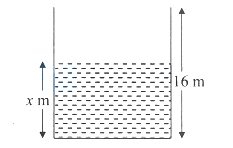
Water flows from the base of a rectangular tank of depth $16 \ m$. The rate of flow of the water is proportional to the square root of the depth at any time $t$. If the depth is $4 \ m$ when $t = 2 \ hours$,then after $3.5 \ hours$,the depth (in meters) is:
A
$0$
B
$0.25$
C
$0.5$
D
$3$
Solution
(B) Let $x$ be the depth of water at time $t$. Given that the rate of flow is proportional to the square root of the depth,we have $\frac{dx}{dt} = -k\sqrt{x}$,where $k > 0$ is a constant (negative sign indicates decreasing depth).
Separating the variables,we get $\frac{dx}{\sqrt{x}} = -k dt$.
Integrating both sides,we get $\int x^{-1/2} dx = \int -k dt$,which gives $2\sqrt{x} = -kt + C$.
At $t = 0$,the initial depth $x = 16 \ m$. Substituting these values,$2\sqrt{16} = -k(0) + C \Rightarrow C = 8$.
So,the equation becomes $2\sqrt{x} = -kt + 8$.
At $t = 2 \ hours$,the depth $x = 4 \ m$. Substituting these values,$2\sqrt{4} = -k(2) + 8 \Rightarrow 4 = -2k + 8 \Rightarrow 2k = 4 \Rightarrow k = 2$.
Thus,the equation is $2\sqrt{x} = -2t + 8$,or $\sqrt{x} = 4 - t$.
For $t = 3.5 \ hours$,$\sqrt{x} = 4 - 3.5 = 0.5$.
Squaring both sides,$x = (0.5)^2 = 0.25 \ m$.
Separating the variables,we get $\frac{dx}{\sqrt{x}} = -k dt$.
Integrating both sides,we get $\int x^{-1/2} dx = \int -k dt$,which gives $2\sqrt{x} = -kt + C$.
At $t = 0$,the initial depth $x = 16 \ m$. Substituting these values,$2\sqrt{16} = -k(0) + C \Rightarrow C = 8$.
So,the equation becomes $2\sqrt{x} = -kt + 8$.
At $t = 2 \ hours$,the depth $x = 4 \ m$. Substituting these values,$2\sqrt{4} = -k(2) + 8 \Rightarrow 4 = -2k + 8 \Rightarrow 2k = 4 \Rightarrow k = 2$.
Thus,the equation is $2\sqrt{x} = -2t + 8$,or $\sqrt{x} = 4 - t$.
For $t = 3.5 \ hours$,$\sqrt{x} = 4 - 3.5 = 0.5$.
Squaring both sides,$x = (0.5)^2 = 0.25 \ m$.
0 likes
View Solution71
DifficultMCQ
The rate at which the population of a city increases varies as the population present. Within the period of $30$ years,the population grew from $20$ lakhs to $40$ lakhs. Then,the population after a further period of $15$ years will be (Take $\sqrt{2} = 1.41$) (in $lakhs$)
A
$56$
B
$60$
C
$57.4$
D
$56.4$
Solution
(D) Let $P$ be the population at time $t$. Given $\frac{dP}{dt} \propto P$,so $\frac{dP}{dt} = kP$.
Integrating,we get $\ln P = kt + C$.
At $t = 0$,$P = 20$,so $C = \ln 20$.
Thus,$\ln P = kt + \ln 20$.
At $t = 30$,$P = 40$,so $\ln 40 = 30k + \ln 20$,which gives $30k = \ln 2$,or $k = \frac{\ln 2}{30}$.
We need to find $P$ at $t = 30 + 15 = 45$ years.
$\ln P = \left(\frac{\ln 2}{30}\right) \times 45 + \ln 20 = 1.5 \ln 2 + \ln 20 = \ln(2^{1.5} \times 20)$.
$P = 20 \times 2^{1.5} = 20 \times 2 \times \sqrt{2} = 40 \times 1.41 = 56.4$ lakhs.
Integrating,we get $\ln P = kt + C$.
At $t = 0$,$P = 20$,so $C = \ln 20$.
Thus,$\ln P = kt + \ln 20$.
At $t = 30$,$P = 40$,so $\ln 40 = 30k + \ln 20$,which gives $30k = \ln 2$,or $k = \frac{\ln 2}{30}$.
We need to find $P$ at $t = 30 + 15 = 45$ years.
$\ln P = \left(\frac{\ln 2}{30}\right) \times 45 + \ln 20 = 1.5 \ln 2 + \ln 20 = \ln(2^{1.5} \times 20)$.
$P = 20 \times 2^{1.5} = 20 \times 2 \times \sqrt{2} = 40 \times 1.41 = 56.4$ lakhs.
0 likes
View Solution72
DifficultMCQ
If surrounding air is kept at $20^{\circ} C$ and a body cools from $80^{\circ} C$ to $70^{\circ} C$ in $5$ minutes,then the temperature of the body after $15$ minutes will be: (in $^{\circ} C$)
A
$52.7$
B
$51.7$
C
$54.7$
D
$50.7$
Solution
(C) According to Newton's Law of Cooling,$\frac{dT}{dt} = -k(T - T_s)$,where $T_s = 20^{\circ} C$.
Integrating this gives $T(t) = T_s + (T_0 - T_s)e^{-kt}$.
Given $T_0 = 80^{\circ} C$,we have $T(t) = 20 + 60e^{-kt}$.
For $t = 5$ minutes,$T = 70^{\circ} C$:
$70 = 20 + 60e^{-5k} \Rightarrow 50 = 60e^{-5k} \Rightarrow e^{-5k} = \frac{5}{6}$.
For $t = 15$ minutes:
$T(15) = 20 + 60e^{-15k} = 20 + 60(e^{-5k})^3$.
Substituting $e^{-5k} = \frac{5}{6}$:
$T(15) = 20 + 60 \times \left(\frac{5}{6}\right)^3 = 20 + 60 \times \frac{125}{216} = 20 + \frac{125}{3.6} = 20 + 34.722 = 54.722^{\circ} C$.
Rounding to one decimal place,the temperature is $54.7^{\circ} C$.
Integrating this gives $T(t) = T_s + (T_0 - T_s)e^{-kt}$.
Given $T_0 = 80^{\circ} C$,we have $T(t) = 20 + 60e^{-kt}$.
For $t = 5$ minutes,$T = 70^{\circ} C$:
$70 = 20 + 60e^{-5k} \Rightarrow 50 = 60e^{-5k} \Rightarrow e^{-5k} = \frac{5}{6}$.
For $t = 15$ minutes:
$T(15) = 20 + 60e^{-15k} = 20 + 60(e^{-5k})^3$.
Substituting $e^{-5k} = \frac{5}{6}$:
$T(15) = 20 + 60 \times \left(\frac{5}{6}\right)^3 = 20 + 60 \times \frac{125}{216} = 20 + \frac{125}{3.6} = 20 + 34.722 = 54.722^{\circ} C$.
Rounding to one decimal place,the temperature is $54.7^{\circ} C$.
0 likes
View Solution73
DifficultMCQ
The rate of disintegration of a radioactive element at time $t$ is proportional to its mass at that time. Then the time during which the original mass of $6 \text{ gm}$ will disintegrate into its mass of $3 \text{ gm}$ is proportional to
A
$\log 4$
B
$\log 3$
C
$\log 5$
D
$\log 2$
Solution
(D) Let $m$ be the mass of the radioactive element at time $t$. According to the problem,the rate of disintegration is proportional to its mass:
$\frac{dm}{dt} = -km$ (where $k > 0$ is the decay constant).
Separating the variables,we get:
$\frac{dm}{m} = -k \, dt$.
Integrating both sides:
$\int \frac{dm}{m} = -\int k \, dt \implies \ln(m) = -kt + C$.
At $t = 0$,the initial mass $m = 6 \text{ gm}$,so $\ln(6) = C$.
Thus,$\ln(m) = -kt + \ln(6) \implies \ln(\frac{m}{6}) = -kt$.
We want to find the time $t$ when the mass $m = 3 \text{ gm}$:
$\ln(\frac{3}{6}) = -kt
\implies \ln(\frac{1}{2}) = -kt
\implies -\ln(2) = -kt
\implies t = \frac{\ln(2)}{k}$.
Therefore,the time $t$ is proportional to $\log 2$.
$\frac{dm}{dt} = -km$ (where $k > 0$ is the decay constant).
Separating the variables,we get:
$\frac{dm}{m} = -k \, dt$.
Integrating both sides:
$\int \frac{dm}{m} = -\int k \, dt \implies \ln(m) = -kt + C$.
At $t = 0$,the initial mass $m = 6 \text{ gm}$,so $\ln(6) = C$.
Thus,$\ln(m) = -kt + \ln(6) \implies \ln(\frac{m}{6}) = -kt$.
We want to find the time $t$ when the mass $m = 3 \text{ gm}$:
$\ln(\frac{3}{6}) = -kt
\implies \ln(\frac{1}{2}) = -kt
\implies -\ln(2) = -kt
\implies t = \frac{\ln(2)}{k}$.
Therefore,the time $t$ is proportional to $\log 2$.
0 likes
View Solution74
DifficultMCQ
$A$ spherical raindrop evaporates at a rate proportional to its surface area. If its radius originally is $3 \text{ mm}$ and $1 \text{ hour}$ later has been reduced to $2 \text{ mm}$,then the expression of radius $r$ of the raindrop at any time $t$ is (where $0 \leq t < 3$):
A
$r=t+5$
B
$r=t-5$
C
$r=3-t$
D
$r=t+3$
Solution
(C) Let $V$ be the volume and $S$ be the surface area of the spherical raindrop. We are given that the rate of evaporation is proportional to the surface area,so $\frac{dV}{dt} = -kS$,where $k > 0$ is a constant.
Since $V = \frac{4}{3}\pi r^3$,we have $\frac{dV}{dt} = 4\pi r^2 \frac{dr}{dt}$.
The surface area $S = 4\pi r^2$.
Substituting these into the rate equation: $4\pi r^2 \frac{dr}{dt} = -k(4\pi r^2)$.
This simplifies to $\frac{dr}{dt} = -k$.
Integrating with respect to $t$,we get $r = -kt + c$.
At $t = 0$,$r = 3$,so $3 = -k(0) + c \Rightarrow c = 3$.
Thus,$r = -kt + 3$.
At $t = 1$,$r = 2$,so $2 = -k(1) + 3 \Rightarrow k = 1$.
Substituting $k=1$ and $c=3$ into the expression for $r$,we get $r = -t + 3$ or $r = 3 - t$.
Since $V = \frac{4}{3}\pi r^3$,we have $\frac{dV}{dt} = 4\pi r^2 \frac{dr}{dt}$.
The surface area $S = 4\pi r^2$.
Substituting these into the rate equation: $4\pi r^2 \frac{dr}{dt} = -k(4\pi r^2)$.
This simplifies to $\frac{dr}{dt} = -k$.
Integrating with respect to $t$,we get $r = -kt + c$.
At $t = 0$,$r = 3$,so $3 = -k(0) + c \Rightarrow c = 3$.
Thus,$r = -kt + 3$.
At $t = 1$,$r = 2$,so $2 = -k(1) + 3 \Rightarrow k = 1$.
Substituting $k=1$ and $c=3$ into the expression for $r$,we get $r = -t + 3$ or $r = 3 - t$.
0 likes
View Solution75
MediumMCQ
The assets of a person are reduced in his business such that the rate of reduction is proportional to the square root of the existing assets. If the assets were initially ₹ $10,00,000$ and due to loss they reduce to ₹ $10,000$ after $3$ years,then the number of years required for the person to go bankrupt will be
A
$\frac{10}{3}$
B
$\frac{10}{9}$
C
$\frac{20}{9}$
D
$\frac{20}{3}$
Solution
(A) Let $x$ be the asset at time $t$.
$\frac{dx}{dt} = -k\sqrt{x}$,where $k > 0$.
Separating variables,we get $\frac{dx}{\sqrt{x}} = -k dt$.
Integrating both sides,$2\sqrt{x} = -kt + c$.
At $t = 0$,$x = 10,00,000$,so $2\sqrt{10,00,000} = c \implies c = 2000$.
Thus,$2\sqrt{x} = -kt + 2000$.
At $t = 3$,$x = 10,000$,so $2\sqrt{10,000} = -3k + 2000 \implies 200 = -3k + 2000 \implies 3k = 1800 \implies k = 600$.
For bankruptcy,$x = 0$.
$0 = -600T + 2000 \implies 600T = 2000 \implies T = \frac{2000}{600} = \frac{10}{3}$ years.
$\frac{dx}{dt} = -k\sqrt{x}$,where $k > 0$.
Separating variables,we get $\frac{dx}{\sqrt{x}} = -k dt$.
Integrating both sides,$2\sqrt{x} = -kt + c$.
At $t = 0$,$x = 10,00,000$,so $2\sqrt{10,00,000} = c \implies c = 2000$.
Thus,$2\sqrt{x} = -kt + 2000$.
At $t = 3$,$x = 10,000$,so $2\sqrt{10,000} = -3k + 2000 \implies 200 = -3k + 2000 \implies 3k = 1800 \implies k = 600$.
For bankruptcy,$x = 0$.
$0 = -600T + 2000 \implies 600T = 2000 \implies T = \frac{2000}{600} = \frac{10}{3}$ years.
0 likes
View Solution76
EasyMCQ
The decay rate of radioactive material at any time $t$ is proportional to its mass at that time. The mass is $27 \text{ grams}$ when $t=0$. After $3 \text{ hours}$,it was found that $8 \text{ grams}$ are left. Then the substance left after one more hour is
A
$\frac{27}{8} \text{ grams}$
B
$\frac{81}{4} \text{ grams}$
C
$\frac{16}{3} \text{ grams}$
D
$\frac{16}{9} \text{ grams}$
Solution
(C) Let $x$ be the mass of the material at time $t$.
The rate of decay is given by $\frac{dx}{dt} = -kx$.
Integrating this,we get $\ln(x) = -kt + C$.
At $t=0, x=27$,so $C = \ln(27)$.
Thus,$\ln(x) = -kt + \ln(27)$.
At $t=3, x=8$,so $\ln(8) = -3k + \ln(27)$,which gives $3k = \ln(27) - \ln(8) = \ln(\frac{27}{8})$.
Therefore,$k = \frac{1}{3} \ln(\frac{27}{8}) = \ln((\frac{27}{8})^{1/3}) = \ln(\frac{3}{2})$.
We need to find the mass after one more hour,i.e.,at $t=4$.
$\ln(x) = -4 \ln(\frac{3}{2}) + \ln(27) = \ln((\frac{3}{2})^{-4}) + \ln(27) = \ln(\frac{16}{81} \times 27) = \ln(\frac{16}{3})$.
Therefore,$x = \frac{16}{3} \text{ grams}$.
The rate of decay is given by $\frac{dx}{dt} = -kx$.
Integrating this,we get $\ln(x) = -kt + C$.
At $t=0, x=27$,so $C = \ln(27)$.
Thus,$\ln(x) = -kt + \ln(27)$.
At $t=3, x=8$,so $\ln(8) = -3k + \ln(27)$,which gives $3k = \ln(27) - \ln(8) = \ln(\frac{27}{8})$.
Therefore,$k = \frac{1}{3} \ln(\frac{27}{8}) = \ln((\frac{27}{8})^{1/3}) = \ln(\frac{3}{2})$.
We need to find the mass after one more hour,i.e.,at $t=4$.
$\ln(x) = -4 \ln(\frac{3}{2}) + \ln(27) = \ln((\frac{3}{2})^{-4}) + \ln(27) = \ln(\frac{16}{81} \times 27) = \ln(\frac{16}{3})$.
Therefore,$x = \frac{16}{3} \text{ grams}$.
0 likes
View Solution77
MediumMCQ
If a body cools from $80^{\circ} C$ to $50^{\circ} C$ in a room at a temperature of $25^{\circ} C$ in $30$ minutes,then the temperature of the body after $1$ hour is: (in $^{\circ} C$)
A
$31.36$
B
$32.25$
C
$36.36$
D
$33.25$
Solution
(C) According to Newton's law of cooling,$\frac{d\theta}{dt} = -k(\theta - \theta_0)$,where $\theta_0 = 25^{\circ} C$.
Integrating,we get $\ln(\theta - 25) = -kt + C$.
At $t = 0$,$\theta = 80^{\circ} C$,so $C = \ln(55)$.
Thus,$\ln(\theta - 25) = -kt + \ln(55)$,or $\ln\left(\frac{\theta - 25}{55}\right) = -kt$.
At $t = 30$ min,$\theta = 50^{\circ} C$,so $\ln\left(\frac{50 - 25}{55}\right) = -30k$ $\Rightarrow \ln\left(\frac{25}{55}\right) = -30k$ $\Rightarrow \ln\left(\frac{5}{11}\right) = -30k$.
For $t = 60$ min,$\ln\left(\frac{\theta - 25}{55}\right) = -60k = 2(-30k) = 2 \ln\left(\frac{5}{11}\right)$.
Therefore,$\frac{\theta - 25}{55} = \left(\frac{5}{11}\right)^2 = \frac{25}{121}$.
$\theta - 25 = 55 \times \frac{25}{121} = 5 \times \frac{25}{11} = \frac{125}{11} \approx 11.36$.
$\theta = 25 + 11.36 = 36.36^{\circ} C$.
Integrating,we get $\ln(\theta - 25) = -kt + C$.
At $t = 0$,$\theta = 80^{\circ} C$,so $C = \ln(55)$.
Thus,$\ln(\theta - 25) = -kt + \ln(55)$,or $\ln\left(\frac{\theta - 25}{55}\right) = -kt$.
At $t = 30$ min,$\theta = 50^{\circ} C$,so $\ln\left(\frac{50 - 25}{55}\right) = -30k$ $\Rightarrow \ln\left(\frac{25}{55}\right) = -30k$ $\Rightarrow \ln\left(\frac{5}{11}\right) = -30k$.
For $t = 60$ min,$\ln\left(\frac{\theta - 25}{55}\right) = -60k = 2(-30k) = 2 \ln\left(\frac{5}{11}\right)$.
Therefore,$\frac{\theta - 25}{55} = \left(\frac{5}{11}\right)^2 = \frac{25}{121}$.
$\theta - 25 = 55 \times \frac{25}{121} = 5 \times \frac{25}{11} = \frac{125}{11} \approx 11.36$.
$\theta = 25 + 11.36 = 36.36^{\circ} C$.
0 likes
View Solution78
DifficultMCQ
If a body cools from $135^{\circ} C$ to $80^{\circ} C$ at a room temperature of $25^{\circ} C$ in $60 \text{ minutes}$,then the temperature of the body after $2 \text{ hours}$ is: (in $^{\circ} C$)
A
$52.5$
B
$10.5$
C
$52.75$
D
$10.75$
Solution
(A) Let $\theta^{\circ} C$ be the temperature of the body at time $t \text{ min}$. The room temperature is $T_s = 25^{\circ} C$. According to Newton's law of cooling,$\frac{d\theta}{dt} = -k(\theta - T_s)$.
Integrating this,we get $\ln(\theta - 25) = -kt + C$.
At $t = 0$,$\theta = 135^{\circ} C$,so $C = \ln(135 - 25) = \ln(110)$.
Thus,$\ln\left(\frac{\theta - 25}{110}\right) = -kt$.
At $t = 60 \text{ min}$,$\theta = 80^{\circ} C$,so $\ln\left(\frac{80 - 25}{110}\right) = -60k \Rightarrow \ln(0.5) = -60k \Rightarrow k = -\frac{1}{60}\ln(0.5)$.
For $t = 120 \text{ min}$ $(2 \text{ hours})$,$\ln\left(\frac{\theta - 25}{110}\right) = -120 \times \left(-\frac{1}{60}\ln(0.5)\right) = 2\ln(0.5) = \ln(0.5^2) = \ln(0.25)$.
Therefore,$\frac{\theta - 25}{110} = 0.25 \Rightarrow \theta - 25 = 110 \times 0.25 = 27.5$.
$\theta = 27.5 + 25 = 52.5^{\circ} C$.
Integrating this,we get $\ln(\theta - 25) = -kt + C$.
At $t = 0$,$\theta = 135^{\circ} C$,so $C = \ln(135 - 25) = \ln(110)$.
Thus,$\ln\left(\frac{\theta - 25}{110}\right) = -kt$.
At $t = 60 \text{ min}$,$\theta = 80^{\circ} C$,so $\ln\left(\frac{80 - 25}{110}\right) = -60k \Rightarrow \ln(0.5) = -60k \Rightarrow k = -\frac{1}{60}\ln(0.5)$.
For $t = 120 \text{ min}$ $(2 \text{ hours})$,$\ln\left(\frac{\theta - 25}{110}\right) = -120 \times \left(-\frac{1}{60}\ln(0.5)\right) = 2\ln(0.5) = \ln(0.5^2) = \ln(0.25)$.
Therefore,$\frac{\theta - 25}{110} = 0.25 \Rightarrow \theta - 25 = 110 \times 0.25 = 27.5$.
$\theta = 27.5 + 25 = 52.5^{\circ} C$.
0 likes
View Solution79
EasyMCQ
If $\frac{d^{2} y}{d x^{2}}=\sin x+e^{x}$,$y(0)=3$,and $\frac{d y}{d x}$ at $x=0$ is $4$,then find the equation of the curve.
A
$y=4+2 x+e^{x}-\sin x$
B
$y=2+3 x+e^{x}-\sin x$
C
$y=2+4 x+e^{x}-\sin x$
D
$y=4+2 x+e^{x}+\sin x$
Solution
(C) Given $\frac{d^{2} y}{d x^{2}}=\sin x+e^{x}$.
Integrating both sides with respect to $x$:
$\frac{d y}{d x} = \int (\sin x + e^{x}) dx = -\cos x + e^{x} + c_{1}$.
Given $\frac{d y}{d x} = 4$ at $x=0$:
$4 = -\cos(0) + e^{0} + c_{1} \implies 4 = -1 + 1 + c_{1} \implies c_{1} = 4$.
So,$\frac{d y}{d x} = e^{x} - \cos x + 4$.
Integrating both sides again with respect to $x$:
$y = \int (e^{x} - \cos x + 4) dx = e^{x} - \sin x + 4x + c_{2}$.
Given $y(0) = 3$:
$3 = e^{0} - \sin(0) + 4(0) + c_{2} \implies 3 = 1 - 0 + 0 + c_{2} \implies c_{2} = 2$.
Thus,the equation of the curve is $y = e^{x} - \sin x + 4x + 2$.
Integrating both sides with respect to $x$:
$\frac{d y}{d x} = \int (\sin x + e^{x}) dx = -\cos x + e^{x} + c_{1}$.
Given $\frac{d y}{d x} = 4$ at $x=0$:
$4 = -\cos(0) + e^{0} + c_{1} \implies 4 = -1 + 1 + c_{1} \implies c_{1} = 4$.
So,$\frac{d y}{d x} = e^{x} - \cos x + 4$.
Integrating both sides again with respect to $x$:
$y = \int (e^{x} - \cos x + 4) dx = e^{x} - \sin x + 4x + c_{2}$.
Given $y(0) = 3$:
$3 = e^{0} - \sin(0) + 4(0) + c_{2} \implies 3 = 1 - 0 + 0 + c_{2} \implies c_{2} = 2$.
Thus,the equation of the curve is $y = e^{x} - \sin x + 4x + 2$.
0 likes
View Solution80
EasyMCQ
The differential equation $\frac{dy}{dx} = \frac{\sqrt{1-y^2}}{y}$ determines a family of circles with
A
variable radii and a fixed centre at $(0, -1)$
B
fixed radius of $1$ unit and variable centres along the $X$-axis
C
fixed radius of $1$ unit and variable centres along the $Y$-axis
D
variable radii and a fixed centre at $(0, 1)$
Solution
(B) Given the differential equation: $\frac{dy}{dx} = \frac{\sqrt{1-y^2}}{y}$
Separating the variables,we get: $\int \frac{y}{\sqrt{1-y^2}} dy = \int dx$
Let $u = 1-y^2$,then $du = -2y dy$,so $y dy = -\frac{1}{2} du$.
Substituting this into the integral: $-\frac{1}{2} \int u^{-1/2} du = x + C$
$-\frac{1}{2} \cdot 2u^{1/2} = x + C$
$-\sqrt{1-y^2} = x + C$
Squaring both sides: $1-y^2 = (x+C)^2$
$(x+C)^2 + y^2 = 1$
This is the equation of a circle $(x-h)^2 + (y-k)^2 = r^2$,where the centre is $(-C, 0)$ and the radius $r = 1$.
Since $C$ is an arbitrary constant,the centre $(-C, 0)$ varies along the $X$-axis,while the radius remains fixed at $1$ unit.
Separating the variables,we get: $\int \frac{y}{\sqrt{1-y^2}} dy = \int dx$
Let $u = 1-y^2$,then $du = -2y dy$,so $y dy = -\frac{1}{2} du$.
Substituting this into the integral: $-\frac{1}{2} \int u^{-1/2} du = x + C$
$-\frac{1}{2} \cdot 2u^{1/2} = x + C$
$-\sqrt{1-y^2} = x + C$
Squaring both sides: $1-y^2 = (x+C)^2$
$(x+C)^2 + y^2 = 1$
This is the equation of a circle $(x-h)^2 + (y-k)^2 = r^2$,where the centre is $(-C, 0)$ and the radius $r = 1$.
Since $C$ is an arbitrary constant,the centre $(-C, 0)$ varies along the $X$-axis,while the radius remains fixed at $1$ unit.
0 likes
View Solution81
DifficultMCQ
Water at $100^{\circ} C$ cools in $10 \text{ minutes}$ to $80^{\circ} C$ in a room temperature of $25^{\circ} C$. What will be the temperature of water after $20 \text{ minutes}$ (in $^{\circ} C$)?
A
$65.33$
B
$69.33$
C
$60.33$
D
$63.33$
Solution
(A) According to Newton's Law of Cooling,$\frac{dT}{dt} = -k(T - T_s)$,where $T_s = 25^{\circ} C$.
Integrating this,we get $T(t) = T_s + (T_0 - T_s)e^{-kt}$.
Given $T_0 = 100^{\circ} C$,so $T(t) = 25 + 75e^{-kt}$.
At $t = 10 \text{ min}$,$T = 80^{\circ} C$:
$80 = 25 + 75e^{-10k} \Rightarrow 55 = 75e^{-10k} \Rightarrow e^{-10k} = \frac{55}{75} = \frac{11}{15}$.
At $t = 20 \text{ min}$,$T = 25 + 75e^{-20k} = 25 + 75(e^{-10k})^2$.
Substituting the value: $T = 25 + 75 \times (\frac{11}{15})^2 = 25 + 75 \times \frac{121}{225} = 25 + \frac{121}{3} = 25 + 40.33 = 65.33^{\circ} C$.
Integrating this,we get $T(t) = T_s + (T_0 - T_s)e^{-kt}$.
Given $T_0 = 100^{\circ} C$,so $T(t) = 25 + 75e^{-kt}$.
At $t = 10 \text{ min}$,$T = 80^{\circ} C$:
$80 = 25 + 75e^{-10k} \Rightarrow 55 = 75e^{-10k} \Rightarrow e^{-10k} = \frac{55}{75} = \frac{11}{15}$.
At $t = 20 \text{ min}$,$T = 25 + 75e^{-20k} = 25 + 75(e^{-10k})^2$.
Substituting the value: $T = 25 + 75 \times (\frac{11}{15})^2 = 25 + 75 \times \frac{121}{225} = 25 + \frac{121}{3} = 25 + 40.33 = 65.33^{\circ} C$.
0 likes
View Solution82
MediumMCQ
The solution of the differential equation $x \frac{d^2 y}{d x^2} = 1$ at $x = y = 1$ with $\frac{dy}{d x} = 0$ at $x = 1$ is:
A
$y = x \log x + x + 2$
B
$y = x \log x - x + 2$
C
$y = x \log x + 2$
D
$x \log x - x = y$
Solution
(B) Given the differential equation: $x \frac{d^2 y}{d x^2} = 1$.
Dividing by $x$ (assuming $x \neq 0$): $\frac{d^2 y}{d x^2} = \frac{1}{x}$.
Integrating with respect to $x$: $\frac{dy}{dx} = \int \frac{1}{x} dx = \log x + C_1$.
Given $\frac{dy}{dx} = 0$ at $x = 1$: $0 = \log(1) + C_1 \implies C_1 = 0$.
So,$\frac{dy}{dx} = \log x$.
Integrating again with respect to $x$: $y = \int \log x dx = x \log x - x + C_2$.
Given $y = 1$ at $x = 1$: $1 = 1 \log(1) - 1 + C_2 \implies 1 = 0 - 1 + C_2 \implies C_2 = 2$.
Thus,the solution is $y = x \log x - x + 2$.
Dividing by $x$ (assuming $x \neq 0$): $\frac{d^2 y}{d x^2} = \frac{1}{x}$.
Integrating with respect to $x$: $\frac{dy}{dx} = \int \frac{1}{x} dx = \log x + C_1$.
Given $\frac{dy}{dx} = 0$ at $x = 1$: $0 = \log(1) + C_1 \implies C_1 = 0$.
So,$\frac{dy}{dx} = \log x$.
Integrating again with respect to $x$: $y = \int \log x dx = x \log x - x + C_2$.
Given $y = 1$ at $x = 1$: $1 = 1 \log(1) - 1 + C_2 \implies 1 = 0 - 1 + C_2 \implies C_2 = 2$.
Thus,the solution is $y = x \log x - x + 2$.
0 likes
View Solution83
MediumMCQ
The equation of the curve passing through $\left(2, \frac{9}{2}\right)$ and having the slope $\left(1-\frac{1}{x^2}\right)$ at $(x, y)$ is
A
$xy = x^2 + x + 2$
B
$xy = x^2 + 2x + 1$
C
$xy = x^2 + x + 5$
D
$xy = x^2 + 2x + 5$
Solution
(B) Given the slope of the curve is $\frac{dy}{dx} = 1 - \frac{1}{x^2}$.
Integrating both sides with respect to $x$:
$\int dy = \int \left(1 - \frac{1}{x^2}\right) dx$
$y = x + \frac{1}{x} + C$
Since the curve passes through $\left(2, \frac{9}{2}\right)$,substitute $x = 2$ and $y = \frac{9}{2}$:
$\frac{9}{2} = 2 + \frac{1}{2} + C$
$\frac{9}{2} = \frac{5}{2} + C$
$C = \frac{9}{2} - \frac{5}{2} = 2$
Thus,the equation is $y = x + \frac{1}{x} + 2$.
Multiplying by $x$,we get $xy = x^2 + 1 + 2x$,which simplifies to $xy = x^2 + 2x + 1$.
Integrating both sides with respect to $x$:
$\int dy = \int \left(1 - \frac{1}{x^2}\right) dx$
$y = x + \frac{1}{x} + C$
Since the curve passes through $\left(2, \frac{9}{2}\right)$,substitute $x = 2$ and $y = \frac{9}{2}$:
$\frac{9}{2} = 2 + \frac{1}{2} + C$
$\frac{9}{2} = \frac{5}{2} + C$
$C = \frac{9}{2} - \frac{5}{2} = 2$
Thus,the equation is $y = x + \frac{1}{x} + 2$.
Multiplying by $x$,we get $xy = x^2 + 1 + 2x$,which simplifies to $xy = x^2 + 2x + 1$.
0 likes
View Solution84
MediumMCQ
$A$ wet substance in the open air loses its moisture at a rate proportional to the moisture content. If a sheet,hung in the open air,loses half its moisture during the first hour,then $90 \%$ of the moisture will be lost in ...... hours.
A
$2 \log _2 10$
B
$\frac{\log 10}{\log 2}$
C
$\log _2 10$
D
$\frac{3 \log 10}{\log 2}$
Solution
(C) Let $M(t)$ be the moisture content at time $t$. The rate of change is given by $\frac{dM}{dt} = -kM$,where $k > 0$.
Solving this differential equation,we get $M(t) = M_0 e^{-kt}$,where $M_0$ is the initial moisture.
Given that at $t = 1$ hour,the moisture lost is $50 \%$,so $M(1) = 0.5 M_0$.
$0.5 M_0 = M_0 e^{-k} \implies e^{-k} = 0.5 = \frac{1}{2}$.
Taking natural logarithms,$-k = \ln(1/2) = -\ln 2$,so $k = \ln 2$.
We want to find $t$ such that $90 \%$ of the moisture is lost,meaning $10 \%$ remains.
$M(t) = 0.1 M_0 = M_0 e^{-kt}$.
$0.1 = e^{-kt} \implies \ln(0.1) = -kt$.
$-\ln 10 = -(\ln 2)t$.
$t = \frac{\ln 10}{\ln 2} = \log_2 10$ hours.
Solving this differential equation,we get $M(t) = M_0 e^{-kt}$,where $M_0$ is the initial moisture.
Given that at $t = 1$ hour,the moisture lost is $50 \%$,so $M(1) = 0.5 M_0$.
$0.5 M_0 = M_0 e^{-k} \implies e^{-k} = 0.5 = \frac{1}{2}$.
Taking natural logarithms,$-k = \ln(1/2) = -\ln 2$,so $k = \ln 2$.
We want to find $t$ such that $90 \%$ of the moisture is lost,meaning $10 \%$ remains.
$M(t) = 0.1 M_0 = M_0 e^{-kt}$.
$0.1 = e^{-kt} \implies \ln(0.1) = -kt$.
$-\ln 10 = -(\ln 2)t$.
$t = \frac{\ln 10}{\ln 2} = \log_2 10$ hours.
0 likes
View Solution85
EasyMCQ
The differential equation $x \frac{dy}{dx} = 2y$ represents ....
A
a family of circles with radius $c$.
B
a family of parabolas with vertex at the origin and axis along the positive $Y$-axis.
C
a family of parabolas with vertex at the origin and axis along the $X$-axis.
D
a family of ellipses.
Solution
(B) Given the differential equation: $x \frac{dy}{dx} = 2y$.
Separating the variables,we get: $\frac{dy}{y} = 2 \frac{dx}{x}$.
Integrating both sides: $\int \frac{dy}{y} = 2 \int \frac{dx}{x}$.
This gives: $\ln|y| = 2 \ln|x| + C$.
Using properties of logarithms: $\ln|y| = \ln|x^2| + C$.
Taking the exponential of both sides: $y = e^{\ln|x^2| + C} = e^C \cdot x^2$.
Let $e^C = k$,where $k$ is an arbitrary constant.
Thus,$y = kx^2$.
This equation represents a family of parabolas with the vertex at the origin $(0,0)$ and the axis along the $Y$-axis.
Separating the variables,we get: $\frac{dy}{y} = 2 \frac{dx}{x}$.
Integrating both sides: $\int \frac{dy}{y} = 2 \int \frac{dx}{x}$.
This gives: $\ln|y| = 2 \ln|x| + C$.
Using properties of logarithms: $\ln|y| = \ln|x^2| + C$.
Taking the exponential of both sides: $y = e^{\ln|x^2| + C} = e^C \cdot x^2$.
Let $e^C = k$,where $k$ is an arbitrary constant.
Thus,$y = kx^2$.
This equation represents a family of parabolas with the vertex at the origin $(0,0)$ and the axis along the $Y$-axis.
0 likes
View Solution86
MediumMCQ
The population $p$ of the city at time $t$ is given by $\frac{dp}{dt} = \frac{p}{2} - 100$. If the initial population at $t = 0$ is $100$,then $p$ is:
A
$200 + 100 e^{t/2}$
B
$200 - 100 e^{t/2}$
C
$300 - 100 e^{t/2}$
D
$300 + 100 e^{t/2}$
Solution
(B) Given the differential equation: $\frac{dp}{dt} = \frac{p - 200}{2}$.
Separating the variables,we get: $\frac{dp}{p - 200} = \frac{1}{2} dt$.
Integrating both sides: $\int \frac{dp}{p - 200} = \int \frac{1}{2} dt$.
This gives: $\ln|p - 200| = \frac{t}{2} + C$.
Exponentiating both sides: $p - 200 = e^{t/2 + C} = Ae^{t/2}$,where $A = \pm e^C$.
So,$p = 200 + Ae^{t/2}$.
Given the initial condition $p(0) = 100$:
$100 = 200 + Ae^0 \implies 100 = 200 + A \implies A = -100$.
Substituting $A$ back into the equation: $p = 200 - 100 e^{t/2}$.
Separating the variables,we get: $\frac{dp}{p - 200} = \frac{1}{2} dt$.
Integrating both sides: $\int \frac{dp}{p - 200} = \int \frac{1}{2} dt$.
This gives: $\ln|p - 200| = \frac{t}{2} + C$.
Exponentiating both sides: $p - 200 = e^{t/2 + C} = Ae^{t/2}$,where $A = \pm e^C$.
So,$p = 200 + Ae^{t/2}$.
Given the initial condition $p(0) = 100$:
$100 = 200 + Ae^0 \implies 100 = 200 + A \implies A = -100$.
Substituting $A$ back into the equation: $p = 200 - 100 e^{t/2}$.
0 likes
View Solution87
EasyMCQ
The differential equation $\frac{dy}{dx} = \frac{\sqrt{1-y^2}}{y}$ determines a family of circles with
A
variable radii and fixed centre at $(0,1)$.
B
variable radii and fixed centre at $(0,-1)$.
C
fixed radius of $1$ unit and variable centre along the $Y$-axis.
D
fixed radius of $1$ unit and variable centre along the $X$-axis.
Solution
(D) Given the differential equation: $\frac{dy}{dx} = \frac{\sqrt{1-y^2}}{y}$
Separate the variables: $\int \frac{y}{\sqrt{1-y^2}} dy = \int dx$
Let $u = 1-y^2$,then $du = -2y dy$,so $y dy = -\frac{1}{2} du$.
The integral becomes: $-\frac{1}{2} \int u^{-1/2} du = x + C$
$-\frac{1}{2} (2u^{1/2}) = x + C$
$-\sqrt{1-y^2} = x + C$
Square both sides: $1-y^2 = (x+C)^2$
$(x+C)^2 + y^2 = 1$
This is the equation of a circle $(x-h)^2 + (y-k)^2 = r^2$ where $h = -C$,$k = 0$,and $r = 1$.
Thus,the radius is fixed at $1$ unit and the centre $(-C, 0)$ varies along the $X$-axis.
Separate the variables: $\int \frac{y}{\sqrt{1-y^2}} dy = \int dx$
Let $u = 1-y^2$,then $du = -2y dy$,so $y dy = -\frac{1}{2} du$.
The integral becomes: $-\frac{1}{2} \int u^{-1/2} du = x + C$
$-\frac{1}{2} (2u^{1/2}) = x + C$
$-\sqrt{1-y^2} = x + C$
Square both sides: $1-y^2 = (x+C)^2$
$(x+C)^2 + y^2 = 1$
This is the equation of a circle $(x-h)^2 + (y-k)^2 = r^2$ where $h = -C$,$k = 0$,and $r = 1$.
Thus,the radius is fixed at $1$ unit and the centre $(-C, 0)$ varies along the $X$-axis.
0 likes
View Solution88
DifficultMCQ
$A$ differential equation for the temperature $T$ of a hot body as a function of time,when it is placed in a bath which is held at a constant temperature of $32^{\circ} F$,is given by (where $k$ is a constant of proportionality):
A
$\frac{dT}{dt}=k(T-32)$
B
$\frac{dT}{dt}=-k(T-32)$
C
$\frac{dT}{dt}=k(T+32)$
D
$\frac{dT}{dt}=32kT$
Solution
(B) According to Newton's Law of Cooling,the rate of change of temperature of a body is proportional to the difference between the temperature of the body $T$ and the temperature of the surrounding medium $T_s$.
Here,$T_s = 32^{\circ} F$.
Since the body is hot,its temperature $T$ decreases as time $t$ increases,so $\frac{dT}{dt} < 0$.
Thus,$\frac{dT}{dt} \propto -(T - 32)$.
Introducing a positive constant of proportionality $k$,we get:
$\frac{dT}{dt} = -k(T - 32)$.
Here,$T_s = 32^{\circ} F$.
Since the body is hot,its temperature $T$ decreases as time $t$ increases,so $\frac{dT}{dt} < 0$.
Thus,$\frac{dT}{dt} \propto -(T - 32)$.
Introducing a positive constant of proportionality $k$,we get:
$\frac{dT}{dt} = -k(T - 32)$.
0 likes
View Solution89
MediumMCQ
The equation of a curve whose normal at any point has a slope which is the same as the ordinate and which passes through $(1, -1)$ is $2x = k(3 - y^2)$. Then $k$ is:
A
$1$
B
$2$
C
$3$
D
$4$
Solution
(A) Let the point on the curve be $(x, y)$. The slope of the tangent is $\frac{dy}{dx}$.
The slope of the normal is $-\frac{dx}{dy}$.
According to the problem,the slope of the normal is equal to the ordinate $y$,so $-\frac{dx}{dy} = y$.
This implies $dx = -y \, dy$.
Integrating both sides,we get $x = -\frac{y^2}{2} + C$.
Since the curve passes through $(1, -1)$,we substitute these values: $1 = -\frac{(-1)^2}{2} + C$,which gives $1 = -\frac{1}{2} + C$,so $C = \frac{3}{2}$.
Thus,the equation is $x = -\frac{y^2}{2} + \frac{3}{2}$,which simplifies to $2x = -y^2 + 3$,or $2x = 1(3 - y^2)$.
Comparing this with $2x = k(3 - y^2)$,we find $k = 1$.
The slope of the normal is $-\frac{dx}{dy}$.
According to the problem,the slope of the normal is equal to the ordinate $y$,so $-\frac{dx}{dy} = y$.
This implies $dx = -y \, dy$.
Integrating both sides,we get $x = -\frac{y^2}{2} + C$.
Since the curve passes through $(1, -1)$,we substitute these values: $1 = -\frac{(-1)^2}{2} + C$,which gives $1 = -\frac{1}{2} + C$,so $C = \frac{3}{2}$.
Thus,the equation is $x = -\frac{y^2}{2} + \frac{3}{2}$,which simplifies to $2x = -y^2 + 3$,or $2x = 1(3 - y^2)$.
Comparing this with $2x = k(3 - y^2)$,we find $k = 1$.
0 likes
View Solution90
MediumMCQ
In a bank,the principal increases continuously at a rate of $x \%$ per year. Then the rate,$x$,if ₹$100$ doubles itself in $10$ years,is (Given $\log 2 = 0.6931$) (in $\%$)
A
$6.93$
B
$9.63$
C
$6.09$
D
$3.69$
Solution
(A) Let $P$ be the principal at time $t$. Given that the principal increases continuously at a rate of $x \%$ per year,we have the differential equation: $\frac{dP}{dt} = \frac{x}{100} P$.
Integrating this,we get $\int \frac{dP}{P} = \int \frac{x}{100} dt$,which gives $\ln P = \frac{x}{100} t + C$.
At $t = 0$,$P = P_0 = 100$. Thus,$C = \ln 100$.
So,$\ln P = \frac{x}{100} t + \ln 100$,or $\ln(\frac{P}{100}) = \frac{x}{100} t$.
Given that the principal doubles in $10$ years,at $t = 10$,$P = 200$.
Substituting these values: $\ln(\frac{200}{100}) = \frac{x}{100} \times 10$.
$\ln 2 = \frac{x}{10}$.
Since $\ln 2 = 2.3026 \times \log_{10} 2$,we have $\ln 2 = 2.3026 \times 0.6931 \approx 1.596$.
However,if the rate is defined such that $\frac{dP}{dt} = rP$ where $r = \frac{x}{100}$,then $P(t) = P_0 e^{rt}$.
$200 = 100 e^{10r} \implies 2 = e^{10r} \implies 10r = \ln 2$.
Using $\ln 2 \approx 0.6931$,$10r = 0.6931 \implies r = 0.06931$.
Thus,$x = 100r = 6.931 \% \approx 6.93 \%$.
Integrating this,we get $\int \frac{dP}{P} = \int \frac{x}{100} dt$,which gives $\ln P = \frac{x}{100} t + C$.
At $t = 0$,$P = P_0 = 100$. Thus,$C = \ln 100$.
So,$\ln P = \frac{x}{100} t + \ln 100$,or $\ln(\frac{P}{100}) = \frac{x}{100} t$.
Given that the principal doubles in $10$ years,at $t = 10$,$P = 200$.
Substituting these values: $\ln(\frac{200}{100}) = \frac{x}{100} \times 10$.
$\ln 2 = \frac{x}{10}$.
Since $\ln 2 = 2.3026 \times \log_{10} 2$,we have $\ln 2 = 2.3026 \times 0.6931 \approx 1.596$.
However,if the rate is defined such that $\frac{dP}{dt} = rP$ where $r = \frac{x}{100}$,then $P(t) = P_0 e^{rt}$.
$200 = 100 e^{10r} \implies 2 = e^{10r} \implies 10r = \ln 2$.
Using $\ln 2 \approx 0.6931$,$10r = 0.6931 \implies r = 0.06931$.
Thus,$x = 100r = 6.931 \% \approx 6.93 \%$.
0 likes
View Solution91
MediumMCQ
The principal increases continuously in a newly opened bank at the rate of $10 \%$ per year. An amount of Rs. $2000$ is deposited with this bank. How much will it become after $5$ years? $(e^{0.5} = 1.648)$
A
$3926$
B
$3296$
C
$3692$
D
$3269$
Solution
(B) Let $P$ be the principal at any time $t$.
Given that the principal increases continuously at the rate of $10 \%$ per year,we have the differential equation:
$\frac{dP}{dt} = 0.10 P$
Separating the variables,we get:
$\frac{dP}{P} = 0.10 dt$
Integrating both sides:
$\int \frac{dP}{P} = \int 0.10 dt$
$\ln(P) = 0.10 t + C$
$P(t) = e^{0.10 t + C} = Ae^{0.10 t}$
At $t = 0$,$P = 2000$. Substituting these values:
$2000 = Ae^{0.10(0)} \implies A = 2000$
So,the equation for the principal is $P(t) = 2000 e^{0.10 t}$.
After $t = 5$ years:
$P(5) = 2000 e^{0.10(5)} = 2000 e^{0.5}$
Given $e^{0.5} = 1.648$:
$P(5) = 2000 \times 1.648 = 3296$
Thus,the amount after $5$ years will be Rs. $3296$.
Given that the principal increases continuously at the rate of $10 \%$ per year,we have the differential equation:
$\frac{dP}{dt} = 0.10 P$
Separating the variables,we get:
$\frac{dP}{P} = 0.10 dt$
Integrating both sides:
$\int \frac{dP}{P} = \int 0.10 dt$
$\ln(P) = 0.10 t + C$
$P(t) = e^{0.10 t + C} = Ae^{0.10 t}$
At $t = 0$,$P = 2000$. Substituting these values:
$2000 = Ae^{0.10(0)} \implies A = 2000$
So,the equation for the principal is $P(t) = 2000 e^{0.10 t}$.
After $t = 5$ years:
$P(5) = 2000 e^{0.10(5)} = 2000 e^{0.5}$
Given $e^{0.5} = 1.648$:
$P(5) = 2000 \times 1.648 = 3296$
Thus,the amount after $5$ years will be Rs. $3296$.
0 likes
View Solution92
MediumMCQ
The rate of reduction of a person's assets is proportional to the square root of the existing assets. The assets reduced from $25 \text{ lakhs}$ to $6.25 \text{ lakhs}$ in $2 \text{ years}$. This rate of reduction of his assets will make him bankrupt in: (in $\text{years}$)
A
$3$
B
$5$
C
$4$
D
$6$
Solution
(C) Let $A(t)$ be the assets at time $t$. The rate of reduction is proportional to the square root of the assets, so $\frac{dA}{dt} = -k \sqrt{A}$, where $k > 0$.
Separating variables, we get $\frac{dA}{\sqrt{A}} = -k dt$.
Integrating both sides, $\int A^{-1/2} dA = \int -k dt$, which gives $2\sqrt{A} = -kt + C$.
At $t = 0$, $A = 25$, so $2\sqrt{25} = C \implies C = 10$.
Thus, $2\sqrt{A} = -kt + 10$.
At $t = 2$, $A = 6.25$, so $2\sqrt{6.25} = -k(2) + 10$.
$2(2.5) = -2k + 10 \implies 5 = -2k + 10 \implies 2k = 5 \implies k = 2.5$.
The equation becomes $2\sqrt{A} = -2.5t + 10$.
For bankruptcy, $A = 0$, so $0 = -2.5t + 10$.
$2.5t = 10 \implies t = \frac{10}{2.5} = 4 \text{ years}$.
Separating variables, we get $\frac{dA}{\sqrt{A}} = -k dt$.
Integrating both sides, $\int A^{-1/2} dA = \int -k dt$, which gives $2\sqrt{A} = -kt + C$.
At $t = 0$, $A = 25$, so $2\sqrt{25} = C \implies C = 10$.
Thus, $2\sqrt{A} = -kt + 10$.
At $t = 2$, $A = 6.25$, so $2\sqrt{6.25} = -k(2) + 10$.
$2(2.5) = -2k + 10 \implies 5 = -2k + 10 \implies 2k = 5 \implies k = 2.5$.
The equation becomes $2\sqrt{A} = -2.5t + 10$.
For bankruptcy, $A = 0$, so $0 = -2.5t + 10$.
$2.5t = 10 \implies t = \frac{10}{2.5} = 4 \text{ years}$.
0 likes
View Solution93
MediumMCQ
The assets of a person reduced in his business such that the rate of reduction is proportional to the square root of the existing assets. If the assets were initially ₹ $10$ lakhs and due to loss they reduce to ₹ $10000$ after $3$ years,then the number of years required for the person to be bankrupt will be
A
$\frac{20}{3}$ years
B
$\frac{10}{3}$ years
C
$\frac{10}{9}$ years
D
$\frac{20}{9}$ years
Solution
(B) Let $A(t)$ be the assets at time $t$. The rate of reduction is proportional to the square root of the assets,so $\frac{dA}{dt} = -k\sqrt{A}$,where $k > 0$.
Separating variables,we get $A^{-1/2} dA = -k dt$.
Integrating both sides,we get $2\sqrt{A} = -kt + C$.
At $t = 0$,$A = 10,00,000$. Thus,$2\sqrt{10,00,000} = C \implies C = 2 \times 1000 = 2000$.
So,$2\sqrt{A} = -kt + 2000$.
At $t = 3$,$A = 10,000$. Thus,$2\sqrt{10,000} = -3k + 2000 \implies 200 = -3k + 2000 \implies 3k = 1800 \implies k = 600$.
The equation is $2\sqrt{A} = -600t + 2000$.
For bankruptcy,$A = 0$,so $0 = -600t + 2000$.
$600t = 2000 \implies t = \frac{2000}{600} = \frac{20}{6} = \frac{10}{3}$ years.
Separating variables,we get $A^{-1/2} dA = -k dt$.
Integrating both sides,we get $2\sqrt{A} = -kt + C$.
At $t = 0$,$A = 10,00,000$. Thus,$2\sqrt{10,00,000} = C \implies C = 2 \times 1000 = 2000$.
So,$2\sqrt{A} = -kt + 2000$.
At $t = 3$,$A = 10,000$. Thus,$2\sqrt{10,000} = -3k + 2000 \implies 200 = -3k + 2000 \implies 3k = 1800 \implies k = 600$.
The equation is $2\sqrt{A} = -600t + 2000$.
For bankruptcy,$A = 0$,so $0 = -600t + 2000$.
$600t = 2000 \implies t = \frac{2000}{600} = \frac{20}{6} = \frac{10}{3}$ years.
0 likes
View Solution94
MediumMCQ
In a culture,the bacteria count is $1,00,000$ initially. The number increases by $10 \%$ in the first $2$ hours. In how many hours will the count reach $2,00,000$,if the rate of growth of bacteria is proportional to the number present?
A
$\frac{2 \log 2}{\log(1.1)}$
B
$\frac{\log 2}{\log(1.1)}$
C
$\frac{2 \log(1.1)}{\log 2}$
D
$\frac{\log(1.1)}{\log 2}$
Solution
(A) Let $N$ be the number of bacteria at time $t$. Given that the rate of growth is proportional to the number present,we have $\frac{dN}{dt} = kN$.
Integrating this,we get $\ln N = kt + C$,or $N(t) = N_0 e^{kt}$.
Initially,at $t = 0$,$N_0 = 1,00,000$.
After $2$ hours,the count increases by $10 \%$,so $N(2) = 1,00,000 + 0.10 \times 1,00,000 = 1,10,000$.
Substituting these values: $1,10,000 = 1,00,000 e^{2k} \implies e^{2k} = 1.1 \implies 2k = \ln(1.1) \implies k = \frac{\ln(1.1)}{2}$.
We want to find $t$ such that $N(t) = 2,00,000$.
$2,00,000 = 1,00,000 e^{kt} \implies 2 = e^{kt} \implies \ln 2 = kt$.
Substituting $k$: $\ln 2 = \left(\frac{\ln(1.1)}{2}\right) t$.
Solving for $t$: $t = \frac{2 \ln 2}{\ln(1.1)} = \frac{2 \log 2}{\log(1.1)}$.
Integrating this,we get $\ln N = kt + C$,or $N(t) = N_0 e^{kt}$.
Initially,at $t = 0$,$N_0 = 1,00,000$.
After $2$ hours,the count increases by $10 \%$,so $N(2) = 1,00,000 + 0.10 \times 1,00,000 = 1,10,000$.
Substituting these values: $1,10,000 = 1,00,000 e^{2k} \implies e^{2k} = 1.1 \implies 2k = \ln(1.1) \implies k = \frac{\ln(1.1)}{2}$.
We want to find $t$ such that $N(t) = 2,00,000$.
$2,00,000 = 1,00,000 e^{kt} \implies 2 = e^{kt} \implies \ln 2 = kt$.
Substituting $k$: $\ln 2 = \left(\frac{\ln(1.1)}{2}\right) t$.
Solving for $t$: $t = \frac{2 \ln 2}{\ln(1.1)} = \frac{2 \log 2}{\log(1.1)}$.
0 likes
View Solution95
MediumMCQ
The population of a town increases at a rate proportional to the population at that time. If the population increases from $40,000$ to $80,000$ in $20$ years,then the population in another $40$ years will be (in $,000$)
A
$240$
B
$160$
C
$320$
D
$640$
Solution
(C) Let $P(t)$ be the population at time $t$. The rate of change is given by $\frac{dP}{dt} = kP$.
Integrating this,we get $\ln P = kt + C$,or $P(t) = P_0 e^{kt}$.
At $t = 0$,$P(0) = 40,000$. So,$P_0 = 40,000$.
At $t = 20$,$P(20) = 80,000$. Thus,$80,000 = 40,000 e^{20k}$,which implies $e^{20k} = 2$.
We want to find the population after another $40$ years,which is at $t = 20 + 40 = 60$ years.
$P(60) = 40,000 e^{60k} = 40,000 (e^{20k})^3$.
Substituting $e^{20k} = 2$,we get $P(60) = 40,000 \times (2)^3 = 40,000 \times 8 = 320,000$.
Integrating this,we get $\ln P = kt + C$,or $P(t) = P_0 e^{kt}$.
At $t = 0$,$P(0) = 40,000$. So,$P_0 = 40,000$.
At $t = 20$,$P(20) = 80,000$. Thus,$80,000 = 40,000 e^{20k}$,which implies $e^{20k} = 2$.
We want to find the population after another $40$ years,which is at $t = 20 + 40 = 60$ years.
$P(60) = 40,000 e^{60k} = 40,000 (e^{20k})^3$.
Substituting $e^{20k} = 2$,we get $P(60) = 40,000 \times (2)^3 = 40,000 \times 8 = 320,000$.
0 likes
View Solution96
MediumMCQ
The rate at which a substance cools in moving air is proportional to the difference between the temperature of the substance and that of air. The temperature of air is $290 \ K$ and the substance cools from $370 \ K$ to $330 \ K$ in $10 \ minutes$. Then the time to cool the substance up to $295 \ K$ is: (in $min$)
A
$40$
B
$96$
C
$50$
D
$60$
Solution
(A) According to Newton's Law of Cooling,$\frac{dT}{dt} = -k(T - T_a)$,where $T_a = 290 \ K$.
Integrating,we get $\ln(T - 290) = -kt + C$,or $T - 290 = Ce^{-kt}$.
At $t = 0$,$T = 370$,so $370 - 290 = C$,which gives $C = 80$.
Thus,$T - 290 = 80e^{-kt}$.
At $t = 10 \ min$,$T = 330$,so $330 - 290 = 80e^{-10k}$,which means $40 = 80e^{-10k}$,so $e^{-10k} = 0.5$.
Taking natural logs,$-10k = \ln(0.5) = -\ln(2)$,so $k = \frac{\ln(2)}{10}$.
We want to find $t$ when $T = 295$.
$295 - 290 = 80e^{-kt} \implies 5 = 80e^{-kt} \implies e^{-kt} = \frac{5}{80} = \frac{1}{16} = (\frac{1}{2})^4$.
Since $e^{-10k} = \frac{1}{2}$,we have $e^{-kt} = (e^{-10k})^4 = e^{-40k}$.
Therefore,$kt = 40k$,which gives $t = 40 \ minutes$.
Integrating,we get $\ln(T - 290) = -kt + C$,or $T - 290 = Ce^{-kt}$.
At $t = 0$,$T = 370$,so $370 - 290 = C$,which gives $C = 80$.
Thus,$T - 290 = 80e^{-kt}$.
At $t = 10 \ min$,$T = 330$,so $330 - 290 = 80e^{-10k}$,which means $40 = 80e^{-10k}$,so $e^{-10k} = 0.5$.
Taking natural logs,$-10k = \ln(0.5) = -\ln(2)$,so $k = \frac{\ln(2)}{10}$.
We want to find $t$ when $T = 295$.
$295 - 290 = 80e^{-kt} \implies 5 = 80e^{-kt} \implies e^{-kt} = \frac{5}{80} = \frac{1}{16} = (\frac{1}{2})^4$.
Since $e^{-10k} = \frac{1}{2}$,we have $e^{-kt} = (e^{-10k})^4 = e^{-40k}$.
Therefore,$kt = 40k$,which gives $t = 40 \ minutes$.
0 likes
View Solution97
MediumMCQ
The rate at which the population of a city increases varies as the population. In a period of $20$ years,the population increased from $4$ lakhs to $6$ lakhs. In another $20$ years,the population will be (in $lakhs$)
A
$8$
B
$12$
C
$9$
D
$10$
Solution
(C) Let $P(t)$ be the population at time $t$. According to the problem,the rate of increase is proportional to the population: $\frac{dP}{dt} = kP$.
Integrating this,we get $\ln P = kt + C$,or $P(t) = P_0 e^{kt}$.
At $t = 0$,$P(0) = 4$ lakhs,so $P_0 = 4$.
At $t = 20$,$P(20) = 6$ lakhs. Thus,$6 = 4 e^{20k}$,which gives $e^{20k} = \frac{6}{4} = 1.5$.
We need to find the population after another $20$ years,i.e.,at $t = 40$.
$P(40) = P_0 e^{40k} = 4 (e^{20k})^2$.
Substituting $e^{20k} = 1.5$,we get $P(40) = 4 \times (1.5)^2 = 4 \times 2.25 = 9$ lakhs.
Integrating this,we get $\ln P = kt + C$,or $P(t) = P_0 e^{kt}$.
At $t = 0$,$P(0) = 4$ lakhs,so $P_0 = 4$.
At $t = 20$,$P(20) = 6$ lakhs. Thus,$6 = 4 e^{20k}$,which gives $e^{20k} = \frac{6}{4} = 1.5$.
We need to find the population after another $20$ years,i.e.,at $t = 40$.
$P(40) = P_0 e^{40k} = 4 (e^{20k})^2$.
Substituting $e^{20k} = 1.5$,we get $P(40) = 4 \times (1.5)^2 = 4 \times 2.25 = 9$ lakhs.
0 likes
View Solution98
MediumMCQ
The rate of increase of the population of a city is proportional to the population present at that instant. In the period of $40$ years,the population increased from $30,000$ to $40,000$. At any time $t$,the population is given by $P(t) = (a)(b)^{\frac{t}{40}}$. Then the values of $a$ and $b$ are respectively:
A
$30,000, \frac{2}{3}$
B
$30,000, \frac{4}{3}$
C
$40,000, \frac{2}{3}$
D
$40,000, \frac{3}{4}$
Solution
(B) Let $P(t)$ be the population at time $t$. According to the problem,$\frac{dP}{dt} \propto P$,which implies $\frac{dP}{dt} = kP$.
Solving this differential equation,we get $P(t) = Ce^{kt}$.
At $t = 0$,the population is $30,000$,so $P(0) = C = 30,000$.
Thus,$P(t) = 30,000 e^{kt}$.
At $t = 40$,the population is $40,000$,so $40,000 = 30,000 e^{40k}$.
This simplifies to $e^{40k} = \frac{40,000}{30,000} = \frac{4}{3}$.
Substituting this into the equation for $P(t)$,we get $P(t) = 30,000 (e^{40k})^{\frac{t}{40}} = 30,000 (\frac{4}{3})^{\frac{t}{40}}$.
Comparing this with the given form $P(t) = (a)(b)^{\frac{t}{40}}$,we find $a = 30,000$ and $b = \frac{4}{3}$.
Solving this differential equation,we get $P(t) = Ce^{kt}$.
At $t = 0$,the population is $30,000$,so $P(0) = C = 30,000$.
Thus,$P(t) = 30,000 e^{kt}$.
At $t = 40$,the population is $40,000$,so $40,000 = 30,000 e^{40k}$.
This simplifies to $e^{40k} = \frac{40,000}{30,000} = \frac{4}{3}$.
Substituting this into the equation for $P(t)$,we get $P(t) = 30,000 (e^{40k})^{\frac{t}{40}} = 30,000 (\frac{4}{3})^{\frac{t}{40}}$.
Comparing this with the given form $P(t) = (a)(b)^{\frac{t}{40}}$,we find $a = 30,000$ and $b = \frac{4}{3}$.
0 likes
View Solution99
MediumMCQ
The money invested in a company is compounded continuously. If ₹ $400$ invested today becomes ₹ $800$ in $6$ years,then at the end of $30$ years,it will become (in ₹)
A
$18101.76$
B
$12800$
C
$9050.88$
D
$12804$
Solution
(B) For continuous compounding,the amount $A$ at time $t$ is given by the formula $A(t) = P e^{rt}$,where $P$ is the principal amount,$r$ is the rate of interest,and $t$ is the time in years.
Given $P = 400$ and $A(6) = 800$,we have $800 = 400 e^{6r}$.
Dividing by $400$,we get $2 = e^{6r}$.
Taking the natural logarithm on both sides,$\ln(2) = 6r$,so $r = \frac{\ln(2)}{6}$.
We need to find the amount at $t = 30$ years: $A(30) = 400 e^{30r}$.
Substituting $r = \frac{\ln(2)}{6}$,we get $A(30) = 400 e^{30 \times \frac{\ln(2)}{6}} = 400 e^{5 \ln(2)}$.
Using the property $e^{a \ln(b)} = b^a$,we get $A(30) = 400 \times 2^5$.
$A(30) = 400 \times 32 = 12800$.
Thus,the amount at the end of $30$ years will be ₹ $12800$.
Given $P = 400$ and $A(6) = 800$,we have $800 = 400 e^{6r}$.
Dividing by $400$,we get $2 = e^{6r}$.
Taking the natural logarithm on both sides,$\ln(2) = 6r$,so $r = \frac{\ln(2)}{6}$.
We need to find the amount at $t = 30$ years: $A(30) = 400 e^{30r}$.
Substituting $r = \frac{\ln(2)}{6}$,we get $A(30) = 400 e^{30 \times \frac{\ln(2)}{6}} = 400 e^{5 \ln(2)}$.
Using the property $e^{a \ln(b)} = b^a$,we get $A(30) = 400 \times 2^5$.
$A(30) = 400 \times 32 = 12800$.
Thus,the amount at the end of $30$ years will be ₹ $12800$.
0 likes
View SolutionDifferential Equations — Application of differential equations · Frequently Asked Questions
1Are these Differential Equations questions useful for JEE and NEET?
Yes. All questions in this section are mapped to JEE Main and NEET exam patterns. Previous year questions from JEE Main, NEET, GUJCET and state-level exams are included with full solutions.
2Can I switch to Hindi or Gujarati for these questions?
Yes. Use the language tabs in the hero section or the sidebar to view the same questions and solutions in English, Hindi or Gujarati.
3How do I generate a question paper from this subtopic?
Use the Vedclass Exam Paper Generator — select the chapter and subtopic, set difficulty, and generate Sets A, B, C, D automatically. First 3 chapters of every subject are free.
Vedclass Products
For Students
Vedclass Test Series
Mock tests in real JEE/NEET style with performance analysis. 5-day free trial.
Start Free TrialFor Teachers
Exam Paper Generator
Generate Set A/B/C/D papers from this chapter in 2 minutes. 3 chapters free.
Try FreeFor Institutes
Online Exam Module
Live online exams with unlimited students, 360° analytics & white-label branding.
See DemoFor Teachers & Institutes
Generate a Differential Equations Exam Paper in 2 Minutes
Select subtopic & difficulty — Sets A, B, C, D auto-generated with No Repeat logic.
First 3 chapters of every subject are free — no payment required.