
A English
Derivative at a point, Standard differentiation Questions in English
Class 12 Mathematics · Continuity and Differentiation · Derivative at a point, Standard differentiation
493+
Questions
English
Language
100%
With Solutions
Showing 50 of 493 questions in English
301
EasyMCQ
If $f(x) = \log(\sec x + \tan x)$,then $f^{\prime}\left(\frac{\pi}{4}\right) = $
A
$1$
B
$\frac{2}{\sqrt{3}}$
C
$\frac{1}{\sqrt{2}}$
D
$\sqrt{2}$
Solution
(D) Given $f(x) = \log(\sec x + \tan x)$.
To find $f^{\prime}(x)$,we differentiate with respect to $x$ using the chain rule:
$f^{\prime}(x) = \frac{d}{dx} [\log(\sec x + \tan x)]$
$f^{\prime}(x) = \frac{1}{\sec x + \tan x} \cdot \frac{d}{dx}(\sec x + \tan x)$
$f^{\prime}(x) = \frac{1}{\sec x + \tan x} \cdot (\sec x \tan x + \sec^2 x)$
Factor out $\sec x$ from the numerator:
$f^{\prime}(x) = \frac{\sec x(\tan x + \sec x)}{\sec x + \tan x}$
$f^{\prime}(x) = \sec x$
Now,evaluate at $x = \frac{\pi}{4}$:
$f^{\prime}\left(\frac{\pi}{4}\right) = \sec\left(\frac{\pi}{4}\right) = \sqrt{2}$.
To find $f^{\prime}(x)$,we differentiate with respect to $x$ using the chain rule:
$f^{\prime}(x) = \frac{d}{dx} [\log(\sec x + \tan x)]$
$f^{\prime}(x) = \frac{1}{\sec x + \tan x} \cdot \frac{d}{dx}(\sec x + \tan x)$
$f^{\prime}(x) = \frac{1}{\sec x + \tan x} \cdot (\sec x \tan x + \sec^2 x)$
Factor out $\sec x$ from the numerator:
$f^{\prime}(x) = \frac{\sec x(\tan x + \sec x)}{\sec x + \tan x}$
$f^{\prime}(x) = \sec x$
Now,evaluate at $x = \frac{\pi}{4}$:
$f^{\prime}\left(\frac{\pi}{4}\right) = \sec\left(\frac{\pi}{4}\right) = \sqrt{2}$.
0 likes
View Solution302
EasyMCQ
The value of $\left(\frac{\Delta^{2}}{E}\right) x^{3}$ at $h=1$ is
A
$8 x$
B
$6 x$
C
$5 x^{2}$
D
$6 x^{2}$
Solution
(B) We know that $\Delta = E - 1$,so $\Delta^{2} = (E - 1)^{2} = E^{2} - 2E + 1$.
Given expression is $\left(\frac{\Delta^{2}}{E}\right) x^{3} = \left(\frac{E^{2} - 2E + 1}{E}\right) x^{3}$.
This simplifies to $(E - 2 + E^{-1}) x^{3}$.
Applying the operators: $E(x^{3}) = (x+1)^{3}$,$-2(x^{3}) = -2x^{3}$,and $E^{-1}(x^{3}) = (x-1)^{3}$.
Summing these: $(x+1)^{3} - 2x^{3} + (x-1)^{3}$.
Expanding the terms: $(x^{3} + 3x^{2} + 3x + 1) - 2x^{3} + (x^{3} - 3x^{2} + 3x - 1)$.
Combining like terms: $(x^{3} - 2x^{3} + x^{3}) + (3x^{2} - 3x^{2}) + (3x + 3x) + (1 - 1) = 6x$.
Given expression is $\left(\frac{\Delta^{2}}{E}\right) x^{3} = \left(\frac{E^{2} - 2E + 1}{E}\right) x^{3}$.
This simplifies to $(E - 2 + E^{-1}) x^{3}$.
Applying the operators: $E(x^{3}) = (x+1)^{3}$,$-2(x^{3}) = -2x^{3}$,and $E^{-1}(x^{3}) = (x-1)^{3}$.
Summing these: $(x+1)^{3} - 2x^{3} + (x-1)^{3}$.
Expanding the terms: $(x^{3} + 3x^{2} + 3x + 1) - 2x^{3} + (x^{3} - 3x^{2} + 3x - 1)$.
Combining like terms: $(x^{3} - 2x^{3} + x^{3}) + (3x^{2} - 3x^{2}) + (3x + 3x) + (1 - 1) = 6x$.
0 likes
View Solution303
EasyMCQ
If $y = 1 + x + \frac{x^{2}}{2!} + \frac{x^{3}}{3!} + \dots$,then $\frac{dy}{dx} = $
A
$y - 1$
B
$y + 1$
C
$y^{2} - 1$
D
$y$
Solution
(D) The given series is the Maclaurin series expansion for the exponential function $e^{x}$.
$y = 1 + x + \frac{x^{2}}{2!} + \frac{x^{3}}{3!} + \dots = e^{x}$.
Now,we differentiate $y$ with respect to $x$:
$\frac{dy}{dx} = \frac{d}{dx}(e^{x})$.
Since the derivative of $e^{x}$ is $e^{x}$,we have:
$\frac{dy}{dx} = e^{x}$.
Substituting the original expression for $y$ back into the result,we get:
$\frac{dy}{dx} = y$.
$y = 1 + x + \frac{x^{2}}{2!} + \frac{x^{3}}{3!} + \dots = e^{x}$.
Now,we differentiate $y$ with respect to $x$:
$\frac{dy}{dx} = \frac{d}{dx}(e^{x})$.
Since the derivative of $e^{x}$ is $e^{x}$,we have:
$\frac{dy}{dx} = e^{x}$.
Substituting the original expression for $y$ back into the result,we get:
$\frac{dy}{dx} = y$.
0 likes
View Solution304
MediumMCQ
If $y = (x^x)^x$,then $\frac{dy}{dx} = $
A
$x^{x^2}(1+\log x)$
B
$x \cdot x^{x^2}(1+\log x)$
C
$x^{x^2}(1+2 \log x)$
D
$x \cdot x^{x^2}(2 \log x+1)$
Solution
(D) Given $y = (x^x)^x$.
Using the exponent rule $(a^m)^n = a^{mn}$,we have $y = x^{x \cdot x} = x^{x^2}$.
Taking the natural logarithm on both sides: $\log y = \log(x^{x^2}) = x^2 \log x$.
Differentiating both sides with respect to $x$:
$\frac{1}{y} \frac{dy}{dx} = \frac{d}{dx}(x^2 \log x)$.
Using the product rule:
$\frac{1}{y} \frac{dy}{dx} = x^2 \cdot \frac{1}{x} + (\log x) \cdot (2x) = x + 2x \log x$.
$\frac{dy}{dx} = y(x + 2x \log x) = x^{x^2} \cdot x(1 + 2 \log x)$.
Thus,$\frac{dy}{dx} = x \cdot x^{x^2}(1 + 2 \log x)$.
Using the exponent rule $(a^m)^n = a^{mn}$,we have $y = x^{x \cdot x} = x^{x^2}$.
Taking the natural logarithm on both sides: $\log y = \log(x^{x^2}) = x^2 \log x$.
Differentiating both sides with respect to $x$:
$\frac{1}{y} \frac{dy}{dx} = \frac{d}{dx}(x^2 \log x)$.
Using the product rule:
$\frac{1}{y} \frac{dy}{dx} = x^2 \cdot \frac{1}{x} + (\log x) \cdot (2x) = x + 2x \log x$.
$\frac{dy}{dx} = y(x + 2x \log x) = x^{x^2} \cdot x(1 + 2 \log x)$.
Thus,$\frac{dy}{dx} = x \cdot x^{x^2}(1 + 2 \log x)$.
0 likes
View Solution305
MediumMCQ
If $y=x^{n} \log x+x(\log x)^{n}$,then $\frac{d y}{d x}$ is equal to
A
$x^{n-1}(1+n \log x)+(\log x)^{n-1}[n+\log x]$
B
$x^{n-2}(1+n \log x)+(\log x)^{n-1}[n+\log x]$
C
$x^{n-1}(1+n \log x)+(\log x)^{n-1}[n-\log x]$
D
None of the above
Solution
(A) Given,$y=x^{n} \log x+x(\log x)^{n}$.
Applying the product rule $\frac{d}{dx}(uv) = u \frac{dv}{dx} + v \frac{du}{dx}$ to both terms:
$\frac{dy}{dx} = \frac{d}{dx}(x^n \log x) + \frac{d}{dx}(x(\log x)^n)$
$= (x^n \cdot \frac{1}{x} + \log x \cdot nx^{n-1}) + (x \cdot n(\log x)^{n-1} \cdot \frac{1}{x} + (\log x)^n \cdot 1)$
$= (x^{n-1} + nx^{n-1} \log x) + (n(\log x)^{n-1} + (\log x)^n)$
$= x^{n-1}(1 + n \log x) + (\log x)^{n-1}(n + \log x)$.
Applying the product rule $\frac{d}{dx}(uv) = u \frac{dv}{dx} + v \frac{du}{dx}$ to both terms:
$\frac{dy}{dx} = \frac{d}{dx}(x^n \log x) + \frac{d}{dx}(x(\log x)^n)$
$= (x^n \cdot \frac{1}{x} + \log x \cdot nx^{n-1}) + (x \cdot n(\log x)^{n-1} \cdot \frac{1}{x} + (\log x)^n \cdot 1)$
$= (x^{n-1} + nx^{n-1} \log x) + (n(\log x)^{n-1} + (\log x)^n)$
$= x^{n-1}(1 + n \log x) + (\log x)^{n-1}(n + \log x)$.
0 likes
View Solution306
EasyMCQ
Derivative of $e^x$ with respect to $\sqrt{x}$ is
A
$\sqrt{x} e^x$
B
$-2 \sqrt{x}$
C
$2 \sqrt{x} e^x$
D
$\frac{1}{2} \sqrt{x} e^x$
Solution
(C) Let $u = e^x$ and $v = \sqrt{x}$.
Differentiating $u$ and $v$ with respect to $x$,we get:
$\frac{du}{dx} = e^x$
$\frac{dv}{dx} = \frac{1}{2\sqrt{x}}$
Using the chain rule,the derivative of $u$ with respect to $v$ is given by:
$\frac{du}{dv} = \frac{du/dx}{dv/dx} = \frac{e^x}{1/(2\sqrt{x})} = 2\sqrt{x} e^x$.
Differentiating $u$ and $v$ with respect to $x$,we get:
$\frac{du}{dx} = e^x$
$\frac{dv}{dx} = \frac{1}{2\sqrt{x}}$
Using the chain rule,the derivative of $u$ with respect to $v$ is given by:
$\frac{du}{dv} = \frac{du/dx}{dv/dx} = \frac{e^x}{1/(2\sqrt{x})} = 2\sqrt{x} e^x$.
0 likes
View Solution307
MediumMCQ
If $y = \tan^{-1}\left(\frac{4x}{1+5x^2}\right) + \cot^{-1}\left(\frac{3-2x}{2+3x}\right)$,then $\frac{dy}{dx}$ is equal to
A
$\frac{5}{1+25x^2}$
B
$\frac{1}{1+25x^2}$
C
$\frac{1}{1+5x^2}$
D
$\frac{5}{1+5x^2}$
Solution
(A) Given $y = \tan^{-1}\left(\frac{5x-x}{1+5x \cdot x}\right) + \cot^{-1}\left(\frac{\frac{3}{2}-x}{1+\frac{3}{2}x}\right)$.
Using the formula $\tan^{-1} A - \tan^{-1} B = \tan^{-1}\left(\frac{A-B}{1+AB}\right)$,we have:
$y = (\tan^{-1}(5x) - \tan^{-1}(x)) + (\cot^{-1}(x) - \cot^{-1}(\frac{3}{2}))$.
Since $\cot^{-1}(x) = \frac{\pi}{2} - \tan^{-1}(x)$,we substitute:
$y = \tan^{-1}(5x) - \tan^{-1}(x) + \frac{\pi}{2} - \tan^{-1}(x) - \cot^{-1}(\frac{3}{2})$.
$y = \tan^{-1}(5x) - 2\tan^{-1}(x) + \frac{\pi}{2} - \cot^{-1}(\frac{3}{2})$.
Differentiating with respect to $x$:
$\frac{dy}{dx} = \frac{d}{dx}(\tan^{-1}(5x)) - 2\frac{d}{dx}(\tan^{-1}(x)) + 0 - 0$.
$\frac{dy}{dx} = \frac{5}{1+(5x)^2} - \frac{2}{1+x^2} = \frac{5}{1+25x^2} - \frac{2}{1+x^2}$.
Note: Re-evaluating the expression $\cot^{-1}\left(\frac{3-2x}{2+3x}\right) = \tan^{-1}\left(\frac{2+3x}{3-2x}\right) = \tan^{-1}\left(\frac{\frac{2}{3}+x}{1-\frac{2}{3}x}\right) = \tan^{-1}(\frac{2}{3}) + \tan^{-1}(x)$.
Thus,$y = \tan^{-1}(5x) - \tan^{-1}(x) + \tan^{-1}(\frac{2}{3}) + \tan^{-1}(x) = \tan^{-1}(5x) + \tan^{-1}(\frac{2}{3})$.
$\frac{dy}{dx} = \frac{5}{1+25x^2}$.
Using the formula $\tan^{-1} A - \tan^{-1} B = \tan^{-1}\left(\frac{A-B}{1+AB}\right)$,we have:
$y = (\tan^{-1}(5x) - \tan^{-1}(x)) + (\cot^{-1}(x) - \cot^{-1}(\frac{3}{2}))$.
Since $\cot^{-1}(x) = \frac{\pi}{2} - \tan^{-1}(x)$,we substitute:
$y = \tan^{-1}(5x) - \tan^{-1}(x) + \frac{\pi}{2} - \tan^{-1}(x) - \cot^{-1}(\frac{3}{2})$.
$y = \tan^{-1}(5x) - 2\tan^{-1}(x) + \frac{\pi}{2} - \cot^{-1}(\frac{3}{2})$.
Differentiating with respect to $x$:
$\frac{dy}{dx} = \frac{d}{dx}(\tan^{-1}(5x)) - 2\frac{d}{dx}(\tan^{-1}(x)) + 0 - 0$.
$\frac{dy}{dx} = \frac{5}{1+(5x)^2} - \frac{2}{1+x^2} = \frac{5}{1+25x^2} - \frac{2}{1+x^2}$.
Note: Re-evaluating the expression $\cot^{-1}\left(\frac{3-2x}{2+3x}\right) = \tan^{-1}\left(\frac{2+3x}{3-2x}\right) = \tan^{-1}\left(\frac{\frac{2}{3}+x}{1-\frac{2}{3}x}\right) = \tan^{-1}(\frac{2}{3}) + \tan^{-1}(x)$.
Thus,$y = \tan^{-1}(5x) - \tan^{-1}(x) + \tan^{-1}(\frac{2}{3}) + \tan^{-1}(x) = \tan^{-1}(5x) + \tan^{-1}(\frac{2}{3})$.
$\frac{dy}{dx} = \frac{5}{1+25x^2}$.
0 likes
View Solution308
MediumMCQ
If $f^{\prime}(x)=\tan ^{-1}(\sec x+\tan x),-\frac{\pi}{2} < x < \frac{\pi}{2}$ and $f(0)=0$,then $f(1)$ is
A
$\frac{\pi+1}{4}$
B
$\frac{\pi+2}{4}$
C
$\pi+\frac{1}{4}$
D
$\frac{\pi-1}{4}$
Solution
(A) Given $f^{\prime}(x) = \tan ^{-1}(\sec x + \tan x)$.
Simplifying the expression inside the inverse tangent:
$f^{\prime}(x) = \tan ^{-1}\left(\frac{1+\sin x}{\cos x}\right)$
Using half-angle identities $\sin x = 2\sin\frac{x}{2}\cos\frac{x}{2}$,$\cos x = \cos^2\frac{x}{2} - \sin^2\frac{x}{2}$,and $1 = \cos^2\frac{x}{2} + \sin^2\frac{x}{2}$:
$f^{\prime}(x) = \tan ^{-1}\left[\frac{(\cos \frac{x}{2} + \sin \frac{x}{2})^2}{(\cos \frac{x}{2} - \sin \frac{x}{2})(\cos \frac{x}{2} + \sin \frac{x}{2})}\right]$
$f^{\prime}(x) = \tan ^{-1}\left(\frac{\cos \frac{x}{2} + \sin \frac{x}{2}}{\cos \frac{x}{2} - \sin \frac{x}{2}}\right)$
Dividing numerator and denominator by $\cos \frac{x}{2}$:
$f^{\prime}(x) = \tan ^{-1}\left(\frac{1 + \tan \frac{x}{2}}{1 - \tan \frac{x}{2}}\right) = \tan ^{-1}\left[\tan \left(\frac{\pi}{4} + \frac{x}{2}\right)\right]$
Thus,$f^{\prime}(x) = \frac{\pi}{4} + \frac{x}{2}$.
Integrating with respect to $x$:
$f(x) = \int \left(\frac{\pi}{4} + \frac{x}{2}\right) dx = \frac{\pi x}{4} + \frac{x^2}{4} + C$.
Given $f(0) = 0$,we get $C = 0$.
So,$f(x) = \frac{\pi x + x^2}{4}$.
Therefore,$f(1) = \frac{\pi(1) + (1)^2}{4} = \frac{\pi+1}{4}$.
Simplifying the expression inside the inverse tangent:
$f^{\prime}(x) = \tan ^{-1}\left(\frac{1+\sin x}{\cos x}\right)$
Using half-angle identities $\sin x = 2\sin\frac{x}{2}\cos\frac{x}{2}$,$\cos x = \cos^2\frac{x}{2} - \sin^2\frac{x}{2}$,and $1 = \cos^2\frac{x}{2} + \sin^2\frac{x}{2}$:
$f^{\prime}(x) = \tan ^{-1}\left[\frac{(\cos \frac{x}{2} + \sin \frac{x}{2})^2}{(\cos \frac{x}{2} - \sin \frac{x}{2})(\cos \frac{x}{2} + \sin \frac{x}{2})}\right]$
$f^{\prime}(x) = \tan ^{-1}\left(\frac{\cos \frac{x}{2} + \sin \frac{x}{2}}{\cos \frac{x}{2} - \sin \frac{x}{2}}\right)$
Dividing numerator and denominator by $\cos \frac{x}{2}$:
$f^{\prime}(x) = \tan ^{-1}\left(\frac{1 + \tan \frac{x}{2}}{1 - \tan \frac{x}{2}}\right) = \tan ^{-1}\left[\tan \left(\frac{\pi}{4} + \frac{x}{2}\right)\right]$
Thus,$f^{\prime}(x) = \frac{\pi}{4} + \frac{x}{2}$.
Integrating with respect to $x$:
$f(x) = \int \left(\frac{\pi}{4} + \frac{x}{2}\right) dx = \frac{\pi x}{4} + \frac{x^2}{4} + C$.
Given $f(0) = 0$,we get $C = 0$.
So,$f(x) = \frac{\pi x + x^2}{4}$.
Therefore,$f(1) = \frac{\pi(1) + (1)^2}{4} = \frac{\pi+1}{4}$.
0 likes
View Solution309
MediumMCQ
If $f^{\prime}(x) = \tan^{-1}(\sec x + \tan x)$,$\frac{-\pi}{2} < x < \frac{\pi}{2}$ and $f(0) = 0$,then $f(1) =$
A
$\frac{1}{4}$
B
$\frac{\pi-1}{4}$
C
$\frac{\pi+1}{4}$
D
$\frac{\pi+2}{4}$
Solution
(C) Given $f^{\prime}(x) = \tan^{-1}(\sec x + \tan x) = \tan^{-1}\left(\frac{1+\sin x}{\cos x}\right)$.
Using trigonometric identities,$\frac{1+\sin x}{\cos x} = \frac{(\cos(x/2) + \sin(x/2))^2}{\cos^2(x/2) - \sin^2(x/2)} = \frac{\cos(x/2) + \sin(x/2)}{\cos(x/2) - \sin(x/2)} = \tan(\frac{\pi}{4} + \frac{x}{2})$.
Thus,$f^{\prime}(x) = \tan^{-1}(\tan(\frac{\pi}{4} + \frac{x}{2})) = \frac{\pi}{4} + \frac{x}{2}$.
Now,$f(x) = \int f^{\prime}(x) dx = \int (\frac{\pi}{4} + \frac{x}{2}) dx = \frac{\pi}{4}x + \frac{x^2}{4} + C$.
Since $f(0) = 0$,we have $0 = 0 + 0 + C$,so $C = 0$.
Therefore,$f(x) = \frac{x^2 + \pi x}{4}$.
Substituting $x = 1$,we get $f(1) = \frac{1^2 + \pi(1)}{4} = \frac{\pi+1}{4}$.
Using trigonometric identities,$\frac{1+\sin x}{\cos x} = \frac{(\cos(x/2) + \sin(x/2))^2}{\cos^2(x/2) - \sin^2(x/2)} = \frac{\cos(x/2) + \sin(x/2)}{\cos(x/2) - \sin(x/2)} = \tan(\frac{\pi}{4} + \frac{x}{2})$.
Thus,$f^{\prime}(x) = \tan^{-1}(\tan(\frac{\pi}{4} + \frac{x}{2})) = \frac{\pi}{4} + \frac{x}{2}$.
Now,$f(x) = \int f^{\prime}(x) dx = \int (\frac{\pi}{4} + \frac{x}{2}) dx = \frac{\pi}{4}x + \frac{x^2}{4} + C$.
Since $f(0) = 0$,we have $0 = 0 + 0 + C$,so $C = 0$.
Therefore,$f(x) = \frac{x^2 + \pi x}{4}$.
Substituting $x = 1$,we get $f(1) = \frac{1^2 + \pi(1)}{4} = \frac{\pi+1}{4}$.
0 likes
View Solution310
MediumMCQ
The derivative of the function $\cot ^{-1}[\cos 2 x]^{1 / 2}$ at $x=\pi / 6$ is
A
$\left(\frac{1}{3}\right)^{1 / 2}$
B
$\left(\frac{2}{3}\right)^{1 / 2}$
C
$\left(\frac{3}{2}\right)^{1 / 2}$
D
$(3)^{1 / 2}$
Solution
(B) Let $f(x) = \cot^{-1}(\sqrt{\cos 2x})$.
Using the chain rule,the derivative is $f'(x) = \frac{-1}{1 + (\sqrt{\cos 2x})^2} \times \frac{d}{dx}(\sqrt{\cos 2x})$.
$f'(x) = \frac{-1}{1 + \cos 2x} \times \frac{1}{2\sqrt{\cos 2x}} \times (-\sin 2x \times 2)$.
$f'(x) = \frac{\sin 2x}{(1 + \cos 2x)\sqrt{\cos 2x}}$.
At $x = \frac{\pi}{6}$,$2x = \frac{\pi}{3}$.
$f'\left(\frac{\pi}{6}\right) = \frac{\sin(\pi/3)}{(1 + \cos(\pi/3))\sqrt{\cos(\pi/3)}}$.
$f'\left(\frac{\pi}{6}\right) = \frac{\sqrt{3}/2}{(1 + 1/2)\sqrt{1/2}} = \frac{\sqrt{3}/2}{(3/2)(1/\sqrt{2})} = \frac{\sqrt{3}}{2} \times \frac{2}{3} \times \sqrt{2} = \frac{\sqrt{6}}{3} = \sqrt{\frac{6}{9}} = \sqrt{\frac{2}{3}} = \left(\frac{2}{3}\right)^{1/2}$.
Using the chain rule,the derivative is $f'(x) = \frac{-1}{1 + (\sqrt{\cos 2x})^2} \times \frac{d}{dx}(\sqrt{\cos 2x})$.
$f'(x) = \frac{-1}{1 + \cos 2x} \times \frac{1}{2\sqrt{\cos 2x}} \times (-\sin 2x \times 2)$.
$f'(x) = \frac{\sin 2x}{(1 + \cos 2x)\sqrt{\cos 2x}}$.
At $x = \frac{\pi}{6}$,$2x = \frac{\pi}{3}$.
$f'\left(\frac{\pi}{6}\right) = \frac{\sin(\pi/3)}{(1 + \cos(\pi/3))\sqrt{\cos(\pi/3)}}$.
$f'\left(\frac{\pi}{6}\right) = \frac{\sqrt{3}/2}{(1 + 1/2)\sqrt{1/2}} = \frac{\sqrt{3}/2}{(3/2)(1/\sqrt{2})} = \frac{\sqrt{3}}{2} \times \frac{2}{3} \times \sqrt{2} = \frac{\sqrt{6}}{3} = \sqrt{\frac{6}{9}} = \sqrt{\frac{2}{3}} = \left(\frac{2}{3}\right)^{1/2}$.
0 likes
View Solution311
MediumMCQ
If $y = \sec(\tan^{-1} x)$,then $\frac{dy}{dx}$ at $x = 1$ is
A
$\sqrt{2}$
B
$\frac{1}{2}$
C
$1$
D
$\frac{1}{\sqrt{2}}$
Solution
(D) Given $y = \sec(\tan^{-1} x)$.
Using the chain rule,$\frac{dy}{dx} = \sec(\tan^{-1} x) \tan(\tan^{-1} x) \cdot \frac{d}{dx}(\tan^{-1} x)$.
Since $\frac{d}{dx}(\tan^{-1} x) = \frac{1}{1+x^2}$,we have $\frac{dy}{dx} = \sec(\tan^{-1} x) \cdot x \cdot \frac{1}{1+x^2}$.
At $x = 1$,$\tan^{-1}(1) = \frac{\pi}{4}$.
So,$\frac{dy}{dx} = \sec(\frac{\pi}{4}) \cdot 1 \cdot \frac{1}{1+1^2} = \sqrt{2} \cdot \frac{1}{2} = \frac{1}{\sqrt{2}}$.
Alternatively,let $\tan^{-1} x = \theta$,then $\tan \theta = x$. Since $\sec^2 \theta = 1 + \tan^2 \theta$,we have $\sec \theta = \sqrt{1+x^2}$.
Thus,$y = \sqrt{1+x^2}$.
Then $\frac{dy}{dx} = \frac{1}{2\sqrt{1+x^2}} \cdot 2x = \frac{x}{\sqrt{1+x^2}}$.
At $x = 1$,$\frac{dy}{dx} = \frac{1}{\sqrt{1+1^2}} = \frac{1}{\sqrt{2}}$.
Using the chain rule,$\frac{dy}{dx} = \sec(\tan^{-1} x) \tan(\tan^{-1} x) \cdot \frac{d}{dx}(\tan^{-1} x)$.
Since $\frac{d}{dx}(\tan^{-1} x) = \frac{1}{1+x^2}$,we have $\frac{dy}{dx} = \sec(\tan^{-1} x) \cdot x \cdot \frac{1}{1+x^2}$.
At $x = 1$,$\tan^{-1}(1) = \frac{\pi}{4}$.
So,$\frac{dy}{dx} = \sec(\frac{\pi}{4}) \cdot 1 \cdot \frac{1}{1+1^2} = \sqrt{2} \cdot \frac{1}{2} = \frac{1}{\sqrt{2}}$.
Alternatively,let $\tan^{-1} x = \theta$,then $\tan \theta = x$. Since $\sec^2 \theta = 1 + \tan^2 \theta$,we have $\sec \theta = \sqrt{1+x^2}$.
Thus,$y = \sqrt{1+x^2}$.
Then $\frac{dy}{dx} = \frac{1}{2\sqrt{1+x^2}} \cdot 2x = \frac{x}{\sqrt{1+x^2}}$.
At $x = 1$,$\frac{dy}{dx} = \frac{1}{\sqrt{1+1^2}} = \frac{1}{\sqrt{2}}$.
0 likes
View Solution312
MediumMCQ
$\frac{d}{d x}\left(\sqrt{\frac{1-\tan x}{1+\tan x}}\right) = $
A
$\frac{\sec ^2 x}{(1+\tan x)^{3 / 2}(1-\tan x)^{1 / 2}}$
B
$\frac{-\sec ^2 x}{\left(1-\tan ^2 x\right)^{1 / 2}}$
C
$\frac{\sec ^2 x}{\left(1-\tan ^2 x\right)^{1 / 2}}$
D
$\frac{-\sec ^2 x}{(1+\tan x)^{3 / 2}(1-\tan x)^{1 / 2}}$
Solution
(D) Let $y = \sqrt{\frac{1-\tan x}{1+\tan x}}$.
Using the chain rule,$\frac{dy}{dx} = \frac{1}{2\sqrt{\frac{1-\tan x}{1+\tan x}}} \cdot \frac{d}{dx}\left(\frac{1-\tan x}{1+\tan x}\right)$.
Applying the quotient rule to the inner term:
$\frac{d}{dx}\left(\frac{1-\tan x}{1+\tan x}\right) = \frac{(1+\tan x)(-\sec^2 x) - (1-\tan x)(\sec^2 x)}{(1+\tan x)^2} = \frac{-\sec^2 x - \tan x \sec^2 x - \sec^2 x + \tan x \sec^2 x}{(1+\tan x)^2} = \frac{-2\sec^2 x}{(1+\tan x)^2}$.
Now,substitute this back:
$\frac{dy}{dx} = \frac{1}{2} \sqrt{\frac{1+\tan x}{1-\tan x}} \cdot \left(\frac{-2\sec^2 x}{(1+\tan x)^2}\right) = \frac{-\sec^2 x}{\sqrt{1-\tan x} \cdot (1+\tan x)^{3/2}}$.
Using the chain rule,$\frac{dy}{dx} = \frac{1}{2\sqrt{\frac{1-\tan x}{1+\tan x}}} \cdot \frac{d}{dx}\left(\frac{1-\tan x}{1+\tan x}\right)$.
Applying the quotient rule to the inner term:
$\frac{d}{dx}\left(\frac{1-\tan x}{1+\tan x}\right) = \frac{(1+\tan x)(-\sec^2 x) - (1-\tan x)(\sec^2 x)}{(1+\tan x)^2} = \frac{-\sec^2 x - \tan x \sec^2 x - \sec^2 x + \tan x \sec^2 x}{(1+\tan x)^2} = \frac{-2\sec^2 x}{(1+\tan x)^2}$.
Now,substitute this back:
$\frac{dy}{dx} = \frac{1}{2} \sqrt{\frac{1+\tan x}{1-\tan x}} \cdot \left(\frac{-2\sec^2 x}{(1+\tan x)^2}\right) = \frac{-\sec^2 x}{\sqrt{1-\tan x} \cdot (1+\tan x)^{3/2}}$.
0 likes
View Solution313
EasyMCQ
If $y = \cos(\sin x^2)$,then $\frac{dy}{dx}$ at $x = \sqrt{\frac{\pi}{2}}$ is
A
$-2$
B
$0$
C
$2$
D
$-1$
Solution
(B) Given $y = \cos(\sin x^2)$.
Applying the chain rule,we differentiate with respect to $x$:
$\frac{dy}{dx} = -\sin(\sin x^2) \cdot \frac{d}{dx}(\sin x^2)$
$\frac{dy}{dx} = -\sin(\sin x^2) \cdot \cos(x^2) \cdot 2x$
Now,substitute $x = \sqrt{\frac{\pi}{2}}$ into the derivative:
$\frac{dy}{dx} = -\sin(\sin(\frac{\pi}{2})) \cdot \cos(\frac{\pi}{2}) \cdot 2\sqrt{\frac{\pi}{2}}$
Since $\cos(\frac{\pi}{2}) = 0$,the entire expression becomes:
$\frac{dy}{dx} = -\sin(1) \cdot 0 \cdot 2\sqrt{\frac{\pi}{2}} = 0$.
Applying the chain rule,we differentiate with respect to $x$:
$\frac{dy}{dx} = -\sin(\sin x^2) \cdot \frac{d}{dx}(\sin x^2)$
$\frac{dy}{dx} = -\sin(\sin x^2) \cdot \cos(x^2) \cdot 2x$
Now,substitute $x = \sqrt{\frac{\pi}{2}}$ into the derivative:
$\frac{dy}{dx} = -\sin(\sin(\frac{\pi}{2})) \cdot \cos(\frac{\pi}{2}) \cdot 2\sqrt{\frac{\pi}{2}}$
Since $\cos(\frac{\pi}{2}) = 0$,the entire expression becomes:
$\frac{dy}{dx} = -\sin(1) \cdot 0 \cdot 2\sqrt{\frac{\pi}{2}} = 0$.
0 likes
View Solution314
MediumMCQ
If $f(x)=3 x^2+2 x f^{\prime}(1)+f^{\prime \prime}(2)$,then $f(x)=$ . . . . . .
A
$3 x^2+8 x+4$
B
$3 x^2+12 x+12$
C
$3 x^2-12 x+6$
D
$3 x^2-18 x+5$
Solution
(C) Given $f(x) = 3x^2 + 2x f'(1) + f''(2)$.
Let $f'(1) = a$ and $f''(2) = b$.
Then $f(x) = 3x^2 + 2ax + b$.
Differentiating with respect to $x$,we get $f'(x) = 6x + 2a$.
At $x = 1$,$f'(1) = 6(1) + 2a = 6 + 2a$.
Since $f'(1) = a$,we have $a = 6 + 2a$,which implies $a = -6$.
Now,differentiating $f'(x) = 6x + 2a$ again,we get $f''(x) = 6$.
Thus,$f''(2) = 6$.
Since $f''(2) = b$,we have $b = 6$.
Substituting $a = -6$ and $b = 6$ into the expression for $f(x)$:
$f(x) = 3x^2 + 2(-6)x + 6 = 3x^2 - 12x + 6$.
Let $f'(1) = a$ and $f''(2) = b$.
Then $f(x) = 3x^2 + 2ax + b$.
Differentiating with respect to $x$,we get $f'(x) = 6x + 2a$.
At $x = 1$,$f'(1) = 6(1) + 2a = 6 + 2a$.
Since $f'(1) = a$,we have $a = 6 + 2a$,which implies $a = -6$.
Now,differentiating $f'(x) = 6x + 2a$ again,we get $f''(x) = 6$.
Thus,$f''(2) = 6$.
Since $f''(2) = b$,we have $b = 6$.
Substituting $a = -6$ and $b = 6$ into the expression for $f(x)$:
$f(x) = 3x^2 + 2(-6)x + 6 = 3x^2 - 12x + 6$.
0 likes
View Solution315
MediumMCQ
Let $f: R \rightarrow R$ be a function such that $f(x)=x^3+x^2 f^{\prime}(1)+x f^{\prime \prime}(2)+6, x \in R$,then $f(2)$ equals
A
$30$
B
$-4$
C
$-2$
D
$8$
Solution
(C) Given $f(x)=x^3+x^2 f^{\prime}(1)+x f^{\prime \prime}(2)+6$.
Differentiating with respect to $x$,we get $f^{\prime}(x)=3 x^2+2 x f^{\prime}(1)+f^{\prime \prime}(2)$.
Differentiating again,we get $f^{\prime \prime}(x)=6 x+2 f^{\prime}(1)$.
Substituting $x=1$ in the expression for $f^{\prime}(x)$:
$f^{\prime}(1)=3(1)^2+2(1) f^{\prime}(1)+f^{\prime \prime}(2) \Rightarrow f^{\prime}(1)+f^{\prime \prime}(2)=-3$ (Equation $I$).
Substituting $x=2$ in the expression for $f^{\prime \prime}(x)$:
$f^{\prime \prime}(2)=6(2)+2 f^{\prime}(1) \Rightarrow f^{\prime \prime}(2)=12+2 f^{\prime}(1)$ (Equation $II$).
Substituting $f^{\prime \prime}(2)$ from Equation $II$ into Equation $I$:
$f^{\prime}(1)+12+2 f^{\prime}(1)=-3 \Rightarrow 3 f^{\prime}(1)=-15 \Rightarrow f^{\prime}(1)=-5$.
Now,find $f^{\prime \prime}(2)$ using Equation $II$:
$f^{\prime \prime}(2)=12+2(-5)=12-10=2$.
Finally,substitute $f^{\prime}(1)$ and $f^{\prime \prime}(2)$ into the original function $f(x)$ at $x=2$:
$f(2)=2^3+2^2(-5)+2(2)+6 = 8-20+4+6 = -2$.
Differentiating with respect to $x$,we get $f^{\prime}(x)=3 x^2+2 x f^{\prime}(1)+f^{\prime \prime}(2)$.
Differentiating again,we get $f^{\prime \prime}(x)=6 x+2 f^{\prime}(1)$.
Substituting $x=1$ in the expression for $f^{\prime}(x)$:
$f^{\prime}(1)=3(1)^2+2(1) f^{\prime}(1)+f^{\prime \prime}(2) \Rightarrow f^{\prime}(1)+f^{\prime \prime}(2)=-3$ (Equation $I$).
Substituting $x=2$ in the expression for $f^{\prime \prime}(x)$:
$f^{\prime \prime}(2)=6(2)+2 f^{\prime}(1) \Rightarrow f^{\prime \prime}(2)=12+2 f^{\prime}(1)$ (Equation $II$).
Substituting $f^{\prime \prime}(2)$ from Equation $II$ into Equation $I$:
$f^{\prime}(1)+12+2 f^{\prime}(1)=-3 \Rightarrow 3 f^{\prime}(1)=-15 \Rightarrow f^{\prime}(1)=-5$.
Now,find $f^{\prime \prime}(2)$ using Equation $II$:
$f^{\prime \prime}(2)=12+2(-5)=12-10=2$.
Finally,substitute $f^{\prime}(1)$ and $f^{\prime \prime}(2)$ into the original function $f(x)$ at $x=2$:
$f(2)=2^3+2^2(-5)+2(2)+6 = 8-20+4+6 = -2$.
0 likes
View Solution316
DifficultMCQ
If $8 f(x)+6 f\left(\frac{1}{x}\right)=x+5$ and $y=x^2 f(x)$,then $\frac{d y}{d x}$ at $x=-1$ is
A
$14$
B
$-14$
C
$\frac{1}{14}$
D
$-\frac{1}{14}$
Solution
(D) Given $8 f(x)+6 f\left(\frac{1}{x}\right)=x+5 \dots (i)$
Replacing $x$ with $\frac{1}{x}$,we get $8 f\left(\frac{1}{x}\right)+6 f(x)=\frac{1}{x}+5 \dots (ii)$
Multiply $(i)$ by $4$ and $(ii)$ by $3$:
$32 f(x)+24 f\left(\frac{1}{x}\right)=4x+20 \dots (iii)$
$18 f(x)+24 f\left(\frac{1}{x}\right)=\frac{3}{x}+15 \dots (iv)$
Subtracting $(iv)$ from $(iii)$:
$14 f(x)=4x-\frac{3}{x}+5 \implies f(x)=\frac{1}{14}\left(4x-\frac{3}{x}+5\right)$
Then $f'(x)=\frac{1}{14}\left(4+\frac{3}{x^2}\right)$
At $x=-1$:
$f(-1)=\frac{1}{14}(-4+3+5)=\frac{4}{14}=\frac{2}{7}$
$f'(-1)=\frac{1}{14}(4+3)=\frac{7}{14}=\frac{1}{2}$
Given $y=x^2 f(x)$,differentiating w.r.t $x$:
$\frac{dy}{dx}=2x f(x)+x^2 f'(x)$
At $x=-1$:
$\left.\frac{dy}{dx}\right|_{x=-1}=2(-1)f(-1)+(-1)^2 f'(-1)$
$= -2\left(\frac{2}{7}\right) + 1\left(\frac{1}{2}\right) = -\frac{4}{7} + \frac{1}{2} = \frac{-8+7}{14} = -\frac{1}{14}$
Replacing $x$ with $\frac{1}{x}$,we get $8 f\left(\frac{1}{x}\right)+6 f(x)=\frac{1}{x}+5 \dots (ii)$
Multiply $(i)$ by $4$ and $(ii)$ by $3$:
$32 f(x)+24 f\left(\frac{1}{x}\right)=4x+20 \dots (iii)$
$18 f(x)+24 f\left(\frac{1}{x}\right)=\frac{3}{x}+15 \dots (iv)$
Subtracting $(iv)$ from $(iii)$:
$14 f(x)=4x-\frac{3}{x}+5 \implies f(x)=\frac{1}{14}\left(4x-\frac{3}{x}+5\right)$
Then $f'(x)=\frac{1}{14}\left(4+\frac{3}{x^2}\right)$
At $x=-1$:
$f(-1)=\frac{1}{14}(-4+3+5)=\frac{4}{14}=\frac{2}{7}$
$f'(-1)=\frac{1}{14}(4+3)=\frac{7}{14}=\frac{1}{2}$
Given $y=x^2 f(x)$,differentiating w.r.t $x$:
$\frac{dy}{dx}=2x f(x)+x^2 f'(x)$
At $x=-1$:
$\left.\frac{dy}{dx}\right|_{x=-1}=2(-1)f(-1)+(-1)^2 f'(-1)$
$= -2\left(\frac{2}{7}\right) + 1\left(\frac{1}{2}\right) = -\frac{4}{7} + \frac{1}{2} = \frac{-8+7}{14} = -\frac{1}{14}$
0 likes
View Solution317
DifficultMCQ
If $f(1)=1$ and $f^{\prime}(1)=3$,then the derivative of $f(f(f(x)))+(f(x))^2$ at $x=1$ is
A
$12$
B
$30$
C
$15$
D
$33$
Solution
(D) Let $y = f(f(f(x))) + (f(x))^2$.
Applying the chain rule,the derivative is:
$\frac{dy}{dx} = f^{\prime}(f(f(x))) \cdot f^{\prime}(f(x)) \cdot f^{\prime}(x) + 2f(x)f^{\prime}(x)$.
Evaluating at $x=1$:
$\left. \frac{dy}{dx} \right|_{x=1} = f^{\prime}(f(f(1))) \cdot f^{\prime}(f(1)) \cdot f^{\prime}(1) + 2f(1)f^{\prime}(1)$.
Given $f(1)=1$ and $f^{\prime}(1)=3$,we have:
$f(f(1)) = f(1) = 1$ and $f(f(f(1))) = f(1) = 1$.
Substituting these values:
$\left. \frac{dy}{dx} \right|_{x=1} = f^{\prime}(1) \cdot f^{\prime}(1) \cdot f^{\prime}(1) + 2(1)(3) = 3 \cdot 3 \cdot 3 + 6 = 27 + 6 = 33$.
Applying the chain rule,the derivative is:
$\frac{dy}{dx} = f^{\prime}(f(f(x))) \cdot f^{\prime}(f(x)) \cdot f^{\prime}(x) + 2f(x)f^{\prime}(x)$.
Evaluating at $x=1$:
$\left. \frac{dy}{dx} \right|_{x=1} = f^{\prime}(f(f(1))) \cdot f^{\prime}(f(1)) \cdot f^{\prime}(1) + 2f(1)f^{\prime}(1)$.
Given $f(1)=1$ and $f^{\prime}(1)=3$,we have:
$f(f(1)) = f(1) = 1$ and $f(f(f(1))) = f(1) = 1$.
Substituting these values:
$\left. \frac{dy}{dx} \right|_{x=1} = f^{\prime}(1) \cdot f^{\prime}(1) \cdot f^{\prime}(1) + 2(1)(3) = 3 \cdot 3 \cdot 3 + 6 = 27 + 6 = 33$.
0 likes
View Solution318
MediumMCQ
If $f(1)=1$ and $f^{\prime}(1)=5$,then the derivative of $f(f(f(x)))+(f(x))^2$ at $x=1$ is
A
$125$
B
$1250$
C
$135$
D
$35$
Solution
(C) Let $y = f(f(f(x))) + (f(x))^2$.
Applying the chain rule,the derivative is:
$\frac{dy}{dx} = f^{\prime}(f(f(x))) \cdot f^{\prime}(f(x)) \cdot f^{\prime}(x) + 2f(x) \cdot f^{\prime}(x)$.
At $x=1$,we have:
$\left(\frac{dy}{dx}\right)_{x=1} = f^{\prime}(f(f(1))) \cdot f^{\prime}(f(1)) \cdot f^{\prime}(1) + 2f(1) \cdot f^{\prime}(1)$.
Given $f(1)=1$ and $f^{\prime}(1)=5$,we substitute these values:
$= f^{\prime}(f(f(1))) \cdot f^{\prime}(f(1)) \cdot 5 + 2(1)(5)$.
Since $f(1)=1$,then $f(f(1)) = f(1) = 1$.
$= f^{\prime}(1) \cdot f^{\prime}(1) \cdot 5 + 10$.
$= 5 \cdot 5 \cdot 5 + 10 = 125 + 10 = 135$.
Applying the chain rule,the derivative is:
$\frac{dy}{dx} = f^{\prime}(f(f(x))) \cdot f^{\prime}(f(x)) \cdot f^{\prime}(x) + 2f(x) \cdot f^{\prime}(x)$.
At $x=1$,we have:
$\left(\frac{dy}{dx}\right)_{x=1} = f^{\prime}(f(f(1))) \cdot f^{\prime}(f(1)) \cdot f^{\prime}(1) + 2f(1) \cdot f^{\prime}(1)$.
Given $f(1)=1$ and $f^{\prime}(1)=5$,we substitute these values:
$= f^{\prime}(f(f(1))) \cdot f^{\prime}(f(1)) \cdot 5 + 2(1)(5)$.
Since $f(1)=1$,then $f(f(1)) = f(1) = 1$.
$= f^{\prime}(1) \cdot f^{\prime}(1) \cdot 5 + 10$.
$= 5 \cdot 5 \cdot 5 + 10 = 125 + 10 = 135$.
0 likes
View Solution319
EasyMCQ
If $f(x)=e^{x} g(x)$,$g(0)=4$,and $g^{\prime}(0)=2$,then $f^{\prime}(0)=$
A
$4$
B
$6$
C
$1$
D
$2$
Solution
(B) Given the function $f(x) = e^{x} g(x)$.
Applying the product rule for differentiation,we have $f^{\prime}(x) = \frac{d}{dx}(e^{x}) \cdot g(x) + e^{x} \cdot \frac{d}{dx}(g(x))$.
This simplifies to $f^{\prime}(x) = e^{x} g(x) + e^{x} g^{\prime}(x) = e^{x} (g(x) + g^{\prime}(x))$.
Now,substitute $x = 0$ into the derivative expression:
$f^{\prime}(0) = e^{0} (g(0) + g^{\prime}(0))$.
Given $g(0) = 4$ and $g^{\prime}(0) = 2$,and knowing $e^{0} = 1$:
$f^{\prime}(0) = 1 \cdot (4 + 2) = 6$.
Applying the product rule for differentiation,we have $f^{\prime}(x) = \frac{d}{dx}(e^{x}) \cdot g(x) + e^{x} \cdot \frac{d}{dx}(g(x))$.
This simplifies to $f^{\prime}(x) = e^{x} g(x) + e^{x} g^{\prime}(x) = e^{x} (g(x) + g^{\prime}(x))$.
Now,substitute $x = 0$ into the derivative expression:
$f^{\prime}(0) = e^{0} (g(0) + g^{\prime}(0))$.
Given $g(0) = 4$ and $g^{\prime}(0) = 2$,and knowing $e^{0} = 1$:
$f^{\prime}(0) = 1 \cdot (4 + 2) = 6$.
0 likes
View Solution320
EasyMCQ
$(1+\Delta)^{n} f(a)$ is equal to
A
$f(a+h)$
B
$f(a+2h)$
C
$f(a+nh)$
D
$f(a+(n-1)h)$
Solution
(C) We know that the shift operator $E$ is defined as $E = 1 + \Delta$,where $\Delta$ is the forward difference operator.
Thus,$(1+\Delta)^{n} f(a) = E^{n} f(a)$.
By the definition of the shift operator,$E^{n} f(a) = f(a+nh)$.
Therefore,$(1+\Delta)^{n} f(a) = f(a+nh)$.
Thus,$(1+\Delta)^{n} f(a) = E^{n} f(a)$.
By the definition of the shift operator,$E^{n} f(a) = f(a+nh)$.
Therefore,$(1+\Delta)^{n} f(a) = f(a+nh)$.
0 likes
View Solution321
EasyMCQ
If $f(x) = e^{x} g(x)$,$g(0) = 2$,and $g^{\prime}(0) = 1$,then $f^{\prime}(0)$ is
A
$1$
B
$3$
C
$2$
D
$0$
Solution
(B) Given $f(x) = e^{x} g(x)$.
Applying the product rule for differentiation,we get:
$f^{\prime}(x) = e^{x} g^{\prime}(x) + e^{x} g(x)$.
Substituting $x = 0$:
$f^{\prime}(0) = e^{0} \cdot g^{\prime}(0) + e^{0} \cdot g(0)$.
Since $e^{0} = 1$,$g^{\prime}(0) = 1$,and $g(0) = 2$:
$f^{\prime}(0) = 1 \cdot 1 + 1 \cdot 2$.
$f^{\prime}(0) = 1 + 2 = 3$.
Applying the product rule for differentiation,we get:
$f^{\prime}(x) = e^{x} g^{\prime}(x) + e^{x} g(x)$.
Substituting $x = 0$:
$f^{\prime}(0) = e^{0} \cdot g^{\prime}(0) + e^{0} \cdot g(0)$.
Since $e^{0} = 1$,$g^{\prime}(0) = 1$,and $g(0) = 2$:
$f^{\prime}(0) = 1 \cdot 1 + 1 \cdot 2$.
$f^{\prime}(0) = 1 + 2 = 3$.
0 likes
View Solution322
DifficultMCQ
The value of $\Delta \log f(x) + \Delta^{2}(3^{x})$ is
A
$\log \left[1 + \frac{\Delta f(x)}{f(x)}\right] + 4 \cdot 3^{x}$
B
$\log \left[1 + \frac{\Delta f(x)}{f(x)}\right] + 3^{x}$
C
$\log \left[\frac{\Delta f(x)}{1 + f(x)}\right] + 4 \cdot 3^{x}$
D
$\log \left[\frac{\Delta f(x)}{1 + f(x)}\right] + 3^{x}$
Solution
(A) We know that $\Delta \log f(x) = \log f(x+h) - \log f(x) = \log \left[\frac{f(x+h)}{f(x)}\right]$.
Since $f(x+h) = (1 + \Delta) f(x)$,we have $\Delta \log f(x) = \log \left[\frac{(1 + \Delta) f(x)}{f(x)}\right] = \log \left[1 + \frac{\Delta f(x)}{f(x)}\right]$.
Next,for the second term,$\Delta^{2}(3^{x}) = (E - 1)^{2} 3^{x} = (E^{2} - 2E + 1) 3^{x}$.
$= E^{2}(3^{x}) - 2E(3^{x}) + 3^{x} = 3^{x+2} - 2 \cdot 3^{x+1} + 3^{x}$.
$= 3^{x}(9 - 6 + 1) = 4 \cdot 3^{x}$.
Combining both terms,the result is $\log \left[1 + \frac{\Delta f(x)}{f(x)}\right] + 4 \cdot 3^{x}$.
Since $f(x+h) = (1 + \Delta) f(x)$,we have $\Delta \log f(x) = \log \left[\frac{(1 + \Delta) f(x)}{f(x)}\right] = \log \left[1 + \frac{\Delta f(x)}{f(x)}\right]$.
Next,for the second term,$\Delta^{2}(3^{x}) = (E - 1)^{2} 3^{x} = (E^{2} - 2E + 1) 3^{x}$.
$= E^{2}(3^{x}) - 2E(3^{x}) + 3^{x} = 3^{x+2} - 2 \cdot 3^{x+1} + 3^{x}$.
$= 3^{x}(9 - 6 + 1) = 4 \cdot 3^{x}$.
Combining both terms,the result is $\log \left[1 + \frac{\Delta f(x)}{f(x)}\right] + 4 \cdot 3^{x}$.
0 likes
View Solution323
EasyMCQ
If $f^{\prime}(x)=k(\cos x-\sin x)$,$f^{\prime}(0)=3$,and $f\left(\frac{\pi}{2}\right)=15$,then $f(x)=$
A
$3(\sin x+\cos x)+12$
B
$3(\sin x+\cos x)-12$
C
$-3(\sin x+\cos x)-12$
D
$12(\sin x+\cos x)+3$
Solution
(A) Given $f^{\prime}(x)=k(\cos x-\sin x)$.
Substitute $x=0$ into the derivative: $f^{\prime}(0)=k(\cos 0-\sin 0)=k(1-0)=k$.
Since $f^{\prime}(0)=3$,we have $k=3$.
Now,integrate $f^{\prime}(x)$ to find $f(x)$:
$f(x)=\int 3(\cos x-\sin x) \, dx = 3(\sin x+\cos x)+C$.
Use the condition $f\left(\frac{\pi}{2}\right)=15$ to find $C$:
$f\left(\frac{\pi}{2}\right)=3(\sin \frac{\pi}{2}+\cos \frac{\pi}{2})+C = 3(1+0)+C = 3+C$.
Setting $3+C=15$,we get $C=12$.
Therefore,$f(x)=3(\sin x+\cos x)+12$.
Substitute $x=0$ into the derivative: $f^{\prime}(0)=k(\cos 0-\sin 0)=k(1-0)=k$.
Since $f^{\prime}(0)=3$,we have $k=3$.
Now,integrate $f^{\prime}(x)$ to find $f(x)$:
$f(x)=\int 3(\cos x-\sin x) \, dx = 3(\sin x+\cos x)+C$.
Use the condition $f\left(\frac{\pi}{2}\right)=15$ to find $C$:
$f\left(\frac{\pi}{2}\right)=3(\sin \frac{\pi}{2}+\cos \frac{\pi}{2})+C = 3(1+0)+C = 3+C$.
Setting $3+C=15$,we get $C=12$.
Therefore,$f(x)=3(\sin x+\cos x)+12$.
0 likes
View Solution324
EasyMCQ
If $G(x) = -\sqrt{25-x^{2}}$,then $\lim _{x \rightarrow 1} \frac{G(x)-G(1)}{x-1}$ is
A
$\frac{1}{24}$
B
$\frac{1}{5}$
C
$\frac{1}{\sqrt{24}}$
D
None of these
Solution
(C) The expression $\lim _{x \rightarrow 1} \frac{G(x)-G(1)}{x-1}$ represents the derivative of $G(x)$ at $x=1$,denoted as $G'(1)$.
Given $G(x) = -\sqrt{25-x^{2}}$.
Using the chain rule,$G'(x) = -\frac{1}{2\sqrt{25-x^{2}}} \cdot (-2x) = \frac{x}{\sqrt{25-x^{2}}}$.
Substituting $x=1$:
$G'(1) = \frac{1}{\sqrt{25-(1)^{2}}} = \frac{1}{\sqrt{24}}$.
Given $G(x) = -\sqrt{25-x^{2}}$.
Using the chain rule,$G'(x) = -\frac{1}{2\sqrt{25-x^{2}}} \cdot (-2x) = \frac{x}{\sqrt{25-x^{2}}}$.
Substituting $x=1$:
$G'(1) = \frac{1}{\sqrt{25-(1)^{2}}} = \frac{1}{\sqrt{24}}$.
0 likes
View Solution325
EasyMCQ
$\left\{\frac{d}{d x}\left(x^x+x^{x+1}+x^{x+2}\right)\right\}_{x=e} = \text{?}$
A
$e^e(1+4e+2e^2)$
B
$e^e(1+e^2+2e)$
C
$e^e(2e^2+4e+3)$
D
$e^e(3e^2+2e+2)$
Solution
(C) Let $f(x) = x^x + x^{x+1} + x^{x+2}$.
We know that $\frac{d}{dx}(x^x) = x^x(1 + \ln x)$.
For $x^{x+1}$,let $y = x^{x+1}$,then $\ln y = (x+1)\ln x$. Differentiating both sides: $\frac{1}{y} \frac{dy}{dx} = \ln x + \frac{x+1}{x} = \ln x + 1 + \frac{1}{x}$. So,$\frac{d}{dx}(x^{x+1}) = x^{x+1}(\ln x + 1 + \frac{1}{x})$.
For $x^{x+2}$,let $y = x^{x+2}$,then $\ln y = (x+2)\ln x$. Differentiating both sides: $\frac{1}{y} \frac{dy}{dx} = \ln x + \frac{x+2}{x} = \ln x + 1 + \frac{2}{x}$. So,$\frac{d}{dx}(x^{x+2}) = x^{x+2}(\ln x + 1 + \frac{2}{x})$.
Now,evaluate at $x=e$:
$\frac{d}{dx}(x^x)|_{x=e} = e^e(1 + \ln e) = e^e(1+1) = 2e^e$.
$\frac{d}{dx}(x^{x+1})|_{x=e} = e^{e+1}(\ln e + 1 + \frac{1}{e}) = e^{e+1}(2 + \frac{1}{e}) = 2e^{e+1} + e^e = e^e(2e+1)$.
$\frac{d}{dx}(x^{x+2})|_{x=e} = e^{e+2}(\ln e + 1 + \frac{2}{e}) = e^{e+2}(2 + \frac{2}{e}) = 2e^{e+2} + 2e^{e+1} = e^e(2e^2+2e)$.
Summing these: $e^e(2 + 2e + 1 + 2e^2 + 2e) = e^e(2e^2 + 4e + 3)$.
We know that $\frac{d}{dx}(x^x) = x^x(1 + \ln x)$.
For $x^{x+1}$,let $y = x^{x+1}$,then $\ln y = (x+1)\ln x$. Differentiating both sides: $\frac{1}{y} \frac{dy}{dx} = \ln x + \frac{x+1}{x} = \ln x + 1 + \frac{1}{x}$. So,$\frac{d}{dx}(x^{x+1}) = x^{x+1}(\ln x + 1 + \frac{1}{x})$.
For $x^{x+2}$,let $y = x^{x+2}$,then $\ln y = (x+2)\ln x$. Differentiating both sides: $\frac{1}{y} \frac{dy}{dx} = \ln x + \frac{x+2}{x} = \ln x + 1 + \frac{2}{x}$. So,$\frac{d}{dx}(x^{x+2}) = x^{x+2}(\ln x + 1 + \frac{2}{x})$.
Now,evaluate at $x=e$:
$\frac{d}{dx}(x^x)|_{x=e} = e^e(1 + \ln e) = e^e(1+1) = 2e^e$.
$\frac{d}{dx}(x^{x+1})|_{x=e} = e^{e+1}(\ln e + 1 + \frac{1}{e}) = e^{e+1}(2 + \frac{1}{e}) = 2e^{e+1} + e^e = e^e(2e+1)$.
$\frac{d}{dx}(x^{x+2})|_{x=e} = e^{e+2}(\ln e + 1 + \frac{2}{e}) = e^{e+2}(2 + \frac{2}{e}) = 2e^{e+2} + 2e^{e+1} = e^e(2e^2+2e)$.
Summing these: $e^e(2 + 2e + 1 + 2e^2 + 2e) = e^e(2e^2 + 4e + 3)$.
0 likes
View Solution326
EasyMCQ
Consider the function $f: [1.2, 1.9] \rightarrow \mathbb{R}$ defined by $f(x) = [x]$,where $[x]$ denotes the greatest integer less than or equal to $x$. Which of the following is true?
A
$f'(x) = 0$
B
$f$ is not differentiable
C
$f$ is discontinuous
D
$f'(x) = 1$
Solution
(A) For $x \in [1.2, 1.9]$,the greatest integer function $[x]$ is constant because $1 \le x < 2$.
Specifically,for any $x$ in the interval $[1.2, 1.9]$,$[x] = 1$.
Since $f(x) = 1$ is a constant function on the interval $[1.2, 1.9]$,it is continuous and differentiable at every point in the interval.
The derivative of a constant function is zero,so $f'(x) = 0$ for all $x \in [1.2, 1.9]$.
Therefore,option $A$ is correct.
Specifically,for any $x$ in the interval $[1.2, 1.9]$,$[x] = 1$.
Since $f(x) = 1$ is a constant function on the interval $[1.2, 1.9]$,it is continuous and differentiable at every point in the interval.
The derivative of a constant function is zero,so $f'(x) = 0$ for all $x \in [1.2, 1.9]$.
Therefore,option $A$ is correct.
0 likes
View Solution327
EasyMCQ
$\frac{d}{d x}\left(\operatorname{cosec}^{-1} e^x\right) = $ . . . . . .
A
$\frac{1}{\sqrt{e^{2 x}-1}}$
B
$\sin ^{-1}\left(e^x\right)$
C
$\frac{-1}{e^x \sqrt{e^{2 x}-1}}$
D
$\frac{-e^x}{\sqrt{e^{2 x}-1}}$
Solution
(C) Let $y = \operatorname{cosec}^{-1}(e^x)$.
Using the chain rule,we differentiate with respect to $x$:
$\frac{d y}{d x} = \frac{d}{d x}(\operatorname{cosec}^{-1}(e^x))$
We know that $\frac{d}{d u}(\operatorname{cosec}^{-1} u) = \frac{-1}{|u| \sqrt{u^2 - 1}}$.
Here,$u = e^x$,so $\frac{d u}{d x} = e^x$.
Applying the chain rule:
$\frac{d y}{d x} = \frac{-1}{|e^x| \sqrt{(e^x)^2 - 1}} \cdot \frac{d}{d x}(e^x)$
Since $e^x > 0$ for all real $x$,$|e^x| = e^x$.
$\frac{d y}{d x} = \frac{-1}{e^x \sqrt{e^{2 x} - 1}} \cdot e^x$
$\frac{d y}{d x} = \frac{-1}{\sqrt{e^{2 x} - 1}}$
Therefore,the correct option is $C$.
Using the chain rule,we differentiate with respect to $x$:
$\frac{d y}{d x} = \frac{d}{d x}(\operatorname{cosec}^{-1}(e^x))$
We know that $\frac{d}{d u}(\operatorname{cosec}^{-1} u) = \frac{-1}{|u| \sqrt{u^2 - 1}}$.
Here,$u = e^x$,so $\frac{d u}{d x} = e^x$.
Applying the chain rule:
$\frac{d y}{d x} = \frac{-1}{|e^x| \sqrt{(e^x)^2 - 1}} \cdot \frac{d}{d x}(e^x)$
Since $e^x > 0$ for all real $x$,$|e^x| = e^x$.
$\frac{d y}{d x} = \frac{-1}{e^x \sqrt{e^{2 x} - 1}} \cdot e^x$
$\frac{d y}{d x} = \frac{-1}{\sqrt{e^{2 x} - 1}}$
Therefore,the correct option is $C$.
0 likes
View Solution328
EasyMCQ
If $f(x) = 4x^3 + 3x^2 + 3x + 4$,$x \neq 0$,then $\frac{d}{dx}\left(x^3 \cdot f\left(\frac{1}{x}\right)\right) =$ . . . . . .
A
$24x^5 + 15x^4 + 12x^3 + 12x^2$
B
$\frac{x^2}{12} + \frac{x}{6} + \frac{1}{3}$
C
$\frac{12}{x^2} + \frac{6}{x} + 3$
D
$12x^2 + 6x + 3$
Solution
(D) Given $f(x) = 4x^3 + 3x^2 + 3x + 4$.
First,find $f\left(\frac{1}{x}\right)$:
$f\left(\frac{1}{x}\right) = 4\left(\frac{1}{x}\right)^3 + 3\left(\frac{1}{x}\right)^2 + 3\left(\frac{1}{x}\right) + 4 = \frac{4}{x^3} + \frac{3}{x^2} + \frac{3}{x} + 4$.
Now,multiply by $x^3$:
$x^3 \cdot f\left(\frac{1}{x}\right) = x^3 \left(\frac{4}{x^3} + \frac{3}{x^2} + \frac{3}{x} + 4\right) = 4 + 3x + 3x^2 + 4x^3$.
Finally,differentiate with respect to $x$:
$\frac{d}{dx}(4 + 3x + 3x^2 + 4x^3) = 0 + 3 + 6x + 12x^2 = 12x^2 + 6x + 3$.
Thus,the correct option is $D$.
First,find $f\left(\frac{1}{x}\right)$:
$f\left(\frac{1}{x}\right) = 4\left(\frac{1}{x}\right)^3 + 3\left(\frac{1}{x}\right)^2 + 3\left(\frac{1}{x}\right) + 4 = \frac{4}{x^3} + \frac{3}{x^2} + \frac{3}{x} + 4$.
Now,multiply by $x^3$:
$x^3 \cdot f\left(\frac{1}{x}\right) = x^3 \left(\frac{4}{x^3} + \frac{3}{x^2} + \frac{3}{x} + 4\right) = 4 + 3x + 3x^2 + 4x^3$.
Finally,differentiate with respect to $x$:
$\frac{d}{dx}(4 + 3x + 3x^2 + 4x^3) = 0 + 3 + 6x + 12x^2 = 12x^2 + 6x + 3$.
Thus,the correct option is $D$.
0 likes
View Solution329
EasyMCQ
If $f(x) = 1 + x + x^2 + \ldots + x^{1000}$,then $f^{\prime}(-1) = $ . . . . . .
A
$-50$
B
$-500$
C
$-100$
D
$500500$
Solution
(B) Given the function $f(x) = 1 + x + x^2 + \ldots + x^{1000}$.
This is a geometric series with $1001$ terms,where the first term $a = 1$ and the common ratio $r = x$.
The sum of the series is $f(x) = \frac{x^{1001} - 1}{x - 1}$ for $x \neq 1$.
To find $f^{\prime}(x)$,we use the quotient rule: $\left( \frac{u}{v} \right)^{\prime} = \frac{u^{\prime}v - uv^{\prime}}{v^2}$.
Here $u = x^{1001} - 1$ and $v = x - 1$,so $u^{\prime} = 1001x^{1000}$ and $v^{\prime} = 1$.
$f^{\prime}(x) = \frac{(1001x^{1000})(x - 1) - (x^{1001} - 1)(1)}{(x - 1)^2}$.
Now,substitute $x = -1$:
$f^{\prime}(-1) = \frac{(1001(-1)^{1000})(-1 - 1) - ((-1)^{1001} - 1)}{(-1 - 1)^2}$.
$f^{\prime}(-1) = \frac{(1001 \times 1)(-2) - (-1 - 1)}{(-2)^2}$.
$f^{\prime}(-1) = \frac{-2002 - (-2)}{4} = \frac{-2002 + 2}{4} = \frac{-2000}{4} = -500$.
This is a geometric series with $1001$ terms,where the first term $a = 1$ and the common ratio $r = x$.
The sum of the series is $f(x) = \frac{x^{1001} - 1}{x - 1}$ for $x \neq 1$.
To find $f^{\prime}(x)$,we use the quotient rule: $\left( \frac{u}{v} \right)^{\prime} = \frac{u^{\prime}v - uv^{\prime}}{v^2}$.
Here $u = x^{1001} - 1$ and $v = x - 1$,so $u^{\prime} = 1001x^{1000}$ and $v^{\prime} = 1$.
$f^{\prime}(x) = \frac{(1001x^{1000})(x - 1) - (x^{1001} - 1)(1)}{(x - 1)^2}$.
Now,substitute $x = -1$:
$f^{\prime}(-1) = \frac{(1001(-1)^{1000})(-1 - 1) - ((-1)^{1001} - 1)}{(-1 - 1)^2}$.
$f^{\prime}(-1) = \frac{(1001 \times 1)(-2) - (-1 - 1)}{(-2)^2}$.
$f^{\prime}(-1) = \frac{-2002 - (-2)}{4} = \frac{-2002 + 2}{4} = \frac{-2000}{4} = -500$.
0 likes
View Solution330
EasyMCQ
Evaluate: $\frac{d}{d x}\left(3 \cos \left(\frac{\pi}{6}+x^{\circ}\right)-4 \cos ^3\left(\frac{\pi}{6}+x^{\circ}\right)\right) = $ . . . . . .
A
$\cos 3 x^{\circ}$
B
$\frac{\pi}{60} \sin \left(3 x^{\circ}\right)$
C
$\frac{\pi}{60} \cos \left(3 x^{\circ}\right)$
D
$-\frac{\pi}{60} \sin \left(3 x^{\circ}\right)$
Solution
(C) We know the trigonometric identity $\cos(3\theta) = 4\cos^3(\theta) - 3\cos(\theta)$.
Given expression is $E = 3 \cos \left(\frac{\pi}{6}+x^{\circ}\right)-4 \cos ^3\left(\frac{\pi}{6}+x^{\circ}\right)$.
This can be rewritten as $E = - (4 \cos ^3\left(\frac{\pi}{6}+x^{\circ}\right) - 3 \cos \left(\frac{\pi}{6}+x^{\circ}\right))$.
Using the identity,$E = - \cos \left(3 \left(\frac{\pi}{6}+x^{\circ}\right)\right) = - \cos \left(\frac{\pi}{2} + 3x^{\circ}\right)$.
Since $\cos(\frac{\pi}{2} + \theta) = -\sin(\theta)$,we have $E = -(-\sin(3x^{\circ})) = \sin(3x^{\circ})$.
Now,we need to differentiate $E$ with respect to $x$.
First,convert $x^{\circ}$ to radians: $x^{\circ} = x \times \frac{\pi}{180}$ radians.
So,$E = \sin\left(3 \times \frac{\pi x}{180}\right) = \sin\left(\frac{\pi x}{60}\right)$.
Now,$\frac{d}{dx} \sin\left(\frac{\pi x}{60}\right) = \cos\left(\frac{\pi x}{60}\right) \times \frac{d}{dx} \left(\frac{\pi x}{60}\right) = \frac{\pi}{60} \cos\left(\frac{\pi x}{60}\right)$.
Converting back to degrees,$\frac{\pi x}{60} = 3x^{\circ}$.
Thus,the derivative is $\frac{\pi}{60} \cos(3x^{\circ})$.
Therefore,the correct option is $C$.
Given expression is $E = 3 \cos \left(\frac{\pi}{6}+x^{\circ}\right)-4 \cos ^3\left(\frac{\pi}{6}+x^{\circ}\right)$.
This can be rewritten as $E = - (4 \cos ^3\left(\frac{\pi}{6}+x^{\circ}\right) - 3 \cos \left(\frac{\pi}{6}+x^{\circ}\right))$.
Using the identity,$E = - \cos \left(3 \left(\frac{\pi}{6}+x^{\circ}\right)\right) = - \cos \left(\frac{\pi}{2} + 3x^{\circ}\right)$.
Since $\cos(\frac{\pi}{2} + \theta) = -\sin(\theta)$,we have $E = -(-\sin(3x^{\circ})) = \sin(3x^{\circ})$.
Now,we need to differentiate $E$ with respect to $x$.
First,convert $x^{\circ}$ to radians: $x^{\circ} = x \times \frac{\pi}{180}$ radians.
So,$E = \sin\left(3 \times \frac{\pi x}{180}\right) = \sin\left(\frac{\pi x}{60}\right)$.
Now,$\frac{d}{dx} \sin\left(\frac{\pi x}{60}\right) = \cos\left(\frac{\pi x}{60}\right) \times \frac{d}{dx} \left(\frac{\pi x}{60}\right) = \frac{\pi}{60} \cos\left(\frac{\pi x}{60}\right)$.
Converting back to degrees,$\frac{\pi x}{60} = 3x^{\circ}$.
Thus,the derivative is $\frac{\pi}{60} \cos(3x^{\circ})$.
Therefore,the correct option is $C$.
0 likes
View Solution331
EasyMCQ
$\frac{d}{dx} \left( \sqrt{3} \sin \left(2x + \frac{\pi}{3} \right) + \cos \left(2x + \frac{\pi}{3} \right) \right) = $ . . . . . .
A
$4 \cos 2x$
B
$-4 \sin 2x$
C
$4 \sin 2x$
D
$-4 \cos 2x$
Solution
(B) Let $y = \sqrt{3} \sin \left(2x + \frac{\pi}{3} \right) + \cos \left(2x + \frac{\pi}{3} \right)$.
We can rewrite this expression by multiplying and dividing by $2$:
$y = 2 \left( \frac{\sqrt{3}}{2} \sin \left(2x + \frac{\pi}{3} \right) + \frac{1}{2} \cos \left(2x + \frac{\pi}{3} \right) \right)$.
Using the identity $\sin(A+B) = \sin A \cos B + \cos A \sin B$,where $\cos(\frac{\pi}{6}) = \frac{\sqrt{3}}{2}$ and $\sin(\frac{\pi}{6}) = \frac{1}{2}$:
$y = 2 \left( \sin \left(2x + \frac{\pi}{3} \right) \cos \left(\frac{\pi}{6} \right) + \cos \left(2x + \frac{\pi}{3} \right) \sin \left(\frac{\pi}{6} \right) \right)$.
$y = 2 \sin \left(2x + \frac{\pi}{3} + \frac{\pi}{6} \right) = 2 \sin \left(2x + \frac{\pi}{2} \right)$.
Since $\sin(\theta + \frac{\pi}{2}) = \cos \theta$,we have $y = 2 \cos(2x)$.
Now,differentiate with respect to $x$:
$\frac{dy}{dx} = \frac{d}{dx} (2 \cos 2x) = 2 \times (- \sin 2x) \times 2 = -4 \sin 2x$.
Thus,the correct option is $B$.
We can rewrite this expression by multiplying and dividing by $2$:
$y = 2 \left( \frac{\sqrt{3}}{2} \sin \left(2x + \frac{\pi}{3} \right) + \frac{1}{2} \cos \left(2x + \frac{\pi}{3} \right) \right)$.
Using the identity $\sin(A+B) = \sin A \cos B + \cos A \sin B$,where $\cos(\frac{\pi}{6}) = \frac{\sqrt{3}}{2}$ and $\sin(\frac{\pi}{6}) = \frac{1}{2}$:
$y = 2 \left( \sin \left(2x + \frac{\pi}{3} \right) \cos \left(\frac{\pi}{6} \right) + \cos \left(2x + \frac{\pi}{3} \right) \sin \left(\frac{\pi}{6} \right) \right)$.
$y = 2 \sin \left(2x + \frac{\pi}{3} + \frac{\pi}{6} \right) = 2 \sin \left(2x + \frac{\pi}{2} \right)$.
Since $\sin(\theta + \frac{\pi}{2}) = \cos \theta$,we have $y = 2 \cos(2x)$.
Now,differentiate with respect to $x$:
$\frac{dy}{dx} = \frac{d}{dx} (2 \cos 2x) = 2 \times (- \sin 2x) \times 2 = -4 \sin 2x$.
Thus,the correct option is $B$.
0 likes
View Solution332
EasyMCQ
If $y=1+x+\frac{x^2}{2!}+\frac{x^3}{3!}+\ldots$,then $\frac{dy}{dx}=$ . . . . . . .
A
$y$
B
$y-1$
C
$0$
D
Does not exist
Solution
(A) The given series is the expansion of the exponential function $y = e^x$.
We know that $e^x = 1 + x + \frac{x^2}{2!} + \frac{x^3}{3!} + \ldots$.
Therefore,$y = e^x$.
Differentiating both sides with respect to $x$,we get $\frac{dy}{dx} = \frac{d}{dx}(e^x) = e^x$.
Since $y = e^x$,it follows that $\frac{dy}{dx} = y$.
Thus,the correct option is $A$.
We know that $e^x = 1 + x + \frac{x^2}{2!} + \frac{x^3}{3!} + \ldots$.
Therefore,$y = e^x$.
Differentiating both sides with respect to $x$,we get $\frac{dy}{dx} = \frac{d}{dx}(e^x) = e^x$.
Since $y = e^x$,it follows that $\frac{dy}{dx} = y$.
Thus,the correct option is $A$.
0 likes
View Solution333
EasyMCQ
$\frac{d}{dx} \left( \frac{2 \tan x}{1 + \tan^2 x} \right) = $ . . . . . .
A
$2 \cos 2x$
B
$\sin 2x$
C
$\cos 2x$
D
$2 \sin 2x$
Solution
(A) We know that the trigonometric identity for $\sin 2x$ is given by:
$\sin 2x = \frac{2 \tan x}{1 + \tan^2 x}$
Substituting this into the expression,we get:
$\frac{d}{dx} (\sin 2x)$
Using the chain rule for differentiation,the derivative of $\sin(ax)$ is $a \cos(ax)$:
$\frac{d}{dx} (\sin 2x) = 2 \cos 2x$
Therefore,the correct option is $A$.
$\sin 2x = \frac{2 \tan x}{1 + \tan^2 x}$
Substituting this into the expression,we get:
$\frac{d}{dx} (\sin 2x)$
Using the chain rule for differentiation,the derivative of $\sin(ax)$ is $a \cos(ax)$:
$\frac{d}{dx} (\sin 2x) = 2 \cos 2x$
Therefore,the correct option is $A$.
0 likes
View Solution334
EasyMCQ
$\left\{\frac{d}{d x}\left(\sec x^{\circ}\right)\right\}_{x=30} = $ . . . . . . .
A
$\frac{\pi}{240}$
B
$\frac{\pi}{180}$
C
$\frac{\pi}{270}$
D
$\frac{\pi}{90}$
Solution
(C) First,convert the angle from degrees to radians: $x^{\circ} = x \times \frac{\pi}{180} \text{ radians}$.
Thus,$\sec(x^{\circ}) = \sec\left(\frac{\pi x}{180}\right)$.
Let $f(x) = \sec\left(\frac{\pi x}{180}\right)$.
Using the chain rule,the derivative is $f'(x) = \sec\left(\frac{\pi x}{180}\right) \tan\left(\frac{\pi x}{180}\right) \times \frac{\pi}{180}$.
At $x = 30$,we have $f'(30) = \sec\left(\frac{30\pi}{180}\right) \tan\left(\frac{30\pi}{180}\right) \times \frac{\pi}{180}$.
This simplifies to $f'(30) = \sec\left(\frac{\pi}{6}\right) \tan\left(\frac{\pi}{6}\right) \times \frac{\pi}{180}$.
Since $\sec\left(\frac{\pi}{6}\right) = \frac{2}{\sqrt{3}}$ and $\tan\left(\frac{\pi}{6}\right) = \frac{1}{\sqrt{3}}$,we get:
$f'(30) = \left(\frac{2}{\sqrt{3}}\right) \left(\frac{1}{\sqrt{3}}\right) \times \frac{\pi}{180} = \frac{2}{3} \times \frac{\pi}{180} = \frac{\pi}{270}$.
Therefore,the correct option is $C$.
Thus,$\sec(x^{\circ}) = \sec\left(\frac{\pi x}{180}\right)$.
Let $f(x) = \sec\left(\frac{\pi x}{180}\right)$.
Using the chain rule,the derivative is $f'(x) = \sec\left(\frac{\pi x}{180}\right) \tan\left(\frac{\pi x}{180}\right) \times \frac{\pi}{180}$.
At $x = 30$,we have $f'(30) = \sec\left(\frac{30\pi}{180}\right) \tan\left(\frac{30\pi}{180}\right) \times \frac{\pi}{180}$.
This simplifies to $f'(30) = \sec\left(\frac{\pi}{6}\right) \tan\left(\frac{\pi}{6}\right) \times \frac{\pi}{180}$.
Since $\sec\left(\frac{\pi}{6}\right) = \frac{2}{\sqrt{3}}$ and $\tan\left(\frac{\pi}{6}\right) = \frac{1}{\sqrt{3}}$,we get:
$f'(30) = \left(\frac{2}{\sqrt{3}}\right) \left(\frac{1}{\sqrt{3}}\right) \times \frac{\pi}{180} = \frac{2}{3} \times \frac{\pi}{180} = \frac{\pi}{270}$.
Therefore,the correct option is $C$.
0 likes
View Solution335
EasyMCQ
$\frac{d}{d x}\left(\frac{2^x+3^x}{4^x}\right) = $ . . . . . .
A
$\left(\frac{1}{2}\right)^x \log \frac{1}{2} + \left(\frac{3}{2}\right)^x \log \frac{3}{4}$
B
$\left(\frac{1}{2}\right)^x \log \frac{1}{2} + \left(\frac{3}{4}\right)^x \log \frac{3}{4}$
C
$\left(\frac{1}{2}\right)^x \log \frac{1}{2} - \left(\frac{3}{4}\right)^x \log \frac{3}{4}$
D
$\left(\frac{1}{2}\right)^x \log \frac{1}{2} - \left(\frac{3}{4}\right)^x \log \frac{3}{2}$
Solution
(B) Let $y = \frac{2^x + 3^x}{4^x} = \frac{2^x}{4^x} + \frac{3^x}{4^x} = \left(\frac{2}{4}\right)^x + \left(\frac{3}{4}\right)^x = \left(\frac{1}{2}\right)^x + \left(\frac{3}{4}\right)^x$.
Now,differentiate with respect to $x$ using the formula $\frac{d}{dx}(a^x) = a^x \log a$:
$\frac{dy}{dx} = \frac{d}{dx}\left(\left(\frac{1}{2}\right)^x\right) + \frac{d}{dx}\left(\left(\frac{3}{4}\right)^x\right)$
$\frac{dy}{dx} = \left(\frac{1}{2}\right)^x \log \frac{1}{2} + \left(\frac{3}{4}\right)^x \log \frac{3}{4}$.
Thus,the correct option is $B$.
Now,differentiate with respect to $x$ using the formula $\frac{d}{dx}(a^x) = a^x \log a$:
$\frac{dy}{dx} = \frac{d}{dx}\left(\left(\frac{1}{2}\right)^x\right) + \frac{d}{dx}\left(\left(\frac{3}{4}\right)^x\right)$
$\frac{dy}{dx} = \left(\frac{1}{2}\right)^x \log \frac{1}{2} + \left(\frac{3}{4}\right)^x \log \frac{3}{4}$.
Thus,the correct option is $B$.
0 likes
View Solution336
EasyMCQ
$\frac{d}{d x}\left(3^{1-2 x}\right) = $ . . . . . .
A
$-2 \cdot 3^{1-2 x} \log 3$
B
$3^{1-2 x} \log 3$
C
$-2 \cdot 3^{1-2 x} \log _3 e$
D
$\frac{1}{2} 3^{1-2 x} \log _3 e$
Solution
(A) To find the derivative of $y = 3^{1-2 x}$,we use the chain rule and the formula $\frac{d}{d x}(a^u) = a^u \cdot \log a \cdot \frac{d u}{d x}$.
Here,$a = 3$ and $u = 1 - 2x$.
First,find the derivative of the exponent: $\frac{d}{d x}(1 - 2x) = -2$.
Now,apply the formula:
$\frac{d}{d x}(3^{1-2 x}) = 3^{1-2 x} \cdot \log 3 \cdot \frac{d}{d x}(1 - 2x)$
$= 3^{1-2 x} \cdot \log 3 \cdot (-2)$
$= -2 \cdot 3^{1-2 x} \log 3$.
Thus,the correct option is $A$.
Here,$a = 3$ and $u = 1 - 2x$.
First,find the derivative of the exponent: $\frac{d}{d x}(1 - 2x) = -2$.
Now,apply the formula:
$\frac{d}{d x}(3^{1-2 x}) = 3^{1-2 x} \cdot \log 3 \cdot \frac{d}{d x}(1 - 2x)$
$= 3^{1-2 x} \cdot \log 3 \cdot (-2)$
$= -2 \cdot 3^{1-2 x} \log 3$.
Thus,the correct option is $A$.
0 likes
View Solution337
EasyMCQ
If $y=5 \sin x+6 \cos x$,then $y^2+(y_1)^2=$ . . . . . .
A
$61$
B
$(5 \sin x-6 \cos x)^2$
C
$5 \cos x-6 \sin x$
D
$0$
Solution
(A) Given $y = 5 \sin x + 6 \cos x$.
First,find the derivative $y_1 = \frac{dy}{dx} = 5 \cos x - 6 \sin x$.
Now,calculate $y^2 + (y_1)^2$:
$y^2 = (5 \sin x + 6 \cos x)^2 = 25 \sin^2 x + 36 \cos^2 x + 60 \sin x \cos x$.
$(y_1)^2 = (5 \cos x - 6 \sin x)^2 = 25 \cos^2 x + 36 \sin^2 x - 60 \sin x \cos x$.
Adding these two expressions:
$y^2 + (y_1)^2 = (25 \sin^2 x + 36 \cos^2 x + 60 \sin x \cos x) + (25 \cos^2 x + 36 \sin^2 x - 60 \sin x \cos x)$.
$y^2 + (y_1)^2 = 25(\sin^2 x + \cos^2 x) + 36(\cos^2 x + \sin^2 x)$.
Since $\sin^2 x + \cos^2 x = 1$,we get:
$y^2 + (y_1)^2 = 25(1) + 36(1) = 61$.
First,find the derivative $y_1 = \frac{dy}{dx} = 5 \cos x - 6 \sin x$.
Now,calculate $y^2 + (y_1)^2$:
$y^2 = (5 \sin x + 6 \cos x)^2 = 25 \sin^2 x + 36 \cos^2 x + 60 \sin x \cos x$.
$(y_1)^2 = (5 \cos x - 6 \sin x)^2 = 25 \cos^2 x + 36 \sin^2 x - 60 \sin x \cos x$.
Adding these two expressions:
$y^2 + (y_1)^2 = (25 \sin^2 x + 36 \cos^2 x + 60 \sin x \cos x) + (25 \cos^2 x + 36 \sin^2 x - 60 \sin x \cos x)$.
$y^2 + (y_1)^2 = 25(\sin^2 x + \cos^2 x) + 36(\cos^2 x + \sin^2 x)$.
Since $\sin^2 x + \cos^2 x = 1$,we get:
$y^2 + (y_1)^2 = 25(1) + 36(1) = 61$.
0 likes
View Solution338
EasyMCQ
Evaluate: $\frac{d}{d x}\left[e^{\tan ^{-1} x+\cot ^{-1} x}+\frac{x}{2} \sqrt{a^2-x^2}+\frac{a^2}{2} \sin ^{-1} \frac{x}{a}\right]$
A
$\sqrt{a^2-x^2}$
B
$\sqrt{x^2-a^2}$
C
$\frac{1}{\sqrt{a^2-x^2}}$
D
$\sqrt{x^2+a^2}$
Solution
(A) Let $y = e^{\tan ^{-1} x+\cot ^{-1} x}+\frac{x}{2} \sqrt{a^2-x^2}+\frac{a^2}{2} \sin ^{-1} \frac{x}{a}$.
We know that $\tan ^{-1} x + \cot ^{-1} x = \frac{\pi}{2}$ for all $x \in \mathbb{R}$.
So,the first term becomes $e^{\pi/2}$,which is a constant. The derivative of a constant is $0$.
Now,differentiate the remaining terms: $\frac{d}{dx} \left[ \frac{x}{2} \sqrt{a^2-x^2} + \frac{a^2}{2} \sin ^{-1} \frac{x}{a} \right]$.
Using the product rule for the first part: $\frac{d}{dx} \left( \frac{x}{2} \sqrt{a^2-x^2} \right) = \frac{1}{2} \sqrt{a^2-x^2} + \frac{x}{2} \cdot \frac{1}{2\sqrt{a^2-x^2}} \cdot (-2x) = \frac{1}{2} \sqrt{a^2-x^2} - \frac{x^2}{2\sqrt{a^2-x^2}} = \frac{a^2-x^2-x^2}{2\sqrt{a^2-x^2}} = \frac{a^2-2x^2}{2\sqrt{a^2-x^2}}$.
For the second part: $\frac{d}{dx} \left( \frac{a^2}{2} \sin ^{-1} \frac{x}{a} \right) = \frac{a^2}{2} \cdot \frac{1}{\sqrt{1-(x/a)^2}} \cdot \frac{1}{a} = \frac{a^2}{2} \cdot \frac{1}{\sqrt{(a^2-x^2)/a^2}} \cdot \frac{1}{a} = \frac{a^2}{2} \cdot \frac{a}{\sqrt{a^2-x^2}} \cdot \frac{1}{a} = \frac{a^2}{2\sqrt{a^2-x^2}}$.
Adding these results: $\frac{a^2-2x^2}{2\sqrt{a^2-x^2}} + \frac{a^2}{2\sqrt{a^2-x^2}} = \frac{2a^2-2x^2}{2\sqrt{a^2-x^2}} = \frac{2(a^2-x^2)}{2\sqrt{a^2-x^2}} = \sqrt{a^2-x^2}$.
We know that $\tan ^{-1} x + \cot ^{-1} x = \frac{\pi}{2}$ for all $x \in \mathbb{R}$.
So,the first term becomes $e^{\pi/2}$,which is a constant. The derivative of a constant is $0$.
Now,differentiate the remaining terms: $\frac{d}{dx} \left[ \frac{x}{2} \sqrt{a^2-x^2} + \frac{a^2}{2} \sin ^{-1} \frac{x}{a} \right]$.
Using the product rule for the first part: $\frac{d}{dx} \left( \frac{x}{2} \sqrt{a^2-x^2} \right) = \frac{1}{2} \sqrt{a^2-x^2} + \frac{x}{2} \cdot \frac{1}{2\sqrt{a^2-x^2}} \cdot (-2x) = \frac{1}{2} \sqrt{a^2-x^2} - \frac{x^2}{2\sqrt{a^2-x^2}} = \frac{a^2-x^2-x^2}{2\sqrt{a^2-x^2}} = \frac{a^2-2x^2}{2\sqrt{a^2-x^2}}$.
For the second part: $\frac{d}{dx} \left( \frac{a^2}{2} \sin ^{-1} \frac{x}{a} \right) = \frac{a^2}{2} \cdot \frac{1}{\sqrt{1-(x/a)^2}} \cdot \frac{1}{a} = \frac{a^2}{2} \cdot \frac{1}{\sqrt{(a^2-x^2)/a^2}} \cdot \frac{1}{a} = \frac{a^2}{2} \cdot \frac{a}{\sqrt{a^2-x^2}} \cdot \frac{1}{a} = \frac{a^2}{2\sqrt{a^2-x^2}}$.
Adding these results: $\frac{a^2-2x^2}{2\sqrt{a^2-x^2}} + \frac{a^2}{2\sqrt{a^2-x^2}} = \frac{2a^2-2x^2}{2\sqrt{a^2-x^2}} = \frac{2(a^2-x^2)}{2\sqrt{a^2-x^2}} = \sqrt{a^2-x^2}$.
0 likes
View Solution339
EasyMCQ
$\frac{d}{dx}(\sin(x^2) + \cos(x^2)) = $ . . . . . .
A
$2x(\cos(x^2) - \sin(x^2))$
B
$2\cos(2x)$
C
$0$
D
$\cos(x^2) - \sin(x^2)$
Solution
(A) To find the derivative of $f(x) = \sin(x^2) + \cos(x^2)$,we use the chain rule.
Let $u = x^2$,then $\frac{du}{dx} = 2x$.
The derivative is given by $\frac{d}{dx}(\sin(u) + \cos(u)) = \frac{d}{du}(\sin(u) + \cos(u)) \cdot \frac{du}{dx}$.
$= (\cos(u) - \sin(u)) \cdot 2x$.
Substituting $u = x^2$ back into the expression,we get:
$= 2x(\cos(x^2) - \sin(x^2))$.
Thus,the correct option is $A$.
Let $u = x^2$,then $\frac{du}{dx} = 2x$.
The derivative is given by $\frac{d}{dx}(\sin(u) + \cos(u)) = \frac{d}{du}(\sin(u) + \cos(u)) \cdot \frac{du}{dx}$.
$= (\cos(u) - \sin(u)) \cdot 2x$.
Substituting $u = x^2$ back into the expression,we get:
$= 2x(\cos(x^2) - \sin(x^2))$.
Thus,the correct option is $A$.
0 likes
View Solution340
EasyMCQ
$\frac{d}{d x}\left[\left(\sqrt{x}+\frac{1}{\sqrt{x}}\right)^2\right]=$ . . . . . .
A
$1-\frac{1}{x^2}$
B
$1+\log x$
C
$1+\frac{1}{x^2}$
D
$2 x-\frac{2}{x^3}$
Solution
(A) Let $y = \left(\sqrt{x}+\frac{1}{\sqrt{x}}\right)^2$.
Expanding the expression using $(a+b)^2 = a^2 + 2ab + b^2$,we get:
$y = (\sqrt{x})^2 + 2(\sqrt{x})\left(\frac{1}{\sqrt{x}}\right) + \left(\frac{1}{\sqrt{x}}\right)^2$
$y = x + 2 + \frac{1}{x}$
Now,differentiate with respect to $x$:
$\frac{d y}{d x} = \frac{d}{d x}(x) + \frac{d}{d x}(2) + \frac{d}{d x}(x^{-1})$
$\frac{d y}{d x} = 1 + 0 - x^{-2}$
$\frac{d y}{d x} = 1 - \frac{1}{x^2}$
Thus,the correct option is $A$.
Expanding the expression using $(a+b)^2 = a^2 + 2ab + b^2$,we get:
$y = (\sqrt{x})^2 + 2(\sqrt{x})\left(\frac{1}{\sqrt{x}}\right) + \left(\frac{1}{\sqrt{x}}\right)^2$
$y = x + 2 + \frac{1}{x}$
Now,differentiate with respect to $x$:
$\frac{d y}{d x} = \frac{d}{d x}(x) + \frac{d}{d x}(2) + \frac{d}{d x}(x^{-1})$
$\frac{d y}{d x} = 1 + 0 - x^{-2}$
$\frac{d y}{d x} = 1 - \frac{1}{x^2}$
Thus,the correct option is $A$.
0 likes
View Solution341
DifficultMCQ
$\frac{d}{d x}\left[\cos ^2\left(\cot ^{-1} \sqrt{\frac{2+x}{2-x}}\right)\right]$ is
A
$-\frac{3}{4}$
B
$-\frac{1}{2}$
C
$\frac{1}{2}$
D
$\frac{1}{4}$
Solution
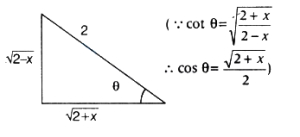
(D) Let $\theta = \cot ^{-1} \sqrt{\frac{2+x}{2-x}}$. Then $\cot \theta = \sqrt{\frac{2+x}{2-x}}$.
From the right-angled triangle with base $\sqrt{2+x}$ and perpendicular $\sqrt{2-x}$,the hypotenuse is $\sqrt{(\sqrt{2+x})^2 + (\sqrt{2-x})^2} = \sqrt{2+x+2-x} = \sqrt{4} = 2$.
Thus,$\cos \theta = \frac{\text{base}}{\text{hypotenuse}} = \frac{\sqrt{2+x}}{2}$.
Now,the expression becomes $\frac{d}{d x}\left[\cos ^2 \theta\right] = \frac{d}{d x}\left[\left(\frac{\sqrt{2+x}}{2}\right)^2\right]$.
$= \frac{d}{d x}\left(\frac{2+x}{4}\right) = \frac{d}{d x}\left(\frac{1}{2} + \frac{x}{4}\right) = 0 + \frac{1}{4} = \frac{1}{4}$.
From the right-angled triangle with base $\sqrt{2+x}$ and perpendicular $\sqrt{2-x}$,the hypotenuse is $\sqrt{(\sqrt{2+x})^2 + (\sqrt{2-x})^2} = \sqrt{2+x+2-x} = \sqrt{4} = 2$.
Thus,$\cos \theta = \frac{\text{base}}{\text{hypotenuse}} = \frac{\sqrt{2+x}}{2}$.
Now,the expression becomes $\frac{d}{d x}\left[\cos ^2 \theta\right] = \frac{d}{d x}\left[\left(\frac{\sqrt{2+x}}{2}\right)^2\right]$.
$= \frac{d}{d x}\left(\frac{2+x}{4}\right) = \frac{d}{d x}\left(\frac{1}{2} + \frac{x}{4}\right) = 0 + \frac{1}{4} = \frac{1}{4}$.
0 likes
View Solution342
EasyMCQ
If the function $f(x)$ is defined by $f(x) = \frac{x^{100}}{100} + \frac{x^{99}}{99} + \dots + \frac{x^2}{2} + x + 1$,then $f'(0) = $
A
$100$
B
$-1$
C
$100 f'(0)$
D
$1$
Solution
(D) Given the function $f(x) = \frac{x^{100}}{100} + \frac{x^{99}}{99} + \dots + \frac{x^2}{2} + x + 1$.
To find $f'(x)$,we differentiate $f(x)$ with respect to $x$ using the power rule $\frac{d}{dx}(x^n) = nx^{n-1}$:
$f'(x) = \frac{100x^{99}}{100} + \frac{99x^{98}}{99} + \dots + \frac{2x}{2} + 1$.
Simplifying this,we get $f'(x) = x^{99} + x^{98} + \dots + x + 1$.
Now,substituting $x = 0$ into the derivative:
$f'(0) = 0^{99} + 0^{98} + \dots + 0 + 1 = 1$.
To find $f'(x)$,we differentiate $f(x)$ with respect to $x$ using the power rule $\frac{d}{dx}(x^n) = nx^{n-1}$:
$f'(x) = \frac{100x^{99}}{100} + \frac{99x^{98}}{99} + \dots + \frac{2x}{2} + 1$.
Simplifying this,we get $f'(x) = x^{99} + x^{98} + \dots + x + 1$.
Now,substituting $x = 0$ into the derivative:
$f'(0) = 0^{99} + 0^{98} + \dots + 0 + 1 = 1$.
0 likes
View Solution343
DifficultMCQ
Let the function satisfy the equation $f(x+y)=f(x)f(y)$ for all $x, y \in \mathbb{R}$,where $f(0) \neq 0$. If $f(5)=3$ and $f^{\prime}(0)=2$,then $f^{\prime}(5)$ is
A
$6$
B
$0$
C
$3$
D
$-6$
Solution
(A) Given $f(x+y)=f(x)f(y)$.
Putting $x=0, y=5$,we get $f(5)=f(0)f(5)$.
Since $f(5)=3 \neq 0$,we have $f(0)=1$.
Now,$f^{\prime}(5) = \lim_{h \to 0} \frac{f(5+h)-f(5)}{h}$.
Using the given functional equation,$f(5+h)=f(5)f(h)$.
So,$f^{\prime}(5) = \lim_{h \to 0} \frac{f(5)f(h)-f(5)}{h} = f(5) \lim_{h \to 0} \frac{f(h)-1}{h}$.
Since $f(0)=1$,this is $f(5) \lim_{h \to 0} \frac{f(h)-f(0)}{h} = f(5)f^{\prime}(0)$.
Substituting the values,$f^{\prime}(5) = 3 \times 2 = 6$.
Putting $x=0, y=5$,we get $f(5)=f(0)f(5)$.
Since $f(5)=3 \neq 0$,we have $f(0)=1$.
Now,$f^{\prime}(5) = \lim_{h \to 0} \frac{f(5+h)-f(5)}{h}$.
Using the given functional equation,$f(5+h)=f(5)f(h)$.
So,$f^{\prime}(5) = \lim_{h \to 0} \frac{f(5)f(h)-f(5)}{h} = f(5) \lim_{h \to 0} \frac{f(h)-1}{h}$.
Since $f(0)=1$,this is $f(5) \lim_{h \to 0} \frac{f(h)-f(0)}{h} = f(5)f^{\prime}(0)$.
Substituting the values,$f^{\prime}(5) = 3 \times 2 = 6$.
0 likes
View Solution344
MediumMCQ
If $y = f(x^2 + 2)$ and $f'(3) = 5$,then $\frac{dy}{dx}$ at $x = 1$ is:
A
$5$
B
$15$
C
$20$
D
$10$
Solution
(D) Given the function $y = f(x^2 + 2)$.
Applying the chain rule to differentiate with respect to $x$,we get:
$\frac{dy}{dx} = f'(x^2 + 2) \cdot \frac{d}{dx}(x^2 + 2)$
$\frac{dy}{dx} = f'(x^2 + 2) \cdot (2x)$
Now,evaluate the derivative at $x = 1$:
$\left. \frac{dy}{dx} \right|_{x=1} = f'(1^2 + 2) \cdot (2 \cdot 1)$
$\left. \frac{dy}{dx} \right|_{x=1} = f'(3) \cdot 2$
Given that $f'(3) = 5$,substitute this value into the expression:
$\left. \frac{dy}{dx} \right|_{x=1} = 5 \cdot 2 = 10$
Applying the chain rule to differentiate with respect to $x$,we get:
$\frac{dy}{dx} = f'(x^2 + 2) \cdot \frac{d}{dx}(x^2 + 2)$
$\frac{dy}{dx} = f'(x^2 + 2) \cdot (2x)$
Now,evaluate the derivative at $x = 1$:
$\left. \frac{dy}{dx} \right|_{x=1} = f'(1^2 + 2) \cdot (2 \cdot 1)$
$\left. \frac{dy}{dx} \right|_{x=1} = f'(3) \cdot 2$
Given that $f'(3) = 5$,substitute this value into the expression:
$\left. \frac{dy}{dx} \right|_{x=1} = 5 \cdot 2 = 10$
0 likes
View Solution345
EasyMCQ
If $f(x)$ is an even function,then $f^{\prime}(x)$ is
A
an odd function
B
an even function
C
may be even or may be odd
D
nothing can be said
Solution
(A) By definition,a function $f(x)$ is even if $f(-x) = f(x)$.
Differentiating both sides with respect to $x$ using the chain rule,we get:
$\frac{d}{dx}[f(-x)] = \frac{d}{dx}[f(x)]$
$f^{\prime}(-x) \cdot (-1) = f^{\prime}(x)$
$-f^{\prime}(-x) = f^{\prime}(x)$
$f^{\prime}(-x) = -f^{\prime}(x)$
Since $f^{\prime}(-x) = -f^{\prime}(x)$,the derivative $f^{\prime}(x)$ is an odd function.
Differentiating both sides with respect to $x$ using the chain rule,we get:
$\frac{d}{dx}[f(-x)] = \frac{d}{dx}[f(x)]$
$f^{\prime}(-x) \cdot (-1) = f^{\prime}(x)$
$-f^{\prime}(-x) = f^{\prime}(x)$
$f^{\prime}(-x) = -f^{\prime}(x)$
Since $f^{\prime}(-x) = -f^{\prime}(x)$,the derivative $f^{\prime}(x)$ is an odd function.
0 likes
View Solution346
EasyMCQ
If the function $g(x)$ is defined by $g(x) = \frac{x^{200}}{200} + \frac{x^{199}}{199} + \frac{x^{198}}{198} + \dots + \frac{x^2}{2} + x + 5$,then find $g'(0)$.
A
$0$
B
$1$
C
$5$
D
$200$
Solution
(B) Given the function: $g(x) = \frac{x^{200}}{200} + \frac{x^{199}}{199} + \dots + \frac{x^2}{2} + x + 5$.
To find $g'(x)$,we differentiate $g(x)$ with respect to $x$ using the power rule $\frac{d}{dx}(x^n) = nx^{n-1}$:
$g'(x) = \frac{200x^{199}}{200} + \frac{199x^{198}}{199} + \dots + \frac{2x}{2} + 1 + 0$.
Simplifying the expression,we get:
$g'(x) = x^{199} + x^{198} + \dots + x + 1$.
Now,substitute $x = 0$ into the derivative:
$g'(0) = 0^{199} + 0^{198} + \dots + 0 + 1$.
$g'(0) = 1$.
To find $g'(x)$,we differentiate $g(x)$ with respect to $x$ using the power rule $\frac{d}{dx}(x^n) = nx^{n-1}$:
$g'(x) = \frac{200x^{199}}{200} + \frac{199x^{198}}{199} + \dots + \frac{2x}{2} + 1 + 0$.
Simplifying the expression,we get:
$g'(x) = x^{199} + x^{198} + \dots + x + 1$.
Now,substitute $x = 0$ into the derivative:
$g'(0) = 0^{199} + 0^{198} + \dots + 0 + 1$.
$g'(0) = 1$.
0 likes
View Solution347
MediumMCQ
The local minimum value of the function $f'(x)$,where $f(x) = 3 + |x|$ for $x \in \mathbb{R}$,is:
A
$3$
B
$0$
C
$-1$
D
$1$
Solution
(C) Given the function $f(x) = 3 + |x|$.
We know that the derivative of $|x|$ is given by:
$f'(x) = \frac{d}{dx}(3 + |x|) = \frac{d}{dx}(|x|) = \text{sgn}(x)$
Where $\text{sgn}(x)$ is the signum function defined as:
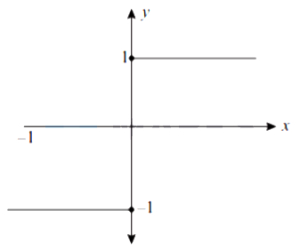
$f'(x) = \begin{cases} 1, & x > 0 \\ -1, & x < 0 \end{cases}$
The function $f'(x)$ is undefined at $x = 0$.
Looking at the values of $f'(x)$,it takes only two values: $1$ for $x > 0$ and $-1$ for $x < 0$.
The minimum value of this function $f'(x)$ is $-1$.
We know that the derivative of $|x|$ is given by:
$f'(x) = \frac{d}{dx}(3 + |x|) = \frac{d}{dx}(|x|) = \text{sgn}(x)$
Where $\text{sgn}(x)$ is the signum function defined as:
$f'(x) = \begin{cases} 1, & x > 0 \\ -1, & x < 0 \end{cases}$
The function $f'(x)$ is undefined at $x = 0$.
Looking at the values of $f'(x)$,it takes only two values: $1$ for $x > 0$ and $-1$ for $x < 0$.
The minimum value of this function $f'(x)$ is $-1$.
0 likes
View Solution348
MediumMCQ
If $y=\frac{\cos x}{1+\sin x}$,then
$(a)$ $\frac{dy}{dx}=\frac{-1}{1+\sin x}$
$(b)$ $\frac{dy}{dx}=\frac{1}{1+\sin x}$
$(c)$ $\frac{dy}{dx}=-\frac{1}{2} \sec ^2\left(\frac{\pi}{4}-\frac{x}{2}\right)$
$(d)$ $\frac{dy}{dx}=\frac{1}{2} \sec ^2\left(\frac{\pi}{4}-\frac{x}{2}\right)$
$(a)$ $\frac{dy}{dx}=\frac{-1}{1+\sin x}$
$(b)$ $\frac{dy}{dx}=\frac{1}{1+\sin x}$
$(c)$ $\frac{dy}{dx}=-\frac{1}{2} \sec ^2\left(\frac{\pi}{4}-\frac{x}{2}\right)$
$(d)$ $\frac{dy}{dx}=\frac{1}{2} \sec ^2\left(\frac{\pi}{4}-\frac{x}{2}\right)$
A
Only $b$ is correct
B
Only $a$ is correct
C
Both $a$ and $c$ are correct
D
Both $b$ and $d$ are correct
Solution
(C) Given $y = \frac{\cos x}{1+\sin x}$.
Using the quotient rule $\frac{d}{dx}\left(\frac{u}{v}\right) = \frac{u'v - uv'}{v^2}$:
$\frac{dy}{dx} = \frac{(-\sin x)(1+\sin x) - (\cos x)(\cos x)}{(1+\sin x)^2}$
$\frac{dy}{dx} = \frac{-\sin x - \sin^2 x - \cos^2 x}{(1+\sin x)^2} = \frac{-(\sin x + \sin^2 x + \cos^2 x)}{(1+\sin x)^2}$
Since $\sin^2 x + \cos^2 x = 1$,we have:
$\frac{dy}{dx} = \frac{-(1+\sin x)}{(1+\sin x)^2} = \frac{-1}{1+\sin x}$. This matches option $(a)$.
Now,simplify $\frac{-1}{1+\sin x}$ using trigonometric identities:
$1+\sin x = 1+\cos\left(\frac{\pi}{2}-x\right) = 2\cos^2\left(\frac{\pi}{4}-\frac{x}{2}\right)$.
Therefore,$\frac{dy}{dx} = \frac{-1}{2\cos^2\left(\frac{\pi}{4}-\frac{x}{2}\right)} = -\frac{1}{2}\sec^2\left(\frac{\pi}{4}-\frac{x}{2}\right)$. This matches option $(c)$.
Thus,both $(a)$ and $(c)$ are correct.
Using the quotient rule $\frac{d}{dx}\left(\frac{u}{v}\right) = \frac{u'v - uv'}{v^2}$:
$\frac{dy}{dx} = \frac{(-\sin x)(1+\sin x) - (\cos x)(\cos x)}{(1+\sin x)^2}$
$\frac{dy}{dx} = \frac{-\sin x - \sin^2 x - \cos^2 x}{(1+\sin x)^2} = \frac{-(\sin x + \sin^2 x + \cos^2 x)}{(1+\sin x)^2}$
Since $\sin^2 x + \cos^2 x = 1$,we have:
$\frac{dy}{dx} = \frac{-(1+\sin x)}{(1+\sin x)^2} = \frac{-1}{1+\sin x}$. This matches option $(a)$.
Now,simplify $\frac{-1}{1+\sin x}$ using trigonometric identities:
$1+\sin x = 1+\cos\left(\frac{\pi}{2}-x\right) = 2\cos^2\left(\frac{\pi}{4}-\frac{x}{2}\right)$.
Therefore,$\frac{dy}{dx} = \frac{-1}{2\cos^2\left(\frac{\pi}{4}-\frac{x}{2}\right)} = -\frac{1}{2}\sec^2\left(\frac{\pi}{4}-\frac{x}{2}\right)$. This matches option $(c)$.
Thus,both $(a)$ and $(c)$ are correct.
0 likes
View Solution349
MediumMCQ
If $a$ and $b$ are fixed non-zero constants,then the derivative of $\frac{a}{x^{4}}-\frac{b}{x^{2}}+\cos x$ is $ma+nb-p$,where
A
$m=4x^{3}, n=\frac{-2}{x^{3}}$ and $p=\sin x$
B
$m=\frac{-4}{x^{5}}, n=\frac{2}{x^{3}}$ and $p=\sin x$
C
$m=\frac{-4}{x^{5}}, n=\frac{-2}{x^{3}}$ and $p=\sin x$
D
$m=4x^{3}, n=\frac{2}{x^{3}}$ and $p=-\sin x$
Solution
(B) Given the function is $f(x) = \frac{a}{x^{4}} - \frac{b}{x^{2}} + \cos x$.
To find the derivative with respect to $x$,we use the power rule $\frac{d}{dx}(x^{n}) = nx^{n-1}$ and the derivative of $\cos x$ is $-\sin x$.
$\frac{d}{dx} f(x) = \frac{d}{dx}(ax^{-4} - bx^{-2} + \cos x)$
$= a(-4x^{-5}) - b(-2x^{-3}) - \sin x$
$= -\frac{4a}{x^{5}} + \frac{2b}{x^{3}} - \sin x$
Comparing this with the expression $ma + nb - p$,we get:
$m = -\frac{4}{x^{5}}$,$n = \frac{2}{x^{3}}$,and $p = \sin x$.
To find the derivative with respect to $x$,we use the power rule $\frac{d}{dx}(x^{n}) = nx^{n-1}$ and the derivative of $\cos x$ is $-\sin x$.
$\frac{d}{dx} f(x) = \frac{d}{dx}(ax^{-4} - bx^{-2} + \cos x)$
$= a(-4x^{-5}) - b(-2x^{-3}) - \sin x$
$= -\frac{4a}{x^{5}} + \frac{2b}{x^{3}} - \sin x$
Comparing this with the expression $ma + nb - p$,we get:
$m = -\frac{4}{x^{5}}$,$n = \frac{2}{x^{3}}$,and $p = \sin x$.
0 likes
View Solution350
EasyMCQ
If $y = (\cos x^{2})^{2}$,then $\frac{dy}{dx}$ is equal to
A
$-4x \sin 2x^{2}$
B
$-x \sin x^{2}$
C
$-2x \sin 2x^{2}$
D
$-x \cos 2x^{2}$
Solution
(C) $y = (\cos x^{2})^{2}$
Differentiating with respect to $x$ using the chain rule:
$\frac{dy}{dx} = 2(\cos x^{2}) \cdot \frac{d}{dx}(\cos x^{2})$
$\frac{dy}{dx} = 2(\cos x^{2}) \cdot (-\sin x^{2}) \cdot \frac{d}{dx}(x^{2})$
$\frac{dy}{dx} = 2(\cos x^{2}) \cdot (-\sin x^{2}) \cdot (2x)$
$\frac{dy}{dx} = -4x \sin x^{2} \cos x^{2}$
Using the trigonometric identity $\sin 2\theta = 2 \sin \theta \cos \theta$,we have:
$\frac{dy}{dx} = -2x(2 \sin x^{2} \cos x^{2}) = -2x \sin 2x^{2}$
Differentiating with respect to $x$ using the chain rule:
$\frac{dy}{dx} = 2(\cos x^{2}) \cdot \frac{d}{dx}(\cos x^{2})$
$\frac{dy}{dx} = 2(\cos x^{2}) \cdot (-\sin x^{2}) \cdot \frac{d}{dx}(x^{2})$
$\frac{dy}{dx} = 2(\cos x^{2}) \cdot (-\sin x^{2}) \cdot (2x)$
$\frac{dy}{dx} = -4x \sin x^{2} \cos x^{2}$
Using the trigonometric identity $\sin 2\theta = 2 \sin \theta \cos \theta$,we have:
$\frac{dy}{dx} = -2x(2 \sin x^{2} \cos x^{2}) = -2x \sin 2x^{2}$
0 likes
View SolutionContinuity and Differentiation — Derivative at a point, Standard differentiation · Frequently Asked Questions
1Are these Continuity and Differentiation questions useful for JEE and NEET?
Yes. All questions in this section are mapped to JEE Main and NEET exam patterns. Previous year questions from JEE Main, NEET, GUJCET and state-level exams are included with full solutions.
2Can I switch to Hindi or Gujarati for these questions?
Yes. Use the language tabs in the hero section or the sidebar to view the same questions and solutions in English, Hindi or Gujarati.
3How do I generate a question paper from this subtopic?
Use the Vedclass Exam Paper Generator — select the chapter and subtopic, set difficulty, and generate Sets A, B, C, D automatically. First 3 chapters of every subject are free.
Vedclass Products
For Students
Vedclass Test Series
Mock tests in real JEE/NEET style with performance analysis. 5-day free trial.
Start Free TrialFor Teachers
Exam Paper Generator
Generate Set A/B/C/D papers from this chapter in 2 minutes. 3 chapters free.
Try FreeFor Institutes
Online Exam Module
Live online exams with unlimited students, 360° analytics & white-label branding.
See DemoFor Teachers & Institutes
Generate a Continuity and Differentiation Exam Paper in 2 Minutes
Select subtopic & difficulty — Sets A, B, C, D auto-generated with No Repeat logic.
First 3 chapters of every subject are free — no payment required.