
A English
Mix Examples-Determinants and Matrices Questions in English
Class 12 Mathematics · 3 and 4 .Determinants and Matrices · Mix Examples-Determinants and Matrices
432+
Questions
English
Language
100%
With Solutions
Showing 47 of 432 questions in English
351
EasyMCQ
If $A=\left[\begin{array}{ccc}1 & 1 & 3 \\ 5 & 2 & 6 \\ -2 & -1 & -3\end{array}\right]$,then $A+A^3+A^4+A^5+3 I=$
A
$\left[\begin{array}{ccc}4 & 2 & 1 \\ 2 & 5 & 6 \\ -3 & 2 & 3\end{array}\right]$
B
$\left[\begin{array}{ccc}4 & 1 & 3 \\ 5 & 5 & 6 \\ -2 & -1 & 0\end{array}\right]$
C
$\left[\begin{array}{ccc}3 & 1 & 4 \\ 3 & 1 & -2 \\ -1 & 2 & -1\end{array}\right]$
D
$\left[\begin{array}{ccc}4 & 1 & 3 \\ 2 & 3 & 5 \\ -3 & -2 & -3\end{array}\right]$
Solution
(B) Given $A=\left[\begin{array}{ccc}1 & 1 & 3 \\ 5 & 2 & 6 \\ -2 & -1 & -3\end{array}\right]$.
The characteristic equation is given by $|A-\lambda I|=0$.
$\left|\begin{array}{ccc}1-\lambda & 1 & 3 \\ 5 & 2-\lambda & 6 \\ -2 & -1 & -3-\lambda\end{array}\right|=0$
Expanding the determinant:
$(1-\lambda)[(2-\lambda)(-3-\lambda) - (-6)] - 1[5(-3-\lambda) - (-12)] + 3[5(-1) - (-2)(2-\lambda)] = 0$
$(1-\lambda)[\lambda^2+\lambda-6+6] - 1[-15-5\lambda+12] + 3[-5+4-2\lambda] = 0$
$(1-\lambda)(\lambda^2+\lambda) - 1(-5\lambda-3) + 3(-2\lambda-1) = 0$
$\lambda^2+\lambda-\lambda^3-\lambda^2 + 5\lambda+3 - 6\lambda-3 = 0$
$-\lambda^3 = 0 \Rightarrow \lambda^3 = 0$.
By the Cayley-Hamilton theorem,every matrix satisfies its characteristic equation,so $A^3 = 0$.
Since $A^3 = 0$,it follows that $A^4 = A^3 \cdot A = 0$ and $A^5 = A^3 \cdot A^2 = 0$.
Therefore,$A+A^3+A^4+A^5+3I = A + 0 + 0 + 0 + 3I = A + 3I$.
$A+3I = \left[\begin{array}{ccc}1 & 1 & 3 \\ 5 & 2 & 6 \\ -2 & -1 & -3\end{array}\right] + \left[\begin{array}{ccc}3 & 0 & 0 \\ 0 & 3 & 0 \\ 0 & 0 & 3\end{array}\right] = \left[\begin{array}{ccc}4 & 1 & 3 \\ 5 & 5 & 6 \\ -2 & -1 & 0\end{array}\right]$.
The characteristic equation is given by $|A-\lambda I|=0$.
$\left|\begin{array}{ccc}1-\lambda & 1 & 3 \\ 5 & 2-\lambda & 6 \\ -2 & -1 & -3-\lambda\end{array}\right|=0$
Expanding the determinant:
$(1-\lambda)[(2-\lambda)(-3-\lambda) - (-6)] - 1[5(-3-\lambda) - (-12)] + 3[5(-1) - (-2)(2-\lambda)] = 0$
$(1-\lambda)[\lambda^2+\lambda-6+6] - 1[-15-5\lambda+12] + 3[-5+4-2\lambda] = 0$
$(1-\lambda)(\lambda^2+\lambda) - 1(-5\lambda-3) + 3(-2\lambda-1) = 0$
$\lambda^2+\lambda-\lambda^3-\lambda^2 + 5\lambda+3 - 6\lambda-3 = 0$
$-\lambda^3 = 0 \Rightarrow \lambda^3 = 0$.
By the Cayley-Hamilton theorem,every matrix satisfies its characteristic equation,so $A^3 = 0$.
Since $A^3 = 0$,it follows that $A^4 = A^3 \cdot A = 0$ and $A^5 = A^3 \cdot A^2 = 0$.
Therefore,$A+A^3+A^4+A^5+3I = A + 0 + 0 + 0 + 3I = A + 3I$.
$A+3I = \left[\begin{array}{ccc}1 & 1 & 3 \\ 5 & 2 & 6 \\ -2 & -1 & -3\end{array}\right] + \left[\begin{array}{ccc}3 & 0 & 0 \\ 0 & 3 & 0 \\ 0 & 0 & 3\end{array}\right] = \left[\begin{array}{ccc}4 & 1 & 3 \\ 5 & 5 & 6 \\ -2 & -1 & 0\end{array}\right]$.
0 likes
View Solution352
MediumMCQ
If the inverse of $\begin{bmatrix} -x & 14x & 7x \\ 0 & 1 & 0 \\ x & -4x & -2x \end{bmatrix}$ is $\begin{bmatrix} 2 & 0 & 7 \\ 0 & 1 & 0 \\ 1 & -2 & 1 \end{bmatrix}$,then $\left|\begin{array}{ccc} x & x+1 & x+2 \\ x+1 & x+2 & x+3 \\ x+2 & x+3 & x+4 \end{array}\right| = $
A
$x/5$
B
$x-5$
C
$5x-1$
D
$0$
Solution
(D) Let $A = \begin{bmatrix} -x & 14x & 7x \\ 0 & 1 & 0 \\ x & -4x & -2x \end{bmatrix}$. The inverse $A^{-1}$ is given as $\begin{bmatrix} 2 & 0 & 7 \\ 0 & 1 & 0 \\ 1 & -2 & 1 \end{bmatrix}$.
We know that $A \cdot A^{-1} = I$,where $I$ is the identity matrix.
Multiplying the first row of $A$ by the first column of $A^{-1}$:
$(-x)(2) + (14x)(0) + (7x)(1) = 1$ (since the element at $(1,1)$ of $I$ is $1$)
$-2x + 7x = 1 \implies 5x = 1 \implies x = 1/5$.
Now,we need to evaluate the determinant $D = \left|\begin{array}{ccc} x & x+1 & x+2 \\ x+1 & x+2 & x+3 \\ x+2 & x+3 & x+4 \end{array}\right|$.
Apply row operations: $R_2 \to R_2 - R_1$ and $R_3 \to R_3 - R_2$.
$D = \left|\begin{array}{ccc} x & x+1 & x+2 \\ 1 & 1 & 1 \\ 1 & 1 & 1 \end{array}\right|$.
Since two rows are identical,the determinant is $0$.
We know that $A \cdot A^{-1} = I$,where $I$ is the identity matrix.
Multiplying the first row of $A$ by the first column of $A^{-1}$:
$(-x)(2) + (14x)(0) + (7x)(1) = 1$ (since the element at $(1,1)$ of $I$ is $1$)
$-2x + 7x = 1 \implies 5x = 1 \implies x = 1/5$.
Now,we need to evaluate the determinant $D = \left|\begin{array}{ccc} x & x+1 & x+2 \\ x+1 & x+2 & x+3 \\ x+2 & x+3 & x+4 \end{array}\right|$.
Apply row operations: $R_2 \to R_2 - R_1$ and $R_3 \to R_3 - R_2$.
$D = \left|\begin{array}{ccc} x & x+1 & x+2 \\ 1 & 1 & 1 \\ 1 & 1 & 1 \end{array}\right|$.
Since two rows are identical,the determinant is $0$.
0 likes
View Solution353
DifficultMCQ
If $A = \int_{1}^{\sin \theta} \frac{t}{1+t^2} dt$ and $B = \int_{1}^{\operatorname{cosec} \theta} \frac{1}{t(1+t^2)} dt$,then the value of $\left| \begin{array}{ccc} A & A^2 & B \\ e^{A+B} & B^2 & -1 \\ 1 & A^2+B^2 & -1 \end{array} \right| = $
A
$0$
B
$1$
C
$e$
D
$-1$
Solution
(A) First,evaluate $A$: $A = \int_{1}^{\sin \theta} \frac{t}{1+t^2} dt = \frac{1}{2} [\ln(1+t^2)]_{1}^{\sin \theta} = \frac{1}{2} \ln(1+\sin^2 \theta) - \frac{1}{2} \ln(2) = \frac{1}{2} \ln(\frac{1+\sin^2 \theta}{2})$.
Next,evaluate $B$: $B = \int_{1}^{\operatorname{cosec} \theta} \frac{1}{t(1+t^2)} dt$. Using partial fractions,$\frac{1}{t(1+t^2)} = \frac{1}{t} - \frac{t}{1+t^2}$.
So,$B = [\ln|t| - \frac{1}{2} \ln(1+t^2)]_{1}^{\operatorname{cosec} \theta} = [\ln(\frac{t}{\sqrt{1+t^2}})]_{1}^{\operatorname{cosec} \theta}$.
Since $\frac{t}{\sqrt{1+t^2}} = \frac{\operatorname{cosec} \theta}{\sqrt{1+\operatorname{cosec}^2 \theta}} = \frac{1}{\sqrt{\sin^2 \theta + 1}}$,we have $B = \ln(\frac{1}{\sqrt{1+\sin^2 \theta}}) - \ln(\frac{1}{\sqrt{2}}) = \ln(\sqrt{\frac{2}{1+\sin^2 \theta}}) = -\frac{1}{2} \ln(\frac{1+\sin^2 \theta}{2}) = -A$.
Thus,$A+B = 0$,which implies $e^{A+B} = e^0 = 1$.
The determinant becomes $\left| \begin{array}{ccc} A & A^2 & -A \\ 1 & (-A)^2 & -1 \\ 1 & A^2+(-A)^2 & -1 \end{array} \right| = \left| \begin{array}{ccc} A & A^2 & -A \\ 1 & A^2 & -1 \\ 1 & 2A^2 & -1 \end{array} \right|$.
Since the first and third columns are proportional (column $3$ is $-1$ times column $1$),the determinant is $0$.
Next,evaluate $B$: $B = \int_{1}^{\operatorname{cosec} \theta} \frac{1}{t(1+t^2)} dt$. Using partial fractions,$\frac{1}{t(1+t^2)} = \frac{1}{t} - \frac{t}{1+t^2}$.
So,$B = [\ln|t| - \frac{1}{2} \ln(1+t^2)]_{1}^{\operatorname{cosec} \theta} = [\ln(\frac{t}{\sqrt{1+t^2}})]_{1}^{\operatorname{cosec} \theta}$.
Since $\frac{t}{\sqrt{1+t^2}} = \frac{\operatorname{cosec} \theta}{\sqrt{1+\operatorname{cosec}^2 \theta}} = \frac{1}{\sqrt{\sin^2 \theta + 1}}$,we have $B = \ln(\frac{1}{\sqrt{1+\sin^2 \theta}}) - \ln(\frac{1}{\sqrt{2}}) = \ln(\sqrt{\frac{2}{1+\sin^2 \theta}}) = -\frac{1}{2} \ln(\frac{1+\sin^2 \theta}{2}) = -A$.
Thus,$A+B = 0$,which implies $e^{A+B} = e^0 = 1$.
The determinant becomes $\left| \begin{array}{ccc} A & A^2 & -A \\ 1 & (-A)^2 & -1 \\ 1 & A^2+(-A)^2 & -1 \end{array} \right| = \left| \begin{array}{ccc} A & A^2 & -A \\ 1 & A^2 & -1 \\ 1 & 2A^2 & -1 \end{array} \right|$.
Since the first and third columns are proportional (column $3$ is $-1$ times column $1$),the determinant is $0$.
0 likes
View Solution354
DifficultMCQ
Match the items of List-$I$ with those of List-$II$. The correct match is:
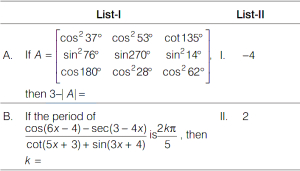
A
$A$. If $A = \begin{bmatrix} \cos^2 37^{\circ} & \cos^2 53^{\circ} & \cot 135^{\circ} \\ \sin^2 76^{\circ} & \sin 270^{\circ} & \sin^2 14^{\circ} \\ \cos 180^{\circ} & \cos^2 28^{\circ} & \cos^2 62^{\circ} \end{bmatrix}$,then $3 - |A| = $
B
$B$. If the period of $\frac{\cos(6x - 4) - \sec(3 - 4x)}{\cot(5x + 3) + \sin(3x + 4)}$ is $\frac{2k\pi}{5}$,then $k = $
C
$C$. The maximum value of $y = \cos^2(\frac{\pi}{4} - x) + (\sin x - \cos x)^2$ is
D
$D$. If $x + y + z = 0^{\circ}$,then $\frac{\sin 2x + \sin 2y + \sin 2z}{\sin(-x)\sin(-y)\sin(-z)} = $
Solution
(A)
| $A$. Given $A = \begin{bmatrix} \cos^2 37^{\circ} & \cos^2 53^{\circ} & -1 \\ \sin^2 76^{\circ} & -1 & \sin^2 14^{\circ} \\ -1 & \cos^2 28^{\circ} & \cos^2 62^{\circ} \end{bmatrix}$. Using properties of determinants,$|A| = 0$. Thus,$3 - |A| = 3 - 0 = 3$. Matches $(iii)$. |
| $B$. The period of $\cos(6x-4)$ is $\frac{\pi}{3}$,$\sec(3-4x)$ is $\frac{\pi}{2}$,$\cot(5x+3)$ is $\frac{\pi}{5}$,and $\sin(3x+4)$ is $\frac{2\pi}{3}$. The period of the expression is $LCM(\frac{\pi}{3}, \frac{\pi}{2}, \frac{\pi}{5}, \frac{2\pi}{3}) = 2\pi$. Given $\frac{2k\pi}{5} = 2\pi$,so $k = 5$. Matches $(v)$. |
| $C$. $y = \frac{1}{2}(\cos x + \sin x)^2 + (\sin x - \cos x)^2 = \frac{3}{2} - \frac{\sin 2x}{2}$. Max value is $\frac{3}{2} + \frac{1}{2} = 2$. Matches $(ii)$. |
| $D$. If $x+y+z=0$,then $\sin 2x + \sin 2y + \sin 2z = -4\sin x \sin y \sin z$. The expression becomes $\frac{-4\sin x \sin y \sin z}{-\sin x \sin y \sin z} = 4$. Matches $(iv)$. |
0 likes
View Solution355
MediumMCQ
Let $A = (a_{ij})$ be an $n \times n$ matrix defined by $a_{ij} = \begin{cases} k^i, & \forall i=j \\ 0, & \text{otherwise} \end{cases}$. If $m = \text{trace of } A$ and $\lim_{k \rightarrow 1} \frac{n-m}{1-k} = 171$,then the value of $n$ is:
A
$18$
B
$23$
C
$35$
D
$42$
Solution
(A) The matrix $A$ is a diagonal matrix where the diagonal elements are $a_{ii} = k^i$ for $i = 1, 2, \dots, n$.
The trace of $A$,denoted by $m$,is the sum of its diagonal elements:
$m = \sum_{i=1}^{n} k^i = k + k^2 + \dots + k^n = \frac{k(1-k^n)}{1-k}$.
We are given the limit: $\lim_{k \rightarrow 1} \frac{n-m}{1-k} = 171$.
Substituting $m$: $\lim_{k \rightarrow 1} \frac{n - \frac{k(1-k^n)}{1-k}}{1-k} = \lim_{k \rightarrow 1} \frac{n(1-k) - (k - k^{n+1})}{(1-k)^2} = 171$.
Using $L$'Hospital's rule (differentiating numerator and denominator with respect to $k$):
Numerator derivative: $\frac{d}{dk} [n - nk - k + k^{n+1}] = -n - 1 + (n+1)k^n$.
Denominator derivative: $\frac{d}{dk} [(1-k)^2] = 2(1-k)(-1) = -2(1-k)$.
Applying $L$'Hospital's rule again:
$\lim_{k \rightarrow 1} \frac{-n - 1 + (n+1)k^n}{-2(1-k)} = \lim_{k \rightarrow 1} \frac{(n+1)n k^{n-1}}{2} = 171$.
$\frac{n(n+1)}{2} = 171 \Rightarrow n^2 + n - 342 = 0$.
Solving the quadratic equation: $(n+19)(n-18) = 0$.
Since $n > 0$,we have $n = 18$.
The trace of $A$,denoted by $m$,is the sum of its diagonal elements:
$m = \sum_{i=1}^{n} k^i = k + k^2 + \dots + k^n = \frac{k(1-k^n)}{1-k}$.
We are given the limit: $\lim_{k \rightarrow 1} \frac{n-m}{1-k} = 171$.
Substituting $m$: $\lim_{k \rightarrow 1} \frac{n - \frac{k(1-k^n)}{1-k}}{1-k} = \lim_{k \rightarrow 1} \frac{n(1-k) - (k - k^{n+1})}{(1-k)^2} = 171$.
Using $L$'Hospital's rule (differentiating numerator and denominator with respect to $k$):
Numerator derivative: $\frac{d}{dk} [n - nk - k + k^{n+1}] = -n - 1 + (n+1)k^n$.
Denominator derivative: $\frac{d}{dk} [(1-k)^2] = 2(1-k)(-1) = -2(1-k)$.
Applying $L$'Hospital's rule again:
$\lim_{k \rightarrow 1} \frac{-n - 1 + (n+1)k^n}{-2(1-k)} = \lim_{k \rightarrow 1} \frac{(n+1)n k^{n-1}}{2} = 171$.
$\frac{n(n+1)}{2} = 171 \Rightarrow n^2 + n - 342 = 0$.
Solving the quadratic equation: $(n+19)(n-18) = 0$.
Since $n > 0$,we have $n = 18$.
0 likes
View Solution356
EasyMCQ
$A = [a_{ij}]$ is a $3 \times 3$ matrix with positive integers as its elements. Elements of $A$ are such that the sum of all the elements of each row is equal to $6$ and $a_{22} = 2$. If $a_{ii} = \begin{cases} a_{ij} + a_{ji}, & j = i + 1 \text{ when } i < 3 \\ a_{ij} + a_{ji}, & j = 4 - i \text{ when } i = 3 \end{cases}$ for $i = 1, 2, 3$,then $|A| = $
A
$6$
B
$18$
C
$3$
D
$12$
Solution
(D) Consider $A = \begin{bmatrix} a_{11} & a_{12} & a_{13} \\ a_{21} & a_{22} & a_{23} \\ a_{31} & a_{32} & a_{33} \end{bmatrix}$.
Each row sum is $6$:
$a_{11} + a_{12} + a_{13} = 6 \dots (i)$
$a_{21} + a_{22} + a_{23} = 6 \dots (ii)$
$a_{31} + a_{32} + a_{33} = 6 \dots (iii)$
From the given condition on diagonal entries:
$a_{11} = a_{12} + a_{21} \dots (iv)$
$a_{22} = a_{23} + a_{32} = 2 \dots (v)$
$a_{33} = a_{13} + a_{31} \dots (vi)$
Since entries are positive integers,from $(v)$,$a_{23} = 1$ and $a_{32} = 1$. Substituting into $(ii)$,$a_{21} + 2 + 1 = 6 \Rightarrow a_{21} = 3$.
From $(iv)$,$a_{11} = a_{12} + 3$. Substituting into $(i)$,$(a_{12} + 3) + a_{12} + a_{13} = 6 \Rightarrow 2a_{12} + a_{13} = 3$. Since $a_{ij} \ge 1$,we must have $a_{12} = 1$,$a_{13} = 1$,and $a_{11} = 4$.
From $(iii)$ and $(vi)$,$a_{31} + a_{32} + a_{33} = 6 \Rightarrow a_{31} + 1 + a_{33} = 6 \Rightarrow a_{31} + a_{33} = 5$. Also $a_{33} = a_{13} + a_{31} = 1 + a_{31}$.
Substituting $a_{33}$ in the sum,$a_{31} + (1 + a_{31}) = 5 \Rightarrow 2a_{31} = 4 \Rightarrow a_{31} = 2$,so $a_{33} = 3$.
Thus,$A = \begin{bmatrix} 4 & 1 & 1 \\ 3 & 2 & 1 \\ 2 & 1 & 3 \end{bmatrix}$.
$|A| = 4(6 - 1) - 1(9 - 2) + 1(3 - 4) = 4(5) - 1(7) + 1(-1) = 20 - 7 - 1 = 12$.
Each row sum is $6$:
$a_{11} + a_{12} + a_{13} = 6 \dots (i)$
$a_{21} + a_{22} + a_{23} = 6 \dots (ii)$
$a_{31} + a_{32} + a_{33} = 6 \dots (iii)$
From the given condition on diagonal entries:
$a_{11} = a_{12} + a_{21} \dots (iv)$
$a_{22} = a_{23} + a_{32} = 2 \dots (v)$
$a_{33} = a_{13} + a_{31} \dots (vi)$
Since entries are positive integers,from $(v)$,$a_{23} = 1$ and $a_{32} = 1$. Substituting into $(ii)$,$a_{21} + 2 + 1 = 6 \Rightarrow a_{21} = 3$.
From $(iv)$,$a_{11} = a_{12} + 3$. Substituting into $(i)$,$(a_{12} + 3) + a_{12} + a_{13} = 6 \Rightarrow 2a_{12} + a_{13} = 3$. Since $a_{ij} \ge 1$,we must have $a_{12} = 1$,$a_{13} = 1$,and $a_{11} = 4$.
From $(iii)$ and $(vi)$,$a_{31} + a_{32} + a_{33} = 6 \Rightarrow a_{31} + 1 + a_{33} = 6 \Rightarrow a_{31} + a_{33} = 5$. Also $a_{33} = a_{13} + a_{31} = 1 + a_{31}$.
Substituting $a_{33}$ in the sum,$a_{31} + (1 + a_{31}) = 5 \Rightarrow 2a_{31} = 4 \Rightarrow a_{31} = 2$,so $a_{33} = 3$.
Thus,$A = \begin{bmatrix} 4 & 1 & 1 \\ 3 & 2 & 1 \\ 2 & 1 & 3 \end{bmatrix}$.
$|A| = 4(6 - 1) - 1(9 - 2) + 1(3 - 4) = 4(5) - 1(7) + 1(-1) = 20 - 7 - 1 = 12$.
0 likes
View Solution357
EasyMCQ
If $A+B=\left[\begin{array}{lll}2 & 1 & 2 \\ 1 & 2 & 0 \\ 0 & 2 & 2\end{array}\right]$ and $AB=\left[\begin{array}{lll}1 & 2 & 2 \\ 1 & 1 & 0 \\ 1 & 2 & 1\end{array}\right]$,then $A^2+B(A+B)=$
A
$\left[\begin{array}{lll}4 & 6 & 6 \\ 3 & 4 & 2 \\ 1 & 6 & 3\end{array}\right]$
B
$\left[\begin{array}{lll}4 & 9 & 6 \\ 3 & 3 & 2 \\ 4 & 7 & 4\end{array}\right]$
C
$\left[\begin{array}{ccc}6 & 10 & 8 \\ 4 & 5 & 2 \\ 4 & 9 & 6\end{array}\right]$
D
$\left[\begin{array}{lll}3 & 4 & 4 \\ 2 & 3 & 2 \\ 0 & 4 & 2\end{array}\right]$
Solution
(A) Given,$A+B=\left[\begin{array}{lll} 2 & 1 & 2 \\ 1 & 2 & 0 \\ 0 & 2 & 2\end{array}\right]$ and $AB=\left[\begin{array}{lll}1 & 2 & 2 \\ 1 & 1 & 0 \\ 1 & 2 & 1\end{array}\right]$.
We need to find $A^2+B(A+B)$.
Note that $A^2+B(A+B) = A^2+BA+B^2$.
We know that $(A+B)^2 = (A+B)(A+B) = A^2+AB+BA+B^2$.
Thus,$A^2+BA+B^2 = (A+B)^2 - AB$.
First,calculate $(A+B)^2 = \left[\begin{array}{lll} 2 & 1 & 2 \\ 1 & 2 & 0 \\ 0 & 2 & 2\end{array}\right] \times \left[\begin{array}{lll} 2 & 1 & 2 \\ 1 & 2 & 0 \\ 0 & 2 & 2\end{array}\right] = \left[\begin{array}{lll} 4+1+0 & 2+2+4 & 4+0+4 \\ 2+2+0 & 1+4+0 & 2+0+0 \\ 0+2+0 & 0+4+4 & 0+0+4\end{array}\right] = \left[\begin{array}{lll} 5 & 8 & 8 \\ 4 & 5 & 2 \\ 2 & 8 & 4\end{array}\right]$.
Now,$A^2+B(A+B) = \left[\begin{array}{lll} 5 & 8 & 8 \\ 4 & 5 & 2 \\ 2 & 8 & 4\end{array}\right] - \left[\begin{array}{lll} 1 & 2 & 2 \\ 1 & 1 & 0 \\ 1 & 2 & 1\end{array}\right] = \left[\begin{array}{lll} 4 & 6 & 6 \\ 3 & 4 & 2 \\ 1 & 6 & 3\end{array}\right]$.
We need to find $A^2+B(A+B)$.
Note that $A^2+B(A+B) = A^2+BA+B^2$.
We know that $(A+B)^2 = (A+B)(A+B) = A^2+AB+BA+B^2$.
Thus,$A^2+BA+B^2 = (A+B)^2 - AB$.
First,calculate $(A+B)^2 = \left[\begin{array}{lll} 2 & 1 & 2 \\ 1 & 2 & 0 \\ 0 & 2 & 2\end{array}\right] \times \left[\begin{array}{lll} 2 & 1 & 2 \\ 1 & 2 & 0 \\ 0 & 2 & 2\end{array}\right] = \left[\begin{array}{lll} 4+1+0 & 2+2+4 & 4+0+4 \\ 2+2+0 & 1+4+0 & 2+0+0 \\ 0+2+0 & 0+4+4 & 0+0+4\end{array}\right] = \left[\begin{array}{lll} 5 & 8 & 8 \\ 4 & 5 & 2 \\ 2 & 8 & 4\end{array}\right]$.
Now,$A^2+B(A+B) = \left[\begin{array}{lll} 5 & 8 & 8 \\ 4 & 5 & 2 \\ 2 & 8 & 4\end{array}\right] - \left[\begin{array}{lll} 1 & 2 & 2 \\ 1 & 1 & 0 \\ 1 & 2 & 1\end{array}\right] = \left[\begin{array}{lll} 4 & 6 & 6 \\ 3 & 4 & 2 \\ 1 & 6 & 3\end{array}\right]$.
0 likes
View Solution358
DifficultMCQ
If $\left[\begin{array}{ccc}0 & 2 & a \\ b & 0 & 4 \\ -3 & c & 0\end{array}\right]$ is a skew-symmetric matrix,then $\left[\begin{array}{cc}a & b \\ b & a\end{array}\right]\left[\begin{array}{cc}b & c \\ c & b\end{array}\right]=$
A
$\left[\begin{array}{cc}0 & 0 \\ 0 & 0\end{array}\right]$
B
$\left[\begin{array}{cc}1 & 0 \\ 0 & 1\end{array}\right]$
C
$\left[\begin{array}{cc}2 & -8 \\ -8 & 2\end{array}\right]$
D
$\left[\begin{array}{cc}2 & 8 \\ 8 & 2\end{array}\right]$
Solution
(C) Let $A = \left[\begin{array}{ccc}0 & 2 & a \\ b & 0 & 4 \\ -3 & c & 0\end{array}\right]$ be a skew-symmetric matrix.
By definition,$A = -A^T$.
$\left[\begin{array}{ccc}0 & 2 & a \\ b & 0 & 4 \\ -3 & c & 0\end{array}\right] = -\left[\begin{array}{ccc}0 & b & -3 \\ 2 & 0 & c \\ a & 4 & 0\end{array}\right] = \left[\begin{array}{ccc}0 & -b & 3 \\ -2 & 0 & -c \\ -a & -4 & 0\end{array}\right]$.
Comparing the corresponding elements,we get:
$-b = 2 \Rightarrow b = -2$
$a = 3$
$c = -4$
Now,substitute these values into the expression:
$\left[\begin{array}{cc}a & b \\ b & a\end{array}\right]\left[\begin{array}{cc}b & c \\ c & b\end{array}\right] = \left[\begin{array}{cc}3 & -2 \\ -2 & 3\end{array}\right]\left[\begin{array}{cc}-2 & -4 \\ -4 & -2\end{array}\right]$
$= \left[\begin{array}{cc}(3)(-2) + (-2)(-4) & (3)(-4) + (-2)(-2) \\ (-2)(-2) + (3)(-4) & (-2)(-4) + (3)(-2)\end{array}\right]$
$= \left[\begin{array}{cc}-6 + 8 & -12 + 4 \\ 4 - 12 & 8 - 6\end{array}\right] = \left[\begin{array}{cc}2 & -8 \\ -8 & 2\end{array}\right]$.
By definition,$A = -A^T$.
$\left[\begin{array}{ccc}0 & 2 & a \\ b & 0 & 4 \\ -3 & c & 0\end{array}\right] = -\left[\begin{array}{ccc}0 & b & -3 \\ 2 & 0 & c \\ a & 4 & 0\end{array}\right] = \left[\begin{array}{ccc}0 & -b & 3 \\ -2 & 0 & -c \\ -a & -4 & 0\end{array}\right]$.
Comparing the corresponding elements,we get:
$-b = 2 \Rightarrow b = -2$
$a = 3$
$c = -4$
Now,substitute these values into the expression:
$\left[\begin{array}{cc}a & b \\ b & a\end{array}\right]\left[\begin{array}{cc}b & c \\ c & b\end{array}\right] = \left[\begin{array}{cc}3 & -2 \\ -2 & 3\end{array}\right]\left[\begin{array}{cc}-2 & -4 \\ -4 & -2\end{array}\right]$
$= \left[\begin{array}{cc}(3)(-2) + (-2)(-4) & (3)(-4) + (-2)(-2) \\ (-2)(-2) + (3)(-4) & (-2)(-4) + (3)(-2)\end{array}\right]$
$= \left[\begin{array}{cc}-6 + 8 & -12 + 4 \\ 4 - 12 & 8 - 6\end{array}\right] = \left[\begin{array}{cc}2 & -8 \\ -8 & 2\end{array}\right]$.
0 likes
View Solution359
MediumMCQ
Let $A, B, C$ be $3 \times 3$ non-singular matrices and $I$ be the identity matrix of order three. If $A B A = B A^2 B$ and $A^3 = I$,then $A B^4 - B^4 A = $
A
$O_{3 \times 3}$
B
$1/2$
C
$1$
D
$21$
Solution
(A) Given,$A B A = B A^2 B$ and $A^3 = I$.
Multiplying both sides of $A B A = B A^2 B$ by $A^2$ on the right,we get:
$A B A \cdot A^2 = B A^2 B \cdot A^2$
$A B A^3 = B A^2 B A^2$
Since $A^3 = I$,we have:
$A B = B A^2 B A^2$
Now,multiply by $B$ on the right:
$A B^2 = B A^2 B A^2 B$
Substitute $A^2 B = A B A$ from the given equation:
$A B^2 = B A^2 B (A B A)$
$A B^2 = B A^2 B A B A$
Using $A^3 = I$,we can simplify further.
Alternatively,note that $A B A = B A^2 B \implies A B = B A^2 B A^{-1}$.
Since $A^3 = I$,$A^{-1} = A^2$.
Thus $A B = B A^2 B A^2$.
By induction or repeated substitution,$A B^4 = B^4 A$.
Therefore,$A B^4 - B^4 A = O_{3 \times 3}$.
Multiplying both sides of $A B A = B A^2 B$ by $A^2$ on the right,we get:
$A B A \cdot A^2 = B A^2 B \cdot A^2$
$A B A^3 = B A^2 B A^2$
Since $A^3 = I$,we have:
$A B = B A^2 B A^2$
Now,multiply by $B$ on the right:
$A B^2 = B A^2 B A^2 B$
Substitute $A^2 B = A B A$ from the given equation:
$A B^2 = B A^2 B (A B A)$
$A B^2 = B A^2 B A B A$
Using $A^3 = I$,we can simplify further.
Alternatively,note that $A B A = B A^2 B \implies A B = B A^2 B A^{-1}$.
Since $A^3 = I$,$A^{-1} = A^2$.
Thus $A B = B A^2 B A^2$.
By induction or repeated substitution,$A B^4 = B^4 A$.
Therefore,$A B^4 - B^4 A = O_{3 \times 3}$.
0 likes
View Solution360
MediumMCQ
If $A = \begin{bmatrix} -8 & 5 \\ 2 & 4 \end{bmatrix}$ satisfies the equation $x^2 + 4x - p = 0$,then $p$ is equal to
A
$64$
B
$42$
C
$36$
D
$24$
Solution
(B) Given the matrix $A = \begin{bmatrix} -8 & 5 \\ 2 & 4 \end{bmatrix}$.
Since $A$ satisfies the equation $x^2 + 4x - p = 0$,we have $A^2 + 4A - pI = 0$,where $I$ is the identity matrix $\begin{bmatrix} 1 & 0 \\ 0 & 1 \end{bmatrix}$.
First,calculate $A^2$:
$A^2 = \begin{bmatrix} -8 & 5 \\ 2 & 4 \end{bmatrix} \begin{bmatrix} -8 & 5 \\ 2 & 4 \end{bmatrix} = \begin{bmatrix} (-8)(-8) + (5)(2) & (-8)(5) + (5)(4) \\ (2)(-8) + (4)(2) & (2)(5) + (4)(4) \end{bmatrix} = \begin{bmatrix} 64 + 10 & -40 + 20 \\ -16 + 8 & 10 + 16 \end{bmatrix} = \begin{bmatrix} 74 & -20 \\ -8 & 26 \end{bmatrix}$.
Next,calculate $4A$:
$4A = 4 \begin{bmatrix} -8 & 5 \\ 2 & 4 \end{bmatrix} = \begin{bmatrix} -32 & 20 \\ 8 & 16 \end{bmatrix}$.
Now,substitute these into the equation $A^2 + 4A - pI = 0$:
$\begin{bmatrix} 74 & -20 \\ -8 & 26 \end{bmatrix} + \begin{bmatrix} -32 & 20 \\ 8 & 16 \end{bmatrix} - \begin{bmatrix} p & 0 \\ 0 & p \end{bmatrix} = \begin{bmatrix} 0 & 0 \\ 0 & 0 \end{bmatrix}$.
Summing the matrices:
$\begin{bmatrix} 74 - 32 - p & -20 + 20 - 0 \\ -8 + 8 - 0 & 26 + 16 - p \end{bmatrix} = \begin{bmatrix} 0 & 0 \\ 0 & 0 \end{bmatrix}$.
$\begin{bmatrix} 42 - p & 0 \\ 0 & 42 - p \end{bmatrix} = \begin{bmatrix} 0 & 0 \\ 0 & 0 \end{bmatrix}$.
Comparing the elements,we get $42 - p = 0$,which implies $p = 42$.
Since $A$ satisfies the equation $x^2 + 4x - p = 0$,we have $A^2 + 4A - pI = 0$,where $I$ is the identity matrix $\begin{bmatrix} 1 & 0 \\ 0 & 1 \end{bmatrix}$.
First,calculate $A^2$:
$A^2 = \begin{bmatrix} -8 & 5 \\ 2 & 4 \end{bmatrix} \begin{bmatrix} -8 & 5 \\ 2 & 4 \end{bmatrix} = \begin{bmatrix} (-8)(-8) + (5)(2) & (-8)(5) + (5)(4) \\ (2)(-8) + (4)(2) & (2)(5) + (4)(4) \end{bmatrix} = \begin{bmatrix} 64 + 10 & -40 + 20 \\ -16 + 8 & 10 + 16 \end{bmatrix} = \begin{bmatrix} 74 & -20 \\ -8 & 26 \end{bmatrix}$.
Next,calculate $4A$:
$4A = 4 \begin{bmatrix} -8 & 5 \\ 2 & 4 \end{bmatrix} = \begin{bmatrix} -32 & 20 \\ 8 & 16 \end{bmatrix}$.
Now,substitute these into the equation $A^2 + 4A - pI = 0$:
$\begin{bmatrix} 74 & -20 \\ -8 & 26 \end{bmatrix} + \begin{bmatrix} -32 & 20 \\ 8 & 16 \end{bmatrix} - \begin{bmatrix} p & 0 \\ 0 & p \end{bmatrix} = \begin{bmatrix} 0 & 0 \\ 0 & 0 \end{bmatrix}$.
Summing the matrices:
$\begin{bmatrix} 74 - 32 - p & -20 + 20 - 0 \\ -8 + 8 - 0 & 26 + 16 - p \end{bmatrix} = \begin{bmatrix} 0 & 0 \\ 0 & 0 \end{bmatrix}$.
$\begin{bmatrix} 42 - p & 0 \\ 0 & 42 - p \end{bmatrix} = \begin{bmatrix} 0 & 0 \\ 0 & 0 \end{bmatrix}$.
Comparing the elements,we get $42 - p = 0$,which implies $p = 42$.
0 likes
View Solution361
MediumMCQ
$A$ is a $3 \times 3$ matrix satisfying $A^3-5A^2+7A+I=0$. If $A^5-6A^4+12A^3-6A^2+2A+2I=lA+mI$,then $l+m=$
A
$5$
B
-$1$
C
$4$
D
$2$
Solution
(A) Given the characteristic equation $A^3-5A^2+7A+I=0$,we have $A^3 = 5A^2-7A-I$.
We need to simplify $P(A) = A^5-6A^4+12A^3-6A^2+2A+2I$.
Divide $P(A)$ by $A^3-5A^2+7A+I$ using polynomial division:
$A^5-6A^4+12A^3-6A^2+2A+2I = (A^2-A)(A^3-5A^2+7A+I) + (0A^2+2A+3I)$.
Since $A^3-5A^2+7A+I=0$,the expression simplifies to $0 + 2A+3I$.
Comparing this with $lA+mI$,we get $l=2$ and $m=3$.
Therefore,$l+m = 2+3 = 5$.
We need to simplify $P(A) = A^5-6A^4+12A^3-6A^2+2A+2I$.
Divide $P(A)$ by $A^3-5A^2+7A+I$ using polynomial division:
$A^5-6A^4+12A^3-6A^2+2A+2I = (A^2-A)(A^3-5A^2+7A+I) + (0A^2+2A+3I)$.
Since $A^3-5A^2+7A+I=0$,the expression simplifies to $0 + 2A+3I$.
Comparing this with $lA+mI$,we get $l=2$ and $m=3$.
Therefore,$l+m = 2+3 = 5$.
0 likes
View Solution362
DifficultMCQ
If $A$ is a square matrix and $A^2+I=2 A$,then $A^9=$
A
$8 A^2-7 I$
B
$9 A+8 I$
C
$9 A-8 I$
D
$8 A^2+7 I$
Solution
(C) Given $A^2+I=2 A$,we have $A^2=2 A-I$.
Multiplying by $A$,we get $A^3=2 A^2-A=2(2 A-I)-A=4 A-2 I-A=3 A-2 I$.
Now,$A^6 = A^3 \cdot A^3 = (3 A-2 I)(3 A-2 I) = 9 A^2-12 A+4 I$.
Substituting $A^2=2 A-I$,we get $A^6 = 9(2 A-I)-12 A+4 I = 18 A-9 I-12 A+4 I = 6 A-5 I$.
Finally,$A^9 = A^6 \cdot A^3 = (6 A-5 I)(3 A-2 I) = 18 A^2-12 A-15 A+10 I = 18 A^2-27 A+10 I$.
Substituting $A^2=2 A-I$ again,$A^9 = 18(2 A-I)-27 A+10 I = 36 A-18 I-27 A+10 I = 9 A-8 I$.
Multiplying by $A$,we get $A^3=2 A^2-A=2(2 A-I)-A=4 A-2 I-A=3 A-2 I$.
Now,$A^6 = A^3 \cdot A^3 = (3 A-2 I)(3 A-2 I) = 9 A^2-12 A+4 I$.
Substituting $A^2=2 A-I$,we get $A^6 = 9(2 A-I)-12 A+4 I = 18 A-9 I-12 A+4 I = 6 A-5 I$.
Finally,$A^9 = A^6 \cdot A^3 = (6 A-5 I)(3 A-2 I) = 18 A^2-12 A-15 A+10 I = 18 A^2-27 A+10 I$.
Substituting $A^2=2 A-I$ again,$A^9 = 18(2 A-I)-27 A+10 I = 36 A-18 I-27 A+10 I = 9 A-8 I$.
0 likes
View Solution363
DifficultMCQ
If $P$ is a non-singular matrix such that $I+P+P^2+\ldots+P^{n}=0$ ($0$ denotes the null matrix),then $P^{-1}=$
A
$P^{n}$
B
$-P^{n}$
C
$-(I+P+\ldots+P^{n-1})$
D
$-I$
Solution
(A) Given the equation: $I+P+P^2+\ldots+P^{n}=0$ ... $(i)$
We can rewrite this as: $I+P+P^2+\ldots+P^{n-1} = -P^n$ ... $(ii)$
Now,multiply equation $(i)$ by $P^{-1}$ on the left side:
$P^{-1}(I+P+P^2+\ldots+P^{n}) = P^{-1}(0)$
$P^{-1}I + P^{-1}P + P^{-1}P^2 + \ldots + P^{-1}P^n = 0$
$P^{-1} + I + P + \ldots + P^{n-1} = 0$
From equation $(ii)$,we know that $I+P+\ldots+P^{n-1} = -P^n$.
Substituting this into the equation:
$P^{-1} + (-P^n) = 0$
Therefore,$P^{-1} = P^n$.
We can rewrite this as: $I+P+P^2+\ldots+P^{n-1} = -P^n$ ... $(ii)$
Now,multiply equation $(i)$ by $P^{-1}$ on the left side:
$P^{-1}(I+P+P^2+\ldots+P^{n}) = P^{-1}(0)$
$P^{-1}I + P^{-1}P + P^{-1}P^2 + \ldots + P^{-1}P^n = 0$
$P^{-1} + I + P + \ldots + P^{n-1} = 0$
From equation $(ii)$,we know that $I+P+\ldots+P^{n-1} = -P^n$.
Substituting this into the equation:
$P^{-1} + (-P^n) = 0$
Therefore,$P^{-1} = P^n$.
0 likes
View Solution364
MediumMCQ
If $A = \begin{bmatrix} 1 & a & 3 \\ b & 2 & c \\ 3 & d & 4 \end{bmatrix}$ is a symmetric matrix and $B = \begin{bmatrix} 0 & 5 & b \\ -5 & 0 & -7 \\ 6 & c & 0 \end{bmatrix}$ is a skew-symmetric matrix,then $AB = $
A
$\begin{bmatrix} 48 & 27 & 48 \\ 52 & 19 & 22 \\ -59 & 43 & -67 \end{bmatrix}$
B
$\begin{bmatrix} 48 & 26 & 36 \\ 32 & 19 & 22 \\ -11 & 43 & -67 \end{bmatrix}$
C
$\begin{bmatrix} 12 & 26 & 36 \\ 32 & 79 & 50 \\ -11 & 43 & -67 \end{bmatrix}$
D
$\begin{bmatrix} 12 & 32 & 41 \\ 32 & 19 & 22 \\ -11 & 43 & -67 \end{bmatrix}$
Solution
(B) For matrix $A$ to be symmetric,$A = A^T$,which implies $a=b$,$c=d$,and $3=3$. Thus,$A = \begin{bmatrix} 1 & a & 3 \\ a & 2 & c \\ 3 & c & 4 \end{bmatrix}$.
For matrix $B$ to be skew-symmetric,$B = -B^T$,which implies diagonal elements are $0$. From $B_{13} = -B_{31}$,we get $b = -6$. From $B_{23} = -B_{32}$,we get $-7 = -c$,so $c = 7$.
Substituting these values,we get $a = b = -6$ and $d = c = 7$.
So,$A = \begin{bmatrix} 1 & -6 & 3 \\ -6 & 2 & 7 \\ 3 & 7 & 4 \end{bmatrix}$ and $B = \begin{bmatrix} 0 & 5 & -6 \\ -5 & 0 & -7 \\ 6 & 7 & 0 \end{bmatrix}$.
Now,calculating the product $AB$:
$AB = \begin{bmatrix} 1 & -6 & 3 \\ -6 & 2 & 7 \\ 3 & 7 & 4 \end{bmatrix} \begin{bmatrix} 0 & 5 & -6 \\ -5 & 0 & -7 \\ 6 & 7 & 0 \end{bmatrix} = \begin{bmatrix} 0+30+18 & 5+0+21 & -6+42+0 \\ 0-10+42 & -30+0+49 & 36-14+0 \\ 0-35+24 & 15+0+28 & -18-49+0 \end{bmatrix} = \begin{bmatrix} 48 & 26 & 36 \\ 32 & 19 & 22 \\ -11 & 43 & -67 \end{bmatrix}$.
For matrix $B$ to be skew-symmetric,$B = -B^T$,which implies diagonal elements are $0$. From $B_{13} = -B_{31}$,we get $b = -6$. From $B_{23} = -B_{32}$,we get $-7 = -c$,so $c = 7$.
Substituting these values,we get $a = b = -6$ and $d = c = 7$.
So,$A = \begin{bmatrix} 1 & -6 & 3 \\ -6 & 2 & 7 \\ 3 & 7 & 4 \end{bmatrix}$ and $B = \begin{bmatrix} 0 & 5 & -6 \\ -5 & 0 & -7 \\ 6 & 7 & 0 \end{bmatrix}$.
Now,calculating the product $AB$:
$AB = \begin{bmatrix} 1 & -6 & 3 \\ -6 & 2 & 7 \\ 3 & 7 & 4 \end{bmatrix} \begin{bmatrix} 0 & 5 & -6 \\ -5 & 0 & -7 \\ 6 & 7 & 0 \end{bmatrix} = \begin{bmatrix} 0+30+18 & 5+0+21 & -6+42+0 \\ 0-10+42 & -30+0+49 & 36-14+0 \\ 0-35+24 & 15+0+28 & -18-49+0 \end{bmatrix} = \begin{bmatrix} 48 & 26 & 36 \\ 32 & 19 & 22 \\ -11 & 43 & -67 \end{bmatrix}$.
0 likes
View Solution365
DifficultMCQ
If $\begin{bmatrix} -1 & 2 & b \\ a & 5 & 6 \\ 3 & c & 7 \end{bmatrix}$ is a symmetric matrix,then $\begin{vmatrix} a & b & c \\ b & c & a \\ c & a & b \end{vmatrix} =$
A
$0$
B
$-121$
C
$143$
D
$-143$
Solution
(D) Given the matrix $X = \begin{bmatrix} -1 & 2 & b \\ a & 5 & 6 \\ 3 & c & 7 \end{bmatrix}$ is a symmetric matrix,we have $X = X^T$.
Equating the elements,we get:
$\begin{bmatrix} -1 & 2 & b \\ a & 5 & 6 \\ 3 & c & 7 \end{bmatrix} = \begin{bmatrix} -1 & a & 3 \\ 2 & 5 & c \\ b & 6 & 7 \end{bmatrix}$
Comparing corresponding elements,we find $a = 2$,$b = 3$,and $c = 6$.
Now,we need to evaluate the determinant $\begin{vmatrix} a & b & c \\ b & c & a \\ c & a & b \end{vmatrix} = \begin{vmatrix} 2 & 3 & 6 \\ 3 & 6 & 2 \\ 6 & 2 & 3 \end{vmatrix}$.
Expanding along the first row $(R_1)$:
$= 2(6 \times 3 - 2 \times 2) - 3(3 \times 3 - 6 \times 2) + 6(3 \times 2 - 6 \times 6)$
$= 2(18 - 4) - 3(9 - 12) + 6(6 - 36)$
$= 2(14) - 3(-3) + 6(-30)$
$= 28 + 9 - 180$
$= 37 - 180 = -143$.
Equating the elements,we get:
$\begin{bmatrix} -1 & 2 & b \\ a & 5 & 6 \\ 3 & c & 7 \end{bmatrix} = \begin{bmatrix} -1 & a & 3 \\ 2 & 5 & c \\ b & 6 & 7 \end{bmatrix}$
Comparing corresponding elements,we find $a = 2$,$b = 3$,and $c = 6$.
Now,we need to evaluate the determinant $\begin{vmatrix} a & b & c \\ b & c & a \\ c & a & b \end{vmatrix} = \begin{vmatrix} 2 & 3 & 6 \\ 3 & 6 & 2 \\ 6 & 2 & 3 \end{vmatrix}$.
Expanding along the first row $(R_1)$:
$= 2(6 \times 3 - 2 \times 2) - 3(3 \times 3 - 6 \times 2) + 6(3 \times 2 - 6 \times 6)$
$= 2(18 - 4) - 3(9 - 12) + 6(6 - 36)$
$= 2(14) - 3(-3) + 6(-30)$
$= 28 + 9 - 180$
$= 37 - 180 = -143$.
0 likes
View Solution366
MediumMCQ
Let $B$ and $C$ be $n \times n$ matrices such that $A=B+C$,$BC=CB$,and $C^2=0$ (where $0$ is the null matrix). Then,$B^{2020}[B+(2021)C]=$
A
$A^{2020}$
B
Null matrix of order $n \times n$
C
$A^{2021}$
D
$B^{2021}$
Solution
(C) Given that $A=B+C$,$BC=CB$,and $C^2=0$.
Since $B$ and $C$ commute,we can use the Binomial Theorem for matrices:
$A^k = (B+C)^k = \sum_{r=0}^{k} \binom{k}{r} B^{k-r} C^r$.
Since $C^2=0$,all higher powers $C^r=0$ for $r \ge 2$.
Thus,$A^k = \binom{k}{0} B^k C^0 + \binom{k}{1} B^{k-1} C^1 = B^k + k B^{k-1} C = B^{k-1}(B+kC)$.
Setting $k=2021$,we get:
$A^{2021} = B^{2021-1}(B+2021C) = B^{2020}(B+2021C)$.
Therefore,$B^{2020}[B+(2021)C] = A^{2021}$.
Since $B$ and $C$ commute,we can use the Binomial Theorem for matrices:
$A^k = (B+C)^k = \sum_{r=0}^{k} \binom{k}{r} B^{k-r} C^r$.
Since $C^2=0$,all higher powers $C^r=0$ for $r \ge 2$.
Thus,$A^k = \binom{k}{0} B^k C^0 + \binom{k}{1} B^{k-1} C^1 = B^k + k B^{k-1} C = B^{k-1}(B+kC)$.
Setting $k=2021$,we get:
$A^{2021} = B^{2021-1}(B+2021C) = B^{2020}(B+2021C)$.
Therefore,$B^{2020}[B+(2021)C] = A^{2021}$.
0 likes
View Solution367
MediumMCQ
If $A = \begin{bmatrix} 1 & 2 & 2 \\ 2 & 1 & 2 \\ 2 & 2 & 1 \end{bmatrix}$,then $A^3 - 4A^2 - 6A$ is equal to:
A
$0$
B
$A$
C
$-A$
D
$I$
Solution
(C) Given $A = \begin{bmatrix} 1 & 2 & 2 \\ 2 & 1 & 2 \\ 2 & 2 & 1 \end{bmatrix}$.
First,calculate $A^2 = A \cdot A = \begin{bmatrix} 1 & 2 & 2 \\ 2 & 1 & 2 \\ 2 & 2 & 1 \end{bmatrix} \begin{bmatrix} 1 & 2 & 2 \\ 2 & 1 & 2 \\ 2 & 2 & 1 \end{bmatrix} = \begin{bmatrix} 9 & 8 & 8 \\ 8 & 9 & 8 \\ 8 & 8 & 9 \end{bmatrix}$.
Next,calculate $A^3 = A^2 \cdot A = \begin{bmatrix} 9 & 8 & 8 \\ 8 & 9 & 8 \\ 8 & 8 & 9 \end{bmatrix} \begin{bmatrix} 1 & 2 & 2 \\ 2 & 1 & 2 \\ 2 & 2 & 1 \end{bmatrix} = \begin{bmatrix} 41 & 42 & 42 \\ 42 & 41 & 42 \\ 42 & 42 & 41 \end{bmatrix}$.
Now,substitute these into the expression $A^3 - 4A^2 - 6A$:
$= \begin{bmatrix} 41 & 42 & 42 \\ 42 & 41 & 42 \\ 42 & 42 & 41 \end{bmatrix} - 4 \begin{bmatrix} 9 & 8 & 8 \\ 8 & 9 & 8 \\ 8 & 8 & 9 \end{bmatrix} - 6 \begin{bmatrix} 1 & 2 & 2 \\ 2 & 1 & 2 \\ 2 & 2 & 1 \end{bmatrix}$
$= \begin{bmatrix} 41-36-6 & 42-32-12 & 42-32-12 \\ 42-32-12 & 41-36-6 & 42-32-12 \\ 42-32-12 & 42-32-12 & 41-36-6 \end{bmatrix}$
$= \begin{bmatrix} -1 & -2 & -2 \\ -2 & -1 & -2 \\ -2 & -2 & -1 \end{bmatrix} = -\begin{bmatrix} 1 & 2 & 2 \\ 2 & 1 & 2 \\ 2 & 2 & 1 \end{bmatrix} = -A$.
First,calculate $A^2 = A \cdot A = \begin{bmatrix} 1 & 2 & 2 \\ 2 & 1 & 2 \\ 2 & 2 & 1 \end{bmatrix} \begin{bmatrix} 1 & 2 & 2 \\ 2 & 1 & 2 \\ 2 & 2 & 1 \end{bmatrix} = \begin{bmatrix} 9 & 8 & 8 \\ 8 & 9 & 8 \\ 8 & 8 & 9 \end{bmatrix}$.
Next,calculate $A^3 = A^2 \cdot A = \begin{bmatrix} 9 & 8 & 8 \\ 8 & 9 & 8 \\ 8 & 8 & 9 \end{bmatrix} \begin{bmatrix} 1 & 2 & 2 \\ 2 & 1 & 2 \\ 2 & 2 & 1 \end{bmatrix} = \begin{bmatrix} 41 & 42 & 42 \\ 42 & 41 & 42 \\ 42 & 42 & 41 \end{bmatrix}$.
Now,substitute these into the expression $A^3 - 4A^2 - 6A$:
$= \begin{bmatrix} 41 & 42 & 42 \\ 42 & 41 & 42 \\ 42 & 42 & 41 \end{bmatrix} - 4 \begin{bmatrix} 9 & 8 & 8 \\ 8 & 9 & 8 \\ 8 & 8 & 9 \end{bmatrix} - 6 \begin{bmatrix} 1 & 2 & 2 \\ 2 & 1 & 2 \\ 2 & 2 & 1 \end{bmatrix}$
$= \begin{bmatrix} 41-36-6 & 42-32-12 & 42-32-12 \\ 42-32-12 & 41-36-6 & 42-32-12 \\ 42-32-12 & 42-32-12 & 41-36-6 \end{bmatrix}$
$= \begin{bmatrix} -1 & -2 & -2 \\ -2 & -1 & -2 \\ -2 & -2 & -1 \end{bmatrix} = -\begin{bmatrix} 1 & 2 & 2 \\ 2 & 1 & 2 \\ 2 & 2 & 1 \end{bmatrix} = -A$.
0 likes
View Solution368
MediumMCQ
If $A$ and $B$ are two square matrices of the same order and $(AB+BA)^{T}+(AB-BA)^{T}=2BA$,then:
A
$A$ and $B$ are both symmetric matrices but not skew-symmetric matrices
B
$A$ and $B$ are both skew-symmetric matrices but not symmetric matrices
C
$A$ and $B$ are neither symmetric nor skew-symmetric matrices
D
$A$ and $B$ are any two non-zero matrices
Solution
(A) Given the equation: $(AB+BA)^{T}+(AB-BA)^{T}=2BA$
Using the property $(X+Y)^T = X^T + Y^T$,we get:
$(AB)^T + (BA)^T + (AB)^T - (BA)^T = 2BA$
$2(AB)^T = 2BA$
$(AB)^T = BA$
$B^T A^T = BA$
If $A$ and $B$ are symmetric,then $A^T = A$ and $B^T = B$. Substituting these,we get $BA = BA$,which is true.
If $A$ and $B$ are skew-symmetric,then $A^T = -A$ and $B^T = -B$. Substituting these,we get $(-B)(-A) = BA$,which is $BA = BA$,which is also true.
Thus,the condition holds if $A$ and $B$ are both symmetric or both skew-symmetric. Since the options provided are limited,the most appropriate conclusion based on the derivation is that the property holds for both cases.
Using the property $(X+Y)^T = X^T + Y^T$,we get:
$(AB)^T + (BA)^T + (AB)^T - (BA)^T = 2BA$
$2(AB)^T = 2BA$
$(AB)^T = BA$
$B^T A^T = BA$
If $A$ and $B$ are symmetric,then $A^T = A$ and $B^T = B$. Substituting these,we get $BA = BA$,which is true.
If $A$ and $B$ are skew-symmetric,then $A^T = -A$ and $B^T = -B$. Substituting these,we get $(-B)(-A) = BA$,which is $BA = BA$,which is also true.
Thus,the condition holds if $A$ and $B$ are both symmetric or both skew-symmetric. Since the options provided are limited,the most appropriate conclusion based on the derivation is that the property holds for both cases.
0 likes
View Solution369
EasyMCQ
If a matrix is chosen at random from the set of all $3 \times 3$ non-zero matrices whose entries are the elements of the set $\{-1, 0, 1\}$,then the probability that the matrix is skew-symmetric is
A
$\frac{1}{729}$
B
$\frac{1}{757}$
C
$\frac{1}{703}$
D
$\frac{1}{742}$
Solution
(B) The total number of $3 \times 3$ matrices with entries from $\{-1, 0, 1\}$ is $3^9 = 19683$. Since we are considering only non-zero matrices,the total number of possible matrices is $3^9 - 1 = 19682$.
$A$ skew-symmetric matrix $A$ satisfies $A^T = -A$. For a $3 \times 3$ matrix,this implies the diagonal elements must be $0$. The matrix takes the form:
$\begin{bmatrix} 0 & a & b \\ -a & 0 & c \\ -b & -c & 0 \end{bmatrix}$
The entries $a, b, c$ can each be chosen from $\{-1, 0, 1\}$. Thus,there are $3^3 = 27$ such matrices.
Excluding the zero matrix (where $a=b=c=0$),the number of non-zero skew-symmetric matrices is $27 - 1 = 26$.
The probability is $\frac{26}{19682} = \frac{1}{757}$.
$A$ skew-symmetric matrix $A$ satisfies $A^T = -A$. For a $3 \times 3$ matrix,this implies the diagonal elements must be $0$. The matrix takes the form:
$\begin{bmatrix} 0 & a & b \\ -a & 0 & c \\ -b & -c & 0 \end{bmatrix}$
The entries $a, b, c$ can each be chosen from $\{-1, 0, 1\}$. Thus,there are $3^3 = 27$ such matrices.
Excluding the zero matrix (where $a=b=c=0$),the number of non-zero skew-symmetric matrices is $27 - 1 = 26$.
The probability is $\frac{26}{19682} = \frac{1}{757}$.
0 likes
View Solution370
MediumMCQ
If $\begin{bmatrix} a & b & c \\ d & e & f \\ g & h & i \end{bmatrix}$ is a skew-symmetric matrix and $b, c, f$ are non-zero real numbers,then $\frac{b}{c} = $
A
$\frac{dh}{fg}$
B
$\frac{df}{gh}$
C
$\frac{-df}{gh}$
D
$\frac{-dh}{fg}$
Solution
(D) For a skew-symmetric matrix $A$,we have $A = -A^T$.
This implies that the diagonal elements must be zero,so $a = e = i = 0$.
Thus,the matrix is $A = \begin{bmatrix} 0 & b & c \\ d & 0 & f \\ g & h & 0 \end{bmatrix}$.
Since $A$ is a skew-symmetric matrix,we have $d = -b$,$g = -c$,and $h = -f$.
Substituting these into the expression $\frac{b}{c}$:
We know that for any skew-symmetric matrix of odd order,the determinant is $0$.
$|A| = 0 \cdot (0 - fh) - b(0 - gf) + c(dh - 0) = 0$.
$bgf + cdh = 0$.
$bgf = -cdh$.
Dividing by $cf$,we get $\frac{b}{c} = \frac{-dh}{fg}$.
This implies that the diagonal elements must be zero,so $a = e = i = 0$.
Thus,the matrix is $A = \begin{bmatrix} 0 & b & c \\ d & 0 & f \\ g & h & 0 \end{bmatrix}$.
Since $A$ is a skew-symmetric matrix,we have $d = -b$,$g = -c$,and $h = -f$.
Substituting these into the expression $\frac{b}{c}$:
We know that for any skew-symmetric matrix of odd order,the determinant is $0$.
$|A| = 0 \cdot (0 - fh) - b(0 - gf) + c(dh - 0) = 0$.
$bgf + cdh = 0$.
$bgf = -cdh$.
Dividing by $cf$,we get $\frac{b}{c} = \frac{-dh}{fg}$.
0 likes
View Solution371
MediumMCQ
If $M$ and $N$ are square matrices of order $3$,then which one of the following statements is not true?
A
For all symmetric matrices $M$ and $N$,$MN - NM$ is skew-symmetric
B
$N^{\top}MN$ is symmetric or skew-symmetric according as $M$ is symmetric or skew-symmetric
C
For all symmetric matrices $M$ and $N$,matrix $MN$ is symmetric
D
For any two matrices $M$ and $N$,$\text{adj}(MN)$ and $\text{adj}(NM)$ need not be equal
Solution
(C) For two square matrices $M$ and $N$ of order $3$:
$1$. The matrix $MN - NM$ is skew-symmetric if $M$ and $N$ are symmetric matrices,because $(MN - NM)^T = (MN)^T - (NM)^T = N^T M^T - M^T N^T = NM - MN = -(MN - NM)$.
$2$. The matrix $N^T MN$ is symmetric or skew-symmetric according as $M$ is symmetric or skew-symmetric,because $(N^T MN)^T = N^T M^T (N^T)^T = N^T M^T N$. If $M^T = M$,then $(N^T MN)^T = N^T MN$ (symmetric). If $M^T = -M$,then $(N^T MN)^T = -N^T MN$ (skew-symmetric).
$3$. The product of two symmetric matrices $MN$ is symmetric if and only if $MN = NM$. Since this is not true for all symmetric matrices,statement $(c)$ is false.
$4$. For any two matrices $M$ and $N$,$\text{adj}(MN)$ and $\text{adj}(NM)$ are not necessarily equal.
Thus,the statement that is not true is $(c)$.
$1$. The matrix $MN - NM$ is skew-symmetric if $M$ and $N$ are symmetric matrices,because $(MN - NM)^T = (MN)^T - (NM)^T = N^T M^T - M^T N^T = NM - MN = -(MN - NM)$.
$2$. The matrix $N^T MN$ is symmetric or skew-symmetric according as $M$ is symmetric or skew-symmetric,because $(N^T MN)^T = N^T M^T (N^T)^T = N^T M^T N$. If $M^T = M$,then $(N^T MN)^T = N^T MN$ (symmetric). If $M^T = -M$,then $(N^T MN)^T = -N^T MN$ (skew-symmetric).
$3$. The product of two symmetric matrices $MN$ is symmetric if and only if $MN = NM$. Since this is not true for all symmetric matrices,statement $(c)$ is false.
$4$. For any two matrices $M$ and $N$,$\text{adj}(MN)$ and $\text{adj}(NM)$ are not necessarily equal.
Thus,the statement that is not true is $(c)$.
0 likes
View Solution372
MediumMCQ
If $x, y$ are any two non-zero real numbers, $a_{i j} = xi + yj$, $A = \{a_{i j}\}_{n \times n}$ and $P, Q$ are two $n \times n$ matrices such that $A = xP + yQ$, then
A
$P$ is singular and $Q$ is non-singular
B
$P+Q$ is symmetric and $P-Q$ is skew-symmetric
C
Both $P+Q$ and $P-Q$ are singular
D
Both $P+Q$ and $P-Q$ are non-singular
Solution
(B) Given $a_{i j} = xi + yj$. The matrix $A$ is defined as $A = [a_{i j}]_{n \times n}$.
We can write $A$ as:
$A = \begin{bmatrix} x+y & 2x+y & \dots & nx+y \\ x+2y & 2x+2y & \dots & nx+2y \\ \vdots & \vdots & \ddots & \vdots \\ x+ny & 2x+ny & \dots & nx+ny \end{bmatrix}$
This can be decomposed into:
$A = x \begin{bmatrix} 1 & 2 & \dots & n \\ 1 & 2 & \dots & n \\ \vdots & \vdots & \ddots & \vdots \\ 1 & 2 & \dots & n \end{bmatrix} + y \begin{bmatrix} 1 & 1 & \dots & 1 \\ 2 & 2 & \dots & 2 \\ \vdots & \vdots & \ddots & \vdots \\ n & n & \dots & n \end{bmatrix}$
Let $P = \begin{bmatrix} 1 & 2 & \dots & n \\ 1 & 2 & \dots & n \\ \vdots & \vdots & \ddots & \vdots \\ 1 & 2 & \dots & n \end{bmatrix}$ and $Q = \begin{bmatrix} 1 & 1 & \dots & 1 \\ 2 & 2 & \dots & 2 \\ \vdots & \vdots & \ddots & \vdots \\ n & n & \dots & n \end{bmatrix}$.
Note that $P$ has identical rows, so its rank is $1$. $Q$ has proportional rows, so its rank is $1$.
However, the question asks for properties of $P+Q$ and $P-Q$.
$P+Q = [i+j]_{n \times n}$, which is a symmetric matrix because $(P+Q)^T = [j+i]^T = [i+j] = P+Q$.
$P-Q = [i-j]_{n \times n}$, which is a skew-symmetric matrix because $(P-Q)^T = [j-i]^T = [-(i-j)] = -(P-Q)$.
We can write $A$ as:
$A = \begin{bmatrix} x+y & 2x+y & \dots & nx+y \\ x+2y & 2x+2y & \dots & nx+2y \\ \vdots & \vdots & \ddots & \vdots \\ x+ny & 2x+ny & \dots & nx+ny \end{bmatrix}$
This can be decomposed into:
$A = x \begin{bmatrix} 1 & 2 & \dots & n \\ 1 & 2 & \dots & n \\ \vdots & \vdots & \ddots & \vdots \\ 1 & 2 & \dots & n \end{bmatrix} + y \begin{bmatrix} 1 & 1 & \dots & 1 \\ 2 & 2 & \dots & 2 \\ \vdots & \vdots & \ddots & \vdots \\ n & n & \dots & n \end{bmatrix}$
Let $P = \begin{bmatrix} 1 & 2 & \dots & n \\ 1 & 2 & \dots & n \\ \vdots & \vdots & \ddots & \vdots \\ 1 & 2 & \dots & n \end{bmatrix}$ and $Q = \begin{bmatrix} 1 & 1 & \dots & 1 \\ 2 & 2 & \dots & 2 \\ \vdots & \vdots & \ddots & \vdots \\ n & n & \dots & n \end{bmatrix}$.
Note that $P$ has identical rows, so its rank is $1$. $Q$ has proportional rows, so its rank is $1$.
However, the question asks for properties of $P+Q$ and $P-Q$.
$P+Q = [i+j]_{n \times n}$, which is a symmetric matrix because $(P+Q)^T = [j+i]^T = [i+j] = P+Q$.
$P-Q = [i-j]_{n \times n}$, which is a skew-symmetric matrix because $(P-Q)^T = [j-i]^T = [-(i-j)] = -(P-Q)$.
0 likes
View Solution373
DifficultMCQ
For a square matrix $B$ of order $3$,if $B^T=B^{-1}$ and $|B|=1$,then $|B-I|=$
A
$0$
B
$1$
C
$2$
D
$-1$
Solution
(A) Given that $B$ is an orthogonal matrix,$B^T = B^{-1}$,which implies $B^T B = I$.
Taking the determinant on both sides,we get $|B^T B| = |I| = 1$.
Since $|B^T| = |B|$,we have $|B|^2 = 1$.
Given $|B| = 1$,we consider the matrix $B-I$.
We know that $|B-I| = |B-I|^T = |B^T - I^T| = |B^T - I|$.
Since $B^T = B^{-1}$,we have $|B^T - I| = |B^{-1} - I| = |B^{-1}(I - B)| = |B^{-1}| |I - B| = \frac{1}{|B|} |-(B-I)| = \frac{1}{1} (-1)^3 |B-I| = -|B-I|$.
Thus,$|B-I| = -|B-I|$,which implies $2|B-I| = 0$,so $|B-I| = 0$.
Taking the determinant on both sides,we get $|B^T B| = |I| = 1$.
Since $|B^T| = |B|$,we have $|B|^2 = 1$.
Given $|B| = 1$,we consider the matrix $B-I$.
We know that $|B-I| = |B-I|^T = |B^T - I^T| = |B^T - I|$.
Since $B^T = B^{-1}$,we have $|B^T - I| = |B^{-1} - I| = |B^{-1}(I - B)| = |B^{-1}| |I - B| = \frac{1}{|B|} |-(B-I)| = \frac{1}{1} (-1)^3 |B-I| = -|B-I|$.
Thus,$|B-I| = -|B-I|$,which implies $2|B-I| = 0$,so $|B-I| = 0$.
0 likes
View Solution374
MediumMCQ
Let $A = \begin{bmatrix} \frac{1}{6} & \frac{-1}{3} & \frac{-1}{6} \\ \frac{-1}{3} & \frac{2}{3} & \frac{1}{3} \\ \frac{-1}{6} & \frac{1}{3} & \frac{1}{6} \end{bmatrix}$. If $A^{2016l} + A^{2017m} + A^{2018n} = \frac{1}{\alpha} A$,for every $l, m, n \in N$,then the value of $\alpha$ is
A
$\frac{1}{6}$
B
$\frac{1}{3}$
C
$\frac{1}{2}$
D
$\frac{2}{3}$
Solution
(B) Given $A = \begin{bmatrix} \frac{1}{6} & -\frac{1}{3} & -\frac{1}{6} \\ -\frac{1}{3} & \frac{2}{3} & \frac{1}{3} \\ -\frac{1}{6} & \frac{1}{3} & \frac{1}{6} \end{bmatrix}$.
First,we calculate $A^2 = A \times A$.
$A^2 = \begin{bmatrix} \frac{1}{6} & -\frac{1}{3} & -\frac{1}{6} \\ -\frac{1}{3} & \frac{2}{3} & \frac{1}{3} \\ -\frac{1}{6} & \frac{1}{3} & \frac{1}{6} \end{bmatrix} \begin{bmatrix} \frac{1}{6} & -\frac{1}{3} & -\frac{1}{6} \\ -\frac{1}{3} & \frac{2}{3} & \frac{1}{3} \\ -\frac{1}{6} & \frac{1}{3} & \frac{1}{6} \end{bmatrix} = \frac{1}{36} \begin{bmatrix} 6 & -12 & -6 \\ -12 & 24 & 12 \\ -6 & 12 & 6 \end{bmatrix} = \begin{bmatrix} \frac{1}{6} & -\frac{1}{3} & -\frac{1}{6} \\ -\frac{1}{3} & \frac{2}{3} & \frac{1}{3} \\ -\frac{1}{6} & \frac{1}{3} & \frac{1}{6} \end{bmatrix} = A$.
Since $A^2 = A$,it follows that $A^k = A$ for all $k \in N$.
Therefore,$A^{2016l} = A$,$A^{2017m} = A$,and $A^{2018n} = A$.
The given equation becomes $A + A + A = \frac{1}{\alpha} A$,which simplifies to $3A = \frac{1}{\alpha} A$.
Comparing both sides,we get $\frac{1}{\alpha} = 3$,which implies $\alpha = \frac{1}{3}$.
First,we calculate $A^2 = A \times A$.
$A^2 = \begin{bmatrix} \frac{1}{6} & -\frac{1}{3} & -\frac{1}{6} \\ -\frac{1}{3} & \frac{2}{3} & \frac{1}{3} \\ -\frac{1}{6} & \frac{1}{3} & \frac{1}{6} \end{bmatrix} \begin{bmatrix} \frac{1}{6} & -\frac{1}{3} & -\frac{1}{6} \\ -\frac{1}{3} & \frac{2}{3} & \frac{1}{3} \\ -\frac{1}{6} & \frac{1}{3} & \frac{1}{6} \end{bmatrix} = \frac{1}{36} \begin{bmatrix} 6 & -12 & -6 \\ -12 & 24 & 12 \\ -6 & 12 & 6 \end{bmatrix} = \begin{bmatrix} \frac{1}{6} & -\frac{1}{3} & -\frac{1}{6} \\ -\frac{1}{3} & \frac{2}{3} & \frac{1}{3} \\ -\frac{1}{6} & \frac{1}{3} & \frac{1}{6} \end{bmatrix} = A$.
Since $A^2 = A$,it follows that $A^k = A$ for all $k \in N$.
Therefore,$A^{2016l} = A$,$A^{2017m} = A$,and $A^{2018n} = A$.
The given equation becomes $A + A + A = \frac{1}{\alpha} A$,which simplifies to $3A = \frac{1}{\alpha} A$.
Comparing both sides,we get $\frac{1}{\alpha} = 3$,which implies $\alpha = \frac{1}{3}$.
0 likes
View Solution375
MediumMCQ
$A$ and $B$ are two $3 \times 3$ non-singular matrices such that $\operatorname{adj} A = |A| B$. If $\operatorname{tr}(X)$ denotes the trace of a square matrix $X$ and $C = \begin{bmatrix} 4 & 4 & 7 \\ 3 & -2 & 5 \\ -2 & 3 & 6 \end{bmatrix}$,then $\sum_{k=1}^{\infty} \operatorname{tr}\left(\frac{1}{3^k}(A B)^k C\right)$ is equal to
A
$12$
B
$4$
C
$81$
D
$\infty$ (infinite)
Solution
(B) Given,$\operatorname{adj} A = |A| B$.
Since $A$ is non-singular,$\operatorname{adj} A = |A| A^{-1}$.
Thus,$|A| B = |A| A^{-1}$,which implies $B = A^{-1}$.
Therefore,$A B = A A^{-1} = I$,where $I$ is the identity matrix.
Now,consider the sum $S = \sum_{k=1}^{\infty} \operatorname{tr}\left(\frac{1}{3^k}(A B)^k C\right)$.
Since $(A B)^k = I^k = I$,the expression becomes $S = \sum_{k=1}^{\infty} \operatorname{tr}\left(\frac{1}{3^k} I C\right) = \sum_{k=1}^{\infty} \frac{1}{3^k} \operatorname{tr}(C)$.
The trace of $C$ is $\operatorname{tr}(C) = 4 + (-2) + 6 = 8$.
So,$S = 8 \sum_{k=1}^{\infty} \left(\frac{1}{3}\right)^k$.
This is an infinite geometric series with first term $a = \frac{1}{3}$ and common ratio $r = \frac{1}{3}$.
The sum is $S = 8 \left( \frac{1/3}{1 - 1/3} \right) = 8 \left( \frac{1/3}{2/3} \right) = 8 \times \frac{1}{2} = 4$.
Since $A$ is non-singular,$\operatorname{adj} A = |A| A^{-1}$.
Thus,$|A| B = |A| A^{-1}$,which implies $B = A^{-1}$.
Therefore,$A B = A A^{-1} = I$,where $I$ is the identity matrix.
Now,consider the sum $S = \sum_{k=1}^{\infty} \operatorname{tr}\left(\frac{1}{3^k}(A B)^k C\right)$.
Since $(A B)^k = I^k = I$,the expression becomes $S = \sum_{k=1}^{\infty} \operatorname{tr}\left(\frac{1}{3^k} I C\right) = \sum_{k=1}^{\infty} \frac{1}{3^k} \operatorname{tr}(C)$.
The trace of $C$ is $\operatorname{tr}(C) = 4 + (-2) + 6 = 8$.
So,$S = 8 \sum_{k=1}^{\infty} \left(\frac{1}{3}\right)^k$.
This is an infinite geometric series with first term $a = \frac{1}{3}$ and common ratio $r = \frac{1}{3}$.
The sum is $S = 8 \left( \frac{1/3}{1 - 1/3} \right) = 8 \left( \frac{1/3}{2/3} \right) = 8 \times \frac{1}{2} = 4$.
0 likes
View Solution376
DifficultMCQ
If $A$ is a $2 \times 2$ matrix such that $\operatorname{det} A = -21$ and $\operatorname{trace}(A^3) = 2024$,then the trace of $A$ is
A
$6$
B
$11$
C
$12$
D
$13$
Solution
(B) Let the eigenvalues of the $2 \times 2$ matrix $A$ be $\lambda_1$ and $\lambda_2$.
Given $\operatorname{det} A = \lambda_1 \lambda_2 = -21$.
The eigenvalues of $A^3$ are $\lambda_1^3$ and $\lambda_2^3$.
The trace of $A^3$ is $\lambda_1^3 + \lambda_2^3 = 2024$.
We know that $\lambda_1^3 + \lambda_2^3 = (\lambda_1 + \lambda_2)(\lambda_1^2 - \lambda_1 \lambda_2 + \lambda_2^2)$.
Substituting $\lambda_1^2 + \lambda_2^2 = (\lambda_1 + \lambda_2)^2 - 2\lambda_1 \lambda_2$,we get:
$\lambda_1^3 + \lambda_2^3 = (\lambda_1 + \lambda_2)((\lambda_1 + \lambda_2)^2 - 3\lambda_1 \lambda_2)$.
Let $T = \lambda_1 + \lambda_2$ be the trace of $A$.
Then $2024 = T(T^2 - 3(-21)) = T(T^2 + 63) = T^3 + 63T$.
So,$T^3 + 63T - 2024 = 0$.
Testing the options:
For $T = 11$: $11^3 + 63(11) = 1331 + 693 = 2024$.
Thus,the trace of $A$ is $11$.
Given $\operatorname{det} A = \lambda_1 \lambda_2 = -21$.
The eigenvalues of $A^3$ are $\lambda_1^3$ and $\lambda_2^3$.
The trace of $A^3$ is $\lambda_1^3 + \lambda_2^3 = 2024$.
We know that $\lambda_1^3 + \lambda_2^3 = (\lambda_1 + \lambda_2)(\lambda_1^2 - \lambda_1 \lambda_2 + \lambda_2^2)$.
Substituting $\lambda_1^2 + \lambda_2^2 = (\lambda_1 + \lambda_2)^2 - 2\lambda_1 \lambda_2$,we get:
$\lambda_1^3 + \lambda_2^3 = (\lambda_1 + \lambda_2)((\lambda_1 + \lambda_2)^2 - 3\lambda_1 \lambda_2)$.
Let $T = \lambda_1 + \lambda_2$ be the trace of $A$.
Then $2024 = T(T^2 - 3(-21)) = T(T^2 + 63) = T^3 + 63T$.
So,$T^3 + 63T - 2024 = 0$.
Testing the options:
For $T = 11$: $11^3 + 63(11) = 1331 + 693 = 2024$.
Thus,the trace of $A$ is $11$.
0 likes
View Solution377
MediumMCQ
Let $B=\left[\begin{array}{ll}1 & 2 \\ 0 & 1\end{array}\right]$ and $A$ be a $2 \times 2$ matrix satisfying $\left(A^T\right)^{-1}=A$. If $X=A B A^T$,then $A^T X^{2021} A=$
A
$\left[\begin{array}{cc}1 & 2^{2021} \\ 0 & 1\end{array}\right]$
B
$\left[\begin{array}{cc}1 & 2021 \\ 0 & 1\end{array}\right]$
C
$\left[\begin{array}{ll}1 & 0 \\ 0 & 1\end{array}\right]$
D
$\left[\begin{array}{cc}1 & 4042 \\ 0 & 1\end{array}\right]$
Solution
(D) Given $\left(A^T\right)^{-1}=A$,which implies $A A^T=A^T A=I$.
Now,$X=A B A^T$.
Then $X^{2021}=\left(A B A^T\right)^{2021} = (A B A^T)(A B A^T) \dots (A B A^T)$.
Using the associative property of matrix multiplication,we have $X^{2021}=A B (A^T A) B (A^T A) B \dots (A^T A) B A^T$.
Since $A^T A=I$,this simplifies to $X^{2021}=A B I B I B \dots I B A^T = A B^{2021} A^T$.
Now,we need to calculate $A^T X^{2021} A = A^T (A B^{2021} A^T) A = (A^T A) B^{2021} (A^T A) = I B^{2021} I = B^{2021}$.
For matrix $B=\left[\begin{array}{ll}1 & 2 \\ 0 & 1\end{array}\right]$,we observe:
$B^2 = \left[\begin{array}{ll}1 & 2 \\ 0 & 1\end{array}\right] \left[\begin{array}{ll}1 & 2 \\ 0 & 1\end{array}\right] = \left[\begin{array}{ll}1 & 4 \\ 0 & 1\end{array}\right] = \left[\begin{array}{cc}1 & 2 \times 2 \\ 0 & 1\end{array}\right]$.
$B^3 = B^2 B = \left[\begin{array}{ll}1 & 4 \\ 0 & 1\end{array}\right] \left[\begin{array}{ll}1 & 2 \\ 0 & 1\end{array}\right] = \left[\begin{array}{ll}1 & 6 \\ 0 & 1\end{array}\right] = \left[\begin{array}{cc}1 & 2 \times 3 \\ 0 & 1\end{array}\right]$.
By induction,$B^n = \left[\begin{array}{cc}1 & 2n \\ 0 & 1\end{array}\right]$.
Therefore,$B^{2021} = \left[\begin{array}{cc}1 & 2 \times 2021 \\ 0 & 1\end{array}\right] = \left[\begin{array}{cc}1 & 4042 \\ 0 & 1\end{array}\right]$.
Now,$X=A B A^T$.
Then $X^{2021}=\left(A B A^T\right)^{2021} = (A B A^T)(A B A^T) \dots (A B A^T)$.
Using the associative property of matrix multiplication,we have $X^{2021}=A B (A^T A) B (A^T A) B \dots (A^T A) B A^T$.
Since $A^T A=I$,this simplifies to $X^{2021}=A B I B I B \dots I B A^T = A B^{2021} A^T$.
Now,we need to calculate $A^T X^{2021} A = A^T (A B^{2021} A^T) A = (A^T A) B^{2021} (A^T A) = I B^{2021} I = B^{2021}$.
For matrix $B=\left[\begin{array}{ll}1 & 2 \\ 0 & 1\end{array}\right]$,we observe:
$B^2 = \left[\begin{array}{ll}1 & 2 \\ 0 & 1\end{array}\right] \left[\begin{array}{ll}1 & 2 \\ 0 & 1\end{array}\right] = \left[\begin{array}{ll}1 & 4 \\ 0 & 1\end{array}\right] = \left[\begin{array}{cc}1 & 2 \times 2 \\ 0 & 1\end{array}\right]$.
$B^3 = B^2 B = \left[\begin{array}{ll}1 & 4 \\ 0 & 1\end{array}\right] \left[\begin{array}{ll}1 & 2 \\ 0 & 1\end{array}\right] = \left[\begin{array}{ll}1 & 6 \\ 0 & 1\end{array}\right] = \left[\begin{array}{cc}1 & 2 \times 3 \\ 0 & 1\end{array}\right]$.
By induction,$B^n = \left[\begin{array}{cc}1 & 2n \\ 0 & 1\end{array}\right]$.
Therefore,$B^{2021} = \left[\begin{array}{cc}1 & 2 \times 2021 \\ 0 & 1\end{array}\right] = \left[\begin{array}{cc}1 & 4042 \\ 0 & 1\end{array}\right]$.
0 likes
View Solution378
MediumMCQ
If $A, B$ are two non-singular matrices of order $3$ and $|B|=k$,where $k$ is a positive integer,then match the items of List-$I$ with the items of List-$II$.
| List-$I$ | List-$II$ |
| $A$. $|k^{-1} A^{-1}|$ | $I$. $BA^k + A^kB$ |
| $B$. $|\text{Adj}(A^{-1})|$ | $II$. $\frac{B\text{Adj}(B)}{|B|}$ |
| $C$. $BAB^{-1} = I \Rightarrow BA^kB^{-1} =$ | $III$. $\frac{1}{|B|^3|A|}$ |
| $D$. $\text{Adj}(\text{Adj}(A^{-1})) =$ | $IV$. $\frac{1}{|A|}(A^{-1})$ |
| $V$. $\frac{1}{|A|^2}$ |
A
$A-III, B-V, C-II, D-IV$
B
$A-III, B-IV, C-I, D-II$
C
$A-I, B-V, C-II, D-IV$
D
$A-III, B-IV, C-II, D-I$
Solution
(C) Given $A$ and $B$ are non-singular matrices of order $3$ and $|B|=k$.
$A$. $|k^{-1} A^{-1}| = (k^{-1})^3 |A^{-1}| = \frac{1}{k^3 |A|} = \frac{1}{|B|^3 |A|}$. Thus,$A-III$.
$B$. $|\text{Adj}(A^{-1})| = |A^{-1}|^{3-1} = |A^{-1}|^2 = \frac{1}{|A|^2}$. Thus,$B-V$.
$C$. Given $BAB^{-1} = I$,then $A = B^{-1}IB = B^{-1}B = I$ is not necessarily true,but $BAB^{-1} = I \Rightarrow A = B^{-1}B = I$ is wrong. Actually,$BAB^{-1} = I \Rightarrow A = B^{-1}B = I$ is not implied. However,$BAB^{-1} = I \Rightarrow BA^kB^{-1} = (BAB^{-1})^k = I^k = I$. Wait,the options suggest $BA^kB^{-1} = B \frac{\text{Adj}(B)}{|B|} = I$. Since $B \text{Adj}(B) = |B|I$,then $B \frac{\text{Adj}(B)}{|B|} = I$. Thus,$C-II$.
$D$. $\text{Adj}(\text{Adj}(A^{-1})) = |A^{-1}|^{3-2} (A^{-1}) = |A^{-1}| A^{-1} = \frac{1}{|A|} A^{-1}$. Thus,$D-IV$.
Therefore,the correct match is $A-III, B-V, C-II, D-IV$.
$A$. $|k^{-1} A^{-1}| = (k^{-1})^3 |A^{-1}| = \frac{1}{k^3 |A|} = \frac{1}{|B|^3 |A|}$. Thus,$A-III$.
$B$. $|\text{Adj}(A^{-1})| = |A^{-1}|^{3-1} = |A^{-1}|^2 = \frac{1}{|A|^2}$. Thus,$B-V$.
$C$. Given $BAB^{-1} = I$,then $A = B^{-1}IB = B^{-1}B = I$ is not necessarily true,but $BAB^{-1} = I \Rightarrow A = B^{-1}B = I$ is wrong. Actually,$BAB^{-1} = I \Rightarrow A = B^{-1}B = I$ is not implied. However,$BAB^{-1} = I \Rightarrow BA^kB^{-1} = (BAB^{-1})^k = I^k = I$. Wait,the options suggest $BA^kB^{-1} = B \frac{\text{Adj}(B)}{|B|} = I$. Since $B \text{Adj}(B) = |B|I$,then $B \frac{\text{Adj}(B)}{|B|} = I$. Thus,$C-II$.
$D$. $\text{Adj}(\text{Adj}(A^{-1})) = |A^{-1}|^{3-2} (A^{-1}) = |A^{-1}| A^{-1} = \frac{1}{|A|} A^{-1}$. Thus,$D-IV$.
Therefore,the correct match is $A-III, B-V, C-II, D-IV$.
0 likes
View Solution379
MediumMCQ
Let $[A]_{3 \times 3}$ be a non-singular matrix such that $A^{-1}=\frac{1}{3}(A^2-5A+7I)$. Then $17A^8-85A^7+119A^6-51A^5-19A^4+95A^3-133A^2+58A+I=$
A
$0$
B
$A$
C
$A+I$
D
$A^2+A+I$
Solution
(C) Given that $A^{-1}=\frac{1}{3}(A^2-5A+7I)$.
Multiplying by $3A$,we get $3I = A^3-5A^2+7A$,which implies $A^3-5A^2+7A-3I=0$.
Let $P(x) = x^3-5x^2+7x-3$. Since $P(A)=0$,we can perform polynomial division of the given expression $17A^8-85A^7+119A^6-51A^5-19A^4+95A^3-133A^2+58A+I$ by $A^3-5A^2+7A-3I$.
Dividing the polynomial $17x^8-85x^7+119x^6-51x^5-19x^4+95x^3-133x^2+58x+1$ by $x^3-5x^2+7x-3$ gives the quotient $17x^5-19x$ and the remainder $x+1$.
Thus,$17A^8-85A^7+119A^6-51A^5-19A^4+95A^3-133A^2+58A+I = (A^3-5A^2+7A-3I)(17A^5-19A) + (A+I)$.
Since $A^3-5A^2+7A-3I=0$,the expression simplifies to $0 + A+I = A+I$.
Multiplying by $3A$,we get $3I = A^3-5A^2+7A$,which implies $A^3-5A^2+7A-3I=0$.
Let $P(x) = x^3-5x^2+7x-3$. Since $P(A)=0$,we can perform polynomial division of the given expression $17A^8-85A^7+119A^6-51A^5-19A^4+95A^3-133A^2+58A+I$ by $A^3-5A^2+7A-3I$.
Dividing the polynomial $17x^8-85x^7+119x^6-51x^5-19x^4+95x^3-133x^2+58x+1$ by $x^3-5x^2+7x-3$ gives the quotient $17x^5-19x$ and the remainder $x+1$.
Thus,$17A^8-85A^7+119A^6-51A^5-19A^4+95A^3-133A^2+58A+I = (A^3-5A^2+7A-3I)(17A^5-19A) + (A+I)$.
Since $A^3-5A^2+7A-3I=0$,the expression simplifies to $0 + A+I = A+I$.
0 likes
View Solution380
MediumMCQ
$A=\begin{bmatrix} 1 & 0 & 1 \\ 0 & 1 & 1 \\ 0 & 1 & 0 \end{bmatrix} \Rightarrow A^2-2A=$
A
$A^{-1}$
B
$-A^{-1}$
C
$I$
D
$-I$
Solution
(B) Given,$A = \begin{bmatrix} 1 & 0 & 1 \\ 0 & 1 & 1 \\ 0 & 1 & 0 \end{bmatrix}$.
First,calculate $A^2 = A \times A = \begin{bmatrix} 1 & 0 & 1 \\ 0 & 1 & 1 \\ 0 & 1 & 0 \end{bmatrix} \begin{bmatrix} 1 & 0 & 1 \\ 0 & 1 & 1 \\ 0 & 1 & 0 \end{bmatrix} = \begin{bmatrix} 1 & 1 & 1 \\ 0 & 2 & 1 \\ 0 & 1 & 1 \end{bmatrix}$.
Now,$A^2 - 2A = \begin{bmatrix} 1 & 1 & 1 \\ 0 & 2 & 1 \\ 0 & 1 & 1 \end{bmatrix} - 2 \begin{bmatrix} 1 & 0 & 1 \\ 0 & 1 & 1 \\ 0 & 1 & 0 \end{bmatrix} = \begin{bmatrix} 1 & 1 & 1 \\ 0 & 2 & 1 \\ 0 & 1 & 1 \end{bmatrix} - \begin{bmatrix} 2 & 0 & 2 \\ 0 & 2 & 2 \\ 0 & 2 & 0 \end{bmatrix} = \begin{bmatrix} -1 & 1 & -1 \\ 0 & 0 & -1 \\ 0 & -1 & 1 \end{bmatrix}$.
Next,find $|A| = 1(0-1) - 0 + 1(0-0) = -1$.
The cofactor matrix $C$ is given by $C_{ij} = (-1)^{i+j} M_{ij}$.
$C_{11} = -1, C_{12} = 0, C_{13} = 0$.
$C_{21} = 1, C_{22} = 0, C_{23} = -1$.
$C_{31} = -1, C_{32} = -1, C_{33} = 1$.
$adj(A) = C^T = \begin{bmatrix} -1 & 1 & -1 \\ 0 & 0 & -1 \\ 0 & -1 & 1 \end{bmatrix}$.
Since $A^{-1} = \frac{1}{|A|} adj(A) = \frac{1}{-1} \begin{bmatrix} -1 & 1 & -1 \\ 0 & 0 & -1 \\ 0 & -1 & 1 \end{bmatrix} = \begin{bmatrix} 1 & -1 & 1 \\ 0 & 0 & 1 \\ 0 & 1 & -1 \end{bmatrix}$.
Comparing $A^2 - 2A = \begin{bmatrix} -1 & 1 & -1 \\ 0 & 0 & -1 \\ 0 & -1 & 1 \end{bmatrix}$ with $-A^{-1} = - \begin{bmatrix} 1 & -1 & 1 \\ 0 & 0 & 1 \\ 0 & 1 & -1 \end{bmatrix} = \begin{bmatrix} -1 & 1 & -1 \\ 0 & 0 & -1 \\ 0 & -1 & 1 \end{bmatrix}$.
Thus,$A^2 - 2A = -A^{-1}$.
First,calculate $A^2 = A \times A = \begin{bmatrix} 1 & 0 & 1 \\ 0 & 1 & 1 \\ 0 & 1 & 0 \end{bmatrix} \begin{bmatrix} 1 & 0 & 1 \\ 0 & 1 & 1 \\ 0 & 1 & 0 \end{bmatrix} = \begin{bmatrix} 1 & 1 & 1 \\ 0 & 2 & 1 \\ 0 & 1 & 1 \end{bmatrix}$.
Now,$A^2 - 2A = \begin{bmatrix} 1 & 1 & 1 \\ 0 & 2 & 1 \\ 0 & 1 & 1 \end{bmatrix} - 2 \begin{bmatrix} 1 & 0 & 1 \\ 0 & 1 & 1 \\ 0 & 1 & 0 \end{bmatrix} = \begin{bmatrix} 1 & 1 & 1 \\ 0 & 2 & 1 \\ 0 & 1 & 1 \end{bmatrix} - \begin{bmatrix} 2 & 0 & 2 \\ 0 & 2 & 2 \\ 0 & 2 & 0 \end{bmatrix} = \begin{bmatrix} -1 & 1 & -1 \\ 0 & 0 & -1 \\ 0 & -1 & 1 \end{bmatrix}$.
Next,find $|A| = 1(0-1) - 0 + 1(0-0) = -1$.
The cofactor matrix $C$ is given by $C_{ij} = (-1)^{i+j} M_{ij}$.
$C_{11} = -1, C_{12} = 0, C_{13} = 0$.
$C_{21} = 1, C_{22} = 0, C_{23} = -1$.
$C_{31} = -1, C_{32} = -1, C_{33} = 1$.
$adj(A) = C^T = \begin{bmatrix} -1 & 1 & -1 \\ 0 & 0 & -1 \\ 0 & -1 & 1 \end{bmatrix}$.
Since $A^{-1} = \frac{1}{|A|} adj(A) = \frac{1}{-1} \begin{bmatrix} -1 & 1 & -1 \\ 0 & 0 & -1 \\ 0 & -1 & 1 \end{bmatrix} = \begin{bmatrix} 1 & -1 & 1 \\ 0 & 0 & 1 \\ 0 & 1 & -1 \end{bmatrix}$.
Comparing $A^2 - 2A = \begin{bmatrix} -1 & 1 & -1 \\ 0 & 0 & -1 \\ 0 & -1 & 1 \end{bmatrix}$ with $-A^{-1} = - \begin{bmatrix} 1 & -1 & 1 \\ 0 & 0 & 1 \\ 0 & 1 & -1 \end{bmatrix} = \begin{bmatrix} -1 & 1 & -1 \\ 0 & 0 & -1 \\ 0 & -1 & 1 \end{bmatrix}$.
Thus,$A^2 - 2A = -A^{-1}$.
0 likes
View Solution381
MediumMCQ
If $\Delta_{r}=\left|\begin{array}{cc}\frac{1}{3r-2} & \frac{2}{3r-5} \\ 0 & \frac{3}{3r+1}\end{array}\right|$,then $\sum_{r=1}^{33} \Delta_{r}=$
A
$0.99$
B
$0.33$
C
$0.66$
D
$0.55$
Solution
(A) Given $\Delta_{r} = \left|\begin{array}{cc}\frac{1}{3r-2} & \frac{2}{3r-5} \\ 0 & \frac{3}{3r+1}\end{array}\right|$.
Expanding the determinant,we get:
$\Delta_{r} = \left(\frac{1}{3r-2}\right) \left(\frac{3}{3r+1}\right) - (0) \left(\frac{2}{3r-5}\right) = \frac{3}{(3r-2)(3r+1)}$.
Using partial fractions,we can write:
$\frac{3}{(3r-2)(3r+1)} = \frac{A}{3r-2} + \frac{B}{3r+1}$.
$3 = A(3r+1) + B(3r-2)$.
For $r = 2/3$,$3 = A(3) \implies A = 1$.
For $r = -1/3$,$3 = B(-3) \implies B = -1$.
Thus,$\Delta_{r} = \frac{1}{3r-2} - \frac{1}{3r+1}$.
Now,we calculate the sum $\sum_{r=1}^{33} \Delta_{r} = \sum_{r=1}^{33} \left( \frac{1}{3r-2} - \frac{1}{3r+1} \right)$.
This is a telescoping series:
$= \left( \frac{1}{1} - \frac{1}{4} \right) + \left( \frac{1}{4} - \frac{1}{7} \right) + \dots + \left( \frac{1}{3(33)-2} - \frac{1}{3(33)+1} \right)$.
$= 1 - \frac{1}{100} = \frac{99}{100} = 0.99$.
Expanding the determinant,we get:
$\Delta_{r} = \left(\frac{1}{3r-2}\right) \left(\frac{3}{3r+1}\right) - (0) \left(\frac{2}{3r-5}\right) = \frac{3}{(3r-2)(3r+1)}$.
Using partial fractions,we can write:
$\frac{3}{(3r-2)(3r+1)} = \frac{A}{3r-2} + \frac{B}{3r+1}$.
$3 = A(3r+1) + B(3r-2)$.
For $r = 2/3$,$3 = A(3) \implies A = 1$.
For $r = -1/3$,$3 = B(-3) \implies B = -1$.
Thus,$\Delta_{r} = \frac{1}{3r-2} - \frac{1}{3r+1}$.
Now,we calculate the sum $\sum_{r=1}^{33} \Delta_{r} = \sum_{r=1}^{33} \left( \frac{1}{3r-2} - \frac{1}{3r+1} \right)$.
This is a telescoping series:
$= \left( \frac{1}{1} - \frac{1}{4} \right) + \left( \frac{1}{4} - \frac{1}{7} \right) + \dots + \left( \frac{1}{3(33)-2} - \frac{1}{3(33)+1} \right)$.
$= 1 - \frac{1}{100} = \frac{99}{100} = 0.99$.
0 likes
View Solution382
MediumMCQ
If $\left|\begin{array}{ccc}1 & 2 & 3-\lambda \\ 0 & -1-\lambda & 2 \\ 1-\lambda & 1 & 3\end{array}\right|=A \lambda^3+B \lambda^2+C \lambda+D$,then $D+A=$
A
$1$
B
$-4$
C
$-5$
D
$3$
Solution
(C) To find $D$ and $A$,we expand the determinant $\Delta(\lambda) = \left|\begin{array}{ccc}1 & 2 & 3-\lambda \\ 0 & -1-\lambda & 2 \\ 1-\lambda & 1 & 3\end{array}\right|$.
Step $1$: Find $D$ by setting $\lambda = 0$.
$D = \Delta(0) = \left|\begin{array}{ccc}1 & 2 & 3 \\ 0 & -1 & 2 \\ 1 & 1 & 3\end{array}\right|$.
Expanding along the first column: $D = 1((-1)(3) - (2)(1)) - 0 + 1((2)(2) - (-1)(3)) = 1(-3-2) + 1(4+3) = -5 + 7 = 2$.
Step $2$: Find $A$ by looking at the coefficient of $\lambda^3$.
The determinant is of the form $\left|\begin{array}{ccc}1 & 2 & -\lambda \\ 0 & -\lambda & 2 \\ -\lambda & 1 & 3\end{array}\right| + \dots$ (considering only terms with $\lambda^3$).
The coefficient of $\lambda^3$ comes from the product of the diagonal elements: $(1)(-\lambda)(3) = -3\lambda^3$. Thus,$A = -3$.
Step $3$: Calculate $D+A$.
$D+A = 2 + (-3) = -1$.
Wait,re-evaluating the expansion: $\Delta(\lambda) = 1((-1-\lambda)(3) - 2) - 2(0 - 2(1-\lambda)) + (3-\lambda)(0 - (-1-\lambda)(1-\lambda))$.
$= (-3-3\lambda-2) - 2(2\lambda-2) + (3-\lambda)(-(1-\lambda^2)) = -5-3\lambda - 4\lambda + 4 - (3-\lambda)(1-\lambda^2) = -1-7\lambda - (3 - 3\lambda^2 - \lambda + \lambda^3) = -1-7\lambda - 3 + 3\lambda^2 + \lambda - \lambda^3 = -\lambda^3 + 3\lambda^2 - 6\lambda - 4$.
So $A = -1$ and $D = -4$.
$D+A = -4 + (-1) = -5$.
Step $1$: Find $D$ by setting $\lambda = 0$.
$D = \Delta(0) = \left|\begin{array}{ccc}1 & 2 & 3 \\ 0 & -1 & 2 \\ 1 & 1 & 3\end{array}\right|$.
Expanding along the first column: $D = 1((-1)(3) - (2)(1)) - 0 + 1((2)(2) - (-1)(3)) = 1(-3-2) + 1(4+3) = -5 + 7 = 2$.
Step $2$: Find $A$ by looking at the coefficient of $\lambda^3$.
The determinant is of the form $\left|\begin{array}{ccc}1 & 2 & -\lambda \\ 0 & -\lambda & 2 \\ -\lambda & 1 & 3\end{array}\right| + \dots$ (considering only terms with $\lambda^3$).
The coefficient of $\lambda^3$ comes from the product of the diagonal elements: $(1)(-\lambda)(3) = -3\lambda^3$. Thus,$A = -3$.
Step $3$: Calculate $D+A$.
$D+A = 2 + (-3) = -1$.
Wait,re-evaluating the expansion: $\Delta(\lambda) = 1((-1-\lambda)(3) - 2) - 2(0 - 2(1-\lambda)) + (3-\lambda)(0 - (-1-\lambda)(1-\lambda))$.
$= (-3-3\lambda-2) - 2(2\lambda-2) + (3-\lambda)(-(1-\lambda^2)) = -5-3\lambda - 4\lambda + 4 - (3-\lambda)(1-\lambda^2) = -1-7\lambda - (3 - 3\lambda^2 - \lambda + \lambda^3) = -1-7\lambda - 3 + 3\lambda^2 + \lambda - \lambda^3 = -\lambda^3 + 3\lambda^2 - 6\lambda - 4$.
So $A = -1$ and $D = -4$.
$D+A = -4 + (-1) = -5$.
0 likes
View Solution383
MediumMCQ
If $K = \left|\begin{array}{ll}3 & 4 \\ 5 & 4\end{array}\right| + \left|\begin{array}{cc}1 & -1 \\ 5 & 4\end{array}\right| + \left|\begin{array}{cc}\frac{1}{3} & \frac{1}{4} \\ 5 & 4\end{array}\right| + \left|\begin{array}{cc}\frac{1}{9} & -\frac{1}{16} \\ 5 & 4\end{array}\right| + \ldots \text{ to } \infty$,then $K = $
A
$1$
B
$2$
C
$3$
D
$4$
Solution
(B) Let the $n$-th term of the series be $D_n = \left|\begin{array}{cc} a_n & b_n \\ 5 & 4 \end{array}\right| = 4a_n - 5b_n$.
Here,$a_n$ is a geometric progression with first term $a_1 = 3$ and common ratio $r_1 = 1/3$. Thus,$a_n = 3(1/3)^{n-1}$.
Also,$b_n$ is a geometric progression with first term $b_1 = 4$ and common ratio $r_2 = -1/4$. Thus,$b_n = 4(-1/4)^{n-1}$.
Therefore,$K = \sum_{n=1}^{\infty} (4a_n - 5b_n) = 4 \sum_{n=1}^{\infty} a_n - 5 \sum_{n=1}^{\infty} b_n$.
Using the sum of an infinite geometric series formula $S = \frac{a}{1-r}$:
$\sum_{n=1}^{\infty} a_n = \frac{3}{1 - 1/3} = \frac{3}{2/3} = \frac{9}{2}$.
$\sum_{n=1}^{\infty} b_n = \frac{4}{1 - (-1/4)} = \frac{4}{5/4} = \frac{16}{5}$.
Substituting these values into the expression for $K$:
$K = 4 \left(\frac{9}{2}\right) - 5 \left(\frac{16}{5}\right) = 18 - 16 = 2$.
Here,$a_n$ is a geometric progression with first term $a_1 = 3$ and common ratio $r_1 = 1/3$. Thus,$a_n = 3(1/3)^{n-1}$.
Also,$b_n$ is a geometric progression with first term $b_1 = 4$ and common ratio $r_2 = -1/4$. Thus,$b_n = 4(-1/4)^{n-1}$.
Therefore,$K = \sum_{n=1}^{\infty} (4a_n - 5b_n) = 4 \sum_{n=1}^{\infty} a_n - 5 \sum_{n=1}^{\infty} b_n$.
Using the sum of an infinite geometric series formula $S = \frac{a}{1-r}$:
$\sum_{n=1}^{\infty} a_n = \frac{3}{1 - 1/3} = \frac{3}{2/3} = \frac{9}{2}$.
$\sum_{n=1}^{\infty} b_n = \frac{4}{1 - (-1/4)} = \frac{4}{5/4} = \frac{16}{5}$.
Substituting these values into the expression for $K$:
$K = 4 \left(\frac{9}{2}\right) - 5 \left(\frac{16}{5}\right) = 18 - 16 = 2$.
0 likes
View Solution384
MediumMCQ
$\det \left[ \begin{array}{ccc} \frac{a^2+b^2}{c} & c & c \\ a & \frac{b^2+c^2}{a} & a \\ b & b & \frac{c^2+a^2}{b} \end{array} \right] = $
A
$4abc$
B
$abc$
C
$2abc$
D
$0$
Solution
(A) Let $\Delta = \left| \begin{array}{ccc} \frac{a^2+b^2}{c} & c & c \\ a & \frac{b^2+c^2}{a} & a \\ b & b & \frac{c^2+a^2}{b} \end{array} \right|$.
Multiply $R_1$ by $c$,$R_2$ by $a$,and $R_3$ by $b$:
$\Delta = \frac{1}{abc} \left| \begin{array}{ccc} a^2+b^2 & c^2 & c^2 \\ a^2 & b^2+c^2 & a^2 \\ b^2 & b^2 & c^2+a^2 \end{array} \right|$.
Apply $C_1 \rightarrow C_1 - C_3$ and $C_2 \rightarrow C_2 - C_3$:
$\Delta = \frac{1}{abc} \left| \begin{array}{ccc} a^2+b^2-c^2 & 0 & c^2 \\ 0 & b^2+c^2-a^2 & a^2 \\ b^2-c^2-a^2 & b^2-a^2-c^2 & c^2+a^2 \end{array} \right|$.
Applying $R_3 \rightarrow R_3 + R_1 + R_2$:
$\Delta = \frac{1}{abc} \left| \begin{array}{ccc} a^2+b^2-c^2 & 0 & c^2 \\ 0 & b^2+c^2-a^2 & a^2 \\ 2b^2-2c^2 & 2b^2-2a^2 & 2a^2+2c^2 \end{array} \right|$.
After simplifying the determinant,we get $\Delta = 4abc$.
Multiply $R_1$ by $c$,$R_2$ by $a$,and $R_3$ by $b$:
$\Delta = \frac{1}{abc} \left| \begin{array}{ccc} a^2+b^2 & c^2 & c^2 \\ a^2 & b^2+c^2 & a^2 \\ b^2 & b^2 & c^2+a^2 \end{array} \right|$.
Apply $C_1 \rightarrow C_1 - C_3$ and $C_2 \rightarrow C_2 - C_3$:
$\Delta = \frac{1}{abc} \left| \begin{array}{ccc} a^2+b^2-c^2 & 0 & c^2 \\ 0 & b^2+c^2-a^2 & a^2 \\ b^2-c^2-a^2 & b^2-a^2-c^2 & c^2+a^2 \end{array} \right|$.
Applying $R_3 \rightarrow R_3 + R_1 + R_2$:
$\Delta = \frac{1}{abc} \left| \begin{array}{ccc} a^2+b^2-c^2 & 0 & c^2 \\ 0 & b^2+c^2-a^2 & a^2 \\ 2b^2-2c^2 & 2b^2-2a^2 & 2a^2+2c^2 \end{array} \right|$.
After simplifying the determinant,we get $\Delta = 4abc$.
0 likes
View Solution385
MediumMCQ
$A, P, B$ are $3 \times 3$ matrices. If $|-B|=5, |BA^T|=15, |P^T AP|=-27$,then one of the values of $|P|$ is
A
$3$
B
$-5$
C
$9$
D
$6$
Solution
(A) Given that $A, P, B$ are $3 \times 3$ matrices.
$1$. For $|-B|=5$:
Since $B$ is a $3 \times 3$ matrix,$|-B| = (-1)^3 |B| = -|B|$.
Thus,$-|B| = 5 \Rightarrow |B| = -5$.
$2$. For $|BA^T|=15$:
Using the property $|XY| = |X||Y|$ and $|A^T| = |A|$,we have:
$|B||A| = 15$
$(-5)|A| = 15 \Rightarrow |A| = -3$.
$3$. For $|P^T AP| = -27$:
Using the properties $|P^T| = |P|$ and $|XY| = |X||Y|$,we have:
$|P^T||A||P| = -27$
$|P||A||P| = -27$
$|P|^2 (-3) = -27$
$|P|^2 = 9$
$|P| = \pm 3$.
Therefore,one of the values of $|P|$ is $3$.
$1$. For $|-B|=5$:
Since $B$ is a $3 \times 3$ matrix,$|-B| = (-1)^3 |B| = -|B|$.
Thus,$-|B| = 5 \Rightarrow |B| = -5$.
$2$. For $|BA^T|=15$:
Using the property $|XY| = |X||Y|$ and $|A^T| = |A|$,we have:
$|B||A| = 15$
$(-5)|A| = 15 \Rightarrow |A| = -3$.
$3$. For $|P^T AP| = -27$:
Using the properties $|P^T| = |P|$ and $|XY| = |X||Y|$,we have:
$|P^T||A||P| = -27$
$|P||A||P| = -27$
$|P|^2 (-3) = -27$
$|P|^2 = 9$
$|P| = \pm 3$.
Therefore,one of the values of $|P|$ is $3$.
0 likes
View Solution386
MediumMCQ
If $\frac{x^2+7}{(x^2+1)(x-2)}=\frac{A}{x-2}+\frac{Bx+C}{x^2+1}$,then the determinant of the matrix $\begin{bmatrix} A & B \\ C & \frac{2}{5} \end{bmatrix}$ is
A
$5$
B
$-5$
C
$\frac{94}{25}$
D
$-2$
Solution
(D) Given the partial fraction decomposition: $\frac{x^2+7}{(x^2+1)(x-2)} = \frac{A}{x-2} + \frac{Bx+C}{x^2+1}$.
Multiplying both sides by $(x^2+1)(x-2)$,we get: $x^2+7 = A(x^2+1) + (Bx+C)(x-2) \quad \dots (1)$.
Setting $x=2$: $2^2+7 = A(2^2+1) \Rightarrow 11 = 5A \Rightarrow A = \frac{11}{5}$.
Comparing the coefficients of $x^2$ in $(1)$: $1 = A+B \Rightarrow B = 1 - \frac{11}{5} = -\frac{6}{5}$.
Comparing the constant terms in $(1)$: $7 = A - 2C \Rightarrow 2C = A - 7 = \frac{11}{5} - 7 = -\frac{24}{5} \Rightarrow C = -\frac{12}{5}$.
Now,we calculate the determinant of the matrix $\begin{bmatrix} A & B \\ C & \frac{2}{5} \end{bmatrix}$:
$\det = A \cdot \frac{2}{5} - B \cdot C = \left(\frac{11}{5}\right)\left(\frac{2}{5}\right) - \left(-\frac{6}{5}\right)\left(-\frac{12}{5}\right)$.
$\det = \frac{22}{25} - \frac{72}{25} = -\frac{50}{25} = -2$.
Multiplying both sides by $(x^2+1)(x-2)$,we get: $x^2+7 = A(x^2+1) + (Bx+C)(x-2) \quad \dots (1)$.
Setting $x=2$: $2^2+7 = A(2^2+1) \Rightarrow 11 = 5A \Rightarrow A = \frac{11}{5}$.
Comparing the coefficients of $x^2$ in $(1)$: $1 = A+B \Rightarrow B = 1 - \frac{11}{5} = -\frac{6}{5}$.
Comparing the constant terms in $(1)$: $7 = A - 2C \Rightarrow 2C = A - 7 = \frac{11}{5} - 7 = -\frac{24}{5} \Rightarrow C = -\frac{12}{5}$.
Now,we calculate the determinant of the matrix $\begin{bmatrix} A & B \\ C & \frac{2}{5} \end{bmatrix}$:
$\det = A \cdot \frac{2}{5} - B \cdot C = \left(\frac{11}{5}\right)\left(\frac{2}{5}\right) - \left(-\frac{6}{5}\right)\left(-\frac{12}{5}\right)$.
$\det = \frac{22}{25} - \frac{72}{25} = -\frac{50}{25} = -2$.
0 likes
View Solution387
MediumMCQ
Let $A, B$ be two $3 \times 3$ matrices and $C$ be a $3 \times 3$ identity matrix such that $AB-C$ is a non-singular matrix. Let $D=(AB-C)^{-1}$. Then,consider the following statements.
Statement $I$: $\operatorname{det}(BA)=\operatorname{det}(BA-C) \operatorname{det}(BDA)$
Statement $II$: $ABD=DAB$
Which of the above statements is (are) true?
Statement $I$: $\operatorname{det}(BA)=\operatorname{det}(BA-C) \operatorname{det}(BDA)$
Statement $II$: $ABD=DAB$
Which of the above statements is (are) true?
A
Statement $I$ is true,but Statement $II$ is false
B
Statement $II$ is true,but Statement $I$ is false
C
Both Statement $I$ and Statement $II$ are true
D
Both Statement $I$ and Statement $II$ are false
Solution
(C) Let $A = \begin{bmatrix} 1 & 0 & 0 \\ 0 & 0 & 0 \\ 0 & 0 & 0 \end{bmatrix}$,$B = \begin{bmatrix} 0 & 0 & 0 \\ 0 & 0 & 1 \\ 0 & 0 & 0 \end{bmatrix}$,and $C = \begin{bmatrix} 1 & 0 & 0 \\ 0 & 1 & 0 \\ 0 & 0 & 1 \end{bmatrix}$.
Then $AB = \begin{bmatrix} 0 & 0 & 0 \\ 0 & 0 & 0 \\ 0 & 0 & 0 \end{bmatrix}$,so $AB-C = \begin{bmatrix} -1 & 0 & 0 \\ 0 & -1 & 0 \\ 0 & 0 & -1 \end{bmatrix}$.
Since $\det(AB-C) = -1 \neq 0$,$AB-C$ is non-singular and $D = (AB-C)^{-1} = \begin{bmatrix} -1 & 0 & 0 \\ 0 & -1 & 0 \\ 0 & 0 & -1 \end{bmatrix} = -C$.
For Statement $I$: $\det(BA) = \det(0) = 0$. $\det(BA-C) = \det(-C) = -1$. $\det(BDA) = \det(-CBA) = \det(0) = 0$. Thus $0 = (-1)(0)$ is true.
For Statement $II$: $ABD = AB(-C) = -AB = 0$. $DAB = (-C)AB = -AB = 0$. Thus $ABD = DAB$ is true.
Both statements are true.
Then $AB = \begin{bmatrix} 0 & 0 & 0 \\ 0 & 0 & 0 \\ 0 & 0 & 0 \end{bmatrix}$,so $AB-C = \begin{bmatrix} -1 & 0 & 0 \\ 0 & -1 & 0 \\ 0 & 0 & -1 \end{bmatrix}$.
Since $\det(AB-C) = -1 \neq 0$,$AB-C$ is non-singular and $D = (AB-C)^{-1} = \begin{bmatrix} -1 & 0 & 0 \\ 0 & -1 & 0 \\ 0 & 0 & -1 \end{bmatrix} = -C$.
For Statement $I$: $\det(BA) = \det(0) = 0$. $\det(BA-C) = \det(-C) = -1$. $\det(BDA) = \det(-CBA) = \det(0) = 0$. Thus $0 = (-1)(0)$ is true.
For Statement $II$: $ABD = AB(-C) = -AB = 0$. $DAB = (-C)AB = -AB = 0$. Thus $ABD = DAB$ is true.
Both statements are true.
0 likes
View Solution388
MediumMCQ
If $\Delta_1=\left|\begin{array}{lll}1 & a^2 & a^3 \\ 1 & b^2 & b^3 \\ 1 & c^2 & c^3\end{array}\right|$ and $\Delta_2=\left|\begin{array}{lll}b c & b+c & 1 \\ c a & c+a & 1 \\ a b & a+b & 1\end{array}\right|$,then $\frac{\Delta_1}{\Delta_2}=$
A
$a b+b c+c a$
B
$a b c$
C
$2(a b+b c+c a)$
D
$(a+b+c)^2$
Solution
(A) First,we evaluate $\Delta_1 = \left|\begin{array}{lll}1 & a^2 & a^3 \\ 1 & b^2 & b^3 \\ 1 & c^2 & c^3\end{array}\right|$.
Applying $R_2 \rightarrow R_2-R_1$ and $R_3 \rightarrow R_3-R_1$:
$\Delta_1 = \left|\begin{array}{ccc}1 & a^2 & a^3 \\ 0 & b^2-a^2 & b^3-a^3 \\ 0 & c^2-a^2 & c^3-a^3\end{array}\right| = (b-a)(c-a) \left|\begin{array}{ccc}1 & a^2 & a^3 \\ 0 & b+a & b^2+a^2+ab \\ 0 & c+a & c^2+a^2+ac\end{array}\right|$.
Expanding along the first column:
$\Delta_1 = (b-a)(c-a) [(b+a)(c^2+a^2+ac) - (c+a)(b^2+a^2+ab)]$
$= (b-a)(c-a) [bc^2+a^2b+abc+ac^2+a^3+a^2c - (cb^2+ca^2+abc+ab^2+a^3+a^2b)]$
$= (b-a)(c-a) [bc^2+ac^2-cb^2-ab^2+a^2c-a^2b]$
$= (b-a)(c-a) [bc(c-b) + a^2(c-b) + a(c^2-b^2)]$
$= (b-a)(c-a)(c-b) [bc + a^2 + a(c+b)]$
$= -(a-b)(b-c)(c-a) (ab+bc+ca)$.
Now,we evaluate $\Delta_2 = \left|\begin{array}{lll}bc & b+c & 1 \\ ca & c+a & 1 \\ ab & a+b & 1\end{array}\right|$.
Applying $R_2 \rightarrow R_2-R_1$ and $R_3 \rightarrow R_3-R_1$:
$\Delta_2 = \left|\begin{array}{ccc}bc & b+c & 1 \\ ca-bc & a-b & 0 \\ ab-bc & a-c & 0\end{array}\right| = \left|\begin{array}{ccc}bc & b+c & 1 \\ -c(b-a) & -(b-a) & 0 \\ -b(c-a) & -(c-a) & 0\end{array}\right|$.
Taking $(b-a)$ from $R_2$ and $(c-a)$ from $R_3$:
$\Delta_2 = (b-a)(c-a) \left|\begin{array}{ccc}bc & b+c & 1 \\ -c & -1 & 0 \\ -b & -1 & 0\end{array}\right| = (b-a)(c-a) [1(c-b)] = -(a-b)(b-c)(c-a)$.
Finally,$\frac{\Delta_1}{\Delta_2} = \frac{-(a-b)(b-c)(c-a)(ab+bc+ca)}{-(a-b)(b-c)(c-a)} = ab+bc+ca$.
Applying $R_2 \rightarrow R_2-R_1$ and $R_3 \rightarrow R_3-R_1$:
$\Delta_1 = \left|\begin{array}{ccc}1 & a^2 & a^3 \\ 0 & b^2-a^2 & b^3-a^3 \\ 0 & c^2-a^2 & c^3-a^3\end{array}\right| = (b-a)(c-a) \left|\begin{array}{ccc}1 & a^2 & a^3 \\ 0 & b+a & b^2+a^2+ab \\ 0 & c+a & c^2+a^2+ac\end{array}\right|$.
Expanding along the first column:
$\Delta_1 = (b-a)(c-a) [(b+a)(c^2+a^2+ac) - (c+a)(b^2+a^2+ab)]$
$= (b-a)(c-a) [bc^2+a^2b+abc+ac^2+a^3+a^2c - (cb^2+ca^2+abc+ab^2+a^3+a^2b)]$
$= (b-a)(c-a) [bc^2+ac^2-cb^2-ab^2+a^2c-a^2b]$
$= (b-a)(c-a) [bc(c-b) + a^2(c-b) + a(c^2-b^2)]$
$= (b-a)(c-a)(c-b) [bc + a^2 + a(c+b)]$
$= -(a-b)(b-c)(c-a) (ab+bc+ca)$.
Now,we evaluate $\Delta_2 = \left|\begin{array}{lll}bc & b+c & 1 \\ ca & c+a & 1 \\ ab & a+b & 1\end{array}\right|$.
Applying $R_2 \rightarrow R_2-R_1$ and $R_3 \rightarrow R_3-R_1$:
$\Delta_2 = \left|\begin{array}{ccc}bc & b+c & 1 \\ ca-bc & a-b & 0 \\ ab-bc & a-c & 0\end{array}\right| = \left|\begin{array}{ccc}bc & b+c & 1 \\ -c(b-a) & -(b-a) & 0 \\ -b(c-a) & -(c-a) & 0\end{array}\right|$.
Taking $(b-a)$ from $R_2$ and $(c-a)$ from $R_3$:
$\Delta_2 = (b-a)(c-a) \left|\begin{array}{ccc}bc & b+c & 1 \\ -c & -1 & 0 \\ -b & -1 & 0\end{array}\right| = (b-a)(c-a) [1(c-b)] = -(a-b)(b-c)(c-a)$.
Finally,$\frac{\Delta_1}{\Delta_2} = \frac{-(a-b)(b-c)(c-a)(ab+bc+ca)}{-(a-b)(b-c)(c-a)} = ab+bc+ca$.
0 likes
View Solution389
EasyMCQ
If $\Delta=\left|\begin{array}{lll}1 & 5 & 6 \\ 0 & 1 & 7 \\ 0 & 0 & 1\end{array}\right|$ and $\Delta^{\prime}=\left|\begin{array}{ccc}1 & 0 & 1 \\ 3 & 0 & 3 \\ 4 & 6 & 100\end{array}\right|$,then
A
$\Delta^2-3 \Delta^{\prime}=0$
B
$(\Delta+\Delta^{\prime})^2-3(\Delta+\Delta^{\prime})+2=0$
C
$(\Delta+\Delta^{\prime})^2+3(\Delta+\Delta^{\prime})+5=0$
D
$\Delta+3 \Delta^{\prime}+1=0$
Solution
(B) Given,$\Delta = \left|\begin{array}{lll}1 & 5 & 6 \\ 0 & 1 & 7 \\ 0 & 0 & 1\end{array}\right|$.
Since this is an upper triangular matrix,the determinant is the product of the diagonal elements:
$\Delta = 1 \times 1 \times 1 = 1$.
Now,$\Delta^{\prime} = \left|\begin{array}{ccc}1 & 0 & 1 \\ 3 & 0 & 3 \\ 4 & 6 & 100\end{array}\right|$.
Expanding along the second column:
$\Delta^{\prime} = -0(300-12) + 0(100-4) - 6(3-3) = 0$.
Now,substitute $\Delta = 1$ and $\Delta^{\prime} = 0$ into the expression $(\Delta+\Delta^{\prime})^2-3(\Delta+\Delta^{\prime})+2$:
$= (1+0)^2 - 3(1+0) + 2$
$= 1^2 - 3 + 2$
$= 1 - 3 + 2 = 0$.
Thus,the correct option is $B$.
Since this is an upper triangular matrix,the determinant is the product of the diagonal elements:
$\Delta = 1 \times 1 \times 1 = 1$.
Now,$\Delta^{\prime} = \left|\begin{array}{ccc}1 & 0 & 1 \\ 3 & 0 & 3 \\ 4 & 6 & 100\end{array}\right|$.
Expanding along the second column:
$\Delta^{\prime} = -0(300-12) + 0(100-4) - 6(3-3) = 0$.
Now,substitute $\Delta = 1$ and $\Delta^{\prime} = 0$ into the expression $(\Delta+\Delta^{\prime})^2-3(\Delta+\Delta^{\prime})+2$:
$= (1+0)^2 - 3(1+0) + 2$
$= 1^2 - 3 + 2$
$= 1 - 3 + 2 = 0$.
Thus,the correct option is $B$.
0 likes
View Solution390
EasyMCQ
If $C$ and $D$ are two $n \times n$ non-singular matrices over the set of real numbers $\mathbb{R}$ such that $CD = -DC$,then $n$ is:
A
a natural number of the form $3k+5, k \in \mathbb{N}$
B
an odd integer
C
an even integer
D
equal to one
Solution
(C) Given that $C$ and $D$ are non-singular matrices of order $n \times n$.
Since $C$ and $D$ are non-singular,$|C| \neq 0$ and $|D| \neq 0$.
We are given the relation $CD = -DC$.
Taking the determinant on both sides,we get $|CD| = |-DC|$.
Using the property $|AB| = |A||B|$ and $|kA| = k^n|A|$,we have $|C||D| = (-1)^n |D||C|$.
Since $|C| \neq 0$ and $|D| \neq 0$,we can divide both sides by $|C||D|$,which gives $1 = (-1)^n$.
For $(-1)^n = 1$ to hold,$n$ must be an even integer.
Since $C$ and $D$ are non-singular,$|C| \neq 0$ and $|D| \neq 0$.
We are given the relation $CD = -DC$.
Taking the determinant on both sides,we get $|CD| = |-DC|$.
Using the property $|AB| = |A||B|$ and $|kA| = k^n|A|$,we have $|C||D| = (-1)^n |D||C|$.
Since $|C| \neq 0$ and $|D| \neq 0$,we can divide both sides by $|C||D|$,which gives $1 = (-1)^n$.
For $(-1)^n = 1$ to hold,$n$ must be an even integer.
0 likes
View Solution391
EasyMCQ
$\left|\begin{array}{lll}2 & 3 & 5 \\ 3 & 5 & 2 \\ 5 & 2 & 3\end{array}\right|+\left|\begin{array}{ccc}1 & 1 & 1 \\ 7 & 11 & 13 \\ 49 & 121 & 169\end{array}\right|=$
A
$32$
B
$-67$
C
$93$
D
$-22$
Solution
(D) We evaluate the two determinants separately.
First,consider the determinant $D_1 = \left|\begin{array}{lll}2 & 3 & 5 \\ 3 & 5 & 2 \\ 5 & 2 & 3\end{array}\right|$.
Using the property $\left|\begin{array}{lll}a & b & c \\ b & c & a \\ c & a & b\end{array}\right| = 3abc - a^3 - b^3 - c^3$,we get:
$D_1 = 3(2)(3)(5) - 2^3 - 3^3 - 5^3$
$D_1 = 90 - 8 - 27 - 125 = -70$.
Next,consider the determinant $D_2 = \left|\begin{array}{ccc}1 & 1 & 1 \\ 7 & 11 & 13 \\ 49 & 121 & 169\end{array}\right|$.
This is a Vandermonde determinant of the form $\left|\begin{array}{ccc}1 & 1 & 1 \\ a & b & c \\ a^2 & b^2 & c^2\end{array}\right| = (a-b)(b-c)(c-a)$,where $a=7, b=11, c=13$.
$D_2 = (7-11)(11-13)(13-7)$
$D_2 = (-4)(-2)(6) = 48$.
The required sum is $D_1 + D_2 = -70 + 48 = -22$.
First,consider the determinant $D_1 = \left|\begin{array}{lll}2 & 3 & 5 \\ 3 & 5 & 2 \\ 5 & 2 & 3\end{array}\right|$.
Using the property $\left|\begin{array}{lll}a & b & c \\ b & c & a \\ c & a & b\end{array}\right| = 3abc - a^3 - b^3 - c^3$,we get:
$D_1 = 3(2)(3)(5) - 2^3 - 3^3 - 5^3$
$D_1 = 90 - 8 - 27 - 125 = -70$.
Next,consider the determinant $D_2 = \left|\begin{array}{ccc}1 & 1 & 1 \\ 7 & 11 & 13 \\ 49 & 121 & 169\end{array}\right|$.
This is a Vandermonde determinant of the form $\left|\begin{array}{ccc}1 & 1 & 1 \\ a & b & c \\ a^2 & b^2 & c^2\end{array}\right| = (a-b)(b-c)(c-a)$,where $a=7, b=11, c=13$.
$D_2 = (7-11)(11-13)(13-7)$
$D_2 = (-4)(-2)(6) = 48$.
The required sum is $D_1 + D_2 = -70 + 48 = -22$.
0 likes
View Solution392
MediumMCQ
Let $A$ and $B$ be two $3 \times 3$ non-singular matrices such that $\operatorname{det}(A^T B A) = 27$ and $\operatorname{det}(A B^{-1}) = 8$. Then $\operatorname{det}(B^T A^{-1} B) = $
A
$\frac{3}{32}$
B
$\frac{1}{16}$
C
$1$
D
$16$
Solution
(A) Given,$\operatorname{det}(A^T B A) = 27$.
Since $\operatorname{det}(A^T) = \operatorname{det}(A)$,we have $|A|^2 |B| = 27$ $(i)$.
Also,$\operatorname{det}(A B^{-1}) = 8$,which implies $\frac{|A|}{|B|} = 8$,so $|B| = \frac{|A|}{8}$ $(ii)$.
Substituting $(ii)$ into $(i)$:
$|A|^2 \left(\frac{|A|}{8}\right) = 27 \Rightarrow |A|^3 = 216 \Rightarrow |A| = 6$.
Then,$|B| = \frac{6}{8} = \frac{3}{4}$.
We need to find $\operatorname{det}(B^T A^{-1} B) = |B^T| |A^{-1}| |B| = |B| \cdot \frac{1}{|A|} \cdot |B| = \frac{|B|^2}{|A|}$.
Substituting the values:
$\frac{(\frac{3}{4})^2}{6} = \frac{9/16}{6} = \frac{9}{96} = \frac{3}{32}$.
Since $\operatorname{det}(A^T) = \operatorname{det}(A)$,we have $|A|^2 |B| = 27$ $(i)$.
Also,$\operatorname{det}(A B^{-1}) = 8$,which implies $\frac{|A|}{|B|} = 8$,so $|B| = \frac{|A|}{8}$ $(ii)$.
Substituting $(ii)$ into $(i)$:
$|A|^2 \left(\frac{|A|}{8}\right) = 27 \Rightarrow |A|^3 = 216 \Rightarrow |A| = 6$.
Then,$|B| = \frac{6}{8} = \frac{3}{4}$.
We need to find $\operatorname{det}(B^T A^{-1} B) = |B^T| |A^{-1}| |B| = |B| \cdot \frac{1}{|A|} \cdot |B| = \frac{|B|^2}{|A|}$.
Substituting the values:
$\frac{(\frac{3}{4})^2}{6} = \frac{9/16}{6} = \frac{9}{96} = \frac{3}{32}$.
0 likes
View Solution393
EasyMCQ
Let $A$ be the set of all $3 \times 3$ determinants with entries $0$ or $1$ only and $B$ be the subset of $A$ consisting of all determinants with value $1$. If $C$ is the subset of $A$ consisting of all determinants with value $-1$,then:
A
$n(C)=0$
B
$n(B)=n(C)$
C
$A=B \cup C$
D
$n(B)=2n(A)$
Solution
(B) We know that the interchange of two adjacent rows (or columns) changes the value of a determinant only in sign but not in magnitude.
Hence,corresponding to every element $\Delta \in B$,there is an element $\Delta^{\prime} \in C$ obtained by interchanging two adjacent rows (or columns) in $\Delta$.
This implies that $n(B) \leq n(C)$,meaning the number of elements in $B$ is less than or equal to the number of elements in $C$.
Similarly,by interchanging two rows in any determinant of $C$,we obtain a determinant in $B$,so $n(C) \leq n(B)$.
Therefore,$n(B) = n(C)$,which means $B$ has as many elements as $C$.
Hence,corresponding to every element $\Delta \in B$,there is an element $\Delta^{\prime} \in C$ obtained by interchanging two adjacent rows (or columns) in $\Delta$.
This implies that $n(B) \leq n(C)$,meaning the number of elements in $B$ is less than or equal to the number of elements in $C$.
Similarly,by interchanging two rows in any determinant of $C$,we obtain a determinant in $B$,so $n(C) \leq n(B)$.
Therefore,$n(B) = n(C)$,which means $B$ has as many elements as $C$.
0 likes
View Solution394
MediumMCQ
Let $X = \left\{ \begin{bmatrix} a & b \\ c & d \end{bmatrix} : a, b, c, d \in \mathbb{R} \right\}$. If $f: X \rightarrow \mathbb{R}$ is defined by $f(A) = \det(A)$ for all $A \in X$,then $f$ is
A
one-one but not onto
B
onto but not one-one
C
one-one and onto
D
neither one-one nor onto
Solution
(B) The set $X$ consists of all $2 \times 2$ matrices with real entries. The function $f: X \rightarrow \mathbb{R}$ is defined as $f(A) = \det(A) = ad - bc$.
To check if $f$ is one-one,consider two different matrices $A_1 = \begin{bmatrix} 1 & 0 \\ 0 & 1 \end{bmatrix}$ and $A_2 = \begin{bmatrix} 2 & 0 \\ 0 & 0.5 \end{bmatrix}$.
Here,$f(A_1) = (1)(1) - (0)(0) = 1$ and $f(A_2) = (2)(0.5) - (0)(0) = 1$.
Since $f(A_1) = f(A_2)$ but $A_1 \neq A_2$,the function $f$ is not one-one.
To check if $f$ is onto,for any real number $k \in \mathbb{R}$,we can find a matrix $A = \begin{bmatrix} k & 0 \\ 0 & 1 \end{bmatrix} \in X$ such that $f(A) = (k)(1) - (0)(0) = k$.
Since every element in the codomain $\mathbb{R}$ has a pre-image in $X$,the function $f$ is onto.
Therefore,$f$ is onto but not one-one.
To check if $f$ is one-one,consider two different matrices $A_1 = \begin{bmatrix} 1 & 0 \\ 0 & 1 \end{bmatrix}$ and $A_2 = \begin{bmatrix} 2 & 0 \\ 0 & 0.5 \end{bmatrix}$.
Here,$f(A_1) = (1)(1) - (0)(0) = 1$ and $f(A_2) = (2)(0.5) - (0)(0) = 1$.
Since $f(A_1) = f(A_2)$ but $A_1 \neq A_2$,the function $f$ is not one-one.
To check if $f$ is onto,for any real number $k \in \mathbb{R}$,we can find a matrix $A = \begin{bmatrix} k & 0 \\ 0 & 1 \end{bmatrix} \in X$ such that $f(A) = (k)(1) - (0)(0) = k$.
Since every element in the codomain $\mathbb{R}$ has a pre-image in $X$,the function $f$ is onto.
Therefore,$f$ is onto but not one-one.
0 likes
View Solution395
MediumMCQ
If the function $f:[a, b] \rightarrow \left[-\frac{\sqrt{3}}{4}, \frac{1}{2}\right]$ defined by $f(x) = \left| \begin{array}{ccc} 1 & 1 & 1 \\ 1 & 1+\sin x & 1 \\ 1+\cos x & 1 & 1 \end{array} \right|$ is one-one and onto,then:
A
$a = -\frac{\pi}{4}, b = \frac{\pi}{6}$
B
$a = -\frac{\pi}{2}, b = \frac{\pi}{2}$
C
$a = -\frac{\pi}{6}, b = \frac{\pi}{4}$
D
$a = -\pi, b = \pi$
Solution
(A) Given $f(x) = \left| \begin{array}{ccc} 1 & 1 & 1 \\ 1 & 1+\sin x & 1 \\ 1+\cos x & 1 & 1 \end{array} \right|$.
Applying $C_2 \rightarrow C_2 - C_1$ and $C_3 \rightarrow C_3 - C_1$:
$f(x) = \left| \begin{array}{ccc} 1 & 0 & 0 \\ 1 & \sin x & 0 \\ 1+\cos x & -\cos x & -\cos x \end{array} \right|$.
Expanding along the first row: $f(x) = 1 \cdot (\sin x \cdot (-\cos x) - 0) = -\sin x \cos x = -\frac{1}{2} \sin 2x$.
For $f$ to be one-one and onto,the range of $f(x)$ must be $\left[ -\frac{\sqrt{3}}{4}, \frac{1}{2} \right]$.
So,$-\frac{\sqrt{3}}{4} \leq -\frac{1}{2} \sin 2x \leq \frac{1}{2}$.
Multiplying by $-2$: $-1 \leq \sin 2x \leq \frac{\sqrt{3}}{2}$.
This implies $2x \in \left[ -\frac{\pi}{2}, \frac{\pi}{3} \right]$.
Dividing by $2$: $x \in \left[ -\frac{\pi}{4}, \frac{\pi}{6} \right]$.
Thus,$a = -\frac{\pi}{4}$ and $b = \frac{\pi}{6}$.
Applying $C_2 \rightarrow C_2 - C_1$ and $C_3 \rightarrow C_3 - C_1$:
$f(x) = \left| \begin{array}{ccc} 1 & 0 & 0 \\ 1 & \sin x & 0 \\ 1+\cos x & -\cos x & -\cos x \end{array} \right|$.
Expanding along the first row: $f(x) = 1 \cdot (\sin x \cdot (-\cos x) - 0) = -\sin x \cos x = -\frac{1}{2} \sin 2x$.
For $f$ to be one-one and onto,the range of $f(x)$ must be $\left[ -\frac{\sqrt{3}}{4}, \frac{1}{2} \right]$.
So,$-\frac{\sqrt{3}}{4} \leq -\frac{1}{2} \sin 2x \leq \frac{1}{2}$.
Multiplying by $-2$: $-1 \leq \sin 2x \leq \frac{\sqrt{3}}{2}$.
This implies $2x \in \left[ -\frac{\pi}{2}, \frac{\pi}{3} \right]$.
Dividing by $2$: $x \in \left[ -\frac{\pi}{4}, \frac{\pi}{6} \right]$.
Thus,$a = -\frac{\pi}{4}$ and $b = \frac{\pi}{6}$.
0 likes
View Solution396
EasyMCQ
Let $X = \left\{\begin{bmatrix} a & b \\ c & d \end{bmatrix} : a, b, c, d \in \mathbb{R} \right\}$. Define $f: X \rightarrow \mathbb{R}$ by $f(A) = \operatorname{det}(A), \forall A \in X$. Then,$f$ is
A
one-one but not onto
B
onto but not one-one
C
one-one and onto
D
neither one-one nor onto
Solution
(B) We have $X = \left\{\begin{bmatrix} a & b \\ c & d \end{bmatrix} : a, b, c, d \in \mathbb{R} \right\}$ and $f(A) = \operatorname{det}(A) = ad - bc$.
For the function to be onto,for every $y \in \mathbb{R}$,there must exist a matrix $A \in X$ such that $f(A) = y$.
Consider the matrix $A = \begin{bmatrix} y & 0 \\ 0 & 1 \end{bmatrix}$. Then $\operatorname{det}(A) = y(1) - 0(0) = y$. Since such a matrix exists for any $y \in \mathbb{R}$,the function is onto.
For the function to be one-one,$f(A_1) = f(A_2)$ must imply $A_1 = A_2$.
Consider $A_1 = \begin{bmatrix} 1 & 0 \\ 0 & 1 \end{bmatrix}$ and $A_2 = \begin{bmatrix} 2 & 1 \\ 1 & 1 \end{bmatrix}$.
$f(A_1) = (1)(1) - (0)(0) = 1$ and $f(A_2) = (2)(1) - (1)(1) = 1$.
Since $f(A_1) = f(A_2)$ but $A_1 \neq A_2$,the function is not one-one.
Therefore,$f$ is onto but not one-one.
For the function to be onto,for every $y \in \mathbb{R}$,there must exist a matrix $A \in X$ such that $f(A) = y$.
Consider the matrix $A = \begin{bmatrix} y & 0 \\ 0 & 1 \end{bmatrix}$. Then $\operatorname{det}(A) = y(1) - 0(0) = y$. Since such a matrix exists for any $y \in \mathbb{R}$,the function is onto.
For the function to be one-one,$f(A_1) = f(A_2)$ must imply $A_1 = A_2$.
Consider $A_1 = \begin{bmatrix} 1 & 0 \\ 0 & 1 \end{bmatrix}$ and $A_2 = \begin{bmatrix} 2 & 1 \\ 1 & 1 \end{bmatrix}$.
$f(A_1) = (1)(1) - (0)(0) = 1$ and $f(A_2) = (2)(1) - (1)(1) = 1$.
Since $f(A_1) = f(A_2)$ but $A_1 \neq A_2$,the function is not one-one.
Therefore,$f$ is onto but not one-one.
0 likes
View Solution397
DifficultMCQ
Let $P = \begin{bmatrix} 1 & 2 & 3 \\ 4 & 5 & 6 \\ 7 & 8 & 9 \end{bmatrix}$ be a matrix. Three elements of this matrix $P$ are selected at random. $A$ is the event of having the three elements whose sum is odd. $B$ is the event of selecting the three elements which are in a row or column. Then $P(A) + P(A|B) =$?
A
$\frac{221}{420}$
B
$\frac{17}{21}$
C
$\frac{21}{20}$
D
$\frac{3}{2}$
Solution
(B) The matrix $P$ has $9$ elements: $5$ odd $(1, 3, 5, 7, 9)$ and $4$ even $(2, 4, 6, 8)$.
Total ways to select $3$ elements is $\binom{9}{3} = \frac{9 \times 8 \times 7}{3 \times 2 \times 1} = 84$.
Event $A$: Sum of $3$ elements is odd. This happens if we select ($3$ odd) or ($1$ odd,$2$ even).
Ways for $A = \binom{5}{3} + \binom{5}{1} \times \binom{4}{2} = 10 + 5 \times 6 = 10 + 30 = 40$.
So,$P(A) = \frac{40}{84} = \frac{10}{21}$.
Event $B$: Selecting $3$ elements in a row or column. There are $3$ rows and $3$ columns,so $6$ ways.
$P(B) = \frac{6}{84} = \frac{1}{14}$.
For $P(A|B)$,we need elements in a row or column whose sum is odd.
Rows: $R_1(1,2,3) \to \text{sum } 6 (\text{even})$,$R_2(4,5,6) \to \text{sum } 15 (\text{odd})$,$R_3(7,8,9) \to \text{sum } 24 (\text{even})$.
Columns: $C_1(1,4,7) \to \text{sum } 12 (\text{even})$,$C_2(2,5,8) \to \text{sum } 15 (\text{odd})$,$C_3(3,6,9) \to \text{sum } 18 (\text{even})$.
There are $2$ such sets ($R_2$ and $C_2$).
So,$P(A \cap B) = \frac{2}{84}$.
$P(A|B) = \frac{P(A \cap B)}{P(B)} = \frac{2/84}{6/84} = \frac{2}{6} = \frac{1}{3}$.
$P(A) + P(A|B) = \frac{10}{21} + \frac{1}{3} = \frac{10+7}{21} = \frac{17}{21}$.
Total ways to select $3$ elements is $\binom{9}{3} = \frac{9 \times 8 \times 7}{3 \times 2 \times 1} = 84$.
Event $A$: Sum of $3$ elements is odd. This happens if we select ($3$ odd) or ($1$ odd,$2$ even).
Ways for $A = \binom{5}{3} + \binom{5}{1} \times \binom{4}{2} = 10 + 5 \times 6 = 10 + 30 = 40$.
So,$P(A) = \frac{40}{84} = \frac{10}{21}$.
Event $B$: Selecting $3$ elements in a row or column. There are $3$ rows and $3$ columns,so $6$ ways.
$P(B) = \frac{6}{84} = \frac{1}{14}$.
For $P(A|B)$,we need elements in a row or column whose sum is odd.
Rows: $R_1(1,2,3) \to \text{sum } 6 (\text{even})$,$R_2(4,5,6) \to \text{sum } 15 (\text{odd})$,$R_3(7,8,9) \to \text{sum } 24 (\text{even})$.
Columns: $C_1(1,4,7) \to \text{sum } 12 (\text{even})$,$C_2(2,5,8) \to \text{sum } 15 (\text{odd})$,$C_3(3,6,9) \to \text{sum } 18 (\text{even})$.
There are $2$ such sets ($R_2$ and $C_2$).
So,$P(A \cap B) = \frac{2}{84}$.
$P(A|B) = \frac{P(A \cap B)}{P(B)} = \frac{2/84}{6/84} = \frac{2}{6} = \frac{1}{3}$.
$P(A) + P(A|B) = \frac{10}{21} + \frac{1}{3} = \frac{10+7}{21} = \frac{17}{21}$.
0 likes
View Solution3 and 4 .Determinants and Matrices — Mix Examples-Determinants and Matrices · Frequently Asked Questions
1Are these 3 and 4 .Determinants and Matrices questions useful for JEE and NEET?
Yes. All questions in this section are mapped to JEE Main and NEET exam patterns. Previous year questions from JEE Main, NEET, GUJCET and state-level exams are included with full solutions.
2Can I switch to Hindi or Gujarati for these questions?
Yes. Use the language tabs in the hero section or the sidebar to view the same questions and solutions in English, Hindi or Gujarati.
3How do I generate a question paper from this subtopic?
Use the Vedclass Exam Paper Generator — select the chapter and subtopic, set difficulty, and generate Sets A, B, C, D automatically. First 3 chapters of every subject are free.
Vedclass Products
For Students
Vedclass Test Series
Mock tests in real JEE/NEET style with performance analysis. 5-day free trial.
Start Free TrialFor Teachers
Exam Paper Generator
Generate Set A/B/C/D papers from this chapter in 2 minutes. 3 chapters free.
Try FreeFor Institutes
Online Exam Module
Live online exams with unlimited students, 360° analytics & white-label branding.
See DemoFor Teachers & Institutes
Generate a 3 and 4 .Determinants and Matrices Exam Paper in 2 Minutes
Select subtopic & difficulty — Sets A, B, C, D auto-generated with No Repeat logic.
First 3 chapters of every subject are free — no payment required.