
A English
Method of expressing concentration of solution Questions in English
Class 12 Chemistry · Solutions · Method of expressing concentration of solution
481+
Questions
English
Language
100%
With Solutions
Showing 50 of 481 questions in English
351
DifficultMCQ
The molality of a $10\%\ (v/v)$ solution of di-bromine in $CCl_4$ (carbon tetrachloride) is $x$. $x = ...... \times 10^{-2}\ m$. (Nearest integer)
[Given : molar mass of $Br_2 = 160\ g\ mol^{-1}$
atomic mass of $C = 12\ g\ mol^{-1}$
atomic mass of $Cl = 35.5\ g\ mol^{-1}$
density of dibromine $= 3.2\ g\ cm^{-3}$
density of $CCl_4 = 1.6\ g\ cm^{-3}$]
[Given : molar mass of $Br_2 = 160\ g\ mol^{-1}$
atomic mass of $C = 12\ g\ mol^{-1}$
atomic mass of $Cl = 35.5\ g\ mol^{-1}$
density of dibromine $= 3.2\ g\ cm^{-3}$
density of $CCl_4 = 1.6\ g\ cm^{-3}$]
A
$138$
B
$139$
C
$137$
D
$136$
Solution
(B) $10\%\ (v/v)$ solution means $10\ mL$ of solute $(Br_2)$ is present in $100\ mL$ of total solution.
Therefore,the volume of solvent $(CCl_4)$ $= 100\ mL - 10\ mL = 90\ mL$.
Mass of solute $(Br_2)$ $= \text{Volume} \times \text{Density} = 10\ mL \times 3.2\ g\ cm^{-3} = 32\ g$.
Mass of solvent $(CCl_4)$ $= \text{Volume} \times \text{Density} = 90\ mL \times 1.6\ g\ cm^{-3} = 144\ g = 0.144\ kg$.
Moles of solute $(Br_2)$ $= \frac{32\ g}{160\ g\ mol^{-1}} = 0.2\ mol$.
Molality $(m)$ $= \frac{\text{moles of solute}}{\text{mass of solvent in kg}} = \frac{0.2}{0.144} \approx 1.3888\ m$.
Expressing as $x \times 10^{-2}\ m$,we get $138.88 \times 10^{-2}\ m$.
Rounding to the nearest integer,$x = 139$.
Therefore,the volume of solvent $(CCl_4)$ $= 100\ mL - 10\ mL = 90\ mL$.
Mass of solute $(Br_2)$ $= \text{Volume} \times \text{Density} = 10\ mL \times 3.2\ g\ cm^{-3} = 32\ g$.
Mass of solvent $(CCl_4)$ $= \text{Volume} \times \text{Density} = 90\ mL \times 1.6\ g\ cm^{-3} = 144\ g = 0.144\ kg$.
Moles of solute $(Br_2)$ $= \frac{32\ g}{160\ g\ mol^{-1}} = 0.2\ mol$.
Molality $(m)$ $= \frac{\text{moles of solute}}{\text{mass of solvent in kg}} = \frac{0.2}{0.144} \approx 1.3888\ m$.
Expressing as $x \times 10^{-2}\ m$,we get $138.88 \times 10^{-2}\ m$.
Rounding to the nearest integer,$x = 139$.
0 likes
View Solution352
DifficultMCQ
$A$ solution of sugar is obtained by mixing $200 \ g$ of its $25 \%$ solution and $500 \ g$ of its $40 \%$ solution (both by mass). The mass percentage of the resulting sugar solution is $..........$. (Nearest integer)
A
$35$
B
$34$
C
$33$
D
$36$
Solution
(D) Mass of sugar in the first solution $= 200 \ g \times 0.25 = 50 \ g$.
Mass of sugar in the second solution $= 500 \ g \times 0.40 = 200 \ g$.
Total mass of sugar $= 50 \ g + 200 \ g = 250 \ g$.
Total mass of the resulting solution $= 200 \ g + 500 \ g = 700 \ g$.
Mass percentage of the resulting sugar solution $= (\frac{250 \ g}{700 \ g}) \times 100 \approx 35.71 \%$.
Rounding to the nearest integer,we get $36 \%$.
Mass of sugar in the second solution $= 500 \ g \times 0.40 = 200 \ g$.
Total mass of sugar $= 50 \ g + 200 \ g = 250 \ g$.
Total mass of the resulting solution $= 200 \ g + 500 \ g = 700 \ g$.
Mass percentage of the resulting sugar solution $= (\frac{250 \ g}{700 \ g}) \times 100 \approx 35.71 \%$.
Rounding to the nearest integer,we get $36 \%$.
0 likes
View Solution353
MediumMCQ
$A$ solution is prepared by adding $2 \ g$ of $X$ to $1 \ mole$ of water. Mass percent of $X$ in the solution is $............. \ \%$
A
$20$
B
$5$
C
$2$
D
$10$
Solution
(D) Mass of solute $(X) = 2 \ g$
Mass of solvent $(H_2O) = 1 \ mole = 18 \ g$
Total mass of solution = Mass of solute + Mass of solvent = $2 \ g + 18 \ g = 20 \ g$
Mass percent of $X = \frac{\text{Mass of solute}}{\text{Total mass of solution}} \times 100$
Mass percent of $X = \frac{2 \ g}{20 \ g} \times 100 = 10 \ \%$
Mass of solvent $(H_2O) = 1 \ mole = 18 \ g$
Total mass of solution = Mass of solute + Mass of solvent = $2 \ g + 18 \ g = 20 \ g$
Mass percent of $X = \frac{\text{Mass of solute}}{\text{Total mass of solution}} \times 100$
Mass percent of $X = \frac{2 \ g}{20 \ g} \times 100 = 10 \ \%$
0 likes
View Solution354
MediumMCQ
The quantity which changes with temperature is:
A
Molarity
B
Mass percentage
C
Molality
D
Mole fraction
Solution
(A) $Molarity = \frac{\text{Moles of solute}}{\text{Volume of solution (L)}}$
Since the volume of a solution is temperature-dependent,the molarity of the solution changes with a change in temperature.
Other concentration terms like molality,mass percentage,and mole fraction involve mass,which is independent of temperature.
Since the volume of a solution is temperature-dependent,the molarity of the solution changes with a change in temperature.
Other concentration terms like molality,mass percentage,and mole fraction involve mass,which is independent of temperature.
0 likes
View Solution355
MediumMCQ
Molality of $0.8 \ M \ H_2SO_4$ solution (density $1.06 \ g \ cm^{-3}$) is . . . . . . $\times 10^{-3} \ m$.
A
$814$
B
$817$
C
$816$
D
$815$
Solution
(D) Given: Molarity $(M)$ = $0.8 \ M$,Density $(d)$ = $1.06 \ g \ cm^{-3}$,Molar mass of $H_2SO_4$ $(M_2)$ = $98 \ g \ mol^{-1}$.
Formula for molality $(m)$: $m = \frac{M \times 1000}{d \times 1000 - M \times M_2}$.
Substituting the values: $m = \frac{0.8 \times 1000}{1.06 \times 1000 - 0.8 \times 98}$.
$m = \frac{800}{1060 - 78.4} = \frac{800}{981.6} \approx 0.81499 \ m$.
Converting to $\times 10^{-3} \ m$: $0.81499 \times 10^3 \times 10^{-3} \ m \approx 815 \times 10^{-3} \ m$.
Formula for molality $(m)$: $m = \frac{M \times 1000}{d \times 1000 - M \times M_2}$.
Substituting the values: $m = \frac{0.8 \times 1000}{1.06 \times 1000 - 0.8 \times 98}$.
$m = \frac{800}{1060 - 78.4} = \frac{800}{981.6} \approx 0.81499 \ m$.
Converting to $\times 10^{-3} \ m$: $0.81499 \times 10^3 \times 10^{-3} \ m \approx 815 \times 10^{-3} \ m$.
0 likes
View Solution356
EasyMCQ
If a substance $A$ dissolves in a solution of a mixture of $B$ and $C$ with their respective number of moles as $n_A, n_B$ and $n_C$,the mole fraction of $C$ in the solution is:
A
$\frac{n_C}{n_A \times n_B \times n_C}$
B
$\frac{n_C}{n_A + n_B + n_C}$
C
$\frac{n_C}{n_A - n_B - n_C}$
D
$\frac{n_B}{n_A + n_B}$
Solution
(B) The mole fraction of a component in a mixture is defined as the ratio of the number of moles of that component to the total number of moles of all components present in the solution.
The total number of moles in the solution is $n_{total} = n_A + n_B + n_C$.
The mole fraction of $C$ $(X_C)$ is given by:
$X_C = \frac{n_C}{n_A + n_B + n_C}$.
The total number of moles in the solution is $n_{total} = n_A + n_B + n_C$.
The mole fraction of $C$ $(X_C)$ is given by:
$X_C = \frac{n_C}{n_A + n_B + n_C}$.
0 likes
View Solution357
MediumMCQ
The density of '$x$' $M$ solution ('$x$' molar) of $NaOH$ is $1.12 \ g \ mL^{-1}$. While in molality,the concentration of the solution is $3 \ m$ $(3 \ molal)$. Then '$x$' is.
(Given: Molar mass of $NaOH$ is $40 \ g \ mol^{-1}$)
(Given: Molar mass of $NaOH$ is $40 \ g \ mol^{-1}$)
A
$3.5$
B
$3.0$
C
$3.8$
D
$2.8$
Solution
(B) The relationship between molality $(m)$ and molarity $(M)$ is given by the formula:
$m = \frac{1000 \times M}{(1000 \times d) - (M \times Mw_{\text{solute}})}$
Given:
$m = 3 \ molal$
$d = 1.12 \ g \ mL^{-1}$
$Mw_{\text{solute}} = 40 \ g \ mol^{-1}$
$M = x$
Substituting the values into the formula:
$3 = \frac{1000 \times x}{(1000 \times 1.12) - (x \times 40)}$
$3 = \frac{1000x}{1120 - 40x}$
$3(1120 - 40x) = 1000x$
$3360 - 120x = 1000x$
$3360 = 1120x$
$x = \frac{3360}{1120} = 3$
Therefore,the value of '$x$' is $3$.
$m = \frac{1000 \times M}{(1000 \times d) - (M \times Mw_{\text{solute}})}$
Given:
$m = 3 \ molal$
$d = 1.12 \ g \ mL^{-1}$
$Mw_{\text{solute}} = 40 \ g \ mol^{-1}$
$M = x$
Substituting the values into the formula:
$3 = \frac{1000 \times x}{(1000 \times 1.12) - (x \times 40)}$
$3 = \frac{1000x}{1120 - 40x}$
$3(1120 - 40x) = 1000x$
$3360 - 120x = 1000x$
$3360 = 1120x$
$x = \frac{3360}{1120} = 3$
Therefore,the value of '$x$' is $3$.
0 likes
View Solution358
MediumMCQ
Molality $(m)$ of $3 \text{ M}$ aqueous solution of $NaCl$ is:
(Given: Density of solution = $1.25 \text{ g mL}^{-1}$, Molar mass in $\text{g mol}^{-1}$: $Na = 23$, $Cl = 35.5$) (in $\text{m}$)
(Given: Density of solution = $1.25 \text{ g mL}^{-1}$, Molar mass in $\text{g mol}^{-1}$: $Na = 23$, $Cl = 35.5$) (in $\text{m}$)
A
$2.90$
B
$2.79$
C
$1.90$
D
$3.85$
Solution
(B) $3 \text{ M}$ solution means $3 \text{ moles}$ of $NaCl$ are present in $1 \text{ L}$ $(1000 \text{ mL})$ of solution.
Mass of solution = $\text{Volume} \times \text{Density} = 1000 \text{ mL} \times 1.25 \text{ g mL}^{-1} = 1250 \text{ g}$.
Mass of solute $(NaCl)$ = $3 \text{ mol} \times 58.5 \text{ g mol}^{-1} = 175.5 \text{ g}$.
Mass of solvent = $\text{Mass of solution} - \text{Mass of solute} = 1250 \text{ g} - 175.5 \text{ g} = 1074.5 \text{ g} = 1.0745 \text{ kg}$.
Molality $(m)$ = $\frac{\text{Moles of solute}}{\text{Mass of solvent in kg}} = \frac{3}{1.0745} = 2.79 \text{ m}$.
Alternatively, using the formula:
$m = \frac{M \times 1000}{1000 \times d - M \times M_B}$
$m = \frac{3 \times 1000}{1000 \times 1.25 - 3 \times 58.5} = 2.79 \text{ m}$.
Mass of solution = $\text{Volume} \times \text{Density} = 1000 \text{ mL} \times 1.25 \text{ g mL}^{-1} = 1250 \text{ g}$.
Mass of solute $(NaCl)$ = $3 \text{ mol} \times 58.5 \text{ g mol}^{-1} = 175.5 \text{ g}$.
Mass of solvent = $\text{Mass of solution} - \text{Mass of solute} = 1250 \text{ g} - 175.5 \text{ g} = 1074.5 \text{ g} = 1.0745 \text{ kg}$.
Molality $(m)$ = $\frac{\text{Moles of solute}}{\text{Mass of solvent in kg}} = \frac{3}{1.0745} = 2.79 \text{ m}$.
Alternatively, using the formula:
$m = \frac{M \times 1000}{1000 \times d - M \times M_B}$
$m = \frac{3 \times 1000}{1000 \times 1.25 - 3 \times 58.5} = 2.79 \text{ m}$.
0 likes
View Solution359
MediumMCQ
Molality of an aqueous solution of urea is $4.44 \ m$. Mole fraction of urea in solution is $x \times 10^{-5}$. Value of $x$ is. . . . . . (integer answer)
A
$70$
B
$73$
C
$74$
D
$80$
Solution
(C) Molality $(m)$ is defined as the number of moles of solute per kilogram of solvent.
Given $m = 4.44 \ m$,this means $4.44 \ mol$ of urea is dissolved in $1000 \ g$ $(1 \ kg)$ of water.
Moles of water $(n_{water})$ = $\frac{1000 \ g}{18 \ g/mol} \approx 55.56 \ mol$.
Mole fraction of urea $(X_{urea})$ = $\frac{n_{urea}}{n_{urea} + n_{water}} = \frac{4.44}{4.44 + 55.56} = \frac{4.44}{60} = 0.074$.
We are given $X_{urea} = x \times 10^{-5}$.
$0.074 = 7400 \times 10^{-5}$.
Therefore,$x = 7400$.
Given $m = 4.44 \ m$,this means $4.44 \ mol$ of urea is dissolved in $1000 \ g$ $(1 \ kg)$ of water.
Moles of water $(n_{water})$ = $\frac{1000 \ g}{18 \ g/mol} \approx 55.56 \ mol$.
Mole fraction of urea $(X_{urea})$ = $\frac{n_{urea}}{n_{urea} + n_{water}} = \frac{4.44}{4.44 + 55.56} = \frac{4.44}{60} = 0.074$.
We are given $X_{urea} = x \times 10^{-5}$.
$0.074 = 7400 \times 10^{-5}$.
Therefore,$x = 7400$.
0 likes
View Solution360
MediumMCQ
$A$ solution is prepared by adding $1 \ mole$ of ethyl alcohol in $9 \ mole$ of water. The mass percent of solute in the solution is. . . . . . . (Integer Answer)
(Given : Molar mass in $g \ mol^{-1}$ Ethyl alcohol : $46$,
water : $18$)
(Given : Molar mass in $g \ mol^{-1}$ Ethyl alcohol : $46$,
water : $18$)
A
$20$
B
$22$
C
$30$
D
$35$
Solution
(B) Mass of solute (ethyl alcohol) $= 1 \ mole \times 46 \ g \ mol^{-1} = 46 \ g$.
Mass of solvent (water) $= 9 \ mole \times 18 \ g \ mol^{-1} = 162 \ g$.
Total mass of solution $= 46 \ g + 162 \ g = 208 \ g$.
Mass percent of solute $= \frac{\text{Mass of solute}}{\text{Total mass of solution}} \times 100$.
Mass percent $= \frac{46}{208} \times 100 = \frac{4600}{208} \approx 22.11 \%$.
The integer value is $22$.
Mass of solvent (water) $= 9 \ mole \times 18 \ g \ mol^{-1} = 162 \ g$.
Total mass of solution $= 46 \ g + 162 \ g = 208 \ g$.
Mass percent of solute $= \frac{\text{Mass of solute}}{\text{Total mass of solution}} \times 100$.
Mass percent $= \frac{46}{208} \times 100 = \frac{4600}{208} \approx 22.11 \%$.
The integer value is $22$.
2 likes
View Solution361
MediumMCQ
Molarity $(M)$ of an aqueous solution containing $x \ g$ of anhydrous $CuSO_4$ in $500 \ mL$ solution at $32^{\circ} C$ is $2 \times 10^{-1} \ M$. Its molality will be. . . . . .$\times 10^{-3} \ m$ (nearest integer). [Given density of the solution $= 1.25 \ g/mL$.]
A
$160$
B
$164$
C
$167$
D
$168$
Solution
(B) Given: Molarity $(M) = 0.2 \ M$,Volume $(V) = 500 \ mL = 0.5 \ L$,Density $(d) = 1.25 \ g/mL$,Molar mass of $CuSO_4 = 159.5 \ g/mol$.
Step $1$: Calculate moles of solute $(n)$:
$n = M \times V = 0.2 \times 0.5 = 0.1 \ mol$.
Step $2$: Calculate mass of solute $(x)$:
$x = n \times \text{Molar mass} = 0.1 \times 159.5 = 15.95 \ g$.
Step $3$: Calculate mass of solution:
$Mass_{soln} = V \times d = 500 \times 1.25 = 625 \ g$.
Step $4$: Calculate mass of solvent $(W_{solvent})$:
$W_{solvent} = Mass_{soln} - x = 625 - 15.95 = 609.05 \ g$.
Step $5$: Calculate molality $(m)$:
$m = \frac{n \times 1000}{W_{solvent} (in \ g)} = \frac{0.1 \times 1000}{609.05} \approx 0.16418 \ m$.
$m \approx 164 \times 10^{-3} \ m$.
Step $1$: Calculate moles of solute $(n)$:
$n = M \times V = 0.2 \times 0.5 = 0.1 \ mol$.
Step $2$: Calculate mass of solute $(x)$:
$x = n \times \text{Molar mass} = 0.1 \times 159.5 = 15.95 \ g$.
Step $3$: Calculate mass of solution:
$Mass_{soln} = V \times d = 500 \times 1.25 = 625 \ g$.
Step $4$: Calculate mass of solvent $(W_{solvent})$:
$W_{solvent} = Mass_{soln} - x = 625 - 15.95 = 609.05 \ g$.
Step $5$: Calculate molality $(m)$:
$m = \frac{n \times 1000}{W_{solvent} (in \ g)} = \frac{0.1 \times 1000}{609.05} \approx 0.16418 \ m$.
$m \approx 164 \times 10^{-3} \ m$.
1 likes
View Solution362
MediumMCQ
The mole fraction of a solute in a solution is $0.1$. At $298 \ K$,molarity of the solution is the same as its molality. The density of this solution at $298 \ K$ is $2.0 \ g \ cm^{-3}$. The ratio of the molecular weights of the solute and solvent,$\left(\frac{MW_{solute}}{MW_{solvent}}\right)$,is
A
$7$
B
$9$
C
$5$
D
$4$
Solution
(B) Let the molecular weight of the solute be $M_1$ and the solvent be $M_2$.
Given mole fraction of solute $X_1 = 0.1$,so mole fraction of solvent $X_2 = 0.9$.
For a solution,the relation between molarity $(M)$ and molality $(m)$ is given by $m = \frac{1000M}{1000d - MM_1}$,where $d$ is the density in $g \ cm^{-3}$.
Since $M = m$,we have $1 = \frac{1000}{1000d - MM_1}$.
$1000d - MM_1 = 1000$ $\Rightarrow 1000(2) - MM_1 = 1000$ $\Rightarrow MM_1 = 1000$.
Since $M = \frac{n_1}{V(L)}$,and $n_1 = \frac{mass}{M_1}$,we have $M = \frac{mass}{M_1 \times V(L)}$.
Given $d = \frac{mass}{V} = 2000 \ g \ L^{-1}$,so $mass = 2000 \times V$.
$M = \frac{2000 \times V \times w_1}{M_1 \times V} = \frac{2000 w_1}{M_1}$ where $w_1$ is the mass fraction of solute.
Using $X_1 = \frac{n_1}{n_1 + n_2} = 0.1$,we get $n_2 = 9n_1$.
$\frac{mass_2}{M_2} = 9 \times \frac{mass_1}{M_1} \Rightarrow \frac{mass_2}{mass_1} = 9 \times \frac{M_2}{M_1}$.
Since $M = m$,the mass of solvent is $1000 \ g$.
From $MM_1 = 1000$,we find $n_1 = 1 \ mol$.
Thus,$n_2 = 9 \ mol$.
Mass of solvent $= 9 \times M_2 = 1000 \ g \Rightarrow M_2 = \frac{1000}{9}$.
Mass of solute $= 1 \times M_1 = 1000 - (2000 - 1000) = 1000 \ g$ is incorrect; using $X_1 = 0.1$,$\frac{M_1}{M_2} = \frac{X_1}{X_2} \times \frac{n_2}{n_1} = \frac{0.1}{0.9} \times 9 = 1$ is wrong.
Correct approach: $\frac{M_1}{M_2} = \frac{X_1}{X_2} \times \frac{n_2}{n_1}$. With $M=m$,$d = 1 + \frac{M M_1}{1000} = 2$. $M M_1 = 1000$. $n_1 = M \times 1 = 1000/M_1$. $n_2 = (2000 - 1000)/M_2 = 1000/M_2$. $X_1 = \frac{1000/M_1}{1000/M_1 + 1000/M_2} = 0.1$ $\Rightarrow \frac{M_2}{M_1+M_2} = 0.1$ $\Rightarrow M_2 = 0.1M_1 + 0.1M_2$ $\Rightarrow 0.9M_2 = 0.1M_1$ $\Rightarrow \frac{M_1}{M_2} = 9$.
Given mole fraction of solute $X_1 = 0.1$,so mole fraction of solvent $X_2 = 0.9$.
For a solution,the relation between molarity $(M)$ and molality $(m)$ is given by $m = \frac{1000M}{1000d - MM_1}$,where $d$ is the density in $g \ cm^{-3}$.
Since $M = m$,we have $1 = \frac{1000}{1000d - MM_1}$.
$1000d - MM_1 = 1000$ $\Rightarrow 1000(2) - MM_1 = 1000$ $\Rightarrow MM_1 = 1000$.
Since $M = \frac{n_1}{V(L)}$,and $n_1 = \frac{mass}{M_1}$,we have $M = \frac{mass}{M_1 \times V(L)}$.
Given $d = \frac{mass}{V} = 2000 \ g \ L^{-1}$,so $mass = 2000 \times V$.
$M = \frac{2000 \times V \times w_1}{M_1 \times V} = \frac{2000 w_1}{M_1}$ where $w_1$ is the mass fraction of solute.
Using $X_1 = \frac{n_1}{n_1 + n_2} = 0.1$,we get $n_2 = 9n_1$.
$\frac{mass_2}{M_2} = 9 \times \frac{mass_1}{M_1} \Rightarrow \frac{mass_2}{mass_1} = 9 \times \frac{M_2}{M_1}$.
Since $M = m$,the mass of solvent is $1000 \ g$.
From $MM_1 = 1000$,we find $n_1 = 1 \ mol$.
Thus,$n_2 = 9 \ mol$.
Mass of solvent $= 9 \times M_2 = 1000 \ g \Rightarrow M_2 = \frac{1000}{9}$.
Mass of solute $= 1 \times M_1 = 1000 - (2000 - 1000) = 1000 \ g$ is incorrect; using $X_1 = 0.1$,$\frac{M_1}{M_2} = \frac{X_1}{X_2} \times \frac{n_2}{n_1} = \frac{0.1}{0.9} \times 9 = 1$ is wrong.
Correct approach: $\frac{M_1}{M_2} = \frac{X_1}{X_2} \times \frac{n_2}{n_1}$. With $M=m$,$d = 1 + \frac{M M_1}{1000} = 2$. $M M_1 = 1000$. $n_1 = M \times 1 = 1000/M_1$. $n_2 = (2000 - 1000)/M_2 = 1000/M_2$. $X_1 = \frac{1000/M_1}{1000/M_1 + 1000/M_2} = 0.1$ $\Rightarrow \frac{M_2}{M_1+M_2} = 0.1$ $\Rightarrow M_2 = 0.1M_1 + 0.1M_2$ $\Rightarrow 0.9M_2 = 0.1M_1$ $\Rightarrow \frac{M_1}{M_2} = 9$.
0 likes
View Solution363
DifficultMCQ
Dissolving $120 \ g$ of urea (mol. wt. $60$) in $1000 \ g$ of water gave a solution of density $1.15 \ g / mL$. The molarity of the solution is (in $M$)
A
$1.78$
B
$2.00$
C
$2.05$
D
$2.22$
Solution
(C) Molarity is defined as the number of moles of solute dissolved in per litre of solution.
Molarity,$M = \frac{n}{V}$
$n =$ number of moles of solute = mass $/$ molar mass
$V =$ volume of solution
Mass of urea = $120 \ g$
Molar mass of urea = $60 \ g / mol$
Mass of water = $1000 \ g$
Density of solution,$\rho = 1.15 \ g / mL$
$n = \frac{120}{60} = 2 \ mol$
Total mass of solution = $m_{solute} + m_{solvent} = 120 \ g + 1000 \ g = 1120 \ g$
Volume of solution,$V = \frac{\text{mass}}{\text{density}} = \frac{1120 \ g}{1.15 \ g / mL} \approx 973.91 \ mL = 0.97391 \ L$
Molarity,$M = \frac{n}{V} = \frac{2 \ mol}{0.97391 \ L} \approx 2.05 \ M$
Hence,the correct option is $C$.
Molarity,$M = \frac{n}{V}$
$n =$ number of moles of solute = mass $/$ molar mass
$V =$ volume of solution
Mass of urea = $120 \ g$
Molar mass of urea = $60 \ g / mol$
Mass of water = $1000 \ g$
Density of solution,$\rho = 1.15 \ g / mL$
$n = \frac{120}{60} = 2 \ mol$
Total mass of solution = $m_{solute} + m_{solvent} = 120 \ g + 1000 \ g = 1120 \ g$
Volume of solution,$V = \frac{\text{mass}}{\text{density}} = \frac{1120 \ g}{1.15 \ g / mL} \approx 973.91 \ mL = 0.97391 \ L$
Molarity,$M = \frac{n}{V} = \frac{2 \ mol}{0.97391 \ L} \approx 2.05 \ M$
Hence,the correct option is $C$.
0 likes
View Solution364
MediumMCQ
The mole fraction of urea in an aqueous urea solution containing $900 \text{ g}$ of water is $0.05$. If the density of the solution is $1.2 \text{ g cm}^{-3}$,the molarity of the urea solution is . . . . . (Given data: Molar masses of urea and water are $60 \text{ g mol}^{-1}$ and $18 \text{ g mol}^{-1}$,respectively)
A
$2.50$
B
$2.55$
C
$2.60$
D
$2.98$
Solution
(D) Moles of water $(n_{H_2O})$ = $\frac{900}{18} = 50 \text{ mol}$.
Mole fraction of urea $(x_{urea})$ = $0.05$.
Using the formula $x_{urea} = \frac{n_{urea}}{n_{urea} + n_{H_2O}}$:
$0.05 = \frac{n_{urea}}{n_{urea} + 50}$.
$0.05n_{urea} + 2.5 = n_{urea} \implies 0.95n_{urea} = 2.5 \implies n_{urea} = \frac{2.5}{0.95} \approx 2.6316 \text{ mol}$.
Mass of urea = $2.6316 \text{ mol} \times 60 \text{ g mol}^{-1} = 157.896 \text{ g}$.
Total mass of solution = $157.896 \text{ g} + 900 \text{ g} = 1057.896 \text{ g}$.
Volume of solution $(V)$ = $\frac{\text{Mass}}{\text{Density}} = \frac{1057.896 \text{ g}}{1.2 \text{ g cm}^{-3}} = 881.58 \text{ mL} = 0.88158 \text{ L}$.
Molarity $(M)$ = $\frac{n_{urea}}{V(L)} = \frac{2.6316}{0.88158} \approx 2.98 \text{ M}$.
Mole fraction of urea $(x_{urea})$ = $0.05$.
Using the formula $x_{urea} = \frac{n_{urea}}{n_{urea} + n_{H_2O}}$:
$0.05 = \frac{n_{urea}}{n_{urea} + 50}$.
$0.05n_{urea} + 2.5 = n_{urea} \implies 0.95n_{urea} = 2.5 \implies n_{urea} = \frac{2.5}{0.95} \approx 2.6316 \text{ mol}$.
Mass of urea = $2.6316 \text{ mol} \times 60 \text{ g mol}^{-1} = 157.896 \text{ g}$.
Total mass of solution = $157.896 \text{ g} + 900 \text{ g} = 1057.896 \text{ g}$.
Volume of solution $(V)$ = $\frac{\text{Mass}}{\text{Density}} = \frac{1057.896 \text{ g}}{1.2 \text{ g cm}^{-3}} = 881.58 \text{ mL} = 0.88158 \text{ L}$.
Molarity $(M)$ = $\frac{n_{urea}}{V(L)} = \frac{2.6316}{0.88158} \approx 2.98 \text{ M}$.
0 likes
View Solution365
MediumMCQ
$A$ compound $H_2X$ with molar weight of $80 \ g \ mol^{-1}$ is dissolved in a solvent having density of $0.4 \ g \ mL^{-1}$. Assuming no change in volume upon dissolution,the molality of a $3.2 \ M$ solution is:
A
$6$
B
$7$
C
$8$
D
$9$
Solution
(C) Given: Molarity $(M)$ = $3.2 \ mol \ L^{-1}$.
Consider $1 \ L$ of the solution.
Number of moles of solute $(n)$ = $3.2 \ mol$.
Mass of solute = $n \times \text{Molar mass} = 3.2 \ mol \times 80 \ g \ mol^{-1} = 256 \ g$.
Mass of solution = $\text{Density of solution} \times \text{Volume}$. Since the density of the solvent is $0.4 \ g \ mL^{-1}$ and we assume no volume change,we consider the solvent volume as $1 \ L$ $(1000 \ mL)$.
Mass of solvent = $\text{Density} \times \text{Volume} = 0.4 \ g \ mL^{-1} \times 1000 \ mL = 400 \ g = 0.4 \ kg$.
Molality $(m)$ = $\frac{\text{moles of solute}}{\text{mass of solvent in kg}} = \frac{3.2 \ mol}{0.4 \ kg} = 8 \ m$.
Consider $1 \ L$ of the solution.
Number of moles of solute $(n)$ = $3.2 \ mol$.
Mass of solute = $n \times \text{Molar mass} = 3.2 \ mol \times 80 \ g \ mol^{-1} = 256 \ g$.
Mass of solution = $\text{Density of solution} \times \text{Volume}$. Since the density of the solvent is $0.4 \ g \ mL^{-1}$ and we assume no volume change,we consider the solvent volume as $1 \ L$ $(1000 \ mL)$.
Mass of solvent = $\text{Density} \times \text{Volume} = 0.4 \ g \ mL^{-1} \times 1000 \ mL = 400 \ g = 0.4 \ kg$.
Molality $(m)$ = $\frac{\text{moles of solute}}{\text{mass of solvent in kg}} = \frac{3.2 \ mol}{0.4 \ kg} = 8 \ m$.
0 likes
View Solution366
MediumMCQ
Density of $3 \ M$ $NaCl$ solution is $1.25 \ g/mL$. The molality of the solution is : (in $m$)
A
$1.79$
B
$2$
C
$3$
D
$2.79$
Solution
(D) Given: Molarity $(M)$ = $3 \ M$,Density $(d)$ = $1.25 \ g/mL$,Molar mass of $NaCl$ $(M_w)$ = $58.5 \ g/mol$.
The formula for molality $(m)$ is: $m = \frac{M \times 1000}{1000 \times d - M \times M_w}$.
Substituting the values: $m = \frac{3 \times 1000}{1000 \times 1.25 - 3 \times 58.5}$.
$m = \frac{3000}{1250 - 175.5}$.
$m = \frac{3000}{1074.5} \approx 2.79 \ m$.
The formula for molality $(m)$ is: $m = \frac{M \times 1000}{1000 \times d - M \times M_w}$.
Substituting the values: $m = \frac{3 \times 1000}{1000 \times 1.25 - 3 \times 58.5}$.
$m = \frac{3000}{1250 - 175.5}$.
$m = \frac{3000}{1074.5} \approx 2.79 \ m$.
0 likes
View Solution367
MediumMCQ
The molarity of a $70 \%$ (mass/mass) aqueous solution of a monobasic acid $(X)$ is $........... \ M$ (Nearest integer). Given: Density of aqueous solution of $(X)$ is $1.25 \ g \ mL^{-1}$,Molar mass of the acid is $70 \ g \ mol^{-1}$.
A
$10$
B
$12$
C
$13$
D
$15$
Solution
(C) Let the mass of the solution be $100 \ g$.
Since the solution is $70 \%$ (mass/mass),the mass of the solute $(X)$ is $70 \ g$.
The volume of the solution is calculated as: $V = \frac{\text{mass}}{\text{density}} = \frac{100 \ g}{1.25 \ g \ mL^{-1}} = 80 \ mL$.
The number of moles of the acid $(X)$ is: $n = \frac{\text{mass}}{\text{molar mass}} = \frac{70 \ g}{70 \ g \ mol^{-1}} = 1 \ mol$.
Molarity $(M)$ is defined as: $M = \frac{n \times 1000}{V \text{ (in } mL)} = \frac{1 \times 1000}{80} = 12.5 \ M$.
Rounding to the nearest integer,we get $13 \ M$.
Since the solution is $70 \%$ (mass/mass),the mass of the solute $(X)$ is $70 \ g$.
The volume of the solution is calculated as: $V = \frac{\text{mass}}{\text{density}} = \frac{100 \ g}{1.25 \ g \ mL^{-1}} = 80 \ mL$.
The number of moles of the acid $(X)$ is: $n = \frac{\text{mass}}{\text{molar mass}} = \frac{70 \ g}{70 \ g \ mol^{-1}} = 1 \ mol$.
Molarity $(M)$ is defined as: $M = \frac{n \times 1000}{V \text{ (in } mL)} = \frac{1 \times 1000}{80} = 12.5 \ M$.
Rounding to the nearest integer,we get $13 \ M$.
0 likes
View Solution368
MediumMCQ
$x \ g$ of $NaCl$ is added to water in a beaker with a lid. The temperature of the system is raised from $1^{\circ}C$ to $25^{\circ}C$. Which out of the following plots is best suited for the change in the molarity $(M)$ of the solution with respect to temperature? [Consider the solubility of $NaCl$ remains unchanged over the temperature range]
A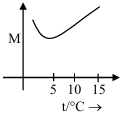
B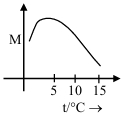
C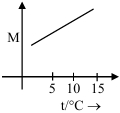
D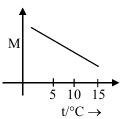
Solution
(A) The density of water is maximum at $4^{\circ}C$,which means the volume of water is minimum at $4^{\circ}C$.
As the temperature increases from $1^{\circ}C$ to $4^{\circ}C$,the volume of water decreases,causing the molarity $(M = n/V)$ to increase.
As the temperature increases from $4^{\circ}C$ to $25^{\circ}C$,the volume of water increases due to thermal expansion,causing the molarity to decrease.
Therefore,the molarity first increases and then decreases,which is represented by plot $A$.
As the temperature increases from $1^{\circ}C$ to $4^{\circ}C$,the volume of water decreases,causing the molarity $(M = n/V)$ to increase.
As the temperature increases from $4^{\circ}C$ to $25^{\circ}C$,the volume of water increases due to thermal expansion,causing the molarity to decrease.
Therefore,the molarity first increases and then decreases,which is represented by plot $A$.
0 likes
View Solution369
DifficultMCQ
Which of the following properties will change when the system containing solution $1$ becomes solution $2$?
(Solution $1$) (Solution $2$)
| $10 \ mol$ of solute $x + 10 \ L$ of water | $1 \ L$ of solution $1 + 1 \ mol$ of solute $x + 1 \ L$ of water |
(Solution $1$) (Solution $2$)
A
Molar heat capacity
B
Density
C
Concentration
D
Gibbs free energy
Solution
(D) Solution $1$ consists of $10 \ mol$ of solute $x$ in $10 \ L$ of water,resulting in a concentration of $1 \ mol/L$.
Solution $2$ is prepared by taking $1 \ L$ of solution $1$ (which contains $1 \ mol$ of $x$ and $1 \ L$ of water) and adding $1 \ mol$ of solute $x$ and $1 \ L$ of water.
Total amount in solution $2$ is $2 \ mol$ of $x$ in $2 \ L$ of water,so the concentration remains $1 \ mol/L$.
Since the concentration and composition are identical,intensive properties like density and molar heat capacity remain unchanged.
Gibbs free energy $(G)$ is an extensive property,which depends on the total amount of matter in the system.
Since the total amount of substance in solution $1$ is greater than in solution $2$,the Gibbs free energy will change.
Solution $2$ is prepared by taking $1 \ L$ of solution $1$ (which contains $1 \ mol$ of $x$ and $1 \ L$ of water) and adding $1 \ mol$ of solute $x$ and $1 \ L$ of water.
Total amount in solution $2$ is $2 \ mol$ of $x$ in $2 \ L$ of water,so the concentration remains $1 \ mol/L$.
Since the concentration and composition are identical,intensive properties like density and molar heat capacity remain unchanged.
Gibbs free energy $(G)$ is an extensive property,which depends on the total amount of matter in the system.
Since the total amount of substance in solution $1$ is greater than in solution $2$,the Gibbs free energy will change.
0 likes
View Solution370
DifficultMCQ
Sea water,which can be considered as a $6 \ M$ solution of $NaCl$,has a density of $2 \ g \ mL^{-1}$. The concentration of dissolved oxygen $(O_2)$ in sea water is $5.8 \ ppm$. Then the concentration of dissolved oxygen $(O_2)$ in sea water is $x \times 10^{-4} \ m$. $x = ............$ $(Nearest \ integer)$
Given: Molar mass of $NaCl$ is $58.5 \ g \ mol^{-1}$. Molar mass of $O_2$ is $32 \ g \ mol^{-1}$.
Given: Molar mass of $NaCl$ is $58.5 \ g \ mol^{-1}$. Molar mass of $O_2$ is $32 \ g \ mol^{-1}$.
A
$2$
B
$4$
C
$6$
D
$8$
Solution
(A) Sea water is $6 \ M$ in $NaCl$,so $1000 \ mL$ of sea water contains $6 \ mol$ of $NaCl$.
$\text{Mass of solution} = \text{Volume} \times \text{density} = 1000 \times 2 = 2000 \ g$.
$\text{ppm} = \frac{\text{mass of } O_2}{\text{mass of solution}} \times 10^6$.
$5.8 = \frac{\text{mass of } O_2}{2000} \times 10^6$ $\Rightarrow \text{mass of } O_2 = 5.8 \times 2 \times 10^{-3} = 1.16 \times 10^{-2} \ g$.
$\text{Molality of } O_2 = \frac{\text{moles of } O_2}{\text{mass of solvent in } kg}$.
$\text{Mass of solvent} = \text{Mass of solution} - \text{Mass of } NaCl = 2000 - (6 \times 58.5) = 2000 - 351 = 1649 \ g = 1.649 \ kg$.
$\text{Moles of } O_2 = \frac{1.16 \times 10^{-2}}{32} = 0.03625 \times 10^{-2} = 3.625 \times 10^{-4} \ mol$.
$\text{Molality} = \frac{3.625 \times 10^{-4}}{1.649} \approx 2.197 \times 10^{-4} \ m$.
Thus,$x \approx 2$.
$\text{Mass of solution} = \text{Volume} \times \text{density} = 1000 \times 2 = 2000 \ g$.
$\text{ppm} = \frac{\text{mass of } O_2}{\text{mass of solution}} \times 10^6$.
$5.8 = \frac{\text{mass of } O_2}{2000} \times 10^6$ $\Rightarrow \text{mass of } O_2 = 5.8 \times 2 \times 10^{-3} = 1.16 \times 10^{-2} \ g$.
$\text{Molality of } O_2 = \frac{\text{moles of } O_2}{\text{mass of solvent in } kg}$.
$\text{Mass of solvent} = \text{Mass of solution} - \text{Mass of } NaCl = 2000 - (6 \times 58.5) = 2000 - 351 = 1649 \ g = 1.649 \ kg$.
$\text{Moles of } O_2 = \frac{1.16 \times 10^{-2}}{32} = 0.03625 \times 10^{-2} = 3.625 \times 10^{-4} \ mol$.
$\text{Molality} = \frac{3.625 \times 10^{-4}}{1.649} \approx 2.197 \times 10^{-4} \ m$.
Thus,$x \approx 2$.
0 likes
View Solution371
DifficultMCQ
Match List-$I$ with List-$II$.
Choose the correct answer from the options given below:
| List-$I$ (Example) | List-$II$ (Type of Solution) |
|---|---|
| $A$. Humidity | $I$. Solid in solid |
| $B$. Alloys | $II$. Liquid in gas |
| $C$. Amalgams | $III$. Solid in gas |
| $D$. Smoke | $IV$. Liquid in solid |
Choose the correct answer from the options given below:
A
$A-II, B-I, C-IV, D-III$
B
$A-II, B-I, C-III, D-IV$
C
$A-III, B-I, C-IV, D-II$
D
$A-III, B-II, C-I, D-IV$
Solution
(A) . Humidity is a solution of water vapor (liquid) in air (gas),which is $Liquid \text{ in } gas$.
$B$. Alloys are homogeneous mixtures of metals,which are $Solid \text{ in } solid$.
$C$. Amalgams are solutions of mercury (liquid) in another metal (solid),which is $Liquid \text{ in } solid$.
$D$. Smoke consists of solid particles dispersed in air (gas),which is $Solid \text{ in } gas$.
Therefore,the correct matching is $A-II, B-I, C-IV, D-III$.
$B$. Alloys are homogeneous mixtures of metals,which are $Solid \text{ in } solid$.
$C$. Amalgams are solutions of mercury (liquid) in another metal (solid),which is $Liquid \text{ in } solid$.
$D$. Smoke consists of solid particles dispersed in air (gas),which is $Solid \text{ in } gas$.
Therefore,the correct matching is $A-II, B-I, C-IV, D-III$.
0 likes
View Solution372
EasyMCQ
Which of the following concentration terms is dependent on temperature?
A
Molarity
B
Molality
C
Mole fraction
D
Mass percentage
Solution
(A) The volume of a solution changes with temperature.
Concentration terms that involve volume in their definition,such as Molarity $(M = \frac{\text{moles of solute}}{\text{volume of solution in L}})$,are dependent on temperature.
In contrast,Molality,Mole fraction,and Mass percentage are based on mass,which does not change with temperature.
Concentration terms that involve volume in their definition,such as Molarity $(M = \frac{\text{moles of solute}}{\text{volume of solution in L}})$,are dependent on temperature.
In contrast,Molality,Mole fraction,and Mass percentage are based on mass,which does not change with temperature.
0 likes
View Solution373
MediumMCQ
Calculate the mass of urea $[NH_2CONH_2]$ required in making $2.5 \ kg$ of $0.25 \ m$ aqueous solution. (in $g$)
A
$37.38$
B
$15.94$
C
$36.94$
D
$18.47$
Solution
(C) $0.25 \ m$ (molal) solution means $0.25 \ \text{moles}$ of urea are dissolved in $1000 \ g$ $(1 \ kg)$ of solvent.
The molar mass of urea $[NH_2CONH_2]$ is $14 + 2 + 12 + 16 + 14 + 2 = 60 \ g/mol$.
Mass of urea in $1000 \ g$ of solvent $= 0.25 \ \text{mol} \times 60 \ g/mol = 15 \ g$.
Total mass of the solution $= \text{Mass of solute} + \text{Mass of solvent} = 15 \ g + 1000 \ g = 1015 \ g = 1.015 \ kg$.
For $1.015 \ kg$ of solution,we need $15 \ g$ of urea.
Therefore,for $2.5 \ kg$ of solution,the mass of urea required $= (15 \ g / 1.015 \ kg) \times 2.5 \ kg \approx 36.94 \ g$.
The molar mass of urea $[NH_2CONH_2]$ is $14 + 2 + 12 + 16 + 14 + 2 = 60 \ g/mol$.
Mass of urea in $1000 \ g$ of solvent $= 0.25 \ \text{mol} \times 60 \ g/mol = 15 \ g$.
Total mass of the solution $= \text{Mass of solute} + \text{Mass of solvent} = 15 \ g + 1000 \ g = 1015 \ g = 1.015 \ kg$.
For $1.015 \ kg$ of solution,we need $15 \ g$ of urea.
Therefore,for $2.5 \ kg$ of solution,the mass of urea required $= (15 \ g / 1.015 \ kg) \times 2.5 \ kg \approx 36.94 \ g$.
0 likes
View Solution374
MediumMCQ
Calculate the mole fraction of $C_2H_6O_2$ (ethylene glycol) in an aqueous solution containing $28 \%$ by mass of $C_2H_6O_2$.
A
$0.201$
B
$0.101$
C
$0.450$
D
$0.84$
Solution
(B) Given: Mass percentage of $C_2H_6O_2 = 28 \%$.
This means $28 \ g$ of $C_2H_6O_2$ is present in $100 \ g$ of the solution.
Mass of water = $100 \ g - 28 \ g = 72 \ g$.
Molar mass of $C_2H_6O_2 = (2 \times 12) + (6 \times 1) + (2 \times 16) = 62 \ g/mol$.
Molar mass of $H_2O = 18 \ g/mol$.
Moles of $C_2H_6O_2 (n_1) = \frac{28}{62} \approx 0.4516 \ mol$.
Moles of $H_2O (n_2) = \frac{72}{18} = 4.000 \ mol$.
Mole fraction of $C_2H_6O_2 (x_1) = \frac{n_1}{n_1 + n_2} = \frac{0.4516}{0.4516 + 4.000} = \frac{0.4516}{4.4516} \approx 0.1014$.
Therefore,the mole fraction is approximately $0.101$.
This means $28 \ g$ of $C_2H_6O_2$ is present in $100 \ g$ of the solution.
Mass of water = $100 \ g - 28 \ g = 72 \ g$.
Molar mass of $C_2H_6O_2 = (2 \times 12) + (6 \times 1) + (2 \times 16) = 62 \ g/mol$.
Molar mass of $H_2O = 18 \ g/mol$.
Moles of $C_2H_6O_2 (n_1) = \frac{28}{62} \approx 0.4516 \ mol$.
Moles of $H_2O (n_2) = \frac{72}{18} = 4.000 \ mol$.
Mole fraction of $C_2H_6O_2 (x_1) = \frac{n_1}{n_1 + n_2} = \frac{0.4516}{0.4516 + 4.000} = \frac{0.4516}{4.4516} \approx 0.1014$.
Therefore,the mole fraction is approximately $0.101$.
0 likes
View Solution375
EasyMCQ
$V_1 \ \text{c.c.}$ of a solution having molarity $M_1$ is diluted to have molarity $M_2$. The volume of water required to be added will be $:-$
A
$(\frac{M_1-M_2}{M_2}) V_1$
B
$(\frac{M_1-M_2}{M_1}) V_1$
C
$(\frac{M_1}{M_2-M_1}) V_1$
D
$(\frac{M_2}{M_2-M_1}) V_1$
Solution
(A) According to the dilution formula,$M_1 V_1 = M_2 V_2$,where $V_2$ is the final volume of the solution.
$V_2 = \frac{M_1 V_1}{M_2}$.
The volume of water to be added is $V_{\text{added}} = V_2 - V_1$.
Substituting $V_2$,we get $V_{\text{added}} = \frac{M_1 V_1}{M_2} - V_1$.
$V_{\text{added}} = V_1 (\frac{M_1}{M_2} - 1) = V_1 (\frac{M_1 - M_2}{M_2})$.
$V_2 = \frac{M_1 V_1}{M_2}$.
The volume of water to be added is $V_{\text{added}} = V_2 - V_1$.
Substituting $V_2$,we get $V_{\text{added}} = \frac{M_1 V_1}{M_2} - V_1$.
$V_{\text{added}} = V_1 (\frac{M_1}{M_2} - 1) = V_1 (\frac{M_1 - M_2}{M_2})$.
0 likes
View Solution376
MediumMCQ
What is the molarity of acid in vinegar containing $4.0 \%$ acetic acid by $(w/w)$ and having a density of $1.02 \ g/mL$ (in $M$)?
A
$0.50$
B
$0.68$
C
$0.75$
D
$1.36$
Solution
(B) $1$. The molar mass of acetic acid $(CH_3COOH)$ is calculated as: $(2 \times 12) + (4 \times 1) + (2 \times 16) = 60 \ g/mol$.
$2$. Given $4.0 \%$ $(w/w)$ means $4.0 \ g$ of acetic acid in $100 \ g$ of vinegar solution.
$3$. The volume of $100 \ g$ of solution is calculated using density: $V = \frac{mass}{density} = \frac{100 \ g}{1.02 \ g/mL} \approx 98.04 \ mL = 0.09804 \ L$.
$4$. Moles of acetic acid = $\frac{mass}{molar \ mass} = \frac{4.0 \ g}{60 \ g/mol} \approx 0.06667 \ mol$.
$5$. Molarity $(M) = \frac{moles \ of \ solute}{volume \ of \ solution \ in \ L} = \frac{0.06667 \ mol}{0.09804 \ L} \approx 0.68 \ M$.
$2$. Given $4.0 \%$ $(w/w)$ means $4.0 \ g$ of acetic acid in $100 \ g$ of vinegar solution.
$3$. The volume of $100 \ g$ of solution is calculated using density: $V = \frac{mass}{density} = \frac{100 \ g}{1.02 \ g/mL} \approx 98.04 \ mL = 0.09804 \ L$.
$4$. Moles of acetic acid = $\frac{mass}{molar \ mass} = \frac{4.0 \ g}{60 \ g/mol} \approx 0.06667 \ mol$.
$5$. Molarity $(M) = \frac{moles \ of \ solute}{volume \ of \ solution \ in \ L} = \frac{0.06667 \ mol}{0.09804 \ L} \approx 0.68 \ M$.
0 likes
View Solution377
EasyMCQ
Calculate the mole fraction of solute in the solution if the solution is prepared by dissolving $394 \ g$ of a nonvolatile solute in $622 \ g$ of water at $30^{\circ}C$ (Molar mass of solute $= 342 \ g \ mol^{-1}$).
A
$0.032$
B
$0.022$
C
$0.967$
D
$0.044$
Solution
(A) Step $1$: Calculate the moles of solute $(n_{solute})$.
$n_{solute} = \frac{\text{mass}}{\text{molar mass}} = \frac{394 \ g}{342 \ g \ mol^{-1}} \approx 1.152 \ mol$.
Step $2$: Calculate the moles of solvent $(n_{solvent})$.
$n_{solvent} = \frac{622 \ g}{18 \ g \ mol^{-1}} \approx 34.556 \ mol$.
Step $3$: Calculate the mole fraction of solute $(X_{solute})$.
$X_{solute} = \frac{n_{solute}}{n_{solute} + n_{solvent}} = \frac{1.152}{1.152 + 34.556} = \frac{1.152}{35.708} \approx 0.032$.
$n_{solute} = \frac{\text{mass}}{\text{molar mass}} = \frac{394 \ g}{342 \ g \ mol^{-1}} \approx 1.152 \ mol$.
Step $2$: Calculate the moles of solvent $(n_{solvent})$.
$n_{solvent} = \frac{622 \ g}{18 \ g \ mol^{-1}} \approx 34.556 \ mol$.
Step $3$: Calculate the mole fraction of solute $(X_{solute})$.
$X_{solute} = \frac{n_{solute}}{n_{solute} + n_{solvent}} = \frac{1.152}{1.152 + 34.556} = \frac{1.152}{35.708} \approx 0.032$.
0 likes
View Solution378
MediumMCQ
What type of solution is an alloy?
A
Solid in liquid
B
Gas in liquid
C
Solid in gas
D
Solid in solid
Solution
(D) An alloy is a homogeneous mixture of two or more metals,or a metal and a non-metal. Since both the solute and the solvent are in the solid state,an alloy is classified as a $Solid$ in $Solid$ solution.
0 likes
View Solution379
EasyMCQ
Which of the following concentration terms depends on temperature?
A
Molality
B
Molarity
C
Mole fraction
D
Percent by mass
Solution
(B) Concentration terms that involve volume are temperature-dependent because volume changes with temperature.
$Molarity$ $(M)$ is defined as the number of moles of solute per liter of solution $(mol/L)$.
Since volume is a component of the denominator,$Molarity$ changes with temperature.
In contrast,$Molality$,$Mole fraction$,and $Percent by mass$ are based on mass,which is independent of temperature.
$Molarity$ $(M)$ is defined as the number of moles of solute per liter of solution $(mol/L)$.
Since volume is a component of the denominator,$Molarity$ changes with temperature.
In contrast,$Molality$,$Mole fraction$,and $Percent by mass$ are based on mass,which is independent of temperature.
0 likes
View Solution380
EasyMCQ
What type of solution is ethyl alcohol in water?
A
Liquid in solid
B
Solid in liquid
C
Liquid in liquid
D
Gas in liquid
Solution
(C) solution of ethyl alcohol in water is formed by dissolving a liquid solute (ethyl alcohol) in a liquid solvent (water). Therefore,it is classified as a $Liquid$ in $Liquid$ type of solution.
0 likes
View Solution381
EasyMCQ
What type of solution is obtained from an amalgam of mercury with sodium?
A
Liquid in solid
B
Solid in gas
C
Solid in solid
D
Solid in liquid
Solution
(A) In an amalgam of mercury with sodium,$Hg$ (mercury) is the solute and $Na$ (sodium) is the solvent.
Since mercury is a liquid and sodium is a solid,this forms a solution of a liquid in a solid.
Therefore,the correct classification is liquid in solid.
Since mercury is a liquid and sodium is a solid,this forms a solution of a liquid in a solid.
Therefore,the correct classification is liquid in solid.
0 likes
View Solution382
MediumMCQ
Which of the following statements is $NOT$ correct about a solution?
A
The three states of matter,solid,liquid,and gas,may play the role of either solute or solvent.
B
The component of a solution that constitutes the smaller part is called the solute.
C
When water is the solvent,the process of solvation is known as hydration.
D
$A$ true solution is a heterogeneous mixture of two or more substances with a fixed composition.
Solution
(D) true solution is a homogeneous mixture of two or more substances.
It is not a heterogeneous mixture.
In a true solution,the particle size of the solute is less than $10^{-9} \ m$ or $1 \ nm$.
Since the components are uniformly distributed at the molecular level,it exhibits consistent properties throughout.
Therefore,the statement in option $D$ is incorrect.
It is not a heterogeneous mixture.
In a true solution,the particle size of the solute is less than $10^{-9} \ m$ or $1 \ nm$.
Since the components are uniformly distributed at the molecular level,it exhibits consistent properties throughout.
Therefore,the statement in option $D$ is incorrect.
0 likes
View Solution383
EasyMCQ
If $2.0 \ g$ of $NaOH$ is dissolved in $500 \ cm^{3}$ of water, what is the molarity of the solution?
A
$0.25 \ mol \ dm^{-3}$
B
$0.1 \ mol \ dm^{-3}$
C
$0.4 \ mol \ dm^{-3}$
D
$0.50 \ mol \ dm^{-3}$
Solution
(B) Molar mass of $NaOH = 23 + 16 + 1 = 40 \ g \ mol^{-1}$.
Number of moles of $NaOH = \frac{\text{mass}}{\text{molar mass}} = \frac{2.0 \ g}{40 \ g \ mol^{-1}} = 0.05 \ mol$.
Volume of solution $= 500 \ cm^{3} = 0.5 \ L$.
Molarity $(M) = \frac{\text{moles of solute}}{\text{volume of solution in } L} = \frac{0.05 \ mol}{0.5 \ L} = 0.1 \ mol \ dm^{-3}$.
Number of moles of $NaOH = \frac{\text{mass}}{\text{molar mass}} = \frac{2.0 \ g}{40 \ g \ mol^{-1}} = 0.05 \ mol$.
Volume of solution $= 500 \ cm^{3} = 0.5 \ L$.
Molarity $(M) = \frac{\text{moles of solute}}{\text{volume of solution in } L} = \frac{0.05 \ mol}{0.5 \ L} = 0.1 \ mol \ dm^{-3}$.
0 likes
View Solution384
MediumMCQ
$60 \ g$ of $CH_3COOH$ is dissolved in $1 \ dm^3$ of solvent. What is the molality of the solution (in $m$)? (Density $= 1.25 \ g / cm^3$)
A
$0.8$
B
$0.4$
C
$0.2$
D
$0.6$
Solution
(A) Given: Mass of solute $(CH_3COOH)$ $= 60 \ g$,Volume of solution $= 1 \ dm^3 = 1000 \ cm^3$,Density of solution $= 1.25 \ g / cm^3$.
Molar mass of $CH_3COOH = 12 + 3 + 12 + 16 + 16 + 1 = 60 \ g / mol$.
Moles of solute $= \frac{60 \ g}{60 \ g / mol} = 1 \ mol$.
Mass of solution $= \text{Volume} \times \text{Density} = 1000 \ cm^3 \times 1.25 \ g / cm^3 = 1250 \ g$.
Mass of solvent $= \text{Mass of solution} - \text{Mass of solute} = 1250 \ g - 60 \ g = 1190 \ g = 1.19 \ kg$.
Molality $(m) = \frac{\text{Moles of solute}}{\text{Mass of solvent in kg}} = \frac{1 \ mol}{1.19 \ kg} \approx 0.84 \ m$.
Note: Assuming the $1 \ dm^3$ refers to the volume of the solution,the calculated molality is approximately $0.84 \ m$. Given the options,$0.8 \ m$ is the closest approximation.
Molar mass of $CH_3COOH = 12 + 3 + 12 + 16 + 16 + 1 = 60 \ g / mol$.
Moles of solute $= \frac{60 \ g}{60 \ g / mol} = 1 \ mol$.
Mass of solution $= \text{Volume} \times \text{Density} = 1000 \ cm^3 \times 1.25 \ g / cm^3 = 1250 \ g$.
Mass of solvent $= \text{Mass of solution} - \text{Mass of solute} = 1250 \ g - 60 \ g = 1190 \ g = 1.19 \ kg$.
Molality $(m) = \frac{\text{Moles of solute}}{\text{Mass of solvent in kg}} = \frac{1 \ mol}{1.19 \ kg} \approx 0.84 \ m$.
Note: Assuming the $1 \ dm^3$ refers to the volume of the solution,the calculated molality is approximately $0.84 \ m$. Given the options,$0.8 \ m$ is the closest approximation.
0 likes
View Solution385
MediumMCQ
The molarity of urea (molar mass $60 \ g \ mol^{-1}$) solution obtained by dissolving $15 \ g$ of urea in $500 \ cm^3$ of water is
A
$0.5 \ mol \ dm^{-3}$
B
$0.25 \ mol \ dm^{-3}$
C
$0.125 \ mol \ dm^{-3}$
D
$0.0005 \ mol \ dm^{-3}$
Solution
(A) Given: Mass of urea $= 15 \ g$,Molar mass of urea $= 60 \ g \ mol^{-1}$,Volume of solution $= 500 \ cm^3 = 0.5 \ L$.
Moles of urea $= \frac{\text{mass}}{\text{molar mass}} = \frac{15 \ g}{60 \ g \ mol^{-1}} = 0.25 \ mol$.
Molarity $(M) = \frac{\text{moles of solute}}{\text{volume of solution in } L} = \frac{0.25 \ mol}{0.5 \ L} = 0.5 \ mol \ dm^{-3}$.
Moles of urea $= \frac{\text{mass}}{\text{molar mass}} = \frac{15 \ g}{60 \ g \ mol^{-1}} = 0.25 \ mol$.
Molarity $(M) = \frac{\text{moles of solute}}{\text{volume of solution in } L} = \frac{0.25 \ mol}{0.5 \ L} = 0.5 \ mol \ dm^{-3}$.
0 likes
View Solution386
DifficultMCQ
$5.0 \ g$ of sodium hydroxide (Molar mass $40 \ g \ mol^{-1}$) is dissolved in a small quantity of water and the solution is diluted up to $100 \ mL$. What is the molarity of the resulting solution?
A
$0.1 \ mol \ dm^{-3}$
B
$1.0 \ mol \ dm^{-3}$
C
$0.125 \ mol \ dm^{-3}$
D
$1.25 \ mol \ dm^{-3}$
Solution
(D) Molarity $(M) = \frac{\text{Number of moles of solute}}{\text{Volume of solution in Litres}}$
Number of moles of $NaOH = \frac{\text{Mass}}{\text{Molar mass}} = \frac{5.0 \ g}{40 \ g \ mol^{-1}} = 0.125 \ mol$
Volume of solution $= 100 \ mL = 0.1 \ L$
Molarity $= \frac{0.125 \ mol}{0.1 \ L} = 1.25 \ mol \ L^{-1}$ (or $1.25 \ mol \ dm^{-3}$)
Therefore,the correct option is $D$.
Number of moles of $NaOH = \frac{\text{Mass}}{\text{Molar mass}} = \frac{5.0 \ g}{40 \ g \ mol^{-1}} = 0.125 \ mol$
Volume of solution $= 100 \ mL = 0.1 \ L$
Molarity $= \frac{0.125 \ mol}{0.1 \ L} = 1.25 \ mol \ L^{-1}$ (or $1.25 \ mol \ dm^{-3}$)
Therefore,the correct option is $D$.
0 likes
View Solution387
MediumMCQ
The molar concentration of chloride ions in the resulting solution of $300 \ mL$ of $3.0 \ M$ $NaCl$ and $200 \ mL$ of $4.0 \ M$ $BaCl_{2}$ will be (in $M$)
A
$1.7$
B
$1.8$
C
$5.0$
D
$3.4$
Solution
(C) For $NaCl$: $n(Cl^-) = M \times V = 3.0 \ M \times 0.300 \ L = 0.9 \ mol$.
For $BaCl_{2}$: $BaCl_{2} \rightarrow Ba^{2+} + 2Cl^-$.
$n(Cl^-) = 2 \times M \times V = 2 \times 4.0 \ M \times 0.200 \ L = 1.6 \ mol$.
Total moles of $Cl^- = 0.9 \ mol + 1.6 \ mol = 2.5 \ mol$.
Total volume of solution = $300 \ mL + 200 \ mL = 500 \ mL = 0.5 \ L$.
Molar concentration of $Cl^- = \frac{\text{Total moles}}{\text{Total volume}} = \frac{2.5 \ mol}{0.5 \ L} = 5.0 \ M$.
For $BaCl_{2}$: $BaCl_{2} \rightarrow Ba^{2+} + 2Cl^-$.
$n(Cl^-) = 2 \times M \times V = 2 \times 4.0 \ M \times 0.200 \ L = 1.6 \ mol$.
Total moles of $Cl^- = 0.9 \ mol + 1.6 \ mol = 2.5 \ mol$.
Total volume of solution = $300 \ mL + 200 \ mL = 500 \ mL = 0.5 \ L$.
Molar concentration of $Cl^- = \frac{\text{Total moles}}{\text{Total volume}} = \frac{2.5 \ mol}{0.5 \ L} = 5.0 \ M$.
0 likes
View Solution388
MediumMCQ
An aqueous solution of urea containing $18 \ g$ of urea in $1500 \ cm^{3}$ of the solution has a density of $1.052 \ g/cm^{3}$. If the molecular weight of urea is $60$,the molality of the solution is: (in $m$)
A
$0.200$
B
$0.192$
C
$0.100$
D
$1.200$
Solution
(B) Given: Volume of solution $= 1500 \ cm^{3}$,Density of solution $= 1.052 \ g/cm^{3}$,Mass of urea (solute) $= 18 \ g$,Molar mass of urea $= 60 \ g/mol$.
Mass of solution $= \text{Volume} \times \text{Density} = 1500 \ cm^{3} \times 1.052 \ g/cm^{3} = 1578 \ g$.
Mass of solvent (water) $= \text{Mass of solution} - \text{Mass of solute} = 1578 \ g - 18 \ g = 1560 \ g = 1.560 \ kg$.
Molality $(m) = \frac{\text{moles of solute}}{\text{mass of solvent in } kg} = \frac{18 / 60}{1.560} = \frac{0.3}{1.560} \approx 0.192 \ m$.
Mass of solution $= \text{Volume} \times \text{Density} = 1500 \ cm^{3} \times 1.052 \ g/cm^{3} = 1578 \ g$.
Mass of solvent (water) $= \text{Mass of solution} - \text{Mass of solute} = 1578 \ g - 18 \ g = 1560 \ g = 1.560 \ kg$.
Molality $(m) = \frac{\text{moles of solute}}{\text{mass of solvent in } kg} = \frac{18 / 60}{1.560} = \frac{0.3}{1.560} \approx 0.192 \ m$.
0 likes
View Solution389
EasyMCQ
$450 \ mg$ of glucose is dissolved in $100 \ g$ of solvent. What is the molality of the solution (in $m$)?
A
$0.0025$
B
$0.025$
C
$0.25$
D
$2.5$
Solution
(B) Molality is defined as the number of moles of solute per kilogram of solvent.
Formula: $\text{Molality} = \frac{\text{mass of solute (g)}}{\text{molar mass of solute (g/mol)} \times \text{mass of solvent (kg)}}$
Given: Mass of glucose $= 450 \ mg = 0.45 \ g$,Molar mass of glucose $(C_6H_{12}O_6) = 180 \ g/mol$,Mass of solvent $= 100 \ g = 0.1 \ kg$.
Calculation: $\text{Molality} = \frac{0.45 \ g}{180 \ g/mol \times 0.1 \ kg} = \frac{0.45}{18} = 0.025 \ m$.
Formula: $\text{Molality} = \frac{\text{mass of solute (g)}}{\text{molar mass of solute (g/mol)} \times \text{mass of solvent (kg)}}$
Given: Mass of glucose $= 450 \ mg = 0.45 \ g$,Molar mass of glucose $(C_6H_{12}O_6) = 180 \ g/mol$,Mass of solvent $= 100 \ g = 0.1 \ kg$.
Calculation: $\text{Molality} = \frac{0.45 \ g}{180 \ g/mol \times 0.1 \ kg} = \frac{0.45}{18} = 0.025 \ m$.
0 likes
View Solution390
EasyMCQ
Which of the following concentration factors is affected by a change in temperature?
A
Molarity
B
Molality
C
Mole fraction
D
Weight fraction
Solution
(A) Molarity is defined as the number of moles of solute per unit volume of solution $(M = \frac{n}{V})$.
Since volume $(V)$ of a solution changes with temperature due to thermal expansion or contraction,molarity is temperature-dependent.
In contrast,molality,mole fraction,and weight fraction are based on mass,which remains constant regardless of temperature changes.
Since volume $(V)$ of a solution changes with temperature due to thermal expansion or contraction,molarity is temperature-dependent.
In contrast,molality,mole fraction,and weight fraction are based on mass,which remains constant regardless of temperature changes.
0 likes
View Solution391
EasyMCQ
What is the relation between molality $(m)$ of the solution and molar mass $(M_2)$ of the solute,where $W_2$ is the mass of solute in grams and $W_1$ is the mass of solvent in grams?
A
$m = \frac{M_2 \times W_2}{1000 \times W_1}$
B
$m = \frac{1000 \times W_2}{M_2 \times W_1}$
C
$m = \frac{1000 \times W_1}{M_2 \times W_2}$
D
$m = \frac{M_2 \times W_1}{1000 \times W_2}$
Solution
(B) Molality $(m)$ is defined as the number of moles of solute per kilogram of solvent.
Number of moles of solute $(n_2)$ = $\frac{W_2}{M_2}$.
Mass of solvent in kg = $\frac{W_1}{1000}$.
Therefore,$m = \frac{n_2}{\text{mass of solvent in kg}} = \frac{W_2 / M_2}{W_1 / 1000} = \frac{1000 \times W_2}{M_2 \times W_1}$.
Number of moles of solute $(n_2)$ = $\frac{W_2}{M_2}$.
Mass of solvent in kg = $\frac{W_1}{1000}$.
Therefore,$m = \frac{n_2}{\text{mass of solvent in kg}} = \frac{W_2 / M_2}{W_1 / 1000} = \frac{1000 \times W_2}{M_2 \times W_1}$.
0 likes
View Solution392
EasyMCQ
Which of the following factors affect the molarity of a solution?
A
Nature of solute dissolved
B
Temperature
C
Mass of solvent
D
Molar mass of solvent
Solution
(B) Molarity $(M)$ is defined as the number of moles of solute per liter of solution.
$M = \frac{n_{solute}}{V_{solution(L)}}$
Since the volume of a solution $(V)$ is dependent on temperature (due to thermal expansion or contraction),a change in temperature will change the volume of the solution.
Therefore,molarity is affected by a change in temperature.
$M = \frac{n_{solute}}{V_{solution(L)}}$
Since the volume of a solution $(V)$ is dependent on temperature (due to thermal expansion or contraction),a change in temperature will change the volume of the solution.
Therefore,molarity is affected by a change in temperature.
0 likes
View Solution393
MediumMCQ
$3.42 \times 10^{-2} \ kg$ of sugar (molar mass $342 \ g \ mol^{-1}$) is dissolved in water to produce $234.2 \ g$ of sugar syrup. What is the molality of the sugar syrup?
A
$0.50 \ mol \ kg^{-1}$
B
$0.76 \ mol \ kg^{-1}$
C
$0.67 \ mol \ kg^{-1}$
D
$0.85 \ mol \ kg^{-1}$
Solution
(A) Mass of sugar $= 3.42 \times 10^{-2} \ kg = 34.2 \ g$.
Mass of sugar syrup $= 234.2 \ g$.
Mass of solvent (water) $= 234.2 \ g - 34.2 \ g = 200 \ g = 0.2 \ kg$.
Moles of sugar $= \frac{\text{Mass}}{\text{Molar mass}} = \frac{34.2 \ g}{342 \ g \ mol^{-1}} = 0.1 \ mol$.
Molality $(m) = \frac{\text{Moles of solute}}{\text{Mass of solvent in } kg} = \frac{0.1 \ mol}{0.2 \ kg} = 0.5 \ mol \ kg^{-1}$.
Mass of sugar syrup $= 234.2 \ g$.
Mass of solvent (water) $= 234.2 \ g - 34.2 \ g = 200 \ g = 0.2 \ kg$.
Moles of sugar $= \frac{\text{Mass}}{\text{Molar mass}} = \frac{34.2 \ g}{342 \ g \ mol^{-1}} = 0.1 \ mol$.
Molality $(m) = \frac{\text{Moles of solute}}{\text{Mass of solvent in } kg} = \frac{0.1 \ mol}{0.2 \ kg} = 0.5 \ mol \ kg^{-1}$.
0 likes
View Solution394
EasyMCQ
Mole fraction of solute in its $2$ molal aqueous solution is
A
$0.028775$
B
$0.0347$
C
$0.054$
D
$0.018$
Solution
(B) $2$ molal aqueous solution means $2$ moles of solute are present in $1 \ kg$ $(1000 \ g)$ of water.
Moles of solute $(n_{solute})$ $= 2 \ mol$.
Moles of solvent (water,$n_{solvent}$) $= \frac{1000 \ g}{18 \ g/mol} \approx 55.56 \ mol$.
Total moles $= n_{solute} + n_{solvent} = 2 + 55.56 = 57.56 \ mol$.
Mole fraction of solute $(x_{solute})$ $= \frac{n_{solute}}{n_{solute} + n_{solvent}} = \frac{2}{57.56} \approx 0.0347$.
Moles of solute $(n_{solute})$ $= 2 \ mol$.
Moles of solvent (water,$n_{solvent}$) $= \frac{1000 \ g}{18 \ g/mol} \approx 55.56 \ mol$.
Total moles $= n_{solute} + n_{solvent} = 2 + 55.56 = 57.56 \ mol$.
Mole fraction of solute $(x_{solute})$ $= \frac{n_{solute}}{n_{solute} + n_{solvent}} = \frac{2}{57.56} \approx 0.0347$.
0 likes
View Solution395
EasyMCQ
$A$ solution is $0.25 \%$ by mass. What is the weight of solvent containing $1.25 \ g$ solute (in $g$)?
A
$498.75$
B
$300$
C
$600$
D
$200$
Solution
(A) Mass percentage of solute $= 0.25 \%$. This means $0.25 \ g$ of solute is present in $100 \ g$ of solution.
Mass of solvent $= \text{Mass of solution} - \text{Mass of solute} = 100 \ g - 0.25 \ g = 99.75 \ g$.
Thus,$0.25 \ g$ of solute is present in $99.75 \ g$ of solvent.
For $1.25 \ g$ of solute,the mass of solvent required is $\frac{99.75 \ g \text{ solvent}}{0.25 \ g \text{ solute}} \times 1.25 \ g \text{ solute} = 498.75 \ g$.
Mass of solvent $= \text{Mass of solution} - \text{Mass of solute} = 100 \ g - 0.25 \ g = 99.75 \ g$.
Thus,$0.25 \ g$ of solute is present in $99.75 \ g$ of solvent.
For $1.25 \ g$ of solute,the mass of solvent required is $\frac{99.75 \ g \text{ solvent}}{0.25 \ g \text{ solute}} \times 1.25 \ g \text{ solute} = 498.75 \ g$.
0 likes
View Solution396
MediumMCQ
What is the molality of a solution containing $300 \ mg$ of urea (molar mass $60 \ g/mol$) dissolved in $30 \ g$ of water (in $m$)?
A
$0.133$
B
$0.825$
C
$0.498$
D
$0.166$
Solution
(D) Step $1$: Calculate the number of moles of urea. Given mass $= 300 \ mg = 0.3 \ g$. Molar mass $= 60 \ g/mol$. Moles $(n) = \frac{0.3 \ g}{60 \ g/mol} = 0.005 \ mol$.
Step $2$: Calculate the mass of the solvent in $kg$. Mass of water $= 30 \ g = 0.03 \ kg$.
Step $3$: Calculate molality $(m)$. Molality $= \frac{\text{moles of solute}}{\text{mass of solvent in } kg} = \frac{0.005 \ mol}{0.03 \ kg} = 0.166 \ m$.
Step $2$: Calculate the mass of the solvent in $kg$. Mass of water $= 30 \ g = 0.03 \ kg$.
Step $3$: Calculate molality $(m)$. Molality $= \frac{\text{moles of solute}}{\text{mass of solvent in } kg} = \frac{0.005 \ mol}{0.03 \ kg} = 0.166 \ m$.
0 likes
View Solution397
EasyMCQ
What is the molarity of a solution containing $3.2 \ g$ of $NaOH$ (molar mass $40 \ g \ mol^{-1}$) in $250 \ cm^{3}$ of water?
A
$0.512 \ mol \ dm^{-3}$
B
$0.32 \ mol \ dm^{-3}$
C
$0.032 \ mol \ dm^{-3}$
D
$0.02 \ mol \ dm^{-3}$
Solution
(B) Mass of $NaOH$ $(m) = 3.2 \ g$
Volume of solution $(V) = 250 \ cm^{3} = 0.25 \ L$
Molar mass of $NaOH$ $(M) = 40 \ g \ mol^{-1}$
Number of moles $(n) = \frac{m}{M} = \frac{3.2 \ g}{40 \ g \ mol^{-1}} = 0.08 \ mol$
Molarity $(M) = \frac{n}{V(L)} = \frac{0.08 \ mol}{0.25 \ L} = 0.32 \ mol \ dm^{-3}$
Volume of solution $(V) = 250 \ cm^{3} = 0.25 \ L$
Molar mass of $NaOH$ $(M) = 40 \ g \ mol^{-1}$
Number of moles $(n) = \frac{m}{M} = \frac{3.2 \ g}{40 \ g \ mol^{-1}} = 0.08 \ mol$
Molarity $(M) = \frac{n}{V(L)} = \frac{0.08 \ mol}{0.25 \ L} = 0.32 \ mol \ dm^{-3}$
0 likes
View Solution398
MediumMCQ
What is the molarity of a solution containing $0.8 \ g$ of $NaOH$ (molar mass $40 \ g \ mol^{-1}$) in $150 \ cm^{3}$ of water?
A
$0.02 \ mol \ dm^{-3}$
B
$0.12 \ mol \ dm^{-3}$
C
$5.33 \ mol \ dm^{-3}$
D
$0.1333 \ mol \ dm^{-3}$
Solution
(D) Step $1$: Calculate the number of moles of $NaOH$ $(n)$:
$n = \frac{\text{mass}}{\text{molar mass}} = \frac{0.8 \ g}{40 \ g \ mol^{-1}} = 0.02 \ mol$
Step $2$: Convert the volume of the solution from $cm^{3}$ to $L$:
$V = 150 \ cm^{3} = 0.15 \ L$
Step $3$: Calculate the molarity $(M)$:
$M = \frac{n}{V(L)} = \frac{0.02 \ mol}{0.15 \ L} = 0.1333 \ mol \ dm^{-3}$
$n = \frac{\text{mass}}{\text{molar mass}} = \frac{0.8 \ g}{40 \ g \ mol^{-1}} = 0.02 \ mol$
Step $2$: Convert the volume of the solution from $cm^{3}$ to $L$:
$V = 150 \ cm^{3} = 0.15 \ L$
Step $3$: Calculate the molarity $(M)$:
$M = \frac{n}{V(L)} = \frac{0.02 \ mol}{0.15 \ L} = 0.1333 \ mol \ dm^{-3}$
0 likes
View Solution399
MediumMCQ
$34.2 \ g$ of sugar is dissolved in $1.8 \times 10^{2} \ g$ of water to form sugar syrup. Calculate the mole fraction of sugar. (Molar mass of sugar $= 342 \ g/mol$,water $= 18 \ g/mol$)
A
$0.0099$
B
$0.001$
C
$0.1$
D
$0.9$
Solution
(A) Given: Mass of sugar $= 34.2 \ g$,Molar mass of sugar $= 342 \ g/mol$.
Number of moles of sugar $(n_{sugar}) = \frac{34.2}{342} = 0.1 \ mol$.
Mass of water $= 1.8 \times 10^{2} \ g = 180 \ g$,Molar mass of water $= 18 \ g/mol$.
Number of moles of water $(n_{water}) = \frac{180}{18} = 10 \ mol$.
Mole fraction of sugar $(x_{sugar}) = \frac{n_{sugar}}{n_{sugar} + n_{water}} = \frac{0.1}{0.1 + 10} = \frac{0.1}{10.1} \approx 0.0099$.
Number of moles of sugar $(n_{sugar}) = \frac{34.2}{342} = 0.1 \ mol$.
Mass of water $= 1.8 \times 10^{2} \ g = 180 \ g$,Molar mass of water $= 18 \ g/mol$.
Number of moles of water $(n_{water}) = \frac{180}{18} = 10 \ mol$.
Mole fraction of sugar $(x_{sugar}) = \frac{n_{sugar}}{n_{sugar} + n_{water}} = \frac{0.1}{0.1 + 10} = \frac{0.1}{10.1} \approx 0.0099$.
0 likes
View Solution400
EasyMCQ
Molarity is:
A
The number of moles of solute present in $1 \ dm^3$ volume of solution
B
The number of moles of solute dissolved in $1 \ kg$ of solvent
C
The number of moles of solute dissolved in $1 \ kg$ of solution
D
The number of moles of solute dissolved in $100 \ dm^3$ volume of solution
Solution
(A) Molarity $(M)$ is defined as the number of moles of solute present in $1 \ dm^3$ (or $1 \ L$) of solution.
$Molarity (M) = \frac{\text{Number of moles of solute}}{\text{Volume of solution in } dm^3}$
$Molarity (M) = \frac{\text{Number of moles of solute}}{\text{Volume of solution in } dm^3}$
0 likes
View SolutionSolutions — Method of expressing concentration of solution · Frequently Asked Questions
1Are these Solutions questions useful for JEE and NEET?
Yes. All questions in this section are mapped to JEE Main and NEET exam patterns. Previous year questions from JEE Main, NEET, GUJCET and state-level exams are included with full solutions.
2Can I switch to Hindi or Gujarati for these questions?
Yes. Use the language tabs in the hero section or the sidebar to view the same questions and solutions in English, Hindi or Gujarati.
3How do I generate a question paper from this subtopic?
Use the Vedclass Exam Paper Generator — select the chapter and subtopic, set difficulty, and generate Sets A, B, C, D automatically. First 3 chapters of every subject are free.
Vedclass Products
For Students
Vedclass Test Series
Mock tests in real JEE/NEET style with performance analysis. 5-day free trial.
Start Free TrialFor Teachers
Exam Paper Generator
Generate Set A/B/C/D papers from this chapter in 2 minutes. 3 chapters free.
Try FreeFor Institutes
Online Exam Module
Live online exams with unlimited students, 360° analytics & white-label branding.
See DemoFor Teachers & Institutes
Generate a Solutions Exam Paper in 2 Minutes
Select subtopic & difficulty — Sets A, B, C, D auto-generated with No Repeat logic.
First 3 chapters of every subject are free — no payment required.