
A English
Type of solid and Their properties Questions in English
Class 12 Chemistry · Solid State · Type of solid and Their properties
281+
Questions
English
Language
100%
With Solutions
Showing 50 of 281 questions in English
201
Easy
What is the main use of $Quartz$?
Solution
(N/A) $Quartz$ is extensively used as a piezoelectric material. It has made it possible to develop extremely accurate clocks,modern radio and television broadcasting,and mobile radio communications.
0 likes
View Solution202
EasyMCQ
What happens when glass is heated?
A
It turns into a gas.
B
It melts and its sharp edges become rounded.
C
It remains unchanged.
D
It turns into a crystalline solid.
Solution
(B) When glass is heated,it softens and melts into a liquid state. Due to surface tension,the liquid glass tends to minimize its surface area,causing sharp edges to become rounded. This process of heating glass to round off sharp edges is known as $Fire \ Polishing$ of glass.
0 likes
View Solution203
Easy
How is it proven that glass is a supercooled liquid?
Solution
(N/A) If we measure the thickness of glass panes in old buildings,they are found to be slightly thicker at the bottom than at the top.
This observation proves that glass is a supercooled liquid,which flows very slowly from top to bottom over a long period of time.
This observation proves that glass is a supercooled liquid,which flows very slowly from top to bottom over a long period of time.
0 likes
View Solution204
Medium
Write a note on the classification of materials based on their conductivity.
Solution
(A) Materials are classified into conductors,insulators,and semiconductors based on the magnitude of their electrical conductivity.
$1$. Conductors: These materials have very high conductivity. Examples include metals and their alloys (e.g.,$Na, Cu, Ag, Au, Fe$),certain non-metals like carbon black and graphite,and some electronically conducting organic polymers.
$2$. Insulators: These materials have very low conductivity. Examples include glass,ceramics,and polymers like Teflon.
$3$. Semiconductors: These materials have conductivity values between those of conductors and insulators. Examples include silicon,doped silicon,gallium arsenide,and certain oxides like $CuO$. These are important electronic materials.
$4$. Superconductors: These are materials that exhibit zero resistivity or infinite conductivity. While earlier only metals and alloys at very low temperatures ($0 \ K$ to $15 \ K$) were known to be superconductors,many ceramic materials and mixed oxides are now known to exhibit superconductivity at temperatures as high as $150 \ K$.
$1$. Conductors: These materials have very high conductivity. Examples include metals and their alloys (e.g.,$Na, Cu, Ag, Au, Fe$),certain non-metals like carbon black and graphite,and some electronically conducting organic polymers.
$2$. Insulators: These materials have very low conductivity. Examples include glass,ceramics,and polymers like Teflon.
$3$. Semiconductors: These materials have conductivity values between those of conductors and insulators. Examples include silicon,doped silicon,gallium arsenide,and certain oxides like $CuO$. These are important electronic materials.
$4$. Superconductors: These are materials that exhibit zero resistivity or infinite conductivity. While earlier only metals and alloys at very low temperatures ($0 \ K$ to $15 \ K$) were known to be superconductors,many ceramic materials and mixed oxides are now known to exhibit superconductivity at temperatures as high as $150 \ K$.
0 likes
View Solution205
Medium
Classify the following materials into superconductors,conductors,semiconductors,and insulators: $Cu$,$Al$,$Si$,$Ge$,glass,Teflon,$Au$,$Pt$,$CuO$ (at low temperature),graphite,carbon black,and alloys at low temperature.
Solution
(N/A) The classification is as follows:
$1$. Conductors: $Cu$,$Al$,$Au$,$Pt$,graphite,carbon black.
$2$. Semiconductors: $Si$,$Ge$.
$3$. Insulators: glass,Teflon.
$4$. Superconductors: $CuO$ (at low temperature),alloys at low temperature.
$1$. Conductors: $Cu$,$Al$,$Au$,$Pt$,graphite,carbon black.
$2$. Semiconductors: $Si$,$Ge$.
$3$. Insulators: glass,Teflon.
$4$. Superconductors: $CuO$ (at low temperature),alloys at low temperature.
0 likes
View Solution206
EasyMCQ
Which of the following is an example of a network solid?
A
$SO_{2}$ (solid)
B
$I_{2}$
C
Diamond
D
$H_{2}O$ (ice)
Solution
(C) Diamond is a giant molecule in which constituent atoms are held together by covalent bonds. Hence,it is a network solid.
$SO_{2}$ (solid),$H_{2}O$ (ice),and $I_{2}$ are examples of molecular solids.
$SO_{2}$ (solid),$H_{2}O$ (ice),and $I_{2}$ are examples of molecular solids.
0 likes
View Solution207
EasyMCQ
$MnO$ is $:$
A
Ferromagnetic
B
Diamagnetic
C
Ferrimagnetic
D
Antiferromagnetic
Solution
(D) $MnO$ is antiferromagnetic because the magnetic moments of the domains are aligned in a compensatory manner,resulting in a net magnetic moment of zero. This is illustrated by the alternating spin directions shown below:
(Image shows a grid of arrows pointing up and down in an alternating pattern,labeled as Antiferromagnetic).
(Image shows a grid of arrows pointing up and down in an alternating pattern,labeled as Antiferromagnetic).
0 likes
View Solution208
EasyMCQ
$A$ hard substance melts at high temperature and is an insulator in both solid and in molten state. This solid is most likely to be a / an :
A
Ionic solid
B
Molecular solid
C
Metallic solid
D
Covalent solid
Solution
(D) Covalent or network solids possess a giant three-dimensional structure held together by strong covalent bonds,which results in a very high melting point.
Since all electrons are involved in bonding and are not free to move,these substances act as insulators in both their solid and molten states.
Since all electrons are involved in bonding and are not free to move,these substances act as insulators in both their solid and molten states.
0 likes
View Solution209
DifficultMCQ
Match items of List-$I$ with those of List-$II$ :
Choose the most appropriate answer from the options given below:
| List-$I$ (Property) | List-$II$ (Example) |
| $a$. Diamagnetism | $i$. $MnO$ |
| $b$. Ferrimagnetism | $ii$. $O_{2}$ |
| $c$. Paramagnetism | $iii$. $NaCl$ |
| $d$. Antiferromagnetism | $iv$. $Fe_{3}O_{4}$ |
Choose the most appropriate answer from the options given below:
A
$a-ii, b-i, c-iii, d-iv$
B
$a-i, b-iii, c-iv, d-ii$
C
$a-iii, b-iv, c-ii, d-i$
D
$a-iv, b-ii, c-i, d-iii$
Solution
(C) The magnetic properties of substances are classified as follows:
$a$. Diamagnetism: Substances that are weakly repelled by a magnetic field,e.g.,$NaCl$ (all electrons are paired).
$b$. Ferrimagnetism: Substances where magnetic moments are aligned in parallel and anti-parallel directions in unequal numbers,e.g.,$Fe_{3}O_{4}$.
$c$. Paramagnetism: Substances that are weakly attracted by a magnetic field due to the presence of unpaired electrons,e.g.,$O_{2}$.
$d$. Antiferromagnetism: Substances where magnetic moments are aligned in a compensatory way such that the net magnetic moment is zero,e.g.,$MnO$.
Therefore,the correct matching is: $a-iii, b-iv, c-ii, d-i$.
$a$. Diamagnetism: Substances that are weakly repelled by a magnetic field,e.g.,$NaCl$ (all electrons are paired).
$b$. Ferrimagnetism: Substances where magnetic moments are aligned in parallel and anti-parallel directions in unequal numbers,e.g.,$Fe_{3}O_{4}$.
$c$. Paramagnetism: Substances that are weakly attracted by a magnetic field due to the presence of unpaired electrons,e.g.,$O_{2}$.
$d$. Antiferromagnetism: Substances where magnetic moments are aligned in a compensatory way such that the net magnetic moment is zero,e.g.,$MnO$.
Therefore,the correct matching is: $a-iii, b-iv, c-ii, d-i$.
0 likes
View Solution210
DifficultMCQ
Given below are two statements. One is labelled as Assertion $A$ and the other is labelled as Reason $R$.
Assertion $A$: Sharp glass edge becomes smooth on heating it up to its melting point.
Reason $R$: The viscosity of glass decreases on melting.
Choose the most appropriate answer from the options given below.
Assertion $A$: Sharp glass edge becomes smooth on heating it up to its melting point.
Reason $R$: The viscosity of glass decreases on melting.
Choose the most appropriate answer from the options given below.
A
Both $A$ and $R$ are true and $R$ is the correct explanation of $A$.
B
$A$ is true but $R$ is false.
C
$A$ is false but $R$ is true.
D
Both $A$ and $R$ are true but $R$ is $NOT$ the correct explanation of $A$.
Solution
(D) Glass is an amorphous solid. On heating,it softens and flows,which causes the sharp edges to become smooth due to surface tension.
Assertion $A$ is true because heating glass to its melting point allows it to flow and round off sharp edges.
Reason $R$ is true because the viscosity of glass decreases as temperature increases,allowing it to flow more easily.
However,the smoothing of edges is primarily due to the effect of surface tension,not just the decrease in viscosity. Therefore,$R$ is not the correct explanation for $A$.
Assertion $A$ is true because heating glass to its melting point allows it to flow and round off sharp edges.
Reason $R$ is true because the viscosity of glass decreases as temperature increases,allowing it to flow more easily.
However,the smoothing of edges is primarily due to the effect of surface tension,not just the decrease in viscosity. Therefore,$R$ is not the correct explanation for $A$.
0 likes
View Solution211
DifficultMCQ
Select the correct statements.
$(A)$ Crystalline solids have long range order.
$(B)$ Crystalline solids are isotropic.
$(C)$ Amorphous solids are sometimes called pseudo solids.
$(D)$ Amorphous solids soften over a range of temperature.
$(E)$ Amorphous solids have a definite heat of fusion.
Choose the most appropriate answer from the options given below:
$(A)$ Crystalline solids have long range order.
$(B)$ Crystalline solids are isotropic.
$(C)$ Amorphous solids are sometimes called pseudo solids.
$(D)$ Amorphous solids soften over a range of temperature.
$(E)$ Amorphous solids have a definite heat of fusion.
Choose the most appropriate answer from the options given below:
A
$(C)$,$(D)$ only
B
$(A)$,$(C)$,$(D)$ only
C
$(B)$,$(D)$ only
D
$(A)$,$(B)$,$(E)$ only
Solution
(B) Crystalline solids have a regular,repeating arrangement of constituent particles and exhibit long-range order.
$(B)$ Crystalline solids are anisotropic,meaning their physical properties vary with direction.
$(C)$ Amorphous solids are often referred to as pseudo solids or supercooled liquids because they lack a long-range ordered structure.
$(D)$ Amorphous solids do not have a sharp melting point; they gradually soften over a range of temperatures.
$(E)$ Amorphous solids do not have a definite heat of fusion because they do not have a sharp melting point.
Therefore,statements $(A)$,$(C)$,and $(D)$ are correct.
$(B)$ Crystalline solids are anisotropic,meaning their physical properties vary with direction.
$(C)$ Amorphous solids are often referred to as pseudo solids or supercooled liquids because they lack a long-range ordered structure.
$(D)$ Amorphous solids do not have a sharp melting point; they gradually soften over a range of temperatures.
$(E)$ Amorphous solids do not have a definite heat of fusion because they do not have a sharp melting point.
Therefore,statements $(A)$,$(C)$,and $(D)$ are correct.
1 likes
View Solution212
Medium
What is anisotropy? Explain.
Solution
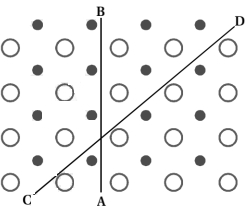
(N/A) When a substance possesses different magnitudes of physical properties such as electrical conductivity,refractive index,and thermal expansion along different directions,it is said to be anisotropic,and this property is known as anisotropy.
Anisotropy in crystals is due to the different arrangement of particles along different directions. The figure shows a simple two-dimensional pattern of the arrangement of two kinds of atoms. $A$ mechanical property such as resistance to shearing stress might be quite different in two directions $AB$ and $CD$. Deformation in the $CD$ direction displaces a row which has two different types of atoms,while in the $AB$ direction,rows made of one type of atoms are displaced.
Anisotropy in crystals is due to the different arrangement of particles along different directions. The figure shows a simple two-dimensional pattern of the arrangement of two kinds of atoms. $A$ mechanical property such as resistance to shearing stress might be quite different in two directions $AB$ and $CD$. Deformation in the $CD$ direction displaces a row which has two different types of atoms,while in the $AB$ direction,rows made of one type of atoms are displaced.
0 likes
View Solution213
Medium
Give the classification of crystalline solids.
Solution
(N/A) Crystalline solids are classified based on the nature of the intermolecular forces or bonds that hold the constituent particles together.
These are classified into four main categories:
$(i)$ Ionic solids: Held together by strong electrostatic forces of attraction between ions (e.g.,$NaCl$,$ZnS$).
$(ii)$ Covalent (Network) solids: Held together by covalent bonds forming a continuous network (e.g.,$SiO_2$,diamond,graphite).
$(iii)$ Metallic solids: Held together by metallic bonds involving a sea of delocalized electrons (e.g.,$Fe$,$Cu$,$Ag$).
$(iv)$ Molecular solids: Held together by Van der Waals forces or hydrogen bonds (e.g.,$I_2$,$P_4$,$H_2O$).
In graphite,the presence of free electrons makes it a good conductor of electricity.
These are classified into four main categories:
$(i)$ Ionic solids: Held together by strong electrostatic forces of attraction between ions (e.g.,$NaCl$,$ZnS$).
$(ii)$ Covalent (Network) solids: Held together by covalent bonds forming a continuous network (e.g.,$SiO_2$,diamond,graphite).
$(iii)$ Metallic solids: Held together by metallic bonds involving a sea of delocalized electrons (e.g.,$Fe$,$Cu$,$Ag$).
$(iv)$ Molecular solids: Held together by Van der Waals forces or hydrogen bonds (e.g.,$I_2$,$P_4$,$H_2O$).
In graphite,the presence of free electrons makes it a good conductor of electricity.
0 likes
View Solution214
Medium
Classify solids on the basis of their electrical conductivities.
Solution
(N/A) Solids exhibit electrical conductivities ranging from $10^{-20}$ to $10^{7} \ \Omega^{-1} \ m^{-1}$. They are classified into three categories:
$(i)$ Conductors: Solids with conductivities ranging between $10^{4}$ to $10^{7} \ \Omega^{-1} \ m^{-1}$. Metals have conductivities in the order of $10^{7} \ \Omega^{-1} \ m^{-1}$ and are good conductors.
$(ii)$ Insulators: Solids with very low conductivities ranging between $10^{-20}$ to $10^{-10} \ \Omega^{-1} \ m^{-1}$. Examples include wood and plastics.
$(iii)$ Semiconductors: Solids with conductivities in the intermediate range from $10^{-6}$ to $10^{4} \ \Omega^{-1} \ m^{-1}$. Their conductivity is mainly due to defects or impurities. The conduction of electricity in metals and semiconductors is explained by Band Theory.
Certain transition metal oxides show variations in electrical properties:
$ReO_{3}$ has an appearance and conductivity similar to copper.
$(i)$ Conductors: Solids with conductivities ranging between $10^{4}$ to $10^{7} \ \Omega^{-1} \ m^{-1}$. Metals have conductivities in the order of $10^{7} \ \Omega^{-1} \ m^{-1}$ and are good conductors.
$(ii)$ Insulators: Solids with very low conductivities ranging between $10^{-20}$ to $10^{-10} \ \Omega^{-1} \ m^{-1}$. Examples include wood and plastics.
$(iii)$ Semiconductors: Solids with conductivities in the intermediate range from $10^{-6}$ to $10^{4} \ \Omega^{-1} \ m^{-1}$. Their conductivity is mainly due to defects or impurities. The conduction of electricity in metals and semiconductors is explained by Band Theory.
Certain transition metal oxides show variations in electrical properties:
| Electrical Property | Transition Metal Oxides |
| Metals-like oxides | $TiO, CrO_{2}, ReO_{3}, VO$ |
| Metal-to-insulator behavior at certain temperatures | $Ti_{2}O_{3}, VO_{2}, V_{2}O_{3}$ |
| Insulators-like oxides | $MnO, CuO, FeO$ |
$ReO_{3}$ has an appearance and conductivity similar to copper.
0 likes
View Solution215
Medium
Explain doping.
Solution
(N/A) The process of increasing the conductivity of intrinsic semiconductors by adding a small amount of suitable impurities is known as $doping$. The added impurities are called $dopants$.
Doping is performed to modify the electronic properties of semiconductors like $Si$ or $Ge$. Depending on the nature of the impurity,two types of extrinsic semiconductors are formed:
$(i)$ $n$-type semiconductors: Formed by doping with electron-rich impurities (Group $15$ elements like $P$ or $As$ added to Group $14$ elements).
$(ii)$ $p$-type semiconductors: Formed by doping with electron-deficient impurities (Group $13$ elements like $B$ or $Al$ added to Group $14$ elements).
Doping is performed to modify the electronic properties of semiconductors like $Si$ or $Ge$. Depending on the nature of the impurity,two types of extrinsic semiconductors are formed:
$(i)$ $n$-type semiconductors: Formed by doping with electron-rich impurities (Group $15$ elements like $P$ or $As$ added to Group $14$ elements).
$(ii)$ $p$-type semiconductors: Formed by doping with electron-deficient impurities (Group $13$ elements like $B$ or $Al$ added to Group $14$ elements).
0 likes
View Solution216
Medium
Explain $n$-type and $p$-type semiconductors.
Solution
(N/A) $(i)$ $n$-type semiconductors: These semiconductors are obtained by adding electron-rich impurities to silicon or germanium. Silicon and germanium belong to group-$14$ and have four valence electrons each. In their crystals,each atom forms four covalent bonds with its neighbors. When doped with group-$15$ elements like $P$ or $As$,which contain five valence electrons,they occupy some lattice sites in the silicon or germanium crystal. Four out of five electrons are used to form four covalent bonds with four neighboring silicon atoms. The fifth electron is extra and is delocalized. These delocalized electrons increase the conductivity of the doped silicon or germanium,and this increase is due to the negatively charged electron. Hence,silicon doped with an electron-rich impurity is called an $n$-type semiconductor.
$(ii)$ $p$-type semiconductors: These semiconductors are obtained by adding electron-deficient impurities to silicon or germanium. When silicon or germanium is doped with a group-$13$ element such as $B$,$Al$,or $Ga$,which contains only three valence electrons,an electron hole is formed where the fourth electron is missing. This is also known as an electron vacancy or hole. Under an applied electric field,electrons from neighboring atoms can move to fill the hole,effectively moving the hole in the opposite direction. Since the hole behaves as a positive charge,this is called a $p$-type semiconductor.
$(ii)$ $p$-type semiconductors: These semiconductors are obtained by adding electron-deficient impurities to silicon or germanium. When silicon or germanium is doped with a group-$13$ element such as $B$,$Al$,or $Ga$,which contains only three valence electrons,an electron hole is formed where the fourth electron is missing. This is also known as an electron vacancy or hole. Under an applied electric field,electrons from neighboring atoms can move to fill the hole,effectively moving the hole in the opposite direction. Since the hole behaves as a positive charge,this is called a $p$-type semiconductor.
0 likes
View Solution217
Medium
Explain the cause of magnetism in a substance.
Solution
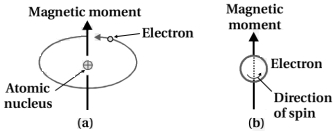
(N/A) The origin of magnetic properties in a substance is due to two types of motions of electrons:
$(i)$ Orbital motion around the nucleus.
$(ii)$ Spin motion around its own axis.
An electron in an atom behaves like a tiny magnet. Since an electron is a charged particle and undergoes these motions,it can be considered as a small loop of current which possesses a magnetic moment.
Each electron thus has a permanent spin and an orbital magnetic moment associated with it. The magnitude of the magnetic moment is very small and is measured in the unit called Bohr magneton,$\mu_{B}$,which is equal to $9.27 \times 10^{-24} \text{ A m}^{2}$.
On the basis of their magnetic properties,substances are classified as:
$(i)$ Paramagnetic
$(ii)$ Diamagnetic
$(iii)$ Ferromagnetic
$(iv)$ Antiferromagnetic
$(v)$ Ferrimagnetic
$(i)$ Orbital motion around the nucleus.
$(ii)$ Spin motion around its own axis.
An electron in an atom behaves like a tiny magnet. Since an electron is a charged particle and undergoes these motions,it can be considered as a small loop of current which possesses a magnetic moment.
Each electron thus has a permanent spin and an orbital magnetic moment associated with it. The magnitude of the magnetic moment is very small and is measured in the unit called Bohr magneton,$\mu_{B}$,which is equal to $9.27 \times 10^{-24} \text{ A m}^{2}$.
On the basis of their magnetic properties,substances are classified as:
$(i)$ Paramagnetic
$(ii)$ Diamagnetic
$(iii)$ Ferromagnetic
$(iv)$ Antiferromagnetic
$(v)$ Ferrimagnetic
0 likes
View Solution218
Medium
Explain Ferrimagnetism.
Solution
(N/A) Ferrimagnetism is observed when the magnetic moments of the domains in a substance are aligned in parallel and anti-parallel directions in unequal numbers.
These substances are weakly attracted by a magnetic field compared to ferromagnetic substances.
Upon heating,these substances lose their ferrimagnetism and become paramagnetic.
Examples include $MgFe_{2}O_{4}$,$Fe_{3}O_{4}$,and $ZnFe_{2}O_{4}$.
These substances are weakly attracted by a magnetic field compared to ferromagnetic substances.
Upon heating,these substances lose their ferrimagnetism and become paramagnetic.
Examples include $MgFe_{2}O_{4}$,$Fe_{3}O_{4}$,and $ZnFe_{2}O_{4}$.
0 likes
View Solution219
MediumMCQ
Given below are two statements.
Statement $I$ : $O_2, Cu^{2+}$ and $Fe^{3+}$ are weakly attracted by magnetic field and are magnetized in the same direction as magnetic field.
Statement $II$ : $NaCl$ and $H_2O$ are weakly magnetized in opposite direction to magnetic field.
In the light of the above statements,choose the most appropriate answer from the options given below:
Statement $I$ : $O_2, Cu^{2+}$ and $Fe^{3+}$ are weakly attracted by magnetic field and are magnetized in the same direction as magnetic field.
Statement $II$ : $NaCl$ and $H_2O$ are weakly magnetized in opposite direction to magnetic field.
In the light of the above statements,choose the most appropriate answer from the options given below:
A
Both Statement $I$ and Statement $II$ are correct.
B
Both Statement $I$ and Statement $II$ are incorrect.
C
Statement $I$ is correct but Statement $II$ is incorrect.
D
Statement $I$ is incorrect but Statement $II$ is correct.
Solution
(A) $O_2, Cu^{2+}$ and $Fe^{3+}$ contain unpaired electrons,hence they are paramagnetic.
Paramagnetic substances are weakly attracted by an external magnetic field and are magnetized in the direction of the field.
$NaCl$ and $H_2O$ have all electrons paired,hence they are diamagnetic.
Diamagnetic substances are weakly repelled by an external magnetic field and are weakly magnetized in the direction opposite to the applied magnetic field.
Therefore,both Statement $I$ and Statement $II$ are correct.
Paramagnetic substances are weakly attracted by an external magnetic field and are magnetized in the direction of the field.
$NaCl$ and $H_2O$ have all electrons paired,hence they are diamagnetic.
Diamagnetic substances are weakly repelled by an external magnetic field and are weakly magnetized in the direction opposite to the applied magnetic field.
Therefore,both Statement $I$ and Statement $II$ are correct.
0 likes
View Solution220
DifficultMCQ
$A$ solid is hard and brittle. It is an insulator in solid state,but conducts electricity in molten state. The solid is a
A
molecular solid
B
ionic solid
C
metallic solid
D
covalent solid
Solution
(B) The characteristics provided describe an $ionic$ $solid$.
$1$. $Ionic$ solids are hard and brittle due to strong electrostatic forces of attraction.
$2$. They act as insulators in the solid state because ions are fixed in their lattice positions.
$3$. They conduct electricity in the molten state or in aqueous solution because the ions become free to move.
$1$. $Ionic$ solids are hard and brittle due to strong electrostatic forces of attraction.
$2$. They act as insulators in the solid state because ions are fixed in their lattice positions.
$3$. They conduct electricity in the molten state or in aqueous solution because the ions become free to move.
0 likes
View Solution221
MediumMCQ
Which of the following materials is not a semiconductor?
A
Germanium
B
Graphite
C
Silicon
D
Copper oxide
Solution
(B) Semiconductors are materials with electrical conductivity between conductors and insulators. $Germanium$,$Silicon$,and $Copper \ oxide$ $(Cu_2O)$ are well-known semiconductors. $Graphite$ is an allotrope of carbon that possesses delocalized electrons,making it a good conductor of electricity. Therefore,$Graphite$ is not a semiconductor.
0 likes
View Solution222
MediumMCQ
$STATEMENT-1$: Band gap in germanium is small.
$STATEMENT-2$: The energy spread of each germanium atomic energy level is infinitesimally small.
$STATEMENT-2$: The energy spread of each germanium atomic energy level is infinitesimally small.
A
$Statement-1$ is True,$Statement-2$ is True; $Statement-2$ is a correct explanation for $Statement-1$
B
$Statement-1$ is True,$Statement-2$ is True; $Statement-2$ is $NOT$ a correct explanation for $Statement-1$
C
$Statement-1$ is True,$Statement-2$ is False
D
$Statement-1$ is False,$Statement-2$ is True
Solution
(C) $Statement-1$ is True because Germanium is a semiconductor with a small band gap (approx $0.7 \ eV$).
$Statement-2$ is False. In a solid,atomic energy levels overlap to form energy bands due to the interaction of a large number of atoms,which results in a significant energy spread,not an infinitesimally small one.
$Statement-2$ is False. In a solid,atomic energy levels overlap to form energy bands due to the interaction of a large number of atoms,which results in a significant energy spread,not an infinitesimally small one.
0 likes
View Solution223
MediumMCQ
Which of the following solids has the highest $m.p.$?
A
$CO_2$
B
$H_2O$
C
$SiO_2$
D
$He_{(s)}$
Solution
(C) $SiO_2$ (silica) has the highest $m.p.$ because it possesses a three-dimensional covalent network structure.
In contrast,$CO_2$ and $He_{(s)}$ are molecular solids held by weak van der Waals forces,and $H_2O$ (ice) is a molecular solid held by hydrogen bonds,all of which have significantly lower melting points than the giant covalent network of $SiO_2$.
In contrast,$CO_2$ and $He_{(s)}$ are molecular solids held by weak van der Waals forces,and $H_2O$ (ice) is a molecular solid held by hydrogen bonds,all of which have significantly lower melting points than the giant covalent network of $SiO_2$.
0 likes
View Solution224
EasyMCQ
What type of solid is ice?
A
Ionic solid
B
Covalent network solid
C
Molecular solid
D
Metallic solid
Solution
(C) Ice is the solid form of water $(H_2O)$.
In ice,water molecules are held together by hydrogen bonding,which is a type of intermolecular force.
Therefore,ice is classified as a molecular solid.
In ice,water molecules are held together by hydrogen bonding,which is a type of intermolecular force.
Therefore,ice is classified as a molecular solid.
0 likes
View Solution225
EasyMCQ
Which among the following solids is a non-polar solid?
A
Hydrogen chloride
B
Sulphur dioxide
C
Water
D
Carbon dioxide
Solution
(D) non-polar solid is one that does not possess a permanent dipole moment.
$CO_2$ (Carbon dioxide) has a linear geometry with two $C=O$ bonds oriented at $180^{\circ}$.
The bond dipoles cancel each other out,resulting in a net dipole moment of zero,making it a non-polar molecule.
$CO_2$ (Carbon dioxide) has a linear geometry with two $C=O$ bonds oriented at $180^{\circ}$.
The bond dipoles cancel each other out,resulting in a net dipole moment of zero,making it a non-polar molecule.
0 likes
View Solution226
EasyMCQ
Which of the following pairs of compounds exhibits isomorphism?
A
Calcite and aragonite
B
$ \alpha $-quartz and cristobalite
C
Sodium nitrate and calcium carbonate
D
Diamond and fullerene
Solution
(C) Isomorphism is the phenomenon where different substances crystallize in the same crystalline form and have similar chemical formulas.
Sodium nitrate $(NaNO_3)$ and calcium carbonate $(CaCO_3)$ are classic examples of isomorphism.
Both crystallize in the rhombohedral system and have similar structural arrangements of their constituent ions.
Calcite and aragonite are polymorphs of $CaCO_3$,not isomorphs.
$ \alpha $-quartz and cristobalite are polymorphs of $SiO_2$.
Diamond and fullerene are allotropes of carbon.
Sodium nitrate $(NaNO_3)$ and calcium carbonate $(CaCO_3)$ are classic examples of isomorphism.
Both crystallize in the rhombohedral system and have similar structural arrangements of their constituent ions.
Calcite and aragonite are polymorphs of $CaCO_3$,not isomorphs.
$ \alpha $-quartz and cristobalite are polymorphs of $SiO_2$.
Diamond and fullerene are allotropes of carbon.
0 likes
View Solution227
EasyMCQ
Which among the following is $NOT$ a polar molecular solid?
A
$CH_{4}$
B
$SO_{2}$
C
$HCl$
D
$H_{2}S$
Solution
(A) polar molecular solid consists of molecules held together by dipole-dipole interactions.
$CH_{4}$ has a symmetrical tetrahedral geometry,which results in a net dipole moment of $0$.
Therefore,$CH_{4}$ is a non-polar molecular solid.
$SO_{2}$,$HCl$,and $H_{2}S$ are polar molecules due to the difference in electronegativity between the bonded atoms and their non-symmetrical shapes.
$CH_{4}$ has a symmetrical tetrahedral geometry,which results in a net dipole moment of $0$.
Therefore,$CH_{4}$ is a non-polar molecular solid.
$SO_{2}$,$HCl$,and $H_{2}S$ are polar molecules due to the difference in electronegativity between the bonded atoms and their non-symmetrical shapes.
0 likes
View Solution228
EasyMCQ
Which of the following statements is $NOT$ true about polymorphism?
A
The existence of a substance in more than one crystalline form.
B
Polymorphism occurring in an element is called allotropy.
C
Polymorphic forms of a substance are formed under different conditions.
D
The crystal shape of polymorphic substances is identical to each other.
Solution
(D) Polymorphism is the ability of a solid material to exist in more than one form or crystal structure.
Since these forms have different crystal structures,their physical properties like crystal shape,density,and melting point are different.
Therefore,the statement that the crystal shape of polymorphic substances is identical is false.
Since these forms have different crystal structures,their physical properties like crystal shape,density,and melting point are different.
Therefore,the statement that the crystal shape of polymorphic substances is identical is false.
0 likes
View Solution229
EasyMCQ
Which of the following solids is isotropic?
A
Glass
B
Ceramics
C
Graphite
D
Ice
Solution
(A) Amorphous solids are isotropic in nature,meaning their physical properties (such as refractive index,electrical conductivity,etc.) are the same in all directions.
Glass is an amorphous solid,whereas ceramics,graphite,and ice are crystalline solids,which are anisotropic.
Glass is an amorphous solid,whereas ceramics,graphite,and ice are crystalline solids,which are anisotropic.
0 likes
View Solution230
MediumMCQ
Which from the following solids exhibits isotropic properties?
A
Diamond
B
Graphite
C
Sodium
D
Metallic glass
Solution
(D) Amorphous solids are isotropic in nature,meaning they exhibit the same magnitude for physical properties like refractive index,electrical conductivity,etc.,in every direction.
Metallic glass is an amorphous solid.
Therefore,it is isotropic in nature.
Metallic glass is an amorphous solid.
Therefore,it is isotropic in nature.
0 likes
View Solution231
EasyMCQ
Which of the following statements is $NOT$ true regarding a crystalline solid?
A
There is a regularity and periodicity in the arrangement of constituent particles.
B
It is isotropic.
C
It melts at a definite temperature.
D
It has different magnitudes for refractive index in every direction.
Solution
(B) Crystalline solids are anisotropic in nature,meaning their physical properties such as refractive index,thermal conductivity,and electrical conductivity vary when measured in different directions. Therefore,the statement that a crystalline solid is isotropic is incorrect.
0 likes
View Solution232
EasyMCQ
Which of the following characteristic properties is $NOT$ true for crystalline solids?
A
These substances have a sharp melting point.
B
These have different values of refractive index in different directions.
C
The constituent particles are orderly arranged.
D
These are isotropic.
Solution
(D) Crystalline solids are anisotropic in nature,meaning they exhibit different physical properties (such as refractive index) when measured in different directions. Therefore,the statement that they are isotropic is incorrect.
0 likes
View Solution233
EasyMCQ
Which from the following is $NOT$ an example of an amorphous solid?
A
Glass
B
Plastic
C
Rubber
D
Diamond
Solution
(D) Diamond is a crystalline solid because its constituent particles are arranged in a regular,repeating pattern throughout the entire structure.
In contrast,glass,plastic,and rubber are amorphous solids because they lack a long-range ordered arrangement of particles.
In contrast,glass,plastic,and rubber are amorphous solids because they lack a long-range ordered arrangement of particles.
0 likes
View Solution234
MediumMCQ
Which of the following statements is $NOT$ true about polymorphism?
A
$NaF$ and $MgO$ are polymorphous compounds.
B
Fullerene is a polymorphic form of carbon.
C
Polymorphism occurring in elements is called allotropy.
D
$A$ single substance that exists in two or more forms is said to be polymorphous.
Solution
(A) Polymorphism refers to the ability of a solid material to exist in more than one form or crystal structure.
$NaF$ and $MgO$ both crystallize in the rock salt structure ($NaCl$ type) and do not exhibit polymorphism.
Therefore,the statement that $NaF$ and $MgO$ are polymorphous compounds is incorrect.
$NaF$ and $MgO$ both crystallize in the rock salt structure ($NaCl$ type) and do not exhibit polymorphism.
Therefore,the statement that $NaF$ and $MgO$ are polymorphous compounds is incorrect.
0 likes
View Solution235
EasyMCQ
Which among the following statements is $NOT$ true about covalent network solids?
A
In these solids,the constituent particles are atoms.
B
Covalent solids have high melting points.
C
The atoms in these solids are linked by covalent bonds.
D
These are soft in nature.
Solution
(D) Covalent network solids,also known as giant molecules,are formed by a continuous network of covalent bonds throughout the crystal. Due to this strong,directional bonding,they are extremely hard and have very high melting points. Therefore,the statement that they are soft in nature is incorrect.
0 likes
View Solution236
EasyMCQ
Which among the following is an example of an amorphous solid?
A
Camphor
B
Magnesium
C
Diamond
D
Glass
Solution
(D) Amorphous solids are those in which the constituent particles do not have a long-range order of arrangement.
$Glass$,$rubber$,and $plastics$ are common examples of amorphous solids.
$Camphor$ is a crystalline molecular solid.
$Magnesium$ is a metallic crystalline solid.
$Diamond$ is a covalent (network) crystalline solid.
Therefore,$Glass$ is the correct example of an amorphous solid.
$Glass$,$rubber$,and $plastics$ are common examples of amorphous solids.
$Camphor$ is a crystalline molecular solid.
$Magnesium$ is a metallic crystalline solid.
$Diamond$ is a covalent (network) crystalline solid.
Therefore,$Glass$ is the correct example of an amorphous solid.
0 likes
View Solution237
EasyMCQ
Which among the following is $NOT$ an amorphous solid?
A
Rubber
B
Butter
C
Tar
D
Camphor
Solution
(D) Amorphous solids are those in which the constituent particles do not have a long-range ordered arrangement. Examples include rubber,glass,plastic,and tar.
Crystalline solids have a long-range ordered arrangement of constituent particles. Camphor is a molecular crystalline solid.
Therefore,camphor is $NOT$ an amorphous solid.
Crystalline solids have a long-range ordered arrangement of constituent particles. Camphor is a molecular crystalline solid.
Therefore,camphor is $NOT$ an amorphous solid.
0 likes
View Solution238
MediumMCQ
What type of solid is silica?
A
Ionic
B
Covalent
C
Molecular
D
Metallic
Solution
(B) Silica $(SiO_2)$ is a covalent solid (also known as a network solid).
In this structure,silicon and oxygen atoms are held together by strong covalent bonds in a continuous three-dimensional network.
This extensive bonding results in high hardness and a very high melting point for silica.
In this structure,silicon and oxygen atoms are held together by strong covalent bonds in a continuous three-dimensional network.
This extensive bonding results in high hardness and a very high melting point for silica.
0 likes
View Solution239
EasyMCQ
Which among the following metals crystallises as a simple cube?
A
Polonium
B
Iron
C
Copper
D
Gold
Solution
(A) Polonium $(Po)$ is the only known metal that crystallizes in a simple cubic structure.
0 likes
View Solution240
EasyMCQ
Which metal crystallises in a simple cubic structure?
A
Polonium
B
Copper
C
Nickel
D
Iron
Solution
(A) Polonium $(Po)$ is the only known metal that crystallizes in a simple cubic structure at room temperature.
0 likes
View Solution241
DifficultMCQ
Which of the following is an example of an ionic solid?
A
Calcium fluoride
B
Ice
C
Silica
D
Sodium metal
Solution
(A) $CaF_2$ is an ionic solid.
$Ice$ is a molecular solid.
$SiO_2$ is a covalent network (atomic) solid.
$Na$ is a metallic solid.
$Ice$ is a molecular solid.
$SiO_2$ is a covalent network (atomic) solid.
$Na$ is a metallic solid.
0 likes
View Solution242
MediumMCQ
Which of the following statements is not true about ionic solids?
A
The constituent particles of ionic solids are cations and anions.
B
Ionic solids are hard and brittle.
C
In these,constituent particles are held together by electrostatic forces of attraction.
D
Pure ionic solids are good conductors of electricity in the solid state.
Solution
(D) Ionic solids consist of ions held together by strong electrostatic forces of attraction,making them hard and brittle. However,in the solid state,the ions are fixed in their lattice positions and are not free to move. Therefore,they are poor conductors of electricity in the solid state. They only conduct electricity when molten or dissolved in water,as the ions become free to move. Thus,statement $D$ is incorrect.
0 likes
View Solution243
EasyMCQ
Which of the following dopants is used in germanium to form $n-$type semiconductor?
A
$As$
B
$B$
C
$In$
D
$Ga$
Solution
(A) To form an $n-$type semiconductor,a pentavalent impurity (Group $15$ element) is added to a tetravalent semiconductor like germanium $(Ge)$.
Among the given options,$As$ (Arsenic) is a Group $15$ element,while $B$ (Boron),$In$ (Indium),and $Ga$ (Gallium) are Group $13$ elements.
Adding a Group $15$ element provides an extra electron,which is responsible for $n-$type conductivity.
Therefore,$As$ is the correct dopant.
Among the given options,$As$ (Arsenic) is a Group $15$ element,while $B$ (Boron),$In$ (Indium),and $Ga$ (Gallium) are Group $13$ elements.
Adding a Group $15$ element provides an extra electron,which is responsible for $n-$type conductivity.
Therefore,$As$ is the correct dopant.
0 likes
View Solution244
EasyMCQ
Which from the following dopants is used in germanium to produce $p-$type semiconductor?
A
$B$
B
$P$
C
$As$
D
$Sb$
Solution
(A) To produce a $p-$type semiconductor,a group $13$ element (trivalent impurity) is added to a group $14$ element like germanium.
$B$ (Boron) belongs to group $13$,while $P$ (Phosphorus),$As$ (Arsenic),and $Sb$ (Antimony) belong to group $15$ (pentavalent impurities).
Adding a group $13$ element creates an electron hole,which is responsible for $p-$type conductivity.
Therefore,$B$ is the correct dopant.
$B$ (Boron) belongs to group $13$,while $P$ (Phosphorus),$As$ (Arsenic),and $Sb$ (Antimony) belong to group $15$ (pentavalent impurities).
Adding a group $13$ element creates an electron hole,which is responsible for $p-$type conductivity.
Therefore,$B$ is the correct dopant.
0 likes
View Solution245
EasyMCQ
Which of the following dopant is used in silicon to produce $p$-type semiconductor?
A
$Ga$
B
$Sb$
C
$As$
D
$P$
Solution
(A) To produce a $p$-type semiconductor, silicon (a group $14$ element) is doped with a group $13$ element.
Group $13$ elements have $3$ valence electrons, which create an electron deficiency or 'hole' in the crystal lattice.
Among the given options, $Ga$ (Gallium) belongs to group $13$, while $Sb$ (Antimony), $As$ (Arsenic), and $P$ (Phosphorus) belong to group $15$.
Group $15$ elements are used to produce $n$-type semiconductors.
Therefore, $Ga$ is the correct dopant.
Group $13$ elements have $3$ valence electrons, which create an electron deficiency or 'hole' in the crystal lattice.
Among the given options, $Ga$ (Gallium) belongs to group $13$, while $Sb$ (Antimony), $As$ (Arsenic), and $P$ (Phosphorus) belong to group $15$.
Group $15$ elements are used to produce $n$-type semiconductors.
Therefore, $Ga$ is the correct dopant.
0 likes
View Solution246
EasyMCQ
Which of the following dopants is added to silicon to obtain an $n$-type semiconductor?
A
$As$
B
$B$
C
$Ga$
D
$In$
Solution
(A) To obtain an $n$-type semiconductor, a group-$15$ element (pentavalent) is added as a dopant to a group-$14$ element like silicon $(Si)$.
Among the given options, $As$ (Arsenic) belongs to group-$15$, while $B$ (Boron), $Ga$ (Gallium), and $In$ (Indium) belong to group-$13$.
Therefore, adding $As$ to $Si$ creates an $n$-type semiconductor due to the presence of an extra electron.
Among the given options, $As$ (Arsenic) belongs to group-$15$, while $B$ (Boron), $Ga$ (Gallium), and $In$ (Indium) belong to group-$13$.
Therefore, adding $As$ to $Si$ creates an $n$-type semiconductor due to the presence of an extra electron.
0 likes
View Solution247
MediumMCQ
Identify the ferromagnetic substance from the following.
A
$NaCl$
B
$C_6H_6$
C
$CrO_2$
D
$H_2O$
Solution
(C) The magnetic properties of the given substances are as follows:
$1$. $NaCl$: Diamagnetic
$2$. $C_6H_6$: Diamagnetic
$3$. $CrO_2$: Ferromagnetic
$4$. $H_2O$: Diamagnetic
Therefore,$CrO_2$ is the ferromagnetic substance.
$1$. $NaCl$: Diamagnetic
$2$. $C_6H_6$: Diamagnetic
$3$. $CrO_2$: Ferromagnetic
$4$. $H_2O$: Diamagnetic
Therefore,$CrO_2$ is the ferromagnetic substance.
0 likes
View Solution248
DifficultMCQ
$n$-type semiconductor is formed when:
A
Silicon is doped with phosphorus
B
Silicon is doped with boron
C
Germanium is doped with boron
D
Germanium is doped with aluminium
Solution
(A) An $n$-type semiconductor is formed when a group $14$ element (like silicon or germanium) is doped with a group $15$ element (like phosphorus or arsenic) that has more valence electrons.
$(1)$ Silicon has $4$ valence electrons. Phosphorus has $5$ valence electrons.
$(2)$ When silicon is doped with phosphorus,$4$ electrons of phosphorus form covalent bonds with silicon,while the $5^{th}$ electron remains free.
$(3)$ This extra free electron increases the electrical conductivity,resulting in an $n$-type semiconductor.
$(1)$ Silicon has $4$ valence electrons. Phosphorus has $5$ valence electrons.
$(2)$ When silicon is doped with phosphorus,$4$ electrons of phosphorus form covalent bonds with silicon,while the $5^{th}$ electron remains free.
$(3)$ This extra free electron increases the electrical conductivity,resulting in an $n$-type semiconductor.
0 likes
View Solution249
MediumMCQ
Which among the following is a ferromagnetic substance?
A
$NaCl$
B
$H_2O$
C
$O_2$
D
$CrO_2$
Solution
(D) Ferromagnetic substances are those that are strongly attracted by a magnetic field and show permanent magnetism even when the magnetic field is removed.
Examples include $Fe$,$Co$,$Ni$,$CrO_2$,and $Fe_3O_4$.
Analyzing the given options:
- $NaCl$ is diamagnetic.
- $H_2O$ is diamagnetic.
- $O_2$ is paramagnetic.
- $CrO_2$ is ferromagnetic.
Therefore,the correct option is $D$.
Examples include $Fe$,$Co$,$Ni$,$CrO_2$,and $Fe_3O_4$.
Analyzing the given options:
- $NaCl$ is diamagnetic.
- $H_2O$ is diamagnetic.
- $O_2$ is paramagnetic.
- $CrO_2$ is ferromagnetic.
Therefore,the correct option is $D$.
0 likes
View Solution250
EasyMCQ
Which among the following is $NOT$ ferromagnetic in nature?
A
$Fe$
B
$Zn$
C
$Ni$
D
$Co$
Solution
(B) $Fe$,$Co$,and $Ni$ are ferromagnetic substances.
$Zn$ is diamagnetic in nature.
$Zn$ is diamagnetic in nature.
0 likes
View SolutionSolid State — Type of solid and Their properties · Frequently Asked Questions
1Are these Solid State questions useful for JEE and NEET?
Yes. All questions in this section are mapped to JEE Main and NEET exam patterns. Previous year questions from JEE Main, NEET, GUJCET and state-level exams are included with full solutions.
2Can I switch to Hindi or Gujarati for these questions?
Yes. Use the language tabs in the hero section or the sidebar to view the same questions and solutions in English, Hindi or Gujarati.
3How do I generate a question paper from this subtopic?
Use the Vedclass Exam Paper Generator — select the chapter and subtopic, set difficulty, and generate Sets A, B, C, D automatically. First 3 chapters of every subject are free.
Vedclass Products
For Students
Vedclass Test Series
Mock tests in real JEE/NEET style with performance analysis. 5-day free trial.
Start Free TrialFor Teachers
Exam Paper Generator
Generate Set A/B/C/D papers from this chapter in 2 minutes. 3 chapters free.
Try FreeFor Institutes
Online Exam Module
Live online exams with unlimited students, 360° analytics & white-label branding.
See DemoFor Teachers & Institutes
Generate a Solid State Exam Paper in 2 Minutes
Select subtopic & difficulty — Sets A, B, C, D auto-generated with No Repeat logic.
First 3 chapters of every subject are free — no payment required.