
A English
Type of solid and Their properties Questions in English
Class 12 Chemistry · Solid State · Type of solid and Their properties
281+
Questions
English
Language
100%
With Solutions
Showing 50 of 281 questions in English
101
DifficultMCQ
What type of solid is quartz?
A
Ionic
B
Molecular
C
Covalent (Network)
D
Metallic
Solution
(C) Quartz $(SiO_2)$ is a network solid where silicon and oxygen atoms are linked together by a continuous network of covalent bonds. Therefore,it is classified as a covalent or network solid.
0 likes
View Solution102
EasyMCQ
Isotropy is a property of .......
A
Ionic solids
B
Covalent solids
C
Metallic solids
D
Amorphous solids
Solution
(D) Isotropy is the property of exhibiting the same physical properties in all directions.
Amorphous solids are isotropic in nature because their constituent particles are arranged randomly,leading to identical properties in all directions.
In contrast,crystalline solids are anisotropic.
Amorphous solids are isotropic in nature because their constituent particles are arranged randomly,leading to identical properties in all directions.
In contrast,crystalline solids are anisotropic.
0 likes
View Solution103
EasyMCQ
Glass can be classified as $.......$.
A
anisotropic and supercooled liquid
B
isotropic and crystalline solid
C
anisotropic and crystalline solid
D
isotropic and supercooled liquid
0 likes
View Solution104
EasyMCQ
Which of the following possesses a layered crystal structure?
A
Graphite
B
Cadmium iodide
C
Lime
D
Both $A$ and $B$
Solution
(D) Graphite consists of layers of carbon atoms arranged in a hexagonal lattice,where layers are held together by weak van der Waals forces.
Cadmium iodide $(CdI_2)$ also exhibits a layered structure where layers of $I^-$ ions are held together by van der Waals forces with $Cd^{2+}$ ions occupying octahedral holes.
Therefore,both graphite and cadmium iodide possess a layered crystal structure.
Cadmium iodide $(CdI_2)$ also exhibits a layered structure where layers of $I^-$ ions are held together by van der Waals forces with $Cd^{2+}$ ions occupying octahedral holes.
Therefore,both graphite and cadmium iodide possess a layered crystal structure.
0 likes
View Solution105
EasyMCQ
Which of the following is isotropic?
A
Glass
B
Sodium
C
Lime
D
All of the above
Solution
(A) Amorphous solids are isotropic in nature,meaning their physical properties (such as refractive index,electrical conductivity,etc.) are the same in all directions. $Glass$ is an amorphous solid,whereas $Sodium$ (a metal) and $Lime$ $(CaO)$ are crystalline solids,which are anisotropic. Therefore,$Glass$ is the correct answer.
0 likes
View Solution106
EasyMCQ
Which of the following will show anisotropy?
A
Glass
B
Barium chloride
C
Wood
D
Paper
Solution
(B) Anisotropy is a property exhibited by crystalline solids,where physical properties like refractive index,electrical conductivity,and thermal expansion vary with the direction of measurement.
Among the given options,$Barium \ chloride$ $(BaCl_2)$ is a crystalline solid,whereas glass,wood,and paper are amorphous solids.
Therefore,$Barium \ chloride$ will show anisotropy.
Among the given options,$Barium \ chloride$ $(BaCl_2)$ is a crystalline solid,whereas glass,wood,and paper are amorphous solids.
Therefore,$Barium \ chloride$ will show anisotropy.
0 likes
View Solution107
EasyMCQ
Which of the following is a pseudo solid?
A
$CaF_2$
B
Rubber
C
$NaCl$
D
All of the above
Solution
(B) Amorphous solids are often referred to as pseudo solids or supercooled liquids because they do not have a long-range order of particles.
Rubber,glass,and plastics are common examples of amorphous solids.
$CaF_2$ and $NaCl$ are crystalline solids,which possess a regular,repeating arrangement of particles.
Therefore,rubber is the correct answer.
Rubber,glass,and plastics are common examples of amorphous solids.
$CaF_2$ and $NaCl$ are crystalline solids,which possess a regular,repeating arrangement of particles.
Therefore,rubber is the correct answer.
0 likes
View Solution108
EasyMCQ
Which of the following exhibits the highest melting point?
A
Covalent solid
B
Ionic solid
C
Amorphous solid
D
Molecular solid
Solution
(B) Ionic solids consist of ions held together by strong electrostatic forces of attraction.
These forces are significantly stronger than the intermolecular forces found in molecular solids or the forces in amorphous solids.
While covalent network solids (like diamond) also have very high melting points,in the context of general classification,ionic solids are characterized by high melting points due to their rigid crystal lattice structure.
These forces are significantly stronger than the intermolecular forces found in molecular solids or the forces in amorphous solids.
While covalent network solids (like diamond) also have very high melting points,in the context of general classification,ionic solids are characterized by high melting points due to their rigid crystal lattice structure.
0 likes
View Solution109
EasyMCQ
Crystalline solids have ...
A
Disordered arrangement
B
Long-range order
C
Short-range order
D
None of the above
Solution
(B) The correct answer is $B$.
Crystalline solids are characterized by a regular and repeating pattern of constituent particles (atoms,ions,or molecules) that extends throughout the entire three-dimensional structure of the solid.
This is known as $ \text{long-range order} $.
In contrast,amorphous solids exhibit only $ \text{short-range order} $.
Crystalline solids are characterized by a regular and repeating pattern of constituent particles (atoms,ions,or molecules) that extends throughout the entire three-dimensional structure of the solid.
This is known as $ \text{long-range order} $.
In contrast,amorphous solids exhibit only $ \text{short-range order} $.
0 likes
View Solution110
EasyMCQ
Which of the following elements has the smallest energy gap?
A
$B$
B
$Zn$
C
$Cl$
D
$Ge$
Solution
(D) The energy gap (band gap) is the energy difference between the valence band and the conduction band.
For conductors,the gap is zero or negligible.
For semiconductors,the gap is small (typically $0.5 \ eV$ to $3 \ eV$).
For insulators,the gap is very large.
Among the given options:
$B$ (Boron) is a metalloid/non-metal with a large gap.
$Zn$ (Zinc) is a metal,but in the context of solid-state band theory,$Ge$ (Germanium) is a well-known semiconductor with a small band gap of approximately $0.67 \ eV$.
$Cl$ (Chlorine) is a non-metal insulator with a very large gap.
Therefore,$Ge$ has the smallest energy gap among the choices provided.
For conductors,the gap is zero or negligible.
For semiconductors,the gap is small (typically $0.5 \ eV$ to $3 \ eV$).
For insulators,the gap is very large.
Among the given options:
$B$ (Boron) is a metalloid/non-metal with a large gap.
$Zn$ (Zinc) is a metal,but in the context of solid-state band theory,$Ge$ (Germanium) is a well-known semiconductor with a small band gap of approximately $0.67 \ eV$.
$Cl$ (Chlorine) is a non-metal insulator with a very large gap.
Therefore,$Ge$ has the smallest energy gap among the choices provided.
0 likes
View Solution111
EasyMCQ
The conductivity of semiconductors $..........$ with an increase in temperature.
A
increases
B
decreases
C
remains constant
D
cannot be determined
Solution
(A) In semiconductors,the energy gap between the valence band and the conduction band is small.
At low temperatures,electrons are unable to jump to the conduction band.
As the temperature increases,more electrons gain sufficient thermal energy to jump from the valence band to the conduction band.
This increase in the number of charge carriers leads to an increase in the conductivity of semiconductors.
At low temperatures,electrons are unable to jump to the conduction band.
As the temperature increases,more electrons gain sufficient thermal energy to jump from the valence band to the conduction band.
This increase in the number of charge carriers leads to an increase in the conductivity of semiconductors.
0 likes
View Solution112
EasyMCQ
Which of the following acts as an intrinsic semiconductor?
A
$Ge$
B
$Ge-Ga$
C
$Fe$
D
$Ga-As$
Solution
(A) An intrinsic semiconductor is a pure semiconductor material without any significant dopant species present. $Ge$ (Germanium) and $Si$ (Silicon) are group $14$ elements that act as intrinsic semiconductors in their pure form. $Ga-As$ is a compound semiconductor,and $Ge-Ga$ represents a doped semiconductor. Therefore,$Ge$ is the correct answer.
0 likes
View Solution113
EasyMCQ
The electrical conductivity of semiconductors can be increased by:
A
Decreasing the temperature
B
Adding impurities (Doping)
C
Purification
D
None of the above
Solution
(B) The electrical conductivity of semiconductors is low at room temperature.
By adding a small amount of appropriate impurity (a process known as $Doping$),the number of charge carriers (electrons or holes) increases significantly.
This process increases the electrical conductivity of the semiconductor.
By adding a small amount of appropriate impurity (a process known as $Doping$),the number of charge carriers (electrons or holes) increases significantly.
This process increases the electrical conductivity of the semiconductor.
0 likes
View Solution114
EasyMCQ
What type of semiconductor is obtained by doping $Ge$ with $As$ $(P, Sb, Bi)$?
A
$n-$ type
B
$p-$ type
C
$npn-$ type
D
$pnp-$ type
Solution
(A) $Ge$ is a group $14$ element.
$As, P, Sb,$ and $Bi$ are group $15$ elements.
When a group $14$ element is doped with a group $15$ element,there is an extra electron available after forming four covalent bonds with the neighboring $Ge$ atoms.
This excess electron increases the conductivity of the semiconductor,resulting in an $n-$ type semiconductor.
$As, P, Sb,$ and $Bi$ are group $15$ elements.
When a group $14$ element is doped with a group $15$ element,there is an extra electron available after forming four covalent bonds with the neighboring $Ge$ atoms.
This excess electron increases the conductivity of the semiconductor,resulting in an $n-$ type semiconductor.
0 likes
View Solution115
EasyMCQ
What type of semiconductor is obtained by doping $Si$ with $B$ $(Al, Ga)$?
A
$n-$type
B
$p-$type
C
$npn-$type
D
$pnp-$type
Solution
(B) Silicon $(Si)$ belongs to group $14$ of the periodic table,which has $4$ valence electrons.
Boron $(B)$,Aluminum $(Al)$,and Gallium $(Ga)$ belong to group $13$,which has $3$ valence electrons.
When $Si$ is doped with group $13$ elements,there is a deficiency of one electron in the crystal lattice,creating an electron hole.
Since the charge carriers are positive holes,the resulting semiconductor is a $p-$type semiconductor.
Boron $(B)$,Aluminum $(Al)$,and Gallium $(Ga)$ belong to group $13$,which has $3$ valence electrons.
When $Si$ is doped with group $13$ elements,there is a deficiency of one electron in the crystal lattice,creating an electron hole.
Since the charge carriers are positive holes,the resulting semiconductor is a $p-$type semiconductor.
0 likes
View Solution116
EasyMCQ
In $n$-type semiconductors,the conduction of electricity is primarily due to which of the following?
A
Electrons
B
Holes
C
Ions
D
None of the above
Solution
(A) In $n$-type semiconductors,the doping is done with group $15$ elements (like $P$ or $As$) in a group $14$ element (like $Si$ or $Ge$).
This results in an excess of electrons.
Therefore,the conduction of electricity is primarily due to the movement of these extra electrons.
This results in an excess of electrons.
Therefore,the conduction of electricity is primarily due to the movement of these extra electrons.
0 likes
View Solution117
EasyMCQ
In $p$-type semiconductors,the conduction of electricity is primarily due to ....
A
Electrons
B
Holes
C
Ions
D
None of the above
Solution
(B) In $p$-type semiconductors,the doping is done with group $13$ elements (like $B$,$Al$,$Ga$) into group $14$ elements (like $Si$,$Ge$).
This creates electron-deficient sites known as holes.
These holes act as charge carriers,and the movement of electrons into these holes results in the conduction of electricity.
Therefore,the conduction in $p$-type semiconductors is primarily due to holes.
This creates electron-deficient sites known as holes.
These holes act as charge carriers,and the movement of electrons into these holes results in the conduction of electricity.
Therefore,the conduction in $p$-type semiconductors is primarily due to holes.
0 likes
View Solution118
EasyMCQ
To prepare $p$-type semiconductors,which type of impurity is added to intrinsic semiconductors?
A
Tetravalent
B
Pentavalent
C
Trivalent
D
Monovalent
Solution
(C) Intrinsic semiconductors like $Si$ or $Ge$ are group $14$ elements. To create $p$-type semiconductors,they are doped with group $13$ elements,which are trivalent (having $3$ valence electrons). This creates an electron hole,which acts as a charge carrier.
0 likes
View Solution119
MediumMCQ
Which of the following substances is useful for making permanent magnets?
A
$Fe_3O_4$
B
$Fe^{3+}$
C
$Gd$
D
$MnO$
Solution
(A) Substances that show permanent magnetism are called ferromagnetic substances.
$Fe_3O_4$ (magnetite) is a well-known ferromagnetic substance used in making permanent magnets.
$MnO$ is antiferromagnetic,while $Gd$ (Gadolinium) is ferromagnetic but $Fe_3O_4$ is the standard textbook example for permanent magnets.
$Fe_3O_4$ (magnetite) is a well-known ferromagnetic substance used in making permanent magnets.
$MnO$ is antiferromagnetic,while $Gd$ (Gadolinium) is ferromagnetic but $Fe_3O_4$ is the standard textbook example for permanent magnets.
0 likes
View Solution120
EasyMCQ
Which of the following is true for $CrO_2$?
A
It is a conductor and paramagnetic.
B
It is a conductor and ferromagnetic.
C
It is an insulator and ferromagnetic.
D
It is a conductor and ferrimagnetic.
Solution
(B) $CrO_2$ is a metal oxide that exhibits metallic conductivity like metals. It also shows ferromagnetic properties,which makes it useful in the manufacture of magnetic tapes.
0 likes
View Solution121
EasyMCQ
Which of the following substances is not ferromagnetic?
A
$Fe_2O_3$
B
$Fe_3O_4$
C
$MgFe_2O_4$
D
$ZnFe_2O_4$
Solution
(D) Ferromagnetic substances are those that are strongly attracted by a magnetic field. $Fe_3O_4$ (magnetite) and ferrites like $MgFe_2O_4$ are examples of ferrimagnetic substances,which show strong attraction due to unequal alignment of magnetic moments. However,$ZnFe_2O_4$ is an example of an antiferromagnetic substance where the magnetic moments of the domains are aligned in such a way that they cancel each other out,resulting in zero net magnetic moment. $Fe_2O_3$ is also known to exhibit ferrimagnetism or antiferromagnetism depending on the phase. Among the given options,$ZnFe_2O_4$ is specifically classified as antiferromagnetic.
0 likes
View Solution122
EasyMCQ
Which of the following metallic oxides is antiferromagnetic?
A
$MnO$
B
$TiO_2$
C
$VO_2$
D
$CrO_2$
Solution
(A) Antiferromagnetic substances possess domain structures similar to ferromagnetic substances,but their domains are oppositely oriented and cancel out each other's magnetic moment.
$MnO$ (Manganese$(II)$ oxide) is a classic example of an antiferromagnetic substance.
$TiO_2$ is diamagnetic.
$VO_2$ and $CrO_2$ are ferromagnetic.
$MnO$ (Manganese$(II)$ oxide) is a classic example of an antiferromagnetic substance.
$TiO_2$ is diamagnetic.
$VO_2$ and $CrO_2$ are ferromagnetic.
0 likes
View Solution123
DifficultMCQ
Which of the following compounds is ferroelectric?
A
$BaTiO_3$
B
$K_4[Fe(CN)_6]$
C
$Pb_2O_3$
D
None of these
Solution
(A) Ferroelectric materials are those that possess a permanent electric dipole moment even in the absence of an external electric field.
$BaTiO_3$ (Barium titanate) is a well-known example of a ferroelectric material.
In $BaTiO_3$,the $Ti^{4+}$ ion is displaced from the center of the octahedral void,creating a permanent dipole moment.
$BaTiO_3$ (Barium titanate) is a well-known example of a ferroelectric material.
In $BaTiO_3$,the $Ti^{4+}$ ion is displaced from the center of the octahedral void,creating a permanent dipole moment.
0 likes
View Solution124
DifficultMCQ
When mechanical stress is applied to a crystal,a small amount of electricity is produced. This property is called ........
A
pyroelectricity
B
ferroelectricity
C
piezoelectricity
D
none of these
Solution
(C) When mechanical stress is applied to certain crystals,they produce electricity due to the displacement of ions. This phenomenon is known as $piezoelectricity$.
0 likes
View Solution125
EasyMCQ
The phenomenon in which a substance exists in more than one form is called ......
A
Isomorphism
B
Polymorphism
C
Amorphism
D
Allotropy
Solution
(B) The phenomenon in which a substance exists in more than one form is known as $Polymorphism$.
If the substance is an element,it is specifically called $Allotropy$.
However,in the context of general solid-state chemistry,$Polymorphism$ is the term used for compounds existing in multiple crystalline forms.
If the substance is an element,it is specifically called $Allotropy$.
However,in the context of general solid-state chemistry,$Polymorphism$ is the term used for compounds existing in multiple crystalline forms.
0 likes
View Solution126
EasyMCQ
Which of the following is an amorphous solid?
A
Diamond
B
Glass
C
Rock salt
D
$CaCO_3$
Solution
(B) Amorphous solids are those in which the constituent particles do not have a long-range ordered arrangement.
Glass is a classic example of an amorphous solid (often called a supercooled liquid).
Diamond,rock salt $(NaCl)$,and $CaCO_3$ are crystalline solids with a well-defined,long-range ordered structure.
Glass is a classic example of an amorphous solid (often called a supercooled liquid).
Diamond,rock salt $(NaCl)$,and $CaCO_3$ are crystalline solids with a well-defined,long-range ordered structure.
0 likes
View Solution127
EasyMCQ
Which of the following is the composition of glass?
A
Silica,lime,$NaCl$
B
Silica,lime,$Na_2CO_3$
C
Silica,$NaCl$
D
Lime,$Na_2CO_3$
Solution
(B) Glass is an amorphous solid,which is primarily composed of silica $(SiO_2)$,lime $(CaO)$,and sodium carbonate $(Na_2CO_3)$.
These components are fused together at high temperatures to form ordinary soda-lime glass.
These components are fused together at high temperatures to form ordinary soda-lime glass.
0 likes
View Solution128
EasyMCQ
Which of the following is an ionic solid?
A
$BrF_5$
B
$S_4N_4$
C
$N_2O_5$
D
$NO$
Solution
(C) In the solid state,$N_2O_5$ exists as the nitronium nitrate salt,which is composed of $[NO_2]^+$ and $[NO_3]^-$ ions.
Therefore,it is an ionic solid.
$BrF_5$ is a covalent molecule,$S_4N_4$ is a covalent cage structure,and $NO$ is a covalent gas.
Therefore,it is an ionic solid.
$BrF_5$ is a covalent molecule,$S_4N_4$ is a covalent cage structure,and $NO$ is a covalent gas.
0 likes
View Solution129
MediumMCQ
Which of the following components in cement sets at the slowest rate?
A
Dicalcium silicate $(C_2S)$
B
Tricalcium silicate $(C_3S)$
C
Tricalcium aluminate $(C_3A)$
D
Tetracalcium aluminoferrite $(C_4AF)$
Solution
(A) The setting of cement is a complex process involving the hydration of its constituents.
$C_3A$ (Tricalcium aluminate) sets the fastest,causing flash set.
$C_3S$ (Tricalcium silicate) is responsible for early strength.
$C_2S$ (Dicalcium silicate) hydrates very slowly and is responsible for the development of strength over a long period.
Therefore,$C_2S$ sets at the slowest rate.
$C_3A$ (Tricalcium aluminate) sets the fastest,causing flash set.
$C_3S$ (Tricalcium silicate) is responsible for early strength.
$C_2S$ (Dicalcium silicate) hydrates very slowly and is responsible for the development of strength over a long period.
Therefore,$C_2S$ sets at the slowest rate.
0 likes
View Solution130
MediumMCQ
The existence of a substance in more than one solid modification is known as
A
isomorphism
B
Polymorphism
C
Amorphism
D
Allotropy
Solution
(B) The existence of a substance in more than one solid modification is known as polymorphism.
For example,sulphur is a polymorphic substance,its two polymorphic forms are rhombic and monoclinic sulphur.
For example,sulphur is a polymorphic substance,its two polymorphic forms are rhombic and monoclinic sulphur.
0 likes
View Solution131
DifficultMCQ
Molecules/ions and their magnetic properties are given below.
The correctly matched pairs are:
| Molecule/ion | Magnetic property |
| $(i). C_6H_6$ | $(1).$ Antiferromagnetic |
| $(ii). CrO_2$ | $(2).$ Ferrimagnetic |
| $(iii). MnO$ | $(3).$ Ferromagnetic |
| $(iv). Fe_3O_4$ | $(4).$ Paramagnetic |
| $(v). Fe^{3+}$ | $(5).$ Diamagnetic |
The correctly matched pairs are:
A
$i-5, ii-3, iii-2, iv-1, v-4$
B
$i-3, ii-5, iii-1, iv-4, v-2$
C
$i-5, ii-3, iii-1, iv-2, v-4$
D
$i-5, ii-3, iii-1, iv-4, v-2$
Solution
(C) $C_6H_6$ is diamagnetic $(i-5)$.
$CrO_2$ is ferromagnetic $(ii-3)$.
$MnO$ is antiferromagnetic $(iii-1)$.
$Fe_3O_4$ is ferrimagnetic $(iv-2)$.
$Fe^{3+}$ is paramagnetic with $5$ unpaired electrons $(v-4)$.
$CrO_2$ is ferromagnetic $(ii-3)$.
$MnO$ is antiferromagnetic $(iii-1)$.
$Fe_3O_4$ is ferrimagnetic $(iv-2)$.
$Fe^{3+}$ is paramagnetic with $5$ unpaired electrons $(v-4)$.
0 likes
View Solution132
DifficultMCQ
Assertion : Stability of a crystal is reflected in the magnitude of its melting point.
Reason : The stability of a crystal depends upon the strength of the interparticle attractive force.
Reason : The stability of a crystal depends upon the strength of the interparticle attractive force.
A
If both Assertion and Reason are correct and the Reason is a correct explanation of the Assertion.
B
If both Assertion and Reason are correct but Reason is not a correct explanation of the Assertion.
C
If the Assertion is correct but Reason is incorrect.
D
If both the Assertion and Reason are incorrect.
Solution
(A) The stability of a crystal depends upon the strength of the interparticle attractive force.
The melting point of a solid is a measure of the energy required to overcome these attractive forces.
Therefore,a higher melting point indicates stronger interparticle forces,which corresponds to higher crystal stability.
Thus,the stability of a crystal is reflected in the magnitude of its melting point,and the Reason correctly explains the Assertion.
The melting point of a solid is a measure of the energy required to overcome these attractive forces.
Therefore,a higher melting point indicates stronger interparticle forces,which corresponds to higher crystal stability.
Thus,the stability of a crystal is reflected in the magnitude of its melting point,and the Reason correctly explains the Assertion.
0 likes
View Solution133
DifficultMCQ
Assertion : On heating ferromagnetic or ferrimagnetic substances,they become paramagnetic.
Reason : The electrons change their spin on heating.
Reason : The electrons change their spin on heating.
A
If both Assertion and Reason are correct and the Reason is a correct explanation of the Assertion.
B
If both Assertion and Reason are correct but Reason is not a correct explanation of the Assertion.
C
If the Assertion is correct but Reason is incorrect.
D
If both the Assertion and Reason are incorrect.
Solution
(C) Ferromagnetic and ferrimagnetic substances possess ordered magnetic domains at room temperature.
On heating,the thermal energy increases,which leads to the randomisation of the magnetic moments (spins).
This randomisation results in the loss of the ordered magnetic structure,causing the substance to become paramagnetic.
The reason provided is incorrect because the electrons do not change their intrinsic spin; rather,the alignment of the spins becomes random due to thermal agitation.
On heating,the thermal energy increases,which leads to the randomisation of the magnetic moments (spins).
This randomisation results in the loss of the ordered magnetic structure,causing the substance to become paramagnetic.
The reason provided is incorrect because the electrons do not change their intrinsic spin; rather,the alignment of the spins becomes random due to thermal agitation.
0 likes
View Solution134
Easy
Why are solids rigid?
Solution
(N/A) The intermolecular forces of attraction present in solids are very strong. The constituent particles of solids have fixed positions and cannot move from their mean positions. They can only oscillate about their mean positions. This is the reason why solids are rigid.
0 likes
View Solution135
EasyMCQ
Why do solids have a definite volume?
A
Due to weak intermolecular forces.
B
Due to strong intermolecular forces of attraction.
C
Due to the random motion of particles.
D
Due to the high kinetic energy of particles.
Solution
(B) The intermolecular forces of attraction present in solids are very strong.
The constituent particles of solids have fixed positions,meaning they are rigid and cannot move freely.
Because the particles are held tightly in fixed positions,solids maintain a definite volume.
The constituent particles of solids have fixed positions,meaning they are rigid and cannot move freely.
Because the particles are held tightly in fixed positions,solids maintain a definite volume.
0 likes
View Solution136
Easy
Classify the following as amorphous or crystalline solids: Polyurethane,naphthalene,benzoic acid,teflon,potassium nitrate,cellophane,polyvinyl chloride,fibre glass,copper.
Solution
(N/A) Amorphous solids: Polyurethane,teflon,cellophane,polyvinyl chloride,fibre glass.
Crystalline solids: Naphthalene,benzoic acid,potassium nitrate,copper.
Crystalline solids: Naphthalene,benzoic acid,potassium nitrate,copper.
0 likes
View Solution137
Easy
Refractive index of a solid is observed to have the same value along all directions. Comment on the nature of this solid. Would it show cleavage property?
Solution
(N/A) An isotropic solid has the same value of physical properties when measured along different directions.
Therefore,the given solid,having the same value of refractive index along all directions,is isotropic in nature.
Hence,the solid is an amorphous solid.
When an amorphous solid is cut with a sharp-edged tool,it cuts into two pieces with irregular surfaces,meaning it does not show the cleavage property.
Therefore,the given solid,having the same value of refractive index along all directions,is isotropic in nature.
Hence,the solid is an amorphous solid.
When an amorphous solid is cut with a sharp-edged tool,it cuts into two pieces with irregular surfaces,meaning it does not show the cleavage property.
0 likes
View Solution138
Easy
Classify the following solids in different categories based on the nature of intermolecular forces operating in them:
Potassium sulphate,tin,benzene,urea,ammonia,water,zinc sulphide,graphite,rubidium,argon,silicon carbide.
Potassium sulphate,tin,benzene,urea,ammonia,water,zinc sulphide,graphite,rubidium,argon,silicon carbide.
Solution
(N/A) The classification of the given solids based on the nature of intermolecular forces is as follows:
$1$. Potassium sulphate $(K_2SO_4)$: Ionic solid
$2$. Tin $(Sn)$: Metallic solid
$3$. Benzene $(C_6H_6)$: Molecular (non-polar) solid
$4$. Urea $(NH_2CONH_2)$: Polar molecular solid
$5$. Ammonia $(NH_3)$: Polar molecular solid
$6$. Water $(H_2O)$: Hydrogen bonded molecular solid
$7$. Zinc sulphide $(ZnS)$: Ionic solid
$8$. Graphite $(C)$: Covalent or network solid
$9$. Rubidium $(Rb)$: Metallic solid
$10$. Argon $(Ar)$: Non-polar molecular solid
$11$. Silicon carbide $(SiC)$: Covalent or network solid
$1$. Potassium sulphate $(K_2SO_4)$: Ionic solid
$2$. Tin $(Sn)$: Metallic solid
$3$. Benzene $(C_6H_6)$: Molecular (non-polar) solid
$4$. Urea $(NH_2CONH_2)$: Polar molecular solid
$5$. Ammonia $(NH_3)$: Polar molecular solid
$6$. Water $(H_2O)$: Hydrogen bonded molecular solid
$7$. Zinc sulphide $(ZnS)$: Ionic solid
$8$. Graphite $(C)$: Covalent or network solid
$9$. Rubidium $(Rb)$: Metallic solid
$10$. Argon $(Ar)$: Non-polar molecular solid
$11$. Silicon carbide $(SiC)$: Covalent or network solid
0 likes
View Solution139
EasyMCQ
Solid $A$ is a very hard electrical insulator in solid as well as in molten state and melts at extremely high temperature. What type of solid is it?
A
Ionic solid
B
Covalent or network solid
C
Molecular solid
D
Metallic solid
Solution
(B) The given properties,such as being very hard,acting as an electrical insulator in both solid and molten states,and having an extremely high melting point,are characteristic of a covalent or network solid.
In these solids,atoms are linked by a continuous network of covalent bonds.
Examples of such solids include diamond $(C)$ and quartz $(SiO_2)$.
In these solids,atoms are linked by a continuous network of covalent bonds.
Examples of such solids include diamond $(C)$ and quartz $(SiO_2)$.
0 likes
View Solution140
Easy
Ionic solids conduct electricity in molten state but not in solid state. Explain.
Solution
(N/A) In ionic compounds,electricity is conducted by the movement of ions.
In the solid state,ions are held together by strong electrostatic forces of attraction and are not free to move throughout the crystal lattice.
Therefore,ionic solids act as insulators in the solid state.
However,in the molten state or when dissolved in a polar solvent,the crystal lattice breaks down,and the ions become free to move,allowing them to conduct electricity.
In the solid state,ions are held together by strong electrostatic forces of attraction and are not free to move throughout the crystal lattice.
Therefore,ionic solids act as insulators in the solid state.
However,in the molten state or when dissolved in a polar solvent,the crystal lattice breaks down,and the ions become free to move,allowing them to conduct electricity.
0 likes
View Solution141
EasyMCQ
What type of solids are electrical conductors,malleable and ductile?
A
Ionic solids
B
Covalent solids
C
Metallic solids
D
Molecular solids
Solution
(C) Metallic solids are characterized by the presence of a sea of delocalized electrons,which makes them good electrical conductors. Due to the non-directional nature of metallic bonds,they are also malleable and ductile.
0 likes
View Solution142
EasyMCQ
$A$ group $14$ element is to be converted into $n-$type semiconductor by doping it with a suitable impurity. To which group should this impurity belong?
A
Group $13$
B
Group $15$
C
Group $16$
D
Group $12$
Solution
(B) An $n-$type semiconductor conducts electricity due to the presence of extra electrons.
Since group $14$ elements have $4$ valence electrons,doping them with a group $15$ element (which has $5$ valence electrons) introduces an extra electron into the crystal lattice.
Therefore,a group $14$ element is converted into an $n-$type semiconductor by doping it with a group $15$ element.
Since group $14$ elements have $4$ valence electrons,doping them with a group $15$ element (which has $5$ valence electrons) introduces an extra electron into the crystal lattice.
Therefore,a group $14$ element is converted into an $n-$type semiconductor by doping it with a group $15$ element.
0 likes
View Solution143
Medium
What type of substances would make better permanent magnets,ferromagnetic or ferrimagnetic? Justify your answer.
Solution
(A) Ferromagnetic substances make better permanent magnets.
In the solid state,the metal ions of ferromagnetic substances are grouped together into small regions called domains. Each domain acts as a tiny magnet.
In an unmagnetised piece of a ferromagnetic substance,the domains are randomly oriented,causing their magnetic moments to cancel out.
However,when the substance is placed in an external magnetic field,all the domains align in the direction of the magnetic field,producing a strong magnetic effect.
This alignment of the domains persists even after the removal of the external magnetic field,thereby making the ferromagnetic substance a permanent magnet.
In the solid state,the metal ions of ferromagnetic substances are grouped together into small regions called domains. Each domain acts as a tiny magnet.
In an unmagnetised piece of a ferromagnetic substance,the domains are randomly oriented,causing their magnetic moments to cancel out.
However,when the substance is placed in an external magnetic field,all the domains align in the direction of the magnetic field,producing a strong magnetic effect.
This alignment of the domains persists even after the removal of the external magnetic field,thereby making the ferromagnetic substance a permanent magnet.
0 likes
View Solution144
Easy
Define the term 'amorphous'. Give a few examples of amorphous solids.
Solution
(N/A) Amorphous solids are solids whose constituent particles are arranged in an irregular pattern and possess only short-range order.
These solids are isotropic in nature and melt over a range of temperature.
Because of this,they are sometimes referred to as pseudo solids or supercooled liquids.
They do not have a definite heat of fusion.
When cut with a sharp-edged tool,they break into pieces with irregular surfaces.
Examples of amorphous solids include $glass$,$rubber$,and $plastic$.
These solids are isotropic in nature and melt over a range of temperature.
Because of this,they are sometimes referred to as pseudo solids or supercooled liquids.
They do not have a definite heat of fusion.
When cut with a sharp-edged tool,they break into pieces with irregular surfaces.
Examples of amorphous solids include $glass$,$rubber$,and $plastic$.
0 likes
View Solution145
Easy
What makes a glass different from a solid such as quartz? Under what conditions could quartz be converted into glass?
Solution
(N/A) The arrangement of the constituent particles makes glass different from quartz. In glass,the constituent particles have short-range order,whereas in quartz,the constituent particles have both long-range and short-range orders.
Quartz can be converted into glass by heating it to a high temperature and then cooling it rapidly (quenching).
Quartz can be converted into glass by heating it to a high temperature and then cooling it rapidly (quenching).
0 likes
View Solution146
Easy
Classify each of the following solids as ionic,metallic,molecular,network (covalent) or amorphous.
$(i)$ Tetra phosphorus decoxide $(P_{4}O_{10})$ $(ii)$ Ammonium phosphate $(NH_{4})_{3}PO_{4}$
$(iii)$ $SiC$ $(iv)$ $I_{2}$ $(v)$ $P_{4}$ $(vi)$ Plastic $(vii)$ Graphite $(viii)$ Brass $(ix)$ $Rb$ $(x)$ $LiBr$ $(xi)$ $Si$
$(i)$ Tetra phosphorus decoxide $(P_{4}O_{10})$ $(ii)$ Ammonium phosphate $(NH_{4})_{3}PO_{4}$
$(iii)$ $SiC$ $(iv)$ $I_{2}$ $(v)$ $P_{4}$ $(vi)$ Plastic $(vii)$ Graphite $(viii)$ Brass $(ix)$ $Rb$ $(x)$ $LiBr$ $(xi)$ $Si$
Solution
(N/A) The classification of the given solids is as follows:
$1$. Ionic: $(ii)$ $(NH_{4})_{3}PO_{4}$ and $(x)$ $LiBr$ (composed of ions held by electrostatic forces).
$2$. Metallic: $(viii)$ Brass (an alloy) and $(ix)$ $Rb$ (alkali metal).
$3$. Molecular: $(i)$ $P_{4}O_{10}$,$(iv)$ $I_{2}$,and $(v)$ $P_{4}$ (composed of discrete molecules held by van der Waals forces).
$4$. Network (Covalent): $(iii)$ $SiC$,$(vii)$ Graphite,and $(xi)$ $Si$ (composed of atoms linked by a continuous network of covalent bonds).
$5$. Amorphous: $(vi)$ Plastic (lacks a long-range ordered structure).
$1$. Ionic: $(ii)$ $(NH_{4})_{3}PO_{4}$ and $(x)$ $LiBr$ (composed of ions held by electrostatic forces).
$2$. Metallic: $(viii)$ Brass (an alloy) and $(ix)$ $Rb$ (alkali metal).
$3$. Molecular: $(i)$ $P_{4}O_{10}$,$(iv)$ $I_{2}$,and $(v)$ $P_{4}$ (composed of discrete molecules held by van der Waals forces).
$4$. Network (Covalent): $(iii)$ $SiC$,$(vii)$ Graphite,and $(xi)$ $Si$ (composed of atoms linked by a continuous network of covalent bonds).
$5$. Amorphous: $(vi)$ Plastic (lacks a long-range ordered structure).
0 likes
View Solution147
Easy
'Stability of a crystal is reflected in the magnitude of its melting points'. Comment. Collect melting points of solid water,ethyl alcohol,diethyl ether and methane from a data book. What can you say about the intermolecular forces between these molecules?
Solution
(N/A) The stability of a crystal is directly related to the magnitude of its melting point. $A$ higher melting point indicates stronger intermolecular forces of attraction,which leads to greater stability of the crystal lattice.
The melting points of the given substances are:
$1$. Solid water: $273 \ K$
$2$. Ethyl alcohol: $158.8 \ K$
$3$. Diethyl ether: $156.85 \ K$
$4$. Methane: $89.34 \ K$
Conclusion: Based on the melting point values,the intermolecular forces are strongest in solid water due to hydrogen bonding and weakest in methane due to weak London dispersion forces.
The melting points of the given substances are:
$1$. Solid water: $273 \ K$
$2$. Ethyl alcohol: $158.8 \ K$
$3$. Diethyl ether: $156.85 \ K$
$4$. Methane: $89.34 \ K$
Conclusion: Based on the melting point values,the intermolecular forces are strongest in solid water due to hydrogen bonding and weakest in methane due to weak London dispersion forces.
0 likes
View Solution148
Easy
Explain:
$(i)$ The basis of similarities and differences between metallic and ionic crystals.
$(ii)$ Why are ionic solids hard and brittle?
$(i)$ The basis of similarities and differences between metallic and ionic crystals.
$(ii)$ Why are ionic solids hard and brittle?
Solution
(N/A) $(i)$ The basis of similarities between metallic and ionic crystals is that both these crystal types are held by electrostatic forces of attraction. In metallic crystals,the electrostatic force acts between positive metal ions and delocalized electrons. In ionic crystals,it acts between oppositely charged ions. Consequently,both types generally possess high melting points.
The basis of differences is that in metallic crystals,electrons are free to move,allowing them to conduct electricity in the solid state. In ionic crystals,ions are held in fixed positions and are not free to move; therefore,they are insulators in the solid state but conduct electricity in the molten state or in aqueous solution.
$(ii)$ The constituent particles of ionic crystals are ions held together in a three-dimensional lattice by strong electrostatic forces of attraction. Because these forces are very strong and directional,the ions are locked in fixed positions,making the crystals hard. They are brittle because the application of an external force can shift the layers of ions,causing like-charged ions to come close to each other,resulting in strong electrostatic repulsion that causes the crystal to fracture.
The basis of differences is that in metallic crystals,electrons are free to move,allowing them to conduct electricity in the solid state. In ionic crystals,ions are held in fixed positions and are not free to move; therefore,they are insulators in the solid state but conduct electricity in the molten state or in aqueous solution.
$(ii)$ The constituent particles of ionic crystals are ions held together in a three-dimensional lattice by strong electrostatic forces of attraction. Because these forces are very strong and directional,the ions are locked in fixed positions,making the crystals hard. They are brittle because the application of an external force can shift the layers of ions,causing like-charged ions to come close to each other,resulting in strong electrostatic repulsion that causes the crystal to fracture.
0 likes
View Solution149
Easy
What is a semiconductor? Describe the two main types of semiconductors and contrast their conduction mechanism.
Solution
(N/A) Semiconductors are substances having conductance in the intermediate range of $10^{-6}$ to $10^{4} \ ohm^{-1} \ m^{-1}$.
The two main types of semiconductors are:
$(i)$ $n$-type semiconductor
$(ii)$ $p$-type semiconductor
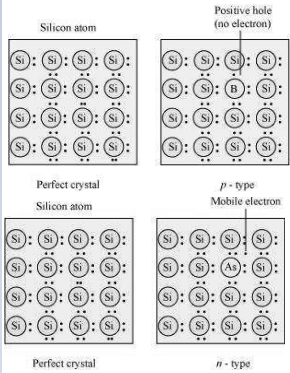
$n$-type semiconductor: The semiconductor whose increased conductivity is a result of negatively-charged electrons is called an $n$-type semiconductor. When the crystal of a group $14$ element such as $Si$ or $Ge$ is doped with a group $15$ element such as $P$ or $As$,an $n$-type semiconductor is generated.
$Si$ and $Ge$ have four valence electrons each. In their crystals,each atom forms four covalent bonds. On the other hand,$P$ and $As$ contain five valence electrons each. When $Si$ or $Ge$ is doped with $P$ or $As$,the latter occupies some of the lattice sites in the crystal. Four out of five electrons are used in the formation of four covalent bonds with four neighbouring $Si$ or $Ge$ atoms. The remaining fifth electron becomes delocalised and increases the conductivity of the doped $Si$ or $Ge$.
$p$-type semiconductor: The semiconductor whose increased conductivity is a result of electron holes is called a $p$-type semiconductor. When a crystal of group $14$ elements such as $Si$ or $Ge$ is doped with a group $13$ element such as $B$,$Al$,or $Ga$ (which contains only three valence electrons),a $p$-type semiconductor is generated.
When a crystal of $Si$ is doped with $B$,the three electrons of $B$ are used in the formation of three covalent bonds and an electron hole is created. An electron from the neighbouring atom can come and fill this electron hole,but in doing so,it would leave an electron hole at its original position. The process appears as if the electron hole has moved in the direction opposite to that of the electron that filled it. Therefore,when an electric field is applied,electrons will move toward the positively-charged plate through electron holes. However,it will appear as if the electron holes are positively-charged and are moving toward the negatively-charged plate.
The two main types of semiconductors are:
$(i)$ $n$-type semiconductor
$(ii)$ $p$-type semiconductor
$n$-type semiconductor: The semiconductor whose increased conductivity is a result of negatively-charged electrons is called an $n$-type semiconductor. When the crystal of a group $14$ element such as $Si$ or $Ge$ is doped with a group $15$ element such as $P$ or $As$,an $n$-type semiconductor is generated.
$Si$ and $Ge$ have four valence electrons each. In their crystals,each atom forms four covalent bonds. On the other hand,$P$ and $As$ contain five valence electrons each. When $Si$ or $Ge$ is doped with $P$ or $As$,the latter occupies some of the lattice sites in the crystal. Four out of five electrons are used in the formation of four covalent bonds with four neighbouring $Si$ or $Ge$ atoms. The remaining fifth electron becomes delocalised and increases the conductivity of the doped $Si$ or $Ge$.
$p$-type semiconductor: The semiconductor whose increased conductivity is a result of electron holes is called a $p$-type semiconductor. When a crystal of group $14$ elements such as $Si$ or $Ge$ is doped with a group $13$ element such as $B$,$Al$,or $Ga$ (which contains only three valence electrons),a $p$-type semiconductor is generated.
When a crystal of $Si$ is doped with $B$,the three electrons of $B$ are used in the formation of three covalent bonds and an electron hole is created. An electron from the neighbouring atom can come and fill this electron hole,but in doing so,it would leave an electron hole at its original position. The process appears as if the electron hole has moved in the direction opposite to that of the electron that filled it. Therefore,when an electric field is applied,electrons will move toward the positively-charged plate through electron holes. However,it will appear as if the electron holes are positively-charged and are moving toward the negatively-charged plate.
0 likes
View Solution150
Easy
Classify each of the following as being either a $p$-type or a $n$-type semiconductor:
$(i)$ $Ge$ doped with $In$
$(ii)$ $Si$ doped with $B$.
$(i)$ $Ge$ doped with $In$
$(ii)$ $Si$ doped with $B$.
Solution
(A) $(i)$ $Ge$ (a group $14$ element) is doped with $In$ (a group $13$ element). Since $In$ has one less valence electron than $Ge$,a hole is created,resulting in a $p$-type semiconductor.
$(ii)$ $Si$ (a group $14$ element) is doped with $B$ (a group $13$ element). Similar to the first case,$B$ has one less valence electron than $Si$,creating a hole,which also results in a $p$-type semiconductor.
$(ii)$ $Si$ (a group $14$ element) is doped with $B$ (a group $13$ element). Similar to the first case,$B$ has one less valence electron than $Si$,creating a hole,which also results in a $p$-type semiconductor.
0 likes
View SolutionSolid State — Type of solid and Their properties · Frequently Asked Questions
1Are these Solid State questions useful for JEE and NEET?
Yes. All questions in this section are mapped to JEE Main and NEET exam patterns. Previous year questions from JEE Main, NEET, GUJCET and state-level exams are included with full solutions.
2Can I switch to Hindi or Gujarati for these questions?
Yes. Use the language tabs in the hero section or the sidebar to view the same questions and solutions in English, Hindi or Gujarati.
3How do I generate a question paper from this subtopic?
Use the Vedclass Exam Paper Generator — select the chapter and subtopic, set difficulty, and generate Sets A, B, C, D automatically. First 3 chapters of every subject are free.
Vedclass Products
For Students
Vedclass Test Series
Mock tests in real JEE/NEET style with performance analysis. 5-day free trial.
Start Free TrialFor Teachers
Exam Paper Generator
Generate Set A/B/C/D papers from this chapter in 2 minutes. 3 chapters free.
Try FreeFor Institutes
Online Exam Module
Live online exams with unlimited students, 360° analytics & white-label branding.
See DemoFor Teachers & Institutes
Generate a Solid State Exam Paper in 2 Minutes
Select subtopic & difficulty — Sets A, B, C, D auto-generated with No Repeat logic.
First 3 chapters of every subject are free — no payment required.