
A English
Type of solid and Their properties Questions in English
Class 12 Chemistry · Solid State · Type of solid and Their properties
281+
Questions
English
Language
100%
With Solutions
Showing 50 of 281 questions in English
151
Easy
In terms of band theory,what is the difference:
$(i)$ Between a conductor and an insulator
$(ii)$ Between a conductor and a semiconductor
$(i)$ Between a conductor and an insulator
$(ii)$ Between a conductor and a semiconductor
Solution
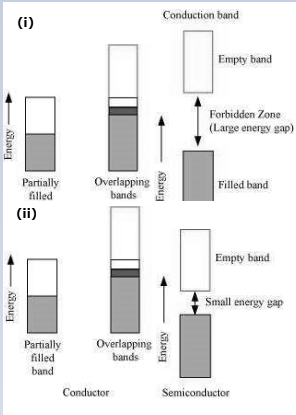
(N/A) $(i)$ The valence band of a conductor is partially-filled or it overlaps with a higher energy,unoccupied conduction band.
On the other hand,in the case of an insulator,the valence band is fully-filled and there is a large energy gap between the valence band and the conduction band.
$(ii)$ In the case of a conductor,the valence band is partially-filled or it overlaps with a higher energy,unoccupied conduction band. So,the electrons can flow easily under an applied electric field.
On the other hand,the valence band of a semiconductor is filled and there is a small energy gap between the valence band and the next higher conduction band. Therefore,some electrons can jump from the valence band to the conduction band and conduct electricity.
On the other hand,in the case of an insulator,the valence band is fully-filled and there is a large energy gap between the valence band and the conduction band.
$(ii)$ In the case of a conductor,the valence band is partially-filled or it overlaps with a higher energy,unoccupied conduction band. So,the electrons can flow easily under an applied electric field.
On the other hand,the valence band of a semiconductor is filled and there is a small energy gap between the valence band and the next higher conduction band. Therefore,some electrons can jump from the valence band to the conduction band and conduct electricity.
0 likes
View Solution152
Easy
Explain the following with suitable examples:
$(i)$ Ferromagnetism
$(i)$ Ferromagnetism
Solution
(N/A) $(i)$ Ferromagnetism: The substances that are strongly attracted by a magnetic field are called ferromagnetic substances.
Ferromagnetic substances can be permanently magnetised even in the absence of a magnetic field.
Some examples of ferromagnetic substances are iron,cobalt,nickel,gadolinium,and $CrO_2$.
In solid state,the metal ions of ferromagnetic substances are grouped together into small regions called domains and each domain acts as a tiny magnet.
In an unmagnetised piece of a ferromagnetic substance,the domains are randomly-oriented and so,their magnetic moments get cancelled.
However,when the substance is placed in a magnetic field,all the domains get oriented in the direction of the magnetic field.
As a result,a strong magnetic effect is produced.
This ordering of domains persists even after the removal of the magnetic field.
Thus,the ferromagnetic substance becomes a permanent magnet.
Schematic alignment of magnetic moments in ferromagnetic substances:
Ferromagnetic substances can be permanently magnetised even in the absence of a magnetic field.
Some examples of ferromagnetic substances are iron,cobalt,nickel,gadolinium,and $CrO_2$.
In solid state,the metal ions of ferromagnetic substances are grouped together into small regions called domains and each domain acts as a tiny magnet.
In an unmagnetised piece of a ferromagnetic substance,the domains are randomly-oriented and so,their magnetic moments get cancelled.
However,when the substance is placed in a magnetic field,all the domains get oriented in the direction of the magnetic field.
As a result,a strong magnetic effect is produced.
This ordering of domains persists even after the removal of the magnetic field.
Thus,the ferromagnetic substance becomes a permanent magnet.
Schematic alignment of magnetic moments in ferromagnetic substances:

0 likes
View Solution153
Easy
Explain the following with suitable examples:
$(ii)$ Paramagnetism
$(ii)$ Paramagnetism
Solution
(N/A) $(ii)$ Paramagnetism: The substances that are attracted by a magnetic field are called paramagnetic substances. Some examples of paramagnetic substances are $O_2$,$Cu^{2+}$,$Fe^{3+}$,and $Cr^{3+}$.
Paramagnetic substances get magnetised in a magnetic field in the same direction,but lose magnetism when the magnetic field is removed. To undergo paramagnetism,a substance must have one or more unpaired electrons. This is because the unpaired electrons are attracted by a magnetic field,thereby causing paramagnetism.
Paramagnetic substances get magnetised in a magnetic field in the same direction,but lose magnetism when the magnetic field is removed. To undergo paramagnetism,a substance must have one or more unpaired electrons. This is because the unpaired electrons are attracted by a magnetic field,thereby causing paramagnetism.
0 likes
View Solution154
Easy
Explain the following with suitable examples:
$(iii)$ Ferrimagnetism
$(iii)$ Ferrimagnetism
Solution
(N/A) $(iii)$ Ferrimagnetism: The substances in which the magnetic moments of the domains are aligned in parallel and anti-parallel directions,in unequal numbers,are said to exhibit ferrimagnetism.
Examples include $Fe_3O_4$ (magnetite),and ferrites such as $MgFe_2O_4$ and $ZnFe_2O_4$.
Ferrimagnetic substances are weakly attracted by a magnetic field as compared to ferromagnetic substances. On heating,these substances become paramagnetic.
Schematic alignment of magnetic moments in ferrimagnetic substances: (Up,Down,Down,Up,Down,Down)
Examples include $Fe_3O_4$ (magnetite),and ferrites such as $MgFe_2O_4$ and $ZnFe_2O_4$.
Ferrimagnetic substances are weakly attracted by a magnetic field as compared to ferromagnetic substances. On heating,these substances become paramagnetic.
Schematic alignment of magnetic moments in ferrimagnetic substances: (Up,Down,Down,Up,Down,Down)

0 likes
View Solution155
Easy
Explain the following with suitable examples:
$iv$. Antiferromagnetism
$iv$. Antiferromagnetism
Solution
(N/A) $iv$. Antiferromagnetism: Antiferromagnetic substances have domain structures similar to ferromagnetic substances,but are oppositely-oriented.
The oppositely-oriented domains cancel out each other's magnetic moments,resulting in a net magnetic moment of zero.
Example: $MnO$ (Manganese$(II)$ oxide).
Schematic alignment of magnetic moments in antiferromagnetic substances:
The oppositely-oriented domains cancel out each other's magnetic moments,resulting in a net magnetic moment of zero.
Example: $MnO$ (Manganese$(II)$ oxide).
Schematic alignment of magnetic moments in antiferromagnetic substances:

0 likes
View Solution156
Easy
Explain the following with suitable examples:
$(v)$ $12-16$ and $13-15$ group compounds.
$(v)$ $12-16$ and $13-15$ group compounds.
Solution
(N/A) $(v)$ $12-16$ and $13-15$ group compounds: The $12-16$ group compounds are prepared by combining group $12$ and group $16$ elements,and the $13-15$ group compounds are prepared by combining group $13$ and group $15$ elements.
These compounds are prepared to simulate the average valence of $4$,as seen in $Ge$ or $Si$.
$13-15$ group compounds: Examples include indium $(III)$ antimonide $(InSb)$,aluminium phosphide $(AlP)$,and gallium arsenide $(GaAs)$. $GaAs$ semiconductors have a very fast response time and have revolutionised the design of semiconductor devices.
$12-16$ group compounds: Examples include zinc sulphide $(ZnS)$,cadmium sulphide $(CdS)$,cadmium selenide $(CdSe)$,and mercury $(II)$ telluride $(HgTe)$.
The bonds in these compounds are not perfectly covalent; the ionic character of the bonds depends on the electronegativities of the two elements.
These compounds are prepared to simulate the average valence of $4$,as seen in $Ge$ or $Si$.
$13-15$ group compounds: Examples include indium $(III)$ antimonide $(InSb)$,aluminium phosphide $(AlP)$,and gallium arsenide $(GaAs)$. $GaAs$ semiconductors have a very fast response time and have revolutionised the design of semiconductor devices.
$12-16$ group compounds: Examples include zinc sulphide $(ZnS)$,cadmium sulphide $(CdS)$,cadmium selenide $(CdSe)$,and mercury $(II)$ telluride $(HgTe)$.
The bonds in these compounds are not perfectly covalent; the ionic character of the bonds depends on the electronegativities of the two elements.
0 likes
View Solution157
Easy
Explain the terms 'fluids' and 'rigidity' in the context of states of matter.
Solution
(N/A) Liquids and gases are called $fluids$ because they have the ability to flow. Their constituent particles are free to move around.
In solids,the constituent particles have fixed positions and can only oscillate about their mean positions. This property is known as the $rigidity$ of solids.
Both these properties depend on the nature of the constituent particles and the intermolecular forces acting between them.
In solids,the constituent particles have fixed positions and can only oscillate about their mean positions. This property is known as the $rigidity$ of solids.
Both these properties depend on the nature of the constituent particles and the intermolecular forces acting between them.
0 likes
View Solution158
Medium
Enlist the characteristic properties of solid state.
Solution
(N/A) Solids have definite mass,volume,and shape.
Intermolecular distances are short.
Intermolecular forces are strong.
The constituent particles (atoms,molecules,or ions) in solids have fixed positions and can only oscillate about their mean positions.
They are rigid and incompressible.
Intermolecular distances are short.
Intermolecular forces are strong.
The constituent particles (atoms,molecules,or ions) in solids have fixed positions and can only oscillate about their mean positions.
They are rigid and incompressible.
0 likes
View Solution159
EasyMCQ
What are the characteristics of intermolecular distance and intermolecular forces in a solid state?
A
Short intermolecular distance and strong intermolecular forces
B
Long intermolecular distance and weak intermolecular forces
C
Short intermolecular distance and weak intermolecular forces
D
Long intermolecular distance and strong intermolecular forces
Solution
(A) In a solid state,the constituent particles (atoms,molecules,or ions) are held together by strong intermolecular forces of attraction.
Due to these strong forces,the particles are packed closely together,resulting in a very short intermolecular distance.
Therefore,solids have a fixed shape and volume.
Due to these strong forces,the particles are packed closely together,resulting in a very short intermolecular distance.
Therefore,solids have a fixed shape and volume.
0 likes
View Solution160
EasyMCQ
Why are solids rigid?
A
Because they have high density.
B
Because their constituent particles have fixed positions and can only oscillate about their mean positions.
C
Because they have strong intermolecular forces.
D
Because they have a definite shape.
Solution
(B) Solids are rigid because their constituent particles (atoms,molecules,or ions) are held together by strong intermolecular forces of attraction.
These particles have fixed positions and cannot move freely; they can only oscillate about their mean positions,which gives solids their rigid structure.
These particles have fixed positions and cannot move freely; they can only oscillate about their mean positions,which gives solids their rigid structure.
0 likes
View Solution161
Difficult
Explain crystalline and amorphous solids.
Solution
(N/A) Based on the arrangement of particles,solids are broadly classified as:
$(i)$ Crystalline solids
$(ii)$ Amorphous solids
$(i)$ Crystalline Solids: $A$ solid in which the constituent particles have definite ordered arrangements are called crystalline solids.
$A$ crystalline solid consists of a large number of small crystals,each of them having a definite characteristic geometrical shape.
In a crystal,the arrangement of constituent particles (atoms,molecules or ions) is ordered and repetitive in three dimensions. It has a long-range order which means that there is a regular pattern of arrangement of particles which repeats itself periodically over the entire crystal.
Crystalline solids have a sharp melting point and at a characteristic temperature,they melt abruptly and become liquid. They are anisotropic,meaning their physical properties like electrical resistance or refractive index show different values when measured along different directions. Examples include $NaCl$ and quartz.
$(ii)$ Amorphous Solids: The term amorphous comes from the Greek word 'amorphos',meaning 'no form'.
In amorphous solids,the constituent particles (atoms,molecules or ions) do not have a long-range order. They have only short-range order,where the regular and periodically repeating pattern is observed only over short distances.
Amorphous solids soften over a range of temperature and can be moulded and blown into various shapes. They are isotropic in nature,meaning their physical properties are the same in all directions. Examples include glass,rubber,and plastics.
$(i)$ Crystalline solids
$(ii)$ Amorphous solids
$(i)$ Crystalline Solids: $A$ solid in which the constituent particles have definite ordered arrangements are called crystalline solids.
$A$ crystalline solid consists of a large number of small crystals,each of them having a definite characteristic geometrical shape.
In a crystal,the arrangement of constituent particles (atoms,molecules or ions) is ordered and repetitive in three dimensions. It has a long-range order which means that there is a regular pattern of arrangement of particles which repeats itself periodically over the entire crystal.
Crystalline solids have a sharp melting point and at a characteristic temperature,they melt abruptly and become liquid. They are anisotropic,meaning their physical properties like electrical resistance or refractive index show different values when measured along different directions. Examples include $NaCl$ and quartz.
$(ii)$ Amorphous Solids: The term amorphous comes from the Greek word 'amorphos',meaning 'no form'.
In amorphous solids,the constituent particles (atoms,molecules or ions) do not have a long-range order. They have only short-range order,where the regular and periodically repeating pattern is observed only over short distances.
Amorphous solids soften over a range of temperature and can be moulded and blown into various shapes. They are isotropic in nature,meaning their physical properties are the same in all directions. Examples include glass,rubber,and plastics.
0 likes
View Solution162
Medium
What are polycrystalline solids?
Solution
(N/A) - Some solids appear to be amorphous but actually possess microcrystalline structures. Such substances are known as polycrystalline solids.
- Example: Metals are often found in a polycrystalline state.
- In a metal sample,individual crystals are randomly oriented,which makes the bulk material appear isotropic even though the individual crystals are anisotropic.
- Example: Metals are often found in a polycrystalline state.
- In a metal sample,individual crystals are randomly oriented,which makes the bulk material appear isotropic even though the individual crystals are anisotropic.
0 likes
View Solution163
Medium
State the uses of amorphous solids and describe the cleavage property of amorphous solids.
Solution
(N/A) $1$. Amorphous solids like glass,rubber,and plastics are widely used in our daily life.
$2$. Amorphous silicon is one of the best photovoltaic materials available for conversion of sunlight into electricity.
$3$. Cleavage property: When cut with a sharp-edged tool,amorphous solids cut into two pieces with irregular surfaces. They do not show a clean cleavage.
$2$. Amorphous silicon is one of the best photovoltaic materials available for conversion of sunlight into electricity.
$3$. Cleavage property: When cut with a sharp-edged tool,amorphous solids cut into two pieces with irregular surfaces. They do not show a clean cleavage.
0 likes
View Solution164
MediumMCQ
Give examples of crystalline solids and polycrystalline solids.
A
Crystalline: $NaCl$,$Quartz$; Polycrystalline: $Metals$
B
Crystalline: $Glass$,$Rubber$; Polycrystalline: $Plastic$
C
Crystalline: $Plastic$,$Glass$; Polycrystalline: $Quartz$
D
Crystalline: $Rubber$,$Plastic$; Polycrystalline: $NaCl$
Solution
(A) Crystalline solids are those in which the constituent particles have a regular,repeating arrangement throughout the entire structure. Examples include $NaCl$,$Quartz$,and $Diamond$.
Polycrystalline solids are composed of many small crystalline grains separated by grain boundaries. Most metals and ceramics are examples of polycrystalline solids.
Polycrystalline solids are composed of many small crystalline grains separated by grain boundaries. Most metals and ceramics are examples of polycrystalline solids.
0 likes
View Solution165
Easy
Define the term 'Isotropic' property.
Solution
(N/A) The property in which the physical properties of a substance,such as electrical conductivity,refractive index,and thermal expansion,are identical in all directions is known as the 'Isotropic' property. This is a characteristic feature of amorphous solids.
0 likes
View Solution166
EasyMCQ
Why are amorphous solids called pseudo solids or supercooled liquids?
A
They have a long-range order.
B
They have a tendency to flow very slowly over time.
C
They have a sharp melting point.
D
They are isotropic in nature.
Solution
(B) Amorphous solids are called pseudo solids or supercooled liquids because they possess a tendency to flow very slowly over a long period of time,similar to liquids. This is evident in old window panes which appear slightly thicker at the bottom due to the downward flow of glass over many years.
0 likes
View Solution167
EasyMCQ
What is the order of arrangement of constituent particles in a crystalline solid?
A
Short-range order
B
Long-range order
C
Random arrangement
D
No regular arrangement
Solution
(B) In a crystalline solid,the constituent particles (atoms,molecules,or ions) are arranged in a regular and repeating pattern throughout the entire structure. This is known as $ \text{long-range order} $. Therefore,the correct option is $ B $.
0 likes
View Solution168
Medium
Classify crystalline solids with explanations of their examples and properties.
Solution
(N/A) Crystalline solids are classified into four categories based on the nature of intermolecular forces or the bonds holding the constituent particles together:
$1$. Molecular Solids: These contain molecules as constituent particles. Examples include $I_2$,$S_8$,$P_4$,and $H_2O$ (ice).
$2$. Ionic Solids: These consist of ions as constituent particles held by strong electrostatic forces. Examples include $NaCl$,$ZnS$,and $MgO$.
$3$. Metallic Solids: These consist of positive metal ions surrounded by a sea of delocalized electrons. Examples include $Fe$,$Cu$,and $Ag$.
$4$. Covalent or Network Solids: These consist of atoms linked by a continuous network of covalent bonds. Examples include $SiO_2$ (quartz),$SiC$,and diamond.
$1$. Molecular Solids: These contain molecules as constituent particles. Examples include $I_2$,$S_8$,$P_4$,and $H_2O$ (ice).
$2$. Ionic Solids: These consist of ions as constituent particles held by strong electrostatic forces. Examples include $NaCl$,$ZnS$,and $MgO$.
$3$. Metallic Solids: These consist of positive metal ions surrounded by a sea of delocalized electrons. Examples include $Fe$,$Cu$,and $Ag$.
$4$. Covalent or Network Solids: These consist of atoms linked by a continuous network of covalent bonds. Examples include $SiO_2$ (quartz),$SiC$,and diamond.
0 likes
View Solution169
Medium
What are molecular solids? State its types.
Solution
(N/A) Molecular solids are solids in which the constituent particles are molecules held together by weak Van der Waals forces or hydrogen bonds.
Examples include $I_2$,$P_4$,and $H_2O$ (ice).
Molecular solids are classified into three types:
$i$. Non-polar molecular solids: These consist of atoms or non-polar molecules held by weak London dispersion forces.
$ii$. Polar molecular solids: These consist of polar molecules held by dipole-dipole interactions.
$iii$. Hydrogen-bonded molecular solids: These consist of molecules containing hydrogen atoms linked to highly electronegative atoms ($N$,$O$,or $F$),held by strong hydrogen bonds.
Examples include $I_2$,$P_4$,and $H_2O$ (ice).
Molecular solids are classified into three types:
$i$. Non-polar molecular solids: These consist of atoms or non-polar molecules held by weak London dispersion forces.
$ii$. Polar molecular solids: These consist of polar molecules held by dipole-dipole interactions.
$iii$. Hydrogen-bonded molecular solids: These consist of molecules containing hydrogen atoms linked to highly electronegative atoms ($N$,$O$,or $F$),held by strong hydrogen bonds.
0 likes
View Solution170
Medium
Explain the characteristics of ionic solids.
Solution
(N/A) $1$. The constituent particles of ionic solids are ions.
$2$. These solids are formed by the three-dimensional arrangement of cations and anions bound by strong Coulombic (electrostatic) forces.
$3$. These solids are hard and brittle in nature and possess high melting and boiling points.
$4$. In the solid state,they are electrical insulators because the ions are not free to move. However,in the molten state or when dissolved in water,the ions become free to move,allowing them to conduct electricity.
$2$. These solids are formed by the three-dimensional arrangement of cations and anions bound by strong Coulombic (electrostatic) forces.
$3$. These solids are hard and brittle in nature and possess high melting and boiling points.
$4$. In the solid state,they are electrical insulators because the ions are not free to move. However,in the molten state or when dissolved in water,the ions become free to move,allowing them to conduct electricity.
0 likes
View Solution171
Medium
Write a note on metallic solids.
Solution
(N/A) In metallic solids,there is a three-dimensional arrangement of metal ions surrounded by and held together by a sea of electrons.
The electrons are mobile and are evenly spread out in the entire crystal,and each metal atom contributes one or more electrons towards this sea of mobile electrons. Examples: $Fe, Cu, Ag, Mg$,etc.
Properties of metallic solids:
$1$. Metallic solids are good conductors of heat and electricity because of the presence of mobile electrons.
$2$. When an electric field is applied,these electrons flow through the network of positive ions. Similarly,when heat is supplied to one portion of the metal,the thermal energy is uniformly spread out by the free electrons.
$3$. Metals show lustre and colour in some cases due to the presence of free electrons.
$4$. Metals are malleable and ductile.
The electrons are mobile and are evenly spread out in the entire crystal,and each metal atom contributes one or more electrons towards this sea of mobile electrons. Examples: $Fe, Cu, Ag, Mg$,etc.
Properties of metallic solids:
$1$. Metallic solids are good conductors of heat and electricity because of the presence of mobile electrons.
$2$. When an electric field is applied,these electrons flow through the network of positive ions. Similarly,when heat is supplied to one portion of the metal,the thermal energy is uniformly spread out by the free electrons.
$3$. Metals show lustre and colour in some cases due to the presence of free electrons.
$4$. Metals are malleable and ductile.
0 likes
View Solution172
Difficult
Write a note on covalent or network solids.
Solution
(N/A) - These solids are also known as giant molecules. They consist of atoms held together by covalent bonds throughout the crystal.
- The covalent bonds are strong and directional in nature,which holds the atoms very strongly at their positions.
- These solids are very hard and brittle. They have extremely high melting points and may decompose before melting.
- They are electrical insulators and do not conduct electricity. Examples include diamond and silicon carbide $(SiC)$.
- Graphite is an exception; it is soft and a good conductor of electricity.
- In graphite,each carbon atom is covalently bonded to three neighboring carbon atoms in the same layer,leaving the fourth valence electron free to move between layers,which makes graphite a good conductor.
- Since the layers in graphite can slide over each other,it is a soft solid and acts as a good solid lubricant.
- The covalent bonds are strong and directional in nature,which holds the atoms very strongly at their positions.
- These solids are very hard and brittle. They have extremely high melting points and may decompose before melting.
- They are electrical insulators and do not conduct electricity. Examples include diamond and silicon carbide $(SiC)$.
- Graphite is an exception; it is soft and a good conductor of electricity.
- In graphite,each carbon atom is covalently bonded to three neighboring carbon atoms in the same layer,leaving the fourth valence electron free to move between layers,which makes graphite a good conductor.
- Since the layers in graphite can slide over each other,it is a soft solid and acts as a good solid lubricant.
0 likes
View Solution173
Difficult
Explain the structure of diamond and graphite.
Solution
(N/A) $1$. Diamond and graphite are examples of covalent or network solids. In these,atoms are held together by strong,directional covalent bonds,forming a giant molecular structure.
$2$. Diamond: Each carbon atom is $sp^3$ hybridized and bonded to four other carbon atoms in a tetrahedral geometry. This creates a rigid,three-dimensional network,making diamond the hardest natural substance with a very high melting point. It is an electrical insulator because all valence electrons are involved in bonding.
$3$. Graphite: Each carbon atom is $sp^2$ hybridized and bonded to three other carbon atoms in the same plane,forming hexagonal rings in layers. The fourth valence electron is delocalized between the layers,allowing graphite to conduct electricity. The layers are held by weak van der Waals forces,allowing them to slide over each other,which makes graphite soft and a good lubricant.
$2$. Diamond: Each carbon atom is $sp^3$ hybridized and bonded to four other carbon atoms in a tetrahedral geometry. This creates a rigid,three-dimensional network,making diamond the hardest natural substance with a very high melting point. It is an electrical insulator because all valence electrons are involved in bonding.
$3$. Graphite: Each carbon atom is $sp^2$ hybridized and bonded to three other carbon atoms in the same plane,forming hexagonal rings in layers. The fourth valence electron is delocalized between the layers,allowing graphite to conduct electricity. The layers are held by weak van der Waals forces,allowing them to slide over each other,which makes graphite soft and a good lubricant.
0 likes
View Solution174
EasyMCQ
What is the electrical conductivity of ionic solids?
A
They are good conductors of electricity in the solid state.
B
They are insulators in the solid state but conduct electricity in the molten state or in aqueous solution.
C
They are semiconductors.
D
They are superconductors.
Solution
(B) Ionic solids consist of ions held together by strong electrostatic forces of attraction.
In the solid state,these ions are fixed in their lattice positions and are not free to move.
Therefore,they act as insulators in the solid state.
However,in the molten state or when dissolved in water,the ions become free to move,allowing them to conduct electricity.
In the solid state,these ions are fixed in their lattice positions and are not free to move.
Therefore,they act as insulators in the solid state.
However,in the molten state or when dissolved in water,the ions become free to move,allowing them to conduct electricity.
0 likes
View Solution175
EasyMCQ
Give an example of a metallic crystalline solid.
A
Copper $(Cu)$
B
Sodium chloride $(NaCl)$
C
Diamond $(C)$
D
Dry ice $(CO_2)$
Solution
(A) Metallic solids are composed of positive metal ions surrounded by a sea of delocalized electrons.
Examples include metals like $Cu$,$Fe$,$Ag$,and $Au$.
Therefore,Copper $(Cu)$ is an example of a metallic crystalline solid.
Examples include metals like $Cu$,$Fe$,$Ag$,and $Au$.
Therefore,Copper $(Cu)$ is an example of a metallic crystalline solid.
0 likes
View Solution176
EasyMCQ
What are the constituent particles of metallic solids?
A
Atoms
B
Positive ions in a sea of delocalized electrons
C
Molecules
D
Positive and negative ions
Solution
(B) Metallic solids consist of positive metal ions surrounded by a sea of delocalized electrons. These delocalized electrons are free to move throughout the crystal lattice,which accounts for the high electrical and thermal conductivity of metals. Therefore,the constituent particles are positive ions in a sea of delocalized electrons.
0 likes
View Solution177
Difficult
What are unit cells? State its types. Enlist the characteristics of unit cell. Explain different types of unit cells.
Solution
(N/A) unit cell is the smallest repeating structural unit of a crystalline solid which,when repeated in three dimensions,generates the entire crystal lattice.
Characteristics of a unit cell:
$A$ unit cell is characterized by six parameters: three edge lengths $(a, b, c)$ and three interfacial angles $(\alpha, \beta, \gamma)$.
Types of unit cells:
$1$. Primitive unit cells: Constituent particles are present only at the corner positions.
$2$. Centred unit cells: Constituent particles are present at positions other than corners in addition to those at corners.
Types of centred unit cells:
$(i)$ Body-Centred Unit Cells: Contains one constituent particle at its body-centre in addition to the corners.
$(ii)$ Face-Centred Unit Cells: Contains one constituent particle at the centre of each face in addition to the corners.
$(iii)$ End-Centred Unit Cells: Contains one constituent particle at the centre of any two opposite faces in addition to the corners.
Characteristics of a unit cell:
$A$ unit cell is characterized by six parameters: three edge lengths $(a, b, c)$ and three interfacial angles $(\alpha, \beta, \gamma)$.
Types of unit cells:
$1$. Primitive unit cells: Constituent particles are present only at the corner positions.
$2$. Centred unit cells: Constituent particles are present at positions other than corners in addition to those at corners.
Types of centred unit cells:
$(i)$ Body-Centred Unit Cells: Contains one constituent particle at its body-centre in addition to the corners.
$(ii)$ Face-Centred Unit Cells: Contains one constituent particle at the centre of each face in addition to the corners.
$(iii)$ End-Centred Unit Cells: Contains one constituent particle at the centre of any two opposite faces in addition to the corners.
0 likes
View Solution178
EasyMCQ
Graphite and Cinnabar are examples of $.......$ and $.......$ crystal systems,respectively.
A
Hexagonal and Trigonal
B
Trigonal and Hexagonal
C
Hexagonal and Cubic
D
Orthorhombic and Hexagonal
Solution
(A) Graphite crystallizes in the $Hexagonal$ crystal system.
Cinnabar $(HgS)$ crystallizes in the $Trigonal$ (also known as $Rhombohedral$) crystal system.
Therefore,the correct sequence is $Hexagonal$ and $Trigonal$.
Cinnabar $(HgS)$ crystallizes in the $Trigonal$ (also known as $Rhombohedral$) crystal system.
Therefore,the correct sequence is $Hexagonal$ and $Trigonal$.
0 likes
View Solution179
Medium
Classify solids based on their electrical conductivity.
Solution
(N/A) Solids are classified into three categories based on their electrical conductivity,which ranges over $27$ orders of magnitude,from $10^{-20}$ to $10^{7} \ ohm^{-1} m^{-1}$.
$(i)$ Conductors: These are solids with conductivities in the range of $10^{4}$ to $10^{7} \ ohm^{-1} m^{-1}$. Metals have conductivities in the order of $10^{7} \ ohm^{-1} m^{-1}$ and are good conductors.
$(ii)$ Insulators: These solids have very low electrical conductivity,ranging from $10^{-20}$ to $10^{-10} \ ohm^{-1} m^{-1}$.
$(iii)$ Semiconductors: These are solids with conductivities in the intermediate range,from $10^{-6}$ to $10^{4} \ ohm^{-1} m^{-1}$.
$(i)$ Conductors: These are solids with conductivities in the range of $10^{4}$ to $10^{7} \ ohm^{-1} m^{-1}$. Metals have conductivities in the order of $10^{7} \ ohm^{-1} m^{-1}$ and are good conductors.
$(ii)$ Insulators: These solids have very low electrical conductivity,ranging from $10^{-20}$ to $10^{-10} \ ohm^{-1} m^{-1}$.
$(iii)$ Semiconductors: These are solids with conductivities in the intermediate range,from $10^{-6}$ to $10^{4} \ ohm^{-1} m^{-1}$.
0 likes
View Solution180
Advanced
Explain the electrical conduction in semiconductors.
Solution
(N/A) $1$. In semiconductors,the energy gap between the valence band and the conduction band is small. Therefore,some electrons can jump to the conduction band,showing some conductivity.
$2$. The electrical conductivity of semiconductors increases with an increase in temperature because more electrons can jump into the conduction band.
$3$. $Si$ and $Ge$ exhibit this behavior and are called intrinsic semiconductors.
$4$. The conductivity of semiconductors can be increased by adding an appropriate amount of suitable impurity. This process is called 'doping'.
$5$. Doping can be done using electron-rich or electron-deficient impurities,which creates electronic defects.
$6$. There are two types of electronic defects:
$7$. $(i)$ Electron-rich impurity: Since $Si$ and $Ge$ belong to group $14$ of the periodic table,they have four valence electrons. In their crystal lattice,each atom forms four covalent bonds with neighbors.
$8$. When doped with group $15$ elements like $P$ or $As$,which have five valence electrons,some lattice sites of $Si$ or $Ge$ are occupied by these atoms. Four of the five electrons are used in forming covalent bonds with four neighboring atoms.
$9$. The fifth electron is extra and becomes delocalized. This delocalized electron increases the conductivity of the doped $Si$ or $Ge$.
$2$. The electrical conductivity of semiconductors increases with an increase in temperature because more electrons can jump into the conduction band.
$3$. $Si$ and $Ge$ exhibit this behavior and are called intrinsic semiconductors.
$4$. The conductivity of semiconductors can be increased by adding an appropriate amount of suitable impurity. This process is called 'doping'.
$5$. Doping can be done using electron-rich or electron-deficient impurities,which creates electronic defects.
$6$. There are two types of electronic defects:
$7$. $(i)$ Electron-rich impurity: Since $Si$ and $Ge$ belong to group $14$ of the periodic table,they have four valence electrons. In their crystal lattice,each atom forms four covalent bonds with neighbors.
$8$. When doped with group $15$ elements like $P$ or $As$,which have five valence electrons,some lattice sites of $Si$ or $Ge$ are occupied by these atoms. Four of the five electrons are used in forming covalent bonds with four neighboring atoms.
$9$. The fifth electron is extra and becomes delocalized. This delocalized electron increases the conductivity of the doped $Si$ or $Ge$.
0 likes
View Solution181
Advanced
Write a note on $n$-type and $p$-type semiconductors.
Solution
(N/A) $n$-type semiconductors: These are formed when group $14$ elements (like $Si$ or $Ge$) are doped with group $15$ elements (like $P$ or $As$). The dopant has $5$ valence electrons,$4$ of which form covalent bonds with the host atoms,leaving one extra electron free to conduct electricity. Since the charge carriers are electrons (negative charge),they are called $n$-type semiconductors.
$p$-type semiconductors: These are formed when group $14$ elements are doped with group $13$ elements (like $B$ or $Al$). The dopant has only $3$ valence electrons,creating an electron vacancy or 'hole' in the crystal lattice. These holes move through the crystal,allowing for electrical conductivity. Since the charge carriers are effectively positive holes,they are called $p$-type semiconductors.
$p$-type semiconductors: These are formed when group $14$ elements are doped with group $13$ elements (like $B$ or $Al$). The dopant has only $3$ valence electrons,creating an electron vacancy or 'hole' in the crystal lattice. These holes move through the crystal,allowing for electrical conductivity. Since the charge carriers are effectively positive holes,they are called $p$-type semiconductors.
0 likes
View Solution182
Advanced
Explain electron-rich impurities and electron-deficient impurities in semiconductors.
Solution
(N/A) $1$. Electron-rich impurities: These are formed when group-$15$ elements (like $P$ or $As$) are doped into group-$14$ elements (like $Si$ or $Ge$). Since group-$15$ elements have $5$ valence electrons,$4$ electrons are used for covalent bonding with $Si/Ge$ atoms,and the $5$th electron remains free,creating an $n$-type semiconductor.
$2$. Electron-deficient impurities: These are formed when group-$13$ elements (like $B$ or $Al$) are doped into group-$14$ elements. Since group-$13$ elements have only $3$ valence electrons,they create an electron hole (vacancy) in the lattice,which acts as a positive charge carrier,creating a $p$-type semiconductor.
$2$. Electron-deficient impurities: These are formed when group-$13$ elements (like $B$ or $Al$) are doped into group-$14$ elements. Since group-$13$ elements have only $3$ valence electrons,they create an electron hole (vacancy) in the lattice,which acts as a positive charge carrier,creating a $p$-type semiconductor.
0 likes
View Solution183
Medium
Write the uses of $n$-type and $p$-type semiconductors.
Solution
(N/A) $n$-type and $p$-type semiconductors are used in the following ways:
$1$. They are used to form $p-n$ junctions,which are the building blocks of electronic devices.
$2$. They are used in the manufacturing of diodes,which are used for rectification (converting $AC$ to $DC$).
$3$. They are used in transistors,which are used for detecting or amplifying radio or audio signals.
$4$. They are used in the production of photo-diodes,which are used for detecting optical signals.
$5$. They are used in solar cells for the conversion of light energy into electrical energy.
$1$. They are used to form $p-n$ junctions,which are the building blocks of electronic devices.
$2$. They are used in the manufacturing of diodes,which are used for rectification (converting $AC$ to $DC$).
$3$. They are used in transistors,which are used for detecting or amplifying radio or audio signals.
$4$. They are used in the production of photo-diodes,which are used for detecting optical signals.
$5$. They are used in solar cells for the conversion of light energy into electrical energy.
0 likes
View Solution184
EasyMCQ
What is the order of electrical conductivity in metals?
A
Metals > Semiconductors > Insulators
B
Insulators > Semiconductors > Metals
C
Semiconductors > Metals > Insulators
D
Metals > Insulators > Semiconductors
Solution
(A) The electrical conductivity of solids is classified based on their ability to conduct electricity.
Metals are excellent conductors of electricity with conductivity in the range of $10^7 \ \Omega^{-1} \ m^{-1}$.
Semiconductors have intermediate conductivity ranging from $10^2$ to $10^9 \ \Omega^{-1} \ m^{-1}$.
Insulators have very low conductivity,typically ranging from $10^{-20}$ to $10^{-10} \ \Omega^{-1} \ m^{-1}$.
Therefore,the correct order is $Metals > Semiconductors > Insulators$.
Metals are excellent conductors of electricity with conductivity in the range of $10^7 \ \Omega^{-1} \ m^{-1}$.
Semiconductors have intermediate conductivity ranging from $10^2$ to $10^9 \ \Omega^{-1} \ m^{-1}$.
Insulators have very low conductivity,typically ranging from $10^{-20}$ to $10^{-10} \ \Omega^{-1} \ m^{-1}$.
Therefore,the correct order is $Metals > Semiconductors > Insulators$.
0 likes
View Solution185
EasyMCQ
Give examples of intrinsic semiconductors.
A
Silicon $(Si)$
B
Germanium $(Ge)$
C
Both $(A)$ and $(B)$
D
Copper $(Cu)$
Solution
(C) Intrinsic semiconductors are pure elements that conduct electricity without any doping.
Examples of intrinsic semiconductors include pure Silicon $(Si)$ and pure Germanium $(Ge)$.
Examples of intrinsic semiconductors include pure Silicon $(Si)$ and pure Germanium $(Ge)$.
0 likes
View Solution186
EasyMCQ
Which type of impurity is added to form a $p$-type semiconductor?
A
Group $13$ element
B
Group $14$ element
C
Group $15$ element
D
Group $16$ element
Solution
(A) $p$-type semiconductors are formed by doping intrinsic semiconductors (like $Si$ or $Ge$ of Group $14$) with impurities from Group $13$ elements.
These elements have only $3$ valence electrons,creating an electron hole (vacancy) in the crystal lattice,which facilitates electrical conduction.
These elements have only $3$ valence electrons,creating an electron hole (vacancy) in the crystal lattice,which facilitates electrical conduction.
0 likes
View Solution187
Difficult
Explain the magnetic properties of solids.
Solution
(N/A) Every substance has some magnetic properties associated with it. The origin of these properties lies in the electrons.
Each electron in an atom behaves like a tiny magnet.
Its magnetic moment originates from two types of motions: $(i)$ Orbital motion around the nucleus,$(ii)$ Spin motion around its own axis.
Each electron has a permanent spin and an orbital magnetic moment associated with it.
This magnitude of magnetic moment is very small and is measured in the unit Bohr magneton,denoted as $\mu_{B}$,which is equal to $9.27 \times 10^{-24} \ A \ m^{2}$.
Each electron in an atom behaves like a tiny magnet.
Its magnetic moment originates from two types of motions: $(i)$ Orbital motion around the nucleus,$(ii)$ Spin motion around its own axis.
Each electron has a permanent spin and an orbital magnetic moment associated with it.
This magnitude of magnetic moment is very small and is measured in the unit Bohr magneton,denoted as $\mu_{B}$,which is equal to $9.27 \times 10^{-24} \ A \ m^{2}$.
0 likes
View Solution188
Advanced
Explain paramagnetism and diamagnetism. Write a note on ferromagnetism. Explain antiferromagnetism.
Solution
(N/A) Paramagnetism: Substances that are weakly attracted by a magnetic field are called paramagnetic substances. They are magnetized in a magnetic field in the same direction and lose their magnetism in the absence of the magnetic field. This is due to the presence of one or more unpaired electrons.
Diamagnetism: Substances that are weakly repelled by a magnetic field are called diamagnetic substances. They are weakly magnetized in a magnetic field in the opposite direction. This is due to the presence of only paired electrons.
Ferromagnetism: Substances that are attracted strongly by a magnetic field and retain magnetism even in the absence of magnetic fields are called ferromagnetic substances. In solid state,the metal ions are grouped together into small regions called domains. Each domain acts as a tiny magnet. In an unmagnetized piece,domains are randomly oriented,cancelling their magnetic moments. When placed in a magnetic field,all domains orient in the direction of the field,producing a strong magnetic effect. This ordering persists even after the field is removed,making them permanent magnets.
Antiferromagnetism: Substances that have zero net magnetic moment despite having unpaired electrons are called antiferromagnetic substances. In these,the domain structure is similar to ferromagnetic substances,but the domains are oriented in opposite directions,cancelling each other's magnetic moments. Examples: $MnO$,$Fe_{2}O_{3}$,$V_{2}O_{3}$.
Diamagnetism: Substances that are weakly repelled by a magnetic field are called diamagnetic substances. They are weakly magnetized in a magnetic field in the opposite direction. This is due to the presence of only paired electrons.
Ferromagnetism: Substances that are attracted strongly by a magnetic field and retain magnetism even in the absence of magnetic fields are called ferromagnetic substances. In solid state,the metal ions are grouped together into small regions called domains. Each domain acts as a tiny magnet. In an unmagnetized piece,domains are randomly oriented,cancelling their magnetic moments. When placed in a magnetic field,all domains orient in the direction of the field,producing a strong magnetic effect. This ordering persists even after the field is removed,making them permanent magnets.
Antiferromagnetism: Substances that have zero net magnetic moment despite having unpaired electrons are called antiferromagnetic substances. In these,the domain structure is similar to ferromagnetic substances,but the domains are oriented in opposite directions,cancelling each other's magnetic moments. Examples: $MnO$,$Fe_{2}O_{3}$,$V_{2}O_{3}$.
0 likes
View Solution189
EasyMCQ
$NaCl$ and $C_6H_6$ exhibit which type of magnetism?
A
Paramagnetism
B
Diamagnetism
C
Ferromagnetism
D
Antiferromagnetism
Solution
(B) Substances that are weakly repelled by an external magnetic field are called diamagnetic substances.
$NaCl$ and $C_6H_6$ (benzene) have all their electrons paired.
Therefore,they exhibit diamagnetism.
$NaCl$ and $C_6H_6$ (benzene) have all their electrons paired.
Therefore,they exhibit diamagnetism.
0 likes
View Solution190
EasyMCQ
What type of magnetism is exhibited by $MnO$?
A
Paramagnetism
B
Diamagnetism
C
Ferromagnetism
D
Antiferromagnetism
Solution
(D) In $MnO$,the magnetic moments of the $Mn^{2+}$ ions are aligned in a compensatory manner,such that the net magnetic moment is zero. This type of magnetic behavior is known as $Antiferromagnetism$.
0 likes
View Solution191
EasyMCQ
Give examples of ferrimagnetism.
A
$Fe_3O_4$ (magnetite)
B
$MgFe_2O_4$
C
$CuFe_2O_4$
D
All of the above
Solution
(D) Ferrimagnetism is observed when the magnetic moments of the domains in the substance are aligned in parallel and anti-parallel directions in unequal numbers.
Examples of ferrimagnetic substances include $Fe_3O_4$ (magnetite),$MgFe_2O_4$,and $CuFe_2O_4$.
These substances lose ferrimagnetism on heating and become paramagnetic.
Examples of ferrimagnetic substances include $Fe_3O_4$ (magnetite),$MgFe_2O_4$,and $CuFe_2O_4$.
These substances lose ferrimagnetism on heating and become paramagnetic.
0 likes
View Solution192
EasyMCQ
What is a domain in the context of magnetism in solids?
A
$A$ region where all magnetic moments are aligned in the same direction.
B
$A$ region where magnetic moments are randomly oriented.
C
$A$ region where magnetic moments are aligned in opposite directions.
D
$A$ region where there is no magnetic moment.
Solution
(A) In ferromagnetic substances,the metal ions are grouped together into small regions called $domains$.
Each $domain$ acts as a tiny magnet.
When the substance is placed in a magnetic field,all the $domains$ get oriented in the direction of the magnetic field and a strong magnetic effect is produced.
Each $domain$ acts as a tiny magnet.
When the substance is placed in a magnetic field,all the $domains$ get oriented in the direction of the magnetic field and a strong magnetic effect is produced.
0 likes
View Solution193
EasyMCQ
Why are solids incompressible?
A
Due to large interparticle distance.
B
Due to strong electrostatic forces of attraction.
C
Due to very small interparticle distance and strong repulsive forces between electron clouds when compressed.
D
Due to the presence of free electrons.
Solution
(C) In solids,the constituent particles are held very closely together,resulting in a very small interparticle distance.
When an external pressure is applied to compress a solid,the particles are forced even closer.
At this reduced distance,the repulsive forces between the electron clouds of the particles become dominant and resist further compression.
Therefore,solids are considered incompressible.
When an external pressure is applied to compress a solid,the particles are forced even closer.
At this reduced distance,the repulsive forces between the electron clouds of the particles become dominant and resist further compression.
Therefore,solids are considered incompressible.
0 likes
View Solution194
Easy
Why does the electrical conductivity of semiconductors increase with a rise in temperature?
Solution
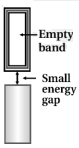
In semiconductors,there is a small energy gap between the valence band and the conduction band.
As the temperature increases,more electrons gain sufficient thermal energy to overcome this small energy gap.
Consequently,these electrons jump from the valence band into the conduction band,increasing the number of charge carriers and thus enhancing the electrical conductivity.
As the temperature increases,more electrons gain sufficient thermal energy to overcome this small energy gap.
Consequently,these electrons jump from the valence band into the conduction band,increasing the number of charge carriers and thus enhancing the electrical conductivity.
0 likes
View Solution195
Medium
Explain why the conductivity of germanium crystals increases on doping with gallium.
Solution
(N/A) When germanium is doped with gallium,some of the lattice positions of germanium are occupied by gallium atoms. Gallium has only $3$ valence electrons,which are used to form covalent bonds with neighboring germanium atoms. Consequently,for every gallium atom,a vacancy or 'hole' is created at the site where the $4^{th}$ electron is missing. These holes are responsible for electrical conduction. Under the influence of an electric field,electrons from neighboring atoms move to fill these holes,effectively causing the holes to move towards the negatively charged plate,while electrons move towards the positively charged plate,thus increasing the conductivity.
0 likes
View Solution196
EasyMCQ
Under which situations can an amorphous substance change to crystalline form?
A
By rapid cooling of the melt
B
By annealing (slow heating and cooling) over a long period of time
C
By applying high pressure at room temperature
D
By dissolving in a solvent and evaporating
Solution
(B) An amorphous solid can be changed to a crystalline solid by the process of annealing,which involves slowly heating and cooling the substance over a long period of time. This allows the particles to arrange themselves into a regular,ordered pattern.
0 likes
View Solution197
EasyMCQ
What type of substance is $TiO$?
A
Ferromagnetic
B
Paramagnetic
C
Diamagnetic
D
Antiferromagnetic
Solution
(B) In $TiO$,the oxidation state of $Ti$ is $+2$. The electronic configuration of $Ti^{2+}$ is $[Ar] 3d^2$. Since it has unpaired electrons,it exhibits metallic properties and is known to be a metallic conductor. However,in terms of magnetic behavior,$TiO$ is classified as a paramagnetic substance due to the presence of unpaired electrons in the $3d$ orbitals.
0 likes
View Solution198
Advanced
How does doping increase the conductivity of semiconductors?
Solution
(N/A) Doping involves adding small amounts of impurities to a semiconductor to modify its electrical properties.
$1$. When a semiconductor like $Si$ or $Ge$ is doped with electron-rich impurities (Group $15$ elements like $P$ or $As$),the extra valence electrons become delocalized,increasing conductivity. This is known as an $n$-type semiconductor.
$2$. When doped with electron-deficient impurities (Group $13$ elements like $B$ or $Al$),the crystal lattice develops electron vacancies called 'holes'. These holes allow electrons to move,thereby increasing conductivity. This is known as a $p$-type semiconductor.
Thus,doping introduces electronic defects that facilitate charge carrier movement,significantly enhancing electrical conductivity.
$1$. When a semiconductor like $Si$ or $Ge$ is doped with electron-rich impurities (Group $15$ elements like $P$ or $As$),the extra valence electrons become delocalized,increasing conductivity. This is known as an $n$-type semiconductor.
$2$. When doped with electron-deficient impurities (Group $13$ elements like $B$ or $Al$),the crystal lattice develops electron vacancies called 'holes'. These holes allow electrons to move,thereby increasing conductivity. This is known as a $p$-type semiconductor.
Thus,doping introduces electronic defects that facilitate charge carrier movement,significantly enhancing electrical conductivity.
0 likes
View Solution199
Easy
Why are liquids and gases called fluids while solids are rigid?
Solution
(N/A) Liquids and gases are called fluids because of their ability to flow. The fluidity in both of these states is due to the fact that the molecules are free to move about.
On the contrary,the constituent particles in solids have fixed positions and can only oscillate about their mean positions. Thus,solids are rigid. These properties depend upon the nature of constituent particles and the binding forces operating between them.
On the contrary,the constituent particles in solids have fixed positions and can only oscillate about their mean positions. Thus,solids are rigid. These properties depend upon the nature of constituent particles and the binding forces operating between them.
0 likes
View Solution200
Difficult
Differentiate between crystalline solids and amorphous solids.
Solution
(N/A) The distinction between crystalline and amorphous solids is summarized in the table below:
| Property | Crystalline solids | Amorphous solids |
| Shape | Definite characteristic geometrical shape | Irregular shape |
| Melting point | Melt at a sharp and characteristic temperature | Gradually soften over a range of temperature |
| Cleavage property | Split into two pieces with plain and smooth surfaces when cut | Split into two pieces with irregular surfaces when cut |
| Heat of fusion | Definite and characteristic enthalpy of fusion | No definite enthalpy of fusion |
| Anisotropy | Anisotropic in nature | Isotropic in nature |
| Nature | True solids | Pseudo solids or supercooled liquids |
| Order of particles | Long-range order | Short-range order |
0 likes
View SolutionSolid State — Type of solid and Their properties · Frequently Asked Questions
1Are these Solid State questions useful for JEE and NEET?
Yes. All questions in this section are mapped to JEE Main and NEET exam patterns. Previous year questions from JEE Main, NEET, GUJCET and state-level exams are included with full solutions.
2Can I switch to Hindi or Gujarati for these questions?
Yes. Use the language tabs in the hero section or the sidebar to view the same questions and solutions in English, Hindi or Gujarati.
3How do I generate a question paper from this subtopic?
Use the Vedclass Exam Paper Generator — select the chapter and subtopic, set difficulty, and generate Sets A, B, C, D automatically. First 3 chapters of every subject are free.
Vedclass Products
For Students
Vedclass Test Series
Mock tests in real JEE/NEET style with performance analysis. 5-day free trial.
Start Free TrialFor Teachers
Exam Paper Generator
Generate Set A/B/C/D papers from this chapter in 2 minutes. 3 chapters free.
Try FreeFor Institutes
Online Exam Module
Live online exams with unlimited students, 360° analytics & white-label branding.
See DemoFor Teachers & Institutes
Generate a Solid State Exam Paper in 2 Minutes
Select subtopic & difficulty — Sets A, B, C, D auto-generated with No Repeat logic.
First 3 chapters of every subject are free — no payment required.