
A English
Type of solid and Their properties Questions in English
Class 12 Chemistry · Solid State · Type of solid and Their properties
281+
Questions
English
Language
100%
With Solutions
Showing 28 of 281 questions in English
251
EasyMCQ
Which among the following is ferromagnetic in nature?
A
Benzene
B
Oxygen
C
Iron
D
Water
Solution
(C) $O_2$ is paramagnetic.
Benzene and water are diamagnetic.
$Fe$ (Iron) is ferromagnetic.
Benzene and water are diamagnetic.
$Fe$ (Iron) is ferromagnetic.
0 likes
View Solution252
DifficultMCQ
What type of information is collected using scanning electron microscopy $(SEM)$?
A
Structure of material surface
B
Crystal structure
C
Binding nature
D
Particle size
Solution
(A) Scanning electron microscopy $(SEM)$ is a technique used to image the surface of a sample by scanning the surface with a focused beam of electrons.
It provides detailed information about the topography and morphology (structure) of the material surface.
Therefore,the correct option is $A$.
It provides detailed information about the topography and morphology (structure) of the material surface.
Therefore,the correct option is $A$.
0 likes
View Solution253
EasyMCQ
At which temperature,ceramic materials behave as superconductors (in $K$)?
A
$90$
B
$15$
C
$200$
D
$150$
Solution
(D) Ceramic materials,specifically high-temperature superconductors like $YBa_2Cu_3O_7$,exhibit superconductivity at temperatures significantly higher than conventional metallic superconductors.
While many ceramic superconductors operate in the range of $90 \ K$ to $150 \ K$,the specific context of this question refers to the discovery of materials that show superconductivity at temperatures around $150 \ K$.
Therefore,the correct option is $D$.
While many ceramic superconductors operate in the range of $90 \ K$ to $150 \ K$,the specific context of this question refers to the discovery of materials that show superconductivity at temperatures around $150 \ K$.
Therefore,the correct option is $D$.
0 likes
View Solution254
EasyMCQ
Silicon doped with gallium forms
A
$n$-type semiconductor
B
both $n$ and $p$-type semiconductor
C
an intrinsic semiconductor
D
$p$-type semiconductor
Solution
(D) Silicon belongs to group $14$ and gallium belongs to group $13$.
When $Si$ is doped with $Ga$,a $p$-type semiconductor is produced.
This is because group $13$ elements have only $3$ valence electrons,while group $14$ elements have $4$.
This creates an electron-deficient bond or an electron vacancy (hole) in the crystal lattice.
These holes can move through the crystal like a positive charge,giving rise to electrical conductivity.
When $Si$ is doped with $Ga$,a $p$-type semiconductor is produced.
This is because group $13$ elements have only $3$ valence electrons,while group $14$ elements have $4$.
This creates an electron-deficient bond or an electron vacancy (hole) in the crystal lattice.
These holes can move through the crystal like a positive charge,giving rise to electrical conductivity.
0 likes
View Solution255
EasyMCQ
$MnO$ exhibits
A
ferrimagnetism
B
antiferromagnetism
C
ferromagnetism
D
paramagnetism
Solution
(B) $MnO$ exhibits antiferromagnetism.
They have a domain structure similar to ferromagnetic substances,but their domains are oppositely oriented and cancel out each other's magnetic moment.
They have a domain structure similar to ferromagnetic substances,but their domains are oppositely oriented and cancel out each other's magnetic moment.
0 likes
View Solution256
DifficultMCQ
Which of the following oxides shows electrical properties like metals?
A
$SiO_{2}$
B
$MgO$
C
$SO_{2} \ (s)$
D
$CrO_{2}$
Solution
(D) Some transition metal oxides exhibit electrical conductivity similar to metals.
Specifically,$TiO$,$CrO_{2}$,and $ReO_{3}$ are known to behave like metals in terms of their electrical properties.
Specifically,$TiO$,$CrO_{2}$,and $ReO_{3}$ are known to behave like metals in terms of their electrical properties.
0 likes
View Solution257
MediumMCQ
Match the column $A$ (type of crystalline solid) with the column $B$ (example for each type).
| $P$. Molecular solid | $i$. $SiC$ |
| $Q$. Ionic solid | $ii$. $Mg$ |
| $R$. Metallic solid | $iii$. $H_2O$ |
| $S$. Network solid | $iv$. $MgO$ |
A
$P-iii, Q-i, R-ii, S-iv$
B
$P-iv, Q-iii, R-ii, S-i$
C
$P-ii, Q-iv, R-iii, S-i$
D
$P-iii, Q-iv, R-ii, S-i$
Solution
(D) The correct matches are as follows:
$P$. Molecular solid: $H_2O$ $(iii)$
$Q$. Ionic solid: $MgO$ $(iv)$
$R$. Metallic solid: $Mg$ $(ii)$
$S$. Network solid: $SiC$ $(i)$
Therefore,the correct sequence is $P-iii, Q-iv, R-ii, S-i$.
$P$. Molecular solid: $H_2O$ $(iii)$
$Q$. Ionic solid: $MgO$ $(iv)$
$R$. Metallic solid: $Mg$ $(ii)$
$S$. Network solid: $SiC$ $(i)$
Therefore,the correct sequence is $P-iii, Q-iv, R-ii, S-i$.
0 likes
View Solution258
EasyMCQ
Which one of the following is a covalent crystal?
A
Rock salt
B
Ice
C
Quartz
D
Dry ice
Solution
(C) In quartz $(SiO_2)$,the lattice points are occupied by silicon and oxygen atoms,which are held together by a continuous network of covalent bonds.
Therefore,quartz is classified as a covalent or network crystal.
Therefore,quartz is classified as a covalent or network crystal.
0 likes
View Solution259
EasyMCQ
Which of the following is not true about the amorphous solids?
A
They may become crystalline on keeping for long time.
B
Amorphous solids can be moulded by heating.
C
They are anisotropic in nature.
D
On heating they may become crystalline at certain temperature.
Solution
(C) Statement $(C)$ is incorrect.
Amorphous solids are isotropic in nature,meaning their physical properties (such as electrical conductivity or refractive index) are the same in all directions.
Crystalline solids,on the other hand,are anisotropic.
Amorphous solids are isotropic in nature,meaning their physical properties (such as electrical conductivity or refractive index) are the same in all directions.
Crystalline solids,on the other hand,are anisotropic.
0 likes
View Solution260
EasyMCQ
Which of the following is a network crystalline solid?
A
$NaCl$
B
$Ice$
C
$I_2$
D
$AlN$
Solution
(D) network crystalline solid,also known as a covalent network solid,consists of atoms linked by a continuous network of covalent bonds throughout the crystal.
$NaCl$ is an ionic solid.
$Ice$ is a molecular solid held by hydrogen bonds.
$I_2$ is a molecular solid held by London dispersion forces.
$AlN$ (Aluminum Nitride) is a covalent network solid with a wurtzite-like structure.
Therefore,the correct option is $(D)$.
$NaCl$ is an ionic solid.
$Ice$ is a molecular solid held by hydrogen bonds.
$I_2$ is a molecular solid held by London dispersion forces.
$AlN$ (Aluminum Nitride) is a covalent network solid with a wurtzite-like structure.
Therefore,the correct option is $(D)$.
0 likes
View Solution261
EasyMCQ
Which one of the following is a molecular crystal?
A
Rock salt
B
Quartz
C
Dry ice
D
Diamond
Solution
(C) In dry ice (solid $CO_2$),the constituent particles are molecules.
These molecules are held together by weak intermolecular forces such as London dispersion forces or dipole-dipole interactions.
Therefore,it is classified as a molecular crystal.
Rock salt $(NaCl)$ is an ionic crystal,while quartz $(SiO_2)$ and diamond $(C)$ are covalent (network) crystals.
These molecules are held together by weak intermolecular forces such as London dispersion forces or dipole-dipole interactions.
Therefore,it is classified as a molecular crystal.
Rock salt $(NaCl)$ is an ionic crystal,while quartz $(SiO_2)$ and diamond $(C)$ are covalent (network) crystals.
0 likes
View Solution262
EasyMCQ
Some substances are given below:
$Ag$; $CO_{2(s)}$; $SiO_2$; $ZnS$;
$SO_{2(s)}$; $AlN$; $HCl_{(s)}$; $H_2O_{(s)}$
The number of molecular solids and network solids in the above list is respectively
$Ag$; $CO_{2(s)}$; $SiO_2$; $ZnS$;
$SO_{2(s)}$; $AlN$; $HCl_{(s)}$; $H_2O_{(s)}$
The number of molecular solids and network solids in the above list is respectively
A
$3, 3$
B
$2, 4$
C
$4, 2$
D
$3, 2$
Solution
(C) $Ag$ is a metallic solid.
$ZnS$ is an ionic solid.
$CO_{2(s)}$,$SO_{2(s)}$,$HCl_{(s)}$,and $H_2O_{(s)}$ are molecular solids (Total = $4$).
$SiO_2$ and $AlN$ are network solids (Total = $2$).
Therefore,the number of molecular solids is $4$ and the number of network solids is $2$.
$ZnS$ is an ionic solid.
$CO_{2(s)}$,$SO_{2(s)}$,$HCl_{(s)}$,and $H_2O_{(s)}$ are molecular solids (Total = $4$).
$SiO_2$ and $AlN$ are network solids (Total = $2$).
Therefore,the number of molecular solids is $4$ and the number of network solids is $2$.
0 likes
View Solution263
EasyMCQ
Which among the following is a physical property of molecular solids?
A
Volatile
B
Quite hard
C
Brittle
D
Good conductor of electricity
Solution
(A) Molecular solids are composed of molecules held together by weak van der Waals' forces or hydrogen bonds.
Because of these weak intermolecular forces,molecular solids are generally soft and have low melting points.
Many molecular solids are also volatile in nature.
Therefore,the correct option is $A$.
Because of these weak intermolecular forces,molecular solids are generally soft and have low melting points.
Many molecular solids are also volatile in nature.
Therefore,the correct option is $A$.
0 likes
View Solution264
MediumMCQ
Identify the incorrect set from the following:
A
$SiO_2$,covalent solid,insulator,high melting point
B
$MgO$,covalent solid,insulator,high melting point
C
$H_2O_{\text{(ice)}}$,molecular solid,insulator,low melting point
D
$Ag_{(s)}$,metallic solid,conductor,high melting point
Solution
(B) $1$. $SiO_2$ is a covalent network solid,which is an insulator and has a very high melting point. This is correct.
$2$. $MgO$ is an ionic solid,not a covalent solid. It consists of $Mg^{2+}$ and $O^{2-}$ ions held together by strong electrostatic forces of attraction. It is an insulator in the solid state and has a high melting point. Therefore,the description 'covalent solid' for $MgO$ is incorrect.
$3$. $H_2O_{\text{(ice)}}$ is a molecular solid held by hydrogen bonding,which is an insulator and has a low melting point. This is correct.
$4$. $Ag_{(s)}$ is a metallic solid,which is a conductor of electricity and has a high melting point. This is correct.
Thus,the incorrect set is $B$.
$2$. $MgO$ is an ionic solid,not a covalent solid. It consists of $Mg^{2+}$ and $O^{2-}$ ions held together by strong electrostatic forces of attraction. It is an insulator in the solid state and has a high melting point. Therefore,the description 'covalent solid' for $MgO$ is incorrect.
$3$. $H_2O_{\text{(ice)}}$ is a molecular solid held by hydrogen bonding,which is an insulator and has a low melting point. This is correct.
$4$. $Ag_{(s)}$ is a metallic solid,which is a conductor of electricity and has a high melting point. This is correct.
Thus,the incorrect set is $B$.
0 likes
View Solution265
MediumMCQ
Match the items in List-$I$ with their corresponding items in List-$II$.
| List-$I$ (Magnetic property) | List-$II$ (Substance) |
|---|---|
| $(A)$ Ferromagnetic | $(1)$ $O_2$ |
| $(B)$ Antiferromagnetic | $(2)$ $CrO_2$ |
| $(C)$ Ferrimagnetic | $(3)$ $MnO$ |
| $(D)$ Paramagnetic | $(4)$ $Fe_3O_4$ |
| $(5)$ $C_6H_6$ |
A
$A-2, B-3, C-4, D-1$
B
$A-3, B-2, C-4, D-1$
C
$A-2, B-4, C-3, D-1$
D
$A-4, B-3, C-2, D-1$
Solution
(A) The correct matching is based on the magnetic properties of the given substances:
$(A)$ Ferromagnetic: $CrO_2$ is a well-known ferromagnetic substance.
$(B)$ Antiferromagnetic: $MnO$ exhibits antiferromagnetism due to the alignment of magnetic moments in opposite directions.
$(C)$ Ferrimagnetic: $Fe_3O_4$ (magnetite) is a classic example of a ferrimagnetic substance.
$(D)$ Paramagnetic: $O_2$ is paramagnetic due to the presence of unpaired electrons in its molecular orbitals.
Therefore,the correct sequence is $A-2, B-3, C-4, D-1$.
$(A)$ Ferromagnetic: $CrO_2$ is a well-known ferromagnetic substance.
$(B)$ Antiferromagnetic: $MnO$ exhibits antiferromagnetism due to the alignment of magnetic moments in opposite directions.
$(C)$ Ferrimagnetic: $Fe_3O_4$ (magnetite) is a classic example of a ferrimagnetic substance.
$(D)$ Paramagnetic: $O_2$ is paramagnetic due to the presence of unpaired electrons in its molecular orbitals.
Therefore,the correct sequence is $A-2, B-3, C-4, D-1$.
0 likes
View Solution266
EasyMCQ
The 'dry ice' is
A
dry $CO_2$ gas
B
solid $CO_2$
C
dry $SO_2$ gas
D
solid $NH_3$
Solution
(B) Dry ice is the solid form of $CO_2$.
It is a molecular crystal that undergoes sublimation at atmospheric pressure.
It is a molecular crystal that undergoes sublimation at atmospheric pressure.
0 likes
View Solution267
EasyMCQ
Pure silicon doped with phosphorus is
A
amorphous
B
p-type semiconductor
C
n-type semiconductor
D
insulator
Solution
(C) Silicon is a group $14$ element. When it is doped with a group $15$ element like phosphorus,it has one extra electron compared to the silicon atoms. This excess electron makes it an $n$-type semiconductor.
0 likes
View Solution268
MediumMCQ
Which one of the following is used as a piezoelectric material?
A
tridymite
B
quartz
C
zeolite
D
mica
Solution
(B) $Quartz$ is a piezoelectric material.
Piezoelectric materials develop an electric charge due to the displacement of ions or movement of electrons upon the application of mechanical stress.
Piezoelectric materials develop an electric charge due to the displacement of ions or movement of electrons upon the application of mechanical stress.
0 likes
View Solution269
EasyMCQ
An example of a network solid is
A
$SiO_2$
B
$MgO$
C
$CaF_2$
D
$ZnS$
Solution
(A) $SiO_2$ (quartz) is a covalent network solid that forms a continuous three-dimensional network of tetrahedral $SiO_4$ units linked by shared oxygen atoms.
$MgO$,$CaF_2$,and $ZnS$ are examples of ionic solids.
$MgO$,$CaF_2$,and $ZnS$ are examples of ionic solids.
0 likes
View Solution270
EasyMCQ
Which of the following solids is not a molecular solid?
A
$HCl$
B
$H_2O$
C
$CCl_4$
D
$SiO_2$
Solution
(D) Molecules are the constituent particles of molecular solids. These are further subdivided into three categories: $1$. Non-polar molecular solids,$2$. Polar molecular solids,$3$. Hydrogen-bonded molecular solids. $HCl$,$H_2O$ (ice),and $CCl_4$ are examples of molecular solids.
Silicon dioxide $(SiO_2)$ is a covalent or network solid. In this structure,each silicon atom is covalently bonded in a tetrahedral manner to four oxygen atoms. Each oxygen atom is further bonded to another silicon atom,creating a giant three-dimensional network. Therefore,it is not a molecular solid.
Silicon dioxide $(SiO_2)$ is a covalent or network solid. In this structure,each silicon atom is covalently bonded in a tetrahedral manner to four oxygen atoms. Each oxygen atom is further bonded to another silicon atom,creating a giant three-dimensional network. Therefore,it is not a molecular solid.
0 likes
View Solution271
EasyMCQ
Match List-$I$ with List-$II$ based on the type of solid and its example:
| List-$I$ (Type of solid) | List-$II$ (Example) |
|---|---|
| $(A)$ Metallic | $(1)$ Diamond |
| $(B)$ Ionic | $(2)$ Ice |
| $(C)$ Molecular | $(3)$ $NaCl$ |
| $(D)$ Covalent | $(4)$ $Cu$ |
A
$A-4, B-3, C-2, D-1$
B
$A-4, B-3, C-1, D-2$
C
$A-3, B-4, C-2, D-1$
D
$A-3, B-4, C-1, D-2$
Solution
(A) The correct matching is as follows:
$(A)$ Metallic solid: $Cu$ $(4)$
$(B)$ Ionic solid: $NaCl$ $(3)$
$(C)$ Molecular solid: Ice $(2)$
$(D)$ Covalent (Network) solid: Diamond $(1)$
Therefore,the correct sequence is $A-4, B-3, C-2, D-1$.
$(A)$ Metallic solid: $Cu$ $(4)$
$(B)$ Ionic solid: $NaCl$ $(3)$
$(C)$ Molecular solid: Ice $(2)$
$(D)$ Covalent (Network) solid: Diamond $(1)$
Therefore,the correct sequence is $A-4, B-3, C-2, D-1$.
0 likes
View Solution272
EasyMCQ
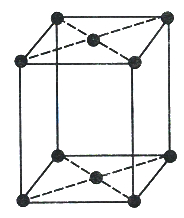
The given unit cell belongs to the type:
A
Primitive unit cell
B
Body centred unit cell
C
Face centred unit cell
D
End centred unit cell
Solution
(D) The given unit cell has atoms at all the corners and at two opposite face centres.
Thus,it is an end-centred unit cell.
Thus,it is an end-centred unit cell.
0 likes
View Solution273
EasyMCQ
Which among the following materials is extensively used as a piezoelectric material?
A
Quartz
B
Mica
C
Amorphous silica
D
Tridymite
Solution
(A) Piezoelectric materials are materials that have the ability to generate an internal electrical charge from applied mechanical stress.
Quartz $(SiO_2)$ is a well-known example of a piezoelectric material.
Hence,option $(A)$ is correct.
Quartz $(SiO_2)$ is a well-known example of a piezoelectric material.
Hence,option $(A)$ is correct.
0 likes
View Solution274
EasyMCQ
Which one of the following elements on doping with germanium,makes it a $p$-type semiconductor?
A
$Bi$
B
$Sb$
C
$As$
D
$Ga$
Solution
(D) Germanium $(Ge)$ belongs to group $14$ of the periodic table.
To create a $p$-type semiconductor,we need to dope it with an element from group $13$,which has one less valence electron than $Ge$.
This creates an electron-deficient bond or a 'hole',which acts as a positive charge carrier.
Among the given options,$Bi$,$Sb$,and $As$ belong to group $15$ (which would create an $n$-type semiconductor),while $Ga$ belongs to group $13$.
Therefore,doping $Ge$ with $Ga$ results in a $p$-type semiconductor.
To create a $p$-type semiconductor,we need to dope it with an element from group $13$,which has one less valence electron than $Ge$.
This creates an electron-deficient bond or a 'hole',which acts as a positive charge carrier.
Among the given options,$Bi$,$Sb$,and $As$ belong to group $15$ (which would create an $n$-type semiconductor),while $Ga$ belongs to group $13$.
Therefore,doping $Ge$ with $Ga$ results in a $p$-type semiconductor.
0 likes
View Solution275
EasyMCQ
Which one of the following elements,when present as an impurity in silicon,makes it a $p$-type semiconductor?
A
$As$
B
$P$
C
$In$
D
$Sb$
Solution
(C) When silicon $(Si)$ is doped with an impurity having a valency less than $4$,a $p$-type semiconductor is obtained.
Silicon belongs to group $14$ and has a valency of $4$.
Elements like $As$ (Arsenic),$P$ (Phosphorus),and $Sb$ (Antimony) belong to group $15$ and have a valency of $5$,which results in $n$-type semiconductors.
$In$ (Indium) belongs to group $13$ and has a valency of $3$.
Therefore,doping $Si$ with $In$ creates electron holes,resulting in a $p$-type semiconductor.
Silicon belongs to group $14$ and has a valency of $4$.
Elements like $As$ (Arsenic),$P$ (Phosphorus),and $Sb$ (Antimony) belong to group $15$ and have a valency of $5$,which results in $n$-type semiconductors.
$In$ (Indium) belongs to group $13$ and has a valency of $3$.
Therefore,doping $Si$ with $In$ creates electron holes,resulting in a $p$-type semiconductor.
0 likes
View Solution276
MediumMCQ
Which of the following statements is correct?
A
Silicon doped with boron is an $n$-type semiconductor
B
Silicon doped with arsenic is a $p$-type semiconductor
C
Metals are good conductors of electricity
D
Electrical conductivity of semiconductors decreases with increasing temperature
Solution
(C) Metals are good conductors of electricity due to the presence of free electrons.
Electrical conductivity of semiconductors increases with an increase in temperature.
Silicon doped with boron (Group $13$ element) creates a $p$-type semiconductor.
Silicon doped with arsenic (Group $15$ element) creates an $n$-type semiconductor.
Electrical conductivity of semiconductors increases with an increase in temperature.
Silicon doped with boron (Group $13$ element) creates a $p$-type semiconductor.
Silicon doped with arsenic (Group $15$ element) creates an $n$-type semiconductor.
0 likes
View Solution277
DifficultMCQ
How many of the following compounds show ferrimagnetism?
$Fe_3O_4; MgFe_2O_4; NiFe_2O_4; MnO; CrO_2$
$Fe_3O_4; MgFe_2O_4; NiFe_2O_4; MnO; CrO_2$
A
$1$
B
$2$
C
$3$
D
$4$
Solution
(C) In ferrimagnetic substances,the magnetic moments of the domains are aligned in parallel and antiparallel directions in unequal numbers.
The net magnetic moment is non-zero but small.
These substances are weakly attracted by a magnetic field compared to ferromagnetic substances and lose their ferrimagnetism on heating,becoming paramagnetic.
Examples include $Fe_3O_4$ (magnetite) and ferrites like $MgFe_2O_4$ and $NiFe_2O_4$.
Among the given compounds:
$1$. $Fe_3O_4$: Ferrimagnetic
$2$. $MgFe_2O_4$: Ferrimagnetic
$3$. $NiFe_2O_4$: Ferrimagnetic
$4$. $MnO$: Antiferromagnetic
$5$. $CrO_2$: Ferromagnetic
Thus,there are $3$ compounds that show ferrimagnetism.
Therefore,option $C$ is the correct answer.
The net magnetic moment is non-zero but small.
These substances are weakly attracted by a magnetic field compared to ferromagnetic substances and lose their ferrimagnetism on heating,becoming paramagnetic.
Examples include $Fe_3O_4$ (magnetite) and ferrites like $MgFe_2O_4$ and $NiFe_2O_4$.
Among the given compounds:
$1$. $Fe_3O_4$: Ferrimagnetic
$2$. $MgFe_2O_4$: Ferrimagnetic
$3$. $NiFe_2O_4$: Ferrimagnetic
$4$. $MnO$: Antiferromagnetic
$5$. $CrO_2$: Ferromagnetic
Thus,there are $3$ compounds that show ferrimagnetism.
Therefore,option $C$ is the correct answer.
0 likes
View Solution278
EasyMCQ
Match the following magnetic properties with their respective domain alignments shown in the image.
The correct matching is:
| $A$. Antiferromagnetism | $I$. $\uparrow \downarrow \uparrow \downarrow \uparrow \downarrow$ |
| $B$. Ferromagnetism | $II$. $\uparrow \uparrow \uparrow \uparrow \uparrow \uparrow$ |
| $C$. Ferrimagnetism | $III$. $\uparrow \uparrow \downarrow \uparrow \uparrow \downarrow$ |
The correct matching is:
A
$A-I, B-II, C-III$
B
$A-II, B-I, C-III$
C
$A-I, B-III, C-II$
D
$A-III, B-II, C-I$
Solution
(A) Based on the magnetic domain alignments:
$1$. Antiferromagnetism $(A)$ shows equal and opposite alignment of magnetic moments,resulting in zero net magnetic moment. This corresponds to $I$ $(\uparrow \downarrow \uparrow \downarrow \uparrow \downarrow)$.
$2$. Ferromagnetism $(B)$ shows all magnetic moments aligned in the same direction,resulting in a large net magnetic moment. This corresponds to $II$ $(\uparrow \uparrow \uparrow \uparrow \uparrow \uparrow)$.
$3$. Ferrimagnetism $(C)$ shows unequal and opposite alignment of magnetic moments,resulting in a net magnetic moment. This corresponds to $III$ $(\uparrow \uparrow \downarrow \uparrow \uparrow \downarrow)$.
Therefore,the correct match is $A-I, B-II, C-III$.
$1$. Antiferromagnetism $(A)$ shows equal and opposite alignment of magnetic moments,resulting in zero net magnetic moment. This corresponds to $I$ $(\uparrow \downarrow \uparrow \downarrow \uparrow \downarrow)$.
$2$. Ferromagnetism $(B)$ shows all magnetic moments aligned in the same direction,resulting in a large net magnetic moment. This corresponds to $II$ $(\uparrow \uparrow \uparrow \uparrow \uparrow \uparrow)$.
$3$. Ferrimagnetism $(C)$ shows unequal and opposite alignment of magnetic moments,resulting in a net magnetic moment. This corresponds to $III$ $(\uparrow \uparrow \downarrow \uparrow \uparrow \downarrow)$.
Therefore,the correct match is $A-I, B-II, C-III$.
0 likes
View SolutionSolid State — Type of solid and Their properties · Frequently Asked Questions
1Are these Solid State questions useful for JEE and NEET?
Yes. All questions in this section are mapped to JEE Main and NEET exam patterns. Previous year questions from JEE Main, NEET, GUJCET and state-level exams are included with full solutions.
2Can I switch to Hindi or Gujarati for these questions?
Yes. Use the language tabs in the hero section or the sidebar to view the same questions and solutions in English, Hindi or Gujarati.
3How do I generate a question paper from this subtopic?
Use the Vedclass Exam Paper Generator — select the chapter and subtopic, set difficulty, and generate Sets A, B, C, D automatically. First 3 chapters of every subject are free.
Vedclass Products
For Students
Vedclass Test Series
Mock tests in real JEE/NEET style with performance analysis. 5-day free trial.
Start Free TrialFor Teachers
Exam Paper Generator
Generate Set A/B/C/D papers from this chapter in 2 minutes. 3 chapters free.
Try FreeFor Institutes
Online Exam Module
Live online exams with unlimited students, 360° analytics & white-label branding.
See DemoFor Teachers & Institutes
Generate a Solid State Exam Paper in 2 Minutes
Select subtopic & difficulty — Sets A, B, C, D auto-generated with No Repeat logic.
First 3 chapters of every subject are free — no payment required.