
A English
Defects in crystal Questions in English
Class 12 Chemistry · Solid State · Defects in crystal
197+
Questions
English
Language
100%
With Solutions
Showing 50 of 197 questions in English
101
MediumMCQ
If $NaCl$ is doped with $10^{-5} \ mol$ of $AlCl_3$,what will be the concentration of cation vacancies?
A
$6.02 \times 10^{23} \ mol^{-1}$
B
$6.02 \times 10^{18} \ mol^{-1}$
C
$6.02 \times 10^{20} \ mol^{-1}$
D
$12.04 \times 10^{18} \ mol^{-1}$
Solution
(D) When $Al^{3+}$ ions are introduced into the $NaCl$ lattice,each $Al^{3+}$ ion replaces one $Na^+$ ion to maintain electrical neutrality.
Since $Al^{3+}$ has a charge of $+3$ and $Na^+$ has a charge of $+1$,one $Al^{3+}$ ion replaces three $Na^+$ ions.
This creates two cation vacancies for every $Al^{3+}$ ion added.
Concentration of $Al^{3+}$ = $10^{-5} \ mol$.
Number of $Al^{3+}$ ions = $10^{-5} \times 6.022 \times 10^{23} = 6.022 \times 10^{18} \ ions$.
Number of cation vacancies = $2 \times (6.022 \times 10^{18}) = 12.044 \times 10^{18} \ mol^{-1}$.
Since $Al^{3+}$ has a charge of $+3$ and $Na^+$ has a charge of $+1$,one $Al^{3+}$ ion replaces three $Na^+$ ions.
This creates two cation vacancies for every $Al^{3+}$ ion added.
Concentration of $Al^{3+}$ = $10^{-5} \ mol$.
Number of $Al^{3+}$ ions = $10^{-5} \times 6.022 \times 10^{23} = 6.022 \times 10^{18} \ ions$.
Number of cation vacancies = $2 \times (6.022 \times 10^{18}) = 12.044 \times 10^{18} \ mol^{-1}$.
0 likes
View Solution102
DifficultMCQ
When $KCl$ is heated in an atmosphere of $K$ vapor,it appears violet. This is because .................
A
Electrons enter the crystal and occupy the vacancies created by $Cl^-$ ions.
B
Electrons enter the crystal and occupy interstitial sites.
C
$K^+$ ions enter the crystal and occupy the vacancies created by $Cl^-$ ions.
D
None of the above.
Solution
(A) When $KCl$ is heated in an atmosphere of $K$ vapor,excess $K$ atoms deposit on the surface of the crystal.
$Cl^-$ ions diffuse to the surface and combine with $K$ atoms to form $KCl$.
This process releases electrons,which diffuse into the crystal and occupy the anionic vacancies (holes) left by $Cl^-$ ions.
These trapped electrons are known as $F$-centers (from the German word $Farbenzentrum$,meaning color center),which absorb light from the visible region and impart a violet color to the $KCl$ crystal.
$Cl^-$ ions diffuse to the surface and combine with $K$ atoms to form $KCl$.
This process releases electrons,which diffuse into the crystal and occupy the anionic vacancies (holes) left by $Cl^-$ ions.
These trapped electrons are known as $F$-centers (from the German word $Farbenzentrum$,meaning color center),which absorb light from the visible region and impart a violet color to the $KCl$ crystal.
0 likes
View Solution103
DifficultMCQ
Compounds with low coordination numbers of cations and anions exhibit Frenkel defects because the compound has ................
A
Cations and anions of similar size
B
Cations and anions with the same coordination number
C
Highly polarizable cation and easily polarizable anion
D
Highly polarizable anion and easily polarizable cation
Solution
(C) Frenkel defect is observed in ionic crystals where there is a large difference in the size of the ions.
It occurs in compounds where the cation is much smaller than the anion.
Due to the small size of the cation,it can easily leave its lattice site and occupy an interstitial site.
This process is favored by a high degree of polarization,where the cation is highly polarizable (or has high polarizing power) and the anion is easily polarizable.
Therefore,the correct condition is that the compound has a highly polarizing cation and an easily polarizable anion.
It occurs in compounds where the cation is much smaller than the anion.
Due to the small size of the cation,it can easily leave its lattice site and occupy an interstitial site.
This process is favored by a high degree of polarization,where the cation is highly polarizable (or has high polarizing power) and the anion is easily polarizable.
Therefore,the correct condition is that the compound has a highly polarizing cation and an easily polarizable anion.
0 likes
View Solution104
DifficultMCQ
It is observed that $Li_2O$ is soluble in $NiO$ in small amounts,where $Li^+$ ions occupy some of the cation sites. Which of the following conclusions can be drawn?
A
$NiO$ contains only $Ni^{2+}$,$Li^+$,and $O^{2-}$ ions.
B
$NiO$ contains an equal number of $Li^+$ and $Ni^{2+}$ ions.
C
$NiO$ contains an equal number of $Li^+$ and $Ni^{3+}$ ions.
D
$NiO$ contains an equal number of $Ni^{2+}$ and $Ni^{3+}$ ions.
Solution
(C) When $Li^+$ ions replace $Ni^{2+}$ ions in the $NiO$ lattice,the electrical neutrality of the crystal must be maintained.
Since $Li^+$ has a $+1$ charge and $Ni^{2+}$ has a $+2$ charge,replacing one $Ni^{2+}$ with one $Li^+$ creates a charge deficiency of $+1$.
To compensate for this,an equivalent number of $Ni^{2+}$ ions must be oxidized to $Ni^{3+}$ ions.
Therefore,for every $Li^+$ ion introduced,one $Ni^{2+}$ ion is converted to $Ni^{3+}$,resulting in an equal number of $Li^+$ and $Ni^{3+}$ ions in the crystal.
Since $Li^+$ has a $+1$ charge and $Ni^{2+}$ has a $+2$ charge,replacing one $Ni^{2+}$ with one $Li^+$ creates a charge deficiency of $+1$.
To compensate for this,an equivalent number of $Ni^{2+}$ ions must be oxidized to $Ni^{3+}$ ions.
Therefore,for every $Li^+$ ion introduced,one $Ni^{2+}$ ion is converted to $Ni^{3+}$,resulting in an equal number of $Li^+$ and $Ni^{3+}$ ions in the crystal.
0 likes
View Solution105
MediumMCQ
$A$ metal oxide shows $p-$type semiconductivity. The conductivity of the oxide will increase by:
A
Increasing the pressure of oxygen in contact with the oxide
B
Decreasing the pressure of oxygen in contact with the oxide
C
Conductivity is independent of oxygen pressure
D
Conductivity increases because oxygen forms a $p-n$ junction
Solution
(A) $p-$type semiconductivity in metal oxides is typically caused by metal deficiency defects. For example,in $NiO$,some $Ni^{2+}$ ions are replaced by $Ni^{3+}$ ions to maintain electrical neutrality,creating cation vacancies. The reaction with oxygen is: $\frac{1}{2} O_2(g) \rightarrow O^{2-} + 2h^+ + V_{Ni}^{2-}$. Increasing the partial pressure of oxygen shifts the equilibrium to the right,increasing the concentration of $Ni^{3+}$ ions (holes),which increases the conductivity.
0 likes
View Solution106
MediumMCQ
Which is not correct about the Schottky defects?
A
Both cations and anions are missing from their lattice sites without affecting the stoichiometry of the compound.
B
Because of presence of holes the lattice energy decreases.
C
The presence of holes causes the density of the crystal to decrease.
D
The defect increases the electrical conductivity of the solid due to migration of the ions into the holes.
Solution
(B) In a Schottky defect,an equal number of cations and anions are missing from their lattice sites to maintain electrical neutrality and stoichiometry.
This creates vacancies,which causes the density of the crystal to decrease.
Since the formation of these defects is an endothermic process,the lattice energy of the crystal actually increases,not decreases.
Therefore,the statement that lattice energy decreases is incorrect.
The defect does increase electrical conductivity due to the migration of ions into the vacant holes.
This creates vacancies,which causes the density of the crystal to decrease.
Since the formation of these defects is an endothermic process,the lattice energy of the crystal actually increases,not decreases.
Therefore,the statement that lattice energy decreases is incorrect.
The defect does increase electrical conductivity due to the migration of ions into the vacant holes.
0 likes
View Solution107
DifficultMCQ
Assertion : No compound has both Schottky and Frenkel defects.
Reason : Both defects change the density of the solid.
Reason : Both defects change the density of the solid.
A
If both Assertion and Reason are correct and the Reason is a correct explanation of the Assertion.
B
If both Assertion and Reason are correct but Reason is not a correct explanation of the Assertion.
C
If the Assertion is correct but Reason is incorrect.
D
If both the Assertion and Reason are incorrect.
Solution
(D) The Assertion is incorrect because certain ionic solids,such as $AgBr$,exhibit both Schottky and Frenkel defects.
The Reason is also incorrect because only Schottky defects change the density of the solid (due to missing ions),whereas Frenkel defects do not change the density because the ions merely shift to interstitial sites without leaving the crystal lattice.
The Reason is also incorrect because only Schottky defects change the density of the solid (due to missing ions),whereas Frenkel defects do not change the density because the ions merely shift to interstitial sites without leaving the crystal lattice.
0 likes
View Solution108
DifficultMCQ
Assertion : Due to Frenkel defect,there is no effect on the density of the crystalline solid.
Reason : In Frenkel defect,no cation or anion leaves the crystal.
Reason : In Frenkel defect,no cation or anion leaves the crystal.
A
If both Assertion and Reason are correct and the Reason is a correct explanation of the Assertion.
B
If both Assertion and Reason are correct but Reason is not a correct explanation of the Assertion.
C
If the Assertion is correct but Reason is incorrect.
D
If both the Assertion and Reason are incorrect.
Solution
(A) In a Frenkel defect,an ion (usually a smaller cation) leaves its lattice site and occupies an interstitial site within the same crystal.
Since no ions leave the crystal lattice entirely,the total mass and volume of the crystal remain unchanged.
Therefore,the density of the crystalline solid remains constant.
Both the Assertion and the Reason are correct,and the Reason correctly explains why the density remains unchanged.
Since no ions leave the crystal lattice entirely,the total mass and volume of the crystal remain unchanged.
Therefore,the density of the crystalline solid remains constant.
Both the Assertion and the Reason are correct,and the Reason correctly explains why the density remains unchanged.
0 likes
View Solution109
DifficultMCQ
The formula of nickel oxide with metal deficiency defect in its crystal is $Ni_{0.98}O$. The crystal contains $Ni^{2+}$ and $Ni^{3+}$ ions. The fraction of nickel existing as $Ni^{2+}$ ions in the crystal is
A
$0.96$
B
$0.04$
C
$0.50$
D
$0.31$
Solution
(A) Let the amount of $Ni^{2+}$ ions in the crystal $Ni_{0.98}O$ be $x$.
Then,the amount of $Ni^{3+}$ ions in the crystal will be $(0.98 - x)$.
Since the crystal is electrically neutral,the total positive charge must equal the total negative charge (from $O^{2-}$).
$2(x) + 3(0.98 - x) = 2$
$2x + 2.94 - 3x = 2$
$-x = 2 - 2.94$
$-x = -0.94$
$x = 0.94$
Therefore,the fraction of nickel existing as $Ni^{2+}$ ions is $\frac{0.94}{0.98} \approx 0.96$.
Then,the amount of $Ni^{3+}$ ions in the crystal will be $(0.98 - x)$.
Since the crystal is electrically neutral,the total positive charge must equal the total negative charge (from $O^{2-}$).
$2(x) + 3(0.98 - x) = 2$
$2x + 2.94 - 3x = 2$
$-x = 2 - 2.94$
$-x = -0.94$
$x = 0.94$
Therefore,the fraction of nickel existing as $Ni^{2+}$ ions is $\frac{0.94}{0.98} \approx 0.96$.
0 likes
View Solution110
MediumMCQ
Which of the following compounds is likely to show both Frenkel and Schottky defects in its crystalline form?
A
$AgBr$
B
$ZnS$
C
$HBr$
D
$CsCl$
Solution
(A) $AgBr$ has an intermediate radius ratio,which allows it to exhibit both Schottky and Frenkel defects.
$ZnS$ primarily shows Frenkel defects due to the small size of the $Zn^{2+}$ ion.
$KBr$ and $CsCl$ typically show Schottky defects due to their high coordination numbers and similar ionic sizes.
$ZnS$ primarily shows Frenkel defects due to the small size of the $Zn^{2+}$ ion.
$KBr$ and $CsCl$ typically show Schottky defects due to their high coordination numbers and similar ionic sizes.
0 likes
View Solution111
Easy
What type of defect can arise when a solid is heated? Which physical property is affected by it and in what way?
Solution
(N/A) When a solid is heated,a vacancy defect can arise. $A$ solid crystal is said to have a vacancy defect when some of the lattice sites are vacant.
Vacancy defect leads to a decrease in the density of the solid.
Vacancy defect leads to a decrease in the density of the solid.
0 likes
View Solution112
Easy
What type of stoichiometric defect is shown by:
$(i)$ $ZnS$
$(ii)$ $AgBr$
$(i)$ $ZnS$
$(ii)$ $AgBr$
Solution
(N/A) $(i)$ $ZnS$ shows Frenkel defect.
$(ii)$ $AgBr$ shows both Frenkel defect and Schottky defect.
$(ii)$ $AgBr$ shows both Frenkel defect and Schottky defect.
0 likes
View Solution113
Medium
Explain how vacancies are introduced in an ionic solid when a cation of higher valence is added as an impurity in it.
Solution
(N/A) When a cation of higher valence is added to an ionic solid as an impurity,it replaces more than one cation of lower valence to maintain electrical neutrality of the crystal.
As a result,some lattice sites remain vacant.
For example,when $Sr^{2+}$ is added to $NaCl$,each $Sr^{2+}$ ion replaces two $Na^{+}$ ions.
One $Sr^{2+}$ ion occupies the site of one $Na^{+}$ ion,while the other site remains vacant.
Thus,cationic vacancies are introduced in the crystal lattice.
As a result,some lattice sites remain vacant.
For example,when $Sr^{2+}$ is added to $NaCl$,each $Sr^{2+}$ ion replaces two $Na^{+}$ ions.
One $Sr^{2+}$ ion occupies the site of one $Na^{+}$ ion,while the other site remains vacant.
Thus,cationic vacancies are introduced in the crystal lattice.
0 likes
View Solution114
Medium
Ionic solids,which have anionic vacancies due to metal excess defect,develop colour. Explain with the help of a suitable example.
Solution
(N/A) The colour develops because of the presence of electrons in the anionic sites,known as $F$-centers. These electrons absorb energy from the visible part of radiation and get excited.
For example,when crystals of $NaCl$ are heated in an atmosphere of sodium vapours,the sodium atoms get deposited on the surface of the crystal and the chloride ions $(Cl^-)$ from the crystal diffuse to the surface to form $NaCl$ with the deposited $Na$ atoms. During this process,the $Na$ atoms on the surface lose electrons to form $Na^+$ ions and the released electrons diffuse into the crystal to occupy the vacant anionic sites. These electrons get excited by absorbing energy from the visible light and impart yellow colour to the crystals.
For example,when crystals of $NaCl$ are heated in an atmosphere of sodium vapours,the sodium atoms get deposited on the surface of the crystal and the chloride ions $(Cl^-)$ from the crystal diffuse to the surface to form $NaCl$ with the deposited $Na$ atoms. During this process,the $Na$ atoms on the surface lose electrons to form $Na^+$ ions and the released electrons diffuse into the crystal to occupy the vacant anionic sites. These electrons get excited by absorbing energy from the visible light and impart yellow colour to the crystals.
0 likes
View Solution115
Easy
Analysis shows that nickel oxide has the formula $Ni_{0.98}O_{1.00}$. What fractions of nickel exist as $Ni^{2+}$ and $Ni^{3+}$ ions?
Solution
(N/A) The formula of nickel oxide is $Ni_{0.98}O_{1.00}$.
Therefore,the ratio of the number of $Ni$ atoms to the number of $O$ atoms is $Ni : O = 0.98 : 1.00 = 98 : 100$.
Now,the total charge on $100 \ O^{2-}$ ions $= 100 \times (-2) = -200$.
Let the number of $Ni^{2+}$ ions be $x$.
So,the number of $Ni^{3+}$ ions is $98 - x$.
Now,the total charge on $Ni^{2+}$ ions $= x(+2) = +2x$.
And,the total charge on $Ni^{3+}$ ions $= (98 - x)(+3) = 294 - 3x$.
Since the compound is neutral,we can write:
$2x + (294 - 3x) - 200 = 0$.
$\Rightarrow -x + 94 = 0$.
$\Rightarrow x = 94$.
Therefore,the number of $Ni^{2+}$ ions $= 94$.
And,the number of $Ni^{3+}$ ions $= 98 - 94 = 4$.
Hence,the fraction of nickel that exists as $Ni^{2+} = \frac{94}{98} = 0.959$.
And,the fraction of nickel that exists as $Ni^{3+} = \frac{4}{98} = 0.041$.
Therefore,the ratio of the number of $Ni$ atoms to the number of $O$ atoms is $Ni : O = 0.98 : 1.00 = 98 : 100$.
Now,the total charge on $100 \ O^{2-}$ ions $= 100 \times (-2) = -200$.
Let the number of $Ni^{2+}$ ions be $x$.
So,the number of $Ni^{3+}$ ions is $98 - x$.
Now,the total charge on $Ni^{2+}$ ions $= x(+2) = +2x$.
And,the total charge on $Ni^{3+}$ ions $= (98 - x)(+3) = 294 - 3x$.
Since the compound is neutral,we can write:
$2x + (294 - 3x) - 200 = 0$.
$\Rightarrow -x + 94 = 0$.
$\Rightarrow x = 94$.
Therefore,the number of $Ni^{2+}$ ions $= 94$.
And,the number of $Ni^{3+}$ ions $= 98 - 94 = 4$.
Hence,the fraction of nickel that exists as $Ni^{2+} = \frac{94}{98} = 0.959$.
And,the fraction of nickel that exists as $Ni^{3+} = \frac{4}{98} = 0.041$.
0 likes
View Solution116
Easy
Non-stoichiometric cuprous oxide,$Cu_{2}O$ can be prepared in the laboratory. In this oxide,the copper to oxygen ratio is slightly less than $2:1$. Can you account for the fact that this substance is a $p$-type semiconductor?
Solution
(N/A) In the cuprous oxide $(Cu_{2}O)$ prepared in the laboratory,the copper to oxygen ratio is slightly less than $2:1$.
This implies that the number of $Cu^{+}$ ions is slightly less than twice the number of $O^{2-}$ ions.
This occurs because some $Cu^{+}$ ions are replaced by $Cu^{2+}$ ions to maintain electrical neutrality.
Since every $Cu^{2+}$ ion replaces two $Cu^{+}$ ions,it creates a cation vacancy or a 'hole'.
These positive holes facilitate the conduction of electricity.
Therefore,the substance acts as a $p$-type semiconductor.
This implies that the number of $Cu^{+}$ ions is slightly less than twice the number of $O^{2-}$ ions.
This occurs because some $Cu^{+}$ ions are replaced by $Cu^{2+}$ ions to maintain electrical neutrality.
Since every $Cu^{2+}$ ion replaces two $Cu^{+}$ ions,it creates a cation vacancy or a 'hole'.
These positive holes facilitate the conduction of electricity.
Therefore,the substance acts as a $p$-type semiconductor.
0 likes
View Solution117
Easy
Explain the following term with a suitable example:
$(i)$ Schottky defect
$(i)$ Schottky defect
Solution
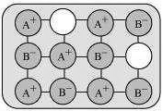
(N/A) $(i)$ Schottky defect: Schottky defect is a type of vacancy defect shown by ionic solids.
In this defect,an equal number of cations and anions are missing from their lattice sites to maintain electrical neutrality.
It decreases the density of the substance.
$A$ significant number of Schottky defects are present in ionic solids.
For example,in $NaCl$,there are approximately $10^{6}$ Schottky pairs per $cm^{3}$ at room temperature.
Ionic substances containing cations and anions of similar sizes show this type of defect.
Examples include $NaCl$,$KCl$,$CsCl$,and $AgBr$.
In this defect,an equal number of cations and anions are missing from their lattice sites to maintain electrical neutrality.
It decreases the density of the substance.
$A$ significant number of Schottky defects are present in ionic solids.
For example,in $NaCl$,there are approximately $10^{6}$ Schottky pairs per $cm^{3}$ at room temperature.
Ionic substances containing cations and anions of similar sizes show this type of defect.
Examples include $NaCl$,$KCl$,$CsCl$,and $AgBr$.
0 likes
View Solution118
Easy
Explain the following term with a suitable example:
$(ii)$ Frenkel defect
$(ii)$ Frenkel defect
Solution
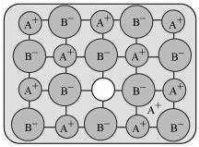
(N/A) $(ii)$ Frenkel defect: Ionic solids containing large differences in the sizes of ions show this type of defect.
When the smaller ion (usually cation) is dislocated from its normal lattice site to an interstitial site,a Frenkel defect is created.
It creates a vacancy defect at its original site as well as an interstitial defect at the new site.
Frenkel defect is also known as dislocation defect.
Ionic solids such as $AgCl$,$AgBr$,$AgI$,and $ZnS$ show this type of defect.
When the smaller ion (usually cation) is dislocated from its normal lattice site to an interstitial site,a Frenkel defect is created.
It creates a vacancy defect at its original site as well as an interstitial defect at the new site.
Frenkel defect is also known as dislocation defect.
Ionic solids such as $AgCl$,$AgBr$,$AgI$,and $ZnS$ show this type of defect.
0 likes
View Solution119
Easy
Explain the following term with a suitable example:
$(iii)$ Interstitials
$(iii)$ Interstitials
Solution
(N/A) $(iii)$ Interstitials: Interstitial defect is shown by non-ionic solids.
This type of defect is created when some constituent particles (atoms or molecules) occupy an interstitial site of the crystal.
The density of a substance increases because of this defect.
Example: In a crystal lattice,if extra atoms occupy the empty spaces between the regular lattice sites,it is called an interstitial defect.
This type of defect is created when some constituent particles (atoms or molecules) occupy an interstitial site of the crystal.
The density of a substance increases because of this defect.
Example: In a crystal lattice,if extra atoms occupy the empty spaces between the regular lattice sites,it is called an interstitial defect.
0 likes
View Solution120
Easy
Explain the following term with a suitable example:
$(iv)$ $F$-centres
$(iv)$ $F$-centres
Solution
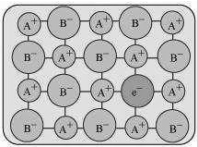
(N/A) $(iv)$ $F$-centres: When the anionic sites of a crystal are occupied by unpaired electrons,these sites are called $F$-centres (from the German word $Farbenzentrum$,meaning colour centre).
These unpaired electrons absorb energy from visible light and get excited,which imparts colour to the crystals.
For example,when crystals of $NaCl$ are heated in an atmosphere of sodium vapour,the sodium atoms are deposited on the surface of the crystal.
The $Cl^{-}$ ions diffuse from the crystal to its surface and combine with $Na$ atoms,forming $NaCl$.
During this process,the $Na$ atoms on the surface of the crystal lose electrons.
These released electrons diffuse into the crystal and occupy the vacant anionic sites,creating $F$-centres,which turn the $NaCl$ crystal yellow.
These unpaired electrons absorb energy from visible light and get excited,which imparts colour to the crystals.
For example,when crystals of $NaCl$ are heated in an atmosphere of sodium vapour,the sodium atoms are deposited on the surface of the crystal.
The $Cl^{-}$ ions diffuse from the crystal to its surface and combine with $Na$ atoms,forming $NaCl$.
During this process,the $Na$ atoms on the surface of the crystal lose electrons.
These released electrons diffuse into the crystal and occupy the vacant anionic sites,creating $F$-centres,which turn the $NaCl$ crystal yellow.
0 likes
View Solution121
EasyMCQ
If $NaCl$ is doped with $10^{-3} \, mol \%$ of $SrCl_{2}$,what is the concentration of cation vacancies?
A
$6.022 \times 10^{18} \, mol^{-1}$
B
$6.022 \times 10^{20} \, mol^{-1}$
C
$10^{-3} \, mol^{-1}$
D
$10^{-5} \, mol^{-1}$
Solution
(A) It is given that $NaCl$ is doped with $10^{-3} \, mol \%$ of $SrCl_{2}$.
This means that $100 \, mol$ of $NaCl$ is doped with $10^{-3} \, mol$ of $SrCl_{2}$.
Therefore,$1 \, mol$ of $NaCl$ is doped with $\frac{10^{-3}}{100} = 10^{-5} \, mol$ of $SrCl_{2}$.
Since each $Sr^{2+}$ ion replaces two $Na^+$ ions to maintain electrical neutrality,one $Sr^{2+}$ ion creates one cation vacancy.
Thus,the number of cation vacancies per $mol$ of $NaCl$ is equal to the number of $Sr^{2+}$ ions per $mol$ of $NaCl$.
Concentration of cation vacancies $= 10^{-5} \times 6.022 \times 10^{23} \, mol^{-1} = 6.022 \times 10^{18} \, mol^{-1}$.
This means that $100 \, mol$ of $NaCl$ is doped with $10^{-3} \, mol$ of $SrCl_{2}$.
Therefore,$1 \, mol$ of $NaCl$ is doped with $\frac{10^{-3}}{100} = 10^{-5} \, mol$ of $SrCl_{2}$.
Since each $Sr^{2+}$ ion replaces two $Na^+$ ions to maintain electrical neutrality,one $Sr^{2+}$ ion creates one cation vacancy.
Thus,the number of cation vacancies per $mol$ of $NaCl$ is equal to the number of $Sr^{2+}$ ions per $mol$ of $NaCl$.
Concentration of cation vacancies $= 10^{-5} \times 6.022 \times 10^{23} \, mol^{-1} = 6.022 \times 10^{18} \, mol^{-1}$.
0 likes
View Solution122
Medium
How do defects arise in crystals? State the types of defects.
Solution
(N/A) Crystalline solids possess short-range as well as long-range order in the arrangement of their constituent particles,yet they are not perfectly crystalline.
Generally,a solid consists of an aggregate of a large number of small crystals. These small crystals have defects in them. This happens when the process of crystallization occurs at a fast or moderate rate.
Defects are basically irregularities in the arrangement of constituent particles. There are two main types of defects:
$(i)$ Point defects
$(ii)$ Line defects
$(i)$ Point defects: These are the irregularities or deviations from the ideal arrangement around a point or an atom in a crystalline substance.
$(ii)$ Line defects: These are the irregularities or deviations from the ideal arrangement in the entire row of lattice points.
Generally,a solid consists of an aggregate of a large number of small crystals. These small crystals have defects in them. This happens when the process of crystallization occurs at a fast or moderate rate.
Defects are basically irregularities in the arrangement of constituent particles. There are two main types of defects:
$(i)$ Point defects
$(ii)$ Line defects
$(i)$ Point defects: These are the irregularities or deviations from the ideal arrangement around a point or an atom in a crystalline substance.
$(ii)$ Line defects: These are the irregularities or deviations from the ideal arrangement in the entire row of lattice points.
0 likes
View Solution123
Easy
State the types of point defects.
Solution
(N/A) Point defects can be classified into three types:
$(i)$ Stoichiometric defects
$(ii)$ Impurity defects
$(iii)$ Non-stoichiometric defects
$(i)$ Stoichiometric defects
$(ii)$ Impurity defects
$(iii)$ Non-stoichiometric defects
0 likes
View Solution124
Medium
What is stoichiometric defect? State its types.
Solution
(N/A) stoichiometric defect is a point defect in a crystal lattice that does not disturb the stoichiometry of the solid. These are also known as intrinsic or thermodynamic defects.
They are primarily classified into two types for non-ionic solids:
$(i)$ Vacancy defect
$(ii)$ Interstitial defect
For ionic solids,these defects are classified as:
$(i)$ Schottky defect
$(ii)$ Frenkel defect
They are primarily classified into two types for non-ionic solids:
$(i)$ Vacancy defect
$(ii)$ Interstitial defect
For ionic solids,these defects are classified as:
$(i)$ Schottky defect
$(ii)$ Frenkel defect
0 likes
View Solution125
Difficult
Explain vacancy defect and interstitial defect.
Solution
(N/A) $(i)$ Vacancy defect: When some of the lattice sites are vacant,the crystal is said to have a vacancy defect.
- This results in a decrease in the density of the substance.
- This defect can also develop when a substance is heated.
- $(ii)$ Interstitial defect: When some constituent particles (atoms or molecules) occupy an interstitial site,the crystal is said to have an interstitial defect.
- This defect increases the density of the crystal.
- Vacancy and interstitial defects are found in non-ionic solids.
- In ionic solids,electrical neutrality must be maintained; therefore,instead of vacancy and interstitial defects,these are known as Frenkel and Schottky defects.
- This results in a decrease in the density of the substance.
- This defect can also develop when a substance is heated.
- $(ii)$ Interstitial defect: When some constituent particles (atoms or molecules) occupy an interstitial site,the crystal is said to have an interstitial defect.
- This defect increases the density of the crystal.
- Vacancy and interstitial defects are found in non-ionic solids.
- In ionic solids,electrical neutrality must be maintained; therefore,instead of vacancy and interstitial defects,these are known as Frenkel and Schottky defects.
0 likes
View Solution126
Advanced
Write a short note on Frenkel defect and Schottky defect.
Solution
(N/A) Both these defects are observed in ionic solids.
$(i)$ Frenkel Defect: This defect is shown by ionic substances.
The smaller ion (usually cation) is dislocated from its normal site to an interstitial site.
It creates a vacancy defect at its original site and an interstitial defect at its new location. It is also called a dislocation defect.
It does not change the density of the solid. It occurs in ionic solids where there is a large difference in the size of ions. Examples: $ZnS, AgCl, AgBr, AgI$ due to the small size of $Zn^{2+}$ and $Ag^+$ ions.
$(ii)$ Schottky Defect: This is basically a vacancy defect in ionic solids.
To maintain electrical neutrality,the number of missing cations and anions is equal,as shown in the diagram.
Like simple vacancy defects,Schottky defects decrease the density of the substance.
$(i)$ Frenkel Defect: This defect is shown by ionic substances.
The smaller ion (usually cation) is dislocated from its normal site to an interstitial site.
It creates a vacancy defect at its original site and an interstitial defect at its new location. It is also called a dislocation defect.
It does not change the density of the solid. It occurs in ionic solids where there is a large difference in the size of ions. Examples: $ZnS, AgCl, AgBr, AgI$ due to the small size of $Zn^{2+}$ and $Ag^+$ ions.
$(ii)$ Schottky Defect: This is basically a vacancy defect in ionic solids.
To maintain electrical neutrality,the number of missing cations and anions is equal,as shown in the diagram.
Like simple vacancy defects,Schottky defects decrease the density of the substance.
0 likes
View Solution127
Difficult
Write a short note on impurity defects.
Solution
(N/A) - If molten $NaCl$ containing a small amount of $SrCl_2$ is crystallized,some of the sites of $Na^+$ ions are occupied by $Sr^{2+}$ ions.
- Each $Sr^{2+}$ ion replaces two $Na^+$ ions. It occupies one site,and the other site remains vacant.
- The number of cationic vacancies produced is equal to the number of $Sr^{2+}$ ions added.
- Example: Solid solution of $CdCl_2$ and $AgCl$.
- Each $Sr^{2+}$ ion replaces two $Na^+$ ions. It occupies one site,and the other site remains vacant.
- The number of cationic vacancies produced is equal to the number of $Sr^{2+}$ ions added.
- Example: Solid solution of $CdCl_2$ and $AgCl$.
0 likes
View Solution128
MediumMCQ
If $10^{-4} \% SrCl_2$ is added to a crystal of $NaCl$,find the number of cationic vacancies created in the crystal.
A
$6.022 \times 10^{16}$
B
$6.022 \times 10^{17}$
C
$6.022 \times 10^{18}$
D
$6.022 \times 10^{15}$
Solution
(B) The addition of $Sr^{2+}$ ions to $NaCl$ creates cationic vacancies because each $Sr^{2+}$ ion replaces two $Na^+$ ions,leaving one vacancy.
Number of cationic vacancies = Number of $Sr^{2+}$ ions.
$10^{-4} \% SrCl_2$ means $10^{-4} \, g$ of $SrCl_2$ in $100 \, g$ of $NaCl$,or in terms of moles,$10^{-6} \, mol$ of $Sr^{2+}$ per mole of $NaCl$.
Number of $Sr^{2+}$ ions = $10^{-6} \times 6.022 \times 10^{23} \, mol^{-1} = 6.022 \times 10^{17}$.
Number of cationic vacancies = Number of $Sr^{2+}$ ions.
$10^{-4} \% SrCl_2$ means $10^{-4} \, g$ of $SrCl_2$ in $100 \, g$ of $NaCl$,or in terms of moles,$10^{-6} \, mol$ of $Sr^{2+}$ per mole of $NaCl$.
Number of $Sr^{2+}$ ions = $10^{-6} \times 6.022 \times 10^{23} \, mol^{-1} = 6.022 \times 10^{17}$.
0 likes
View Solution129
Easy
What is non-stoichiometric defect? State its types.
Solution
(N/A) Non-stoichiometric defects occur when the ratio of constituent elements in an inorganic solid deviates from the ideal stoichiometric ratio due to defects in the crystal structure.
These are primarily classified into two types:
$(i)$ Metal excess defect
$(ii)$ Metal deficiency defect
These are primarily classified into two types:
$(i)$ Metal excess defect
$(ii)$ Metal deficiency defect
0 likes
View Solution130
Difficult
Explain the metal excess defect.
Solution
(N/A) Metal excess defect is of two types:
$(i)$ Metal excess defect due to anionic vacancies: Alkali halides like $NaCl$ and $KCl$ show this type of defect. When crystals of $NaCl$ are heated in an atmosphere of $Na$ vapor,$Na$ atoms are deposited on the surface of the crystal. $Cl^-$ ions diffuse to the surface of the crystal and combine with $Na$ atoms to give $NaCl$.
This happens by loss of electrons by $Na$ atoms to form $Na^+$ ions. The released electrons diffuse into the crystal and occupy anionic sites. As a result,the crystal now has an excess of $Na$.
Anionic sites occupied by unpaired electrons are called $F$-centers (from the German word $Farbenzenter$ meaning color center). They impart yellow color to the crystals of $NaCl$.
This color results from the excitation of these electrons when they absorb energy from the incident visible light. Similarly,excess $Li$ makes $LiCl$ crystals pink and excess $K$ makes $KCl$ crystals violet (or lilac).
$(ii)$ Metal excess defect due to the presence of extra cations at interstitial sites: This defect arises due to the presence of extra metal ions in the interstitial sites.
$ZnO$ is white in color at room temperature. On heating,it loses oxygen and turns yellow. The reaction is: $ZnO \xrightarrow{\Delta} Zn^{2+} + \frac{1}{2}O_2 + 2e^-$.
Now,there is an excess of zinc in the crystal and its formula becomes $Zn_{1+x}O$. The extra $Zn^{2+}$ ions move to interstitial sites and the electrons move to neighboring interstitial sites.
$(i)$ Metal excess defect due to anionic vacancies: Alkali halides like $NaCl$ and $KCl$ show this type of defect. When crystals of $NaCl$ are heated in an atmosphere of $Na$ vapor,$Na$ atoms are deposited on the surface of the crystal. $Cl^-$ ions diffuse to the surface of the crystal and combine with $Na$ atoms to give $NaCl$.
This happens by loss of electrons by $Na$ atoms to form $Na^+$ ions. The released electrons diffuse into the crystal and occupy anionic sites. As a result,the crystal now has an excess of $Na$.
Anionic sites occupied by unpaired electrons are called $F$-centers (from the German word $Farbenzenter$ meaning color center). They impart yellow color to the crystals of $NaCl$.
This color results from the excitation of these electrons when they absorb energy from the incident visible light. Similarly,excess $Li$ makes $LiCl$ crystals pink and excess $K$ makes $KCl$ crystals violet (or lilac).
$(ii)$ Metal excess defect due to the presence of extra cations at interstitial sites: This defect arises due to the presence of extra metal ions in the interstitial sites.
$ZnO$ is white in color at room temperature. On heating,it loses oxygen and turns yellow. The reaction is: $ZnO \xrightarrow{\Delta} Zn^{2+} + \frac{1}{2}O_2 + 2e^-$.
Now,there is an excess of zinc in the crystal and its formula becomes $Zn_{1+x}O$. The extra $Zn^{2+}$ ions move to interstitial sites and the electrons move to neighboring interstitial sites.
0 likes
View Solution131
DifficultMCQ
Explain the defects arising due to anionic vacancies and due to the presence of extra cations in the interstitial sites.
A
Metal excess defect due to anionic vacancies
B
Metal excess defect due to extra cations
C
Both $A$ and $B$
D
None of the above
Solution
(C) $1$. Metal excess defect due to anionic vacancies: This occurs when a negative ion is missing from its lattice site,leaving a hole that is occupied by an electron to maintain electrical neutrality. This electron is called an $F$-center,which imparts color to the crystal (e.g.,$NaCl$ turns yellow).
$2$. Metal excess defect due to extra cations: This occurs when extra positive ions occupy interstitial sites,and an equivalent number of electrons occupy other interstitial sites to maintain electrical neutrality (e.g.,$ZnO$ turns yellow on heating).
$2$. Metal excess defect due to extra cations: This occurs when extra positive ions occupy interstitial sites,and an equivalent number of electrons occupy other interstitial sites to maintain electrical neutrality (e.g.,$ZnO$ turns yellow on heating).
0 likes
View Solution132
Medium
Explain metal deficiency defect.
Solution
(N/A) Many solids are prepared in which the metal ions are less in number than as required by the stoichiometric proportion.
For example,$FeO$ is mostly found with a composition of $Fe_{0.95}O$.
It may actually range from $Fe_{0.93}O$ to $Fe_{0.96}O$.
In crystals of $FeO$,some $Fe^{2+}$ cations are missing and the loss of positive charge is made up by the presence of the required number of $Fe^{3+}$ ions.
For example,$FeO$ is mostly found with a composition of $Fe_{0.95}O$.
It may actually range from $Fe_{0.93}O$ to $Fe_{0.96}O$.
In crystals of $FeO$,some $Fe^{2+}$ cations are missing and the loss of positive charge is made up by the presence of the required number of $Fe^{3+}$ ions.
0 likes
View Solution133
EasyMCQ
Which type of defect is observed in $AgBr$?
A
Schottky defect
B
Frenkel defect
C
Both Schottky and Frenkel defects
D
Metal excess defect
Solution
(C) $AgBr$ (Silver bromide) is a unique ionic compound that exhibits both $Schottky$ and $Frenkel$ defects.
In $Frenkel$ defect,the smaller $Ag^+$ ion moves into the interstitial site.
In $Schottky$ defect,an equal number of $Ag^+$ and $Br^-$ ions are missing from their lattice sites.
In $Frenkel$ defect,the smaller $Ag^+$ ion moves into the interstitial site.
In $Schottky$ defect,an equal number of $Ag^+$ and $Br^-$ ions are missing from their lattice sites.
0 likes
View Solution134
EasyMCQ
What is a point defect?
A
Defect involving a row of atoms
B
Defect involving a plane of atoms
C
Defect involving a single atom or a point in a crystal lattice
D
Defect involving the entire crystal structure
Solution
(C) point defect is defined as the irregularities or deviations from the ideal arrangement around a point or an atom in a crystalline substance.
These defects occur due to the displacement of atoms or ions from their ideal lattice positions.
These defects occur due to the displacement of atoms or ions from their ideal lattice positions.
0 likes
View Solution135
EasyMCQ
How does the density of a crystal change in Schottky defect and Frenkel defect?
A
Density decreases in Schottky defect and remains unchanged in Frenkel defect.
B
Density increases in Schottky defect and decreases in Frenkel defect.
C
Density remains unchanged in both defects.
D
Density decreases in both defects.
Solution
(A) In $Schottky$ defect,equal numbers of cations and anions are missing from their lattice sites,which leads to a decrease in the mass of the crystal while the volume remains constant. Thus,the density of the crystal decreases.
In $Frenkel$ defect,ions (usually cations) leave their lattice sites and occupy interstitial sites. Since no ions leave the crystal,the mass and volume remain unchanged. Thus,the density of the crystal remains unchanged.
In $Frenkel$ defect,ions (usually cations) leave their lattice sites and occupy interstitial sites. Since no ions leave the crystal,the mass and volume remain unchanged. Thus,the density of the crystal remains unchanged.
0 likes
View Solution136
EasyMCQ
Give examples of displacement defects in solids.
A
Schottky defect
B
Frenkel defect
C
Metal excess defect
D
Metal deficiency defect
Solution
(B) Displacement defect is another name for the $Frenkel$ defect. In this defect,an ion (usually a cation) is displaced from its normal lattice site to an interstitial site. Examples include $AgCl$,$AgBr$,$AgI$,and $ZnS$.
0 likes
View Solution137
EasyMCQ
$A$ solid solution of $CdCl_2$ and $AgCl$ exhibits which type of defect?
A
Schottky defect
B
Frenkel defect
C
Metal excess defect
D
Impurity defect
Solution
(D) When $CdCl_2$ is added to $AgCl$,$Cd^{2+}$ ions replace some of the $Ag^+$ ions.
To maintain electrical neutrality,for every $Cd^{2+}$ ion introduced,two $Ag^+$ ions are removed,creating one cation vacancy.
This type of defect is known as an impurity defect.
To maintain electrical neutrality,for every $Cd^{2+}$ ion introduced,two $Ag^+$ ions are removed,creating one cation vacancy.
This type of defect is known as an impurity defect.
0 likes
View Solution138
EasyMCQ
Electron-deficient impurities are caused by the elements of which group?
A
Group $13$
B
Group $14$
C
Group $15$
D
Group $16$
Solution
(A) When a group $14$ element (like $Si$ or $Ge$) is doped with a group $13$ element (like $B$,$Al$,or $Ga$),the group $13$ element has only $3$ valence electrons.
This creates a vacancy or an 'electron hole' in the crystal lattice because one bond remains incomplete.
Therefore,electron-deficient impurities are caused by group $13$ elements.
This creates a vacancy or an 'electron hole' in the crystal lattice because one bond remains incomplete.
Therefore,electron-deficient impurities are caused by group $13$ elements.
0 likes
View Solution139
Easy
In spite of long-range order in the arrangement of particles,why are the crystals usually not perfect?
Solution
(N/A) This is because when crystallization takes place at either fast or moderate rates,the particles may not get sufficient time to arrange themselves in a perfect order. Consequently,defects or irregularities are introduced,making the crystals imperfect.
0 likes
View Solution140
EasyMCQ
Why does table salt,$NaCl$,sometimes appear yellow in colour?
A
Due to the presence of impurities
B
Due to metal excess defect caused by anion vacancies
C
Due to metal deficiency defect
D
Due to the presence of interstitial cations
Solution
(B) The yellow colour of $NaCl$ crystals is due to the metal excess defect caused by anion vacancies.
When $NaCl$ crystals are heated in an atmosphere of sodium vapour,sodium atoms are deposited on the surface of the crystal.
$Cl^-$ ions diffuse to the surface and combine with $Na$ atoms to form $NaCl$.
This process creates anionic vacancies in the crystal lattice,which are occupied by electrons to maintain electrical neutrality.
These trapped electrons are known as $F$-centres.
When these electrons absorb energy from the visible region of light,they get excited and impart a yellow colour to the $NaCl$ crystals.
When $NaCl$ crystals are heated in an atmosphere of sodium vapour,sodium atoms are deposited on the surface of the crystal.
$Cl^-$ ions diffuse to the surface and combine with $Na$ atoms to form $NaCl$.
This process creates anionic vacancies in the crystal lattice,which are occupied by electrons to maintain electrical neutrality.
These trapped electrons are known as $F$-centres.
When these electrons absorb energy from the visible region of light,they get excited and impart a yellow colour to the $NaCl$ crystals.
0 likes
View Solution141
EasyMCQ
Why is $FeO_{(s)}$ not formed in stoichiometric composition?
A
$Fe^{2+}$ ions are replaced by $Fe^{3+}$ ions.
B
It is a non-stoichiometric defect.
C
It is due to metal deficiency defect.
D
All of the above.
Solution
(D) In a crystal of $FeO$,some of the $Fe^{2+}$ ions are replaced by $Fe^{3+}$ ions.
Three $Fe^{2+}$ ions are replaced by two $Fe^{3+}$ ions to maintain electrical neutrality.
This results in a metal deficiency defect,where the ratio of $Fe$ to $O$ is less than $1:1$ (typically $Fe_{0.95}O$).
Therefore,it is not formed in stoichiometric composition.
Three $Fe^{2+}$ ions are replaced by two $Fe^{3+}$ ions to maintain electrical neutrality.
This results in a metal deficiency defect,where the ratio of $Fe$ to $O$ is less than $1:1$ (typically $Fe_{0.95}O$).
Therefore,it is not formed in stoichiometric composition.
0 likes
View Solution142
MediumMCQ
Why does white $ZnO_{(s)}$ become yellow upon heating?
A
Due to the formation of $Zn^{2+}$ ions.
B
Due to the presence of interstitial electrons.
C
Due to the loss of oxygen,creating metal excess defect.
D
All of the above.
Solution
(D) On heating,$ZnO$ loses oxygen as follows:
$ZnO_{(s)} \stackrel{\Delta}{\longrightarrow} Zn^{2+} + \frac{1}{2} O_{2} + 2e^{-}$
The $Zn^{2+}$ ions formed occupy interstitial sites,and the electrons occupy neighboring interstitial sites to maintain electrical neutrality.
These trapped electrons in the interstitial sites absorb energy from visible light and get excited,which imparts a yellow color to the $ZnO$ crystal.
$ZnO_{(s)} \stackrel{\Delta}{\longrightarrow} Zn^{2+} + \frac{1}{2} O_{2} + 2e^{-}$
The $Zn^{2+}$ ions formed occupy interstitial sites,and the electrons occupy neighboring interstitial sites to maintain electrical neutrality.
These trapped electrons in the interstitial sites absorb energy from visible light and get excited,which imparts a yellow color to the $ZnO$ crystal.
0 likes
View Solution143
Difficult
$A$ sample of ferrous oxide has actual formula $Fe_{0.93}O_{1.00}$. In this sample,what fraction of metal ions are $Fe^{2+}$ ions? What type of non-stoichiometric defect is present in this sample?
Solution
(N/A) Let the number of $O^{2-}$ ions $= 100$.
Then,the number of $Fe$ ions $= 93$.
Let the number of $Fe^{2+}$ ions $= x$.
Then,the number of $Fe^{3+}$ ions $= (93 - x)$.
Since the compound is electrically neutral,the total positive charge must equal the total negative charge:
$2x + 3(93 - x) = 2 \times 100$
$2x + 279 - 3x = 200$
$-x = 200 - 279$
$x = 79$.
Thus,the number of $Fe^{2+}$ ions is $79$.
The fraction of $Fe^{2+}$ ions $= \frac{79}{93} \approx 0.849$.
The sample exhibits a metal deficiency defect because the number of $Fe$ ions is less than the number required for the stoichiometric ratio $(1:1)$.
Then,the number of $Fe$ ions $= 93$.
Let the number of $Fe^{2+}$ ions $= x$.
Then,the number of $Fe^{3+}$ ions $= (93 - x)$.
Since the compound is electrically neutral,the total positive charge must equal the total negative charge:
$2x + 3(93 - x) = 2 \times 100$
$2x + 279 - 3x = 200$
$-x = 200 - 279$
$x = 79$.
Thus,the number of $Fe^{2+}$ ions is $79$.
The fraction of $Fe^{2+}$ ions $= \frac{79}{93} \approx 0.849$.
The sample exhibits a metal deficiency defect because the number of $Fe$ ions is less than the number required for the stoichiometric ratio $(1:1)$.
0 likes
View Solution144
MediumMCQ
If a trivalent atom replaces a few silicon atoms in the three-dimensional network of silicon dioxide,what would be the type of charge on the overall structure?
A
Positive charge
B
Negative charge
C
Neutral
D
None of these
Solution
(C) In the $SiO_{2}$ structure,silicon is tetravalent $(Si^{4+})$. When a trivalent atom (e.g.,$B^{3+}$ or $Al^{3+}$) replaces a $Si$ atom,it creates an electron deficiency or a 'hole' in the lattice.
Although this hole allows for $p$-type semiconduction,the crystal as a whole remains electrically neutral because the total number of protons and electrons in the lattice remains balanced after the substitution.
Although this hole allows for $p$-type semiconduction,the crystal as a whole remains electrically neutral because the total number of protons and electrons in the lattice remains balanced after the substitution.
0 likes
View Solution145
MediumMCQ
Which one of the following compounds shows both,Frenkel as well as Schottky defects?
A
$ZnS$
B
$AgBr$
C
$AgI$
D
$NaCl$
Solution
(B) $AgBr$ is a unique compound that exhibits both Frenkel and Schottky defects.
In $AgBr$,the $Ag^+$ ion is small enough to occupy interstitial sites (Frenkel defect),while the crystal lattice also allows for the formation of vacancy pairs (Schottky defect) due to the ionic nature of the compound.
In $AgBr$,the $Ag^+$ ion is small enough to occupy interstitial sites (Frenkel defect),while the crystal lattice also allows for the formation of vacancy pairs (Schottky defect) due to the ionic nature of the compound.
0 likes
View Solution146
EasyMCQ
The formula of a metal oxide with a metal deficiency defect in its crystal is $A_{0.8}O$. The crystal contains $A^{2+}$ and $A^{3+}$ ions. The fraction of metal existing as $A^{2+}$ ions in the crystal is -
A
$0.96$
B
$0.04$
C
$0.50$
D
$0.31$
Solution
(C) The formula is $A_{0.8}O$. This implies that for every $1$ mole of $O^{2-}$ ions,there are $0.8$ moles of $A$ ions.
Let the number of $A^{2+}$ ions be $x$ and the number of $A^{3+}$ ions be $(0.8 - x)$.
Since the crystal is electrically neutral,the total positive charge must equal the total negative charge:
$2x + 3(0.8 - x) = 2$
$2x + 2.4 - 3x = 2$
$-x = -0.4$
$x = 0.4$
Thus,the number of $A^{2+}$ ions is $0.4$.
The fraction of metal existing as $A^{2+}$ ions is given by:
$\text{Fraction} = \frac{\text{Number of } A^{2+} \text{ ions}}{\text{Total number of } A \text{ ions}} = \frac{0.4}{0.8} = 0.5$.
Let the number of $A^{2+}$ ions be $x$ and the number of $A^{3+}$ ions be $(0.8 - x)$.
Since the crystal is electrically neutral,the total positive charge must equal the total negative charge:
$2x + 3(0.8 - x) = 2$
$2x + 2.4 - 3x = 2$
$-x = -0.4$
$x = 0.4$
Thus,the number of $A^{2+}$ ions is $0.4$.
The fraction of metal existing as $A^{2+}$ ions is given by:
$\text{Fraction} = \frac{\text{Number of } A^{2+} \text{ ions}}{\text{Total number of } A \text{ ions}} = \frac{0.4}{0.8} = 0.5$.
0 likes
View Solution147
DifficultMCQ
$KBr$ is doped with $10^{-5}$ mole percent of $SrBr_2$. The number of cationic vacancies in $1 \ g$ of $KBr$ crystal is ........ $\times 10^{14}$. (Round off to the Nearest Integer).
[Atomic Mass : $K = 39.1 \ u$,$Br = 79.9 \ u$; $N_A = 6.023 \times 10^{23} \ mol^{-1}$]
[Atomic Mass : $K = 39.1 \ u$,$Br = 79.9 \ u$; $N_A = 6.023 \times 10^{23} \ mol^{-1}$]
A
$105$
B
$25$
C
$15$
D
$5$
Solution
(D) Molar mass of $KBr = 39.1 + 79.9 = 119 \ g/mol$.
$1 \ mole$ of $KBr$ is doped with $\frac{10^{-5}}{100} = 10^{-7} \ moles$ of $SrBr_2$.
Since $1 \ Sr^{2+}$ ion replaces $2 \ K^+$ ions to maintain electrical neutrality,it creates $1$ cationic vacancy.
Therefore,$1 \ mole$ of $KBr$ contains $10^{-7} \ moles$ of cationic vacancies.
Number of cationic vacancies in $1 \ g$ of $KBr = \frac{10^{-7} \times N_A}{\text{Molar mass of } KBr} = \frac{10^{-7} \times 6.023 \times 10^{23}}{119}$.
$= \frac{6.023 \times 10^{16}}{119} \approx 0.0506 \times 10^{16} = 5.06 \times 10^{14}$.
Rounding to the nearest integer,we get $5 \times 10^{14}$.
$1 \ mole$ of $KBr$ is doped with $\frac{10^{-5}}{100} = 10^{-7} \ moles$ of $SrBr_2$.
Since $1 \ Sr^{2+}$ ion replaces $2 \ K^+$ ions to maintain electrical neutrality,it creates $1$ cationic vacancy.
Therefore,$1 \ mole$ of $KBr$ contains $10^{-7} \ moles$ of cationic vacancies.
Number of cationic vacancies in $1 \ g$ of $KBr = \frac{10^{-7} \times N_A}{\text{Molar mass of } KBr} = \frac{10^{-7} \times 6.023 \times 10^{23}}{119}$.
$= \frac{6.023 \times 10^{16}}{119} \approx 0.0506 \times 10^{16} = 5.06 \times 10^{14}$.
Rounding to the nearest integer,we get $5 \times 10^{14}$.
0 likes
View Solution148
DifficultMCQ
Given below are two statements.
Statement $I:$ Frenkel defects are vacancy as well as interstitial defects.
Statement $II:$ Frenkel defect leads to colour in ionic solids due to presence of $F$-centres.
Choose the most appropriate answer for the statements from the options given below:
Statement $I:$ Frenkel defects are vacancy as well as interstitial defects.
Statement $II:$ Frenkel defect leads to colour in ionic solids due to presence of $F$-centres.
Choose the most appropriate answer for the statements from the options given below:
A
Statement $I$ is false but Statement $II$ is true
B
Both Statement $I$ and Statement $II$ are true
C
Statement $I$ is true but Statement $II$ is false
D
Both Statement $I$ and Statement $II$ are false
Solution
(C) Statement $I$ is true because in a Frenkel defect,an ion leaves its lattice site (creating a vacancy) and occupies an interstitial site.
Statement $II$ is false because the colour in ionic solids due to $F$-centres is a characteristic of metal excess defects (specifically anion vacancies),not Frenkel defects.
Therefore,Statement $I$ is true but Statement $II$ is false.
Statement $II$ is false because the colour in ionic solids due to $F$-centres is a characteristic of metal excess defects (specifically anion vacancies),not Frenkel defects.
Therefore,Statement $I$ is true but Statement $II$ is false.
0 likes
View Solution149
Medium
Explain stoichiometric defects shown by non-ionic solids.
Solution
(N/A) $(i)$ Vacancy Defect: When some of the lattice sites are vacant,the crystal is said to have a vacancy defect. This results in a decrease in the density of the substance.
$(ii)$ Interstitial Defect: When some of the constituent particles (atoms or molecules) occupy an interstitial site,the crystal is said to have interstitial defects. The density of the crystal increases due to this defect.
$(ii)$ Interstitial Defect: When some of the constituent particles (atoms or molecules) occupy an interstitial site,the crystal is said to have interstitial defects. The density of the crystal increases due to this defect.
0 likes
View Solution150
Medium
Explain Schottky defect and Frenkel defect.
Solution
(N/A) $(i)$ Schottky Defect: It is a type of vacancy defect in ionic solids where electrical neutrality is maintained by the absence of an equal number of cations and anions from their lattice sites.
Like a simple vacancy defect,the Schottky defect decreases the density of the substance. The number of such defects is quite significant in ionic solids. For example,in $NaCl$ at room temperature,there are $10^{6}$ Schottky pairs per $cm^{3}$ and about $10^{22}$ ions per $cm^{3}$,meaning there is one Schottky defect per $10^{16}$ ions.
Ionic compounds with high coordination numbers and cations and anions of comparable size exhibit Schottky defects. Examples include $NaCl$,$KCl$,$CsCl$,and $AgBr$.
$(ii)$ Frenkel Defect: This defect is shown by ionic compounds with low coordination numbers and a large difference in the size of the cation and anion. In this defect,the smaller ion (usually the cation) is dislocated from its normal site to an interstitial site. It does not change the density of the crystal. Examples include $ZnS$,$AgCl$,$AgBr$,and $AgI$.
Like a simple vacancy defect,the Schottky defect decreases the density of the substance. The number of such defects is quite significant in ionic solids. For example,in $NaCl$ at room temperature,there are $10^{6}$ Schottky pairs per $cm^{3}$ and about $10^{22}$ ions per $cm^{3}$,meaning there is one Schottky defect per $10^{16}$ ions.
Ionic compounds with high coordination numbers and cations and anions of comparable size exhibit Schottky defects. Examples include $NaCl$,$KCl$,$CsCl$,and $AgBr$.
$(ii)$ Frenkel Defect: This defect is shown by ionic compounds with low coordination numbers and a large difference in the size of the cation and anion. In this defect,the smaller ion (usually the cation) is dislocated from its normal site to an interstitial site. It does not change the density of the crystal. Examples include $ZnS$,$AgCl$,$AgBr$,and $AgI$.
0 likes
View SolutionSolid State — Defects in crystal · Frequently Asked Questions
1Are these Solid State questions useful for JEE and NEET?
Yes. All questions in this section are mapped to JEE Main and NEET exam patterns. Previous year questions from JEE Main, NEET, GUJCET and state-level exams are included with full solutions.
2Can I switch to Hindi or Gujarati for these questions?
Yes. Use the language tabs in the hero section or the sidebar to view the same questions and solutions in English, Hindi or Gujarati.
3How do I generate a question paper from this subtopic?
Use the Vedclass Exam Paper Generator — select the chapter and subtopic, set difficulty, and generate Sets A, B, C, D automatically. First 3 chapters of every subject are free.
Vedclass Products
For Students
Vedclass Test Series
Mock tests in real JEE/NEET style with performance analysis. 5-day free trial.
Start Free TrialFor Teachers
Exam Paper Generator
Generate Set A/B/C/D papers from this chapter in 2 minutes. 3 chapters free.
Try FreeFor Institutes
Online Exam Module
Live online exams with unlimited students, 360° analytics & white-label branding.
See DemoFor Teachers & Institutes
Generate a Solid State Exam Paper in 2 Minutes
Select subtopic & difficulty — Sets A, B, C, D auto-generated with No Repeat logic.
First 3 chapters of every subject are free — no payment required.