
A English
Defects in crystal Questions in English
Class 12 Chemistry · Solid State · Defects in crystal
197+
Questions
English
Language
100%
With Solutions
Showing 47 of 197 questions in English
151
Medium
Write a short note on non-stoichiometric defects.
Solution
(N/A) When the stoichiometry of a crystal is disturbed by the presence of defects,these are called non-stoichiometric defects.
These defects arise due to the presence of either extra cations or extra anions,which disturbs the ratio of cations and anions in the crystal.
$A$ large number of inorganic compounds are known to have constituents in non-stoichiometric ratios due to these defects in the crystal structure.
In compounds with non-stoichiometric defects,electrical neutrality is maintained either by the presence of extra electrons or by the presence of extra positive charges.
There are two types of non-stoichiometric defects:
$(i)$ Metal excess defects.
$(ii)$ Metal deficiency defects.
These defects arise due to the presence of either extra cations or extra anions,which disturbs the ratio of cations and anions in the crystal.
$A$ large number of inorganic compounds are known to have constituents in non-stoichiometric ratios due to these defects in the crystal structure.
In compounds with non-stoichiometric defects,electrical neutrality is maintained either by the presence of extra electrons or by the presence of extra positive charges.
There are two types of non-stoichiometric defects:
$(i)$ Metal excess defects.
$(ii)$ Metal deficiency defects.
0 likes
View Solution152
Medium
Explain metal excess defects.
Solution
(N/A) $(i)$ Defects due to anionic vacancies: Alkali halides such as $NaCl$ and $KCl$ show this type of defect.
In this type of defect,an anion is missing from its lattice site,and the site is occupied by an electron to maintain electrical neutrality. These electrons trapped in anionic vacancies are called $F$-centers (from the German word $Farbenzentrum$,meaning color center),which are responsible for the color of the crystals.
$(ii)$ Defects due to the presence of extra cations at interstitial sites: Zinc oxide $(ZnO)$ is white at room temperature. On heating,it loses oxygen and turns yellow due to the following reaction:
$ZnO \xrightarrow{\Delta} Zn^{2+} + \frac{1}{2}O_2 + 2e^-$
Now,there is an excess of zinc in the crystal and its formula becomes $Zn_{1+x}O$. The excess $Zn^{2+}$ ions move to interstitial sites and the electrons to neighboring interstitial sites to maintain electrical neutrality.
In this type of defect,an anion is missing from its lattice site,and the site is occupied by an electron to maintain electrical neutrality. These electrons trapped in anionic vacancies are called $F$-centers (from the German word $Farbenzentrum$,meaning color center),which are responsible for the color of the crystals.
$(ii)$ Defects due to the presence of extra cations at interstitial sites: Zinc oxide $(ZnO)$ is white at room temperature. On heating,it loses oxygen and turns yellow due to the following reaction:
$ZnO \xrightarrow{\Delta} Zn^{2+} + \frac{1}{2}O_2 + 2e^-$
Now,there is an excess of zinc in the crystal and its formula becomes $Zn_{1+x}O$. The excess $Zn^{2+}$ ions move to interstitial sites and the electrons to neighboring interstitial sites to maintain electrical neutrality.
0 likes
View Solution153
Difficult
Calcium crystallizes in a face-centred cubic $(FCC)$ lattice with an edge length of $556 \ pm$. Calculate the density if:
$(i)$ There is $0.1 \%$ Schottky defect.
$(ii)$ There is $0.1 \%$ Frenkel defect.
$(i)$ There is $0.1 \%$ Schottky defect.
$(ii)$ There is $0.1 \%$ Frenkel defect.
Solution
(N/A) For an $FCC$ lattice, the number of atoms per unit cell is $Z = 4$. The molar mass of $Ca$ is $M = 40.08 \ g \ mol^{-1}$. The edge length is $a = 556 \ pm = 5.56 \times 10^{-8} \ cm$. The Avogadro constant is $N_A = 6.022 \times 10^{23} \ mol^{-1}$.
$(i)$ In a Schottky defect, some lattice sites are vacant, reducing the number of effective atoms per unit cell. The new number of atoms is $Z' = 4 \times (1 - 0.001) = 3.996$. The density is $\rho = \frac{Z' \times M}{N_A \times a^3} = \frac{3.996 \times 40.08}{6.022 \times 10^{23} \times (5.56 \times 10^{-8})^3} \approx 1.543 \ g \ cm^{-3}$.
$(ii)$ In a Frenkel defect, ions shift to interstitial sites, but the total number of ions in the crystal remains the same. Thus, the number of atoms per unit cell remains $Z = 4$. The density is $\rho = \frac{Z \times M}{N_A \times a^3} = \frac{4 \times 40.08}{6.022 \times 10^{23} \times (5.56 \times 10^{-8})^3} \approx 1.545 \ g \ cm^{-3}$.
$(i)$ In a Schottky defect, some lattice sites are vacant, reducing the number of effective atoms per unit cell. The new number of atoms is $Z' = 4 \times (1 - 0.001) = 3.996$. The density is $\rho = \frac{Z' \times M}{N_A \times a^3} = \frac{3.996 \times 40.08}{6.022 \times 10^{23} \times (5.56 \times 10^{-8})^3} \approx 1.543 \ g \ cm^{-3}$.
$(ii)$ In a Frenkel defect, ions shift to interstitial sites, but the total number of ions in the crystal remains the same. Thus, the number of atoms per unit cell remains $Z = 4$. The density is $\rho = \frac{Z \times M}{N_A \times a^3} = \frac{4 \times 40.08}{6.022 \times 10^{23} \times (5.56 \times 10^{-8})^3} \approx 1.545 \ g \ cm^{-3}$.
0 likes
View Solution154
MediumMCQ
Given below are two statements: one is labelled as Assertion $(A)$ and the other is labelled as Reason $(R).$
Assertion $(A):$ In a particular point defect,an ionic solid is electrically neutral,even if few of its cations are missing from its unit cells.
Reason $(R):$ In an ionic solid,Frenkel defect arises due to dislocation of cation from its lattice site to interstitial site,maintaining overall electrical neutrality.
In the light of the above statements,choose the most appropriate answer from the options given below:
Assertion $(A):$ In a particular point defect,an ionic solid is electrically neutral,even if few of its cations are missing from its unit cells.
Reason $(R):$ In an ionic solid,Frenkel defect arises due to dislocation of cation from its lattice site to interstitial site,maintaining overall electrical neutrality.
In the light of the above statements,choose the most appropriate answer from the options given below:
A
Both $(A)$ and $(R)$ are correct but $(R)$ is not the correct explanation of $(A)$
B
$(A)$ is correct but $(R)$ is not correct
C
$(A)$ is not correct but $(R)$ is correct
D
Both $(A)$ and $(R)$ are correct and $(R)$ is the correct explanation of $(A)$
Solution
(A) $(i)$ Assertion $(A)$ is correct because in point defects like Schottky or metal deficiency defects,the ionic solid maintains electrical neutrality despite the absence of ions.
$(ii)$ Reason $(R)$ is correct because Frenkel defect occurs when a cation leaves its lattice site and occupies an interstitial site,which preserves the overall electrical neutrality of the crystal.
$(iii)$ However,the Reason $(R)$ describes the Frenkel defect,whereas the Assertion $(A)$ refers to a general property of point defects (specifically vacancy-type defects). Therefore,$(R)$ is not the correct explanation for $(A)$.
$(ii)$ Reason $(R)$ is correct because Frenkel defect occurs when a cation leaves its lattice site and occupies an interstitial site,which preserves the overall electrical neutrality of the crystal.
$(iii)$ However,the Reason $(R)$ describes the Frenkel defect,whereas the Assertion $(A)$ refers to a general property of point defects (specifically vacancy-type defects). Therefore,$(R)$ is not the correct explanation for $(A)$.
0 likes
View Solution155
MediumMCQ
Metal deficiency defect is shown by $Fe_{0.93}O$. In the crystal,some $Fe^{2+}$ cations are missing and loss of positive charge is compensated by the presence of $Fe^{3+}$ ions. The percentage of $Fe^{2+}$ ions in the $Fe_{0.93}O$ crystals is $....$ (Nearest integer)
A
$85$
B
$50$
C
$75$
D
$100$
Solution
(A) Let the number of $Fe^{2+}$ ions be $x$ and the number of $Fe^{3+}$ ions be $y$.
Total number of $Fe$ ions is $x + y = 0.93$.
Since the crystal is electrically neutral,the total positive charge must equal the total negative charge ($-2$ for $O^{2-}$).
$2x + 3y = 2$.
Substituting $y = 0.93 - x$ into the charge equation:
$2x + 3(0.93 - x) = 2$
$2x + 2.79 - 3x = 2$
$-x = -0.79$
$x = 0.79$.
Thus,the number of $Fe^{2+}$ ions is $0.79$.
The percentage of $Fe^{2+}$ ions is $\frac{0.79}{0.93} \times 100 \approx 84.94\%$.
The nearest integer is $85\%$.
Total number of $Fe$ ions is $x + y = 0.93$.
Since the crystal is electrically neutral,the total positive charge must equal the total negative charge ($-2$ for $O^{2-}$).
$2x + 3y = 2$.
Substituting $y = 0.93 - x$ into the charge equation:
$2x + 3(0.93 - x) = 2$
$2x + 2.79 - 3x = 2$
$-x = -0.79$
$x = 0.79$.
Thus,the number of $Fe^{2+}$ ions is $0.79$.
The percentage of $Fe^{2+}$ ions is $\frac{0.79}{0.93} \times 100 \approx 84.94\%$.
The nearest integer is $85\%$.
0 likes
View Solution156
EasyMCQ
The incorrect statement about the imperfections in solids is .... .
A
Schottky defect decreases the density of the substance.
B
Interstitial defect increases the density of the substance.
C
Frenkel defect does not alter the density of the substance.
D
Vacancy defect increases the density of the substance.
Solution
(D) In a vacancy defect,some of the lattice sites are vacant,which leads to a decrease in the number of atoms per unit volume,thereby decreasing the density of the substance. Therefore,the statement that vacancy defect increases the density is incorrect.
0 likes
View Solution157
EasyMCQ
Schottky defect in a crystal arises due to
A
creation of equal number of cation and anion vacancies
B
creation of unequal number of cation and anion vacancies
C
migration of cations to interstitial voids
D
migration of anions to interstitial voids
Solution
(A) Schottky defect is a type of vacancy defect in ionic solids,where an equal number of cations and anions are missing from their lattice sites to maintain electrical neutrality.This defect leads to a decrease in the density of the crystal.It is typically observed in ionic compounds where the cations and anions have similar sizes,such as $NaCl$ and $AgBr$.
0 likes
View Solution158
DifficultMCQ
When $Fe_{0.93}O$ is heated in the presence of oxygen,it converts to $Fe_2O_3$. The number of correct statement$(s)$ from the following is:
$A.$ The equivalent weight of $Fe_{0.93}O$ is $\frac{\text{Molecular weight}}{0.79}$.
$B.$ The number of moles of $Fe^{2+}$ and $Fe^{3+}$ in $1 \text{ mole}$ of $Fe_{0.93}O$ is $0.79$ and $0.14$ respectively.
$C.$ $Fe_{0.93}O$ is metal deficient with a lattice comprising of a cubic closed-packed arrangement of $O^{2-}$ ions.
$D.$ The $\%$ composition of $Fe^{2+}$ and $Fe^{3+}$ in $Fe_{0.93}O$ is $85\%$ and $15\%$ respectively.
$A.$ The equivalent weight of $Fe_{0.93}O$ is $\frac{\text{Molecular weight}}{0.79}$.
$B.$ The number of moles of $Fe^{2+}$ and $Fe^{3+}$ in $1 \text{ mole}$ of $Fe_{0.93}O$ is $0.79$ and $0.14$ respectively.
$C.$ $Fe_{0.93}O$ is metal deficient with a lattice comprising of a cubic closed-packed arrangement of $O^{2-}$ ions.
$D.$ The $\%$ composition of $Fe^{2+}$ and $Fe^{3+}$ in $Fe_{0.93}O$ is $85\%$ and $15\%$ respectively.
A
$3$
B
$2$
C
$4$
D
$8$
Solution
(C) For $Fe_{0.93}O \rightarrow Fe_2O_3$:
$A.$ The oxidation state of $Fe$ in $Fe_{0.93}O$ is $x$: $0.93x - 2 = 0 \Rightarrow x = \frac{2}{0.93} \approx 2.15$. In $Fe_2O_3$,$Fe$ is $+3$. The change in oxidation state per $Fe$ atom is $3 - \frac{2}{0.93}$. Total $n$-factor $= 0.93 \times (3 - \frac{2}{0.93}) = 0.93 \times 3 - 2 = 2.79 - 2 = 0.79$. Thus,equivalent weight $= \frac{\text{Molecular weight}}{0.79}$. Statement $A$ is correct.
$B.$ Let moles of $Fe^{2+}$ be $x$ and $Fe^{3+}$ be $y$. $x + y = 0.93$ and $2x + 3y = 2$. Solving gives $x = 0.79$ and $y = 0.14$. Statement $B$ is correct.
$C.$ $Fe_{0.93}O$ is a non-stoichiometric metal-deficient oxide with $O^{2-}$ in $ccp$ arrangement. Statement $C$ is correct.
$D.$ $\% Fe^{2+} = \frac{0.79}{0.93} \times 100 \approx 84.95\% \approx 85\%$. $\% Fe^{3+} = \frac{0.14}{0.93} \times 100 \approx 15.05\% \approx 15\%$. Statement $D$ is correct.
All $4$ statements are correct.
$A.$ The oxidation state of $Fe$ in $Fe_{0.93}O$ is $x$: $0.93x - 2 = 0 \Rightarrow x = \frac{2}{0.93} \approx 2.15$. In $Fe_2O_3$,$Fe$ is $+3$. The change in oxidation state per $Fe$ atom is $3 - \frac{2}{0.93}$. Total $n$-factor $= 0.93 \times (3 - \frac{2}{0.93}) = 0.93 \times 3 - 2 = 2.79 - 2 = 0.79$. Thus,equivalent weight $= \frac{\text{Molecular weight}}{0.79}$. Statement $A$ is correct.
$B.$ Let moles of $Fe^{2+}$ be $x$ and $Fe^{3+}$ be $y$. $x + y = 0.93$ and $2x + 3y = 2$. Solving gives $x = 0.79$ and $y = 0.14$. Statement $B$ is correct.
$C.$ $Fe_{0.93}O$ is a non-stoichiometric metal-deficient oxide with $O^{2-}$ in $ccp$ arrangement. Statement $C$ is correct.
$D.$ $\% Fe^{2+} = \frac{0.79}{0.93} \times 100 \approx 84.95\% \approx 85\%$. $\% Fe^{3+} = \frac{0.14}{0.93} \times 100 \approx 15.05\% \approx 15\%$. Statement $D$ is correct.
All $4$ statements are correct.
0 likes
View Solution159
DifficultMCQ
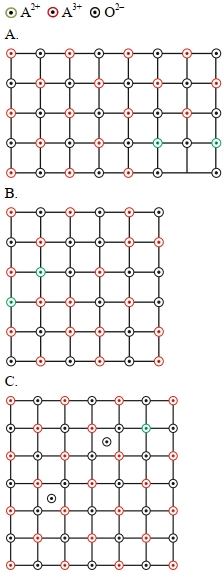
Which of the following represents the lattice structure of $A_{0.95} O$ containing $A^{2+}$,$A^{3+}$,and $O^{2-}$ ions?
A
$B$ and $C$ only
B
$B$ only
C
$A$ and $B$ only
D
$A$ only
Solution
(D) In the metal deficiency defect of $A_{0.95} O$,the total charge must be neutral. Let the number of $A^{3+}$ ions be $x$. Then the number of $A^{2+}$ ions is $(0.95 - x)$.
Equating the total positive charge to the total negative charge (which is $2$ for $O^{2-}$):
$3x + 2(0.95 - x) = 2$
$3x + 1.9 - 2x = 2$
$x = 0.1$
So,there are $0.1$ $A^{3+}$ ions and $0.85$ $A^{2+}$ ions for every $O^{2-}$ ion.
This defect involves the replacement of $A^{2+}$ ions by $A^{3+}$ ions,creating cation vacancies to maintain electrical neutrality. Structure $C$ correctly shows the presence of $A^{2+}$,$A^{3+}$,and a vacant cation site (represented by an empty circle with a dot).
Equating the total positive charge to the total negative charge (which is $2$ for $O^{2-}$):
$3x + 2(0.95 - x) = 2$
$3x + 1.9 - 2x = 2$
$x = 0.1$
So,there are $0.1$ $A^{3+}$ ions and $0.85$ $A^{2+}$ ions for every $O^{2-}$ ion.
This defect involves the replacement of $A^{2+}$ ions by $A^{3+}$ ions,creating cation vacancies to maintain electrical neutrality. Structure $C$ correctly shows the presence of $A^{2+}$,$A^{3+}$,and a vacant cation site (represented by an empty circle with a dot).
0 likes
View Solution160
DifficultMCQ
The correct statement$(s)$ regarding defects in solids is(are):
$A$. Frenkel defect is usually favoured by a very small difference in the sizes of cation and anion.
$B$. Frenkel defect is a dislocation defect.
$C$. Trapping of an electron in the lattice leads to the formation of $F$-center.
$D$. Schottky defects have no effect on the physical properties of solids.
$A$. Frenkel defect is usually favoured by a very small difference in the sizes of cation and anion.
$B$. Frenkel defect is a dislocation defect.
$C$. Trapping of an electron in the lattice leads to the formation of $F$-center.
$D$. Schottky defects have no effect on the physical properties of solids.
A
$B, C$
B
$A, B, C$
C
$B, C, D$
D
$A, D$
Solution
(A) and $C$ are correct statements.
$A$. Incorrect: Frenkel defect is favoured by a large difference in the sizes of cation and anion.
$B$. Correct: Frenkel defect is a dislocation defect where an ion moves from its lattice site to an interstitial site.
$C$. Correct: Trapping of an electron in an anionic vacancy leads to the formation of $F$-centers,which impart color to the crystal.
$D$. Incorrect: Schottky defects decrease the density of the solid,thus affecting its physical properties.
$A$. Incorrect: Frenkel defect is favoured by a large difference in the sizes of cation and anion.
$B$. Correct: Frenkel defect is a dislocation defect where an ion moves from its lattice site to an interstitial site.
$C$. Correct: Trapping of an electron in an anionic vacancy leads to the formation of $F$-centers,which impart color to the crystal.
$D$. Incorrect: Schottky defects decrease the density of the solid,thus affecting its physical properties.
0 likes
View Solution161
EasyMCQ
Identify the type of defect from the following in stainless steel.
A
Substitutional impurity defect
B
Interstitial impurity defect
C
Metal excess defect
D
Frenkel defect
Solution
(A) Stainless steel is an alloy of iron $(Fe)$ with other elements like chromium $(Cr)$,nickel $(Ni)$,and carbon $(C)$.
In the crystal lattice of iron,some iron atoms are replaced by atoms of other metals like chromium or nickel.
This type of defect,where foreign atoms replace the host atoms in the lattice,is known as a $Substitutional \ impurity \ defect$.
In the crystal lattice of iron,some iron atoms are replaced by atoms of other metals like chromium or nickel.
This type of defect,where foreign atoms replace the host atoms in the lattice,is known as a $Substitutional \ impurity \ defect$.
0 likes
View Solution162
EasyMCQ
Identify the defect developed when an ion of an ionic compound is missing from its regular site and occupies an interstitial position between lattice points.
A
Schottky defect
B
Frenkel defect
C
Substitutional impurity defect
D
Interstitial impurity defect
Solution
(B) In a $Frenkel$ defect,an ion (usually the smaller cation) is displaced from its normal lattice site and occupies an interstitial site.
This defect does not change the stoichiometry of the crystal because the number of ions remains the same.
It is commonly observed in ionic compounds where there is a large difference in the size of ions,such as $AgCl$ or $ZnS$.
This defect does not change the stoichiometry of the crystal because the number of ions remains the same.
It is commonly observed in ionic compounds where there is a large difference in the size of ions,such as $AgCl$ or $ZnS$.
0 likes
View Solution163
EasyMCQ
In an ionic solid,equal number of cations and anions are missing from their regular positions in the crystal lattice,creating vacancies. This is called-
A
Vacancy defect
B
Self interstitial defect
C
Schottky defect
D
Frenkel defect
Solution
(C) The correct answer is $C$ (Schottky defect).
$A$ $Schottky$ defect occurs in an ionic solid when equal numbers of cations and anions are missing from their regular positions in the crystal lattice,creating vacancies.
This defect maintains the overall electrical neutrality of the crystal.
$A$ $Schottky$ defect occurs in an ionic solid when equal numbers of cations and anions are missing from their regular positions in the crystal lattice,creating vacancies.
This defect maintains the overall electrical neutrality of the crystal.
0 likes
View Solution164
EasyMCQ
Which among the following statements is $NOT$ true about Frenkel defect?
A
It occurs in ionic compounds with sizes of cations and anions almost equal.
B
The density of solid crystal and its chemical properties remain unchanged as no ions are missing from the crystal lattice as a whole.
C
The crystal as whole remains electrically neutral because equal number of cations and anions are present.
D
The ions of ionic compound must have low co-ordination number.
Solution
(A) Frenkel defect occurs in ionic compounds where there is a large difference in the size of ions,specifically where the cation is much smaller than the anion. Option $A$ is incorrect because Frenkel defect is characteristic of compounds with a large difference in ionic sizes,whereas Schottky defect occurs in compounds where cation and anion sizes are almost equal.
0 likes
View Solution165
EasyMCQ
Which of the following statements is $NOT$ true about Schottky defect?
A
The electrical neutrality of the compound is not preserved.
B
It occurs in ionic compounds with sizes of cation and anion almost equal.
C
The ions of ionic compound must have high co-ordination number.
D
The density of the substance decreases.
Solution
(A) Schottky defect is a type of point defect in ionic crystals where an equal number of cations and anions are missing from their lattice sites.
$1$. Electrical neutrality is maintained because the number of missing cations equals the number of missing anions.
$2$. It typically occurs in ionic compounds where the cation and anion sizes are similar.
$3$. It is favored in compounds with high coordination numbers.
$4$. Due to the loss of ions from the lattice,the density of the crystal decreases.
Therefore,the statement that electrical neutrality is not preserved is incorrect.
$1$. Electrical neutrality is maintained because the number of missing cations equals the number of missing anions.
$2$. It typically occurs in ionic compounds where the cation and anion sizes are similar.
$3$. It is favored in compounds with high coordination numbers.
$4$. Due to the loss of ions from the lattice,the density of the crystal decreases.
Therefore,the statement that electrical neutrality is not preserved is incorrect.
0 likes
View Solution166
MediumMCQ
Which among the following statements is true about Schottky defect?
A
In this defect,cation and anion are lacking in stoichiometric proportion.
B
Formation of metal alloy is an example of this defect.
C
In this,a cation or anion moves from a regular site to a place between lattice sites.
D
In this,a regular cation is replaced by a different cation.
Solution
(A) In Schottky defect,cations and anions are missing from their lattice sites in stoichiometric proportion.
It is a type of vacancy defect in ionic solids.
To maintain electrical neutrality,the number of missing cations and anions must be equal.
This defect decreases the density of the crystal.
It is a type of vacancy defect in ionic solids.
To maintain electrical neutrality,the number of missing cations and anions must be equal.
This defect decreases the density of the crystal.
0 likes
View Solution167
EasyMCQ
Which among the following solids shows Frenkel defect?
A
$NaCl$
B
$CsCl$
C
$KCl$
D
$AgCl$
Solution
(D) Frenkel defect is observed in ionic solids where there is a large difference in the size of the ions.
Specifically,it occurs in crystals where the smaller ion (usually the cation) can leave its lattice site and occupy an interstitial site.
$AgCl$ shows Frenkel defect because the $Ag^+$ ion is significantly smaller than the $Cl^-$ ion,allowing it to move into interstitial positions.
In contrast,$NaCl$,$CsCl$,and $KCl$ typically exhibit Schottky defects due to the comparable sizes of their constituent ions.
Specifically,it occurs in crystals where the smaller ion (usually the cation) can leave its lattice site and occupy an interstitial site.
$AgCl$ shows Frenkel defect because the $Ag^+$ ion is significantly smaller than the $Cl^-$ ion,allowing it to move into interstitial positions.
In contrast,$NaCl$,$CsCl$,and $KCl$ typically exhibit Schottky defects due to the comparable sizes of their constituent ions.
0 likes
View Solution168
EasyMCQ
Among the following solids,Schottky defect is $NOT$ observed in-
A
$ZnS$
B
$NaCl$
C
$KCl$
D
$CsCl$
Solution
(A) $ZnS$ exhibits Frenkel defect because the $Zn^{2+}$ ion is small enough to occupy interstitial sites,whereas Schottky defect is typically observed in ionic solids with similar-sized cations and anions,such as $NaCl$,$KCl$,and $CsCl$.
0 likes
View Solution169
EasyMCQ
Identify the defect that develops when the ratio of number of cations to anions becomes different from that indicated by its chemical formula.
A
Schottky defect
B
Interstitial defect
C
Substitutional impurity defect
D
Non-stoichiometric defect
Solution
(D) defect is called non-stoichiometric if the ratio of the number of cations to anions in the crystal becomes different from that indicated by its chemical formula.
This occurs due to the presence of metal excess or metal deficiency in the crystal lattice.
This occurs due to the presence of metal excess or metal deficiency in the crystal lattice.
0 likes
View Solution170
MediumMCQ
Identify the type of defect in brass alloy.
A
Interstitial impurity defect
B
Schottky defect
C
Substitutional impurity defect
D
Metal deficiency defect
Solution
(C) Brass is an alloy of $Cu$ and $Zn$. In brass,$Zn$ atoms replace some of the $Cu$ atoms in the crystal lattice of copper. Since the host atoms are replaced by foreign atoms of similar size,this is classified as a substitutional impurity defect.
0 likes
View Solution171
MediumMCQ
The correct statement regarding defects in solids is
A
Frenkel defect is usually favoured by a very small difference in the sizes of cations and anions.
B
Frenkel defect is a dislocation defect.
C
Trapping of proton in the lattice leads to the formation of $F$-centers.
D
Schottky defect has no effect on the physical properties of solids.
Solution
(B) Option $(B)$ is correct.
$1$. Frenkel defect occurs in compounds where there is a large difference in the size of ions,specifically where anions are much larger than cations.
$2$. Frenkel defect is known as a dislocation defect because an ion is dislocated from its normal lattice site to an interstitial site.
$3$. $F$-centers are formed by the trapping of electrons in anion vacancies,not protons.
$4$. Schottky defect leads to a decrease in the density of the crystal due to the presence of vacancies.
$1$. Frenkel defect occurs in compounds where there is a large difference in the size of ions,specifically where anions are much larger than cations.
$2$. Frenkel defect is known as a dislocation defect because an ion is dislocated from its normal lattice site to an interstitial site.
$3$. $F$-centers are formed by the trapping of electrons in anion vacancies,not protons.
$4$. Schottky defect leads to a decrease in the density of the crystal due to the presence of vacancies.
0 likes
View Solution172
EasyMCQ
The correct statement regarding defects in solids is
A
Frenkel defect is a vacancy defect
B
Schottky defect is a dislocation defect
C
Trapping of an electron in the lattice leads to the formation of $F$-centre
D
Schottky defect has no effect on density
Solution
(C) The correct statement is that the trapping of an electron in the lattice leads to the formation of an $F$-centre.
Frenkel defect is a dislocation defect where an ion leaves its lattice site and occupies an interstitial site.
Schottky defect is a vacancy defect where equal numbers of cations and anions are missing from the lattice,which leads to a decrease in the density of the solid.
Frenkel defect is a dislocation defect where an ion leaves its lattice site and occupies an interstitial site.
Schottky defect is a vacancy defect where equal numbers of cations and anions are missing from the lattice,which leads to a decrease in the density of the solid.
0 likes
View Solution173
MediumMCQ
$1 \ \text{mole}$ of $NaCl$ is doped with $10^{-5} \ \text{mole}$ of $SrCl_{2}$. The number of cationic vacancies in the crystal lattice will be:
A
$6.022 \times 10^{23}$
B
$12.044 \times 10^{20}$
C
$6.022 \times 10^{18}$
D
$6.022 \times 10^{15}$
Solution
(C) When $SrCl_{2}$ is added to $NaCl$,each $Sr^{2+}$ ion replaces two $Na^{+}$ ions to maintain electrical neutrality.
One $Sr^{2+}$ ion creates one cationic vacancy.
Therefore,$1 \ \text{mole}$ of $SrCl_{2}$ creates $1 \ \text{mole}$ of cationic vacancies.
$10^{-5} \ \text{mole}$ of $SrCl_{2}$ will create $10^{-5} \ \text{mole}$ of cationic vacancies.
Number of cationic vacancies $= 10^{-5} \times 6.022 \times 10^{23} = 6.022 \times 10^{18}$.
One $Sr^{2+}$ ion creates one cationic vacancy.
Therefore,$1 \ \text{mole}$ of $SrCl_{2}$ creates $1 \ \text{mole}$ of cationic vacancies.
$10^{-5} \ \text{mole}$ of $SrCl_{2}$ will create $10^{-5} \ \text{mole}$ of cationic vacancies.
Number of cationic vacancies $= 10^{-5} \times 6.022 \times 10^{23} = 6.022 \times 10^{18}$.
0 likes
View Solution174
EasyMCQ
Schottky defect in a crystal is observed when,
A
Unequal number of cations and anions are missing from the lattice.
B
Equal number of cations and anions are missing from the lattice.
C
An ion leaves its normal site and occupies an interstitial site.
D
No ion is missing from its lattice site.
Solution
(B) Schottky defect arises when an equal number of cations and anions are missing from their normal lattice sites to maintain electrical neutrality. This defect leads to a decrease in the density of the crystal.
0 likes
View Solution175
EasyMCQ
Alkali halides do not show dislocation defect because
A
anions cannot be accommodated in vacant spaces
B
cations and anions have almost equal size
C
there is large difference in size of cations and anions
D
cations and anions have low coordination number
Solution
(B) Dislocation defect (Frenkel defect) occurs in ionic crystals where there is a large difference in the size of the ions,allowing the smaller ion (usually the cation) to occupy an interstitial site. In alkali halides,the sizes of the cations and anions are almost equal,which prevents the smaller ion from fitting into the interstitial spaces. Therefore,they do not show dislocation defect.
0 likes
View Solution176
EasyMCQ
The correct statement among the following,regarding defects in solids is:
$(1)$ Frenkel defect is favored by small difference in the sizes of cation and anion.
$(2)$ Frenkel defect is a metal excess defect.
$(3)$ Trapping of electron in the lattice leads to formation of $F$-centres.
$(4)$ Schottky defect has no effect on the physical property of solids.
$(1)$ Frenkel defect is favored by small difference in the sizes of cation and anion.
$(2)$ Frenkel defect is a metal excess defect.
$(3)$ Trapping of electron in the lattice leads to formation of $F$-centres.
$(4)$ Schottky defect has no effect on the physical property of solids.
A
$(1)$
B
$(2)$
C
$(3)$
D
$(4)$
Solution
(C) Analysis of the statements:
$(1)$ Incorrect: Frenkel defect is favored by a large difference in the sizes of cation and anion.
$(2)$ Incorrect: Frenkel defect is a dislocation defect,not a metal excess defect.
$(3)$ Correct: Trapping of electrons in anionic vacancies in the crystal lattice leads to the formation of $F$-centres (Farbenzenter),which are responsible for the color of the crystal.
$(4)$ Incorrect: Schottky defect decreases the density of the solid,thus affecting its physical properties.
$(1)$ Incorrect: Frenkel defect is favored by a large difference in the sizes of cation and anion.
$(2)$ Incorrect: Frenkel defect is a dislocation defect,not a metal excess defect.
$(3)$ Correct: Trapping of electrons in anionic vacancies in the crystal lattice leads to the formation of $F$-centres (Farbenzenter),which are responsible for the color of the crystal.
$(4)$ Incorrect: Schottky defect decreases the density of the solid,thus affecting its physical properties.
0 likes
View Solution177
MediumMCQ
The formula of nickel oxide is $Ni_{0.98}O_{1.00}$. What is the approximate percentage of $Ni^{2+}$ in it?
A
$92$
B
$94$
C
$96$
D
$98$
Solution
(C) Let there be $100$ formula units of $Ni_{0.98}O_{1.00}$. Thus,for $100$ $O^{2-}$ ions,there are $98$ nickel ions ($Ni^{2+}$ or $Ni^{3+}$).
Let $x$ be the number of $Ni^{2+}$ ions.
Then,the number of $Ni^{3+}$ ions is $(98 - x)$.
For the compound to be electrically neutral,the total positive charge must equal the total negative charge:
$2x + 3(98 - x) + 100(-2) = 0$
$2x + 294 - 3x - 200 = 0$
$-x + 94 = 0$
$x = 94$
So,the number of $Ni^{2+}$ ions is $94$.
The percentage of $Ni^{2+}$ ions is $\frac{94}{98} \times 100 \approx 95.92\%$,which is approximately $96\%$.
Let $x$ be the number of $Ni^{2+}$ ions.
Then,the number of $Ni^{3+}$ ions is $(98 - x)$.
For the compound to be electrically neutral,the total positive charge must equal the total negative charge:
$2x + 3(98 - x) + 100(-2) = 0$
$2x + 294 - 3x - 200 = 0$
$-x + 94 = 0$
$x = 94$
So,the number of $Ni^{2+}$ ions is $94$.
The percentage of $Ni^{2+}$ ions is $\frac{94}{98} \times 100 \approx 95.92\%$,which is approximately $96\%$.
0 likes
View Solution178
EasyMCQ
Which of the following statements are not correct?
$(A)$ Diode is a combination of $n$-type and $p$-type semiconductors.
$(B)$ Silicon or germanium is electron rich impurity.
$(C)$ Phosphorus and arsenic are electron deficient impurities.
$(D)$ Schottky defect decreases the density of the crystal.
$(A)$ Diode is a combination of $n$-type and $p$-type semiconductors.
$(B)$ Silicon or germanium is electron rich impurity.
$(C)$ Phosphorus and arsenic are electron deficient impurities.
$(D)$ Schottky defect decreases the density of the crystal.
A
$B$,$C$
B
$A$,$D$
C
$C$,$D$
D
$A$,$C$
Solution
(A) Among the given statements,$(B)$ and $(C)$ are incorrect.
$(B)$ Silicon $(Si)$ and germanium $(Ge)$ are group $14$ elements and are intrinsic semiconductors,not impurities.
$(C)$ Phosphorus $(P)$ and arsenic $(As)$ are group $15$ elements. They have $5$ valence electrons. When doped into group $14$ elements,$4$ electrons form covalent bonds,and the $5$th electron remains free. Thus,they are electron-rich impurities,not electron-deficient.
$(B)$ Silicon $(Si)$ and germanium $(Ge)$ are group $14$ elements and are intrinsic semiconductors,not impurities.
$(C)$ Phosphorus $(P)$ and arsenic $(As)$ are group $15$ elements. They have $5$ valence electrons. When doped into group $14$ elements,$4$ electrons form covalent bonds,and the $5$th electron remains free. Thus,they are electron-rich impurities,not electron-deficient.
0 likes
View Solution179
MediumMCQ
If molten $NaCl$ contains $SrCl_2$ as impurity,crystallization can generate
A
Anionic vacancies
B
Cationic vacancies
C
Metal excess defects
D
Metal deficiency defects
Solution
(B) When molten $NaCl$ containing a small amount of $SrCl_2$ is crystallized,some $Na^{+}$ ion sites are occupied by $Sr^{2+}$ ions.
Each $Sr^{2+}$ ion replaces two $Na^{+}$ ions to maintain electrical neutrality.
One $Sr^{2+}$ ion occupies the site of one $Na^{+}$ ion,while the other site remains vacant.
Thus,the number of cationic vacancies produced is equal to the number of $Sr^{2+}$ ions incorporated into the crystal lattice.
Each $Sr^{2+}$ ion replaces two $Na^{+}$ ions to maintain electrical neutrality.
One $Sr^{2+}$ ion occupies the site of one $Na^{+}$ ion,while the other site remains vacant.
Thus,the number of cationic vacancies produced is equal to the number of $Sr^{2+}$ ions incorporated into the crystal lattice.
0 likes
View Solution180
MediumMCQ
Analysis shows that nickel oxide has the formula $Ni_{0.98}O_{1.00}$. The fractions of $Ni^{2+}$ and $Ni^{3+}$ ions in the crystal are ......
A
$Ni^{2+}=98 \%$ and $Ni^{3+}=2 \%$
B
$Ni^{2+}=2 \%$ and $Ni^{3+}=98 \%$
C
$Ni^{2+}=4 \%$ and $Ni^{3+}=96 \%$
D
$Ni^{2+}=96 \%$ and $Ni^{3+}=4 \%$
Solution
(D) Given the formula of nickel oxide is $Ni_{0.98}O_{1.00}$.
Let the number of $Ni^{2+}$ ions be $x$ and the number of $Ni^{3+}$ ions be $(0.98 - x)$.
Since the total charge of the compound must be zero,the sum of positive charges equals the sum of negative charges.
$2x + 3(0.98 - x) + 1(-2) = 0$
$2x + 2.94 - 3x - 2 = 0$
$-x + 0.94 = 0$
$x = 0.94$
So,the fraction of $Ni^{2+}$ ions $= \frac{0.94}{0.98} \times 100 \approx 96 \%$.
The fraction of $Ni^{3+}$ ions $= \frac{0.98 - 0.94}{0.98} \times 100 = \frac{0.04}{0.98} \times 100 \approx 4 \%$.
Therefore,the fractions are $Ni^{2+}=96 \%$ and $Ni^{3+}=4 \%$.
Let the number of $Ni^{2+}$ ions be $x$ and the number of $Ni^{3+}$ ions be $(0.98 - x)$.
Since the total charge of the compound must be zero,the sum of positive charges equals the sum of negative charges.
$2x + 3(0.98 - x) + 1(-2) = 0$
$2x + 2.94 - 3x - 2 = 0$
$-x + 0.94 = 0$
$x = 0.94$
So,the fraction of $Ni^{2+}$ ions $= \frac{0.94}{0.98} \times 100 \approx 96 \%$.
The fraction of $Ni^{3+}$ ions $= \frac{0.98 - 0.94}{0.98} \times 100 = \frac{0.04}{0.98} \times 100 \approx 4 \%$.
Therefore,the fractions are $Ni^{2+}=96 \%$ and $Ni^{3+}=4 \%$.
0 likes
View Solution181
EasyMCQ
Match List-$I$ with List-$II$.
| List-$I$ (Defect) | List-$II$ (Examples) |
|---|---|
| $A$. Frenkel defects | $1$. $FeO$ |
| $B$. Schottky defects | $2$. $NaCl$ |
| $C$. Vacancy defects | $3$. $AgCl$ |
| $D$. Metal deficiency defects | $4$. Crystals with vacant lattice sites |
A
$A-4, B-3, C-2, D-1$
B
$A-3, B-2, C-4, D-1$
C
$A-1, B-2, C-3, D-4$
D
$A-2, B-3, C-4, D-1$
Solution
(B) . Frenkel defect: Shown by ionic substances with a large difference in ion sizes,e.g.,$AgCl$.
$B$. Schottky defect: Shown by ionic substances with similar cation and anion sizes,e.g.,$NaCl$.
$C$. Vacancy defect: Occurs when some lattice sites are vacant,leading to decreased density.
$D$. Metal deficiency defect: Occurs in non-stoichiometric solids like $FeO$ (often $Fe_{0.95}O$).
$B$. Schottky defect: Shown by ionic substances with similar cation and anion sizes,e.g.,$NaCl$.
$C$. Vacancy defect: Occurs when some lattice sites are vacant,leading to decreased density.
$D$. Metal deficiency defect: Occurs in non-stoichiometric solids like $FeO$ (often $Fe_{0.95}O$).
0 likes
View Solution182
MediumMCQ
For $NaCl$,the number of Schottky pairs per $cm^3$ at room temperature is
A
$10^{12}$
B
$10^{23}$
C
$10^{6}$
D
$10^{4}$
Solution
(C) The concentration of Schottky defects in a crystal is given by the formula $n = N \exp(-E/2kT)$,where $n$ is the number of Schottky pairs per $cm^3$,$N$ is the total number of lattice sites per $cm^3$,$E$ is the energy required to form a defect,$k$ is the Boltzmann constant,and $T$ is the temperature.
For $NaCl$ at room temperature $(298 \ K)$,the calculated value for the number of Schottky pairs is approximately $10^6$ per $cm^3$.
For $NaCl$ at room temperature $(298 \ K)$,the calculated value for the number of Schottky pairs is approximately $10^6$ per $cm^3$.
0 likes
View Solution183
MediumMCQ
Identify the incorrect statement regarding crystals having $Frenkel$ defect.
A
$Frenkel$ defects are observed where the difference in sizes of cations and anions is large.
B
The density of crystals having $Frenkel$ defect is less than that of a pure perfect crystal.
C
An ionic crystal having $Frenkel$ defect may also contain $Schottky$ defect.
D
Alkali halides do not usually have $Frenkel$ defect.
Solution
(B) $Frenkel$ defect occurs when an ion (usually a cation) is dislocated from its normal lattice site to an interstitial site.
Because the ions remain within the crystal lattice,the total mass and volume of the crystal do not change.
Therefore,the density of the crystal remains constant,not less than that of a pure perfect crystal.
This defect is typically observed in ionic solids where there is a large difference in the size of the ions.
$Schottky$ and $Frenkel$ defects can coexist in the same crystal.
Alkali halides (except $AgBr$) generally do not show $Frenkel$ defect due to the similar sizes of their ions.
Because the ions remain within the crystal lattice,the total mass and volume of the crystal do not change.
Therefore,the density of the crystal remains constant,not less than that of a pure perfect crystal.
This defect is typically observed in ionic solids where there is a large difference in the size of the ions.
$Schottky$ and $Frenkel$ defects can coexist in the same crystal.
Alkali halides (except $AgBr$) generally do not show $Frenkel$ defect due to the similar sizes of their ions.
0 likes
View Solution184
EasyMCQ
When $CaCl_2$ is added to $AgCl$ crystal,the defect introduced is
A
Frenkel defect only
B
Schottky defect only
C
No change
D
Both Frenkel and Schottky defects
Solution
(B) When $CaCl_2$ is added to $AgCl$ crystal,each $Ca^{2+}$ ion replaces two $Ag^{+}$ ions to maintain electrical neutrality.
Since one $Ca^{2+}$ ion replaces two $Ag^{+}$ ions,one $Ag^{+}$ site remains vacant,creating a cation vacancy.
This type of defect is a form of impurity defect,which is related to the Schottky defect mechanism where vacancies are created in the lattice.
Therefore,the introduction of $CaCl_2$ into $AgCl$ leads to the formation of cation vacancies,which is characteristic of Schottky-type defects.
Thus,the correct option is $B$.
Since one $Ca^{2+}$ ion replaces two $Ag^{+}$ ions,one $Ag^{+}$ site remains vacant,creating a cation vacancy.
This type of defect is a form of impurity defect,which is related to the Schottky defect mechanism where vacancies are created in the lattice.
Therefore,the introduction of $CaCl_2$ into $AgCl$ leads to the formation of cation vacancies,which is characteristic of Schottky-type defects.
Thus,the correct option is $B$.
0 likes
View Solution185
MediumMCQ
$A$ metallic solid undergoes Frenkel defect. Its original mass,volume and density are $M_0$,$V_0$ and $D_0$ respectively. After Frenkel defect the mass,volume and density are $M$,$V$ and $D$ respectively. The variations of $M$,$V$ and $D$ after Frenkel defect are
A
$M=M_0, V=V_0, D=D_0$
B
$M < M_0, V < V_0, D < D_0$
C
$M > M_0, V=V_0, D > D_0$
D
$M=M_0, V < V_0, D > D_0$
Solution
(A) In a Frenkel defect,an ion leaves its lattice site and occupies an interstitial site within the same crystal lattice.
Since no atoms or ions are lost from or added to the crystal,the total mass $(M)$ remains constant $(M = M_0)$.
The volume $(V)$ of the crystal remains unchanged because the lattice structure does not expand or contract significantly $(V = V_0)$.
Since density $(D)$ is defined as mass divided by volume $(D = M/V)$,and both mass and volume remain constant,the density remains unchanged $(D = D_0)$.
Therefore,the correct option is $(A)$.
Since no atoms or ions are lost from or added to the crystal,the total mass $(M)$ remains constant $(M = M_0)$.
The volume $(V)$ of the crystal remains unchanged because the lattice structure does not expand or contract significantly $(V = V_0)$.
Since density $(D)$ is defined as mass divided by volume $(D = M/V)$,and both mass and volume remain constant,the density remains unchanged $(D = D_0)$.
Therefore,the correct option is $(A)$.
0 likes
View Solution186
MediumMCQ
If $AgCl$ is doped with $1 \times 10^{-4}$ mole percent of $CdCl_2$,the number of cation vacancies (in $mol^{-1}$) is
A
$6.023 \times 10^{19}$
B
$6.023 \times 10^{21}$
C
$6.023 \times 10^{17}$
D
$6.023 \times 10^{23}$
Solution
(C) When $CdCl_2$ is added to $AgCl$,each $Cd^{2+}$ ion replaces two $Ag^+$ ions to maintain electrical neutrality.
One $Cd^{2+}$ ion occupies the site of one $Ag^+$ ion,while the other $Ag^+$ site remains vacant.
Thus,the number of cation vacancies created is equal to the number of $Cd^{2+}$ ions added.
Given that $1 \times 10^{-4}$ mole percent of $CdCl_2$ is added,this means $1 \times 10^{-4} \text{ moles of } CdCl_2$ are present in $100 \text{ moles of } AgCl$.
Therefore,the number of moles of $Cd^{2+}$ ions per mole of $AgCl$ is $\frac{1 \times 10^{-4}}{100} = 1 \times 10^{-6} \text{ mol}$.
The number of cation vacancies per mole is $1 \times 10^{-6} \times N_A$,where $N_A = 6.023 \times 10^{23} \text{ mol}^{-1}$.
Number of vacancies $= 1 \times 10^{-6} \times 6.023 \times 10^{23} = 6.023 \times 10^{17} \text{ mol}^{-1}$.
One $Cd^{2+}$ ion occupies the site of one $Ag^+$ ion,while the other $Ag^+$ site remains vacant.
Thus,the number of cation vacancies created is equal to the number of $Cd^{2+}$ ions added.
Given that $1 \times 10^{-4}$ mole percent of $CdCl_2$ is added,this means $1 \times 10^{-4} \text{ moles of } CdCl_2$ are present in $100 \text{ moles of } AgCl$.
Therefore,the number of moles of $Cd^{2+}$ ions per mole of $AgCl$ is $\frac{1 \times 10^{-4}}{100} = 1 \times 10^{-6} \text{ mol}$.
The number of cation vacancies per mole is $1 \times 10^{-6} \times N_A$,where $N_A = 6.023 \times 10^{23} \text{ mol}^{-1}$.
Number of vacancies $= 1 \times 10^{-6} \times 6.023 \times 10^{23} = 6.023 \times 10^{17} \text{ mol}^{-1}$.
0 likes
View Solution187
MediumMCQ
Zinc oxide (white) is heated to high temperature for some time. Observe the following statements regarding the above process:
$I$. Zinc oxide colour changes to pale yellow
$II$. The type of defect formed is 'metal deficiency'
$III$. Some $Zn^{2+}$ and $e^{-}$ are present in interstitial places
The correct statements are:
$I$. Zinc oxide colour changes to pale yellow
$II$. The type of defect formed is 'metal deficiency'
$III$. Some $Zn^{2+}$ and $e^{-}$ are present in interstitial places
The correct statements are:
A
$I, II$ only
B
$I, III$ only
C
$II, III$ only
D
$I, II, III$
Solution
(B) Zinc oxide is white in colour at room temperature. On heating,it loses oxygen and turns yellow.
$ZnO \xrightarrow{\text{heating}} Zn^{2+} + \frac{1}{2} O_2 + 2e^{-}$
The excess $Zn^{2+}$ ions move to interstitial sites and electrons move to neighbouring interstitial sites.
This is a 'metal excess' defect due to the presence of extra cations at interstitial sites.
Therefore,statements $(I)$ and $(III)$ are correct.
$ZnO \xrightarrow{\text{heating}} Zn^{2+} + \frac{1}{2} O_2 + 2e^{-}$
The excess $Zn^{2+}$ ions move to interstitial sites and electrons move to neighbouring interstitial sites.
This is a 'metal excess' defect due to the presence of extra cations at interstitial sites.
Therefore,statements $(I)$ and $(III)$ are correct.
0 likes
View Solution188
EasyMCQ
$F$-centres are formed in $NaCl$ crystal if it is heated with $Na$ vapour. The above is due to
A
Schottky defect
B
Dislocation defect
C
Metal excess defect
D
Metal deficiency defect
Solution
(C) When $NaCl$ crystals are heated in an atmosphere of $Na$ vapour,the $Na$ atoms deposit on the surface of the crystal.
$Cl^-$ ions diffuse to the surface and combine with $Na$ atoms to form $NaCl$,which releases electrons into the crystal lattice.
These electrons occupy the vacant anionic sites,known as $F$-centres ($F$ stands for the German word 'Farbe',meaning colour).
This phenomenon is a type of metal excess defect caused by anionic vacancies.
$Cl^-$ ions diffuse to the surface and combine with $Na$ atoms to form $NaCl$,which releases electrons into the crystal lattice.
These electrons occupy the vacant anionic sites,known as $F$-centres ($F$ stands for the German word 'Farbe',meaning colour).
This phenomenon is a type of metal excess defect caused by anionic vacancies.
0 likes
View Solution189
EasyMCQ
Which of the following molecular formula and type of defect are correct for the following statement?
"In $FeO$ crystal,some $Fe^{2+}$ ions are missing and the loss of positive charge is made up by the presence of $Fe^{3+}$ ions".
"In $FeO$ crystal,some $Fe^{2+}$ ions are missing and the loss of positive charge is made up by the presence of $Fe^{3+}$ ions".
A
$Fe_{0.95} O$ and metal excess defect.
B
$Fe_{1.05} O$ and metal deficiency defect.
C
$Fe_{0.95} O$ and metal deficiency defect.
D
$Fe_{1.05} O$ and metal excess defect.
Solution
(C) The crystal of $FeO$ exhibits a metal deficiency defect because some $Fe^{2+}$ ions are missing from their lattice sites.
To maintain electrical neutrality,the loss of positive charge is compensated by the presence of $Fe^{3+}$ ions.
Since the number of metal ions is less than the stoichiometric ratio,it is a metal deficiency defect.
Typically,the formula is represented as $Fe_{0.95} O$.
To maintain electrical neutrality,the loss of positive charge is compensated by the presence of $Fe^{3+}$ ions.
Since the number of metal ions is less than the stoichiometric ratio,it is a metal deficiency defect.
Typically,the formula is represented as $Fe_{0.95} O$.
0 likes
View Solution190
EasyMCQ
The defect produced due to the presence of extra cations at interstitial sites is called
A
metal excess defect
B
Schottky defect
C
metal deficiency defect
D
Frenkel defect
Solution
(A) When a crystal lattice contains extra cations in the interstitial sites to maintain electrical neutrality,it is known as a metal excess defect.
This is a type of non-stoichiometric defect.
This is a type of non-stoichiometric defect.
0 likes
View Solution191
EasyMCQ
The incorrect statement about crystals with $Schottky$ defect is:
A
It is due to the missing of an equal number of cations and anions from lattice points.
B
On the whole,the crystal is electrically neutral.
C
It is shown by ionic compounds in which the cation and anion are of almost the same size.
D
The density of the crystal increases.
Solution
(D) $Schottky$ defect is a type of point defect in ionic crystals where an equal number of cations and anions are missing from their lattice sites to maintain electrical neutrality.
Because atoms/ions are missing from the lattice,the total mass of the crystal decreases while the volume remains constant.
Therefore,the density of the crystal decreases,not increases.
Thus,the statement in option $D$ is incorrect.
Because atoms/ions are missing from the lattice,the total mass of the crystal decreases while the volume remains constant.
Therefore,the density of the crystal decreases,not increases.
Thus,the statement in option $D$ is incorrect.
0 likes
View Solution192
MediumMCQ
Identify the correct statement about the crystal defects in solids.
A
Frenkel defect is favoured when the difference between sizes of cation and anion is very small.
B
Frenkel defect is not a dislocation effect.
C
Schottky defects have no effect on physical properties of solids.
D
Trapping of electrons in lattice leads to the formation of $F$-centres.
Solution
(D) The correct statement is that the trapping of electrons in the lattice leads to the formation of $F$-centres.
$1-$ Frenkel defect is favoured when the difference between the size of the cation and anion is large.
$2-$ Frenkel defect is also known as a dislocation defect.
$3-$ Schottky defect affects the physical properties of solids,specifically by decreasing the density of the substance.
$1-$ Frenkel defect is favoured when the difference between the size of the cation and anion is large.
$2-$ Frenkel defect is also known as a dislocation defect.
$3-$ Schottky defect affects the physical properties of solids,specifically by decreasing the density of the substance.
0 likes
View Solution193
DifficultMCQ
Iron crystallizes in $FCC$ with an edge length of $400 \ pm$. If it contains $0.1 \%$ Schottky defects, calculate its approximate density $[AW \text{ of } Fe = 56 \ g/mol]$. (in $g/cm^3$)
A
$5.8$
B
$1.5$
C
$2.9$
D
$8.5$
Solution
(A) In a solid with Schottky defects, atoms are missing from their lattice positions, which decreases the effective number of atoms per unit cell.
For an $FCC$ lattice, the number of atoms per unit cell is $Z = 4$.
With $0.1 \%$ Schottky defects, the effective number of atoms per unit cell is:
$Z_{effective} = 4 \times (1 - \frac{0.1}{100}) = 4 \times 0.999 = 3.996$.
Using the density formula $d = \frac{Z_{effective} \times M}{N_A \times a^3}$:
Given $M = 56 \ g/mol$, $N_A = 6.022 \times 10^{23} \ mol^{-1}$, and $a = 400 \ pm = 4 \times 10^{-8} \ cm$.
$d = \frac{3.996 \times 56}{(6.022 \times 10^{23}) \times (4 \times 10^{-8})^3} \approx \frac{223.776}{6.022 \times 10^{23} \times 64 \times 10^{-24}} \approx \frac{223.776}{38.54} \approx 5.81 \ g/cm^3$.
For an $FCC$ lattice, the number of atoms per unit cell is $Z = 4$.
With $0.1 \%$ Schottky defects, the effective number of atoms per unit cell is:
$Z_{effective} = 4 \times (1 - \frac{0.1}{100}) = 4 \times 0.999 = 3.996$.
Using the density formula $d = \frac{Z_{effective} \times M}{N_A \times a^3}$:
Given $M = 56 \ g/mol$, $N_A = 6.022 \times 10^{23} \ mol^{-1}$, and $a = 400 \ pm = 4 \times 10^{-8} \ cm$.
$d = \frac{3.996 \times 56}{(6.022 \times 10^{23}) \times (4 \times 10^{-8})^3} \approx \frac{223.776}{6.022 \times 10^{23} \times 64 \times 10^{-24}} \approx \frac{223.776}{38.54} \approx 5.81 \ g/cm^3$.
0 likes
View Solution194
DifficultMCQ
Potassium crystallizes in an $FCC$ lattice with a unit cell edge length of $0.5 \ nm$. The approximate density (in $g \ cm^{-3}$),if it contains $0.1 \%$ Schottky defects,is:
A
$1.2$
B
$2.1$
C
$1.7$
D
$2.8$
Solution
(B) In a Schottky defect,an equal number of cations and anions are missing from the lattice,which reduces the effective number of atoms per unit cell $(Z_{eff})$.
For an $FCC$ lattice,the number of atoms per unit cell is $Z = 4$.
With $0.1 \%$ Schottky defects,the new effective number of atoms is $Z_{new} = 4 - (4 \times 0.001) = 3.996 \approx 4$.
However,using the provided calculation logic: $Z_{new} = 4 - 0.004 = 3.996$.
Given the atomic mass of Potassium $(K)$ is $39 \ g \ mol^{-1}$.
The edge length $a = 0.5 \ nm = 5 \times 10^{-8} \ cm$.
The density formula is $\rho = \frac{Z \times M}{N_A \times a^3}$.
$\rho = \frac{3.996 \times 39}{6.022 \times 10^{23} \times (5 \times 10^{-8})^3} = \frac{155.844}{6.022 \times 10^{23} \times 125 \times 10^{-24}} = \frac{155.844}{75.275} \approx 2.07 \ g \ cm^{-3}$.
Rounding to the nearest value,we get $2.1 \ g \ cm^{-3}$.
Thus,Option $B$ is correct.
For an $FCC$ lattice,the number of atoms per unit cell is $Z = 4$.
With $0.1 \%$ Schottky defects,the new effective number of atoms is $Z_{new} = 4 - (4 \times 0.001) = 3.996 \approx 4$.
However,using the provided calculation logic: $Z_{new} = 4 - 0.004 = 3.996$.
Given the atomic mass of Potassium $(K)$ is $39 \ g \ mol^{-1}$.
The edge length $a = 0.5 \ nm = 5 \times 10^{-8} \ cm$.
The density formula is $\rho = \frac{Z \times M}{N_A \times a^3}$.
$\rho = \frac{3.996 \times 39}{6.022 \times 10^{23} \times (5 \times 10^{-8})^3} = \frac{155.844}{6.022 \times 10^{23} \times 125 \times 10^{-24}} = \frac{155.844}{75.275} \approx 2.07 \ g \ cm^{-3}$.
Rounding to the nearest value,we get $2.1 \ g \ cm^{-3}$.
Thus,Option $B$ is correct.
0 likes
View Solution195
MediumMCQ
$NaCl$ is heated in an atmosphere of sodium vapour. The resultant yellow colour is due to the formation of
A
Frenkel defect
B
Schottky defect
C
$F$-centers
D
impurity defects
Solution
(C) Anion vacancies in alkali halides are produced by heating the alkali halide crystals in an atmosphere of the alkali metal vapour.
When the metal atoms deposit on the surface,they diffuse into the crystal.
After ionization,the alkali metal ion occupies cationic vacancies,whereas the electron occupies the anionic vacancy.
Electrons trapped in anion vacancies are referred to as $F$-centers,which give rise to the characteristic yellow colour in $NaCl$ crystals.
When the metal atoms deposit on the surface,they diffuse into the crystal.
After ionization,the alkali metal ion occupies cationic vacancies,whereas the electron occupies the anionic vacancy.
Electrons trapped in anion vacancies are referred to as $F$-centers,which give rise to the characteristic yellow colour in $NaCl$ crystals.
0 likes
View Solution196
MediumMCQ
The formula of a metal oxide is $M_{0.96} O_1$. The fractions of metal that exist as $M^{3+}$ and $M^{2+}$ ions in that oxide are respectively
A
$0.083, 0.916$
B
$0.916, 0.083$
C
$0.88, 0.12$
D
$0.12, 0.88$
Solution
(A) Let $x$ be the number of $M^{3+}$ ions and $y$ be the number of $M^{2+}$ ions.
Total number of metal ions is $x + y = 0.96$.
Therefore,$y = 0.96 - x$.
Since the oxide is electrically neutral,the total positive charge must equal the total negative charge ($-2$ for $O^{2-}$).
$3x + 2y = 2$.
Substituting $y = 0.96 - x$ into the equation:
$3x + 2(0.96 - x) = 2$.
$3x + 1.92 - 2x = 2$.
$x = 0.08$.
Thus,$y = 0.96 - 0.08 = 0.88$.
The fraction of $M^{3+} = \frac{0.08}{0.96} = 0.083$.
The fraction of $M^{2+} = \frac{0.88}{0.96} = 0.917$.
Total number of metal ions is $x + y = 0.96$.
Therefore,$y = 0.96 - x$.
Since the oxide is electrically neutral,the total positive charge must equal the total negative charge ($-2$ for $O^{2-}$).
$3x + 2y = 2$.
Substituting $y = 0.96 - x$ into the equation:
$3x + 2(0.96 - x) = 2$.
$3x + 1.92 - 2x = 2$.
$x = 0.08$.
Thus,$y = 0.96 - 0.08 = 0.88$.
The fraction of $M^{3+} = \frac{0.08}{0.96} = 0.083$.
The fraction of $M^{2+} = \frac{0.88}{0.96} = 0.917$.
0 likes
View Solution197
EasyMCQ
Ionic solids with Schottky defect may contain in their structure
A
cation vacancies only
B
cation vacancies and interstitial cations
C
equal number of cation and anion vacancies
D
anion vacancies and interstitial anions
Solution
(C) In $Schottky$ defect,an equal number of cations and anions are missing from the crystal lattice,which creates an equal number of cation and anion vacancies to maintain electrical neutrality.
0 likes
View SolutionSolid State — Defects in crystal · Frequently Asked Questions
1Are these Solid State questions useful for JEE and NEET?
Yes. All questions in this section are mapped to JEE Main and NEET exam patterns. Previous year questions from JEE Main, NEET, GUJCET and state-level exams are included with full solutions.
2Can I switch to Hindi or Gujarati for these questions?
Yes. Use the language tabs in the hero section or the sidebar to view the same questions and solutions in English, Hindi or Gujarati.
3How do I generate a question paper from this subtopic?
Use the Vedclass Exam Paper Generator — select the chapter and subtopic, set difficulty, and generate Sets A, B, C, D automatically. First 3 chapters of every subject are free.
Vedclass Products
For Students
Vedclass Test Series
Mock tests in real JEE/NEET style with performance analysis. 5-day free trial.
Start Free TrialFor Teachers
Exam Paper Generator
Generate Set A/B/C/D papers from this chapter in 2 minutes. 3 chapters free.
Try FreeFor Institutes
Online Exam Module
Live online exams with unlimited students, 360° analytics & white-label branding.
See DemoFor Teachers & Institutes
Generate a Solid State Exam Paper in 2 Minutes
Select subtopic & difficulty — Sets A, B, C, D auto-generated with No Repeat logic.
First 3 chapters of every subject are free — no payment required.