
A English
Reduction to free Metal Questions in English
Class 12 Chemistry · General Principles and Processes of Isolation of Elements · Reduction to free Metal
597+
Questions
English
Language
100%
With Solutions
Showing 49 of 597 questions in English
201
EasyMCQ
After froth flotation,copper sulfide is reduced by.........
A
Reduction with $C$
B
Electrolysis
C
Self-reduction
D
Cyanide process
Solution
(C) In the extraction of copper,the copper sulfide $(Cu_2S)$ is partially roasted to form copper oxide $(Cu_2O)$.
$2Cu_2S + 3O_2 \rightarrow 2Cu_2O + 2SO_2$
The remaining copper sulfide then reacts with the copper oxide to produce metallic copper,a process known as self-reduction.
$2Cu_2O + Cu_2S \rightarrow 6Cu + SO_2$
$2Cu_2S + 3O_2 \rightarrow 2Cu_2O + 2SO_2$
The remaining copper sulfide then reacts with the copper oxide to produce metallic copper,a process known as self-reduction.
$2Cu_2O + Cu_2S \rightarrow 6Cu + SO_2$
0 likes
View Solution202
EasyMCQ
Which of the following is an acidic flux?
A
$SiO_2$
B
$Fe_2O_3$
C
$Al_2O_3$
D
$CaO$
Solution
(A) flux is a substance added to the furnace to remove gangue (impurities) from the ore.
Acidic flux is used to remove basic impurities.
$SiO_2$ (silica) is an acidic oxide and acts as an acidic flux.
It reacts with basic impurities like $CaO$ to form slag: $CaO + SiO_2 \rightarrow CaSiO_3$ (slag).
Therefore,$SiO_2$ is the correct answer.
Acidic flux is used to remove basic impurities.
$SiO_2$ (silica) is an acidic oxide and acts as an acidic flux.
It reacts with basic impurities like $CaO$ to form slag: $CaO + SiO_2 \rightarrow CaSiO_3$ (slag).
Therefore,$SiO_2$ is the correct answer.
0 likes
View Solution203
EasyMCQ
Which method is used to obtain $Al$ from $Al_2O_3$?
A
Thermal reduction
B
Hydrometallurgy
C
Electrolytic reduction
D
Reduction by iron
Solution
(C) Metals with high electropositive character are extracted by electrolytic reduction. $Al_2O_3$ is reduced to $Al$ using the Hall-Heroult process,which is an electrolytic reduction method.
0 likes
View Solution204
EasyMCQ
The slag formed during the extraction of $Fe$ is...........
A
$FeO$
B
$FeSiO_3$
C
$MgSiO_3$
D
$CaSiO_3$
Solution
(D) In the extraction of $Fe$ (iron),the impurity present is $SiO_2$ (silica),which is acidic in nature. To remove this,$CaO$ (calcium oxide) is added as a flux. The reaction is: $CaO + SiO_2 \rightarrow CaSiO_3$. Here,$CaSiO_3$ (calcium silicate) is the slag formed.
0 likes
View Solution205
EasyMCQ
In the extraction of iron from its ore,the slag produced in the blast furnace is a mixture of......?
A
$CaO + FeO$
B
$FeSiO_3 + CaO$
C
$CaSiO_3 + \text{aluminium silicate}$
D
$CaCO_3 + Al_2O_3$
Solution
(C) In the blast furnace,the iron ore is reduced to iron. The impurities present in the ore,such as silica $(SiO_2)$,are removed by adding limestone $(CaCO_3)$ as a flux.
$CaCO_3$ decomposes to form $CaO$ and $CO_2$.
$CaCO_3 \rightarrow CaO + CO_2$
$CaO$ then reacts with the silica impurity $(SiO_2)$ to form calcium silicate $(CaSiO_3)$,which is the slag.
$CaO + SiO_2 \rightarrow CaSiO_3$ (Slag)
Therefore,the slag produced is primarily $CaSiO_3$ along with other silicate impurities like aluminium silicate if alumina is present in the ore.
$CaCO_3$ decomposes to form $CaO$ and $CO_2$.
$CaCO_3 \rightarrow CaO + CO_2$
$CaO$ then reacts with the silica impurity $(SiO_2)$ to form calcium silicate $(CaSiO_3)$,which is the slag.
$CaO + SiO_2 \rightarrow CaSiO_3$ (Slag)
Therefore,the slag produced is primarily $CaSiO_3$ along with other silicate impurities like aluminium silicate if alumina is present in the ore.
0 likes
View Solution206
MediumMCQ
In the extraction of metals from sulphide ores,the ore is first converted into an oxide before reduction,rather than reducing the sulphide ore directly,because .....
A
$CO_2$ is thermodynamically more stable than $CS_2$.
B
Metal sulphides are less stable than metal oxides.
C
$CO_2$ is more volatile than $CS_2$.
D
Metal sulphides are thermodynamically more stable than $CS_2$.
Solution
(A) The reduction of metal sulphides to metal is thermodynamically unfavourable because the formation of $CS_2$ is not spontaneous compared to the formation of $CO_2$ when carbon is used as a reducing agent.
Since $CO_2$ is thermodynamically much more stable than $CS_2$,the conversion of metal sulphides to oxides makes the subsequent reduction with carbon thermodynamically feasible.
Since $CO_2$ is thermodynamically much more stable than $CS_2$,the conversion of metal sulphides to oxides makes the subsequent reduction with carbon thermodynamically feasible.
0 likes
View Solution207
EasyMCQ
Heating an ore with carbon in the absence of air is known as ....
A
Carbon reduction
B
Smelting
C
Roasting
D
Calcination
Solution
(B) The process of heating an ore with carbon in the absence of air to extract the metal is known as $Smelting$.
In this process,carbon acts as a reducing agent to reduce the metal oxide to its metallic form.
In this process,carbon acts as a reducing agent to reduce the metal oxide to its metallic form.
0 likes
View Solution208
EasyMCQ
$Pb$ and $Sn$ are extracted from their ores by which of the following methods?
A
Reduction by $C$ and self-reduction
B
Self-reduction and reduction by $C$
C
Electrolysis and self-reduction
D
Self-reduction and electrolysis
Solution
(B) $Pb$ is extracted from galena $(PbS)$ primarily by self-reduction (roasting followed by reaction with remaining sulfide).
$2PbO + PbS \rightarrow 3Pb + SO_2$
$PbSO_4 + PbS \rightarrow 2Pb + 2SO_2$
$Sn$ is extracted from cassiterite $(SnO_2)$ by reduction with carbon $(C)$:
$SnO_2 + 2C \rightarrow Sn + 2CO$
$2PbO + PbS \rightarrow 3Pb + SO_2$
$PbSO_4 + PbS \rightarrow 2Pb + 2SO_2$
$Sn$ is extracted from cassiterite $(SnO_2)$ by reduction with carbon $(C)$:
$SnO_2 + 2C \rightarrow Sn + 2CO$
0 likes
View Solution209
EasyMCQ
Which metal is leached from its ore using $KCN$?
A
Copper
B
Zinc
C
Gold
D
Iron
Solution
(C) The extraction of gold $(Au)$ and silver $(Ag)$ from their native ores involves leaching with a dilute solution of $NaCN$ or $KCN$ in the presence of air $(O_2)$,which provides the necessary oxygen to oxidize the metal.
The chemical reaction for gold is:
$4Au(s) + 8CN^-(aq) + 2H_2O(aq) + O_2(g) \rightarrow 4[Au(CN)_2]^-(aq) + 4OH^-(aq)$
This process is known as the MacArthur-Forrest cyanide process.
The chemical reaction for gold is:
$4Au(s) + 8CN^-(aq) + 2H_2O(aq) + O_2(g) \rightarrow 4[Au(CN)_2]^-(aq) + 4OH^-(aq)$
This process is known as the MacArthur-Forrest cyanide process.
0 likes
View Solution210
EasyMCQ
Which substance is used as a fuel in a blast furnace?
A
$CO$
B
$SiO_2$
C
$CaO$
D
$Fe_2O_3$
Solution
(A) In a blast furnace,$C$ (coke) is used as a fuel as well as a reducing agent. $C$ reacts with $O_2$ to produce $CO_2$ and heat,and further reacts with $CO_2$ to form $CO$,which acts as the primary reducing agent for metal oxides.
0 likes
View Solution211
EasyMCQ
In the production of iron,limestone is added to the blast furnace. At the end of the process,the $Ca$ ion is in the form of.......
A
Slag
B
Impurity
C
Calcium metal
D
$CaCO_3$
Solution
(A) In the blast furnace,limestone $(CaCO_3)$ decomposes to form calcium oxide $(CaO)$.
$CaCO_3 \rightarrow CaO + CO_2$
This $CaO$ acts as a flux and reacts with the silica $(SiO_2)$ impurity present in the ore to form calcium silicate $(CaSiO_3)$,which is known as slag.
$CaO + SiO_2 \rightarrow CaSiO_3$ (Slag)
$CaCO_3 \rightarrow CaO + CO_2$
This $CaO$ acts as a flux and reacts with the silica $(SiO_2)$ impurity present in the ore to form calcium silicate $(CaSiO_3)$,which is known as slag.
$CaO + SiO_2 \rightarrow CaSiO_3$ (Slag)
0 likes
View Solution212
EasyMCQ
In metallurgy,a flux is a substance that .....
A
converts infusible impurities into fusible form.
B
converts soluble impurities into insoluble form.
C
converts fusible impurities into infusible form.
D
converts minerals into silicate form.
Solution
(A) In metallurgy,a flux is a chemical substance added to the ore during smelting to remove gangue (impurities).
It reacts with infusible impurities (like $SiO_2$) to form a fusible substance known as slag (e.g.,$CaSiO_3$).
Therefore,the flux converts infusible impurities into a fusible form.
It reacts with infusible impurities (like $SiO_2$) to form a fusible substance known as slag (e.g.,$CaSiO_3$).
Therefore,the flux converts infusible impurities into a fusible form.
0 likes
View Solution213
EasyMCQ
In the cyanide process for the extraction of $Ag$ from argentite,the oxidizing agent and reducing agent used are respectively:
A
$O_2$ and $CO$
B
$O_2$ and $Zn$ powder
C
$HNO_3$ and $Zn$ powder
D
$HNO_3$ and $CO$
Solution
(B) The extraction of $Ag$ from argentite $(Ag_2S)$ involves the following steps:
$1$. Leaching: $Ag_2S + 4NaCN + \frac{1}{2}O_2 \rightarrow 2Na[Ag(CN)_2] + Na_2S$. Here,$O_2$ acts as an oxidizing agent.
$2$. Displacement: $2Na[Ag(CN)_2] + Zn \rightarrow Na_2[Zn(CN)_4] + 2Ag$. Here,$Zn$ acts as a reducing agent.
Thus,$O_2$ is the oxidizing agent and $Zn$ powder is the reducing agent.
$1$. Leaching: $Ag_2S + 4NaCN + \frac{1}{2}O_2 \rightarrow 2Na[Ag(CN)_2] + Na_2S$. Here,$O_2$ acts as an oxidizing agent.
$2$. Displacement: $2Na[Ag(CN)_2] + Zn \rightarrow Na_2[Zn(CN)_4] + 2Ag$. Here,$Zn$ acts as a reducing agent.
Thus,$O_2$ is the oxidizing agent and $Zn$ powder is the reducing agent.
0 likes
View Solution214
EasyMCQ
During the cyanide process,the silver complex ion formed is......
A
$Na_2[Ag(CN)]$
B
$Na[Ag(CN)]$
C
$Na_2[Ag(CN)_2]$
D
$Na[Ag(CN)_2]$
Solution
(D) In the cyanide process for the extraction of silver,silver metal is dissolved in a dilute solution of sodium cyanide $(NaCN)$ in the presence of air (oxygen) to form a soluble complex.
The chemical reaction is as follows:
$4Ag(s) + 8NaCN(aq) + 2H_2O(aq) + O_2(g) \rightarrow 4Na[Ag(CN)_2](aq) + 4NaOH(aq)$
The complex formed is sodium dicyanoargentate$(I)$,which has the formula $Na[Ag(CN)_2]$.
The chemical reaction is as follows:
$4Ag(s) + 8NaCN(aq) + 2H_2O(aq) + O_2(g) \rightarrow 4Na[Ag(CN)_2](aq) + 4NaOH(aq)$
The complex formed is sodium dicyanoargentate$(I)$,which has the formula $Na[Ag(CN)_2]$.
0 likes
View Solution215
EasyMCQ
The reaction occurring in the final stage of the extraction of copper from copper pyrites in a Bessemer converter is:
A
$4Cu_2O + FeS \rightarrow 8Cu + FeSO_4$
B
$Cu_2S + 2Cu_2O \rightarrow 6Cu + SO_2$
C
$2Cu_2O + FeS \rightarrow 4Cu + Fe + SO_2$
D
$Cu_2S + 2FeO \rightarrow 2Cu + 2Fe + SO_2$
Solution
(B) In the Bessemer converter,the molten matte $(Cu_2S + FeS)$ is subjected to oxidation.
First,the remaining $FeS$ is oxidized to $FeO$,which then reacts with silica $(SiO_2)$ to form slag $(FeSiO_3)$.
After the removal of iron,the remaining $Cu_2S$ undergoes self-reduction (autoreduction) by reacting with the $Cu_2O$ formed by the partial oxidation of $Cu_2S$.
The chemical reaction is: $Cu_2S + 2Cu_2O \rightarrow 6Cu + SO_2$.
First,the remaining $FeS$ is oxidized to $FeO$,which then reacts with silica $(SiO_2)$ to form slag $(FeSiO_3)$.
After the removal of iron,the remaining $Cu_2S$ undergoes self-reduction (autoreduction) by reacting with the $Cu_2O$ formed by the partial oxidation of $Cu_2S$.
The chemical reaction is: $Cu_2S + 2Cu_2O \rightarrow 6Cu + SO_2$.
0 likes
View Solution216
EasyMCQ
Which of the following statements is incorrect?
A
$H_2$ is used in the reduction of $NiO$.
B
Van Arkel method is used for Zirconium.
C
Froth flotation method is used for the concentration of Galena.
D
$SiO_2$ is used as a flux in the extraction of iron.
Solution
(D) In the extraction of iron,$CaO$ acts as a flux and combines with $SiO_2$ (impurity) to form slag,$CaSiO_3$. Therefore,the statement that $SiO_2$ is used as a flux is incorrect.
0 likes
View Solution217
EasyMCQ
The 'matte' is a mixture of ...... .
A
$Cu_2S + Fe_2S$
B
$CuS + FeS$
C
$Cu_2S + FeS$
D
$CuS + Fe_2S$
Solution
(C) During the extraction of copper from copper pyrites $(CuFeS_2)$,the ore is roasted and then smelted in a blast furnace.
This process results in the formation of a molten mixture of copper$(I)$ sulfide $(Cu_2S)$ and iron$(II)$ sulfide $(FeS)$,which is known as 'matte'.
Therefore,the correct composition of matte is $Cu_2S + FeS$.
This process results in the formation of a molten mixture of copper$(I)$ sulfide $(Cu_2S)$ and iron$(II)$ sulfide $(FeS)$,which is known as 'matte'.
Therefore,the correct composition of matte is $Cu_2S + FeS$.
0 likes
View Solution218
EasyMCQ
Iron can be obtained on a large scale from $Fe_2O_3$ by which of the following methods?
A
Reduction with $Al$
B
Reduction with $CO$
C
Reduction with $H_2$
D
Reduction with $Na$
Solution
(B) In the blast furnace,$Fe_2O_3$ is reduced to iron using carbon monoxide $(CO)$ as the reducing agent at high temperatures.
The chemical reaction is: $Fe_2O_3 + 3CO \rightarrow 2Fe + 3CO_2$.
The chemical reaction is: $Fe_2O_3 + 3CO \rightarrow 2Fe + 3CO_2$.
0 likes
View Solution219
MediumMCQ
In the extraction of which of the following metals is a complex salt formed?
A
$Cu$
B
$Ag$
C
$Fe$
D
$Na$
Solution
(B) The extraction of silver $(Ag)$ from its ore $(Ag_2S)$ involves the formation of a soluble complex salt,sodium dicyanoargentate$(I)$.
The chemical reactions are:
$Ag_2S + 4NaCN \rightleftharpoons 2Na[Ag(CN)_2] + Na_2S$
$2Na[Ag(CN)_2] + Zn \rightarrow Na_2[Zn(CN)_4] + 2Ag \downarrow$
The chemical reactions are:
$Ag_2S + 4NaCN \rightleftharpoons 2Na[Ag(CN)_2] + Na_2S$
$2Na[Ag(CN)_2] + Zn \rightarrow Na_2[Zn(CN)_4] + 2Ag \downarrow$
0 likes
View Solution220
MediumMCQ
In the equation $4M + 8CN^{-} + 2H_2O + O_2 \to 4[M(CN)_2]^- + 4OH^{-}$,identify the metal $M$.
A
Copper
B
Iron
C
Gold
D
Zinc
Solution
(C) The given chemical equation represents the extraction of gold from its ore using cyanide process (MacArthur-Forrest process).
The balanced chemical equation is: $4Au + 8CN^{-} + 2H_2O + O_2 \to 4[Au(CN)_2]^- + 4OH^{-}$.
Thus,the metal $M$ is Gold $(Au)$.
The balanced chemical equation is: $4Au + 8CN^{-} + 2H_2O + O_2 \to 4[Au(CN)_2]^- + 4OH^{-}$.
Thus,the metal $M$ is Gold $(Au)$.
0 likes
View Solution221
EasyMCQ
Mark the wrong statement.
A
Wrought iron is prepared by heating cast iron in a reverberatory furnace.
B
The impurities present in cast iron are oxidised by air.
C
The impurities are oxidised by $Fe_2O_3$.
D
$CO$ burns with blue flame and the $Si, Mn$ and other impurities form slag with silica.
Solution
(B) The correct answer is $B$. The statement that the impurities present in cast iron are oxidised by air is incorrect. In the reverberatory furnace,the impurities in cast iron are primarily oxidised by $Fe_2O_3$ (hematite) added to the mixture,not by air directly.
0 likes
View Solution222
MediumMCQ
Extraction of gold and silver involves leaching with $CN^{-}$ ion. Silver is later recovered by
A
distillation
B
zone refining
C
displacement with $Zn$
D
liquation
Solution
(C) The extraction of silver and gold involves the cyanide process (MacArthur-Forrest process).
First,the ore is leached with $NaCN$ in the presence of air $(O_2)$ to form a soluble complex:
$Ag_{2}S + 4 NaCN \xrightarrow{O_{2}} 2 Na[Ag(CN)_{2}] + Na_{2}SO_{4}$
Then,the silver is recovered from the solution by displacement using a more electropositive metal like zinc $(Zn)$:
$2 Na[Ag(CN)_{2}] + Zn \longrightarrow Na_{2}[Zn(CN)_{4}] + 2Ag(\downarrow)$
Thus,silver is recovered by displacement with $Zn$.
First,the ore is leached with $NaCN$ in the presence of air $(O_2)$ to form a soluble complex:
$Ag_{2}S + 4 NaCN \xrightarrow{O_{2}} 2 Na[Ag(CN)_{2}] + Na_{2}SO_{4}$
Then,the silver is recovered from the solution by displacement using a more electropositive metal like zinc $(Zn)$:
$2 Na[Ag(CN)_{2}] + Zn \longrightarrow Na_{2}[Zn(CN)_{4}] + 2Ag(\downarrow)$
Thus,silver is recovered by displacement with $Zn$.
0 likes
View Solution223
MediumMCQ
In the extraction of copper from its sulphide ore,the metal is finally obtained by the reduction of cuprous oxide with
A
carbon monoxide
B
copper $(I)$ sulphide
C
sulphur dioxide
D
iron $(II)$ sulphide
Solution
(B) In the extraction of copper from its sulphide ore,the ore is subjected to roasting,where some of it is oxidized to $Cu_{2}O$.
This $Cu_{2}O$ then reacts with the remaining $Cu_{2}S$ (cuprous sulphide) to produce copper metal.
The chemical equation for this self-reduction process is:
$2Cu_{2}O + Cu_{2}S \longrightarrow 6Cu + SO_{2} \uparrow$
In this reaction,$Cu_{2}S$ acts as the reducing agent for $Cu_{2}O$.
This $Cu_{2}O$ then reacts with the remaining $Cu_{2}S$ (cuprous sulphide) to produce copper metal.
The chemical equation for this self-reduction process is:
$2Cu_{2}O + Cu_{2}S \longrightarrow 6Cu + SO_{2} \uparrow$
In this reaction,$Cu_{2}S$ acts as the reducing agent for $Cu_{2}O$.
0 likes
View Solution224
MediumMCQ
The metal oxide which cannot be reduced to metal by carbon is
A
$Al_2O_3$
B
$PbO$
C
$ZnO$
D
$Fe_2O_3$
Solution
(A) Metals with high affinity for oxygen,such as $Al$,$Mg$,and $Ca$,form very stable oxides.
$Al_2O_3$ cannot be reduced to metal by carbon because aluminum has a higher affinity for oxygen than carbon does at moderate temperatures.
Instead of reduction,aluminum reacts with carbon at very high temperatures to form aluminum carbide $(Al_4C_3)$.
$Al_2O_3$ cannot be reduced to metal by carbon because aluminum has a higher affinity for oxygen than carbon does at moderate temperatures.
Instead of reduction,aluminum reacts with carbon at very high temperatures to form aluminum carbide $(Al_4C_3)$.
0 likes
View Solution225
MediumMCQ
Aluminium is extracted from alumina $(Al_2O_3)$ by electrolysis of a molten mixture of
A
$Al_2O_3 + HF + NaAlF_4$
B
$Al_2O_3 + CaF_2 + NaAlF_4$
C
$Al_2O_3 + Na_3AlF_6 + CaF_2$
D
$Al_2O_3 + KF + Na_3AlF_6$
Solution
(C) Alumina,$Al_2O_3$,is a poor conductor of electricity and has a very high melting point.
To facilitate electrolysis,it is mixed with cryolite $(Na_3AlF_6)$ and fluorspar $(CaF_2)$.
These substances lower the melting point of the mixture and increase its electrical conductivity,allowing the electrolysis to occur at a lower temperature.
To facilitate electrolysis,it is mixed with cryolite $(Na_3AlF_6)$ and fluorspar $(CaF_2)$.
These substances lower the melting point of the mixture and increase its electrical conductivity,allowing the electrolysis to occur at a lower temperature.
0 likes
View Solution226
EasyMCQ
Which of the following elements is present as the impurity to the maximum extent in the pig iron?
A
Manganese
B
Carbon
C
Silicon
D
Phosphorus
Solution
(B) Pig iron is the most impure form of iron,obtained directly from the blast furnace.
It contains about $3-4.5 \%$ of carbon as the major impurity.
Other impurities like $S, P, Si,$ and $Mn$ are present in much smaller amounts compared to carbon.
It contains about $3-4.5 \%$ of carbon as the major impurity.
Other impurities like $S, P, Si,$ and $Mn$ are present in much smaller amounts compared to carbon.
0 likes
View Solution227
MediumMCQ
The following reactions take place in the blast furnace during the preparation of impure iron. Identify the reaction pertaining to the formation of the slag.
A
$Fe_2O_{3(s)} + 3CO_{(g)} \rightarrow 2Fe_{(l)} + 3CO_{2(g)}$
B
$CaCO_{3(s)} \rightarrow CaO_{(s)} + CO_{2(g)}$
C
$CaO_{(s)} + SiO_{2(s)} \rightarrow CaSiO_{3(l)}$
D
$2C_{(s)} + O_{2(g)} \rightarrow 2CO_{(g)}$
Solution
(C) In the blast furnace,the limestone $(CaCO_3)$ decomposes to form calcium oxide $(CaO)$,which acts as a flux.
This flux reacts with the silica $(SiO_2)$ impurity (gangue) present in the ore to form a fusible slag called calcium silicate $(CaSiO_3)$.
The reaction is: $CaO_{(s)} + SiO_{2(s)} \rightarrow CaSiO_{3(l)}$.
This flux reacts with the silica $(SiO_2)$ impurity (gangue) present in the ore to form a fusible slag called calcium silicate $(CaSiO_3)$.
The reaction is: $CaO_{(s)} + SiO_{2(s)} \rightarrow CaSiO_{3(l)}$.
0 likes
View Solution228
DifficultMCQ
In the context of the Hall-Heroult process for the extraction of $Al$,which of the following statements is false?
A
$Al^{3+}$ is reduced at the cathode to form $Al$
B
$Na_3AlF_6$ serves as the electrolyte
C
$CO$ and $CO_2$ are produced in this process
D
$Al_2O_3$ is mixed with $CaF_2$ which lowers the melting point of the mixture and brings conductivity
Solution
(B) In the Hall-Heroult process,$Al_2O_3$ is dissolved in molten cryolite $(Na_3AlF_6)$ and fluorspar $(CaF_2)$,which lowers the melting point of the mixture and increases electrical conductivity.
$Al^{3+}$ is reduced to $Al$ at the cathode.
Carbon anodes are oxidized to $CO$ and $CO_2$.
$Na_3AlF_6$ (cryolite) acts as a solvent for $Al_2O_3$,not as the electrolyte itself; the mixture of $Al_2O_3$ and cryolite acts as the electrolyte. Therefore,the statement that $Na_3AlF_6$ serves as the electrolyte is technically false as it is a component of the electrolytic mixture.
$Al^{3+}$ is reduced to $Al$ at the cathode.
Carbon anodes are oxidized to $CO$ and $CO_2$.
$Na_3AlF_6$ (cryolite) acts as a solvent for $Al_2O_3$,not as the electrolyte itself; the mixture of $Al_2O_3$ and cryolite acts as the electrolyte. Therefore,the statement that $Na_3AlF_6$ serves as the electrolyte is technically false as it is a component of the electrolytic mixture.
0 likes
View Solution229
DifficultMCQ
Which series of reactions correctly represents chemical reactions related to iron and its compounds?
A
$Fe$ $\xrightarrow{dil. \ H_2SO_4} FeSO_4$ $\xrightarrow{H_2SO_4, \ O_2} Fe_2(SO_4)_3$ $\xrightarrow{heat} Fe$
B
$Fe$ $\xrightarrow{O_2, \ heat} FeO$ $\xrightarrow{dil. \ H_2SO_4} FeSO_4$ $\xrightarrow{heat} Fe$
C
$Fe$ $\xrightarrow{Cl_2, \ heat} FeCl_3$ $\xrightarrow{heat, \ air} FeCl_2$ $\xrightarrow{Zn} Fe$
D
$Fe$ $\xrightarrow{O_2, \ heat} Fe_3O_4$ $\xrightarrow{CO, \ 600^{\circ}C} FeO$ $\xrightarrow{CO, \ 700^{\circ}C} Fe$
Solution
(D) The reduction of iron oxides to metallic iron is a key step in metallurgy.
In option $D$,the sequence is:
$1. \ 3Fe + 2O_2 \xrightarrow{\Delta} Fe_3O_4$
$2. \ Fe_3O_4 + CO \xrightarrow{600^{\circ}C} 3FeO + CO_2$
$3. \ FeO + CO \xrightarrow{700^{\circ}C} Fe + CO_2$
This sequence correctly represents the extraction of iron from its oxide ore using carbon monoxide as a reducing agent at specific temperatures.
In option $D$,the sequence is:
$1. \ 3Fe + 2O_2 \xrightarrow{\Delta} Fe_3O_4$
$2. \ Fe_3O_4 + CO \xrightarrow{600^{\circ}C} 3FeO + CO_2$
$3. \ FeO + CO \xrightarrow{700^{\circ}C} Fe + CO_2$
This sequence correctly represents the extraction of iron from its oxide ore using carbon monoxide as a reducing agent at specific temperatures.
0 likes
View Solution230
MediumMCQ
An ore of metal $'M'$ $\xrightarrow{\text{Roasting}}$ Metal oxide $\xrightarrow{\text{carbon reduction}}$ $'M'$
(After crushing and grinding)
$'M'$ may be :-
(After crushing and grinding)
$'M'$ may be :-
A
$Zn$
B
$Al$
C
$Hg$
D
$Na$
Solution
(A) The process described is: Ore $\xrightarrow{\text{Roasting}}$ Metal oxide $\xrightarrow{\text{Carbon reduction}}$ Metal $M$.
$1$. $Zn$ (Zinc) is extracted from its ore (Zinc blende,$ZnS$) by roasting to form $ZnO$,followed by reduction with carbon (coke) to obtain $Zn$.
$2$. $Al$ (Aluminum) cannot be extracted by carbon reduction because it is a highly reactive metal; it is extracted by electrolytic reduction.
$3$. $Hg$ (Mercury) is extracted from Cinnabar $(HgS)$ by roasting,which directly yields $Hg$ metal (self-reduction),not by carbon reduction.
$4$. $Na$ (Sodium) is highly reactive and is extracted by electrolysis of fused $NaCl$.
Therefore,the metal that fits the given sequence is $Zn$.
$1$. $Zn$ (Zinc) is extracted from its ore (Zinc blende,$ZnS$) by roasting to form $ZnO$,followed by reduction with carbon (coke) to obtain $Zn$.
$2$. $Al$ (Aluminum) cannot be extracted by carbon reduction because it is a highly reactive metal; it is extracted by electrolytic reduction.
$3$. $Hg$ (Mercury) is extracted from Cinnabar $(HgS)$ by roasting,which directly yields $Hg$ metal (self-reduction),not by carbon reduction.
$4$. $Na$ (Sodium) is highly reactive and is extracted by electrolysis of fused $NaCl$.
Therefore,the metal that fits the given sequence is $Zn$.
0 likes
View Solution231
EasyMCQ
What is blister copper?
A
Impure copper
B
Obtained by self-reduction process in a Bessemer converter
C
Both $A$ and $B$ are correct
D
None is correct
Solution
(C) The solidified copper obtained after the Bessemerisation process is impure and contains impurities like $Fe$,$Ni$,$Zn$,$Ag$,and $Au$.
It has a blistered appearance due to the evolution of $SO_2$ gas during the cooling process,hence it is called blister copper.
Therefore,both statements $A$ and $B$ are correct.
It has a blistered appearance due to the evolution of $SO_2$ gas during the cooling process,hence it is called blister copper.
Therefore,both statements $A$ and $B$ are correct.
0 likes
View Solution232
MediumMCQ
Among the following,an example of the thermite process is:
A
$2Fe + Al_2O_3 \rightarrow 2Al + Fe_2O_3$
B
$3MnO_2 + 4Al \rightarrow 2Al_2O_3 + 3Mn$
C
$2Al + 6H_2SO_4 \rightarrow Al_2(SO_4)_3 + 6H_2O + 3SO_2$
D
$Al_2O_3 + 3C + 3Cl_2 \rightarrow 2AlCl_3 + 3CO$
Solution
(B) The thermite process involves the reduction of a metal oxide using aluminum powder as a reducing agent,which is highly exothermic.
Specifically,the reaction between metal oxides (like $Fe_2O_3$ or $MnO_2$) and aluminum is used to extract metals.
Option $B$ shows the reduction of manganese dioxide $(MnO_2)$ by aluminum to produce manganese $(Mn)$ and aluminum oxide $(Al_2O_3)$,which is a classic example of the thermite process.
Therefore,the correct option is $B$.
Specifically,the reaction between metal oxides (like $Fe_2O_3$ or $MnO_2$) and aluminum is used to extract metals.
Option $B$ shows the reduction of manganese dioxide $(MnO_2)$ by aluminum to produce manganese $(Mn)$ and aluminum oxide $(Al_2O_3)$,which is a classic example of the thermite process.
Therefore,the correct option is $B$.
0 likes
View Solution233
EasyMCQ
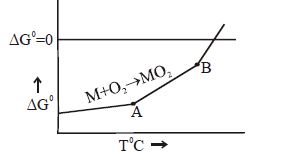
The Ellingham diagram of a certain metal $M$ is represented in the figure. The points $A$ and $B$ respectively correspond to:
A
Oxidation,reduction of metal
B
Beginning and end of reduction process
C
Minimum and maximum value of $\Delta G$
D
Melting point and boiling point of metal
Solution
(D) In an Ellingham diagram,the slope of the line $\Delta G^0$ vs $T$ is given by $\Delta S^0$. $A$ change in the slope of the line indicates a phase change of the metal or the oxide.
At point $A$,the metal $M$ undergoes a phase change (melting),which leads to an increase in entropy,thus changing the slope.
At point $B$,the metal oxide $MO_2$ undergoes a phase change (boiling/vaporization),which further changes the slope.
Therefore,points $A$ and $B$ correspond to the melting point and boiling point of the metal/oxide respectively.
At point $A$,the metal $M$ undergoes a phase change (melting),which leads to an increase in entropy,thus changing the slope.
At point $B$,the metal oxide $MO_2$ undergoes a phase change (boiling/vaporization),which further changes the slope.
Therefore,points $A$ and $B$ correspond to the melting point and boiling point of the metal/oxide respectively.
0 likes
View Solution234
EasyMCQ
The $CORRECT$ match is:
Ores - Common extraction method
Ores - Common extraction method
A
Copper pyrites - Reduction by coke
B
Calamine - Roasting followed by Reduction with $CO$
C
Haematite - Leaching followed by reduction with $CO$
D
Red bauxite - Leaching followed by Electrolysis in dissolved molten $Na_3AlF_6$
Solution
(D) The extraction of metals from their ores involves specific metallurgical processes:
$A$. Copper pyrites $(CuFeS_2)$ is concentrated by froth floatation,followed by roasting and smelting in a reverberatory furnace,not reduction by coke.
$B$. Calamine $(ZnCO_3)$ is first calcined to $ZnO$ and then reduced by coke $(C)$,not $CO$.
$C$. Haematite $(Fe_2O_3)$ is reduced by $CO$ in a blast furnace,but it is not concentrated by leaching.
$D$. Red bauxite $(Al_2O_3 \cdot 2H_2O)$ is concentrated by leaching (Bayer's process) to obtain pure alumina,which is then reduced by electrolysis in molten cryolite $(Na_3AlF_6)$. This is the $CORRECT$ match.
$A$. Copper pyrites $(CuFeS_2)$ is concentrated by froth floatation,followed by roasting and smelting in a reverberatory furnace,not reduction by coke.
$B$. Calamine $(ZnCO_3)$ is first calcined to $ZnO$ and then reduced by coke $(C)$,not $CO$.
$C$. Haematite $(Fe_2O_3)$ is reduced by $CO$ in a blast furnace,but it is not concentrated by leaching.
$D$. Red bauxite $(Al_2O_3 \cdot 2H_2O)$ is concentrated by leaching (Bayer's process) to obtain pure alumina,which is then reduced by electrolysis in molten cryolite $(Na_3AlF_6)$. This is the $CORRECT$ match.
0 likes
View Solution235
EasyMCQ
Case hardening is a process of heating steel in an atmosphere of:
A
Carbon dioxide
B
Ammonia
C
Charcoal
D
Oxygen
Solution
(C) Case hardening is a process used to harden the surface of steel by diffusing carbon or nitrogen into the surface layer.
In the process of case hardening using charcoal,steel is heated in an atmosphere of charcoal $(C)$ or carbon-rich materials to increase the carbon content on the surface,making it harder.
Therefore,the correct option is $C$.
In the process of case hardening using charcoal,steel is heated in an atmosphere of charcoal $(C)$ or carbon-rich materials to increase the carbon content on the surface,making it harder.
Therefore,the correct option is $C$.
0 likes
View Solution236
DifficultMCQ
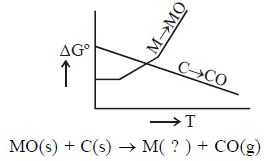
Predict the physical state of the metal $M$ obtained in the following reduction reaction shown by the Ellingham diagram: $MO(s) + C(s) \rightarrow M(?) + CO(g)$.
A
Solid
B
Gas
C
May be liquid or gas
D
May be liquid or solid
Solution
(D) In the Ellingham diagram,the slope of the line for the oxidation of a metal $(M \rightarrow MO)$ changes when the metal undergoes a phase change (melting or boiling).
Looking at the provided diagram,the line for $M \rightarrow MO$ shows a distinct change in slope at a certain temperature.
This change in slope indicates a phase transition of the metal $M$.
Since the reaction $MO(s) + C(s) \rightarrow M(?) + CO(g)$ occurs at temperatures where the metal $M$ is produced,the physical state of $M$ depends on whether the temperature is above or below its melting or boiling point.
Typically,such a change in slope in an Ellingham diagram corresponds to the melting of the metal. Therefore,the metal $M$ can exist as a solid or a liquid depending on the temperature range relative to its melting point.
Looking at the provided diagram,the line for $M \rightarrow MO$ shows a distinct change in slope at a certain temperature.
This change in slope indicates a phase transition of the metal $M$.
Since the reaction $MO(s) + C(s) \rightarrow M(?) + CO(g)$ occurs at temperatures where the metal $M$ is produced,the physical state of $M$ depends on whether the temperature is above or below its melting or boiling point.
Typically,such a change in slope in an Ellingham diagram corresponds to the melting of the metal. Therefore,the metal $M$ can exist as a solid or a liquid depending on the temperature range relative to its melting point.
0 likes
View Solution237
EasyMCQ
The function of fluorspar in the electrolytic reduction of alumina dissolved in fused cryolite $(Na_3AlF_6)$ is:
A
as a catalyst
B
to lower the temperature of melt and to make the fused mixture very conducting
C
to decrease the rate of oxidation of carbon anode
D
none of the above
Solution
(B) The electrolysis of alumina is carried out in a steel tank lined with graphite,which acts as the cathode.
The electrolyte consists of alumina $(Al_2O_3)$ dissolved in fused cryolite $(Na_3AlF_6)$ and fluorspar $(CaF_2)$.
Cryolite lowers the melting point of the mixture to approximately $950^{\circ}C$.
Fluorspar $(CaF_2)$ is added to increase the fluidity of the molten mass and to make the mixture a better conductor of electricity.
This allows the liberated aluminium metal to sink to the bottom of the cell for easy collection.
The electrolyte consists of alumina $(Al_2O_3)$ dissolved in fused cryolite $(Na_3AlF_6)$ and fluorspar $(CaF_2)$.
Cryolite lowers the melting point of the mixture to approximately $950^{\circ}C$.
Fluorspar $(CaF_2)$ is added to increase the fluidity of the molten mass and to make the mixture a better conductor of electricity.
This allows the liberated aluminium metal to sink to the bottom of the cell for easy collection.
0 likes
View Solution238
MediumMCQ
$A$ layer of coke is spread over bauxite during the electrolytic reduction of alumina by the Hall-Heroult process. This layer acts as a/an:
A
flux
B
slag to remove impurities
C
reducing agent
D
insulation and does not allow heat to escape
Solution
(D) The correct option is $D$.
Explanation:
In the Hall-Heroult process,the electrolytic cell is covered with a layer of powdered coke. This layer serves two primary purposes: it acts as an insulator to prevent the loss of heat from the molten electrolyte,and it protects the electrolyte from oxidation by atmospheric oxygen.
Explanation:
In the Hall-Heroult process,the electrolytic cell is covered with a layer of powdered coke. This layer serves two primary purposes: it acts as an insulator to prevent the loss of heat from the molten electrolyte,and it protects the electrolyte from oxidation by atmospheric oxygen.
0 likes
View Solution239
MediumMCQ
Formation of metallic copper from the sulphide ore in the normal thermo-metallurgical process essentially involves which one of the following reactions?
A
$CuS + \frac{3}{2} O_2$ $\rightarrow CuO + SO_2; \ CuO + C$ $\rightarrow Cu + CO$
B
$CuS + \frac{3}{2} O_2$ $\rightarrow CuO + SO_2; \ 2CuO + CuS$ $\rightarrow 3Cu + SO_2$
C
$CuS + 2O_2$ $\rightarrow CuSO_4; \ CuSO_4 + CuS$ $\rightarrow 2Cu + 2SO_2$
D
$CuS + 2O_2$ $\rightarrow CuO + SO_2; \ CuO + CO$ $\rightarrow Cu + CO_2$
Solution
(B) In the extraction of copper from copper glance $(Cu_2S)$ or copper sulphide ore,the process is known as self-reduction or auto-reduction.
First,the sulphide ore is partially roasted in air to form copper$(I)$ oxide:
$2Cu_2S + 3O_2 \rightarrow 2Cu_2O + 2SO_2$
Then,the remaining copper sulphide reacts with the copper oxide formed to produce metallic copper:
$2Cu_2O + Cu_2S \rightarrow 6Cu + SO_2$
This is a self-reduction process where copper sulphide acts as a reducing agent for copper oxide. Among the given options,the reaction sequence representing this principle is $2CuO + CuS \rightarrow 3Cu + SO_2$ (simplified representation of the stoichiometry).
First,the sulphide ore is partially roasted in air to form copper$(I)$ oxide:
$2Cu_2S + 3O_2 \rightarrow 2Cu_2O + 2SO_2$
Then,the remaining copper sulphide reacts with the copper oxide formed to produce metallic copper:
$2Cu_2O + Cu_2S \rightarrow 6Cu + SO_2$
This is a self-reduction process where copper sulphide acts as a reducing agent for copper oxide. Among the given options,the reaction sequence representing this principle is $2CuO + CuS \rightarrow 3Cu + SO_2$ (simplified representation of the stoichiometry).
0 likes
View Solution240
MediumMCQ
$Ag_2S + NaCN + Zn \rightarrow Ag$
This method of extraction of $Ag$ by complex formation and then its displacement is called:
This method of extraction of $Ag$ by complex formation and then its displacement is called:
A
Parke's method
B
McArthur-Forest method
C
Serpeck method
D
Hall's method
Solution
(B) The cyanide process is used for the extraction of $Ag$,which is also known as the $McArthur-Forest$ process.
The reactions occurring during the extraction of silver are:
$Ag_2S + 4NaCN \rightleftharpoons 2Na[Ag(CN)_2] + Na_2S$ (Reversible reaction)
$2Na_2S + 2O_2 + H_2O \rightarrow Na_2S_2O_3 + 2NaOH$ (The presence of $O_2$ shifts the equilibrium to the right by removing $Na_2S$)
$2Na[Ag(CN)_2] + Zn \rightarrow Na_2[Zn(CN)_4] + 2Ag$ (Displacement reaction)
The reactions occurring during the extraction of silver are:
$Ag_2S + 4NaCN \rightleftharpoons 2Na[Ag(CN)_2] + Na_2S$ (Reversible reaction)
$2Na_2S + 2O_2 + H_2O \rightarrow Na_2S_2O_3 + 2NaOH$ (The presence of $O_2$ shifts the equilibrium to the right by removing $Na_2S$)
$2Na[Ag(CN)_2] + Zn \rightarrow Na_2[Zn(CN)_4] + 2Ag$ (Displacement reaction)
0 likes
View Solution241
EasyMCQ
Which of the following is $NOT$ a process used for the extraction of silver?
A
As a side product in the electrolytic refining of copper
B
Parke's process in which $Zn$ is used to extract silver by solvent extraction from molten lead
C
By reaction of silver sulphide with $KCN$ and then reaction of the soluble complex with $Zn$
D
By heating $Na[Ag(CN)_2]$
Solution
(D) The extraction of silver involves several methods:
$1$. Silver is obtained as a byproduct during the electrolytic refining of copper.
$2$. The Parkes process is used to remove silver from lead using $Zn$.
$3$. The Mac-Arthur Forrest cyanide process involves the reaction: $Ag_2S + 4KCN \rightarrow 2K[Ag(CN)_2] + K_2S$,followed by displacement with $Zn$: $2K[Ag(CN)_2] + Zn \rightarrow K_2[Zn(CN)_4] + 2Ag$.
$4$. Heating $Na[Ag(CN)_2]$ does not yield metallic silver; instead,it decomposes into complex products. Therefore,this is not a method for silver extraction.
$1$. Silver is obtained as a byproduct during the electrolytic refining of copper.
$2$. The Parkes process is used to remove silver from lead using $Zn$.
$3$. The Mac-Arthur Forrest cyanide process involves the reaction: $Ag_2S + 4KCN \rightarrow 2K[Ag(CN)_2] + K_2S$,followed by displacement with $Zn$: $2K[Ag(CN)_2] + Zn \rightarrow K_2[Zn(CN)_4] + 2Ag$.
$4$. Heating $Na[Ag(CN)_2]$ does not yield metallic silver; instead,it decomposes into complex products. Therefore,this is not a method for silver extraction.
0 likes
View Solution242
MediumMCQ
In which of the following isolations is no reducing agent required?
A
Iron from haematite
B
Aluminium from bauxite
C
Mercury from cinnabar
D
Zinc from zinc blende
Solution
(C) In the isolation of mercury from cinnabar $(HgS)$,no external reducing agent is required.
Mercury is obtained by the self-reduction method (auto-reduction).
First,cinnabar is roasted in air to form mercury$(II)$ oxide:
$2HgS + 3O_2 \xrightarrow{\Delta} 2HgO + 2SO_2$
Then,the remaining $HgS$ reacts with $HgO$ to produce mercury metal:
$2HgO + HgS \rightarrow 3Hg + SO_2$
Mercury is obtained by the self-reduction method (auto-reduction).
First,cinnabar is roasted in air to form mercury$(II)$ oxide:
$2HgS + 3O_2 \xrightarrow{\Delta} 2HgO + 2SO_2$
Then,the remaining $HgS$ reacts with $HgO$ to produce mercury metal:
$2HgO + HgS \rightarrow 3Hg + SO_2$
0 likes
View Solution243
EasyMCQ
The element which could be extracted by electrolytic reduction of its oxide dissolved in a high temperature melt is:
A
sodium
B
magnesium
C
fluorine
D
aluminium
Solution
(D) Aluminium metal is extracted by the electrolytic reduction of alumina $(Al_2O_3)$.
Since alumina has a very high melting point and is a poor conductor of electricity,it is dissolved in molten cryolite $(Na_3AlF_6)$ and fluorspar $(CaF_2)$.
This mixture melts at approximately $900^{\circ} C$ and allows for the electrolysis process.
During electrolysis,metallic $Al$ is liberated at the cathode.
Since alumina has a very high melting point and is a poor conductor of electricity,it is dissolved in molten cryolite $(Na_3AlF_6)$ and fluorspar $(CaF_2)$.
This mixture melts at approximately $900^{\circ} C$ and allows for the electrolysis process.
During electrolysis,metallic $Al$ is liberated at the cathode.
0 likes
View Solution244
EasyMCQ
Iron obtained from blast furnace is:
A
wrought iron
B
cast iron
C
pig iron
D
steel
Solution
(C) The iron obtained from the blast furnace is known as pig iron.
It contains about $4 \%$ carbon and many impurities in smaller amounts (like $S, P, Si, Mn$).
It has a higher carbon content compared to cast iron and wrought iron.
It contains about $4 \%$ carbon and many impurities in smaller amounts (like $S, P, Si, Mn$).
It has a higher carbon content compared to cast iron and wrought iron.
0 likes
View Solution245
AdvancedMCQ
Match column $(I)$ (process) with column $(II)$ (electrolyte)
Choose the correct alternate :
| $(I)$ (process) | $(II)$ (electrolyte) |
| $(i)$. Downs cell | $(W)$. fused $MgCl_2$ |
| $(ii)$. Dow sea water process | $(X)$. fused $(Al_2O_3 + Na_3AlF_6)$ |
| $(iii)$. Hall-Heroult | $(Y)$. fused $KHF_2$ |
| $(iv)$. Moissan | $(Z)$. fused $(40\% NaCl + 60\% CaCl_2)$ |
Choose the correct alternate :
A
$(i-Z, ii-W, iii-X, iv-Y)$
B
$(i-X, ii-Y, iii-Z, iv-W)$
C
$(i-W, ii-Z, iii-X, iv-Y)$
D
$(i-W, ii-Z, iii-W, iv-Y)$
Solution
(A) $(i)$. In Downs cell,the electrolyte used is a fused mixture of $40\% NaCl$ and $60\% CaCl_2$ to lower the melting point.
$(ii)$. In the Dow sea water process,magnesium is extracted from sea water,and the electrolyte used is fused $MgCl_2$.
$(iii)$. In the Hall-Heroult process,the electrolyte used is a fused mixture of $Al_2O_3$ and $Na_3AlF_6$ (cryolite).
$(iv)$. In the Moissan process,the electrolyte used is fused $KHF_2$ for the preparation of fluorine.
Therefore,the correct match is $(i-Z, ii-W, iii-X, iv-Y)$.
$(ii)$. In the Dow sea water process,magnesium is extracted from sea water,and the electrolyte used is fused $MgCl_2$.
$(iii)$. In the Hall-Heroult process,the electrolyte used is a fused mixture of $Al_2O_3$ and $Na_3AlF_6$ (cryolite).
$(iv)$. In the Moissan process,the electrolyte used is fused $KHF_2$ for the preparation of fluorine.
Therefore,the correct match is $(i-Z, ii-W, iii-X, iv-Y)$.
0 likes
View Solution246
MediumMCQ
$I$. $FeCr_2O_4 + NaOH + \text{air}
ightarrow Na_2CrO_4 + Fe_2O_3$
$II$. $Na_2CrO_4 + H_2SO_4 ightarrow Na_2Cr_2O_7$
$Na_2CrO_4$ and $Fe_2O_3$ are separated by:
$II$. $Na_2CrO_4 + H_2SO_4 ightarrow Na_2Cr_2O_7$
$Na_2CrO_4$ and $Fe_2O_3$ are separated by:
A
dissolving in conc. $H_2SO_4$
B
dissolving in $NH_3$
C
dissolving in $H_2O$
D
dissolving in dil. $HCl$
Solution
(C) In the extraction of chromium from chromite ore $(FeCr_2O_4)$,the ore is fused with $NaOH$ in the presence of air to form sodium chromate $(Na_2CrO_4)$ and iron$(III)$ oxide $(Fe_2O_3)$.
$Na_2CrO_4$ is a soluble salt,whereas $Fe_2O_3$ is an insoluble metal oxide.
Therefore,the mixture can be separated by dissolving the mass in water $(H_2O)$,where $Na_2CrO_4$ dissolves and $Fe_2O_3$ remains as a residue.
$Na_2CrO_4$ is a soluble salt,whereas $Fe_2O_3$ is an insoluble metal oxide.
Therefore,the mixture can be separated by dissolving the mass in water $(H_2O)$,where $Na_2CrO_4$ dissolves and $Fe_2O_3$ remains as a residue.
0 likes
View Solution247
AdvancedMCQ
$I$. $FeCr_2O_4 + NaOH + \text{air} \rightarrow (A) + Fe_2O_3$
$II$. $(A) + (B) \rightarrow Na_2Cr_2O_7$
$III$. $Na_2Cr_2O_7 + X \xrightarrow{\Delta} Cr_2O_3$
$IV$. $Cr_2O_3 + Y \xrightarrow{\Delta} Cr$
High temperature $(> 1000 \ ^\circ C)$ electrolytic reduction is necessary for isolating:
$II$. $(A) + (B) \rightarrow Na_2Cr_2O_7$
$III$. $Na_2Cr_2O_7 + X \xrightarrow{\Delta} Cr_2O_3$
$IV$. $Cr_2O_3 + Y \xrightarrow{\Delta} Cr$
High temperature $(> 1000 \ ^\circ C)$ electrolytic reduction is necessary for isolating:
A
$Al$
B
$Cu$
C
$C$
D
$F_2$
Solution
(A) $I$. $4FeCr_2O_4 + 16NaOH + 7O_2 \rightarrow 8Na_2CrO_4 + 2Fe_2O_3 + 8H_2O$. Here,$(A)$ is $Na_2CrO_4$.
$II$. $2Na_2CrO_4 + 2H^+ \rightarrow Na_2Cr_2O_7 + 2Na^+ + H_2O$. Here,$(B)$ is $H^+$.
$III$. $Na_2Cr_2O_7 + 2C \rightarrow Cr_2O_3 + Na_2CO_3 + CO$. Here,$X$ is $C$.
$IV$. $Cr_2O_3 + 2Al \rightarrow 2Cr + Al_2O_3$. Here,$Y$ is $Al$.
For highly reactive metals like $Al$ (Aluminum),which are at the top of the electrochemical series,electrolytic reduction is required at high temperatures (Hall-Heroult process) because they cannot be reduced by common reducing agents like $C$ or $CO$.
$II$. $2Na_2CrO_4 + 2H^+ \rightarrow Na_2Cr_2O_7 + 2Na^+ + H_2O$. Here,$(B)$ is $H^+$.
$III$. $Na_2Cr_2O_7 + 2C \rightarrow Cr_2O_3 + Na_2CO_3 + CO$. Here,$X$ is $C$.
$IV$. $Cr_2O_3 + 2Al \rightarrow 2Cr + Al_2O_3$. Here,$Y$ is $Al$.
For highly reactive metals like $Al$ (Aluminum),which are at the top of the electrochemical series,electrolytic reduction is required at high temperatures (Hall-Heroult process) because they cannot be reduced by common reducing agents like $C$ or $CO$.
0 likes
View Solution248
AdvancedMCQ
Which of the following reaction$(s)$ do(es) not occur in Bessemer's converter?
A
$2Cu_2S + 5O_2 \rightarrow 2CuSO_4 + 2CuO$
B
$2Cu_2S + 3O_2 \rightarrow 2Cu_2O + 2SO_2 \uparrow$
C
$2CuFeS_2 + O_2 \rightarrow Cu_2S + 2FeS + SO_2$
D
$FeO + SiO_2 \rightarrow FeSiO_3$
Solution
(C) In the extraction of copper,the Bessemer converter is used to convert copper matte $(Cu_2S + FeS)$ into blister copper.
The reactions occurring in the Bessemer converter are:
$1. \ 2FeS + 3O_2 \rightarrow 2FeO + 2SO_2$
$2. \ FeO + SiO_2 \rightarrow FeSiO_3$ (Slag formation)
$3. \ 2Cu_2S + 3O_2 \rightarrow 2Cu_2O + 2SO_2$
$4. \ 2Cu_2O + Cu_2S \rightarrow 6Cu + SO_2$
The reaction $2CuFeS_2 + O_2 \rightarrow Cu_2S + 2FeS + SO_2$ occurs during the roasting process in a reverberatory furnace,not in the Bessemer converter.
The reactions occurring in the Bessemer converter are:
$1. \ 2FeS + 3O_2 \rightarrow 2FeO + 2SO_2$
$2. \ FeO + SiO_2 \rightarrow FeSiO_3$ (Slag formation)
$3. \ 2Cu_2S + 3O_2 \rightarrow 2Cu_2O + 2SO_2$
$4. \ 2Cu_2O + Cu_2S \rightarrow 6Cu + SO_2$
The reaction $2CuFeS_2 + O_2 \rightarrow Cu_2S + 2FeS + SO_2$ occurs during the roasting process in a reverberatory furnace,not in the Bessemer converter.
0 likes
View Solution249
MediumMCQ
In the cyanide process involving the extraction of silver,zinc is used industrially as a(an)
A
oxidising agent
B
reducing agent
C
solvent
D
solvating agent
Solution
(B) In the cyanide process for the extraction of silver,the ore is treated with a dilute solution of $NaCN$ in the presence of air to form a soluble complex: $4Ag + 8CN^- + 2H_2O + O_2 \rightarrow 4[Ag(CN)_2]^- + 4OH^-$.
Zinc is then added to this solution to displace silver from the complex: $2[Ag(CN)_2]^- + Zn \rightarrow [Zn(CN)_4]^{2-} + 2Ag$.
In this reaction,$Zn$ is oxidized to $Zn^{2+}$ and $Ag^+$ is reduced to $Ag$. Therefore,zinc acts as a reducing agent.
Zinc is then added to this solution to displace silver from the complex: $2[Ag(CN)_2]^- + Zn \rightarrow [Zn(CN)_4]^{2-} + 2Ag$.
In this reaction,$Zn$ is oxidized to $Zn^{2+}$ and $Ag^+$ is reduced to $Ag$. Therefore,zinc acts as a reducing agent.
0 likes
View SolutionGeneral Principles and Processes of Isolation of Elements — Reduction to free Metal · Frequently Asked Questions
1Are these General Principles and Processes of Isolation of Elements questions useful for JEE and NEET?
Yes. All questions in this section are mapped to JEE Main and NEET exam patterns. Previous year questions from JEE Main, NEET, GUJCET and state-level exams are included with full solutions.
2Can I switch to Hindi or Gujarati for these questions?
Yes. Use the language tabs in the hero section or the sidebar to view the same questions and solutions in English, Hindi or Gujarati.
3How do I generate a question paper from this subtopic?
Use the Vedclass Exam Paper Generator — select the chapter and subtopic, set difficulty, and generate Sets A, B, C, D automatically. First 3 chapters of every subject are free.
Vedclass Products
For Students
Vedclass Test Series
Mock tests in real JEE/NEET style with performance analysis. 5-day free trial.
Start Free TrialFor Teachers
Exam Paper Generator
Generate Set A/B/C/D papers from this chapter in 2 minutes. 3 chapters free.
Try FreeFor Institutes
Online Exam Module
Live online exams with unlimited students, 360° analytics & white-label branding.
See DemoFor Teachers & Institutes
Generate a General Principles and Processes of Isolation of Elements Exam Paper in 2 Minutes
Select subtopic & difficulty — Sets A, B, C, D auto-generated with No Repeat logic.
First 3 chapters of every subject are free — no payment required.