
A English
Mix Examples of General Principles and processes of Isolation of Elements Questions in English
Class 12 Chemistry · General Principles and Processes of Isolation of Elements · Mix Examples of General Principles and processes of Isolation of Elements
181+
Questions
English
Language
100%
With Solutions
Showing 50 of 181 questions in English
51
DifficultMCQ
Match List-$I$ (substances) with List-$II$ (processes) employed in the manufacture of the substances and select the correct option.
| List-$I$ (Substances) | List-$II$ (Processes) |
| $A$. Sulphuric acid | $i$. Haber's process |
| $B$. Steel | $ii$. Bessemer's process |
| $C$. Sodium hydroxide | $iii$. Leblanc process |
| $D$. Ammonia | $iv$. Contact process |
A
$A-i, B-iv, C-ii, D-iii$
B
$A-i, B-ii, C-iii, D-iv$
C
$A-iv, B-iii, C-ii, D-i$
D
$A-iv, B-ii, C-iii, D-i$
Solution
(D) The correct matches are as follows:
$A$. Sulphuric acid is manufactured by the $iv$. Contact process.
$B$. Steel is manufactured by the $ii$. Bessemer's process.
$C$. Sodium hydroxide was historically manufactured by the $iii$. Leblanc process.
$D$. Ammonia is manufactured by the $i$. Haber's process.
Therefore,the correct matching is $A-iv, B-ii, C-iii, D-i$.
$A$. Sulphuric acid is manufactured by the $iv$. Contact process.
$B$. Steel is manufactured by the $ii$. Bessemer's process.
$C$. Sodium hydroxide was historically manufactured by the $iii$. Leblanc process.
$D$. Ammonia is manufactured by the $i$. Haber's process.
Therefore,the correct matching is $A-iv, B-ii, C-iii, D-i$.
0 likes
View Solution52
MediumMCQ
Which of the following changes involve more than two metallurgical processes?
A
$ZnCO_3$ (Concentrated ore) $\rightarrow$ $Zn$ (Impure)
B
$CuFeS_2$ $\rightarrow$ $Cu$ (Pure)
C
$PbS$ (Roasted ore) $\rightarrow$ $Pb$ (Impure)
D
All of these
Solution
(B) The extraction of metals from their ores involves several steps such as concentration,roasting/calcination,reduction,and refining.
$A$. $ZnCO_3 \rightarrow Zn$ involves calcination followed by reduction ($2$ steps).
$B$. $CuFeS_2 \rightarrow Cu$ involves concentration,roasting,smelting,bessemerization,and electrolytic refining (more than $2$ steps).
$C$. $PbS \rightarrow Pb$ involves roasting followed by reduction ($2$ steps).
Since $CuFeS_2$ extraction involves multiple complex steps including concentration,roasting,smelting,and refining,it clearly involves more than two metallurgical processes.
$A$. $ZnCO_3 \rightarrow Zn$ involves calcination followed by reduction ($2$ steps).
$B$. $CuFeS_2 \rightarrow Cu$ involves concentration,roasting,smelting,bessemerization,and electrolytic refining (more than $2$ steps).
$C$. $PbS \rightarrow Pb$ involves roasting followed by reduction ($2$ steps).
Since $CuFeS_2$ extraction involves multiple complex steps including concentration,roasting,smelting,and refining,it clearly involves more than two metallurgical processes.
0 likes
View Solution53
EasyMCQ
In the metallurgy of iron,when limestone is added to the blast furnace,the calcium ions end up in:
A
Slag
B
Gangue
C
Metallic $Ca$
D
$CaO$
Solution
(A) In the metallurgy of iron,limestone $(CaCO_3)$ is added to the blast furnace as a flux.
Inside the furnace,$CaCO_3$ decomposes to form lime $(CaO)$ and carbon dioxide $(CO_2)$:
$CaCO_3 \rightarrow CaO + CO_2$
The lime $(CaO)$ then reacts with silica $(SiO_2)$,which is an acidic impurity (gangue) present in the ore,to form calcium silicate $(CaSiO_3)$:
$CaO + SiO_2 \rightarrow CaSiO_3$
This calcium silicate $(CaSiO_3)$ is known as slag,which is molten and floats on top of the molten iron.
Therefore,the calcium ions end up in the slag.
Inside the furnace,$CaCO_3$ decomposes to form lime $(CaO)$ and carbon dioxide $(CO_2)$:
$CaCO_3 \rightarrow CaO + CO_2$
The lime $(CaO)$ then reacts with silica $(SiO_2)$,which is an acidic impurity (gangue) present in the ore,to form calcium silicate $(CaSiO_3)$:
$CaO + SiO_2 \rightarrow CaSiO_3$
This calcium silicate $(CaSiO_3)$ is known as slag,which is molten and floats on top of the molten iron.
Therefore,the calcium ions end up in the slag.
0 likes
View Solution54
EasyMCQ
What is the appropriate process for the extraction of lead from low-grade ore (impurity level is high)?
A
$g$ $\rightarrow b$ $\rightarrow d$ $\rightarrow e$
B
$a$ $\rightarrow c$ $\rightarrow d$
C
$a$ $\rightarrow c$ $\rightarrow e$
D
$a$ $\rightarrow c$ $\rightarrow f$
Solution
(D) For the extraction of lead from low-grade ore,the following steps are involved:
$1$. Froth floatation $(a)$: Used to concentrate the ore by removing gangue particles.
$2$. Roasting $(c)$: The concentrated ore is heated in the presence of air to convert lead sulfide $(PbS)$ into lead oxide $(PbO)$.
$3$. Smelting $(f)$: The roasted ore is reduced using coke $(C)$ in a blast furnace to obtain metallic lead $(Pb)$.
Therefore,the correct sequence is $a$ $\rightarrow c$ $\rightarrow f$.
$1$. Froth floatation $(a)$: Used to concentrate the ore by removing gangue particles.
$2$. Roasting $(c)$: The concentrated ore is heated in the presence of air to convert lead sulfide $(PbS)$ into lead oxide $(PbO)$.
$3$. Smelting $(f)$: The roasted ore is reduced using coke $(C)$ in a blast furnace to obtain metallic lead $(Pb)$.
Therefore,the correct sequence is $a$ $\rightarrow c$ $\rightarrow f$.
0 likes
View Solution55
MediumMCQ
Consider the following statements:
$(a)$ When the lead-silver alloy is rich in silver,lead is removed by the cupellation process.
$(b)$ Froth flotation can be applied for non-sulphide ores also using a suitable activator.
$(c)$ $PbSO_4 + H_2SO_4$ electrolyte is used for the refining of $Pb$ by electrolysis.
$(d)$ Any metal will not reduce the oxide of other metals which lie above it in the Ellingham diagram.
Using $'T'$ for true and $'F'$ for false statements in the given sequence,select the correct set of code.
$(a)$ When the lead-silver alloy is rich in silver,lead is removed by the cupellation process.
$(b)$ Froth flotation can be applied for non-sulphide ores also using a suitable activator.
$(c)$ $PbSO_4 + H_2SO_4$ electrolyte is used for the refining of $Pb$ by electrolysis.
$(d)$ Any metal will not reduce the oxide of other metals which lie above it in the Ellingham diagram.
Using $'T'$ for true and $'F'$ for false statements in the given sequence,select the correct set of code.
A
$T, T, F, T$
B
$T, T, F, F$
C
$F, T, F, T$
D
$T, T, T, F$
Solution
(A) True: In the cupellation process,lead is oxidized to $PbO$ and removed,leaving behind pure silver.
$(b)$ True: Froth flotation can be used for non-sulphide ores (like oxides or carbonates) by using specific activators or collectors.
$(c)$ False: The electrolyte used for the electrolytic refining of $Pb$ is $PbSiF_6$ (lead fluosilicate) with $H_2SiF_6$ (hydrofluosilicic acid),not $PbSO_4$.
$(d)$ True: According to the Ellingham diagram,a metal can only reduce the oxide of a metal that lies above it (i.e.,has a more positive $\Delta G$ value at that temperature).
Therefore,the sequence is $T, T, F, T$.
$(b)$ True: Froth flotation can be used for non-sulphide ores (like oxides or carbonates) by using specific activators or collectors.
$(c)$ False: The electrolyte used for the electrolytic refining of $Pb$ is $PbSiF_6$ (lead fluosilicate) with $H_2SiF_6$ (hydrofluosilicic acid),not $PbSO_4$.
$(d)$ True: According to the Ellingham diagram,a metal can only reduce the oxide of a metal that lies above it (i.e.,has a more positive $\Delta G$ value at that temperature).
Therefore,the sequence is $T, T, F, T$.
0 likes
View Solution56
DifficultMCQ
Select the correct matching:
A
Pyro metallurgy: Extraction of $Fe$
B
Pyro metallurgy: Extraction of $Fe$
C
Hydro metallurgy: Extraction of $Au$
D
All above are correct
Solution
(D) Pyro metallurgy involves the extraction of metals by heating ores at high temperatures,which is used for $Fe$ (iron) in a blast furnace.
Hydro metallurgy involves the extraction of metals using aqueous solutions,which is used for $Au$ (gold) via cyanide leaching.
Since both statements are correct,the correct option is $D$.
Hydro metallurgy involves the extraction of metals using aqueous solutions,which is used for $Au$ (gold) via cyanide leaching.
Since both statements are correct,the correct option is $D$.
0 likes
View Solution57
EasyMCQ
Which of the following processes is not used for the extraction of spelter from zinc blende?
A
Smelting
B
Distillation
C
Roasting
D
Froth flotation method
Solution
(D) The extraction of zinc from zinc blende $(ZnS)$ involves the following steps:
$1$. Concentration of the ore by the $Froth \ flotation \ method$.
$2$. $Roasting$ of the concentrated ore to convert $ZnS$ into $ZnO$.
$3$. $Smelting$ (reduction) of $ZnO$ with coke to obtain zinc metal.
$4$. The zinc obtained is purified by $Distillation$.
However,the question asks for a process not used for the extraction of $spelter$ (impure zinc). All the listed processes are standard steps in the extraction of zinc. If we consider the context of the extraction process,$Froth \ flotation$,$Roasting$,$Smelting$,and $Distillation$ are all integral parts of the industrial production of zinc. Given the options,if the question implies a step not directly involved in the chemical reduction or purification,it is often a trick question. However,technically,all are used. If forced to choose,$Froth \ flotation$ is a concentration method,not an extraction method. Thus,it is the most distinct.
$1$. Concentration of the ore by the $Froth \ flotation \ method$.
$2$. $Roasting$ of the concentrated ore to convert $ZnS$ into $ZnO$.
$3$. $Smelting$ (reduction) of $ZnO$ with coke to obtain zinc metal.
$4$. The zinc obtained is purified by $Distillation$.
However,the question asks for a process not used for the extraction of $spelter$ (impure zinc). All the listed processes are standard steps in the extraction of zinc. If we consider the context of the extraction process,$Froth \ flotation$,$Roasting$,$Smelting$,and $Distillation$ are all integral parts of the industrial production of zinc. Given the options,if the question implies a step not directly involved in the chemical reduction or purification,it is often a trick question. However,technically,all are used. If forced to choose,$Froth \ flotation$ is a concentration method,not an extraction method. Thus,it is the most distinct.
0 likes
View Solution58
MediumMCQ
Ellingham diagrams can be drawn for which of the following?
A
Sulphides
B
Oxides
C
Halides
D
All of these
Solution
(D) Ellingham diagrams are graphical representations of the variation of the standard Gibbs free energy of formation $({\Delta}G^{\circ})$ of compounds with temperature.
They are primarily used to predict the feasibility of the reduction of metal oxides,sulphides,and halides using a suitable reducing agent.
Therefore,Ellingham diagrams can be constructed for all these classes of compounds.
They are primarily used to predict the feasibility of the reduction of metal oxides,sulphides,and halides using a suitable reducing agent.
Therefore,Ellingham diagrams can be constructed for all these classes of compounds.
0 likes
View Solution59
MediumMCQ
$A$ metal $(M)$ exists in oxide form. Its oxide cannot be reduced by carbon up to $800\, ^\circ C$,but it can be reduced by $Al$ even below $800\, ^\circ C$. Select the correct Ellingham diagram for metal $(M)$.
A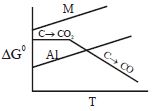
B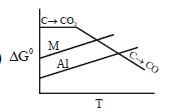
C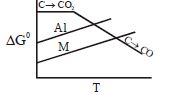
D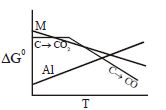
Solution
(B) According to the Ellingham diagram principle,a metal oxide can be reduced by a reducing agent if the line of the reducing agent lies below the line of the metal oxide at that temperature.
$1$. Since the oxide of $M$ cannot be reduced by carbon up to $800\, ^\circ C$,the line for $M$ must lie below the lines for $C \rightarrow CO_2$ and $C \rightarrow CO$ up to $800\, ^\circ C$.
$2$. Since the oxide of $M$ can be reduced by $Al$ below $800\, ^\circ C$,the line for $Al$ must lie below the line for $M$ at temperatures below $800\, ^\circ C$.
$3$. Combining these,the line for $M$ must be above the line for $Al$ but below the lines for carbon oxidation at temperatures below $800\, ^\circ C$. This corresponds to the diagram in option $B$.
$1$. Since the oxide of $M$ cannot be reduced by carbon up to $800\, ^\circ C$,the line for $M$ must lie below the lines for $C \rightarrow CO_2$ and $C \rightarrow CO$ up to $800\, ^\circ C$.
$2$. Since the oxide of $M$ can be reduced by $Al$ below $800\, ^\circ C$,the line for $Al$ must lie below the line for $M$ at temperatures below $800\, ^\circ C$.
$3$. Combining these,the line for $M$ must be above the line for $Al$ but below the lines for carbon oxidation at temperatures below $800\, ^\circ C$. This corresponds to the diagram in option $B$.
0 likes
View Solution60
MediumMCQ
Bessemerisation is carried out for:
$I$: $Fe$
$II$: $Cu$
$III$: $Al$
$IV$: Silver
$I$: $Fe$
$II$: $Cu$
$III$: $Al$
$IV$: Silver
A
$I, II$
B
$II, III$
C
$III, IV$
D
$I, III$
Solution
(A) The Bessemer process is a metallurgical process used for the extraction and purification of metals.
It involves blowing air through molten metal to oxidize impurities.
This process is primarily used for the conversion of pig iron into steel $(Fe)$ and for the extraction of copper $(Cu)$ from copper matte in a Bessemer converter.
Therefore,Bessemerisation is carried out for $Fe$ and $Cu$.
It involves blowing air through molten metal to oxidize impurities.
This process is primarily used for the conversion of pig iron into steel $(Fe)$ and for the extraction of copper $(Cu)$ from copper matte in a Bessemer converter.
Therefore,Bessemerisation is carried out for $Fe$ and $Cu$.
0 likes
View Solution61
MediumMCQ
The correct statements are :
A
Generally,the calcination and roasting are done in a blast furnace.
B
The sandy and rocky materials associated with ore are called matrix.
C
Froth floatation process is suitable for sulphide ores.
D
Both $(b)$ and $(c)$.
Solution
(D) Statement $(a)$ is incorrect because calcination and roasting are typically performed in a reverberatory furnace,not a blast furnace.
Statement $(b)$ is correct; the impurities like sand,clay,or rocks present in the ore are known as gangue or matrix.
Statement $(c)$ is correct; the froth floatation process is specifically used for the concentration of sulphide ores based on the preferential wetting of the ore particles by oil.
Therefore,both $(b)$ and $(c)$ are correct statements.
Statement $(b)$ is correct; the impurities like sand,clay,or rocks present in the ore are known as gangue or matrix.
Statement $(c)$ is correct; the froth floatation process is specifically used for the concentration of sulphide ores based on the preferential wetting of the ore particles by oil.
Therefore,both $(b)$ and $(c)$ are correct statements.
0 likes
View Solution62
DifficultMCQ
Which of the following species is (are) desirable substance$(s)$ in the extraction of copper but not in the extraction of iron?
A
$CaSiO_3$
B
$FeSiO_3$
C
$SiO_2$
D
coke
Solution
(C) In the extraction of iron from haematite $(Fe_2O_3)$,$SiO_2$ is an impurity (gangue) that must be removed by adding a flux like $CaO$ to form $CaSiO_3$ slag. Therefore,$SiO_2$ is undesirable in iron extraction.
In the extraction of copper from copper pyrites $(CuFeS_2)$,$FeO$ is formed as an impurity during roasting. $SiO_2$ is added as a flux to react with $FeO$ to form $FeSiO_3$ (slag),which is easily removed. Thus,$SiO_2$ is a desirable substance in copper extraction.
In the extraction of copper from copper pyrites $(CuFeS_2)$,$FeO$ is formed as an impurity during roasting. $SiO_2$ is added as a flux to react with $FeO$ to form $FeSiO_3$ (slag),which is easily removed. Thus,$SiO_2$ is a desirable substance in copper extraction.
0 likes
View Solution63
MediumMCQ
Match List-$I$ with List-$II$ and select the correct answer using the codes given below the lists :
Codes :
| List-$I$ | List-$II$ |
| $(a)$ van Arkel method | $1$. Manufacture of caustic soda |
| $(b)$ Solvay process | $2$. Purification of titanium |
| $(c)$ Cupellation | $3$. Manufacture of $Na_2CO_3$ |
| $(d)$ Poling | $4$. Purification of copper |
| $ $ | $5$. Refining of silver |
Codes :
A
$a-2, b-1, c-3, d-4$
B
$a-4, b-3, c-2, d-5$
C
$a-2, b-3, c-5, d-4$
D
$a-5, b-1, c-3, d-4$
Solution
(C) van Arkel method is used for the purification of metals like titanium $(Ti)$ and zirconium $(Zr)$. So,$(a-2)$.
$(b)$ Solvay process is used for the manufacture of sodium carbonate $(Na_2CO_3)$. So,$(b-3)$.
$(c)$ Cupellation is a refining process used for the purification of silver $(Ag)$ from lead $(Pb)$. So,$(c-5)$.
$(d)$ Poling is a process used for the removal of cuprous oxide $(Cu_2O)$ from blister copper. So,$(d-4)$.
Therefore,the correct matching is $(a-2, b-3, c-5, d-4)$.
$(b)$ Solvay process is used for the manufacture of sodium carbonate $(Na_2CO_3)$. So,$(b-3)$.
$(c)$ Cupellation is a refining process used for the purification of silver $(Ag)$ from lead $(Pb)$. So,$(c-5)$.
$(d)$ Poling is a process used for the removal of cuprous oxide $(Cu_2O)$ from blister copper. So,$(d-4)$.
Therefore,the correct matching is $(a-2, b-3, c-5, d-4)$.
0 likes
View Solution64
MediumMCQ
$A$ piece of steel is heated until redness and then plunged into cold water or oil. This treatment of iron makes it:
A
soft and malleable
B
hard but not brittle
C
more brittle
D
hard and brittle
Solution
(D) The process described is known as $quenching$. When steel is heated to a high temperature (red heat) and then rapidly cooled by plunging it into cold water or oil,the internal structure of the steel changes. This rapid cooling prevents the formation of softer phases and results in the formation of martensite,which is a very hard and brittle phase of steel. Therefore,this treatment makes the steel hard and brittle.
0 likes
View Solution65
MediumMCQ
Give the correct order of initials $T$ or $F$ for following statements. Use $T$ if statement is true and $F$ if it is false.
$(i)$ $Cu$ metal is extracted from its sulphide ore by reduction of $Cu_2O$ with $FeS$.
$(ii)$ An ore of Tin containing $FeCrO_4$ is concentrated by magnetic separation method.
$(iii)$ Auto reduction process is used in the extraction of $Cu$ & $Hg$.
$(iv)$ Cassiterite and Rutile are oxide ores of the metals.
$(i)$ $Cu$ metal is extracted from its sulphide ore by reduction of $Cu_2O$ with $FeS$.
$(ii)$ An ore of Tin containing $FeCrO_4$ is concentrated by magnetic separation method.
$(iii)$ Auto reduction process is used in the extraction of $Cu$ & $Hg$.
$(iv)$ Cassiterite and Rutile are oxide ores of the metals.
A
$TFTT$
B
$TTFT$
C
$FTTT$
D
$FFFT$
Solution
(C) $(i)$ $Cu_2S$ is reduced by $Cu_2O$ (self-reduction),not by $FeS$. $FeS$ is used to remove $FeO$ as slag. So,statement $(i)$ is $F$.
$(ii)$ $FeCrO_4$ (chromite) is magnetic,and $SnO_2$ (cassiterite) is non-magnetic. Thus,magnetic separation is used. So,statement $(ii)$ is $T$.
$(iii)$ $Cu$ is extracted by self-reduction of $Cu_2S$ with $Cu_2O$,and $Hg$ is extracted by roasting $HgS$ to $HgO$ followed by self-reduction. So,statement $(iii)$ is $T$.
$(iv)$ Cassiterite is $SnO_2$ and Rutile is $TiO_2$. Both are oxide ores. So,statement $(iv)$ is $T$.
The correct order is $FTTT$.
$(ii)$ $FeCrO_4$ (chromite) is magnetic,and $SnO_2$ (cassiterite) is non-magnetic. Thus,magnetic separation is used. So,statement $(ii)$ is $T$.
$(iii)$ $Cu$ is extracted by self-reduction of $Cu_2S$ with $Cu_2O$,and $Hg$ is extracted by roasting $HgS$ to $HgO$ followed by self-reduction. So,statement $(iii)$ is $T$.
$(iv)$ Cassiterite is $SnO_2$ and Rutile is $TiO_2$. Both are oxide ores. So,statement $(iv)$ is $T$.
The correct order is $FTTT$.
0 likes
View Solution66
MediumMCQ
Which of the following statement$(s)$ is/are incorrect?
A
Liquation is applied when the metal has a lower melting point than that of impurities.
B
Presence of carbon in steel makes it hard due to the formation of $Fe_3C$ called cementite.
C
Less reactive metals like $Hg, Pb$ and $Cu$ are obtained by auto-reduction of their sulphide or oxide ores.
D
Amalgamation method of purification cannot be applied for $Au$ and $Ag$.
Solution
(D) Statement $A$ is correct: Liquation is used for metals with low melting points (e.g.,$Sn, Pb, Bi$) compared to impurities.
Statement $B$ is correct: $Fe_3C$ (cementite) formation increases the hardness of steel.
Statement $C$ is correct: Metals like $Hg$ $(HgS + O_2 \rightarrow Hg + SO_2)$ and $Cu$ ($2Cu_2S + 3O_2 \rightarrow 2Cu_2O + 2SO_2$; $2Cu_2O + Cu_2S \rightarrow 6Cu + SO_2$) are extracted via auto-reduction.
Statement $D$ is incorrect: The amalgamation process is specifically used for the extraction and purification of noble metals like $Au$ and $Ag$ because they form amalgams with mercury.
Statement $B$ is correct: $Fe_3C$ (cementite) formation increases the hardness of steel.
Statement $C$ is correct: Metals like $Hg$ $(HgS + O_2 \rightarrow Hg + SO_2)$ and $Cu$ ($2Cu_2S + 3O_2 \rightarrow 2Cu_2O + 2SO_2$; $2Cu_2O + Cu_2S \rightarrow 6Cu + SO_2$) are extracted via auto-reduction.
Statement $D$ is incorrect: The amalgamation process is specifically used for the extraction and purification of noble metals like $Au$ and $Ag$ because they form amalgams with mercury.
0 likes
View Solution67
MediumMCQ
Which of the following statements is correct?
A
Black jack is $ZnS$.
B
Sulphide ores are concentrated by the froth flotation method.
C
Parke's process is based on the distribution principle.
D
All are correct.
0 likes
View Solution68
DifficultMCQ
Match List-$I$ with List-$II$:
| List-$I$ (Property) | List-$II$ (Element/compound) |
| $I$. Explosive | $A$. $Cu$ |
| $II$. Self-reduction | $B$. $Fe_3O_4$ |
| $III$. Magnetic material | $C$. $Cu(CH_3COO)_2 \cdot Cu(OH)_2$ |
| $IV$. Verdigris | $D$. $Pb(NO_3)_2$ |
A
$I-A, II-B, III-C, IV-D$
B
$I-D, II-A, III-B, IV-C$
C
$I-D, II-B, III-A, IV-C$
D
$I-C, II-A, III-B, IV-D$
Solution
(B) $I$. Explosive: $Pb(NO_3)_2$ is known to be explosive upon heating.
$II$. Self-reduction: $Cu$ is obtained from its sulfide ores by self-reduction process ($2Cu_2S + 3O_2 \rightarrow 2Cu_2O + 2SO_2$; $2Cu_2O + Cu_2S \rightarrow 6Cu + SO_2$).
$III$. Magnetic material: $Fe_3O_4$ (Magnetite) is a well-known magnetic material.
$IV$. Verdigris: $Cu(CH_3COO)_2 \cdot Cu(OH)_2$ is the chemical formula for verdigris,a green pigment formed on copper surfaces.
Therefore,the correct match is $I-D, II-A, III-B, IV-C$.
$II$. Self-reduction: $Cu$ is obtained from its sulfide ores by self-reduction process ($2Cu_2S + 3O_2 \rightarrow 2Cu_2O + 2SO_2$; $2Cu_2O + Cu_2S \rightarrow 6Cu + SO_2$).
$III$. Magnetic material: $Fe_3O_4$ (Magnetite) is a well-known magnetic material.
$IV$. Verdigris: $Cu(CH_3COO)_2 \cdot Cu(OH)_2$ is the chemical formula for verdigris,a green pigment formed on copper surfaces.
Therefore,the correct match is $I-D, II-A, III-B, IV-C$.
0 likes
View Solution69
EasyMCQ
The percentage of silver in 'German silver' is:
A
$0$
B
$80$
C
$90$
D
$10$
Solution
(A) $1)$ The percentage of silver in German silver is $0 \%$.
$2)$ German silver is an alloy consisting of copper,zinc,and nickel. Its typical composition is approximately $50 \%$ to $61.6 \%$ copper,$19 \%$ to $17.2 \%$ zinc,and $30 \%$ to $21.1 \%$ nickel.
$3)$ Despite its name,it contains no silver. Therefore,option $A$ is correct.
$2)$ German silver is an alloy consisting of copper,zinc,and nickel. Its typical composition is approximately $50 \%$ to $61.6 \%$ copper,$19 \%$ to $17.2 \%$ zinc,and $30 \%$ to $21.1 \%$ nickel.
$3)$ Despite its name,it contains no silver. Therefore,option $A$ is correct.
0 likes
View Solution70
MediumMCQ
The chemical process of manufacturing of steel from its ore haematite involves
A
oxidation
B
reduction followed by oxidation
C
oxidation followed by reduction
D
oxidation followed by decomposition and reduction
Solution
(B) The extraction of iron from haematite $(Fe_2O_3)$ involves the reduction of iron oxide to metallic iron using carbon monoxide $(CO)$ or coke $(C)$ in a blast furnace. This is a reduction process.
Subsequently,the conversion of pig iron into steel involves the removal of impurities like carbon,silicon,manganese,phosphorus,and sulfur by oxidation.
Therefore,the overall process involves reduction (to obtain iron) followed by oxidation (to refine it into steel).
Subsequently,the conversion of pig iron into steel involves the removal of impurities like carbon,silicon,manganese,phosphorus,and sulfur by oxidation.
Therefore,the overall process involves reduction (to obtain iron) followed by oxidation (to refine it into steel).
0 likes
View Solution71
EasyMCQ
Railway wagon axles are made by heating iron rods embedded in charcoal powder. This process is known as:
A
Sherardising
B
Annealing
C
Tempering
D
Case hardening
Solution
(D) Railway wagon axles are made by heating rods of iron embedded in charcoal powder. This process is known as case hardening.
The process of hardening the surface of wrought iron by depositing a surface layer of steel on it is called case hardening. It is done by heating wrought iron in contact with carbonaceous materials like charcoal. This increases the carbon content on the surface,making it harder and more durable.
The process of hardening the surface of wrought iron by depositing a surface layer of steel on it is called case hardening. It is done by heating wrought iron in contact with carbonaceous materials like charcoal. This increases the carbon content on the surface,making it harder and more durable.
0 likes
View Solution72
AdvancedMCQ
Match List-$I$ and List-$II$ and select the correct answer using the codes given below the lists :
| List-$I$ | List-$II$ |
| $I.$ Cyanide process | $(1)$ Ultrapure $Ge$ |
| $II.$ Floatation process | $(2)$ Dressing of $HgS$ |
| $III.$ Electrolytic reduction | $(3)$ Extraction of $Al$ |
| $IV.$ Zone refining | $(4)$ Extraction of $Au$ |
A
$I-(3), II-(1), III-(4), IV-(2)$
B
$I-(4), II-(2), III-(3), IV-(1)$
C
$I-(3), II-(2), III-(4), IV-(1)$
D
$I-(4), II-(1), III-(3), IV-(2)$
Solution
(B) $I.$ Cyanide process is used for the extraction of $Au$ (Gold) and $Ag$ (Silver).
$II.$ Froth Floatation process is used for the concentration of sulphide ores like $HgS$ (Cinnabar).
$III.$ Electrolytic reduction is used for the extraction of highly reactive metals like $Al$ (Aluminium).
$IV.$ Zone refining is used for the purification of semiconductors like $Ge$ (Germanium) and $Si$ (Silicon).
Therefore,the correct matching is $I-(4), II-(2), III-(3), IV-(1)$.
$II.$ Froth Floatation process is used for the concentration of sulphide ores like $HgS$ (Cinnabar).
$III.$ Electrolytic reduction is used for the extraction of highly reactive metals like $Al$ (Aluminium).
$IV.$ Zone refining is used for the purification of semiconductors like $Ge$ (Germanium) and $Si$ (Silicon).
Therefore,the correct matching is $I-(4), II-(2), III-(3), IV-(1)$.
0 likes
View Solution73
MediumMCQ
In the equation: $M + 8CN^{-} + 2H_2O + O_2 \rightarrow 4[M(CN)_2]^- + 4OH^{-}$,metal $M$ is
A
$Ag$
B
$Au$
C
$Cu$
D
Both $(a)$ and $(b)$
Solution
(D) The given chemical equation represents the MacArthur-Forrest process,which is used for the extraction of noble metals like gold $(Au)$ and silver $(Ag)$ from their ores.
The balanced equation for the dissolution of these metals in cyanide solution is:
$4M + 8CN^{-} + 2H_2O + O_2 \rightarrow 4[M(CN)_2]^- + 4OH^{-}$
Here,$M$ represents either $Au$ or $Ag$.
Therefore,both $(a)$ and $(b)$ are correct.
The balanced equation for the dissolution of these metals in cyanide solution is:
$4M + 8CN^{-} + 2H_2O + O_2 \rightarrow 4[M(CN)_2]^- + 4OH^{-}$
Here,$M$ represents either $Au$ or $Ag$.
Therefore,both $(a)$ and $(b)$ are correct.
0 likes
View Solution74
MediumMCQ
Which of the following reactions is $NOT$ entropy-driven with reference to extractive metallurgy? (unbalanced reactions)
A
$CaCO_{3} \cdot MgCO_{3(s)} \to CaO_{(s)} + MgO_{(s)} + CO_{2(g)}$
B
$C_{(s)} + CO_{2(g)} \to CO_{(g)}$
C
$Cu_{2}S + O_{2(g)} \to Cu_{2}O + SO_{2(g)}$
D
$Ni(CO)_{4(g)} \to Ni_{(s)} + 4CO_{(g)}$
Solution
(C) In extractive metallurgy,a reaction is entropy-driven if the change in entropy $(\Delta S)$ is positive,which usually occurs when the number of moles of gaseous products is greater than the number of moles of gaseous reactants.
$A$: $CaCO_{3} \cdot MgCO_{3(s)} \to CaO_{(s)} + MgO_{(s)} + 2CO_{2(g)}$. Here,$\Delta n_g = 2 - 0 = 2 > 0$. Entropy increases.
$B$: $C_{(s)} + CO_{2(g)} \to 2CO_{(g)}$. Here,$\Delta n_g = 2 - 1 = 1 > 0$. Entropy increases.
$C$: $2Cu_{2}S + 3O_{2(g)} \to 2Cu_{2}O + 2SO_{2(g)}$. Here,$\Delta n_g = 2 - 3 = -1 < 0$. Entropy decreases.
$D$: $Ni(CO)_{4(g)} \to Ni_{(s)} + 4CO_{(g)}$. Here,$\Delta n_g = 4 - 1 = 3 > 0$. Entropy increases.
Since reaction $C$ results in a decrease in the number of gaseous moles,it is not entropy-driven.
$A$: $CaCO_{3} \cdot MgCO_{3(s)} \to CaO_{(s)} + MgO_{(s)} + 2CO_{2(g)}$. Here,$\Delta n_g = 2 - 0 = 2 > 0$. Entropy increases.
$B$: $C_{(s)} + CO_{2(g)} \to 2CO_{(g)}$. Here,$\Delta n_g = 2 - 1 = 1 > 0$. Entropy increases.
$C$: $2Cu_{2}S + 3O_{2(g)} \to 2Cu_{2}O + 2SO_{2(g)}$. Here,$\Delta n_g = 2 - 3 = -1 < 0$. Entropy decreases.
$D$: $Ni(CO)_{4(g)} \to Ni_{(s)} + 4CO_{(g)}$. Here,$\Delta n_g = 4 - 1 = 3 > 0$. Entropy increases.
Since reaction $C$ results in a decrease in the number of gaseous moles,it is not entropy-driven.
0 likes
View Solution75
EasyMCQ
Which of the following alloys contains $Ni$ metal?
A
Monel metal
B
Gun metal
C
Solder
D
$14$ carat gold
Solution
(A) Monel metal is an alloy primarily composed of nickel ($Ni$,$65-70\%$) and copper ($Cu$,$20-29\%$),with small amounts of iron and manganese.
Gun metal is an alloy of copper,tin,and zinc.
Solder is an alloy of lead and tin.
$14$ carat gold is an alloy of gold,silver,and copper.
Therefore,the correct option is $A$.
Gun metal is an alloy of copper,tin,and zinc.
Solder is an alloy of lead and tin.
$14$ carat gold is an alloy of gold,silver,and copper.
Therefore,the correct option is $A$.
0 likes
View Solution76
EasyMCQ
Select the incorrect statement.
A
Concentration of 'Cerrusite' ore is done by froth floatation process.
B
Roasting process is involved for extraction of iron.
C
Byproduct of Serpeck's process is silicon.
D
Cassiterite and Rutile are oxide ores of the metals.
Solution
(B) $1$. Cerrusite is $PbCO_3$ (a carbonate ore),which is concentrated by gravity separation or froth floatation,but it is not the primary method. However,statement $A$ is generally considered acceptable in some contexts.
$2$. In the extraction of iron,the process involves calcination and smelting in a blast furnace,not roasting. Roasting is typically used for sulfide ores. Thus,statement $B$ is incorrect.
$3$. Serpeck's process is used for the purification of bauxite $(Al_2O_3)$. The byproduct is $AlN$ (Aluminum Nitride),not silicon. Thus,statement $C$ is also incorrect.
$4$. Cassiterite $(SnO_2)$ and Rutile $(TiO_2)$ are indeed oxide ores.
Given the standard curriculum,both $B$ and $C$ contain inaccuracies,but $B$ is a fundamental error regarding iron metallurgy.
$2$. In the extraction of iron,the process involves calcination and smelting in a blast furnace,not roasting. Roasting is typically used for sulfide ores. Thus,statement $B$ is incorrect.
$3$. Serpeck's process is used for the purification of bauxite $(Al_2O_3)$. The byproduct is $AlN$ (Aluminum Nitride),not silicon. Thus,statement $C$ is also incorrect.
$4$. Cassiterite $(SnO_2)$ and Rutile $(TiO_2)$ are indeed oxide ores.
Given the standard curriculum,both $B$ and $C$ contain inaccuracies,but $B$ is a fundamental error regarding iron metallurgy.
0 likes
View Solution77
EasyMCQ
Which of the following is not correct?
A
Froth floatation is based on relative wettability of sulphide ore and gangue.
B
$NaCN$ can be used as a depressant in the froth floatation process.
C
Calamine is a carbonate ore.
D
Malachite is an ore of $Zn$.
Solution
(D) $1$. Froth floatation is based on the principle of differential wettability of ore and gangue particles by oil and water. This is correct.
$2$. $NaCN$ is used as a depressant to selectively prevent $ZnS$ from forming froth in the presence of $PbS$. This is correct.
$3$. Calamine is $ZnCO_3$,which is a carbonate ore. This is correct.
$4$. Malachite is a copper ore with the formula $CuCO_3 \cdot Cu(OH)_2$. Therefore,the statement that it is an ore of $Zn$ is incorrect.
$2$. $NaCN$ is used as a depressant to selectively prevent $ZnS$ from forming froth in the presence of $PbS$. This is correct.
$3$. Calamine is $ZnCO_3$,which is a carbonate ore. This is correct.
$4$. Malachite is a copper ore with the formula $CuCO_3 \cdot Cu(OH)_2$. Therefore,the statement that it is an ore of $Zn$ is incorrect.
0 likes
View Solution78
MediumMCQ
| Column-$I$ | Column-$II$ |
| $A$. Metal which occurs in the native state in nature is | $P$. $Hg$ |
| $B$. The oxide of metal that can be commercially reduced by Aluminothermic reduction process is | $Q$. $Ti$ |
| $C$. van Arkel method is used for preparing ultrapure metal of | $R$. $Cr$ |
| $D$. Auto reduction process is employed for the sulphide ore of | $S$. $Ag$ |
A
$A-S, B-R, C-Q, D-P$
B
$A-R, B-S, C-Q, D-P$
C
$A-P, B-S, C-Q, D-R$
D
$A-Q, B-R, C-S, D-P$
Solution
(A) . Silver $(Ag)$ is a noble metal and occurs in the native (free) state in nature.
$B$. Chromium oxide $(Cr_2O_3)$ is reduced to chromium metal using aluminum powder in the Aluminothermic process.
$C$. The van Arkel method is specifically used for the purification of metals like Titanium $(Ti)$ and Zirconium $(Zr)$ by forming volatile iodides.
$D$. Auto-reduction (or self-reduction) is used for sulphide ores of less electropositive metals like Mercury $(Hg)$,Lead $(Pb)$,and Copper $(Cu)$.
Therefore,the correct matching is: $A-S, B-R, C-Q, D-P$.
$B$. Chromium oxide $(Cr_2O_3)$ is reduced to chromium metal using aluminum powder in the Aluminothermic process.
$C$. The van Arkel method is specifically used for the purification of metals like Titanium $(Ti)$ and Zirconium $(Zr)$ by forming volatile iodides.
$D$. Auto-reduction (or self-reduction) is used for sulphide ores of less electropositive metals like Mercury $(Hg)$,Lead $(Pb)$,and Copper $(Cu)$.
Therefore,the correct matching is: $A-S, B-R, C-Q, D-P$.
0 likes
View Solution79
EasyMCQ
Which one of the following statements is incorrect?
A
Tin is extracted by carbon reduction (smelting).
B
Aluminium is extracted by Hall’s process which involves carbon reduction.
C
Extraction of lead does not involve bessemerisation.
D
Silver is extracted by cyanide process.
Solution
(B) The correct answer is $B$.
$A$. Tin $(Sn)$ is extracted from its ore cassiterite $(SnO_2)$ by reduction with carbon (smelting). This is correct.
$B$. Aluminium $(Al)$ is extracted by the Hall-$H$éroult process,which involves the electrolytic reduction of alumina $(Al_2O_3)$ dissolved in molten cryolite $(Na_3AlF_6)$. It does not involve carbon reduction of the oxide. Therefore,this statement is incorrect.
$C$. Bessemerisation is a process primarily used for the extraction of copper from copper matte. It is not involved in the extraction of lead. This is correct.
$D$. Silver $(Ag)$ is extracted by the Mac-Arthur Forrest cyanide process,where the ore is treated with a dilute solution of $NaCN$ or $KCN$. This is correct.
$A$. Tin $(Sn)$ is extracted from its ore cassiterite $(SnO_2)$ by reduction with carbon (smelting). This is correct.
$B$. Aluminium $(Al)$ is extracted by the Hall-$H$éroult process,which involves the electrolytic reduction of alumina $(Al_2O_3)$ dissolved in molten cryolite $(Na_3AlF_6)$. It does not involve carbon reduction of the oxide. Therefore,this statement is incorrect.
$C$. Bessemerisation is a process primarily used for the extraction of copper from copper matte. It is not involved in the extraction of lead. This is correct.
$D$. Silver $(Ag)$ is extracted by the Mac-Arthur Forrest cyanide process,where the ore is treated with a dilute solution of $NaCN$ or $KCN$. This is correct.
0 likes
View Solution80
EasyMCQ
Which of the following statements is not correct?
A
Tin stone is separated from non-magnetic impurity of wolframite by electromagnetic separation
B
$CO$ acts as a reducing agent in most parts of the blast furnace during the extraction of iron
C
$A$ silicate slag is obtained during the extraction of $Cu$ from $CuFeS_2$ and iron from haematite
D
None of the above
Solution
(D) $1$. Tin stone $(SnO_2)$ is non-magnetic,while wolframite $(FeWO_4 + MnWO_4)$ is magnetic. Electromagnetic separation is used to remove magnetic impurities from non-magnetic ores. Thus,statement $A$ is correct.
$2$. In the blast furnace,$CO$ is the primary reducing agent in the upper and middle zones,while $C$ acts as a reducing agent in the lower zone. Thus,statement $B$ is correct.
$3$. During the extraction of $Cu$ from $CuFeS_2$,$FeO$ reacts with $SiO_2$ to form $FeSiO_3$ (slag). During the extraction of iron from haematite,$CaO$ (from limestone) reacts with $SiO_2$ to form $CaSiO_3$ (slag). Thus,statement $C$ is correct.
$4$. Since all statements $A, B,$ and $C$ are correct,the correct choice is $D$.
$2$. In the blast furnace,$CO$ is the primary reducing agent in the upper and middle zones,while $C$ acts as a reducing agent in the lower zone. Thus,statement $B$ is correct.
$3$. During the extraction of $Cu$ from $CuFeS_2$,$FeO$ reacts with $SiO_2$ to form $FeSiO_3$ (slag). During the extraction of iron from haematite,$CaO$ (from limestone) reacts with $SiO_2$ to form $CaSiO_3$ (slag). Thus,statement $C$ is correct.
$4$. Since all statements $A, B,$ and $C$ are correct,the correct choice is $D$.
0 likes
View Solution81
MediumMCQ
Select the correct statement.
A
In an Ellingham diagram,if a metal $M$ is present below the line of another metal oxide $M'O$,then metal $M$ is a good reducing agent for $M'O$.
B
Due to the basic nature of the oxides of alkaline earth elements,they combine with atmospheric acidic oxides to form salts.
C
Both are correct.
D
None is correct.
Solution
(C) $1$. In an Ellingham diagram,the metal whose line lies lower can reduce the oxide of the metal whose line lies higher. Thus,if $M$ is below $M'O$,$M$ can reduce $M'O$ to $M'$. This statement is correct.
$2$. Oxides of alkaline earth metals (like $CaO$,$MgO$) are basic in nature. They react with acidic oxides (like $CO_2$,$SO_2$) present in the atmosphere to form carbonates or sulfites (salts). This statement is also correct.
$3$. Therefore,both statements are correct.
$2$. Oxides of alkaline earth metals (like $CaO$,$MgO$) are basic in nature. They react with acidic oxides (like $CO_2$,$SO_2$) present in the atmosphere to form carbonates or sulfites (salts). This statement is also correct.
$3$. Therefore,both statements are correct.
0 likes
View Solution82
EasyMCQ
Select the correct option regarding the processes used during metal extraction from their ores.
A
$Pb \to$ Self-reduction process
B
$Cu \to$ Poling process
C
$Ag \to$ Leaching process
D
All are correct
Solution
(D) $1$. $Pb$ (Lead) is extracted from Galena $(PbS)$ primarily by self-reduction of its oxide $(PbO)$ with the remaining sulfide $(PbS)$.
$2$. $Cu$ (Copper) is refined using the poling process,where molten copper is stirred with green wood poles to reduce copper$(I)$ oxide $(Cu_2O)$ to copper metal.
$3$. $Ag$ (Silver) is extracted via the Mac-Arthur Forrest cyanide process,which involves leaching silver ore with a dilute solution of $NaCN$ or $KCN$ in the presence of air.
$4$. Since all these processes are standard metallurgical techniques for the respective metals,the correct option is $D$.
$2$. $Cu$ (Copper) is refined using the poling process,where molten copper is stirred with green wood poles to reduce copper$(I)$ oxide $(Cu_2O)$ to copper metal.
$3$. $Ag$ (Silver) is extracted via the Mac-Arthur Forrest cyanide process,which involves leaching silver ore with a dilute solution of $NaCN$ or $KCN$ in the presence of air.
$4$. Since all these processes are standard metallurgical techniques for the respective metals,the correct option is $D$.
0 likes
View Solution83
EasyMCQ
Which of the following metals is present in Brass,Bronze,and German silver?
A
$Cu$
B
$Na$
C
$Mg$
D
$Al$
Solution
(A) $Cu$ (Copper) is present in brass,bronze,and German silver.
Brass is an alloy of $Cu$ and $Zn$.
Bronze is an alloy of $Cu$ and $Sn$.
German silver is an alloy of $Cu$,$Zn$,and $Ni$.
Therefore,$Cu$ is the common metal present in all these alloys.
Brass is an alloy of $Cu$ and $Zn$.
Bronze is an alloy of $Cu$ and $Sn$.
German silver is an alloy of $Cu$,$Zn$,and $Ni$.
Therefore,$Cu$ is the common metal present in all these alloys.
0 likes
View Solution84
MediumMCQ
List-$I$ contains different compounds formed during the extraction of metal $(M)$ in List-$II$. Match the compounds in List-$I$ with the corresponding metal and process in List-$II$.
| List-$I$ | List-$II$ |
| $(P). [M(CN)_2]^-$ | $(1). Ni$ (during refining of metal) |
| $(Q). [M(CO)_4]$ | $(2). Ti$ (during refining of metal) |
| $(R). MI_4$ | $(3). Pb$ (during roasting of ore) |
| $(S). MO$ | $(4). Ag$ (during leaching of ore) |
A
$P-4, Q-1, R-2, S-3$
B
$P-4, Q-2, R-1, S-3$
C
$P-3, Q-1, R-2, S-4$
D
$P-1, Q-2, R-4, S-3$
Solution
(A) $(P). [M(CN)_2]^-$ is formed during the leaching of $Ag$ ore (MacArthur-Forrest process).
$(Q). [M(CO)_4]$ is $Ni(CO)_4$,formed during the Mond process for the refining of $Ni$.
$(R). MI_4$ is $TiI_4$,formed during the van Arkel method for the refining of $Ti$.
$(S). MO$ is $PbO$,formed during the roasting of $PbS$ ore.
Therefore,the correct matching is $P-4, Q-1, R-2, S-3$.
$(Q). [M(CO)_4]$ is $Ni(CO)_4$,formed during the Mond process for the refining of $Ni$.
$(R). MI_4$ is $TiI_4$,formed during the van Arkel method for the refining of $Ti$.
$(S). MO$ is $PbO$,formed during the roasting of $PbS$ ore.
Therefore,the correct matching is $P-4, Q-1, R-2, S-3$.
0 likes
View Solution85
MediumMCQ
List-$I$ shows reactions involved in the metallurgy of $Pb$ (lead) and List-$II$ shows the names of the processes. Match List-$I$ with List-$II$ and select the correct code for your answer.
| List-$I$ | List-$II$ |
| $(P) \ PbS + 2PbO \xrightarrow{\Delta} 3Pb + SO_2 \uparrow$ | $(1) \ \text{Smelting}$ |
| $(Q) \ PbS + \frac{3}{2}O_2 \xrightarrow{\Delta} PbO + SO_2 \uparrow$ | $(2) \ \text{Self reduction}$ |
| $(R) \ PbCO_3 \xrightarrow{\Delta} PbO + CO_2 \uparrow$ | $(3) \ \text{Calcination}$ |
| $(S) \ PbO + C \xrightarrow{\Delta} Pb + CO \uparrow$ | $(4) \ \text{Roasting}$ |
A
$P-2, Q-4, R-3, S-1$
B
$P-2, Q-3, R-4, S-1$
C
$P-4, Q-2, R-1, S-3$
D
$P-4, Q-3, R-2, S-1$
Solution
(A) $(P) \ PbS + 2PbO \xrightarrow{\Delta} 3Pb + SO_2 \uparrow$ is an example of self-reduction.
$(Q) \ PbS + \frac{3}{2}O_2 \xrightarrow{\Delta} PbO + SO_2 \uparrow$ is roasting (heating in excess of air).
$(R) \ PbCO_3 \xrightarrow{\Delta} PbO + CO_2 \uparrow$ is calcination (heating in limited supply of air).
$(S) \ PbO + C \xrightarrow{\Delta} Pb + CO \uparrow$ is smelting (reduction using carbon).
Therefore,the correct matching is $P-2, Q-4, R-3, S-1$.
$(Q) \ PbS + \frac{3}{2}O_2 \xrightarrow{\Delta} PbO + SO_2 \uparrow$ is roasting (heating in excess of air).
$(R) \ PbCO_3 \xrightarrow{\Delta} PbO + CO_2 \uparrow$ is calcination (heating in limited supply of air).
$(S) \ PbO + C \xrightarrow{\Delta} Pb + CO \uparrow$ is smelting (reduction using carbon).
Therefore,the correct matching is $P-2, Q-4, R-3, S-1$.
0 likes
View Solution86
EasyMCQ
Which of the following is correctly matched?
A
Copper matte $\to Cu$ Self Reduction
B
Haematite $\to$ Pig iron Blast furnace
C
Conc. Galena $\to PbO$ Calcination
D
Red Bauxite $\to$ pure $Al$ Electrolytic Reduction
Solution
(B) In the extraction of iron,haematite $(Fe_2O_3)$ is reduced to pig iron in a blast furnace using coke and limestone. This is a correct match.
Copper matte is a mixture of $Cu_2S$ and $FeS$,and its conversion to $Cu$ involves Bessemerization (self-reduction),but the option is often considered incomplete or less accurate compared to the blast furnace process for iron.
Galena $(PbS)$ is converted to $PbO$ by roasting (not calcination).
Red bauxite is purified by the Bayer process,and $Al$ is obtained by Hall-Heroult electrolytic reduction,but the process sequence is distinct.
Copper matte is a mixture of $Cu_2S$ and $FeS$,and its conversion to $Cu$ involves Bessemerization (self-reduction),but the option is often considered incomplete or less accurate compared to the blast furnace process for iron.
Galena $(PbS)$ is converted to $PbO$ by roasting (not calcination).
Red bauxite is purified by the Bayer process,and $Al$ is obtained by Hall-Heroult electrolytic reduction,but the process sequence is distinct.
0 likes
View Solution87
MediumMCQ
Read the following statements :
$(I)$ $Al$ has greater affinity than that of $Cr$ for oxygen
$(II)$ $Al$ can be used for reduction of $Fe_2O_3$
$(III)$ Carbon is used for reduction of $PbO$
$(IV)$ $SnO_2$ can be reduced by carbon
Choose the correct set of statement$(s)$:
$(I)$ $Al$ has greater affinity than that of $Cr$ for oxygen
$(II)$ $Al$ can be used for reduction of $Fe_2O_3$
$(III)$ Carbon is used for reduction of $PbO$
$(IV)$ $SnO_2$ can be reduced by carbon
Choose the correct set of statement$(s)$:
A
$I, III$
B
$I, II$
C
$I, II, III$
D
All of these
Solution
(D) Statement $(I)$ is correct: $Al$ is a stronger reducing agent than $Cr$ because the formation of $Al_2O_3$ is more exothermic than $Cr_2O_3$.
Statement $(II)$ is correct: $Al$ is used in the thermite process to reduce $Fe_2O_3$ to $Fe$.
Statement $(III)$ is correct: $PbO$ is reduced to $Pb$ by carbon in a blast furnace.
Statement $(IV)$ is correct: $SnO_2$ is reduced to $Sn$ by carbon (smelting).
Since all statements are correct,the correct option is $D$.
Statement $(II)$ is correct: $Al$ is used in the thermite process to reduce $Fe_2O_3$ to $Fe$.
Statement $(III)$ is correct: $PbO$ is reduced to $Pb$ by carbon in a blast furnace.
Statement $(IV)$ is correct: $SnO_2$ is reduced to $Sn$ by carbon (smelting).
Since all statements are correct,the correct option is $D$.
0 likes
View Solution88
EasyMCQ
Which of the following alloys contains $Sn$ metal?
A
German Silver
B
Solder
C
Bauxite
D
Thomas-slag
Solution
(B) Solder is an alloy composed of $Sn$ (Tin) and $Pb$ (Lead). Therefore,it contains $Sn$ metal. The composition is typically $Sn + Pb$.
0 likes
View Solution89
MediumMCQ
Correctly match the List-$I$ with List-$II$:
| List-$I$ | List-$II$ |
| $(P) \ [M(CN)_2]^-$ | $(1) \ Ni$ (during refining of metal) |
| $(Q) \ [M(CO)_4]$ | $(2) \ Ti$ (during refining of metal) |
| $(R) \ MI_4$ | $(3) \ Pb$ (during roasting of ore) |
| $(S) \ MO$ | $(4) \ Ag$ (during leaching of ore) |
A
$P-4, Q-1, R-2, S-3$
B
$P-4, Q-2, R-1, S-3$
C
$P-3, Q-1, R-2, S-4$
D
$P-1, Q-2, R-4, S-3$
Solution
(A) The correct matches are as follows:
$(P) \ [M(CN)_2]^-$: This complex is formed by $Ag$ during the leaching of ore (MacArthur-Forrest process).
$(Q) \ [M(CO)_4]$: This corresponds to $Ni(CO)_4$,which is formed during the Mond process for the refining of $Ni$.
$(R) \ MI_4$: This corresponds to $TiI_4$,which is formed during the Van Arkel method for the refining of $Ti$.
$(S) \ MO$: This corresponds to $PbO$,which is formed during the roasting of lead ore $(PbS)$.
Thus,the correct sequence is $P-4, Q-1, R-2, S-3$.
$(P) \ [M(CN)_2]^-$: This complex is formed by $Ag$ during the leaching of ore (MacArthur-Forrest process).
$(Q) \ [M(CO)_4]$: This corresponds to $Ni(CO)_4$,which is formed during the Mond process for the refining of $Ni$.
$(R) \ MI_4$: This corresponds to $TiI_4$,which is formed during the Van Arkel method for the refining of $Ti$.
$(S) \ MO$: This corresponds to $PbO$,which is formed during the roasting of lead ore $(PbS)$.
Thus,the correct sequence is $P-4, Q-1, R-2, S-3$.
0 likes
View Solution90
EasyMCQ
Which alloy contains $Cu$,$Sn$,and $Zn$?
A
Gun metal
B
Solder
C
Bell metal
D
German silver
Solution
(A) The composition of the given alloys is as follows:
$1$. Gun metal $= Cu + Sn + Zn$
$2$. Solder $= Sn + Pb$
$3$. Bell metal $= Cu + Sn$
$4$. German silver $= Ni + Zn + Cu$
Therefore,the alloy containing $Cu$,$Sn$,and $Zn$ is Gun metal.
$1$. Gun metal $= Cu + Sn + Zn$
$2$. Solder $= Sn + Pb$
$3$. Bell metal $= Cu + Sn$
$4$. German silver $= Ni + Zn + Cu$
Therefore,the alloy containing $Cu$,$Sn$,and $Zn$ is Gun metal.
0 likes
View Solution91
EasyMCQ
Which of the following statements is not correct?
A
In froth floatation process,pine oil decreases the surface tension of the solution.
B
In poling refining,non-volatile oxides are removed as scum.
C
Dolomite ore can be considered as ore of both $Ca$ and $Mg$.
D
Aqueous $Al_2(SO_4)_3$ is used for electrorefining of $Al$.
Solution
(D) The correct answer is $D$.
$Al$ is extracted by the electrolytic reduction of fused $Al_2O_3$ mixed with $Na_3AlF_6$ (cryolite) and $CaF_2$ (fluorspar) to lower the melting point and increase conductivity.
Aqueous $Al_2(SO_4)_3$ cannot be used for the electrorefining of $Al$ because $Al$ is more reactive than $H_2$ and would react with water to produce $H_2$ gas instead of depositing $Al$ at the cathode.
Option $A$ is correct as pine oil acts as a frother.
Option $B$ is correct as poling is used to remove impurities like $Cu_2O$ from molten copper.
Option $C$ is correct as dolomite is $CaCO_3 \cdot MgCO_3$.
$Al$ is extracted by the electrolytic reduction of fused $Al_2O_3$ mixed with $Na_3AlF_6$ (cryolite) and $CaF_2$ (fluorspar) to lower the melting point and increase conductivity.
Aqueous $Al_2(SO_4)_3$ cannot be used for the electrorefining of $Al$ because $Al$ is more reactive than $H_2$ and would react with water to produce $H_2$ gas instead of depositing $Al$ at the cathode.
Option $A$ is correct as pine oil acts as a frother.
Option $B$ is correct as poling is used to remove impurities like $Cu_2O$ from molten copper.
Option $C$ is correct as dolomite is $CaCO_3 \cdot MgCO_3$.
0 likes
View Solution92
MediumMCQ
Which of the following statements is correct?
A
Leaching of bauxite using concentrated $NaOH$ solution gives sodium aluminate and sodium silicate.
B
The Hall-Heroult process is used for the production of aluminium and iron.
C
The blistered appearance of copper during the metallurgical process is due to the evolution of $CO_2$.
D
Pig iron is obtained from cast iron.
Solution
(A) In the leaching of bauxite $(Al_2O_3 \cdot 2H_2O)$,the ore contains impurities like $SiO_2$,$Fe_2O_3$,and $TiO_2$.
When treated with concentrated $NaOH$ solution,$Al_2O_3$ dissolves to form sodium aluminate $(Na[Al(OH)_4])$ and $SiO_2$ dissolves to form sodium silicate $(Na_2SiO_3)$.
Thus,option $A$ is correct.
Option $B$ is incorrect because the Hall-Heroult process is used only for aluminium.
Option $C$ is incorrect because the blistered appearance of copper is due to the evolution of $SO_2$ gas,not $CO_2$.
Option $D$ is incorrect because cast iron is obtained from pig iron.
When treated with concentrated $NaOH$ solution,$Al_2O_3$ dissolves to form sodium aluminate $(Na[Al(OH)_4])$ and $SiO_2$ dissolves to form sodium silicate $(Na_2SiO_3)$.
Thus,option $A$ is correct.
Option $B$ is incorrect because the Hall-Heroult process is used only for aluminium.
Option $C$ is incorrect because the blistered appearance of copper is due to the evolution of $SO_2$ gas,not $CO_2$.
Option $D$ is incorrect because cast iron is obtained from pig iron.
0 likes
View Solution93
EasyMCQ
Which alloy contains a non-metal?
A
Brass
B
Bronze
C
Stainless steel
D
Alnico
Solution
(C) An alloy is a mixture of two or more metals or a metal and a non-metal.
$A$. Brass is an alloy of $Cu$ and $Zn$ (both metals).
$B$. Bronze is an alloy of $Cu$ and $Sn$ (both metals).
$C$. Stainless steel is an alloy of $Fe$,$Cr$,$Ni$,and $C$ (carbon is a non-metal).
$D$. Alnico is an alloy of $Al$,$Ni$,$Co$,and $Fe$ (all metals).
Therefore,stainless steel is the correct answer as it contains carbon as a non-metal.
$A$. Brass is an alloy of $Cu$ and $Zn$ (both metals).
$B$. Bronze is an alloy of $Cu$ and $Sn$ (both metals).
$C$. Stainless steel is an alloy of $Fe$,$Cr$,$Ni$,and $C$ (carbon is a non-metal).
$D$. Alnico is an alloy of $Al$,$Ni$,$Co$,and $Fe$ (all metals).
Therefore,stainless steel is the correct answer as it contains carbon as a non-metal.
0 likes
View Solution94
EasyMCQ
Thomas slag is used in
A
Road making and as a building material
B
As a solvent
C
As an activator
D
As a catalyst in contact process
Solution
(A) Thomas slag is a byproduct obtained during the manufacture of steel from phosphatic iron ore by the basic Bessemer process. It consists mainly of calcium phosphate,$Ca_3(PO_4)_2$,and calcium silicate,$CaSiO_3$. Due to its composition,it is primarily used as a fertilizer and in road making and as a building material.
0 likes
View Solution95
EasyMCQ
Which of the following are the by-products $NOT$ obtained in the extraction of copper?
A
Gold and silver are obtained as anode mud
B
$FeSiO_3$ obtained as slag is used in road making
C
$SO_2$,which is further used in the manufacture of $H_2SO_4$ by the contact process
D
$FeSO_4$ which is used to prepare green vitriol
Solution
(D) In the extraction of copper from copper pyrites $(CuFeS_2)$,the following by-products are obtained:
$1$. Gold and silver are recovered from the anode mud during electrolytic refining.
$2$. $FeSiO_3$ (iron silicate) is formed as slag,which is used in road making.
$3$. $SO_2$ gas is released,which is captured and used for the manufacture of $H_2SO_4$ by the contact process.
$4$. $FeSO_4$ (ferrous sulfate) is $NOT$ a by-product obtained in the extraction of copper. Therefore,option $D$ is the correct answer.
$1$. Gold and silver are recovered from the anode mud during electrolytic refining.
$2$. $FeSiO_3$ (iron silicate) is formed as slag,which is used in road making.
$3$. $SO_2$ gas is released,which is captured and used for the manufacture of $H_2SO_4$ by the contact process.
$4$. $FeSO_4$ (ferrous sulfate) is $NOT$ a by-product obtained in the extraction of copper. Therefore,option $D$ is the correct answer.
0 likes
View Solution96
MediumMCQ
For the following statements,mark $T$ for true and $F$ for false statement.
Statement $1$: $SnO_2 +$ wolframite,in this $SnO_2$ is magnetic while wolframite is non-magnetic in nature.
Statement $2$: Argentite ore is concentrated by froth floatation method.
Statement $3$: Copper and lead ores are reduced by self-reduction method.
Statement $4$: In metallurgy of $Fe$,$CO$ is used as a reducing agent at low temperature.
Statement $1$: $SnO_2 +$ wolframite,in this $SnO_2$ is magnetic while wolframite is non-magnetic in nature.
Statement $2$: Argentite ore is concentrated by froth floatation method.
Statement $3$: Copper and lead ores are reduced by self-reduction method.
Statement $4$: In metallurgy of $Fe$,$CO$ is used as a reducing agent at low temperature.
A
$T T T F$
B
$F F F T$
C
$F F T T$
D
$T T F F$
Solution
(B) Statement $1$ is $F$ (False): $SnO_2$ (cassiterite) is non-magnetic,while wolframite $(FeWO_4 + MnWO_4)$ is magnetic. Electromagnetic separation is used to separate them.
Statement $2$ is $T$ (True): Argentite $(Ag_2S)$ is a sulfide ore and is concentrated by the froth floatation process.
Statement $3$ is $T$ (True): Copper and lead ores (like $Cu_2S$ and $PbS$) are extracted by self-reduction (autoreduction) after partial roasting.
Statement $4$ is $T$ (True): In the blast furnace for $Fe$ extraction,$CO$ acts as a reducing agent at lower temperatures (e.g.,$500-800 \ K$ range).
Therefore,the sequence is $F, T, T, T$.
Statement $2$ is $T$ (True): Argentite $(Ag_2S)$ is a sulfide ore and is concentrated by the froth floatation process.
Statement $3$ is $T$ (True): Copper and lead ores (like $Cu_2S$ and $PbS$) are extracted by self-reduction (autoreduction) after partial roasting.
Statement $4$ is $T$ (True): In the blast furnace for $Fe$ extraction,$CO$ acts as a reducing agent at lower temperatures (e.g.,$500-800 \ K$ range).
Therefore,the sequence is $F, T, T, T$.
0 likes
View Solution97
MediumMCQ
Match the following processes in List-$I$ with their respective applications in List-$II$:
| List-$I$ | List-$II$ |
| $A$. Van Arkel method | $P$. Purification of titanium |
| $B$. Solvay process | $Q$. Manufacture of $Na_2CO_3$ |
| $C$. Bassemerisation | $S$. Reduction of copper |
| $D$. Hall-Herault process | $R$. Reduction of aluminium |
A
$A-P, B-Q, C-S, D-R$
B
$A-Q, B-P, C-R, D-S$
C
$A-S, B-Q, C-P, D-R$
D
$A-R, B-P, C-Q, D-S$
Solution
(A) The correct matches are as follows:
$A$. Van Arkel method is used for the purification of metals like titanium and zirconium $(A-P)$.
$B$. Solvay process is used for the industrial manufacture of sodium carbonate $(Na_2CO_3)$ $(B-Q)$.
$C$. Bassemerisation is a process used in the extraction of copper to reduce copper matte $(Cu_2S + FeS)$ to blister copper $(C-S)$.
$D$. Hall-Herault process is the electrolytic reduction of alumina $(Al_2O_3)$ to obtain aluminium $(D-R)$.
Therefore,the correct sequence is $A-P, B-Q, C-S, D-R$.
$A$. Van Arkel method is used for the purification of metals like titanium and zirconium $(A-P)$.
$B$. Solvay process is used for the industrial manufacture of sodium carbonate $(Na_2CO_3)$ $(B-Q)$.
$C$. Bassemerisation is a process used in the extraction of copper to reduce copper matte $(Cu_2S + FeS)$ to blister copper $(C-S)$.
$D$. Hall-Herault process is the electrolytic reduction of alumina $(Al_2O_3)$ to obtain aluminium $(D-R)$.
Therefore,the correct sequence is $A-P, B-Q, C-S, D-R$.
0 likes
View Solution98
EasyMCQ
Which of the following pairs is incorrectly matched?
A
van Arkel method - Zirconium
B
Kroll's process - Titanium
C
Froth Floatation - Cerussite
D
Distillation - Zinc
Solution
(C) The $van \ Arkel$ method is used for the refining of $Zr$ and $Ti$.
$Kroll's$ process is used for the extraction of $Ti$.
$Distillation$ is used for the purification of volatile metals like $Zn$ and $Hg$.
$Froth \ Floatation$ is primarily used for sulphide ores. $Cerussite$ $(PbCO_3)$ is a carbonate ore,so it is concentrated by gravity separation or magnetic separation,not by froth floatation.
Hence,Option $C$ is the incorrectly matched pair.
$Kroll's$ process is used for the extraction of $Ti$.
$Distillation$ is used for the purification of volatile metals like $Zn$ and $Hg$.
$Froth \ Floatation$ is primarily used for sulphide ores. $Cerussite$ $(PbCO_3)$ is a carbonate ore,so it is concentrated by gravity separation or magnetic separation,not by froth floatation.
Hence,Option $C$ is the incorrectly matched pair.
0 likes
View Solution99
EasyMCQ
Bessemerisation is carried out for
A
$Fe, Cu$
B
$Cu, Al$
C
$Al, Ag$
D
$Fe, Al$
Solution
(A) Bessemerisation is a metallurgical process used for the extraction of metals.
In the case of $Fe$ (iron),the Bessemer process is used to remove impurities like carbon,silicon,and manganese from molten pig iron by blowing air through it.
In the case of $Cu$ (copper),the Bessemer converter is used to convert molten matte $(Cu_2S + FeS)$ into blister copper by blowing air,which oxidizes $FeS$ to $FeO$ and then removes it as slag,followed by the self-reduction of $Cu_2S$ to $Cu$.
Therefore,Bessemerisation is carried out for $Fe$ and $Cu$.
In the case of $Fe$ (iron),the Bessemer process is used to remove impurities like carbon,silicon,and manganese from molten pig iron by blowing air through it.
In the case of $Cu$ (copper),the Bessemer converter is used to convert molten matte $(Cu_2S + FeS)$ into blister copper by blowing air,which oxidizes $FeS$ to $FeO$ and then removes it as slag,followed by the self-reduction of $Cu_2S$ to $Cu$.
Therefore,Bessemerisation is carried out for $Fe$ and $Cu$.
0 likes
View Solution100
MediumMCQ
Which of the following is an incorrect match?
A
Purification of $Al$ metal : Baeyer's method
B
Polling : Reduction of $Cu_2O$
C
$FeCr_2O_4$ (chromite ore) : $NaOH/Na_2CO_3$
D
$Ag$ : Mac Arthur cyanide process
Solution
(A) The incorrect match is $A$.
Baeyer's method is used for the concentration of bauxite ore $(Al_2O_3 \cdot 2H_2O)$,not for the purification of $Al$ metal.
Purification of $Al$ metal is typically done by Hoop's electrolytic process.
Baeyer's method is used for the concentration of bauxite ore $(Al_2O_3 \cdot 2H_2O)$,not for the purification of $Al$ metal.
Purification of $Al$ metal is typically done by Hoop's electrolytic process.
0 likes
View SolutionGeneral Principles and Processes of Isolation of Elements — Mix Examples of General Principles and processes of Isolation of Elements · Frequently Asked Questions
1Are these General Principles and Processes of Isolation of Elements questions useful for JEE and NEET?
Yes. All questions in this section are mapped to JEE Main and NEET exam patterns. Previous year questions from JEE Main, NEET, GUJCET and state-level exams are included with full solutions.
2Can I switch to Hindi or Gujarati for these questions?
Yes. Use the language tabs in the hero section or the sidebar to view the same questions and solutions in English, Hindi or Gujarati.
3How do I generate a question paper from this subtopic?
Use the Vedclass Exam Paper Generator — select the chapter and subtopic, set difficulty, and generate Sets A, B, C, D automatically. First 3 chapters of every subject are free.
Vedclass Products
For Students
Vedclass Test Series
Mock tests in real JEE/NEET style with performance analysis. 5-day free trial.
Start Free TrialFor Teachers
Exam Paper Generator
Generate Set A/B/C/D papers from this chapter in 2 minutes. 3 chapters free.
Try FreeFor Institutes
Online Exam Module
Live online exams with unlimited students, 360° analytics & white-label branding.
See DemoFor Teachers & Institutes
Generate a General Principles and Processes of Isolation of Elements Exam Paper in 2 Minutes
Select subtopic & difficulty — Sets A, B, C, D auto-generated with No Repeat logic.
First 3 chapters of every subject are free — no payment required.