
A English
Nernst equation and ECS Questions in English
Class 12 Chemistry · Electrochemistry · Nernst equation and ECS
365+
Questions
English
Language
100%
With Solutions
Showing 14 of 365 questions in English
351
MediumMCQ
What is the reduction electrode potential (in volts) of a copper electrode when $[Cu^{2+}]=0.01 \ M$ is in a solution at $25^{\circ} C$? $(E^{\circ}$ of $Cu^{2+}/Cu$ electrode is $+0.34 \ V)$
A
$0.3991$
B
$0.2809$
C
$0.3105$
D
$0.3695$
Solution
(B) The reduction half-reaction for the copper electrode is: $Cu^{2+}(aq) + 2e^- \rightarrow Cu(s)$.
Using the Nernst equation at $25^{\circ} C$ $(298 \ K)$:
$E_{Cu^{2+}/Cu} = E^{\circ}_{Cu^{2+}/Cu} - \frac{0.0591}{n} \log \frac{1}{[Cu^{2+}]}$
Given $E^{\circ} = +0.34 \ V$,$n = 2$,and $[Cu^{2+}] = 0.01 \ M = 10^{-2} \ M$.
$E_{Cu^{2+}/Cu} = 0.34 - \frac{0.0591}{2} \log \frac{1}{10^{-2}}$
$E_{Cu^{2+}/Cu} = 0.34 - \frac{0.0591}{2} \log(10^2)$
$E_{Cu^{2+}/Cu} = 0.34 - \frac{0.0591}{2} \times 2$
$E_{Cu^{2+}/Cu} = 0.34 - 0.0591 = 0.2809 \ V$.
Using the Nernst equation at $25^{\circ} C$ $(298 \ K)$:
$E_{Cu^{2+}/Cu} = E^{\circ}_{Cu^{2+}/Cu} - \frac{0.0591}{n} \log \frac{1}{[Cu^{2+}]}$
Given $E^{\circ} = +0.34 \ V$,$n = 2$,and $[Cu^{2+}] = 0.01 \ M = 10^{-2} \ M$.
$E_{Cu^{2+}/Cu} = 0.34 - \frac{0.0591}{2} \log \frac{1}{10^{-2}}$
$E_{Cu^{2+}/Cu} = 0.34 - \frac{0.0591}{2} \log(10^2)$
$E_{Cu^{2+}/Cu} = 0.34 - \frac{0.0591}{2} \times 2$
$E_{Cu^{2+}/Cu} = 0.34 - 0.0591 = 0.2809 \ V$.
0 likes
View Solution352
MediumMCQ
The reduction potential of a hydrogen half-cell will be negative if:
A
$p(H_{2}) = 1 \ atm$ and $[H^{+}] = 1.0 \ M$
B
$p(H_{2}) = 1 \ atm$ and $[H^{+}] = 2.0 \ M$
C
$p(H_{2}) = 2 \ atm$ and $[H^{+}] = 1.0 \ M$
D
$p(H_{2}) = 2 \ atm$ and $[H^{+}] = 2.0 \ M$
Solution
(C) The reduction reaction for a hydrogen half-cell is: $2H^{+} + 2e^{-} \rightarrow H_{2}$
Here,$n = 2$ and the reaction quotient $Q = \frac{p(H_{2})}{[H^{+}]^{2}}$.
Using the Nernst equation: $E_{H^{+}/H_{2}} = E^{0}_{H^{+}/H_{2}} - \frac{0.059}{n} \log Q$.
Since $E^{0}_{H^{+}/H_{2}} = 0 \ V$,we have $E_{H^{+}/H_{2}} = -\frac{0.059}{2} \log Q$.
For $E_{H^{+}/H_{2}}$ to be negative,$\log Q$ must be positive,which means $Q > 1$.
Evaluating the options:
$(A)$ $Q = \frac{1}{1^{2}} = 1$ (Not negative)
$(B)$ $Q = \frac{1}{2^{2}} = 0.25 < 1$ (Positive potential)
$(C)$ $Q = \frac{2}{1^{2}} = 2 > 1$ (Negative potential)
$(D)$ $Q = \frac{2}{2^{2}} = 0.5 < 1$ (Positive potential)
Therefore,the correct option is $(C)$.
Here,$n = 2$ and the reaction quotient $Q = \frac{p(H_{2})}{[H^{+}]^{2}}$.
Using the Nernst equation: $E_{H^{+}/H_{2}} = E^{0}_{H^{+}/H_{2}} - \frac{0.059}{n} \log Q$.
Since $E^{0}_{H^{+}/H_{2}} = 0 \ V$,we have $E_{H^{+}/H_{2}} = -\frac{0.059}{2} \log Q$.
For $E_{H^{+}/H_{2}}$ to be negative,$\log Q$ must be positive,which means $Q > 1$.
Evaluating the options:
$(A)$ $Q = \frac{1}{1^{2}} = 1$ (Not negative)
$(B)$ $Q = \frac{1}{2^{2}} = 0.25 < 1$ (Positive potential)
$(C)$ $Q = \frac{2}{1^{2}} = 2 > 1$ (Negative potential)
$(D)$ $Q = \frac{2}{2^{2}} = 0.5 < 1$ (Positive potential)
Therefore,the correct option is $(C)$.
0 likes
View Solution353
MediumMCQ
At a temperature of $298 \ K$,the $emf$ of the following electrochemical cell: $Ag_{(s)} | Ag^{+}(0.1 \ M) || Zn^{2+}(0.1 \ M) | Zn_{(s)}$ will be (Given,$E^{\circ}_{cell} = -1.562 \ V$) (in $V$)
A
$-1.532$
B
$-1.503$
C
$1.532$
D
$-3.06$
Solution
(A) The cell reaction is: $2Ag_{(s)} + Zn^{2+}(0.1 \ M) \longrightarrow 2Ag^{+}(0.1 \ M) + Zn_{(s)}$
Using the Nernst equation at $298 \ K$:
$E_{cell} = E^{\circ}_{cell} - \frac{0.0591}{n} \log \frac{[Ag^{+}]^{2}}{[Zn^{2+}]}$
Here,$n = 2$,$[Ag^{+}] = 0.1 \ M$,and $[Zn^{2+}] = 0.1 \ M$.
$E_{cell} = -1.562 - \frac{0.0591}{2} \log \frac{(0.1)^{2}}{0.1}$
$E_{cell} = -1.562 - 0.02955 \log(0.1)$
$E_{cell} = -1.562 - 0.02955 \times (-1)$
$E_{cell} = -1.562 + 0.02955 = -1.53245 \ V \approx -1.532 \ V$
Using the Nernst equation at $298 \ K$:
$E_{cell} = E^{\circ}_{cell} - \frac{0.0591}{n} \log \frac{[Ag^{+}]^{2}}{[Zn^{2+}]}$
Here,$n = 2$,$[Ag^{+}] = 0.1 \ M$,and $[Zn^{2+}] = 0.1 \ M$.
$E_{cell} = -1.562 - \frac{0.0591}{2} \log \frac{(0.1)^{2}}{0.1}$
$E_{cell} = -1.562 - 0.02955 \log(0.1)$
$E_{cell} = -1.562 - 0.02955 \times (-1)$
$E_{cell} = -1.562 + 0.02955 = -1.53245 \ V \approx -1.532 \ V$
0 likes
View Solution354
MediumMCQ
The potential of a hydrogen electrode at $pH = 10$ is (in $V$)
A
$0.59$
B
$0.00$
C
$-0.59$
D
$-0.059$
Solution
(C) The half-cell reaction for a hydrogen electrode is: $2H^+ (aq) + 2e^- \rightarrow H_2 (g)$.
Using the Nernst equation: $E = E^0 - \frac{0.0591}{n} \log \frac{P_{H_2}}{[H^+]^2}$.
Given $E^0 = 0 \ V$,$n = 2$,$P_{H_2} = 1 \ atm$,and $[H^+] = 10^{-pH} = 10^{-10} \ M$.
Substituting the values: $E = 0 - \frac{0.0591}{2} \log \frac{1}{(10^{-10})^2}$.
$E = -\frac{0.0591}{2} \log (10^{20})$.
$E = -\frac{0.0591}{2} \times 20$.
$E = -0.0591 \times 10 = -0.591 \ V$.
Thus,the potential is approximately $-0.59 \ V$.
Using the Nernst equation: $E = E^0 - \frac{0.0591}{n} \log \frac{P_{H_2}}{[H^+]^2}$.
Given $E^0 = 0 \ V$,$n = 2$,$P_{H_2} = 1 \ atm$,and $[H^+] = 10^{-pH} = 10^{-10} \ M$.
Substituting the values: $E = 0 - \frac{0.0591}{2} \log \frac{1}{(10^{-10})^2}$.
$E = -\frac{0.0591}{2} \log (10^{20})$.
$E = -\frac{0.0591}{2} \times 20$.
$E = -0.0591 \times 10 = -0.591 \ V$.
Thus,the potential is approximately $-0.59 \ V$.
0 likes
View Solution355
MediumMCQ
Identify the correct statement$(s)$:
A
The oxidation number of $Cr$ in $CrO_5$ is $+6$
B
$\Delta H > \Delta U$ for the reaction $N_2O_{4(g)} \rightarrow 2NO_{2(g)}$,provided both gases behave ideally
C
pH of $0.1 \ N \ H_2SO_4$ is less than that of $0.1 \ N \ HCl$ at $25^{\circ} C$
D
$\left(\frac{2.303 RT}{F}\right) = 0.0591 \ V$ at $25^{\circ} C$
Solution
(A, B, D) : In $CrO_5$ (butterfly structure),there are four peroxide linkages and one double bond. The oxidation state of $Cr$ is $+6$. This statement is correct.
$B$: For the reaction $N_2O_{4(g)} \rightarrow 2NO_{2(g)}$,$\Delta n_g = 2 - 1 = 1$. Since $\Delta H = \Delta U + \Delta n_g RT$,and $\Delta n_g > 0$,$\Delta H > \Delta U$. This statement is correct.
$C$: For $0.1 \ N \ H_2SO_4$,$[H^+] = 0.1 \ N$. For $0.1 \ N \ HCl$,$[H^+] = 0.1 \ N$. Since both have the same $[H^+]$,their pH is the same. This statement is incorrect.
$D$: The value of $\frac{2.303 RT}{F}$ at $25^{\circ} C$ $(298 \ K)$ is $\frac{2.303 \times 8.314 \times 298}{96500} \approx 0.0591 \ V$. This statement is correct.
$B$: For the reaction $N_2O_{4(g)} \rightarrow 2NO_{2(g)}$,$\Delta n_g = 2 - 1 = 1$. Since $\Delta H = \Delta U + \Delta n_g RT$,and $\Delta n_g > 0$,$\Delta H > \Delta U$. This statement is correct.
$C$: For $0.1 \ N \ H_2SO_4$,$[H^+] = 0.1 \ N$. For $0.1 \ N \ HCl$,$[H^+] = 0.1 \ N$. Since both have the same $[H^+]$,their pH is the same. This statement is incorrect.
$D$: The value of $\frac{2.303 RT}{F}$ at $25^{\circ} C$ $(298 \ K)$ is $\frac{2.303 \times 8.314 \times 298}{96500} \approx 0.0591 \ V$. This statement is correct.
0 likes
View Solution356
DifficultMCQ
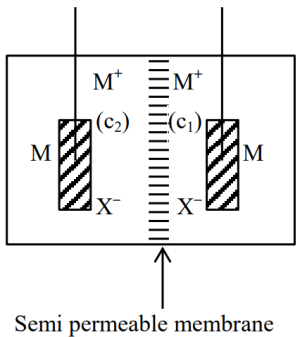
Consider the electrochemical cell shown in the figure where a metal electrode $(M)$ undergoes a redox reaction by forming $M^{+}$ $(M \rightarrow M^{+} + e^{-})$. The cation $M^{+}$ is present in two different concentrations $c_{1}$ and $c_{2}$. Which of the following statements is correct for generating a positive cell potential?
A
If $c_{1}$ is present at the anode,then $c_{1} = c_{2}$
B
If $c_{1}$ is present at the cathode,then $c_{1} < c_{2}$
C
If $c_{1}$ is present at the cathode,then $c_{1} > c_{2}$
D
If $c_{1}$ is present at the anode,then $c_{1} > c_{2}$
Solution
(C) For a concentration cell,the cell reaction is $M^{+}(c_{cathode}) \rightarrow M^{+}(c_{anode})$.
Using the Nernst equation: $E_{cell} = E^{\circ}_{cell} - \frac{0.0591}{n} \log \frac{[M^{+}]_{anode}}{[M^{+}]_{cathode}}$.
Since $E^{\circ}_{cell} = 0$ for a concentration cell,$E_{cell} = -0.0591 \log \frac{c_{anode}}{c_{cathode}} = 0.0591 \log \frac{c_{cathode}}{c_{anode}}$.
For $E_{cell} > 0$,we must have $\log \frac{c_{cathode}}{c_{anode}} > 0$,which implies $c_{cathode} > c_{anode}$.
Case $I$: If $c_{1}$ is at the cathode,then $c_{1} > c_{2}$ (Option $C$ is correct).
Case $II$: If $c_{1}$ is at the anode,then $c_{2} > c_{1}$ (Option $D$ is incorrect).
Using the Nernst equation: $E_{cell} = E^{\circ}_{cell} - \frac{0.0591}{n} \log \frac{[M^{+}]_{anode}}{[M^{+}]_{cathode}}$.
Since $E^{\circ}_{cell} = 0$ for a concentration cell,$E_{cell} = -0.0591 \log \frac{c_{anode}}{c_{cathode}} = 0.0591 \log \frac{c_{cathode}}{c_{anode}}$.
For $E_{cell} > 0$,we must have $\log \frac{c_{cathode}}{c_{anode}} > 0$,which implies $c_{cathode} > c_{anode}$.
Case $I$: If $c_{1}$ is at the cathode,then $c_{1} > c_{2}$ (Option $C$ is correct).
Case $II$: If $c_{1}$ is at the anode,then $c_{2} > c_{1}$ (Option $D$ is incorrect).
0 likes
View Solution357
DifficultMCQ
In the given electrochemical cell,$Ag_{(s)} | AgCl_{(s)} | Cl^-_{(aq)}, Fe^{2+}_{(aq)}, Fe^{3+}_{(aq)} | Pt_{(s)}$ at $298 \ K$,the cell potential $(E_{cell})$ will increase when :
$(A)$ Concentration of $Fe^{2+}$ is increased.
$(B)$ Concentration of $Fe^{3+}$ is decreased.
$(C)$ Concentration of $Fe^{2+}$ is decreased.
$(D)$ Concentration of $Fe^{3+}$ is increased.
$(E)$ Concentration of $Cl^-$ is increased.
Choose the correct answer from the options given below :
$(A)$ Concentration of $Fe^{2+}$ is increased.
$(B)$ Concentration of $Fe^{3+}$ is decreased.
$(C)$ Concentration of $Fe^{2+}$ is decreased.
$(D)$ Concentration of $Fe^{3+}$ is increased.
$(E)$ Concentration of $Cl^-$ is increased.
Choose the correct answer from the options given below :
A
$A$ and $B$ only
B
$A$ and $E$ only
C
$B$ only
D
$C, D$ and $E$ only
Solution
(D) The cell reaction is: $Ag_{(s)} + Cl^-_{(aq)} + Fe^{3+}_{(aq)} \rightarrow AgCl_{(s)} + Fe^{2+}_{(aq)}$.
According to the Nernst equation: $E_{cell} = E^o_{cell} - \frac{0.0591}{1} \log \frac{[Fe^{2+}]}{[Cl^-][Fe^{3+}]}$.
To increase $E_{cell}$,the value of the logarithmic term $\frac{[Fe^{2+}]}{[Cl^-][Fe^{3+}]}$ must decrease.
This occurs when $[Fe^{2+}]$ is decreased,$[Fe^{3+}]$ is increased,or $[Cl^-]$ is increased.
Therefore,the correct options are $C, D,$ and $E$.
According to the Nernst equation: $E_{cell} = E^o_{cell} - \frac{0.0591}{1} \log \frac{[Fe^{2+}]}{[Cl^-][Fe^{3+}]}$.
To increase $E_{cell}$,the value of the logarithmic term $\frac{[Fe^{2+}]}{[Cl^-][Fe^{3+}]}$ must decrease.
This occurs when $[Fe^{2+}]$ is decreased,$[Fe^{3+}]$ is increased,or $[Cl^-]$ is increased.
Therefore,the correct options are $C, D,$ and $E$.
0 likes
View Solution358
DifficultMCQ
Consider the electrochemical cell: $Pt \ | \ O_{2(g)} \ (1 \ bar) \ | \ HCl \ (aq) \ || \ M^{2+} \ (aq, 1.0 \ M) \ | \ M_{(s)}$. The pH above which,oxygen gas would start to evolve at the anode is . . . . . . (nearest integer). $\left[ \text{Given :} \ E^{\circ}_{M^{2+}/M} = 0.994 \ V, \ E^{\circ}_{O_{2}/H_{2}O} = 1.23 \ V, \ \frac{RT}{F}(2.303) = 0.059 \ V \ \text{at the given condition} \right]$
A
$2$
B
$4$
C
$6$
D
$8$
Solution
(B) The cell reaction is $M^{2+} + H_2O \rightarrow M + \frac{1}{2}O_2 + 2H^+$.
For the reaction to be spontaneous,$E_{cell} > 0$.
At the limiting condition,$E_{cell} = 0$,so $E_{cathode} = E_{anode}$.
$E_{cathode} = E^{\circ}_{M^{2+}/M} - \frac{0.059}{2} \log \frac{1}{[M^{2+}]} = 0.994 - 0 = 0.994 \ V$.
$E_{anode} = E^{\circ}_{O_2/H_2O} - \frac{0.059}{4} \log \frac{1}{[H^+]^4 P_{O_2}^{1/2}} = 1.23 + \frac{0.059}{4} \log ([H^+]^4 \times 1) = 1.23 + 0.059 \log [H^+] = 1.23 - 0.059 \times pH$.
Equating $E_{cathode} = E_{anode}$:
$0.994 = 1.23 - 0.059 \times pH$.
$0.059 \times pH = 1.23 - 0.994 = 0.236$.
$pH = \frac{0.236}{0.059} = 4$.
Thus,the nearest integer is $4$.
For the reaction to be spontaneous,$E_{cell} > 0$.
At the limiting condition,$E_{cell} = 0$,so $E_{cathode} = E_{anode}$.
$E_{cathode} = E^{\circ}_{M^{2+}/M} - \frac{0.059}{2} \log \frac{1}{[M^{2+}]} = 0.994 - 0 = 0.994 \ V$.
$E_{anode} = E^{\circ}_{O_2/H_2O} - \frac{0.059}{4} \log \frac{1}{[H^+]^4 P_{O_2}^{1/2}} = 1.23 + \frac{0.059}{4} \log ([H^+]^4 \times 1) = 1.23 + 0.059 \log [H^+] = 1.23 - 0.059 \times pH$.
Equating $E_{cathode} = E_{anode}$:
$0.994 = 1.23 - 0.059 \times pH$.
$0.059 \times pH = 1.23 - 0.994 = 0.236$.
$pH = \frac{0.236}{0.059} = 4$.
Thus,the nearest integer is $4$.
0 likes
View Solution359
DifficultMCQ
Consider the following electrochemical cell at $298 \ K$:
$Pt | HSnO_2^-(aq) | Sn(OH)_6^{2-}(aq) || Bi_2O_3(s) | Bi(s)$.
If the reaction quotient at a given time is $10^6$,then the cell $EMF$ $(E_{\text{cell}})$ is . . . . . . $\times 10^{-1} \ V$ (Nearest integer).
Given the standard half-cell reduction potential as
$E^0_{Bi_2O_3/Bi, OH^-} = -0.44 \ V$ and
$E^0_{Sn(OH)_6^{2-}/HSnO_2^-, OH^-} = -0.90 \ V$.
$Pt | HSnO_2^-(aq) | Sn(OH)_6^{2-}(aq) || Bi_2O_3(s) | Bi(s)$.
If the reaction quotient at a given time is $10^6$,then the cell $EMF$ $(E_{\text{cell}})$ is . . . . . . $\times 10^{-1} \ V$ (Nearest integer).
Given the standard half-cell reduction potential as
$E^0_{Bi_2O_3/Bi, OH^-} = -0.44 \ V$ and
$E^0_{Sn(OH)_6^{2-}/HSnO_2^-, OH^-} = -0.90 \ V$.
A
$2$
B
$3$
C
$4$
D
$5$
Solution
(C) The cell reaction is: $3HSnO_2^- + Bi_2O_3 + 3H_2O + 6OH^- \rightarrow 3Sn(OH)_6^{2-} + 2Bi$.
The number of electrons involved in the balanced equation is $n = 6$.
The standard cell potential is $E^0_{\text{cell}} = E^0_{\text{cathode}} - E^0_{\text{anode}} = -0.44 - (-0.90) = +0.46 \ V$.
Applying the Nernst equation at $298 \ K$: $E_{\text{cell}} = E^0_{\text{cell}} - \frac{0.0591}{n} \log Q$.
Using $0.06$ as an approximation for $\frac{0.0591}{1}$: $E_{\text{cell}} = 0.46 - \frac{0.06}{6} \log(10^6)$.
$E_{\text{cell}} = 0.46 - 0.01 \times 6 = 0.46 - 0.06 = 0.40 \ V$.
Thus,$E_{\text{cell}} = 4 \times 10^{-1} \ V$.
The value is $4$.
The number of electrons involved in the balanced equation is $n = 6$.
The standard cell potential is $E^0_{\text{cell}} = E^0_{\text{cathode}} - E^0_{\text{anode}} = -0.44 - (-0.90) = +0.46 \ V$.
Applying the Nernst equation at $298 \ K$: $E_{\text{cell}} = E^0_{\text{cell}} - \frac{0.0591}{n} \log Q$.
Using $0.06$ as an approximation for $\frac{0.0591}{1}$: $E_{\text{cell}} = 0.46 - \frac{0.06}{6} \log(10^6)$.
$E_{\text{cell}} = 0.46 - 0.01 \times 6 = 0.46 - 0.06 = 0.40 \ V$.
Thus,$E_{\text{cell}} = 4 \times 10^{-1} \ V$.
The value is $4$.
0 likes
View Solution360
MediumMCQ
For a Daniell cell,$E^0_{cell} = 1.1 \ V$. How is $K_c$ represented for the reaction occurring in the Daniell cell?
A
$K_c = 10^{2.2/0.059}$
B
$K_c = 10^{-0.059/1.1}$
C
$K_c = 10^{-2.2/0.059}$
D
$K_c = 10^{0.059/1.1}$
Solution
(A) The relationship between the standard cell potential $(E^0_{cell})$ and the equilibrium constant $(K_c)$ is given by the Nernst equation at equilibrium: $E^0_{cell} = \frac{0.059}{n} \log K_c$ at $298 \ K$.
For a Daniell cell,the cell reaction is $Zn(s) + Cu^{2+}(aq) \rightarrow Zn^{2+}(aq) + Cu(s)$,where the number of electrons transferred is $n = 2$.
Substituting the values into the formula: $1.1 = \frac{0.059}{2} \log K_c$.
Multiplying both sides by $2$,we get $2.2 = 0.059 \log K_c$.
Therefore,$\log K_c = \frac{2.2}{0.059}$.
Converting from logarithmic form to exponential form,we get $K_c = 10^{2.2/0.059}$.
Thus,option $(A)$ is correct.
For a Daniell cell,the cell reaction is $Zn(s) + Cu^{2+}(aq) \rightarrow Zn^{2+}(aq) + Cu(s)$,where the number of electrons transferred is $n = 2$.
Substituting the values into the formula: $1.1 = \frac{0.059}{2} \log K_c$.
Multiplying both sides by $2$,we get $2.2 = 0.059 \log K_c$.
Therefore,$\log K_c = \frac{2.2}{0.059}$.
Converting from logarithmic form to exponential form,we get $K_c = 10^{2.2/0.059}$.
Thus,option $(A)$ is correct.
0 likes
View Solution361
DifficultMCQ
Calculate the equilibrium constant of the following reaction:
$\text{Cu(s)} + 2\text{Ag}^+_{\text{(aq)}} \rightarrow \text{Cu}^{2+}_{\text{(aq)}} + 2\text{Ag(s)}$,given $E^\circ_{\text{cell}} = 0.46 \text{ V}$.
$\text{Cu(s)} + 2\text{Ag}^+_{\text{(aq)}} \rightarrow \text{Cu}^{2+}_{\text{(aq)}} + 2\text{Ag(s)}$,given $E^\circ_{\text{cell}} = 0.46 \text{ V}$.
A
$3.92 \times 10^{14}$
B
$4.92 \times 10^{13}$
C
$4.92 \times 10^{14}$
D
$3.92 \times 10^{15}$
Solution
(D) The relationship between the standard cell potential $(E^\circ_{\text{cell}})$ and the equilibrium constant $(K)$ is given by the Nernst equation at equilibrium:
$\log K = \frac{n E^\circ_{\text{cell}}}{0.0591}$
Here,the number of electrons transferred $(n)$ is $2$,and $E^\circ_{\text{cell}} = 0.46 \text{ V}$.
Substituting the values:
$\log K = \frac{2 \times 0.46}{0.0591} = \frac{0.92}{0.0591} \approx 15.5668$
Now,$K = 10^{15.5668} = 10^{0.5668} \times 10^{15} \approx 3.68 \times 10^{15}$.
Comparing this with the given options,the closest value is $3.92 \times 10^{15}$.
$\log K = \frac{n E^\circ_{\text{cell}}}{0.0591}$
Here,the number of electrons transferred $(n)$ is $2$,and $E^\circ_{\text{cell}} = 0.46 \text{ V}$.
Substituting the values:
$\log K = \frac{2 \times 0.46}{0.0591} = \frac{0.92}{0.0591} \approx 15.5668$
Now,$K = 10^{15.5668} = 10^{0.5668} \times 10^{15} \approx 3.68 \times 10^{15}$.
Comparing this with the given options,the closest value is $3.92 \times 10^{15}$.
0 likes
View Solution362
DifficultMCQ
One half cell in a voltaic cell is constructed by dipping a silver rod in an $AgNO_3$ solution of unknown concentration,and the other half cell is a $Zn$ rod dipped in a $1 \text{ M}$ solution of $ZnSO_4$. $A$ voltage of $1.60 \text{ V}$ is measured at $298 \text{ K}$ for this cell. What is the concentration of $Ag^+$ ions in terms of $\log x$ (where $x = [Ag^+]$)? Given: $E^\ominus_{Zn^{2+}/Zn} = -0.76 \text{ V}$,$E^\ominus_{Ag^+/Ag} = +0.80 \text{ V}$,and $\frac{2.303RT}{F} = 0.059 \text{ V}$.
A
$\frac{2}{3.9}$
B
$\frac{4}{5.9}$
C
$\frac{2.9}{2}$
D
$\frac{5.9}{4}$
Solution
(B) $1$. The cell reaction is: $Zn(s) + 2Ag^+(aq) \to Zn^{2+}(aq) + 2Ag(s)$.
$2$. Calculate the standard cell potential: $E^\circ_{cell} = E^\circ_{cathode} - E^\circ_{anode} = 0.80 \text{ V} - (-0.76 \text{ V}) = 1.56 \text{ V}$.
$3$. Apply the Nernst equation at $298 \text{ K}$: $E_{cell} = E^\circ_{cell} - \frac{0.059}{n} \log \frac{[Zn^{2+}]}{[Ag^+]^2}$.
$4$. Here,$n = 2$,$[Zn^{2+}] = 1 \text{ M}$,and $[Ag^+] = x$. Substituting the values: $1.60 = 1.56 - \frac{0.059}{2} \log \frac{1}{x^2}$.
$5$. Simplify the equation: $1.60 = 1.56 - 0.0295 \times (-2 \log x) = 1.56 + 0.059 \log x$.
$6$. Solve for $\log x$: $0.04 = 0.059 \log x$,which gives $\log x = \frac{0.04}{0.059} = \frac{4}{5.9}$.
$2$. Calculate the standard cell potential: $E^\circ_{cell} = E^\circ_{cathode} - E^\circ_{anode} = 0.80 \text{ V} - (-0.76 \text{ V}) = 1.56 \text{ V}$.
$3$. Apply the Nernst equation at $298 \text{ K}$: $E_{cell} = E^\circ_{cell} - \frac{0.059}{n} \log \frac{[Zn^{2+}]}{[Ag^+]^2}$.
$4$. Here,$n = 2$,$[Zn^{2+}] = 1 \text{ M}$,and $[Ag^+] = x$. Substituting the values: $1.60 = 1.56 - \frac{0.059}{2} \log \frac{1}{x^2}$.
$5$. Simplify the equation: $1.60 = 1.56 - 0.0295 \times (-2 \log x) = 1.56 + 0.059 \log x$.
$6$. Solve for $\log x$: $0.04 = 0.059 \log x$,which gives $\log x = \frac{0.04}{0.059} = \frac{4}{5.9}$.
0 likes
View Solution363
DifficultMCQ
An electrochemical cell consists of the following two redox couples,$M^{x+}(aq)/M(s)$ $[E^{\ominus}_{red} = +0.15 \text{ V}]$ and $Fe^{3+}(aq)/Fe(s)$ $[E^{\ominus}_{red} = -0.036 \text{ V}]$. The cell $EMF$ is recorded to be $0.2057 \text{ V}$. If the reaction quotient of the electrochemical reaction is found to be $10^{-2}$,then the value of $x$ is . . . . . . . (Nearest integer) [Given: $M$ is a $p$-block metal and $\frac{2.303RT}{F} = 0.059 \text{ V}$]
A
$1$
B
$2$
C
$3$
D
$4$
Solution
(B) The cell reaction involves the oxidation of $M$ and reduction of $Fe^{3+}$.
$M \rightarrow M^{x+} + xe^-$ (Anode)
$Fe^{3+} + 3e^- \rightarrow Fe$ (Cathode)
Balanced cell reaction: $3M + xFe^{3+} \rightarrow 3M^{x+} + xFe$.
The number of electrons transferred is $n = 3x$.
Standard cell potential: $E^{\ominus}_{cell} = E^{\ominus}_{cathode} - E^{\ominus}_{anode} = 0.15 - (-0.036) = 0.186 \text{ V}$.
Using the Nernst equation: $E_{cell} = E^{\ominus}_{cell} - \frac{0.059}{n} \log Q$.
$0.2057 = 0.186 - \frac{0.059}{3x} \log(10^{-2})$.
$0.2057 - 0.186 = -\frac{0.059}{3x} \times (-2)$.
$0.0197 = \frac{0.118}{3x}$.
$3x = \frac{0.118}{0.0197} \approx 6$.
$x = 2$.
$M \rightarrow M^{x+} + xe^-$ (Anode)
$Fe^{3+} + 3e^- \rightarrow Fe$ (Cathode)
Balanced cell reaction: $3M + xFe^{3+} \rightarrow 3M^{x+} + xFe$.
The number of electrons transferred is $n = 3x$.
Standard cell potential: $E^{\ominus}_{cell} = E^{\ominus}_{cathode} - E^{\ominus}_{anode} = 0.15 - (-0.036) = 0.186 \text{ V}$.
Using the Nernst equation: $E_{cell} = E^{\ominus}_{cell} - \frac{0.059}{n} \log Q$.
$0.2057 = 0.186 - \frac{0.059}{3x} \log(10^{-2})$.
$0.2057 - 0.186 = -\frac{0.059}{3x} \times (-2)$.
$0.0197 = \frac{0.118}{3x}$.
$3x = \frac{0.118}{0.0197} \approx 6$.
$x = 2$.
0 likes
View Solution364
DifficultMCQ
Calculate the emf of the half-cell given below: $Pt(s) | H_2(g, 2 \text{ atm}) | HCl(aq, 0.02 \text{ M})$,$E^\circ_{H^+/H_2} = 0 \text{ V}$. (Given: $\frac{2.303RT}{F} = 0.059$,$\log 2 = 0.3010$)
A
-$0.109$ $V$
B
$0.109$ $V$
C
$0.035$ $V$
D
-$0.035$ $V$
Solution
(B) The half-cell reaction is: $H_2(g) \to 2H^+(aq) + 2e^-$.
Using the Nernst equation for the oxidation potential: $E = E^\circ - \frac{0.059}{n} \log Q$.
Here,$n = 2$,$E^\circ = 0 \text{ V}$,$[H^+] = 0.02 \text{ M}$,and $P_{H_2} = 2 \text{ atm}$.
$Q = \frac{[H^+]^2}{P_{H_2}} = \frac{(0.02)^2}{2} = \frac{0.0004}{2} = 0.0002 = 2 \times 10^{-4}$.
$E = 0 - \frac{0.059}{2} \log(2 \times 10^{-4})$.
$E = -0.0295 \times (\log 2 + \log 10^{-4}) = -0.0295 \times (0.3010 - 4) = -0.0295 \times (-3.699) \approx 0.109 \text{ V}$.
Using the Nernst equation for the oxidation potential: $E = E^\circ - \frac{0.059}{n} \log Q$.
Here,$n = 2$,$E^\circ = 0 \text{ V}$,$[H^+] = 0.02 \text{ M}$,and $P_{H_2} = 2 \text{ atm}$.
$Q = \frac{[H^+]^2}{P_{H_2}} = \frac{(0.02)^2}{2} = \frac{0.0004}{2} = 0.0002 = 2 \times 10^{-4}$.
$E = 0 - \frac{0.059}{2} \log(2 \times 10^{-4})$.
$E = -0.0295 \times (\log 2 + \log 10^{-4}) = -0.0295 \times (0.3010 - 4) = -0.0295 \times (-3.699) \approx 0.109 \text{ V}$.
0 likes
View SolutionElectrochemistry — Nernst equation and ECS · Frequently Asked Questions
1Are these Electrochemistry questions useful for JEE and NEET?
Yes. All questions in this section are mapped to JEE Main and NEET exam patterns. Previous year questions from JEE Main, NEET, GUJCET and state-level exams are included with full solutions.
2Can I switch to Hindi or Gujarati for these questions?
Yes. Use the language tabs in the hero section or the sidebar to view the same questions and solutions in English, Hindi or Gujarati.
3How do I generate a question paper from this subtopic?
Use the Vedclass Exam Paper Generator — select the chapter and subtopic, set difficulty, and generate Sets A, B, C, D automatically. First 3 chapters of every subject are free.
Vedclass Products
For Students
Vedclass Test Series
Mock tests in real JEE/NEET style with performance analysis. 5-day free trial.
Start Free TrialFor Teachers
Exam Paper Generator
Generate Set A/B/C/D papers from this chapter in 2 minutes. 3 chapters free.
Try FreeFor Institutes
Online Exam Module
Live online exams with unlimited students, 360° analytics & white-label branding.
See DemoFor Teachers & Institutes
Generate a Electrochemistry Exam Paper in 2 Minutes
Select subtopic & difficulty — Sets A, B, C, D auto-generated with No Repeat logic.
First 3 chapters of every subject are free — no payment required.