
A English
Nernst equation and ECS Questions in English
Class 12 Chemistry · Electrochemistry · Nernst equation and ECS
365+
Questions
English
Language
100%
With Solutions
Showing 49 of 365 questions in English
51
DifficultMCQ
For the cell $Zn | Zn^{2+}(0.01 \, M) || Fe^{2+}(0.001 \, M) | Fe$ at $25^o C$,the $E_{cell} = 0.2905 \, V$. The equilibrium constant $K_c$ is:
A
$e^{\frac{0.32}{0.0295}}$
B
$10^{\frac{0.32}{0.0295}}$
C
$10^{\frac{0.26}{0.0295}}$
D
$10^{\frac{0.32}{0.0591}}$
Solution
(B) The cell reaction is: $Zn(s) + Fe^{2+}(aq) \rightarrow Zn^{2+}(aq) + Fe(s)$.
Here,$n = 2$.
Using the Nernst equation: $E_{cell} = E^0_{cell} - \frac{0.0591}{n} \log \frac{[Zn^{2+}]}{[Fe^{2+}]}$.
$0.2905 = E^0_{cell} - \frac{0.0591}{2} \log \frac{0.01}{0.001}$.
$0.2905 = E^0_{cell} - 0.02955 \log(10)$.
$E^0_{cell} = 0.2905 + 0.02955 = 0.32005 \, V \approx 0.32 \, V$.
At equilibrium,$E_{cell} = 0$ and $E^0_{cell} = \frac{0.0591}{n} \log K_c$.
$0.32 = \frac{0.0591}{2} \log K_c$.
$0.32 = 0.02955 \log K_c$.
$\log K_c = \frac{0.32}{0.02955} \approx \frac{0.32}{0.0295}$.
$K_c = 10^{\frac{0.32}{0.0295}}$.
Here,$n = 2$.
Using the Nernst equation: $E_{cell} = E^0_{cell} - \frac{0.0591}{n} \log \frac{[Zn^{2+}]}{[Fe^{2+}]}$.
$0.2905 = E^0_{cell} - \frac{0.0591}{2} \log \frac{0.01}{0.001}$.
$0.2905 = E^0_{cell} - 0.02955 \log(10)$.
$E^0_{cell} = 0.2905 + 0.02955 = 0.32005 \, V \approx 0.32 \, V$.
At equilibrium,$E_{cell} = 0$ and $E^0_{cell} = \frac{0.0591}{n} \log K_c$.
$0.32 = \frac{0.0591}{2} \log K_c$.
$0.32 = 0.02955 \log K_c$.
$\log K_c = \frac{0.32}{0.02955} \approx \frac{0.32}{0.0295}$.
$K_c = 10^{\frac{0.32}{0.0295}}$.
0 likes
View Solution52
EasyMCQ
What is the potential of the cell consisting of two hydrogen electrodes as shown below (in $V$)?
$Pt | H_2(g) | H^+_{(aq)} (10^{-8} \ M) || H^+_{(aq)} (0.001 \ M) | H_2(g) | Pt$
$Pt | H_2(g) | H^+_{(aq)} (10^{-8} \ M) || H^+_{(aq)} (0.001 \ M) | H_2(g) | Pt$
A
$-0.295$
B
$-0.0591$
C
$0.295$
D
$0.0591$
Solution
(C) For a concentration cell,the cell potential is given by the Nernst equation:
$E_{cell} = \frac{0.0591}{n} \log \frac{[H^+]_{cathode}}{[H^+]_{anode}}$
Here,$n = 1$,$[H^+]_{cathode} = 0.001 \ M = 10^{-3} \ M$,and $[H^+]_{anode} = 10^{-8} \ M$.
$E_{cell} = 0.0591 \log \left( \frac{10^{-3}}{10^{-8}} \right)$
$E_{cell} = 0.0591 \log(10^5)$
$E_{cell} = 0.0591 \times 5 = 0.2955 \ V$.
$E_{cell} = \frac{0.0591}{n} \log \frac{[H^+]_{cathode}}{[H^+]_{anode}}$
Here,$n = 1$,$[H^+]_{cathode} = 0.001 \ M = 10^{-3} \ M$,and $[H^+]_{anode} = 10^{-8} \ M$.
$E_{cell} = 0.0591 \log \left( \frac{10^{-3}}{10^{-8}} \right)$
$E_{cell} = 0.0591 \log(10^5)$
$E_{cell} = 0.0591 \times 5 = 0.2955 \ V$.
0 likes
View Solution53
EasyMCQ
Considering the cell $Cu | Cu^{2+} || Ag^{+} | Ag$,what happens to the $emf$ if the concentrations of both $Cu^{2+}$ and $Ag^{+}$ ions are increased by a factor of $10$?
A
It increases by a factor of $10$.
B
It remains the same.
C
It increases by $0.0295 \ V$.
D
It decreases by $0.0295 \ V$.
Solution
(C) The cell reaction is $Cu(s) + 2Ag^{+}(aq) \rightarrow Cu^{2+}(aq) + 2Ag(s)$.
Using the Nernst equation: $E_{cell} = E^{\circ}_{cell} - \frac{0.059}{2} \log \frac{[Cu^{2+}]}{[Ag^{+}]^2}$.
When concentrations are increased by a factor of $10$,the new concentrations are $[Cu^{2+}]' = 10[Cu^{2+}]$ and $[Ag^{+}]' = 10[Ag^{+}]$.
Substituting these into the equation: $E'_{cell} = E^{\circ}_{cell} - \frac{0.059}{2} \log \frac{10[Cu^{2+}]}{(10[Ag^{+}])^2}$.
$E'_{cell} = E^{\circ}_{cell} - \frac{0.059}{2} \log \frac{10[Cu^{2+}]}{100[Ag^{+}]^2} = E^{\circ}_{cell} - \frac{0.059}{2} (\log \frac{[Cu^{2+}]}{[Ag^{+}]^2} + \log \frac{1}{10})$.
$E'_{cell} = E_{cell} - \frac{0.059}{2} (-1) = E_{cell} + 0.0295 \ V$.
Thus,the $emf$ increases by $0.0295 \ V$.
Using the Nernst equation: $E_{cell} = E^{\circ}_{cell} - \frac{0.059}{2} \log \frac{[Cu^{2+}]}{[Ag^{+}]^2}$.
When concentrations are increased by a factor of $10$,the new concentrations are $[Cu^{2+}]' = 10[Cu^{2+}]$ and $[Ag^{+}]' = 10[Ag^{+}]$.
Substituting these into the equation: $E'_{cell} = E^{\circ}_{cell} - \frac{0.059}{2} \log \frac{10[Cu^{2+}]}{(10[Ag^{+}])^2}$.
$E'_{cell} = E^{\circ}_{cell} - \frac{0.059}{2} \log \frac{10[Cu^{2+}]}{100[Ag^{+}]^2} = E^{\circ}_{cell} - \frac{0.059}{2} (\log \frac{[Cu^{2+}]}{[Ag^{+}]^2} + \log \frac{1}{10})$.
$E'_{cell} = E_{cell} - \frac{0.059}{2} (-1) = E_{cell} + 0.0295 \ V$.
Thus,the $emf$ increases by $0.0295 \ V$.
0 likes
View Solution54
MediumMCQ
$A$ copper electrode is dipped in a $0.1 \, M$ copper sulfate solution at $25 \, ^\circ C$. Calculate the reduction potential of the copper electrode. $(E^o_{Cu^{2+}/Cu} = 0.34 \, V)$ (in $, V$)
A
$0.25$
B
$0.31$
C
$0.45$
D
$0.58$
Solution
(B) The reduction half-reaction is: $Cu^{2+} + 2e^- \to Cu$
Using the Nernst equation: $E_{red} = E^o_{red} - \frac{0.059}{n} \log \frac{1}{[Cu^{2+}]}$
Here,$n = 2$ and $[Cu^{2+}] = 0.1 \, M = 10^{-1} \, M$.
Substituting the values: $E = 0.34 - \frac{0.059}{2} \log \frac{1}{10^{-1}}$
$E = 0.34 - 0.0295 \times \log(10)$
Since $\log(10) = 1$,$E = 0.34 - 0.0295 = 0.3105 \, V \approx 0.31 \, V$.
Using the Nernst equation: $E_{red} = E^o_{red} - \frac{0.059}{n} \log \frac{1}{[Cu^{2+}]}$
Here,$n = 2$ and $[Cu^{2+}] = 0.1 \, M = 10^{-1} \, M$.
Substituting the values: $E = 0.34 - \frac{0.059}{2} \log \frac{1}{10^{-1}}$
$E = 0.34 - 0.0295 \times \log(10)$
Since $\log(10) = 1$,$E = 0.34 - 0.0295 = 0.3105 \, V \approx 0.31 \, V$.
0 likes
View Solution55
EasyMCQ
For a cell having a standard $emf$ of $0.295 \ V$ at $25^o \ C$ involving a two-electron change,the equilibrium constant for the reaction is:
A
$29.5 \times 10^{-2}$
B
$10$
C
$10^{10}$
D
$29.5 \times 10^{10}$
Solution
(C) The relationship between standard $emf$ and equilibrium constant $(K_{eq})$ is given by the Nernst equation at $25^o \ C$ $(298 \ K)$:
$E^o_{cell} = \frac{0.0591}{n} \log K_{eq}$
Given: $E^o_{cell} = 0.295 \ V$,$n = 2$.
Substituting the values:
$0.295 = \frac{0.0591}{2} \log K_{eq}$
$0.295 \times 2 = 0.0591 \log K_{eq}$
$0.59 = 0.0591 \log K_{eq}$
$\log K_{eq} = \frac{0.59}{0.0591} \approx 10$
Therefore,$K_{eq} = 10^{10}$.
$E^o_{cell} = \frac{0.0591}{n} \log K_{eq}$
Given: $E^o_{cell} = 0.295 \ V$,$n = 2$.
Substituting the values:
$0.295 = \frac{0.0591}{2} \log K_{eq}$
$0.295 \times 2 = 0.0591 \log K_{eq}$
$0.59 = 0.0591 \log K_{eq}$
$\log K_{eq} = \frac{0.59}{0.0591} \approx 10$
Therefore,$K_{eq} = 10^{10}$.
0 likes
View Solution56
EasyMCQ
For the cell reaction $Zn(s) + Cu^{2+}(aq) (1.0 \, M) \to Cu(s) + Zn^{2+}(aq) (0.1 \, M)$,the measured $e.m.f.$ at $25 \, ^oC$ is $1.3 \, V$. Calculate the $E^o$ value for the cell reaction. (in $, V$)
A
$1.83$
B
$1.06$
C
$1.27$
D
$1.49$
Solution
(C) Using the Nernst equation at $298 \, K$:
$E_{cell} = E^o_{cell} - \frac{0.0591}{n} \log \frac{[Zn^{2+}]}{[Cu^{2+}]}$
Given $n = 2$,$E_{cell} = 1.3 \, V$,$[Zn^{2+}] = 0.1 \, M$,and $[Cu^{2+}] = 1.0 \, M$.
Substituting the values:
$1.3 = E^o_{cell} - \frac{0.0591}{2} \log \frac{0.1}{1.0}$
$1.3 = E^o_{cell} - 0.02955 \log(10^{-1})$
$1.3 = E^o_{cell} + 0.02955 \log(10)$
Since $\log(10) = 1$:
$1.3 = E^o_{cell} + 0.02955$
$E^o_{cell} = 1.3 - 0.02955 = 1.27045 \, V \approx 1.27 \, V$.
$E_{cell} = E^o_{cell} - \frac{0.0591}{n} \log \frac{[Zn^{2+}]}{[Cu^{2+}]}$
Given $n = 2$,$E_{cell} = 1.3 \, V$,$[Zn^{2+}] = 0.1 \, M$,and $[Cu^{2+}] = 1.0 \, M$.
Substituting the values:
$1.3 = E^o_{cell} - \frac{0.0591}{2} \log \frac{0.1}{1.0}$
$1.3 = E^o_{cell} - 0.02955 \log(10^{-1})$
$1.3 = E^o_{cell} + 0.02955 \log(10)$
Since $\log(10) = 1$:
$1.3 = E^o_{cell} + 0.02955$
$E^o_{cell} = 1.3 - 0.02955 = 1.27045 \, V \approx 1.27 \, V$.
0 likes
View Solution57
EasyMCQ
For the redox reaction $Zn(s) + Cu^{2+}(0.1 \ M) \rightarrow Zn^{2+}(1 \ M) + Cu(s)$,given $E^o_{cell} = 1.10 \ V$,calculate the $E_{cell}$ value in $V$. (Given: $2.303 \frac{RT}{F} = 0.0591$) (in $V$)
A
$1.07$
B
$0.82$
C
$2.14$
D
$1.80$
Solution
(A) The Nernst equation for the cell reaction is: $E_{cell} = E^o_{cell} - \frac{0.0591}{n} \log \frac{[Zn^{2+}]}{[Cu^{2+}]}$
Here,$n = 2$,$[Zn^{2+}] = 1 \ M$,and $[Cu^{2+}] = 0.1 \ M$.
Substituting the values: $E_{cell} = 1.10 - \frac{0.0591}{2} \log \frac{1}{0.1}$
$E_{cell} = 1.10 - 0.02955 \times \log(10)$
$E_{cell} = 1.10 - 0.02955 \times 1 = 1.07045 \ V \approx 1.07 \ V$.
Here,$n = 2$,$[Zn^{2+}] = 1 \ M$,and $[Cu^{2+}] = 0.1 \ M$.
Substituting the values: $E_{cell} = 1.10 - \frac{0.0591}{2} \log \frac{1}{0.1}$
$E_{cell} = 1.10 - 0.02955 \times \log(10)$
$E_{cell} = 1.10 - 0.02955 \times 1 = 1.07045 \ V \approx 1.07 \ V$.
0 likes
View Solution58
MediumMCQ
For the cell $Fe | Fe^{+2} (x \, M) || Cu^{+2} (0.01 \, M) | Cu$,if $E_{cell} = 0.78 \, V$,$E^{\circ}_{Fe^{+2} | Fe} = -0.44 \, V$,and $E^{\circ}_{Cu^{+2} | Cu} = +0.34 \, V$,determine the value of $x$.
A
$x > 0.01 \, M$
B
Cannot be determined
C
$x < 0.01 \, M$
D
$x = 0.01 \, M$
0 likes
View Solution59
MediumMCQ
For a galvanic cell reaction at $25^{\circ}C$ with $n = 4$,the standard $emf$ is $0.295 \ V$. What is the equilibrium constant for the reaction? $(F = 96500 \ C \ mol^{-1}; R = 8.314 \ J \ K^{-1} \ mol^{-1})$
A
$1.0 \times 10^{20}$
B
$2.0 \times 10^{11}$
C
$4.0 \times 10^{12}$
D
$1.0 \times 10^{2}$
Solution
(A) The relationship between standard $emf$ $(E^{\circ}_{cell})$ and equilibrium constant $(K_{eq})$ is given by the Nernst equation at $298 \ K$:
$E^{\circ}_{cell} = \frac{0.0591}{n} \log K_{eq}$
Given:
$E^{\circ}_{cell} = 0.295 \ V$
$n = 4$
Substituting the values:
$0.295 = \frac{0.0591}{4} \log K_{eq}$
$\log K_{eq} = \frac{0.295 \times 4}{0.0591}$
$\log K_{eq} \approx 20$
$K_{eq} = 10^{20}$
$E^{\circ}_{cell} = \frac{0.0591}{n} \log K_{eq}$
Given:
$E^{\circ}_{cell} = 0.295 \ V$
$n = 4$
Substituting the values:
$0.295 = \frac{0.0591}{4} \log K_{eq}$
$\log K_{eq} = \frac{0.295 \times 4}{0.0591}$
$\log K_{eq} \approx 20$
$K_{eq} = 10^{20}$
0 likes
View Solution60
MediumMCQ
For the cell reaction $Zn_{(s)} + 2H^+_{(aq)} \to Zn^{2+}_{(aq)} + H_{2(g)}$,what happens when $H_2SO_4$ is added to the cathode compartment?
A
$E_{cell}$ increases and the equilibrium shifts to the right.
B
$E_{cell}$ decreases and the equilibrium shifts to the right.
C
$E_{cell}$ decreases and the equilibrium shifts to the left.
D
$E_{cell}$ increases and the equilibrium shifts to the left.
Solution
(A) The cell reaction is $Zn_{(s)} + 2H^+_{(aq)} \to Zn^{2+}_{(aq)} + H_{2(g)}$.
According to the Nernst equation: $E_{cell} = E^\circ_{cell} - \frac{0.059}{2} \log \frac{[Zn^{2+}] \times P_{H_2}}{[H^+]^2}$.
This can be rewritten as: $E_{cell} = E^\circ_{cell} + \frac{0.059}{2} \log \frac{[H^+]^2}{[Zn^{2+}] \times P_{H_2}}$.
Adding $H_2SO_4$ increases the concentration of $H^+$ ions $[H^+]$.
As $[H^+]$ increases,the logarithmic term increases,leading to an increase in $E_{cell}$.
According to Le Chatelier's principle,an increase in the concentration of reactants $(H^+)$ shifts the equilibrium to the right (towards the products).
According to the Nernst equation: $E_{cell} = E^\circ_{cell} - \frac{0.059}{2} \log \frac{[Zn^{2+}] \times P_{H_2}}{[H^+]^2}$.
This can be rewritten as: $E_{cell} = E^\circ_{cell} + \frac{0.059}{2} \log \frac{[H^+]^2}{[Zn^{2+}] \times P_{H_2}}$.
Adding $H_2SO_4$ increases the concentration of $H^+$ ions $[H^+]$.
As $[H^+]$ increases,the logarithmic term increases,leading to an increase in $E_{cell}$.
According to Le Chatelier's principle,an increase in the concentration of reactants $(H^+)$ shifts the equilibrium to the right (towards the products).
0 likes
View Solution61
EasyMCQ
For the redox reaction occurring in a cell: $Zn_{(s)} + Cu^{2+}(0.1 \ M) \to Zn^{2+}(1 \ M) + Cu_{(s)}$,if $E^o_{cell} = 1.10 \ V$,calculate the value of $E_{cell}$ in $V$. (Given: $2.303 \frac{RT}{F} = 0.0591$)
A
$2.14$
B
$1.80$
C
$1.07$
D
$0.82$
Solution
(C) The Nernst equation is given by: $E_{cell} = E^o_{cell} - \frac{0.0591}{n} \log \left[ \frac{[Zn^{2+}]}{[Cu^{2+}]} \right]$
Here,$n = 2$,$E^o_{cell} = 1.10 \ V$,$[Zn^{2+}] = 1 \ M$,and $[Cu^{2+}] = 0.1 \ M$.
Substituting the values:
$E_{cell} = 1.10 - \frac{0.0591}{2} \log \left( \frac{1}{0.1} \right)$
$E_{cell} = 1.10 - 0.02955 \times \log(10)$
$E_{cell} = 1.10 - 0.02955 \times 1$
$E_{cell} = 1.07045 \ V \approx 1.07 \ V$.
Here,$n = 2$,$E^o_{cell} = 1.10 \ V$,$[Zn^{2+}] = 1 \ M$,and $[Cu^{2+}] = 0.1 \ M$.
Substituting the values:
$E_{cell} = 1.10 - \frac{0.0591}{2} \log \left( \frac{1}{0.1} \right)$
$E_{cell} = 1.10 - 0.02955 \times \log(10)$
$E_{cell} = 1.10 - 0.02955 \times 1$
$E_{cell} = 1.07045 \ V \approx 1.07 \ V$.
0 likes
View Solution62
MediumMCQ
For the cell $Zn_{(s)} | Zn^{2+}_{(1\,M)} || Cu^{2+}_{(1\,M)} | Cu_{(s)}$,the $E^o_{cell} = 1.10 \, V$. When the cell is fully discharged at $298 \, K$,the ratio of the concentrations $[Zn^{2+}] / [Cu^{2+}]$ is:
A
$Antilog (24.08)$
B
$37.3$
C
$10^{37.3}$
D
$9.65 \times 10^{18}$
Solution
(C) The Nernst equation is given by: $E_{cell} = E^o_{cell} - \frac{0.0592}{n} \log \frac{[Zn^{2+}]}{[Cu^{2+}]}$.
When the cell is fully discharged,$E_{cell} = 0$ and $n = 2$.
Substituting the values: $0 = 1.10 - \frac{0.0592}{2} \log \frac{[Zn^{2+}]}{[Cu^{2+}]}$.
$\frac{0.0592}{2} \log \frac{[Zn^{2+}]}{[Cu^{2+}]} = 1.10$.
$\log \frac{[Zn^{2+}]}{[Cu^{2+}]} = \frac{1.10 \times 2}{0.0592} \approx 37.16$.
Rounding to the nearest provided option,the ratio is $10^{37.3}$.
When the cell is fully discharged,$E_{cell} = 0$ and $n = 2$.
Substituting the values: $0 = 1.10 - \frac{0.0592}{2} \log \frac{[Zn^{2+}]}{[Cu^{2+}]}$.
$\frac{0.0592}{2} \log \frac{[Zn^{2+}]}{[Cu^{2+}]} = 1.10$.
$\log \frac{[Zn^{2+}]}{[Cu^{2+}]} = \frac{1.10 \times 2}{0.0592} \approx 37.16$.
Rounding to the nearest provided option,the ratio is $10^{37.3}$.
0 likes
View Solution63
DifficultMCQ
For the cell $Zn | Zn^{2+} (1 \ M) || Cu^{2+} (1 \ M) | Cu$ $(E^{\circ}_{cell} = 1.10 \ V)$ at $298 \ K$,when the cell is completely discharged,what is the ratio of concentrations $\frac{[Zn^{2+}]}{[Cu^{2+}]}$?
A
$9.65 \times 10^{4}$
B
$Antilog(24.08)$
C
$37.3$
D
$10^{37.3}$
Solution
(D) The cell reaction is: $Zn(s) + Cu^{2+}(aq) \rightarrow Zn^{2+}(aq) + Cu(s)$.
For this reaction,$n = 2$.
The Nernst equation is: $E_{cell} = E^{\circ}_{cell} - \frac{0.0591}{n} \log Q$,where $Q = \frac{[Zn^{2+}]}{[Cu^{2+}]}$.
At complete discharge,$E_{cell} = 0$.
Therefore,$0 = 1.10 - \frac{0.0591}{2} \log Q$.
$\log Q = \frac{1.10 \times 2}{0.0591} \approx 37.225$.
$Q = 10^{37.225} \approx 10^{37.3}$.
For this reaction,$n = 2$.
The Nernst equation is: $E_{cell} = E^{\circ}_{cell} - \frac{0.0591}{n} \log Q$,where $Q = \frac{[Zn^{2+}]}{[Cu^{2+}]}$.
At complete discharge,$E_{cell} = 0$.
Therefore,$0 = 1.10 - \frac{0.0591}{2} \log Q$.
$\log Q = \frac{1.10 \times 2}{0.0591} \approx 37.225$.
$Q = 10^{37.225} \approx 10^{37.3}$.
0 likes
View Solution64
MediumMCQ
The standard electrode potential of a $Cu^{2+} | Cu$ electrode is $0.34 \, V$ (reduction potential). What will be the electrode potential of a $0.001 \, M \, Cu^{2+}$ solution in $V$?
A
$0.399$
B
$0.281$
C
$0.222$
D
$0.176$
Solution
(C) The reduction half-reaction is: $Cu^{2+} (aq) + 2e^- \to Cu (s)$.
Using the Nernst equation: $E_{Cu^{2+}|Cu} = E^0_{Cu^{2+}|Cu} - \frac{0.0592}{n} \log \frac{1}{[Cu^{2+}]}$.
Here,$E^0 = 0.34 \, V$,$n = 2$,and $[Cu^{2+}] = 0.001 \, M = 10^{-3} \, M$.
$E_{Cu^{2+}|Cu} = 0.34 - \frac{0.0592}{2} \log \frac{1}{10^{-3}}$.
$E_{Cu^{2+}|Cu} = 0.34 - 0.0296 \times \log(10^3)$.
$E_{Cu^{2+}|Cu} = 0.34 - 0.0296 \times 3$.
$E_{Cu^{2+}|Cu} = 0.34 - 0.0888 = 0.2512 \, V$.
Using the Nernst equation: $E_{Cu^{2+}|Cu} = E^0_{Cu^{2+}|Cu} - \frac{0.0592}{n} \log \frac{1}{[Cu^{2+}]}$.
Here,$E^0 = 0.34 \, V$,$n = 2$,and $[Cu^{2+}] = 0.001 \, M = 10^{-3} \, M$.
$E_{Cu^{2+}|Cu} = 0.34 - \frac{0.0592}{2} \log \frac{1}{10^{-3}}$.
$E_{Cu^{2+}|Cu} = 0.34 - 0.0296 \times \log(10^3)$.
$E_{Cu^{2+}|Cu} = 0.34 - 0.0296 \times 3$.
$E_{Cu^{2+}|Cu} = 0.34 - 0.0888 = 0.2512 \, V$.
0 likes
View Solution65
MediumMCQ
What is the reduction potential of a silver wire dipped in a $0.1 \ M \ AgNO_3$ solution at $25^\circ C$?
A
$E^o_{red}$
B
$(E^o_{red} + 0.059)$
C
$(E^o_{oxi} - 0.059)$
D
$(E^o_{red} - 0.059)$
Solution
(D) The Nernst equation for the reduction of $Ag^+$ ions is given by:
$E_{Ag^+/Ag} = E^o_{Ag^+/Ag} - \frac{0.0591}{n} \log \frac{1}{[Ag^+]}$
For the reaction $Ag^+ + e^- \rightarrow Ag$,$n = 1$.
Substituting the values:
$E_{Ag^+/Ag} = E^o_{Ag^+/Ag} - 0.0591 \log \frac{1}{0.1}$
$E_{Ag^+/Ag} = E^o_{Ag^+/Ag} - 0.0591 \log (10)$
Since $\log (10) = 1$,we get:
$E_{Ag^+/Ag} = E^o_{Ag^+/Ag} - 0.059 \ V$
Thus,the reduction potential is $(E^o_{red} - 0.059)$.
$E_{Ag^+/Ag} = E^o_{Ag^+/Ag} - \frac{0.0591}{n} \log \frac{1}{[Ag^+]}$
For the reaction $Ag^+ + e^- \rightarrow Ag$,$n = 1$.
Substituting the values:
$E_{Ag^+/Ag} = E^o_{Ag^+/Ag} - 0.0591 \log \frac{1}{0.1}$
$E_{Ag^+/Ag} = E^o_{Ag^+/Ag} - 0.0591 \log (10)$
Since $\log (10) = 1$,we get:
$E_{Ag^+/Ag} = E^o_{Ag^+/Ag} - 0.059 \ V$
Thus,the reduction potential is $(E^o_{red} - 0.059)$.
0 likes
View Solution66
DifficultMCQ
For the cell $Zn_{(s)} | Zn^{2+} (0.1 \ M) || Fe^{2+} (0.01 \ M) | Fe_{(s)}$ at $298 \ K$,$E_{cell} = 0.2905 \ V$. What is the equilibrium constant $(K_c)$ for the reaction $Zn_{(s)} + Fe^{2+}_{(aq)} \rightleftharpoons Zn^{2+}_{(aq)} + Fe_{(s)}$?
A
$10^{0.32/0.0295}$
B
$10^{0.595/0.76}$
C
$10^{0.0259/0.32}$
D
$10^{0.32/0.295}$
Solution
(A) The cell reaction is: $Zn_{(s)} + Fe^{2+}_{(aq)} \rightleftharpoons Zn^{2+}_{(aq)} + Fe_{(s)}$
Using the Nernst equation: $E_{cell} = E^{\circ}_{cell} - \frac{0.059}{n} \log \frac{[Zn^{2+}]}{[Fe^{2+}]}$
Given $E_{cell} = 0.2905 \ V$,$n = 2$,$[Zn^{2+}] = 0.1 \ M$,$[Fe^{2+}] = 0.01 \ M$:
$0.2905 = E^{\circ}_{cell} - \frac{0.059}{2} \log \frac{0.1}{0.01}$
$0.2905 = E^{\circ}_{cell} - 0.0295 \log(10)$
$0.2905 = E^{\circ}_{cell} - 0.0295 \implies E^{\circ}_{cell} = 0.32 \ V$
At equilibrium,$E_{cell} = 0$,so $E^{\circ}_{cell} = \frac{0.059}{n} \log K_c$
$0.32 = \frac{0.059}{2} \log K_c$
$0.32 = 0.0295 \log K_c$
$\log K_c = \frac{0.32}{0.0295}$
$K_c = 10^{0.32/0.0295}$
Using the Nernst equation: $E_{cell} = E^{\circ}_{cell} - \frac{0.059}{n} \log \frac{[Zn^{2+}]}{[Fe^{2+}]}$
Given $E_{cell} = 0.2905 \ V$,$n = 2$,$[Zn^{2+}] = 0.1 \ M$,$[Fe^{2+}] = 0.01 \ M$:
$0.2905 = E^{\circ}_{cell} - \frac{0.059}{2} \log \frac{0.1}{0.01}$
$0.2905 = E^{\circ}_{cell} - 0.0295 \log(10)$
$0.2905 = E^{\circ}_{cell} - 0.0295 \implies E^{\circ}_{cell} = 0.32 \ V$
At equilibrium,$E_{cell} = 0$,so $E^{\circ}_{cell} = \frac{0.059}{n} \log K_c$
$0.32 = \frac{0.059}{2} \log K_c$
$0.32 = 0.0295 \log K_c$
$\log K_c = \frac{0.32}{0.0295}$
$K_c = 10^{0.32/0.0295}$
0 likes
View Solution67
EasyMCQ
For the cell reaction $Sn_{(s)} + 2Ag^+_{(aq)} \rightarrow Sn^{2+}_{(aq)} + 2Ag_{(s)}$,what happens when the cell voltage increases?
A
Concentration of $Ag^+$ ions decreases.
B
Concentration of $Sn^{2+}$ ions increases.
C
Concentration of $Ag^+$ ions increases.
D
Both $(A)$ and $(B)$
Solution
(C) According to the Nernst equation,$E_{cell} = E^0_{cell} - \frac{0.0591}{n} \log \frac{[Sn^{2+}]}{[Ag^+]^2}$.
When the cell voltage $(E_{cell})$ increases,the reaction quotient $Q = \frac{[Sn^{2+}]}{[Ag^+]^2}$ must decrease.
This implies that the concentration of the product $[Sn^{2+}]$ must decrease or the concentration of the reactant $[Ag^+]$ must increase.
Therefore,an increase in the concentration of $Ag^+$ ions leads to an increase in the cell voltage.
When the cell voltage $(E_{cell})$ increases,the reaction quotient $Q = \frac{[Sn^{2+}]}{[Ag^+]^2}$ must decrease.
This implies that the concentration of the product $[Sn^{2+}]$ must decrease or the concentration of the reactant $[Ag^+]$ must increase.
Therefore,an increase in the concentration of $Ag^+$ ions leads to an increase in the cell voltage.
0 likes
View Solution68
DifficultMCQ
If a solution of $Cu^{+2}/Cu$ at $298 \, K$ is diluted $100$ times,how will the electrode potential change?
A
$59 \, mV$ increase
B
$59 \, mV$ decrease
C
$29.5 \, mV$ increase
D
$29.5 \, mV$ decrease
Solution
(B) The reduction reaction is: $Cu^{+2} + 2e^- \to Cu$
According to the Nernst equation: $E_{Cu^{+2}/Cu} = E^{\circ}_{Cu^{+2}/Cu} - \frac{0.059}{2} \log \frac{1}{[Cu^{+2}]}$
When the solution is diluted $100$ times,the concentration $[Cu^{+2}]$ becomes $[Cu^{+2}]/100$. The new potential $E'$ is:
$E' = E^{\circ}_{Cu^{+2}/Cu} - \frac{0.059}{2} \log \frac{1}{[Cu^{+2}]/100}$
$E' = E^{\circ}_{Cu^{+2}/Cu} - \frac{0.059}{2} (\log \frac{1}{[Cu^{+2}]} + \log 100)$
$E' = E_{Cu^{+2}/Cu} - \frac{0.059}{2} \times 2$
$E' = E_{Cu^{+2}/Cu} - 0.059 \, V$
Thus,the electrode potential decreases by $0.059 \, V$ or $59 \, mV$.
According to the Nernst equation: $E_{Cu^{+2}/Cu} = E^{\circ}_{Cu^{+2}/Cu} - \frac{0.059}{2} \log \frac{1}{[Cu^{+2}]}$
When the solution is diluted $100$ times,the concentration $[Cu^{+2}]$ becomes $[Cu^{+2}]/100$. The new potential $E'$ is:
$E' = E^{\circ}_{Cu^{+2}/Cu} - \frac{0.059}{2} \log \frac{1}{[Cu^{+2}]/100}$
$E' = E^{\circ}_{Cu^{+2}/Cu} - \frac{0.059}{2} (\log \frac{1}{[Cu^{+2}]} + \log 100)$
$E' = E_{Cu^{+2}/Cu} - \frac{0.059}{2} \times 2$
$E' = E_{Cu^{+2}/Cu} - 0.059 \, V$
Thus,the electrode potential decreases by $0.059 \, V$ or $59 \, mV$.
0 likes
View Solution69
MediumMCQ
The standard cell potential of a cell reaction involving the transfer of $2$ electrons at $25^{\circ}C$ is $0.295 \ V$. What is its equilibrium constant at $25^{\circ}C$?
A
$1 \times 10^{-10}$
B
$29.5 \times 10^{-2}$
C
$10$
D
$1 \times 10^{10}$
Solution
(D) The relationship between standard cell potential $(E^{\circ}_{cell})$ and equilibrium constant $(K)$ is given by the Nernst equation at equilibrium:
$E^{\circ}_{cell} = \frac{0.0591}{n} \log K$
Given: $n = 2$,$E^{\circ}_{cell} = 0.295 \ V$.
Substituting the values:
$0.295 = \frac{0.0591}{2} \log K$
$0.295 = 0.02955 \log K$
$\log K = \frac{0.295}{0.02955} \approx 10$
$K = 10^{10} = 1 \times 10^{10}$
$E^{\circ}_{cell} = \frac{0.0591}{n} \log K$
Given: $n = 2$,$E^{\circ}_{cell} = 0.295 \ V$.
Substituting the values:
$0.295 = \frac{0.0591}{2} \log K$
$0.295 = 0.02955 \log K$
$\log K = \frac{0.295}{0.02955} \approx 10$
$K = 10^{10} = 1 \times 10^{10}$
0 likes
View Solution70
EasyMCQ
For a $Daniel$ cell $Zn | ZnSO_{4(0.01 \ M)} || CuSO_{4(1 \ M)} | Cu$ at $298 \ K$,the cell potential is $E_1$. When the concentrations of $ZnSO_4$ and $CuSO_4$ are changed to $1 \ M$ and $0.01 \ M$ respectively,the cell potential becomes $E_2$. Determine the relationship between $E_1$ and $E_2$.
A
$E_1 > E_2$
B
$E_1 < E_2$
C
$E_1 = E_2$
D
$E_2 = 0 \neq E_1$
Solution
(A) The cell reaction is: $Zn(s) + Cu^{2+}(aq) \to Zn^{2+}(aq) + Cu(s)$.
Using the Nernst equation: $E = E^0 - \frac{0.0592}{2} \log \frac{[Zn^{2+}]}{[Cu^{2+}]}$.
For $E_1$: $[Zn^{2+}] = 0.01 \ M$ and $[Cu^{2+}] = 1 \ M$,so $E_1 = E^0 - \frac{0.0592}{2} \log(0.01) = E^0 - \frac{0.0592}{2} (-2) = E^0 + 0.0592$.
For $E_2$: $[Zn^{2+}] = 1 \ M$ and $[Cu^{2+}] = 0.01 \ M$,so $E_2 = E^0 - \frac{0.0592}{2} \log(100) = E^0 - \frac{0.0592}{2} (2) = E^0 - 0.0592$.
Comparing the two,$E_1 > E_2$.
Using the Nernst equation: $E = E^0 - \frac{0.0592}{2} \log \frac{[Zn^{2+}]}{[Cu^{2+}]}$.
For $E_1$: $[Zn^{2+}] = 0.01 \ M$ and $[Cu^{2+}] = 1 \ M$,so $E_1 = E^0 - \frac{0.0592}{2} \log(0.01) = E^0 - \frac{0.0592}{2} (-2) = E^0 + 0.0592$.
For $E_2$: $[Zn^{2+}] = 1 \ M$ and $[Cu^{2+}] = 0.01 \ M$,so $E_2 = E^0 - \frac{0.0592}{2} \log(100) = E^0 - \frac{0.0592}{2} (2) = E^0 - 0.0592$.
Comparing the two,$E_1 > E_2$.
0 likes
View Solution71
EasyMCQ
Calculate the cell potential for the following cell: ............... $V$
$Cr_{(s)} | Cr^{3+}_{(0.1 \, M)} || Fe^{2+}_{(0.01 \, M)} | Fe_{(s)}$
Given: $E^0_{Cr^{3+}|Cr} = -0.72 \, V$,$E^0_{Fe^{2+}|Fe} = -0.42 \, V$ (in $, V$)
$Cr_{(s)} | Cr^{3+}_{(0.1 \, M)} || Fe^{2+}_{(0.01 \, M)} | Fe_{(s)}$
Given: $E^0_{Cr^{3+}|Cr} = -0.72 \, V$,$E^0_{Fe^{2+}|Fe} = -0.42 \, V$ (in $, V$)
A
$-0.26$
B
$0.26$
C
$0.339$
D
$-0.339$
Solution
(B) The cell reaction is: $2Cr_{(s)} + 3Fe^{2+}_{(aq)} \rightarrow 2Cr^{3+}_{(aq)} + 3Fe_{(s)}$
The standard cell potential is: $E^0_{cell} = E^0_{cathode} - E^0_{anode} = -0.42 - (-0.72) = 0.30 \, V$
Using the Nernst equation at $298 \, K$: $E_{cell} = E^0_{cell} - \frac{0.0591}{n} \log \frac{[Cr^{3+}]^2}{[Fe^{2+}]^3}$
Here,$n = 6$ (total electrons transferred).
$E_{cell} = 0.30 - \frac{0.0591}{6} \log \frac{(0.1)^2}{(0.01)^3}$
$E_{cell} = 0.30 - 0.00985 \log \frac{10^{-2}}{10^{-6}} = 0.30 - 0.00985 \log(10^4)$
$E_{cell} = 0.30 - (0.00985 \times 4) = 0.30 - 0.0394 = 0.2606 \, V \approx 0.26 \, V$
The standard cell potential is: $E^0_{cell} = E^0_{cathode} - E^0_{anode} = -0.42 - (-0.72) = 0.30 \, V$
Using the Nernst equation at $298 \, K$: $E_{cell} = E^0_{cell} - \frac{0.0591}{n} \log \frac{[Cr^{3+}]^2}{[Fe^{2+}]^3}$
Here,$n = 6$ (total electrons transferred).
$E_{cell} = 0.30 - \frac{0.0591}{6} \log \frac{(0.1)^2}{(0.01)^3}$
$E_{cell} = 0.30 - 0.00985 \log \frac{10^{-2}}{10^{-6}} = 0.30 - 0.00985 \log(10^4)$
$E_{cell} = 0.30 - (0.00985 \times 4) = 0.30 - 0.0394 = 0.2606 \, V \approx 0.26 \, V$
0 likes
View Solution72
MediumMCQ
The standard $e.m.f.$ of a cell involving a one-electron change is found to be $0.591 \ V$ at $25^{\circ} C$. What is the equilibrium constant for the reaction? $(F = 96500 \ C \ mol^{-1}; R = 8.314 \ J \ K^{-1} \ mol^{-1})$
A
$1.0 \times 10^{10}$
B
$1.0 \times 10^{5}$
C
$1.0 \times 10^{1}$
D
$1.0 \times 10^{30}$
Solution
(A) The relationship between the standard cell potential $(E^{\circ}_{cell})$ and the equilibrium constant $(K_{eq})$ is given by the Nernst equation at equilibrium:
$E^{\circ}_{cell} = \frac{0.0591}{n} \log K_{eq}$
Given:
$E^{\circ}_{cell} = 0.591 \ V$
$n = 1$ (one-electron change)
Substituting the values:
$0.591 = \frac{0.0591}{1} \log K_{eq}$
$\log K_{eq} = \frac{0.591}{0.0591} = 10$
$K_{eq} = 10^{10} = 1.0 \times 10^{10}$
$E^{\circ}_{cell} = \frac{0.0591}{n} \log K_{eq}$
Given:
$E^{\circ}_{cell} = 0.591 \ V$
$n = 1$ (one-electron change)
Substituting the values:
$0.591 = \frac{0.0591}{1} \log K_{eq}$
$\log K_{eq} = \frac{0.591}{0.0591} = 10$
$K_{eq} = 10^{10} = 1.0 \times 10^{10}$
0 likes
View Solution73
MediumMCQ
For the reduction of silver ions by copper metal,the standard cell potential at $25\,^{\circ}C$ is $0.46\,V$. What is the value of the standard Gibbs energy $(\Delta G^{\circ})$? $(F = 96500\,C\,mol^{-1})$
A
$-98\,kJ$
B
$-89\,kJ$
C
$-89\,J$
D
$-44.5\,kJ$
Solution
(B) The cell reaction is: $2Ag^{+} + Cu \to 2Ag + Cu^{2+}$
Here,the number of electrons transferred,$n = 2$.
The formula for standard Gibbs energy is: $\Delta G^{\circ} = -nFE^{\circ}_{cell}$
Substituting the values: $\Delta G^{\circ} = -2 \times 96500\,C\,mol^{-1} \times 0.46\,V$
$\Delta G^{\circ} = -88780\,J\,mol^{-1} \approx -89\,kJ\,mol^{-1}$
Here,the number of electrons transferred,$n = 2$.
The formula for standard Gibbs energy is: $\Delta G^{\circ} = -nFE^{\circ}_{cell}$
Substituting the values: $\Delta G^{\circ} = -2 \times 96500\,C\,mol^{-1} \times 0.46\,V$
$\Delta G^{\circ} = -88780\,J\,mol^{-1} \approx -89\,kJ\,mol^{-1}$
0 likes
View Solution74
EasyMCQ
When is the reduction potential of a hydrogen half-cell negative?
A
$p(H_2) = 2 \, atm$ and $[H^+] = 1.0 \, M$
B
$p(H_2) = 2 \, atm$ and $[H^+] = 2.0 \, M$
C
$p(H_2) = 1 \, atm$ and $[H^+] = 2.0 \, M$
D
$p(H_2) = 1 \, atm$ and $[H^+] = 1.0 \, M$
Solution
(A) The reduction reaction for a hydrogen half-cell is: $2H^+ (aq) + 2e^- \rightarrow H_2 (g)$.
According to the Nernst equation,the reduction potential $E_{H^+/H_2}$ is given by: $E = E^0 - \frac{0.0591}{2} \log \frac{p(H_2)}{[H^+]^2}$.
Since $E^0 = 0 \, V$,the equation becomes: $E = -0.02955 \log \frac{p(H_2)}{[H^+]^2}$.
For $E$ to be negative,$\log \frac{p(H_2)}{[H^+]^2}$ must be positive,which means $\frac{p(H_2)}{[H^+]^2} > 1$.
Checking option $A$: $\frac{2}{(1.0)^2} = 2 > 1$. Thus,$E$ is negative.
According to the Nernst equation,the reduction potential $E_{H^+/H_2}$ is given by: $E = E^0 - \frac{0.0591}{2} \log \frac{p(H_2)}{[H^+]^2}$.
Since $E^0 = 0 \, V$,the equation becomes: $E = -0.02955 \log \frac{p(H_2)}{[H^+]^2}$.
For $E$ to be negative,$\log \frac{p(H_2)}{[H^+]^2}$ must be positive,which means $\frac{p(H_2)}{[H^+]^2} > 1$.
Checking option $A$: $\frac{2}{(1.0)^2} = 2 > 1$. Thus,$E$ is negative.
0 likes
View Solution75
EasyMCQ
Which of the following is the correct representation of the Nernst equation for the reduction reaction $M^{n+} + ne^- \rightarrow M$?
A
$E_{M^{n+}/M} = E^o_{M^{n+}/M} + \frac{0.0591}{n} \log [M^{n+}]$
B
$E_{M^{n+}/M} = E^o_{M^{n+}/M} - \frac{0.0591}{n} \log \frac{1}{[M^{n+}]}$
C
$E_{M^{n+}/M} = E^o_{M^{n+}/M} + \frac{0.0591}{n} \log \frac{1}{[M^{n+}]}$
D
None of these
Solution
(A) The Nernst equation for the reduction half-reaction $M^{n+} + ne^- \rightarrow M$ is given by:
$E_{M^{n+}/M} = E^o_{M^{n+}/M} - \frac{RT}{nF} \ln \frac{[M]}{[M^{n+}]}$
Since the concentration of a pure solid $[M] = 1$,the equation becomes:
$E_{M^{n+}/M} = E^o_{M^{n+}/M} - \frac{0.0591}{n} \log \frac{1}{[M^{n+}]}$
This can also be written as:
$E_{M^{n+}/M} = E^o_{M^{n+}/M} + \frac{0.0591}{n} \log [M^{n+}]$
$E_{M^{n+}/M} = E^o_{M^{n+}/M} - \frac{RT}{nF} \ln \frac{[M]}{[M^{n+}]}$
Since the concentration of a pure solid $[M] = 1$,the equation becomes:
$E_{M^{n+}/M} = E^o_{M^{n+}/M} - \frac{0.0591}{n} \log \frac{1}{[M^{n+}]}$
This can also be written as:
$E_{M^{n+}/M} = E^o_{M^{n+}/M} + \frac{0.0591}{n} \log [M^{n+}]$
0 likes
View Solution76
MediumMCQ
The reduction potential of a hydrogen electrode at $25^{\circ}C$ is ............... $V$ $(P_{H_2} = 1 \ atm; [H^+] = 0.1 \ M)$.
A
$0$
B
$-0.059$
C
$0.118$
D
$0.059$
Solution
(B) The reduction reaction for a hydrogen electrode is: $2H^+ (aq) + 2e^- \rightarrow H_2 (g)$.
Using the Nernst equation: $E_{red} = E^{\circ}_{red} - \frac{0.0591}{n} \log \frac{P_{H_2}}{[H^+]^2}$.
Given $E^{\circ}_{red} = 0 \ V$,$n = 2$,$P_{H_2} = 1 \ atm$,and $[H^+] = 0.1 \ M$.
$E_{red} = 0 - \frac{0.059}{2} \log \frac{1}{(0.1)^2}$.
$E_{red} = -0.0295 \times \log(100) = -0.0295 \times 2 = -0.059 \ V$.
Using the Nernst equation: $E_{red} = E^{\circ}_{red} - \frac{0.0591}{n} \log \frac{P_{H_2}}{[H^+]^2}$.
Given $E^{\circ}_{red} = 0 \ V$,$n = 2$,$P_{H_2} = 1 \ atm$,and $[H^+] = 0.1 \ M$.
$E_{red} = 0 - \frac{0.059}{2} \log \frac{1}{(0.1)^2}$.
$E_{red} = -0.0295 \times \log(100) = -0.0295 \times 2 = -0.059 \ V$.
0 likes
View Solution77
MediumMCQ
The reduction potential of a hydrogen electrode at $pH = 1$ is ........ $V$.
A
$-0.059$
B
$0$
C
$0.059$
D
$0.59$
Solution
(A) The reduction reaction for a hydrogen electrode is: $2H^+ (aq) + 2e^- \rightarrow H_2 (g)$.
Using the Nernst equation at $298 \ K$:
$E_{H^+/H_2} = E^0_{H^+/H_2} - \frac{0.0591}{n} \log \frac{1}{[H^+]^2}$.
Given $E^0_{H^+/H_2} = 0 \ V$,$n = 2$,and $pH = -\log[H^+] = 1$,which means $[H^+] = 10^{-1} \ M$.
Substituting the values:
$E = 0 - \frac{0.0591}{2} \log \frac{1}{(10^{-1})^2} = -0.02955 \times \log(10^2) = -0.02955 \times 2 = -0.0591 \ V$.
Thus,the reduction potential is approximately $-0.059 \ V$.
Using the Nernst equation at $298 \ K$:
$E_{H^+/H_2} = E^0_{H^+/H_2} - \frac{0.0591}{n} \log \frac{1}{[H^+]^2}$.
Given $E^0_{H^+/H_2} = 0 \ V$,$n = 2$,and $pH = -\log[H^+] = 1$,which means $[H^+] = 10^{-1} \ M$.
Substituting the values:
$E = 0 - \frac{0.0591}{2} \log \frac{1}{(10^{-1})^2} = -0.02955 \times \log(10^2) = -0.02955 \times 2 = -0.0591 \ V$.
Thus,the reduction potential is approximately $-0.059 \ V$.
0 likes
View Solution78
AdvancedMCQ
In the electrochemical cell $:$
$Zn \,|\,ZnSO_4\,(0.01\,M)\,||\,CuSO_4\,(1.0\,M)\,|\,Cu$
the $emf$ of this Daniell cell is $E_1.$ When the concentration of $ZnSO_4$ is changed to $1.0\,M$ and that of $CuSO_4$ changed to $0.01\,M,$ the $emf$ changes to $E_2.$ From the followings,which one is the relationship between $E_1$ and $E_2$ $?$ (Given,$RT/F = 0.059$)
$Zn \,|\,ZnSO_4\,(0.01\,M)\,||\,CuSO_4\,(1.0\,M)\,|\,Cu$
the $emf$ of this Daniell cell is $E_1.$ When the concentration of $ZnSO_4$ is changed to $1.0\,M$ and that of $CuSO_4$ changed to $0.01\,M,$ the $emf$ changes to $E_2.$ From the followings,which one is the relationship between $E_1$ and $E_2$ $?$ (Given,$RT/F = 0.059$)
A
$E_1 < E_2$
B
$E_1 > E_2$
C
$E_1 = E_2$
D
none of the above
Solution
(B) The cell reaction for the Daniell cell is $Zn(s) + Cu^{2+}(aq) \longrightarrow Zn^{2+}(aq) + Cu(s).$
Using the Nernst equation $E = E^{\circ} - \frac{0.059}{n} \log \frac{[Zn^{2+}]}{[Cu^{2+}]}$ where $n = 2.$
For $E_1$: $[Zn^{2+}] = 0.01 \, M$ and $[Cu^{2+}] = 1.0 \, M.$
$E_1 = E^{\circ} - \frac{0.059}{2} \log \frac{0.01}{1} = E^{\circ} - \frac{0.059}{2} \log(10^{-2}) = E^{\circ} + 0.059.$
For $E_2$: $[Zn^{2+}] = 1.0 \, M$ and $[Cu^{2+}] = 0.01 \, M.$
$E_2 = E^{\circ} - \frac{0.059}{2} \log \frac{1}{0.01} = E^{\circ} - \frac{0.059}{2} \log(10^{2}) = E^{\circ} - 0.059.$
Comparing the two,$E_1 = E^{\circ} + 0.059$ and $E_2 = E^{\circ} - 0.059.$
Therefore,$E_1 > E_2.$
Using the Nernst equation $E = E^{\circ} - \frac{0.059}{n} \log \frac{[Zn^{2+}]}{[Cu^{2+}]}$ where $n = 2.$
For $E_1$: $[Zn^{2+}] = 0.01 \, M$ and $[Cu^{2+}] = 1.0 \, M.$
$E_1 = E^{\circ} - \frac{0.059}{2} \log \frac{0.01}{1} = E^{\circ} - \frac{0.059}{2} \log(10^{-2}) = E^{\circ} + 0.059.$
For $E_2$: $[Zn^{2+}] = 1.0 \, M$ and $[Cu^{2+}] = 0.01 \, M.$
$E_2 = E^{\circ} - \frac{0.059}{2} \log \frac{1}{0.01} = E^{\circ} - \frac{0.059}{2} \log(10^{2}) = E^{\circ} - 0.059.$
Comparing the two,$E_1 = E^{\circ} + 0.059$ and $E_2 = E^{\circ} - 0.059.$
Therefore,$E_1 > E_2.$
0 likes
View Solution79
DifficultMCQ
If the $E^{\circ}_{cell}$ for a given reaction has a negative value,which of the following gives the correct relationships for the values of $\Delta G^{\circ}$ and $K_{eq}$ ?
A
$\Delta G^{\circ} > 0; K_{eq} < 1$
B
$\Delta G^{\circ} > 0; K_{eq} > 1$
C
$\Delta G^{\circ} < 0; K_{eq} > 1$
D
$\Delta G^{\circ} < 0; K_{eq} < 1$
Solution
(A) The relationship between standard Gibbs free energy change $(\Delta G^{\circ})$ and standard cell potential $(E^{\circ}_{cell})$ is given by $\Delta G^{\circ} = -nFE^{\circ}_{cell}$.
If $E^{\circ}_{cell} < 0$,then $\Delta G^{\circ} > 0$,which indicates that the reaction is non-spontaneous.
Furthermore,the relationship between $E^{\circ}_{cell}$ and the equilibrium constant $(K_{eq})$ is given by $E^{\circ}_{cell} = \frac{RT}{nF} \ln K_{eq}$.
If $E^{\circ}_{cell} < 0$,then $\ln K_{eq} < 0$,which implies $K_{eq} < 1$.
If $E^{\circ}_{cell} < 0$,then $\Delta G^{\circ} > 0$,which indicates that the reaction is non-spontaneous.
Furthermore,the relationship between $E^{\circ}_{cell}$ and the equilibrium constant $(K_{eq})$ is given by $E^{\circ}_{cell} = \frac{RT}{nF} \ln K_{eq}$.
If $E^{\circ}_{cell} < 0$,then $\ln K_{eq} < 0$,which implies $K_{eq} < 1$.
0 likes
View Solution80
MediumMCQ
The pressure of $H_2$ required to make the potential of $H_2$-electrode zero in pure water at $298 \ K$ is
A
$10^{-10} \ atm$
B
$10^{-4} \ atm$
C
$10^{-14} \ atm$
D
$10^{-12} \ atm$
Solution
(C) The reduction half-reaction for the hydrogen electrode is: $2H^{+} + 2e^{-} \longrightarrow H_{2(g)}$
Using the Nernst equation for the electrode potential: $E_{H^{+}/H_2} = E^{\circ}_{H^{+}/H_2} - \frac{0.0591}{2} \log \frac{P_{H_2}}{[H^{+}]^2}$
Since $E^{\circ}_{H^{+}/H_2} = 0 \ V$ and we want the electrode potential $E_{H^{+}/H_2}$ to be $0 \ V$,we have:
$0 = 0 - \frac{0.0591}{2} \log \frac{P_{H_2}}{[H^{+}]^2}$
This implies $\log \frac{P_{H_2}}{[H^{+}]^2} = 0$,so $\frac{P_{H_2}}{[H^{+}]^2} = 10^0 = 1$
Therefore,$P_{H_2} = [H^{+}]^2$
For pure water at $298 \ K$,the concentration of hydrogen ions is $[H^{+}] = 10^{-7} \ M$
Substituting this value: $P_{H_2} = (10^{-7})^2 = 10^{-14} \ atm$
Using the Nernst equation for the electrode potential: $E_{H^{+}/H_2} = E^{\circ}_{H^{+}/H_2} - \frac{0.0591}{2} \log \frac{P_{H_2}}{[H^{+}]^2}$
Since $E^{\circ}_{H^{+}/H_2} = 0 \ V$ and we want the electrode potential $E_{H^{+}/H_2}$ to be $0 \ V$,we have:
$0 = 0 - \frac{0.0591}{2} \log \frac{P_{H_2}}{[H^{+}]^2}$
This implies $\log \frac{P_{H_2}}{[H^{+}]^2} = 0$,so $\frac{P_{H_2}}{[H^{+}]^2} = 10^0 = 1$
Therefore,$P_{H_2} = [H^{+}]^2$
For pure water at $298 \ K$,the concentration of hydrogen ions is $[H^{+}] = 10^{-7} \ M$
Substituting this value: $P_{H_2} = (10^{-7})^2 = 10^{-14} \ atm$
0 likes
View Solution81
DifficultMCQ
$A$ hydrogen gas electrode is made by dipping platinum wire in a solution of $HCl$ of $pH = 10$ and by passing hydrogen gas around the platinum wire at $1 \ atm$ pressure. The oxidation potential of the electrode would be $.......... \ V$.
A
$0.118$
B
$1.18$
C
$0.059$
D
$0.59$
Solution
(D) The oxidation reaction for the hydrogen electrode is: $H_{2}(g) \rightarrow 2H^{+}(aq) + 2e^{-}$.
Given $pH = 10$,the concentration of hydrogen ions is $[H^{+}] = 10^{-pH} = 10^{-10} \ M$.
The pressure of hydrogen gas is $P_{H_{2}} = 1 \ atm$.
The oxidation potential is given by the Nernst equation: $E_{ox} = E_{ox}^{0} - \frac{0.0591}{n} \log Q$.
For the standard hydrogen electrode,$E_{ox}^{0} = 0 \ V$ and $n = 2$.
The reaction quotient $Q = \frac{[H^{+}]^{2}}{P_{H_{2}}} = \frac{(10^{-10})^{2}}{1} = 10^{-20}$.
Substituting the values: $E_{ox} = 0 - \frac{0.0591}{2} \log(10^{-20})$.
$E_{ox} = -\frac{0.0591}{2} \times (-20) = 0.0591 \times 10 = 0.591 \ V$.
Given $pH = 10$,the concentration of hydrogen ions is $[H^{+}] = 10^{-pH} = 10^{-10} \ M$.
The pressure of hydrogen gas is $P_{H_{2}} = 1 \ atm$.
The oxidation potential is given by the Nernst equation: $E_{ox} = E_{ox}^{0} - \frac{0.0591}{n} \log Q$.
For the standard hydrogen electrode,$E_{ox}^{0} = 0 \ V$ and $n = 2$.
The reaction quotient $Q = \frac{[H^{+}]^{2}}{P_{H_{2}}} = \frac{(10^{-10})^{2}}{1} = 10^{-20}$.
Substituting the values: $E_{ox} = 0 - \frac{0.0591}{2} \log(10^{-20})$.
$E_{ox} = -\frac{0.0591}{2} \times (-20) = 0.0591 \times 10 = 0.591 \ V$.
0 likes
View Solution82
DifficultMCQ
The equilibrium constant of the reaction:
$Cu_{(s)} + 2Ag^{+}_{(aq)} \rightarrow Cu^{2+}_{(aq)} + 2Ag_{(s)}$
with $E^{\circ} = 0.46 \ V$ at $298 \ K$ is:
$Cu_{(s)} + 2Ag^{+}_{(aq)} \rightarrow Cu^{2+}_{(aq)} + 2Ag_{(s)}$
with $E^{\circ} = 0.46 \ V$ at $298 \ K$ is:
A
$2.0 \times 10^{10}$
B
$4.0 \times 10^{10}$
C
$4.0 \times 10^{15}$
D
$2.4 \times 10^{10}$
Solution
(C) For a cell reaction in equilibrium at $298 \ K$,the relationship between the standard cell potential and the equilibrium constant is given by:
$E_{cell}^{\circ} = \frac{0.0591}{n} \log K_{C}$
where $K_{C}$ is the equilibrium constant and $n$ is the number of electrons transferred in the balanced redox reaction.
For the reaction $Cu_{(s)} + 2Ag^{+}_{(aq)} \rightarrow Cu^{2+}_{(aq)} + 2Ag_{(s)}$,the number of electrons transferred is $n = 2$.
Given $E_{cell}^{\circ} = 0.46 \ V$,we substitute the values into the equation:
$0.46 = \frac{0.0591}{2} \log K_{C}$
$\log K_{C} = \frac{0.46 \times 2}{0.0591} = \frac{0.92}{0.0591} \approx 15.567$
$K_{C} = 10^{15.567} \approx 3.69 \times 10^{15} \approx 4.0 \times 10^{15}$
$E_{cell}^{\circ} = \frac{0.0591}{n} \log K_{C}$
where $K_{C}$ is the equilibrium constant and $n$ is the number of electrons transferred in the balanced redox reaction.
For the reaction $Cu_{(s)} + 2Ag^{+}_{(aq)} \rightarrow Cu^{2+}_{(aq)} + 2Ag_{(s)}$,the number of electrons transferred is $n = 2$.
Given $E_{cell}^{\circ} = 0.46 \ V$,we substitute the values into the equation:
$0.46 = \frac{0.0591}{2} \log K_{C}$
$\log K_{C} = \frac{0.46 \times 2}{0.0591} = \frac{0.92}{0.0591} \approx 15.567$
$K_{C} = 10^{15.567} \approx 3.69 \times 10^{15} \approx 4.0 \times 10^{15}$
0 likes
View Solution83
AdvancedMCQ
The cell,$Zn\ |\ Zn^{2+} \,(1\ M)\ ||\ Cu^{2+}\ (1\ M)\ |\ Cu$ $(E^o_{cell} = 1.10\ V)$ was allowed to be completely discharged at $298\ K.$ The relative concentration of $Zn^{2+}$ to $Cu^{2+}$ $\left( \frac{[Zn^{2+}]}{[Cu^{2+}]} \right)$ is
A
$9.65 \times 10^4$
B
antilog $(24.08)$
C
$37.3$
D
$10^{37.3}$
Solution
(D) When the cell is completely discharged,the cell potential $E_{cell} = 0 \ V.$
The Nernst equation for the cell reaction is given by:
$E_{cell} = E_{cell}^{\circ} - \frac{0.059}{n} \log \left( \frac{[Zn^{2+}]}{[Cu^{2+}]} \right)$
Here,$n = 2$ (number of electrons transferred) and $E_{cell}^{\circ} = 1.10 \ V.$
Substituting the values:
$0 = 1.10 - \frac{0.059}{2} \log \left( \frac{[Zn^{2+}]}{[Cu^{2+}]} \right)$
Rearranging the equation:
$\log \left( \frac{[Zn^{2+}]}{[Cu^{2+}]} \right) = \frac{1.10 \times 2}{0.059} \approx 37.288 \approx 37.3$
Therefore,$\frac{[Zn^{2+}]}{[Cu^{2+}]} = 10^{37.3}$.
The Nernst equation for the cell reaction is given by:
$E_{cell} = E_{cell}^{\circ} - \frac{0.059}{n} \log \left( \frac{[Zn^{2+}]}{[Cu^{2+}]} \right)$
Here,$n = 2$ (number of electrons transferred) and $E_{cell}^{\circ} = 1.10 \ V.$
Substituting the values:
$0 = 1.10 - \frac{0.059}{2} \log \left( \frac{[Zn^{2+}]}{[Cu^{2+}]} \right)$
Rearranging the equation:
$\log \left( \frac{[Zn^{2+}]}{[Cu^{2+}]} \right) = \frac{1.10 \times 2}{0.059} \approx 37.288 \approx 37.3$
Therefore,$\frac{[Zn^{2+}]}{[Cu^{2+}]} = 10^{37.3}$.
0 likes
View Solution84
DifficultMCQ
Given $E^o _{Cr^{3+} / Cr} = -0.72 \, V$ and $E^o _{Fe^{2+} / Fe} = -0.42 \, V$. The potential for the cell $Cr \, | \, Cr^{3+}_{(0.1 \, M)} \, || \, Fe^{2+}_{(0.01 \, M)} \, | \, Fe$ is ......... $V$.
A
$-0.26$
B
$0.336$
C
$-0.339$
D
$0.26$
Solution
(D) The cell reaction is: $2Cr(s) + 3Fe^{2+}(aq) \rightarrow 2Cr^{3+}(aq) + 3Fe(s)$.
$n = 6$ (number of electrons transferred).
$E^o_{cell} = E^o_{cathode} - E^o_{anode} = -0.42 - (-0.72) = 0.30 \, V$.
Using the Nernst equation: $E_{cell} = E^o_{cell} - \frac{0.059}{n} \log \frac{[Cr^{3+}]^2}{[Fe^{2+}]^3}$.
$E_{cell} = 0.30 - \frac{0.059}{6} \log \frac{(0.1)^2}{(0.01)^3}$.
$E_{cell} = 0.30 - \frac{0.059}{6} \log \frac{10^{-2}}{10^{-6}} = 0.30 - \frac{0.059}{6} \log(10^4)$.
$E_{cell} = 0.30 - \frac{0.059}{6} \times 4 = 0.30 - 0.0393 = 0.2607 \, V \approx 0.26 \, V$.
$n = 6$ (number of electrons transferred).
$E^o_{cell} = E^o_{cathode} - E^o_{anode} = -0.42 - (-0.72) = 0.30 \, V$.
Using the Nernst equation: $E_{cell} = E^o_{cell} - \frac{0.059}{n} \log \frac{[Cr^{3+}]^2}{[Fe^{2+}]^3}$.
$E_{cell} = 0.30 - \frac{0.059}{6} \log \frac{(0.1)^2}{(0.01)^3}$.
$E_{cell} = 0.30 - \frac{0.059}{6} \log \frac{10^{-2}}{10^{-6}} = 0.30 - \frac{0.059}{6} \log(10^4)$.
$E_{cell} = 0.30 - \frac{0.059}{6} \times 4 = 0.30 - 0.0393 = 0.2607 \, V \approx 0.26 \, V$.
0 likes
View Solution85
MediumMCQ
On diluting the concentration of $Cl^{-}$ ions by ten times in a calomel electrode,its reduction potential at $298 \ K$ is -
A
increased by $0.059 \ V$
B
decreased by $0.059 \ V$
C
increased by $0.0295 \ V$
D
decreased by $0.0295 \ V$
Solution
(A) The calomel electrode reaction is: $Hg_2Cl_2(s) + 2e^{-} \rightleftharpoons 2Hg(l) + 2Cl^{-}(aq)$.
Applying the Nernst equation for the reduction potential:
$E = E^{\circ} - \frac{0.0591}{2} \log [Cl^{-}]^2$.
$E = E^{\circ} - 0.0591 \log [Cl^{-}]$.
If the concentration of $Cl^{-}$ is diluted by ten times,the new concentration is $[Cl^{-}]' = \frac{[Cl^{-}]}{10}$.
New potential $E' = E^{\circ} - 0.0591 \log \left( \frac{[Cl^{-}]}{10} \right)$.
$E' = E^{\circ} - 0.0591 (\log [Cl^{-}] - \log 10)$.
$E' = E^{\circ} - 0.0591 \log [Cl^{-}] + 0.0591$.
$E' = E + 0.0591 \ V$.
Thus,the reduction potential increases by $0.0591 \ V$ (approximately $0.059 \ V$).
Applying the Nernst equation for the reduction potential:
$E = E^{\circ} - \frac{0.0591}{2} \log [Cl^{-}]^2$.
$E = E^{\circ} - 0.0591 \log [Cl^{-}]$.
If the concentration of $Cl^{-}$ is diluted by ten times,the new concentration is $[Cl^{-}]' = \frac{[Cl^{-}]}{10}$.
New potential $E' = E^{\circ} - 0.0591 \log \left( \frac{[Cl^{-}]}{10} \right)$.
$E' = E^{\circ} - 0.0591 (\log [Cl^{-}] - \log 10)$.
$E' = E^{\circ} - 0.0591 \log [Cl^{-}] + 0.0591$.
$E' = E + 0.0591 \ V$.
Thus,the reduction potential increases by $0.0591 \ V$ (approximately $0.059 \ V$).
0 likes
View Solution86
DifficultMCQ
Which graph correctly correlates $E_{cell}$ as a function of concentrations for the cell (for different values of $M$ and $M'$):-
$Zn_{(s)} + Cu^{2+}(M) \to Zn^{2+}(M') + Cu_{(s)};$ $E^o_{cell} = 1.10 \, V$
$X$-axis : $log_{10} \frac{[Zn^{2+}]}{[Cu^{2+}]}$,$Y$-axis : $E_{cell}$
$Zn_{(s)} + Cu^{2+}(M) \to Zn^{2+}(M') + Cu_{(s)};$ $E^o_{cell} = 1.10 \, V$
$X$-axis : $log_{10} \frac{[Zn^{2+}]}{[Cu^{2+}]}$,$Y$-axis : $E_{cell}$
A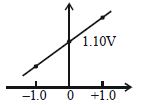
B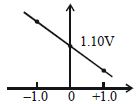
C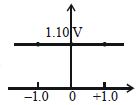
D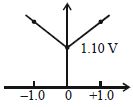
Solution
(B) The Nernst equation for the given cell reaction is:
$E_{cell} = E^o_{cell} - \frac{0.059}{n} log \frac{[Zn^{2+}]}{[Cu^{2+}]}$
Here,$n = 2$,so the equation becomes:
$E_{cell} = 1.10 - \frac{0.059}{2} log \frac{[Zn^{2+}]}{[Cu^{2+}]}$
This is in the form of a linear equation $y = mx + c$,where $y = E_{cell}$,$x = log_{10} \frac{[Zn^{2+}]}{[Cu^{2+}]}$,$c = 1.10$,and the slope $m = -\frac{0.059}{2} = -0.0295$.
Since the slope is negative,the graph of $E_{cell}$ versus $log_{10} \frac{[Zn^{2+}]}{[Cu^{2+}]}$ will be a straight line with a negative slope and a $y$-intercept of $1.10 \, V$.
$E_{cell} = E^o_{cell} - \frac{0.059}{n} log \frac{[Zn^{2+}]}{[Cu^{2+}]}$
Here,$n = 2$,so the equation becomes:
$E_{cell} = 1.10 - \frac{0.059}{2} log \frac{[Zn^{2+}]}{[Cu^{2+}]}$
This is in the form of a linear equation $y = mx + c$,where $y = E_{cell}$,$x = log_{10} \frac{[Zn^{2+}]}{[Cu^{2+}]}$,$c = 1.10$,and the slope $m = -\frac{0.059}{2} = -0.0295$.
Since the slope is negative,the graph of $E_{cell}$ versus $log_{10} \frac{[Zn^{2+}]}{[Cu^{2+}]}$ will be a straight line with a negative slope and a $y$-intercept of $1.10 \, V$.
0 likes
View Solution87
DifficultMCQ
The change in electrode potential of $Cr^{3+}/Cr_2O_7^{2-}$ electrode at $25 \ ^oC$ due to change in $pH$ of its electrolytic solution from $1$ to $3$ is ........... $V$ (Assume: $[Cr_2O_7^{2-}]$ and $[Cr^{3+}]$ remain constant). Use: $\frac{2.303RT}{F} = 0.06$.
A
$0.21$
B
$0.28$
C
$0.14$
D
No change
Solution
(B) The half-cell reaction is: $2Cr^{3+}{_{\text{(aq)}}} + 7H_2O_{\text{(l)}} \rightarrow Cr_2O_7^{2-}{_{\text{(aq)}}} + 14H^{+}{_{\text{(aq)}}} + 6e^{-}$
Using the Nernst equation: $E = E^o - \frac{0.06}{6} \log \frac{[Cr_2O_7^{2-}][H^{+}]^{14}}{[Cr^{3+}]^2}$.
$E = E^o - 0.01 \log \frac{[Cr_2O_7^{2-}]}{[Cr^{3+}]^2} - 0.01 \times 14 \log [H^{+}]$.
Since $pH = -\log[H^{+}]$,we have $E = E^o - 0.01 \log \frac{[Cr_2O_7^{2-}]}{[Cr^{3+}]^2} + 0.14 \ pH$.
The change in potential $\Delta E = E_2 - E_1 = 0.14(pH_2 - pH_1)$.
Given $pH_1 = 1$ and $pH_2 = 3$,$\Delta E = 0.14(3 - 1) = 0.14 \times 2 = 0.28 \ V$.
Using the Nernst equation: $E = E^o - \frac{0.06}{6} \log \frac{[Cr_2O_7^{2-}][H^{+}]^{14}}{[Cr^{3+}]^2}$.
$E = E^o - 0.01 \log \frac{[Cr_2O_7^{2-}]}{[Cr^{3+}]^2} - 0.01 \times 14 \log [H^{+}]$.
Since $pH = -\log[H^{+}]$,we have $E = E^o - 0.01 \log \frac{[Cr_2O_7^{2-}]}{[Cr^{3+}]^2} + 0.14 \ pH$.
The change in potential $\Delta E = E_2 - E_1 = 0.14(pH_2 - pH_1)$.
Given $pH_1 = 1$ and $pH_2 = 3$,$\Delta E = 0.14(3 - 1) = 0.14 \times 2 = 0.28 \ V$.
0 likes
View Solution88
MediumMCQ
Calculate $E_{cell}$ for the following cell:
$Pt_{(s)} | H_{2(g)} | HA, 1 \ M \ (K_a = 10^{-7}) || HB, 1 \ M \ (K_a = 10^{-5}) | H_{2(g)} | Pt_{(s)}$ (in $V$)
$Pt_{(s)} | H_{2(g)} | HA, 1 \ M \ (K_a = 10^{-7}) || HB, 1 \ M \ (K_a = 10^{-5}) | H_{2(g)} | Pt_{(s)}$ (in $V$)
A
$0.06$
B
$0.03$
C
$0.04$
D
$0.05$
Solution
(A) The cell reaction is: $H_{2(g)} + 2H^{+}_{(cathode)} \rightarrow 2H^{+}_{(anode)} + H_{2(g)}$
For weak acid $HA$,$[H^{+}]_{anode} = \sqrt{K_a \times C} = \sqrt{10^{-7} \times 1} = 10^{-3.5} \ M$.
For weak acid $HB$,$[H^{+}]_{cathode} = \sqrt{K_a \times C} = \sqrt{10^{-5} \times 1} = 10^{-2.5} \ M$.
Using the Nernst equation: $E_{cell} = E^{\circ}_{cell} - \frac{0.059}{n} \log Q$.
Here,$E^{\circ}_{cell} = 0$,$n = 2$,and $Q = \frac{[H^{+}]^2_{anode}}{[H^{+}]^2_{cathode}} = \frac{(10^{-3.5})^2}{(10^{-2.5})^2} = \frac{10^{-7}}{10^{-5}} = 10^{-2}$.
$E_{cell} = 0 - \frac{0.06}{2} \log(10^{-2}) = -0.03 \times (-2) = 0.06 \ V$.
For weak acid $HA$,$[H^{+}]_{anode} = \sqrt{K_a \times C} = \sqrt{10^{-7} \times 1} = 10^{-3.5} \ M$.
For weak acid $HB$,$[H^{+}]_{cathode} = \sqrt{K_a \times C} = \sqrt{10^{-5} \times 1} = 10^{-2.5} \ M$.
Using the Nernst equation: $E_{cell} = E^{\circ}_{cell} - \frac{0.059}{n} \log Q$.
Here,$E^{\circ}_{cell} = 0$,$n = 2$,and $Q = \frac{[H^{+}]^2_{anode}}{[H^{+}]^2_{cathode}} = \frac{(10^{-3.5})^2}{(10^{-2.5})^2} = \frac{10^{-7}}{10^{-5}} = 10^{-2}$.
$E_{cell} = 0 - \frac{0.06}{2} \log(10^{-2}) = -0.03 \times (-2) = 0.06 \ V$.
0 likes
View Solution89
MediumMCQ
The standard electrode potential for the following reaction is $+1.33 \ V$. What is the potential at $pH = 2.0$ for the reaction: $Cr_2O_7^{2-} (aq, 1 \ M) + 14H^{+} (aq) + 6e^{-} \rightarrow 2Cr^{3+} (aq, 1 \ M) + 7H_2O (l)$?
A
$1.820 \ V$
B
$+1.990 \ V$
C
$+1.608 \ V$
D
$+1.054 \ V$
Solution
(D) The Nernst equation for the reaction is: $E = E^{\circ} - \frac{0.0591}{n} \log \frac{[Cr^{3+}]^2}{[Cr_2O_7^{2-}][H^{+}]^{14}}$
Given $E^{\circ} = 1.33 \ V$,$n = 6$,$[Cr^{3+}] = 1 \ M$,$[Cr_2O_7^{2-}] = 1 \ M$,and $pH = 2.0$,so $[H^{+}] = 10^{-2} \ M$.
Substituting the values: $E = 1.33 - \frac{0.0591}{6} \log \frac{1^2}{1 \times (10^{-2})^{14}}$
$E = 1.33 - \frac{0.0591}{6} \log (10^{28})$
$E = 1.33 - \frac{0.0591}{6} \times 28$
$E = 1.33 - 0.2758 = 1.0542 \ V$.
Given $E^{\circ} = 1.33 \ V$,$n = 6$,$[Cr^{3+}] = 1 \ M$,$[Cr_2O_7^{2-}] = 1 \ M$,and $pH = 2.0$,so $[H^{+}] = 10^{-2} \ M$.
Substituting the values: $E = 1.33 - \frac{0.0591}{6} \log \frac{1^2}{1 \times (10^{-2})^{14}}$
$E = 1.33 - \frac{0.0591}{6} \log (10^{28})$
$E = 1.33 - \frac{0.0591}{6} \times 28$
$E = 1.33 - 0.2758 = 1.0542 \ V$.
0 likes
View Solution90
EasyMCQ
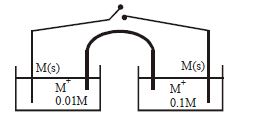
The initial $EMF$ of the concentration cell shown in the figure at $298 \ K$ is .............. $V$.
A
$-0.059$
B
$0.059$
C
$0.59$
D
$0.0059$
Solution
(B) This is a concentration cell where the same electrode $M(s)|M^+(aq)$ is used in both half-cells.
For a concentration cell,the standard cell potential $E^0_{cell} = 0 \ V$.
The cell reaction is: $M(s) + M^+(0.1 \ M) \rightarrow M^+(0.01 \ M) + M(s)$.
Using the Nernst equation at $298 \ K$:
$E_{cell} = E^0_{cell} - \frac{0.0591}{n} \log \frac{[M^+]_{anode}}{[M^+]_{cathode}}$
Here,$n = 1$,$[M^+]_{anode} = 0.01 \ M$,and $[M^+]_{cathode} = 0.1 \ M$.
$E_{cell} = 0 - \frac{0.0591}{1} \log \frac{0.01}{0.1}$
$E_{cell} = -0.0591 \times \log(0.1)$
$E_{cell} = -0.0591 \times (-1) = 0.0591 \ V \approx 0.059 \ V$.
For a concentration cell,the standard cell potential $E^0_{cell} = 0 \ V$.
The cell reaction is: $M(s) + M^+(0.1 \ M) \rightarrow M^+(0.01 \ M) + M(s)$.
Using the Nernst equation at $298 \ K$:
$E_{cell} = E^0_{cell} - \frac{0.0591}{n} \log \frac{[M^+]_{anode}}{[M^+]_{cathode}}$
Here,$n = 1$,$[M^+]_{anode} = 0.01 \ M$,and $[M^+]_{cathode} = 0.1 \ M$.
$E_{cell} = 0 - \frac{0.0591}{1} \log \frac{0.01}{0.1}$
$E_{cell} = -0.0591 \times \log(0.1)$
$E_{cell} = -0.0591 \times (-1) = 0.0591 \ V \approx 0.059 \ V$.
0 likes
View Solution91
MediumMCQ
The $EMF$ of the cell $M | M^{n+} (0.02 \, M) || H^{+} (1 \, M) | H_{2(g)} (1 \, atm), Pt$ at $25 \, ^\circ C$ is $0.81 \, V$. Calculate the valency of the metal $(n)$ if the standard oxidation potential of the metal is $0.76 \, V$. (Use $\frac{2.303 \, RT}{F} = 0.06, \log \, 2 = 0.3$)
A
$1$
B
$2$
C
$3$
D
$4$
Solution
(B) The cell reaction is: $M + nH^{+} \longrightarrow M^{n+} + \frac{n}{2} H_{2}$.
The standard cell potential $E^{\circ}_{cell} = E^{\circ}_{ox}(M) + E^{\circ}_{red}(H^{+}/H_{2}) = 0.76 \, V + 0 \, V = 0.76 \, V$.
Using the Nernst equation: $E_{cell} = E^{\circ}_{cell} - \frac{0.06}{n} \log \frac{[M^{n+}]}{[H^{+}]^{n}}$.
Given $E_{cell} = 0.81 \, V$,$[M^{n+}] = 0.02 \, M$,and $[H^{+}] = 1 \, M$:
$0.81 = 0.76 - \frac{0.06}{n} \log \frac{0.02}{(1)^{n}}$.
$0.05 = -\frac{0.06}{n} \log (2 \times 10^{-2})$.
$0.05 = -\frac{0.06}{n} (\log 2 + \log 10^{-2}) = -\frac{0.06}{n} (0.3 - 2) = -\frac{0.06}{n} (-1.7)$.
$0.05 = \frac{0.102}{n} \implies n = \frac{0.102}{0.05} \approx 2$.
The standard cell potential $E^{\circ}_{cell} = E^{\circ}_{ox}(M) + E^{\circ}_{red}(H^{+}/H_{2}) = 0.76 \, V + 0 \, V = 0.76 \, V$.
Using the Nernst equation: $E_{cell} = E^{\circ}_{cell} - \frac{0.06}{n} \log \frac{[M^{n+}]}{[H^{+}]^{n}}$.
Given $E_{cell} = 0.81 \, V$,$[M^{n+}] = 0.02 \, M$,and $[H^{+}] = 1 \, M$:
$0.81 = 0.76 - \frac{0.06}{n} \log \frac{0.02}{(1)^{n}}$.
$0.05 = -\frac{0.06}{n} \log (2 \times 10^{-2})$.
$0.05 = -\frac{0.06}{n} (\log 2 + \log 10^{-2}) = -\frac{0.06}{n} (0.3 - 2) = -\frac{0.06}{n} (-1.7)$.
$0.05 = \frac{0.102}{n} \implies n = \frac{0.102}{0.05} \approx 2$.
0 likes
View Solution92
EasyMCQ
$A$ $Daniel$ cell is made at $25\,^oC$ by connecting $Zn/Zn^{2+} (0.1\ M, 1\ L)$ and $Cu/Cu^{2+} (0.9\ M, 1\ L)$ electrodes. The cell is discharged until its $emf$ reaches $1.10\ V$,then it is charged (reversing the discharge process) by passing $0.6\ F$ charge.
[Given: ${E^0}_{Zn^{2+}/Zn} = -0.76\ V, {E^0}_{Cu^{2+}/Cu} = 0.34\ V, \frac{2.303RT}{F} = 0.06, \log 2 = 0.30]$
Select the incorrect option.
[Given: ${E^0}_{Zn^{2+}/Zn} = -0.76\ V, {E^0}_{Cu^{2+}/Cu} = 0.34\ V, \frac{2.303RT}{F} = 0.06, \log 2 = 0.30]$
Select the incorrect option.
A
Concentration of $Zn^{2+}$ becomes $1\ M$ when $emf$ reaches $1.10\ V$.
B
Concentration of $Cu^{2+}$ becomes $0.5\ M$ when $emf$ reaches $1.10\ V$.
C
$emf$ of the cell just after charging is $1.118\ V$.
D
After charging,the concentration of $Cu^{2+}$ becomes $0.8\ M$.
Solution
(A) The cell reaction is $Zn(s) + Cu^{2+}(aq) \rightarrow Zn^{2+}(aq) + Cu(s)$.
$E^0_{cell} = E^0_{cathode} - E^0_{anode} = 0.34 - (-0.76) = 1.10\ V$.
At $emf = 1.10\ V$,$E_{cell} = E^0_{cell} - \frac{0.06}{2} \log \frac{[Zn^{2+}]}{[Cu^{2+}]} = 1.10\ V$.
This implies $\log \frac{[Zn^{2+}]}{[Cu^{2+}]} = 0$,so $[Zn^{2+}] = [Cu^{2+}]$.
Let $x$ be the amount of $Zn$ oxidized. $[Zn^{2+}] = 0.1 + x$ and $[Cu^{2+}] = 0.9 - x$.
$0.1 + x = 0.9 - x$ $\Rightarrow 2x = 0.8$ $\Rightarrow x = 0.4$.
So,$[Zn^{2+}] = 0.5\ M$ and $[Cu^{2+}] = 0.5\ M$. Option $A$ is incorrect as $[Zn^{2+}]$ becomes $0.5\ M$,not $1\ M$.
After charging with $0.6\ F$,$0.3\ mol$ of $Zn^{2+}$ is reduced to $Zn$ and $0.3\ mol$ of $Cu$ is oxidized to $Cu^{2+}$.
New $[Zn^{2+}] = 0.5 - 0.3 = 0.2\ M$ and $[Cu^{2+}] = 0.5 + 0.3 = 0.8\ M$.
$E_{cell} = 1.10 - 0.03 \log \frac{0.2}{0.8} = 1.10 - 0.03 \log(0.25) = 1.10 - 0.03(-0.6) = 1.10 + 0.018 = 1.118\ V$.
$E^0_{cell} = E^0_{cathode} - E^0_{anode} = 0.34 - (-0.76) = 1.10\ V$.
At $emf = 1.10\ V$,$E_{cell} = E^0_{cell} - \frac{0.06}{2} \log \frac{[Zn^{2+}]}{[Cu^{2+}]} = 1.10\ V$.
This implies $\log \frac{[Zn^{2+}]}{[Cu^{2+}]} = 0$,so $[Zn^{2+}] = [Cu^{2+}]$.
Let $x$ be the amount of $Zn$ oxidized. $[Zn^{2+}] = 0.1 + x$ and $[Cu^{2+}] = 0.9 - x$.
$0.1 + x = 0.9 - x$ $\Rightarrow 2x = 0.8$ $\Rightarrow x = 0.4$.
So,$[Zn^{2+}] = 0.5\ M$ and $[Cu^{2+}] = 0.5\ M$. Option $A$ is incorrect as $[Zn^{2+}]$ becomes $0.5\ M$,not $1\ M$.
After charging with $0.6\ F$,$0.3\ mol$ of $Zn^{2+}$ is reduced to $Zn$ and $0.3\ mol$ of $Cu$ is oxidized to $Cu^{2+}$.
New $[Zn^{2+}] = 0.5 - 0.3 = 0.2\ M$ and $[Cu^{2+}] = 0.5 + 0.3 = 0.8\ M$.
$E_{cell} = 1.10 - 0.03 \log \frac{0.2}{0.8} = 1.10 - 0.03 \log(0.25) = 1.10 - 0.03(-0.6) = 1.10 + 0.018 = 1.118\ V$.
0 likes
View Solution93
DifficultMCQ
$Pt_{(s)} | Fe^{+2}(10^{-2} \ M, aq), Fe^{+3}(10^{-3} \ M, aq) || MnO_4^-(10^{-3} \ M, aq), Mn^{+2}(10^{-2} \ M, aq) | Pt_{(s)}$
At $298 \ K$,$E^o_{cell}$ for the cell is $-2.31 \ V$. What will be the $E_{cell}$ at $pH = 1$? .......... $Volt$
At $298 \ K$,$E^o_{cell}$ for the cell is $-2.31 \ V$. What will be the $E_{cell}$ at $pH = 1$? .......... $Volt$
A
$-2.36$
B
$-2.26$
C
$-2.78$
D
$-1.837$
Solution
(A) The balanced cell reaction is: $10Fe^{+2} + 2MnO_4^- + 16H^{+} \to 2Mn^{+2} + 10Fe^{+3} + 8H_2O$
The number of electrons transferred $(n)$ is $10$.
The reaction quotient $Q$ is given by: $Q = \frac{[Mn^{+2}]^2 [Fe^{+3}]^{10}}{[Fe^{+2}]^{10} [MnO_4^-]^2 [H^{+}]^{16}}$
Given $[H^+] = 10^{-pH} = 10^{-1} \ M$. Substituting the values:
$Q = \frac{(10^{-2})^2 (10^{-3})^{10}}{(10^{-2})^{10} (10^{-3})^2 (10^{-1})^{16}} = \frac{10^{-4} \times 10^{-30}}{10^{-20} \times 10^{-6} \times 10^{-16}} = \frac{10^{-34}}{10^{-42}} = 10^8$
Using the Nernst equation: $E_{cell} = E^o_{cell} - \frac{0.0591}{n} \log(Q)$
$E_{cell} = -2.31 - \frac{0.0591}{10} \log(10^8)$
$E_{cell} = -2.31 - 0.00591 \times 8 = -2.31 - 0.04728 = -2.35728 \ V \approx -2.36 \ V$
The number of electrons transferred $(n)$ is $10$.
The reaction quotient $Q$ is given by: $Q = \frac{[Mn^{+2}]^2 [Fe^{+3}]^{10}}{[Fe^{+2}]^{10} [MnO_4^-]^2 [H^{+}]^{16}}$
Given $[H^+] = 10^{-pH} = 10^{-1} \ M$. Substituting the values:
$Q = \frac{(10^{-2})^2 (10^{-3})^{10}}{(10^{-2})^{10} (10^{-3})^2 (10^{-1})^{16}} = \frac{10^{-4} \times 10^{-30}}{10^{-20} \times 10^{-6} \times 10^{-16}} = \frac{10^{-34}}{10^{-42}} = 10^8$
Using the Nernst equation: $E_{cell} = E^o_{cell} - \frac{0.0591}{n} \log(Q)$
$E_{cell} = -2.31 - \frac{0.0591}{10} \log(10^8)$
$E_{cell} = -2.31 - 0.00591 \times 8 = -2.31 - 0.04728 = -2.35728 \ V \approx -2.36 \ V$
0 likes
View Solution94
DifficultMCQ
For the cell at $298 \ K$:
$Ag_{(s)} | AgBr_{(s)} | Br^{-}(0.01 \ M) || I^{-}(0.02 \ M) | AgI_{(s)} | Ag_{(s)}$
The correct information is:
[Given: $K_{sp}(AgBr) = 4 \times 10^{-13}$,$K_{sp}(AgI) = 8 \times 10^{-17}$,$\frac{2.303 \ RT}{F} = 0.06 \ V$,$\log 2 = 0.3$]
$Ag_{(s)} | AgBr_{(s)} | Br^{-}(0.01 \ M) || I^{-}(0.02 \ M) | AgI_{(s)} | Ag_{(s)}$
The correct information is:
[Given: $K_{sp}(AgBr) = 4 \times 10^{-13}$,$K_{sp}(AgI) = 8 \times 10^{-17}$,$\frac{2.303 \ RT}{F} = 0.06 \ V$,$\log 2 = 0.3$]
A
$E^o_{cell} = 0$
B
$E_{cell} = 0.018 \ V$
C
$K_{eq}$ for cell reaction $= 2 \times 10^{-4}$
D
$\Delta G^o$ for cell reaction $= -0.06 \times 96500 \times 3.7 \ J$
Solution
(B) The cell reaction is: $AgBr_{(s)} + I^-_{(aq)} \rightleftharpoons AgI_{(s)} + Br^-_{(aq)}$
The equilibrium constant $K_{eq}$ is given by: $K_{eq} = \frac{K_{sp}(AgBr)}{K_{sp}(AgI)} = \frac{4 \times 10^{-13}}{8 \times 10^{-17}} = 0.5 \times 10^4 = 5000$.
$E^o_{cell} = \frac{0.06}{1} \log K_{eq} = 0.06 \times \log(5000) = 0.06 \times (3 + \log 5) = 0.06 \times (3 + 0.7) = 0.06 \times 3.7 = 0.222 \ V$.
Using the Nernst equation: $E_{cell} = E^o_{cell} - 0.06 \log \frac{[Br^-]}{[I^-]} = 0.222 - 0.06 \log \frac{0.01}{0.02} = 0.222 - 0.06 \log(0.5) = 0.222 - 0.06(-0.3) = 0.222 + 0.018 = 0.240 \ V$.
$\Delta G^o = -nFE^o_{cell} = -1 \times 96500 \times 0.222 \ J$.
The equilibrium constant $K_{eq}$ is given by: $K_{eq} = \frac{K_{sp}(AgBr)}{K_{sp}(AgI)} = \frac{4 \times 10^{-13}}{8 \times 10^{-17}} = 0.5 \times 10^4 = 5000$.
$E^o_{cell} = \frac{0.06}{1} \log K_{eq} = 0.06 \times \log(5000) = 0.06 \times (3 + \log 5) = 0.06 \times (3 + 0.7) = 0.06 \times 3.7 = 0.222 \ V$.
Using the Nernst equation: $E_{cell} = E^o_{cell} - 0.06 \log \frac{[Br^-]}{[I^-]} = 0.222 - 0.06 \log \frac{0.01}{0.02} = 0.222 - 0.06 \log(0.5) = 0.222 - 0.06(-0.3) = 0.222 + 0.018 = 0.240 \ V$.
$\Delta G^o = -nFE^o_{cell} = -1 \times 96500 \times 0.222 \ J$.
0 likes
View Solution95
MediumMCQ
What must be the concentration of $Ag^{+}$ in an aqueous solution containing $Cu^{2+} = 1.0 \ M$ so that both the metals can be deposited on the cathode simultaneously? Given that $E^0_{Cu^{2+}/Cu} = 0.34 \ V$ and $E^0_{Ag^{+}/Ag} = 0.812 \ V$ at $T = 298 \ K$.
A
nearly $10^{-19} \ M$
B
nearly $10^{-12} \ M$
C
nearly $10^{-8} \ M$
D
nearly $10^{-16} \ M$
Solution
(C) For simultaneous deposition,the reduction potentials of both ions must be equal at the cathode.
Using the Nernst equation for both half-reactions:
$E_{Cu^{2+}/Cu} = E^0_{Cu^{2+}/Cu} + \frac{0.0591}{2} \log [Cu^{2+}]$
$E_{Ag^{+}/Ag} = E^0_{Ag^{+}/Ag} + 0.0591 \log [Ag^{+}]$
Equating the two potentials:
$0.34 + \frac{0.0591}{2} \log(1.0) = 0.812 + 0.0591 \log [Ag^{+}]$
Since $\log(1.0) = 0$,the equation becomes:
$0.34 = 0.812 + 0.0591 \log [Ag^{+}]$
$0.0591 \log [Ag^{+}] = 0.34 - 0.812 = -0.472$
$\log [Ag^{+}] = \frac{-0.472}{0.0591} \approx -7.986 \approx -8$
$[Ag^{+}] = 10^{-8} \ M$
Using the Nernst equation for both half-reactions:
$E_{Cu^{2+}/Cu} = E^0_{Cu^{2+}/Cu} + \frac{0.0591}{2} \log [Cu^{2+}]$
$E_{Ag^{+}/Ag} = E^0_{Ag^{+}/Ag} + 0.0591 \log [Ag^{+}]$
Equating the two potentials:
$0.34 + \frac{0.0591}{2} \log(1.0) = 0.812 + 0.0591 \log [Ag^{+}]$
Since $\log(1.0) = 0$,the equation becomes:
$0.34 = 0.812 + 0.0591 \log [Ag^{+}]$
$0.0591 \log [Ag^{+}] = 0.34 - 0.812 = -0.472$
$\log [Ag^{+}] = \frac{-0.472}{0.0591} \approx -7.986 \approx -8$
$[Ag^{+}] = 10^{-8} \ M$
0 likes
View Solution96
EasyMCQ
Consider a Daniell cell operating under non-standard state conditions. Suppose that the cell's reaction is multiplied by $2$. Which of the following will double its initial value?
A
$E_{cell}$
B
$E_{cell}^0$
C
$Q$
D
$ln\ Q$
Solution
(D) The cell reaction for a Daniell cell is $Zn(s) + Cu^{2+}(aq) \rightarrow Zn^{2+}(aq) + Cu(s)$.
If the reaction is multiplied by $2$,it becomes $2Zn(s) + 2Cu^{2+}(aq) \rightarrow 2Zn^{2+}(aq) + 2Cu(s)$.
The Nernst equation is $E_{cell} = E_{cell}^0 - \frac{RT}{nF} \ln Q$.
For the original reaction,$n=2$ and $Q = \frac{[Zn^{2+}]}{[Cu^{2+}]}$.
For the multiplied reaction,$n'=4$ and $Q' = \frac{[Zn^{2+}]^2}{[Cu^{2+}]^2} = Q^2$.
Substituting into the Nernst equation: $E'_{cell} = E_{cell}^0 - \frac{RT}{4F} \ln(Q^2) = E_{cell}^0 - \frac{RT}{4F} (2 \ln Q) = E_{cell}^0 - \frac{RT}{2F} \ln Q = E_{cell}$.
Thus,$E_{cell}$ and $E_{cell}^0$ remain unchanged.
However,$\ln Q' = \ln(Q^2) = 2 \ln Q$. Therefore,the value of $\ln Q$ doubles.
If the reaction is multiplied by $2$,it becomes $2Zn(s) + 2Cu^{2+}(aq) \rightarrow 2Zn^{2+}(aq) + 2Cu(s)$.
The Nernst equation is $E_{cell} = E_{cell}^0 - \frac{RT}{nF} \ln Q$.
For the original reaction,$n=2$ and $Q = \frac{[Zn^{2+}]}{[Cu^{2+}]}$.
For the multiplied reaction,$n'=4$ and $Q' = \frac{[Zn^{2+}]^2}{[Cu^{2+}]^2} = Q^2$.
Substituting into the Nernst equation: $E'_{cell} = E_{cell}^0 - \frac{RT}{4F} \ln(Q^2) = E_{cell}^0 - \frac{RT}{4F} (2 \ln Q) = E_{cell}^0 - \frac{RT}{2F} \ln Q = E_{cell}$.
Thus,$E_{cell}$ and $E_{cell}^0$ remain unchanged.
However,$\ln Q' = \ln(Q^2) = 2 \ln Q$. Therefore,the value of $\ln Q$ doubles.
0 likes
View Solution97
MediumMCQ
By how much will the potential of the half-cell $Cu^{2+}/Cu$ change if the solution is diluted to $100$ times at $298 \ K$?
A
Increases by $59 \ mV$
B
Decreases by $59 \ mV$
C
Increases by $29.5 \ mV$
D
Decreases by $29.5 \ mV$
Solution
(B) The Nernst equation for the half-cell $Cu^{2+} + 2e^- \rightarrow Cu$ is:
$E = E^0 - \frac{0.0591}{2} \log \frac{1}{[Cu^{2+}]}$
After dilution to $100$ times,the concentration $[Cu^{2+}]$ becomes $\frac{[Cu^{2+}]}{100}$.
New potential $E' = E^0 - \frac{0.0591}{2} \log \frac{1}{[Cu^{2+}]/100} = E^0 - \frac{0.0591}{2} (\log \frac{1}{[Cu^{2+}]} + \log 100)$
$E' = E - \frac{0.0591}{2} \times 2 = E - 0.0591 \ V = E - 59 \ mV$.
Therefore,the potential decreases by $59 \ mV$.
$E = E^0 - \frac{0.0591}{2} \log \frac{1}{[Cu^{2+}]}$
After dilution to $100$ times,the concentration $[Cu^{2+}]$ becomes $\frac{[Cu^{2+}]}{100}$.
New potential $E' = E^0 - \frac{0.0591}{2} \log \frac{1}{[Cu^{2+}]/100} = E^0 - \frac{0.0591}{2} (\log \frac{1}{[Cu^{2+}]} + \log 100)$
$E' = E - \frac{0.0591}{2} \times 2 = E - 0.0591 \ V = E - 59 \ mV$.
Therefore,the potential decreases by $59 \ mV$.
0 likes
View Solution98
MediumMCQ
Consider the cell $Pt | H_2(P_1 \ atm) | H^{+}(X_1 \ M) || H^{+}(X_2 \ M) | H_2(P_2 \ atm) | Pt$. The cell reaction will be spontaneous if
A
$P_1 = P_2$ and $X_1 > X_2$
B
$P_1 = P_2$ and $X_1 = X_2$
C
$X_1 = X_2$ and $P_1 > P_2$
D
$X_1 = X_2$ and $P_1 < P_2$
Solution
(C) The cell reaction is: $H_2(P_1) + 2H^{+}(X_2) \rightarrow 2H^{+}(X_1) + H_2(P_2)$.
Using the Nernst equation for the cell potential $E_{cell}$:
$E_{cell} = E^0_{cell} - \frac{0.0591}{2} \log \frac{[H^{+}]^2_{X_1} \cdot P_2}{[H^{+}]^2_{X_2} \cdot P_1}$.
Since $E^0_{cell} = 0$ for a concentration cell,$E_{cell} = -0.02955 \log \frac{X_1^2 \cdot P_2}{X_2^2 \cdot P_1}$.
For the reaction to be spontaneous,$E_{cell} > 0$,which implies $\log \frac{X_1^2 \cdot P_2}{X_2^2 \cdot P_1} < 0$.
This means $\frac{X_1^2 \cdot P_2}{X_2^2 \cdot P_1} < 1$,or $\frac{X_1^2}{X_2^2} < \frac{P_1}{P_2}$.
If $X_1 = X_2$,then $1 < \frac{P_1}{P_2}$,which implies $P_2 < P_1$ or $P_1 > P_2$.
Using the Nernst equation for the cell potential $E_{cell}$:
$E_{cell} = E^0_{cell} - \frac{0.0591}{2} \log \frac{[H^{+}]^2_{X_1} \cdot P_2}{[H^{+}]^2_{X_2} \cdot P_1}$.
Since $E^0_{cell} = 0$ for a concentration cell,$E_{cell} = -0.02955 \log \frac{X_1^2 \cdot P_2}{X_2^2 \cdot P_1}$.
For the reaction to be spontaneous,$E_{cell} > 0$,which implies $\log \frac{X_1^2 \cdot P_2}{X_2^2 \cdot P_1} < 0$.
This means $\frac{X_1^2 \cdot P_2}{X_2^2 \cdot P_1} < 1$,or $\frac{X_1^2}{X_2^2} < \frac{P_1}{P_2}$.
If $X_1 = X_2$,then $1 < \frac{P_1}{P_2}$,which implies $P_2 < P_1$ or $P_1 > P_2$.
0 likes
View Solution99
DifficultMCQ
The half-cell reaction involving the quinhydrone electrode is shown below:
$HO-C_6H_4-OH_{(aq)} \rightleftharpoons O=C_6H_4=O_{(aq)} + 2H^+ + 2e^-$
If $E_{op}^o$ for this electrode is $1.30 \ V$,then what will be the oxidation electrode potential at $pH = 3$? ............ $V$
$HO-C_6H_4-OH_{(aq)} \rightleftharpoons O=C_6H_4=O_{(aq)} + 2H^+ + 2e^-$
If $E_{op}^o$ for this electrode is $1.30 \ V$,then what will be the oxidation electrode potential at $pH = 3$? ............ $V$
A
$1.48$
B
$1.20$
C
$1.10$
D
$1.05$
Solution
(A) The oxidation half-cell reaction is: $Hydroquinone \rightleftharpoons Quinone + 2H^+ + 2e^-$
Using the Nernst equation for the oxidation potential $(E_{op})$:
$E_{op} = E_{op}^o - \frac{0.059}{n} \log_{10} Q$
Here,$n = 2$ and $Q = [H^+]^2$ (assuming the ratio of quinone to hydroquinone is $1$ in quinhydrone electrode).
$E_{op} = E_{op}^o - \frac{0.059}{2} \log_{10} [H^+]^2$
$E_{op} = E_{op}^o - 0.059 \log_{10} [H^+]$
Since $pH = -\log_{10} [H^+]$,we have:
$E_{op} = E_{op}^o + 0.059 \times pH$
Given $E_{op}^o = 1.30 \ V$ and $pH = 3$:
$E_{op} = 1.30 + 0.059 \times 3$
$E_{op} = 1.30 + 0.177$
$E_{op} = 1.477 \ V \approx 1.48 \ V$
Using the Nernst equation for the oxidation potential $(E_{op})$:
$E_{op} = E_{op}^o - \frac{0.059}{n} \log_{10} Q$
Here,$n = 2$ and $Q = [H^+]^2$ (assuming the ratio of quinone to hydroquinone is $1$ in quinhydrone electrode).
$E_{op} = E_{op}^o - \frac{0.059}{2} \log_{10} [H^+]^2$
$E_{op} = E_{op}^o - 0.059 \log_{10} [H^+]$
Since $pH = -\log_{10} [H^+]$,we have:
$E_{op} = E_{op}^o + 0.059 \times pH$
Given $E_{op}^o = 1.30 \ V$ and $pH = 3$:
$E_{op} = 1.30 + 0.059 \times 3$
$E_{op} = 1.30 + 0.177$
$E_{op} = 1.477 \ V \approx 1.48 \ V$
0 likes
View SolutionElectrochemistry — Nernst equation and ECS · Frequently Asked Questions
1Are these Electrochemistry questions useful for JEE and NEET?
Yes. All questions in this section are mapped to JEE Main and NEET exam patterns. Previous year questions from JEE Main, NEET, GUJCET and state-level exams are included with full solutions.
2Can I switch to Hindi or Gujarati for these questions?
Yes. Use the language tabs in the hero section or the sidebar to view the same questions and solutions in English, Hindi or Gujarati.
3How do I generate a question paper from this subtopic?
Use the Vedclass Exam Paper Generator — select the chapter and subtopic, set difficulty, and generate Sets A, B, C, D automatically. First 3 chapters of every subject are free.
Vedclass Products
For Students
Vedclass Test Series
Mock tests in real JEE/NEET style with performance analysis. 5-day free trial.
Start Free TrialFor Teachers
Exam Paper Generator
Generate Set A/B/C/D papers from this chapter in 2 minutes. 3 chapters free.
Try FreeFor Institutes
Online Exam Module
Live online exams with unlimited students, 360° analytics & white-label branding.
See DemoFor Teachers & Institutes
Generate a Electrochemistry Exam Paper in 2 Minutes
Select subtopic & difficulty — Sets A, B, C, D auto-generated with No Repeat logic.
First 3 chapters of every subject are free — no payment required.