
A English
Mix Examples-Electrochemistry Questions in English
Class 12 Chemistry · Electrochemistry · Mix Examples-Electrochemistry
123+
Questions
English
Language
100%
With Solutions
Showing 20 of 123 questions in English
101
MediumMCQ
The standard reduction potentials of $2H^{+}/H_2$,$Cu^{2+}/Cu$,$Zn^{2+}/Zn$,and $NO_3^{-}, H^{+}/NO$ are $0.0 \ V$,$0.34 \ V$,$-0.76 \ V$,and $0.97 \ V$ respectively. Observe the following reactions:
$I$. $Zn + HCl \rightarrow$
$II$. $Cu + HCl \rightarrow$
$III$. $Cu + HNO_3 \rightarrow$
Which reactions do not liberate $H_{2(g)}$?
$I$. $Zn + HCl \rightarrow$
$II$. $Cu + HCl \rightarrow$
$III$. $Cu + HNO_3 \rightarrow$
Which reactions do not liberate $H_{2(g)}$?
A
$II, III$ only
B
$I, II$ only
C
$I, III$ only
D
$I, II, III$
Solution
(A) metal can liberate $H_2$ gas from an acid if its standard reduction potential is lower than that of $H^{+}/H_2$ $(0.0 \ V)$.
$I$. $Zn$ $(E^{\circ} = -0.76 \ V)$ reacts with $HCl$ to liberate $H_2$ gas because $-0.76 \ V < 0.0 \ V$.
$II$. $Cu$ $(E^{\circ} = 0.34 \ V)$ does not react with $HCl$ because its reduction potential is higher than $0.0 \ V$.
$III$. $Cu$ reacts with $HNO_3$ to produce $NO$ gas instead of $H_2$ gas because $NO_3^{-}$ is a stronger oxidizing agent than $H^{+}$.
Therefore,reactions $II$ and $III$ do not liberate $H_{2(g)}$.
$I$. $Zn$ $(E^{\circ} = -0.76 \ V)$ reacts with $HCl$ to liberate $H_2$ gas because $-0.76 \ V < 0.0 \ V$.
$II$. $Cu$ $(E^{\circ} = 0.34 \ V)$ does not react with $HCl$ because its reduction potential is higher than $0.0 \ V$.
$III$. $Cu$ reacts with $HNO_3$ to produce $NO$ gas instead of $H_2$ gas because $NO_3^{-}$ is a stronger oxidizing agent than $H^{+}$.
Therefore,reactions $II$ and $III$ do not liberate $H_{2(g)}$.
0 likes
View Solution102
MediumMCQ
The standard reduction potentials of $2H^{+}/H_2$,$Cu^{2+}/Cu$,$Zn^{2+}/Zn$ and $NO_3^{-}, H^{+}/NO$ are $0.0$,$0.34$,$-0.76$ and $0.97 \ V$ respectively. Identify the correct statements from the following:
$I.$ $H^{+}$ does not oxidize $Cu$ to $Cu^{2+}$
$II.$ $Zn$ reduces $Cu^{2+}$ to $Cu$
$III.$ $NO_3^{-}$ oxidizes $Cu$ to $Cu^{2+}$
$I.$ $H^{+}$ does not oxidize $Cu$ to $Cu^{2+}$
$II.$ $Zn$ reduces $Cu^{2+}$ to $Cu$
$III.$ $NO_3^{-}$ oxidizes $Cu$ to $Cu^{2+}$
A
$I, II$ only
B
$I, II, III$
C
$I, III$ only
D
$II, III$ only
Solution
(B) substance with a lower (more negative) standard reduction potential acts as a stronger reducing agent. Conversely,a substance with a higher (more positive) standard reduction potential acts as a stronger oxidizing agent.
$I.$ Since $E^{\circ}_{Cu^{2+}/Cu} (0.34 \ V) > E^{\circ}_{2H^{+}/H_2} (0.0 \ V)$,$H^{+}$ cannot oxidize $Cu$ to $Cu^{2+}$. Statement $I$ is correct.
$II.$ Since $E^{\circ}_{Zn^{2+}/Zn} (-0.76 \ V) < E^{\circ}_{Cu^{2+}/Cu} (0.34 \ V)$,$Zn$ acts as a stronger reducing agent and can reduce $Cu^{2+}$ to $Cu$. Statement $II$ is correct.
$III.$ Since $E^{\circ}_{NO_3^{-}, H^{+}/NO} (0.97 \ V) > E^{\circ}_{Cu^{2+}/Cu} (0.34 \ V)$,$NO_3^{-}$ can oxidize $Cu$ to $Cu^{2+}$. Statement $III$ is correct.
Therefore,all statements $I, II,$ and $III$ are correct.
| $Zn^{2+}/Zn$ | $-0.76 \ V$ |
| $2H^{+}/H_2$ | $0.00 \ V$ |
| $Cu^{2+}/Cu$ | $0.34 \ V$ |
| $NO_3^{-}, H^{+}/NO$ | $0.97 \ V$ |
$I.$ Since $E^{\circ}_{Cu^{2+}/Cu} (0.34 \ V) > E^{\circ}_{2H^{+}/H_2} (0.0 \ V)$,$H^{+}$ cannot oxidize $Cu$ to $Cu^{2+}$. Statement $I$ is correct.
$II.$ Since $E^{\circ}_{Zn^{2+}/Zn} (-0.76 \ V) < E^{\circ}_{Cu^{2+}/Cu} (0.34 \ V)$,$Zn$ acts as a stronger reducing agent and can reduce $Cu^{2+}$ to $Cu$. Statement $II$ is correct.
$III.$ Since $E^{\circ}_{NO_3^{-}, H^{+}/NO} (0.97 \ V) > E^{\circ}_{Cu^{2+}/Cu} (0.34 \ V)$,$NO_3^{-}$ can oxidize $Cu$ to $Cu^{2+}$. Statement $III$ is correct.
Therefore,all statements $I, II,$ and $III$ are correct.
0 likes
View Solution103
MediumMCQ
Consider the cell reaction at $300 \ K$: $A_{(s)} + B^{2+}_{(aq)} \rightleftharpoons A^{2+}_{(aq)} + B_{(s)}$. Its $E^{\circ}$ is $1.0 \ V$. The $\Delta_{r}H^{\circ}$ of the reaction is $-163 \ kJ \ mol^{-1}$. What is $\Delta_{r}S^{\circ}$ (in $J \ K^{-1} \ mol^{-1}$) of the reaction? $(F = 96500 \ C \ mol^{-1})$
A
$10$
B
$100$
C
$1000$
D
$10000$
Solution
(B) Given: $n = 2$,$T = 300 \ K$,$E^{\circ} = 1.0 \ V$,$\Delta_{r}H^{\circ} = -163 \ kJ \ mol^{-1}$.
Using the relation $\Delta G^{\circ} = -nFE^{\circ}$:
$\Delta G^{\circ} = -2 \times 96500 \times 1.0 \ J \ mol^{-1} = -193000 \ J \ mol^{-1} = -193 \ kJ \ mol^{-1}$.
We know that $\Delta G^{\circ} = \Delta H^{\circ} - T\Delta S^{\circ}$.
Rearranging for $\Delta S^{\circ}$: $\Delta S^{\circ} = \frac{\Delta H^{\circ} - \Delta G^{\circ}}{T}$.
Substituting the values: $\Delta S^{\circ} = \frac{-163 - (-193)}{300} \ kJ \ K^{-1} \ mol^{-1} = \frac{30}{300} \ kJ \ K^{-1} \ mol^{-1} = 0.1 \ kJ \ K^{-1} \ mol^{-1}$.
Converting to $J \ K^{-1} \ mol^{-1}$: $\Delta S^{\circ} = 0.1 \times 1000 \ J \ K^{-1} \ mol^{-1} = 100 \ J \ K^{-1} \ mol^{-1}$.
Using the relation $\Delta G^{\circ} = -nFE^{\circ}$:
$\Delta G^{\circ} = -2 \times 96500 \times 1.0 \ J \ mol^{-1} = -193000 \ J \ mol^{-1} = -193 \ kJ \ mol^{-1}$.
We know that $\Delta G^{\circ} = \Delta H^{\circ} - T\Delta S^{\circ}$.
Rearranging for $\Delta S^{\circ}$: $\Delta S^{\circ} = \frac{\Delta H^{\circ} - \Delta G^{\circ}}{T}$.
Substituting the values: $\Delta S^{\circ} = \frac{-163 - (-193)}{300} \ kJ \ K^{-1} \ mol^{-1} = \frac{30}{300} \ kJ \ K^{-1} \ mol^{-1} = 0.1 \ kJ \ K^{-1} \ mol^{-1}$.
Converting to $J \ K^{-1} \ mol^{-1}$: $\Delta S^{\circ} = 0.1 \times 1000 \ J \ K^{-1} \ mol^{-1} = 100 \ J \ K^{-1} \ mol^{-1}$.
0 likes
View Solution104
MediumMCQ
At $300 \ K$,the $E_{cell}^{\circ}$ of $A_{(s)} + B^{2+}_{(aq)} \rightleftharpoons A^{2+}_{(aq)} + B_{(s)}$ is $1.0 \ V$. If $\Delta_r S^{\circ}$ of this reaction is $100 \ J \ K^{-1} \ mol^{-1}$,what is $\Delta_r H^{\circ}$ (in $kJ \ mol^{-1}$) of this reaction? $(F = 96500 \ C \ mol^{-1})$
A
$-163$
B
$-223$
C
$-193$
D
$-163000$
Solution
(A) Given: $\Delta_r S^{\circ} = 100 \ J \ K^{-1} \ mol^{-1}$,$E_{cell}^{\circ} = 1.0 \ V$,$n = 2$,$T = 300 \ K$,$F = 96500 \ C \ mol^{-1}$.
Using the relation $\Delta G^{\circ} = -nFE_{cell}^{\circ}$:
$\Delta G^{\circ} = -2 \times 96500 \times 1 = -193000 \ J \ mol^{-1} = -193 \ kJ \ mol^{-1}$.
Using the Gibbs-Helmholtz equation: $\Delta G^{\circ} = \Delta H^{\circ} - T\Delta S^{\circ}$.
$\Delta H^{\circ} = \Delta G^{\circ} + T\Delta S^{\circ}$.
$\Delta H^{\circ} = -193 \ kJ \ mol^{-1} + (300 \ K \times 100 \ J \ K^{-1} \ mol^{-1}) / 1000$.
$\Delta H^{\circ} = -193 \ kJ \ mol^{-1} + 30 \ kJ \ mol^{-1} = -163 \ kJ \ mol^{-1}$.
Using the relation $\Delta G^{\circ} = -nFE_{cell}^{\circ}$:
$\Delta G^{\circ} = -2 \times 96500 \times 1 = -193000 \ J \ mol^{-1} = -193 \ kJ \ mol^{-1}$.
Using the Gibbs-Helmholtz equation: $\Delta G^{\circ} = \Delta H^{\circ} - T\Delta S^{\circ}$.
$\Delta H^{\circ} = \Delta G^{\circ} + T\Delta S^{\circ}$.
$\Delta H^{\circ} = -193 \ kJ \ mol^{-1} + (300 \ K \times 100 \ J \ K^{-1} \ mol^{-1}) / 1000$.
$\Delta H^{\circ} = -193 \ kJ \ mol^{-1} + 30 \ kJ \ mol^{-1} = -163 \ kJ \ mol^{-1}$.
0 likes
View Solution105
EasyMCQ
Which of the following statements is not correct?
A
Aqueous solution of $NaCl$ is an electrolyte
B
The units of electrochemical equivalent are $g/Coulomb$
C
In the Nernst equation,$n$ represents the number of electrons transferred in the electrode reaction
D
Standard reduction potential of hydrogen electrode is $0 \ V$
Solution
(NONE) The electrochemical equivalent $(Z)$ is defined by the relation $w = Z \cdot I \cdot t$,where $w$ is the mass in grams,$I$ is current in Amperes,and $t$ is time in seconds.
Since $1 \ Coulomb = 1 \ Ampere \cdot 1 \ second$,the unit of $Z$ is $g/Coulomb$.
All statements $A$,$B$,$C$,and $D$ are scientifically correct.
However,if this is a multiple-choice question where one must be incorrect,there might be a context-specific error. Given the standard definitions:
$A$ is correct as $NaCl$ dissociates into ions.
$B$ is correct as $Z = w / (I \cdot t)$.
$C$ is correct as $n$ is the stoichiometric coefficient of electrons.
$D$ is correct by $IUPAC$ convention.
Since all are correct,the question is technically flawed.
Since $1 \ Coulomb = 1 \ Ampere \cdot 1 \ second$,the unit of $Z$ is $g/Coulomb$.
All statements $A$,$B$,$C$,and $D$ are scientifically correct.
However,if this is a multiple-choice question where one must be incorrect,there might be a context-specific error. Given the standard definitions:
$A$ is correct as $NaCl$ dissociates into ions.
$B$ is correct as $Z = w / (I \cdot t)$.
$C$ is correct as $n$ is the stoichiometric coefficient of electrons.
$D$ is correct by $IUPAC$ convention.
Since all are correct,the question is technically flawed.
0 likes
View Solution106
EasyMCQ
Match the entries from Column $I$ and Column $II$ and choose the correct order.
| $A$. Leclanche cell | $1$. Converts energy of combustion into electrical energy |
| $B$. Fuel cell | $2$. Rechargeable cell |
| $C$. Ni-Cd cell | $3$. At anode,$Zn \longrightarrow Zn^{2+} + 2e^{-}$ |
A
$A-3, B-1, C-2$
B
$A-1, B-2, C-3$
C
$A-3, B-2, C-1$
D
$A-2, B-1, C-3$
Solution
(A) The correct matching is as follows:
$A$. Leclanche cell: The anode reaction is $Zn \longrightarrow Zn^{2+} + 2e^{-}$. Thus,$A-3$.
$B$. Fuel cell: It converts the energy of combustion of fuels like $H_2$ directly into electrical energy. Thus,$B-1$.
$C$. Ni-Cd cell: It is a rechargeable (secondary) cell. Thus,$C-2$.
Therefore,the correct sequence is $A-3, B-1, C-2$.
$A$. Leclanche cell: The anode reaction is $Zn \longrightarrow Zn^{2+} + 2e^{-}$. Thus,$A-3$.
$B$. Fuel cell: It converts the energy of combustion of fuels like $H_2$ directly into electrical energy. Thus,$B-1$.
$C$. Ni-Cd cell: It is a rechargeable (secondary) cell. Thus,$C-2$.
Therefore,the correct sequence is $A-3, B-1, C-2$.
0 likes
View Solution107
MediumMCQ
The molar conductivity of $0.027 \ M$ methanoic acid is $40.42 \ S \ cm^2 \ mol^{-1}$. The value of dissociation constant of this acid is
(Given $\lambda_{H^{+}}^{\circ} = 349.6 \ S \ cm^2 \ mol^{-1}$ and $\lambda_{HCOO^{-}}^{\circ} = 54.6 \ S \ cm^2 \ mol^{-1}$)
(Given $\lambda_{H^{+}}^{\circ} = 349.6 \ S \ cm^2 \ mol^{-1}$ and $\lambda_{HCOO^{-}}^{\circ} = 54.6 \ S \ cm^2 \ mol^{-1}$)
A
$1.5 \times 10^{-5}$
B
$6.0 \times 10^{-5}$
C
$4.5 \times 10^{-4}$
D
$3.0 \times 10^{-4}$
Solution
(D) First,calculate the limiting molar conductivity of methanoic acid $(HCOOH)$:
$\Lambda_{m}^{\circ}(HCOOH) = \lambda_{H^{+}}^0 + \lambda_{HCOO^{-}}^0 = 349.6 + 54.6 = 404.2 \ S \ cm^2 \ mol^{-1}$
Next,calculate the degree of dissociation $(\alpha)$:
$\alpha = \frac{\Lambda_{m}}{\Lambda_{m}^0} = \frac{40.42}{404.2} = 0.1$
Finally,calculate the dissociation constant $(K_{a})$:
$K_{a} = \frac{C\alpha^2}{1-\alpha} = \frac{0.027 \times (0.1)^2}{1-0.1} = \frac{0.027 \times 0.01}{0.9} = \frac{0.00027}{0.9} = 3.0 \times 10^{-4}$
$\Lambda_{m}^{\circ}(HCOOH) = \lambda_{H^{+}}^0 + \lambda_{HCOO^{-}}^0 = 349.6 + 54.6 = 404.2 \ S \ cm^2 \ mol^{-1}$
Next,calculate the degree of dissociation $(\alpha)$:
$\alpha = \frac{\Lambda_{m}}{\Lambda_{m}^0} = \frac{40.42}{404.2} = 0.1$
Finally,calculate the dissociation constant $(K_{a})$:
$K_{a} = \frac{C\alpha^2}{1-\alpha} = \frac{0.027 \times (0.1)^2}{1-0.1} = \frac{0.027 \times 0.01}{0.9} = \frac{0.00027}{0.9} = 3.0 \times 10^{-4}$
0 likes
View Solution108
MediumMCQ
The conductivity of $0.01 \ M$ aqueous acetic acid measured with a conductivity cell of cell constant $0.5 \ cm^{-1}$ at $298 \ K$ is $3.12 \times 10^{-4} \ S$. If the limiting molar conductivities of $H^{+}$ and $CH_3COO^{-}$ at the same temperature are $349$ and $41 \ S \ cm^2 \ mol^{-1}$ respectively,the dissociation constant of acetic acid is
A
$1.67 \times 10^{-4}$
B
$1.67 \times 10^{-5}$
C
$1.67 \times 10^{-3}$
D
$1.67 \times 10^{-6}$
Solution
(B) Given: Cell constant $(G^*)$ = $0.5 \ cm^{-1}$,Conductance $(G)$ = $3.12 \times 10^{-4} \ S$,Concentration $(C)$ = $0.01 \ M$.
$\text{Conductivity } (\kappa) = G \times G^* = 3.12 \times 10^{-4} \ S \times 0.5 \ cm^{-1} = 1.56 \times 10^{-4} \ S \ cm^{-1}$.
$\text{Molar conductivity } (\Lambda_m) = \frac{\kappa \times 1000}{C} = \frac{1.56 \times 10^{-4} \times 1000}{0.01} = 15.6 \ S \ cm^2 \ mol^{-1}$.
$\text{Limiting molar conductivity } (\Lambda_m^\circ) = \lambda_m^\circ(H^+) + \lambda_m^\circ(CH_3COO^-) = 349 + 41 = 390 \ S \ cm^2 \ mol^{-1}$.
$\text{Degree of dissociation } (\alpha) = \frac{\Lambda_m}{\Lambda_m^\circ} = \frac{15.6}{390} = 0.04$.
$\text{Dissociation constant } (K_a) = \frac{C \alpha^2}{1 - \alpha} = \frac{0.01 \times (0.04)^2}{1 - 0.04} = \frac{0.01 \times 0.0016}{0.96} = \frac{1.6 \times 10^{-5}}{0.96} \approx 1.67 \times 10^{-5}$.
$\text{Conductivity } (\kappa) = G \times G^* = 3.12 \times 10^{-4} \ S \times 0.5 \ cm^{-1} = 1.56 \times 10^{-4} \ S \ cm^{-1}$.
$\text{Molar conductivity } (\Lambda_m) = \frac{\kappa \times 1000}{C} = \frac{1.56 \times 10^{-4} \times 1000}{0.01} = 15.6 \ S \ cm^2 \ mol^{-1}$.
$\text{Limiting molar conductivity } (\Lambda_m^\circ) = \lambda_m^\circ(H^+) + \lambda_m^\circ(CH_3COO^-) = 349 + 41 = 390 \ S \ cm^2 \ mol^{-1}$.
$\text{Degree of dissociation } (\alpha) = \frac{\Lambda_m}{\Lambda_m^\circ} = \frac{15.6}{390} = 0.04$.
$\text{Dissociation constant } (K_a) = \frac{C \alpha^2}{1 - \alpha} = \frac{0.01 \times (0.04)^2}{1 - 0.04} = \frac{0.01 \times 0.0016}{0.96} = \frac{1.6 \times 10^{-5}}{0.96} \approx 1.67 \times 10^{-5}$.
0 likes
View Solution109
MediumMCQ
At $T(K)$,the molar conductivity of $0.04 \ M$ acetic acid is $7.8 \ S \ cm^2 \ mol^{-1}$. If the limiting molar conductivities of $H^{+}$ and $CH_3COO^{-}$ at $T(K)$ are $349$ and $41 \ S \ cm^2 \ mol^{-1}$ respectively,the dissociation constant of acetic acid is
A
$1.63 \times 10^{-5}$
B
$8.33 \times 10^{-5}$
C
$1.63 \times 10^{-4}$
D
$8.33 \times 10^{-4}$
Solution
(A) The molar conductivity at infinite dilution for acetic acid is given by Kohlrausch's law: $\Lambda_m^0(CH_3COOH) = \lambda_m^0(H^+) + \lambda_m^0(CH_3COO^-) = 349 + 41 = 390 \ S \ cm^2 \ mol^{-1}$.
Degree of dissociation $\alpha = \frac{\Lambda_m^c}{\Lambda_m^0} = \frac{7.8}{390} = 0.02$.
The dissociation constant $K_a$ is given by $K_a = \frac{c \alpha^2}{1 - \alpha}$.
Given $c = 0.04 \ M$,$K_a = \frac{0.04 \times (0.02)^2}{1 - 0.02} = \frac{0.04 \times 0.0004}{0.98} = \frac{0.000016}{0.98} \approx 1.63 \times 10^{-5}$.
Degree of dissociation $\alpha = \frac{\Lambda_m^c}{\Lambda_m^0} = \frac{7.8}{390} = 0.02$.
The dissociation constant $K_a$ is given by $K_a = \frac{c \alpha^2}{1 - \alpha}$.
Given $c = 0.04 \ M$,$K_a = \frac{0.04 \times (0.02)^2}{1 - 0.02} = \frac{0.04 \times 0.0004}{0.98} = \frac{0.000016}{0.98} \approx 1.63 \times 10^{-5}$.
0 likes
View Solution110
DifficultMCQ
$100 \text{ mL}$ of $0.2 \text{ M}$ acetic acid is completely neutralized using a standard solution of $NaOH$. The volume of ethane obtained at $STP$ after complete electrolysis of the resulting solution is: (in $\text{ L}$)
A
$11.2$
B
$2.24$
C
$0.224$
D
$22.4$
Solution
(C) Moles of $CH_3COOH = 0.2 \text{ M} \times 0.1 \text{ L} = 0.02 \text{ mol}$.
Since $CH_3COOH$ is completely neutralized by $NaOH$, moles of $CH_3COONa$ formed $= 0.02 \text{ mol}$.
According to Kolbe's electrolysis reaction:
$2CH_3COONa + 2H_2O \rightarrow CH_3-CH_3 + 2CO_2 + H_2 + 2NaOH$.
From the stoichiometry, $2 \text{ moles}$ of $CH_3COONa$ produce $1 \text{ mole}$ of ethane $(C_2H_6)$.
Moles of $C_2H_6 = \frac{0.02}{2} = 0.01 \text{ mol}$.
Volume of $C_2H_6$ at $STP = 0.01 \text{ mol} \times 22.4 \text{ L/mol} = 0.224 \text{ L}$.
Since $CH_3COOH$ is completely neutralized by $NaOH$, moles of $CH_3COONa$ formed $= 0.02 \text{ mol}$.
According to Kolbe's electrolysis reaction:
$2CH_3COONa + 2H_2O \rightarrow CH_3-CH_3 + 2CO_2 + H_2 + 2NaOH$.
From the stoichiometry, $2 \text{ moles}$ of $CH_3COONa$ produce $1 \text{ mole}$ of ethane $(C_2H_6)$.
Moles of $C_2H_6 = \frac{0.02}{2} = 0.01 \text{ mol}$.
Volume of $C_2H_6$ at $STP = 0.01 \text{ mol} \times 22.4 \text{ L/mol} = 0.224 \text{ L}$.
0 likes
View Solution111
MediumMCQ
The standard Gibb's energy $(\Delta G^{\circ})$ for the following reaction is $A_{(s)} + B^{2+}_{(aq)} \rightleftharpoons A^{2+}_{(aq)} + B_{(s)}$,given $K_C = 10^{12}$ at $25^{\circ} C$ ($K_C$ is the equilibrium constant). (in $kJ$)
A
$-150$
B
$-96.80$
C
$-68.47$
D
$-100$
Solution
(C) The standard Gibb's free energy change $(\Delta G^{\circ})$ is calculated using the formula: $\Delta G^{\circ} = -RT \ln K_C = -2.303 RT \log K_C$.
Given: $R = 8.314 \ J \ mol^{-1} \ K^{-1}$,$T = 25 + 273 = 298 \ K$,and $K_C = 10^{12}$.
Substituting the values: $\Delta G^{\circ} = -2.303 \times 8.314 \times 298 \times \log(10^{12})$.
$\Delta G^{\circ} = -2.303 \times 8.314 \times 298 \times 12$.
$\Delta G^{\circ} = -68,470.18 \ J \ mol^{-1} = -68.47 \ kJ \ mol^{-1}$.
Given: $R = 8.314 \ J \ mol^{-1} \ K^{-1}$,$T = 25 + 273 = 298 \ K$,and $K_C = 10^{12}$.
Substituting the values: $\Delta G^{\circ} = -2.303 \times 8.314 \times 298 \times \log(10^{12})$.
$\Delta G^{\circ} = -2.303 \times 8.314 \times 298 \times 12$.
$\Delta G^{\circ} = -68,470.18 \ J \ mol^{-1} = -68.47 \ kJ \ mol^{-1}$.
0 likes
View Solution112
MediumMCQ
The molar conductivity of acetic acid solution at infinite dilution is $390 \ S \ cm^2 \ mol^{-1}$. What is the molar conductivity of $0.01 \ M$ acetic acid solution (in $S \ cm^2 \ mol^{-1}$)? (Given: $K_{a}(CH_3COOH) = 1.8 \times 10^{-5}$,assume $1-\alpha \approx 1$)
A
$10.64$
B
$16.54$
C
$51.64$
D
$15.64$
Solution
(B) The degree of dissociation $\alpha$ is given by the formula $\alpha = \sqrt{\frac{K_a}{C}}$.
Given $K_a = 1.8 \times 10^{-5}$ and $C = 0.01 \ M = 10^{-2} \ M$.
$\alpha = \sqrt{\frac{1.8 \times 10^{-5}}{10^{-2}}} = \sqrt{1.8 \times 10^{-3}} = \sqrt{18 \times 10^{-4}} = 4.24 \times 10^{-2} = 0.0424$.
The molar conductivity $\Lambda_m$ is related to the molar conductivity at infinite dilution $\Lambda_m^\circ$ by $\Lambda_m = \alpha \times \Lambda_m^\circ$.
$\Lambda_m = 0.0424 \times 390 \ S \ cm^2 \ mol^{-1} = 16.536 \ S \ cm^2 \ mol^{-1} \approx 16.54 \ S \ cm^2 \ mol^{-1}$.
Given $K_a = 1.8 \times 10^{-5}$ and $C = 0.01 \ M = 10^{-2} \ M$.
$\alpha = \sqrt{\frac{1.8 \times 10^{-5}}{10^{-2}}} = \sqrt{1.8 \times 10^{-3}} = \sqrt{18 \times 10^{-4}} = 4.24 \times 10^{-2} = 0.0424$.
The molar conductivity $\Lambda_m$ is related to the molar conductivity at infinite dilution $\Lambda_m^\circ$ by $\Lambda_m = \alpha \times \Lambda_m^\circ$.
$\Lambda_m = 0.0424 \times 390 \ S \ cm^2 \ mol^{-1} = 16.536 \ S \ cm^2 \ mol^{-1} \approx 16.54 \ S \ cm^2 \ mol^{-1}$.
0 likes
View Solution113
MediumMCQ
Identify the correct statements from the following:
$(A)$ At $298 \ K$,the potential of a hydrogen electrode placed in a solution of $pH = 10$ is $-0.59 \ V$.
$(B)$ The limiting molar conductivity of $Ca^{2+}$ and $Cl^{-}$ are $119$ and $76 \ S \ cm^2 \ mol^{-1}$ respectively. The limiting molar conductivity of $CaCl_2$ is $195 \ S \ cm^2 \ mol^{-1}$.
$(C)$ The correct relationship between $K_{c}$ and $E_{cell}^{0}$ is $E_{cell}^{0} = \frac{2.303 RT}{nF} \log K_{c}$.
$(A)$ At $298 \ K$,the potential of a hydrogen electrode placed in a solution of $pH = 10$ is $-0.59 \ V$.
$(B)$ The limiting molar conductivity of $Ca^{2+}$ and $Cl^{-}$ are $119$ and $76 \ S \ cm^2 \ mol^{-1}$ respectively. The limiting molar conductivity of $CaCl_2$ is $195 \ S \ cm^2 \ mol^{-1}$.
$(C)$ The correct relationship between $K_{c}$ and $E_{cell}^{0}$ is $E_{cell}^{0} = \frac{2.303 RT}{nF} \log K_{c}$.
A
$A, B, C$
B
$A, B$ only
C
$A, C$ only
D
$B, C$ only
Solution
(C) For a hydrogen electrode,$E = -0.0591 \times pH = -0.0591 \times 10 = -0.591 \ V$. Thus,statement $(A)$ is correct.
$(B)$ $\Lambda^{\circ}_{m}(CaCl_2) = \Lambda^{\circ}_{m}(Ca^{2+}) + 2 \times \Lambda^{\circ}_{m}(Cl^{-}) = 119 + 2(76) = 119 + 152 = 271 \ S \ cm^2 \ mol^{-1}$. Since $271 \neq 195$,statement $(B)$ is incorrect.
$(C)$ The Nernst equation at equilibrium is $E_{cell} = 0$,which gives $0 = E_{cell}^{0} - \frac{2.303 RT}{nF} \log K_{c}$,so $E_{cell}^{0} = \frac{2.303 RT}{nF} \log K_{c}$. Thus,statement $(C)$ is correct.
Therefore,statements $(A)$ and $(C)$ are correct.
$(B)$ $\Lambda^{\circ}_{m}(CaCl_2) = \Lambda^{\circ}_{m}(Ca^{2+}) + 2 \times \Lambda^{\circ}_{m}(Cl^{-}) = 119 + 2(76) = 119 + 152 = 271 \ S \ cm^2 \ mol^{-1}$. Since $271 \neq 195$,statement $(B)$ is incorrect.
$(C)$ The Nernst equation at equilibrium is $E_{cell} = 0$,which gives $0 = E_{cell}^{0} - \frac{2.303 RT}{nF} \log K_{c}$,so $E_{cell}^{0} = \frac{2.303 RT}{nF} \log K_{c}$. Thus,statement $(C)$ is correct.
Therefore,statements $(A)$ and $(C)$ are correct.
0 likes
View Solution114
MediumMCQ
$A$ and $B$ are two metals. The standard reduction potentials of $A^{+}_{(aq)} / A_{(s)}$ and $B^{+}_{(aq)} / B_{(s)}$ are $-0.5 \ V$ and $+0.5 \ V$ respectively. What is the $\log K_C$ value for the following reaction at $298 \ K$?
$A_{(s)} + B^{+}_{(aq)} \rightleftharpoons A^{+}_{(aq)} + B_{(s)}$
(Given: $\frac{2.303 RT}{F} = 0.06 \ V$)
$A_{(s)} + B^{+}_{(aq)} \rightleftharpoons A^{+}_{(aq)} + B_{(s)}$
(Given: $\frac{2.303 RT}{F} = 0.06 \ V$)
A
$\frac{6}{100}$
B
$\frac{100}{6}$
C
$\frac{1}{200}$
D
$\frac{200}{6}$
Solution
(B) The cell reaction is: $A_{(s)} + B^{+}_{(aq)} \rightleftharpoons A^{+}_{(aq)} + B_{(s)}$
Here,$A$ is oxidized to $A^{+}$ $(n=1)$ and $B^{+}$ is reduced to $B$.
$E^{\circ}_{cell} = E^{\circ}_{cathode} - E^{\circ}_{anode} = E^{\circ}_{B^{+}/B} - E^{\circ}_{A^{+}/A} = 0.5 - (-0.5) = 1.0 \ V$
Using the relation: $E^{\circ}_{cell} = \frac{0.06}{n} \log K_C$
Substituting the values: $1.0 = \frac{0.06}{1} \log K_C$
Therefore,$\log K_C = \frac{1.0}{0.06} = \frac{100}{6}$
Here,$A$ is oxidized to $A^{+}$ $(n=1)$ and $B^{+}$ is reduced to $B$.
$E^{\circ}_{cell} = E^{\circ}_{cathode} - E^{\circ}_{anode} = E^{\circ}_{B^{+}/B} - E^{\circ}_{A^{+}/A} = 0.5 - (-0.5) = 1.0 \ V$
Using the relation: $E^{\circ}_{cell} = \frac{0.06}{n} \log K_C$
Substituting the values: $1.0 = \frac{0.06}{1} \log K_C$
Therefore,$\log K_C = \frac{1.0}{0.06} = \frac{100}{6}$
0 likes
View Solution115
MediumMCQ
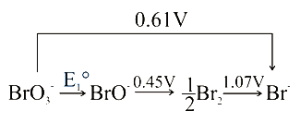
The value of $E_1^{\circ}$ is (in $V$)
A
$0.76$
B
$0.535$
C
$0.428$
D
$1.12$
Solution
(B) Given the Latimer diagram:
$BrO_3^{-}$ $\xrightarrow{E_1^{\circ}} BrO^{-}$ $\xrightarrow{0.45 \ V} \frac{1}{2} Br_2$ $\xrightarrow{1.07 \ V} Br^{-}$
And the overall potential $BrO_3^{-} \rightarrow Br^{-}$ is $0.61 \ V$.
We use the relation $\Delta G^{\circ} = -nFE^{\circ}$.
For the overall reaction $BrO_3^{-} \rightarrow Br^{-}$:
$n = 6$,so $\Delta G_{total}^{\circ} = -6F(0.61 \ V) = -3.66F$.
For the individual steps:
$1$. $BrO_3^{-} \rightarrow BrO^{-}$: $n = 4$,$\Delta G_1^{\circ} = -4FE_1^{\circ}$.
$2$. $BrO^{-} \rightarrow \frac{1}{2} Br_2$: $n = 1$,$\Delta G_2^{\circ} = -1F(0.45 \ V) = -0.45F$.
$3$. $\frac{1}{2} Br_2 \rightarrow Br^{-}$: $n = 1$,$\Delta G_3^{\circ} = -1F(1.07 \ V) = -1.07F$.
Summing the $\Delta G^{\circ}$ values:
$-3.66F = -4FE_1^{\circ} - 0.45F - 1.07F$
$-3.66 = -4E_1^{\circ} - 1.52$
$4E_1^{\circ} = 3.66 - 1.52$
$4E_1^{\circ} = 2.14$
$E_1^{\circ} = \frac{2.14}{4} = 0.535 \ V$.
$BrO_3^{-}$ $\xrightarrow{E_1^{\circ}} BrO^{-}$ $\xrightarrow{0.45 \ V} \frac{1}{2} Br_2$ $\xrightarrow{1.07 \ V} Br^{-}$
And the overall potential $BrO_3^{-} \rightarrow Br^{-}$ is $0.61 \ V$.
We use the relation $\Delta G^{\circ} = -nFE^{\circ}$.
For the overall reaction $BrO_3^{-} \rightarrow Br^{-}$:
$n = 6$,so $\Delta G_{total}^{\circ} = -6F(0.61 \ V) = -3.66F$.
For the individual steps:
$1$. $BrO_3^{-} \rightarrow BrO^{-}$: $n = 4$,$\Delta G_1^{\circ} = -4FE_1^{\circ}$.
$2$. $BrO^{-} \rightarrow \frac{1}{2} Br_2$: $n = 1$,$\Delta G_2^{\circ} = -1F(0.45 \ V) = -0.45F$.
$3$. $\frac{1}{2} Br_2 \rightarrow Br^{-}$: $n = 1$,$\Delta G_3^{\circ} = -1F(1.07 \ V) = -1.07F$.
Summing the $\Delta G^{\circ}$ values:
$-3.66F = -4FE_1^{\circ} - 0.45F - 1.07F$
$-3.66 = -4E_1^{\circ} - 1.52$
$4E_1^{\circ} = 3.66 - 1.52$
$4E_1^{\circ} = 2.14$
$E_1^{\circ} = \frac{2.14}{4} = 0.535 \ V$.
0 likes
View Solution116
Easy
Match the following:
$(a)$ $A-III, B-I, C-II, D-V$
$(b)$ $A-II, B-V, C-I, D-IV$
$(c)$ $A-III, B-IV, C-I, D-II$
$(d)$ $A-V, B-I, C-IV, D-II$
| List-$I$ | List-$II$ |
|---|---|
| $(A)$ Potential of hydrogen electrode at $pH = 10$ | $(I)$ $0.76 \ V$ |
| $(B)$ $Cu^{2+}|Cu$ | $(II)$ $0.059$ |
| $(C)$ $Zn|Zn^{2+}$ | $(III)$ $-0.591 \ V$ |
| $(D)$ $\frac{2.303RT}{F}$ | $(IV)$ $0.337 \ V$ |
| $(V)$ $-0.76 \ V$ |
$(a)$ $A-III, B-I, C-II, D-V$
$(b)$ $A-II, B-V, C-I, D-IV$
$(c)$ $A-III, B-IV, C-I, D-II$
$(d)$ $A-V, B-I, C-IV, D-II$
Solution
(C) For hydrogen electrode: $E = E^0 - 0.0591 \ pH = 0 - 0.0591 \times 10 = -0.591 \ V$. Thus,$A-III$.
$(B)$ Standard reduction potential of $Cu^{2+}|Cu$ is $0.337 \ V$. Thus,$B-IV$.
$(C)$ Standard oxidation potential of $Zn|Zn^{2+}$ is $0.76 \ V$. Thus,$C-I$.
$(D)$ The value of $\frac{2.303RT}{F}$ at $298 \ K$ is $0.059$. Thus,$D-II$.
The correct matching is $A-III, B-IV, C-I, D-II$,which corresponds to option $(c)$.
$(B)$ Standard reduction potential of $Cu^{2+}|Cu$ is $0.337 \ V$. Thus,$B-IV$.
$(C)$ Standard oxidation potential of $Zn|Zn^{2+}$ is $0.76 \ V$. Thus,$C-I$.
$(D)$ The value of $\frac{2.303RT}{F}$ at $298 \ K$ is $0.059$. Thus,$D-II$.
The correct matching is $A-III, B-IV, C-I, D-II$,which corresponds to option $(c)$.
0 likes
View Solution117
MediumMCQ
Which of the following is not correct?
A
Aqueous solution of $NaCl$ is an electrolyte
B
The units of electrochemical equivalent are $g \cdot Coulomb$
C
In the Nernst equation,$n$ represents the number of electrons transferred in the electrode reaction
D
Standard reduction potential of hydrogen electrode is $0 \ V$
Solution
(B) The unit of electrochemical equivalent $(Z)$ is $g/Coulomb$.
From Faraday's law,$w = Z \cdot I \cdot t$.
Therefore,$Z = \frac{w}{I \cdot t}$,which has units of $g/Coulomb$.
Thus,the statement in option $B$ is incorrect as it states the units are $g \cdot Coulomb$ instead of $g/Coulomb$.
From Faraday's law,$w = Z \cdot I \cdot t$.
Therefore,$Z = \frac{w}{I \cdot t}$,which has units of $g/Coulomb$.
Thus,the statement in option $B$ is incorrect as it states the units are $g \cdot Coulomb$ instead of $g/Coulomb$.
0 likes
View Solution118
MediumMCQ
At $300 \ K$,the conductivity of $0.01 \ mol \ dm^{-3}$ aqueous solution of acetic acid is $19.5 \times 10^{-5} \ S \ cm^{-1}$ and the limiting molar conductivity of acetic acid at the same temperature is $390 \ S \ cm^2 \ mol^{-1}$. The degree of dissociation of acetic acid is:
A
$5.0 \times 10^{-5}$
B
$5.0 \times 10^{-2}$
C
$2.5 \times 10^{-5}$
D
$7.5 \times 10^{-2}$
Solution
(B) The degree of dissociation $(\alpha)$ is given by the formula: $\alpha = \frac{\Lambda_m}{\Lambda_m^\circ}$
First,calculate the molar conductivity $(\Lambda_m)$ using the formula: $\Lambda_m = \frac{\kappa \times 1000}{C}$
Given: $\kappa = 19.5 \times 10^{-5} \ S \ cm^{-1}$ and $C = 0.01 \ mol \ L^{-1}$
$\Lambda_m = \frac{19.5 \times 10^{-5} \times 1000}{0.01} = 19.5 \ S \ cm^2 \ mol^{-1}$
Now,calculate $\alpha$:
$\alpha = \frac{19.5}{390} = 0.05 = 5.0 \times 10^{-2}$
First,calculate the molar conductivity $(\Lambda_m)$ using the formula: $\Lambda_m = \frac{\kappa \times 1000}{C}$
Given: $\kappa = 19.5 \times 10^{-5} \ S \ cm^{-1}$ and $C = 0.01 \ mol \ L^{-1}$
$\Lambda_m = \frac{19.5 \times 10^{-5} \times 1000}{0.01} = 19.5 \ S \ cm^2 \ mol^{-1}$
Now,calculate $\alpha$:
$\alpha = \frac{19.5}{390} = 0.05 = 5.0 \times 10^{-2}$
0 likes
View Solution119
DifficultMCQ
Consider the following data.
$BaSO_4$ is sparingly soluble in water. If the conductivity of the saturated $BaSO_4$ solution is $x\text{ S cm}^{-1}$,then the solubility product of $BaSO_4$ can be given as (Here $\Lambda_m = \Lambda_m^\circ$)
| Electrolyte | $\Lambda_m^\circ$ $(S\text{ cm}^2\text{ mol}^{-1})$ |
|---|---|
| $BaCl_2$ | $x_1$ |
| $H_2SO_4$ | $x_2$ |
| $HCl$ | $x_3$ |
$BaSO_4$ is sparingly soluble in water. If the conductivity of the saturated $BaSO_4$ solution is $x\text{ S cm}^{-1}$,then the solubility product of $BaSO_4$ can be given as (Here $\Lambda_m = \Lambda_m^\circ$)
A
$\frac{10^6 x^2}{(x_1 + x_2 - 2x_3)^2}$
B
$\frac{x^2}{(x_1 + x_2 - 2x_3)^2}$
C
$\frac{(x_1 + x_2 - 2x_3)^2}{10^6 x^2}$
D
$\frac{x^2}{(x_1 + x_2 + 2x_3)^2}$
Solution
(A) $1$. The molar conductivity of $BaSO_4$ at infinite dilution is $\Lambda_m^\circ (BaSO_4) = \Lambda_m^\circ(Ba^{2+}) + \Lambda_m^\circ(SO_4^{2-})$.
Using Kohlrausch's law:
$\Lambda_m^\circ(BaSO_4) = \Lambda_m^\circ(BaCl_2) + \Lambda_m^\circ(H_2SO_4) - 2\Lambda_m^\circ(HCl) = x_1 + x_2 - 2x_3$.
$2$. The solubility $S$ (in $\text{mol L}^{-1}$) is given by $S = \frac{1000 \cdot x}{\Lambda_m^\circ} = \frac{1000 \cdot x}{x_1 + x_2 - 2x_3}$.
$3$. The solubility product $K_{sp}$ for $BaSO_4 \rightleftharpoons Ba^{2+} + SO_4^{2-}$ is $K_{sp} = S^2$.
Substituting the value of $S$:
$K_{sp} = \left(\frac{1000 x}{x_1 + x_2 - 2x_3}\right)^2 = \frac{10^6 x^2}{(x_1 + x_2 - 2x_3)^2}$.
Using Kohlrausch's law:
$\Lambda_m^\circ(BaSO_4) = \Lambda_m^\circ(BaCl_2) + \Lambda_m^\circ(H_2SO_4) - 2\Lambda_m^\circ(HCl) = x_1 + x_2 - 2x_3$.
$2$. The solubility $S$ (in $\text{mol L}^{-1}$) is given by $S = \frac{1000 \cdot x}{\Lambda_m^\circ} = \frac{1000 \cdot x}{x_1 + x_2 - 2x_3}$.
$3$. The solubility product $K_{sp}$ for $BaSO_4 \rightleftharpoons Ba^{2+} + SO_4^{2-}$ is $K_{sp} = S^2$.
Substituting the value of $S$:
$K_{sp} = \left(\frac{1000 x}{x_1 + x_2 - 2x_3}\right)^2 = \frac{10^6 x^2}{(x_1 + x_2 - 2x_3)^2}$.
0 likes
View Solution120
DifficultMCQ
Consider the following two half-cell reactions:
$CO_2 + 6H^+ + 6e^- \rightarrow CH_3OH + H_2O$ $(E^{\ominus} = 0.02 \text{ V})$
$\frac{1}{2}O_2 + 2H^+ + 2e^- \rightarrow H_2O$ $(E^{\ominus} = 1.23 \text{ V})$
$A$ fuel cell was set up such that the cell operates under standard conditions. The fuel cell works with $80\%$ efficiency. If the work derived from the cell using $1 \text{ mol}$ of $CH_3OH$ is used to compress an ideal gas isothermally against a constant pressure of $1 \text{ kPa}$,then the change in the volume of the gas,$\Delta V =$ . . . . . . $\text{m}^3$. (nearest integer) Given: $F = 96500 \text{ C mol}^{-1}$
$CO_2 + 6H^+ + 6e^- \rightarrow CH_3OH + H_2O$ $(E^{\ominus} = 0.02 \text{ V})$
$\frac{1}{2}O_2 + 2H^+ + 2e^- \rightarrow H_2O$ $(E^{\ominus} = 1.23 \text{ V})$
$A$ fuel cell was set up such that the cell operates under standard conditions. The fuel cell works with $80\%$ efficiency. If the work derived from the cell using $1 \text{ mol}$ of $CH_3OH$ is used to compress an ideal gas isothermally against a constant pressure of $1 \text{ kPa}$,then the change in the volume of the gas,$\Delta V =$ . . . . . . $\text{m}^3$. (nearest integer) Given: $F = 96500 \text{ C mol}^{-1}$
A
$561$
B
$500$
C
$600$
D
$450$
Solution
(A) The overall cell reaction is obtained by subtracting the first half-reaction from the second (multiplied by $3$):
$3 \times (\frac{1}{2}O_2 + 2H^+ + 2e^- \rightarrow H_2O) \implies 1.5O_2 + 6H^+ + 6e^- \rightarrow 3H_2O$ $(E^{\ominus} = 1.23 \text{ V})$
$CH_3OH + H_2O \rightarrow CO_2 + 6H^+ + 6e^-$ $(E^{\ominus} = -0.02 \text{ V})$
Adding these,we get: $CH_3OH + 1.5O_2 \rightarrow CO_2 + 2H_2O$.
$E^{\ominus}_{cell} = 1.23 \text{ V} - 0.02 \text{ V} = 1.21 \text{ V}$.
The number of electrons transferred,$n = 6$.
The standard Gibbs free energy change is $\Delta G^{\ominus} = -nFE^{\ominus} = -6 \times 96500 \text{ C mol}^{-1} \times 1.21 \text{ V} = -700770 \text{ J mol}^{-1}$.
The work derived from the cell at $80\%$ efficiency is $W = 0.8 \times |\Delta G^{\ominus}| = 0.8 \times 700770 \text{ J} = 560616 \text{ J}$.
Work done in isothermal compression against constant pressure is $W = P \Delta V$.
Given $P = 1 \text{ kPa} = 1000 \text{ Pa}$,we have $560616 = 1000 \times \Delta V$.
$\Delta V = 560.616 \text{ m}^3$.
Rounding to the nearest integer,$\Delta V = 561 \text{ m}^3$.
$3 \times (\frac{1}{2}O_2 + 2H^+ + 2e^- \rightarrow H_2O) \implies 1.5O_2 + 6H^+ + 6e^- \rightarrow 3H_2O$ $(E^{\ominus} = 1.23 \text{ V})$
$CH_3OH + H_2O \rightarrow CO_2 + 6H^+ + 6e^-$ $(E^{\ominus} = -0.02 \text{ V})$
Adding these,we get: $CH_3OH + 1.5O_2 \rightarrow CO_2 + 2H_2O$.
$E^{\ominus}_{cell} = 1.23 \text{ V} - 0.02 \text{ V} = 1.21 \text{ V}$.
The number of electrons transferred,$n = 6$.
The standard Gibbs free energy change is $\Delta G^{\ominus} = -nFE^{\ominus} = -6 \times 96500 \text{ C mol}^{-1} \times 1.21 \text{ V} = -700770 \text{ J mol}^{-1}$.
The work derived from the cell at $80\%$ efficiency is $W = 0.8 \times |\Delta G^{\ominus}| = 0.8 \times 700770 \text{ J} = 560616 \text{ J}$.
Work done in isothermal compression against constant pressure is $W = P \Delta V$.
Given $P = 1 \text{ kPa} = 1000 \text{ Pa}$,we have $560616 = 1000 \times \Delta V$.
$\Delta V = 560.616 \text{ m}^3$.
Rounding to the nearest integer,$\Delta V = 561 \text{ m}^3$.
0 likes
View SolutionElectrochemistry — Mix Examples-Electrochemistry · Frequently Asked Questions
1Are these Electrochemistry questions useful for JEE and NEET?
Yes. All questions in this section are mapped to JEE Main and NEET exam patterns. Previous year questions from JEE Main, NEET, GUJCET and state-level exams are included with full solutions.
2Can I switch to Hindi or Gujarati for these questions?
Yes. Use the language tabs in the hero section or the sidebar to view the same questions and solutions in English, Hindi or Gujarati.
3How do I generate a question paper from this subtopic?
Use the Vedclass Exam Paper Generator — select the chapter and subtopic, set difficulty, and generate Sets A, B, C, D automatically. First 3 chapters of every subject are free.
Vedclass Products
For Students
Vedclass Test Series
Mock tests in real JEE/NEET style with performance analysis. 5-day free trial.
Start Free TrialFor Teachers
Exam Paper Generator
Generate Set A/B/C/D papers from this chapter in 2 minutes. 3 chapters free.
Try FreeFor Institutes
Online Exam Module
Live online exams with unlimited students, 360° analytics & white-label branding.
See DemoFor Teachers & Institutes
Generate a Electrochemistry Exam Paper in 2 Minutes
Select subtopic & difficulty — Sets A, B, C, D auto-generated with No Repeat logic.
First 3 chapters of every subject are free — no payment required.