
A English
Mix Examples-Chemical Kinetics Questions in English
Class 12 Chemistry · Chemical Kinetics · Mix Examples-Chemical Kinetics
53+
Questions
English
Language
100%
With Solutions
Showing 3 of 53 questions in English
51
MediumMCQ
For a chemical reaction,half-life period $(t_{1/2})$ is $10 \ minutes$. How much reactant will be left after $20 \ minutes$ if one starts with $100 \ moles$ of reactant and the order of the reaction is $(i)$ zero,$(ii)$ one,and $(iii)$ two?
A
$0, 25, 33.33$
B
$25, 0, 33.33$
C
$33.33, 25, 0$
D
$25, 33.33, 0$
Solution
(A) For zero order reaction: $t_{1/2} = \frac{a}{2k}$ $\Rightarrow 10 = \frac{100}{2k}$ $\Rightarrow k = 5 \ mol \ L^{-1} \ min^{-1}$. After $t = 20 \ min$,amount reacted $x = kt = 5 \times 20 = 100 \ mol$. Remaining reactant $(a-x) = 100 - 100 = 0 \ mol$.
For first order reaction: Number of half-lives $n = \frac{20}{10} = 2$. Remaining reactant $(a-x) = \frac{a}{2^n} = \frac{100}{2^2} = 25 \ mol$.
For second order reaction: $t_{1/2} = \frac{1}{ak}$ $\Rightarrow 10 = \frac{1}{100k}$ $\Rightarrow k = 10^{-3} \ L \ mol^{-1} \ min^{-1}$. Using integrated rate law $\frac{1}{[A]_t} - \frac{1}{[A]_0} = kt$,we get $\frac{1}{[A]_t} = \frac{1}{100} + (10^{-3} \times 20) = 0.01 + 0.02 = 0.03$. Thus,$[A]_t = \frac{1}{0.03} = 33.33 \ mol$.
For first order reaction: Number of half-lives $n = \frac{20}{10} = 2$. Remaining reactant $(a-x) = \frac{a}{2^n} = \frac{100}{2^2} = 25 \ mol$.
For second order reaction: $t_{1/2} = \frac{1}{ak}$ $\Rightarrow 10 = \frac{1}{100k}$ $\Rightarrow k = 10^{-3} \ L \ mol^{-1} \ min^{-1}$. Using integrated rate law $\frac{1}{[A]_t} - \frac{1}{[A]_0} = kt$,we get $\frac{1}{[A]_t} = \frac{1}{100} + (10^{-3} \times 20) = 0.01 + 0.02 = 0.03$. Thus,$[A]_t = \frac{1}{0.03} = 33.33 \ mol$.
0 likes
View Solution52
DifficultMCQ
Given below are two statements: $R = 8.314 \text{ J K}^{-1} \text{ mol}^{-1}$ and $1 \text{ cal} = 4.2 \text{ J}$.
Statement $I$: When $E_a = 12.6 \text{ kcal/mol}$,the room temperature rate constant is doubled by a $10 \text{ }^\circ\text{C}$ increase in temperature ($298 \text{ K}$ to $308 \text{ K}$).
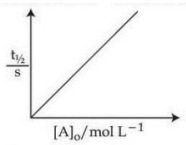
Statement $II$: For a first-order reaction $A \to B$,the graph of half-life $(t_{1/2})$ versus initial concentration $[A]_o$ is a straight line passing through the origin.
In the light of the above statements,choose the correct answer from the options given below:
Statement $I$: When $E_a = 12.6 \text{ kcal/mol}$,the room temperature rate constant is doubled by a $10 \text{ }^\circ\text{C}$ increase in temperature ($298 \text{ K}$ to $308 \text{ K}$).
Statement $II$: For a first-order reaction $A \to B$,the graph of half-life $(t_{1/2})$ versus initial concentration $[A]_o$ is a straight line passing through the origin.
In the light of the above statements,choose the correct answer from the options given below:
A
Both Statement $I$ and Statement $II$ are true
B
Both Statement $I$ and Statement $II$ are false
C
Statement $I$ is true but Statement $II$ is false
D
Statement $I$ is false but Statement $II$ is true
Solution
(C) $1$. For Statement $I$: Using the Arrhenius equation,$\log(k_2/k_1) = \frac{E_a}{2.303R} \left(\frac{T_2-T_1}{T_1 T_2}\right)$.
Given $E_a = 12.6 \text{ kcal/mol} = 12600 \text{ cal/mol}$,$R = 1.987 \text{ cal K}^{-1} \text{ mol}^{-1} \approx 2 \text{ cal K}^{-1} \text{ mol}^{-1}$,$T_1 = 298 \text{ K}$,$T_2 = 308 \text{ K}$.
$\log(2) = 0.301 = \frac{12600}{2.303 \times 2} \left(\frac{10}{298 \times 308}\right) \approx \frac{12600}{4.606} \times \frac{10}{91784} \approx 2735.5 \times 0.000109 \approx 0.298 \approx 0.3$.
Since $\log(2) \approx 0.3$,Statement $I$ is true.
$2$. For Statement $II$: For a first-order reaction,$t_{1/2} = \frac{0.693}{k}$. This shows that $t_{1/2}$ is independent of the initial concentration $[A]_o$. Therefore,the graph of $t_{1/2}$ versus $[A]_o$ should be a horizontal line,not a straight line passing through the origin. Thus,Statement $II$ is false.
Given $E_a = 12.6 \text{ kcal/mol} = 12600 \text{ cal/mol}$,$R = 1.987 \text{ cal K}^{-1} \text{ mol}^{-1} \approx 2 \text{ cal K}^{-1} \text{ mol}^{-1}$,$T_1 = 298 \text{ K}$,$T_2 = 308 \text{ K}$.
$\log(2) = 0.301 = \frac{12600}{2.303 \times 2} \left(\frac{10}{298 \times 308}\right) \approx \frac{12600}{4.606} \times \frac{10}{91784} \approx 2735.5 \times 0.000109 \approx 0.298 \approx 0.3$.
Since $\log(2) \approx 0.3$,Statement $I$ is true.
$2$. For Statement $II$: For a first-order reaction,$t_{1/2} = \frac{0.693}{k}$. This shows that $t_{1/2}$ is independent of the initial concentration $[A]_o$. Therefore,the graph of $t_{1/2}$ versus $[A]_o$ should be a horizontal line,not a straight line passing through the origin. Thus,Statement $II$ is false.
0 likes
View Solution53
MediumMCQ
$t_{100\%}$ is the time required for the $100\%$ completion of the reaction,while $t_{1/2}$ is the time required for $50\%$ of the reaction to be completed. Which of the following options correctly represents the relation between $t_{100\%}$ and $t_{1/2}$ for zero and first-order reactions,respectively?
A
$t_{100\%} = (t_{1/2})^2$ and $t_{100\%} = (t_{1/2})^{-\infty}$
B
$t_{100\%} = 2t_{1/2}$ and $t_{100\%} = \infty$
C
$t_{100\%} = 2t_{1/2}$ and $t_{100\%} = (2t_{1/2})^2$
D
$t_{100\%} = \infty$ and $t_{100\%} = 2t_{1/2}$
Solution
(B) $1$. For a zero-order reaction: The rate constant is $k = [A]_0 / t_{100\%}$. Also,$t_{1/2} = [A]_0 / (2k)$,which implies $[A]_0 = 2kt_{1/2}$. Substituting this into the first equation: $k = (2kt_{1/2}) / t_{100\%}$,which simplifies to $t_{100\%} = 2t_{1/2}$.
$2$. For a first-order reaction: The concentration at time $t$ is given by $[A]_t = [A]_0 e^{-kt}$. For $100\%$ completion,$[A]_t = 0$. This implies $e^{-kt} = 0$,which occurs only when $t \to \infty$. Thus,theoretically,a first-order reaction never reaches $100\%$ completion in finite time.
$2$. For a first-order reaction: The concentration at time $t$ is given by $[A]_t = [A]_0 e^{-kt}$. For $100\%$ completion,$[A]_t = 0$. This implies $e^{-kt} = 0$,which occurs only when $t \to \infty$. Thus,theoretically,a first-order reaction never reaches $100\%$ completion in finite time.
0 likes
View SolutionChemical Kinetics — Mix Examples-Chemical Kinetics · Frequently Asked Questions
1Are these Chemical Kinetics questions useful for JEE and NEET?
Yes. All questions in this section are mapped to JEE Main and NEET exam patterns. Previous year questions from JEE Main, NEET, GUJCET and state-level exams are included with full solutions.
2Can I switch to Hindi or Gujarati for these questions?
Yes. Use the language tabs in the hero section or the sidebar to view the same questions and solutions in English, Hindi or Gujarati.
3How do I generate a question paper from this subtopic?
Use the Vedclass Exam Paper Generator — select the chapter and subtopic, set difficulty, and generate Sets A, B, C, D automatically. First 3 chapters of every subject are free.
Vedclass Products
For Students
Vedclass Test Series
Mock tests in real JEE/NEET style with performance analysis. 5-day free trial.
Start Free TrialFor Teachers
Exam Paper Generator
Generate Set A/B/C/D papers from this chapter in 2 minutes. 3 chapters free.
Try FreeFor Institutes
Online Exam Module
Live online exams with unlimited students, 360° analytics & white-label branding.
See DemoFor Teachers & Institutes
Generate a Chemical Kinetics Exam Paper in 2 Minutes
Select subtopic & difficulty — Sets A, B, C, D auto-generated with No Repeat logic.
First 3 chapters of every subject are free — no payment required.