
A English
Nucleic Acids Questions in English
Class 12 Chemistry · Biomolecules · Nucleic Acids
205+
Questions
English
Language
100%
With Solutions
Showing 48 of 205 questions in English
51
EasyMCQ
$RNA$ contains $........$.
A
Ribose sugar and thymine
B
Ribose sugar and uracil
C
Deoxyribose sugar and uracil
D
Deoxyribose sugar and thymine
Solution
(B) $RNA$ contains ribose sugar and nitrogenous bases: adenine,guanine,cytosine,and uracil.
0 likes
View Solution52
EasyMCQ
What is the unit consisting of a base,sugar,and phosphate in nucleic acids called?
A
Nucleoside
B
Phosphotide
C
None of the above
D
Nucleotide
Solution
(D) In nucleic acids,a unit formed by the combination of a nitrogenous base,a pentose sugar,and a phosphate group is known as a $Nucleotide$.
$A$ $Nucleoside$ consists only of a nitrogenous base and a pentose sugar.
Therefore,the correct option is $D$.
$A$ $Nucleoside$ consists only of a nitrogenous base and a pentose sugar.
Therefore,the correct option is $D$.
0 likes
View Solution53
EasyMCQ
In $DNA$,the base pairs are held together by which of the following?
A
Hydrogen bonds
B
Ionic bonds
C
Phosphate groups
D
Oxygen linkages
Solution
(A) In the structure of $DNA$,the two strands of the double helix are held together by hydrogen bonds between the nitrogenous bases. Specifically,$Adenine$ $(A)$ pairs with $Thymine$ $(T)$ via two hydrogen bonds,and $Guanine$ $(G)$ pairs with $Cytosine$ $(C)$ via three hydrogen bonds.
0 likes
View Solution54
EasyMCQ
Which of the following sequences is correct in a nucleic acid?
A
Phosphate $\rightarrow$ Base $\rightarrow$ Sugar
B
Sugar $\rightarrow$ Base $\rightarrow$ Nucleotide
C
Base $\rightarrow$ Sugar $\rightarrow$ Phosphate
D
Base $\rightarrow$ Phosphate $\rightarrow$ Sugar
Solution
(C) nucleic acid is a polymer of nucleotides. Each nucleotide consists of three components: a nitrogenous base,a pentose sugar,and a phosphate group. The nitrogenous base is attached to the $1'$ position of the sugar,and the phosphate group is attached to the $5'$ position of the sugar. Therefore,the structural sequence within a nucleotide unit is Base $\rightarrow$ Sugar $\rightarrow$ Phosphate.
0 likes
View Solution55
DifficultMCQ
If the base sequence in $DNA$ is $TGAACCCTT$,then the base sequence in $RNA$ is.......
A
$ACUUGGGAA$
B
$TCUUGGGTT$
C
$ACUUCCCAA$
D
None of these
Solution
(A) In $DNA$,the base pairing rule is $A-T$ and $G-C$.
During transcription,$DNA$ is transcribed into $RNA$.
In $RNA$,$Uracil$ $(U)$ replaces $Thymine$ $(T)$.
Therefore,the base pairing for $RNA$ synthesis from $DNA$ is $A-U$,$T-A$,$G-C$,and $C-G$.
Given $DNA$ sequence: $T-G-A-A-C-C-C-T-T$.
Complementary $RNA$ sequence: $A-C-U-U-G-G-G-A-A$.
During transcription,$DNA$ is transcribed into $RNA$.
In $RNA$,$Uracil$ $(U)$ replaces $Thymine$ $(T)$.
Therefore,the base pairing for $RNA$ synthesis from $DNA$ is $A-U$,$T-A$,$G-C$,and $C-G$.
Given $DNA$ sequence: $T-G-A-A-C-C-C-T-T$.
Complementary $RNA$ sequence: $A-C-U-U-G-G-G-A-A$.
0 likes
View Solution56
MediumMCQ
Which components are present in a nucleotide?
A
Pentose sugar
B
Nitrogenous base
C
Phosphoric acid
D
All of the above
Solution
(D) nucleotide is the basic structural unit of nucleic acids like $DNA$ and $RNA$. It consists of three essential components:
$1$. $A$ pentose sugar (ribose or deoxyribose).
$2$. $A$ nitrogenous base (purine or pyrimidine).
$3$. $A$ phosphoric acid group.
Therefore,all the given components are present in a nucleotide.
$1$. $A$ pentose sugar (ribose or deoxyribose).
$2$. $A$ nitrogenous base (purine or pyrimidine).
$3$. $A$ phosphoric acid group.
Therefore,all the given components are present in a nucleotide.
0 likes
View Solution57
DifficultMCQ
In both $DNA$ and $RNA$,the heterocyclic base and phosphate ester linkages are at which positions of the sugar molecule?
A
$C'_5$ and $C'_2$ respectively of the sugar molecule
B
$C'_2$ and $C'_5$ respectively of the sugar molecule
C
$C'_1$ and $C'_5$ respectively of the sugar molecule
D
$C'_5$ and $C'_1$ respectively of the sugar molecule
Solution
(C) In a nucleotide,the sugar molecule (ribose or deoxyribose) is linked to a heterocyclic base at the $C'_1$ position.
The phosphate group is linked to the sugar molecule through an ester linkage at the $C'_5$ position.
Therefore,the heterocyclic base is at $C'_1$ and the phosphate ester linkage is at $C'_5$ of the sugar molecule.
The phosphate group is linked to the sugar molecule through an ester linkage at the $C'_5$ position.
Therefore,the heterocyclic base is at $C'_1$ and the phosphate ester linkage is at $C'_5$ of the sugar molecule.
0 likes
View Solution58
MediumMCQ
Which of the following is not present in a nucleotide?
A
Cytosine
B
Guanine
C
Adenine
D
Tyrosine
Solution
(D) nucleotide consists of a nitrogenous base,a pentose sugar,and a phosphate group.
The common nitrogenous bases found in nucleotides are adenine,guanine,cytosine,thymine,and uracil.
Tyrosine is an amino acid,not a nitrogenous base,and therefore it is not present in a nucleotide.
The common nitrogenous bases found in nucleotides are adenine,guanine,cytosine,thymine,and uracil.
Tyrosine is an amino acid,not a nitrogenous base,and therefore it is not present in a nucleotide.
0 likes
View Solution59
EasyMCQ
The correct statement regarding $RNA$ and $DNA,$ respectively is
A
the sugar component in $RNA$ is a arabinose and the sugar component in $DNA$ is ribose
B
the sugar component in $RNA$ is $2'-$deoxyribose and the sugar component in $DNA$ is arabinose
C
the sugar component in $RNA$ is arabinose and the sugar component in $DNA$ is $2'-$deoxyribose
D
the sugar component in $RNA$ is ribose and the sugar component in $DNA$ is $2'-$deoxyribose.
Solution
(D) $RNA$ (Ribonucleic acid) contains the sugar $\beta-D-ribose.$
$DNA$ (Deoxyribonucleic acid) contains the sugar $\beta-D-2'-deoxyribose.$
Therefore,the correct statement is that the sugar component in $RNA$ is ribose and the sugar component in $DNA$ is $2'-$deoxyribose.
$DNA$ (Deoxyribonucleic acid) contains the sugar $\beta-D-2'-deoxyribose.$
Therefore,the correct statement is that the sugar component in $RNA$ is ribose and the sugar component in $DNA$ is $2'-$deoxyribose.
0 likes
View Solution60
MediumMCQ
In $DNA$,the linkages between different nitrogenous bases are
A
phosphate linkage
B
$H$-bonding
C
glycosidic linkage
D
peptide linkage
Solution
(B) In $DNA$,the two strands are held together by hydrogen bonds between the complementary nitrogenous bases. Adenine $(A)$ pairs with Thymine $(T)$ via two hydrogen bonds,and Guanine $(G)$ pairs with Cytosine $(C)$ via three hydrogen bonds. Therefore,the linkages between different nitrogenous bases are $H$-bonding.
0 likes
View Solution61
MediumMCQ
The segment of $DNA$ which acts as the instrumental manual for the synthesis of the protein is
A
ribose
B
gene
C
nucleoside
D
nucleotide
Solution
(B) The segment of $DNA$ which acts as the instrumental manual for the synthesis of the protein is a $gene$.
Every protein in a cell has a corresponding $gene$ that contains the information required for its synthesis.
Every protein in a cell has a corresponding $gene$ that contains the information required for its synthesis.
0 likes
View Solution62
MediumMCQ
In $DNA$,the complementary bases are
A
adenine and guanine; thymine and cytosine
B
uracil and adenine; cytosine and guanine
C
adenine and thymine; guanine and cytosine
D
adenine and thymine; guanine and uracil
Solution
(C) $DNA$ has a double helical structure.
These helices contain polynucleotide chains,and these chains are held together by hydrogen bonds.
In the $DNA$ double helix,adenine $(A)$ always pairs with thymine $(T)$ via two hydrogen bonds,and guanine $(G)$ always pairs with cytosine $(C)$ via three hydrogen bonds.
These helices contain polynucleotide chains,and these chains are held together by hydrogen bonds.
In the $DNA$ double helix,adenine $(A)$ always pairs with thymine $(T)$ via two hydrogen bonds,and guanine $(G)$ always pairs with cytosine $(C)$ via three hydrogen bonds.
0 likes
View Solution63
EasyMCQ
$RNA$ and $DNA$ are chiral molecules, their chirality is due to
A
chiral bases
B
chiral phosphate ester units
C
$D$-sugar component
D
$L$-sugar component
Solution
(C) $RNA$ and $DNA$ molecules contain ribose and deoxyribose sugars, respectively.
Both sugars possess multiple chiral centers.
The chirality of these nucleic acids is primarily attributed to the presence of the $D$-sugar component (specifically $D$-ribose in $RNA$ and $D$-2-deoxyribose in $DNA$).
Both sugars possess multiple chiral centers.
The chirality of these nucleic acids is primarily attributed to the presence of the $D$-sugar component (specifically $D$-ribose in $RNA$ and $D$-2-deoxyribose in $DNA$).
0 likes
View Solution64
EasyMCQ
The pyrimidine bases present in $DNA$ are
A
cytosine and thymine
B
cytosine and uracil
C
cytosine and adenine
D
cytosine and guanine
Solution
(A) $DNA$ contains two types of nitrogenous bases: purines and pyrimidines.
The purines are adenine $(A)$ and guanine $(G)$.
The pyrimidines present in $DNA$ are cytosine $(C)$ and thymine $(T)$.
In $RNA$,thymine is replaced by uracil $(U)$.
Therefore,the pyrimidine bases in $DNA$ are cytosine and thymine.
The purines are adenine $(A)$ and guanine $(G)$.
The pyrimidines present in $DNA$ are cytosine $(C)$ and thymine $(T)$.
In $RNA$,thymine is replaced by uracil $(U)$.
Therefore,the pyrimidine bases in $DNA$ are cytosine and thymine.
0 likes
View Solution65
EasyMCQ
The presence or absence of a hydroxyl group on which carbon atom of the sugar differentiates $RNA$ and $DNA$?
A
$1^{st}$
B
$2^{nd}$
C
$3^{rd}$
D
$4^{th}$
Solution
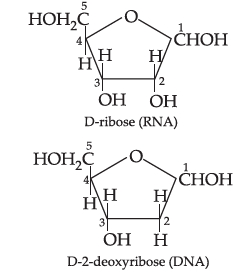
(B) The sugar molecule found in $RNA$ is $D$-ribose,while the sugar in $DNA$ is $D$-$2$-deoxyribose.
$D$-$2$-deoxyribose differs from ribose only in the substitution of a hydrogen atom for an $-OH$ group at the $2$-position,as shown in the figure.
$D$-$2$-deoxyribose differs from ribose only in the substitution of a hydrogen atom for an $-OH$ group at the $2$-position,as shown in the figure.
0 likes
View Solution66
EasyMCQ
Which one of the following bases is $not$ present in $DNA$?
A
Quinoline
B
Adenine
C
Cytosine
D
Thymine
Solution
(A) Quinoline is an alkaloid and is not present in $DNA$.
$DNA$ contains four nitrogenous bases: adenine,guanine,cytosine,and thymine.
$DNA$ contains four nitrogenous bases: adenine,guanine,cytosine,and thymine.
0 likes
View Solution67
EasyMCQ
Which of the following pyrimidine base is present in $RNA$?
A
Adenine
B
Guanine
C
Uracil
D
All of these
Solution
(C) Nucleic acids contain two types of nitrogenous bases: purines and pyrimidines.
$RNA$ contains two purines: Adenine $(A)$ and Guanine $(G)$.
$RNA$ contains two pyrimidines: Cytosine $(C)$ and Uracil $(U)$.
Since Adenine and Guanine are purines,the correct pyrimidine base present in $RNA$ among the options is Uracil.
$RNA$ contains two purines: Adenine $(A)$ and Guanine $(G)$.
$RNA$ contains two pyrimidines: Cytosine $(C)$ and Uracil $(U)$.
Since Adenine and Guanine are purines,the correct pyrimidine base present in $RNA$ among the options is Uracil.
0 likes
View Solution68
EasyMCQ
Which of the following bases is found only in $RNA$ but not in $DNA$?
A
Thymine
B
Guanine
C
Uracil
D
Adenine
Solution
(C) $Uracil$ is the nitrogenous base present only in $RNA$,but not in $DNA$.
$DNA$ contains thymine,guanine,adenine,and cytosine.
In $RNA$,thymine is replaced by $Uracil$.
$DNA$ contains thymine,guanine,adenine,and cytosine.
In $RNA$,thymine is replaced by $Uracil$.
0 likes
View Solution69
EasyMCQ
In a nucleotide,the phosphate linkage is generally attached to -
A
$C-1$ of the sugar
B
$C-2$ of the sugar
C
$C-5$ of the sugar
D
nitrogen atom of the base
Solution
(C) nucleotide consists of three components: a nitrogenous base,a pentose sugar,and a phosphate group.
In the structure of a nucleotide,the nitrogenous base is attached to the $C-1$ position of the pentose sugar.
The phosphate group is attached to the $C-5$ position of the pentose sugar through an ester linkage.
Therefore,the correct option is $C$.
In the structure of a nucleotide,the nitrogenous base is attached to the $C-1$ position of the pentose sugar.
The phosphate group is attached to the $C-5$ position of the pentose sugar through an ester linkage.
Therefore,the correct option is $C$.
0 likes
View Solution70
EasyMCQ
The nitrogenous base which differentiates $DNA$ from $RNA$ is:
A
Cytosine
B
Uracil
C
Adenine
D
Guanine
Solution
(B) $DNA$ contains the nitrogenous bases Adenine $(A)$,Guanine $(G)$,Cytosine $(C)$,and Thymine $(T)$.
$RNA$ contains the nitrogenous bases Adenine $(A)$,Guanine $(G)$,Cytosine $(C)$,and Uracil $(U)$.
Therefore,Uracil is the base present in $RNA$ but absent in $DNA$,while Thymine is present in $DNA$ but absent in $RNA$.
$RNA$ contains the nitrogenous bases Adenine $(A)$,Guanine $(G)$,Cytosine $(C)$,and Uracil $(U)$.
Therefore,Uracil is the base present in $RNA$ but absent in $DNA$,while Thymine is present in $DNA$ but absent in $RNA$.
0 likes
View Solution71
EasyMCQ
If on a strand of $DNA$ the base sequence is $ATTGACGCAT$ then the sequence transcription on $RNA$ would be
A
$UAACUGCGUA$
B
$AUUCUGCGUA$
C
$UAACTGCGUA$
D
$TAACTGCGTA$
Solution
(A) During the process of transcription,the $DNA$ template strand is used to synthesize a complementary $RNA$ strand.
In $RNA$,the base $Uracil$ $(U)$ replaces $Thymine$ $(T)$ found in $DNA$.
Given $DNA$ sequence: $A-T-T-G-A-C-G-C-A-T$.
The complementary $RNA$ sequence will be: $U-A-A-C-U-G-C-G-U-A$.
In $RNA$,the base $Uracil$ $(U)$ replaces $Thymine$ $(T)$ found in $DNA$.
Given $DNA$ sequence: $A-T-T-G-A-C-G-C-A-T$.
The complementary $RNA$ sequence will be: $U-A-A-C-U-G-C-G-U-A$.
0 likes
View Solution72
EasyMCQ
Which of the following is not present in a nucleotide?
A
Deoxyribose
B
Guanine
C
Glycine
D
Cytosine
Solution
(C) nucleotide consists of a sugar (deoxyribose or ribose),a phosphate group,and a nitrogenous base (such as guanine,cytosine,adenine,or thymine/uracil).
Glycine is an amino acid,not a component of a nucleotide.
Glycine is an amino acid,not a component of a nucleotide.
0 likes
View Solution73
MediumMCQ
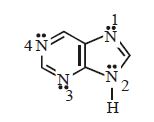
Identify the nitrogen atom that does not contribute to the basicity of the compound shown in the structure.
A
$2$
B
$1$
C
$3$
D
$4$
Solution
(A) The basicity of a nitrogen-containing compound depends on the availability of the lone pair of electrons for protonation.
In the given structure (purine derivative):
- Nitrogen $1$,$3$,and $4$ have lone pairs that are in $sp^2$ hybridized orbitals and are not involved in the aromatic sextet,making them available for protonation.
- Nitrogen $2$ has a lone pair that is part of the aromatic system (it participates in the $6\pi$ electron delocalization required for aromaticity).
- Since the lone pair on nitrogen $2$ is involved in resonance to maintain aromaticity,it is not available for donation to a proton.
- Therefore,nitrogen $2$ does not contribute to the basicity of the compound.
In the given structure (purine derivative):
- Nitrogen $1$,$3$,and $4$ have lone pairs that are in $sp^2$ hybridized orbitals and are not involved in the aromatic sextet,making them available for protonation.
- Nitrogen $2$ has a lone pair that is part of the aromatic system (it participates in the $6\pi$ electron delocalization required for aromaticity).
- Since the lone pair on nitrogen $2$ is involved in resonance to maintain aromaticity,it is not available for donation to a proton.
- Therefore,nitrogen $2$ does not contribute to the basicity of the compound.
0 likes
View Solution74
MediumMCQ
If the sequence of bases in one strand of $DNA$ is $CTGTCAGTA$,then the sequence of bases in its complementary strand is
A
$GUAUTGAUG$
B
$GACAGTCAT$
C
$GUCCUGUTC$
D
$TAACGCUAC$
Solution
(B) In $DNA$,the complementary base pairing follows the rule: $A$ pairs with $T$ and $C$ pairs with $G$.
Given the strand sequence: $C-T-G-T-C-A-G-T-A$.
Replacing each base with its complement:
$C \rightarrow G$
$T \rightarrow A$
$G \rightarrow C$
$T \rightarrow A$
$C \rightarrow G$
$A \rightarrow T$
$G \rightarrow C$
$T \rightarrow A$
$A \rightarrow T$
Thus,the complementary sequence is $GACAGTCAT$.
Given the strand sequence: $C-T-G-T-C-A-G-T-A$.
Replacing each base with its complement:
$C \rightarrow G$
$T \rightarrow A$
$G \rightarrow C$
$T \rightarrow A$
$C \rightarrow G$
$A \rightarrow T$
$G \rightarrow C$
$T \rightarrow A$
$A \rightarrow T$
Thus,the complementary sequence is $GACAGTCAT$.
0 likes
View Solution75
EasyMCQ
In the double-strand helix structure of $DNA,$ thymine forms hydrogen bonds with
A
Guanine $(G)$
B
Uracil $(U)$
C
Cytosine $(C)$
D
Adenine $(A)$
Solution
(D) In the double-strand helix structure of $DNA,$ the nitrogenous bases pair according to Chargaff's rules.
Thymine $(T)$ always forms two hydrogen bonds with Adenine $(A).$
Cytosine $(C)$ always forms three hydrogen bonds with Guanine $(G).$
Therefore,thymine forms hydrogen bonds with adenine.
Thymine $(T)$ always forms two hydrogen bonds with Adenine $(A).$
Cytosine $(C)$ always forms three hydrogen bonds with Guanine $(G).$
Therefore,thymine forms hydrogen bonds with adenine.
0 likes
View Solution76
MediumMCQ
The reason for the double helical structure of $DNA$ is the operation of
A
Electrostatic attractions
B
van der Waals forces
C
Dipole-dipole interactions
D
Hydrogen bonding
Solution
(D) The two polynucleotide chains of $DNA$ molecules are twisted around a common axis but run in opposite directions to form a right-handed helix.
These two chains are held together by specific hydrogen bonds between the complementary nitrogenous bases ($A$ pairs with $T$,and $G$ pairs with $C$).
These two chains are held together by specific hydrogen bonds between the complementary nitrogenous bases ($A$ pairs with $T$,and $G$ pairs with $C$).
0 likes
View Solution77
DifficultMCQ
Which of the following statements is correct?
A
$RNA$ controls the synthesis of proteins.
B
The sugar present in $DNA$ is $D-(-)$-ribose.
C
$RNA$ has a double-stranded $\alpha$-helix structure.
D
$DNA$ mainly occurs in the cytoplasm of the cell.
Solution
(A) $1$. $RNA$ (Ribonucleic acid) is primarily responsible for protein synthesis in the cell.
$2$. The sugar present in $DNA$ is $2$-deoxy-$D$-ribose,not $D-(-)$-ribose (which is found in $RNA$).
$3$. $DNA$ typically has a double-stranded helix structure,whereas $RNA$ is usually single-stranded.
$4$. $DNA$ is primarily found in the nucleus of the cell,while $RNA$ is found in the cytoplasm and nucleus.
Therefore,the correct statement is that $RNA$ controls the synthesis of proteins.
$2$. The sugar present in $DNA$ is $2$-deoxy-$D$-ribose,not $D-(-)$-ribose (which is found in $RNA$).
$3$. $DNA$ typically has a double-stranded helix structure,whereas $RNA$ is usually single-stranded.
$4$. $DNA$ is primarily found in the nucleus of the cell,while $RNA$ is found in the cytoplasm and nucleus.
Therefore,the correct statement is that $RNA$ controls the synthesis of proteins.
0 likes
View Solution78
DifficultMCQ
Among the following compounds,which one is found in $RNA$?
A
Cytosine
B
Uracil
C
Thymine
D
$1,3-$Dimethyluracil
Solution
(B) $RNA$ (Ribonucleic acid) contains four nitrogenous bases: Adenine,Guanine,Cytosine,and Uracil.
Option $A$ represents Cytosine,which is found in both $DNA$ and $RNA$.
Option $B$ represents Uracil,which is specifically found in $RNA$ and replaces Thymine found in $DNA$.
Option $C$ represents Thymine,which is found in $DNA$.
Option $D$ represents $1,3$-Dimethyluracil,which is not a naturally occurring base in $RNA$.
Therefore,both $A$ and $B$ are found in $RNA$. However,Uracil $(B)$ is the characteristic base that distinguishes $RNA$ from $DNA$.
Option $A$ represents Cytosine,which is found in both $DNA$ and $RNA$.
Option $B$ represents Uracil,which is specifically found in $RNA$ and replaces Thymine found in $DNA$.
Option $C$ represents Thymine,which is found in $DNA$.
Option $D$ represents $1,3$-Dimethyluracil,which is not a naturally occurring base in $RNA$.
Therefore,both $A$ and $B$ are found in $RNA$. However,Uracil $(B)$ is the characteristic base that distinguishes $RNA$ from $DNA$.
0 likes
View Solution79
MediumMCQ
Which of the following statements is not true about $RNA$?
A
It has always double stranded $\alpha - \text{helix}$ structure
B
It is present in the nucleus of the cell
C
It controls the synthesis of protein
D
It usually does not replicate
Solution
(A) $RNA$ is typically single-stranded and does not form a double-stranded $\alpha - \text{helix}$ structure like $DNA$. Therefore,the statement that it always has a double-stranded $\alpha - \text{helix}$ structure is incorrect.
0 likes
View Solution80
DifficultMCQ
Which of the following is/are correct?
A
$(A), (B), (C), (D)$
B
$(A), (C), (D)$
C
$(A), (C)$
D
Only $(D)$
Solution
(A) nucleotide is formed by the esterification of a nucleoside with a phosphate group at the $5'$-$OH$ position of the sugar. This statement is correct.
$(B)$ $A$ nucleoside is formed by the attachment of a nitrogenous base to the $1'$-position of a pentose sugar ($ribose$ or $deoxyribose$). This statement is correct.
$(C)$ $DNA$ contains $2$-deoxyribose sugar and thymine,whereas $RNA$ contains ribose sugar and uracil. Thus,they differ in both sugar and nitrogenous base. This statement is correct.
$(D)$ In $DNA$ double helix,adenine $(A)$ pairs with thymine $(T)$ via two hydrogen bonds $(A=T)$,and cytosine $(C)$ pairs with guanine $(G)$ via three hydrogen bonds $(C \equiv G)$. This statement is correct.
Therefore,all statements $(A), (B), (C),$ and $(D)$ are correct.
$(B)$ $A$ nucleoside is formed by the attachment of a nitrogenous base to the $1'$-position of a pentose sugar ($ribose$ or $deoxyribose$). This statement is correct.
$(C)$ $DNA$ contains $2$-deoxyribose sugar and thymine,whereas $RNA$ contains ribose sugar and uracil. Thus,they differ in both sugar and nitrogenous base. This statement is correct.
$(D)$ In $DNA$ double helix,adenine $(A)$ pairs with thymine $(T)$ via two hydrogen bonds $(A=T)$,and cytosine $(C)$ pairs with guanine $(G)$ via three hydrogen bonds $(C \equiv G)$. This statement is correct.
Therefore,all statements $(A), (B), (C),$ and $(D)$ are correct.
0 likes
View Solution81
MediumMCQ
$RNA$ and $DNA$ are chiral molecules,their chirality is due to
A
$L$-sugar component
B
Chiral base
C
Chiral phosphate units
D
$D$-sugar component
Solution
(D) The constituents of nucleic acids are nitrogenous bases,sugar,and phosphoric acid.
The sugar present in $DNA$ is $D(-)-2$-deoxyribose and the sugar present in $RNA$ is $D(-)$-ribose.
Due to these $D$-sugar components,$DNA$ and $RNA$ molecules are chiral molecules.
The sugar present in $DNA$ is $D(-)-2$-deoxyribose and the sugar present in $RNA$ is $D(-)$-ribose.
Due to these $D$-sugar components,$DNA$ and $RNA$ molecules are chiral molecules.
0 likes
View Solution82
EasyMCQ
Which base is present in $RNA$ but not in $DNA$?
A
Thymine
B
Cytosine
C
Guanine
D
Uracil
Solution
(D) $RNA$ contains the bases $Adenine$ $(A)$,$Uracil$ $(U)$,$Guanine$ $(G)$,and $Cytosine$ $(C)$.
$DNA$ contains the bases $Adenine$ $(A)$,$Thymine$ $(T)$,$Guanine$ $(G)$,and $Cytosine$ $(C)$.
Therefore,$Uracil$ $(U)$ is the base present in $RNA$ but not in $DNA$.
$DNA$ contains the bases $Adenine$ $(A)$,$Thymine$ $(T)$,$Guanine$ $(G)$,and $Cytosine$ $(C)$.
Therefore,$Uracil$ $(U)$ is the base present in $RNA$ but not in $DNA$.
0 likes
View Solution83
MediumMCQ
Which of the following is not a protein?
A
Wool
B
Nails
C
Hair
D
$DNA$
Solution
(D) Wool,nails,and hair are primarily composed of fibrous proteins like keratin.
$DNA$ (Deoxyribonucleic acid) is a nucleic acid,not a protein.
Therefore,the correct answer is $DNA$.
$DNA$ (Deoxyribonucleic acid) is a nucleic acid,not a protein.
Therefore,the correct answer is $DNA$.
0 likes
View Solution84
MediumMCQ
Adenine base is present in which of the following?
A
Only in $DNA$
B
Only in $RNA$
C
Both in $DNA$ and $RNA$
D
In proteins
Solution
(C) Nucleic acids are of two types: $DNA$ (Deoxyribonucleic acid) and $RNA$ (Ribonucleic acid).
Both $DNA$ and $RNA$ contain four nitrogenous bases.
The nitrogenous bases in $DNA$ are Adenine $(A)$,Guanine $(G)$,Cytosine $(C)$,and Thymine $(T)$.
The nitrogenous bases in $RNA$ are Adenine $(A)$,Guanine $(G)$,Cytosine $(C)$,and Uracil $(U)$.
Therefore,Adenine is present in both $DNA$ and $RNA$.
Both $DNA$ and $RNA$ contain four nitrogenous bases.
The nitrogenous bases in $DNA$ are Adenine $(A)$,Guanine $(G)$,Cytosine $(C)$,and Thymine $(T)$.
The nitrogenous bases in $RNA$ are Adenine $(A)$,Guanine $(G)$,Cytosine $(C)$,and Uracil $(U)$.
Therefore,Adenine is present in both $DNA$ and $RNA$.
0 likes
View Solution85
MediumMCQ
If one strand of $DNA$ has the sequence $ATGCTTGA$,what would be the sequence of its complementary strand?
A
$TACGAACT$
B
$TACGAATC$
C
$TACGTACT$
D
$TACGTAGT$
Solution
(A) In $DNA$ double helix,the two strands are complementary to each other based on base pairing rules: $A$ pairs with $T$ and $C$ pairs with $G$.
Given sequence: $A-T-G-C-T-T-G-A$.
Complementary sequence:
$A$ pairs with $T$
$T$ pairs with $A$
$G$ pairs with $C$
$C$ pairs with $G$
$T$ pairs with $A$
$T$ pairs with $A$
$G$ pairs with $C$
$A$ pairs with $T$
Thus,the complementary sequence is $TACGAACT$.
Given sequence: $A-T-G-C-T-T-G-A$.
Complementary sequence:
$A$ pairs with $T$
$T$ pairs with $A$
$G$ pairs with $C$
$C$ pairs with $G$
$T$ pairs with $A$
$T$ pairs with $A$
$G$ pairs with $C$
$A$ pairs with $T$
Thus,the complementary sequence is $TACGAACT$.
0 likes
View Solution86
MediumMCQ
Which are the complementary bases in $DNA$?
A
Uracil and Adenine,Cytosine and Guanine
B
Adenine and Thymine,Guanine and Cytosine
C
Adenine and Thymine,Guanine and Uracil
D
Adenine and Guanine,Thymine and Cytosine
Solution
(B) In $DNA$,the nitrogenous bases pair specifically according to Chargaff's rules.
Adenine $(A)$ always pairs with Thymine $(T)$ via two hydrogen bonds.
Guanine $(G)$ always pairs with Cytosine $(C)$ via three hydrogen bonds.
Therefore,the complementary base pairs are $A-T$ and $G-C$.
Adenine $(A)$ always pairs with Thymine $(T)$ via two hydrogen bonds.
Guanine $(G)$ always pairs with Cytosine $(C)$ via three hydrogen bonds.
Therefore,the complementary base pairs are $A-T$ and $G-C$.
0 likes
View Solution87
MediumMCQ
Which of the following substances is not present in nucleic acids?
A
Cytosine
B
Adenine
C
Thymine
D
Guanidine
Solution
(D) Nucleic acids ($DNA$ and $RNA$) contain nitrogenous bases derived from purines and pyrimidines.
The common purines are Adenine $(A)$ and Guanine $(G)$.
The common pyrimidines are Cytosine $(C)$,Thymine $(T)$,and Uracil $(U)$.
Guanidine is a chemical compound with the formula $HNC(NH_2)_2$,which is not a nitrogenous base found in nucleic acids.
Therefore,the correct answer is Guanidine.
The common purines are Adenine $(A)$ and Guanine $(G)$.
The common pyrimidines are Cytosine $(C)$,Thymine $(T)$,and Uracil $(U)$.
Guanidine is a chemical compound with the formula $HNC(NH_2)_2$,which is not a nitrogenous base found in nucleic acids.
Therefore,the correct answer is Guanidine.
0 likes
View Solution88
EasyMCQ
Which part of $DNA$ acts as a messenger for the synthesis of proteins?
A
Nucleoside
B
Nucleotide
C
Ribose sugar
D
Gene
Solution
(D) $Gene$ is a specific segment of $DNA$ that contains the instructions for the synthesis of a particular protein.
It acts as the functional unit of heredity and carries the genetic information required for protein synthesis.
It acts as the functional unit of heredity and carries the genetic information required for protein synthesis.
0 likes
View Solution89
EasyMCQ
What does a nucleotide contain?
A
Pentose sugar
B
Nitrogenous base
C
Phosphate group
D
All of the above
Solution
(D) nucleotide is the basic structural unit of nucleic acids like $DNA$ and $RNA$. It consists of three components:
$1$. $A$ pentose sugar (ribose or deoxyribose).
$2$. $A$ nitrogenous base (purine or pyrimidine).
$3$. $A$ phosphate group.
Therefore,all the given options are correct.
$1$. $A$ pentose sugar (ribose or deoxyribose).
$2$. $A$ nitrogenous base (purine or pyrimidine).
$3$. $A$ phosphate group.
Therefore,all the given options are correct.
0 likes
View Solution90
EasyMCQ
What is the chemical change in a $DNA$ molecule that leads to an alteration in the amino acid sequence during protein synthesis called?
A
Replication
B
Lipid formation
C
Cellular membrane
D
Mutation
Solution
(D) chemical change in the $DNA$ molecule that alters the genetic code is known as a $Mutation$.
This change can lead to a different amino acid being incorporated into the protein chain during protein synthesis,potentially affecting the structure and function of the resulting protein.
This change can lead to a different amino acid being incorporated into the protein chain during protein synthesis,potentially affecting the structure and function of the resulting protein.
0 likes
View Solution91
EasyMCQ
According to Chargaff's rule,in a living system:
A
The amount of $Adenine$ and $Thymine$ and the amount of $Guanine$ and $Cytosine$ are equal.
B
The amount of $Adenine$ and $Guanine$ and the amount of $Thymine$ and $Cytosine$ are equal.
C
The amount of $Adenine$ and $Cytosine$ and the amount of $Guanine$ and $Thymine$ are equal.
D
The amount of all bases is equal.
Solution
(A) Chargaff's rule states that in any double-stranded $DNA$ molecule,the total amount of purines equals the total amount of pyrimidines.
Specifically,the amount of $Adenine$ $(A)$ is equal to the amount of $Thymine$ $(T)$,and the amount of $Guanine$ $(G)$ is equal to the amount of $Cytosine$ $(C)$.
Therefore,the ratio $[A+G]/[T+C] = 1$ and $[A+T]/[G+C]$ is variable.
Specifically,the amount of $Adenine$ $(A)$ is equal to the amount of $Thymine$ $(T)$,and the amount of $Guanine$ $(G)$ is equal to the amount of $Cytosine$ $(C)$.
Therefore,the ratio $[A+G]/[T+C] = 1$ and $[A+T]/[G+C]$ is variable.
0 likes
View Solution92
EasyMCQ
Adenosine is an example of which of the following?
A
Nucleotide
B
Nucleoside
C
Purine base
D
Pyrimidine base
Solution
(B) Adenosine is formed by the attachment of a nitrogenous base (adenine) to a sugar molecule (ribose) at the $1'$ position.
Since it consists only of a nitrogenous base and a sugar without a phosphate group,it is classified as a nucleoside.
Therefore,the correct option is $B$.
Since it consists only of a nitrogenous base and a sugar without a phosphate group,it is classified as a nucleoside.
Therefore,the correct option is $B$.
0 likes
View Solution93
MediumMCQ
Which of the following statements is $NOT$ true regarding $DNA$?
A
It has a double-helical structure.
B
It undergoes replication.
C
The two strands in a $DNA$ molecule are identical.
D
It contains the pentose sugar,$2$-deoxyribose.
Solution
(C) The $DNA$ molecule consists of two polynucleotide strands that are complementary to each other,not identical.
Each strand contains a sequence of nitrogenous bases that pair specifically ($A$ with $T$,$G$ with $C$).
Therefore,the statement that the two strands are identical is false.
Each strand contains a sequence of nitrogenous bases that pair specifically ($A$ with $T$,$G$ with $C$).
Therefore,the statement that the two strands are identical is false.
0 likes
View Solution94
MediumMCQ
What is the relationship between nucleotide triplets and amino acids called?
A
Translation
B
Transcription
C
Replication
D
Genetic code
Solution
(D) The relationship between the sequence of nucleotide triplets (codons) in $mRNA$ and the specific amino acids they encode is known as the $Genetic \ code$.
Each triplet of nucleotides corresponds to a specific amino acid,which forms the basis of protein synthesis.
Each triplet of nucleotides corresponds to a specific amino acid,which forms the basis of protein synthesis.
0 likes
View Solution95
EasyMCQ
Which of the following is a purine derivative?
A
Thymine
B
Uracil
C
Guanine
D
Cytosine
Solution
(C) Nucleic acids contain two types of nitrogenous bases: purines and pyrimidines.
Purines include $Adenine$ $(A)$ and $Guanine$ $(G)$.
Pyrimidines include $Cytosine$ $(C)$,$Thymine$ $(T)$,and $Uracil$ $(U)$.
Therefore,$Guanine$ is a purine derivative.
Purines include $Adenine$ $(A)$ and $Guanine$ $(G)$.
Pyrimidines include $Cytosine$ $(C)$,$Thymine$ $(T)$,and $Uracil$ $(U)$.
Therefore,$Guanine$ is a purine derivative.
0 likes
View Solution96
EasyMCQ
How many nucleotides in a sequence form a codon for an amino acid in messenger $RNA$?
A
$1$
B
$2$
C
$3$
D
$4$
Solution
(C) In the genetic code,a sequence of $3$ nucleotides (a triplet) in messenger $RNA$ $(mRNA)$ specifies a particular amino acid. This sequence of $3$ nucleotides is known as a codon.
0 likes
View Solution97
EasyMCQ
How are the units of a nucleotide linked?
A
Phosphate-Base-Sugar
B
Sugar-Base-Phosphate
C
Base-Sugar-Phosphate
D
Base-Phosphate-Sugar
Solution
(C) nucleotide is composed of three components: a nitrogenous base,a pentose sugar,and a phosphate group.
In the structure of a nucleotide,the nitrogenous base is attached to the $C1'$ position of the pentose sugar,and the phosphate group is attached to the $C5'$ position of the same sugar.
Therefore,the structural arrangement is $Base-Sugar-Phosphate$.
In the structure of a nucleotide,the nitrogenous base is attached to the $C1'$ position of the pentose sugar,and the phosphate group is attached to the $C5'$ position of the same sugar.
Therefore,the structural arrangement is $Base-Sugar-Phosphate$.
0 likes
View Solution98
MediumMCQ
Which of the following is not present in $RNA$?
A
Uracil
B
Ribose
C
Thymine
D
Phosphate
Solution
(C) $RNA$ (Ribonucleic acid) consists of a ribose sugar,a phosphate group,and nitrogenous bases: Adenine $(A)$,Guanine $(G)$,Cytosine $(C)$,and Uracil $(U)$.
Thymine $(T)$ is present in $DNA$ but is replaced by Uracil in $RNA$.
Thymine $(T)$ is present in $DNA$ but is replaced by Uracil in $RNA$.
0 likes
View SolutionBiomolecules — Nucleic Acids · Frequently Asked Questions
1Are these Biomolecules questions useful for JEE and NEET?
Yes. All questions in this section are mapped to JEE Main and NEET exam patterns. Previous year questions from JEE Main, NEET, GUJCET and state-level exams are included with full solutions.
2Can I switch to Hindi or Gujarati for these questions?
Yes. Use the language tabs in the hero section or the sidebar to view the same questions and solutions in English, Hindi or Gujarati.
3How do I generate a question paper from this subtopic?
Use the Vedclass Exam Paper Generator — select the chapter and subtopic, set difficulty, and generate Sets A, B, C, D automatically. First 3 chapters of every subject are free.
Vedclass Products
For Students
Vedclass Test Series
Mock tests in real JEE/NEET style with performance analysis. 5-day free trial.
Start Free TrialFor Teachers
Exam Paper Generator
Generate Set A/B/C/D papers from this chapter in 2 minutes. 3 chapters free.
Try FreeFor Institutes
Online Exam Module
Live online exams with unlimited students, 360° analytics & white-label branding.
See DemoFor Teachers & Institutes
Generate a Biomolecules Exam Paper in 2 Minutes
Select subtopic & difficulty — Sets A, B, C, D auto-generated with No Repeat logic.
First 3 chapters of every subject are free — no payment required.