
A English
Nucleic Acids Questions in English
Class 12 Chemistry · Biomolecules · Nucleic Acids
205+
Questions
English
Language
100%
With Solutions
Showing 47 of 205 questions in English
151
DifficultMCQ
Which among the following nitrogen bases of polynucleotides is $NOT$ derived from pyrimidine?
A
Guanine
B
Uracil
C
Cytosine
D
Thymine
Solution
(A) Nitrogenous bases in nucleic acids are classified into two types: purines and pyrimidines.
$1$. Pyrimidines are heterocyclic compounds containing two nitrogen atoms in a six-membered ring. Examples include $Cytosine$,$Uracil$,and $Thymine$.
$2$. Purines are heterocyclic compounds consisting of a six-membered ring fused to a five-membered ring,containing four nitrogen atoms. Examples include $Adenine$ and $Guanine$.
Therefore,$Guanine$ is a purine derivative,not a pyrimidine derivative.
$1$. Pyrimidines are heterocyclic compounds containing two nitrogen atoms in a six-membered ring. Examples include $Cytosine$,$Uracil$,and $Thymine$.
$2$. Purines are heterocyclic compounds consisting of a six-membered ring fused to a five-membered ring,containing four nitrogen atoms. Examples include $Adenine$ and $Guanine$.
Therefore,$Guanine$ is a purine derivative,not a pyrimidine derivative.
0 likes
View Solution152
DifficultMCQ
Identify the nitrogenous base of nucleic acid from the following that has a double-ring structure.
A
Thymine
B
Uracil
C
Cytosine
D
Guanine
Solution
(D) Nitrogenous bases in nucleic acids are classified into two types: purines and pyrimidines.
Purines have a double-ring structure (a six-membered ring fused to a five-membered ring),while pyrimidines have a single-ring structure.
Among the given options,$Thymine$,$Uracil$,and $Cytosine$ are pyrimidines (single-ring).
$Guanine$ is a purine and possesses a double-ring structure.
Therefore,the correct option is $D$.
Purines have a double-ring structure (a six-membered ring fused to a five-membered ring),while pyrimidines have a single-ring structure.
Among the given options,$Thymine$,$Uracil$,and $Cytosine$ are pyrimidines (single-ring).
$Guanine$ is a purine and possesses a double-ring structure.
Therefore,the correct option is $D$.
0 likes
View Solution153
DifficultMCQ
Which nitrogen atom of the pyrimidine base,numbered from $1$ to $6$,is bonded with the furanose sugar?
A
$4$
B
$2$
C
$1$
D
$5$
Solution
(C) In nucleosides,the nitrogen atom at position $1$ $(N-1)$ of the pyrimidine base is covalently bonded to the $C-1'$ carbon atom of the furanose sugar.
0 likes
View Solution154
EasyMCQ
Which among the following compounds possesses the highest number of $N$ atoms in it?
A
Guanine
B
Thymine
C
Cytosine
D
Uracil
Solution
(A) To determine the number of $N$ atoms in each compound,we examine their chemical structures:
$1$. Guanine $(C_5H_5N_5O)$: It contains $5$ nitrogen atoms.
$2$. Thymine $(C_5H_6N_2O_2)$: It contains $2$ nitrogen atoms.
$3$. Cytosine $(C_4H_5N_3O)$: It contains $3$ nitrogen atoms.
$4$. Uracil $(C_4H_4N_2O_2)$: It contains $2$ nitrogen atoms.
Comparing these,Guanine has the highest number of nitrogen atoms $(5)$.
Therefore,the correct option is $A$.
$1$. Guanine $(C_5H_5N_5O)$: It contains $5$ nitrogen atoms.
$2$. Thymine $(C_5H_6N_2O_2)$: It contains $2$ nitrogen atoms.
$3$. Cytosine $(C_4H_5N_3O)$: It contains $3$ nitrogen atoms.
$4$. Uracil $(C_4H_4N_2O_2)$: It contains $2$ nitrogen atoms.
Comparing these,Guanine has the highest number of nitrogen atoms $(5)$.
Therefore,the correct option is $A$.
0 likes
View Solution155
MediumMCQ
Which nitrogen atom of a purine base is bonded with the furanose sugar to form a nucleoside?
A
$2$
B
$7$
C
$9$
D
$1$
Solution
(C) In a nucleoside,the nitrogenous base is linked to the $C1'$ position of the sugar (ribose or deoxyribose) via a $\beta$-glycosidic linkage.
For purine bases (like adenine or guanine),this linkage occurs at the $N9$ nitrogen atom.
For pyrimidine bases (like cytosine,thymine,or uracil),this linkage occurs at the $N1$ nitrogen atom.
As shown in the provided structure,the furanose ring is attached to the $N9$ position of the purine base.
For purine bases (like adenine or guanine),this linkage occurs at the $N9$ nitrogen atom.
For pyrimidine bases (like cytosine,thymine,or uracil),this linkage occurs at the $N1$ nitrogen atom.
As shown in the provided structure,the furanose ring is attached to the $N9$ position of the purine base.
0 likes
View Solution156
MediumMCQ
Which of the following is the correct abbreviation for deoxyriboadenosine monophosphate?
A
$AMP$
B
$dAMP$
C
$dTMP$
D
$UMP$
Solution
(B) The correct abbreviation for deoxyriboadenosine monophosphate is $dAMP$.
$d$ stands for deoxyribose,$A$ stands for adenosine,$M$ stands for monophosphate,and $P$ stands for phosphate.
$d$ stands for deoxyribose,$A$ stands for adenosine,$M$ stands for monophosphate,and $P$ stands for phosphate.
0 likes
View Solution157
EasyMCQ
Which of the following is not present in $DNA$?
A
Thymine
B
Guanine
C
Adenine
D
Uracil
Solution
(D) Uracil is not present in $DNA$. It is present in $RNA$.
$DNA$ contains four bases,i.e.,adenine $(A)$,guanine $(G)$,cytosine $(C)$,and thymine $(T)$.
In $RNA$,thymine $(T)$ is replaced by uracil $(U)$.
$DNA$ contains four bases,i.e.,adenine $(A)$,guanine $(G)$,cytosine $(C)$,and thymine $(T)$.
In $RNA$,thymine $(T)$ is replaced by uracil $(U)$.
0 likes
View Solution158
MediumMCQ
Which carbon atom of deoxyribose sugar in $DNA$ does $NOT$ contain the $-OH$ group?
A
$C_5$
B
$C_3$
C
$C_2$
D
$C_1$
Solution
(C) The sugar present in $DNA$ is $2$-deoxyribose.
In ribose sugar,all carbon atoms ($C_1$ to $C_5$) are attached to an $-OH$ group.
However,in $2$-deoxyribose,the $-OH$ group at the $C_2$ position is replaced by a hydrogen atom $(-H)$.
Therefore,the $C_2$ carbon atom does not contain an $-OH$ group.
In ribose sugar,all carbon atoms ($C_1$ to $C_5$) are attached to an $-OH$ group.
However,in $2$-deoxyribose,the $-OH$ group at the $C_2$ position is replaced by a hydrogen atom $(-H)$.
Therefore,the $C_2$ carbon atom does not contain an $-OH$ group.
0 likes
View Solution159
EasyMCQ
What type of sugar molecule is present in $DNA$?
A
$D-3-\text{deoxyribose}$
B
$D-\text{ribose}$
C
$D-2-\text{deoxyribose}$
D
$D-\text{Glucopyranose}$
Solution
(C) $D-2-\text{deoxyribose}$ sugar molecule is present in $DNA$.
0 likes
View Solution160
EasyMCQ
Which of the following statements is incorrect regarding the structure of nucleic acids?
A
Nucleotides are joined together by phosphodiester linkage.
B
In a $DNA$ molecule,the sugar moiety is $\beta-D-2-deoxyribose$.
C
$A$ unit formed by the attachment of a base to the $1'$ position of sugar is known as a nucleoside.
D
$RNA$ contains four bases: adenine,guanine,cytosine,and thymine.
Solution
(D) The correct answer is $D$. $RNA$ contains adenine,guanine,cytosine,and uracil,not thymine. Thymine is present in $DNA$.
0 likes
View Solution161
EasyMCQ
Which base is not present in the $DNA$ structure?
A
Adenine
B
Uracil
C
Guanine
D
Cytosine
Solution
(B) The nitrogenous bases present in $DNA$ are Adenine $(A)$,Guanine $(G)$,Cytosine $(C)$,and Thymine $(T)$.
Uracil $(U)$ is a nitrogenous base found in $RNA$ instead of Thymine.
Therefore,Uracil is not present in the $DNA$ structure.
Thus,the correct option is $B$.
Uracil $(U)$ is a nitrogenous base found in $RNA$ instead of Thymine.
Therefore,Uracil is not present in the $DNA$ structure.
Thus,the correct option is $B$.
0 likes
View Solution162
EasyMCQ
Select the correct sequence of True $(T)$ and False $(F)$ statements from the following:
$(i)$ $\text{Pentose sugar} + \text{base} \rightarrow \text{Nucleotide}$
$(ii)$ $\text{Nucleotide} + \text{phosphate} \rightarrow \text{Nucleoside}$
$(iii)$ $DNA$ contains four bases $A$,$G$,$C$ and $T$
$(iv)$ $RNA$ contains four bases $A$,$G$,$C$ and $U$.
$(i)$ $\text{Pentose sugar} + \text{base} \rightarrow \text{Nucleotide}$
$(ii)$ $\text{Nucleotide} + \text{phosphate} \rightarrow \text{Nucleoside}$
$(iii)$ $DNA$ contains four bases $A$,$G$,$C$ and $T$
$(iv)$ $RNA$ contains four bases $A$,$G$,$C$ and $U$.
A
$FTFT$
B
$FTTT$
C
$FFTT$
D
$TTTT$
Solution
(C) Statement $(i)$ is False because $\text{Pentose sugar} + \text{base} \rightarrow \text{Nucleoside}$.
Statement $(ii)$ is False because $\text{Nucleoside} + \text{phosphate} \rightarrow \text{Nucleotide}$.
Statement $(iii)$ is True as $DNA$ contains Adenine $(A)$,Guanine $(G)$,Cytosine $(C)$,and Thymine $(T)$.
Statement $(iv)$ is True as $RNA$ contains Adenine $(A)$,Guanine $(G)$,Cytosine $(C)$,and Uracil $(U)$.
Thus,the sequence is $FFTT$.
Statement $(ii)$ is False because $\text{Nucleoside} + \text{phosphate} \rightarrow \text{Nucleotide}$.
Statement $(iii)$ is True as $DNA$ contains Adenine $(A)$,Guanine $(G)$,Cytosine $(C)$,and Thymine $(T)$.
Statement $(iv)$ is True as $RNA$ contains Adenine $(A)$,Guanine $(G)$,Cytosine $(C)$,and Uracil $(U)$.
Thus,the sequence is $FFTT$.
0 likes
View Solution163
EasyMCQ
Assign '$T$' for true statements and '$F$' for false statements,and select the correct option from the given choices for the following statements:
$(i)$ Cytosine base is a derivative of pyrimidine.
$(ii)$ $\beta-D$-ribose sugar is present in $DNA$.
$(iii)$ The message for the synthesis of a specific protein is present in $RNA$.
$(iv)$ $DNA$ is responsible for maintaining the identity of different species of organisms for millions of years.
$(i)$ Cytosine base is a derivative of pyrimidine.
$(ii)$ $\beta-D$-ribose sugar is present in $DNA$.
$(iii)$ The message for the synthesis of a specific protein is present in $RNA$.
$(iv)$ $DNA$ is responsible for maintaining the identity of different species of organisms for millions of years.
A
$FTFF$
B
$TFFT$
C
$FFFT$
D
$FFTF$
Solution
(B) $(i)$ Cytosine is a pyrimidine derivative,so it is $T$.
$(ii)$ $DNA$ contains $2$-deoxy-$\beta-D$-ribose,not $\beta-D$-ribose (which is in $RNA$),so it is $F$.
$(iii)$ $RNA$ carries the genetic message for protein synthesis,so it is $T$.
$(iv)$ $DNA$ is responsible for the transmission of hereditary information over generations,not just for one century,so it is $F$.
Thus,the sequence is $T, F, T, F$. The correct option is $B$.
$(ii)$ $DNA$ contains $2$-deoxy-$\beta-D$-ribose,not $\beta-D$-ribose (which is in $RNA$),so it is $F$.
$(iii)$ $RNA$ carries the genetic message for protein synthesis,so it is $T$.
$(iv)$ $DNA$ is responsible for the transmission of hereditary information over generations,not just for one century,so it is $F$.
Thus,the sequence is $T, F, T, F$. The correct option is $B$.
0 likes
View Solution164
EasyMCQ
Which one is a purine base?
A
Uracil
B
Thymine
C
Cytosine
D
Guanine
Solution
(D) Nitrogenous bases are classified into two types: purines and pyrimidines.
Purines include $Adenine$ $(A)$ and $Guanine$ $(G)$.
Pyrimidines include $Cytosine$ $(C)$,$Thymine$ $(T)$,and $Uracil$ $(U)$.
Therefore,$Guanine$ is a purine base.
The correct option is $D$.
Purines include $Adenine$ $(A)$ and $Guanine$ $(G)$.
Pyrimidines include $Cytosine$ $(C)$,$Thymine$ $(T)$,and $Uracil$ $(U)$.
Therefore,$Guanine$ is a purine base.
The correct option is $D$.
0 likes
View Solution165
EasyMCQ
Which of the following bases is bicyclic?
A
Guanine
B
Thymine
C
Uracil
D
Cytosine
Solution
(A) Nitrogenous bases are classified into two types: purines and pyrimidines.
Purines are bicyclic structures (a six-membered ring fused to a five-membered ring).
Pyrimidines are monocyclic structures (a single six-membered ring).
Among the given options,$Guanine$ and $Adenine$ are purines (bicyclic).
$Thymine$,$Uracil$,and $Cytosine$ are pyrimidines (monocyclic).
Therefore,$Guanine$ is the correct answer.
Purines are bicyclic structures (a six-membered ring fused to a five-membered ring).
Pyrimidines are monocyclic structures (a single six-membered ring).
Among the given options,$Guanine$ and $Adenine$ are purines (bicyclic).
$Thymine$,$Uracil$,and $Cytosine$ are pyrimidines (monocyclic).
Therefore,$Guanine$ is the correct answer.
0 likes
View Solution166
EasyMCQ
Which is a bicyclic base?
A
$U$
B
$C$
C
$T$
D
$G$
Solution
(D) In nucleic acids,the nitrogenous bases are classified into two types based on their structure:
$1$. $\text{Purines}$ (bicyclic bases with two fused rings): Adenine $(A)$ and Guanine $(G)$.
$2$. $\text{Pyrimidines}$ (monocyclic bases with one ring): Cytosine $(C)$,Thymine $(T)$,and Uracil $(U)$.
Since Guanine $(G)$ is a purine,it possesses a bicyclic (double-ring) structure. Therefore,the correct answer is $G$.
$1$. $\text{Purines}$ (bicyclic bases with two fused rings): Adenine $(A)$ and Guanine $(G)$.
$2$. $\text{Pyrimidines}$ (monocyclic bases with one ring): Cytosine $(C)$,Thymine $(T)$,and Uracil $(U)$.
Since Guanine $(G)$ is a purine,it possesses a bicyclic (double-ring) structure. Therefore,the correct answer is $G$.
0 likes
View Solution167
EasyMCQ
Hydrogen bond is present in which two pairs of bases in the double helix structure of $DNA$?
A
Guanine and Thymine
B
Adenine and Thymine
C
Adenine and Cytosine
D
Cytosine and Thymine
Solution
(B) In the double helix structure of $DNA$,nitrogenous bases form specific base pairs through hydrogen bonding.
$Adenine$ $(A)$ pairs with $Thymine$ $(T)$ via two hydrogen bonds.
$Guanine$ $(G)$ pairs with $Cytosine$ $(C)$ via three hydrogen bonds.
Therefore,the correct pair among the options is $Adenine$ and $Thymine$.
$Adenine$ $(A)$ pairs with $Thymine$ $(T)$ via two hydrogen bonds.
$Guanine$ $(G)$ pairs with $Cytosine$ $(C)$ via three hydrogen bonds.
Therefore,the correct pair among the options is $Adenine$ and $Thymine$.
0 likes
View Solution168
MediumMCQ
The type of linkage present between nucleotides is
A
phosphoester linkage
B
phosphodiester linkage
C
amide linkage
D
glycosidic linkage
Solution
(B) Nucleotides are joined together by a phosphodiester linkage between the $5^{\prime}$ and $3^{\prime}$ carbon atoms of the pentose sugar.
0 likes
View Solution169
EasyMCQ
$A$ nucleic acid,whether $DNA$ or $RNA$,gives on complete hydrolysis,two purine bases,two pyrimidine bases,a pentose sugar,and phosphoric acid. Nucleotides,which are intermediate products in the hydrolysis,contain:
A
a purine base,pentose sugar and ortho-phosphoric acid
B
purine or pyrimidine base and ortho-phosphoric acid
C
purine or pyrimidine base,a pentose sugar and ortho-phosphoric acid
D
purine or pyrimidine base and pentose sugar
Solution
(C) nucleotide is composed of three components: a nitrogenous base (purine or pyrimidine),a pentose sugar,and ortho-phosphoric acid.
These three components are linked together to form the monomeric unit of nucleic acids.
These three components are linked together to form the monomeric unit of nucleic acids.
0 likes
View Solution170
MediumMCQ
$RNA$ and $DNA$ are chiral molecules. Their chirality is due to the presence of:
A
$D$-sugar component
B
$L$-sugar component
C
chiral bases
D
chiral phosphate ester unit
Solution
(A) $RNA$ and $DNA$ are chiral molecules because they contain sugar units ($D$-ribose in $RNA$ and $D$-2-deoxyribose in $DNA$).
These sugar molecules possess multiple chiral carbon atoms,which impart chirality to the entire $RNA$ and $DNA$ structure.
These sugar molecules possess multiple chiral carbon atoms,which impart chirality to the entire $RNA$ and $DNA$ structure.
0 likes
View Solution171
EasyMCQ
The primary structure of a nucleic acid contains the base sequence $GATGC...$. Which of the following chains is complementary to this sequence?
A
$GGTGA...$
B
$TGAAG...$
C
$CTACG...$
D
$TTTAG...$
Solution
(C) In $DNA$,the base pairing rules are based on hydrogen bonding between specific nitrogenous bases: $A$ (Adenine) pairs with $T$ (Thymine),and $G$ (Guanine) pairs with $C$ (Cytosine).
Given the sequence $G-A-T-G-C$,the complementary sequence is formed by replacing each base with its pair:
$G \rightarrow C$
$A \rightarrow T$
$T \rightarrow A$
$G \rightarrow C$
$C \rightarrow G$
Thus,the complementary chain is $CTACG...$.
Given the sequence $G-A-T-G-C$,the complementary sequence is formed by replacing each base with its pair:
$G \rightarrow C$
$A \rightarrow T$
$T \rightarrow A$
$G \rightarrow C$
$C \rightarrow G$
Thus,the complementary chain is $CTACG...$.
0 likes
View Solution172
EasyMCQ
In nucleic acids,the nucleotides are joined together by
A
Phosphodisulphide linkage
B
Sulphodiester linkage
C
Phosphoester linkage
D
Phosphodiester linkage
Solution
(D)
In nucleic acids,the individual nucleotides are linked together through the $3'-5'$ phosphodiester bonds,which connect the $5'$ carbon atom of one sugar molecule to the $3'$ carbon atom of the next sugar molecule via a phosphate group.
In nucleic acids,the individual nucleotides are linked together through the $3'-5'$ phosphodiester bonds,which connect the $5'$ carbon atom of one sugar molecule to the $3'$ carbon atom of the next sugar molecule via a phosphate group.
0 likes
View Solution173
EasyMCQ
Which of the following bases is not present in $DNA$?
A
Adenine
B
Guanine
C
Cytosine
D
Uracil
Solution
(D) $DNA$ contains four bases,that is,adenine,guanine,cytosine,and thymine.
Uracil is found in $RNA$.
Uracil is found in $RNA$.
0 likes
View Solution174
EasyMCQ
Which of the following is correct about $H$-bonding in $DNA$?
A
$A-T, G-C$
B
$A-G, T-C$
C
$G-T, A-C$
D
$A-A, T-T$
Solution
(A) In $DNA$,the nitrogenous bases pair specifically through hydrogen bonding.
Adenine $(A)$ always pairs with thymine $(T)$ via two hydrogen bonds.
Guanine $(G)$ always pairs with cytosine $(C)$ via three hydrogen bonds.
Therefore,the correct base pairing is $A-T$ and $G-C$.
Adenine $(A)$ always pairs with thymine $(T)$ via two hydrogen bonds.
Guanine $(G)$ always pairs with cytosine $(C)$ via three hydrogen bonds.
Therefore,the correct base pairing is $A-T$ and $G-C$.
0 likes
View Solution175
EasyMCQ
Adenosine is an example of
A
Nucleotide
B
Purine base
C
Pyrimidine base
D
Nucleoside
Solution
(D) nucleoside is formed by the combination of a pentose sugar and a nitrogenous base.
Adenosine consists of the sugar ribose and the nitrogenous base adenine.
Since it lacks a phosphate group,it is classified as a nucleoside.
Adenosine consists of the sugar ribose and the nitrogenous base adenine.
Since it lacks a phosphate group,it is classified as a nucleoside.
0 likes
View Solution176
MediumMCQ
Which of the following represents the simplified version of a nucleoside?
A
Base $-$ sugar $-$ phosphate
B
Sugar $-$ base
C
Sugar $-$ phosphate
D
Base $-$ phosphate
Solution
(B) unit formed by the attachment of a nitrogenous base to the $1^{\prime}$ position of a sugar molecule is known as a nucleoside.
In a nucleoside,the sugar carbons are numbered as $1^{\prime}, 2^{\prime}, 3^{\prime}$,etc.
Therefore,a nucleoside consists only of a sugar and a base.
Nucleotide = Sugar $+$ Base $+$ Phosphate group.
In a nucleoside,the sugar carbons are numbered as $1^{\prime}, 2^{\prime}, 3^{\prime}$,etc.
Therefore,a nucleoside consists only of a sugar and a base.
Nucleotide = Sugar $+$ Base $+$ Phosphate group.
0 likes
View Solution177
EasyMCQ
The structure of the nitrogen-containing heterocyclic base given below represents:
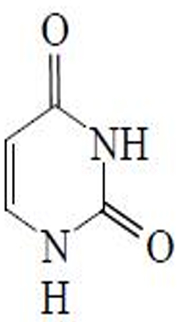
A
Adenine
B
Thymine
C
Uracil
D
Cytosine
Solution
(C) The given structure is a six-membered heterocyclic ring containing two nitrogen atoms at positions $1$ and $3$,and two carbonyl groups at positions $2$ and $4$. This structure is characteristic of $Uracil$.
$Adenine$ is a purine base.
$Thymine$ is $5-methyluracil$.
$Cytosine$ contains an amino group at position $4$ and a carbonyl group at position $2$.
$Adenine$ is a purine base.
$Thymine$ is $5-methyluracil$.
$Cytosine$ contains an amino group at position $4$ and a carbonyl group at position $2$.
0 likes
View Solution178
EasyMCQ
Identify the set containing purine and pyrimidine base of $DNA$ respectively.
A
Adenine,Uracil
B
Cytosine,Guanine
C
Thymine,Uracil
D
Adenine,Cytosine
Solution
(D) The nitrogenous bases in $DNA$ are classified into two categories: purines and pyrimidines.
Purines are double-ring structures,which include $Adenine$ $(A)$ and $Guanine$ $(G)$.
Pyrimidines are single-ring structures,which include $Cytosine$ $(C)$ and $Thymine$ $(T)$ in $DNA$.
Therefore,the set containing a purine followed by a pyrimidine base of $DNA$ is $Adenine$ and $Cytosine$.
Purines are double-ring structures,which include $Adenine$ $(A)$ and $Guanine$ $(G)$.
Pyrimidines are single-ring structures,which include $Cytosine$ $(C)$ and $Thymine$ $(T)$ in $DNA$.
Therefore,the set containing a purine followed by a pyrimidine base of $DNA$ is $Adenine$ and $Cytosine$.
0 likes
View Solution179
MediumMCQ
Given below are two statements:
Statement $I$: Cytosine and guanine are formed in equal quantities in $DNA$ hydrolysis.
Statement $II$: Adenine and uracil are formed in equal quantities in $RNA$ hydrolysis.
The correct answer is:
Statement $I$: Cytosine and guanine are formed in equal quantities in $DNA$ hydrolysis.
Statement $II$: Adenine and uracil are formed in equal quantities in $RNA$ hydrolysis.
The correct answer is:
A
Statements $I$ and $II$ both are correct
B
Statements $I$ and $II$ both are incorrect
C
Statement $I$ is correct but statement $II$ is incorrect
D
Statement $I$ is incorrect but statement $II$ is correct
Solution
(C) Chargaff's rule states that in the $DNA$ of any species,the amount of guanine $(G)$ is equal to the amount of cytosine $(C)$,and the amount of adenine $(A)$ is equal to the amount of thymine $(T)$.
Statement $I$ is correct because $G = C$ in $DNA$.
Statement $II$ is incorrect because in $RNA$,adenine pairs with uracil,but there is no fixed stoichiometric rule stating their quantities must be equal in the total hydrolysate of $RNA$ as there is for $DNA$ base pairing.
Therefore,statement $I$ is correct but statement $II$ is incorrect.
Statement $I$ is correct because $G = C$ in $DNA$.
Statement $II$ is incorrect because in $RNA$,adenine pairs with uracil,but there is no fixed stoichiometric rule stating their quantities must be equal in the total hydrolysate of $RNA$ as there is for $DNA$ base pairing.
Therefore,statement $I$ is correct but statement $II$ is incorrect.
0 likes
View Solution180
EasyMCQ
Given below are two statements:
Assertion $(A)$: Hydrolysis of $DNA$ does not form equal number of $A$ and $T$; $G$ and $C$.
Reason $(R)$: In $DNA$,adenine forms hydrogen bonds with thymine and cytosine forms hydrogen bonds with guanine.
The correct answer is:
Assertion $(A)$: Hydrolysis of $DNA$ does not form equal number of $A$ and $T$; $G$ and $C$.
Reason $(R)$: In $DNA$,adenine forms hydrogen bonds with thymine and cytosine forms hydrogen bonds with guanine.
The correct answer is:
A
Both $A$ and $R$ are correct and $R$ is the correct explanation of $A$.
B
Both $A$ and $R$ are correct but $R$ is not the correct explanation of $A$.
C
$A$ is correct but $R$ is incorrect.
D
$A$ is incorrect but $R$ is correct.
Solution
(D) According to Chargaff's rule,in a double-stranded $DNA$ molecule,the amount of adenine $(A)$ is equal to the amount of thymine $(T)$,and the amount of guanine $(G)$ is equal to the amount of cytosine $(C)$.
This is because $A$ pairs with $T$ via two hydrogen bonds,and $G$ pairs with $C$ via three hydrogen bonds.
Therefore,the Assertion $(A)$ is incorrect because hydrolysis of $DNA$ yields equal amounts of $A$ and $T$,and $G$ and $C$.
The Reason $(R)$ is correct as it describes the base-pairing mechanism.
Thus,the correct option is $D$.
This is because $A$ pairs with $T$ via two hydrogen bonds,and $G$ pairs with $C$ via three hydrogen bonds.
Therefore,the Assertion $(A)$ is incorrect because hydrolysis of $DNA$ yields equal amounts of $A$ and $T$,and $G$ and $C$.
The Reason $(R)$ is correct as it describes the base-pairing mechanism.
Thus,the correct option is $D$.
0 likes
View Solution181
MediumMCQ
In a nucleoside,the base is attached to which position of the sugar molecule?
A
$C-1'$
B
$C-2'$
C
$C-3'$
D
$C-5'$
Solution
(A) nucleoside is formed by the attachment of a nitrogenous base to the $1'$ position of a pentose sugar through an $N$-glycosidic linkage.
As shown in the structure,the nitrogenous base is attached to the $C-1'$ carbon atom of the sugar molecule.
As shown in the structure,the nitrogenous base is attached to the $C-1'$ carbon atom of the sugar molecule.
0 likes
View Solution182
MediumMCQ
Which of the following bases are present both in $DNA$ and $RNA$?
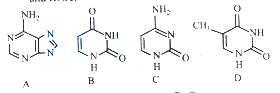
A
$A, C$
B
$B, C$
C
$A, B$
D
$A, D$
Solution
(A) In the given structures:
$A$ is Adenine,$B$ is Uracil,$C$ is Cytosine,and $D$ is Thymine.
Adenine $(A)$,Guanine $(G)$,and Cytosine $(C)$ are present in both $DNA$ and $RNA$.
Thymine $(T)$ is present only in $DNA$,and Uracil $(U)$ is present only in $RNA$.
Therefore,the bases present in both are Adenine $(A)$ and Cytosine $(C)$.
$A$ is Adenine,$B$ is Uracil,$C$ is Cytosine,and $D$ is Thymine.
Adenine $(A)$,Guanine $(G)$,and Cytosine $(C)$ are present in both $DNA$ and $RNA$.
Thymine $(T)$ is present only in $DNA$,and Uracil $(U)$ is present only in $RNA$.
Therefore,the bases present in both are Adenine $(A)$ and Cytosine $(C)$.
0 likes
View Solution183
EasyMCQ
Which of the following correctly represents hydrogen bonded pairs in $DNA$?
A
$G \equiv C ; T=A$
B
$G=C ; T=A$
C
$G \equiv C ; T \equiv A$
D
$G \equiv C ; T=A$
Solution
(A) In $DNA$,the nitrogenous bases form specific hydrogen-bonded pairs.
Adenine $(A)$ pairs with Thymine $(T)$ through two hydrogen bonds $(A=T)$.
Guanine $(G)$ pairs with Cytosine $(C)$ through three hydrogen bonds $(G \equiv C)$.
Thus,the correct representation is $G \equiv C$ and $T=A$.
Adenine $(A)$ pairs with Thymine $(T)$ through two hydrogen bonds $(A=T)$.
Guanine $(G)$ pairs with Cytosine $(C)$ through three hydrogen bonds $(G \equiv C)$.
Thus,the correct representation is $G \equiv C$ and $T=A$.
0 likes
View Solution184
EasyMCQ
Which of the following is not a type of $RNA$?
A
$m$-$RNA$
B
$d$-$RNA$
C
$t$-$RNA$
D
$r$-$RNA$
Solution
(B) There are three main types of $RNA$ involved in protein synthesis: $m$-$RNA$ (messenger $RNA$),$t$-$RNA$ (transfer $RNA$),and $r$-$RNA$ (ribosomal $RNA$).
$d$-$RNA$ is not a recognized type of $RNA$.
$d$-$RNA$ is not a recognized type of $RNA$.
0 likes
View Solution185
EasyMCQ
Hydrolysis of nucleic acid gives nitrogenous base,sugar and......
A
sulphuric acid
B
phosphorous acid
C
sulphurous acid
D
phosphoric acid
Solution
(D) Complete hydrolysis of nucleic acids ($DNA$ or $RNA$) yields three components: a nitrogenous base,a pentose sugar (ribose or deoxyribose),and phosphoric acid $(H_3PO_4)$.
0 likes
View Solution186
EasyMCQ
Hydrolysis of which of the following nucleic acids does not give an equal number of $A$ and $T$ or $G$ and $C$?
$(A)$ $m$-$RNA$
$(B)$ Single strand $DNA$
$(C)$ $r$-$RNA$
$(D)$ Double helix $DNA$
$(A)$ $m$-$RNA$
$(B)$ Single strand $DNA$
$(C)$ $r$-$RNA$
$(D)$ Double helix $DNA$
A
$(A)$,$(B)$,$(C)$
B
$(B)$,$(C)$,$(D)$
C
$(B)$ only
D
$(A)$ only
Solution
(A) According to Chargaff's rule,the amount of adenine $(A)$ is equal to the amount of thymine $(T)$,and the amount of guanine $(G)$ is equal to the amount of cytosine $(C)$ only in double-stranded $DNA$.
$m$-$RNA$,$r$-$RNA$,and single-stranded $DNA$ are single-stranded molecules.
Therefore,they do not follow Chargaff's rule and do not yield an equal number of $A$ and $T$ or $G$ and $C$ upon hydrolysis.
Thus,$(A)$,$(B)$,and $(C)$ do not give equal numbers of these bases.
$m$-$RNA$,$r$-$RNA$,and single-stranded $DNA$ are single-stranded molecules.
Therefore,they do not follow Chargaff's rule and do not yield an equal number of $A$ and $T$ or $G$ and $C$ upon hydrolysis.
Thus,$(A)$,$(B)$,and $(C)$ do not give equal numbers of these bases.
0 likes
View Solution187
MediumMCQ
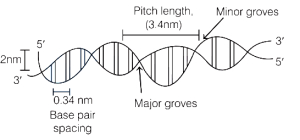
$DNA$ consists of two polynucleotide chains. Each chain forms a right-handed spiral with how many bases in one turn of the spiral?
A
$4$
B
$6$
C
$8$
D
$10$
Solution
(D) Watson and Crick proposed that the $DNA$ molecule is in the form of a double helix with two polynucleotide chains coiled around one another in a spiral.
This is known as $B-DNA$ or biological $DNA$.
It has $10$ nucleotide pairs per turn of the double helix and is right-handed with a diameter of $20 \mathring{A}$.
One complete turn of the double helix is $34 \mathring{A}$.
The distance between adjacent stacks or nucleotides is $3.4 \mathring{A}$.
Hence,option $(D)$ is correct.
This is known as $B-DNA$ or biological $DNA$.
It has $10$ nucleotide pairs per turn of the double helix and is right-handed with a diameter of $20 \mathring{A}$.
One complete turn of the double helix is $34 \mathring{A}$.
The distance between adjacent stacks or nucleotides is $3.4 \mathring{A}$.
Hence,option $(D)$ is correct.
0 likes
View Solution188
MediumMCQ
Which of the following statements about $DNA$ is not correct?
A
It has a double helix structure
B
Adenine forms hydrogen bonds with thymine and cytosine forms hydrogen bonds with guanine
C
The two strands in a $DNA$ molecule are not complementary to each other
D
It contains the pentose sugar,$2$-deoxyribose
Solution
(C) $I$. $DNA$ has a double helix structure.
$II$. Adenine forms hydrogen bonds with thymine $(A=T)$ and cytosine forms hydrogen bonds with guanine $(C \equiv G)$.
$III$. The two strands in $DNA$ molecules are complementary to each other.
$IV$. $DNA$ strand contains pentose $2$-deoxyribose sugar.
Thus,option $(C)$ is incorrect.
$II$. Adenine forms hydrogen bonds with thymine $(A=T)$ and cytosine forms hydrogen bonds with guanine $(C \equiv G)$.
$III$. The two strands in $DNA$ molecules are complementary to each other.
$IV$. $DNA$ strand contains pentose $2$-deoxyribose sugar.
Thus,option $(C)$ is incorrect.
0 likes
View Solution189
EasyMCQ
The type of bond connecting two nucleotides is
A
peptide bond
B
hydrogen bond
C
phosphodiester bond
D
glycosidic bond
Solution
(C) $DNA$ is a polynucleotide chain where nucleotides are joined by phosphodiester bonds.
These bonds are strong covalent linkages between the phosphate group of one nucleotide and the sugar molecule of the adjacent nucleotide.
Specifically,the phosphate group connects the $5'$-carbon of one deoxyribose sugar to the $3'$-carbon of the next deoxyribose sugar.
These bonds are strong covalent linkages between the phosphate group of one nucleotide and the sugar molecule of the adjacent nucleotide.
Specifically,the phosphate group connects the $5'$-carbon of one deoxyribose sugar to the $3'$-carbon of the next deoxyribose sugar.
0 likes
View Solution190
EasyMCQ
The number of hydrogen bonds between guanine and cytosine; and between adenine and thymine in $DNA$ is
A
$3, 2$
B
$2, 3$
C
$3, 1$
D
$2, 1$
Solution
(A) In $DNA$,the nitrogenous bases pair specifically through hydrogen bonds.
$G$ (guanine) pairs with $C$ (cytosine) via $3$ hydrogen bonds $(G \equiv C)$.
$A$ (adenine) pairs with $T$ (thymine) via $2$ hydrogen bonds $(A = T)$.
Therefore,the number of hydrogen bonds between guanine and cytosine is $3$,and between adenine and thymine is $2$.
$G$ (guanine) pairs with $C$ (cytosine) via $3$ hydrogen bonds $(G \equiv C)$.
$A$ (adenine) pairs with $T$ (thymine) via $2$ hydrogen bonds $(A = T)$.
Therefore,the number of hydrogen bonds between guanine and cytosine is $3$,and between adenine and thymine is $2$.
0 likes
View Solution191
EasyMCQ
Assertion $(A)$: Adenine and guanine are present in $RNA$ as purine bases.
Reason $(R)$: The base uracil is present in $RNA$.
The correct option among the following is:
Reason $(R)$: The base uracil is present in $RNA$.
The correct option among the following is:
A
$(A)$ is true,$(R)$ is true and $(R)$ is the correct explanation for $(A)$.
B
$(A)$ is true,$(R)$ is true but $(R)$ is not the correct explanation for $(A)$.
C
$(A)$ is true but $(R)$ is false.
D
$(A)$ is false but $(R)$ is true.
Solution
(B) $RNA$ contains four nitrogenous bases:
$1$. The purines: Adenine $(A)$ and Guanine $(G)$.
$2$. The pyrimidines: Cytosine $(C)$ and Uracil $(U)$.
Both the Assertion $(A)$ and Reason $(R)$ are factually correct statements.
However,the presence of uracil in $RNA$ does not explain why adenine and guanine are purine bases.
Therefore,$(R)$ is not the correct explanation for $(A)$.
$1$. The purines: Adenine $(A)$ and Guanine $(G)$.
$2$. The pyrimidines: Cytosine $(C)$ and Uracil $(U)$.
Both the Assertion $(A)$ and Reason $(R)$ are factually correct statements.
However,the presence of uracil in $RNA$ does not explain why adenine and guanine are purine bases.
Therefore,$(R)$ is not the correct explanation for $(A)$.
0 likes
View Solution192
EasyMCQ
The number of complementary hydrogen bond$(s)$ between a guanine and cytosine pair is
A
$2$
B
$1$
C
$4$
D
$3$
Solution
(D) In $DNA$,adenine $(A)$ pairs with thymine $(T)$ through $2$ hydrogen bonds $(A=T)$.
In contrast,guanine $(G)$ pairs with cytosine $(C)$ through $3$ hydrogen bonds $(G \equiv C)$.
In contrast,guanine $(G)$ pairs with cytosine $(C)$ through $3$ hydrogen bonds $(G \equiv C)$.
0 likes
View Solution193
DifficultMCQ
Identify the nucleoside from the following:
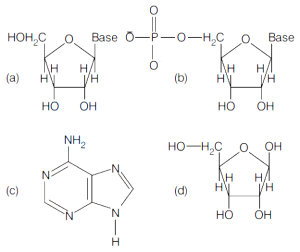
A
$(a)$
B
$(b)$
C
$(c)$
D
$(d)$
Solution
(A) nucleoside is formed by the attachment of a nitrogenous base to the $1^{\prime}$ position of a pentose sugar.
Structure $(a)$ represents a pentose sugar attached to a nitrogenous base,which is the definition of a nucleoside.
Structure $(b)$ represents a nucleotide (nucleoside + phosphate group).
Structure $(c)$ represents a nitrogenous base (adenine).
Structure $(d)$ represents a pentose sugar (ribose).
Structure $(a)$ represents a pentose sugar attached to a nitrogenous base,which is the definition of a nucleoside.
Structure $(b)$ represents a nucleotide (nucleoside + phosphate group).
Structure $(c)$ represents a nitrogenous base (adenine).
Structure $(d)$ represents a pentose sugar (ribose).
0 likes
View Solution194
MediumMCQ
The number of hydrogen bonds between guanine and cytosine; and between adenine and thymine in $DNA$ is
A
$1, 2$
B
$3, 2$
C
$3, 1$
D
$2, 1$
Solution
(B) In the $DNA$ double helix,the nitrogenous bases pair specifically through hydrogen bonds.
Guanine $(G)$ pairs with cytosine $(C)$ via three hydrogen bonds $(G \equiv C)$.
Adenine $(A)$ pairs with thymine $(T)$ via two hydrogen bonds $(A = T)$.
Therefore,the number of hydrogen bonds between guanine and cytosine is $3$,and between adenine and thymine is $2$.
Guanine $(G)$ pairs with cytosine $(C)$ via three hydrogen bonds $(G \equiv C)$.
Adenine $(A)$ pairs with thymine $(T)$ via two hydrogen bonds $(A = T)$.
Therefore,the number of hydrogen bonds between guanine and cytosine is $3$,and between adenine and thymine is $2$.
0 likes
View Solution195
EasyMCQ
The $AT/GC$ ratio in human beings is (where $A = \text{adenine}$,$T = \text{thymine}$,$G = \text{guanine}$,$C = \text{cytosine}$)
A
$1$
B
$1.52$
C
$9.3$
D
$2$
Solution
(B) The base composition of human $DNA$ varies,but the average ratio of $(A+T)/(G+C)$ in human beings is approximately $1.52$.
0 likes
View Solution196
EasyMCQ
Which one is not a constituent of nucleic acid?
A
Uracil
B
Guanidine
C
Phosphoric acid
D
Ribose sugar
Solution
(B) Nucleic acids ($DNA$ and $RNA$) are composed of three main components: a pentose sugar (ribose or deoxyribose),a phosphate group (derived from phosphoric acid),and nitrogenous bases (adenine,guanine,cytosine,thymine,or uracil).
$Guanidine$ is a chemical compound with the formula $HNC(NH_2)_2$,which is not a constituent of nucleic acids.
$Guanine$ is a nitrogenous base found in nucleic acids,whereas $Guanidine$ is not.
$Guanidine$ is a chemical compound with the formula $HNC(NH_2)_2$,which is not a constituent of nucleic acids.
$Guanine$ is a nitrogenous base found in nucleic acids,whereas $Guanidine$ is not.
0 likes
View Solution197
EasyMCQ
$ADP$ and $ATP$ differ in the number of
A
phosphate units
B
ribose units
C
adenine base
D
nitrogen atom
Solution
(A) $ADP$ stands for adenosine diphosphate,which contains $2$ phosphate groups.
$ATP$ stands for adenosine triphosphate,which contains $3$ phosphate groups.
Therefore,they differ in the number of phosphate units.
$ATP$ stands for adenosine triphosphate,which contains $3$ phosphate groups.
Therefore,they differ in the number of phosphate units.
0 likes
View SolutionBiomolecules — Nucleic Acids · Frequently Asked Questions
1Are these Biomolecules questions useful for JEE and NEET?
Yes. All questions in this section are mapped to JEE Main and NEET exam patterns. Previous year questions from JEE Main, NEET, GUJCET and state-level exams are included with full solutions.
2Can I switch to Hindi or Gujarati for these questions?
Yes. Use the language tabs in the hero section or the sidebar to view the same questions and solutions in English, Hindi or Gujarati.
3How do I generate a question paper from this subtopic?
Use the Vedclass Exam Paper Generator — select the chapter and subtopic, set difficulty, and generate Sets A, B, C, D automatically. First 3 chapters of every subject are free.
Vedclass Products
For Students
Vedclass Test Series
Mock tests in real JEE/NEET style with performance analysis. 5-day free trial.
Start Free TrialFor Teachers
Exam Paper Generator
Generate Set A/B/C/D papers from this chapter in 2 minutes. 3 chapters free.
Try FreeFor Institutes
Online Exam Module
Live online exams with unlimited students, 360° analytics & white-label branding.
See DemoFor Teachers & Institutes
Generate a Biomolecules Exam Paper in 2 Minutes
Select subtopic & difficulty — Sets A, B, C, D auto-generated with No Repeat logic.
First 3 chapters of every subject are free — no payment required.