
A English
Nucleic Acids Questions in English
Class 12 Chemistry · Biomolecules · Nucleic Acids
205+
Questions
English
Language
100%
With Solutions
Showing 49 of 205 questions in English
1
MediumMCQ
The pairs of bases in $DNA$ are held together by
A
Hydrogen bonds
B
Ionic bonds
C
Phosphate groups
D
Deoxyribose groups
Solution
(A) In $DNA$,the nitrogenous base pairs are held together by hydrogen bonds.
Adenine $(A)$ pairs with Thymine $(T)$ via $2$ hydrogen bonds,and Guanine $(G)$ pairs with Cytosine $(C)$ via $3$ hydrogen bonds.
These hydrogen bonds provide stability to the double-helical structure of $DNA$.
Adenine $(A)$ pairs with Thymine $(T)$ via $2$ hydrogen bonds,and Guanine $(G)$ pairs with Cytosine $(C)$ via $3$ hydrogen bonds.
These hydrogen bonds provide stability to the double-helical structure of $DNA$.
0 likes
View Solution2
EasyMCQ
$A$ nucleotide consists of
A
Base and sugar
B
Base and phosphate
C
Sugar and phosphate
D
Base,sugar and phosphate
Solution
(D) The correct answer is $D$.
$A$ nucleotide is composed of three components: a nitrogenous base,a pentose sugar,and a phosphate group.
The combination of a nitrogenous base and a sugar is known as a nucleoside.
Therefore,$\text{Nucleotide} = \text{Nucleoside} + \text{Phosphate} = (\text{Nitrogen base} + \text{Sugar}) + \text{Phosphate}$.
$A$ nucleotide is composed of three components: a nitrogenous base,a pentose sugar,and a phosphate group.
The combination of a nitrogenous base and a sugar is known as a nucleoside.
Therefore,$\text{Nucleotide} = \text{Nucleoside} + \text{Phosphate} = (\text{Nitrogen base} + \text{Sugar}) + \text{Phosphate}$.
0 likes
View Solution3
EasyMCQ
Which of the following is responsible for hereditary characters?
A
$DNA$
B
$RNA$
C
$Proteins$
D
$Hormones$
Solution
(A) $DNA$ (deoxyribonucleic acid) is the primary hereditary material in humans and almost all other organisms.
It carries the genetic instructions necessary for the development,functioning,growth,and reproduction of organisms.
The information in $DNA$ is stored as a code made up of four chemical bases: adenine $(A)$,guanine $(G)$,cytosine $(C)$,and thymine $(T)$.
It carries the genetic instructions necessary for the development,functioning,growth,and reproduction of organisms.
The information in $DNA$ is stored as a code made up of four chemical bases: adenine $(A)$,guanine $(G)$,cytosine $(C)$,and thymine $(T)$.
0 likes
View Solution4
EasyMCQ
The base adenine occurs in
A
$DNA$ only
B
$RNA$ only
C
$DNA$ and $RNA$ both
D
Protein
Solution
(C) Adenine is a purine base that is present in both $DNA$ and $RNA$ as a fundamental component of nucleotides.
0 likes
View Solution5
EasyMCQ
Which of the following statements about the assembly of nucleotides in a molecule of deoxyribose nucleic acid $(DNA)$ is correct?
A
$A$. $A$ pentose of one unit connects to a pentose of another
B
$B$. $A$ pentose of one unit connects to the base of another
C
$C$. $A$ phosphate of one unit connects to a pentose of another
D
$D$. $A$ phosphate of one unit connects to the base of another
Solution
(C) In a $DNA$ molecule,nucleotides are linked together by phosphodiester bonds.
Specifically,the $3'$-hydroxyl group of the pentose sugar of one nucleotide is linked to the $5'$-phosphate group of the next nucleotide.
Thus,the phosphate group of one unit connects to the pentose sugar of another unit.
Specifically,the $3'$-hydroxyl group of the pentose sugar of one nucleotide is linked to the $5'$-phosphate group of the next nucleotide.
Thus,the phosphate group of one unit connects to the pentose sugar of another unit.
0 likes
View Solution6
EasyMCQ
Which of the following is not a constituent of $RNA$?
A
Ribose
B
Phosphate
C
Adenine
D
Pyridine
Solution
(D) $RNA$ is composed of ribonucleotides.
Each ribonucleotide consists of a pentose sugar (ribose),a nitrogenous base ($Adenine$,$Guanine$,$Uracil$,or $Cytosine$),and a $Phosphate$ group.
$Pyridine$ is a heterocyclic organic compound and is not a constituent of $RNA$.
Each ribonucleotide consists of a pentose sugar (ribose),a nitrogenous base ($Adenine$,$Guanine$,$Uracil$,or $Cytosine$),and a $Phosphate$ group.
$Pyridine$ is a heterocyclic organic compound and is not a constituent of $RNA$.
0 likes
View Solution7
EasyMCQ
Which one is found in $ATP$ ribonucleotide?
A
Guanine
B
Uracil
C
Adenine
D
None of these
Solution
(C) $ATP$ stands for $Adenosine$ $Triphosphate$.
The structure of $ATP$ consists of an $Adenine$ base,a ribose sugar,and three phosphate groups.
Therefore,$Adenine$ is the nitrogenous base found in $ATP$.
The structure of $ATP$ consists of an $Adenine$ base,a ribose sugar,and three phosphate groups.
Therefore,$Adenine$ is the nitrogenous base found in $ATP$.
0 likes
View Solution8
EasyMCQ
Which substance is not present in nucleic acid?
A
Cytosine
B
Adenine
C
Thymine
D
Guanidine
Solution
(D) Guanidine is not present in nucleic acid. The four main nitrogenous bases found in nucleic acids are Cytosine,Adenine,Thymine,and Guanine.
Adenine and Guanine are purines,while Thymine and Cytosine are pyrimidines.
These bases,along with sugar and phosphate,form the components of $DNA$.
Guanidine is a distinct chemical compound with the formula $CH_5N_3$.
Adenine and Guanine are purines,while Thymine and Cytosine are pyrimidines.
These bases,along with sugar and phosphate,form the components of $DNA$.
Guanidine is a distinct chemical compound with the formula $CH_5N_3$.
0 likes
View Solution9
EasyMCQ
Which of the following is not present in nucleic acids?
A
Uracil
B
$2-$aminopyridine
C
Thymine
D
Adenine
Solution
(B) Nucleic acids ($DNA$ and $RNA$) contain nitrogenous bases such as Adenine,Guanine,Cytosine,Thymine,and Uracil.
$2-$aminopyridine is an organic compound with the formula $H_2NC_5H_4N$ and is not a component of nucleic acids.
Adenine and Guanine are purines,while Thymine,Cytosine,and Uracil are pyrimidines.
$2-$aminopyridine is an organic compound with the formula $H_2NC_5H_4N$ and is not a component of nucleic acids.
Adenine and Guanine are purines,while Thymine,Cytosine,and Uracil are pyrimidines.
0 likes
View Solution10
MediumMCQ
In nucleic acids,the sequence of the backbone components is
A
Base-phosphate-sugar
B
Phosphate-base-sugar
C
Sugar-base-phosphate
D
Sugar-phosphate-base
Solution
(D) Nucleic acids are polymers of nucleotides. Each nucleotide consists of a nitrogenous base,a pentose sugar,and a phosphate group.
In the structure of a nucleic acid,the backbone is formed by the alternating sequence of sugar and phosphate groups,while the nitrogenous bases are attached to the sugar units.
Therefore,the repeating unit in the backbone is sugar-phosphate,with the base attached to the sugar. Among the given options,the sequence of components in a nucleotide unit is often represented as sugar-phosphate-base (where the base is attached to the sugar). However,if referring to the backbone chain specifically,it is sugar-phosphate. Given the options provided,$D$ is the most appropriate representation of the structural arrangement.
In the structure of a nucleic acid,the backbone is formed by the alternating sequence of sugar and phosphate groups,while the nitrogenous bases are attached to the sugar units.
Therefore,the repeating unit in the backbone is sugar-phosphate,with the base attached to the sugar. Among the given options,the sequence of components in a nucleotide unit is often represented as sugar-phosphate-base (where the base is attached to the sugar). However,if referring to the backbone chain specifically,it is sugar-phosphate. Given the options provided,$D$ is the most appropriate representation of the structural arrangement.
0 likes
View Solution11
EasyMCQ
The segment of $DNA$ which acts as the instructional manual for the synthesis of the protein is
A
Nucleoside
B
Nucleotide
C
Ribose
D
Gene
Solution
(D) The segment of $DNA$ that acts as the instructional manual for the synthesis of a protein is called a $Gene$.
Every protein in a cell is encoded by a specific $Gene$.
Every protein in a cell is encoded by a specific $Gene$.
0 likes
View Solution12
EasyMCQ
The double helical structure of $DNA$ was proposed by
A
Watson and Crick
B
Meicher
C
Emil Fischer
D
Khorana
Solution
(A) The $3-dimensional$ double helical structure of $DNA$ was proposed by James Watson and Francis Crick in $1953$.
0 likes
View Solution13
EasyMCQ
$A$ segment of $DNA$ molecule which codes or specifies for one polypeptide chain is called:
A
Phosphate group
B
Adenine
C
Gene
D
Amino acid
Solution
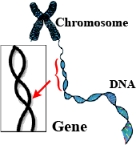
(C) The segment of $DNA$ molecules which codes or specifies for one polypeptide chain is called a gene.
$A$ gene is the basic physical and functional unit of heredity.
Genes,which are made up of $DNA$,act as instructions to make proteins.
They hold the information to build and maintain an organism's cells and pass genetic characters to offspring.
$A$ gene is the basic physical and functional unit of heredity.
Genes,which are made up of $DNA$,act as instructions to make proteins.
They hold the information to build and maintain an organism's cells and pass genetic characters to offspring.
0 likes
View Solution14
EasyMCQ
The structure of $DNA$ is
A
Linear
B
Single helix
C
Double helix
D
Triple helix
Solution
(C) $DNA$ has a double-helical structure.Its two strands are complementary to each other.Both strands of $DNA$ are antiparallel to one another.
0 likes
View Solution15
MediumMCQ
$A$ gene is a segment of a molecule of
A
$DNA$
B
$m-RNA$
C
$t-RNA$
D
Protein
Solution
(A) gene is defined as a specific segment of a $DNA$ molecule that contains the instructions to code for a particular protein or functional $RNA$ molecule.
0 likes
View Solution16
EasyMCQ
$DNA$ contains the sugar
A
Deoxyribose
B
Ribose
C
$D$-Fructose
D
$D$-Glucose
Solution
(A) The sugar present in $DNA$ is $2$-deoxy-$D$-ribose,commonly known as deoxyribose.
It contains one less hydroxyl group at the $2'$-position compared to the ribose sugar found in $RNA$.
It contains one less hydroxyl group at the $2'$-position compared to the ribose sugar found in $RNA$.
0 likes
View Solution17
EasyMCQ
The base present in $DNA$,but not in $RNA$ is
A
Guanine
B
Adenine
C
Uracil
D
Thymine
Solution
(D) $DNA$ contains the nitrogenous base Thymine $(T)$,whereas $RNA$ contains Uracil $(U)$ in its place.
Therefore,the base present in $DNA$ but not in $RNA$ is Thymine.
Therefore,the base present in $DNA$ but not in $RNA$ is Thymine.
0 likes
View Solution18
EasyMCQ
Mutation of $DNA$ occurs due to changes in the sequence of one of the following:
A
Bases
B
Ribose units
C
Phosphate units
D
Sugar units
Solution
(A) Mutation is a chemical change in the sequence of nitrogenous bases along the $DNA$ strand,which can lead to the synthesis of a protein with an altered amino acid sequence.
0 likes
View Solution19
EasyMCQ
Which of the following bases is a purine derivative?
A
Guanine
B
Cytosine
C
Thymine
D
Uracil
Solution
(A) The nitrogenous bases found in nucleic acids are classified into two types: purines and pyrimidines.
Purines consist of a bicyclic structure (a six-membered ring fused to a five-membered ring),which includes $Adenine$ and $Guanine$.
Pyrimidines consist of a single six-membered ring,which includes $Cytosine$,$Thymine$,and $Uracil$.
Therefore,$Guanine$ is a purine derivative.
Purines consist of a bicyclic structure (a six-membered ring fused to a five-membered ring),which includes $Adenine$ and $Guanine$.
Pyrimidines consist of a single six-membered ring,which includes $Cytosine$,$Thymine$,and $Uracil$.
Therefore,$Guanine$ is a purine derivative.
0 likes
View Solution20
MediumMCQ
$RNA$ is different from $DNA$ because $RNA$ contains
A
Ribose sugar and thymine
B
Ribose sugar and uracil
C
Deoxyribose sugar and thymine
D
Deoxyribose sugar and uracil
Solution
(B) $DNA$ contains $2$-deoxyribose sugar and the nitrogenous base thymine $(T)$.
$RNA$ contains ribose sugar and the nitrogenous base uracil $(U)$ instead of thymine.
Therefore,$RNA$ is characterized by the presence of ribose sugar and uracil.
$RNA$ contains ribose sugar and the nitrogenous base uracil $(U)$ instead of thymine.
Therefore,$RNA$ is characterized by the presence of ribose sugar and uracil.
0 likes
View Solution21
MediumMCQ
The function of $DNA$ in an organism is
A
To assist in the synthesis of $RNA$ molecule
B
To store information of heredity characteristics
C
To assist in the synthesis of proteins and polypeptides
D
All of these
Solution
(D) $DNA$ performs the following primary functions in an organism:
$(i)$ It acts as the template for the synthesis of $RNA$ molecules (transcription).
$(ii)$ It stores and transmits genetic information regarding heredity characteristics from one generation to the next.
$(iii)$ It provides the coded instructions necessary for the synthesis of proteins and polypeptides (translation).
Therefore,all of the given options are correct functions of $DNA$.
$(i)$ It acts as the template for the synthesis of $RNA$ molecules (transcription).
$(ii)$ It stores and transmits genetic information regarding heredity characteristics from one generation to the next.
$(iii)$ It provides the coded instructions necessary for the synthesis of proteins and polypeptides (translation).
Therefore,all of the given options are correct functions of $DNA$.
0 likes
View Solution22
MediumMCQ
Codon is present in
A
$t-RNA$
B
$m-RNA$
C
$r-RNA$
D
All of these
Solution
(B) codon is a sequence of three nucleotides in $m-RNA$ that codes for a specific amino acid during protein synthesis.
$t-RNA$ contains the anticodon,which is complementary to the codon on $m-RNA$.
$t-RNA$ contains the anticodon,which is complementary to the codon on $m-RNA$.
0 likes
View Solution23
EasyMCQ
Nucleic acid is a polymer of
A
Nucleosides
B
$\alpha-amino$ acids
C
Nucleotides
D
Glucose
Solution
(C) Nucleic acid is a polymer of nucleotides.
Nucleotides are the monomeric units that link together through phosphodiester bonds to form long chains of nucleic acids,such as $DNA$ and $RNA$.
Nucleotides are the monomeric units that link together through phosphodiester bonds to form long chains of nucleic acids,such as $DNA$ and $RNA$.
0 likes
View Solution24
EasyMCQ
An alteration in the base sequence of a nucleic acid molecule is called:
A
Replication
B
Mutation
C
Duplication
D
Dislocation
Solution
(B) An alteration in the base sequence of a nucleic acid molecule is called a mutation.
This can be caused by factors such as radioactive rays,chemical mutagens,or errors during $DNA$ replication.
This can be caused by factors such as radioactive rays,chemical mutagens,or errors during $DNA$ replication.
0 likes
View Solution25
MediumMCQ
The nucleic acid base having two possible binding sites is
A
Thymine
B
Cytosine
C
Guanine
D
Adenine
Solution
(C) $Guanine$ is the nucleic acid base that possesses two possible binding sites for hydrogen bonding in the context of base pairing,specifically involving the $N-H$ group and the carbonyl oxygen or nitrogen atoms.
0 likes
View Solution26
EasyMCQ
Chargaff's rule states that in an organism
A
Amounts of all bases are equal
B
Amount of adenine $(A)$ is equal to that of thymine $(T)$ and the amount of guanine $(G)$ is equal to that of cytosine $(C)$
C
Amount of adenine $(A)$ is equal to that of guanine $(G)$ and the amount of thymine $(T)$ is equal to that of cytosine $(C)$
D
Amount of adenine $(A)$ is equal to that of cytosine $(C)$ and the amount of thymine $(T)$ is equal to guanine $(G)$
Solution
(B) According to Chargaff's rule,the $DNA$ of any species from any organism should have a $1:1$ stoichiometric ratio of purine and pyrimidine bases.
Specifically,the amount of adenine $(A)$ is equal to that of thymine $(T)$,and the amount of guanine $(G)$ is equal to that of cytosine $(C)$.
Therefore,the correct option is $(B)$.
Specifically,the amount of adenine $(A)$ is equal to that of thymine $(T)$,and the amount of guanine $(G)$ is equal to that of cytosine $(C)$.
Therefore,the correct option is $(B)$.
0 likes
View Solution27
EasyMCQ
$DNA$ multiplication is called:
A
Translation
B
Transduction
C
Transcription
D
Replication
Solution
(D) The process of $DNA$ multiplication is known as replication.
During this process,a $DNA$ molecule makes an exact copy of itself.
During this process,a $DNA$ molecule makes an exact copy of itself.
0 likes
View Solution28
EasyMCQ
Which of the following is not a pyrimidine?
A
Uracil
B
Guanine
C
Cytosine
D
Thymine
Solution
(B) Nucleic acids contain two types of nitrogenous bases: purines and pyrimidines.
$1$. Purines include Adenine $(A)$ and Guanine $(G)$.
$2$. Pyrimidines include Cytosine $(C)$,Thymine $(T)$,and Uracil $(U)$.
Therefore,Guanine is a purine,not a pyrimidine.
$1$. Purines include Adenine $(A)$ and Guanine $(G)$.
$2$. Pyrimidines include Cytosine $(C)$,Thymine $(T)$,and Uracil $(U)$.
Therefore,Guanine is a purine,not a pyrimidine.
0 likes
View Solution29
MediumMCQ
Which of the following is not a purine?
A
Adenine
B
Guanine
C
Caffeine
D
Cytosine
Solution
(D) Nucleic acids contain two types of nitrogenous bases: purines and pyrimidines.
$1$. Purines include $Adenine$ and $Guanine$.
$2$. Pyrimidines include $Cytosine$,$Thymine$,and $Uracil$.
$Caffeine$ is a xanthine alkaloid,which is a derivative of purine,but it is not one of the standard nitrogenous bases found in nucleic acids.
However,among the given options,$Cytosine$ is a pyrimidine,not a purine. Therefore,$Cytosine$ is the correct answer as it is a pyrimidine.
$1$. Purines include $Adenine$ and $Guanine$.
$2$. Pyrimidines include $Cytosine$,$Thymine$,and $Uracil$.
$Caffeine$ is a xanthine alkaloid,which is a derivative of purine,but it is not one of the standard nitrogenous bases found in nucleic acids.
However,among the given options,$Cytosine$ is a pyrimidine,not a purine. Therefore,$Cytosine$ is the correct answer as it is a pyrimidine.
0 likes
View Solution30
EasyMCQ
Which base is present in $RNA$ but absent in $DNA$?
A
Uracil
B
Cytosine
C
Guanine
D
Thymine
Solution
(A) $DNA$ contains the bases adenine,guanine,cytosine,and thymine.
$RNA$ contains the bases adenine,guanine,cytosine,and uracil.
Therefore,uracil is present in $RNA$ but absent in $DNA$.
$RNA$ contains the bases adenine,guanine,cytosine,and uracil.
Therefore,uracil is present in $RNA$ but absent in $DNA$.
0 likes
View Solution31
EasyMCQ
Which pyrimidine bases are present in $DNA$?
A
Cytosine and Adenine
B
Cytosine and Guanine
C
Cytosine and Thymine
D
Cytosine and Uracil
Solution
(C) $DNA$ (Deoxyribonucleic acid) contains four nitrogenous bases: Adenine $(A)$,Guanine $(G)$,Cytosine $(C)$,and Thymine $(T)$.
These bases are classified into two categories: Purines and Pyrimidines.
Purines include Adenine $(A)$ and Guanine $(G)$.
Pyrimidines include Cytosine $(C)$ and Thymine $(T)$.
Therefore,the pyrimidine bases present in $DNA$ are Cytosine and Thymine.
These bases are classified into two categories: Purines and Pyrimidines.
Purines include Adenine $(A)$ and Guanine $(G)$.
Pyrimidines include Cytosine $(C)$ and Thymine $(T)$.
Therefore,the pyrimidine bases present in $DNA$ are Cytosine and Thymine.
0 likes
View Solution32
EasyMCQ
Which of the following is not a constituent of nucleic acids?
A
Uracil
B
Guanidine
C
Phosphoric acid
D
Ribose sugar
Solution
(B) Nucleic acids ($DNA$ and $RNA$) are composed of three main components: a pentose sugar (ribose or deoxyribose),a nitrogenous base (adenine,guanine,cytosine,thymine,or uracil),and phosphoric acid. $Guanidine$ is not a constituent of nucleic acids.
0 likes
View Solution33
EasyMCQ
The complementary bases in $DNA$ are .......
A
Uracil and Adenine : Cytosine and Guanine
B
Adenine and Thymine : Guanine and Cytosine
C
Adenine and Thymine : Guanine and Uracil
D
Adenine and Guanine : Thymine and Cytosine
Solution
(B) In $DNA$ molecules,the nitrogenous bases pair specifically according to Chargaff's rules.
Adenine $(A)$ always pairs with Thymine $(T)$ via two hydrogen bonds.
Guanine $(G)$ always pairs with Cytosine $(C)$ via three hydrogen bonds.
Therefore,the complementary base pairs are $A-T$ and $G-C$.
Adenine $(A)$ always pairs with Thymine $(T)$ via two hydrogen bonds.
Guanine $(G)$ always pairs with Cytosine $(C)$ via three hydrogen bonds.
Therefore,the complementary base pairs are $A-T$ and $G-C$.
0 likes
View Solution34
EasyMCQ
Which base is present in $RNA$ instead of $Thymine$?
A
Uracil
B
Cytosine
C
Guanine
D
Adenine
Solution
(A) In $DNA$,the four nitrogenous bases are $Adenine$ $(A)$,$Guanine$ $(G)$,$Cytosine$ $(C)$,and $Thymine$ $(T)$.
In $RNA$,$Thymine$ is replaced by $Uracil$ $(U)$.
Therefore,the correct answer is $Uracil$.
In $RNA$,$Thymine$ is replaced by $Uracil$ $(U)$.
Therefore,the correct answer is $Uracil$.
0 likes
View Solution35
EasyMCQ
The base adenine is found in ........
A
Only $DNA$
B
Only $RNA$
C
Both $DNA$ and $RNA$
D
Protein
Solution
(C) Adenine $(A)$ is a purine base that serves as a fundamental component of nucleic acids. It is present in both $DNA$ (deoxyribonucleic acid) and $RNA$ (ribonucleic acid),where it forms base pairs with thymine $(T)$ in $DNA$ and uracil $(U)$ in $RNA$.
0 likes
View Solution36
EasyMCQ
In the sugar that differentiates $RNA$ from $DNA$,the presence or absence of the $-OH$ group occurs at which carbon atom?
A
$1$
B
$2$
C
$3$
D
$4$
Solution
(B) $DNA$ stands for Deoxyribonucleic acid and $RNA$ stands for Ribonucleic acid.
In $RNA$,the sugar is ribose,which has an $-OH$ group at the $2'$-carbon position.
In $DNA$,the sugar is $2$-deoxyribose,which lacks the $-OH$ group at the $2'$-carbon position (it has only an $-H$ atom there).
Therefore,the difference in the sugar structure is at the $2'$-carbon atom.
In $RNA$,the sugar is ribose,which has an $-OH$ group at the $2'$-carbon position.
In $DNA$,the sugar is $2$-deoxyribose,which lacks the $-OH$ group at the $2'$-carbon position (it has only an $-H$ atom there).
Therefore,the difference in the sugar structure is at the $2'$-carbon atom.
0 likes
View Solution37
MediumMCQ
The difference between $DNA$ and $RNA$ is based on the presence or absence of a hydroxyl group at which carbon atom of the sugar molecule?
A
$3^{rd}$
B
$4^{th}$
C
$1^{st}$
D
$2^{nd}$
Solution
(D) In $DNA$ (Deoxyribonucleic acid),the sugar is $2$-deoxyribose,which lacks a hydroxyl $(-OH)$ group at the $2^{nd}$ carbon position.
In $RNA$ (Ribonucleic acid),the sugar is ribose,which contains a hydroxyl $(-OH)$ group at the $2^{nd}$ carbon position.
Therefore,the structural difference between the sugars of $DNA$ and $RNA$ is at the $2^{nd}$ carbon atom.
In $RNA$ (Ribonucleic acid),the sugar is ribose,which contains a hydroxyl $(-OH)$ group at the $2^{nd}$ carbon position.
Therefore,the structural difference between the sugars of $DNA$ and $RNA$ is at the $2^{nd}$ carbon atom.
0 likes
View Solution38
EasyMCQ
The double-helical structure of $DNA$ is due to the action of . . . . . . .
A
Van der Waals forces
B
Dipole-dipole attraction
C
Hydrogen bonding
D
Electrostatic attraction
Solution
(C) The double-helical structure of $DNA$ is stabilized primarily by hydrogen bonding between the complementary nitrogenous bases ($Adenine$ with $Thymine$ and $Guanine$ with $Cytosine$).
These hydrogen bonds hold the two strands of the $DNA$ double helix together.
These hydrogen bonds hold the two strands of the $DNA$ double helix together.
0 likes
View Solution39
EasyMCQ
Which of the following base pairing is correct in a nucleotide sequence?
A
$A - T, G - C$
B
$A - G, T - C$
C
$G - T, A - C$
D
$A - A, T - T$
Solution
(A) In the structure of $DNA$,the nitrogenous bases follow Chargaff's rule of base pairing.
According to this rule,Adenine $(A)$ always pairs with Thymine $(T)$ via two hydrogen bonds,and Guanine $(G)$ always pairs with Cytosine $(C)$ via three hydrogen bonds.
Therefore,the correct base pairing is $A - T$ and $G - C$.
According to this rule,Adenine $(A)$ always pairs with Thymine $(T)$ via two hydrogen bonds,and Guanine $(G)$ always pairs with Cytosine $(C)$ via three hydrogen bonds.
Therefore,the correct base pairing is $A - T$ and $G - C$.
0 likes
View Solution40
EasyMCQ
In $DNA$ and $RNA$,the heterocyclic base and phosphate ester are attached to which carbons of the sugar molecule,respectively?
A
$C_5$ and $C_2$
B
$C_2$ and $C_3$
C
$C_1$ and $C_5$
D
$C_5$ and $C_1$
Solution
(C) In the structure of nucleotides,which are the building blocks of $DNA$ and $RNA$,the sugar molecule is a pentose sugar (deoxyribose or ribose).
The heterocyclic nitrogenous base is attached to the $C_1$ position of the sugar via an $N$-glycosidic linkage.
The phosphate group is attached to the $C_5$ position of the sugar via a phosphoester linkage.
Therefore,the base is at $C_1$ and the phosphate ester is at $C_5$.
The heterocyclic nitrogenous base is attached to the $C_1$ position of the sugar via an $N$-glycosidic linkage.
The phosphate group is attached to the $C_5$ position of the sugar via a phosphoester linkage.
Therefore,the base is at $C_1$ and the phosphate ester is at $C_5$.
0 likes
View Solution41
EasyMCQ
Which of the following bases are present in both $DNA$ and $RNA$?
A
Adenine,Uracil,Thymine
B
Adenine,Guanine,Cytosine
C
Adenine,Guanine,Uracil
D
Adenine,Guanine,Thymine
Solution
(B) $DNA$ contains the nitrogenous bases Adenine $(A)$,Guanine $(G)$,Cytosine $(C)$,and Thymine $(T)$.
$RNA$ contains the nitrogenous bases Adenine $(A)$,Guanine $(G)$,Cytosine $(C)$,and Uracil $(U)$.
Comparing both,the common bases present in both $DNA$ and $RNA$ are Adenine,Guanine,and Cytosine.
$RNA$ contains the nitrogenous bases Adenine $(A)$,Guanine $(G)$,Cytosine $(C)$,and Uracil $(U)$.
Comparing both,the common bases present in both $DNA$ and $RNA$ are Adenine,Guanine,and Cytosine.
0 likes
View Solution42
EasyMCQ
$DNA$ contains a base that is not present in $RNA$. Identify it.
A
Guanine
B
Adenine
C
Uracil
D
Thymine
Solution
(D) $DNA$ contains the nitrogenous base $Thymine$ $(5-methyluracil)$,whereas $RNA$ contains $Uracil$ in its place. Therefore,$Thymine$ is the base present in $DNA$ but not in $RNA$.
0 likes
View Solution43
EasyMCQ
Who proposed the double-helix structure of $DNA$?
A
Emil Fischer
B
Watson and Crick
C
Dr. Khorana
D
Malaika and Sirlos
Solution
(B) The double-helix structure of $DNA$ was proposed by James Watson and Francis Crick in $1953$. This model explains the base pairing and the helical nature of the $DNA$ molecule.
0 likes
View Solution44
EasyMCQ
When two nucleotides are linked together by a phosphodiester bond to form a dinucleotide,which carbon atoms of the pentose sugar of the nucleotides are involved in the linkage?
A
$5'$ and $3'$
B
$1'$ and $5'$
C
$5'$ and $5'$
D
$3'$ and $3'$
Solution
(A) In a polynucleotide chain,a phosphodiester linkage is formed between the $3'$-$OH$ group of the pentose sugar of one nucleotide and the $5'$-phosphate group of the adjacent nucleotide.
Therefore,the linkage involves the $3'$ carbon of one sugar and the $5'$ carbon of the other.
Therefore,the linkage involves the $3'$ carbon of one sugar and the $5'$ carbon of the other.
0 likes
View Solution45
EasyMCQ
The sequence in nucleic acids is .......
A
Phosphate-Base-Sugar
B
Sugar-Base-Phosphate
C
Base-Sugar-Phosphate
D
Base-Phosphate-Sugar
Solution
(C) In nucleic acids ($DNA$ and $RNA$),the fundamental unit is a nucleotide.
$A$ nucleotide consists of three components: a nitrogenous base,a pentose sugar (ribose or deoxyribose),and a phosphate group.
The nitrogenous base is attached to the $1'$ position of the sugar,and the phosphate group is attached to the $5'$ position of the sugar.
Thus,the structural sequence in a nucleotide unit is $Base-Sugar-Phosphate$.
$A$ nucleotide consists of three components: a nitrogenous base,a pentose sugar (ribose or deoxyribose),and a phosphate group.
The nitrogenous base is attached to the $1'$ position of the sugar,and the phosphate group is attached to the $5'$ position of the sugar.
Thus,the structural sequence in a nucleotide unit is $Base-Sugar-Phosphate$.
0 likes
View Solution46
EasyMCQ
In $DNA$,the base units are linked by which of the following?
A
Hydrogen bonds
B
Electrostatic bonds
C
Covalent bonds
D
Van der Waals forces
Solution
(A) In the structure of $DNA$,the two strands are held together by hydrogen bonds between the complementary nitrogenous bases. Adenine $(A)$ pairs with Thymine $(T)$ via two hydrogen bonds,and Guanine $(G)$ pairs with Cytosine $(C)$ via three hydrogen bonds.
0 likes
View Solution47
EasyMCQ
What is the unit of base-sugar-phosphate in nucleic acids called?
A
Nucleotide
B
Nucleoside
C
Phosphotide
D
None of these
Solution
(A) In nucleic acids,a unit consisting of a nitrogenous base,a pentose sugar,and a phosphate group is known as a $Nucleotide$.
$A$ $Nucleoside$ consists only of a nitrogenous base attached to a pentose sugar.
$A$ $Nucleoside$ consists only of a nitrogenous base attached to a pentose sugar.
0 likes
View Solution48
EasyMCQ
Which statement is correct for the nucleotides of $DNA$?
A
One pentose is linked to another pentose.
B
One unit of pentose is linked to the base of another.
C
One unit of phosphate is linked to the pentose of another.
D
One unit of phosphate is linked to the base of another.
Solution
(C) In $DNA$,nucleotides are linked together by phosphodiester bonds.
Specifically,the $5'$-phosphate group of one nucleotide is linked to the $3'$-hydroxyl group of the pentose sugar of the next nucleotide.
This forms the sugar-phosphate backbone of the $DNA$ strand.
Specifically,the $5'$-phosphate group of one nucleotide is linked to the $3'$-hydroxyl group of the pentose sugar of the next nucleotide.
This forms the sugar-phosphate backbone of the $DNA$ strand.
0 likes
View Solution49
MediumMCQ
The process of $DNA$ replication is known as........
A
Translation
B
Transduction
C
Transcription
D
Replication
Solution
(D) The process of $DNA$ duplication or copying is known as $Replication$.
0 likes
View SolutionBiomolecules — Nucleic Acids · Frequently Asked Questions
1Are these Biomolecules questions useful for JEE and NEET?
Yes. All questions in this section are mapped to JEE Main and NEET exam patterns. Previous year questions from JEE Main, NEET, GUJCET and state-level exams are included with full solutions.
2Can I switch to Hindi or Gujarati for these questions?
Yes. Use the language tabs in the hero section or the sidebar to view the same questions and solutions in English, Hindi or Gujarati.
3How do I generate a question paper from this subtopic?
Use the Vedclass Exam Paper Generator — select the chapter and subtopic, set difficulty, and generate Sets A, B, C, D automatically. First 3 chapters of every subject are free.
Vedclass Products
For Students
Vedclass Test Series
Mock tests in real JEE/NEET style with performance analysis. 5-day free trial.
Start Free TrialFor Teachers
Exam Paper Generator
Generate Set A/B/C/D papers from this chapter in 2 minutes. 3 chapters free.
Try FreeFor Institutes
Online Exam Module
Live online exams with unlimited students, 360° analytics & white-label branding.
See DemoFor Teachers & Institutes
Generate a Biomolecules Exam Paper in 2 Minutes
Select subtopic & difficulty — Sets A, B, C, D auto-generated with No Repeat logic.
First 3 chapters of every subject are free — no payment required.