
A English
Asexual reproduction/Vegetative propagation Questions in English
Class 12 Biology · Reproduction in Organisms · Asexual reproduction/Vegetative propagation
236+
Questions
English
Language
100%
With Solutions
Showing 50 of 236 questions in English
101
Medium
Distinguish between: Natural and Artificial Vegetative Propagation.
Solution
(N/A)
| Natural Vegetative Propagation | Artificial Vegetative Propagation |
|---|---|
| $(1)$ It is a natural method of vegetative propagation occurring in the environment. | $(1)$ It is an induced method of vegetative propagation performed for specific purposes. |
| $(2)$ It involves plant parts like roots,stems,leaves,and buds. | $(2)$ It primarily utilizes plant stems for propagation. |
| $(3)$ It occurs naturally in common and specialized forms. | $(3)$ It is artificially induced. Examples include layering,cutting,and grafting. |
| $(4)$ It maintains the productivity of the plant species. | $(4)$ It is used to enhance the productivity and quality of the plants. |
0 likes
View Solution102
MediumMCQ
Give a scientific reason: Vegetative propagation is more desirable than sexual reproduction.
A
It produces genetically diverse offspring.
B
It maintains the desirable traits of the parent plant in the offspring.
C
It is a faster method of reproduction.
D
It allows for the introduction of new variations.
Solution
(B) In vegetative propagation,only a single parent is involved. Therefore,the desirable traits of the parent plant are preserved exactly as they are in the offspring.
In contrast,sexual reproduction involves the fusion of gametes from two different individuals,which can lead to the combination of both good and bad traits from both parents.
Vegetative propagation allows for the multiplication of plants that have long seed dormancy or poor survival rates,which would otherwise show reduced efficiency in sexual reproduction.
Common infections in parent plants can also be eliminated through vegetative propagation techniques (e.g.,meristem culture).
Furthermore,through grafting techniques,desirable traits from two different plants can be combined into one.
Thus,vegetative propagation is highly beneficial in plant breeding and agriculture.
In contrast,sexual reproduction involves the fusion of gametes from two different individuals,which can lead to the combination of both good and bad traits from both parents.
Vegetative propagation allows for the multiplication of plants that have long seed dormancy or poor survival rates,which would otherwise show reduced efficiency in sexual reproduction.
Common infections in parent plants can also be eliminated through vegetative propagation techniques (e.g.,meristem culture).
Furthermore,through grafting techniques,desirable traits from two different plants can be combined into one.
Thus,vegetative propagation is highly beneficial in plant breeding and agriculture.
0 likes
View Solution103
Medium
Give a scientific reason: The asexual method of spore formation is a blessing for organisms to maintain survival under unfavorable conditions.
Solution
(N/A) Spore formation is a process where organisms produce specialized structures called spores to survive during unfavorable conditions.
In organisms like $Amoeba$,the organism undergoes a process called encystation during unfavorable conditions.
$Amoeba$ withdraws its pseudopodia and secretes a three-layered,hard,protective covering or cyst around itself.
When favorable conditions return,the encysted $Amoeba$ undergoes multiple fission and produces many minute $Amoeba$ or pseudopodiospores.
The cyst wall bursts,and the spores are released into the surrounding medium to grow into many $Amoeba$.
Thus,spore formation allows lower organisms to survive harsh environmental conditions,acting as a survival mechanism or a 'blessing'.
In organisms like $Amoeba$,the organism undergoes a process called encystation during unfavorable conditions.
$Amoeba$ withdraws its pseudopodia and secretes a three-layered,hard,protective covering or cyst around itself.
When favorable conditions return,the encysted $Amoeba$ undergoes multiple fission and produces many minute $Amoeba$ or pseudopodiospores.
The cyst wall bursts,and the spores are released into the surrounding medium to grow into many $Amoeba$.
Thus,spore formation allows lower organisms to survive harsh environmental conditions,acting as a survival mechanism or a 'blessing'.
0 likes
View Solution104
MediumMCQ
Give a scientific reason: Asexual reproduction through fission results in the creation of genetic clones of the parent.
A
Fission involves meiosis,leading to genetic variation.
B
Fission is a type of sexual reproduction.
C
Fission involves only mitotic division,where the offspring are genetically identical to the parent.
D
Fission leads to the formation of gametes.
Solution
(C) In simple organisms like $Amoeba$,asexual reproduction occurs through fission.
During binary fission,a single nucleus divides to form two daughter cells,and in multiple fission,the nucleus divides repeatedly to form a multinucleated structure.
Since fission involves only mitotic cell division,there is no fusion of gametes or recombination of genetic material.
As a result,the daughter cells produced are genetically identical to the parent,forming clones.
During binary fission,a single nucleus divides to form two daughter cells,and in multiple fission,the nucleus divides repeatedly to form a multinucleated structure.
Since fission involves only mitotic cell division,there is no fusion of gametes or recombination of genetic material.
As a result,the daughter cells produced are genetically identical to the parent,forming clones.
0 likes
View Solution105
Medium
Define $/$ Explain the following terms:
$1.$ Clone
$2.$ Budding
$1.$ Clone
$2.$ Budding
Solution
(N/A) $1.$ Clone: Morphologically and genetically similar individuals are referred to as clones.
$2.$ Budding: In organisms like yeast,the division is unequal and small buds are produced that remain attached initially to the parent body and eventually separate to mature into new organisms.
$2.$ Budding: In organisms like yeast,the division is unequal and small buds are produced that remain attached initially to the parent body and eventually separate to mature into new organisms.
0 likes
View Solution106
Easy
Define/Explain the following terms:
$(a)$ Life span
$(b)$ Spores
$(a)$ Life span
$(b)$ Spores
Solution
(N/A) $(1)$ Life span: The period from birth to the natural death of an organism represents its life span.
$(2)$ Spores: These are microscopic,asexual reproductive units produced within structures called sporangia. Upon germination,they develop into a new individual.
$(2)$ Spores: These are microscopic,asexual reproductive units produced within structures called sporangia. Upon germination,they develop into a new individual.
0 likes
View Solution107
Medium
Mention two inherent characteristics of Amoeba and yeast that enable them to reproduce asexually.
Solution
(N/A) The two inherent characteristics of $Amoeba$ and yeast that enable them to reproduce asexually are:
$(a)$ They are unicellular organisms,which allows their entire body to participate in the reproductive process.
$(b)$ They possess a very simple body organization,which facilitates rapid cell division or budding without the need for complex reproductive organs or specialized germ cells.
$(a)$ They are unicellular organisms,which allows their entire body to participate in the reproductive process.
$(b)$ They possess a very simple body organization,which facilitates rapid cell division or budding without the need for complex reproductive organs or specialized germ cells.
0 likes
View Solution108
EasyMCQ
Match the organisms given in Column-$I$ with the vegetative propagules given in Column-$II$.
| Column-$I$ | Column-$II$ |
| $A$. Bryophyllum | $1$. Offset |
| $B$. Agave | $2$. Eyes |
| $C$. Potato | $3$. Leaf buds |
| $D$. Water hyacinth | $4$. Bulbils |
A
$A-1, B-2, C-3, D-4$
B
$A-3, B-4, C-2, D-1$
C
$A-4, B-3, C-2, D-1$
D
$A-3, B-2, C-1, D-4$
Solution
(B) The correct matches are as follows:
$A$. Bryophyllum reproduces vegetatively through adventitious buds present on the notches of its leaves, known as leaf buds $(A-3)$.
$B$. Agave produces specialized fleshy buds called bulbils for vegetative propagation $(B-4)$.
$C$. Potato tubers have small depressions on their surface known as 'eyes', which are axillary buds that grow into new plants $(C-2)$.
$D$. Water hyacinth (Eichhornia) reproduces vegetatively through a specialized runner-like structure called an offset $(D-1)$.
Therefore, the correct sequence is $A-3, B-4, C-2, D-1$.
$A$. Bryophyllum reproduces vegetatively through adventitious buds present on the notches of its leaves, known as leaf buds $(A-3)$.
$B$. Agave produces specialized fleshy buds called bulbils for vegetative propagation $(B-4)$.
$C$. Potato tubers have small depressions on their surface known as 'eyes', which are axillary buds that grow into new plants $(C-2)$.
$D$. Water hyacinth (Eichhornia) reproduces vegetatively through a specialized runner-like structure called an offset $(D-1)$.
Therefore, the correct sequence is $A-3, B-4, C-2, D-1$.
0 likes
View Solution109
Medium
Is it possible to consider vegetative propagation observed in certain plants like $Bryophyllum$,water hyacinth,ginger,etc.,as a type of asexual reproduction? Give two/three reasons.
Solution
(N/A) Yes,vegetative propagation is considered a type of asexual reproduction for the following reasons:
$(i)$ It is uniparental,meaning only one parent is involved in the process.
$(ii)$ The offspring produced are genetically and morphologically identical to the parent,forming a clone.
$(iii)$ There is no formation or fusion of gametes (fertilization),which is a characteristic feature of sexual reproduction.
$(i)$ It is uniparental,meaning only one parent is involved in the process.
$(ii)$ The offspring produced are genetically and morphologically identical to the parent,forming a clone.
$(iii)$ There is no formation or fusion of gametes (fertilization),which is a characteristic feature of sexual reproduction.
0 likes
View Solution110
Medium
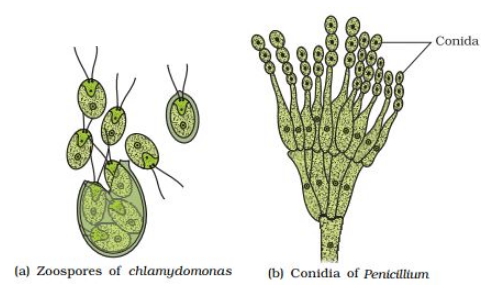
Draw the sketches of a zoospore and a conidium. Mention two dissimilarities between them and at least one feature common to both structures.
Solution
(N/A) Zoospores and conidia are both specialized asexual reproductive structures.
Dissimilarities:
$1$. Zoospores are motile structures due to the presence of flagella,whereas conidia are non-motile.
$2$. Zoospores are typically produced endogenously within a zoosporangium,while conidia are produced exogenously at the tips of specialized hyphae called conidiophores.
Common feature:
Both zoospores and conidia are haploid asexual reproductive structures that help in the dispersal and propagation of the organism.
Dissimilarities:
$1$. Zoospores are motile structures due to the presence of flagella,whereas conidia are non-motile.
$2$. Zoospores are typically produced endogenously within a zoosporangium,while conidia are produced exogenously at the tips of specialized hyphae called conidiophores.
Common feature:
Both zoospores and conidia are haploid asexual reproductive structures that help in the dispersal and propagation of the organism.
0 likes
View Solution111
Medium
Justify the statement 'Vegetative reproduction is also a type of asexual reproduction'.
Solution
(N/A) Vegetative reproduction is considered a type of asexual reproduction because:
$(i)$ It is uniparental,meaning only one parent is involved.
$(ii)$ It results in the formation of clones,which are genetically identical offspring.
$(iii)$ There is no fertilization process involved.
$(iv)$ There is no gamete formation or fusion.
$(i)$ It is uniparental,meaning only one parent is involved.
$(ii)$ It results in the formation of clones,which are genetically identical offspring.
$(iii)$ There is no fertilization process involved.
$(iv)$ There is no gamete formation or fusion.
0 likes
View Solution112
Medium
Enumerate the differences between asexual and sexual reproduction. Describe the types of asexual reproduction exhibited by unicellular organisms.
Solution
(N/A) Asexual reproduction involves a single parent capable of producing offspring. The offspring produced are genetically identical to the parent and to each other,often referred to as clones.
Sexual reproduction involves the formation and fusion of male and female gametes,either by the same individual or by different individuals of the opposite sex. These gametes fuse to form a zygote,which develops into a new organism. It is a complex and slower process compared to asexual reproduction. Due to the fusion of gametes,sexual reproduction results in offspring that are genetically distinct from the parents and from each other.
In unicellular organisms like Protists and Monerans,the parent cell divides into two to give rise to new individuals; thus,cell division is a mode of reproduction.
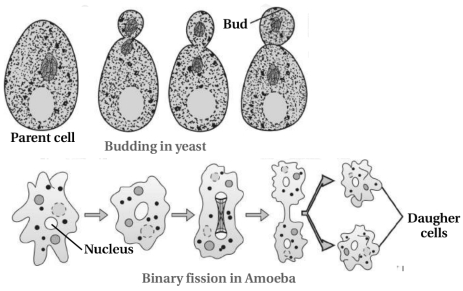
$1$. Binary Fission: $A$ cell divides into two halves,and each half rapidly grows into an adult (e.g.,Amoeba,Paramecium).
$2$. Budding: In yeast,the division is unequal. Small buds are produced that remain attached initially to the parent cell,eventually separating and maturing into new organisms.
Sexual reproduction involves the formation and fusion of male and female gametes,either by the same individual or by different individuals of the opposite sex. These gametes fuse to form a zygote,which develops into a new organism. It is a complex and slower process compared to asexual reproduction. Due to the fusion of gametes,sexual reproduction results in offspring that are genetically distinct from the parents and from each other.
In unicellular organisms like Protists and Monerans,the parent cell divides into two to give rise to new individuals; thus,cell division is a mode of reproduction.
$1$. Binary Fission: $A$ cell divides into two halves,and each half rapidly grows into an adult (e.g.,Amoeba,Paramecium).
$2$. Budding: In yeast,the division is unequal. Small buds are produced that remain attached initially to the parent cell,eventually separating and maturing into new organisms.
0 likes
View Solution113
Medium
Mention two inherent characteristics of Amoeba and yeast that enable them to reproduce asexually.
Solution
(N/A) The two inherent characteristics of $Amoeba$ and yeast that enable them to reproduce asexually are:
$1$. $Unicellular$ $nature$: Both organisms are single-celled, which allows the entire cell to participate in the reproductive process.
$2$. $Mitotic$ $cell$ $division$: They undergo simple mitotic cell division (or binary fission in $Amoeba$ and budding in yeast), where the parent cell divides to produce genetically identical offspring without the involvement of gamete formation or fusion.
$1$. $Unicellular$ $nature$: Both organisms are single-celled, which allows the entire cell to participate in the reproductive process.
$2$. $Mitotic$ $cell$ $division$: They undergo simple mitotic cell division (or binary fission in $Amoeba$ and budding in yeast), where the parent cell divides to produce genetically identical offspring without the involvement of gamete formation or fusion.
0 likes
View Solution114
Medium
Write a short note on Binary fission.
Solution
(N/A) Binary fission is a type of asexual reproduction where a parent cell divides into two equal-sized daughter cells.
$1$. It is commonly observed in organisms like Protists (e.g.,Amoeba) and Monerans (e.g.,Bacteria).
$2$. The process begins with the replication of genetic material followed by the division of the nucleus (karyokinesis).
$3$. This is followed by the division of the cytoplasm (cytokinesis).
$4$. Finally,two identical daughter cells are formed,which grow into mature individuals.
$1$. It is commonly observed in organisms like Protists (e.g.,Amoeba) and Monerans (e.g.,Bacteria).
$2$. The process begins with the replication of genetic material followed by the division of the nucleus (karyokinesis).
$3$. This is followed by the division of the cytoplasm (cytokinesis).
$4$. Finally,two identical daughter cells are formed,which grow into mature individuals.
0 likes
View Solution115
Medium
Describe in detail about asexual reproduction in organisms.
Solution
(N/A) Asexual reproduction is a common mode of reproduction in single-celled organisms and in some plants and animals with relatively simple organizations.
In these organisms,cell division is itself a mode of reproduction.
Many single-celled organisms reproduce by binary fission,where a cell divides into two halves and each rapidly grows into an adult. Examples include $Amoeba$ and $Paramoecium$.
Since binary fission involves only mitosis,the resultant offspring are genetically and morphologically identical to the parent and to each other; such individuals are called clones.
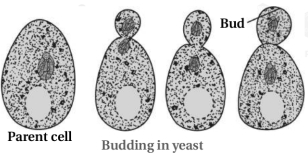
In other organisms like yeast,reproduction occurs by budding. In this process,the division is unequal,and small buds are produced that remain attached initially to the parent cell,which eventually get separated and mature into new organisms.
In these organisms,cell division is itself a mode of reproduction.
Many single-celled organisms reproduce by binary fission,where a cell divides into two halves and each rapidly grows into an adult. Examples include $Amoeba$ and $Paramoecium$.
Since binary fission involves only mitosis,the resultant offspring are genetically and morphologically identical to the parent and to each other; such individuals are called clones.
In other organisms like yeast,reproduction occurs by budding. In this process,the division is unequal,and small buds are produced that remain attached initially to the parent cell,which eventually get separated and mature into new organisms.
0 likes
View Solution116
Medium
Describe fission and its types.
Solution
(N/A) Fission is a form of asexual reproduction in which a single-celled organism divides into two or more daughter cells.
$1$. Binary Fission: In this process,the parent cell divides into two equal halves,each of which grows into an adult organism. Examples include $Amoeba$ and $Paramecium$.
$2$. Multiple Fission: In this process,the parent cell divides into many daughter cells simultaneously. This often occurs under unfavorable conditions,where the organism forms a cyst. An example is $Plasmodium$.
Note: The provided image illustrates budding in yeast,which is a different mode of asexual reproduction where a small outgrowth (bud) develops on the parent cell and eventually detaches to form a new individual.
$1$. Binary Fission: In this process,the parent cell divides into two equal halves,each of which grows into an adult organism. Examples include $Amoeba$ and $Paramecium$.
$2$. Multiple Fission: In this process,the parent cell divides into many daughter cells simultaneously. This often occurs under unfavorable conditions,where the organism forms a cyst. An example is $Plasmodium$.
Note: The provided image illustrates budding in yeast,which is a different mode of asexual reproduction where a small outgrowth (bud) develops on the parent cell and eventually detaches to form a new individual.
0 likes
View Solution117
MediumMCQ
Why is the offspring formed by asexual reproduction referred to as a clone?
A
Because they are morphologically similar.
B
Because they are genetically similar.
C
Because they are genetically and morphologically identical to the parent.
D
Because they are produced by sexual reproduction.
Solution
(C) clone is defined as a group of individuals that are genetically and morphologically identical.
In asexual reproduction,only a single parent is involved,and there is no fusion of gametes or meiosis.
Since the offspring are produced through mitotic cell division,they inherit the exact genetic makeup of the parent.
Therefore,the offspring are identical to the parent and to each other,and they are referred to as clones.
In asexual reproduction,only a single parent is involved,and there is no fusion of gametes or meiosis.
Since the offspring are produced through mitotic cell division,they inherit the exact genetic makeup of the parent.
Therefore,the offspring are identical to the parent and to each other,and they are referred to as clones.
0 likes
View Solution118
MediumMCQ
Why is vegetative reproduction also considered a type of asexual reproduction?
A
It involves two parents.
B
It involves a single parent and produces genetically identical offspring.
C
It requires fertilization.
D
It leads to genetic variation.
Solution
(B) Vegetative reproduction is considered a type of asexual reproduction because it involves only a single parent.
In this process,the offspring produced are genetically and morphologically identical to the parent,which is a defining characteristic of asexual reproduction (clones).
In this process,the offspring produced are genetically and morphologically identical to the parent,which is a defining characteristic of asexual reproduction (clones).
0 likes
View Solution119
Medium
What is vegetative propagation? Give two suitable examples.
Solution
(N/A) Vegetative propagation is a type of asexual reproduction in plants where new individuals develop from vegetative parts such as roots,stems,or leaves,without the involvement of seeds or spores.
Examples:
$(i)$ Buds (eyes) of potato.
$(ii)$ Rhizome of ginger.
Examples:
$(i)$ Buds (eyes) of potato.
$(ii)$ Rhizome of ginger.
0 likes
View Solution120
Medium
Why is $Amoeba$ called immortal?
Solution
(N/A) $Amoeba$ is considered immortal because it does not undergo natural death.
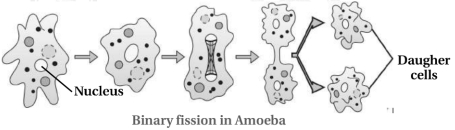
During favourable conditions, the parent $Amoeba$ undergoes binary fission, where it divides into two daughter cells.
Since the entire parent body is transformed into the offspring, there is no remnant of the parent left to die, thus making it biologically immortal.
During favourable conditions, the parent $Amoeba$ undergoes binary fission, where it divides into two daughter cells.
Since the entire parent body is transformed into the offspring, there is no remnant of the parent left to die, thus making it biologically immortal.
0 likes
View Solution121
Medium
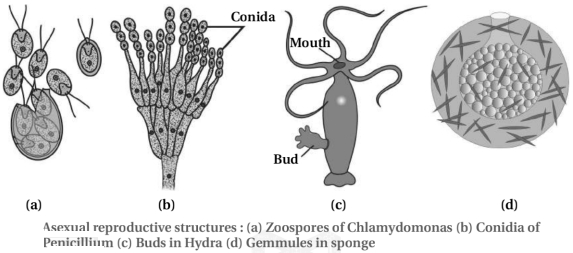
Explain the asexual reproductive structures shown in the figure.
Solution
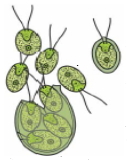
(N/A) $1$. Zoospores: These are microscopic,motile structures involved in asexual reproduction,e.g.,$Chlamydomonas$.
$2$. Conidia: These are non-motile asexual reproductive structures,e.g.,$Penicillium$,$Aspergillus$.
$3$. Buds: Cells in some parts of the body of an organism undergo repeated mitotic divisions to produce a small,raised outgrowth called a bud,which eventually detaches to form a new individual,e.g.,$Hydra$.
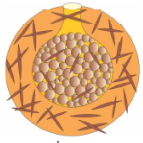
$4$. Gemmules: In sponges,specialized internal cell masses are produced,which are enveloped by a protective sheath to survive harsh conditions,e.g.,$Spongilla$,$Sycon$.
$2$. Conidia: These are non-motile asexual reproductive structures,e.g.,$Penicillium$,$Aspergillus$.
$3$. Buds: Cells in some parts of the body of an organism undergo repeated mitotic divisions to produce a small,raised outgrowth called a bud,which eventually detaches to form a new individual,e.g.,$Hydra$.
$4$. Gemmules: In sponges,specialized internal cell masses are produced,which are enveloped by a protective sheath to survive harsh conditions,e.g.,$Spongilla$,$Sycon$.
0 likes
View Solution122
Easy
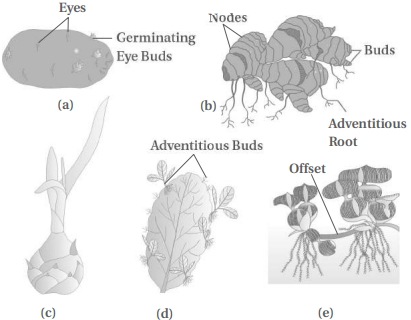
In the given figure,identify the structures through which these organisms propagate.
Solution
(N/A) The figure illustrates various modes of vegetative propagation in plants:
$(a)$ Potato: Propagates through 'Eyes' which are axillary buds.
$(b)$ Ginger: Propagates through 'Rhizome' which has nodes and internodes.
$(c)$ Agave: Propagates through 'Bulbil' which is a modified floral bud.
$(d)$ Bryophyllum: Propagates through 'Leaf buds' (adventitious buds) present on the leaf margins.
$(e)$ Water Hyacinth: Propagates through 'Offset' which is a type of runner.
$(a)$ Potato: Propagates through 'Eyes' which are axillary buds.
$(b)$ Ginger: Propagates through 'Rhizome' which has nodes and internodes.
$(c)$ Agave: Propagates through 'Bulbil' which is a modified floral bud.
$(d)$ Bryophyllum: Propagates through 'Leaf buds' (adventitious buds) present on the leaf margins.
$(e)$ Water Hyacinth: Propagates through 'Offset' which is a type of runner.
0 likes
View Solution123
Medium
Is the term clone applicable to the offspring formed by vegetative reproduction? Cite two reasons for this.
Solution
(N/A) Yes,the term clone is applicable to the offspring formed by vegetative reproduction.
Reasons:
$1$. There is only a single parent involved in the process,which is a characteristic of asexual reproduction.
$2$. Only mitosis occurs during vegetative reproduction,which ensures that the offspring are genetically and morphologically identical to the parent,making them true clones.
Reasons:
$1$. There is only a single parent involved in the process,which is a characteristic of asexual reproduction.
$2$. Only mitosis occurs during vegetative reproduction,which ensures that the offspring are genetically and morphologically identical to the parent,making them true clones.
0 likes
View Solution124
MediumMCQ
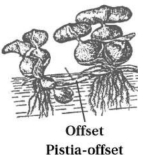
In aquatic plants like $Pistia$ and $Eichhornia$,leaves and roots are found near $.........$
A
Water surface
B
Soil surface
C
Stem base
D
Leaf apex
Solution
(A) In aquatic plants like $Pistia$ and $Eichhornia$,the stem is modified into an offset,which is a type of runner.
Each node of the offset bears a rosette of leaves above and a tuft of roots below.
Since these plants are free-floating aquatic plants,these leaves and roots are found near the water surface.
Each node of the offset bears a rosette of leaves above and a tuft of roots below.
Since these plants are free-floating aquatic plants,these leaves and roots are found near the water surface.
0 likes
View Solution125
EasyMCQ
What is the process of producing offspring by a single parent with or without the formation of gametes called?
A
Development
B
Asexual reproduction
C
Sexual reproduction
D
Embryogenesis
Solution
(B) Asexual reproduction is defined as the process where a single parent produces offspring with or without the involvement of gamete formation. In this process,the offspring produced are genetically and morphologically identical to the parent,often referred to as clones. Unlike sexual reproduction,it does not involve the fusion of male and female gametes.
0 likes
View Solution126
EasyMCQ
Which organisms are considered immortal?
A
Animals
B
Plants
C
Single-celled organisms
D
Multicellular organisms
Solution
(C) Single-celled organisms,such as bacteria and protozoa,are considered immortal because they reproduce through binary fission. In this process,the parent cell divides into two daughter cells,and the original parent body does not die but continues to exist in the form of the daughter cells. Thus,there is no natural death for these organisms.
0 likes
View Solution127
EasyMCQ
In which method does a single parent have the capacity to produce offspring?
A
Sexual reproduction
B
Asexual reproduction
C
Asexual and sexual reproduction
D
Apomixis
Solution
(B) Asexual reproduction is a mode of reproduction in which a single parent is capable of producing offspring.
In this process,the offspring produced are genetically and morphologically identical to the parent,often referred to as clones.
Sexual reproduction,on the other hand,typically involves two parents of opposite sexes.
In this process,the offspring produced are genetically and morphologically identical to the parent,often referred to as clones.
Sexual reproduction,on the other hand,typically involves two parents of opposite sexes.
0 likes
View Solution128
EasyMCQ
Which type of asexual reproduction occurs in yeast?
A
Binary fission
B
Budding
C
Conidia
D
Multiple fission
Solution
(B) Yeast ($Saccharomyces$ $cerevisiae$) is a unicellular fungus that primarily reproduces asexually through a process called budding. In this process,a small outgrowth called a bud is formed on the parent cell. The nucleus of the parent cell divides,and one daughter nucleus migrates into the bud. The bud eventually detaches from the parent cell and matures into a new individual.
0 likes
View Solution129
EasyMCQ
How many parents are involved in the production of offspring in asexual reproduction?
A
One
B
Two
C
Three
D
Four
Solution
(A) In asexual reproduction,a single parent is capable of producing offspring.
As a result,the offspring produced are genetically and morphologically identical to each other and to the parent,which are referred to as clones.
Therefore,the correct answer is $A$ (One).
As a result,the offspring produced are genetically and morphologically identical to each other and to the parent,which are referred to as clones.
Therefore,the correct answer is $A$ (One).
0 likes
View Solution130
EasyMCQ
In which organism does asexual reproduction occur through the formation of conidia?
A
Amoeba
B
Unicellular fungi
C
Hydra
D
Penicillium
Solution
(D) Conidia are asexual reproductive structures produced in certain fungi.
In the genus $Penicillium$,conidia are formed at the tips of specialized hyphae called conidiophores.
These spores are exogenous,meaning they are produced outside the parent body.
$Amoeba$ reproduces by binary fission,$Hydra$ reproduces by budding,and unicellular fungi like yeast reproduce by budding.
In the genus $Penicillium$,conidia are formed at the tips of specialized hyphae called conidiophores.
These spores are exogenous,meaning they are produced outside the parent body.
$Amoeba$ reproduces by binary fission,$Hydra$ reproduces by budding,and unicellular fungi like yeast reproduce by budding.
0 likes
View Solution131
EasyMCQ
In which organisms is asexual reproduction common?
A
In unicellular organisms
B
In all higher plants
C
In multicellular organisms
D
In all higher animals
Solution
(A) Asexual reproduction is a mode of reproduction where a single parent produces offspring without the involvement of gamete fusion. This method is most common and characteristic of unicellular organisms (such as bacteria,protists,and yeast) and relatively simple multicellular organisms. In contrast,higher plants and animals predominantly reproduce through sexual reproduction.
0 likes
View Solution132
EasyMCQ
How does asexual reproduction occur in $Chlamydomonas$?
A
Zoospore
B
Conidia
C
Binary fission
D
Sporangiospore
Solution
(A) In $Chlamydomonas$,asexual reproduction primarily occurs through the formation of motile,flagellated spores known as $Zoospore$. These spores are produced within the parent cell and are released to develop into new individuals. Therefore,the correct option is $A$.
0 likes
View Solution133
EasyMCQ
In which organisms does gemmule formation occur?
A
Amoeba
B
Paramecium
C
Sponges
D
Penicillium
Solution
(C) Gemmule formation is a specialized method of asexual reproduction found in certain aquatic organisms.
It is primarily observed in sponges (Phylum $Porifera$),such as $Spongilla$.
These gemmules are internal buds that help the organism survive unfavorable environmental conditions like drought or extreme temperatures.
When conditions become favorable,the gemmules germinate to form new individuals.
Therefore,the correct option is $C$.
It is primarily observed in sponges (Phylum $Porifera$),such as $Spongilla$.
These gemmules are internal buds that help the organism survive unfavorable environmental conditions like drought or extreme temperatures.
When conditions become favorable,the gemmules germinate to form new individuals.
Therefore,the correct option is $C$.
0 likes
View Solution134
EasyMCQ
Which process is observed in $Amoeba$ during unfavorable conditions?
A
Binary fission
B
Budding
C
Sporulation (Encystation)
D
Sexual reproduction
Solution
(C) During unfavorable conditions,$Amoeba$ withdraws its pseudopodia and secretes a three-layered hard covering or cyst around itself. This phenomenon is called encystation. When favorable conditions return,the encysted $Amoeba$ divides by multiple fission and produces many minute $Amoeba$ or pseudopodiospores; this process is known as sporulation.
0 likes
View Solution135
EasyMCQ
What are the structures in plants that are capable of giving rise to new offspring called?
A
Vegetative propagules
B
Apomictic organs
C
Sexual propagules
D
Sexual buds
Solution
(A) In plants,the units of vegetative propagation such as runners,rhizomes,suckers,tubers,offsets,and bulbs are capable of giving rise to new offspring.
These structures are collectively referred to as vegetative propagules.
Since the formation of these structures does not involve two parents,the process involved is asexual reproduction.
These structures are collectively referred to as vegetative propagules.
Since the formation of these structures does not involve two parents,the process involved is asexual reproduction.
0 likes
View Solution136
MediumMCQ
How many of the following plants reproduce vegetatively through rhizomes?
Potato,Amorphophallus (Suran),Agave,Bryophyllum,Banana,Ginger
Potato,Amorphophallus (Suran),Agave,Bryophyllum,Banana,Ginger
A
One
B
Two
C
Three
D
Four
Solution
(B) Vegetative propagation through rhizomes occurs in plants that possess underground stems known as rhizomes.
Among the given list:
$1$. Potato: Reproduces via tubers.
$2$. Amorphophallus (Suran): Reproduces via corms.
$3$. Agave: Reproduces via bulbils.
$4$. Bryophyllum: Reproduces via foliar buds (leaf buds).
$5$. Banana: Reproduces via rhizomes.
$6$. Ginger: Reproduces via rhizomes.
Therefore,only $2$ plants (Banana and Ginger) reproduce vegetatively through rhizomes.
Among the given list:
$1$. Potato: Reproduces via tubers.
$2$. Amorphophallus (Suran): Reproduces via corms.
$3$. Agave: Reproduces via bulbils.
$4$. Bryophyllum: Reproduces via foliar buds (leaf buds).
$5$. Banana: Reproduces via rhizomes.
$6$. Ginger: Reproduces via rhizomes.
Therefore,only $2$ plants (Banana and Ginger) reproduce vegetatively through rhizomes.
0 likes
View Solution137
MediumMCQ
Which of the following structures is formed by the involvement of only one parent?
A
Endosperm in angiosperms
B
Zygote
C
Fertilized egg
D
Bulbil
Solution
(D) Asexual reproduction involves only one parent and does not involve the fusion of gametes.
Bulbils are specialized vegetative structures used for asexual reproduction in plants like $Agave$ and $Dioscorea$.
They are formed from the parent plant through vegetative propagation,which is a form of asexual reproduction.
In contrast,endosperm,zygote,and fertilized eggs are products of sexual reproduction,which requires two parents (male and female gametes).
Bulbils are specialized vegetative structures used for asexual reproduction in plants like $Agave$ and $Dioscorea$.
They are formed from the parent plant through vegetative propagation,which is a form of asexual reproduction.
In contrast,endosperm,zygote,and fertilized eggs are products of sexual reproduction,which requires two parents (male and female gametes).
0 likes
View Solution138
EasyMCQ
Which plant is also known as the 'Terror of Bengal'?
A
Water Lily
B
Water Hyacinth
C
Bacopa
D
Zostera
Solution
(B) The plant $Eichhornia$ $crassipes$,commonly known as Water Hyacinth,is referred to as the 'Terror of Bengal'.
It is one of the most invasive weeds found growing wherever there is standing water.
It drains oxygen from the water,which leads to the death of fishes and other aquatic organisms.
It was introduced in India because of its beautiful flowers and shape of leaves,but it propagates vegetatively at a phenomenal rate and spreads all over the water body in a short period of time,making it very difficult to get rid of.
It is one of the most invasive weeds found growing wherever there is standing water.
It drains oxygen from the water,which leads to the death of fishes and other aquatic organisms.
It was introduced in India because of its beautiful flowers and shape of leaves,but it propagates vegetatively at a phenomenal rate and spreads all over the water body in a short period of time,making it very difficult to get rid of.
0 likes
View Solution139
EasyMCQ
Which of the following plants is considered an aquatic weed?
A
Water lily
B
Water hyacinth
C
Strobilanthes kunthiana
D
Hydrilla
Solution
(B) Water hyacinth $(Eichhornia \text{ crassipes})$ is known as the 'Terror of Bengal'. It is an invasive aquatic weed that grows abundantly in eutrophic water bodies, leading to an imbalance in the ecosystem by depleting dissolved oxygen, which causes the death of fishes. It propagates vegetatively at a phenomenal rate.
0 likes
View Solution140
EasyMCQ
Which structure acts as a vegetative propagule in $Bryophyllum$?
A
Tuber
B
Floral bud
C
Rhizome
D
Adventitious bud
Solution
(D) In $Bryophyllum$ (commonly known as $Patharchatta$ or $Bryophyllum$),vegetative propagation occurs through leaves.
These leaves possess adventitious buds in the notches along the leaf margins.
When these leaves fall on moist soil,the adventitious buds develop into new plantlets,which eventually grow into independent plants.
Therefore,the adventitious buds are the vegetative propagules in $Bryophyllum$.
These leaves possess adventitious buds in the notches along the leaf margins.
When these leaves fall on moist soil,the adventitious buds develop into new plantlets,which eventually grow into independent plants.
Therefore,the adventitious buds are the vegetative propagules in $Bryophyllum$.
0 likes
View Solution141
EasyMCQ
What is the period of growth in an organism before it reaches reproductive maturity called?
A
Juvenile phase
B
Active phase
C
Organogenesis phase
D
Reproductive phase
Solution
(A) The period of growth in an organism from birth up to the time it attains reproductive maturity is known as the $Juvenile$ $phase$.
In plants,this phase is referred to as the $Vegetative$ $phase$.
After the completion of this phase,the organism enters the $Reproductive$ $phase$.
In plants,this phase is referred to as the $Vegetative$ $phase$.
After the completion of this phase,the organism enters the $Reproductive$ $phase$.
0 likes
View Solution142
EasyMCQ
Parthenogenesis is the development of an organism from ........
A
a fertilized egg
B
a sperm
C
an unfertilized egg
D
a zygote
Solution
(C) Parthenogenesis is a form of asexual reproduction in which an embryo develops from an unfertilized egg cell. This phenomenon is commonly observed in organisms like honeybees,rotifers,and some lizards. Since no fertilization occurs,the offspring are typically clones of the mother or have a specific ploidy level determined by the species.
0 likes
View Solution143
EasyMCQ
Match the plants with their vegetative propagules:
| List-$I$ | List-$II$ |
| $(a)$ Potato | $(1)$ Rhizome |
| $(b)$ Banana | $(2)$ Offset |
| $(c)$ Water hyacinth | $(3)$ Leaf buds |
| $(d)$ Bryophyllum | $(4)$ Eyes |
A
$a-3, b-2, c-1, d-4$
B
$a-4, b-2, c-1, d-3$
C
$a-4, b-1, c-2, d-3$
D
$a-1, b-4, c-2, d-3$
Solution
(C) The correct matches are as follows:
$(a)$ Potato propagates through 'eyes', which are axillary buds found on the tuber.
$(b)$ Banana propagates through a rhizome, an underground stem modification.
$(c)$ Water hyacinth propagates through an offset, a runner-like structure.
$(d)$ Bryophyllum propagates through leaf buds (adventitious buds) present on the leaf margins.
Therefore, the correct matching is $(a-4, b-1, c-2, d-3)$.
$(a)$ Potato propagates through 'eyes', which are axillary buds found on the tuber.
$(b)$ Banana propagates through a rhizome, an underground stem modification.
$(c)$ Water hyacinth propagates through an offset, a runner-like structure.
$(d)$ Bryophyllum propagates through leaf buds (adventitious buds) present on the leaf margins.
Therefore, the correct matching is $(a-4, b-1, c-2, d-3)$.
0 likes
View Solution144
MediumMCQ
Which of the following statements is correct?
A
Sexual reproduction occurs through vegetative propagules.
B
Two parents are involved in the formation of vegetative propagules.
C
Water lily is also known as the Terror of Bengal.
D
Offset is a vegetative propagule.
Solution
(D) $1$. Vegetative propagation is a type of asexual reproduction, so option $A$ is incorrect.
$2$. Vegetative propagation involves only one parent, so option $B$ is incorrect.
$3$. The plant known as the 'Terror of Bengal' is Eichhornia crassipes (Water Hyacinth), not Water Lily, so option $C$ is incorrect.
$4$. An offset is a type of vegetative propagule found in plants like Eichhornia and Pistia, which helps in vegetative propagation. Thus, option $D$ is correct.
$2$. Vegetative propagation involves only one parent, so option $B$ is incorrect.
$3$. The plant known as the 'Terror of Bengal' is Eichhornia crassipes (Water Hyacinth), not Water Lily, so option $C$ is incorrect.
$4$. An offset is a type of vegetative propagule found in plants like Eichhornia and Pistia, which helps in vegetative propagation. Thus, option $D$ is correct.
0 likes
View Solution145
EasyMCQ
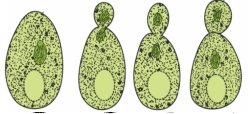
Identify the given figure.
A
Fission in Amoeba
B
Fission in Yeast
C
Budding in Amoeba
D
Budding in Yeast
Solution
(D) The provided figure shows the process of budding in the unicellular fungus,Yeast ($Saccharomyces$ $cerevisiae$).
In this process,a small outgrowth called a bud is formed on the parent cell.
The nucleus of the parent cell divides,and one daughter nucleus migrates into the bud.
The bud eventually detaches from the parent cell and grows into a new individual.
In this process,a small outgrowth called a bud is formed on the parent cell.
The nucleus of the parent cell divides,and one daughter nucleus migrates into the bud.
The bud eventually detaches from the parent cell and grows into a new individual.
0 likes
View Solution146
EasyMCQ
Identify the given figure.
A
Zoospore of Chlamydomonas
B
Conidia of Penicillium
C
Buds of Yeast
D
Gemmules of Sponge
Solution
(A) The provided figure shows the formation of zoospores in the green alga $Chlamydomonas$.
Zoospores are microscopic,motile structures that help in asexual reproduction.
They are characterized by the presence of flagella,which allow them to move in an aquatic environment.
Therefore,the correct option is $A$.
Zoospores are microscopic,motile structures that help in asexual reproduction.
They are characterized by the presence of flagella,which allow them to move in an aquatic environment.
Therefore,the correct option is $A$.
0 likes
View Solution147
EasyMCQ
What does the given figure represent?
A
Bud in Hydra
B
Gemmule in sponge
C
Multiple fission in Amoeba
D
Bulbil of Agave
Solution
(B) The given figure represents a gemmule in a sponge. Gemmules are internal buds formed in sponges (like Spongilla) that serve as a means of asexual reproduction. They are resistant structures that help the organism survive unfavorable conditions and develop into a new sponge when conditions become favorable.
0 likes
View Solution148
EasyMCQ
What does the figure $X$ represent?
A
Zoospore
B
Ascospore
C
Conidia
D
Bud
Solution
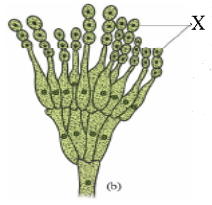
(C) The provided figure shows the asexual reproductive structure of the fungus $Penicillium$.
The structure labeled as $X$ represents the $Conidia$ (singular: $Conidium$).
$Conidia$ are asexual spores produced exogenously on specialized hyphae called conidiophores in $Penicillium$.
Therefore,the correct option is $C$.
The structure labeled as $X$ represents the $Conidia$ (singular: $Conidium$).
$Conidia$ are asexual spores produced exogenously on specialized hyphae called conidiophores in $Penicillium$.
Therefore,the correct option is $C$.
0 likes
View Solution149
EasyMCQ
Identify the structure shown in the figure.
A
Bud of Bryophyllum
B
Agave plant
C
Fruit of Agave
D
Bulbil of Agave
Solution
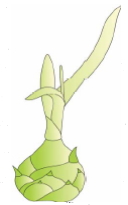
(D) The figure shows a bulbil,which is a specialized vegetative reproductive structure found in the Agave plant.
These bulbils are modified floral buds that develop into new plants when they fall on the ground.
Therefore,the correct identification is the bulbil of Agave.
These bulbils are modified floral buds that develop into new plants when they fall on the ground.
Therefore,the correct identification is the bulbil of Agave.
0 likes
View Solution150
EasyMCQ
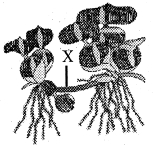
What does the figure $X$ represent?
A
Offset
B
Runner
C
Stolon
D
Adventitious buds
Solution
(A) The provided image shows the plant $Eichhornia$ (water hyacinth).
In $Eichhornia$,the vegetative propagation occurs through a specialized structure known as an offset.
An offset is a short,thick,horizontal branch that produces a new plant at its tip.
Therefore,the structure labeled $X$ represents an offset.
In $Eichhornia$,the vegetative propagation occurs through a specialized structure known as an offset.
An offset is a short,thick,horizontal branch that produces a new plant at its tip.
Therefore,the structure labeled $X$ represents an offset.
0 likes
View SolutionReproduction in Organisms — Asexual reproduction/Vegetative propagation · Frequently Asked Questions
1Are these Reproduction in Organisms questions useful for JEE and NEET?
Yes. All questions in this section are mapped to JEE Main and NEET exam patterns. Previous year questions from JEE Main, NEET, GUJCET and state-level exams are included with full solutions.
2Can I switch to Hindi or Gujarati for these questions?
Yes. Use the language tabs in the hero section or the sidebar to view the same questions and solutions in English, Hindi or Gujarati.
3How do I generate a question paper from this subtopic?
Use the Vedclass Exam Paper Generator — select the chapter and subtopic, set difficulty, and generate Sets A, B, C, D automatically. First 3 chapters of every subject are free.
Vedclass Products
For Students
Vedclass Test Series
Mock tests in real JEE/NEET style with performance analysis. 5-day free trial.
Start Free TrialFor Teachers
Exam Paper Generator
Generate Set A/B/C/D papers from this chapter in 2 minutes. 3 chapters free.
Try FreeFor Institutes
Online Exam Module
Live online exams with unlimited students, 360° analytics & white-label branding.
See DemoFor Teachers & Institutes
Generate a Reproduction in Organisms Exam Paper in 2 Minutes
Select subtopic & difficulty — Sets A, B, C, D auto-generated with No Repeat logic.
First 3 chapters of every subject are free — no payment required.