
A English
Asexual reproduction/Vegetative propagation Questions in English
Class 12 Biology · Reproduction in Organisms · Asexual reproduction/Vegetative propagation
236+
Questions
English
Language
100%
With Solutions
Showing 36 of 236 questions in English
201
EasyMCQ
Fleshy buds in aquatic plants are known as
A
Bulbils
B
Offset
C
Turions
D
Rhizome
Solution
(C) Turions are modified,fleshy,overwintering buds found in many aquatic plants,such as $Potamogeton$ and $Utricularia$. These buds store starch and help the plant survive unfavorable conditions by detaching from the parent plant and sinking to the bottom of the water body,where they remain dormant until favorable conditions return.
0 likes
View Solution202
MediumMCQ
$A$ portion of an underground stem bearing a bud forms a new plant in
A
Adiantum,Colocasia,and Vallisneria
B
Narcissus,Gladiolus,and Freesia
C
Garlic,Onion,and Water hyacinth
D
Turmeric,Ginger,and Strawberry
Solution
(B) Vegetative propagation through underground stems occurs in various plants.
$Narcissus$ reproduces via bulbs.
$Gladiolus$ reproduces via corms.
$Freesia$ reproduces via corms.
These are all examples of underground stems (or modified stems) that bear buds capable of developing into new plants.
$Narcissus$ reproduces via bulbs.
$Gladiolus$ reproduces via corms.
$Freesia$ reproduces via corms.
These are all examples of underground stems (or modified stems) that bear buds capable of developing into new plants.
0 likes
View Solution203
MediumMCQ
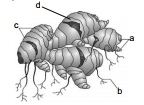
Examine the figure given below and select the correct option for labelled parts $a, b, c, d$.
A
$a$ - Buds; $b$ - Adventitious root; $c$ - Nodes; $d$ - Leaves
B
$a$ - Nodes; $b$ - Adventitious root; $c$ - Leaves; $d$ - Buds
C
$a$ - Buds; $b$ - Adventitious root; $c$ - Leaves; $d$ - Nodes
D
$a$ - Nodes; $b$ - Adventitious root; $c$ - Buds; $d$ - Leaves
Solution
(A) The given figure represents a ginger rhizome,which is a modified stem used for vegetative propagation.
In this figure:
$a$ represents the buds,which are responsible for the growth of new shoots.
$b$ represents the adventitious roots,which arise from the nodes of the rhizome.
$c$ represents the nodes,which are the points on the stem from where leaves or branches arise.
$d$ represents the scale leaves,which are modified leaves covering the nodes.
Therefore,the correct labeling is $a$ - Buds,$b$ - Adventitious root,$c$ - Nodes,$d$ - Leaves.
In this figure:
$a$ represents the buds,which are responsible for the growth of new shoots.
$b$ represents the adventitious roots,which arise from the nodes of the rhizome.
$c$ represents the nodes,which are the points on the stem from where leaves or branches arise.
$d$ represents the scale leaves,which are modified leaves covering the nodes.
Therefore,the correct labeling is $a$ - Buds,$b$ - Adventitious root,$c$ - Nodes,$d$ - Leaves.
0 likes
View Solution204
MediumMCQ
$A$: Runner,tuber,sucker,offset,etc.,are vegetative propagules.
$R$: Two parents are involved in the formation of these structures.
$R$: Two parents are involved in the formation of these structures.
A
Assertion and Reason both are correct and Reason is the correct explanation of Assertion.
B
Assertion and Reason both are correct but Reason is not the correct explanation of Assertion.
C
Assertion is correct,but Reason is incorrect.
D
Both Assertion and Reason are incorrect.
Solution
(C) Vegetative propagation is a type of asexual reproduction.
In asexual reproduction,only a single parent is involved in the formation of offspring.
Structures like runners,tubers,suckers,and offsets are known as vegetative propagules,which are capable of giving rise to new plants.
Since these structures are involved in asexual reproduction,they are uniparental,not biparental.
Therefore,the Assertion is correct,but the Reason is incorrect.
In asexual reproduction,only a single parent is involved in the formation of offspring.
Structures like runners,tubers,suckers,and offsets are known as vegetative propagules,which are capable of giving rise to new plants.
Since these structures are involved in asexual reproduction,they are uniparental,not biparental.
Therefore,the Assertion is correct,but the Reason is incorrect.
0 likes
View Solution205
MediumMCQ
Parthenogenesis is a type of
A
Sexual reproduction
B
Asexual reproduction
C
Budding
D
Regeneration
Solution
(B) Parthenogenesis is a form of asexual reproduction where an organism develops from an unfertilized egg. Since it does not involve the fusion of male and female gametes,it is classified as a type of asexual reproduction.
0 likes
View Solution206
EasyMCQ
Stem cuttings are commonly used for the propagation of
A
Banana
B
Rose
C
Mango
D
Cotton
Solution
(B) Stem cutting is a method of vegetative propagation where a portion of the stem is cut and planted in the soil to grow into a new plant.
Plants like $Rose$, $Sugarcane$, $Cocoa$, and $Bougainvillea$ are commonly propagated using stem cuttings.
Plants like $Rose$, $Sugarcane$, $Cocoa$, and $Bougainvillea$ are commonly propagated using stem cuttings.
0 likes
View Solution207
EasyMCQ
Sugarcane is cultivated through
A
Stem cutting
B
Root cutting
C
True seed
D
Adventitious roots
Solution
(A) Sugarcane is typically propagated vegetatively using stem cuttings. These cuttings,often called 'setts',contain nodes that possess axillary buds. When planted in the soil,these buds sprout to form new sugarcane plants. This method ensures that the offspring are genetically identical to the parent plant.
0 likes
View Solution208
EasyMCQ
In which one pair,both the plants can be vegetatively propagated by leaf pieces?
A
Bryophyllum and Kalanchoe
B
Chrysanthemum and Agave
C
Asparagus and Bryophyllum
D
Kalanchoe and Asparagus
Solution
(A) Vegetative propagation by leaf pieces occurs in plants that develop adventitious buds on their leaf margins. Both $Bryophyllum$ and $Kalanchoe$ are well-known examples where the leaf notches produce new plantlets,which can grow into independent plants when they touch the soil.
0 likes
View Solution209
Medium
Differentiate between Zoospores and Conidia.
Solution
(N/A)
| Zoospores | Conidia |
|---|---|
| $(1)$ These are motile spores. | $(1)$ These are non-motile spores. |
| $(2)$ Flagella are present. | $(2)$ Flagella are absent. |
| $(3)$ They swim in water. | $(3)$ They are dispersed by wind. |
| $(4)$ They are formed by algae and fungi. | $(4)$ They are formed commonly in terrestrial fungi. |
| $(5)$ $E$.g.,$Ulothrix$,$Oedogonium$. | $(5)$ $E$.g.,$Penicillium$,$Aspergillus$. |
0 likes
View Solution210
Medium
Give a scientific reason: Amoeba is called immortal.
Solution
(N/A) $Amoeba$ reproduces by binary fission. The entire parent body acts as the reproductive unit. The parent body ceases to exist as a distinct entity only because it divides into two daughter individuals. Since there is no natural death or leftover dead body,$Amoeba$ is considered immortal.
0 likes
View Solution211
MediumMCQ
Give a scientific reason: It is very difficult to get rid of Eichhornia from a water body.
A
It produces seeds in large quantities.
B
It has a deep root system.
C
It propagates vegetatively at a phenomenal rate.
D
It is resistant to all herbicides.
Solution
(C) Eichhornia,commonly known as water hyacinth,was introduced in India due to its beautiful flowers and leaf shape.
It propagates vegetatively at a phenomenal rate using structures called offsets.
Because of this rapid vegetative reproduction,it spreads across the entire water body in a very short period of time,making it extremely difficult to eradicate.
It propagates vegetatively at a phenomenal rate using structures called offsets.
Because of this rapid vegetative reproduction,it spreads across the entire water body in a very short period of time,making it extremely difficult to eradicate.
0 likes
View Solution212
Medium
Give a scientific reason: Offspring produced by asexual reproduction are called clones.
Solution
(N/A) In asexual reproduction,only one parent is involved.
It does not involve the formation or fusion of gametes.
It involves only mitotic cell division.
Since mitosis produces genetically identical daughter cells,the new individuals produced are genetically and morphologically similar to the parent and to each other.
Therefore,they are referred to as clones.
It does not involve the formation or fusion of gametes.
It involves only mitotic cell division.
Since mitosis produces genetically identical daughter cells,the new individuals produced are genetically and morphologically similar to the parent and to each other.
Therefore,they are referred to as clones.
0 likes
View Solution213
Medium
Give a scientific reason: Why is the Whiptail lizard referred to as parthenogenetic?
Solution
(N/A) Parthenogenesis is the process of development of an unfertilized ovum into a fully formed organism.
It is a special type of monoparental reproduction where no fertilization occurs.
The Whiptail lizard species consists entirely of females that reproduce by producing eggs through parthenogenesis.
Since they do not require males for reproduction,they exhibit obligate parthenogenesis,often colloquially referred to as the 'lesbian lizard'.
It is a special type of monoparental reproduction where no fertilization occurs.
The Whiptail lizard species consists entirely of females that reproduce by producing eggs through parthenogenesis.
Since they do not require males for reproduction,they exhibit obligate parthenogenesis,often colloquially referred to as the 'lesbian lizard'.
0 likes
View Solution214
Medium
Give a scientific reason: Why is vegetative reproduction practiced for growing certain types of plants?
Solution
(N/A) Vegetative reproduction is practiced for several scientific reasons:
$1$. Plants raised through vegetative propagation can bear flowers and fruits earlier than those produced from seeds.
$2$. It is the only method for propagating plants that have lost the capacity to produce viable seeds,such as banana,orange,rose,and jasmine.
$3$. All offspring produced are genetically identical to the parent plant,ensuring that desirable traits are preserved across generations.
$1$. Plants raised through vegetative propagation can bear flowers and fruits earlier than those produced from seeds.
$2$. It is the only method for propagating plants that have lost the capacity to produce viable seeds,such as banana,orange,rose,and jasmine.
$3$. All offspring produced are genetically identical to the parent plant,ensuring that desirable traits are preserved across generations.
0 likes
View Solution215
EasyMCQ
Match the following columns regarding vegetative propagules in plants:
| Column $I$ | Column $II$ |
|---|---|
| $(1)$ $Bryophyllum$ | $(a)$ Offset |
| $(2)$ $Agave$ | $(b)$ Eyes |
| $(3)$ $Potato$ | $(c)$ Leaf buds |
| $(4)$ $Water$ $hyacinth$ | $(d)$ Bulbils |
A
$1-c, 2-d, 3-b, 4-a$
B
$1-d, 2-c, 3-b, 4-a$
C
$1-c, 2-d, 3-a, 4-b$
D
$1-b, 2-c, 3-d, 4-a$
Solution
(A) The correct matches are as follows:
$(1)$ $Bryophyllum$: Reproduces through adventitious buds present on the notches of the leaves,known as $Leaf$ $buds$ $(1-c)$.
$(2)$ $Agave$: Produces specialized floral buds called $Bulbils$ for vegetative propagation $(2-d)$.
$(3)$ $Potato$: The tubers of potato have axillary buds known as $Eyes$ $(3-b)$.
$(4)$ $Water$ $hyacinth$: Reproduces vegetatively through a runner-like structure called an $Offset$ $(4-a)$.
Therefore,the correct sequence is $(1-c, 2-d, 3-b, 4-a)$.
$(1)$ $Bryophyllum$: Reproduces through adventitious buds present on the notches of the leaves,known as $Leaf$ $buds$ $(1-c)$.
$(2)$ $Agave$: Produces specialized floral buds called $Bulbils$ for vegetative propagation $(2-d)$.
$(3)$ $Potato$: The tubers of potato have axillary buds known as $Eyes$ $(3-b)$.
$(4)$ $Water$ $hyacinth$: Reproduces vegetatively through a runner-like structure called an $Offset$ $(4-a)$.
Therefore,the correct sequence is $(1-c, 2-d, 3-b, 4-a)$.
0 likes
View Solution216
EasyMCQ
Identify the asexual reproductive structure associated with $Penicillium$:
A
Conidia
B
Gemmules
C
Buds
D
Zoospores
Solution
(A) $Penicillium$ is a type of fungus that reproduces asexually through specialized structures called conidia.
Conidia are non-motile spores produced exogenously at the tips of specialized hyphae known as conidiophores.
Gemmules are internal buds found in sponges.
Buds are seen in organisms like $Hydra$ and yeast.
Zoospores are motile,flagellated spores found in algae like $Chlamydomonas$.
Conidia are non-motile spores produced exogenously at the tips of specialized hyphae known as conidiophores.
Gemmules are internal buds found in sponges.
Buds are seen in organisms like $Hydra$ and yeast.
Zoospores are motile,flagellated spores found in algae like $Chlamydomonas$.
0 likes
View Solution217
MediumMCQ
Which of the following is a method of vegetative reproduction?
A
Fragmentation
B
Fission
C
Budding
D
All of the above
Solution
(D) Vegetative reproduction is a type of asexual reproduction in plants and fungi where new individuals are formed from vegetative parts of the parent organism.
$1$. Fragmentation: The body breaks into pieces,and each piece grows into a new individual (e.g.,in filamentous fungi like Rhizopus).
$2$. Fission: The parent cell divides into two or more daughter cells (e.g.,in some yeasts).
$3$. Budding: $A$ small outgrowth or bud develops on the parent body,which eventually detaches to form a new individual (e.g.,in yeast).
Since all these methods are observed in various fungi and plants for vegetative propagation,the correct answer is $D$.
$1$. Fragmentation: The body breaks into pieces,and each piece grows into a new individual (e.g.,in filamentous fungi like Rhizopus).
$2$. Fission: The parent cell divides into two or more daughter cells (e.g.,in some yeasts).
$3$. Budding: $A$ small outgrowth or bud develops on the parent body,which eventually detaches to form a new individual (e.g.,in yeast).
Since all these methods are observed in various fungi and plants for vegetative propagation,the correct answer is $D$.
0 likes
View Solution218
MediumMCQ
The formation of new algae through fragmentation is a type of:
A
Sexual reproduction
B
Asexual reproduction
C
Fragmentation
D
All of the above
Solution
(B) Fragmentation is a form of asexual reproduction in which an organism is split into fragments. Each of these fragments develops into a mature,fully grown individual. In algae,this is a common method of vegetative propagation,which is considered a type of asexual reproduction.
0 likes
View Solution219
MediumMCQ
What type of reproduction is vegetative propagation?
A
Sexual reproduction
B
Asexual reproduction
C
Both
D
None of these
Solution
(B) Vegetative propagation is a form of asexual reproduction in plants.
In this process,new plants are produced from vegetative parts of the parent plant such as roots,stems,or leaves,without the involvement of seeds or spores.
Since it involves only one parent and does not involve the fusion of gametes,it is classified as asexual reproduction.
In this process,new plants are produced from vegetative parts of the parent plant such as roots,stems,or leaves,without the involvement of seeds or spores.
Since it involves only one parent and does not involve the fusion of gametes,it is classified as asexual reproduction.
0 likes
View Solution220
EasyMCQ
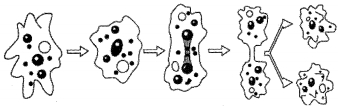
What does the following figure represent?
A
Binary fission in Amoeba
B
Budding in Yeast
C
Budding in Amoeba
D
Binary fission in Yeast
Solution
(A) The provided figure illustrates the process of binary fission in $Amoeba$.
In this process,the parent cell undergoes division to produce two daughter cells.
First,the nucleus divides (karyokinesis),followed by the division of the cytoplasm (cytokinesis).
This is a common method of asexual reproduction in unicellular organisms like $Amoeba$.
In this process,the parent cell undergoes division to produce two daughter cells.
First,the nucleus divides (karyokinesis),followed by the division of the cytoplasm (cytokinesis).
This is a common method of asexual reproduction in unicellular organisms like $Amoeba$.
0 likes
View Solution221
EasyMCQ
Select the correct option based on the mode of asexual reproduction.
$Binary \text{ } fission$ $\quad$ $\quad$ $\quad$ $\quad$ $Budding$
$Binary \text{ } fission$ $\quad$ $\quad$ $\quad$ $\quad$ $Budding$
A
$Amoeba, \text{ } Paramecium$ $\quad$ $\quad$ $Yeast$
B
$Amoeba$ $\quad$ $\quad$ $Yeast, \text{ } Paramecium$
C
$Yeast$ $\quad$ $\quad$ $Amoeba, \text{ } Paramecium$
D
$Yeast, \text{ } Paramecium$ $\quad$ $\quad$ $Amoeba$
Solution
(A) $Binary \text{ } fission$ is a mode of asexual reproduction where a parent cell divides into two equal daughter cells. $Amoeba$ and $Paramecium$ reproduce by $binary \text{ } fission$.
$Budding$ is a mode of asexual reproduction where a small outgrowth (bud) develops on the parent body, which eventually detaches to form a new individual. $Yeast$ reproduces by $budding$.
$Budding$ is a mode of asexual reproduction where a small outgrowth (bud) develops on the parent body, which eventually detaches to form a new individual. $Yeast$ reproduces by $budding$.
0 likes
View Solution222
EasyMCQ
Vegetative propagules are $.........$
A
Structures that bring about variation in plants
B
Structures that produce new species
C
Structures that produce new offspring
D
Structures that bring about variation in species
Solution
(C) Vegetative propagules are specialized plant structures that are capable of developing into a new plant.
These structures are involved in vegetative propagation,which is a type of asexual reproduction.
Examples of vegetative propagules include runners,rhizomes,suckers,tubers,offsets,and bulbs.
Since vegetative propagation is a form of asexual reproduction,the new offspring produced are genetically identical to the parent plant.
Therefore,these structures are defined as units that produce new offspring.
These structures are involved in vegetative propagation,which is a type of asexual reproduction.
Examples of vegetative propagules include runners,rhizomes,suckers,tubers,offsets,and bulbs.
Since vegetative propagation is a form of asexual reproduction,the new offspring produced are genetically identical to the parent plant.
Therefore,these structures are defined as units that produce new offspring.
0 likes
View Solution223
EasyMCQ
Vegetative propagation is a type of ........ reproduction.
A
Asexual reproduction
B
Sexual reproduction
C
Both
D
None of these
Solution
(A) Vegetative propagation is a mode of reproduction in plants where new individuals develop from vegetative parts like roots,stems,or leaves. Since this process involves only a single parent and does not involve the fusion of gametes or meiosis,it is classified as a type of $Asexual$ reproduction.
0 likes
View Solution224
MediumMCQ
Match the following columns:
| Column-$I$ (Plant) | Column-$II$ (Vegetative Propagule) |
| $P$. Potato | $I$. Adventitious buds |
| $Q$. Ginger | $II$. Offset |
| $R$. Agave | $III$. Bulbil |
| $S$. Bryophyllum | $IV$. Rhizome |
| $T$. Water hyacinth | $V$. Eyes |
A
$P-I, Q-II, R-III, S-V, T-IV$
B
$P-V, Q-I, R-II, S-IV, T-III$
C
$P-IV, Q-V, R-I, S-III, T-II$
D
$P-V, Q-IV, R-III, S-I, T-II$
Solution
(D) The correct matches are as follows:
$P$. Potato: Reproduces via 'eyes' (axillary buds), so $P-V$.
$Q$. Ginger: Reproduces via rhizome, so $Q-IV$.
$R$. Agave: Reproduces via bulbils, so $R-III$.
$S$. Bryophyllum: Reproduces via adventitious buds on leaves, so $S-I$.
$T$. Water hyacinth: Reproduces via offsets, so $T-II$.
Thus, the correct sequence is $P-V, Q-IV, R-III, S-I, T-II$.
$P$. Potato: Reproduces via 'eyes' (axillary buds), so $P-V$.
$Q$. Ginger: Reproduces via rhizome, so $Q-IV$.
$R$. Agave: Reproduces via bulbils, so $R-III$.
$S$. Bryophyllum: Reproduces via adventitious buds on leaves, so $S-I$.
$T$. Water hyacinth: Reproduces via offsets, so $T-II$.
Thus, the correct sequence is $P-V, Q-IV, R-III, S-I, T-II$.
0 likes
View Solution225
EasyMCQ
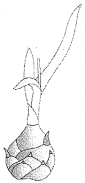
Select the correct option for the structure given below.
A
Garlic - Bulb
B
Onion - Bulb
C
Agave - Bulbil
D
Water hyacinth - Offset
Solution
(C) The image provided shows a bulbil of Agave. In Agave,the floral buds develop into bulbils,which are specialized structures for vegetative propagation. When these bulbils fall on the ground,they grow into new plants. Therefore,the correct option is $C$.
0 likes
View Solution226
MediumMCQ
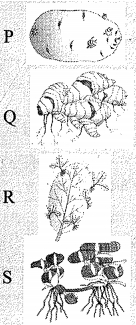
Match the following columns:
| Column-$I$ | Column-$II$ |
|---|---|
| $P$. Potato tuber | $I$. Leaf buds of Bryophyllum |
| $Q$. Ginger rhizome | $II$. Eyes of potato |
| $R$. Bryophyllum leaf | $III$. Offset of water hyacinth |
| $S$. Water hyacinth | $IV$. Rhizome of ginger |
A
$(P-II), (Q-IV), (R-I), (S-III)$
B
$(P-I), (Q-II), (R-IV), (S-III)$
C
$(P-III), (Q-II), (R-I), (S-IV)$
D
$(P-II), (Q-III), (R-IV), (S-I)$
Solution
(A) Based on the provided images:
$P$ represents a potato tuber,which propagates through its 'eyes' (axillary buds). Thus,$P-II$.
$Q$ represents a ginger rhizome. Thus,$Q-IV$.
$R$ represents a Bryophyllum leaf,which propagates through foliar adventitious buds (leaf buds). Thus,$R-I$.
$S$ represents water hyacinth,which propagates through an offset. Thus,$S-III$.
Therefore,the correct matching is $(P-II), (Q-IV), (R-I), (S-III)$.
$P$ represents a potato tuber,which propagates through its 'eyes' (axillary buds). Thus,$P-II$.
$Q$ represents a ginger rhizome. Thus,$Q-IV$.
$R$ represents a Bryophyllum leaf,which propagates through foliar adventitious buds (leaf buds). Thus,$R-I$.
$S$ represents water hyacinth,which propagates through an offset. Thus,$S-III$.
Therefore,the correct matching is $(P-II), (Q-IV), (R-I), (S-III)$.
0 likes
View Solution227
EasyMCQ
All organisms reach a certain stage of growth and maturity in their life before they can reproduce sexually. This period of growth is called ..........
A
Senescent phase
B
Juvenile phase
C
Adulthood
D
None of these
Solution
(B) In living organisms,the period of growth between birth and reproductive maturity is known as the $Juvenile$ $phase$. In plants,this phase is referred to as the $Vegetative$ $phase$. After this phase,the organism enters the reproductive phase. The $Senescent$ $phase$ is the final stage of life,characterized by the end of reproductive ability and the onset of aging.
0 likes
View Solution228
EasyMCQ
Given below are two statements.
Statement $I$ - In artificial methods of plant propagation like cutting,the vegetative part used for propagation contains one or more buds.
Statement $II$ - In artificial methods of vegetative propagation like budding,a vegetative part of the stem contains only one bud.
In the light of the above statements,select the correct option given below:
Statement $I$ - In artificial methods of plant propagation like cutting,the vegetative part used for propagation contains one or more buds.
Statement $II$ - In artificial methods of vegetative propagation like budding,a vegetative part of the stem contains only one bud.
In the light of the above statements,select the correct option given below:
A
Both statement $I$ and statement $II$ are correct.
B
Both statement $I$ and statement $II$ are incorrect.
C
Statement $I$ is correct but statement $II$ is incorrect.
D
Statement $I$ is incorrect but statement $II$ is correct.
Solution
(A) Statement $I$ is correct because in cutting,a piece of stem,root,or leaf containing one or more buds is used to develop a new plant.
Statement $II$ is also correct because the technique of budding (a type of grafting) specifically involves the use of a single bud (scion) which is inserted into the rootstock of another plant.
Therefore,both statements are scientifically accurate descriptions of artificial vegetative propagation techniques.
Statement $II$ is also correct because the technique of budding (a type of grafting) specifically involves the use of a single bud (scion) which is inserted into the rootstock of another plant.
Therefore,both statements are scientifically accurate descriptions of artificial vegetative propagation techniques.
0 likes
View Solution229
EasyMCQ
Which one of the following is $NOT$ true about vegetative propagation?
A
Easy and cheaper method
B
Rapid propagation
C
Production of genetically similar plants
D
Production of genetically dissimilar plants
Solution
(D) Vegetative propagation is a type of asexual reproduction in plants.
Since it involves only one parent and no meiosis or fusion of gametes,the offspring produced are genetically identical to the parent plant,also known as clones.
Therefore,the statement that it leads to the production of genetically dissimilar plants is incorrect.
It is an easy,cheaper,and rapid method of propagation.
Since it involves only one parent and no meiosis or fusion of gametes,the offspring produced are genetically identical to the parent plant,also known as clones.
Therefore,the statement that it leads to the production of genetically dissimilar plants is incorrect.
It is an easy,cheaper,and rapid method of propagation.
0 likes
View Solution230
EasyMCQ
Which one of the following plants reproduces vegetatively by epiphyllous buds?
A
Sweet potato
B
Potato
C
Onion
D
Kalanchoe
Solution
(D) Epiphyllous (epi: above,phyllous: having leaves) buds are adventitious buds that develop on the margins of leaves. In $Kalanchoe$,these buds detach from the leaf and grow into new individual plants,serving as a method of vegetative propagation.
0 likes
View Solution231
EasyMCQ
Motile zoospores are produced by
A
Chlamydomonas
B
Penicillium
C
Bacteria
D
Amoeba
Solution
(A) Zoospores are microscopic,motile structures that possess flagella,allowing them to move in an aquatic environment.
$Chlamydomonas$ is a green alga that reproduces asexually by forming motile zoospores.
$Penicillium$ reproduces through non-motile conidia.
$Bacteria$ typically reproduce through binary fission or endospore formation (which are not motile zoospores).
$Amoeba$ reproduces through binary fission.
Therefore,the correct option is $A$.
$Chlamydomonas$ is a green alga that reproduces asexually by forming motile zoospores.
$Penicillium$ reproduces through non-motile conidia.
$Bacteria$ typically reproduce through binary fission or endospore formation (which are not motile zoospores).
$Amoeba$ reproduces through binary fission.
Therefore,the correct option is $A$.
0 likes
View Solution232
EasyMCQ
. . . . . . is the most convenient and cheap method of artificial vegetative propagation.
A
Grafting
B
Budding
C
Cutting
D
Micropropagation
Solution
(C) Cutting is considered the most convenient and cheap method of artificial vegetative propagation.
In this method,a piece of the parent plant (stem,root,or leaf) is cut and planted in the soil.
Under favorable conditions,the cutting develops adventitious roots and shoots,eventually growing into a new independent plant.
It is widely used for plants like rose,sugarcane,and hibiscus because it requires minimal equipment and expertise compared to other methods like grafting or micropropagation.
In this method,a piece of the parent plant (stem,root,or leaf) is cut and planted in the soil.
Under favorable conditions,the cutting develops adventitious roots and shoots,eventually growing into a new independent plant.
It is widely used for plants like rose,sugarcane,and hibiscus because it requires minimal equipment and expertise compared to other methods like grafting or micropropagation.
0 likes
View Solution233
EasyMCQ
Which one of the following is $NOT$ a natural method of vegetative propagation?
A
Runner
B
Foliar buds
C
Stem tuber
D
Grafting
Solution
(D) Vegetative propagation is the process by which new plants are produced from vegetative parts of the parent plant.
Natural vegetative propagation occurs through structures like runners,foliar buds,and stem tubers,which are inherent parts of the plant's growth cycle.
$A$ Runner,$B$ Foliar buds,and $C$ Stem tuber are all examples of natural vegetative propagation.
$D$ Grafting is an artificial method of vegetative propagation where tissues from two different plants are joined together to grow as a single plant. Therefore,it is not a natural method.
Natural vegetative propagation occurs through structures like runners,foliar buds,and stem tubers,which are inherent parts of the plant's growth cycle.
$A$ Runner,$B$ Foliar buds,and $C$ Stem tuber are all examples of natural vegetative propagation.
$D$ Grafting is an artificial method of vegetative propagation where tissues from two different plants are joined together to grow as a single plant. Therefore,it is not a natural method.
0 likes
View Solution234
EasyMCQ
Regeneration as a method of asexual reproduction is observed in
A
Ascaris
B
Planaria
C
Prawn
D
Salmonella
Solution
(B) Regeneration is a process where an organism can regrow lost or damaged body parts. In some organisms,this process is so specialized that it serves as a method of asexual reproduction,where a fragmented body part can develop into a complete new individual. $Planaria$ (a flatworm) is a classic example of an organism that exhibits high regenerative capacity,allowing it to reproduce asexually through fragmentation and subsequent regeneration.
0 likes
View Solution235
EasyMCQ
Asexual reproduction through the formation of gemmules occurs in
A
Ascidian
B
Hydra
C
Planaria
D
Spongilla
Solution
(D) Gemmules are internal buds formed by sponges as a means of asexual reproduction.
They are specialized,resistant structures that allow the organism to survive unfavorable environmental conditions.
Among the given options,$Spongilla$ (a freshwater sponge) is the organism that reproduces through the formation of gemmules.
$Hydra$ reproduces by budding,$Planaria$ by regeneration,and $Ascidian$ by sexual reproduction.
They are specialized,resistant structures that allow the organism to survive unfavorable environmental conditions.
Among the given options,$Spongilla$ (a freshwater sponge) is the organism that reproduces through the formation of gemmules.
$Hydra$ reproduces by budding,$Planaria$ by regeneration,and $Ascidian$ by sexual reproduction.
0 likes
View Solution236
EasyMCQ
In bees,the female gamete does not fertilize and produces offspring. This event is known as . . . . . .
A
Parthenogenesis
B
Sexual reproduction
C
Multiplicity
D
Coincidental generation
Solution
(A) In bees,the process where an unfertilized egg develops into a new individual is called Parthenogenesis. In this system,the queen bee produces eggs by meiosis,and if an egg remains unfertilized,it develops into a male (drone) by parthenogenesis. This is a form of asexual reproduction occurring within a sexual species.
0 likes
View SolutionReproduction in Organisms — Asexual reproduction/Vegetative propagation · Frequently Asked Questions
1Are these Reproduction in Organisms questions useful for JEE and NEET?
Yes. All questions in this section are mapped to JEE Main and NEET exam patterns. Previous year questions from JEE Main, NEET, GUJCET and state-level exams are included with full solutions.
2Can I switch to Hindi or Gujarati for these questions?
Yes. Use the language tabs in the hero section or the sidebar to view the same questions and solutions in English, Hindi or Gujarati.
3How do I generate a question paper from this subtopic?
Use the Vedclass Exam Paper Generator — select the chapter and subtopic, set difficulty, and generate Sets A, B, C, D automatically. First 3 chapters of every subject are free.
Vedclass Products
For Students
Vedclass Test Series
Mock tests in real JEE/NEET style with performance analysis. 5-day free trial.
Start Free TrialFor Teachers
Exam Paper Generator
Generate Set A/B/C/D papers from this chapter in 2 minutes. 3 chapters free.
Try FreeFor Institutes
Online Exam Module
Live online exams with unlimited students, 360° analytics & white-label branding.
See DemoFor Teachers & Institutes
Generate a Reproduction in Organisms Exam Paper in 2 Minutes
Select subtopic & difficulty — Sets A, B, C, D auto-generated with No Repeat logic.
First 3 chapters of every subject are free — no payment required.