
A English
Asexual reproduction/Vegetative propagation Questions in English
Class 12 Biology · Reproduction in Organisms · Asexual reproduction/Vegetative propagation
236+
Questions
English
Language
100%
With Solutions
Showing 50 of 236 questions in English
51
EasyMCQ
Which of the following animals reproduce by budding?
A
Sponges,Tapeworms
B
Hydra,Roundworms
C
Sponges,Hydra
D
Hydra,Jellyfish
Solution
(C) Budding is a form of asexual reproduction where a new organism develops from an outgrowth or bud due to cell division at one particular site.
In the animal kingdom,this process is commonly observed in members of the phylum Porifera (e.g.,Sponges) and the phylum Cnidaria (e.g.,Hydra).
Therefore,both Sponges and Hydra reproduce by budding.
In the animal kingdom,this process is commonly observed in members of the phylum Porifera (e.g.,Sponges) and the phylum Cnidaria (e.g.,Hydra).
Therefore,both Sponges and Hydra reproduce by budding.
0 likes
View Solution52
EasyMCQ
What is observed in the $Protozoa$ group during unfavorable conditions?
A
Binary fission
B
Multiple fission
C
Budding
D
Encystation
Solution
(D) During unfavorable conditions,many $Protozoans$ (such as $Amoeba$) undergo a process called $Encystation$. In this process,the organism secretes a thick,protective wall or cyst around itself to survive harsh environmental conditions like desiccation or lack of food. Once favorable conditions return,the cyst wall breaks down,and the organism emerges.
0 likes
View Solution53
EasyMCQ
Which of the following organisms reproduces asexually through multiple fission?
A
Hydra
B
Spongilla
C
Plasmodium
D
Coral
Solution
(C) $Plasmodium$,a malarial parasite,reproduces asexually through a process called multiple fission. During this process,the nucleus divides repeatedly,and each daughter nucleus is surrounded by a small amount of cytoplasm,eventually forming many daughter cells simultaneously within the parent cell.
0 likes
View Solution54
EasyMCQ
Which of the following animals reproduce by budding?
A
Sponges,Tapeworms
B
Hydra,Ascaris
C
Sponges,Hydra
D
Hydra,Jellyfish
Solution
(C) Budding is a form of asexual reproduction where a new organism develops from an outgrowth or bud due to cell division at one particular site.
In the animal kingdom,this process is commonly observed in members of the phylum $Porifera$ (sponges) and the phylum $Cnidaria$ (e.g.,$Hydra$).
Therefore,sponges and $Hydra$ are the correct examples of animals that reproduce by budding.
In the animal kingdom,this process is commonly observed in members of the phylum $Porifera$ (sponges) and the phylum $Cnidaria$ (e.g.,$Hydra$).
Therefore,sponges and $Hydra$ are the correct examples of animals that reproduce by budding.
0 likes
View Solution55
EasyMCQ
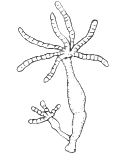
What type of reproduction is shown in the given figure?
A
Vegetative propagation
B
Asexual reproduction
C
Sexual reproduction
D
Branched reproduction
Solution
(B) The figure shows a Hydra undergoing budding,which is a form of asexual reproduction.
In budding,a small outgrowth or 'bud' develops on the parent body due to repeated mitotic cell divisions.
This bud eventually grows into a new individual and detaches from the parent body.
Since this process involves only one parent and does not involve the fusion of gametes,it is classified as asexual reproduction.
In budding,a small outgrowth or 'bud' develops on the parent body due to repeated mitotic cell divisions.
This bud eventually grows into a new individual and detaches from the parent body.
Since this process involves only one parent and does not involve the fusion of gametes,it is classified as asexual reproduction.
0 likes
View Solution56
EasyMCQ
Which method of vegetative reproduction occurs in fungi?
A
Fragmentation
B
Conjugation
C
Regeneration
D
Binary fission
Solution
(A) Vegetative reproduction in fungi occurs through various methods such as fragmentation,budding,and fission. Among the given options,fragmentation is a primary method where the fungal mycelium breaks into smaller pieces,and each piece develops into a new mycelium. Conjugation is a sexual process,regeneration is typically associated with animals like Planaria,and binary fission is common in bacteria and some unicellular organisms.
0 likes
View Solution57
EasyMCQ
Which type of vegetative reproduction occurs in algae?
A
Sporulation
B
Budding
C
Regeneration
D
Fragmentation
Solution
(D) Vegetative reproduction in algae primarily occurs through fragmentation.
In this process,the thallus of the algae breaks into smaller fragments,and each fragment develops into a new individual.
Sporulation is a method of asexual reproduction,not vegetative.
Budding is common in yeast,and regeneration is a specialized process of tissue repair or regrowth.
In this process,the thallus of the algae breaks into smaller fragments,and each fragment develops into a new individual.
Sporulation is a method of asexual reproduction,not vegetative.
Budding is common in yeast,and regeneration is a specialized process of tissue repair or regrowth.
0 likes
View Solution58
MediumMCQ
Which method of reproduction in algae and fungi represents vegetative reproduction?
A
Fragmentation
B
Budding
C
Sporulation
D
Both $A$ and $B$
Solution
(D) Vegetative reproduction refers to the asexual reproduction method where a new organism develops from a vegetative part of the parent body.
In algae,fragmentation is a common method of vegetative reproduction where the thallus breaks into smaller pieces,each capable of growing into a new individual.
In fungi,fragmentation is also a primary method of vegetative reproduction,where the mycelium breaks into fragments.
Budding is also a form of asexual reproduction observed in some fungi (e.g.,yeast),which is often categorized under vegetative propagation in a broader biological context.
Therefore,both fragmentation and budding are considered methods of vegetative reproduction in these organisms.
In algae,fragmentation is a common method of vegetative reproduction where the thallus breaks into smaller pieces,each capable of growing into a new individual.
In fungi,fragmentation is also a primary method of vegetative reproduction,where the mycelium breaks into fragments.
Budding is also a form of asexual reproduction observed in some fungi (e.g.,yeast),which is often categorized under vegetative propagation in a broader biological context.
Therefore,both fragmentation and budding are considered methods of vegetative reproduction in these organisms.
0 likes
View Solution59
EasyMCQ
Regeneration is a type of which of the following modes of reproduction?
A
Sexual reproduction
B
Asexual reproduction
C
Both $A$ and $B$
D
Multiple fission
Solution
(B) Regeneration is the process by which an organism regrows lost or damaged body parts. In many organisms,such as Planaria,Hydra,and starfish,this process is used as a method of asexual reproduction where a fragment of the parent body develops into a complete new individual. Therefore,it is classified as a mode of asexual reproduction.
0 likes
View Solution60
MediumMCQ
Which one of the following statements is not correct?
A
Offspring produced by asexual reproduction are called clones.
B
Microscopic,motile,asexual reproductive structures are called zoospores.
C
In potato,banana,and ginger,the plantlets arise from the internodes present in the modified stem.
D
Water hyacinth,growing in standing water,drains oxygen from water,which leads to the death of fishes.
Solution
(C) is the incorrect statement.
In potato,banana,and ginger,the new plantlets arise from the nodes (eyes) present in the modified stems,not from the internodes.
Potato propagates via tubers,which possess buds on their nodes (eyes).
Banana and ginger propagate via rhizomes,which also bear buds on their nodes to facilitate the formation of new plantlets.
In potato,banana,and ginger,the new plantlets arise from the nodes (eyes) present in the modified stems,not from the internodes.
Potato propagates via tubers,which possess buds on their nodes (eyes).
Banana and ginger propagate via rhizomes,which also bear buds on their nodes to facilitate the formation of new plantlets.
0 likes
View Solution61
MediumMCQ
Which one of the following is correctly matched?
A
Onion-$Bulb$
B
Ginger-$Sucker$
C
Chlamydomonas-$Conidia$
D
Yeast-$Zoospores$
Solution
(A) The correct answer is $A$.
$1$. Onion propagates vegetatively through a $Bulb$,which is an underground modified stem.
$2$. Ginger propagates through a $Rhizome$,not a $Sucker$.
$3$. $Chlamydomonas$ reproduces through $Zoospores$,not $Conidia$.
$4$. $Yeast$ reproduces through budding,and it does not produce $Zoospores$.
$1$. Onion propagates vegetatively through a $Bulb$,which is an underground modified stem.
$2$. Ginger propagates through a $Rhizome$,not a $Sucker$.
$3$. $Chlamydomonas$ reproduces through $Zoospores$,not $Conidia$.
$4$. $Yeast$ reproduces through budding,and it does not produce $Zoospores$.
0 likes
View Solution62
EasyMCQ
The "eyes" of the potato tuber are
A
root buds
B
flower buds
C
shoot buds
D
axillary buds
Solution
(D) : Potato is a common example of a stem tuber. It stores starch as a reserve food material. Potato tubers are used for vegetative propagation. These possess axillary buds over their nodes or "eyes". The buds produce new plantlets when a stem tuber or a part of it having an eye is placed in the soil.
0 likes
View Solution63
EasyMCQ
Vegetative propagation in $Pistia$ occurs by
A
stolon
B
offset
C
runner
D
sucker
Solution
(B) $Pistia$ (water lettuce) is an aquatic plant that reproduces vegetatively through structures known as offsets.
An offset is a short,thick runner that grows horizontally at the water surface.
It produces a rosette of leaves at the apex and adventitious roots at the base,eventually developing into a new independent plant.
An offset is a short,thick runner that grows horizontally at the water surface.
It produces a rosette of leaves at the apex and adventitious roots at the base,eventually developing into a new independent plant.
0 likes
View Solution64
MediumMCQ
Vegetative propagation in mint occurs by
A
offset
B
rhizome
C
sucker
D
runner
Solution
(C) Vegetative propagation in mint $(Mentha)$ occurs through a structure known as a sucker.
In this process,a lateral branch originates from the basal and underground portion of the main stem,grows horizontally beneath the soil for some distance,and then turns upwards to form a new leafy shoot.
In this process,a lateral branch originates from the basal and underground portion of the main stem,grows horizontally beneath the soil for some distance,and then turns upwards to form a new leafy shoot.
0 likes
View Solution65
EasyMCQ
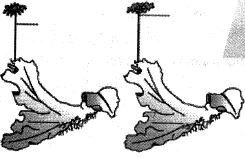
Identify the following figure and select the correct option.
A
Chara
B
Marchantia
C
Sweet potato
D
Ophioglossum
Solution
(B) The provided figure shows the male and female thalli of the liverwort $Marchantia$.
In $Marchantia$,the plant body is a thallus,which is dioecious,meaning the male and female sex organs are borne on separate thalli.
The male thallus bears antheridiophores (carrying antheridia),and the female thallus bears archegoniophores (carrying archegonia).
Therefore,the correct option is $B$.
In $Marchantia$,the plant body is a thallus,which is dioecious,meaning the male and female sex organs are borne on separate thalli.
The male thallus bears antheridiophores (carrying antheridia),and the female thallus bears archegoniophores (carrying archegonia).
Therefore,the correct option is $B$.
0 likes
View Solution66
MediumMCQ
Which of the following is true/correct about the 'terror of Bengal'?
A
Only $I$ and $III$
B
Only $I$ and $II$
C
Only $II$ and $III$
D
$I, II$ and $IV$
Solution
(D) The 'terror of Bengal' refers to the aquatic plant $Eichhornia$ $crassipes$ (water hyacinth).
$(I)$ It is an aquatic plant: This is correct.
$(II)$ It is an invasive weed: This is correct as it grows rapidly and spreads uncontrollably.
$(III)$ It drains oxygen from the water,which leads to the death of fish: This statement is incorrect because the plant actually $DOES$ drain oxygen from the water,causing the death of fish.
$(IV)$ It can propagate vegetatively: This is correct; it propagates very quickly through offsets (vegetative propagation).
Therefore,statements $I, II,$ and $IV$ are correct.
$(I)$ It is an aquatic plant: This is correct.
$(II)$ It is an invasive weed: This is correct as it grows rapidly and spreads uncontrollably.
$(III)$ It drains oxygen from the water,which leads to the death of fish: This statement is incorrect because the plant actually $DOES$ drain oxygen from the water,causing the death of fish.
$(IV)$ It can propagate vegetatively: This is correct; it propagates very quickly through offsets (vegetative propagation).
Therefore,statements $I, II,$ and $IV$ are correct.
0 likes
View Solution67
EasyMCQ
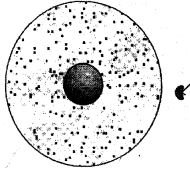
Identify the given figure:
A
Isogametes of Cladophora
B
Heterogametes of Fucus
C
Heterogametes of human
D
Isogametes of Chara
Solution
(B) The figure shows two distinct types of gametes: a large,non-motile egg (ovum) and a small,motile sperm. This condition is known as heterogamety. Specifically,this diagram represents the heterogametes of the brown alga $Fucus$ (a species of algae). In $Fucus$,the male gamete is small and motile,while the female gamete is large and non-motile. Therefore,the correct option is $B$.
0 likes
View Solution68
MediumMCQ
Identify the odd one out.
A
Eye of potato
B
Rhizome of ginger
C
Bulbil of agave
D
None of the above
Solution
(D) The options $A$,$B$,and $C$ represent different types of vegetative propagules used in plants for asexual reproduction.
$1$. Eye of potato is a vegetative bud.
$2$. Rhizome of ginger is an underground stem modification.
$3$. Bulbil of agave is a specialized vegetative bud.
Since all these are examples of vegetative propagules,none of them is the odd one out. Therefore,the correct answer is $D$.
$1$. Eye of potato is a vegetative bud.
$2$. Rhizome of ginger is an underground stem modification.
$3$. Bulbil of agave is a specialized vegetative bud.
Since all these are examples of vegetative propagules,none of them is the odd one out. Therefore,the correct answer is $D$.
0 likes
View Solution69
EasyMCQ
Asexual reproduction occurs by budding in
A
Hydra
B
Planaria
C
Ginger
D
Cockroach
Solution
(A) Budding is a type of asexual reproduction where a new organism develops from an outgrowth or bud due to cell division at one particular site.
In $Hydra$,the cells divide rapidly at a specific site and develop into an outgrowth called a bud.
This bud gradually grows and develops into a tiny individual,which eventually detaches from the parent body to become a new independent organism.
$Planaria$ reproduces by regeneration,$Ginger$ reproduces by vegetative propagation (rhizomes),and $Cockroach$ reproduces sexually.
In $Hydra$,the cells divide rapidly at a specific site and develop into an outgrowth called a bud.
This bud gradually grows and develops into a tiny individual,which eventually detaches from the parent body to become a new independent organism.
$Planaria$ reproduces by regeneration,$Ginger$ reproduces by vegetative propagation (rhizomes),and $Cockroach$ reproduces sexually.
0 likes
View Solution70
EasyMCQ
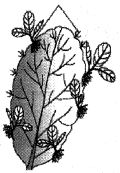
Identify the plant shown in the figure.
A
Agave
B
Water hyacinth
C
Potato
D
Bryophyllum
Solution
(D) The figure shows a leaf with small plantlets growing along its margins. This is a characteristic method of vegetative propagation in the plant $Bryophyllum$.
In $Bryophyllum$,the adventitious buds arise from the notches present at the margins of the leaves. These buds develop into new plantlets,which eventually detach and grow into independent plants.
In $Bryophyllum$,the adventitious buds arise from the notches present at the margins of the leaves. These buds develop into new plantlets,which eventually detach and grow into independent plants.
0 likes
View Solution71
MediumMCQ
$A$ haploid parent produces gametes by which type of division?
A
Mitotic division
B
Meiosis division
C
$A$ and $B$ both
D
None of the above
Solution
(A) Organisms with a haploid plant body (like Monera,Fungi,Algae,and Bryophytes) produce gametes through mitotic division.
Since the parent is already haploid $(n)$,it cannot undergo meiosis because meiosis is a reductional division that would result in a chromosome number of $n/2$,which is not biologically viable for gamete formation in these organisms.
Therefore,they undergo mitosis to produce haploid gametes.
Since the parent is already haploid $(n)$,it cannot undergo meiosis because meiosis is a reductional division that would result in a chromosome number of $n/2$,which is not biologically viable for gamete formation in these organisms.
Therefore,they undergo mitosis to produce haploid gametes.
0 likes
View Solution72
EasyMCQ
Adventitious buds are produced on a leaf margin of.....
A
Bryophyllum
B
Sugar cane
C
Potato
D
Ginger
Solution
(A) Vegetative propagation is a type of asexual reproduction in plants where new individuals are formed from vegetative parts like roots,stems,or leaves. In $Bryophyllum$,the leaf margins possess notches that contain adventitious buds. When these leaves fall on moist soil,these buds develop into new plantlets. This is a classic example of vegetative propagation through leaves.
0 likes
View Solution73
EasyMCQ
Identify water weeds.
A
Water hyacinth
B
Strigula
C
Bamboo
D
Bryophyllum
Solution
(A) Water hyacinth $(Eichhornia \text{ } crassipes)$ is one of the most invasive weeds found growing wherever there is standing water.
It drains oxygen from the water, which leads to the death of fishes.
It is also known as the 'Terror of Bengal' due to its rapid vegetative propagation, which makes it extremely difficult to get rid of.
Therefore, the correct option is $A$.
It drains oxygen from the water, which leads to the death of fishes.
It is also known as the 'Terror of Bengal' due to its rapid vegetative propagation, which makes it extremely difficult to get rid of.
Therefore, the correct option is $A$.
0 likes
View Solution74
EasyMCQ
Identify the odd one out:
A
Offset
B
Stolons
C
Bulbil
D
Conidia
Solution
(D) The correct answer is $D$ (Conidia).
$A$ (Offset),$B$ (Stolons),and $C$ (Bulbil) are all types of vegetative propagules involved in vegetative propagation in plants.
$D$ (Conidia) are asexual reproductive structures (spores) found in fungi,such as Penicillium,and are not considered vegetative propagules.
$A$ (Offset),$B$ (Stolons),and $C$ (Bulbil) are all types of vegetative propagules involved in vegetative propagation in plants.
$D$ (Conidia) are asexual reproductive structures (spores) found in fungi,such as Penicillium,and are not considered vegetative propagules.
0 likes
View Solution75
EasyMCQ
Which of the following statements is incorrect?
A
Penicillium - conidia
B
Hydra - Bud
C
Yeast - Equal cell division
D
Sponge - gemmule
Solution
(C) In $Penicillium$,asexual reproduction occurs through $conidia$.
In $Hydra$,asexual reproduction occurs through the formation of $buds$.
In $Sponge$,asexual reproduction occurs through internal $buds$ called $gemmules$.
In $Yeast$,asexual reproduction occurs through $budding$,which is an unequal cell division process where a small bud is formed on the parent cell. Therefore,the statement '$Yeast$ - Equal cell division' is incorrect.
In $Hydra$,asexual reproduction occurs through the formation of $buds$.
In $Sponge$,asexual reproduction occurs through internal $buds$ called $gemmules$.
In $Yeast$,asexual reproduction occurs through $budding$,which is an unequal cell division process where a small bud is formed on the parent cell. Therefore,the statement '$Yeast$ - Equal cell division' is incorrect.
0 likes
View Solution76
EasyMCQ
In which of the following are zoospores found?
A
Penicillium
B
Chlamydomonas
C
Hydra
D
Sponge
Solution
(B) Zoospores are microscopic,motile structures involved in asexual reproduction.
They are typically flagellated,which allows them to move in an aquatic environment.
Among the given options,$Chlamydomonas$ is a green alga that produces zoospores for asexual reproduction.
$Penicillium$ reproduces via conidia,while $Hydra$ and $Sponge$ reproduce through budding or gemmules,respectively.
They are typically flagellated,which allows them to move in an aquatic environment.
Among the given options,$Chlamydomonas$ is a green alga that produces zoospores for asexual reproduction.
$Penicillium$ reproduces via conidia,while $Hydra$ and $Sponge$ reproduce through budding or gemmules,respectively.
0 likes
View Solution77
EasyMCQ
'Terror of Bengal' is:
A
Water hyacinth
B
Aquatic animal
C
Nutrients
D
Chemical
Solution
(A) The plant $Eichhornia$ $crassipes$,commonly known as 'Water hyacinth',is referred to as the 'Terror of Bengal'.
It is an invasive aquatic weed that grows excessively in standing water,depleting dissolved oxygen from the water.
This leads to the death of fishes and other aquatic organisms,causing severe ecological imbalance in the water bodies of Bengal.
It is an invasive aquatic weed that grows excessively in standing water,depleting dissolved oxygen from the water.
This leads to the death of fishes and other aquatic organisms,causing severe ecological imbalance in the water bodies of Bengal.
0 likes
View Solution78
MediumMCQ
Which of the following organisms reproduce by fragmentation?
A
Fungi
B
Filamentous algae
C
Protonema of mosses
D
All of the above
Solution
(D) Fragmentation is a form of asexual reproduction where an organism breaks into fragments,each of which develops into a new individual.
In fungi,the mycelium can break into fragments to form new colonies.
Filamentous algae (like Spirogyra) reproduce by fragmentation when the filament breaks into smaller pieces.
The protonema of mosses also reproduces through fragmentation,where the protonema breaks into pieces and each piece grows into a new moss plant.
Therefore,all the given organisms reproduce by fragmentation.
In fungi,the mycelium can break into fragments to form new colonies.
Filamentous algae (like Spirogyra) reproduce by fragmentation when the filament breaks into smaller pieces.
The protonema of mosses also reproduces through fragmentation,where the protonema breaks into pieces and each piece grows into a new moss plant.
Therefore,all the given organisms reproduce by fragmentation.
0 likes
View Solution79
MediumMCQ
........... in yeast and hydra.
A
Reproduction does not occur
B
Metabolism does not occur
C
Budding is seen
D
None of the above
Solution
(C) In yeast and hydra,reproduction occurs through a process called budding.
In this process,a small part of the body of the parent organism grows as a bud,which eventually detaches to form a new individual.
Therefore,budding is the characteristic mode of asexual reproduction observed in these organisms.
In this process,a small part of the body of the parent organism grows as a bud,which eventually detaches to form a new individual.
Therefore,budding is the characteristic mode of asexual reproduction observed in these organisms.
0 likes
View Solution80
MediumMCQ
Which of the following set of organisms reproduce by fragmentation?
A
Amoeba,fungi,earthworm
B
Fungi,filamentous algae,protonema of mosses
C
Hydra,cockroach,mule
D
Earthworm,fungi,bacteria
Solution
(B) Fragmentation is a form of asexual reproduction where an organism breaks into fragments,and each fragment develops into a mature,fully grown individual.
In fungi,filamentous algae,and the protonema of mosses,the plant body easily breaks up into small pieces (fragments) upon maturation.
Each of these fragments grows into a new individual.
Therefore,the correct set is fungi,filamentous algae,and protonema of mosses.
In fungi,filamentous algae,and the protonema of mosses,the plant body easily breaks up into small pieces (fragments) upon maturation.
Each of these fragments grows into a new individual.
Therefore,the correct set is fungi,filamentous algae,and protonema of mosses.
0 likes
View Solution81
MediumMCQ
Reproduction occurs through fragmentation in
A
Chlamydomonas
B
Human
C
Mango
D
Bat
Solution
(A) Fragmentation is a form of asexual reproduction where the body of an organism breaks into distinct pieces,each of which can grow into an adult organism.
In the $Plant$ $Kingdom$,specifically among algae,fragmentation is a common method of vegetative reproduction.
$Chlamydomonas$ is a genus of green algae. While it primarily reproduces through zoospores (asexual) or gametes (sexual),many filamentous algae (like $Spirogyra$) and some colonial forms reproduce via fragmentation.
Among the given options,$Chlamydomonas$ is the only organism belonging to the group (Algae) where such reproductive mechanisms are studied,whereas $Human$,$Mango$,and $Bat$ reproduce through complex sexual methods.
In the $Plant$ $Kingdom$,specifically among algae,fragmentation is a common method of vegetative reproduction.
$Chlamydomonas$ is a genus of green algae. While it primarily reproduces through zoospores (asexual) or gametes (sexual),many filamentous algae (like $Spirogyra$) and some colonial forms reproduce via fragmentation.
Among the given options,$Chlamydomonas$ is the only organism belonging to the group (Algae) where such reproductive mechanisms are studied,whereas $Human$,$Mango$,and $Bat$ reproduce through complex sexual methods.
0 likes
View Solution82
MediumMCQ
The main advantage of encystation in $Amoeba$ is .....
A
Disposal of accumulated waste products
B
Ability to survive during unfavourable physical conditions
C
Ability to live for some time without food intake
D
Protection from parasites and predators
Solution
(B) Encystation is a process in $Amoeba$ where the organism withdraws its pseudopodia and secretes a three-layered,hard,protective covering or cyst around itself. This process occurs during unfavourable environmental conditions. The primary purpose of this cyst is to protect the $Amoeba$ from harsh external factors,allowing it to survive until favourable conditions return. Once conditions become favourable,the cyst wall breaks,and the $Amoeba$ undergoes multiple fission to release many small amoebae (sporulation).
0 likes
View Solution83
EasyMCQ
Which of the following propagates through the leaf tip?
A
Walking fern
B
Bryophyllum
C
Marchantia
D
Moss
Solution
(A) The walking fern,scientifically known as $Adiantum \ caudatum$,is a type of fern that propagates vegetatively through its leaf tips. When the tip of the leaf touches the soil,it develops adventitious roots and a new plantlet,allowing the plant to 'walk' or spread across the ground.
0 likes
View Solution84
MediumMCQ
Which of the following is true for multicellular fungi,filamentous algae,and the protonema of mosses?
A
Diplontic life cycle
B
Members of Kingdom Plantae
C
Mode of nutrition
D
Multiplication by fragmentation
Solution
(D) Multicellular fungi,filamentous algae,and the protonema of mosses all share the characteristic of reproducing through fragmentation. In this process,the body of the organism breaks into distinct pieces or fragments,and each fragment grows into a new individual. This is a common method of vegetative propagation or asexual reproduction in these groups.
0 likes
View Solution85
EasyMCQ
In asexual reproduction,the budding method is common in $..........$.
A
Starfish and Hydra
B
Hydra and Sponges
C
Tapeworm and Hydra
D
Sponges and Starfish
Solution
(B) Budding is a form of asexual reproduction where a new organism develops from an outgrowth or bud due to cell division at one particular site.
In the animal kingdom,this process is commonly observed in $Hydra$ (a cnidarian) and $Sponges$ (Porifera).
In $Hydra$,the bud develops into a miniature individual and eventually detaches from the parent body.
In $Sponges$,internal buds called $gemmules$ are formed,which help in asexual reproduction.
In the animal kingdom,this process is commonly observed in $Hydra$ (a cnidarian) and $Sponges$ (Porifera).
In $Hydra$,the bud develops into a miniature individual and eventually detaches from the parent body.
In $Sponges$,internal buds called $gemmules$ are formed,which help in asexual reproduction.
0 likes
View Solution86
MediumMCQ
$A$ new banana plant develops from $..........$.
A
Rhizome
B
Sucker
C
Stolon
D
Seed
Solution
(B) In banana plants,the main stem is underground and is known as a rhizome.
New banana plants develop from the lateral branches that arise from the underground portion of the main stem.
These lateral branches are technically known as suckers.
Therefore,the vegetative propagation in banana occurs through suckers.
New banana plants develop from the lateral branches that arise from the underground portion of the main stem.
These lateral branches are technically known as suckers.
Therefore,the vegetative propagation in banana occurs through suckers.
0 likes
View Solution87
EasyMCQ
Vegetative propagation in Agave occurs through ........
A
Rhizome
B
Stolon
C
Bulbil
D
Sucker
Solution
(C) In $Agave$,vegetative propagation occurs through specialized fleshy buds known as bulbils.
These bulbils develop in the inflorescence instead of flowers.
When these bulbils fall on the ground,they germinate to form new $Agave$ plants.
Therefore,the correct option is $C$.
These bulbils develop in the inflorescence instead of flowers.
When these bulbils fall on the ground,they germinate to form new $Agave$ plants.
Therefore,the correct option is $C$.
0 likes
View Solution88
EasyMCQ
From which of the following does a new banana plant develop?
A
Stolon
B
Rhizome
C
Sucker
D
Seed
Solution
(C) new banana plant develops from a $Sucker$.
$Suckers$ are lateral branches that develop from the underground base of the main stem.
These grow horizontally beneath the soil and then emerge above the ground to form a new independent plant.
This is a common method of vegetative propagation in banana plants.
$Suckers$ are lateral branches that develop from the underground base of the main stem.
These grow horizontally beneath the soil and then emerge above the ground to form a new independent plant.
This is a common method of vegetative propagation in banana plants.
0 likes
View Solution89
EasyMCQ
In which of the following pairs can vegetative propagation be achieved through leaf fragments in both plants?
A
Agave and Kalanchoe
B
Bryophyllum and Kalanchoe
C
Asparagus and Bryophyllum
D
Chrysanthemum and Agave
Solution
(B) Vegetative propagation through leaves occurs when adventitious buds develop on the leaf margins or surface.
In $Bryophyllum$ (often called $Patharchatta$ or $Parnkuti$),adventitious buds arise from the notches present at the margins of the leaves.
Similarly,in $Kalanchoe$,vegetative propagation also occurs through leaf buds.
Therefore,both $Bryophyllum$ and $Kalanchoe$ are classic examples of plants that propagate vegetatively via their leaves.
In $Bryophyllum$ (often called $Patharchatta$ or $Parnkuti$),adventitious buds arise from the notches present at the margins of the leaves.
Similarly,in $Kalanchoe$,vegetative propagation also occurs through leaf buds.
Therefore,both $Bryophyllum$ and $Kalanchoe$ are classic examples of plants that propagate vegetatively via their leaves.
0 likes
View Solution90
EasyMCQ
In water hyacinth, vegetative propagation occurs by ...........
A
Rhizome
B
Offset
C
Stolon
D
Runner
Solution
(B) Water hyacinth $(Eichhornia \text{ } crassipes)$ is an aquatic plant that reproduces vegetatively through a specialized structure known as an $Offset$.
An $Offset$ is a short, thick, horizontal branch that grows from the axil of a leaf and produces a new plant at its tip.
This rapid vegetative propagation allows water hyacinth to spread quickly across water bodies, often becoming an invasive species.
An $Offset$ is a short, thick, horizontal branch that grows from the axil of a leaf and produces a new plant at its tip.
This rapid vegetative propagation allows water hyacinth to spread quickly across water bodies, often becoming an invasive species.
0 likes
View Solution91
EasyMCQ
The eyes of the potato are ......... .
A
Floral buds
B
Shoot buds
C
Axillary buds
D
Root buds
Solution
(C) The potato tuber is a modified underground stem. The 'eyes' present on the surface of the potato tuber are actually axillary buds. These buds are capable of growing into new plants through vegetative propagation. Therefore,the correct option is $C$.
0 likes
View Solution92
EasyMCQ
Which of the following is a correct pair?
A
Onion - Bulb
B
Ginger - Runner
C
Chrysanthemum - Conidia
D
Yeast - Zoospore
Solution
(A) In plants,vegetative propagation occurs through various structures:
$1$. Onion reproduces through a $Bulb$.
$2$. Ginger reproduces through a $Rhizome$,not a $Runner$.
$3$. Chrysanthemum reproduces through $Suckers$,not $Conidia$.
$4$. Yeast reproduces through $Budding$,not $Zoospore$.
Therefore,the correct pair is $Onion - Bulb$.
$1$. Onion reproduces through a $Bulb$.
$2$. Ginger reproduces through a $Rhizome$,not a $Runner$.
$3$. Chrysanthemum reproduces through $Suckers$,not $Conidia$.
$4$. Yeast reproduces through $Budding$,not $Zoospore$.
Therefore,the correct pair is $Onion - Bulb$.
0 likes
View Solution93
EasyMCQ
Offsets are produced by
A
Parthenogenesis
B
Meiotic divisions
C
Parthenocarpy
D
Mitotic divisions
Solution
(D) Offsets are a type of vegetative propagule produced by certain aquatic plants like $Eichhornia$ (water hyacinth).
Vegetative propagation is a form of asexual reproduction where new plants are formed from vegetative parts of the parent plant.
Since asexual reproduction involves the formation of clones,it occurs through $Mitotic$ $divisions$ only,without the involvement of meiosis or gamete fusion.
Vegetative propagation is a form of asexual reproduction where new plants are formed from vegetative parts of the parent plant.
Since asexual reproduction involves the formation of clones,it occurs through $Mitotic$ $divisions$ only,without the involvement of meiosis or gamete fusion.
0 likes
View Solution94
MediumMCQ
Assertion : Many plants are propagated vegetatively even though they bear seeds.
Reason : Potatoes multiply by tubers,apple by cutting etc.
Reason : Potatoes multiply by tubers,apple by cutting etc.
A
If the Assertion is correct but Reason is incorrect.
B
If both Assertion and Reason are correct but Reason is not a correct explanation of the Assertion.
C
If both Assertion and Reason are correct and the Reason is a correct explanation of the Assertion.
D
If both the Assertion and Reason are incorrect.
Solution
(C) Vegetative propagation is a form of asexual reproduction where new plants are formed from vegetative parts like buds,tubers,rhizomes,roots,stems,or leaves.
Many plants that produce seeds are also propagated vegetatively because it allows for the production of clones that are genetically identical to the parent plant and often results in faster growth.
Potatoes are indeed propagated by stem tubers,which contain 'eyes' (buds) that develop into new plants.
Apples are commonly propagated by stem cuttings or grafting to ensure the offspring retain the desirable traits of the parent tree.
Since both the assertion and the reason are factually correct,and the reason provides specific examples of vegetative propagation that support the assertion,the reason is a correct explanation.
Many plants that produce seeds are also propagated vegetatively because it allows for the production of clones that are genetically identical to the parent plant and often results in faster growth.
Potatoes are indeed propagated by stem tubers,which contain 'eyes' (buds) that develop into new plants.
Apples are commonly propagated by stem cuttings or grafting to ensure the offspring retain the desirable traits of the parent tree.
Since both the assertion and the reason are factually correct,and the reason provides specific examples of vegetative propagation that support the assertion,the reason is a correct explanation.
0 likes
View Solution95
MediumMCQ
Assertion: Leaves of $Bryophyllum$ and $Begonia$ help in vegetative multiplication.
Reason: Leaves of these plants possess adventitious buds.
Reason: Leaves of these plants possess adventitious buds.
A
If both Assertion and Reason are correct and the Reason is a correct explanation of the Assertion.
B
If both Assertion and Reason are correct but Reason is not a correct explanation of the Assertion.
C
If the Assertion is correct but Reason is incorrect.
D
If both the Assertion and Reason are incorrect.
Solution
(A) Vegetative propagation is a type of asexual reproduction where new plants are formed from vegetative parts of the parent plant.
In plants like $Bryophyllum$ and $Begonia$,the leaves are specialized to perform vegetative propagation.
These leaves possess adventitious buds (also known as foliar buds) in the notches of their margins.
When these leaves fall on moist soil,the adventitious buds develop into new plantlets.
Therefore,both the Assertion and the Reason are correct,and the Reason is the correct explanation of the Assertion.
In plants like $Bryophyllum$ and $Begonia$,the leaves are specialized to perform vegetative propagation.
These leaves possess adventitious buds (also known as foliar buds) in the notches of their margins.
When these leaves fall on moist soil,the adventitious buds develop into new plantlets.
Therefore,both the Assertion and the Reason are correct,and the Reason is the correct explanation of the Assertion.
0 likes
View Solution96
Medium
Explain asexual reproduction in plants and animals with examples.
Solution
(N/A) In asexual reproduction,a single parent is capable of producing offspring. As a result,the offspring produced are not only identical to one another but are also exact copies of their parent.
These offspring are genetically identical. The term 'clone' is used to describe such morphologically and genetically similar individuals.
$1.$ Binary Fission: In many single-celled organisms,the cell divides into two halves,and each rapidly grows into an adult. Examples: $Amoeba$,$Paramecium$.
$2.$ Budding: In yeast,the division is unequal,and small buds are produced that remain attached initially to the parent cell. Eventually,they get separated and mature into new yeast organisms. In $Hydra$,a bud develops as an outgrowth due to repeated cell division at one specific site.
$3.$ Encystation and Sporulation: Under unfavorable conditions,$Amoeba$ withdraws its pseudopodia and secretes a three-layered hard covering or cyst around itself. This phenomenon is called encystation. When favorable conditions return,the encysted $Amoeba$ divides by multiple fission and produces many pseudopodiospores. The cyst wall bursts,and the spores are released into the surrounding medium to grow up into many $Amoeba$s. This is called sporulation.
These offspring are genetically identical. The term 'clone' is used to describe such morphologically and genetically similar individuals.
$1.$ Binary Fission: In many single-celled organisms,the cell divides into two halves,and each rapidly grows into an adult. Examples: $Amoeba$,$Paramecium$.
$2.$ Budding: In yeast,the division is unequal,and small buds are produced that remain attached initially to the parent cell. Eventually,they get separated and mature into new yeast organisms. In $Hydra$,a bud develops as an outgrowth due to repeated cell division at one specific site.
$3.$ Encystation and Sporulation: Under unfavorable conditions,$Amoeba$ withdraws its pseudopodia and secretes a three-layered hard covering or cyst around itself. This phenomenon is called encystation. When favorable conditions return,the encysted $Amoeba$ divides by multiple fission and produces many pseudopodiospores. The cyst wall bursts,and the spores are released into the surrounding medium to grow up into many $Amoeba$s. This is called sporulation.
0 likes
View Solution97
Medium
Explain vegetative propagation in plants with examples.
Solution
(N/A) In animals and other simple organisms,the term 'asexual' is used explicitly. However,in plants,the term 'vegetative propagation' is frequently used.
Vegetative structures in plants such as runners,rhizomes,suckers,tubers,offsets,and bulbs are capable of giving rise to new offspring. These structures are called vegetative propagules.
Since the formation of these structures does not involve two parents,the process involved is asexual.
Fragmentation: In some organisms,the body breaks into distinct pieces or fragments,and each fragment grows into an adult organism. Example: $Hydra$,$Planaria$. This is also a type of asexual reproduction known as fragmentation.
Vegetative structures in plants such as runners,rhizomes,suckers,tubers,offsets,and bulbs are capable of giving rise to new offspring. These structures are called vegetative propagules.
Since the formation of these structures does not involve two parents,the process involved is asexual.
Fragmentation: In some organisms,the body breaks into distinct pieces or fragments,and each fragment grows into an adult organism. Example: $Hydra$,$Planaria$. This is also a type of asexual reproduction known as fragmentation.
0 likes
View Solution98
EasyMCQ
What is the 'scourge' of water bodies or the 'Terror of Bengal'? Explain briefly.
A
Water Hyacinth (Eichhornia crassipes)
B
Parthenium hysterophorus
C
Lantana camara
D
Cynodon dactylon
Solution
(A) Water Hyacinth $(Eichhornia \text{ } crassipes)$ is one of the most invasive weeds found growing wherever there is standing water.
It drains oxygen from the water, which leads to the death of fishes.
This plant was introduced in India because of its beautiful flowers and shape of leaves.
Since it can propagate vegetatively at a phenomenal rate and spread all over the water body in a short period, it is very difficult to get rid of them.
It drains oxygen from the water, which leads to the death of fishes.
This plant was introduced in India because of its beautiful flowers and shape of leaves.
Since it can propagate vegetatively at a phenomenal rate and spread all over the water body in a short period, it is very difficult to get rid of them.
0 likes
View Solution99
MediumMCQ
Explain vegetative propagation by buds.
A
Buds on potato tubers (eyes).
B
Rhizomes of banana and ginger.
C
Adventitious buds on leaf margins of Bryophyllum.
D
All of the above.
Solution
(D) Vegetative propagation occurs through buds in various plants.
In potato tubers,the buds are known as 'eyes'.
In banana and ginger,the rhizomes contain nodes from which new plants arise.
When these nodes come in contact with damp soil or water,they produce roots and new shoots.
Similarly,in Bryophyllum,adventitious buds arise from the notches present at the margins of the leaves.
This ability to produce new plants vegetatively is widely used by gardeners and farmers for the commercial propagation of plants.
In potato tubers,the buds are known as 'eyes'.
In banana and ginger,the rhizomes contain nodes from which new plants arise.
When these nodes come in contact with damp soil or water,they produce roots and new shoots.
Similarly,in Bryophyllum,adventitious buds arise from the notches present at the margins of the leaves.
This ability to produce new plants vegetatively is widely used by gardeners and farmers for the commercial propagation of plants.
0 likes
View Solution100
Medium
How does vegetative propagation occur in potato,sugarcane,banana,ginger,and dahlia? Explain.
Solution
(N/A) In plants like potato,sugarcane,banana,ginger,and dahlia,vegetative propagation occurs through modified stems.
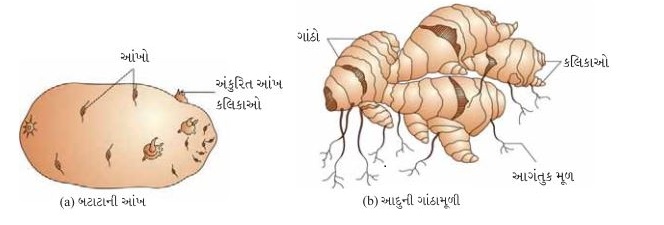
$1$. Potato: The 'eyes' on the potato tuber are axillary buds that give rise to new plants.
$2$. Ginger and Banana: These plants propagate through rhizomes,where nodes present on the modified stem give rise to new shoots.
$3$. Sugarcane: Propagation occurs through stem cuttings containing nodes.
$4$. Dahlia: Propagation occurs through tuberous roots.
When these nodes come in contact with moist soil or water,they produce roots and new plants. This ability to produce new plants from vegetative parts is widely used by gardeners and farmers for the commercial cultivation and propagation of these plants.
$1$. Potato: The 'eyes' on the potato tuber are axillary buds that give rise to new plants.
$2$. Ginger and Banana: These plants propagate through rhizomes,where nodes present on the modified stem give rise to new shoots.
$3$. Sugarcane: Propagation occurs through stem cuttings containing nodes.
$4$. Dahlia: Propagation occurs through tuberous roots.
When these nodes come in contact with moist soil or water,they produce roots and new plants. This ability to produce new plants from vegetative parts is widely used by gardeners and farmers for the commercial cultivation and propagation of these plants.
0 likes
View SolutionReproduction in Organisms — Asexual reproduction/Vegetative propagation · Frequently Asked Questions
1Are these Reproduction in Organisms questions useful for JEE and NEET?
Yes. All questions in this section are mapped to JEE Main and NEET exam patterns. Previous year questions from JEE Main, NEET, GUJCET and state-level exams are included with full solutions.
2Can I switch to Hindi or Gujarati for these questions?
Yes. Use the language tabs in the hero section or the sidebar to view the same questions and solutions in English, Hindi or Gujarati.
3How do I generate a question paper from this subtopic?
Use the Vedclass Exam Paper Generator — select the chapter and subtopic, set difficulty, and generate Sets A, B, C, D automatically. First 3 chapters of every subject are free.
Vedclass Products
For Students
Vedclass Test Series
Mock tests in real JEE/NEET style with performance analysis. 5-day free trial.
Start Free TrialFor Teachers
Exam Paper Generator
Generate Set A/B/C/D papers from this chapter in 2 minutes. 3 chapters free.
Try FreeFor Institutes
Online Exam Module
Live online exams with unlimited students, 360° analytics & white-label branding.
See DemoFor Teachers & Institutes
Generate a Reproduction in Organisms Exam Paper in 2 Minutes
Select subtopic & difficulty — Sets A, B, C, D auto-generated with No Repeat logic.
First 3 chapters of every subject are free — no payment required.