
A English
Environment (Abiotic and Biotic factors) Questions in English
Class 12 Biology · Organisms and Populations · Environment (Abiotic and Biotic factors)
129+
Questions
English
Language
100%
With Solutions
Showing 29 of 129 questions in English
101
MediumMCQ
Mango,tuna fish,and snow leopards are:
A
Euryhaline
B
Stenothermal
C
Eurythermal
D
Eurythermal & euryhaline
Solution
(B) Organisms that can tolerate and thrive in a wide range of temperatures are called eurythermal,whereas those that are restricted to a narrow range of temperatures are called stenothermal.
Mango trees cannot grow in temperate countries like Canada or Germany because they require a specific tropical climate.
Tuna fish and snow leopards also have specific temperature requirements and cannot survive in extreme fluctuations.
Therefore,mango,tuna fish,and snow leopards are classified as stenothermal organisms.
Mango trees cannot grow in temperate countries like Canada or Germany because they require a specific tropical climate.
Tuna fish and snow leopards also have specific temperature requirements and cannot survive in extreme fluctuations.
Therefore,mango,tuna fish,and snow leopards are classified as stenothermal organisms.
0 likes
View Solution102
MediumMCQ
Find out the correct match with respect to salinity (in parts per thousand).
A
Inland water $= < 5$
B
Sea water $= 30-35$
C
Hyper saline lagoons $= > 100$
D
Fresh water $= > 3$
Solution
(C) The salinity of water is measured in parts per thousand $(ppt)$.
Inland water (freshwater) has a salinity of $< 5$ $ppt$.
Sea water has a salinity ranging between $30-35$ $ppt$.
Hyper saline lagoons have a salinity of $> 100$ $ppt$.
Therefore,the correct match is Hyper saline lagoons $= > 100$ $ppt$.
Inland water (freshwater) has a salinity of $< 5$ $ppt$.
Sea water has a salinity ranging between $30-35$ $ppt$.
Hyper saline lagoons have a salinity of $> 100$ $ppt$.
Therefore,the correct match is Hyper saline lagoons $= > 100$ $ppt$.
0 likes
View Solution103
MediumMCQ
Two most important factors influencing the life of organisms are
A
Soil,temperature
B
Light,water
C
Water,temperature
D
Soil,Light
Solution
(C) The two most important abiotic factors that influence the life of organisms are water and temperature.
Temperature affects the kinetics of enzymes and basal metabolism of organisms.
Water is essential for all physiological processes,as life on Earth originated in water and is unsustainable without it.
Temperature affects the kinetics of enzymes and basal metabolism of organisms.
Water is essential for all physiological processes,as life on Earth originated in water and is unsustainable without it.
0 likes
View Solution104
MediumMCQ
Rise in the temperature and air humidity can be observed from
A
Equator towards polar region
B
Poles to equator region during latitudinal transition
C
Plains to mountain top during altitudinal movement
D
More than one option is correct
Solution
(B) The temperature and humidity generally increase as one moves from the poles towards the equator due to the latitudinal gradient of solar radiation. At the equator,the sun's rays are more direct,leading to higher temperatures and increased evaporation,which results in higher air humidity. Conversely,moving from the equator to the poles,or from plains to mountain tops (altitudinal movement),results in a decrease in temperature.
0 likes
View Solution105
MediumMCQ
Consider the following statements $(A - D)$ each with one or two blanks.
$(A)$ Some snails go into $ . . . . . . (i) . . . . . . $ to avoid $ . . . . . . (ii) . . . . . . $ related problems.
$(B)$ Since small animals have a $ . . . . . . (iii) . . . . . . $ surface area relative to their volume,they tend to lose body heat $ . . . . . . (iv) . . . . . . $ when it is cold outside.
$(C)$ Next to temperature,$ . . . . . . (v) . . . . . . $ is the most ecologically important environmental factor.
$(D)$ Every $ . . . . . . (vi) . . . . . . $ the famous Keoladeo National Park in Rajasthan hosts thousands of migrating birds.
Which one of the following options gives the correct fill-ups for the respective blank numbers from $(i)$ to $(vi)$ in the statements?
$(A)$ Some snails go into $ . . . . . . (i) . . . . . . $ to avoid $ . . . . . . (ii) . . . . . . $ related problems.
$(B)$ Since small animals have a $ . . . . . . (iii) . . . . . . $ surface area relative to their volume,they tend to lose body heat $ . . . . . . (iv) . . . . . . $ when it is cold outside.
$(C)$ Next to temperature,$ . . . . . . (v) . . . . . . $ is the most ecologically important environmental factor.
$(D)$ Every $ . . . . . . (vi) . . . . . . $ the famous Keoladeo National Park in Rajasthan hosts thousands of migrating birds.
Which one of the following options gives the correct fill-ups for the respective blank numbers from $(i)$ to $(vi)$ in the statements?
A
$(i)$ Hibernation,$(ii)$ Summer,$(v)$ Light
B
$(iii)$ Larger,$(iv)$ Very fast,$(v)$ Water
C
$(iv)$ Very slow,$(v)$ Water,$(vi)$ Summer
D
$(i)$ Aestivation,$(ii)$ Summer,$(iii)$ Larger,$(iv)$ Very fast,$(v)$ Water,$(vi)$ Winter
Solution
(D) The correct sequence of terms is:
$(i)$ Aestivation: Snails undergo summer sleep to avoid heat and desiccation.
$(ii)$ Summer: The season associated with heat-related stress.
$(iii)$ Larger: Small animals have a larger surface area relative to their volume,leading to rapid heat loss.
$(iv)$ Very fast: Due to the high surface-area-to-volume ratio,they lose heat rapidly in cold environments.
$(v)$ Water: After temperature,water is the most critical factor influencing the distribution of organisms.
$(vi)$ Winter: Migratory birds visit Keoladeo National Park during the winter season.
$(i)$ Aestivation: Snails undergo summer sleep to avoid heat and desiccation.
$(ii)$ Summer: The season associated with heat-related stress.
$(iii)$ Larger: Small animals have a larger surface area relative to their volume,leading to rapid heat loss.
$(iv)$ Very fast: Due to the high surface-area-to-volume ratio,they lose heat rapidly in cold environments.
$(v)$ Water: After temperature,water is the most critical factor influencing the distribution of organisms.
$(vi)$ Winter: Migratory birds visit Keoladeo National Park during the winter season.
0 likes
View Solution106
MediumMCQ
Select the incorrect statement.
A
Organisms living in oceans,lakes,and rivers do not face any water-related problems.
B
Productivity and distribution of plants are dependent on water.
C
The levels of thermal tolerance of different species determine to a large extent their geographical distribution.
D
Foraging,reproductive,and migratory activities of some animals are dependent on seasonal variation in light.
Solution
(A) The statement in option $A$ is incorrect because organisms living in aquatic environments face water-related challenges,such as the chemical composition of water,$pH$,and specifically salinity. Based on their tolerance to salinity,aquatic organisms are classified as either $Euryhaline$ (can tolerate a wide range of salinities) or $Stenohaline$ (restricted to a narrow range of salinities).
0 likes
View Solution107
EasyMCQ
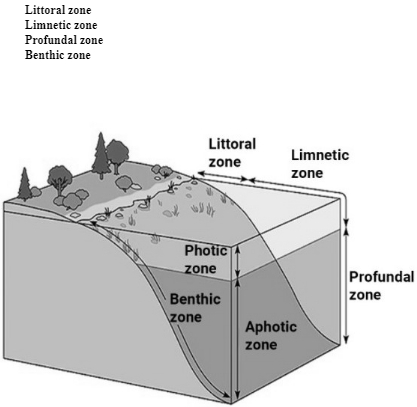
Phytoplanktons are found in which of the following shallow water region zones?
A
Limnetic zone
B
Benthic zone
C
Littoral zone
D
Profundal zone
Solution
(C) Phytoplanktons are found in the littoral zone,which is a shallow water region.
Lakes are subdivided into zones based on light penetration.
The littoral zone is the near-shore area where sunlight penetrates all the way to the sediment,allowing aquatic plants (macrophytes) and phytoplanktons to grow.
The limnetic (pelagic) zone is the open water area where light does not penetrate to the bottom.
The benthic zone is the bottom area covered by layers of mud in which various organisms live.
The profundal zone is the deepest part of a lake,relevant only in extremely deep lakes where light is absent.
Lakes are subdivided into zones based on light penetration.
The littoral zone is the near-shore area where sunlight penetrates all the way to the sediment,allowing aquatic plants (macrophytes) and phytoplanktons to grow.
The limnetic (pelagic) zone is the open water area where light does not penetrate to the bottom.
The benthic zone is the bottom area covered by layers of mud in which various organisms live.
The profundal zone is the deepest part of a lake,relevant only in extremely deep lakes where light is absent.
0 likes
View Solution108
MediumMCQ
Abiotic components refers to
A
Non-living physico-chemical factors
B
Living physico-chemical factors
C
Gases produced by industries
D
Living organisms
Solution
(A) Abiotic components include the non-living physico-chemical factors of the environment.
These components not only affect the distribution and structure of organisms but also their behavior and inter-relationships.
Abiotic factors include inorganic substances,organic compounds,climatic factors,and edaphic factors.
These components not only affect the distribution and structure of organisms but also their behavior and inter-relationships.
Abiotic factors include inorganic substances,organic compounds,climatic factors,and edaphic factors.
0 likes
View Solution109
MediumMCQ
Which of the following plants develop characters of xerophytes?
A
Heliophytes
B
Sciophytes
C
Hydrophytes
D
Halophytes
Solution
(D) Halophytes ($i.e.$,plants growing in saline soils) exhibit the characteristics of xerophytes,such as $Sueda$,$Tamarix$,and $Atriplex$.
These adaptations include succulence,a thick cuticle,sunken stomata,high osmotic pressure,the presence of anthocyanin,tannins,proline,and other organic solutes,as well as a well-developed root system to manage physiological drought.
These adaptations include succulence,a thick cuticle,sunken stomata,high osmotic pressure,the presence of anthocyanin,tannins,proline,and other organic solutes,as well as a well-developed root system to manage physiological drought.
0 likes
View Solution110
EasyMCQ
Tropical dense forests are due to
A
Low rainfall and low temperature
B
High rainfall and low temperature
C
Low rainfall and high temperature
D
High rainfall and high temperature
Solution
(D) Tropical rain forests,also known as tropical dense forests,are primarily found near the equator.
These regions are characterized by high annual rainfall and consistently high temperatures throughout the year.
These environmental conditions support high biodiversity and dense vegetation growth.
These regions are characterized by high annual rainfall and consistently high temperatures throughout the year.
These environmental conditions support high biodiversity and dense vegetation growth.
0 likes
View Solution111
MediumMCQ
At which latitude,heat gain through insolation approximately equals heat loss through terrestrial radiation?
A
$66^{\circ}$ North and South
B
$22 \frac{1}{2}^{\circ}$ North and South
C
$40^{\circ}$ North and South
D
$42 \frac{1}{2}^{\circ}$ North and South
Solution
(C) The Earth's heat balance is maintained by the distribution of energy.
At latitudes near the equator,there is a surplus of heat because insolation exceeds terrestrial radiation.
Conversely,at higher latitudes,there is a deficit.
The transition point where the heat gain through insolation approximately equals the heat loss through terrestrial radiation occurs at approximately $40^{\circ}$ North and South latitudes.
At latitudes near the equator,there is a surplus of heat because insolation exceeds terrestrial radiation.
Conversely,at higher latitudes,there is a deficit.
The transition point where the heat gain through insolation approximately equals the heat loss through terrestrial radiation occurs at approximately $40^{\circ}$ North and South latitudes.
0 likes
View Solution112
MediumMCQ
$-1^{\circ}C$ to $13^{\circ}C$ annual variations in the intensity and duration of temperature and $50$ to $250 \; cm$ annual variation in precipitation account for the formation of a major biome as:
A
Temperate forest
B
Coniferous forest
C
Tropical forest
D
Grassland
Solution
(B) The major biomes are formed based on annual variations in temperature and precipitation.
Coniferous forests (also known as taiga or boreal forests) are characterized by evergreen,cone-bearing trees such as spruce and pine.
These biomes typically experience annual temperature variations ranging from $-1^{\circ}C$ to $13^{\circ}C$ and annual precipitation variations between $50 \; cm$ and $250 \; cm$.
Therefore,the given climatic conditions correspond to the formation of a Coniferous forest.
Coniferous forests (also known as taiga or boreal forests) are characterized by evergreen,cone-bearing trees such as spruce and pine.
These biomes typically experience annual temperature variations ranging from $-1^{\circ}C$ to $13^{\circ}C$ and annual precipitation variations between $50 \; cm$ and $250 \; cm$.
Therefore,the given climatic conditions correspond to the formation of a Coniferous forest.
0 likes
View Solution113
Medium
Differentiate between Heliophytes and Sciophytes.
Solution
(N/A)
| Heliophytes | Sciophytes |
|---|---|
| $(1)$ They are adapted to bright light. | $(1)$ They are adapted to low light intensities. |
| $(2)$ Stems are hard,thick with small internodes. | $(2)$ Stems are soft,slender with large internodes. |
| $(3)$ Thick cuticle on leaves. | $(3)$ Thin cuticle on leaves. |
| $(4)$ Root system is extensively developed. | $(4)$ Root system is less extensively developed. |
| $(5)$ There is a good amount of flowering and fruiting. | $(5)$ Vegetative growth is more as compared to flowering and fruiting. |
| $(6)$ Sunken stomata are generally present on the lower surface of the leaf. | $(6)$ Stomata are at the level of the surface and present on both surfaces. |
0 likes
View Solution114
MediumMCQ
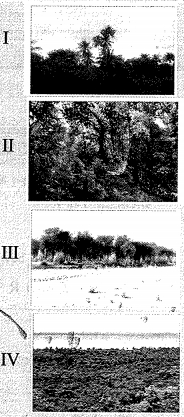
Match the following biomes with their respective images:
| Column-$I$ | Column-$II$ |
| $P$. Deciduous forest | $I$. Coastal area |
| $Q$. Desert | $II$. Tropical rain forest |
| $R$. Tropical rain forest | $III$. Desert |
| $S$. Coastal area | $IV$. Deciduous forest |
A
$(P-IV), (Q-III), (R-II), (S-I)$
B
$(P-II), (Q-III), (R-I), (S-IV)$
C
$(P-I), (Q-III), (R-IV), (S-II)$
D
$(P-IV), (Q-II), (R-III), (S-I)$
Solution
(A) Based on the provided images:
$I$ represents a coastal area with palm trees.
$II$ represents a dense tropical rain forest.
$III$ represents a desert landscape.
$IV$ represents a deciduous forest.
Matching these with the given options:
$P$ (Deciduous forest) matches with $IV$.
$Q$ (Desert) matches with $III$.
$R$ (Tropical rain forest) matches with $II$.
$S$ (Coastal area) matches with $I$.
Therefore,the correct sequence is $(P-IV), (Q-III), (R-II), (S-I)$.
$I$ represents a coastal area with palm trees.
$II$ represents a dense tropical rain forest.
$III$ represents a desert landscape.
$IV$ represents a deciduous forest.
Matching these with the given options:
$P$ (Deciduous forest) matches with $IV$.
$Q$ (Desert) matches with $III$.
$R$ (Tropical rain forest) matches with $II$.
$S$ (Coastal area) matches with $I$.
Therefore,the correct sequence is $(P-IV), (Q-III), (R-II), (S-I)$.
0 likes
View Solution115
MediumMCQ
...... is the most ecologically relevant environmental factor.
A
Temperature
B
Water
C
Light
D
Soil
Solution
(A) Temperature is considered the most ecologically relevant environmental factor because it significantly affects the kinetics of enzymes and through them,the metabolic activity and other physiological functions of the organism. While water,light,and soil are also crucial,temperature has a direct and profound impact on the survival and distribution of organisms across different biomes.
0 likes
View Solution116
DifficultMCQ
In which of the following cases does the temperature decrease?
A
From plains to mountain tops
B
From mountain tops to plains
C
From the equator towards the poles
D
Both $A$ and $C$
Solution
(D) Temperature varies significantly across different biomes.
$1$. As we move from plains to mountain tops (increase in altitude),the temperature decreases.
$2$. As we move from the equator towards the poles (increase in latitude),the temperature decreases.
Therefore,both cases $A$ and $C$ result in a decrease in temperature.
$1$. As we move from plains to mountain tops (increase in altitude),the temperature decreases.
$2$. As we move from the equator towards the poles (increase in latitude),the temperature decreases.
Therefore,both cases $A$ and $C$ result in a decrease in temperature.
0 likes
View Solution117
MediumMCQ
Match the following columns:
| Column-$I$ (Temperature) | Column-$II$ (Habitat) |
| $P$. Sub-zero levels | $I$. Thermal springs |
| $Q$. Can exceed $50^{\circ}C$ | $II$. Polar regions |
| $R$. Can even exceed $100^{\circ}C$ | $III$. High altitude areas |
| $IV$. Deep-sea hydrothermal vents | |
| $V$. Tropical deserts |
A
$(P - II, III), (Q - V), (R - I, IV)$
B
$(P - II), (Q - V, III), (R - I, IV)$
C
$(P - II), (Q - V), (R - I, II, IV)$
D
$(P - II, V), (Q - II, IV), (R - III)$
Solution
(A) The distribution of organisms is significantly influenced by temperature, which varies across different habitats:
$1$. $P$. Sub-zero levels: These temperatures are characteristic of $II$ (Polar regions) and $III$ (High altitude areas).
$2$. $Q$. Can exceed $50^{\circ}C$: These high temperatures are typically found in $V$ (Tropical deserts).
$3$. $R$. Can even exceed $100^{\circ}C$: These extreme temperatures are found in $I$ (Thermal springs) and $IV$ (Deep-sea hydrothermal vents).
Therefore, the correct matching is $(P - II, III), (Q - V), (R - I, IV)$.
$1$. $P$. Sub-zero levels: These temperatures are characteristic of $II$ (Polar regions) and $III$ (High altitude areas).
$2$. $Q$. Can exceed $50^{\circ}C$: These high temperatures are typically found in $V$ (Tropical deserts).
$3$. $R$. Can even exceed $100^{\circ}C$: These extreme temperatures are found in $I$ (Thermal springs) and $IV$ (Deep-sea hydrothermal vents).
Therefore, the correct matching is $(P - II, III), (Q - V), (R - I, IV)$.
0 likes
View Solution118
MediumMCQ
Organisms that can tolerate and thrive in a wide range of temperatures are $P$,while those restricted to a narrow range of temperatures are $Q$. Choose the correct option for $P$ and $Q$.
$P \quad\quad Q$
$P \quad\quad Q$
A
Euryhaline,Stenohaline
B
Stenohaline,Euryhaline
C
Eurythermal,Stenothermal
D
Stenothermal,Eurythermal
Solution
(C) $1$. Organisms that can tolerate and thrive in a wide range of temperatures are called $Eurythermal$ organisms.
$2$. Organisms that are restricted to a narrow range of temperatures are called $Stenothermal$ organisms.
$3$. The terms $Euryhaline$ and $Stenohaline$ refer to the tolerance of organisms to a wide or narrow range of salinities,respectively.
$4$. Therefore,$P$ is $Eurythermal$ and $Q$ is $Stenothermal$.
$2$. Organisms that are restricted to a narrow range of temperatures are called $Stenothermal$ organisms.
$3$. The terms $Euryhaline$ and $Stenohaline$ refer to the tolerance of organisms to a wide or narrow range of salinities,respectively.
$4$. Therefore,$P$ is $Eurythermal$ and $Q$ is $Stenothermal$.
0 likes
View Solution119
MediumMCQ
$........$ is the most ecologically relevant environmental factor affecting the life of organisms.
A
Temperature
B
Water
C
Light
D
Soil
Solution
(A) Temperature is considered the most ecologically relevant environmental factor. It varies significantly from the equator towards the poles and from plains to mountain tops. The kinetics of enzymes and other metabolic activities of organisms are highly dependent on the ambient temperature of their environment.
0 likes
View Solution120
MediumMCQ
Match the following columns:
| Column-$I$ (Salt concentration) | Column-$II$ (Example) |
| $P$. Less than $5\%$ | $I$. Inland waters |
| $Q$. $30-35\%$ | $II$. Hypersaline lagoons |
| $R$. More than $100\%$ | $III$. Sea |
A
$P-I, Q-III, R-II$
B
$P-I, Q-II, R-III$
C
$P-III, Q-II, R-I$
D
$P-II, Q-III, R-I$
Solution
(A) The salt concentration (salinity) measured in parts per thousand $(ppt)$ varies across different aquatic environments:
$1$. Inland waters (freshwater) have a very low salt concentration,typically less than $5\%$ $(P-I)$.
$2$. The sea (marine water) has a salt concentration ranging between $30-35\%$ $(Q-III)$.
$3$. Hypersaline lagoons (or hypersaline waters) have a very high salt concentration,often exceeding $100\%$ $(R-II)$.
Therefore,the correct matching is $P-I, Q-III, R-II$.
$1$. Inland waters (freshwater) have a very low salt concentration,typically less than $5\%$ $(P-I)$.
$2$. The sea (marine water) has a salt concentration ranging between $30-35\%$ $(Q-III)$.
$3$. Hypersaline lagoons (or hypersaline waters) have a very high salt concentration,often exceeding $100\%$ $(R-II)$.
Therefore,the correct matching is $P-I, Q-III, R-II$.
0 likes
View Solution121
MediumMCQ
Select the incorrect statement from the following.
A
Organisms living in aquatic habitats do not face any water-related problems.
B
Since water availability is limited in deserts,only organisms with special adaptations can survive there.
C
The productivity and distribution of plants are heavily dependent on water.
D
Marine animals cannot survive in freshwater for long periods.
Solution
(A) The correct answer is $A$.
Organisms living in aquatic habitats do face water-related problems,such as osmotic stress,which depends on the salinity of the water.
Option $B$ is correct because desert organisms have specific adaptations (like succulent stems or nocturnal habits) to cope with water scarcity.
Option $C$ is correct as water is a critical limiting factor for plant growth and distribution.
Option $D$ is correct because marine organisms are adapted to high salinity environments and cannot maintain osmotic balance in freshwater,leading to cell lysis or death.
Organisms living in aquatic habitats do face water-related problems,such as osmotic stress,which depends on the salinity of the water.
Option $B$ is correct because desert organisms have specific adaptations (like succulent stems or nocturnal habits) to cope with water scarcity.
Option $C$ is correct as water is a critical limiting factor for plant growth and distribution.
Option $D$ is correct because marine organisms are adapted to high salinity environments and cannot maintain osmotic balance in freshwater,leading to cell lysis or death.
0 likes
View Solution122
MediumMCQ
Organisms use light as a cue to time their ........... activities.
A
Foraging
B
Reproductive
C
Migratory
D
All of the above
Solution
(D) Light is a crucial abiotic factor that influences various biological processes in organisms.
Many organisms use light as a cue to time their foraging,reproductive,and migratory activities.
This phenomenon is known as photoperiodism,where the duration of light exposure regulates physiological responses.
Therefore,all the listed activities are timed based on light cues.
Many organisms use light as a cue to time their foraging,reproductive,and migratory activities.
This phenomenon is known as photoperiodism,where the duration of light exposure regulates physiological responses.
Therefore,all the listed activities are timed based on light cues.
0 likes
View Solution123
MediumMCQ
The nature and properties of soil in different places vary. This does not depend on which of the following?
A
Climate
B
Weathering process or how the soil was transported or sedimentary
C
Light
D
How it developed
Solution
(C) The nature and properties of soil in different places are determined by climate,the weathering process,whether the soil is transported or sedimentary,and how soil development occurred. Light is an abiotic factor that influences photosynthesis and biological rhythms but does not directly determine the physical or chemical properties of soil formation.
0 likes
View Solution124
MediumMCQ
Which of the following does not determine the percolation and water-holding capacity of soils?
A
Soil composition
B
Temperature
C
Grain aggregation
D
Grain size
Solution
(B) The nature and properties of soil in different places vary; it is dependent on the climate,the weathering process,whether soil is transported or sedimentary,and how soil development occurred. Various characteristics of the soil such as soil composition,grain size,and aggregation determine the percolation and water-holding capacity of the soils. These characteristics along with parameters such as pH,mineral composition,and topography determine to a large extent the vegetation in any area. Temperature is an abiotic factor that influences the rate of biological processes and the distribution of organisms,but it does not directly determine the physical percolation or water-holding capacity of the soil itself.
0 likes
View Solution125
MediumMCQ
Match the following columns:
| Column-$I$ (Temperature) | Column-$II$ (Organism) |
| $P$. Above $100^{\circ}C$ | $I$. Thermoacidophiles |
| $Q$. $37^{\circ}C$ | $II$. Human |
| $R$. Below $0^{\circ}C$ | $III$. Antarctic fish |
A
$(P-II), (Q-I), (R-III)$
B
$(P-I), (Q-II), (R-III)$
C
$(P-III), (Q-II), (R-I)$
D
$(P-I), (Q-III), (R-II)$
Solution
(B) $P$. Thermoacidophiles are archaebacteria capable of surviving in extreme temperatures exceeding $100^{\circ}C$.
$Q$. The normal body temperature of a human is approximately $37^{\circ}C$.
$R$. Antarctic fish are adapted to survive in sub-zero temperatures (below $0^{\circ}C$) in polar waters.
Therefore, the correct matching is $(P-I), (Q-II), (R-III)$.
$Q$. The normal body temperature of a human is approximately $37^{\circ}C$.
$R$. Antarctic fish are adapted to survive in sub-zero temperatures (below $0^{\circ}C$) in polar waters.
Therefore, the correct matching is $(P-I), (Q-II), (R-III)$.
0 likes
View Solution126
MediumMCQ
Given below are five statements.
$A.$ Organisms living in oceans,lakes,and rivers also face water-related problems.
$B.$ Euryhaline can tolerate a wide range of salinities.
$C.$ Stenohaline are restricted to a narrow range of salinities.
$D.$ Many freshwater animals cannot live for long in sea water because of the osmotic problems they would face.
$E.$ The salt concentration (measured as salinity in parts per thousand) is less than $5$ in inland waters,$30-35$ in the sea,and $>100$ in some hypersaline lagoons.
$A.$ Organisms living in oceans,lakes,and rivers also face water-related problems.
$B.$ Euryhaline can tolerate a wide range of salinities.
$C.$ Stenohaline are restricted to a narrow range of salinities.
$D.$ Many freshwater animals cannot live for long in sea water because of the osmotic problems they would face.
$E.$ The salt concentration (measured as salinity in parts per thousand) is less than $5$ in inland waters,$30-35$ in the sea,and $>100$ in some hypersaline lagoons.
A
All are correct
B
All are incorrect
C
Only $D$ is incorrect
D
Only $A, B$ and $E$ are correct
Solution
(A) Statement $A$ is correct: Even aquatic organisms face water-related challenges,such as osmotic balance,depending on the salinity of their environment.
Statement $B$ is correct: Euryhaline organisms are capable of tolerating a wide range of salinities.
Statement $C$ is correct: Stenohaline organisms are restricted to a narrow range of salinities.
Statement $D$ is correct: Freshwater animals are adapted to low salinity; if placed in sea water,they face severe osmotic stress due to water loss,which they cannot survive for long.
Statement $E$ is correct: The salinity levels provided are standard ecological measurements: $<5$ ppt for inland waters,$30-35$ ppt for the sea,and $>100$ ppt for hypersaline lagoons.
Since all statements $A, B, C, D,$ and $E$ are scientifically accurate,the correct option is that all are correct.
Statement $B$ is correct: Euryhaline organisms are capable of tolerating a wide range of salinities.
Statement $C$ is correct: Stenohaline organisms are restricted to a narrow range of salinities.
Statement $D$ is correct: Freshwater animals are adapted to low salinity; if placed in sea water,they face severe osmotic stress due to water loss,which they cannot survive for long.
Statement $E$ is correct: The salinity levels provided are standard ecological measurements: $<5$ ppt for inland waters,$30-35$ ppt for the sea,and $>100$ ppt for hypersaline lagoons.
Since all statements $A, B, C, D,$ and $E$ are scientifically accurate,the correct option is that all are correct.
0 likes
View Solution127
EasyMCQ
Match the types of animals in Column-$I$ with their adaptations in Column-$II$:
| Column-$I$ | Column-$II$ |
|---|---|
| $i$. Eurythermal | $a$. Can tolerate only a narrow range of salinity |
| $ii$. Stenothermal | $b$. Can tolerate a wide range of temperature |
| $iii$. Euryhaline | $c$. Can tolerate a wide range of salinity |
| $iv$. Stenohaline | $d$. Can tolerate only a narrow range of temperature |
A
$i-b, ii-d, iii-c, iv-a$
B
$i-a, ii-c, iii-d, iv-b$
C
$i-a, ii-b, iii-c, iv-d$
D
$i-d, ii-a, iii-b, iv-c$
Solution
(A) The correct matches are as follows:
$i$. Eurythermal: Organisms that can tolerate a wide range of temperatures $(b)$.
$ii$. Stenothermal: Organisms that can tolerate only a narrow range of temperatures $(d)$.
$iii$. Euryhaline: Organisms that can tolerate a wide range of salinity $(c)$.
$iv$. Stenohaline: Organisms that can tolerate only a narrow range of salinity $(a)$.
Therefore,the correct matching is $i-b, ii-d, iii-c, iv-a$.
$i$. Eurythermal: Organisms that can tolerate a wide range of temperatures $(b)$.
$ii$. Stenothermal: Organisms that can tolerate only a narrow range of temperatures $(d)$.
$iii$. Euryhaline: Organisms that can tolerate a wide range of salinity $(c)$.
$iv$. Stenohaline: Organisms that can tolerate only a narrow range of salinity $(a)$.
Therefore,the correct matching is $i-b, ii-d, iii-c, iv-a$.
0 likes
View Solution128
EasyMCQ
An organism which can tolerate a wide range of temperature is known as . . . . . . .
A
Eurythermal
B
Stenothermal
C
Isothermal
D
Hydrothermal
Solution
(A) Organisms are classified based on their ability to tolerate environmental conditions.
$1$. $Eurythermal$ organisms are those that can tolerate and thrive in a wide range of temperatures.
$2$. $Stenothermal$ organisms are those that are restricted to a narrow range of temperatures.
$3$. $Isothermal$ refers to a process or state where the temperature remains constant.
$4$. $Hydrothermal$ refers to the action of heated water,often associated with deep-sea vents.
Therefore,the correct term for an organism that can tolerate a wide range of temperature is $Eurythermal$.
$1$. $Eurythermal$ organisms are those that can tolerate and thrive in a wide range of temperatures.
$2$. $Stenothermal$ organisms are those that are restricted to a narrow range of temperatures.
$3$. $Isothermal$ refers to a process or state where the temperature remains constant.
$4$. $Hydrothermal$ refers to the action of heated water,often associated with deep-sea vents.
Therefore,the correct term for an organism that can tolerate a wide range of temperature is $Eurythermal$.
0 likes
View Solution129
Easy
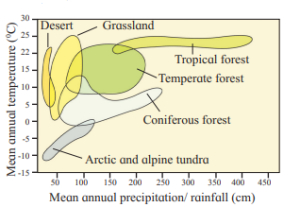
The figure depicts annual variations in temperature and precipitation for different biomes. Based on the provided graph,identify the correct sequence of biomes corresponding to the labels $A, B, C, D, E, F$ as shown in the standard $NCERT$ diagram:
$1$. Temperate forest
$2$. Tropical forest
$3$. Coniferous forest
$4$. Grassland
$5$. Desert
$6$. Arctic and Alpine tundra
$1$. Temperate forest
$2$. Tropical forest
$3$. Coniferous forest
$4$. Grassland
$5$. Desert
$6$. Arctic and Alpine tundra
Solution
(B) Based on the standard $NCERT$ diagram for biomes:
$A$ corresponds to Desert (low precipitation,variable temperature).
$B$ corresponds to Grassland (moderate precipitation,variable temperature).
$C$ corresponds to Tropical forest (high precipitation,high temperature).
$D$ corresponds to Temperate forest (moderate to high precipitation,moderate temperature).
$E$ corresponds to Coniferous forest (moderate precipitation,low temperature).
$F$ corresponds to Arctic and Alpine tundra (low precipitation,very low temperature).
Therefore,the correct sequence is $A-5, B-4, C-2, D-1, E-3, F-6$.
$A$ corresponds to Desert (low precipitation,variable temperature).
$B$ corresponds to Grassland (moderate precipitation,variable temperature).
$C$ corresponds to Tropical forest (high precipitation,high temperature).
$D$ corresponds to Temperate forest (moderate to high precipitation,moderate temperature).
$E$ corresponds to Coniferous forest (moderate precipitation,low temperature).
$F$ corresponds to Arctic and Alpine tundra (low precipitation,very low temperature).
Therefore,the correct sequence is $A-5, B-4, C-2, D-1, E-3, F-6$.
0 likes
View SolutionOrganisms and Populations — Environment (Abiotic and Biotic factors) · Frequently Asked Questions
1Are these Organisms and Populations questions useful for JEE and NEET?
Yes. All questions in this section are mapped to JEE Main and NEET exam patterns. Previous year questions from JEE Main, NEET, GUJCET and state-level exams are included with full solutions.
2Can I switch to Hindi or Gujarati for these questions?
Yes. Use the language tabs in the hero section or the sidebar to view the same questions and solutions in English, Hindi or Gujarati.
3How do I generate a question paper from this subtopic?
Use the Vedclass Exam Paper Generator — select the chapter and subtopic, set difficulty, and generate Sets A, B, C, D automatically. First 3 chapters of every subject are free.
Vedclass Products
For Students
Vedclass Test Series
Mock tests in real JEE/NEET style with performance analysis. 5-day free trial.
Start Free TrialFor Teachers
Exam Paper Generator
Generate Set A/B/C/D papers from this chapter in 2 minutes. 3 chapters free.
Try FreeFor Institutes
Online Exam Module
Live online exams with unlimited students, 360° analytics & white-label branding.
See DemoFor Teachers & Institutes
Generate a Organisms and Populations Exam Paper in 2 Minutes
Select subtopic & difficulty — Sets A, B, C, D auto-generated with No Repeat logic.
First 3 chapters of every subject are free — no payment required.