
A English
Environment (Abiotic and Biotic factors) Questions in English
Class 12 Biology · Organisms and Populations · Environment (Abiotic and Biotic factors)
129+
Questions
English
Language
100%
With Solutions
Showing 50 of 129 questions in English
51
MediumMCQ
Choose the correct statement:
A
The nature and properties of soil in different places vary.
B
Only grain size of soil particles determines the percolation and water holding capacity of the soils.
C
In the aquatic environment,the sediment characteristics do not determine the type of benthic animals that can thrive there.
D
Types of animals dictate the vegetation in any area.
Solution
(A) The nature and properties of soil in different places vary significantly due to climate,the weathering process,whether soil is transported or sedimentary,and how soil development occurred. This is a fundamental concept in ecology.
Option $B$ is incorrect because,besides grain size,factors like soil composition,aggregation,and percolation also influence water-holding capacity.
Option $C$ is incorrect because sediment characteristics in aquatic environments are a primary determinant for the type of benthic animals that can thrive there.
Option $D$ is incorrect because vegetation (producers) dictates the types of animals (consumers) that can survive in an area,not the other way around.
Option $B$ is incorrect because,besides grain size,factors like soil composition,aggregation,and percolation also influence water-holding capacity.
Option $C$ is incorrect because sediment characteristics in aquatic environments are a primary determinant for the type of benthic animals that can thrive there.
Option $D$ is incorrect because vegetation (producers) dictates the types of animals (consumers) that can survive in an area,not the other way around.
0 likes
View Solution52
MediumMCQ
$A$ - The salt concentration is less than $5$ (parts per thousand) in inland waters.
$R$ - The salt concentration is $30 - 35$ (parts per thousand) in the sea.
$R$ - The salt concentration is $30 - 35$ (parts per thousand) in the sea.
A
$A$ and $R$ both are correct.
B
$A$ and $R$ both are incorrect.
C
$A$ is correct,$R$ is incorrect.
D
$A$ is incorrect,$R$ is correct.
Solution
(A) Statement $A$ is correct because inland waters (freshwater) have a salt concentration of less than $5$ parts per thousand (ppt).
Statement $R$ is correct because the average salt concentration in the sea is $30 - 35$ ppt. The value $45 - 50$ ppt mentioned in the original prompt is incorrect for the sea,so it has been updated to the standard biological value of $30 - 35$ ppt.
Statement $R$ is correct because the average salt concentration in the sea is $30 - 35$ ppt. The value $45 - 50$ ppt mentioned in the original prompt is incorrect for the sea,so it has been updated to the standard biological value of $30 - 35$ ppt.
0 likes
View Solution53
MediumMCQ
The salinity is ............ in hypersaline lagoons.
A
$30 – 35$ parts per thousand
B
$5 – 10$ parts per thousand
C
Less than $5$ parts per thousand
D
$> 100$ parts per thousand
Solution
(D) Salinity is measured in parts per thousand $(ppt)$.
In the sea,the average salinity is $30 – 35$ $ppt$.
In inland waters,the salinity is less than $5$ $ppt$.
In hypersaline lagoons,the salinity exceeds $100$ $ppt$.
In the sea,the average salinity is $30 – 35$ $ppt$.
In inland waters,the salinity is less than $5$ $ppt$.
In hypersaline lagoons,the salinity exceeds $100$ $ppt$.
0 likes
View Solution54
MediumMCQ
In which form do organisms realize the emergence of their environment?
A
Biological
B
Physical
C
Chemical
D
All of the above
Solution
(D) Organisms are complex entities that interact with their surroundings in multiple ways.
They respond to physical stimuli (like light,temperature,and water),chemical stimuli (like pollutants or nutrients),and biological stimuli (like interactions with other organisms).
Therefore,the emergence of their environment is realized through physical,chemical,and biological forms.
They respond to physical stimuli (like light,temperature,and water),chemical stimuli (like pollutants or nutrients),and biological stimuli (like interactions with other organisms).
Therefore,the emergence of their environment is realized through physical,chemical,and biological forms.
0 likes
View Solution55
EasyMCQ
Life does not exist on the moon due to the absence of .......
A
$O_2$
B
Water
C
Light
D
Temperature
Solution
(B) Life as we know it requires specific conditions to exist,primarily the presence of liquid water,an atmosphere containing oxygen,and a suitable temperature range.
On the moon,there is no atmosphere to hold gases or regulate temperature,and there is no liquid water available on the surface.
Among the given options,the absence of water is the most fundamental reason why life cannot be sustained on the moon,as water is the universal solvent and essential for all biological processes.
On the moon,there is no atmosphere to hold gases or regulate temperature,and there is no liquid water available on the surface.
Among the given options,the absence of water is the most fundamental reason why life cannot be sustained on the moon,as water is the universal solvent and essential for all biological processes.
0 likes
View Solution56
MediumMCQ
Organisms that can tolerate only a narrow range of salt concentrations are called . . . . . . .
A
Stenohaline
B
Euryhaline
C
Anadromous
D
Catadromous
Solution
(A) Organisms are classified based on their tolerance to salinity levels in their environment.
$1$. $Stenohaline$ organisms are those that can tolerate only a narrow range of salt concentrations.
$2$. $Euryhaline$ organisms are those that can tolerate a wide range of salt concentrations.
$3$. $Anadromous$ and $Catadromous$ refer to migratory patterns of fish between freshwater and marine environments.
Therefore,the correct term for organisms that tolerate a narrow range of salinity is $Stenohaline$.
$1$. $Stenohaline$ organisms are those that can tolerate only a narrow range of salt concentrations.
$2$. $Euryhaline$ organisms are those that can tolerate a wide range of salt concentrations.
$3$. $Anadromous$ and $Catadromous$ refer to migratory patterns of fish between freshwater and marine environments.
Therefore,the correct term for organisms that tolerate a narrow range of salinity is $Stenohaline$.
0 likes
View Solution57
MediumMCQ
Which animals are most affected by changes in environmental temperature?
A
Homeotherms
B
Aquatic
C
Poikilotherms
D
Desert-dwelling
Solution
(C) Poikilotherms (ectotherms) are animals whose internal body temperature varies significantly with the ambient environmental temperature. Unlike homeotherms (endotherms) that maintain a constant body temperature through metabolic processes,poikilotherms lack such internal regulatory mechanisms. Therefore,their physiological processes and metabolic rates are directly influenced by external temperature fluctuations,making them the most affected group.
0 likes
View Solution58
MediumMCQ
In which of the following habitats is the variation in soil temperature most significant?
A
Wetlands
B
Forest
C
Desert
D
Grassland
Solution
(C) The variation in soil temperature is most significant in deserts.
$1$. Deserts are characterized by extreme conditions,including high solar radiation and very low moisture content in the soil.
$2$. Due to the lack of vegetation cover and low water content,the soil in deserts heats up rapidly during the day and loses heat quickly at night,leading to a high diurnal range of temperature.
$3$. In contrast,forests,wetlands,and grasslands have more vegetation cover and moisture,which act as thermal buffers,stabilizing the soil temperature.
$1$. Deserts are characterized by extreme conditions,including high solar radiation and very low moisture content in the soil.
$2$. Due to the lack of vegetation cover and low water content,the soil in deserts heats up rapidly during the day and loses heat quickly at night,leading to a high diurnal range of temperature.
$3$. In contrast,forests,wetlands,and grasslands have more vegetation cover and moisture,which act as thermal buffers,stabilizing the soil temperature.
0 likes
View Solution59
MediumMCQ
Which of the following is a characteristic feature of the desert environment?
A
Transpiration
B
Low atmospheric humidity
C
High temperature
D
High rate of evaporation
Solution
(B) The desert environment is characterized by extreme conditions that limit the survival of many organisms.
Key features include:
$1$. Low and erratic rainfall.
$2$. High solar radiation leading to high temperatures.
$3$. High rate of evaporation.
$4$. Low atmospheric humidity.
While high temperature and high evaporation are features,'Low atmospheric humidity' is a fundamental climatic characteristic that defines the aridity of the desert biome. However,in many standard biological contexts,all these factors contribute to the desert environment. Given the options,'Low atmospheric humidity' is a defining abiotic factor.
Key features include:
$1$. Low and erratic rainfall.
$2$. High solar radiation leading to high temperatures.
$3$. High rate of evaporation.
$4$. Low atmospheric humidity.
While high temperature and high evaporation are features,'Low atmospheric humidity' is a fundamental climatic characteristic that defines the aridity of the desert biome. However,in many standard biological contexts,all these factors contribute to the desert environment. Given the options,'Low atmospheric humidity' is a defining abiotic factor.
0 likes
View Solution60
EasyMCQ
What is the approximate concentration of $CO_2$ in the atmosphere (in $\%$)?
A
$0.0314$
B
$0.34$
C
$3.34$
D
$4.0$
Solution
(A) The concentration of carbon dioxide $(CO_2)$ in the Earth's atmosphere is approximately $0.03\%$ to $0.04\%$.
Among the given options,$0.0314\%$ is the most accurate representation of the standard atmospheric concentration of $CO_2$ (often cited as approximately $314 \ ppm$ in historical contexts or standard textbook references).
Therefore,option $A$ is the correct answer.
Among the given options,$0.0314\%$ is the most accurate representation of the standard atmospheric concentration of $CO_2$ (often cited as approximately $314 \ ppm$ in historical contexts or standard textbook references).
Therefore,option $A$ is the correct answer.
0 likes
View Solution61
MediumMCQ
The salinity in sea water in parts per thousand $(ppt)$ ranges between
A
$30-35$
B
$10-15$
C
$3-5$
D
$0-5$
Solution
(A) Salinity is defined as the concentration of salts in water,measured in parts per thousand $(ppt)$.
In the sea,the salinity typically ranges between $30-35$ $ppt$.
In contrast,inland waters (freshwater) have a salinity of less than $5$ $ppt$.
Some hypersaline lagoons can have salinities exceeding $100$ $ppt$.
In the sea,the salinity typically ranges between $30-35$ $ppt$.
In contrast,inland waters (freshwater) have a salinity of less than $5$ $ppt$.
Some hypersaline lagoons can have salinities exceeding $100$ $ppt$.
0 likes
View Solution62
Medium
Write a short note on:
$(a)$ Adaptations of desert plants and animals
$(b)$ Adaptations of plants to water scarcity
$(c)$ Behavioural adaptations in animals
$(d)$ Importance of light to plants
$(e)$ Effect of temperature or water scarcity and the adaptations of animals.
$(a)$ Adaptations of desert plants and animals
$(b)$ Adaptations of plants to water scarcity
$(c)$ Behavioural adaptations in animals
$(d)$ Importance of light to plants
$(e)$ Effect of temperature or water scarcity and the adaptations of animals.
Solution
(N/A) Adaptations of desert plants and animals
Adaptations of desert plants: Plants in deserts are adapted to water scarcity and heat. They have extensive root systems to reach underground water,thick cuticles,and sunken stomata to reduce transpiration. In $Opuntia$,leaves are modified into spines,and photosynthesis occurs in green stems. They use $CAM$ ($Crassulacean$ $Acid$ $Metabolism$) pathway to keep stomata closed during the day.
Adaptations of desert animals: Animals like kangaroo rats,lizards,and snakes are well-adapted. The kangaroo rat never drinks water; it concentrates its urine to conserve water. Desert lizards bask in the sun during the morning and burrow in the sand during the afternoon to escape heat.
$(b)$ Adaptations of plants to water scarcity: Plants adapt by developing deep root systems,thick waxy cuticles,and sunken stomata. Many desert plants use the $CAM$ pathway,which allows stomata to remain closed during the day,significantly reducing water loss through transpiration.
$(c)$ Behavioural adaptations in animals: Organisms exhibit behavioural changes like hibernation,aestivation,and migration to escape environmental stress. Ectotherms (cold-blooded animals) like lizards bask in the sun to warm up and burrow into the sand to cool down. Endotherms (warm-blooded animals) may hibernate or aestivate to survive extreme temperatures.
$(d)$ Importance of light to plants: Sunlight is the primary energy source for photosynthesis. Light also regulates photoperiodic responses,which are essential for flowering in many plants. In aquatic habitats,light intensity determines the vertical distribution of plants.
$(e)$ Effect of temperature or water scarcity and the adaptations of animals: Temperature affects animal distribution; eurythermal animals tolerate a wide range of temperatures,while stenothermal animals tolerate a narrow range. Animals in cold regions have shorter ears and limbs to prevent heat loss,and thick fat layers (blubber) for insulation. Water scarcity leads to physiological adaptations like concentrated urine in kangaroo rats and behavioural adaptations like burrowing in desert reptiles.
Adaptations of desert plants: Plants in deserts are adapted to water scarcity and heat. They have extensive root systems to reach underground water,thick cuticles,and sunken stomata to reduce transpiration. In $Opuntia$,leaves are modified into spines,and photosynthesis occurs in green stems. They use $CAM$ ($Crassulacean$ $Acid$ $Metabolism$) pathway to keep stomata closed during the day.
Adaptations of desert animals: Animals like kangaroo rats,lizards,and snakes are well-adapted. The kangaroo rat never drinks water; it concentrates its urine to conserve water. Desert lizards bask in the sun during the morning and burrow in the sand during the afternoon to escape heat.
$(b)$ Adaptations of plants to water scarcity: Plants adapt by developing deep root systems,thick waxy cuticles,and sunken stomata. Many desert plants use the $CAM$ pathway,which allows stomata to remain closed during the day,significantly reducing water loss through transpiration.
$(c)$ Behavioural adaptations in animals: Organisms exhibit behavioural changes like hibernation,aestivation,and migration to escape environmental stress. Ectotherms (cold-blooded animals) like lizards bask in the sun to warm up and burrow into the sand to cool down. Endotherms (warm-blooded animals) may hibernate or aestivate to survive extreme temperatures.
$(d)$ Importance of light to plants: Sunlight is the primary energy source for photosynthesis. Light also regulates photoperiodic responses,which are essential for flowering in many plants. In aquatic habitats,light intensity determines the vertical distribution of plants.
$(e)$ Effect of temperature or water scarcity and the adaptations of animals: Temperature affects animal distribution; eurythermal animals tolerate a wide range of temperatures,while stenothermal animals tolerate a narrow range. Animals in cold regions have shorter ears and limbs to prevent heat loss,and thick fat layers (blubber) for insulation. Water scarcity leads to physiological adaptations like concentrated urine in kangaroo rats and behavioural adaptations like burrowing in desert reptiles.
0 likes
View Solution63
Easy
List the various abiotic environmental factors.
Solution
(N/A) The major abiotic environmental factors that influence the life of organisms are as follows:
$1$. Temperature: It is the most ecologically relevant environmental factor,affecting the kinetics of enzymes and basal metabolism of organisms.
$2$. Water: It is essential for life,and the productivity and distribution of plants are heavily dependent on water availability.
$3$. Light: Since plants produce food through photosynthesis,light is crucial for their growth. Many animals also use light cues for foraging,reproductive,and migratory activities.
$4$. Soil: The nature and properties of soil (such as soil composition,grain size,and percolation) determine the vegetation in an area,which in turn dictates the types of animals that can be supported.
$1$. Temperature: It is the most ecologically relevant environmental factor,affecting the kinetics of enzymes and basal metabolism of organisms.
$2$. Water: It is essential for life,and the productivity and distribution of plants are heavily dependent on water availability.
$3$. Light: Since plants produce food through photosynthesis,light is crucial for their growth. Many animals also use light cues for foraging,reproductive,and migratory activities.
$4$. Soil: The nature and properties of soil (such as soil composition,grain size,and percolation) determine the vegetation in an area,which in turn dictates the types of animals that can be supported.
0 likes
View Solution64
Medium
Describe various abiotic environmental factors.
Solution
(N/A) The major abiotic factors influencing the life of organisms are:
$1$. $\text{Temperature}$: It is the most ecologically relevant environmental factor. It affects the kinetics of enzymes,basal metabolism,and other physiological functions. Organisms are classified as $\text{eurythermal}$ (can tolerate a wide range of temperatures) or $\text{stenothermal}$ (restricted to a narrow range of temperatures).
$2$. $\text{Water}$: Life originated in water and is unsustainable without it. For aquatic organisms,the quality of water (chemical composition and $pH$) and salt concentration (salinity) are critical. Organisms are classified as $\text{euryhaline}$ (tolerant of a wide range of salinities) or $\text{stenohaline}$ (restricted to a narrow range).
$3$. $\text{Light}$: Essential for photosynthesis in autotrophs. Many plants are adapted to low light conditions in forests. Light also regulates photoperiodic requirements for flowering and acts as a cue for foraging,reproductive,and migratory activities in animals. The spectral quality of solar radiation,including $UV$ components,also impacts life.
$4$. $\text{Soil}$: The nature and properties of soil (composition,grain size,percolation,water-holding capacity) determine the vegetation of an area,which in turn dictates the types of animals that can be supported.
$1$. $\text{Temperature}$: It is the most ecologically relevant environmental factor. It affects the kinetics of enzymes,basal metabolism,and other physiological functions. Organisms are classified as $\text{eurythermal}$ (can tolerate a wide range of temperatures) or $\text{stenothermal}$ (restricted to a narrow range of temperatures).
$2$. $\text{Water}$: Life originated in water and is unsustainable without it. For aquatic organisms,the quality of water (chemical composition and $pH$) and salt concentration (salinity) are critical. Organisms are classified as $\text{euryhaline}$ (tolerant of a wide range of salinities) or $\text{stenohaline}$ (restricted to a narrow range).
$3$. $\text{Light}$: Essential for photosynthesis in autotrophs. Many plants are adapted to low light conditions in forests. Light also regulates photoperiodic requirements for flowering and acts as a cue for foraging,reproductive,and migratory activities in animals. The spectral quality of solar radiation,including $UV$ components,also impacts life.
$4$. $\text{Soil}$: The nature and properties of soil (composition,grain size,percolation,water-holding capacity) determine the vegetation of an area,which in turn dictates the types of animals that can be supported.
0 likes
View Solution65
Easy
Explain the responses of organisms to abiotic factors.
Solution
(N/A) Organisms are often bothered by the highly fluctuating external environment. It is expected that during the millions of years of their existence,many species have evolved a relatively constant internal (within the body) environment that permits all biochemical reactions and physiological functions to proceed with maximal efficiency and thus,enhance the overall fitness of the species.
This constancy could be in terms of optimal temperature and osmotic concentration of body fluids. Ideally,an organism should try to maintain the constancy of its internal environment (a process called homeostasis) despite varying external environmental conditions that tend to upset its homeostasis.
Let us take an analogy to clarify this important concept. Suppose a person is able to perform his/her best when the temperature is $25^o C$ and wishes to maintain it so,even when it scorchingly hot or freezingly cold outside. It could be achieved at home,in the car while travelling,and at workplace by using an air conditioner in summer and heater in winter. Then his/her performance would be always maximal regardless of the weather around him/her. Here the person's homeostasis is accomplished,not by physiological,but by artificial means.
This constancy could be in terms of optimal temperature and osmotic concentration of body fluids. Ideally,an organism should try to maintain the constancy of its internal environment (a process called homeostasis) despite varying external environmental conditions that tend to upset its homeostasis.
Let us take an analogy to clarify this important concept. Suppose a person is able to perform his/her best when the temperature is $25^o C$ and wishes to maintain it so,even when it scorchingly hot or freezingly cold outside. It could be achieved at home,in the car while travelling,and at workplace by using an air conditioner in summer and heater in winter. Then his/her performance would be always maximal regardless of the weather around him/her. Here the person's homeostasis is accomplished,not by physiological,but by artificial means.
0 likes
View Solution66
MediumMCQ
Species that can tolerate a narrow range of temperature are called $.............$ .
A
Eurythermal
B
Stenothermal
C
Euryhaline
D
Stenohaline
Solution
(B) Organisms that can tolerate only a narrow range of temperature are known as $Stenothermal$ species.
In contrast,organisms that can tolerate a wide range of temperatures are called $Eurythermal$ species.
$Steno-$ means narrow,and $thermal$ refers to temperature.
In contrast,organisms that can tolerate a wide range of temperatures are called $Eurythermal$ species.
$Steno-$ means narrow,and $thermal$ refers to temperature.
0 likes
View Solution67
EasyMCQ
What are Eurythermic species?
A
Species that can tolerate a narrow range of temperatures.
B
Species that can tolerate a wide range of temperatures.
C
Species that live only in cold environments.
D
Species that live only in hot environments.
Solution
(B) Species that can tolerate and thrive in a wide range of temperatures are known as Eurythermic species.
These organisms are capable of maintaining their physiological functions across significant fluctuations in environmental temperature.
Examples include many mammals and birds.
These organisms are capable of maintaining their physiological functions across significant fluctuations in environmental temperature.
Examples include many mammals and birds.
0 likes
View Solution68
Medium
Define stenohaline species.
Solution
(N/A) Stenohaline species are organisms that can tolerate only a narrow range of salinity in their environment. These species are typically restricted to either freshwater or marine habitats and cannot survive significant fluctuations in salt concentration.
0 likes
View Solution69
Easy
State the relationship between habitat and temperature.
Solution
(N/A) The relationship between habitat and temperature is fundamental to the distribution and survival of organisms.
$1$. Temperature is a critical environmental factor that varies significantly across different habitats,such as polar regions,temperate zones,and tropical rainforests.
$2$. Organisms are adapted to specific temperature ranges; for example,stenothermal organisms can only tolerate a narrow range of temperatures,while eurythermal organisms can survive in a wide range of temperatures.
$3$. Habitat temperature directly influences metabolic rates,enzyme activity,and physiological processes.
$4$. As one moves from the equator towards the poles,the average temperature decreases,which dictates the types of flora and fauna found in those specific habitats.
$1$. Temperature is a critical environmental factor that varies significantly across different habitats,such as polar regions,temperate zones,and tropical rainforests.
$2$. Organisms are adapted to specific temperature ranges; for example,stenothermal organisms can only tolerate a narrow range of temperatures,while eurythermal organisms can survive in a wide range of temperatures.
$3$. Habitat temperature directly influences metabolic rates,enzyme activity,and physiological processes.
$4$. As one moves from the equator towards the poles,the average temperature decreases,which dictates the types of flora and fauna found in those specific habitats.
0 likes
View Solution70
EasyMCQ
Emergent land plants that can tolerate the salinities of the sea are called:
A
Hydrophytes
B
Halophytes
C
Xerophytes
D
Mesophytes
Solution
(B) Plants that are adapted to grow in high-salinity environments,such as coastal areas or salt marshes,are known as $Halophytes$. These plants have specialized mechanisms to tolerate or excrete excess salt,allowing them to survive in conditions where most other land plants would perish.
0 likes
View Solution71
Easy
Why do high altitude areas have brighter sunlight and lower temperatures compared to the plains?
Solution
(N/A) High altitude areas experience brighter sunlight because the atmosphere is thinner,resulting in less scattering and absorption of solar radiation by dust particles and atmospheric gases.
Additionally,at higher altitudes,the atmospheric pressure is lower. Since temperature is directly related to the density of air molecules,lower atmospheric pressure leads to a decrease in temperature,making these regions colder than the plains.
Additionally,at higher altitudes,the atmospheric pressure is lower. Since temperature is directly related to the density of air molecules,lower atmospheric pressure leads to a decrease in temperature,making these regions colder than the plains.
0 likes
View Solution72
Medium
Define heliophytes and sciophytes. Name a plant from your locality that is either a heliophyte or a sciophyte.
Solution
(N/A) Heliophytes, also known as sun-loving plants, are those that require full exposure to sunlight for their optimum growth.
Example: $Mangifera \text{ } indica$ (Mango), $Helianthus \text{ } annuus$ (Sunflower).
Sciophytes, also known as shade-loving plants, are those that require reduced light intensity for their growth.
Example: $Lycopodium$, $Abies$, $Taxus$.
Example: $Mangifera \text{ } indica$ (Mango), $Helianthus \text{ } annuus$ (Sunflower).
Sciophytes, also known as shade-loving plants, are those that require reduced light intensity for their growth.
Example: $Lycopodium$, $Abies$, $Taxus$.
0 likes
View Solution73
Easy
Does light factor affect the distribution of organisms? Write a brief note giving suitable examples of either plants or animals.
Solution
(N/A) Yes,light is a critical abiotic factor that significantly influences the distribution of organisms.
$1$. Plants: Since plants produce food through photosynthesis,which requires sunlight as an energy source,light availability determines their growth. Many small plants (herbs and shrubs) in forests are adapted to photosynthesize optimally under low light conditions because they are overshadowed by tall,canopied trees. Additionally,many plants depend on sunlight to meet their photoperiodic requirements for flowering.
$2$. Animals: For many animals,light is crucial as they use diurnal and seasonal variations in light intensity and duration (photoperiod) as cues for timing their foraging,reproductive,and migratory activities.
$1$. Plants: Since plants produce food through photosynthesis,which requires sunlight as an energy source,light availability determines their growth. Many small plants (herbs and shrubs) in forests are adapted to photosynthesize optimally under low light conditions because they are overshadowed by tall,canopied trees. Additionally,many plants depend on sunlight to meet their photoperiodic requirements for flowering.
$2$. Animals: For many animals,light is crucial as they use diurnal and seasonal variations in light intensity and duration (photoperiod) as cues for timing their foraging,reproductive,and migratory activities.
0 likes
View Solution74
Medium
What is the basis of variations in the physical and chemical conditions of different habitats?
Solution
(A) The variations in the physical and chemical conditions of different habitats are primarily determined by two major factors:
$(a)$ Abiotic factors: These include Temperature,Water,Light,and Soil. These non-living components significantly influence the environment of a habitat.
$(b)$ Biotic factors: These include pathogens,parasites,predators,and competitors with which an organism interacts constantly.
Key Abiotic Factors:
$1$. Temperature: It is the most ecologically relevant environmental factor. It affects enzyme kinetics,basal metabolism,and physiological functions. Organisms are classified as Eurythermal (wide range) or Stenothermal (narrow range).
$2$. Water: It is essential for life. Productivity and distribution of plants depend on water. For aquatic organisms,water quality ($pH$ and salinity) is crucial. Organisms are classified as Euryhaline (wide range of salinity) or Stenohaline (narrow range of salinity).
$3$. Light: Essential for photosynthesis in autotrophs. Many plants are adapted to low light conditions. Light also acts as a cue for animals for foraging,reproduction,and migration based on photoperiods. Spectral quality is also vital,as $UV$ components can be harmful.
$4$. Soil: The nature and properties of soil (composition,grain size,percolation,water-holding capacity) determine the vegetation and,consequently,the animal life in a habitat.
$(a)$ Abiotic factors: These include Temperature,Water,Light,and Soil. These non-living components significantly influence the environment of a habitat.
$(b)$ Biotic factors: These include pathogens,parasites,predators,and competitors with which an organism interacts constantly.
Key Abiotic Factors:
$1$. Temperature: It is the most ecologically relevant environmental factor. It affects enzyme kinetics,basal metabolism,and physiological functions. Organisms are classified as Eurythermal (wide range) or Stenothermal (narrow range).
$2$. Water: It is essential for life. Productivity and distribution of plants depend on water. For aquatic organisms,water quality ($pH$ and salinity) is crucial. Organisms are classified as Euryhaline (wide range of salinity) or Stenohaline (narrow range of salinity).
$3$. Light: Essential for photosynthesis in autotrophs. Many plants are adapted to low light conditions. Light also acts as a cue for animals for foraging,reproduction,and migration based on photoperiods. Spectral quality is also vital,as $UV$ components can be harmful.
$4$. Soil: The nature and properties of soil (composition,grain size,percolation,water-holding capacity) determine the vegetation and,consequently,the animal life in a habitat.
0 likes
View Solution75
Medium
Is it true that there is more solar energy available in the tropics? Explain briefly.
Solution
(A) Yes,it is true that there is more solar energy available in the tropics.
The tropics are located near the equator,where the sun's rays fall almost vertically throughout the year.
This results in a higher intensity of solar radiation per unit area compared to the temperate and polar regions.
Additionally,the length of the day and night remains relatively constant at the equator,providing a consistent supply of energy for photosynthesis and biological productivity.
The tropics are located near the equator,where the sun's rays fall almost vertically throughout the year.
This results in a higher intensity of solar radiation per unit area compared to the temperate and polar regions.
Additionally,the length of the day and night remains relatively constant at the equator,providing a consistent supply of energy for photosynthesis and biological productivity.
0 likes
View Solution76
EasyMCQ
What are the average annual temperature and annual precipitation range for a desert biome?
A
$20-25^{\circ}C, 50 \, cm$
B
$25-30^{\circ}C, 100 \, cm$
C
$30-35^{\circ}C, 0 \, cm$
D
$40-45^{\circ}C, 100 \, cm$
Solution
(A) desert biome is characterized by extreme temperatures and very low annual precipitation.
According to the standard ecological classification of biomes,deserts typically experience high average annual temperatures ranging from $20^{\circ}C$ to $25^{\circ}C$ (or higher in some regions) and very low annual precipitation,usually less than $50 \, cm$.
Option $A$ represents the most accurate range for these environmental conditions among the given choices.
According to the standard ecological classification of biomes,deserts typically experience high average annual temperatures ranging from $20^{\circ}C$ to $25^{\circ}C$ (or higher in some regions) and very low annual precipitation,usually less than $50 \, cm$.
Option $A$ represents the most accurate range for these environmental conditions among the given choices.
0 likes
View Solution77
MediumMCQ
Which of the following are the $Key$ elements that cause variation in the physical and chemical conditions of an ecosystem?
A
Temperature
B
Light
C
Soil
D
All of the above
Solution
(D) The physical and chemical conditions of an ecosystem are primarily determined by abiotic factors.
These factors include temperature,water,light,and soil.
Temperature is the most ecologically relevant environmental factor.
Light is essential for photosynthesis,and soil composition determines the vegetation of an area.
Therefore,all the given options are key elements that cause variations in the physical and chemical conditions of an ecosystem.
These factors include temperature,water,light,and soil.
Temperature is the most ecologically relevant environmental factor.
Light is essential for photosynthesis,and soil composition determines the vegetation of an area.
Therefore,all the given options are key elements that cause variations in the physical and chemical conditions of an ecosystem.
0 likes
View Solution78
MediumMCQ
What is the typical temperature range in high-altitude regions,which acts as a significant environmental factor?
A
Zero
B
$50^{\circ} C$
C
Below zero
D
$35-40^{\circ} C$
Solution
(C) High-altitude regions are characterized by extreme cold conditions due to the decrease in atmospheric pressure and temperature with increasing elevation. In these regions,the temperature often drops significantly,frequently falling below the freezing point of water $(0^{\circ} C)$. This low temperature acts as a critical abiotic factor that limits the survival and distribution of organisms in high-altitude ecosystems.
0 likes
View Solution79
MediumMCQ
Identify the characteristic of an $eurythermal$ organism.
A
Thrive in a narrow range of temperatures.
B
Growth rate decreases in a wide range of temperatures.
C
Tolerate and thrive in a wide range of temperatures.
D
Both $A$ and $C$.
Solution
(C) Organisms are classified based on their tolerance to temperature ranges into two main categories: $eurythermal$ and $stenothermal$.
$Eurythermal$ organisms are those that can tolerate and thrive in a wide range of temperatures.
In contrast,$stenothermal$ organisms are restricted to a narrow range of temperatures.
Therefore,the characteristic of an $eurythermal$ organism is the ability to tolerate and thrive in a wide range of temperatures.
$Eurythermal$ organisms are those that can tolerate and thrive in a wide range of temperatures.
In contrast,$stenothermal$ organisms are restricted to a narrow range of temperatures.
Therefore,the characteristic of an $eurythermal$ organism is the ability to tolerate and thrive in a wide range of temperatures.
0 likes
View Solution80
MediumMCQ
Identify the incorrect statement regarding the concentration of salt (salinity) in different water bodies.
A
Inland water: less than $5 \%$.
B
Sea: $30$ to $35 \%$.
C
Hypersaline lagoons: more than $100 \%$.
D
Stenothermal water: concentration of marine habitats.
Solution
(D) The concentration of salt,measured as salinity in parts per thousand $(ppt)$,varies across different aquatic environments.
$1$. Inland waters (freshwater) have a salinity of less than $5 \%$.
$2$. The sea has a salinity ranging between $30$ to $35 \%$.
$3$. Hypersaline lagoons can have a salinity exceeding $100 \%$.
$4$. The term 'Stenothermal' refers to organisms that can tolerate only a narrow range of temperatures,not a type of water body or a specific salinity concentration. Therefore,option $D$ is incorrect.
$1$. Inland waters (freshwater) have a salinity of less than $5 \%$.
$2$. The sea has a salinity ranging between $30$ to $35 \%$.
$3$. Hypersaline lagoons can have a salinity exceeding $100 \%$.
$4$. The term 'Stenothermal' refers to organisms that can tolerate only a narrow range of temperatures,not a type of water body or a specific salinity concentration. Therefore,option $D$ is incorrect.
0 likes
View Solution81
MediumMCQ
Why are stenohaline organisms unable to survive in marine habitats for a long period?
A
Osmotic problems
B
Body structure
C
Respiration
D
Both $A$ and $C$
Solution
(A) Stenohaline organisms are those that can tolerate only a narrow range of salinity. Marine habitats have high salinity levels. When stenohaline organisms are placed in such environments,they face severe osmotic stress because their internal body fluids cannot maintain equilibrium with the highly concentrated external environment. This leads to water loss or gain,causing cellular damage and death. Therefore,osmotic problems are the primary reason they cannot survive in marine habitats for a long period.
0 likes
View Solution82
MediumMCQ
Which of the following factors determine the percolation rate and water-holding capacity of soil?
A
Soil composition
B
Grain size and aggregation
C
Organisms living in the soil
D
Both $A$ and $B$
Solution
(D) The nature and properties of soil in different places vary; it is dependent on the climate,the weathering process,whether soil is transported or sedimentary,and how soil development occurred.
Various characteristics of the soil such as soil composition,grain size,and aggregation determine the percolation rate and water-holding capacity of the soil.
These characteristics along with parameters such as $pH$,mineral composition,and topography determine to a large extent the vegetation in any area.
Therefore,both soil composition and grain size/aggregation are responsible for determining the percolation and water-holding capacity of the soil.
Various characteristics of the soil such as soil composition,grain size,and aggregation determine the percolation rate and water-holding capacity of the soil.
These characteristics along with parameters such as $pH$,mineral composition,and topography determine to a large extent the vegetation in any area.
Therefore,both soil composition and grain size/aggregation are responsible for determining the percolation and water-holding capacity of the soil.
0 likes
View Solution83
MediumMCQ
Which of the following factors collectively determine the percolation and water-holding capacity of soils,along with parameters like $pH$,mineral composition,and topography?
A
Plant community
B
Habitat of organisms
C
Type of animals
D
All of the above
Solution
(A) The nature and properties of soil in any area are determined by climate,the weathering process,whether soil is transported or sedimentary,and how soil development occurs.
These characteristics,such as soil composition,grain size,and aggregation,determine the percolation and water-holding capacity of the soils.
These characteristics along with parameters such as $pH$,mineral composition,and topography determine to a large extent the vegetation in any area.
This vegetation in turn dictates the type of animals that can be supported in that area.
Therefore,the soil characteristics determine the plant community,which subsequently influences the habitat of organisms.
These characteristics,such as soil composition,grain size,and aggregation,determine the percolation and water-holding capacity of the soils.
These characteristics along with parameters such as $pH$,mineral composition,and topography determine to a large extent the vegetation in any area.
This vegetation in turn dictates the type of animals that can be supported in that area.
Therefore,the soil characteristics determine the plant community,which subsequently influences the habitat of organisms.
0 likes
View Solution84
MediumMCQ
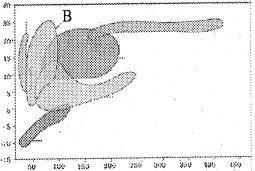
Identify $B$ from the given diagram showing different biomes based on mean annual temperature and mean annual precipitation.
A
Coniferous forest
B
Tropical forest
C
Grassland
D
Desert
Solution
(B) The provided diagram is a standard representation of biomes plotted against mean annual temperature and mean annual precipitation.
In this graph,the biome labeled as $B$ corresponds to the 'Tropical forest',which is characterized by high mean annual temperature and high mean annual precipitation.
In this graph,the biome labeled as $B$ corresponds to the 'Tropical forest',which is characterized by high mean annual temperature and high mean annual precipitation.
0 likes
View Solution85
MediumMCQ
In an ecosystem, which abiotic factor influences birds and mammals to have a larger body size in colder regions and a smaller body size in warmer regions?
A
Light
B
Water
C
Soil
D
Temperature
Solution
(D) This phenomenon is known as $Bergmann's$ rule. It states that animals living in colder climates tend to have larger body sizes compared to those in warmer climates. This is because a larger body size results in a smaller surface area-to-volume ratio, which helps in conserving body heat in cold environments. Therefore, $Temperature$ is the primary abiotic factor influencing this adaptation.
0 likes
View Solution86
MediumMCQ
Regulators are also called
A
Endotherms
B
Exotherms
C
Ectotherms
D
Either $(b)$ or $(c)$
Solution
(A) Regulators are organisms that can maintain a constant internal body temperature regardless of the external environmental conditions. These organisms are also known as endotherms. Evolutionary biologists believe that the success of mammals is mainly due to their ability to maintain a constant body temperature (endotherms) and live comfortably whether they are in Antarctica or the Sahara Desert.
0 likes
View Solution87
MediumMCQ
Nature and properties of soil in different places vary due to
A
Climate
B
Weathering process
C
Topography
D
All of these
Solution
(D) The nature and properties of soil in different places are primarily determined by the climate,the weathering process,and the topography of the region.
$1$. Climate: Temperature and precipitation influence the rate of weathering and the accumulation of organic matter.
$2$. Weathering process: The breakdown of rocks into fine particles occurs through physical (mechanical),chemical,and biological processes.
$3$. Topography: The slope and elevation of the land affect soil drainage,erosion,and the accumulation of minerals.
These factors collectively determine the physical and chemical properties of the soil,which in turn dictate the types of plants that can grow in a particular habitat.
$1$. Climate: Temperature and precipitation influence the rate of weathering and the accumulation of organic matter.
$2$. Weathering process: The breakdown of rocks into fine particles occurs through physical (mechanical),chemical,and biological processes.
$3$. Topography: The slope and elevation of the land affect soil drainage,erosion,and the accumulation of minerals.
These factors collectively determine the physical and chemical properties of the soil,which in turn dictate the types of plants that can grow in a particular habitat.
0 likes
View Solution88
MediumMCQ
In which one of the following habitats does the diurnal temperature of the soil surface vary the most?
A
Shrub land
B
Forest
C
Desert
D
Grassland
Solution
(C) Deserts experience very hot days and very cold nights. Due to the lack of significant plant cover,the soil in the desert is much more exposed to these temperature fluctuations compared to other habitats. During the daytime,the soil absorbs heat rapidly and becomes very hot,while at night,it loses heat quickly and becomes cool.
0 likes
View Solution89
MediumMCQ
In the oceans,the environment is perpetually dark at depths of:
A
More than $100 \, m$
B
More than $500 \, m$
C
Less than $100 \, m$
D
Less than $500 \, m$
Solution
(B) In the oceans,sunlight cannot penetrate beyond a certain depth.
At depths greater than $500 \, m$,the environment is perpetually dark.
The inhabitants living at these depths are not aware of the existence of any celestial source of light.
At depths greater than $500 \, m$,the environment is perpetually dark.
The inhabitants living at these depths are not aware of the existence of any celestial source of light.
0 likes
View Solution90
MediumMCQ
The temperature gradient over the Earth's surface is:
A
$6.4$ to $6.5^{\circ} C$ per $1000 \, m$ altitude
B
$6.4$ to $6.5^{\circ} C$ per $1000 \, m$ latitude
C
$7.5$ to $9.5^{\circ} C$ per $1000 \, m$ latitude
D
$7.5$ to $9.5^{\circ} C$ per $1000 \, m$ altitude
Solution
(B) The temperature gradient over the Earth's surface is approximately $6.4^{\circ} C$ to $6.5^{\circ} C$ per $1000 \, m$ of latitude (moving from the equator towards the poles).
This gradient results in a decrease in mean temperature as one moves from the equator to the poles.
Organisms are classified based on their temperature requirements:
$1$. Megatherms: Tropical organisms.
$2$. Mesotherms: Sub-tropical organisms.
$3$. Microtherms: Temperate organisms.
$4$. Hekistotherms: Arctic organisms.
This gradient results in a decrease in mean temperature as one moves from the equator to the poles.
Organisms are classified based on their temperature requirements:
$1$. Megatherms: Tropical organisms.
$2$. Mesotherms: Sub-tropical organisms.
$3$. Microtherms: Temperate organisms.
$4$. Hekistotherms: Arctic organisms.
0 likes
View Solution91
MediumMCQ
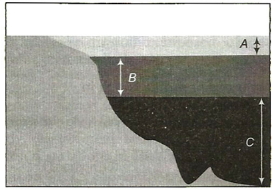
Identify $A, B$ and $C$ in the given diagram.
A
$A-$Aphotic zone,$B-$Euphotic zone,$C-$Disphotic zone
B
$A-$Euphotic zone,$B-$Disphotic zone,$C-$Aphotic zone
C
$A-$Euphotic zone,$B-$Aphotic zone,$C-$Disphotic zone
D
$A-$Aphotic zone,$B-$Disphotic zone,$C-$Euphotic zone
Solution
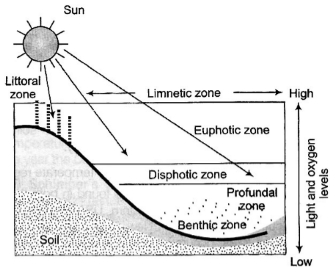
(B) In aquatic habitats,light zonation occurs in deep lakes and oceans based on light penetration:
$(i)$ Euphotic Zone $(A)$: This is the uppermost layer where light intensity is sufficient for photosynthesis to exceed respiration. It receives the most sunlight.
$(ii)$ Disphotic Zone $(B)$: This is the intermediate layer (twilight zone) where light intensity is low,often at or below the compensation point,limiting photosynthetic activity.
$(iii)$ Aphotic Zone $(C)$: This is the deepest layer where light does not penetrate,resulting in perpetual darkness. Photosynthesis cannot occur here.
Based on the provided diagram,$A$ represents the Euphotic zone,$B$ represents the Disphotic zone,and $C$ represents the Aphotic zone. Therefore,the correct option is $B$.
$(i)$ Euphotic Zone $(A)$: This is the uppermost layer where light intensity is sufficient for photosynthesis to exceed respiration. It receives the most sunlight.
$(ii)$ Disphotic Zone $(B)$: This is the intermediate layer (twilight zone) where light intensity is low,often at or below the compensation point,limiting photosynthetic activity.
$(iii)$ Aphotic Zone $(C)$: This is the deepest layer where light does not penetrate,resulting in perpetual darkness. Photosynthesis cannot occur here.
Based on the provided diagram,$A$ represents the Euphotic zone,$B$ represents the Disphotic zone,and $C$ represents the Aphotic zone. Therefore,the correct option is $B$.
0 likes
View Solution92
MediumMCQ
Average temperature of thermal springs and deep sea hydrothermal vents exceeds (in $^{\circ} C$)
A
$50$
B
$60$
C
$70$
D
$100$
Solution
(D) There are unique habitats such as thermal springs and deep sea hydrothermal vents where the average temperature exceeds $100^{\circ} C$. These extreme environments support specialized microorganisms known as extremophiles,particularly thermophiles,which can thrive at such high temperatures.
0 likes
View Solution93
MediumMCQ
Formation of major biomes such as desert and rainforest takes place by
A
Rotation of our planet around the sun
B
Tilting of our planet to its axis
C
Both $(a)$ and $(b)$
D
Seasonal periodicity
Solution
(C) The formation of major biomes is primarily determined by the annual variations in the intensity and duration of temperature and precipitation.
These variations are caused by the rotation of our planet around the sun and the tilting of our planet on its axis.
Therefore,both factors contribute to the distinct climatic conditions that define different biomes.
These variations are caused by the rotation of our planet around the sun and the tilting of our planet on its axis.
Therefore,both factors contribute to the distinct climatic conditions that define different biomes.
0 likes
View Solution94
EasyMCQ
The organisms that are present in tropical regions are called:
A
Mesotherms
B
Megatherms
C
Microtherms
D
Hekistotherms
Solution
(B) Organisms present in tropical regions are called megatherms.
The temperature gradient over the Earth's surface is approximately $6.4-6.5^{\circ}C$ per $1000\,m$ of altitude or per $10^{\circ}$ of latitude. Consequently,there is a decrease in the mean annual temperature from the equator towards the poles.
Organisms adapted to these specific climatic zones are classified as follows:
$1$. Tropical regions: Megatherms
$2$. Sub-tropical regions: Mesotherms
$3$. Temperate regions: Microtherms
$4$. Arctic/Alpine regions: Hekistotherms
The temperature gradient over the Earth's surface is approximately $6.4-6.5^{\circ}C$ per $1000\,m$ of altitude or per $10^{\circ}$ of latitude. Consequently,there is a decrease in the mean annual temperature from the equator towards the poles.
Organisms adapted to these specific climatic zones are classified as follows:
$1$. Tropical regions: Megatherms
$2$. Sub-tropical regions: Mesotherms
$3$. Temperate regions: Microtherms
$4$. Arctic/Alpine regions: Hekistotherms
0 likes
View Solution95
MediumMCQ
Factors which play a significant role in the formation of major biomes are
A
Temperature only
B
Temperature and precipitation
C
Precipitation and wind
D
Precipitation and atmosphere
Solution
(B) The formation of major biomes is primarily determined by regional variations in climate. The two most critical abiotic factors that influence these variations are temperature and precipitation. These factors dictate the type of vegetation and animal life that can thrive in a specific region,leading to the development of distinct biomes such as deserts,rainforests,and tundras.
0 likes
View Solution96
EasyMCQ
Permafrost condition is a characteristic feature of:
A
Hot desert biome
B
Cold desert biome
C
Savanna biome
D
Chaparral biome
Solution
(B) Permafrost,which refers to the subsoil that remains frozen throughout the year,is a characteristic feature of the cold desert biome (also known as the tundra biome).
0 likes
View Solution97
MediumMCQ
Find out the incorrect match.
A
Topographic factors - Soil texture
B
Edaphic factors - Soil factors
C
Climatic factors - Wind,humidity
D
Physiographic factors - Mountain slope
Solution
(A) Topographic factors (also known as physiographic factors) relate to the surface features of the land,such as the slope of a mountain or the aspect of the terrain.
Soil texture is a component of edaphic factors,which pertain to the physical and chemical properties of the soil.
Therefore,the match '$A$' is incorrect because soil texture is an edaphic factor,not a topographic factor.
Soil texture is a component of edaphic factors,which pertain to the physical and chemical properties of the soil.
Therefore,the match '$A$' is incorrect because soil texture is an edaphic factor,not a topographic factor.
0 likes
View Solution98
EasyMCQ
Choose the odd one with respect to the features of a tropical rain forest.
A
Permafrost
B
Drip tips
C
Epiphytes
D
Woody climbers
Solution
(A) Permafrost is a characteristic feature of the $Tundra$ biome,where the ground remains permanently frozen.
$Drip$ $tips$,$woody$ $climbers$ (lianes),and $epiphytes$ are characteristic adaptations found in $tropical$ $rain$ $forests$ due to high rainfall and intense competition for sunlight.
$Drip$ $tips$,$woody$ $climbers$ (lianes),and $epiphytes$ are characteristic adaptations found in $tropical$ $rain$ $forests$ due to high rainfall and intense competition for sunlight.
0 likes
View Solution99
MediumMCQ
Which of the following is the most ecologically relevant environmental factor?
A
Precipitation
B
Temperature
C
Soil
D
Wind
Solution
(B) Temperature is considered the most ecologically relevant environmental factor. It significantly affects the kinetics of enzymes and through it the metabolic activity and other physiological functions of the organism. It also influences the geographical distribution of organisms.
0 likes
View Solution100
MediumMCQ
$A$ habitat is constituted by
A
Predators and pathogens
B
Abiotic and biotic factors
C
Climatic and edaphic factors
D
Topographic,climatic and edaphic factors
Solution
(B) habitat is the natural environment in which an organism lives. It is defined by the interaction of both abiotic (non-living) and biotic (living) components. Abiotic factors include temperature,water,light,and soil,while biotic factors include plants,animals,and microorganisms.
0 likes
View SolutionOrganisms and Populations — Environment (Abiotic and Biotic factors) · Frequently Asked Questions
1Are these Organisms and Populations questions useful for JEE and NEET?
Yes. All questions in this section are mapped to JEE Main and NEET exam patterns. Previous year questions from JEE Main, NEET, GUJCET and state-level exams are included with full solutions.
2Can I switch to Hindi or Gujarati for these questions?
Yes. Use the language tabs in the hero section or the sidebar to view the same questions and solutions in English, Hindi or Gujarati.
3How do I generate a question paper from this subtopic?
Use the Vedclass Exam Paper Generator — select the chapter and subtopic, set difficulty, and generate Sets A, B, C, D automatically. First 3 chapters of every subject are free.
Vedclass Products
For Students
Vedclass Test Series
Mock tests in real JEE/NEET style with performance analysis. 5-day free trial.
Start Free TrialFor Teachers
Exam Paper Generator
Generate Set A/B/C/D papers from this chapter in 2 minutes. 3 chapters free.
Try FreeFor Institutes
Online Exam Module
Live online exams with unlimited students, 360° analytics & white-label branding.
See DemoFor Teachers & Institutes
Generate a Organisms and Populations Exam Paper in 2 Minutes
Select subtopic & difficulty — Sets A, B, C, D auto-generated with No Repeat logic.
First 3 chapters of every subject are free — no payment required.