
A English
Microbes in Production of Biogas Questions in English
Class 12 Biology · Microbes in Human Welfare · Microbes in Production of Biogas
156+
Questions
English
Language
100%
With Solutions
Showing 50 of 156 questions in English
51
MediumMCQ
What is the spent slurry (leftover sludge) in biogas production used for?
A
Cooking
B
Fertilizer
C
Sewage treatment
D
Both $ (B) $ and $ (C) $
Solution
(B) In the process of biogas production,the remaining material after the anaerobic digestion of organic waste is known as spent slurry. This spent slurry is rich in nutrients like nitrogen and phosphorus,making it an excellent organic fertilizer for crops. It is not used for cooking (as it is the byproduct) nor is it used for sewage treatment.
0 likes
View Solution52
MediumMCQ
Assertion $(S)$: $H_2$ is capable of converting solar energy into chemical energy.
Reason $(R)$: Photosynthetic microorganisms produce $H_2$.
Reason $(R)$: Photosynthetic microorganisms produce $H_2$.
A
$S$ and $R$ are both true,and $R$ is the correct explanation of $S$.
B
$S$ and $R$ are both true,but $R$ is not the correct explanation of $S$.
C
$S$ is true and $R$ is false.
D
$S$ is false and $R$ is true.
Solution
(D) Assertion $(S)$ is false because $H_2$ (hydrogen gas) itself is not a primary agent for converting solar energy into chemical energy; rather,it is a product of certain metabolic processes.
Reason $(R)$ is true because certain photosynthetic microorganisms,such as cyanobacteria and green algae,can produce $H_2$ gas during specific metabolic conditions.
Therefore,the correct option is $D$.
Reason $(R)$ is true because certain photosynthetic microorganisms,such as cyanobacteria and green algae,can produce $H_2$ gas during specific metabolic conditions.
Therefore,the correct option is $D$.
0 likes
View Solution53
MediumMCQ
Which is the main gas produced in biogas?
A
$H_2$
B
$CH_4$
C
$CO_2$
D
$H_2S$
Solution
(B) Biogas is a mixture of gases,predominantly methane $(CH_4)$,produced by the microbial activity of methanogens (e.g.,$Methanobacterium$) during the anaerobic breakdown of organic waste.
$CH_4$ typically constitutes $50-70\%$ of the total biogas composition,making it the primary component.
$CH_4$ typically constitutes $50-70\%$ of the total biogas composition,making it the primary component.
0 likes
View Solution54
MediumMCQ
Which type of carbohydrate,when processed by bacteria,yields the highest amount of methane?
A
Starch
B
Pectin
C
Cellulose
D
Glycogen
Solution
(C) Methanogens are a group of anaerobic bacteria that produce methane $(CH_4)$ as a metabolic byproduct in anoxic conditions.
These bacteria are commonly found in the rumen of cattle and in anaerobic sludge digesters.
Cellulose is a complex polysaccharide and a major component of plant cell walls.
When methanogens act on cellulosic material (which is abundant in agricultural and animal waste),they break it down through a series of anaerobic processes to produce biogas,which is rich in methane.
Therefore,cellulose is the primary substrate used in biogas production to yield high amounts of methane.
These bacteria are commonly found in the rumen of cattle and in anaerobic sludge digesters.
Cellulose is a complex polysaccharide and a major component of plant cell walls.
When methanogens act on cellulosic material (which is abundant in agricultural and animal waste),they break it down through a series of anaerobic processes to produce biogas,which is rich in methane.
Therefore,cellulose is the primary substrate used in biogas production to yield high amounts of methane.
0 likes
View Solution55
MediumMCQ
Which organization developed the biogas technology in India?
A
$IVRI$
B
$ICBN$
C
$KVIC$
D
$NBRI$
Solution
(C) The technology for biogas production was developed in India mainly due to the efforts of the Indian Agricultural Research Institute $(IARI)$ and the Khadi and Village Industries Commission $(KVIC)$.
$KVIC$ stands for Khadi and Village Industries Commission,which played a pivotal role in promoting and implementing biogas plants in rural areas of India.
Therefore,the correct option is $C$.
$KVIC$ stands for Khadi and Village Industries Commission,which played a pivotal role in promoting and implementing biogas plants in rural areas of India.
Therefore,the correct option is $C$.
0 likes
View Solution56
MediumMCQ
Identify the correct statements from the following:
A
Biogas is composed of methane,hydrogen sulfide,and carbon dioxide.
B
Biogas is used as a fuel for energy.
C
$A$ large amount of $CO_2$ is produced in biogas.
D
Methanogen bacteria are present in the rumen of cattle.
Solution
(A, B, C, D) $1$. Biogas is a mixture of gases (containing predominantly $CH_4$) produced by the microbial activity of methanogens.
$2$. Methanogens,such as $Methanobacterium$,grow anaerobically on cellulosic material and are commonly found in the rumen (a part of the stomach) of cattle.
$3$. In the rumen,these bacteria help in the breakdown of cellulose and play an important role in the nutrition of cattle.
$4$. Biogas is used as a source of energy for cooking and lighting.
$5$. The composition of biogas typically includes methane $(CH_4)$,carbon dioxide $(CO_2)$,and trace amounts of hydrogen sulfide $(H_2S)$,hydrogen $(H_2)$,and nitrogen $(N_2)$.
$6$. Therefore,all the given statements are scientifically correct.
$2$. Methanogens,such as $Methanobacterium$,grow anaerobically on cellulosic material and are commonly found in the rumen (a part of the stomach) of cattle.
$3$. In the rumen,these bacteria help in the breakdown of cellulose and play an important role in the nutrition of cattle.
$4$. Biogas is used as a source of energy for cooking and lighting.
$5$. The composition of biogas typically includes methane $(CH_4)$,carbon dioxide $(CO_2)$,and trace amounts of hydrogen sulfide $(H_2S)$,hydrogen $(H_2)$,and nitrogen $(N_2)$.
$6$. Therefore,all the given statements are scientifically correct.
0 likes
View Solution57
EasyMCQ
In a biogas plant,when does the gas holder (cover) rise?
A
When waste is disposed of
B
When gas is produced by bacteria
C
When organic waste and cow dung slurry are mixed in the tank
D
None of the above
Solution
(B) biogas plant consists of a concrete tank (digester) in which bio-wastes are collected and a slurry of dung is fed.
$A$ floating cover is placed over the slurry,which keeps on rising as the gas is produced in the tank due to the microbial activity of methanogens.
Therefore,the gas holder rises when gas is produced by bacteria.
$A$ floating cover is placed over the slurry,which keeps on rising as the gas is produced in the tank due to the microbial activity of methanogens.
Therefore,the gas holder rises when gas is produced by bacteria.
0 likes
View Solution58
MediumMCQ
Statement $P$: Bacteria produce methane gas due to metabolic processes like anaerobic respiration.
Statement $Q$: Bacteria act on starchy materials.
Statement $Q$: Bacteria act on starchy materials.
A
Statement $P$ is true,but Statement $Q$ is false.
B
Statement $P$ is false,but Statement $Q$ is true.
C
Both Statement $P$ and Statement $Q$ are true,and Statement $Q$ is the correct explanation of Statement $P$.
D
Both Statement $P$ and Statement $Q$ are false.
Solution
(C) Methanogens,such as $Methanobacterium$,are bacteria that grow anaerobically on cellulosic material and produce large amounts of methane,$CO_2$,and $H_2$.
These bacteria are commonly found in the anaerobic sludge during sewage treatment and in the rumen (a part of the stomach) of cattle.
In the rumen,these bacteria help in the breakdown of cellulose,which is a polysaccharide (a type of carbohydrate/starchy material) present in the food of cattle.
Therefore,Statement $P$ is true as methanogens perform anaerobic respiration to produce methane.
Statement $Q$ is also true because these bacteria act on cellulosic/starchy materials to facilitate digestion and biogas production.
Since the breakdown of these materials is the metabolic process that leads to methane production,Statement $Q$ is the correct explanation for Statement $P$.
These bacteria are commonly found in the anaerobic sludge during sewage treatment and in the rumen (a part of the stomach) of cattle.
In the rumen,these bacteria help in the breakdown of cellulose,which is a polysaccharide (a type of carbohydrate/starchy material) present in the food of cattle.
Therefore,Statement $P$ is true as methanogens perform anaerobic respiration to produce methane.
Statement $Q$ is also true because these bacteria act on cellulosic/starchy materials to facilitate digestion and biogas production.
Since the breakdown of these materials is the metabolic process that leads to methane production,Statement $Q$ is the correct explanation for Statement $P$.
0 likes
View Solution59
EasyMCQ
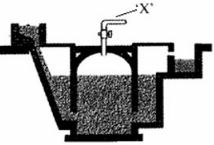
What does the part labeled '$X$' in the given figure represent?
A
Gas valve
B
Floating cover
C
Gas outlet
D
Sludge chamber
Solution
(C) The provided figure represents a biogas plant.
In a biogas plant,the anaerobic digestion of organic waste by methanogens produces biogas.
The biogas produced collects in the gas holder or gas tank.
The part labeled '$X$' is the pipe through which the produced biogas is taken out for use,which is known as the gas outlet.
In a biogas plant,the anaerobic digestion of organic waste by methanogens produces biogas.
The biogas produced collects in the gas holder or gas tank.
The part labeled '$X$' is the pipe through which the produced biogas is taken out for use,which is known as the gas outlet.
0 likes
View Solution60
MediumMCQ
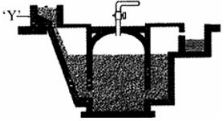
What does the part labeled '$Y$' in the given diagram represent?
A
Ground level
B
Inlet chamber
C
Overflow tank
D
Mixing tank
Solution
(B) The provided diagram illustrates a biogas plant. The part labeled '$Y$' is the inlet chamber where the slurry of dung and water is fed into the digester tank for anaerobic digestion.
0 likes
View Solution61
EasyMCQ
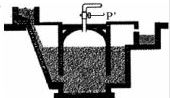
What does the part labeled $P$ in the given diagram represent?
A
Sludge cover
B
Gas valve
C
Mixing tank
D
Overflow tank
Solution
(B) The provided diagram represents a biogas plant. The part labeled $P$ is the gas valve,which is used to release the produced biogas from the digester tank for domestic or industrial use.
0 likes
View Solution62
EasyMCQ
Which of the following gases is a byproduct of biogas production?
A
Nitrogen
B
Hydrogen
C
Chlorine
D
Carbon dioxide
Solution
(D) Biogas is a mixture of gases produced by the microbial activity of methanogens (e.g.,$Methanobacterium$) on cellulosic material under anaerobic conditions.
The composition of biogas primarily includes $CH_4$ (methane),$CO_2$ (carbon dioxide),and traces of other gases like $H_2$ (hydrogen),$H_2S$ (hydrogen sulfide),and $N_2$ (nitrogen).
Among the given options,$CO_2$ (carbon dioxide) is a significant byproduct of the anaerobic digestion process used in biogas plants.
The composition of biogas primarily includes $CH_4$ (methane),$CO_2$ (carbon dioxide),and traces of other gases like $H_2$ (hydrogen),$H_2S$ (hydrogen sulfide),and $N_2$ (nitrogen).
Among the given options,$CO_2$ (carbon dioxide) is a significant byproduct of the anaerobic digestion process used in biogas plants.
0 likes
View Solution63
MediumMCQ
Which gases are produced during the sewage treatment process in the formation of biogas?
A
Hydrogen sulfide
B
Methane
C
Carbon dioxide
D
$A, B$ and $C$ all
Solution
(D) During the sewage treatment process,specifically in the anaerobic sludge digesters,bacteria produce a mixture of gases known as biogas.
This biogas is primarily composed of $CH_4$ (Methane),$CO_2$ (Carbon dioxide),and $H_2S$ (Hydrogen sulfide).
These gases are produced by the action of methanogenic bacteria on the organic matter present in the sewage sludge.
Therefore,all the listed gases are components of biogas.
This biogas is primarily composed of $CH_4$ (Methane),$CO_2$ (Carbon dioxide),and $H_2S$ (Hydrogen sulfide).
These gases are produced by the action of methanogenic bacteria on the organic matter present in the sewage sludge.
Therefore,all the listed gases are components of biogas.
0 likes
View Solution64
MediumMCQ
The type of gases produced during the process in biogas plants depends on which of the following?
A
Type of substrate
B
Type of bacteria
C
Both $(A)$ and $(B)$
D
Location of the plant
Solution
(C) The production of biogas is a microbial process involving the anaerobic breakdown of organic matter.
$1$. The type of substrate (organic waste) used determines the composition and yield of the gases produced.
$2$. The type of bacteria (methanogens) involved in the digestion process is crucial,as different microbes act on different organic materials to produce specific gases like $CH_4$,$CO_2$,and $H_2S$.
Therefore,the gas composition depends on both the substrate and the microbial community present.
$1$. The type of substrate (organic waste) used determines the composition and yield of the gases produced.
$2$. The type of bacteria (methanogens) involved in the digestion process is crucial,as different microbes act on different organic materials to produce specific gases like $CH_4$,$CO_2$,and $H_2S$.
Therefore,the gas composition depends on both the substrate and the microbial community present.
0 likes
View Solution65
MediumMCQ
In biogas plants,when is methane gas produced in large quantities?
A
Cellulosic materials are low.
B
Bacteria are high.
C
Cellulosic materials are high.
D
$B$ and $C$ both.
Solution
(C) Biogas is a mixture of gases (containing predominantly $CH_4$) produced by the microbial activity.
Certain bacteria,which grow anaerobically on cellulosic material,produce large amounts of $CH_4$ along with $CO_2$ and $H_2$.
These bacteria are collectively called methanogens (e.g.,$Methanobacterium$).
Since these bacteria thrive on cellulosic materials (like cattle dung),a higher concentration of cellulosic material provides more substrate for the bacteria to act upon,leading to a higher production of methane gas.
Therefore,the presence of high cellulosic material is the primary factor for large-scale methane production.
Certain bacteria,which grow anaerobically on cellulosic material,produce large amounts of $CH_4$ along with $CO_2$ and $H_2$.
These bacteria are collectively called methanogens (e.g.,$Methanobacterium$).
Since these bacteria thrive on cellulosic materials (like cattle dung),a higher concentration of cellulosic material provides more substrate for the bacteria to act upon,leading to a higher production of methane gas.
Therefore,the presence of high cellulosic material is the primary factor for large-scale methane production.
0 likes
View Solution66
MediumMCQ
$A$: Herbivores release methane gas into the atmosphere.
$R$: Herbivores consume a cellulose-rich diet.
$R$: Herbivores consume a cellulose-rich diet.
A
$A$ and $R$ are both true and $R$ is the correct explanation of $A$.
B
$A$ and $R$ are both true,but $R$ is not the correct explanation of $A$.
C
$A$ is true and $R$ is false.
D
$A$ is false and $R$ is true.
Solution
(A) Herbivores (like cattle) consume a diet rich in cellulose.
In the rumen (a part of the stomach) of these animals,certain bacteria called methanogens (e.g.,Methanobacterium) are present.
These bacteria anaerobically break down cellulose and produce large amounts of methane $(CH_4)$ along with $CO_2$ and $H_2$.
This methane is released into the atmosphere through the animal's digestive tract.
Therefore,$A$ is true because herbivores release methane,and $R$ is the correct explanation because the presence of methanogens is directly linked to the digestion of their cellulose-rich diet.
In the rumen (a part of the stomach) of these animals,certain bacteria called methanogens (e.g.,Methanobacterium) are present.
These bacteria anaerobically break down cellulose and produce large amounts of methane $(CH_4)$ along with $CO_2$ and $H_2$.
This methane is released into the atmosphere through the animal's digestive tract.
Therefore,$A$ is true because herbivores release methane,and $R$ is the correct explanation because the presence of methanogens is directly linked to the digestion of their cellulose-rich diet.
0 likes
View Solution67
MediumMCQ
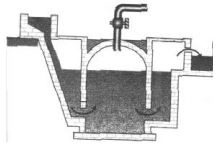
What does the given figure represent?
A
Gobar gas plant
B
$CNG$ gas plant
C
Biogas plant
D
Both $(A)$ and $(C)$
Solution
(D) The provided figure represents a typical biogas plant,which is also commonly referred to as a gobar gas plant in India because it primarily uses cattle dung (gobar) as the substrate for anaerobic digestion by methanogenic bacteria.
Since both terms refer to the same type of facility,option $(D)$ is the correct answer.
Since both terms refer to the same type of facility,option $(D)$ is the correct answer.
0 likes
View Solution68
MediumMCQ
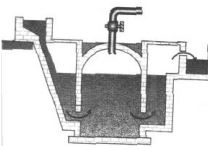
Which microorganisms are responsible for the production of gas in the biogas plant shown in the figure?
A
Methanogens
B
$E$. coli
C
Rhizobium
D
Bacillus thuringiensis
Solution
(A) The figure shows a biogas plant. Biogas is a mixture of gases (predominantly $CH_4$) produced by the microbial activity of methanogens.
Methanogens are anaerobic bacteria that grow on cellulosic material and produce large amounts of methane,$CO_2$,and $H_2$.
These bacteria are commonly found in the anaerobic sludge during sewage treatment and in the rumen of cattle.
Therefore,methanogens are responsible for the production of biogas.
Methanogens are anaerobic bacteria that grow on cellulosic material and produce large amounts of methane,$CO_2$,and $H_2$.
These bacteria are commonly found in the anaerobic sludge during sewage treatment and in the rumen of cattle.
Therefore,methanogens are responsible for the production of biogas.
0 likes
View Solution69
MediumMCQ
$A$: Biogas is a mixture of various gases.
$R$: The type of gases produced depends on the microbes and the organic substrate used.
$R$: The type of gases produced depends on the microbes and the organic substrate used.
A
Both $A$ and $R$ are true and $R$ is the correct explanation of $A$.
B
Both $A$ and $R$ are true but $R$ is not the correct explanation of $A$.
C
$A$ is true but $R$ is false.
D
$A$ is false but $R$ is true.
Solution
(A) Biogas is a mixture of gases (containing predominantly $CH_4$) produced by the microbial activity.
These microbes,specifically methanogens like $Methanobacterium$,grow anaerobically on cellulosic material.
The composition of the biogas produced depends on the type of organic waste (substrate) used and the specific microbial population present in the digester.
Therefore,both the assertion and the reason are correct,and the reason explains why the composition of biogas varies.
These microbes,specifically methanogens like $Methanobacterium$,grow anaerobically on cellulosic material.
The composition of the biogas produced depends on the type of organic waste (substrate) used and the specific microbial population present in the digester.
Therefore,both the assertion and the reason are correct,and the reason explains why the composition of biogas varies.
0 likes
View Solution70
MediumMCQ
Statement $X$: Biogas is used as a fuel for energy.
Statement $Y$: Biogas contains $H_2S$,$CO_2$,and oxygen gas.
Statement $Y$: Biogas contains $H_2S$,$CO_2$,and oxygen gas.
A
Statement $X$ is true,$Y$ is false.
B
Statement $X$ is false,$Y$ is true.
C
Both statements $X$ and $Y$ are true.
D
Both statements $X$ and $Y$ are false.
Solution
(A) Statement $X$ is true because biogas is a mixture of gases produced by the breakdown of organic matter in the absence of oxygen,which is primarily used as a fuel source.
Statement $Y$ is false because biogas consists mainly of methane $(CH_4)$,carbon dioxide $(CO_2)$,and trace amounts of hydrogen sulfide $(H_2S)$. It does not contain oxygen $(O_2)$ as a significant component; in fact,the process of methanogenesis is anaerobic (occurring in the absence of oxygen).
Statement $Y$ is false because biogas consists mainly of methane $(CH_4)$,carbon dioxide $(CO_2)$,and trace amounts of hydrogen sulfide $(H_2S)$. It does not contain oxygen $(O_2)$ as a significant component; in fact,the process of methanogenesis is anaerobic (occurring in the absence of oxygen).
0 likes
View Solution71
EasyMCQ
Which of the following is responsible for the production of biogas?
A
Halophiles
B
Methanogens
C
Thermoacidophiles
D
Firmicutes
Solution
(B) Methanogens are a group of archaebacteria that produce methane $(CH_4)$ as a metabolic byproduct in anoxic conditions.
They are commonly found in the gut of ruminant animals (like cows and buffaloes) and in marshy areas.
These bacteria play a crucial role in the production of biogas from the dung of these animals.
They are commonly found in the gut of ruminant animals (like cows and buffaloes) and in marshy areas.
These bacteria play a crucial role in the production of biogas from the dung of these animals.
0 likes
View Solution72
MediumMCQ
$S$ Statement: $Halophilus$ is responsible for the production of biogas. $R$ Statement: $Halophilus$ is an example of the $Bacteria$ domain.
A
$S$ and $R$ are both true,and $R$ is the correct explanation of $S$.
B
$S$ and $R$ are both true,but $R$ is not the correct explanation of $S$.
C
$S$ is true and $R$ is false.
D
$S$ and $R$ are both false.
Solution
(D) $1$. $Methanogens$ (not $Halophilus$) are responsible for the production of biogas in anaerobic conditions. Thus,statement $S$ is false.
$2$. $Halophiles$ are a group of $Archaea$ (not $Bacteria$) that live in extremely salty areas. Thus,statement $R$ is false.
$3$. Since both statements $S$ and $R$ are incorrect,the correct option is $D$.
$2$. $Halophiles$ are a group of $Archaea$ (not $Bacteria$) that live in extremely salty areas. Thus,statement $R$ is false.
$3$. Since both statements $S$ and $R$ are incorrect,the correct option is $D$.
0 likes
View Solution73
MediumMCQ
Methanogens are responsible for -
A
Producing food
B
Producing biogas
C
Living in extremely salty areas
D
Living in hot springs
Solution
(B) Methanogens are a group of archaebacteria that are strictly anaerobic.
They are found in the gut of several ruminant animals such as cows and buffaloes.
These bacteria are responsible for the production of methane (biogas) from the dung of these animals.
Therefore,they are commonly known as methanogens.
They are found in the gut of several ruminant animals such as cows and buffaloes.
These bacteria are responsible for the production of methane (biogas) from the dung of these animals.
Therefore,they are commonly known as methanogens.
0 likes
View Solution74
MediumMCQ
The primitive prokaryotes responsible for the production of biogas from the dung of ruminant animals include the:
A
methanogens
B
eubacteria
C
halophiles
D
thermoacidophiles
Solution
(A) : Methanogens belong to the domain Archaebacteria. They include methane-producing genera such as $Methanobacillus$ and $Methanothrix$.
Methanogens are obligate anaerobes found in oxygen-deficient environments,such as marshes,swamps,sludge (formed during sewage treatment),and the digestive systems of ruminants.
They obtain their energy primarily by reducing carbon dioxide $(CO_2)$ and oxidizing hydrogen $(H_2)$,resulting in the production of methane $(CH_4)$.
Methanogens are obligate anaerobes found in oxygen-deficient environments,such as marshes,swamps,sludge (formed during sewage treatment),and the digestive systems of ruminants.
They obtain their energy primarily by reducing carbon dioxide $(CO_2)$ and oxidizing hydrogen $(H_2)$,resulting in the production of methane $(CH_4)$.
0 likes
View Solution75
MediumMCQ
The guts of cow and buffalo possess
A
Methanogens
B
Cyanobacteria
C
Fucus sp.
D
Chlorella sp.
Solution
(A) : Methanogens like $Methanobacterium$ are found in the rumen (a part of the stomach) of cattle.
$A$ lot of cellulosic material is also available in the rumen.
In the rumen,these bacteria help in the breakdown of cellulose and play an important role in the nutrition of cattle.
$A$ lot of cellulosic material is also available in the rumen.
In the rumen,these bacteria help in the breakdown of cellulose and play an important role in the nutrition of cattle.
0 likes
View Solution76
MediumMCQ
In gobar gas,the maximum amount is that of
A
butane
B
methane
C
propane
D
carbon dioxide
Solution
(B) Biogas or gobar gas is a methane-rich fuel gas produced by the anaerobic breakdown or digestion of biomass with the help of methanogenic bacteria.
It is primarily composed of methane $(50-70\%)$,carbon dioxide $(30-40\%)$,and traces of nitrogen,hydrogen sulphide,and hydrogen.
Therefore,methane is present in the maximum amount in gobar gas.
It is primarily composed of methane $(50-70\%)$,carbon dioxide $(30-40\%)$,and traces of nitrogen,hydrogen sulphide,and hydrogen.
Therefore,methane is present in the maximum amount in gobar gas.
0 likes
View Solution77
MediumMCQ
Which of the following is mainly produced by the activity of anaerobic bacteria on sewage?
A
Laughing gas
B
Propane
C
Mustard gas
D
Marsh gas
Solution
(D) : Marsh gas or methane $(CH_4)$ gas is mainly produced by the activities of anaerobic bacteria on sewage.
Sewage contains large amounts of organic matter and microbes,many of which are pathogenic.
These microbes (bacteria and fungi) are digested during the secondary treatment process of sewage by anaerobic bacteria.
During this anaerobic digestion,bacteria produce a mixture of gases such as methane,hydrogen sulphide $(H_2S)$,and carbon dioxide $(CO_2)$.
These gases are collectively called biogas and can be easily used as a source of energy as they are inflammable.
Sewage contains large amounts of organic matter and microbes,many of which are pathogenic.
These microbes (bacteria and fungi) are digested during the secondary treatment process of sewage by anaerobic bacteria.
During this anaerobic digestion,bacteria produce a mixture of gases such as methane,hydrogen sulphide $(H_2S)$,and carbon dioxide $(CO_2)$.
These gases are collectively called biogas and can be easily used as a source of energy as they are inflammable.
0 likes
View Solution78
MediumMCQ
Which is the correct group of gases produced during aerobic digestion (biogas production)?
A
Carbon dioxide,hydrogen sulphide,methane,ethane.
B
Methane,oxygen,carbon dioxide.
C
Methane,hydrogen sulphide,carbon dioxide.
D
Ethane,methane,hydrogen sulphide.
Solution
(C) Biogas is a mixture of gases (containing predominantly methane) produced by the microbial activity of methanogens on organic waste under anaerobic conditions.
During the process of anaerobic digestion,the primary gases produced are $CH_4$ (methane),$CO_2$ (carbon dioxide),and $H_2S$ (hydrogen sulphide).
Therefore,the correct group of gases is Methane,hydrogen sulphide,and carbon dioxide.
During the process of anaerobic digestion,the primary gases produced are $CH_4$ (methane),$CO_2$ (carbon dioxide),and $H_2S$ (hydrogen sulphide).
Therefore,the correct group of gases is Methane,hydrogen sulphide,and carbon dioxide.
0 likes
View Solution79
EasyMCQ
If bacteria grow on cellulosic material,they produce a large amount of which gas?
A
Ethane
B
Oxygen
C
Methane
D
Propane
Solution
(C) Certain bacteria,which grow anaerobically on cellulosic material,are collectively called methanogens. These bacteria produce large amounts of methane along with $CO_2$ and $H_2$. $A$ common example of such a bacterium is $Methanobacterium$. These bacteria are commonly found in the anaerobic sludge during sewage treatment and in the rumen (a part of the stomach) of cattle.
0 likes
View Solution80
MediumMCQ
It is rich in methanogens.
A
Primary sludge
B
Activated sludge
C
Excreta of cattle
D
Flocs
Solution
(C) Methanogens are anaerobic bacteria that produce methane as a metabolic byproduct in anoxic conditions.
These bacteria are commonly found in the rumen (a part of the stomach) of cattle and in their excreta (dung).
In the context of biogas production,the excreta of cattle (cow dung) is used as a primary source of methanogens to initiate the anaerobic digestion process.
Therefore,the excreta of cattle is rich in methanogens.
These bacteria are commonly found in the rumen (a part of the stomach) of cattle and in their excreta (dung).
In the context of biogas production,the excreta of cattle (cow dung) is used as a primary source of methanogens to initiate the anaerobic digestion process.
Therefore,the excreta of cattle is rich in methanogens.
0 likes
View Solution81
MediumMCQ
The microorganism used in the production of biogas is:
A
Bacteria
B
Virus
C
Algae
D
Yeast
Solution
(A) Biogas is produced by the anaerobic breakdown of organic matter by methanogenic bacteria.
These bacteria,such as $Methanobacterium$,grow anaerobically on cellulosic material and produce large amounts of methane,$CO_2$,and $H_2$.
These bacteria are commonly found in the anaerobic sludge during sewage treatment and in the rumen (a part of the stomach) of cattle.
Therefore,bacteria are the microorganisms responsible for biogas production.
These bacteria,such as $Methanobacterium$,grow anaerobically on cellulosic material and produce large amounts of methane,$CO_2$,and $H_2$.
These bacteria are commonly found in the anaerobic sludge during sewage treatment and in the rumen (a part of the stomach) of cattle.
Therefore,bacteria are the microorganisms responsible for biogas production.
0 likes
View Solution82
MediumMCQ
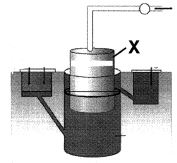
Which gases are produced in the labelled part $X$ in the given figure?
A
$O_2, CO, CO_2, H_2, CH_4$
B
$CO_2, O_2, H_2$
C
$CH_4, H_2, CO_2, O_2$
D
$CO_2, H_2, CH_4$
Solution
(D) The figure represents a biogas plant. The part labelled $X$ is the gas holder,which stores the biogas produced by the anaerobic digestion of organic waste.
Biogas is a mixture of gases,primarily consisting of methane $(CH_4)$,carbon dioxide $(CO_2)$,and hydrogen $(H_2)$,along with trace amounts of other gases.
Therefore,the gases present in the gas holder are $CO_2, H_2,$ and $CH_4$.
Biogas is a mixture of gases,primarily consisting of methane $(CH_4)$,carbon dioxide $(CO_2)$,and hydrogen $(H_2)$,along with trace amounts of other gases.
Therefore,the gases present in the gas holder are $CO_2, H_2,$ and $CH_4$.
0 likes
View Solution83
EasyMCQ
Which organizations are developed for biogas technology?
A
$TARI$ and $ICZN$
B
$ICBN$ and $KVIC$
C
$IRRI$ and $IARI$
D
$KVIC$ and $IARI$
Solution
(D) In India,the technology for biogas production was developed mainly due to the efforts of two major organizations:
$1$. $IARI$ (Indian Agricultural Research Institute)
$2$. $KVIC$ (Khadi and Village Industries Commission)
These institutions played a crucial role in the research,development,and implementation of biogas plants in rural areas to provide a sustainable source of energy and organic fertilizer.
$1$. $IARI$ (Indian Agricultural Research Institute)
$2$. $KVIC$ (Khadi and Village Industries Commission)
These institutions played a crucial role in the research,development,and implementation of biogas plants in rural areas to provide a sustainable source of energy and organic fertilizer.
0 likes
View Solution84
MediumMCQ
$A$ - The excreta (dung) of cattle is rich in methanogen bacteria.
$R$ - Thus,dung can be used in biogas production.
$R$ - Thus,dung can be used in biogas production.
A
$A$ and $R$ both are correct.
B
$A$ and $R$ both are incorrect.
C
$A$ is incorrect,$R$ is correct.
D
$A$ is correct,$R$ is incorrect.
Solution
(A) $1$. Methanogens are a group of anaerobic bacteria that produce methane $(CH_4)$ as a metabolic byproduct.
$2$. These bacteria are commonly found in the anaerobic sludge during sewage treatment and in the rumen (a part of the stomach) of cattle.
$3$. Cattle dung is rich in these methanogens because they are present in the digestive tract of the animals.
$4$. Due to the presence of these bacteria,cattle dung is used as an inoculum for the production of biogas in biogas plants.
$5$. Therefore,both the assertion $(A)$ and the reason $(R)$ are correct,and $R$ is the correct explanation of $A$.
$2$. These bacteria are commonly found in the anaerobic sludge during sewage treatment and in the rumen (a part of the stomach) of cattle.
$3$. Cattle dung is rich in these methanogens because they are present in the digestive tract of the animals.
$4$. Due to the presence of these bacteria,cattle dung is used as an inoculum for the production of biogas in biogas plants.
$5$. Therefore,both the assertion $(A)$ and the reason $(R)$ are correct,and $R$ is the correct explanation of $A$.
0 likes
View Solution85
MediumMCQ
Choose the correct sentence.
A
The type of gas produced in biogas depends upon the microbes and the organic substrates they utilize.
B
Bacteria,which grow on cellulosic material,produce a large amount of $CH_4$.
C
$A$ large amount of methanogenic bacteria are present in the rumen of cattle.
D
$CO_2$ is also called biogas.
Solution
(A) $1$. The type of gas produced during biogas production depends on the microbes and the organic substrates they utilize. This is a correct statement.
$2$. Bacteria that grow on cellulosic material (like methanogens) produce a large amount of methane $(CH_4)$,not $NO_2$.
$3$. Methanogenic bacteria are present in the rumen (a part of the stomach) of cattle,not the mouth.
$4$. Biogas is a mixture of gases,primarily methane $(CH_4)$,$CO_2$,and hydrogen,not just $CO_2$.
$2$. Bacteria that grow on cellulosic material (like methanogens) produce a large amount of methane $(CH_4)$,not $NO_2$.
$3$. Methanogenic bacteria are present in the rumen (a part of the stomach) of cattle,not the mouth.
$4$. Biogas is a mixture of gases,primarily methane $(CH_4)$,$CO_2$,and hydrogen,not just $CO_2$.
0 likes
View Solution86
MediumMCQ
In the anaerobic digestion of organic waste,such as in the production of biogas,which of the following remains undegraded?
A
Hemicellulose
B
Cellulose
C
Lipids
D
Lignin
Solution
(D) During the process of anaerobic digestion for biogas production,methanogenic bacteria break down complex organic matter like cellulose,hemicellulose,and lipids into methane $(CH_4)$,carbon dioxide $(CO_2)$,and hydrogen $(H_2)$.
Lignin is a complex phenolic polymer found in the cell walls of plants.
Due to its highly complex and recalcitrant structure,it is resistant to microbial degradation under anaerobic conditions.
Therefore,lignin remains undegraded in the biogas digester.
Lignin is a complex phenolic polymer found in the cell walls of plants.
Due to its highly complex and recalcitrant structure,it is resistant to microbial degradation under anaerobic conditions.
Therefore,lignin remains undegraded in the biogas digester.
0 likes
View Solution87
EasyMCQ
Organisms known as methanogens are abundant in . . . . . . .
A
Cattle yard
B
Polluted stream
C
Hot springs
D
Sulfur rocks
Solution
(A) Methanogens are a group of anaerobic bacteria,such as $Methanobacterium$,that produce methane $(CH_4)$ as a metabolic byproduct in anoxic conditions.
These bacteria are commonly found in the anaerobic sludge during sewage treatment and in the rumen (a part of the stomach) of cattle.
In the rumen,these bacteria help in the breakdown of cellulose in the food eaten by cattle and play an important role in the nutrition of the cattle.
Therefore,methanogens are found in abundance in the rumen of cattle and in cattle yards where cattle dung is present.
These bacteria are commonly found in the anaerobic sludge during sewage treatment and in the rumen (a part of the stomach) of cattle.
In the rumen,these bacteria help in the breakdown of cellulose in the food eaten by cattle and play an important role in the nutrition of the cattle.
Therefore,methanogens are found in abundance in the rumen of cattle and in cattle yards where cattle dung is present.
0 likes
View Solution88
MediumMCQ
Which of the following is primarily produced by the activity of anaerobic bacteria on sewage?
A
Propane
B
Mustard gas
C
Marsh gas
D
Laughing gas
Solution
(C) During the secondary treatment of sewage,anaerobic bacteria digest the organic matter present in the sludge.
This process of anaerobic digestion produces a mixture of gases,primarily methane $(CH_4)$,along with hydrogen sulfide $(H_2S)$ and carbon dioxide $(CO_2)$.
This mixture of gases is commonly known as biogas or marsh gas,as methane is the primary component found in marshy areas.
This process of anaerobic digestion produces a mixture of gases,primarily methane $(CH_4)$,along with hydrogen sulfide $(H_2S)$ and carbon dioxide $(CO_2)$.
This mixture of gases is commonly known as biogas or marsh gas,as methane is the primary component found in marshy areas.
0 likes
View Solution89
EasyMCQ
Recently,the Government of India has permitted the blending of alcohol with petrol. What is the percentage of alcohol that can be blended with petrol?
A
$2.5\%$
B
$10-15\%$
C
$10\%$
D
$5\%$
Solution
(D) The Government of India has implemented the Ethanol Blended Petrol $(EBP)$ programme to reduce dependence on imported crude oil and to lower carbon emissions.
Initially,the government permitted a $5\%$ blending of ethanol (alcohol) with petrol.
Over time,this target has been increased to $10\%$ and further to $20\%$ (E20) to promote sustainable fuel usage.
Given the options provided,$5\%$ was the initial standard percentage permitted for blending.
Initially,the government permitted a $5\%$ blending of ethanol (alcohol) with petrol.
Over time,this target has been increased to $10\%$ and further to $20\%$ (E20) to promote sustainable fuel usage.
Given the options provided,$5\%$ was the initial standard percentage permitted for blending.
0 likes
View Solution90
MediumMCQ
Pollution from animal excreta and organic waste from the kitchen can be most profitably minimized by
A
storing them in underground storage tanks
B
using them for producing biogas
C
vermiculture
D
using them directly as biofertilizers
Solution
(C) Vermiculture is the process of using earthworms to decompose organic waste. These worms consume organic matter,such as animal excreta and kitchen waste,and excrete it as vermicompost,which is rich in nutrients and humus. This process is highly profitable as it converts waste into a valuable organic fertilizer,thereby minimizing pollution effectively.
0 likes
View Solution91
EasyMCQ
Which of the following statements about methanogens is not correct?
A
They can be used to produce biogas.
B
They are found in the rumen of cattle and their excreta.
C
They grow aerobically and breakdown cellulose-rich food.
D
They produce methane gas.
Solution
(C) Methanogens are a group of bacteria that produce methane $(CH_4)$ gas in anaerobic conditions.
They are commonly found in the rumen (a part of the stomach) of cattle,where they help in the breakdown of cellulose-rich food.
They are also present in the excreta (dung) of these animals and are used in the production of biogas in biogas plants.
Since methanogens are obligate anaerobes,they cannot grow in the presence of oxygen.
Therefore,the statement that they grow aerobically is incorrect.
They are commonly found in the rumen (a part of the stomach) of cattle,where they help in the breakdown of cellulose-rich food.
They are also present in the excreta (dung) of these animals and are used in the production of biogas in biogas plants.
Since methanogens are obligate anaerobes,they cannot grow in the presence of oxygen.
Therefore,the statement that they grow aerobically is incorrect.
0 likes
View Solution92
Easy
Do you think microbes can also be used as a source of energy? If yes,how?
Solution
(N/A) Yes,microbes can be used as a source of energy. Bacteria such as $Methanobacterium$ are used for the generation of $gobar$ gas or biogas.
The generation of biogas is an anaerobic process in a biogas plant,which consists of a concrete tank ($10-15$ feet deep) with sufficient outlets and inlets.
The dung is mixed with water to form a slurry and fed into the tank.
The digester of the tank is filled with numerous anaerobic methane-producing bacteria,which produce biogas from the slurry.
Biogas can be removed through a pipe and used as a source of energy,while the spent slurry is removed from the outlet and used as a fertilizer.
The generation of biogas is an anaerobic process in a biogas plant,which consists of a concrete tank ($10-15$ feet deep) with sufficient outlets and inlets.
The dung is mixed with water to form a slurry and fed into the tank.
The digester of the tank is filled with numerous anaerobic methane-producing bacteria,which produce biogas from the slurry.
Biogas can be removed through a pipe and used as a source of energy,while the spent slurry is removed from the outlet and used as a fertilizer.
0 likes
View Solution93
Easy
Describe the contribution of microbes in the production of biogas.
Solution
(N/A) Microbes produce different types of gaseous end products during growth and metabolism.
- The type of gas produced depends upon the microbes and the organic substrates they utilize. In examples such as the fermentation of dough,cheese making,and the production of beverages,the main gas produced is $CO_{2}$.
- However,certain bacteria which grow anaerobically on cellulosic material produce large amounts of methane along with $CO_{2}$ and $H_{2}$. These bacteria are collectively called methanogens,and one such common bacterium is $Methanobacterium$.
- These bacteria are present in the rumen (a part of the stomach) of cattle.
- $A$ lot of cellulosic material present in the food of cattle is also present in the rumen. In the rumen,these bacteria help in the breakdown of cellulose and play an important role in the nutrition of cattle.
- Thus,the excreta (dung) of cattle,which is also called 'gobar',is rich in these bacteria. Dung can be used for the generation of biogas,commonly called 'gobar gas'.
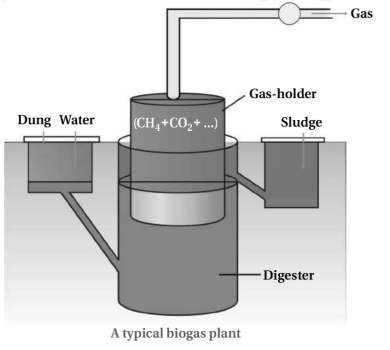
- The biogas plant consists of a concrete tank ($10$-$15$ feet deep) in which bio-wastes are collected and a slurry of dung is fed. $A$ floating cover is placed over the slurry,which keeps on rising as the gas is produced in the tank due to microbial activity.
- The biogas plant has an outlet which is connected to a pipe to supply biogas to nearby houses.
- Biogas is a mixture of gases (containing predominantly methane) produced by microbial activity and can be used as fuel.
- The type of gas produced depends upon the microbes and the organic substrates they utilize. In examples such as the fermentation of dough,cheese making,and the production of beverages,the main gas produced is $CO_{2}$.
- However,certain bacteria which grow anaerobically on cellulosic material produce large amounts of methane along with $CO_{2}$ and $H_{2}$. These bacteria are collectively called methanogens,and one such common bacterium is $Methanobacterium$.
- These bacteria are present in the rumen (a part of the stomach) of cattle.
- $A$ lot of cellulosic material present in the food of cattle is also present in the rumen. In the rumen,these bacteria help in the breakdown of cellulose and play an important role in the nutrition of cattle.
- Thus,the excreta (dung) of cattle,which is also called 'gobar',is rich in these bacteria. Dung can be used for the generation of biogas,commonly called 'gobar gas'.
- The biogas plant consists of a concrete tank ($10$-$15$ feet deep) in which bio-wastes are collected and a slurry of dung is fed. $A$ floating cover is placed over the slurry,which keeps on rising as the gas is produced in the tank due to microbial activity.
- The biogas plant has an outlet which is connected to a pipe to supply biogas to nearby houses.
- Biogas is a mixture of gases (containing predominantly methane) produced by microbial activity and can be used as fuel.
0 likes
View Solution94
Medium
Provide information about a biogas plant.
Solution
(N/A) Microbes produce different types of gaseous end products during growth and metabolism.
- The type of gas produced depends upon the microbes and the organic substrates they utilize. In the examples cited in relation to the fermentation of dough,cheese making,and the production of beverages,the main gas produced was $CO_{2}$.
- However,certain bacteria which grow anaerobically on cellulosic material produce a large amount of methane along with $CO_{2}$ and $H_{2}$. These bacteria are collectively called methanogens,and one such common bacterium is $Methanobacterium$.
- These bacteria are present in the rumen part of cattle.
- $A$ lot of cellulosic material present in the food of cattle is also present in the rumen. In the rumen,these bacteria help in the breakdown of cellulose and play an important role in the nutrition of cattle.
- Thus,the excreta (dung) of cattle is also called 'Gobar'. It possesses a high level of these bacteria. Dung can be used for the generation of biogas,commonly called gobar gas.
- The biogas plant consists of a concrete tank ($10-15$ feet deep) in which bio-wastes are collected and a slurry of dung is fed. $A$ floating cover is placed over the slurry,which keeps on rising as the gas is produced in the tank due to microbial activity.
- The biogas plant has an outlet which is connected to a pipe to supply biogas to nearby houses.
- Biogas is a mixture of gases (containing predominantly methane) produced by microbial activity and may be used as fuel.
- The type of gas produced depends upon the microbes and the organic substrates they utilize. In the examples cited in relation to the fermentation of dough,cheese making,and the production of beverages,the main gas produced was $CO_{2}$.
- However,certain bacteria which grow anaerobically on cellulosic material produce a large amount of methane along with $CO_{2}$ and $H_{2}$. These bacteria are collectively called methanogens,and one such common bacterium is $Methanobacterium$.
- These bacteria are present in the rumen part of cattle.
- $A$ lot of cellulosic material present in the food of cattle is also present in the rumen. In the rumen,these bacteria help in the breakdown of cellulose and play an important role in the nutrition of cattle.
- Thus,the excreta (dung) of cattle is also called 'Gobar'. It possesses a high level of these bacteria. Dung can be used for the generation of biogas,commonly called gobar gas.
- The biogas plant consists of a concrete tank ($10-15$ feet deep) in which bio-wastes are collected and a slurry of dung is fed. $A$ floating cover is placed over the slurry,which keeps on rising as the gas is produced in the tank due to microbial activity.
- The biogas plant has an outlet which is connected to a pipe to supply biogas to nearby houses.
- Biogas is a mixture of gases (containing predominantly methane) produced by microbial activity and may be used as fuel.
0 likes
View Solution95
Medium
Give scientific reasons: Why are biogas plants more commonly found in rural areas?
Solution
(N/A) Biogas plants are more common in rural areas primarily because the raw materials required,such as animal dung and agricultural waste,are abundantly available there. In rural settings,livestock rearing is a major occupation,providing a continuous supply of dung. Additionally,biogas serves as an efficient,cost-effective,and eco-friendly source of energy for cooking and lighting in areas where access to commercial fuels like $LPG$ might be limited or expensive. Thus,the proximity to the source of raw materials and the practical utility make biogas plants highly beneficial in rural regions.
0 likes
View Solution96
MediumMCQ
What is the group of bacteria found in both the rumen of cattle and sludge of sewage treatment?
A
Methanogens
B
Cyanobacteria
C
Eubacteria
D
Actinomycetes
Solution
(A) Methanogens are a group of anaerobic bacteria that produce methane $(CH_{4})$ as a metabolic byproduct in anoxic conditions.
These bacteria are commonly found in the rumen (a part of the stomach) of cattle,where they help in the breakdown of cellulosic material.
They are also found in the anaerobic sludge produced during sewage treatment,where they decompose organic matter to produce biogas,which includes $CH_{4}$,$CO_{2}$,and $H_{2}$.
These bacteria are commonly found in the rumen (a part of the stomach) of cattle,where they help in the breakdown of cellulosic material.
They are also found in the anaerobic sludge produced during sewage treatment,where they decompose organic matter to produce biogas,which includes $CH_{4}$,$CO_{2}$,and $H_{2}$.
0 likes
View Solution97
Easy
What is the chemical nature of biogas? Name an organism which is involved in biogas production.
Solution
(N/A) Biogas is a mixture of gases,primarily composed of methane $(CH_4)$,carbon dioxide $(CO_2)$,and traces of hydrogen $(H_2)$,hydrogen sulfide $(H_2S)$,and nitrogen $(N_2)$.
Methanogens,such as $Methanobacterium$,are the microorganisms involved in the production of biogas. These bacteria grow anaerobically on cellulosic material and produce large amounts of methane along with $CO_2$ and $H_2$.
Methanogens,such as $Methanobacterium$,are the microorganisms involved in the production of biogas. These bacteria grow anaerobically on cellulosic material and produce large amounts of methane along with $CO_2$ and $H_2$.
0 likes
View Solution98
Easy
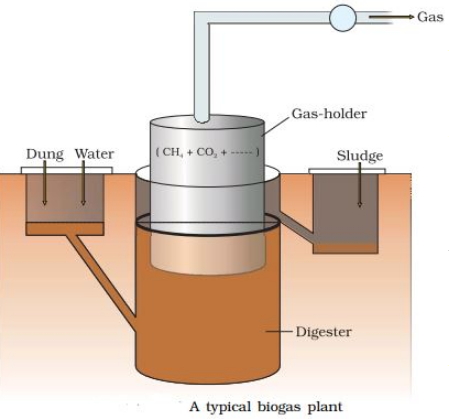
Draw a diagrammatic sketch of a biogas plant and label its various components: Gas Holder,Sludge Chamber,Digester,and Dung + water chamber.
Solution
(N/A) biogas plant is a concrete tank that is $10-15$ feet deep,in which bio-wastes and slurry of dung are collected.
$1$. Dung + water chamber: This is the inlet where the mixture of cattle dung and water is fed into the digester.
$2$. Digester: It is a sealed chamber where anaerobic digestion of organic matter takes place by methanogenic bacteria (e.g.,Methanobacterium).
$3$. Gas Holder: It is a floating cover placed over the slurry in the digester,which rises as gas is produced.
$4$. Sludge Chamber: This is the outlet through which the spent slurry (leftover waste) is removed and can be used as fertilizer.
$1$. Dung + water chamber: This is the inlet where the mixture of cattle dung and water is fed into the digester.
$2$. Digester: It is a sealed chamber where anaerobic digestion of organic matter takes place by methanogenic bacteria (e.g.,Methanobacterium).
$3$. Gas Holder: It is a floating cover placed over the slurry in the digester,which rises as gas is produced.
$4$. Sludge Chamber: This is the outlet through which the spent slurry (leftover waste) is removed and can be used as fertilizer.
0 likes
View Solution99
MediumMCQ
Which organisms are responsible for digestion in a biogas plant?
A
Aerobic bacteria
B
Anaerobic bacteria
C
Algae
D
Fungi
Solution
(B) In a biogas plant,the digestion of organic waste (like cattle dung) is carried out by anaerobic bacteria.
These bacteria,specifically methanogens (e.g.,Methanobacterium),grow anaerobically on cellulosic material.
They produce a mixture of gases,primarily methane,along with $CO_2$ and $H_2$,which is collectively known as biogas.
These bacteria,specifically methanogens (e.g.,Methanobacterium),grow anaerobically on cellulosic material.
They produce a mixture of gases,primarily methane,along with $CO_2$ and $H_2$,which is collectively known as biogas.
0 likes
View Solution100
MediumMCQ
Biogas produced in $STPs$ is a mixture of which gases?
A
$CH_{4}, H_{2}, CO_{2}$
B
$CH_{4}, H_{2}, CO$
C
$CH_{4}, He, CO_{2}$
D
$CH_{4}, H_{2}S, CO_{2}$
Solution
(D) During the secondary treatment of sewage in $STPs$ (Sewage Treatment Plants),anaerobic sludge digesters are used.
In these digesters,anaerobic bacteria digest the organic matter present in the sludge.
This process produces a mixture of gases,primarily methane $(CH_{4})$,hydrogen sulfide $(H_{2}S)$,and carbon dioxide $(CO_{2})$,which is collectively known as biogas.
In these digesters,anaerobic bacteria digest the organic matter present in the sludge.
This process produces a mixture of gases,primarily methane $(CH_{4})$,hydrogen sulfide $(H_{2}S)$,and carbon dioxide $(CO_{2})$,which is collectively known as biogas.
0 likes
View SolutionMicrobes in Human Welfare — Microbes in Production of Biogas · Frequently Asked Questions
1Are these Microbes in Human Welfare questions useful for JEE and NEET?
Yes. All questions in this section are mapped to JEE Main and NEET exam patterns. Previous year questions from JEE Main, NEET, GUJCET and state-level exams are included with full solutions.
2Can I switch to Hindi or Gujarati for these questions?
Yes. Use the language tabs in the hero section or the sidebar to view the same questions and solutions in English, Hindi or Gujarati.
3How do I generate a question paper from this subtopic?
Use the Vedclass Exam Paper Generator — select the chapter and subtopic, set difficulty, and generate Sets A, B, C, D automatically. First 3 chapters of every subject are free.
Vedclass Products
For Students
Vedclass Test Series
Mock tests in real JEE/NEET style with performance analysis. 5-day free trial.
Start Free TrialFor Teachers
Exam Paper Generator
Generate Set A/B/C/D papers from this chapter in 2 minutes. 3 chapters free.
Try FreeFor Institutes
Online Exam Module
Live online exams with unlimited students, 360° analytics & white-label branding.
See DemoFor Teachers & Institutes
Generate a Microbes in Human Welfare Exam Paper in 2 Minutes
Select subtopic & difficulty — Sets A, B, C, D auto-generated with No Repeat logic.
First 3 chapters of every subject are free — no payment required.