
A English
Microbes in Production of Biogas Questions in English
Class 12 Biology · Microbes in Human Welfare · Microbes in Production of Biogas
156+
Questions
English
Language
100%
With Solutions
Showing 50 of 156 questions in English
101
MediumMCQ
The type of gases produced in a biogas plant depends on which of the following?
A
The microbes and the organic substrate they utilize.
B
The design of the biogas plant.
C
The quantity of organic matter.
D
The number of microbes.
Solution
(A) The production of biogas is a microbial process. The type of gas produced depends on the specific type of microbes present (e.g.,methanogens) and the nature of the organic substrate (waste) being decomposed by them. Different microbes break down different organic materials to produce gases like $CH_4$,$CO_2$,and $H_2S$.
0 likes
View Solution102
MediumMCQ
Select the correct option for $Methanogens$.
A
Anaerobic bacteria producing biogas
B
Aerobic bacteria producing biogas
C
Fungi producing biogas
D
Flocs producing biogas
Solution
(A) $Methanogens$ are a group of anaerobic bacteria that thrive in oxygen-deficient environments.
They are commonly found in the anaerobic sludge during sewage treatment and in the rumen (a part of the stomach) of cattle.
These bacteria break down cellulosic material and produce large amounts of methane $(CH_4)$,carbon dioxide $(CO_2)$,and hydrogen $(H_2)$,which are collectively known as biogas.
They are commonly found in the anaerobic sludge during sewage treatment and in the rumen (a part of the stomach) of cattle.
These bacteria break down cellulosic material and produce large amounts of methane $(CH_4)$,carbon dioxide $(CO_2)$,and hydrogen $(H_2)$,which are collectively known as biogas.
0 likes
View Solution103
MediumMCQ
Where are methanogens found?
A
Excreta of cattle
B
Rumen of cattle
C
Anaerobic sludge
D
All of the above
Solution
(D) Methanogens are a group of bacteria that produce methane $(CH_4)$ under anaerobic conditions.
They are commonly found in the rumen (a part of the stomach) of cattle,where they help in the breakdown of cellulose.
They are also present in the excreta (dung) of these cattle.
Furthermore,they are found in anaerobic sludge during sewage treatment,where they are utilized for biogas production.
Therefore,all the given options are correct.
They are commonly found in the rumen (a part of the stomach) of cattle,where they help in the breakdown of cellulose.
They are also present in the excreta (dung) of these cattle.
Furthermore,they are found in anaerobic sludge during sewage treatment,where they are utilized for biogas production.
Therefore,all the given options are correct.
0 likes
View Solution104
MediumMCQ
What is the depth of the concrete tank used in a biogas plant?
A
$10-12$ feet
B
$8-12$ feet
C
$10-15$ feet
D
$10-20$ feet
Solution
(C) In a biogas plant,the concrete tank is a deep pit where bio-wastes are collected and a slurry of dung is fed.
According to the $NCERT$ textbook,the depth of this concrete tank is typically $10-15$ feet.
This tank is covered with a floating cover that keeps rising as gas is produced in the tank due to the microbial activity of methanogens.
According to the $NCERT$ textbook,the depth of this concrete tank is typically $10-15$ feet.
This tank is covered with a floating cover that keeps rising as gas is produced in the tank due to the microbial activity of methanogens.
0 likes
View Solution105
MediumMCQ
What can be inferred if the floating cover in a biogas plant rises upwards?
A
There has been an increase in the amount of cellulose-rich material in the tank.
B
There has been a decrease in bacterial growth.
C
Biogas has been produced by the bacteria.
D
There has been an increase in inorganic matter.
Solution
(C) In a biogas plant,the anaerobic digestion of organic waste by methanogenic bacteria produces biogas,which is a mixture of gases including $CH_4$,$CO_2$,and $H_2S$.
As the bacteria break down the organic matter,the gas accumulates in the tank.
The floating cover (gas holder) is designed to rise as the volume of the produced gas increases.
Therefore,the upward movement of the floating cover indicates that biogas has been generated by the microbial activity.
As the bacteria break down the organic matter,the gas accumulates in the tank.
The floating cover (gas holder) is designed to rise as the volume of the produced gas increases.
Therefore,the upward movement of the floating cover indicates that biogas has been generated by the microbial activity.
0 likes
View Solution106
MediumMCQ
In India,the technology of biogas production was developed mainly by the efforts of which organizations?
A
$IVRI$ and $KVCI$
B
$IARI$ and $KVIC$
C
$RIAV$ and $KCIV$
D
$IVIR$ and $KICV$
Solution
(B) In India,the technology of biogas production was developed mainly due to the efforts of the Indian Agricultural Research Institute $(IARI)$ and the Khadi and Village Industries Commission $(KVIC)$.
These organizations played a pivotal role in promoting biogas plants in rural areas to provide a sustainable source of energy and organic fertilizer.
These organizations played a pivotal role in promoting biogas plants in rural areas to provide a sustainable source of energy and organic fertilizer.
0 likes
View Solution107
MediumMCQ
Which gases are produced when anaerobic bacteria grow in a medium containing cellulose?
A
Methane,Carbon dioxide,Hydrogen sulfide
B
Ethane,Carbon monoxide,Hydrogen
C
Methane,Carbon dioxide,Hydrogen
D
Ethane,Carbon dioxide,Helium
Solution
(C) Anaerobic bacteria,specifically methanogens (e.g.,$Methanobacterium$),act on cellulosic material during the process of anaerobic digestion.
This process is commonly observed in the rumen of cattle and in biogas plants.
The breakdown of cellulose by these bacteria under anaerobic conditions results in the production of a mixture of gases,primarily $CH_4$ (Methane),$CO_2$ (Carbon dioxide),and $H_2$ (Hydrogen).
Therefore,the correct combination of gases produced is Methane,Carbon dioxide,and Hydrogen.
This process is commonly observed in the rumen of cattle and in biogas plants.
The breakdown of cellulose by these bacteria under anaerobic conditions results in the production of a mixture of gases,primarily $CH_4$ (Methane),$CO_2$ (Carbon dioxide),and $H_2$ (Hydrogen).
Therefore,the correct combination of gases produced is Methane,Carbon dioxide,and Hydrogen.
0 likes
View Solution108
MediumMCQ
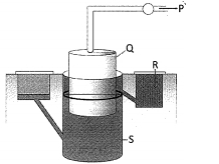
What does the given figure represent?
A
Sewage treatment plant
B
Typical biogas plant
C
Fermentation plant
D
Primary treatment
Solution
(B) The given figure represents a typical biogas plant.
It consists of a concrete tank (digester) where bio-wastes are collected and a slurry of dung is fed.
$P$ represents gas,$Q$ represents the gas holder,$R$ represents the sludge,and $S$ represents the digester.
It consists of a concrete tank (digester) where bio-wastes are collected and a slurry of dung is fed.
$P$ represents gas,$Q$ represents the gas holder,$R$ represents the sludge,and $S$ represents the digester.
0 likes
View Solution109
MediumMCQ
In the given diagram of a biogas plant,what do '$Q$' and '$S$' represent?
A
Gases and Slurry
B
Slurry and Gases
C
Gas holder and Slurry
D
Gas holder and Digester tank
Solution
(C) In a standard biogas plant diagram,the component '$Q$' typically represents the 'Gas holder' (the floating cover where biogas collects),and the component '$S$' represents the 'Slurry' (the mixture of dung and water that undergoes anaerobic digestion). Therefore,'$Q$' is the Gas holder and '$S$' is the Slurry.
0 likes
View Solution110
MediumMCQ
In the given figure,what do '$R$' and '$P$' represent?
A
Sludge and Gas
B
Slurry and Gas
C
Gas holder and Sludge
D
Sludge and Steam
Solution
(A) The provided figure represents a typical biogas plant.
In this diagram:
- '$P$' represents the gas (biogas) being released from the gas holder.
- '$Q$' represents the gas holder.
- '$R$' represents the sludge (spent slurry) which is removed from the outlet.
- '$S$' represents the digester tank containing the slurry.
Therefore,'$R$' represents sludge and '$P$' represents gas.
In this diagram:
- '$P$' represents the gas (biogas) being released from the gas holder.
- '$Q$' represents the gas holder.
- '$R$' represents the sludge (spent slurry) which is removed from the outlet.
- '$S$' represents the digester tank containing the slurry.
Therefore,'$R$' represents sludge and '$P$' represents gas.
0 likes
View Solution111
MediumMCQ
Which of the following is correct about biogas?
A
Methane gas is produced along with ethyl alcohol by methanogens.
B
Methanogens act on cellulose and release biogas.
C
Biogas is produced by thunder and lightning.
D
The maximum gas found in biogas is $CO_{2}$.
Solution
(B) Biogas production is a result of the anaerobic activity of methanogens.
These microorganisms,such as $Methanobacterium$,grow anaerobically on cellulosic material.
They break down cellulose to produce large amounts of methane $(CH_{4})$,along with $CO_{2}$ and $H_{2}$.
Therefore,the correct statement is that methanogens act on cellulose and release biogas.
Thus,the correct option is $(B)$.
These microorganisms,such as $Methanobacterium$,grow anaerobically on cellulosic material.
They break down cellulose to produce large amounts of methane $(CH_{4})$,along with $CO_{2}$ and $H_{2}$.
Therefore,the correct statement is that methanogens act on cellulose and release biogas.
Thus,the correct option is $(B)$.
0 likes
View Solution112
MediumMCQ
Which gas is present predominantly in biogas?
A
Methane
B
Ethane
C
Butane
D
Propane
Solution
(A) Biogas is a mixture of gases produced by the microbial activity of methanogens.
Among these,methane $(CH_4)$ is the primary component.
Biogas typically contains approximately $50-70 \%$ methane,making it the predominant gas present.
Among these,methane $(CH_4)$ is the primary component.
Biogas typically contains approximately $50-70 \%$ methane,making it the predominant gas present.
0 likes
View Solution113
MediumMCQ
$A$ : Methanogens can show symbiotic association with eukaryotic organisms.
$R$ : They are used for the production of biogas.
$R$ : They are used for the production of biogas.
A
Assertion and Reason both are correct and Reason is the correct explanation of Assertion.
B
Assertion and Reason both are correct but Reason is not the correct explanation of Assertion.
C
Assertion is correct,but Reason is incorrect.
D
Both Assertion and Reason are incorrect.
Solution
(B) Methanogens are archaebacteria that live in anaerobic environments,such as the rumen of cattle,where they exist in a symbiotic relationship to help in the digestion of cellulose. This is a correct statement.
Methanogens are indeed used in the production of biogas (methane) from organic waste in biogas plants. This is also a correct statement.
However,the fact that they are used for biogas production is not the reason why they form symbiotic associations with eukaryotes. Therefore,the Reason is not the correct explanation of the Assertion.
Methanogens are indeed used in the production of biogas (methane) from organic waste in biogas plants. This is also a correct statement.
However,the fact that they are used for biogas production is not the reason why they form symbiotic associations with eukaryotes. Therefore,the Reason is not the correct explanation of the Assertion.
0 likes
View Solution114
MediumMCQ
By anaerobic process,the cow dung is used to produce
A
Methane
B
Butane
C
Ethane
D
Propane
Solution
(A) Biogas is a mixture of gases (containing predominantly $CH_4$) produced by the microbial activity. During the anaerobic digestion of organic waste like cow dung,methanogenic bacteria (e.g.,$Methanobacterium$) break down the biomass to produce biogas,which is rich in methane.
0 likes
View Solution115
MediumMCQ
Gobar gas contains mainly
A
$CH_{4}$ and $CO_{2}$
B
$CH_{4}$ and $O_{2}$
C
$CH_{4}$ and $H_{2}$
D
$CH_{4}$ and $SO_{2}$
Solution
(A) Biogas,commonly known as gobar gas,is a methane-rich fuel gas produced by the anaerobic breakdown or digestion of biomass (mainly animal waste like cow dung) with the help of methanogenic bacteria.
It is primarily composed of methane $(50-70\%)$,$CO_{2}$ $(30-40\%)$,and traces of hydrogen,nitrogen,and $H_{2}S$.
It is primarily composed of methane $(50-70\%)$,$CO_{2}$ $(30-40\%)$,and traces of hydrogen,nitrogen,and $H_{2}S$.
0 likes
View Solution116
MediumMCQ
Methanogens,particularly $Methanobacterium$,grow anaerobically on cellulosic material and produce:
$I.$ Methane
$II.$ Carbon dioxide
$III.$ Oxygen
$IV.$ Ethane
Choose the correct option.
$I.$ Methane
$II.$ Carbon dioxide
$III.$ Oxygen
$IV.$ Ethane
Choose the correct option.
A
$I$ and $II$
B
$I$ and $III$
C
$III$ and $IV$
D
$I, II$ and $III$
Solution
(A) Biogas is a methane-rich fuel gas produced by the anaerobic breakdown or digestion of organic matter (cellulosic material) with the help of methanogenic bacteria.
Methanogens,such as $Methanobacterium$,are found in the anaerobic sludge during sewage treatment and in the rumen of cattle.
These bacteria produce a mixture of gases,primarily methane $(50-70\%)$,carbon dioxide $(30-40\%)$,and traces of other gases like hydrogen,hydrogen sulphide,and nitrogen.
Oxygen is not produced during this anaerobic process; in fact,it is inhibited by oxygen.
Therefore,the correct products are methane $(I)$ and carbon dioxide $(II)$.
Methanogens,such as $Methanobacterium$,are found in the anaerobic sludge during sewage treatment and in the rumen of cattle.
These bacteria produce a mixture of gases,primarily methane $(50-70\%)$,carbon dioxide $(30-40\%)$,and traces of other gases like hydrogen,hydrogen sulphide,and nitrogen.
Oxygen is not produced during this anaerobic process; in fact,it is inhibited by oxygen.
Therefore,the correct products are methane $(I)$ and carbon dioxide $(II)$.
0 likes
View Solution117
MediumMCQ
Methanogens are found in
$I.$ organic acid
$II.$ rumen of cattle
$III.$ butanal
$IV.$ anaerobic sludge
Choose the correct option
$I.$ organic acid
$II.$ rumen of cattle
$III.$ butanal
$IV.$ anaerobic sludge
Choose the correct option
A
$I$ and $II$
B
$II$ and $III$
C
$II$ and $IV$
D
$III$ and $IV$
Solution
(C) Methanogens are a group of archaebacteria that produce methane $(CH_{4})$ as a metabolic byproduct in hypoxic conditions.
They are commonly found in the following environments:
$(i)$ The rumen (a part of the stomach) of herbivorous cattle,where they help in the breakdown of cellulose.
$(ii)$ Anaerobic sludge produced during sewage treatment,where they play a crucial role in the production of biogas.
Therefore,statements $II$ and $IV$ are correct.
They are commonly found in the following environments:
$(i)$ The rumen (a part of the stomach) of herbivorous cattle,where they help in the breakdown of cellulose.
$(ii)$ Anaerobic sludge produced during sewage treatment,where they play a crucial role in the production of biogas.
Therefore,statements $II$ and $IV$ are correct.
0 likes
View Solution118
MediumMCQ
Which is produced during anaerobic fermentation of agricultural wastes?
A
Methane
B
$CO_{2}$
C
Carbon monoxide
D
Biogas
Solution
(D) Biogas or gobar gas is produced during the anaerobic fermentation of agricultural wastes.
Biogas is a mixture of gases (predominantly methane) produced by the microbial activity.
It is used as a fuel for heating,cooking,and lighting,and as a power source for irrigation.
It serves as an eco-friendly and pollution-free alternative to firewood,kerosene,dung cakes,electricity,and $LPG$.
Biogas is a mixture of gases (predominantly methane) produced by the microbial activity.
It is used as a fuel for heating,cooking,and lighting,and as a power source for irrigation.
It serves as an eco-friendly and pollution-free alternative to firewood,kerosene,dung cakes,electricity,and $LPG$.
0 likes
View Solution119
MediumMCQ
Consider the following statements about methanogenic bacteria:
$I.$ Methanogenic bacteria are commonly found in the anaerobic sludge formed during sewage treatment.
$II.$ These bacteria also occur in the rumen of cattle,where they act upon cellulosic material to break down cellulose.
$III.$ They play a very important role in the nutrition of cattle by digesting cellulosic material.
Which of the statements given above are correct?
$I.$ Methanogenic bacteria are commonly found in the anaerobic sludge formed during sewage treatment.
$II.$ These bacteria also occur in the rumen of cattle,where they act upon cellulosic material to break down cellulose.
$III.$ They play a very important role in the nutrition of cattle by digesting cellulosic material.
Which of the statements given above are correct?
A
$I, II$ and $III$
B
$I$ and $II$
C
$I$ and $III$
D
$II$ and $III$
Solution
(A) Methanogens,particularly $Methanobacterium$,are anaerobic bacteria that thrive in environments lacking oxygen.
Statement $I$ is correct because these bacteria are commonly found in the anaerobic sludge formed during sewage treatment.
Statement $II$ is correct because they are present in the rumen (a part of the stomach) of cattle,where they break down cellulosic material.
Statement $III$ is correct because by digesting cellulose,they help in the nutrition of cattle.
Therefore,all three statements are correct.
Statement $I$ is correct because these bacteria are commonly found in the anaerobic sludge formed during sewage treatment.
Statement $II$ is correct because they are present in the rumen (a part of the stomach) of cattle,where they break down cellulosic material.
Statement $III$ is correct because by digesting cellulose,they help in the nutrition of cattle.
Therefore,all three statements are correct.
0 likes
View Solution120
MediumMCQ
$A$ is a methane-rich fuel gas produced by $B$ breakdown with the help of $C$ bacteria. Here $A, B$,and $C$ refer to:
A
$A-$Gobar gas,$B-$aerobic,$C-$fermentative
B
$A-$Biogas,$B-$anaerobic,$C-$methanogenic
C
$A-$water gas,$B-$aerobic,$C-$methanogenic
D
$A-$Biogas,$B-$anaerobic,$C-$fermentative
Solution
(B) Biogas $(A)$ is a methane-rich fuel gas produced by anaerobic $(B)$ breakdown of organic matter with the help of methanogenic $(C)$ bacteria,such as Methanobacterium. These bacteria grow anaerobically on cellulosic material to produce large amounts of methane,$CO_2$,and $H_2$.
0 likes
View Solution121
MediumMCQ
Methanogens,growing anaerobically on cellulosic material,produce
A
Methane
B
Methane and carbon dioxide
C
Methane and hydrogen
D
Methane,carbon dioxide and hydrogen
Solution
(D) Methanogens produce methane,$CO_{2}$,and hydrogen.
Biogas is a methane-rich fuel gas produced by the anaerobic breakdown or digestion of biomass with the help of methanogenic bacteria.
Biogas is primarily composed of methane,carbon dioxide,and traces of hydrogen.
Biogas is a methane-rich fuel gas produced by the anaerobic breakdown or digestion of biomass with the help of methanogenic bacteria.
Biogas is primarily composed of methane,carbon dioxide,and traces of hydrogen.
0 likes
View Solution122
MediumMCQ
The technology of biogas production from cow dung was developed in India largely by the efforts of
A
Oil and Natural Gas Commission
B
Gas Authority of India
C
Indian Agricultural Research Institute and Khadi and Village Industries Commission
D
Indian Oil Corporation
Solution
(C) Biogas or gobar gas generation has been taken up in India on a large scale.
The technology for biogas production from cow dung was developed in India largely due to the efforts of the Indian Agricultural Research Institute $(IARI)$ and the Khadi and Village Industries Commission $(KVIC)$.
The technology for biogas production from cow dung was developed in India largely due to the efforts of the Indian Agricultural Research Institute $(IARI)$ and the Khadi and Village Industries Commission $(KVIC)$.
0 likes
View Solution123
MediumMCQ
Biogas is a mixture of inflammable gases like
A
Methane,$CO_{2}, H_{2}$ and $H_{2}S$
B
Methane,$CO, H_{2}$ and $N_{2}$
C
$CO_{2}, H_{2}$ and $H_{2}S$
D
$CO$,Methane and $N_{2}$
Solution
(A) Biogas is a mixture of gases produced by the microbial activity of methanogens.
The major component of biogas is methane $(CH_{4})$,which is highly inflammable and constitutes about $50-68\%$ of the mixture.
Other gases present include carbon dioxide $(CO_{2})$ at $25-35\%$,hydrogen $(H_{2})$ at $1-7\%$,and small amounts of hydrogen sulphide $(H_{2}S)$.
Therefore,the correct mixture of inflammable gases is methane,$CO_{2}, H_{2}$ and $H_{2}S$.
The major component of biogas is methane $(CH_{4})$,which is highly inflammable and constitutes about $50-68\%$ of the mixture.
Other gases present include carbon dioxide $(CO_{2})$ at $25-35\%$,hydrogen $(H_{2})$ at $1-7\%$,and small amounts of hydrogen sulphide $(H_{2}S)$.
Therefore,the correct mixture of inflammable gases is methane,$CO_{2}, H_{2}$ and $H_{2}S$.
0 likes
View Solution124
MediumMCQ
Biogas is pathogen-free because
A
Anaerobic digestion removes pathogens and bacteria
B
It is toxic to pathogens
C
During decomposition,it produces antibiotics
D
Cattle dung is pathogen-free
Solution
(A) Biogas is pathogen-free because the process of anaerobic digestion inactivates pathogens and parasites. This process is highly effective in reducing the incidence of water-borne diseases by eliminating harmful microorganisms present in the organic waste.
0 likes
View Solution125
MediumMCQ
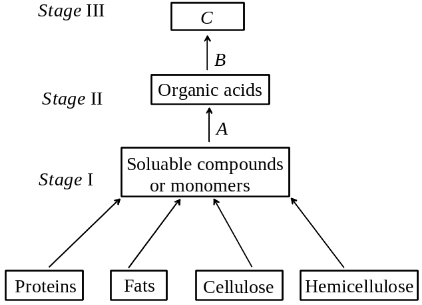
Study the following flow chart of biogas production and select the correct option for $A, B$ and $C$.
Stage $III$: $C$
Stage $II$: Organic acids $\xrightarrow{B}$ $C$
Stage $I$: Soluble compounds or monomers $\xrightarrow{A}$ Organic acids
(Note: The flow chart shows: Proteins,Fats,Cellulose,Hemicellulose $\rightarrow$ Soluble compounds or monomers $\xrightarrow{A}$ Organic acids $\xrightarrow{B}$ $C$)
Stage $III$: $C$
Stage $II$: Organic acids $\xrightarrow{B}$ $C$
Stage $I$: Soluble compounds or monomers $\xrightarrow{A}$ Organic acids
(Note: The flow chart shows: Proteins,Fats,Cellulose,Hemicellulose $\rightarrow$ Soluble compounds or monomers $\xrightarrow{A}$ Organic acids $\xrightarrow{B}$ $C$)
A
$A-$Methanogenic bacteria,$B-$Fermentative microbes,$C-CO_{2}$ and hydrogen (biogas)
B
$A-$Anaerobic microorganisms,$B-$Methanococcus,$C-CO_{2}$ and nitrogen (biogas)
C
$A-$Fermentative microbes,$B-$Methanogenic bacteria,$C-CO_{2}$ and methane (biogas)
D
$A-$Aerobic microorganisms,$B-$Methanobacter,$C-CO_{2}$ and methane (biogas)
Solution
(C) Biogas production occurs in three main stages:
$1$. Stage $I$: Complex organic polymers like proteins,fats,and carbohydrates (cellulose,hemicellulose) are broken down into soluble monomers by hydrolytic bacteria.
$2$. Stage $II$: These monomers are converted into organic acids (like acetic acid) by fermentative microbes $(A)$.
$3$. Stage $III$: Finally,methanogenic bacteria $(B)$ act on these organic acids to produce biogas,which consists mainly of methane $(CH_{4})$ and carbon dioxide $(CO_{2})$ $(C)$.
Therefore,$A$ represents fermentative microbes,$B$ represents methanogenic bacteria,and $C$ represents $CO_{2}$ and methane.
$1$. Stage $I$: Complex organic polymers like proteins,fats,and carbohydrates (cellulose,hemicellulose) are broken down into soluble monomers by hydrolytic bacteria.
$2$. Stage $II$: These monomers are converted into organic acids (like acetic acid) by fermentative microbes $(A)$.
$3$. Stage $III$: Finally,methanogenic bacteria $(B)$ act on these organic acids to produce biogas,which consists mainly of methane $(CH_{4})$ and carbon dioxide $(CO_{2})$ $(C)$.
Therefore,$A$ represents fermentative microbes,$B$ represents methanogenic bacteria,and $C$ represents $CO_{2}$ and methane.
0 likes
View Solution126
MediumMCQ
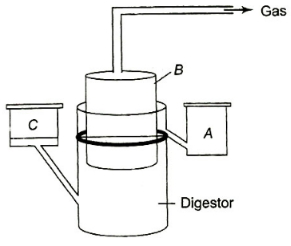
The diagram below represents a typical biogas plant. Select the correct option for what $A$,$B$,and $C$ refer to.
A
$A-$Sludge,$B-$Dung $+$ water,$C-CH_{4} + CO_{2}$
B
$A-$Dung $+$ water,$B-$Sludge,$C-CH_{4} + CO_{2}$
C
$A-$Sludge,$B-CH_{4} + CO_{2}$,$C-$Dung $+$ water
D
$A-CH_{4} + CO_{2}$,$B-$Dung $+$ water,$C-$Sludge
Solution
(C) In a typical biogas plant:
$1$. The input mixture of dung and water is fed into the digester through the inlet tank,which is labeled as $C$.
$2$. The gas holder (labeled as $B$) collects the biogas,which consists primarily of $CH_{4}$ and $CO_{2}$.
$3$. The spent slurry (sludge) is removed through the outlet tank,which is labeled as $A$.
Therefore,$A$ represents sludge,$B$ represents the gas holder containing $CH_{4} + CO_{2}$,and $C$ represents the inlet for dung $+$ water.
Matching these with the options,the correct sequence is $A-$Sludge,$B-CH_{4} + CO_{2}$,$C-$Dung $+$ water.
$1$. The input mixture of dung and water is fed into the digester through the inlet tank,which is labeled as $C$.
$2$. The gas holder (labeled as $B$) collects the biogas,which consists primarily of $CH_{4}$ and $CO_{2}$.
$3$. The spent slurry (sludge) is removed through the outlet tank,which is labeled as $A$.
Therefore,$A$ represents sludge,$B$ represents the gas holder containing $CH_{4} + CO_{2}$,and $C$ represents the inlet for dung $+$ water.
Matching these with the options,the correct sequence is $A-$Sludge,$B-CH_{4} + CO_{2}$,$C-$Dung $+$ water.
0 likes
View Solution127
EasyMCQ
What is the composition of the biogas?
A
Methane,carbon dioxide,oxygen etc.
B
Methane,carbon dioxide,hydrogen,nitrogen dioxide etc.
C
Methane,carbon dioxide,hydrogen etc.
D
Methane,carbon dioxide,sulphur dioxide etc.
Solution
(C) Biogas is a mixture of gases produced by the microbial activity of methanogens on organic waste under anaerobic conditions.
Its primary composition includes Methane $(CH_4)$,Carbon dioxide $(CO_2)$,and Hydrogen $(H_2)$,along with trace amounts of other gases like Hydrogen sulphide $(H_2S)$.
Its primary composition includes Methane $(CH_4)$,Carbon dioxide $(CO_2)$,and Hydrogen $(H_2)$,along with trace amounts of other gases like Hydrogen sulphide $(H_2S)$.
0 likes
View Solution128
MediumMCQ
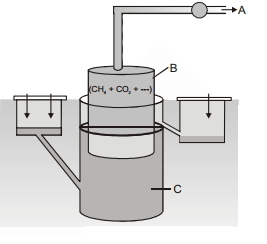
Identify the parts labelled $A, B,$ and $C$ with respect to the biogas plant shown in the figure.
A
| $A$: Gas | $B$: Sludge | $C$: Dung water |
B
| $A$: Gas | $B$: Gas holder | $C$: Digester |
C
| $A$: Gas holder | $B$: Sludge | $C$: Dung water |
D
| $A$: Gas holder | $B$: Digester | $C$: Dung water |
Solution
(B) Based on the standard diagram of a biogas plant:
$A$ represents the output gas (biogas) being released.
$B$ represents the floating gas holder,which stores the gas produced by microbial activity.
$C$ represents the digester tank,where the slurry of dung and water undergoes anaerobic digestion by methanogens.
Therefore,the correct identification is $A-$Gas,$B-$Gas holder,and $C-$Digester.
$A$ represents the output gas (biogas) being released.
$B$ represents the floating gas holder,which stores the gas produced by microbial activity.
$C$ represents the digester tank,where the slurry of dung and water undergoes anaerobic digestion by methanogens.
Therefore,the correct identification is $A-$Gas,$B-$Gas holder,and $C-$Digester.
0 likes
View Solution129
EasyMCQ
The bacteria responsible for biogas production are collectively called:
A
Methanogens
B
Thermoacidophiles
C
Halophiles
D
Cyanobacteria
Solution
(A) Methanogens are a group of anaerobic bacteria that produce methane $(CH_4)$ as a metabolic byproduct in anoxic conditions. These bacteria are commonly found in the anaerobic sludge during sewage treatment and in the rumen of cattle,where they help in the breakdown of cellulose. Due to their ability to produce methane,they are collectively referred to as methanogens and are essential for biogas production.
0 likes
View Solution130
EasyMCQ
The technology of biogas production was developed in India mainly due to the efforts of:
A
$IPM$
B
$IARI$ and $KVIC$
C
$IRRI$
D
$ICAR$
Solution
(B) The technology of biogas production was developed in India mainly due to the efforts of the Indian Agricultural Research Institute $(IARI)$ and the Khadi and Village Industries Commission $(KVIC)$.
0 likes
View Solution131
MediumMCQ
Biogas contains
A
$30\% - 40\%$ $Methane$
B
$50\% - 70\%$ $CO_2$
C
$50\% - 70\%$ $Methane$
D
$20\%$ $Methane$
Solution
(C) Biogas is a mixture of gases produced by the microbial activity and may be used as fuel.
Its composition is as follows:
$CH_4$ (Methane): $50-70\%$
$CO_2$ (Carbon dioxide): $30-40\%$
$H_2, H_2S$ and other trace gases: $10\%$
Therefore, the correct option is $C$.
Its composition is as follows:
$CH_4$ (Methane): $50-70\%$
$CO_2$ (Carbon dioxide): $30-40\%$
$H_2, H_2S$ and other trace gases: $10\%$
Therefore, the correct option is $C$.
0 likes
View Solution132
MediumMCQ
The first step in biogas production is carried out with the help of:
A
Obligate aerobes
B
Decomposers
C
Methanogens
D
Parasites
Solution
(B) The production of biogas occurs in three stages: solubilization,acidogenesis,and methanogenesis. The initial breakdown of complex organic matter (like cellulose) into simpler monomers is carried out by decomposers (cellulolytic bacteria). Methanogens are involved in the final stage of biogas production,where they convert organic acids into methane $(CH_4)$. Therefore,the first step is initiated by decomposers.
1 likes
View Solution133
MediumMCQ
Identify the incorrect statement with respect to a biogas plant.
A
It consists of a concrete tank,$10-15$ feet deep,in which bio-wastes are collected and a slurry of dung is fed.
B
$A$ floating cover is placed over the slurry,which keeps on rising as the gas is consumed in the tank.
C
It has an outlet,which is connected to a pipe to supply biogas to nearby houses.
D
The spent slurry is removed and may be used as fertilizer.
Solution
(B) The statement in option $B$ is incorrect. In a biogas plant,a floating cover is placed over the slurry,which keeps on rising as the gas is produced in the tank due to microbial activity,not as it is consumed.
0 likes
View Solution134
MediumMCQ
$A$: The chief component of biogas is $CH_4$.
$R$: Biogas plants are prepared on foreign technology.
$R$: Biogas plants are prepared on foreign technology.
A
Assertion and Reason both are correct and Reason is the correct explanation of Assertion.
B
Assertion and Reason both are correct but Reason is not the correct explanation of Assertion.
C
Assertion is correct,but Reason is incorrect.
D
Both Assertion and Reason are incorrect.
Solution
(C) The chief component of biogas is methane $(CH_4)$,which typically constitutes $50\% - 70\%$ of the gas.
In India,the technology for biogas plants was developed by the Indian Agricultural Research Institute $(IARI)$ and the Khadi and Village Industries Commission $(KVIC)$.
Therefore,these plants are based on indigenous (Indian) technology,not foreign technology.
Thus,the Assertion is correct,but the Reason is incorrect.
In India,the technology for biogas plants was developed by the Indian Agricultural Research Institute $(IARI)$ and the Khadi and Village Industries Commission $(KVIC)$.
Therefore,these plants are based on indigenous (Indian) technology,not foreign technology.
Thus,the Assertion is correct,but the Reason is incorrect.
0 likes
View Solution135
EasyMCQ
What is the significance of methanogens?
A
They are responsible for the production of antibiotics.
B
They produce approximately $65 \%$ of atmospheric methane.
C
They are used in the production of curd from milk.
D
They help in the fixation of atmospheric nitrogen.
Solution
(B) Methanogens are archaebacteria that thrive in anaerobic environments like the rumen of cattle and marshy areas.
They are responsible for the production of methane (biogas) from organic waste.
They contribute significantly to the environment by producing approximately $65 \%$ of the total atmospheric methane.
They are responsible for the production of methane (biogas) from organic waste.
They contribute significantly to the environment by producing approximately $65 \%$ of the total atmospheric methane.
0 likes
View Solution136
MediumMCQ
Which gases are present in the biogas produced during sewage treatment?
A
$CH_4, CO_2, H_2S$
B
$CH_4, CO_2, NH_3, H_2$
C
$CH_4, CO_2, H_2$
D
$CH_4, CO_2, H_2S, NH_3$
Solution
(A) During the sewage treatment process,specifically in the anaerobic sludge digesters,anaerobic bacteria digest the organic matter present in the sludge.
This process produces a mixture of gases,which is known as biogas.
Biogas primarily consists of methane $(CH_4)$,carbon dioxide $(CO_2)$,and hydrogen sulfide $(H_2S)$.
Therefore,the correct composition of gases produced during this process is $CH_4, CO_2,$ and $H_2S$.
This process produces a mixture of gases,which is known as biogas.
Biogas primarily consists of methane $(CH_4)$,carbon dioxide $(CO_2)$,and hydrogen sulfide $(H_2S)$.
Therefore,the correct composition of gases produced during this process is $CH_4, CO_2,$ and $H_2S$.
0 likes
View Solution137
EasyMCQ
Which gases are produced in a biogas plant by methanogenic bacteria?
A
$CH_4, CO_2, NH_3, H_2S$
B
$CH_4, CO_2, NH_3, H_2$
C
$CH_4, CO_2, H_2$
D
$CH_4, CO_2, H_2S$
Solution
(C) Methanogens,such as $Methanobacterium$,are anaerobic bacteria that grow in anaerobic conditions.
These bacteria are found in the rumen of cattle and in sewage treatment plants.
In a biogas plant,these bacteria break down cellulosic material present in the dung (gobar) of cattle.
During this process,they produce a mixture of gases,primarily $CH_4$ (methane),$CO_2$ (carbon dioxide),and $H_2$ (hydrogen).
Therefore,the correct composition of gases produced is $CH_4, CO_2,$ and $H_2$.
These bacteria are found in the rumen of cattle and in sewage treatment plants.
In a biogas plant,these bacteria break down cellulosic material present in the dung (gobar) of cattle.
During this process,they produce a mixture of gases,primarily $CH_4$ (methane),$CO_2$ (carbon dioxide),and $H_2$ (hydrogen).
Therefore,the correct composition of gases produced is $CH_4, CO_2,$ and $H_2$.
0 likes
View Solution138
MediumMCQ
Which of the following represents the gas holder in the given biogas plant diagram?
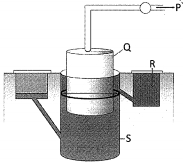
A
$P$
B
$Q$
C
$R$
D
$S$
Solution
(B) In a typical biogas plant diagram:
- $P$ represents the gas outlet pipe.
- $Q$ represents the floating gas holder (gas drum) that stores the produced biogas.
- $R$ represents the outlet for spent slurry (fertilizer).
- $S$ represents the digester tank where anaerobic digestion occurs.
Therefore,$Q$ is the gas holder.
- $P$ represents the gas outlet pipe.
- $Q$ represents the floating gas holder (gas drum) that stores the produced biogas.
- $R$ represents the outlet for spent slurry (fertilizer).
- $S$ represents the digester tank where anaerobic digestion occurs.
Therefore,$Q$ is the gas holder.
0 likes
View Solution139
EasyMCQ
In India,biogas technology was developed by which of the following organizations?
A
$IARI$
B
$KVIC$
C
Both $IARI$ and $KVIC$
D
$IVRI$
Solution
(C) In India,the technology for biogas production was developed mainly by the efforts of the Indian Agricultural Research Institute $(IARI)$ and the Khadi and Village Industries Commission $(KVIC)$.
Both these organizations played a crucial role in promoting and implementing biogas plants in rural areas to provide a sustainable source of energy and organic fertilizer.
Both these organizations played a crucial role in promoting and implementing biogas plants in rural areas to provide a sustainable source of energy and organic fertilizer.
0 likes
View Solution140
MediumMCQ
Methanogens $:-$
A
are present in the rumen of humans
B
are found in aerobic sludge of sewage
C
produce a large amount of $CO_2$ with a little amount of methane
D
grow anaerobically on cellulosic material
Solution
(D) Methanogens are a group of anaerobic bacteria that produce methane $(CH_4)$ as a metabolic byproduct in anoxic conditions.
They are commonly found in the rumen (a part of the stomach) of cattle and other ruminant animals,where they help in the breakdown of cellulose.
They also grow anaerobically on cellulosic material in anaerobic sludge digesters to produce biogas.
Therefore,option $D$ is the correct statement.
They are commonly found in the rumen (a part of the stomach) of cattle and other ruminant animals,where they help in the breakdown of cellulose.
They also grow anaerobically on cellulosic material in anaerobic sludge digesters to produce biogas.
Therefore,option $D$ is the correct statement.
0 likes
View Solution141
MediumMCQ
Which of the following compositions is called biogas?
A
$CH_4, SO_2, H_2$
B
$CH_4, CO_2, H_2$
C
$C_2H_6, CO_2, H_2$
D
$CH_4, N_2O, H_2$
Solution
(B) Biogas is a mixture of gases produced by the microbial activity of methanogens (anaerobic bacteria) on organic waste.
The primary components of biogas are methane $(CH_4)$,carbon dioxide $(CO_2)$,and hydrogen $(H_2)$.
Methane is the major combustible component,while $CO_2$ and $H_2$ are present in smaller quantities.
Therefore,the correct composition is $CH_4, CO_2, H_2$.
The primary components of biogas are methane $(CH_4)$,carbon dioxide $(CO_2)$,and hydrogen $(H_2)$.
Methane is the major combustible component,while $CO_2$ and $H_2$ are present in smaller quantities.
Therefore,the correct composition is $CH_4, CO_2, H_2$.
0 likes
View Solution142
EasyMCQ
Biogas contains:
A
$CH_4, C_2H_5OH, N_2, O_2$
B
$CH_4, CO, H_2, N_2, H_2S$
C
$CO_2, H_2, N_2, O_2$
D
$CH_4, CO_2, H_2, N_2, H_2S$
Solution
(D) Biogas is a mixture of gases produced by the microbial activity of methanogens (e.g.,Methanobacterium) during the anaerobic breakdown of organic waste.
The primary component of biogas is methane $(CH_4)$,which is flammable.
Other gases present in biogas include carbon dioxide $(CO_2)$,hydrogen $(H_2)$,nitrogen $(N_2)$,and trace amounts of hydrogen sulfide $(H_2S)$.
Therefore,the correct composition is $CH_4, CO_2, H_2, N_2, H_2S$.
The primary component of biogas is methane $(CH_4)$,which is flammable.
Other gases present in biogas include carbon dioxide $(CO_2)$,hydrogen $(H_2)$,nitrogen $(N_2)$,and trace amounts of hydrogen sulfide $(H_2S)$.
Therefore,the correct composition is $CH_4, CO_2, H_2, N_2, H_2S$.
0 likes
View Solution143
EasyMCQ
Which bacteria is utilized in a Gobar gas plant?
A
Methanogens
B
Ammonifying bacteria
C
Denitrifying bacteria
D
Nitrifying bacteria
Solution
(A) Gobar gas plant,also known as a biogas plant,utilizes anaerobic bacteria to break down organic waste (like cattle dung).
These bacteria are collectively known as Methanogens.
Methanogens,such as $Methanobacterium$,grow anaerobically on cellulosic material and produce large amounts of methane $(CH_4)$,carbon dioxide $(CO_2)$,and hydrogen $(H_2)$.
These gases together constitute biogas.
These bacteria are collectively known as Methanogens.
Methanogens,such as $Methanobacterium$,grow anaerobically on cellulosic material and produce large amounts of methane $(CH_4)$,carbon dioxide $(CO_2)$,and hydrogen $(H_2)$.
These gases together constitute biogas.
0 likes
View Solution144
EasyMCQ
Methanococcus converts acetate to form . . . . . . .
A
methane only
B
$CO_2$ and $H_2O$ only
C
methane $+ CO_2 + H_2O$
D
formic acid only
Solution
(C) Methanogens,such as $Methanococcus$,are anaerobic bacteria that thrive in oxygen-deficient environments.
They perform methanogenesis,a metabolic process where they convert substrates like acetate,$H_2$,and $CO_2$ into methane $(CH_4)$,$CO_2$,and $H_2O$ as metabolic byproducts.
They perform methanogenesis,a metabolic process where they convert substrates like acetate,$H_2$,and $CO_2$ into methane $(CH_4)$,$CO_2$,and $H_2O$ as metabolic byproducts.
0 likes
View Solution145
EasyMCQ
Which one of the following reactions occurs during the process of solubilization in biogas production?
A
Carbohydrates and proteins are converted into simple sugars and amino acids respectively.
B
Acetic acid or formic acid is converted into methane,$CO_2$,and $H_2O$.
C
Simple organic material is converted into formic acid or acetic acid.
D
Simple sugars and amino acids are converted into carbohydrates and proteins.
Solution
(A) The process of biogas production occurs in three main stages:
$1$. Solubilization (Hydrolysis): Complex organic polymers like carbohydrates,proteins,and fats are broken down into their simpler monomers like simple sugars,amino acids,and fatty acids by extracellular enzymes.
$2$. Acidogenesis: These simple monomers are further converted into volatile fatty acids like acetic acid,formic acid,and alcohols.
$3$. Methanogenesis: Finally,acetic acid or formic acid is converted into methane $(CH_4)$,$CO_2$,and $H_2O$ by methanogenic bacteria.
Therefore,the correct reaction for solubilization is that carbohydrates and proteins are converted into simple sugars and amino acids respectively.
$1$. Solubilization (Hydrolysis): Complex organic polymers like carbohydrates,proteins,and fats are broken down into their simpler monomers like simple sugars,amino acids,and fatty acids by extracellular enzymes.
$2$. Acidogenesis: These simple monomers are further converted into volatile fatty acids like acetic acid,formic acid,and alcohols.
$3$. Methanogenesis: Finally,acetic acid or formic acid is converted into methane $(CH_4)$,$CO_2$,and $H_2O$ by methanogenic bacteria.
Therefore,the correct reaction for solubilization is that carbohydrates and proteins are converted into simple sugars and amino acids respectively.
0 likes
View Solution146
EasyMCQ
Select the correct sequence of anaerobic digestion during biogas production.
A
Acidogenesis $\longrightarrow$ Hydrolysis $\longrightarrow$ Methanogenesis
B
Solubilization $\longrightarrow$ Methanogenesis $\longrightarrow$ Acidogenesis
C
Hydrolysis $\longrightarrow$ Acidogenesis $\longrightarrow$ Methanogenesis
D
Methanogenesis $\longrightarrow$ Hydrolysis $\longrightarrow$ Acidogenesis
Solution
(C) The process of anaerobic digestion in biogas production occurs in three main stages:
$1$. Hydrolysis: Complex organic polymers like carbohydrates,proteins,and fats are broken down into simpler monomers like sugars,amino acids,and fatty acids by extracellular enzymes.
$2$. Acidogenesis: These monomers are further converted into volatile fatty acids (like acetic acid),alcohols,and gases (like $CO_2$ and $H_2$) by acidogenic bacteria.
$3$. Methanogenesis: Finally,methanogenic bacteria (methanogens) convert these products into methane $(CH_4)$ and carbon dioxide $(CO_2)$.
Therefore,the correct sequence is Hydrolysis $\longrightarrow$ Acidogenesis $\longrightarrow$ Methanogenesis.
$1$. Hydrolysis: Complex organic polymers like carbohydrates,proteins,and fats are broken down into simpler monomers like sugars,amino acids,and fatty acids by extracellular enzymes.
$2$. Acidogenesis: These monomers are further converted into volatile fatty acids (like acetic acid),alcohols,and gases (like $CO_2$ and $H_2$) by acidogenic bacteria.
$3$. Methanogenesis: Finally,methanogenic bacteria (methanogens) convert these products into methane $(CH_4)$ and carbon dioxide $(CO_2)$.
Therefore,the correct sequence is Hydrolysis $\longrightarrow$ Acidogenesis $\longrightarrow$ Methanogenesis.
0 likes
View Solution147
EasyMCQ
Cattle dung used as a substrate in biogas production is a rich source of . . . . . . .
A
cellulose
B
fatty acids
C
proteins
D
lipids
Solution
(A) Cattle dung,also known as cow dung,is used as a substrate in biogas plants because it contains a high concentration of cellulose.
Cellulose is a complex carbohydrate found in the cell walls of plants,which cattle consume as part of their diet.
During the process of anaerobic digestion,methanogenic bacteria (methanogens) break down this cellulose into simpler compounds,ultimately producing methane $(CH_4)$,which is the primary component of biogas.
Cellulose is a complex carbohydrate found in the cell walls of plants,which cattle consume as part of their diet.
During the process of anaerobic digestion,methanogenic bacteria (methanogens) break down this cellulose into simpler compounds,ultimately producing methane $(CH_4)$,which is the primary component of biogas.
0 likes
View Solution148
EasyMCQ
Mohan was writing a report on the benefits of biogas:
$i$. It is cheap and safe
$ii$. Can be used for cooking
$iii$. Can be transported easily
$iv$. Causes pollution
Which one of the above statements has been reported incorrectly?
$i$. It is cheap and safe
$ii$. Can be used for cooking
$iii$. Can be transported easily
$iv$. Causes pollution
Which one of the above statements has been reported incorrectly?
A
$iv$.
B
$v$.
C
$i$.
D
$ii$.
Solution
(A) Biogas is a clean,renewable,and eco-friendly source of energy.
It is produced by the anaerobic breakdown of organic matter.
Statement $i$ is correct as it is a cost-effective and safe fuel.
Statement $ii$ is correct as it is widely used for cooking and lighting.
Statement $iii$ is correct as it can be transported through pipelines.
Statement $iv$ is incorrect because biogas is a clean fuel that does not cause significant pollution compared to fossil fuels; it actually helps in waste management and reduces greenhouse gas emissions.
It is produced by the anaerobic breakdown of organic matter.
Statement $i$ is correct as it is a cost-effective and safe fuel.
Statement $ii$ is correct as it is widely used for cooking and lighting.
Statement $iii$ is correct as it can be transported through pipelines.
Statement $iv$ is incorrect because biogas is a clean fuel that does not cause significant pollution compared to fossil fuels; it actually helps in waste management and reduces greenhouse gas emissions.
0 likes
View Solution149
EasyMCQ
During biogas formation,which one of the following processes is $NOT$ involved in the anaerobic digestion of slurry?
A
Methanogenesis
B
Acidogenesis
C
Photolysis
D
Hydrolysis
Solution
(C) Biogas production involves the anaerobic breakdown of organic matter (slurry) by microorganisms. The process occurs in three main stages:
$1$. $Hydrolysis$: Complex organic polymers like carbohydrates,proteins,and fats are broken down into simpler monomers like sugars,amino acids,and fatty acids.
$2$. $Acidogenesis$: These monomers are further converted into volatile fatty acids,alcohols,and gases like $CO_2$ and $H_2$ by acidogenic bacteria.
$3$. $Methanogenesis$: Finally,methanogenic bacteria convert these products into methane $(CH_4)$ and $CO_2$.
$Photolysis$ is the decomposition of molecules by light energy,which does not occur in the dark,anaerobic environment of a biogas digester.
$1$. $Hydrolysis$: Complex organic polymers like carbohydrates,proteins,and fats are broken down into simpler monomers like sugars,amino acids,and fatty acids.
$2$. $Acidogenesis$: These monomers are further converted into volatile fatty acids,alcohols,and gases like $CO_2$ and $H_2$ by acidogenic bacteria.
$3$. $Methanogenesis$: Finally,methanogenic bacteria convert these products into methane $(CH_4)$ and $CO_2$.
$Photolysis$ is the decomposition of molecules by light energy,which does not occur in the dark,anaerobic environment of a biogas digester.
0 likes
View Solution150
EasyMCQ
In a biogas plant,the role of acidogenic bacteria is to
A
convert monomers to organic acids
B
convert monomers to complex polymers
C
transform acetic acid to biogas
D
digest fungi in the sludge
Solution
(A) In a biogas plant,the anaerobic digestion process occurs in three main stages: $1.$ Solubilization (Hydrolysis),$2.$ Acidogenesis,and $3.$ Methanogenesis.
During the acidogenesis stage,acidogenic bacteria (also known as acid-forming bacteria) break down the monomers produced during the hydrolysis phase (such as sugars and amino acids) into organic acids (like acetic acid,propionic acid,and butyric acid),alcohols,$H_2$,and $CO_2$.
Therefore,the primary role of acidogenic bacteria is to convert monomers into organic acids.
During the acidogenesis stage,acidogenic bacteria (also known as acid-forming bacteria) break down the monomers produced during the hydrolysis phase (such as sugars and amino acids) into organic acids (like acetic acid,propionic acid,and butyric acid),alcohols,$H_2$,and $CO_2$.
Therefore,the primary role of acidogenic bacteria is to convert monomers into organic acids.
0 likes
View SolutionMicrobes in Human Welfare — Microbes in Production of Biogas · Frequently Asked Questions
1Are these Microbes in Human Welfare questions useful for JEE and NEET?
Yes. All questions in this section are mapped to JEE Main and NEET exam patterns. Previous year questions from JEE Main, NEET, GUJCET and state-level exams are included with full solutions.
2Can I switch to Hindi or Gujarati for these questions?
Yes. Use the language tabs in the hero section or the sidebar to view the same questions and solutions in English, Hindi or Gujarati.
3How do I generate a question paper from this subtopic?
Use the Vedclass Exam Paper Generator — select the chapter and subtopic, set difficulty, and generate Sets A, B, C, D automatically. First 3 chapters of every subject are free.
Vedclass Products
For Students
Vedclass Test Series
Mock tests in real JEE/NEET style with performance analysis. 5-day free trial.
Start Free TrialFor Teachers
Exam Paper Generator
Generate Set A/B/C/D papers from this chapter in 2 minutes. 3 chapters free.
Try FreeFor Institutes
Online Exam Module
Live online exams with unlimited students, 360° analytics & white-label branding.
See DemoFor Teachers & Institutes
Generate a Microbes in Human Welfare Exam Paper in 2 Minutes
Select subtopic & difficulty — Sets A, B, C, D auto-generated with No Repeat logic.
First 3 chapters of every subject are free — no payment required.