
A English
Parturition and Lactation Questions in English
Class 12 Biology · Human Reproduction · Parturition and Lactation
111+
Questions
English
Language
100%
With Solutions
Showing 49 of 111 questions in English
51
MediumMCQ
Assertion : Mammary glands are apocrine glands.
Reason : The distal part containing secretory granules breaks down and leaves as a secretion.
Reason : The distal part containing secretory granules breaks down and leaves as a secretion.
A
If both Assertion and Reason are correct and the Reason is a correct explanation of the Assertion.
B
If both Assertion and Reason are correct but Reason is not a correct explanation of the Assertion.
C
If the Assertion is correct but Reason is incorrect.
D
If both the Assertion and Reason are incorrect.
Solution
(A) Based on the mode of secretion,glands are classified into three types: merocrine,apocrine,and holocrine.
Mammary glands,which are present in mammals to feed their young with milk,are classic examples of apocrine glands.
In apocrine glands,the secretion accumulates as secretory granules in the distal part (apical portion) of the cell.
During the process of secretion,this distal part of the cell breaks off and is released along with the secretory product.
Therefore,both the Assertion and the Reason are correct,and the Reason provides the correct explanation for the Assertion.
Mammary glands,which are present in mammals to feed their young with milk,are classic examples of apocrine glands.
In apocrine glands,the secretion accumulates as secretory granules in the distal part (apical portion) of the cell.
During the process of secretion,this distal part of the cell breaks off and is released along with the secretory product.
Therefore,both the Assertion and the Reason are correct,and the Reason provides the correct explanation for the Assertion.
0 likes
View Solution52
MediumMCQ
Which of the following hormones is responsible for both the milk ejection reflex and the foetal ejection reflex?
A
Estrogen
B
Prolactin
C
Oxytocin
D
Relaxin
Solution
(C) Oxytocin is a hormone produced by the hypothalamus and released by the posterior pituitary gland.
It plays a crucial role in two major physiological processes:
$1$. Foetal ejection reflex: During parturition (childbirth),oxytocin acts on the uterine muscles to cause strong contractions,which helps in the expulsion of the baby.
$2$. Milk ejection reflex: During lactation,oxytocin acts on the smooth muscles of the mammary glands (myoepithelial cells) to cause the ejection of milk.
Therefore,the correct answer is $C$.
It plays a crucial role in two major physiological processes:
$1$. Foetal ejection reflex: During parturition (childbirth),oxytocin acts on the uterine muscles to cause strong contractions,which helps in the expulsion of the baby.
$2$. Milk ejection reflex: During lactation,oxytocin acts on the smooth muscles of the mammary glands (myoepithelial cells) to cause the ejection of milk.
Therefore,the correct answer is $C$.
0 likes
View Solution53
Medium
What is parturition? Which hormones are involved in the induction of parturition?
Solution
(N/A) Parturition is the process of giving birth to a baby once the development of the foetus is completed in the mother's womb.
The hormones involved in this process are $Oxytocin$ and $Relaxin$.
$Oxytocin$ acts on the uterine muscle and causes stronger uterine contractions,which pushes the foetus towards the birth canal for delivery.
$Relaxin$ is secreted by the ovary and placenta; it causes the relaxation of the pelvic ligaments and widens the birth canal to facilitate the process of childbirth.
The hormones involved in this process are $Oxytocin$ and $Relaxin$.
$Oxytocin$ acts on the uterine muscle and causes stronger uterine contractions,which pushes the foetus towards the birth canal for delivery.
$Relaxin$ is secreted by the ovary and placenta; it causes the relaxation of the pelvic ligaments and widens the birth canal to facilitate the process of childbirth.
1 likes
View Solution54
Difficult
Write a note on the structure of mammary glands.
Solution
(N/A) The mammary gland is a characteristic feature of all female mammals and is a modified sweat gland.
It is a paired structure located on the pectoralis major muscles.
Each breast contains glandular tissue and a variable amount of fat.
Externally,each breast is a raised structure with a nipple in the center,surrounded by a pigmented area called the areola.
The glandular tissue of each breast is divided into $15-20$ mammary lobes,which contain clusters of cells called alveoli.
The cells of the alveoli secrete milk,which is stored in the cavities (lumens) of the alveoli.
The alveoli open into mammary tubules.
The tubules of each lobe join to form a mammary duct.
Several mammary ducts join to form a wider mammary ampulla,which is connected to the lactiferous duct through which milk is sucked out.
It is a paired structure located on the pectoralis major muscles.
Each breast contains glandular tissue and a variable amount of fat.
Externally,each breast is a raised structure with a nipple in the center,surrounded by a pigmented area called the areola.
The glandular tissue of each breast is divided into $15-20$ mammary lobes,which contain clusters of cells called alveoli.
The cells of the alveoli secrete milk,which is stored in the cavities (lumens) of the alveoli.
The alveoli open into mammary tubules.
The tubules of each lobe join to form a mammary duct.
Several mammary ducts join to form a wider mammary ampulla,which is connected to the lactiferous duct through which milk is sucked out.
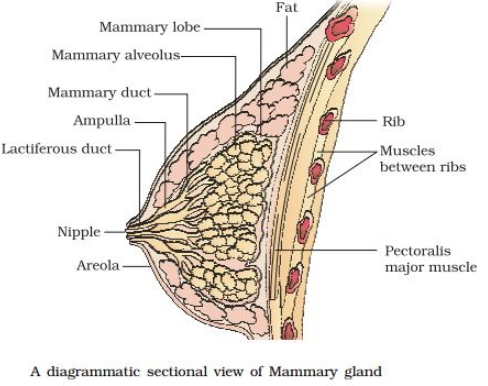
0 likes
View Solution55
Medium
What is meant by parturition? Describe the changes occurring in the uterus during this period.
Solution
(N/A) The average duration of human pregnancy is about $9$ months,which is called the gestation period.
Vigorous contraction of the uterus at the end of pregnancy causes the expulsion or delivery of the foetus. This process of delivery of the foetus is called parturition.
Parturition is induced by a complex neuroendocrine mechanism.
The signals for parturition originate from the fully developed foetus and placenta,which induce mild uterine contractions called the foetal ejection reflex.
This triggers the release of oxytocin from the maternal pituitary gland.
Oxytocin acts on the uterine muscles and causes stronger uterine contractions,which in turn stimulates further secretion of oxytocin.
The stimulatory reflex between the uterine contraction and oxytocin secretion continues,resulting in stronger and stronger contractions.
This leads to the expulsion of the baby out of the uterus through the birth canal,known as parturition. Soon after the infant is delivered,the placenta is also expelled out of the uterus.
Vigorous contraction of the uterus at the end of pregnancy causes the expulsion or delivery of the foetus. This process of delivery of the foetus is called parturition.
Parturition is induced by a complex neuroendocrine mechanism.
The signals for parturition originate from the fully developed foetus and placenta,which induce mild uterine contractions called the foetal ejection reflex.
This triggers the release of oxytocin from the maternal pituitary gland.
Oxytocin acts on the uterine muscles and causes stronger uterine contractions,which in turn stimulates further secretion of oxytocin.
The stimulatory reflex between the uterine contraction and oxytocin secretion continues,resulting in stronger and stronger contractions.
This leads to the expulsion of the baby out of the uterus through the birth canal,known as parturition. Soon after the infant is delivered,the placenta is also expelled out of the uterus.
0 likes
View Solution56
Medium
Explain the process of lactation.
Solution
(N/A) The mammary glands of the female undergo differentiation during pregnancy and start producing milk towards the end of pregnancy by the process called lactation.
The milk produced during the initial few days of lactation is called colostrum,which contains several antibodies,primarily $IgA$.
Breast-feeding during the initial period of infant growth is recommended by doctors for bringing up a healthy baby.
The synthesis of milk in the mammary glands is stimulated by the hormone prolactin,which is secreted by the anterior pituitary gland.
The milk produced during the initial few days of lactation is called colostrum,which contains several antibodies,primarily $IgA$.
Breast-feeding during the initial period of infant growth is recommended by doctors for bringing up a healthy baby.
The synthesis of milk in the mammary glands is stimulated by the hormone prolactin,which is secreted by the anterior pituitary gland.
0 likes
View Solution57
Medium
Give scientific reasons: Doctors advise breastfeeding to mothers for infants.
Solution
(N/A) After parturition,milk production begins in the mammary glands of females. The first milk produced by the mammary glands immediately after childbirth is called colostrum. Colostrum contains essential antibodies,such as $IgA$,which provide passive immunity to the newborn. It is crucial for the healthy development and immune system strengthening of the child. Therefore,doctors advise mothers to breastfeed their infants.
0 likes
View Solution58
Medium
Give scientific reasons: When the time of birth is near,two chemical signals are associated to produce real parturition pain (labour pain).
Solution
(A) The signals for parturition originate from the fully developed foetus and the placenta,which induce mild uterine contractions called the foetal ejection reflex.
This reflex triggers the release of $Oxytocin$ from the maternal posterior pituitary gland.
$Oxytocin$ acts on the uterine muscle and causes stronger uterine contractions,which in turn stimulates further secretion of $Oxytocin$.
Simultaneously,the placenta releases $Prostaglandins$,which further enhance uterine contractions.
The stimulatory reflex between the uterine contraction and $Oxytocin$ secretion continues,resulting in stronger and more frequent contractions,leading to the expulsion of the baby out of the uterus through the birth canal.
This reflex triggers the release of $Oxytocin$ from the maternal posterior pituitary gland.
$Oxytocin$ acts on the uterine muscle and causes stronger uterine contractions,which in turn stimulates further secretion of $Oxytocin$.
Simultaneously,the placenta releases $Prostaglandins$,which further enhance uterine contractions.
The stimulatory reflex between the uterine contraction and $Oxytocin$ secretion continues,resulting in stronger and more frequent contractions,leading to the expulsion of the baby out of the uterus through the birth canal.
0 likes
View Solution59
Medium
From where do the parturition signals arise—mother or foetus? Mention the main hormone involved in parturition.
Solution
(N/A) Parturition is a complex process regulated by a combination of neural and hormonal mechanisms.
The signals for parturition originate from the fully developed foetus and the placenta, which induce mild uterine contractions known as the $foetal \text{ } ejection \text{ } reflex$.
$Oxytocin$ is the primary hormone involved in parturition. It acts on the uterine muscles to cause stronger uterine contractions, which ultimately lead to the expulsion of the baby from the uterus through the birth canal.
The signals for parturition originate from the fully developed foetus and the placenta, which induce mild uterine contractions known as the $foetal \text{ } ejection \text{ } reflex$.
$Oxytocin$ is the primary hormone involved in parturition. It acts on the uterine muscles to cause stronger uterine contractions, which ultimately lead to the expulsion of the baby from the uterus through the birth canal.
0 likes
View Solution60
Medium
What is the foetal ejection reflex? Explain how it leads to parturition.
Solution
(N/A) The foetal ejection reflex is a neuroendocrine mechanism triggered by the fully developed foetus and the placenta.
It involves the following steps:
$1$. Signals originating from the fully developed foetus and the placenta induce mild uterine contractions.
$2$. These contractions trigger the release of the hormone $Oxytocin$ from the maternal posterior pituitary gland.
$3$. $Oxytocin$ acts on the uterine muscles,causing stronger uterine contractions.
$4$. This creates a positive feedback loop where the stimulatory reflex between the uterine contraction and $Oxytocin$ secretion continues,resulting in increasingly stronger contractions.
$5$. This process ultimately leads to the expulsion of the baby out of the uterus through the birth canal,a process known as $Parturition$.
It involves the following steps:
$1$. Signals originating from the fully developed foetus and the placenta induce mild uterine contractions.
$2$. These contractions trigger the release of the hormone $Oxytocin$ from the maternal posterior pituitary gland.
$3$. $Oxytocin$ acts on the uterine muscles,causing stronger uterine contractions.
$4$. This creates a positive feedback loop where the stimulatory reflex between the uterine contraction and $Oxytocin$ secretion continues,resulting in increasingly stronger contractions.
$5$. This process ultimately leads to the expulsion of the baby out of the uterus through the birth canal,a process known as $Parturition$.
0 likes
View Solution61
Medium
Why do doctors recommend breastfeeding during the initial period of infant growth?
Solution
(N/A) The milk produced during the initial few days of lactation is called $colostrum$,which contains several antibodies,primarily $IgA$. These antibodies are essential for developing immunity in newborn babies. Therefore,doctors recommend breastfeeding during the initial period of an infant's growth to ensure the development of a healthy baby.
0 likes
View Solution62
EasyMCQ
Why is mother's milk considered the most appropriate food for a newborn infant?
A
It contains high levels of fat.
B
It is rich in antibodies like $IgA$.
C
It is easily digestible.
D
It is sterile and free from pathogens.
Solution
(B) Mother's milk is considered the most appropriate food for a newborn infant.
This is because the yellowish fluid,known as colostrum,secreted by the mother during the initial days of lactation,contains abundant antibodies,specifically $IgA$.
These antibodies provide passive immunity to the infant,protecting them from various infections during their early stages of life.
This is because the yellowish fluid,known as colostrum,secreted by the mother during the initial days of lactation,contains abundant antibodies,specifically $IgA$.
These antibodies provide passive immunity to the infant,protecting them from various infections during their early stages of life.
0 likes
View Solution63
MediumMCQ
Which layer of the uterus is responsible for parturition?
A
Endometrium
B
Myometrium
C
Perimetrium
D
Both $A$ and $B$
Solution
(B) The uterus has three layers of tissue: the outer thin membranous $Perimetrium$,the middle thick layer of smooth muscle called $Myometrium$,and the inner glandular layer called $Endometrium$.
During parturition (childbirth),the $Myometrium$ exhibits strong contractions to expel the fetus from the uterus.
Therefore,the $Myometrium$ is the layer responsible for parturition.
During parturition (childbirth),the $Myometrium$ exhibits strong contractions to expel the fetus from the uterus.
Therefore,the $Myometrium$ is the layer responsible for parturition.
0 likes
View Solution64
MediumMCQ
What is parturition?
A
Lactation
B
Milk secretion
C
Conception
D
Childbirth
Solution
(D) Parturition is the process of giving birth to a baby after the completion of the gestation period. It involves vigorous contractions of the uterus at the end of pregnancy,which leads to the expulsion or delivery of the fetus. Therefore,it is commonly referred to as childbirth.
0 likes
View Solution65
MediumMCQ
Which mechanism is responsible for parturition?
A
Muscular mechanism
B
Nine-month gestation period
C
Neuroendocrine mechanism
D
Fetal body
Solution
(C) Parturition is induced by a complex neuroendocrine mechanism.
$1$. The signals for parturition originate from the fully developed fetus and the placenta,which induce mild uterine contractions called the Fetal Ejection Reflex.
$2$. This reflex triggers the release of oxytocin from the maternal pituitary gland.
$3$. Oxytocin acts on the uterine muscle and causes stronger uterine contractions,which in turn stimulates further secretion of oxytocin.
$4$. This stimulatory reflex between the uterine contraction and oxytocin secretion continues,resulting in stronger and stronger contractions,leading to the expulsion of the baby out of the uterus through the birth canal.
$1$. The signals for parturition originate from the fully developed fetus and the placenta,which induce mild uterine contractions called the Fetal Ejection Reflex.
$2$. This reflex triggers the release of oxytocin from the maternal pituitary gland.
$3$. Oxytocin acts on the uterine muscle and causes stronger uterine contractions,which in turn stimulates further secretion of oxytocin.
$4$. This stimulatory reflex between the uterine contraction and oxytocin secretion continues,resulting in stronger and stronger contractions,leading to the expulsion of the baby out of the uterus through the birth canal.
0 likes
View Solution66
EasyMCQ
The signals for parturition originate from which of the following?
A
Placenta
B
Fully developed foetus
C
Umbilical cord
D
Both $A$ and $B$
Solution
(D) The process of parturition is induced by a complex neuroendocrine mechanism.
Signals for parturition originate from the fully developed foetus and the placenta,which induce mild uterine contractions called the foetal ejection reflex.
Therefore,both the fully developed foetus and the placenta are responsible for initiating the signals for parturition.
Signals for parturition originate from the fully developed foetus and the placenta,which induce mild uterine contractions called the foetal ejection reflex.
Therefore,both the fully developed foetus and the placenta are responsible for initiating the signals for parturition.
0 likes
View Solution67
MediumMCQ
On which layer of the uterus does oxytocin exert its maximum effect?
A
Endometrium
B
Myometrium
C
Perimetrium
D
All layers
Solution
(B) Oxytocin is a hormone released by the posterior pituitary gland.
During parturition (childbirth),it acts on the uterine muscles to induce strong contractions.
The middle,thick layer of the uterus,which is composed of smooth muscle,is known as the myometrium.
Oxytocin binds to receptors on the myometrium,causing it to contract forcefully,which helps in the expulsion of the fetus.
Therefore,the correct answer is myometrium.
During parturition (childbirth),it acts on the uterine muscles to induce strong contractions.
The middle,thick layer of the uterus,which is composed of smooth muscle,is known as the myometrium.
Oxytocin binds to receptors on the myometrium,causing it to contract forcefully,which helps in the expulsion of the fetus.
Therefore,the correct answer is myometrium.
0 likes
View Solution68
MediumMCQ
What is the yellowish fluid produced during the initial days of lactation after parturition called?
A
Mammary gland
B
Lactation
C
Colostrum
D
Antibody
Solution
(C) The yellowish fluid produced by the mammary glands during the initial few days of lactation is called $Colostrum$.
It contains several antibodies,especially $IgA$,which are essential to develop resistance for the newborn babies.
Therefore,the correct option is $C$.
It contains several antibodies,especially $IgA$,which are essential to develop resistance for the newborn babies.
Therefore,the correct option is $C$.
0 likes
View Solution69
MediumMCQ
Which hormone inhibits the menstrual cycle in females during the period of lactation?
A
Estrogen
B
Progesterone
C
Oxytocin
D
Prolactin
Solution
(D) During the period of intense lactation, the hormone $Prolactin$ is secreted in high amounts by the anterior pituitary gland.
$Prolactin$ not only stimulates the production of milk but also inhibits the secretion of $GnRH$ (Gonadotropin-Releasing Hormone) from the hypothalamus.
Due to the inhibition of $GnRH$, the release of $FSH$ (Follicle-Stimulating Hormone) and $LH$ (Luteinizing Hormone) from the anterior pituitary is suppressed.
As a result, the development of ovarian follicles and ovulation are prevented, which leads to the temporary cessation of the menstrual cycle. This phenomenon is known as $Lactational \text{ } Amenorrhea$.
$Prolactin$ not only stimulates the production of milk but also inhibits the secretion of $GnRH$ (Gonadotropin-Releasing Hormone) from the hypothalamus.
Due to the inhibition of $GnRH$, the release of $FSH$ (Follicle-Stimulating Hormone) and $LH$ (Luteinizing Hormone) from the anterior pituitary is suppressed.
As a result, the development of ovarian follicles and ovulation are prevented, which leads to the temporary cessation of the menstrual cycle. This phenomenon is known as $Lactational \text{ } Amenorrhea$.
0 likes
View Solution70
EasyMCQ
The hormone responsible for the production of milk after parturition is:
A
Progesterone
B
Prolactin
C
Oxytocin
D
Estrogen
Solution
(B) Prolactin is secreted by the lactotrope cells of the anterior pituitary gland.
Its primary physiological effect is to stimulate the growth of mammary glands during pregnancy and to initiate and maintain the secretion of milk after childbirth (parturition).
Because of this role,it is often referred to as the 'maternity hormone'.
In contrast,Oxytocin is responsible for the ejection of milk from the mammary glands.
Its primary physiological effect is to stimulate the growth of mammary glands during pregnancy and to initiate and maintain the secretion of milk after childbirth (parturition).
Because of this role,it is often referred to as the 'maternity hormone'.
In contrast,Oxytocin is responsible for the ejection of milk from the mammary glands.
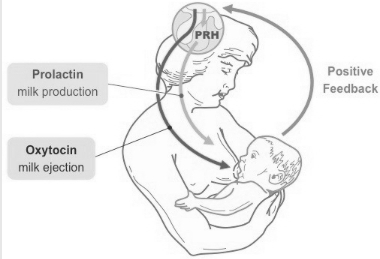
0 likes
View Solution71
MediumMCQ
Foetal ejection reflex in human female is accelerated by
A
Pressure exerted by amniotic fluid
B
Release of oxytocin from pituitary
C
Fully developed foetus and placenta
D
Differentiation of mammary glands
Solution
(B) The foetal ejection reflex is triggered by the fully developed foetus and placenta,which induce mild uterine contractions. These contractions result in the release of oxytocin from the posterior pituitary gland. Oxytocin acts on the uterine muscle and causes stronger uterine contractions,which in turn stimulates further secretion of oxytocin. This stimulatory reflex between the uterine contraction and oxytocin secretion continues,resulting in stronger and stronger contractions,leading to parturition (childbirth). This is an example of a positive feedback mechanism.
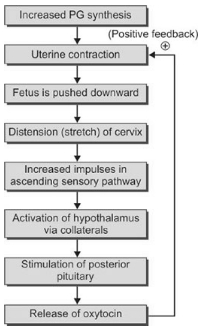
0 likes
View Solution72
EasyMCQ
The activity of formation of milk is regulated by the activity of $A$. While the ejection of milk is controlled by $B$ hormone. Here,$A$ and $B$ refers to:
A
$A$-oxytocin; $B$-prolactin
B
$A$-prolactin; $B$-oxytocin
C
$A$-prolactin; $B$-progesterone
D
$A$-oxytocin; $B$-progesterone
Solution
(B) The formation of milk in the mammary glands is stimulated by the hormone $Prolactin$,which is secreted by the anterior pituitary gland.
The ejection of milk (milk let-down reflex) is stimulated by the hormone $Oxytocin$,which is released by the posterior pituitary gland.
Therefore,$A$ refers to $Prolactin$ and $B$ refers to $Oxytocin$.
The ejection of milk (milk let-down reflex) is stimulated by the hormone $Oxytocin$,which is released by the posterior pituitary gland.
Therefore,$A$ refers to $Prolactin$ and $B$ refers to $Oxytocin$.
0 likes
View Solution73
MediumMCQ
Production,secretion and ejection of milk requires the synergistic effects of prolactin and
A
Estrogen
B
Progesterone
C
Oxytocin
D
All of these
Solution
(D) The production,secretion,and ejection of milk are complex processes that require the synergistic effects of several hormones,including prolactin,estrogen,progesterone,and oxytocin.
$1$. Prolactin: Primarily responsible for the synthesis and production of milk in the mammary alveoli.
$2$. Estrogen: Stimulates the growth and differentiation of the milk duct system. High levels of estrogen during pregnancy inhibit actual milk secretion.
$3$. Progesterone: Influences the growth and development of the alveoli. Like estrogen,high levels of progesterone inhibit lactation before birth. $A$ drop in progesterone levels after childbirth triggers the onset of copious milk production.
$4$. Oxytocin: Essential for the 'milk ejection reflex' (let-down reflex). It causes the contraction of myoepithelial cells surrounding the alveoli,which squeezes the milk into the duct system for ejection.
Therefore,all these hormones work together to facilitate the complete process of lactation.
$1$. Prolactin: Primarily responsible for the synthesis and production of milk in the mammary alveoli.
$2$. Estrogen: Stimulates the growth and differentiation of the milk duct system. High levels of estrogen during pregnancy inhibit actual milk secretion.
$3$. Progesterone: Influences the growth and development of the alveoli. Like estrogen,high levels of progesterone inhibit lactation before birth. $A$ drop in progesterone levels after childbirth triggers the onset of copious milk production.
$4$. Oxytocin: Essential for the 'milk ejection reflex' (let-down reflex). It causes the contraction of myoepithelial cells surrounding the alveoli,which squeezes the milk into the duct system for ejection.
Therefore,all these hormones work together to facilitate the complete process of lactation.
0 likes
View Solution74
MediumMCQ
Parturition is
A
Child birth
B
Expulsion of the baby from the uterus
C
Both $(A)$ and $(B)$
D
None of the above
Solution
(C) Parturition is the process of giving birth to a young one.
It involves vigorous contractions of the uterus at the end of pregnancy,which leads to the expulsion or delivery of the fetus (baby) from the uterus.
Therefore,both child birth and the expulsion of the baby from the uterus describe the process of parturition.
It involves vigorous contractions of the uterus at the end of pregnancy,which leads to the expulsion or delivery of the fetus (baby) from the uterus.
Therefore,both child birth and the expulsion of the baby from the uterus describe the process of parturition.
0 likes
View Solution75
EasyMCQ
The hormone injected by doctors to induce delivery is:
A
Inhibin
B
Oxytocin
C
Oestrogen
D
Prolactin
Solution
(B) Doctors inject the hormone $Oxytocin$ to stimulate strong contractions of the uterine wall during childbirth.
$Parturition$:
$(i)$ The average duration of human pregnancy is about $9$ months,which is known as the gestation period.
$(ii)$ The process of expelling the fully developed fetus from the mother's uterus at the end of the gestation period is called parturition.
$(iii)$ It is induced by a complex neuroendocrine mechanism.
$(iv)$ Signals for parturition originate from the fully developed fetus and the placenta,which induce mild uterine contractions known as the fetal ejection reflex.
$(v)$ This reflex triggers the release of $Oxytocin$ from the maternal pituitary gland.
$(vi)$ $Oxytocin$ acts on the uterine muscle and causes stronger uterine contractions.
$(vii)$ $Relaxin$ increases the flexibility of the pubic symphysis and ligaments,which helps to dilate the uterine cervix during labor.
$(viii)$ This process ultimately leads to the expulsion of the baby.
$Parturition$:
$(i)$ The average duration of human pregnancy is about $9$ months,which is known as the gestation period.
$(ii)$ The process of expelling the fully developed fetus from the mother's uterus at the end of the gestation period is called parturition.
$(iii)$ It is induced by a complex neuroendocrine mechanism.
$(iv)$ Signals for parturition originate from the fully developed fetus and the placenta,which induce mild uterine contractions known as the fetal ejection reflex.
$(v)$ This reflex triggers the release of $Oxytocin$ from the maternal pituitary gland.
$(vi)$ $Oxytocin$ acts on the uterine muscle and causes stronger uterine contractions.
$(vii)$ $Relaxin$ increases the flexibility of the pubic symphysis and ligaments,which helps to dilate the uterine cervix during labor.
$(viii)$ This process ultimately leads to the expulsion of the baby.
0 likes
View Solution76
EasyMCQ
The signals for parturition originate from the fully developed foetus and the placenta, which induce mild uterine contractions known as:
A
Foetal ejection reflex
B
Embryo ejection reflex
C
Blastocoel ejaculation reflex
D
Still birth
Solution
(A) The process of parturition is induced by a complex neuroendocrine mechanism. The signals for parturition originate from the fully developed foetus and the placenta, which induce mild uterine contractions referred to as the $Foetal \text{ } ejection \text{ } reflex$. This reflex triggers the release of oxytocin from the maternal pituitary gland, which acts on the uterine muscle and causes stronger uterine contractions, leading to the expulsion of the baby.
0 likes
View Solution77
MediumMCQ
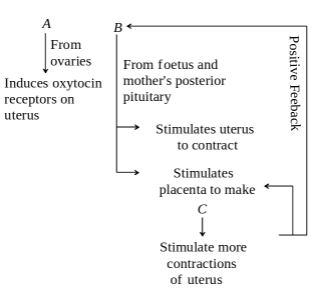
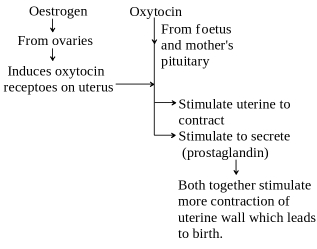
Name the hormones $A, B,$ and $C$ in the given figure.
A
$A-$Prostaglandin,$B-$Oxytocin,$C-$Oestrogen
B
$A-$Oestrogen,$B-$Oxytocin,$C-$Prostaglandin
C
$A-$Oestrogen,$B-$Prostaglandin,$C-$Oxytocin
D
$A-$Prostaglandin,$B-$Oestrogen,$C-$Oxytocin
Solution
(B) Based on the provided figure representing the mechanism of parturition:
$1$. $A$ represents Oestrogen,which is released from the ovaries and induces the formation of oxytocin receptors on the uterine wall.
$2$. $B$ represents Oxytocin,which is released from the foetus and the mother's posterior pituitary gland. It stimulates the uterus to contract.
$3$. $C$ represents Prostaglandin,which is produced by the placenta and acts along with oxytocin to stimulate further uterine contractions,leading to childbirth.
Therefore,the correct sequence is $A-$Oestrogen,$B-$Oxytocin,$C-$Prostaglandin.
$1$. $A$ represents Oestrogen,which is released from the ovaries and induces the formation of oxytocin receptors on the uterine wall.
$2$. $B$ represents Oxytocin,which is released from the foetus and the mother's posterior pituitary gland. It stimulates the uterus to contract.
$3$. $C$ represents Prostaglandin,which is produced by the placenta and acts along with oxytocin to stimulate further uterine contractions,leading to childbirth.
Therefore,the correct sequence is $A-$Oestrogen,$B-$Oxytocin,$C-$Prostaglandin.
0 likes
View Solution78
MediumMCQ
Signals from fully developed foetus and placenta ultimately lead to parturition which requires the release of
A
Estrogen from placenta
B
Oxytocin from maternal pituitary
C
Oxytocin from foetal pituitary
D
Relaxin from Leydig's cells
Solution
(B) Parturition is induced by a complex neuroendocrine mechanism.
Signals for parturition originate from the fully developed foetus and the placenta,which induce mild uterine contractions called the foetal ejection reflex.
This reflex triggers the release of $Oxytocin$ from the maternal posterior pituitary gland.
$Oxytocin$ acts on the uterine muscle and causes stronger uterine contractions,which in turn stimulate further secretion of $Oxytocin$.
The stimulatory reflex between the uterine contraction and $Oxytocin$ secretion continues,resulting in stronger and stronger contractions,eventually leading to the expulsion of the baby out of the uterus through the birth canal.
Signals for parturition originate from the fully developed foetus and the placenta,which induce mild uterine contractions called the foetal ejection reflex.
This reflex triggers the release of $Oxytocin$ from the maternal posterior pituitary gland.
$Oxytocin$ acts on the uterine muscle and causes stronger uterine contractions,which in turn stimulate further secretion of $Oxytocin$.
The stimulatory reflex between the uterine contraction and $Oxytocin$ secretion continues,resulting in stronger and stronger contractions,eventually leading to the expulsion of the baby out of the uterus through the birth canal.
0 likes
View Solution79
MediumMCQ
Sometimes the labor pains are less and uterine contractions have to be induced. What do you think the doctors inject to facilitate delivery?
A
Progesterone and estrogen hormones
B
Oxytocin/Pitocin
C
$FSH$ and $LH$
D
Relaxin
Solution
(B) Oxytocin is a hormone produced by the posterior pituitary gland. It stimulates powerful contractions of the uterine muscles during childbirth,which is why it is often referred to as the 'birth hormone'. When natural labor pains are insufficient,doctors inject synthetic oxytocin (often known by the brand name Pitocin) to induce or strengthen uterine contractions and facilitate the delivery process.
0 likes
View Solution80
MediumMCQ
$A$: Oxytocin acts on the uterine muscles and causes stronger uterine contractions,which in turn stimulates further secretion of oxytocin.
$R$: Oxytocin is released from the maternal pituitary.
$R$: Oxytocin is released from the maternal pituitary.
A
Assertion and Reason both are correct and Reason is the correct explanation of Assertion.
B
Assertion and Reason both are correct but Reason is not the correct explanation of Assertion.
C
Assertion is correct,but Reason is incorrect.
D
Both Assertion and Reason are incorrect.
Solution
(A) Oxytocin is a hormone released from the posterior pituitary gland of the mother. It acts on the smooth muscles of the uterus and causes stronger uterine contractions. This contraction further stimulates the release of more oxytocin,creating a positive feedback loop that facilitates parturition (childbirth). Therefore,both the Assertion and the Reason are correct,and the Reason is the correct explanation of the Assertion.
0 likes
View Solution81
DifficultMCQ
$A$: Corticotrophin-releasing hormone is a part of the clock that establishes the timing of birth.
$R$: The signals for parturition originate from the fully developed foetus and placenta,which induce mild uterine contractions called the foetal ejection reflex.
$R$: The signals for parturition originate from the fully developed foetus and placenta,which induce mild uterine contractions called the foetal ejection reflex.
A
Assertion and Reason both are correct and Reason is the correct explanation of Assertion.
B
Assertion and Reason both are correct but Reason is not the correct explanation of Assertion.
C
Assertion is correct,but Reason is incorrect.
D
Both Assertion and Reason are incorrect.
Solution
(A) The process of parturition is induced by a complex neuroendocrine mechanism.
$1$. The signals for parturition originate from the fully developed foetus and the placenta,which induce mild uterine contractions called the foetal ejection reflex.
$2$. This triggers the release of oxytocin from the maternal pituitary,which acts on the uterine muscle and causes stronger uterine contractions.
$3$. Additionally,the placenta secretes corticotrophin-releasing hormone $(CRH)$,which acts as a 'placental clock' to determine the length of gestation and the timing of birth.
Since both statements are scientifically accurate and the $CRH$ mechanism is part of the overall hormonal control of parturition,the Assertion and Reason are both correct.
$1$. The signals for parturition originate from the fully developed foetus and the placenta,which induce mild uterine contractions called the foetal ejection reflex.
$2$. This triggers the release of oxytocin from the maternal pituitary,which acts on the uterine muscle and causes stronger uterine contractions.
$3$. Additionally,the placenta secretes corticotrophin-releasing hormone $(CRH)$,which acts as a 'placental clock' to determine the length of gestation and the timing of birth.
Since both statements are scientifically accurate and the $CRH$ mechanism is part of the overall hormonal control of parturition,the Assertion and Reason are both correct.
0 likes
View Solution82
MediumMCQ
Lactational amenorrhoea is:
A
Absence of menses in adult age
B
Absence of menses in elderly age
C
Absence of menses during lactation
D
No menses during pregnancy
Solution
(C) Lactational Amenorrhoea Method $(LAM)$ refers to the natural absence of menstruation during the period of intense lactation following childbirth.
This method is based on the fact that ovulation and the menstrual cycle do not occur during the period of intense lactation.
This method is effective only up to a maximum period of six months following childbirth.
This method is based on the fact that ovulation and the menstrual cycle do not occur during the period of intense lactation.
This method is effective only up to a maximum period of six months following childbirth.
0 likes
View Solution83
MediumMCQ
Ovulation does not occur during the lactational period because of:
A
Inhibin
B
Prolactin
C
Prostaglandin
D
Oxytocin
Solution
(B) During the lactational period,the high levels of prolactin are maintained to support milk production.
High levels of prolactin inhibit the secretion of Gonadotropin-Releasing Hormone $(GnRH)$ from the hypothalamus.
This subsequently suppresses the release of Follicle Stimulating Hormone $(FSH)$ and Luteinizing Hormone $(LH)$ from the anterior pituitary.
Due to the lack of these gonadotropins,follicular development and ovulation do not occur,leading to lactational amenorrhea.
High levels of prolactin inhibit the secretion of Gonadotropin-Releasing Hormone $(GnRH)$ from the hypothalamus.
This subsequently suppresses the release of Follicle Stimulating Hormone $(FSH)$ and Luteinizing Hormone $(LH)$ from the anterior pituitary.
Due to the lack of these gonadotropins,follicular development and ovulation do not occur,leading to lactational amenorrhea.
0 likes
View Solution84
MediumMCQ
$A$: Lactational amenorrhoea is due to high levels of prolactin.
$R$: Prolactin stimulates the release of gonadotropins.
$R$: Prolactin stimulates the release of gonadotropins.
A
Assertion and Reason both are correct and Reason is the correct explanation of Assertion.
B
Assertion and Reason both are correct but Reason is not the correct explanation of Assertion.
C
Assertion is correct,but Reason is incorrect.
D
Both Assertion and Reason are incorrect.
Solution
(C) Lactational amenorrhoea refers to the absence of menstruation during the period of intense lactation following parturition.
This condition is caused by high levels of prolactin,which is secreted in response to suckling.
High levels of prolactin inhibit the release of gonadotropins ($LH$ and $FSH$) from the anterior pituitary gland.
Since gonadotropins are essential for ovulation,their inhibition prevents the menstrual cycle.
Therefore,the Assertion is correct,but the Reason is incorrect because prolactin inhibits,rather than stimulates,the release of gonadotropins.
This condition is caused by high levels of prolactin,which is secreted in response to suckling.
High levels of prolactin inhibit the release of gonadotropins ($LH$ and $FSH$) from the anterior pituitary gland.
Since gonadotropins are essential for ovulation,their inhibition prevents the menstrual cycle.
Therefore,the Assertion is correct,but the Reason is incorrect because prolactin inhibits,rather than stimulates,the release of gonadotropins.
0 likes
View Solution85
EasyMCQ
Which of the following immunoglobulin $(Ig)$ is present in colostrum?
A
$IgA$
B
$IgG$
C
$IgM$
D
$IgE$
Solution
(A) $IgA$: Colostrum is a yellowish fluid secreted by the mother during the initial days of lactation. It contains abundant $IgA$ antibodies,which provide passive immunity to the newborn infant.
$IgG$: This is the only antibody class capable of crossing the placenta to provide immunity to the fetus.
$IgE$: This antibody is primarily involved in mediating allergic reactions and defense against parasitic infections.
$IgM$: This is the first antibody to be produced in response to an initial antigen exposure.
$IgG$: This is the only antibody class capable of crossing the placenta to provide immunity to the fetus.
$IgE$: This antibody is primarily involved in mediating allergic reactions and defense against parasitic infections.
$IgM$: This is the first antibody to be produced in response to an initial antigen exposure.
0 likes
View Solution86
MediumMCQ
$A$: Colostrum is a very efficient means of transferring immunity to a newborn.
$R$: $IgM$ from mother's milk protects the baby from the respiratory infection usually affecting in young age.
$R$: $IgM$ from mother's milk protects the baby from the respiratory infection usually affecting in young age.
A
Assertion and Reason both are correct and Reason is the correct explanation of Assertion.
B
Assertion and Reason both are correct but Reason is not the correct explanation of Assertion.
C
Assertion is correct,but Reason is incorrect.
D
Both Assertion and Reason are incorrect.
Solution
(C) The Assertion is correct: Colostrum,the yellowish fluid secreted by the mother during the initial days of lactation,is rich in antibodies and provides passive immunity to the newborn.
The Reason is incorrect: Colostrum contains abundant $IgA$ antibodies,not $IgM$. These $IgA$ antibodies are crucial for protecting the infant's gastrointestinal and respiratory tracts from infections during early life.
The Reason is incorrect: Colostrum contains abundant $IgA$ antibodies,not $IgM$. These $IgA$ antibodies are crucial for protecting the infant's gastrointestinal and respiratory tracts from infections during early life.
0 likes
View Solution87
DifficultMCQ
Which of these is not an important component of the initiation of parturition in humans?
A
Increase in estrogen and progesterone ratio
B
Synthesis of prostaglandins
C
Release of Oxytocin
D
Release of Prolactin
Solution
(D) Parturition is induced by a complex neuroendocrine mechanism.
$1$. The signals for parturition originate from the fully developed fetus and the placenta,which induce mild uterine contractions called the Fetal Ejection Reflex.
$2$. This triggers the release of Oxytocin from the maternal pituitary,which acts on the uterine muscle and causes stronger uterine contractions.
$3$. The ratio of estrogen to progesterone increases,which enhances the sensitivity of the uterus to oxytocin.
$4$. Prostaglandins are also synthesized,which help in further stimulating uterine contractions.
$5$. Prolactin is primarily responsible for milk production (lactogenesis) after childbirth and is not involved in the initiation of parturition.
$1$. The signals for parturition originate from the fully developed fetus and the placenta,which induce mild uterine contractions called the Fetal Ejection Reflex.
$2$. This triggers the release of Oxytocin from the maternal pituitary,which acts on the uterine muscle and causes stronger uterine contractions.
$3$. The ratio of estrogen to progesterone increases,which enhances the sensitivity of the uterus to oxytocin.
$4$. Prostaglandins are also synthesized,which help in further stimulating uterine contractions.
$5$. Prolactin is primarily responsible for milk production (lactogenesis) after childbirth and is not involved in the initiation of parturition.
0 likes
View Solution88
EasyMCQ
Which hormone helps in the process of parturition?
A
$FSH$
B
$MSH$
C
$ADH$
D
Oxytocin
Solution
(D) Parturition is the process of childbirth.
Oxytocin is a hormone released by the posterior pituitary gland.
It acts on the smooth muscles of the uterus and stimulates their vigorous contraction,which helps in the expulsion of the fetus during childbirth.
Therefore,oxytocin is often called the 'birth hormone'.
Oxytocin is a hormone released by the posterior pituitary gland.
It acts on the smooth muscles of the uterus and stimulates their vigorous contraction,which helps in the expulsion of the fetus during childbirth.
Therefore,oxytocin is often called the 'birth hormone'.
0 likes
View Solution89
MediumMCQ
Which hormone stimulates the alveoli of the mammary glands to secrete milk?
A
Estrogen
B
Progesterone
C
Relaxin
D
Oxytocin
Solution
(D) The hormone responsible for the ejection of milk from the mammary glands is $Oxytocin$. However,the hormone that stimulates the alveoli of the mammary glands to synthesize and secrete milk is $Prolactin$. Since $Prolactin$ is not provided in the options,and $Oxytocin$ is often associated with the milk-ejection reflex (let-down reflex) by acting on the myoepithelial cells of the alveoli,$Oxytocin$ is the most appropriate answer among the given choices in the context of milk secretion/ejection mechanisms.
0 likes
View Solution90
MediumMCQ
Which of the following layers is responsible for the process of parturition?
A
Perimetrium
B
Myometrium
C
Endometrium
D
All of the above
Solution
(B) Parturition is the process of giving birth to a child.
It is induced by a complex neuroendocrine mechanism.
The signals for parturition originate from the fully developed fetus and the placenta,which induce mild uterine contractions called the fetal ejection reflex.
This reflex triggers the release of oxytocin from the maternal pituitary gland.
Oxytocin acts on the uterine muscle,specifically the $Myometrium$,causing stronger uterine contractions,which in turn stimulate further secretion of oxytocin.
The stimulatory reflex between the uterine contraction and oxytocin secretion continues,resulting in stronger and stronger contractions,leading to the expulsion of the baby out of the uterus through the birth canal.
It is induced by a complex neuroendocrine mechanism.
The signals for parturition originate from the fully developed fetus and the placenta,which induce mild uterine contractions called the fetal ejection reflex.
This reflex triggers the release of oxytocin from the maternal pituitary gland.
Oxytocin acts on the uterine muscle,specifically the $Myometrium$,causing stronger uterine contractions,which in turn stimulate further secretion of oxytocin.
The stimulatory reflex between the uterine contraction and oxytocin secretion continues,resulting in stronger and stronger contractions,leading to the expulsion of the baby out of the uterus through the birth canal.
0 likes
View Solution91
EasyMCQ
The milk produced during the initial few days of lactation is called colostrum,which contains ....... antibodies.
A
$IgG$
B
$IgA$
C
$IgM$
D
$IgE$
Solution
(B) Colostrum is the yellowish fluid secreted by the mother during the initial days of lactation.
It is rich in nutrients and contains abundant amounts of $IgA$ antibodies.
These antibodies are essential for providing passive immunity to the newborn infant,protecting them from various infections.
It is rich in nutrients and contains abundant amounts of $IgA$ antibodies.
These antibodies are essential for providing passive immunity to the newborn infant,protecting them from various infections.
0 likes
View Solution92
MediumMCQ
Signals for parturition originate from:
A
Pituitary gland
B
Hypothalamus
C
Fully developed foetus and placenta
D
Ovary
Solution
(C) The process of parturition (childbirth) is induced by a complex neuroendocrine mechanism.
Signals for parturition originate from the fully developed foetus and the placenta,which induce mild uterine contractions called the foetal ejection reflex.
This reflex triggers the release of oxytocin from the maternal pituitary gland,which further stimulates stronger uterine contractions,leading to the expulsion of the baby.
Signals for parturition originate from the fully developed foetus and the placenta,which induce mild uterine contractions called the foetal ejection reflex.
This reflex triggers the release of oxytocin from the maternal pituitary gland,which further stimulates stronger uterine contractions,leading to the expulsion of the baby.
0 likes
View Solution93
MediumMCQ
Which hormone injection is administered by doctors to induce parturition?
A
Progesterone
B
Estrogen
C
Relaxin
D
Oxytocin
Solution
(D) Parturition is the process of giving birth to a child. It is induced by a complex neuroendocrine mechanism. The signal for parturition originates from the fully developed fetus and the placenta,which induce mild uterine contractions called the fetal ejection reflex. This triggers the release of $Oxytocin$ from the maternal pituitary gland. $Oxytocin$ acts on the uterine muscle and causes stronger uterine contractions,which in turn stimulate further secretion of $Oxytocin$. The stimulatory reflex between the uterine contraction and $Oxytocin$ secretion continues,resulting in stronger and stronger contractions. This leads to the expulsion of the baby out of the uterus through the birth canal. Therefore,doctors administer synthetic $Oxytocin$ (Pitocin) to induce labor or strengthen uterine contractions during childbirth.
0 likes
View Solution94
MediumMCQ
Given below are two statements: One is labelled as Assertion $A$ and the other is labelled as Reason $R$ :
Assertion $A$ : Breast-feeding during the initial period of infant growth is recommended by doctors for bringing up a healthy baby.
Reason $R$ : Colostrum contains several antibodies absolutely essential to develop resistance in the newborn baby.
In the light of the above statements,choose the most appropriate answer from the options given below:
Assertion $A$ : Breast-feeding during the initial period of infant growth is recommended by doctors for bringing up a healthy baby.
Reason $R$ : Colostrum contains several antibodies absolutely essential to develop resistance in the newborn baby.
In the light of the above statements,choose the most appropriate answer from the options given below:
A
Both $A$ and $R$ are correct but $R$ is $NOT$ the correct explanation of $A$.
B
$A$ is correct but $R$ is not correct.
C
$A$ is not correct but $R$ is correct.
D
Both $A$ and $R$ are correct and $R$ is the correct explanation of $A$.
Solution
(D) The milk produced during the initial few days of lactation is called colostrum.
It contains several antibodies (especially $IgA$) that are absolutely essential to develop resistance for the newborn baby.
Therefore,doctors recommend breast-feeding during the initial period of infant growth to ensure the baby remains healthy and develops immunity.
Thus,both Assertion $A$ and Reason $R$ are correct,and $R$ is the correct explanation of $A$.
It contains several antibodies (especially $IgA$) that are absolutely essential to develop resistance for the newborn baby.
Therefore,doctors recommend breast-feeding during the initial period of infant growth to ensure the baby remains healthy and develops immunity.
Thus,both Assertion $A$ and Reason $R$ are correct,and $R$ is the correct explanation of $A$.
0 likes
View Solution95
MediumMCQ
Assertion $A :$ Colostrum provides passive immunity to the infant.
Reason $R :$ Colostrum secreted by the mother contains antibodies that protect the infant.
Reason $R :$ Colostrum secreted by the mother contains antibodies that protect the infant.
A
$A$ is correct but $R$ is not correct.
B
$A$ is not correct but $R$ is correct.
C
Both $A$ and $R$ are correct and $R$ is the correct explanation of $A.$
D
Both $A$ and $R$ are correct but $R$ is $\text{NOT}$ the correct explanation of $A.$
Solution
(C) Colostrum is the yellowish fluid secreted by the mother during the initial days of lactation.
It contains abundant amounts of $IgA$ antibodies.
Since these antibodies are provided directly to the infant rather than being produced by the infant's own immune system,this is a form of passive immunity.
Therefore,both the assertion and the reason are correct,and the reason provides the correct explanation for the assertion.
It contains abundant amounts of $IgA$ antibodies.
Since these antibodies are provided directly to the infant rather than being produced by the infant's own immune system,this is a form of passive immunity.
Therefore,both the assertion and the reason are correct,and the reason provides the correct explanation for the assertion.
0 likes
View Solution96
MediumMCQ
Which hormone is responsible for milk ejection after the delivery of a newborn?
A
Prolactin
B
Oxytocin
C
Estrogen
D
Progesterone
Solution
(B) The process of milk production is known as lactation.
$1$. Prolactin is the hormone responsible for the synthesis and production of milk in the mammary glands.
$2$. Oxytocin is the hormone responsible for the ejection or 'let-down' of milk from the mammary glands after the delivery of a newborn.
$3$. Therefore,$Oxytocin$ is the correct hormone for milk ejection.
$1$. Prolactin is the hormone responsible for the synthesis and production of milk in the mammary glands.
$2$. Oxytocin is the hormone responsible for the ejection or 'let-down' of milk from the mammary glands after the delivery of a newborn.
$3$. Therefore,$Oxytocin$ is the correct hormone for milk ejection.
0 likes
View Solution97
MediumMCQ
Statement-$I$: Parturition is induced by a complex neuroendocrine mechanism.
Statement-$II$: Oxytocin acts on the uterine muscles and causes stronger uterine contraction.
Statement-$II$: Oxytocin acts on the uterine muscles and causes stronger uterine contraction.
A
Both Statement $I$ and Statement $II$ are correct.
B
Both Statement $I$ and Statement $II$ are incorrect.
C
Statement $I$ is correct but Statement $II$ is incorrect.
D
Statement $I$ is incorrect but Statement $II$ is correct.
Solution
(A) Statement-$I$ is correct because the signals for parturition originate from the fully developed foetus and the placenta,which induce mild uterine contractions called the foetal ejection reflex. This triggers the release of oxytocin from the maternal pituitary,representing a complex neuroendocrine mechanism.
Statement-$II$ is correct because oxytocin acts on the uterine muscles of the mother and causes stronger uterine contractions,which in turn stimulates further secretion of oxytocin. This stimulatory reflex between the uterine contraction and oxytocin secretion continues,resulting in stronger and stronger contractions,leading to the expulsion of the baby.
Statement-$II$ is correct because oxytocin acts on the uterine muscles of the mother and causes stronger uterine contractions,which in turn stimulates further secretion of oxytocin. This stimulatory reflex between the uterine contraction and oxytocin secretion continues,resulting in stronger and stronger contractions,leading to the expulsion of the baby.
0 likes
View Solution98
EasyMCQ
Following features are seen during the dilation stage of parturition $EXCEPT$ . . . . . . .
A
Baby is pushed down in the uterus.
B
Amniotic membrane of foetus ruptures.
C
Uterine contractions become stronger.
D
Foetus gives signals for uterine contractions.
Solution
(D) The process of parturition is divided into three stages: dilation stage,expulsion stage,and placental stage.
$1$. The dilation stage involves the onset of uterine contractions and the dilation of the cervix.
$2$. The signal for parturition originates from the fully developed foetus and the placenta,which induce mild uterine contractions called the foetal ejection reflex. This occurs before the dilation stage begins.
$3$. During the dilation stage,uterine contractions become stronger,the amniotic membrane ruptures (breaking of water),and the baby is gradually pushed down towards the cervix.
$4$. Therefore,the signal for uterine contractions is the trigger for the entire process,not a feature of the dilation stage itself.
$1$. The dilation stage involves the onset of uterine contractions and the dilation of the cervix.
$2$. The signal for parturition originates from the fully developed foetus and the placenta,which induce mild uterine contractions called the foetal ejection reflex. This occurs before the dilation stage begins.
$3$. During the dilation stage,uterine contractions become stronger,the amniotic membrane ruptures (breaking of water),and the baby is gradually pushed down towards the cervix.
$4$. Therefore,the signal for uterine contractions is the trigger for the entire process,not a feature of the dilation stage itself.
0 likes
View Solution99
EasyMCQ
Which of the following is $NOT$ a feature of the dilation stage of parturition?
A
Duration is $20-60$ min.
B
Foetus is forced towards the cervix.
C
Dilation of the cervix.
D
Rupture of the amniotic sac.
Solution
(A) Parturition occurs in three stages: the dilation stage,the expulsion stage,and the placental stage.
$1$. The dilation stage involves the widening of the cervix to allow the passage of the foetus,which typically lasts for several hours.
$2$. The expulsion stage is the period during which the foetus is forced towards the cervix and eventually delivered,which typically lasts $20-60$ minutes.
$3$. Therefore,the statement that the duration of the dilation stage is $20-60$ minutes is incorrect,as this duration corresponds to the expulsion stage.
$1$. The dilation stage involves the widening of the cervix to allow the passage of the foetus,which typically lasts for several hours.
$2$. The expulsion stage is the period during which the foetus is forced towards the cervix and eventually delivered,which typically lasts $20-60$ minutes.
$3$. Therefore,the statement that the duration of the dilation stage is $20-60$ minutes is incorrect,as this duration corresponds to the expulsion stage.
0 likes
View SolutionHuman Reproduction — Parturition and Lactation · Frequently Asked Questions
1Are these Human Reproduction questions useful for JEE and NEET?
Yes. All questions in this section are mapped to JEE Main and NEET exam patterns. Previous year questions from JEE Main, NEET, GUJCET and state-level exams are included with full solutions.
2Can I switch to Hindi or Gujarati for these questions?
Yes. Use the language tabs in the hero section or the sidebar to view the same questions and solutions in English, Hindi or Gujarati.
3How do I generate a question paper from this subtopic?
Use the Vedclass Exam Paper Generator — select the chapter and subtopic, set difficulty, and generate Sets A, B, C, D automatically. First 3 chapters of every subject are free.
Vedclass Products
For Students
Vedclass Test Series
Mock tests in real JEE/NEET style with performance analysis. 5-day free trial.
Start Free TrialFor Teachers
Exam Paper Generator
Generate Set A/B/C/D papers from this chapter in 2 minutes. 3 chapters free.
Try FreeFor Institutes
Online Exam Module
Live online exams with unlimited students, 360° analytics & white-label branding.
See DemoFor Teachers & Institutes
Generate a Human Reproduction Exam Paper in 2 Minutes
Select subtopic & difficulty — Sets A, B, C, D auto-generated with No Repeat logic.
First 3 chapters of every subject are free — no payment required.