
A English
Fertilisation and Implantation Questions in English
Class 12 Biology · Human Reproduction · Fertilisation and Implantation
253+
Questions
English
Language
100%
With Solutions
Showing 50 of 253 questions in English
201
MediumMCQ
Fertilization takes place in
A
Cervix
B
Isthmus
C
Ampulla
D
Follicle
Solution
(C) Fertilization is the process of fusion of a sperm with an ovum. In humans,this process occurs in the $Ampulla$ of the fallopian tube (oviduct). Specifically,it often happens at the $Ampullary-isthmic$ junction,where the sperm and the ovum meet.
0 likes
View Solution202
EasyMCQ
In the given diagram,identify $A, B$ and $C$.
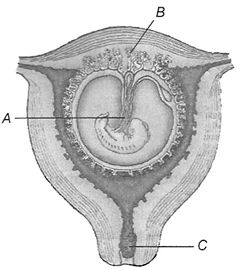
A
$A-$Umbilical cord,$B-$Chorionic villi,$C-$Plug of mucus in cervix
B
$A-$Umbilical cord,$B-$Placenta,$C-$Plug of mucus in cervix
C
$A-$Placenta,$B-$Umbilical cord,$C-$Plug of mucus in cervix
D
$A-$Chorionic villi,$B-$Umbilical cord,$C-$Plug of mucus in cervix
Solution
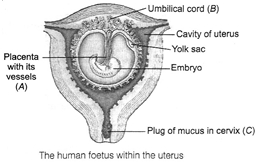
(A) Based on the provided diagram of the human foetus within the uterus:
$A$ represents the Umbilical cord,which connects the foetus to the placenta.
$B$ represents the Chorionic villi,which are finger-like projections that form the placenta.
$C$ represents the Plug of mucus in the cervix,which acts as a protective barrier during pregnancy.
Therefore,the correct identification is $A-$Umbilical cord,$B-$Chorionic villi,$C-$Plug of mucus in cervix.
$A$ represents the Umbilical cord,which connects the foetus to the placenta.
$B$ represents the Chorionic villi,which are finger-like projections that form the placenta.
$C$ represents the Plug of mucus in the cervix,which acts as a protective barrier during pregnancy.
Therefore,the correct identification is $A-$Umbilical cord,$B-$Chorionic villi,$C-$Plug of mucus in cervix.
0 likes
View Solution203
EasyMCQ
Identify $A$ and $B$ in the given figure.
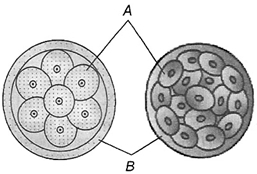
A
$A-$Blastocyst; $B-$Blastomere
B
$A-$Blastula; $B-$Plasma membrane
C
$A-$Blastomere; $B-$Zona pellucida
D
$A-$Zona pellucida; $B-$Blastomere
Solution
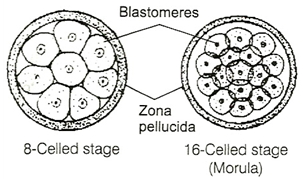
(C) In the given figure,the developing embryo is shown at the $8$-celled and $16$-celled stages.
$A$ points to the individual cells formed by cleavage,which are known as blastomeres.
$B$ points to the outer protective glycoprotein layer surrounding the embryo,known as the zona pellucida.
Therefore,$A$ is a blastomere and $B$ is the zona pellucida.
$A$ points to the individual cells formed by cleavage,which are known as blastomeres.
$B$ points to the outer protective glycoprotein layer surrounding the embryo,known as the zona pellucida.
Therefore,$A$ is a blastomere and $B$ is the zona pellucida.
0 likes
View Solution204
EasyMCQ
Sperm enters from which part of the egg?
A
Anywhere in fertilized egg from animal pole
B
From animal pole in unfertilized egg
C
In unfertilized egg from vegetal pole
D
None of the above
Solution
(B) During the process of fertilization,the sperm typically enters the unfertilized egg through the animal pole. The animal pole is the region of the egg where the nucleus is located and is generally less dense in yolk compared to the vegetal pole.
0 likes
View Solution205
MediumMCQ
Which of the following are secretions produced by the spermatozoa at the time of fertilization?
A
Fertilizin and anti-fertilizin
B
Anti-fertilizin and sperm lysin
C
Fertilizin and sperm lysin
D
Only sperm lysin
Solution
(B) At the time of fertilization,the sperm secretes substances known as $sperm \ lysins$ to penetrate the egg membranes.
Specifically,the acrosome of the sperm releases enzymes such as $hyaluronidase$ and $acrosin$,which are collectively referred to as $sperm \ lysins$.
$Fertilizin$ is a glycoprotein secreted by the egg (ovum),not the sperm.
$Anti-fertilizin$ is a substance present on the surface of the sperm that reacts with $fertilizin$ to facilitate the attachment of the sperm to the egg.
Therefore,the secretions produced by the spermatozoa specifically for the purpose of penetrating the egg are $sperm \ lysins$,while $anti-fertilizin$ is a surface component involved in recognition.
Specifically,the acrosome of the sperm releases enzymes such as $hyaluronidase$ and $acrosin$,which are collectively referred to as $sperm \ lysins$.
$Fertilizin$ is a glycoprotein secreted by the egg (ovum),not the sperm.
$Anti-fertilizin$ is a substance present on the surface of the sperm that reacts with $fertilizin$ to facilitate the attachment of the sperm to the egg.
Therefore,the secretions produced by the spermatozoa specifically for the purpose of penetrating the egg are $sperm \ lysins$,while $anti-fertilizin$ is a surface component involved in recognition.
0 likes
View Solution206
EasyMCQ
Fertilisation in human beings occurs in
A
Isthmus
B
Ampullary-isthmic junction
C
Uterus
D
Infundibulum
Solution
(B) In humans,fertilisation is the process of fusion of a sperm with an ovum. This process takes place in the fallopian tube. Specifically,the sperm and the ovum are transported to the $Ampullary-isthmic$ junction,where the actual fertilisation occurs.
0 likes
View Solution207
MediumMCQ
In human female,the blastocyst
A
Forms placenta even before implantation
B
Gets implanted in the uterus $3$ days after ovulation
C
Gets implanted in the endometrium by trophoblast cells
D
The trophoblast cells get differentiated as the embryo
Solution
(C) The blastocyst gets implanted in the endometrium of the uterus.
This process is facilitated by the trophoblast cells,which attach to the endometrium.
After implantation,the chorionic villi and uterine tissue become interdigitated with each other and jointly form the placenta.
Implantation typically occurs about $7$ days after fertilization.
The inner cell mass differentiates into the embryo,not the trophoblast cells.
This process is facilitated by the trophoblast cells,which attach to the endometrium.
After implantation,the chorionic villi and uterine tissue become interdigitated with each other and jointly form the placenta.
Implantation typically occurs about $7$ days after fertilization.
The inner cell mass differentiates into the embryo,not the trophoblast cells.
0 likes
View Solution208
MediumMCQ
The trophoblast is not involved in the formation of:
A
Protective and trophic membranes
B
Foetal portion of placenta
C
Body of developing embryo
D
Chorionic villi
Solution
(C) During human embryonic development,the blastocyst consists of an outer layer of cells called the trophoblast and an inner group of cells attached to it called the inner cell mass. The trophoblast layer helps in the attachment of the blastocyst to the endometrium and eventually forms the chorionic villi and the foetal portion of the placenta,as well as protective and trophic membranes. The body of the developing embryo is formed exclusively by the inner cell mass.
0 likes
View Solution209
EasyMCQ
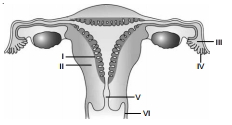
Which of the following depicts the site of implantation of the blastocyst under normal conditions?
A
$II$
B
$V$
C
$I$
D
$VI$
Solution
(C) In the human female reproductive system,the blastocyst normally implants in the uterine wall.
$I$ represents the Endometrium,which is the inner glandular layer of the uterus where implantation occurs.
$II$ represents the Myometrium,the thick middle layer of smooth muscle.
$III$ represents the Infundibulum,the funnel-shaped part of the fallopian tube.
$IV$ represents the Fimbriae,which collect the ovum after ovulation.
$V$ represents the Cervical canal.
$VI$ represents the Vagina.
Therefore,the correct site of implantation is $I$ (Endometrium).
$I$ represents the Endometrium,which is the inner glandular layer of the uterus where implantation occurs.
$II$ represents the Myometrium,the thick middle layer of smooth muscle.
$III$ represents the Infundibulum,the funnel-shaped part of the fallopian tube.
$IV$ represents the Fimbriae,which collect the ovum after ovulation.
$V$ represents the Cervical canal.
$VI$ represents the Vagina.
Therefore,the correct site of implantation is $I$ (Endometrium).
0 likes
View Solution210
MediumMCQ
Why do all copulations not lead to fertilisation and pregnancy? The root cause is . . . . . . .
A
Due to numerous sperms and one ovum
B
Due to less progesterone
C
Ovum and sperms are not transported simultaneously to the ampullary-isthmic junction
D
Due to non-formation of corpus luteum
Solution
(C) Fertilization can only occur if the ovum and sperms are transported simultaneously to the ampullary-isthmic junction.
The lifespan of sperm in the female reproductive tract is approximately $48$ to $72$ hours.
The viability of the secondary oocyte after its release from the ovary is only about $24$ hours.
Therefore,if copulation does not occur during the fertile period when both gametes are viable,fertilization and subsequent pregnancy will not take place.
The lifespan of sperm in the female reproductive tract is approximately $48$ to $72$ hours.
The viability of the secondary oocyte after its release from the ovary is only about $24$ hours.
Therefore,if copulation does not occur during the fertile period when both gametes are viable,fertilization and subsequent pregnancy will not take place.
0 likes
View Solution211
MediumMCQ
What induces the completion of the meiotic division of the secondary oocyte?
A
Contact of the sperm with the zona pellucida layer of the ovum
B
The entry of the sperm into the cytoplasm of the ovum through the zona pellucida and the plasma membrane
C
Entry of the sperm in the ampullary-isthmic junction
D
Copulation
Solution
(B) The secondary oocyte remains arrested in the metaphase-$II$ stage of meiosis-$II$.
When the sperm comes in contact with the ovum,the acrosome releases enzymes that facilitate the penetration of the sperm through the zona pellucida and the plasma membrane.
The actual entry of the sperm into the cytoplasm of the ovum triggers the completion of the second meiotic division,resulting in the formation of a haploid ovum (ootid) and a second polar body.
When the sperm comes in contact with the ovum,the acrosome releases enzymes that facilitate the penetration of the sperm through the zona pellucida and the plasma membrane.
The actual entry of the sperm into the cytoplasm of the ovum triggers the completion of the second meiotic division,resulting in the formation of a haploid ovum (ootid) and a second polar body.
0 likes
View Solution212
EasyMCQ
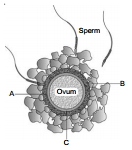
Observe the diagram of an ovum surrounded by a few sperms:
Which of the following options is correct for the labelled parts $A, B$ and $C$?
$A$ $\quad$ $B$ $\quad$ $C$
Which of the following options is correct for the labelled parts $A, B$ and $C$?
$A$ $\quad$ $B$ $\quad$ $C$
A
Follicular cells $\quad$ Corona radiata $\quad$ Perivitelline space
B
Zona pellucida $\quad$ Perivitelline space $\quad$ Corona radiata
C
Zona pellucida $\quad$ Corona radiata $\quad$ Perivitelline space
D
Perivitelline space $\quad$ Zona pellucida $\quad$ Corona radiata
Solution
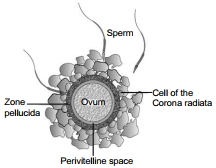
(C) Based on the provided diagram of the ovum:
$A$ points to the $Zona$ $pellucida$,which is the thick,transparent glycoprotein layer surrounding the plasma membrane of the oocyte.
$B$ points to the $Corona$ $radiata$,which is the outermost layer of follicular cells surrounding the $Zona$ $pellucida$.
$C$ points to the $Perivitelline$ $space$,which is the space between the plasma membrane of the oocyte and the $Zona$ $pellucida$.
Therefore,the correct sequence is $A$: $Zona$ $pellucida$,$B$: $Corona$ $radiata$,$C$: $Perivitelline$ $space$. The correct option is $C$.
$A$ points to the $Zona$ $pellucida$,which is the thick,transparent glycoprotein layer surrounding the plasma membrane of the oocyte.
$B$ points to the $Corona$ $radiata$,which is the outermost layer of follicular cells surrounding the $Zona$ $pellucida$.
$C$ points to the $Perivitelline$ $space$,which is the space between the plasma membrane of the oocyte and the $Zona$ $pellucida$.
Therefore,the correct sequence is $A$: $Zona$ $pellucida$,$B$: $Corona$ $radiata$,$C$: $Perivitelline$ $space$. The correct option is $C$.
0 likes
View Solution213
EasyMCQ
Which of the following enzymes helps the sperm to penetrate the $zona \ pellucida$?
A
Hyaluronidase
B
Neuraminidase
C
Acrosin
D
Corona penetrating enzyme
Solution
(C) The acrosome of the sperm contains several hydrolytic enzymes collectively known as sperm lysins.
$Acrosin$ is a proteolytic enzyme,also known as $zona \ lysin$,which specifically digests the $zona \ pellucida$ layer of the ovum to facilitate sperm entry.
$Hyaluronidase$ acts on the ground substance of the follicle cells (corona radiata).
$Corona \ penetrating \ enzyme$ $(CPE)$ also helps in the penetration of the corona radiata layer.
$Acrosin$ is a proteolytic enzyme,also known as $zona \ lysin$,which specifically digests the $zona \ pellucida$ layer of the ovum to facilitate sperm entry.
$Hyaluronidase$ acts on the ground substance of the follicle cells (corona radiata).
$Corona \ penetrating \ enzyme$ $(CPE)$ also helps in the penetration of the corona radiata layer.
0 likes
View Solution214
MediumMCQ
Which centriole of spermatozoa is required for the first cleavage?
A
Proximal centriole
B
Distal centriole
C
Ring centriole
D
Posterior centriole
Solution
(A) During fertilization,the sperm contributes its nucleus and the proximal centriole to the secondary oocyte.
The proximal centriole is essential for the formation of the mitotic spindle apparatus,which is required for the first cleavage of the zygote.
The distal centriole is generally involved in the formation of the sperm tail (axoneme) and does not play a role in the first cleavage.
The proximal centriole is essential for the formation of the mitotic spindle apparatus,which is required for the first cleavage of the zygote.
The distal centriole is generally involved in the formation of the sperm tail (axoneme) and does not play a role in the first cleavage.
0 likes
View Solution215
MediumMCQ
$A$: In the morula stage,the cells divide without any increase in size.
$R$: The zona pellucida remains intact until cleavage is completed.
$R$: The zona pellucida remains intact until cleavage is completed.
A
Assertion and Reason both are correct and Reason is the correct explanation of Assertion.
B
Assertion and Reason both are correct but Reason is not the correct explanation of Assertion.
C
Assertion is correct,but Reason is incorrect.
D
Both Assertion and Reason are incorrect.
Solution
(A) During the cleavage process,the zygote undergoes rapid mitotic divisions to form a solid ball of cells called the morula.
In this stage,the total volume of the embryo does not increase because the cells divide without any growth in size,meaning the cytoplasm is partitioned into smaller cells called blastomeres.
Since the embryo is enclosed within the zona pellucida,which does not expand during these early divisions,the overall size remains constant until the blastocyst stage.
Therefore,both the Assertion and the Reason are correct,and the Reason explains why the cells do not increase in size (due to the constraint of the zona pellucida).
In this stage,the total volume of the embryo does not increase because the cells divide without any growth in size,meaning the cytoplasm is partitioned into smaller cells called blastomeres.
Since the embryo is enclosed within the zona pellucida,which does not expand during these early divisions,the overall size remains constant until the blastocyst stage.
Therefore,both the Assertion and the Reason are correct,and the Reason explains why the cells do not increase in size (due to the constraint of the zona pellucida).
0 likes
View Solution216
MediumMCQ
$A$: All copulations do not lead to fertilisation and pregnancy.
$R$: Fertilisation can occur if the ovum and sperms are transported simultaneously to the ampullary-isthmic junction.
$R$: Fertilisation can occur if the ovum and sperms are transported simultaneously to the ampullary-isthmic junction.
A
Assertion and Reason both are correct and Reason is the correct explanation of Assertion.
B
Assertion and Reason both are correct but Reason is not the correct explanation of Assertion.
C
Assertion is correct,but Reason is incorrect.
D
Both Assertion and Reason are incorrect.
Solution
(A) The Assertion is correct because fertilisation is a chance event that requires the presence of both gametes at the same time and place.
Sperms are viable for $48$ to $72$ hours,while the ovum is viable for only about $24$ hours.
For fertilisation to occur,the ovum and sperms must be transported simultaneously to the ampullary-isthmic junction of the fallopian tube.
If this timing does not coincide,fertilisation will not occur,which explains why not all copulations result in pregnancy.
Sperms are viable for $48$ to $72$ hours,while the ovum is viable for only about $24$ hours.
For fertilisation to occur,the ovum and sperms must be transported simultaneously to the ampullary-isthmic junction of the fallopian tube.
If this timing does not coincide,fertilisation will not occur,which explains why not all copulations result in pregnancy.
0 likes
View Solution217
MediumMCQ
$A$: Fertilizins are glycoproteins present on the surface of the egg membrane.
$R$: They help in the agglutination reaction by interacting with anti-fertilizins on the sperm surface to facilitate fertilization.
$R$: They help in the agglutination reaction by interacting with anti-fertilizins on the sperm surface to facilitate fertilization.
A
Assertion and Reason both are correct and Reason is the correct explanation of Assertion.
B
Assertion and Reason both are correct but Reason is not the correct explanation of Assertion.
C
Assertion is correct,but Reason is incorrect.
D
Both Assertion and Reason are incorrect.
Solution
(A) Fertilizin is a glycoprotein present on the surface of the egg membrane.
Anti-fertilizin is present on the surface of the sperm.
During fertilization,the fertilizin of the egg reacts with the anti-fertilizin of the sperm,which is a species-specific interaction.
This interaction causes the agglutination of sperms around the egg,which is known as the agglutination reaction.
Therefore,both the Assertion and the Reason are correct,and the Reason is the correct explanation of the Assertion.
Anti-fertilizin is present on the surface of the sperm.
During fertilization,the fertilizin of the egg reacts with the anti-fertilizin of the sperm,which is a species-specific interaction.
This interaction causes the agglutination of sperms around the egg,which is known as the agglutination reaction.
Therefore,both the Assertion and the Reason are correct,and the Reason is the correct explanation of the Assertion.
0 likes
View Solution218
MediumMCQ
Which of the following statements is false regarding $ZIFT$?
A
Zygote Intra Fallopian Transfer
B
It is a type of $ART$
C
More than $8$ blastomeres are used
D
It is performed post $IVF$
Solution
(C) $ZIFT$ stands for Zygote Intra Fallopian Transfer.
In this procedure,the zygote or early embryo up to $8$ blastomeres is transferred into the Fallopian tube.
Therefore,the statement that 'more than $8$ blastomeres are used' is false,as embryos with more than $8$ cells are typically used in $IUT$ (Intra Uterine Transfer).
In this procedure,the zygote or early embryo up to $8$ blastomeres is transferred into the Fallopian tube.
Therefore,the statement that 'more than $8$ blastomeres are used' is false,as embryos with more than $8$ cells are typically used in $IUT$ (Intra Uterine Transfer).
0 likes
View Solution219
EasyMCQ
In vivo fertilisation involves the fertilisation that takes place:
A
In the laboratory
B
In the uterus
C
Outside the uterus
D
Either $(a)$ or $(b)$
Solution
(B) In vivo fertilisation refers to the process where the fusion of male and female gametes occurs within the female reproductive tract,specifically within the oviduct (fallopian tube).
This is the natural method of fertilisation,as opposed to in vitro fertilisation $(IVF)$,which occurs outside the body in a laboratory setting.
This is the natural method of fertilisation,as opposed to in vitro fertilisation $(IVF)$,which occurs outside the body in a laboratory setting.
0 likes
View Solution220
DifficultMCQ
Receptors for sperm binding in mammals are present on:
A
Corona radiata
B
Vitelline membrane
C
Perivitelline space
D
Zona pellucida
Solution
(D) In mammals,the ovum is surrounded by several layers. The outermost layer is the corona radiata,followed by the zona pellucida,which is a thick,non-cellular glycoprotein layer.
The zona pellucida contains specific receptors (such as $ZP3$ proteins) that are essential for the recognition and binding of the sperm.
This binding process triggers the acrosome reaction in the sperm,allowing it to penetrate the zona pellucida and reach the plasma membrane of the oocyte.
Therefore,the correct answer is $D$.
The zona pellucida contains specific receptors (such as $ZP3$ proteins) that are essential for the recognition and binding of the sperm.
This binding process triggers the acrosome reaction in the sperm,allowing it to penetrate the zona pellucida and reach the plasma membrane of the oocyte.
Therefore,the correct answer is $D$.
0 likes
View Solution221
EasyMCQ
Define/Explain: Internal fertilization.
A
Fertilization occurring outside the body.
B
Fertilization occurring inside the female reproductive tract.
C
Fertilization occurring in water.
D
Fertilization involving only asexual reproduction.
Solution
(B) $\rightarrow$ In land animals and some aquatic animals,the sperms are introduced by the male into the reproductive tract of the female during copulation. This process is known as internal fertilization.
0 likes
View Solution222
EasyMCQ
The following figure shows an ovum surrounded by sperms. Identify the $Zona$ $Pellucida$.
A
$P$
B
$Q$
C
$R$
D
$S$
Solution
(B) In the diagram of an ovum surrounded by sperms,the $Zona$ $Pellucida$ is the thick,transparent,non-cellular layer that surrounds the plasma membrane of the oocyte.
Based on standard biological diagrams of fertilization:
$P$ typically represents the corona radiata (the outer layer of follicular cells).
$Q$ represents the $Zona$ $Pellucida$ (the glycoprotein layer).
$R$ represents the perivitelline space.
$S$ represents the plasma membrane of the ovum.
Therefore,the correct label for $Zona$ $Pellucida$ is $Q$.
Based on standard biological diagrams of fertilization:
$P$ typically represents the corona radiata (the outer layer of follicular cells).
$Q$ represents the $Zona$ $Pellucida$ (the glycoprotein layer).
$R$ represents the perivitelline space.
$S$ represents the plasma membrane of the ovum.
Therefore,the correct label for $Zona$ $Pellucida$ is $Q$.
0 likes
View Solution223
EasyMCQ
Where does fertilization of the ovum occur to make pregnancy possible?
A
Vagina
B
Ovary
C
Ampullary-isthmic junction
D
Uterus
Solution
(C) Fertilization is the process of fusion of a sperm with an ovum.
In humans,this process occurs in the fallopian tube.
Specifically,the sperm and the ovum are transported to the $Ampullary-isthmic$ junction of the fallopian tube,where fertilization takes place.
If fertilization does not occur at this site,pregnancy cannot be established.
In humans,this process occurs in the fallopian tube.
Specifically,the sperm and the ovum are transported to the $Ampullary-isthmic$ junction of the fallopian tube,where fertilization takes place.
If fertilization does not occur at this site,pregnancy cannot be established.
0 likes
View Solution224
EasyMCQ
Identify the structure shown in the image (assuming a blastocyst stage with inner cell mass and trophoblast).
A
Morula
B
Blastocyst
C
Zygote
D
None of these
Solution
(B) The structure described,characterized by an outer layer of cells called the trophoblast and an inner group of cells known as the inner cell mass,is the $Blastocyst$.
$1$. $Zygote$ is a single-celled structure formed after fertilization.
$2$. $Morula$ is a solid ball of $8-16$ cells.
$3$. $Blastocyst$ is the stage that implants into the uterine wall.
$1$. $Zygote$ is a single-celled structure formed after fertilization.
$2$. $Morula$ is a solid ball of $8-16$ cells.
$3$. $Blastocyst$ is the stage that implants into the uterine wall.
0 likes
View Solution225
EasyMCQ
In which layer of the uterus does implantation occur?
A
Endometrium
B
Myometrium
C
Perimetrium
D
All of the above
Solution
(A) The uterus has three layers of tissue: the outer perimetrium,the middle myometrium,and the inner endometrium.
Implantation is the process by which the blastocyst attaches to and embeds itself into the uterine wall.
This process specifically occurs in the endometrium,which is the innermost glandular layer of the uterus that undergoes cyclic changes during the menstrual cycle to prepare for pregnancy.
Implantation is the process by which the blastocyst attaches to and embeds itself into the uterine wall.
This process specifically occurs in the endometrium,which is the innermost glandular layer of the uterus that undergoes cyclic changes during the menstrual cycle to prepare for pregnancy.
0 likes
View Solution226
MediumMCQ
Select the correct option for the inner cell mass.
A
After implantation,the inner cell mass differentiates into three germ layers.
B
Certain cells in the inner cell mass are known as stem cells,which have the potency to give rise to all tissues and organs.
C
The inner cell mass is found inside the blastocyst.
D
All of the above.
0 likes
View Solution227
MediumMCQ
In $ZIFT$,what is transferred into the fallopian tube?
A
Zygote into the fallopian tube
B
Embryo into the uterus
C
Sperms and eggs into the fallopian tube
D
Sperms and eggs into the uterus
Solution
(A) $ZIFT$ stands for $Zygote$ $Intra$ $Fallopian$ $Transfer$.
In this assisted reproductive technology,the zygote or early embryos (up to $8$ blastomeres) are transferred into the fallopian tube of the female.
Therefore,the correct option is $A$.
In this assisted reproductive technology,the zygote or early embryos (up to $8$ blastomeres) are transferred into the fallopian tube of the female.
Therefore,the correct option is $A$.
0 likes
View Solution228
MediumMCQ
Twins are born to a family that lives next door to you. The twins are a boy and a girl. Which of the following must be true?
A
They are monozygotic twins.
B
They are fraternal twins.
C
They were conceived through in vitro fertilization.
D
They have $75\%$ identical genetic content.
Solution
(B) Monozygotic (identical) twins are formed from a single zygote that splits into two,meaning they must have the same sex.
Since the twins in this case are a boy and a girl,they cannot be monozygotic.
Fraternal (dizygotic) twins are formed from two separate eggs fertilized by two separate sperm cells.
Because they arise from different fertilization events,they are genetically as similar as any other siblings,sharing approximately $50\%$ of their genes.
Therefore,a boy and a girl twin pair must be fraternal twins.
Since the twins in this case are a boy and a girl,they cannot be monozygotic.
Fraternal (dizygotic) twins are formed from two separate eggs fertilized by two separate sperm cells.
Because they arise from different fertilization events,they are genetically as similar as any other siblings,sharing approximately $50\%$ of their genes.
Therefore,a boy and a girl twin pair must be fraternal twins.
0 likes
View Solution229
MediumMCQ
Which structure becomes embedded in the endometrium of the uterus?
A
Blastocyst
B
Unfertilized egg
C
Morula
D
Zygote
Solution
(A) The process of implantation involves the attachment of the embryo to the uterine wall.
After fertilization,the zygote undergoes cleavage to form a $2, 4, 8, 16$ celled stage called the morula.
The morula continues to divide and transforms into a blastocyst.
The blastocyst consists of an outer layer of cells called the trophoblast and an inner cell mass.
It is the blastocyst that gets embedded in the endometrium of the uterus,leading to pregnancy.
After fertilization,the zygote undergoes cleavage to form a $2, 4, 8, 16$ celled stage called the morula.
The morula continues to divide and transforms into a blastocyst.
The blastocyst consists of an outer layer of cells called the trophoblast and an inner cell mass.
It is the blastocyst that gets embedded in the endometrium of the uterus,leading to pregnancy.
0 likes
View Solution230
MediumMCQ
Statement-$I$: The trophoblast layer gets attached to the endometrium and the inner cell mass gets differentiated as the embryo.
Statement-$II$: The morula becomes embedded in the endometrium of the uterus.
Statement-$II$: The morula becomes embedded in the endometrium of the uterus.
A
Both statement $I$ and statement $II$ are correct
B
Statement $I$ is correct but statement $II$ is incorrect
C
Statement $I$ is incorrect but statement $II$ is correct
D
Both statement $I$ and statement $II$ are incorrect
Solution
(B) Statement-$I$ is correct. After the formation of the blastocyst,the outer layer called the trophoblast attaches to the endometrium,and the inner cell mass differentiates into the embryo.
Statement-$II$ is incorrect. It is not the morula but the blastocyst that gets embedded (implanted) in the endometrium of the uterus.
Statement-$II$ is incorrect. It is not the morula but the blastocyst that gets embedded (implanted) in the endometrium of the uterus.
0 likes
View Solution231
MediumMCQ
In which part of the female reproductive system does fertilization take place?
A
Ampulla of vas deferens
B
Uterus
C
Ampulla of Fallopian tube
D
Isthmus of Fallopian tube
Solution
(C) Fertilization is the process of fusion of a sperm with an ovum.
In humans,this process occurs in the $Ampulla$ region of the Fallopian tube (oviduct).
The ovum released from the ovary is transported to the $Ampulla$ where it meets the sperm.
Therefore,the correct site for fertilization is the $Ampulla$ of the Fallopian tube.
In humans,this process occurs in the $Ampulla$ region of the Fallopian tube (oviduct).
The ovum released from the ovary is transported to the $Ampulla$ where it meets the sperm.
Therefore,the correct site for fertilization is the $Ampulla$ of the Fallopian tube.
0 likes
View Solution232
EasyMCQ
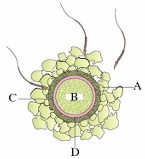
Identify the correct option regarding the provided diagram of an ovum during fertilization.
A
$B \longrightarrow$ secondary oocyte; Estrogen level high
B
$D \longrightarrow$ Perivitelline space; Prevents polyspermy
C
$A \longrightarrow$ Zona pellucida; $ZP-3$ receptor
D
$C \longrightarrow$ Corona radiata; Formed by ovary
Solution
(B) In the given diagram of an ovum undergoing fertilization:
$A$ represents the corona radiata,which is the outer layer of follicular cells.
$B$ represents the secondary oocyte (ovum).
$C$ represents the zona pellucida,which contains $ZP-3$ receptors that facilitate sperm binding.
$D$ represents the perivitelline space,which is the space between the zona pellucida and the plasma membrane of the oocyte. Upon the entry of the first sperm,cortical granules release enzymes into this space,causing the zona pellucida to harden and preventing polyspermy.
Therefore,option $B$ is the correct description.
$A$ represents the corona radiata,which is the outer layer of follicular cells.
$B$ represents the secondary oocyte (ovum).
$C$ represents the zona pellucida,which contains $ZP-3$ receptors that facilitate sperm binding.
$D$ represents the perivitelline space,which is the space between the zona pellucida and the plasma membrane of the oocyte. Upon the entry of the first sperm,cortical granules release enzymes into this space,causing the zona pellucida to harden and preventing polyspermy.
Therefore,option $B$ is the correct description.
0 likes
View Solution233
EasyMCQ
During implantation,the blastocyst becomes embedded in which layer of the uterus?
A
Perimetrium
B
Myometrium
C
Endometrium
D
Serosa
Solution
(C) The uterus wall consists of three layers of tissue: the outer perimetrium,the middle myometrium,and the inner endometrium.
During the process of implantation,the blastocyst attaches to and becomes embedded in the endometrium,which is the innermost glandular layer of the uterus.
The endometrium undergoes cyclic changes during the menstrual cycle to prepare for the implantation of the embryo.
During the process of implantation,the blastocyst attaches to and becomes embedded in the endometrium,which is the innermost glandular layer of the uterus.
The endometrium undergoes cyclic changes during the menstrual cycle to prepare for the implantation of the embryo.
0 likes
View Solution234
MediumMCQ
Cleavage is a $\underline{A}$ which starts just after fertilization as the zygote moves through $\underline{B}$ of the oviduct towards the uterus.
A
$A = \text{Mitosis}, B = \text{Isthmus}$
B
$A = \text{Meiosis}, B = \text{Isthmus}$
C
$A = \text{Mitosis}, B = \text{Ampulla}$
D
$A = \text{Amitosis}, B = \text{Ampulla}$
Solution
(A) Cleavage is a series of rapid mitotic cell divisions of the zygote,which converts the single-celled zygote into a multicellular structure called a blastocyst.
It begins as the zygote moves through the isthmus of the oviduct towards the uterus.
Therefore,$A = \text{Mitosis}$ and $B = \text{Isthmus}$.
It begins as the zygote moves through the isthmus of the oviduct towards the uterus.
Therefore,$A = \text{Mitosis}$ and $B = \text{Isthmus}$.
0 likes
View Solution235
MediumMCQ
Identify $A$ and $B$ and their respective functions:
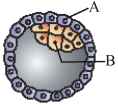
A
$A \rightarrow$ Trophoblast,$B \rightarrow$ Inner cell mass,Function of $A \rightarrow$ Attach to the endometrium,$B \rightarrow$ Differentiated as embryo
B
$A \rightarrow$ Trophoblast,$B \rightarrow$ Inner cell mass,Function of $A \rightarrow$ Differentiated as embryo,$B \rightarrow$ Attach to the endometrium
C
$A \rightarrow$ Mesoderm,$B \rightarrow$ Inner cell mass,Function of $A \rightarrow$ Differentiated as embryo,$B \rightarrow$ Attach to the endometrium
D
$A \rightarrow$ Ectoderm,$B \rightarrow$ Mesoderm,Function of $A \rightarrow$ Attach to the endometrium,$B \rightarrow$ Differentiated as embryo
Solution
(A) The provided image shows a blastocyst.
$A$ represents the outer layer of cells known as the trophoblast,which attaches to the endometrium of the uterus.
$B$ represents the inner cell mass,which contains stem cells that differentiate into the embryo.
Therefore,$A$ is the trophoblast (attaches to the endometrium) and $B$ is the inner cell mass (differentiates into the embryo).
$A$ represents the outer layer of cells known as the trophoblast,which attaches to the endometrium of the uterus.
$B$ represents the inner cell mass,which contains stem cells that differentiate into the embryo.
Therefore,$A$ is the trophoblast (attaches to the endometrium) and $B$ is the inner cell mass (differentiates into the embryo).
0 likes
View Solution236
EasyMCQ
Which hormone helps in the journey of sperms towards the ampulla by causing contractions of the uterus and fallopian tube?
A
$FSH$
B
Progesterone
C
Activin
D
Oxytocin
Solution
(D) Oxytocin is a hormone released by the posterior pituitary gland.
During sexual intercourse,the release of oxytocin causes rhythmic contractions of the smooth muscles of the uterus and the fallopian tubes.
These contractions facilitate the transport of sperms towards the ampulla,which is the site of fertilization in the fallopian tube.
During sexual intercourse,the release of oxytocin causes rhythmic contractions of the smooth muscles of the uterus and the fallopian tubes.
These contractions facilitate the transport of sperms towards the ampulla,which is the site of fertilization in the fallopian tube.
0 likes
View Solution237
EasyMCQ
Following are some events occurring during the fertilization process. Arrange the $CORRECT$ sequence of events and choose the option given below.
$i$. Fertilizin-antifertilizin reaction.
$ii$. Cortical reaction.
$iii$. Acrosome reaction.
$iv$. Karyogamy.
$v$. Capacitation of sperms.
$i$. Fertilizin-antifertilizin reaction.
$ii$. Cortical reaction.
$iii$. Acrosome reaction.
$iv$. Karyogamy.
$v$. Capacitation of sperms.
A
$v \rightarrow ii \rightarrow i \rightarrow iii \rightarrow iv$
B
$v \rightarrow i \rightarrow iii \rightarrow ii \rightarrow iv$
C
$i \rightarrow v \rightarrow iii \rightarrow iv \rightarrow ii$
D
$ii \rightarrow i \rightarrow iv \rightarrow v \rightarrow iii$
Solution
(B) The correct sequence of events during fertilization is as follows:
$1$. Capacitation of sperms $(v)$: This is the physiological maturation of sperms in the female reproductive tract.
$2$. Fertilizin-antifertilizin reaction $(i)$: This is the chemical recognition between the sperm and the egg surface.
$3$. Acrosome reaction $(iii)$: The release of enzymes from the acrosome to penetrate the zona pellucida.
$4$. Cortical reaction $(ii)$: This prevents polyspermy by modifying the zona pellucida after the first sperm enters.
$5$. Karyogamy $(iv)$: The fusion of the male and female pronuclei to form a diploid zygote.
Therefore,the correct sequence is $v \rightarrow i \rightarrow iii \rightarrow ii \rightarrow iv$.
$1$. Capacitation of sperms $(v)$: This is the physiological maturation of sperms in the female reproductive tract.
$2$. Fertilizin-antifertilizin reaction $(i)$: This is the chemical recognition between the sperm and the egg surface.
$3$. Acrosome reaction $(iii)$: The release of enzymes from the acrosome to penetrate the zona pellucida.
$4$. Cortical reaction $(ii)$: This prevents polyspermy by modifying the zona pellucida after the first sperm enters.
$5$. Karyogamy $(iv)$: The fusion of the male and female pronuclei to form a diploid zygote.
Therefore,the correct sequence is $v \rightarrow i \rightarrow iii \rightarrow ii \rightarrow iv$.
0 likes
View Solution238
EasyMCQ
Select the $INCORRECT$ statement regarding the process of cleavage in humans.
A
It is the process of early mitotic as well as meiotic divisions of zygote to form multicellular blastula.
B
$1^{\text{st}}$ cleavage is meridional,$2^{\text{nd}}$ cleavage is longitudinal but at right angles to the first.
C
Cleavage is holoblastic,radial and indeterminate.
D
There is no growth between cleavages,resulting in reduced size of blastomeres after cleavage.
Solution
(A) Cleavage is a series of rapid mitotic divisions of the zygote,which converts the single-celled zygote into a multicellular structure called a blastocyst (or blastula).
Meiosis does not occur during cleavage; only mitosis takes place to increase the number of cells without increasing the total cytoplasmic volume.
Therefore,the statement claiming that cleavage involves meiotic divisions is incorrect.
Meiosis does not occur during cleavage; only mitosis takes place to increase the number of cells without increasing the total cytoplasmic volume.
Therefore,the statement claiming that cleavage involves meiotic divisions is incorrect.
0 likes
View Solution239
EasyMCQ
Sperms after reaching the ampulla of the fallopian tube can remain viable for . . . . . . hours.
A
$10-12$
B
$24-28$
C
$12-23$
D
$49-60$
Solution
(C) In the human reproductive system, after ejaculation, sperm travel through the cervix and uterus to reach the ampulla of the fallopian tube. The viability of sperm in the female reproductive tract is generally considered to be about $24$ to $48$ hours, although some studies suggest they can remain fertile for up to $72$ hours. Among the given options, the range $12-23$ hours is the most scientifically plausible approximation for the duration of viability in the ampulla before fertilization occurs.
0 likes
View Solution240
EasyMCQ
$Statement I$: Penetration of sperm into ovum is a chemical process. $Statement II$: Acrosome of sperm secretes hyaluronidase which dissolves the corona radiata of the ovum.
A
Both $Statement I$ and $Statement II$ are correct
B
Both $Statement I$ and $Statement II$ are incorrect
C
$Statement I$ is correct,but $Statement II$ is incorrect
D
$Statement I$ is incorrect,but $Statement II$ is correct
Solution
(A) $Statement I$ is correct because the sperm penetration involves the acrosomal reaction,which is a chemical process involving the release of enzymes.
$Statement II$ is correct because the acrosome of the sperm secretes hyaluronidase,an enzyme that digests the hyaluronic acid present in the corona radiata cells surrounding the ovum,allowing the sperm to penetrate.
$Statement II$ is correct because the acrosome of the sperm secretes hyaluronidase,an enzyme that digests the hyaluronic acid present in the corona radiata cells surrounding the ovum,allowing the sperm to penetrate.
0 likes
View Solution241
EasyMCQ
Select the correct statement.
A
The zygote secretes fertilizin.
B
The sperm secretes antifertilizin.
C
The ovum secretes antifertilizin.
D
The sperm secretes fertilizin.
Solution
(B) During the process of fertilization,a specific chemical interaction occurs between the gametes.
The ovum (egg cell) secretes a glycoprotein substance known as fertilizin.
The sperm secretes a protein substance known as antifertilizin.
These two substances are species-specific and interact with each other to facilitate the recognition and binding of the sperm to the ovum,which is essential for successful fertilization.
The ovum (egg cell) secretes a glycoprotein substance known as fertilizin.
The sperm secretes a protein substance known as antifertilizin.
These two substances are species-specific and interact with each other to facilitate the recognition and binding of the sperm to the ovum,which is essential for successful fertilization.
0 likes
View Solution242
EasyMCQ
Sperm of animal species $X$ cannot fertilize ovum of species $Y$ because . . . . . . .
A
Fertilizin of $X$ and $Y$ are not specific
B
Antifertilizin of $X$ and $Y$ are not specific
C
Fertilizin of $X$ and antifertilizin of $Y$ are not specific
D
Antifertilizin of $X$ and fertilizin of $Y$ are not specific
Solution
(D) Fertilization is a species-specific process.
This specificity is mediated by chemical interactions between the sperm and the ovum.
The ovum secretes a chemical substance called 'fertilizin' (a glycoprotein),while the sperm surface contains a complementary substance called 'antifertilizin'.
For successful fertilization,the fertilizin of the ovum must be compatible with the antifertilizin of the sperm.
If the sperm of species $X$ cannot fertilize the ovum of species $Y$,it is because the antifertilizin of species $X$ and the fertilizin of species $Y$ are not specific to each other,preventing the necessary binding.
This specificity is mediated by chemical interactions between the sperm and the ovum.
The ovum secretes a chemical substance called 'fertilizin' (a glycoprotein),while the sperm surface contains a complementary substance called 'antifertilizin'.
For successful fertilization,the fertilizin of the ovum must be compatible with the antifertilizin of the sperm.
If the sperm of species $X$ cannot fertilize the ovum of species $Y$,it is because the antifertilizin of species $X$ and the fertilizin of species $Y$ are not specific to each other,preventing the necessary binding.
0 likes
View Solution243
EasyMCQ
The post-fertilization change involves,
A
haploid gametic maturation
B
introduction of centrioles in the ovum
C
inhibition of Meiosis $II$
D
formation of vitelline membrane
Solution
(B) During the process of fertilization,the sperm enters the secondary oocyte.
This entry triggers the completion of $Meiosis \ II$ in the secondary oocyte,which was previously arrested at the metaphase $II$ stage.
Additionally,the sperm contributes its centriole to the ovum,which is essential for the formation of the spindle apparatus required for the first mitotic division of the zygote.
Therefore,the introduction of centrioles into the ovum is a critical post-fertilization event.
This entry triggers the completion of $Meiosis \ II$ in the secondary oocyte,which was previously arrested at the metaphase $II$ stage.
Additionally,the sperm contributes its centriole to the ovum,which is essential for the formation of the spindle apparatus required for the first mitotic division of the zygote.
Therefore,the introduction of centrioles into the ovum is a critical post-fertilization event.
0 likes
View Solution244
EasyMCQ
Which one of the following statements is $CORRECT$?
A
Fertilization in humans takes place in the womb.
B
Zygote contains a haploid number of chromosomes.
C
Fertilization membrane avoids polyspermy.
D
Primary oocyte inhibits the process of oogenesis.
Solution
(C) Fertilization in humans typically occurs in the ampulla region of the fallopian tube,not the womb.
Zygote is formed by the fusion of a haploid sperm and a haploid egg,resulting in a diploid $(2n)$ cell.
The fertilization membrane is a specialized layer formed after the entry of the first sperm into the egg,which prevents the entry of additional sperm,a process known as preventing polyspermy.
Therefore,the statement regarding the fertilization membrane is correct.
Zygote is formed by the fusion of a haploid sperm and a haploid egg,resulting in a diploid $(2n)$ cell.
The fertilization membrane is a specialized layer formed after the entry of the first sperm into the egg,which prevents the entry of additional sperm,a process known as preventing polyspermy.
Therefore,the statement regarding the fertilization membrane is correct.
0 likes
View Solution245
EasyMCQ
Morula formed at the end of cleavage is . . . . . . celled.
A
$14$
B
$16$
C
$18$
D
$20$
Solution
(B) Cleavage is a series of rapid mitotic divisions of the zygote which converts the single-celled zygote into a multicellular structure called a morula.
During this process,the zygote undergoes successive divisions to form $2, 4, 8,$ and finally $16$ daughter cells known as blastomeres.
The stage consisting of $8$ to $16$ blastomeres is typically referred to as the morula.
Therefore,the morula is characterized as a $16$-celled stage.
During this process,the zygote undergoes successive divisions to form $2, 4, 8,$ and finally $16$ daughter cells known as blastomeres.
The stage consisting of $8$ to $16$ blastomeres is typically referred to as the morula.
Therefore,the morula is characterized as a $16$-celled stage.
0 likes
View Solution246
EasyMCQ
The glycoprotein,fertilizin is secreted by
A
Ovum
B
Ovary
C
Sperm
D
Testis
Solution
(A) Fertilizin is a glycoprotein substance secreted by the mature ovum (egg cell).
It plays a crucial role in the process of fertilization by interacting with the antifertilizin present on the surface of the sperm.
This interaction is species-specific,ensuring that the sperm of the same species can fertilize the ovum.
Therefore,the correct option is $A$.
It plays a crucial role in the process of fertilization by interacting with the antifertilizin present on the surface of the sperm.
This interaction is species-specific,ensuring that the sperm of the same species can fertilize the ovum.
Therefore,the correct option is $A$.
0 likes
View Solution247
EasyMCQ
During human fertilization, which of the following induces changes and acts as a barrier to ensure that only one sperm can enter and fertilize the ovum?
A
Perivitelline space
B
Zona pellucida
C
Corona radiata
D
Cytoplasm of the ovum
Solution
(B) During fertilization, a sperm comes in contact with the $Zona$ $\text{pellucida}$ layer of the ovum and induces changes in the membrane that block the entry of additional sperm.
This ensures that only one sperm can fertilize the ovum, a process known as polyspermy block.
Therefore, the $Zona$ $\text{pellucida}$ acts as a primary barrier to prevent polyspermy.
This ensures that only one sperm can fertilize the ovum, a process known as polyspermy block.
Therefore, the $Zona$ $\text{pellucida}$ acts as a primary barrier to prevent polyspermy.
0 likes
View Solution248
EasyMCQ
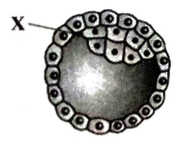
What does '$X$' indicate in the following diagram?
A
Trophoblast
B
Inner cell mass
C
Blastomeres
D
Uterine cells
Solution
(A) The diagram represents a blastocyst.
In a blastocyst,the blastomeres are arranged into an outer layer called the trophoblast and an inner group of cells attached to the trophoblast called the inner cell mass.
'$X$' points to the outer layer of cells,which is the trophoblast.
In a blastocyst,the blastomeres are arranged into an outer layer called the trophoblast and an inner group of cells attached to the trophoblast called the inner cell mass.
'$X$' points to the outer layer of cells,which is the trophoblast.
0 likes
View Solution249
EasyMCQ
In humans,fertilization is possible only when,
A
Ovum and sperm are transported simultaneously to the ampullary region
B
Haploid ovum (ootid) enters into the fallopian tube and sperm enters into the uterus at the same time
C
Ovum and sperm enter into the uterus at the same time
D
The haploid ovum (ootid) is released from the ovary and insemination to the vaginal orifice occurs at the same time
Solution
(A) Fertilization is the fusion of the male and female gametes. In humans,this process occurs in the ampullary region of the fallopian tube. For fertilization to be successful,both the ovum and the sperm must be transported to the ampullary region simultaneously. If they do not reach this specific site at the same time,fertilization cannot occur.
0 likes
View Solution250
EasyMCQ
Fertilisation takes place in . . . . . . of Human.
A
Infundibulum
B
Ampullary region
C
Uterine cavity
D
Vagina
Solution
(B) In humans,fertilisation is the process of fusion of a sperm with an ovum. This process occurs in the $Ampullary$ region of the fallopian tube. The ovum released by the ovary is transported to the $Ampullary$ region where it meets the sperm. Fertilisation can only occur if the ovum and sperms are transported simultaneously to the $Ampullary$ region. Therefore,the correct option is $B$.
0 likes
View SolutionHuman Reproduction — Fertilisation and Implantation · Frequently Asked Questions
1Are these Human Reproduction questions useful for JEE and NEET?
Yes. All questions in this section are mapped to JEE Main and NEET exam patterns. Previous year questions from JEE Main, NEET, GUJCET and state-level exams are included with full solutions.
2Can I switch to Hindi or Gujarati for these questions?
Yes. Use the language tabs in the hero section or the sidebar to view the same questions and solutions in English, Hindi or Gujarati.
3How do I generate a question paper from this subtopic?
Use the Vedclass Exam Paper Generator — select the chapter and subtopic, set difficulty, and generate Sets A, B, C, D automatically. First 3 chapters of every subject are free.
Vedclass Products
For Students
Vedclass Test Series
Mock tests in real JEE/NEET style with performance analysis. 5-day free trial.
Start Free TrialFor Teachers
Exam Paper Generator
Generate Set A/B/C/D papers from this chapter in 2 minutes. 3 chapters free.
Try FreeFor Institutes
Online Exam Module
Live online exams with unlimited students, 360° analytics & white-label branding.
See DemoFor Teachers & Institutes
Generate a Human Reproduction Exam Paper in 2 Minutes
Select subtopic & difficulty — Sets A, B, C, D auto-generated with No Repeat logic.
First 3 chapters of every subject are free — no payment required.