
A English
Fertilisation and Implantation Questions in English
Class 12 Biology · Human Reproduction · Fertilisation and Implantation
253+
Questions
English
Language
100%
With Solutions
Showing 47 of 253 questions in English
101
EasyMCQ
What is the solid,mulberry-like mass of cells formed by repeated cleavage divisions called?
A
Gastrula
B
Blastula
C
Morula
D
Neurula
Solution
(C) The zygote undergoes repeated mitotic divisions called cleavage as it moves through the isthmus of the oviduct towards the uterus.
These divisions result in the formation of $8$ to $16$ daughter cells called blastomeres.
The embryo with $8-16$ blastomeres is called a morula.
The morula continues to divide and transforms into a blastocyst (a type of blastula) as it moves further into the uterus.
Therefore,the solid,mulberry-like stage is known as the morula.
These divisions result in the formation of $8$ to $16$ daughter cells called blastomeres.
The embryo with $8-16$ blastomeres is called a morula.
The morula continues to divide and transforms into a blastocyst (a type of blastula) as it moves further into the uterus.
Therefore,the solid,mulberry-like stage is known as the morula.
0 likes
View Solution102
EasyMCQ
Where does fertilization occur in mammals?
A
Ovary
B
Uterus
C
Vagina
D
Fallopian tube
Solution
(D) In mammals,fertilization is the process where the sperm and the ovum fuse to form a zygote. This process typically takes place in the ampullary region of the fallopian tube (oviduct). The sperm travels through the vagina and uterus to reach the fallopian tube,where it meets the ovum released from the ovary.
0 likes
View Solution103
MediumMCQ
Polyspermy is generally prevented by which of the following?
A
Interaction of fertilizin and antifertilizin
B
Resistance of the ovum to excess sperm
C
Penetrating capacity of the sperm
D
Formation of the fertilization membrane
Solution
(D) Polyspermy refers to the entry of more than one sperm into an ovum during fertilization.
To prevent this,the ovum undergoes specific changes immediately after the first sperm enters.
The cortical granules present beneath the plasma membrane of the ovum release their contents into the perivitelline space.
These contents harden the zona pellucida,forming a fertilization membrane.
This membrane acts as a physical barrier that prevents any other sperm from entering the ovum,thereby ensuring monospermy.
To prevent this,the ovum undergoes specific changes immediately after the first sperm enters.
The cortical granules present beneath the plasma membrane of the ovum release their contents into the perivitelline space.
These contents harden the zona pellucida,forming a fertilization membrane.
This membrane acts as a physical barrier that prevents any other sperm from entering the ovum,thereby ensuring monospermy.
0 likes
View Solution104
MediumMCQ
During cleavage,the zygote undergoes mitotic division as it moves through the .... of the oviduct.
A
Ampulla
B
Isthmus
C
Fimbriae
D
Infundibulum
Solution
(B) Cleavage is a series of rapid mitotic divisions of the zygote which converts the single-celled zygote into a multicellular structure called a blastocyst.
As the zygote moves from the ampulla towards the uterus through the oviduct (Fallopian tube),it undergoes these mitotic divisions.
The process of cleavage specifically occurs while the zygote is passing through the isthmus of the oviduct towards the uterus.
As the zygote moves from the ampulla towards the uterus through the oviduct (Fallopian tube),it undergoes these mitotic divisions.
The process of cleavage specifically occurs while the zygote is passing through the isthmus of the oviduct towards the uterus.
0 likes
View Solution105
EasyMCQ
The attachment of the blastocyst to the uterine wall is known as .......
A
Fertilization
B
Implantation
C
Gestation
D
Parturition
Solution
(B) The process by which the blastocyst becomes embedded in the endometrium of the uterus is called implantation.
$1$. Fertilization is the fusion of male and female gametes to form a zygote.
$2$. Implantation is the attachment of the blastocyst to the uterine wall,which leads to pregnancy.
$3$. Gestation is the period of development of the fetus in the uterus.
$4$. Parturition is the process of giving birth to the young one.
$1$. Fertilization is the fusion of male and female gametes to form a zygote.
$2$. Implantation is the attachment of the blastocyst to the uterine wall,which leads to pregnancy.
$3$. Gestation is the period of development of the fetus in the uterus.
$4$. Parturition is the process of giving birth to the young one.
0 likes
View Solution106
MediumMCQ
Which of the following is true for cleavage?
A
The size of the embryo increases.
B
The size of the cells decreases.
C
The size of the cells increases.
D
The size of the embryo decreases.
Solution
(B) Cleavage is a series of rapid mitotic divisions of the zygote,which converts the single-celled zygote into a multicellular structure called a morula.
During cleavage,the total volume of the embryo remains constant because there is no growth phase ($G_1$ or $G_2$) between divisions.
As the number of cells increases,the size of each individual cell (blastomere) decreases because the cytoplasm is partitioned into smaller units without an increase in total cytoplasmic mass.
During cleavage,the total volume of the embryo remains constant because there is no growth phase ($G_1$ or $G_2$) between divisions.
As the number of cells increases,the size of each individual cell (blastomere) decreases because the cytoplasm is partitioned into smaller units without an increase in total cytoplasmic mass.
0 likes
View Solution107
EasyMCQ
Where does the process of cleavage begin in humans?
A
Fallopian tube
B
Uterus
C
Vagina
D
None of these
Solution
(A) In humans,fertilization occurs in the ampullary region of the Fallopian tube.
Following fertilization,the zygote undergoes a series of mitotic divisions known as cleavage.
Cleavage begins while the zygote is still moving through the Fallopian tube towards the uterus.
Therefore,the process of cleavage starts in the Fallopian tube.
Following fertilization,the zygote undergoes a series of mitotic divisions known as cleavage.
Cleavage begins while the zygote is still moving through the Fallopian tube towards the uterus.
Therefore,the process of cleavage starts in the Fallopian tube.
0 likes
View Solution108
EasyMCQ
Fertilizin is secreted by which of the following?
A
Immature ovum
B
Mature ovum
C
Sperm
D
Polar body
Solution
(B) Fertilizin is a glycoprotein substance secreted by the mature ovum (egg).
It acts as a chemical attractant for sperm of the same species.
It interacts with the antifertilizin present on the surface of the sperm,facilitating the recognition and binding of the sperm to the egg during the process of fertilization.
It acts as a chemical attractant for sperm of the same species.
It interacts with the antifertilizin present on the surface of the sperm,facilitating the recognition and binding of the sperm to the egg during the process of fertilization.
0 likes
View Solution109
EasyMCQ
In mammals,the sperm produces an enzyme-like substance called sperm lysin. What is it called?
A
Hyaluronidase
B
Hyaluronic acid
C
Androgamone
D
Gynogamone
Solution
(A) In mammals,the head of the sperm contains an acrosome,which is filled with digestive enzymes known as sperm lysins. The most important sperm lysin is $Hyaluronidase$. This enzyme acts on the ground substances of the follicle cells (corona radiata) surrounding the ovum,allowing the sperm to penetrate and fertilize the egg. Therefore,the correct answer is $Hyaluronidase$.
0 likes
View Solution110
MediumMCQ
When are identical twins produced?
A
One sperm fertilizes two eggs.
B
Two sperms fertilize one egg.
C
Both eggs are fertilized.
D
$A$ single fertilized egg divides into two blastomeres and then separates from each other.
Solution
(D) Identical twins,also known as monozygotic twins,are produced when a single fertilized egg (zygote) undergoes early cleavage and the resulting blastomeres separate into two independent embryos.
Since they originate from the same zygote,they share the same genetic makeup.
This process is distinct from fraternal twins,which result from the fertilization of two separate eggs by two separate sperms.
Since they originate from the same zygote,they share the same genetic makeup.
This process is distinct from fraternal twins,which result from the fertilization of two separate eggs by two separate sperms.
0 likes
View Solution111
MediumMCQ
On what does the type of fertilization (external or internal) depend?
A
Structure of the ovum
B
Site of embryonic development
C
Type of sperm
D
Both $(A)$ and $(B)$
Solution
(B) Fertilization is the process of fusion of male and female gametes.
It is classified into two types based on the location where the fusion occurs:
$1$. External fertilization: Occurs outside the body of the organism (e.g.,in water).
$2$. Internal fertilization: Occurs inside the body of the organism.
This classification is fundamentally based on the site where the fusion of gametes takes place,which is often correlated with the site of embryonic development. In many organisms,the site of fertilization determines the subsequent site of embryonic development.
It is classified into two types based on the location where the fusion occurs:
$1$. External fertilization: Occurs outside the body of the organism (e.g.,in water).
$2$. Internal fertilization: Occurs inside the body of the organism.
This classification is fundamentally based on the site where the fusion of gametes takes place,which is often correlated with the site of embryonic development. In many organisms,the site of fertilization determines the subsequent site of embryonic development.
0 likes
View Solution112
EasyMCQ
What is the process of fusion of the nuclei of a sperm and an ovum called?
A
Karyogamy
B
Parthenogenesis
C
Vitellogenesis
D
Oogenesis
Solution
(A) The process of fusion of the nuclei of a sperm and an ovum is known as $Karyogamy$.
$Karyogamy$ is a critical step in the process of $Syngamy$ (fertilization),where the haploid nuclei of the male and female gametes fuse to form a diploid $Zygote$.
$Parthenogenesis$ is the development of an embryo from an unfertilized egg.
$Vitellogenesis$ is the process of yolk formation in the oocyte.
$Oogenesis$ is the process of formation of female gametes (ova).
$Karyogamy$ is a critical step in the process of $Syngamy$ (fertilization),where the haploid nuclei of the male and female gametes fuse to form a diploid $Zygote$.
$Parthenogenesis$ is the development of an embryo from an unfertilized egg.
$Vitellogenesis$ is the process of yolk formation in the oocyte.
$Oogenesis$ is the process of formation of female gametes (ova).
0 likes
View Solution113
MediumMCQ
From which part of the ovum does the sperm enter?
A
Anywhere in the unfertilized egg of the vegetal pole
B
From the animal pole of the unfertilized egg
C
Vegetal pole of the unfertilized egg
D
None of these
Solution
(B) In most animal species, the sperm enters the ovum through the $animal \text{ } pole$. The $animal \text{ } pole$ is the region of the egg that contains the nucleus and is generally less dense in yolk, making it the site where fertilization typically occurs. The $vegetal \text{ } pole$ is typically rich in yolk and is not the primary site for sperm entry.
0 likes
View Solution114
MediumMCQ
Which chemical present in the ovum attracts the sperm?
A
Fertilizin
B
Antifertilizin
C
Agglutinin
D
Thrombin
Solution
(A) The ovum secretes a chemical substance known as $Fertilizin$ (a glycoprotein) from its surface. This substance acts as a chemoattractant that attracts the sperm,which possesses $Antifertilizin$ on its surface. The interaction between $Fertilizin$ and $Antifertilizin$ is a species-specific reaction that facilitates the binding of the sperm to the ovum during the process of fertilization.
0 likes
View Solution115
MediumMCQ
What is the significant function of the fertilizin-antifertilizin interaction?
A
Protection of sperm
B
Entry of few sperms into the ovum
C
Attraction of gametes of the opposite sex
D
Binding of gametes of the same species
Solution
(D) Fertilizin is a glycoprotein present on the surface of the egg (ovum),while antifertilizin is a protein present on the surface of the sperm.
During the process of fertilization,the fertilizin of the egg interacts with the antifertilizin of the sperm.
This interaction is species-specific,which ensures that the sperm of the same species can bind to and fertilize the egg of that specific species.
Therefore,the primary function of the fertilizin-antifertilizin interaction is the binding of gametes of the same species.
During the process of fertilization,the fertilizin of the egg interacts with the antifertilizin of the sperm.
This interaction is species-specific,which ensures that the sperm of the same species can bind to and fertilize the egg of that specific species.
Therefore,the primary function of the fertilizin-antifertilizin interaction is the binding of gametes of the same species.
0 likes
View Solution116
MediumMCQ
During fertilization,which layer of the ovum does the sperm come into contact with first?
A
Jelly coat
B
Zona pellucida
C
Vitelline membrane
D
Perivitelline space
Solution
(B) During the process of fertilization,the sperm approaches the ovum. The ovum is surrounded by several layers,including the corona radiata and the zona pellucida. The sperm first comes into contact with the $Zona \ pellucida$ layer of the ovum. This contact triggers the acrosome reaction in the sperm,which releases enzymes that help the sperm penetrate the $Zona \ pellucida$ to reach the plasma membrane of the ovum.
0 likes
View Solution117
MediumMCQ
Where does fertilization occur in the human female reproductive system?
A
Cervix
B
Ampulla
C
Isthmus
D
Vagina
Solution
(B) Fertilization is the process of fusion of a sperm with an ovum. In the human female reproductive system,this process takes place in the $Ampulla$ region of the fallopian tube (oviduct). The sperm and ovum are transported simultaneously to the $Ampulla$ region where fertilization occurs.
0 likes
View Solution118
EasyMCQ
What is fertilization the fusion of?
A
$A$ diploid sperm and a diploid egg fuse to form a diploid zygote.
B
$A$ haploid sperm and a diploid egg fuse to form a diploid zygote.
C
$A$ diploid sperm and a haploid egg fuse to form a diploid zygote.
D
$A$ haploid sperm and a haploid egg fuse to form a diploid zygote.
Solution
(D) Fertilization is the process of fusion of a haploid male gamete (sperm) with a haploid female gamete (ovum/egg).
Both the sperm and the egg contain $n$ number of chromosomes (haploid).
Upon fusion,they form a diploid zygote $(2n)$,which contains the full set of chromosomes ($2n$ = $46$ in humans).
Therefore,the correct statement is that a haploid sperm and a haploid egg fuse to form a diploid zygote.
Both the sperm and the egg contain $n$ number of chromosomes (haploid).
Upon fusion,they form a diploid zygote $(2n)$,which contains the full set of chromosomes ($2n$ = $46$ in humans).
Therefore,the correct statement is that a haploid sperm and a haploid egg fuse to form a diploid zygote.
0 likes
View Solution119
MediumMCQ
If fertilization does not occur,the corpus luteum...
A
stops the secretion of progesterone.
B
degenerates into corpus albicans.
C
starts the secretion of progesterone.
D
none of the above.
Solution
(B) In the human female reproductive cycle,if fertilization does not occur,the corpus luteum cannot be maintained because the human chorionic gonadotropin $(hCG)$ hormone is not produced by the embryo.
As a result,the corpus luteum undergoes degeneration and transforms into a white fibrous scar tissue known as the corpus albicans.
This degeneration leads to a sharp decline in the levels of progesterone and estrogen,which triggers the shedding of the uterine endometrium,resulting in menstruation.
As a result,the corpus luteum undergoes degeneration and transforms into a white fibrous scar tissue known as the corpus albicans.
This degeneration leads to a sharp decline in the levels of progesterone and estrogen,which triggers the shedding of the uterine endometrium,resulting in menstruation.
0 likes
View Solution120
MediumMCQ
During fertilization,from where does the head of the sperm enter the ovum?
A
From anywhere
B
From the animal pole
C
From the vegetal pole
D
From the lateral side of the ovum
Solution
(B) During the process of fertilization in many organisms,the sperm enters the ovum specifically through the animal pole. The animal pole is the region of the egg where the nucleus is located and where the cytoplasm is less dense with yolk,facilitating the entry of the sperm head. The vegetal pole,conversely,is typically rich in yolk and is not the site of sperm entry.
0 likes
View Solution121
EasyMCQ
The cells formed as a result of cleavage are called:
A
Megameres
B
Micromeres
C
Blastoderm
D
Blastomeres
Solution
(D) Cleavage is a series of rapid mitotic cell divisions of the zygote following fertilization.
These divisions occur without any significant growth of the daughter cells.
The resulting daughter cells formed during the cleavage process are known as $Blastomeres$.
These divisions occur without any significant growth of the daughter cells.
The resulting daughter cells formed during the cleavage process are known as $Blastomeres$.
0 likes
View Solution122
EasyMCQ
The life of multicellular organisms begins with which of the following?
A
Amoeba
B
Ovum
C
Gamete
D
Zygote
Solution
(D) The life of all sexually reproducing multicellular organisms begins from a single cell called the $Zygote$.
This $Zygote$ is formed by the fusion of male and female gametes during the process of fertilization.
It represents the starting point of the development of an individual organism.
This $Zygote$ is formed by the fusion of male and female gametes during the process of fertilization.
It represents the starting point of the development of an individual organism.
0 likes
View Solution123
EasyMCQ
Which of the following participate in the formation of a zygote?
A
Sperm cells
B
Egg cells
C
Reproductive cells (Gametes)
D
Somatic cells
Solution
(C) The formation of a zygote occurs through the process of fertilization,which involves the fusion of two haploid gametes.
Gametes are specialized reproductive cells.
In humans,the male gamete is the sperm cell and the female gamete is the egg cell (ovum).
Since both sperm and egg cells are types of reproductive cells,they both participate in the formation of the zygote.
However,the most comprehensive answer that includes both types of gametes is 'Reproductive cells'.
Gametes are specialized reproductive cells.
In humans,the male gamete is the sperm cell and the female gamete is the egg cell (ovum).
Since both sperm and egg cells are types of reproductive cells,they both participate in the formation of the zygote.
However,the most comprehensive answer that includes both types of gametes is 'Reproductive cells'.
0 likes
View Solution124
EasyMCQ
What is formed by the fusion of male and female gametes?
A
Male pronucleus
B
Female pronucleus
C
Zygote
D
Ovum
Solution
(C) The process of fusion of a male gamete (sperm) with a female gamete (ovum) is known as fertilization.
This fusion results in the formation of a diploid cell called a $Zygote$.
The $Zygote$ contains the combined genetic material from both parents,representing the first cell of a new organism.
This fusion results in the formation of a diploid cell called a $Zygote$.
The $Zygote$ contains the combined genetic material from both parents,representing the first cell of a new organism.
0 likes
View Solution125
EasyMCQ
What gives rise to an adult individual?
A
Somatic cell
B
Gamete
C
Germ cell
D
Zygote
Solution
(D) The development of an adult individual begins with a single cell called the $Zygote$.
$Zygote$ is formed by the fusion of male and female gametes during the process of fertilization.
This $Zygote$ undergoes repeated mitotic cell divisions to form an embryo,which eventually develops into a complete adult organism.
$Zygote$ is formed by the fusion of male and female gametes during the process of fertilization.
This $Zygote$ undergoes repeated mitotic cell divisions to form an embryo,which eventually develops into a complete adult organism.
0 likes
View Solution126
EasyMCQ
What forms the zygote?
A
Somatic cells
B
Male and female spores
C
Male and female gametes
D
Germ cells
Solution
(C) The process of fertilization involves the fusion of a male gamete and a female gamete. This fusion results in the formation of a diploid cell known as the zygote. Therefore,the zygote is formed by the union of male and female gametes.
0 likes
View Solution127
MediumMCQ
$A$: Every cell of the body contains the same genetic material as the zygote. $R$: The zygote is formed by the fusion of male and female gametes.
A
$A$ and $R$ are both true and $R$ is the correct explanation of $A$.
B
$A$ and $R$ are both true,but $R$ is not the correct explanation of $A$.
C
$A$ is true and $R$ is false.
D
$A$ is false and $R$ is true.
Solution
(B) Assertion $(A)$ is true because all somatic cells in an organism are derived from the zygote through repeated mitotic cell divisions. Since mitosis maintains the same chromosome number and genetic content,every cell contains the same genetic material as the original zygote.
Reason $(R)$ is also true because the zygote is indeed formed by the fusion of haploid male and female gametes during fertilization.
However,the reason $(R)$ explains the origin of the zygote,but it does not explain why every cell in the body retains the same genetic material as the zygote (which is due to the process of mitosis). Therefore,$R$ is not the correct explanation of $A$.
Reason $(R)$ is also true because the zygote is indeed formed by the fusion of haploid male and female gametes during fertilization.
However,the reason $(R)$ explains the origin of the zygote,but it does not explain why every cell in the body retains the same genetic material as the zygote (which is due to the process of mitosis). Therefore,$R$ is not the correct explanation of $A$.
0 likes
View Solution128
EasyMCQ
The structure formed as a result of the fusion of gametes in a species is known as:
A
Ovum
B
Sperm
C
Zygote
D
Secondary oocyte
Solution
(C) In sexual reproduction,the fusion of male and female gametes is called fertilization. The product of this fusion is a diploid cell known as the $Zygote$. The $Zygote$ serves as the vital link that ensures the continuity of the species between organisms of one generation and the next.
0 likes
View Solution129
EasyMCQ
Which process leads to the formation of a zygote?
A
Fertilization
B
Transformation
C
Binary fission
D
Budding
Solution
(A) The process of fusion of a male gamete with a female gamete is known as fertilization. This fusion results in the formation of a diploid cell called a zygote. Therefore,fertilization is the event that leads to the formation of a zygote.
0 likes
View Solution130
MediumMCQ
The structure formed as a result of the fusion of gametes of the same species is known as...
A
Ovum
B
Sperm
C
Zygote
D
Secondary oocyte
Solution
(C) The process of fusion of a male gamete (sperm) and a female gamete (ovum) is called fertilization.
This fusion results in the formation of a diploid cell known as the $Zygote$.
The $Zygote$ is the first cell of a new organism.
This fusion results in the formation of a diploid cell known as the $Zygote$.
The $Zygote$ is the first cell of a new organism.
0 likes
View Solution131
MediumMCQ
Capacitation occurs in
A
epididymis
B
vas deferens
C
female reproductive tract
D
rete testis
Solution
(C) The correct answer is $C$. Capacitation is the physiological maturation process that spermatozoa undergo within the $female$ $reproductive$ $tract$.
During this process, secretions from the female genital tract remove coating substances (such as cholesterol and glycoproteins) deposited on the surface of the sperm, particularly over the acrosome.
This removal exposes the receptor sites on the acrosome, which allows the sperm to bind to the zona pellucida of the egg and become active enough to penetrate it.
Therefore, capacitation is essential for fertilization and occurs only after the sperm enters the female reproductive system.
During this process, secretions from the female genital tract remove coating substances (such as cholesterol and glycoproteins) deposited on the surface of the sperm, particularly over the acrosome.
This removal exposes the receptor sites on the acrosome, which allows the sperm to bind to the zona pellucida of the egg and become active enough to penetrate it.
Therefore, capacitation is essential for fertilization and occurs only after the sperm enters the female reproductive system.
0 likes
View Solution132
MediumMCQ
Fertilisation in humans is practically feasible only if
A
the ovum and sperms are transported simultaneously to ampullary-isthmic junction of the cervix
B
the sperms are transported into cervix within $48$ hrs of release of ovum in uterus
C
the sperms are transported into vagina just after the release of ovum in Fallopian tube
D
the ovum and sperms are transported simultaneously to ampullary-isthmic junction of the Fallopian tube.
Solution
(D) : The fusion of a haploid male gamete (sperm) and a haploid female gamete (ovum) to form a diploid zygote is called fertilisation.
In human beings,fertilisation takes place only when the ovum and sperms are transported simultaneously to the ampullary-isthmic junction of the Fallopian tube (oviduct).
In human beings,fertilisation takes place only when the ovum and sperms are transported simultaneously to the ampullary-isthmic junction of the Fallopian tube (oviduct).
0 likes
View Solution133
EasyMCQ
Ectopic pregnancies are referred to as
A
implantation of defective embryo in the uterus
B
pregnancies terminated due to hormonal imbalance
C
pregnancies with genetic abnormality
D
implantation of embryo at site other than uterus.
Solution
(D) : Ectopic pregnancy is a complication of pregnancy in which implantation of the embryo takes place at a site other than the uterus.
Signs and symptoms include abdominal pain and vaginal bleeding.
Most ectopic pregnancies $(90\%)$ occur in the Fallopian tube,which are known as tubal pregnancies.
Signs and symptoms include abdominal pain and vaginal bleeding.
Most ectopic pregnancies $(90\%)$ occur in the Fallopian tube,which are known as tubal pregnancies.
0 likes
View Solution134
MediumMCQ
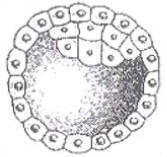
Identify the human developmental stage shown below as well as the related right place of its occurrence in a normal pregnant woman,and select the right option for the two,together.
A
Late morula $\to$ Middle part of Fallopian tube
B
Blastula $\to$ End part of Fallopian tube
C
Blastocyst $\to$ Uterine wall
D
$8$-celled morula $\to$ Starting point of Fallopian tube
Solution
(C) : After fertilization,the zygote undergoes rapid mitotic divisions,called cleavage,which is characterized by the absence of growth of daughter cells. This leads to the conversion of a single-celled zygote into a multicellular structure called a blastocyst. Implantation or embedding of the zygote into the endometrium of the uterus occurs in the blastocyst stage. The blastocyst comes in contact with the endometrium in the region of the embryonal knob or embryonic disc and adheres to it. The surface cells of the trophoblast secrete lytic enzymes which cause corrosion of the endometrial lining. They also give rise to finger-like outgrowths called chorionic villi. Chorionic villi and uterine tissue become interdigitated. Villi not only help in fixation but also in the absorption of nourishment.
0 likes
View Solution135
MediumMCQ
What happens during fertilization in humans after many sperms reach close to the ovum?
A
Secretions of acrosome help one sperm enter the cytoplasm of the ovum through the zona pellucida.
B
All sperms except the one nearest to the ovum lose their tails.
C
Cells of corona radiata trap all the sperms except one.
D
Only two sperms nearest the ovum penetrate the zona pellucida.
Solution
(A) The process of fusion of a sperm with an ovum is called fertilization.
During fertilization,a sperm comes in contact with the zona pellucida layer of the ovum and induces changes in the membrane that block the entry of additional sperms.
Thus,it ensures that only one sperm can fertilize an ovum.
The secretions of the acrosome help the sperm enter into the cytoplasm of the ovum through the zona pellucida and the plasma membrane.
In contact with the surface of the egg covering,the acrosome releases its contained hydrolytic enzymes,also called sperm lysins.
This is known as the acrosomal reaction.
The acrosomal reaction results in the dissolving of corona cells and the degeneration of the zona pellucida,which helps in sperm penetration.
During fertilization,a sperm comes in contact with the zona pellucida layer of the ovum and induces changes in the membrane that block the entry of additional sperms.
Thus,it ensures that only one sperm can fertilize an ovum.
The secretions of the acrosome help the sperm enter into the cytoplasm of the ovum through the zona pellucida and the plasma membrane.
In contact with the surface of the egg covering,the acrosome releases its contained hydrolytic enzymes,also called sperm lysins.
This is known as the acrosomal reaction.
The acrosomal reaction results in the dissolving of corona cells and the degeneration of the zona pellucida,which helps in sperm penetration.
0 likes
View Solution136
MediumMCQ
In human females,the blastocyst:
A
forms placenta even before implantation.
B
gets implanted into the uterus $3$ days after ovulation.
C
gets nutrition from uterine endometrial secretion only after implantation.
D
gets implanted in the endometrium by the trophoblast cells.
Solution
(D) The correct answer is $(d)$.
Implantation in the endometrial uterine wall takes place at the blastocyst stage of embryonic development.
Before implantation,the blastomeres of the early blastocyst arrange themselves into an outer layer called the trophoblast and an inner group of cells attached to the trophoblast called the inner cell mass.
It is the trophoblast layer through which the blastocyst attaches to the endometrium,and the inner cell mass differentiates into the embryo.
Implantation in the endometrial uterine wall takes place at the blastocyst stage of embryonic development.
Before implantation,the blastomeres of the early blastocyst arrange themselves into an outer layer called the trophoblast and an inner group of cells attached to the trophoblast called the inner cell mass.
It is the trophoblast layer through which the blastocyst attaches to the endometrium,and the inner cell mass differentiates into the embryo.
0 likes
View Solution137
MediumMCQ
Which one of the following is the most likely root cause why menstruation is not taking place in a regularly cycling human female?
A
Maintenance of the hypertrophical endometrial lining
B
Maintenance of high concentration of sex hormones in the blood stream
C
Retention of well-developed corpus luteum
D
Fertilization of the ovum
Solution
(D) The correct answer is $D$. In a regularly cycling human female,the most common physiological reason for the cessation of menstruation is pregnancy,which occurs following the fertilization of the ovum.
$1$. Upon fertilization,the embryo secretes $hCG$ (human Chorionic Gonadotropin),which maintains the corpus luteum.
$2$. The corpus luteum continues to secrete high levels of progesterone and estrogen,which prevent the shedding of the endometrial lining.
$3$. Consequently,the menstrual cycle is suspended to support the developing embryo.
$1$. Upon fertilization,the embryo secretes $hCG$ (human Chorionic Gonadotropin),which maintains the corpus luteum.
$2$. The corpus luteum continues to secrete high levels of progesterone and estrogen,which prevent the shedding of the endometrial lining.
$3$. Consequently,the menstrual cycle is suspended to support the developing embryo.
0 likes
View Solution138
MediumMCQ
$A$ change in the amount of yolk and its distribution in the egg will affect
A
pattern of cleavage
B
number of blastomeres produced
C
fertilization
D
formation of zygote.
Solution
(A) : Cleavage is a series of rapid mitotic cell divisions by which a single fertilized egg cell (zygote) is transformed into a multicellular structure called the blastula.
During cleavage,there is no significant growth in the size of the embryo,and the shape remains largely unchanged except for the formation of a central cavity known as the blastocoel.
The ratio of nuclear material $(DNA)$ to cytoplasm increases with each division.
The pattern or mode of cleavage is primarily determined by the amount of yolk present in the egg and its distribution (pattern of yolk deposition).
Based on the yolk content,cleavage is classified as holoblastic (total) or meroblastic (partial).
During cleavage,there is no significant growth in the size of the embryo,and the shape remains largely unchanged except for the formation of a central cavity known as the blastocoel.
The ratio of nuclear material $(DNA)$ to cytoplasm increases with each division.
The pattern or mode of cleavage is primarily determined by the amount of yolk present in the egg and its distribution (pattern of yolk deposition).
Based on the yolk content,cleavage is classified as holoblastic (total) or meroblastic (partial).
0 likes
View Solution139
MediumMCQ
Assisted reproductive technology, $IVF$ involves transfer of
A
ovum into the Fallopian tube
B
zygote into the Fallopian tube
C
zygote into the uterus
D
embryo with $16$ blastomeres into the Fallopian tube.
Solution
(B) : Assisted reproductive technologies $(ART)$ include a number of special techniques which assist infertile couples to have children.
An important technique of $ART$ is the test tube baby programme.
The baby produced by conceiving in a culture dish and nursing in the uterus is called a test tube baby.
This method involves in vitro fertilization $(IVF)$, $i.e.$, fertilization of male and female gamete outside the body in conditions similar to those in the body, followed by embryo transfer $(ET)$.
Zygote or early embryo up to $8$ blastomeres is transferred into the Fallopian tube $(ZIFT - \text{Zygote Intra Fallopian Transfer})$, and an embryo with more than $8$ blastomeres is transferred to the uterus to complete its further development.
An important technique of $ART$ is the test tube baby programme.
The baby produced by conceiving in a culture dish and nursing in the uterus is called a test tube baby.
This method involves in vitro fertilization $(IVF)$, $i.e.$, fertilization of male and female gamete outside the body in conditions similar to those in the body, followed by embryo transfer $(ET)$.
Zygote or early embryo up to $8$ blastomeres is transferred into the Fallopian tube $(ZIFT - \text{Zygote Intra Fallopian Transfer})$, and an embryo with more than $8$ blastomeres is transferred to the uterus to complete its further development.
0 likes
View Solution140
MediumMCQ
The test-tube baby programme employs which one of the following techniques?
A
Intra cytoplasmic sperm injection $(ICSI)$
B
Intra uterine insemination $(IUI)$
C
Gamete intra Fallopian transfer $(GIFT)$
D
Zygote intra Fallopian transfer $(ZIFT)$
Solution
(D) : In the in vitro fertilization method,popularly known as the test-tube baby programme,ova from the wife/donor (female) and sperms from the husband/donor (male) are collected and induced to form a zygote under simulated conditions in the laboratory.
The zygote or early embryos (with up to $8$ blastomeres) can then be transferred into the Fallopian tube,which is known as Zygote Intra Fallopian Transfer $(ZIFT)$.
Embryos with more than $8$ blastomeres are transferred into the uterus,known as Intra Uterine Transfer $(IUT)$,to complete their further development.
The zygote or early embryos (with up to $8$ blastomeres) can then be transferred into the Fallopian tube,which is known as Zygote Intra Fallopian Transfer $(ZIFT)$.
Embryos with more than $8$ blastomeres are transferred into the uterus,known as Intra Uterine Transfer $(IUT)$,to complete their further development.
0 likes
View Solution141
MediumMCQ
At which stage is the sex of the baby determined?
A
At the time of fertilization
B
After placenta formation
C
At the time of secondary oocytes
D
After implantation
Solution
(A) The sex of a human baby is determined at the time of fertilization.
In humans,the female produces gametes with $22 + X$ chromosomes,while the male produces two types of sperm: $22 + X$ and $22 + Y$.
When a sperm carrying an $X$ chromosome fertilizes the ovum,the resulting zygote is $44 + XX$ (female).
When a sperm carrying a $Y$ chromosome fertilizes the ovum,the resulting zygote is $44 + XY$ (male).
Since this genetic combination is established the moment the sperm fuses with the egg,the sex is determined at fertilization.
In humans,the female produces gametes with $22 + X$ chromosomes,while the male produces two types of sperm: $22 + X$ and $22 + Y$.
When a sperm carrying an $X$ chromosome fertilizes the ovum,the resulting zygote is $44 + XX$ (female).
When a sperm carrying a $Y$ chromosome fertilizes the ovum,the resulting zygote is $44 + XY$ (male).
Since this genetic combination is established the moment the sperm fuses with the egg,the sex is determined at fertilization.
0 likes
View Solution142
EasyMCQ
Fertilization is the fusion of:
A
Diploid sperm with haploid ovum to form diploid zygote.
B
Haploid sperm with diploid ovum to form diploid zygote.
C
Diploid sperm with diploid ovum to form diploid zygote.
D
Haploid sperm with haploid ovum to form diploid zygote.
Solution
(D) Fertilization is the process of fusion of a haploid male gamete (sperm) with a haploid female gamete (ovum).
Both the sperm and the ovum contain $n$ number of chromosomes (haploid).
Upon fusion,they form a diploid zygote which contains $2n$ number of chromosomes.
Therefore,the correct statement is that a haploid sperm fuses with a haploid ovum to form a diploid zygote.
Both the sperm and the ovum contain $n$ number of chromosomes (haploid).
Upon fusion,they form a diploid zygote which contains $2n$ number of chromosomes.
Therefore,the correct statement is that a haploid sperm fuses with a haploid ovum to form a diploid zygote.
0 likes
View Solution143
EasyMCQ
Site of fertilization in a mammal is ......
A
Ovary
B
Uterus
C
Vagina
D
Fallopian tube
Solution
(D) In mammals, fertilization is the process where the sperm and the ovum fuse to form a zygote.
This process typically occurs in the ampulla region of the $Fallopian \text{ tube}$ (oviduct).
The ovum is released from the ovary and travels into the $Fallopian \text{ tube}$, where it meets the sperm.
Therefore, the correct site for fertilization is the $Fallopian \text{ tube}$.
This process typically occurs in the ampulla region of the $Fallopian \text{ tube}$ (oviduct).
The ovum is released from the ovary and travels into the $Fallopian \text{ tube}$, where it meets the sperm.
Therefore, the correct site for fertilization is the $Fallopian \text{ tube}$.
0 likes
View Solution144
EasyMCQ
Corpus luteum secretes.....
A
$LH$
B
Estrogen
C
Progesterone
D
$FSH$
Solution
(C) After ovulation,the ruptured follicle transforms into a structure called the corpus luteum.
The corpus luteum primarily secretes large amounts of progesterone,which is essential for the maintenance of the endometrium.
It also secretes some amount of estrogen.
Since progesterone is the primary hormone secreted to support pregnancy,it is the most appropriate answer.
The corpus luteum primarily secretes large amounts of progesterone,which is essential for the maintenance of the endometrium.
It also secretes some amount of estrogen.
Since progesterone is the primary hormone secreted to support pregnancy,it is the most appropriate answer.
0 likes
View Solution145
EasyMCQ
The embryo at the $16$-celled stage is called:
A
Morula
B
Blastula
C
Blastomere
D
Gastrula
Solution
(A) During the process of cleavage,the zygote undergoes repeated mitotic divisions as it moves through the isthmus of the oviduct towards the uterus.
These divisions result in the formation of $2, 4, 8,$ and finally $16$ daughter cells.
These daughter cells are known as blastomeres.
The embryo consisting of $8$ to $16$ blastomeres is called a Morula.
Therefore,the $16$-celled stage is specifically referred to as the Morula stage.
These divisions result in the formation of $2, 4, 8,$ and finally $16$ daughter cells.
These daughter cells are known as blastomeres.
The embryo consisting of $8$ to $16$ blastomeres is called a Morula.
Therefore,the $16$-celled stage is specifically referred to as the Morula stage.
0 likes
View Solution146
MediumMCQ
Which event is possible when changes in the layer of $zona$ $pellucida$ occur due to sperm at the time of fertilization?
A
Sperm enters into the ovum.
B
Block the entry of additional sperms into the ovum.
C
Stop the fertilization process and prevent pregnancy.
D
Possible fertilization process is facilitated and pregnancy occurs.
Solution
(B) During the process of fertilization,a sperm comes in contact with the $zona$ $pellucida$ layer of the ovum and induces changes in the membrane.
These changes in the $zona$ $pellucida$ layer are crucial because they block the entry of additional sperms into the ovum.
This mechanism ensures that only one sperm can fertilize the ovum,a phenomenon known as polyspermy prevention.
Therefore,the correct event that occurs due to these changes is the blocking of additional sperms.
These changes in the $zona$ $pellucida$ layer are crucial because they block the entry of additional sperms into the ovum.
This mechanism ensures that only one sperm can fertilize the ovum,a phenomenon known as polyspermy prevention.
Therefore,the correct event that occurs due to these changes is the blocking of additional sperms.
0 likes
View Solution147
MediumMCQ
Incomplete cleavage is a type of which division?
A
Meroblastic
B
Incomplete
C
Holoblastic
D
Spiral
Solution
(A) Cleavage is the series of mitotic divisions of the zygote.
$1$. $Holoblastic$ cleavage refers to complete cleavage where the entire egg is divided.
$2$. $Meroblastic$ cleavage refers to incomplete or partial cleavage,which occurs in eggs with a large amount of yolk (e.g.,birds,reptiles).
Therefore,incomplete cleavage is synonymous with $Meroblastic$ cleavage.
$1$. $Holoblastic$ cleavage refers to complete cleavage where the entire egg is divided.
$2$. $Meroblastic$ cleavage refers to incomplete or partial cleavage,which occurs in eggs with a large amount of yolk (e.g.,birds,reptiles).
Therefore,incomplete cleavage is synonymous with $Meroblastic$ cleavage.
0 likes
View SolutionHuman Reproduction — Fertilisation and Implantation · Frequently Asked Questions
1Are these Human Reproduction questions useful for JEE and NEET?
Yes. All questions in this section are mapped to JEE Main and NEET exam patterns. Previous year questions from JEE Main, NEET, GUJCET and state-level exams are included with full solutions.
2Can I switch to Hindi or Gujarati for these questions?
Yes. Use the language tabs in the hero section or the sidebar to view the same questions and solutions in English, Hindi or Gujarati.
3How do I generate a question paper from this subtopic?
Use the Vedclass Exam Paper Generator — select the chapter and subtopic, set difficulty, and generate Sets A, B, C, D automatically. First 3 chapters of every subject are free.
Vedclass Products
For Students
Vedclass Test Series
Mock tests in real JEE/NEET style with performance analysis. 5-day free trial.
Start Free TrialFor Teachers
Exam Paper Generator
Generate Set A/B/C/D papers from this chapter in 2 minutes. 3 chapters free.
Try FreeFor Institutes
Online Exam Module
Live online exams with unlimited students, 360° analytics & white-label branding.
See DemoFor Teachers & Institutes
Generate a Human Reproduction Exam Paper in 2 Minutes
Select subtopic & difficulty — Sets A, B, C, D auto-generated with No Repeat logic.
First 3 chapters of every subject are free — no payment required.