
A English
Fertilisation and Implantation Questions in English
Class 12 Biology · Human Reproduction · Fertilisation and Implantation
253+
Questions
English
Language
100%
With Solutions
Showing 48 of 253 questions in English
151
MediumMCQ
Which of the following statements is correct regarding the cleavage of a human zygote?
A
It is incomplete.
B
It starts when the ovum reaches the uterus.
C
It starts in the fallopian tube.
D
It is identical to normal mitosis.
Solution
(C) Cleavage in a human zygote is a series of rapid mitotic divisions that occur as the zygote moves through the fallopian tube (oviduct) towards the uterus.
Unlike normal mitosis,cleavage divisions do not involve cell growth between divisions,meaning the total size of the embryo remains the same while the number of cells (blastomeres) increases.
Therefore,cleavage starts in the fallopian tube while the zygote is still moving towards the uterus.
Unlike normal mitosis,cleavage divisions do not involve cell growth between divisions,meaning the total size of the embryo remains the same while the number of cells (blastomeres) increases.
Therefore,cleavage starts in the fallopian tube while the zygote is still moving towards the uterus.
0 likes
View Solution152
MediumMCQ
Which of the following secretes fertilizin?
A
Immature egg
B
Mature egg
C
Sperm
D
Polar bodies
Solution
(B) Fertilizin is a chemical substance (a glycoprotein) secreted by the mature egg (ovum) to attract sperm. It interacts with the antifertilizin present on the surface of the sperm,facilitating the recognition and binding of the sperm to the egg during the process of fertilization.
0 likes
View Solution153
MediumMCQ
What is the most likely reason for the absence of regular menstruation in women?
A
Fertilization of the ovum
B
Maintenance of the hypertrophied endometrium
C
Maintenance of high concentration of sex hormones in the bloodstream
D
Maintenance of a well-developed corpus luteum
Solution
(A) जब अंडकोष का निषेचन होता है,तो गर्भावस्था की प्रक्रिया शुरू होती है। निषेचित अंडकोष गर्भाशय में स्थापित हो जाता है। इस समय,कॉर्पस ल्यूटियम विघटित होने के बजाय प्रोजेस्टेरोन का स्राव जारी रखता है। प्रोजेस्टेरोन का उच्च स्तर गर्भाशय की परत (एंडोमेट्रियम) को बनाए रखता है ताकि भ्रूण का विकास हो सके। इस स्थिति में मासिक धर्म रुक जाता है,जो गर्भावस्था का मुख्य संकेत है। इसलिए,अंडकोष का निषेचन मासिक धर्म न आने का प्राथमिक कारण है।
0 likes
View Solution154
MediumMCQ
Variations in the amount and distribution of yolk in an egg affect which of the following?
A
Formation of the zygote
B
Pattern of cleavage
C
Production of embryonic cells
D
Fertilization
Solution
(B) The amount and distribution of yolk in an egg significantly influence the pattern of cleavage during early embryonic development.
$1$. Yolk acts as a physical barrier to the cleavage furrow.
$2$. In eggs with little yolk (isolecithal),cleavage is holoblastic (complete).
$3$. In eggs with a large amount of yolk (telolecithal or centrolecithal),cleavage is meroblastic (incomplete) because the furrow cannot penetrate the dense yolk.
Therefore,the distribution of yolk determines whether the cleavage will be holoblastic or meroblastic.
$1$. Yolk acts as a physical barrier to the cleavage furrow.
$2$. In eggs with little yolk (isolecithal),cleavage is holoblastic (complete).
$3$. In eggs with a large amount of yolk (telolecithal or centrolecithal),cleavage is meroblastic (incomplete) because the furrow cannot penetrate the dense yolk.
Therefore,the distribution of yolk determines whether the cleavage will be holoblastic or meroblastic.
0 likes
View Solution155
EasyMCQ
How is an ectopic pregnancy identified?
A
Pregnancy with genetic abnormalities
B
Implantation at a site other than the uterus
C
Implantation of a defective embryo in the uterus
D
Pregnancy termination due to hormonal irregularities
Solution
(B) An ectopic pregnancy occurs when a fertilized egg implants and grows outside the main cavity of the uterus.
Most ectopic pregnancies occur in a fallopian tube,which carries eggs from the ovaries to the uterus.
This type of pregnancy is not viable and can cause serious health complications for the mother if not treated promptly.
Most ectopic pregnancies occur in a fallopian tube,which carries eggs from the ovaries to the uterus.
This type of pregnancy is not viable and can cause serious health complications for the mother if not treated promptly.
0 likes
View Solution156
MediumMCQ
In humans,fertilization is only possible if:
A
The ovum and sperms are transported simultaneously to the ampullary-isthmic junction of the fallopian tube.
B
The ovum and sperms are transported simultaneously to the cervical-ampullary junction of the uterus.
C
Sperms are transported into the cervix within $48$ hours of the release of the ovum.
D
Sperms are transported into the vagina just after the ovum is released into the fallopian tube.
Solution
(A) Fertilization in humans is a highly specific process that requires the meeting of the male and female gametes at a precise location and time.
$1$. The ovum released by the ovary is transported to the fallopian tube.
$2$. The sperms are transported through the vagina and uterus to the fallopian tube.
$3$. Fertilization can only occur if the ovum and sperms are transported simultaneously to the ampullary-isthmic junction of the fallopian tube.
$4$. If they do not reach this junction at the same time,fertilization will not occur.
$1$. The ovum released by the ovary is transported to the fallopian tube.
$2$. The sperms are transported through the vagina and uterus to the fallopian tube.
$3$. Fertilization can only occur if the ovum and sperms are transported simultaneously to the ampullary-isthmic junction of the fallopian tube.
$4$. If they do not reach this junction at the same time,fertilization will not occur.
0 likes
View Solution157
EasyMCQ
Capacitation occurs in the .......
A
Rete testis
B
Epididymis
C
Vas deferens
D
Female reproductive tract
Solution
(D) Capacitation is the physiological maturation process that sperm must undergo in order to be able to penetrate and fertilize an egg.
This process involves the removal of cholesterol and glycoproteins from the sperm plasma membrane,which increases the fluidity of the membrane and enhances the motility of the sperm.
Capacitation occurs naturally within the female reproductive tract after the sperm has been deposited during copulation.
This process involves the removal of cholesterol and glycoproteins from the sperm plasma membrane,which increases the fluidity of the membrane and enhances the motility of the sperm.
Capacitation occurs naturally within the female reproductive tract after the sperm has been deposited during copulation.
0 likes
View Solution158
MediumMCQ
$A$ test-tube baby is one that is produced by:
A
Birth through artificial insemination
B
Development inside a test tube
C
Fertilization in a laboratory setting
D
Development without fertilization
Solution
(C) test-tube baby is produced through the process of In Vitro Fertilization $(IVF)$.
In this technique,the ovum from the wife or a donor and the sperm from the husband or a donor are collected and induced to form a zygote under simulated conditions in the laboratory.
The zygote or early embryos (up to $8$ blastomeres) are then transferred into the fallopian tube ($ZIFT$ - Zygote Intra Fallopian Transfer) or embryos with more than $8$ blastomeres are transferred into the uterus ($IUT$ - Intra Uterine Transfer) to complete further development.
Therefore,the term 'test-tube baby' refers to the fertilization occurring outside the body in a laboratory.
In this technique,the ovum from the wife or a donor and the sperm from the husband or a donor are collected and induced to form a zygote under simulated conditions in the laboratory.
The zygote or early embryos (up to $8$ blastomeres) are then transferred into the fallopian tube ($ZIFT$ - Zygote Intra Fallopian Transfer) or embryos with more than $8$ blastomeres are transferred into the uterus ($IUT$ - Intra Uterine Transfer) to complete further development.
Therefore,the term 'test-tube baby' refers to the fertilization occurring outside the body in a laboratory.
0 likes
View Solution159
MediumMCQ
What is involved in the assisted reproductive technology $IVF$?
A
Transfer of ovum into the fallopian tube
B
Transfer of zygote into the fallopian tube
C
Transfer of zygote into the uterus
D
$16$-celled embryo into the fallopian tube
Solution
(B) $IVF$ stands for $\text{In Vitro Fertilization}$. In this process,fertilization occurs outside the body in laboratory conditions. After fertilization,the resulting zygote or early embryo (up to $8$ blastomeres) is transferred into the fallopian tube,a procedure known as Zygote Intra-Fallopian Transfer $(ZIFT)$. If the embryo is at a stage beyond $8$ blastomeres,it is transferred into the uterus. Therefore,the transfer of a zygote or early embryo into the fallopian tube is the primary step associated with $IVF$ and $ZIFT$.
0 likes
View Solution160
MediumMCQ
Assertion: Holoblastic cleavage with almost equal-sized blastomeres is a characteristic of placental animals.
Reason: Eggs of most mammals,including humans,are of centrolecithal type.
Reason: Eggs of most mammals,including humans,are of centrolecithal type.
A
If both Assertion and Reason are correct and the Reason is a correct explanation of the Assertion.
B
If both Assertion and Reason are correct but Reason is not a correct explanation of the Assertion.
C
If the Assertion is correct but Reason is incorrect.
D
If both the Assertion and Reason are incorrect.
Solution
(C) The Assertion is correct because placental mammals exhibit holoblastic (total) cleavage,resulting in blastomeres of nearly equal size.
The Reason is incorrect because the eggs of most mammals,including humans,are microlecithal (isolecithal),meaning they contain a very small amount of yolk distributed evenly. Centrolecithal eggs,which have yolk concentrated in the center,are characteristic of insects.
The Reason is incorrect because the eggs of most mammals,including humans,are microlecithal (isolecithal),meaning they contain a very small amount of yolk distributed evenly. Centrolecithal eggs,which have yolk concentrated in the center,are characteristic of insects.
0 likes
View Solution161
MediumMCQ
Which reproductive adaptation is characteristic of most terrestrial vertebrates but not of most aquatic vertebrates?
A
External fertilization
B
Internal fertilization
C
Motile gametes
D
External development
Solution
(B) Most vertebrate animals that live on land have an adaptation that allows $Internal \ fertilization$,whereby the male deposits sperm directly into the female body. This is advantageous because sperm require a liquid medium to swim,and the moist female reproductive tract provides this environment. In contrast,aquatic vertebrate animals live in water,which allows sperm to be easily released into the surrounding medium to swim toward the female gametes,making $External \ fertilization$ more common in aquatic environments.
0 likes
View Solution162
MediumMCQ
Corpus luteum is a mass of cells found in
A
brain
B
ovary
C
pancreas
D
spleen
Solution
(B) Corpus luteum is a yellow-coloured mass of cells found in the ovary.
It is formed from the ruptured follicle after ovulation.
Corpus luteum secretes the hormone progesterone, which is essential for maintaining pregnancy; therefore, it is also known as the "pregnancy hormone."
It is formed from the ruptured follicle after ovulation.
Corpus luteum secretes the hormone progesterone, which is essential for maintaining pregnancy; therefore, it is also known as the "pregnancy hormone."
0 likes
View Solution163
EasyMCQ
Meroblastic cleavage refers to which type of division of egg?
A
Complete
B
Spiral
C
Incomplete
D
Horizontal
Solution
(C) Meroblastic cleavage is a type of cleavage where the division of the egg is incomplete or partial. This occurs in eggs with a large amount of yolk,such as those of birds and reptiles,where the cleavage furrow does not penetrate the entire egg cytoplasm.
0 likes
View Solution164
MediumMCQ
Assertion : During fertilization,only the head of the spermatozoa enters the egg.
Reason : If several spermatozoa hit the egg at the same time,all can enter the egg.
Reason : If several spermatozoa hit the egg at the same time,all can enter the egg.
A
If both Assertion and Reason are correct and the Reason is a correct explanation of the Assertion.
B
If both Assertion and Reason are correct but the Reason is not a correct explanation of the Assertion.
C
If the Assertion is correct but the Reason is incorrect.
D
If both the Assertion and Reason are incorrect.
Solution
(C) During the process of fertilization,the sperm head (containing the nucleus) enters the egg cytoplasm,while the tail and middle piece (containing mitochondria) are usually left outside.
Therefore,the Assertion is correct.
However,the Reason is incorrect because the egg has mechanisms to prevent polyspermy (the entry of more than one sperm). Once the first sperm enters the egg,the zona pellucida undergoes changes to block the entry of other sperm,ensuring that only one sperm fertilizes the egg.
Therefore,the Assertion is correct.
However,the Reason is incorrect because the egg has mechanisms to prevent polyspermy (the entry of more than one sperm). Once the first sperm enters the egg,the zona pellucida undergoes changes to block the entry of other sperm,ensuring that only one sperm fertilizes the egg.
0 likes
View Solution165
Medium
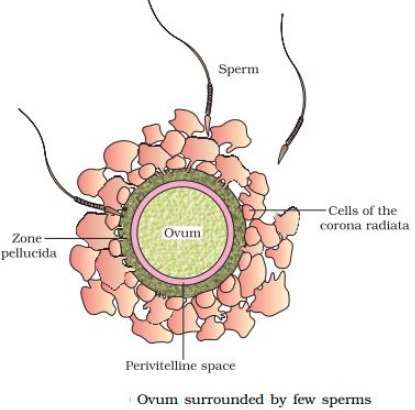
Where does fertilisation take place in human beings? What changes occur in the egg cell (ovum) during fertilisation?
Solution
(N/A) In humans,fertilisation takes place at the ampullary-isthmic junction of the fallopian tube.
During copulation,semen is released into the vagina. The motile sperm swim rapidly through the cervix and uterus to reach the ampullary-isthmic junction.
The ovum released by the ovary is also transported to the same junction. Fertilisation can only occur if the ovum and sperms are transported simultaneously to this site.
During fertilisation,the following changes occur in the ovum:
$1$. When a sperm comes in contact with the zona pellucida layer of the ovum,it induces changes in the membrane that block the entry of additional sperms,ensuring that only one sperm fertilises the ovum.
$2$. The secretions of the acrosome help the sperm enter the cytoplasm of the ovum through the zona pellucida and the plasma membrane.
$3$. This entry induces the completion of the second meiotic division of the secondary oocyte,which is an unequal division resulting in the formation of a second polar body and a haploid ovum (ootid).
$4$. Finally,the haploid nucleus of the sperm and the haploid nucleus of the ovum fuse together to form a diploid zygote.
During copulation,semen is released into the vagina. The motile sperm swim rapidly through the cervix and uterus to reach the ampullary-isthmic junction.
The ovum released by the ovary is also transported to the same junction. Fertilisation can only occur if the ovum and sperms are transported simultaneously to this site.
During fertilisation,the following changes occur in the ovum:
$1$. When a sperm comes in contact with the zona pellucida layer of the ovum,it induces changes in the membrane that block the entry of additional sperms,ensuring that only one sperm fertilises the ovum.
$2$. The secretions of the acrosome help the sperm enter the cytoplasm of the ovum through the zona pellucida and the plasma membrane.
$3$. This entry induces the completion of the second meiotic division of the secondary oocyte,which is an unequal division resulting in the formation of a second polar body and a haploid ovum (ootid).
$4$. Finally,the haploid nucleus of the sperm and the haploid nucleus of the ovum fuse together to form a diploid zygote.
0 likes
View Solution166
Medium
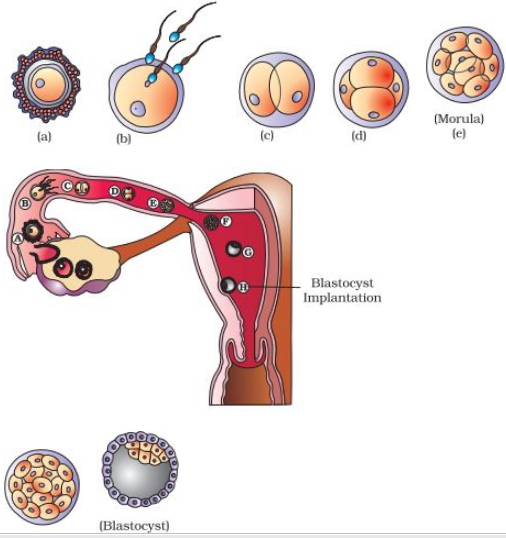
Describe the process of implantation of the embryo.
Solution
(N/A) As the zygote moves through the isthmus of the oviduct towards the uterus,it undergoes mitotic divisions called cleavage,forming $2, 4, 8,$ and $16$ daughter cells known as blastomeres.
The embryo containing $8$ to $16$ blastomeres is called a morula.
The morula continues to divide and moves further into the uterus,where it transforms into a blastocyst.
The blastomeres in the blastocyst are arranged into an outer layer called the trophoblast and an inner group of cells attached to the trophoblast called the inner cell mass.
The trophoblast layer then gets attached to the endometrium,and the inner cell mass gets differentiated as the embryo.
After attachment,the uterine cells divide rapidly and cover the blastocyst.
As a result,the blastocyst becomes embedded in the endometrium of the uterus. This process is called implantation and it leads to pregnancy.
The embryo containing $8$ to $16$ blastomeres is called a morula.
The morula continues to divide and moves further into the uterus,where it transforms into a blastocyst.
The blastomeres in the blastocyst are arranged into an outer layer called the trophoblast and an inner group of cells attached to the trophoblast called the inner cell mass.
The trophoblast layer then gets attached to the endometrium,and the inner cell mass gets differentiated as the embryo.
After attachment,the uterine cells divide rapidly and cover the blastocyst.
As a result,the blastocyst becomes embedded in the endometrium of the uterus. This process is called implantation and it leads to pregnancy.
0 likes
View Solution167
Medium
Give scientific reasons: Enzymes are secreted from the cells of trophoblast.
Solution
(N/A) Enzymes are secreted from the trophoblast cells to digest specific tissues and blood vessels of the uterine wall,which facilitates the process of implantation.
As the blastocyst reaches the uterus,the inner wall of the uterus (endometrium) develops and partially surrounds the embryo.
To ensure the embryo is firmly fixed to the uterine wall,the trophoblast cells release proteolytic enzymes that digest the endometrial lining.
This enzymatic action creates a site for the embryo to embed itself,a process known as implantation.
As the blastocyst reaches the uterus,the inner wall of the uterus (endometrium) develops and partially surrounds the embryo.
To ensure the embryo is firmly fixed to the uterine wall,the trophoblast cells release proteolytic enzymes that digest the endometrial lining.
This enzymatic action creates a site for the embryo to embed itself,a process known as implantation.
0 likes
View Solution168
MediumMCQ
What is the significance of the ampullary-isthmic junction in the female reproductive tract?
A
It is the site of implantation of the embryo.
B
It is the site where fertilization of the ovum occurs.
C
It is the site of oogenesis.
D
It is the site of sperm maturation.
Solution
(B) The ampullary-isthmic junction is the specific region in the fallopian tube (oviduct) where the sperm and the ovum meet.
Fertilization,which is the fusion of the male and female gametes to form a zygote,occurs at this junction.
Therefore,it is the most critical site for the initiation of pregnancy.
Fertilization,which is the fusion of the male and female gametes to form a zygote,occurs at this junction.
Therefore,it is the most critical site for the initiation of pregnancy.
0 likes
View Solution169
MediumMCQ
How does the $zona$ $pellucida$ of the ovum help in preventing polyspermy?
A
It secretes enzymes to digest the sperm.
B
It undergoes a chemical change that prevents other sperms from binding.
C
It physically blocks all sperms from entering the ovum.
D
It attracts only one sperm and repels others.
Solution
(B) During fertilization,when the first sperm comes in contact with the $zona$ $pellucida$ layer of the ovum,it induces changes in the membrane.
Specifically,the cortical granules present beneath the plasma membrane of the ovum release enzymes that alter the structure of the $zona$ $pellucida$.
This change,often referred to as the 'zona reaction',renders the $zona$ $pellucida$ impermeable to other sperms,thereby effectively preventing polyspermy.
Specifically,the cortical granules present beneath the plasma membrane of the ovum release enzymes that alter the structure of the $zona$ $pellucida$.
This change,often referred to as the 'zona reaction',renders the $zona$ $pellucida$ impermeable to other sperms,thereby effectively preventing polyspermy.
0 likes
View Solution170
MediumMCQ
Where does the first cleavage division of the zygote take place?
A
In the uterus
B
In the isthmus of the oviduct
C
In the infundibulum
D
In the ovary
Solution
(B) The first cleavage division of the zygote occurs in the isthmus of the oviduct (fallopian tube).
After approximately $30$ hours of fertilization,as the zygote moves from the isthmus towards the uterus,the mitotic division known as cleavage begins,eventually leading to the formation of the blastocyst.
After approximately $30$ hours of fertilization,as the zygote moves from the isthmus towards the uterus,the mitotic division known as cleavage begins,eventually leading to the formation of the blastocyst.
0 likes
View Solution171
EasyMCQ
What is fertilization?
A
Fusion of gametes
B
Transport of gametes
C
Gametogenesis
D
Degeneration of gametes
Solution
(A) Fertilization is the biological process involving the fusion of male and female gametes to form a diploid zygote. This process is a fundamental event in sexual reproduction,leading to the development of a new organism.
0 likes
View Solution172
EasyMCQ
What is the cell formed as a result of gamete fusion called?
A
Gamete mother cell
B
Male gamete
C
Female gamete
D
Zygote
Solution
(D) The process of fusion of male and female gametes is known as fertilization or syngamy. The product of this fusion is a diploid cell called a $Zygote$. This $Zygote$ acts as the vital link that ensures the continuity of species between organisms of one generation and the next.
0 likes
View Solution173
MediumMCQ
What is insemination?
A
Formation of testes
B
Formation of sperms
C
Release of sperms
D
Transfer of sperms into the female genital tract
Solution
(D) Insemination is defined as the process of transferring sperms from the male reproductive system into the female genital tract (vagina) during sexual intercourse. This is a crucial step in the process of human reproduction,as it allows the sperms to travel towards the fallopian tube for fertilization.
0 likes
View Solution174
MediumMCQ
The fusion of a sperm with which of the following results in the formation of a diploid zygote?
A
Secondary oocyte
B
Primary oocyte
C
Haploid ovum
D
Both $A$ and $C$
Solution
(D) In humans,the process of fertilization involves the fusion of a haploid sperm $(n)$ with a haploid female gamete.
During oogenesis,the secondary oocyte completes meiosis-$II$ only after the entry of the sperm.
Upon the entry of the sperm,the secondary oocyte undergoes the second meiotic division to form a haploid ovum (ootid) and a second polar body.
Subsequently,the haploid nucleus of the sperm and the haploid nucleus of the ovum fuse together to form a diploid zygote $(2n)$.
Since the secondary oocyte is the stage that receives the sperm and eventually leads to the formation of the ovum,both terms are biologically relevant in the context of the fertilization event leading to the zygote.
Therefore,the correct answer is $D$.
During oogenesis,the secondary oocyte completes meiosis-$II$ only after the entry of the sperm.
Upon the entry of the sperm,the secondary oocyte undergoes the second meiotic division to form a haploid ovum (ootid) and a second polar body.
Subsequently,the haploid nucleus of the sperm and the haploid nucleus of the ovum fuse together to form a diploid zygote $(2n)$.
Since the secondary oocyte is the stage that receives the sperm and eventually leads to the formation of the ovum,both terms are biologically relevant in the context of the fertilization event leading to the zygote.
Therefore,the correct answer is $D$.
0 likes
View Solution175
MediumMCQ
When and from what is the fertilization membrane formed?
A
Before fertilization from the secondary oocyte
B
After fertilization from the secondary oocyte
C
Before fertilization from the zona pellucida
D
After fertilization from the zona pellucida
Solution
(D) The fertilization membrane is a protective layer that forms around the egg immediately after the entry of a sperm to prevent polyspermy.
During the process of fertilization,the cortical granules present in the egg cytoplasm release their contents into the perivitelline space.
These contents interact with the $Zona \ Pellucida$ to harden it,thereby transforming it into the fertilization membrane.
Therefore,this process occurs after fertilization and involves the modification of the $Zona \ Pellucida$.
During the process of fertilization,the cortical granules present in the egg cytoplasm release their contents into the perivitelline space.
These contents interact with the $Zona \ Pellucida$ to harden it,thereby transforming it into the fertilization membrane.
Therefore,this process occurs after fertilization and involves the modification of the $Zona \ Pellucida$.
0 likes
View Solution176
MediumMCQ
What is the process of division of the zygote into blastomeres called?
A
Cleavage
B
Fragmentation
C
Differentiation
D
Morula
Solution
(A) The process of rapid mitotic cell division of the zygote as it moves through the isthmus of the oviduct towards the uterus is called $Cleavage$. This process results in the formation of daughter cells known as $blastomeres$.
0 likes
View Solution177
MediumMCQ
What are the outer layer cells of the blastocyst called?
A
Inner cell mass
B
Blastomere
C
Trophoblast
D
Both $A$ and $C$
Solution
(C) The blastocyst is an early stage of embryonic development in mammals.
It consists of an outer layer of cells called the $Trophoblast$ and an inner group of cells attached to the trophoblast known as the $Inner cell mass$.
The trophoblast layer eventually forms the extra-embryonic membranes and the placenta,while the inner cell mass gives rise to the embryo proper.
It consists of an outer layer of cells called the $Trophoblast$ and an inner group of cells attached to the trophoblast known as the $Inner cell mass$.
The trophoblast layer eventually forms the extra-embryonic membranes and the placenta,while the inner cell mass gives rise to the embryo proper.
0 likes
View Solution178
MediumMCQ
Which part of the embryo is responsible for its implantation in the uterus?
A
Blastomere
B
Blastocyst
C
Inner cell mass
D
Trophoblast
Solution
(D) The process of implantation involves the attachment of the embryo to the uterine wall.
In humans,the embryo reaches the uterus as a blastocyst.
The outer layer of the blastocyst,known as the trophoblast,attaches to the endometrium of the uterus.
Therefore,the trophoblast cells are responsible for the implantation of the embryo into the uterine wall.
In humans,the embryo reaches the uterus as a blastocyst.
The outer layer of the blastocyst,known as the trophoblast,attaches to the endometrium of the uterus.
Therefore,the trophoblast cells are responsible for the implantation of the embryo into the uterine wall.
0 likes
View Solution179
MediumMCQ
Which part of the sperm enters the ovum during fertilization in humans?
A
Only the head
B
Acrosome and middle piece
C
The entire sperm
D
Cannot be determined
Solution
(B) During the process of fertilization in humans,the sperm makes contact with the zona pellucida layer of the ovum. The acrosome of the sperm releases enzymes that help it penetrate the egg. Upon fusion of the sperm and egg plasma membranes,the head and the middle piece of the sperm enter the cytoplasm of the ovum. The tail is usually left outside or degenerates. Therefore,the head (containing the nucleus) and the middle piece (containing mitochondria) enter the ovum.
0 likes
View Solution180
MediumMCQ
Which of the following does $NOT$ occur during the process of cleavage?
A
Increase in the number of cells
B
Maintenance of the size of the zygote
C
Decrease in the amount of $DNA$
D
Decrease in the size of cells
Solution
(C) Cleavage is a series of rapid mitotic divisions of the zygote that converts a single-celled zygote into a multicellular structure called a blastocyst.
During cleavage,the total volume of the embryo remains constant,and the size of the zygote does not increase.
As the number of cells (blastomeres) increases,the size of each individual cell decreases.
However,the amount of $DNA$ per cell remains constant,and the total amount of $DNA$ in the embryo increases because each cell division is preceded by $DNA$ replication.
Therefore,the amount of $DNA$ does not decrease; it increases.
During cleavage,the total volume of the embryo remains constant,and the size of the zygote does not increase.
As the number of cells (blastomeres) increases,the size of each individual cell decreases.
However,the amount of $DNA$ per cell remains constant,and the total amount of $DNA$ in the embryo increases because each cell division is preceded by $DNA$ replication.
Therefore,the amount of $DNA$ does not decrease; it increases.
0 likes
View Solution181
MediumMCQ
How many times does the zygote undergo cleavage to reach the morula stage?
A
$8$
B
$6$
C
$4$
D
$2$
Solution
(C) The zygote undergoes successive mitotic divisions called cleavage as it moves through the isthmus of the oviduct towards the uterus.
Cleavage results in the formation of $2, 4, 8,$ and $16$ daughter cells called blastomeres.
The embryo with $8$ to $16$ blastomeres is called a morula.
To reach the $16$-celled stage (morula),the zygote undergoes $4$ rounds of cleavage $(2^4 = 16)$.
Therefore,the correct answer is $4$.
Cleavage results in the formation of $2, 4, 8,$ and $16$ daughter cells called blastomeres.
The embryo with $8$ to $16$ blastomeres is called a morula.
To reach the $16$-celled stage (morula),the zygote undergoes $4$ rounds of cleavage $(2^4 = 16)$.
Therefore,the correct answer is $4$.
0 likes
View Solution182
MediumMCQ
Which lytic enzyme present in the sperm helps in penetrating the corona radiata during fertilization?
A
Hyaluronidase
B
Zona lysin
C
Hyaluronic acid
D
Both $A$ and $B$
Solution
(D) During the process of fertilization,the sperm head releases enzymes from the acrosome to penetrate the layers surrounding the ovum.
$1$. The corona radiata is composed of follicular cells held together by hyaluronic acid.
$2$. The enzyme $Hyaluronidase$ (also known as sperm lysin) digests this hyaluronic acid,allowing the sperm to pass through the corona radiata.
$3$. Once the sperm reaches the zona pellucida,it releases $Zona$ $lysin$ (acrosin) to penetrate that layer.
$4$. Since both enzymes are involved in the sequential penetration of the ovum's protective layers,the correct answer is $D$.
$1$. The corona radiata is composed of follicular cells held together by hyaluronic acid.
$2$. The enzyme $Hyaluronidase$ (also known as sperm lysin) digests this hyaluronic acid,allowing the sperm to pass through the corona radiata.
$3$. Once the sperm reaches the zona pellucida,it releases $Zona$ $lysin$ (acrosin) to penetrate that layer.
$4$. Since both enzymes are involved in the sequential penetration of the ovum's protective layers,the correct answer is $D$.
0 likes
View Solution183
MediumMCQ
The process of fusion of a sperm (male gamete) and an ovum (female gamete) is called?
A
Parthenogenesis
B
Plasmogamy
C
Karyogamy
D
Fertilization
Solution
(D) The process of fusion of a male gamete (sperm) and a female gamete (ovum) is known as fertilization.
This process results in the formation of a diploid zygote.
Parthenogenesis is the development of an embryo without fertilization.
Plasmogamy is the fusion of cytoplasm of two cells.
Karyogamy is the fusion of two nuclei.
This process results in the formation of a diploid zygote.
Parthenogenesis is the development of an embryo without fertilization.
Plasmogamy is the fusion of cytoplasm of two cells.
Karyogamy is the fusion of two nuclei.
0 likes
View Solution184
EasyMCQ
What is an ectopic pregnancy?
A
Implantation of the embryo in the uterus
B
Delivery in the $7^{th}$ month
C
Implantation of the embryo at a site other than the uterus
D
Delivery in the $10^{th}$ month
Solution
(C) An ectopic pregnancy occurs when a fertilized egg implants and grows outside the main cavity of the uterus. Most ectopic pregnancies occur in a fallopian tube,which carries eggs from the ovaries to the uterus. This type of pregnancy is not viable and can pose serious health risks to the mother if not treated promptly.
0 likes
View Solution185
MediumMCQ
Identify the part labeled as $a$ in the given figure.

A
Zona pellucida
B
Corona radiata cells
C
Ovum
D
Perivitelline space
Solution
(B) The given figure represents an ovum surrounded by sperm cells during the process of fertilization.
In the diagram,the outermost layer of cells surrounding the ovum is the corona radiata.
The label $a$ points to these follicular cells that are attached to the zona pellucida.
Therefore,the part labeled as $a$ is the corona radiata cells.
In the diagram,the outermost layer of cells surrounding the ovum is the corona radiata.
The label $a$ points to these follicular cells that are attached to the zona pellucida.
Therefore,the part labeled as $a$ is the corona radiata cells.
0 likes
View Solution186
MediumMCQ
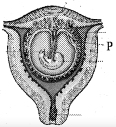
Identify $P$ from the parts shown in the given figure.
A
Placental villi
B
Embryo
C
Yolk sac
D
Uterine cavity
Solution
(A) The given figure represents the human fetus within the uterus.
In this diagram,the label $P$ points to the placental villi,which are finger-like projections that extend from the chorion into the uterine tissue to facilitate the exchange of nutrients,oxygen,and waste products between the mother and the fetus.
Therefore,the correct option is $A$.
In this diagram,the label $P$ points to the placental villi,which are finger-like projections that extend from the chorion into the uterine tissue to facilitate the exchange of nutrients,oxygen,and waste products between the mother and the fetus.
Therefore,the correct option is $A$.
0 likes
View Solution187
EasyMCQ
Where does capacitation occur?
A
Epididymis
B
Fallopian tube
C
Vagina
D
Testis
Solution
(C) Capacitation is the physiological maturation process of spermatozoa that occurs after they have been deposited in the female reproductive tract.
Specifically, it takes place in the $\text{female reproductive tract}$, primarily within the $\text{vagina}$ and the $\text{uterus}$ / $\text{fallopian tubes}$.
Among the given options, the $\text{vagina}$ is the site where the process begins upon entry of the sperm into the female reproductive system.
Specifically, it takes place in the $\text{female reproductive tract}$, primarily within the $\text{vagina}$ and the $\text{uterus}$ / $\text{fallopian tubes}$.
Among the given options, the $\text{vagina}$ is the site where the process begins upon entry of the sperm into the female reproductive system.
0 likes
View Solution188
MediumMCQ
What is an ectopic pregnancy?
A
Implantation of the embryo in the fallopian tube instead of the uterus
B
Infertility
C
Cancer of the reproductive tract
D
All of the above
Solution
(A) An ectopic pregnancy occurs when a fertilized egg implants and grows outside the main cavity of the uterus.
Most ectopic pregnancies occur in a fallopian tube,which is why they are sometimes called tubal pregnancies.
In this condition,the embryo cannot develop normally and it can cause life-threatening bleeding if left untreated.
Therefore,the correct option is $A$.
Most ectopic pregnancies occur in a fallopian tube,which is why they are sometimes called tubal pregnancies.
In this condition,the embryo cannot develop normally and it can cause life-threatening bleeding if left untreated.
Therefore,the correct option is $A$.
0 likes
View Solution189
MediumMCQ
Identify the correct statement regarding fertilization.
A
$Labeo$ - Internal fertilization
B
Frog - Internal fertilization
C
Birds - External fertilization
D
$Balaenoptera$ - Internal fertilization
Solution
(D) The correct option is $(D)$.
$Labeo$ (Rohu fish) exhibits external fertilization.
Frogs exhibit external fertilization.
Birds exhibit internal fertilization.
$Balaenoptera$ (Blue whale) is a mammal and exhibits internal fertilization.
$Labeo$ (Rohu fish) exhibits external fertilization.
Frogs exhibit external fertilization.
Birds exhibit internal fertilization.
$Balaenoptera$ (Blue whale) is a mammal and exhibits internal fertilization.
0 likes
View Solution190
EasyMCQ
In oviparous individuals,the fertilized egg is covered by
A
Sodium shell
B
Phosphorus cell
C
Both $(a)$ and $(b)$
D
Hard calcareous shell
Solution
(D) Oviparous animals lay eggs that are protected by a hard outer covering. This protective layer is a hard calcareous shell,which is primarily composed of calcium carbonate $(CaCO_3)$. This shell provides protection to the developing embryo from environmental stress and desiccation.
0 likes
View Solution191
EasyMCQ
The part where fertilization of the ovum takes place in rabbits,humans,and other placental mammals is:
A
Ovary
B
Uterus
C
Vagina
D
Fallopian tube
Solution
(D) In placental mammals,including humans and rabbits,fertilization is the process where the sperm fuses with the ovum. This biological event occurs in the ampullary region of the Fallopian tube (also known as the oviduct). The ovum is released from the ovary and travels into the Fallopian tube,where it meets the sperm. Therefore,the correct site for fertilization is the Fallopian tube.
0 likes
View Solution192
MediumMCQ
Insemination is
A
$A$ sperm injection to increase male fertility
B
$A$ cure of male infertility
C
Inability of male to produce sperms
D
The transfer of sperms by male into the genital tract of female
Solution
(D) Insemination is defined as the transfer of sperms by the male into the genital tract of the female.
The major reproductive events in human beings are as follows:
$(i)$ Gametogenesis: It is the formation of gametes (spermatogenesis and oogenesis).
$(ii)$ Insemination: It is the transfer of sperms by the male into the genital tract of the female.
$(iii)$ Fertilization: Fusion of male and female gametes to form a zygote.
$(iv)$ Cleavage: Rapid mitotic divisions of the zygote to form a blastocyst.
$(v)$ Implantation: Attachment of the blastocyst to the uterine wall.
$(vi)$ Placentation: Formation of the placenta for exchange of materials between the foetus and mother.
$(vii)$ Gastrulation: Transformation of the blastocyst into a gastrula with three primary germ layers.
$(viii)$ Organogenesis: Formation of tissues,organs,and organ systems.
$(ix)$ Parturition: The process of childbirth or expelling the baby from the uterus.
The major reproductive events in human beings are as follows:
$(i)$ Gametogenesis: It is the formation of gametes (spermatogenesis and oogenesis).
$(ii)$ Insemination: It is the transfer of sperms by the male into the genital tract of the female.
$(iii)$ Fertilization: Fusion of male and female gametes to form a zygote.
$(iv)$ Cleavage: Rapid mitotic divisions of the zygote to form a blastocyst.
$(v)$ Implantation: Attachment of the blastocyst to the uterine wall.
$(vi)$ Placentation: Formation of the placenta for exchange of materials between the foetus and mother.
$(vii)$ Gastrulation: Transformation of the blastocyst into a gastrula with three primary germ layers.
$(viii)$ Organogenesis: Formation of tissues,organs,and organ systems.
$(ix)$ Parturition: The process of childbirth or expelling the baby from the uterus.
0 likes
View Solution193
MediumMCQ
In human beings,normally in which one of the following parts does the sperm fertilize the ovum?
A
Cervix
B
Fallopian tube
C
Lower part of uterus
D
Upper part of uterus
Solution
(B) In humans,fertilization occurs in the $ampullary$ region of the $Fallopian$ $tube$ (oviduct).
During fertilization,the sperm and ovum are transported to the $ampullary-isthmic$ junction,where they fuse to form a $zygote$.
The embryo then travels down the $Fallopian$ $tube$ and develops up to the $blastocyst$ stage before implantation in the uterus.
During fertilization,the sperm and ovum are transported to the $ampullary-isthmic$ junction,where they fuse to form a $zygote$.
The embryo then travels down the $Fallopian$ $tube$ and develops up to the $blastocyst$ stage before implantation in the uterus.
0 likes
View Solution194
MediumMCQ
Implantation is:
A
Attachment of blastocyst to uterine wall
B
Division of blastocyst
C
Formation of organs
D
An $IVF$ technique
Solution
(A) Implantation is the process of attachment of the blastocyst to the uterine wall of the mother.
Following fertilization,the zygote undergoes cleavage to form a multicellular structure called the blastocyst.
This blastocyst then embeds itself into the endometrium (uterine wall),a process known as implantation,which leads to pregnancy.
Other reproductive events include:
$(i)$ Gametogenesis: Formation of gametes.
$(ii)$ Insemination: Transfer of sperms into the female genital tract.
$(iii)$ Fertilization: Fusion of male and female gametes to form a zygote.
$(iv)$ Cleavage: Rapid mitotic divisions of the zygote.
$(v)$ Placentation: Formation of the placenta.
$(vi)$ Gastrulation: Formation of three primary germ layers.
$(vii)$ Organogenesis: Formation of organs and organ systems.
$(viii)$ Parturition: Childbirth.
Following fertilization,the zygote undergoes cleavage to form a multicellular structure called the blastocyst.
This blastocyst then embeds itself into the endometrium (uterine wall),a process known as implantation,which leads to pregnancy.
Other reproductive events include:
$(i)$ Gametogenesis: Formation of gametes.
$(ii)$ Insemination: Transfer of sperms into the female genital tract.
$(iii)$ Fertilization: Fusion of male and female gametes to form a zygote.
$(iv)$ Cleavage: Rapid mitotic divisions of the zygote.
$(v)$ Placentation: Formation of the placenta.
$(vi)$ Gastrulation: Formation of three primary germ layers.
$(vii)$ Organogenesis: Formation of organs and organ systems.
$(viii)$ Parturition: Childbirth.
0 likes
View Solution195
EasyMCQ
The enzyme present in the sperm acrosome to dissolve the egg membrane is:
A
Sperm lysin
B
Ovolysin
C
Spermatogenolysin
D
Spermatocynin
Solution
(A) The enzymes present in the sperm acrosome are collectively known as sperm lysins. These include:
$(i)$ Hyaluronidase: Acts on the ground substance of follicle cells.
$(ii)$ Corona penetrating enzyme: Dissolves the corona radiata.
$(iii)$ Zona lysin or acrosin: It helps to digest the zona pellucida,allowing the sperm to penetrate the egg membrane.
$(i)$ Hyaluronidase: Acts on the ground substance of follicle cells.
$(ii)$ Corona penetrating enzyme: Dissolves the corona radiata.
$(iii)$ Zona lysin or acrosin: It helps to digest the zona pellucida,allowing the sperm to penetrate the egg membrane.
0 likes
View Solution196
MediumMCQ
Fertilization is
A
Fission of sperm and ova
B
Fusion of sperm and ova
C
Zygote formation
D
Gamete formation
Solution
(B) Fertilization is the fusion of a sperm and an ovum.
$1$. The process of fusion of a sperm (male gamete) with an ovum (female gamete) is called fertilization.
$2$. During coitus,semen is released by the penis into the vagina (insemination).
$3$. The motile sperms swim rapidly through the cervix,enter into the uterus,and reach the ampullary-isthmic junction of the oviduct,which is the site of fertilization.
$4$. $A$ sperm comes in contact with the zona pellucida layer of the ovum and induces changes in the membrane to block the entry of additional sperms.
$5$. The enzymes of the acrosome of the sperm help to dissolve the zona pellucida and plasma membrane of the ovum,allowing the sperm head to enter the cytoplasm of the ovum (secondary oocyte).
$6$. Ultimately,a diploid zygote is produced by the fusion of the haploid sperm and ovum.
$1$. The process of fusion of a sperm (male gamete) with an ovum (female gamete) is called fertilization.
$2$. During coitus,semen is released by the penis into the vagina (insemination).
$3$. The motile sperms swim rapidly through the cervix,enter into the uterus,and reach the ampullary-isthmic junction of the oviduct,which is the site of fertilization.
$4$. $A$ sperm comes in contact with the zona pellucida layer of the ovum and induces changes in the membrane to block the entry of additional sperms.
$5$. The enzymes of the acrosome of the sperm help to dissolve the zona pellucida and plasma membrane of the ovum,allowing the sperm head to enter the cytoplasm of the ovum (secondary oocyte).
$6$. Ultimately,a diploid zygote is produced by the fusion of the haploid sperm and ovum.
0 likes
View Solution197
EasyMCQ
After implantation,finger-like projections on the trophoblast are called $...A....$ which are surrounded by $...B..$ and maternal blood. Here $A$ and $B$ refers to
A
$A-chorion; B-foetal\; cell$
B
$A-chorionic\; villi; B-uterine\; tissue$
C
$A-uterine\; tissue; B-chorionic\; villi$
D
$A-foetal\; cell; B-chorion$
Solution
(B) After implantation,the trophoblast cells form finger-like projections known as $A-chorionic\; villi$.
These villi are surrounded by $B-uterine\; tissue$ and maternal blood.
This structure facilitates the exchange of nutrients,gases,and waste between the mother and the developing foetus,eventually forming the placenta.
These villi are surrounded by $B-uterine\; tissue$ and maternal blood.
This structure facilitates the exchange of nutrients,gases,and waste between the mother and the developing foetus,eventually forming the placenta.
0 likes
View Solution198
EasyMCQ
Ovum receives the sperm in the region of
A
Animal pole
B
Vegetal pole
C
Equator
D
Pigmented area
Solution
(A) The ovum receives the sperm in the region of the animal pole.
During fertilization,the sperm head makes contact with the plasma membrane of the ovum at the animal pole.
The sperm then fuses with the ovum to form a diploid zygote.
The pole of the ovum opposite to the animal pole is known as the vegetal pole,which typically contains the yolk.
During fertilization,the sperm head makes contact with the plasma membrane of the ovum at the animal pole.
The sperm then fuses with the ovum to form a diploid zygote.
The pole of the ovum opposite to the animal pole is known as the vegetal pole,which typically contains the yolk.
0 likes
View SolutionHuman Reproduction — Fertilisation and Implantation · Frequently Asked Questions
1Are these Human Reproduction questions useful for JEE and NEET?
Yes. All questions in this section are mapped to JEE Main and NEET exam patterns. Previous year questions from JEE Main, NEET, GUJCET and state-level exams are included with full solutions.
2Can I switch to Hindi or Gujarati for these questions?
Yes. Use the language tabs in the hero section or the sidebar to view the same questions and solutions in English, Hindi or Gujarati.
3How do I generate a question paper from this subtopic?
Use the Vedclass Exam Paper Generator — select the chapter and subtopic, set difficulty, and generate Sets A, B, C, D automatically. First 3 chapters of every subject are free.
Vedclass Products
For Students
Vedclass Test Series
Mock tests in real JEE/NEET style with performance analysis. 5-day free trial.
Start Free TrialFor Teachers
Exam Paper Generator
Generate Set A/B/C/D papers from this chapter in 2 minutes. 3 chapters free.
Try FreeFor Institutes
Online Exam Module
Live online exams with unlimited students, 360° analytics & white-label branding.
See DemoFor Teachers & Institutes
Generate a Human Reproduction Exam Paper in 2 Minutes
Select subtopic & difficulty — Sets A, B, C, D auto-generated with No Repeat logic.
First 3 chapters of every subject are free — no payment required.