
A English
Immunity Questions in English
Class 12 Biology · Human Health and Disease · Immunity
636+
Questions
English
Language
100%
With Solutions
Showing 50 of 636 questions in English
551
Medium
What are the two corollaries related to the immune system?
Solution
(N/A) The two corollaries of the immune system's ability to differentiate between self and non-self are:
$1$. Higher vertebrates can distinguish between foreign molecules as well as foreign organisms. Most of experimental immunology is based on this aspect.
$2$. Sometimes,due to genetic or other unknown reasons,the body attacks its own cells. This results in damage to the body and is known as an autoimmune disease. An example of this is rheumatoid arthritis.
$1$. Higher vertebrates can distinguish between foreign molecules as well as foreign organisms. Most of experimental immunology is based on this aspect.
$2$. Sometimes,due to genetic or other unknown reasons,the body attacks its own cells. This results in damage to the body and is known as an autoimmune disease. An example of this is rheumatoid arthritis.
0 likes
View Solution552
Medium
Differentiate between $T$-lymphocytes and $B$-lymphocytes.
Solution
(N/A)
| $T$-lymphocytes | $B$-lymphocytes |
| $(1)$ They form the cell-mediated immune system $(CMIS)$. | $(1)$ They form the humoral or antibody-mediated immune system $(AMIS)$. |
| $(2)$ They fight against pathogens,including intracellular parasites,viruses,and fungi that infect cells. | $(2)$ They fight against pathogens like bacteria and viruses that circulate in blood and lymph. |
| $(3)$ Upon activation,they differentiate into killer $(cytotoxic)$,helper,and suppressor $T$-cells. | $(3)$ Upon activation,they differentiate into plasma cells (which produce antibodies) and memory $B$-cells. |
0 likes
View Solution553
Medium
Give scientific reasons: Autoimmune diseases are different from immune deficiency diseases.
Solution
(N/A) Autoimmune diseases occur when the body's immune system loses the ability to distinguish between self and non-self cells,leading it to attack the body's own healthy tissues. An example is rheumatoid arthritis.
In contrast,immune deficiency diseases occur when the body's immune system is weakened or compromised,resulting in an inability to fight off pathogens effectively,which leads to recurrent infections and poor healing. An example is $AIDS$.
In contrast,immune deficiency diseases occur when the body's immune system is weakened or compromised,resulting in an inability to fight off pathogens effectively,which leads to recurrent infections and poor healing. An example is $AIDS$.
0 likes
View Solution554
Medium
Give scientific reasons: Virus-infected cells provide innate immunity to other cells.
Solution
(N/A) Virus-infected cells release proteins called interferons. These interferons are secreted into the extracellular space and bind to receptors on neighboring,uninfected cells. This binding triggers the uninfected cells to produce antiviral proteins that inhibit viral replication,thereby protecting them from further viral infection. This mechanism is a component of cytokine-mediated innate immunity.
0 likes
View Solution555
Medium
What constitutes the immune system and what role does it play in the human body?
Solution
(N/A) The human immune system consists of lymphoid organs,tissues,cells,and soluble molecules like antibodies.
The immune system is unique in the sense that it recognizes foreign antigens,responds to them,and remembers them.
The immune system also plays an important role in allergic reactions,autoimmune diseases,and organ transplantation.
The immune system is unique in the sense that it recognizes foreign antigens,responds to them,and remembers them.
The immune system also plays an important role in allergic reactions,autoimmune diseases,and organ transplantation.
0 likes
View Solution556
DifficultMCQ
Given below are two statements:
Statement $I:$ Autoimmune disorder is a condition where the body's defense mechanism recognizes its own cells as foreign bodies.
Statement $II:$ Rheumatoid arthritis is a condition where the body does not attack self-cells.
In the light of the above statements,choose the most appropriate answer from the options given below:
Statement $I:$ Autoimmune disorder is a condition where the body's defense mechanism recognizes its own cells as foreign bodies.
Statement $II:$ Rheumatoid arthritis is a condition where the body does not attack self-cells.
In the light of the above statements,choose the most appropriate answer from the options given below:
A
Both Statement $I$ and Statement $II$ are incorrect.
B
Statement $I$ is correct but Statement $II$ is incorrect.
C
Statement $I$ is incorrect but Statement $II$ is correct.
D
Both Statement $I$ and Statement $II$ are correct.
Solution
(B) Statement $I$ is correct because autoimmune disorders occur when the immune system loses the ability to distinguish between 'self' and 'non-self' cells,leading it to attack the body's own healthy tissues.
Statement $II$ is incorrect because Rheumatoid arthritis is a classic example of an autoimmune disease where the body's immune system attacks its own cells,specifically the synovial membrane in the joints.
Therefore,Statement $I$ is correct and Statement $II$ is incorrect.
Statement $II$ is incorrect because Rheumatoid arthritis is a classic example of an autoimmune disease where the body's immune system attacks its own cells,specifically the synovial membrane in the joints.
Therefore,Statement $I$ is correct and Statement $II$ is incorrect.
0 likes
View Solution557
MediumMCQ
Select the incorrect statement with respect to acquired immunity.
A
Anamnestic response is elicited on subsequent encounters with the same pathogen.
B
Anamnestic response is due to memory of first encounter.
C
Acquired immunity is non-specific type of defense present at the time of birth.
D
Primary response is produced when our body encounters a pathogen for the first time.
Solution
(C) Acquired immunity is pathogen-specific and is characterized by memory. It is not present at birth but develops during an individual's lifetime after exposure to pathogens or vaccines.
In contrast,innate immunity is non-specific and is present at the time of birth.
Therefore,the statement 'Acquired immunity is non-specific type of defense present at the time of birth' is incorrect.
In contrast,innate immunity is non-specific and is present at the time of birth.
Therefore,the statement 'Acquired immunity is non-specific type of defense present at the time of birth' is incorrect.
0 likes
View Solution558
MediumMCQ
Which cells are responsible for the immune response of the body?
A
Monocytes
B
Lymphocytes
C
Neutrophils
D
Eosinophils
Solution
(B) Lymphocytes are the cells responsible for the immune response of the body.
They are of two main types: $B$-lymphocytes and $T$-lymphocytes.
$B$-lymphocytes produce antibodies to fight pathogens,while $T$-lymphocytes help $B$-cells and directly attack infected cells.
Monocytes and neutrophils are phagocytic cells involved in innate immunity.
Eosinophils are associated with allergic reactions and parasitic infections.
They are of two main types: $B$-lymphocytes and $T$-lymphocytes.
$B$-lymphocytes produce antibodies to fight pathogens,while $T$-lymphocytes help $B$-cells and directly attack infected cells.
Monocytes and neutrophils are phagocytic cells involved in innate immunity.
Eosinophils are associated with allergic reactions and parasitic infections.
0 likes
View Solution559
EasyMCQ
Interferons are secreted by which of the following?
A
Virus
B
Virus-infected cells
C
Bacteria
D
Bacteria-infected cells
Solution
(B) Interferons $(IFNs)$ are a group of signaling proteins made and released by host cells in response to the presence of several viruses.
When a cell is infected by a virus,it secretes interferons to protect neighboring healthy cells from further viral infection.
These proteins bind to receptors on uninfected cells,inducing them to produce antiviral proteins that inhibit viral replication.
Therefore,interferons are secreted by virus-infected cells.
When a cell is infected by a virus,it secretes interferons to protect neighboring healthy cells from further viral infection.
These proteins bind to receptors on uninfected cells,inducing them to produce antiviral proteins that inhibit viral replication.
Therefore,interferons are secreted by virus-infected cells.
0 likes
View Solution560
MediumMCQ
Match the following columns:
| Column-$I$ | Column-$II$ |
|---|---|
| $P$. Physical barriers | $I$. Acid in stomach,saliva in mouth,tears from eyes |
| $Q$. Physiological barriers | $II$. Skin,mucus coating of epithelium lining the respiratory,gastrointestinal and urogenital tracts |
| $R$. Cellular barriers | $III$. Interferons |
| $S$. Cytokine barriers | $IV$. Polymorphonuclear leukocytes ($PMNL$-neutrophils),monocytes,$NK$ cells,macrophages |
A
$P-I, Q-II, R-III, S-IV$
B
$P-II, Q-I, R-III, S-IV$
C
$P-II, Q-I, R-IV, S-III$
D
$P-I, Q-II, R-IV, S-III$
Solution
(C) The innate immunity consists of four types of barriers:
$1$. Physical barriers: The skin on our body is the main barrier which prevents entry of the micro-organisms. Also,mucus coating of the epithelium lining the respiratory,gastrointestinal,and urogenital tracts helps in trapping microbes entering our body $(P-II)$.
$2$. Physiological barriers: Acid in the stomach,saliva in the mouth,and tears from eyes prevent microbial growth $(Q-I)$.
$3$. Cellular barriers: Certain types of leukocytes $(WBC)$ of our body like polymorphonuclear leukocytes ($PMNL$-neutrophils),monocytes,natural killer $(NK)$ cells,and macrophages phagocytose and destroy microbes $(R-IV)$.
$4$. Cytokine barriers: Virus-infected cells secrete proteins called interferons which protect non-infected cells from further viral infection $(S-III)$.
Thus,the correct matching is $P-II, Q-I, R-IV, S-III$.
$1$. Physical barriers: The skin on our body is the main barrier which prevents entry of the micro-organisms. Also,mucus coating of the epithelium lining the respiratory,gastrointestinal,and urogenital tracts helps in trapping microbes entering our body $(P-II)$.
$2$. Physiological barriers: Acid in the stomach,saliva in the mouth,and tears from eyes prevent microbial growth $(Q-I)$.
$3$. Cellular barriers: Certain types of leukocytes $(WBC)$ of our body like polymorphonuclear leukocytes ($PMNL$-neutrophils),monocytes,natural killer $(NK)$ cells,and macrophages phagocytose and destroy microbes $(R-IV)$.
$4$. Cytokine barriers: Virus-infected cells secrete proteins called interferons which protect non-infected cells from further viral infection $(S-III)$.
Thus,the correct matching is $P-II, Q-I, R-IV, S-III$.
0 likes
View Solution561
EasyMCQ
Which cells are responsible for producing antibodies?
A
$B$ - Erythrocytes
B
$T$ - Lymphocytes
C
Virus-infected cells
D
$B$ - Lymphocytes
Solution
(D) Antibodies are specialized proteins produced by the immune system to identify and neutralize foreign objects like bacteria and viruses.
In the human body,$B$-lymphocytes (or $B$-cells) are the specific type of white blood cells responsible for the production of antibodies.
Upon activation by an antigen,$B$-cells differentiate into plasma cells,which then secrete large quantities of antibodies into the blood and lymph.
Therefore,the correct option is $D$.
In the human body,$B$-lymphocytes (or $B$-cells) are the specific type of white blood cells responsible for the production of antibodies.
Upon activation by an antigen,$B$-cells differentiate into plasma cells,which then secrete large quantities of antibodies into the blood and lymph.
Therefore,the correct option is $D$.
0 likes
View Solution562
MediumMCQ
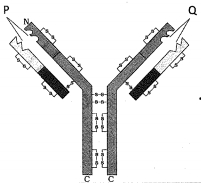
What are $P$ and $Q$ in the given structure?
A
Substrate binding site
B
Antigen binding site
C
Antibody binding site
D
All of the above
Solution
(B) The given structure represents an antibody molecule,which is $Y$-shaped.
It consists of four polypeptide chains: two light chains and two heavy chains.
The variable regions at the tips of the $Y$-shaped structure,labeled as $P$ and $Q$,are the specific sites where antigens bind to the antibody.
Therefore,$P$ and $Q$ represent the antigen binding sites.
It consists of four polypeptide chains: two light chains and two heavy chains.
The variable regions at the tips of the $Y$-shaped structure,labeled as $P$ and $Q$,are the specific sites where antigens bind to the antibody.
Therefore,$P$ and $Q$ represent the antigen binding sites.
0 likes
View Solution563
MediumMCQ
Graft rejection is caused by which of the following?
A
Humoral immune response
B
Passive immunity
C
Cell-mediated immune response
D
Active immunity
Solution
(C) Graft rejection occurs when the recipient's immune system recognizes the transplanted tissue or organ as 'non-self' or foreign.
This process is primarily mediated by $T$-lymphocytes,which are the key components of the cell-mediated immune response.
These $T$-cells identify the foreign antigens on the surface of the graft cells and initiate an immune attack to destroy the transplanted tissue.
Therefore,the cell-mediated immune response is responsible for graft rejection.
This process is primarily mediated by $T$-lymphocytes,which are the key components of the cell-mediated immune response.
These $T$-cells identify the foreign antigens on the surface of the graft cells and initiate an immune attack to destroy the transplanted tissue.
Therefore,the cell-mediated immune response is responsible for graft rejection.
0 likes
View Solution564
EasyMCQ
Which antibody is present in the highest concentration in mother's milk?
A
$IgA$
B
$IgG$
C
$IgM$
D
$IgE$
Solution
(A) Colostrum,the yellowish fluid secreted by the mother during the initial days of lactation,is rich in several protective antibodies.
Among these,$IgA$ (Immunoglobulin $A$) is the most abundant antibody present in mother's milk.
It provides essential passive immunity to the newborn infant,protecting them from various gastrointestinal infections.
Among these,$IgA$ (Immunoglobulin $A$) is the most abundant antibody present in mother's milk.
It provides essential passive immunity to the newborn infant,protecting them from various gastrointestinal infections.
0 likes
View Solution565
MediumMCQ
In vaccination,inactive or dead antigens are introduced into the body. What type of immunity is this?
A
Passive immunity
B
Active immunity
C
Both
D
None of these
Solution
(B) Vaccination involves the introduction of weakened or dead pathogens (antigens) into the body to stimulate the immune system.
When the immune system encounters these antigens,it recognizes them as foreign and produces specific antibodies and memory cells against them.
Since the body's own immune system is actively involved in producing these antibodies,this process is known as $Active \ immunity$.
Passive immunity,on the other hand,involves the direct transfer of ready-made antibodies (e.g.,through colostrum or antitoxins),which is not the case in vaccination.
When the immune system encounters these antigens,it recognizes them as foreign and produces specific antibodies and memory cells against them.
Since the body's own immune system is actively involved in producing these antibodies,this process is known as $Active \ immunity$.
Passive immunity,on the other hand,involves the direct transfer of ready-made antibodies (e.g.,through colostrum or antitoxins),which is not the case in vaccination.
0 likes
View Solution566
EasyMCQ
Which antibody is obtained by the fetus from the placenta to provide immunity?
A
$IgA$
B
$IgG$
C
$IgM$
D
$IgE$
Solution
(B) The fetus receives passive immunity from the mother through the placenta.
$IgG$ is the only class of antibodies that can cross the placental barrier from the mother to the fetus.
This provides the fetus with protection against various pathogens during development and in the early stages after birth.
$IgG$ is the only class of antibodies that can cross the placental barrier from the mother to the fetus.
This provides the fetus with protection against various pathogens during development and in the early stages after birth.
0 likes
View Solution567
EasyMCQ
Which of the following organs are primary lymphoid organs?
A
Thymus
B
Bone marrow
C
Spleen
D
Both $A$ and $B$
Solution
(D) Primary lymphoid organs are the sites where lymphocytes originate and/or mature and differentiate into antigen-specific lymphocytes.
In humans,the bone marrow and thymus are the primary lymphoid organs.
In the bone marrow,all blood cells including lymphocytes are produced.
In the thymus,$T$-lymphocytes mature.
Spleen is a secondary lymphoid organ where lymphocytes interact with the antigen and then proliferate to become effector cells.
In humans,the bone marrow and thymus are the primary lymphoid organs.
In the bone marrow,all blood cells including lymphocytes are produced.
In the thymus,$T$-lymphocytes mature.
Spleen is a secondary lymphoid organ where lymphocytes interact with the antigen and then proliferate to become effector cells.
0 likes
View Solution568
MediumMCQ
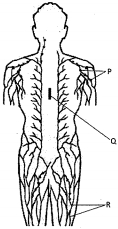
Which of the following is a primary lymphoid organ?
A
$P$
B
$P$ and $Q$
C
$Q$
D
$R$
Solution
(C) In the given diagram,the labels represent different parts of the human lymphatic system:
$P$ represents lymph nodes (secondary lymphoid organs).
$Q$ represents the thymus (a primary lymphoid organ).
$R$ represents lymphatic vessels.
Primary lymphoid organs are the sites where lymphocytes originate and/or mature and become antigen-sensitive. These include the bone marrow and the thymus. Since $Q$ represents the thymus,it is a primary lymphoid organ.
$P$ represents lymph nodes (secondary lymphoid organs).
$Q$ represents the thymus (a primary lymphoid organ).
$R$ represents lymphatic vessels.
Primary lymphoid organs are the sites where lymphocytes originate and/or mature and become antigen-sensitive. These include the bone marrow and the thymus. Since $Q$ represents the thymus,it is a primary lymphoid organ.
0 likes
View Solution569
EasyMCQ
Which molecule is represented by the structure $H_2L_2$?
A
Antigen
B
Antibody
C
Interferon
D
Antibiotic
Solution
(B) An antibody molecule is composed of four polypeptide chains: two small light chains $(L)$ and two large heavy chains $(H)$.
Therefore,the structure of an antibody is represented as $H_2L_2$.
Therefore,the structure of an antibody is represented as $H_2L_2$.
0 likes
View Solution570
EasyMCQ
When pre-formed antibodies are injected into the body,it is called .........
A
Vaccination
B
Active immunity
C
Passive immunity
D
Both $A$ and $B$
Solution
(C) When the body is exposed to antigens (living or dead microbes or their proteins) during immunization or infection,antibodies are produced in the host body. This is called active immunity.
When ready-made or pre-formed antibodies are directly injected into the body to protect against foreign agents,it is called passive immunity.
Examples include the administration of tetanus antitoxin or the transfer of $IgA$ antibodies from mother to infant through colostrum.
When ready-made or pre-formed antibodies are directly injected into the body to protect against foreign agents,it is called passive immunity.
Examples include the administration of tetanus antitoxin or the transfer of $IgA$ antibodies from mother to infant through colostrum.
0 likes
View Solution571
MediumMCQ
Select the incorrect statement regarding passive immunity.
A
Antibodies received by the infant from the mother through breast milk.
B
In case of tetanus,preformed antibodies or antitoxins are injected into the person's body.
C
Inactivated or weakened pathogens are prepared and introduced into the body.
D
Antibodies received by the fetus from the mother through the placenta.
Solution
(C) Passive immunity is defined as the direct provision of preformed antibodies to an individual to provide immediate protection.
Option $A$ (colostrum/breast milk) and Option $D$ (placental transfer) are examples of natural passive immunity.
Option $B$ (tetanus antitoxin) is an example of artificial passive immunity.
Option $C$ describes the process of vaccination (active immunity),where weakened or inactivated pathogens are introduced to stimulate the body's immune system to produce its own antibodies. Therefore,Option $C$ is the incorrect statement regarding passive immunity.
Option $A$ (colostrum/breast milk) and Option $D$ (placental transfer) are examples of natural passive immunity.
Option $B$ (tetanus antitoxin) is an example of artificial passive immunity.
Option $C$ describes the process of vaccination (active immunity),where weakened or inactivated pathogens are introduced to stimulate the body's immune system to produce its own antibodies. Therefore,Option $C$ is the incorrect statement regarding passive immunity.
0 likes
View Solution572
EasyMCQ
When the body attacks its own cells,resulting in damage to the body,it is called .......
A
Passive immunity
B
Vaccination
C
Active immunity
D
Autoimmune disease
Solution
(D) An autoimmune disease occurs when the body's immune system fails to distinguish between 'self' and 'non-self' cells. As a result,the immune system mistakenly attacks and damages the body's own healthy cells and tissues. Examples include Rheumatoid arthritis and Multiple sclerosis.
0 likes
View Solution573
MediumMCQ
Primary lymphoid organs $- P$
Secondary lymphoid organs $- Q$
$I -$ Appendix, $II -$ Peyer's patches of small intestine,
$III -$ Thymus, $IV -$ Spleen, $V -$ Lymph node, $VI -$ Bone marrow, $VII -$ Tonsils
Select the correct option for $P$ and $Q$.
$\quad P \quad \quad Q$
Secondary lymphoid organs $- Q$
$I -$ Appendix, $II -$ Peyer's patches of small intestine,
$III -$ Thymus, $IV -$ Spleen, $V -$ Lymph node, $VI -$ Bone marrow, $VII -$ Tonsils
Select the correct option for $P$ and $Q$.
$\quad P \quad \quad Q$
A
$III, VI \quad I, II, IV, V, VII$
B
$I, II, IV, V, VII \quad III, VI$
C
$II, IV, VII \quad I, III, V, VI$
D
$I, III, V, VI \quad II, IV, VII$
Solution
(A) Primary lymphoid organs are the sites where lymphocytes originate and/or mature and become antigen-sensitive. These include the bone marrow $(VI)$ and the thymus $(III)$.
Secondary lymphoid organs provide the sites for interaction of lymphocytes with the antigen, which then proliferate to become effector cells. These include the spleen $(IV)$, lymph nodes $(V)$, tonsils $(VII)$, Peyer's patches of the small intestine $(II)$, and the appendix $(I)$.
Therefore, $P = \{III, VI\}$ and $Q = \{I, II, IV, V, VII\}$.
Secondary lymphoid organs provide the sites for interaction of lymphocytes with the antigen, which then proliferate to become effector cells. These include the spleen $(IV)$, lymph nodes $(V)$, tonsils $(VII)$, Peyer's patches of the small intestine $(II)$, and the appendix $(I)$.
Therefore, $P = \{III, VI\}$ and $Q = \{I, II, IV, V, VII\}$.
0 likes
View Solution574
EasyMCQ
$MALT$ constitutes about what percentage of the lymphoid tissue in the human body (in $, \%$)?
A
$10$
B
$30$
C
$40$
D
$50$
Solution
(D) $MALT$ stands for Mucosa-Associated Lymphoid Tissue.
It is a significant component of the human immune system.
It is located within the lining of the major tracts of the body,such as the respiratory,digestive,and urogenital tracts.
$MALT$ constitutes about $50\, \%$ of the total lymphoid tissue in the human body.
It is a significant component of the human immune system.
It is located within the lining of the major tracts of the body,such as the respiratory,digestive,and urogenital tracts.
$MALT$ constitutes about $50\, \%$ of the total lymphoid tissue in the human body.
0 likes
View Solution575
EasyMCQ
Which of the following provides a micro-environment for the maturation of $T$-lymphocytes?
A
Thymus
B
Bone marrow
C
Spleen
D
Both $A$ and $B$
Solution
(A) The $T$-lymphocytes originate in the bone marrow but migrate to the thymus for maturation and differentiation. The thymus is a primary lymphoid organ that provides the necessary micro-environment for the development and maturation of $T$-lymphocytes. Therefore,the thymus is the correct site for $T$-cell maturation.
0 likes
View Solution576
MediumMCQ
Which of the following reasons is mainly responsible for graft rejection in transplantation of organs?
A
Inability of recipient to differentiate between 'self' and 'non-self' tissues/cells
B
Humoral immune response only
C
Auto-immune response
D
Cell-mediated response
Solution
(D) Graft rejection is a process where the recipient's immune system recognizes the transplanted organ as foreign ('non-self').
This recognition is primarily mediated by $T$-lymphocytes,which are the key components of the cell-mediated immune response.
When $T$-cells identify the foreign antigens on the graft,they initiate an immune attack to destroy the transplanted tissue.
Therefore,the cell-mediated immune response is the primary mechanism responsible for graft rejection.
This recognition is primarily mediated by $T$-lymphocytes,which are the key components of the cell-mediated immune response.
When $T$-cells identify the foreign antigens on the graft,they initiate an immune attack to destroy the transplanted tissue.
Therefore,the cell-mediated immune response is the primary mechanism responsible for graft rejection.
0 likes
View Solution577
DifficultMCQ
Match List-$I$ with List-$II$ :
Choose the correct answer from the options given below:
| List-$I$ | List-$II$ |
|---|---|
| $a$. Cellular barrier | $i$. Interferons |
| $b$. Cytokine barrier | $ii$. Mucus |
| $c$. Physical barrier | $iii$. Neutrophils |
| $d$. Physiological barrier | $iv$. $HCl$ in gastric juice |
Choose the correct answer from the options given below:
A
$(a) - (ii), (b) - (iii), (c) - (iv), (d) - (i)$
B
$(a) - (ii), (b) - (iii), (c) - (i), (d) - (iv)$
C
$(a) - (iii), (b) - (iv), (c) - (ii), (d) - (i)$
D
$(a) - (iii), (b) - (i), (c) - (ii), (d) - (iv)$
Solution
(D) The innate immunity consists of four types of barriers:
$1$. Physical barriers: Skin and mucus coating of the respiratory,gastrointestinal,and urogenital tracts prevent the entry of microorganisms. Thus,$c - ii$.
$2$. Physiological barriers: Acid in the stomach $(HCl)$,saliva in the mouth,and tears from eyes prevent microbial growth. Thus,$d - iv$.
$3$. Cellular barriers: Certain types of leukocytes (WBCs) like polymorpho-nuclear leukocytes ($PMNL$-neutrophils) and monocytes and natural killer cells in the blood as well as macrophages in tissues can phagocytose and destroy microbes. Thus,$a - iii$.
$4$. Cytokine barriers: Virus-infected cells secrete proteins called interferons which protect non-infected cells from further viral infection. Thus,$b - i$.
Therefore,the correct matching is $(a) - (iii), (b) - (i), (c) - (ii), (d) - (iv)$.
$1$. Physical barriers: Skin and mucus coating of the respiratory,gastrointestinal,and urogenital tracts prevent the entry of microorganisms. Thus,$c - ii$.
$2$. Physiological barriers: Acid in the stomach $(HCl)$,saliva in the mouth,and tears from eyes prevent microbial growth. Thus,$d - iv$.
$3$. Cellular barriers: Certain types of leukocytes (WBCs) like polymorpho-nuclear leukocytes ($PMNL$-neutrophils) and monocytes and natural killer cells in the blood as well as macrophages in tissues can phagocytose and destroy microbes. Thus,$a - iii$.
$4$. Cytokine barriers: Virus-infected cells secrete proteins called interferons which protect non-infected cells from further viral infection. Thus,$b - i$.
Therefore,the correct matching is $(a) - (iii), (b) - (i), (c) - (ii), (d) - (iv)$.
0 likes
View Solution578
MediumMCQ
Which of the following are autoimmune disorders?
$A$. Myasthenia gravis
$B$. Rheumatoid arthritis
$C$. Gout
$D$. Muscular dystrophy
$E$. Systemic Lupus Erythematosus $(SLE)$
Choose the most appropriate answer from the options given below:
$A$. Myasthenia gravis
$B$. Rheumatoid arthritis
$C$. Gout
$D$. Muscular dystrophy
$E$. Systemic Lupus Erythematosus $(SLE)$
Choose the most appropriate answer from the options given below:
A
$A, B$ and $E$ only
B
$B, C$ and $E$ only
C
$C, D$ and $E$ only
D
$A, B$ and $D$ only
Solution
(A) Autoimmune disorders occur when the immune system mistakenly attacks the body's own healthy cells.
$1$. Myasthenia gravis is an autoimmune neuromuscular disorder.
$2$. Rheumatoid arthritis is an autoimmune condition causing chronic joint inflammation.
$3$. Systemic Lupus Erythematosus $(SLE)$ is a systemic autoimmune disease.
Muscular dystrophy is a genetic disorder characterized by progressive weakness and degeneration of skeletal muscles.
Gout is a metabolic disorder caused by the accumulation of uric acid crystals in the joints.
Therefore,$A, B$,and $E$ are autoimmune disorders. The correct option is $A$.
$1$. Myasthenia gravis is an autoimmune neuromuscular disorder.
$2$. Rheumatoid arthritis is an autoimmune condition causing chronic joint inflammation.
$3$. Systemic Lupus Erythematosus $(SLE)$ is a systemic autoimmune disease.
Muscular dystrophy is a genetic disorder characterized by progressive weakness and degeneration of skeletal muscles.
Gout is a metabolic disorder caused by the accumulation of uric acid crystals in the joints.
Therefore,$A, B$,and $E$ are autoimmune disorders. The correct option is $A$.
0 likes
View Solution579
MediumMCQ
Given below are two statements:
Statement $I$: Bone marrow is the main lymphoid organ where all blood cells including lymphocytes are produced.
Statement $II$: Both bone marrow and thymus provide micro-environments for the development and maturation of $T$-lymphocytes.
In the light of the above statements,choose the most appropriate answer from the options given below:
Statement $I$: Bone marrow is the main lymphoid organ where all blood cells including lymphocytes are produced.
Statement $II$: Both bone marrow and thymus provide micro-environments for the development and maturation of $T$-lymphocytes.
In the light of the above statements,choose the most appropriate answer from the options given below:
A
Both Statement $I$ and Statement $II$ are incorrect.
B
Statement $I$ is correct but Statement $II$ is incorrect.
C
Statement $I$ is incorrect but Statement $II$ is correct.
D
Both Statement $I$ and Statement $II$ are correct.
Solution
(D) Statement $I$ is correct: Bone marrow is the primary lymphoid organ where all blood cells,including lymphocytes,are produced through hematopoiesis.
Statement $II$ is correct: Bone marrow and thymus are primary lymphoid organs that provide the necessary micro-environments for the development and maturation of $T$-lymphocytes. Specifically,$T$-lymphocytes migrate to the thymus for maturation.
Therefore,both statements are correct.
Statement $II$ is correct: Bone marrow and thymus are primary lymphoid organs that provide the necessary micro-environments for the development and maturation of $T$-lymphocytes. Specifically,$T$-lymphocytes migrate to the thymus for maturation.
Therefore,both statements are correct.
0 likes
View Solution580
DifficultMCQ
Identify the statement that is $\text{NOT}$ correct.
A
Each antibody has two light and two heavy chains.
B
The heavy and light chains are held together by disulfide bonds.
C
Antigen binding site is located at $C-$terminal region of antibody molecules.
D
Constant region of heavy and light chains are located at $C-$terminus of antibody molecules.
Solution
(C) An antibody molecule is represented as $H_2L_2$,meaning it consists of two heavy $(H)$ chains and two light $(L)$ chains.
These chains are held together by disulfide bonds ($S-S$ bonds).
The antibody molecule has a $Y$-shaped structure.
The variable region,which contains the antigen-binding site,is located at the $N$-terminal region of the antibody.
The constant region is located at the $C$-terminal region of the antibody.
Therefore,the statement that the antigen-binding site is located at the $C$-terminal region is incorrect.
These chains are held together by disulfide bonds ($S-S$ bonds).
The antibody molecule has a $Y$-shaped structure.
The variable region,which contains the antigen-binding site,is located at the $N$-terminal region of the antibody.
The constant region is located at the $C$-terminal region of the antibody.
Therefore,the statement that the antigen-binding site is located at the $C$-terminal region is incorrect.
0 likes
View Solution581
MediumMCQ
After maturation,in primary lymphoid organs,the lymphocytes migrate for interaction with antigens to secondary lymphoid organs like:
$A.$ thymus $B.$ bone marrow $C.$ spleen $D.$ lymph nodes $E.$ Peyer's patches
Choose the correct answer from the options given below:
$A.$ thymus $B.$ bone marrow $C.$ spleen $D.$ lymph nodes $E.$ Peyer's patches
Choose the correct answer from the options given below:
A
$C, D, E$ only
B
$A, B, C$ only
C
$E, A, B$ only
D
$B, C, D$ only
Solution
(A) Lymphoid organs are the sites where origin and/or maturation and proliferation of lymphocytes occur.
Primary lymphoid organs include the bone marrow and thymus,where immature lymphocytes differentiate into antigen-sensitive lymphocytes.
After maturation,the lymphocytes migrate to secondary lymphoid organs.
Secondary lymphoid organs provide the sites for interaction of lymphocytes with the antigen,which then proliferate to become effector cells.
Examples of secondary lymphoid organs include the spleen,lymph nodes,tonsils,Peyer's patches of the small intestine,and the appendix.
Therefore,$C$ (spleen),$D$ (lymph nodes),and $E$ (Peyer's patches) are secondary lymphoid organs,while $A$ (thymus) and $B$ (bone marrow) are primary lymphoid organs.
The correct option is $A$ ($C, D, E$ only).
Primary lymphoid organs include the bone marrow and thymus,where immature lymphocytes differentiate into antigen-sensitive lymphocytes.
After maturation,the lymphocytes migrate to secondary lymphoid organs.
Secondary lymphoid organs provide the sites for interaction of lymphocytes with the antigen,which then proliferate to become effector cells.
Examples of secondary lymphoid organs include the spleen,lymph nodes,tonsils,Peyer's patches of the small intestine,and the appendix.
Therefore,$C$ (spleen),$D$ (lymph nodes),and $E$ (Peyer's patches) are secondary lymphoid organs,while $A$ (thymus) and $B$ (bone marrow) are primary lymphoid organs.
The correct option is $A$ ($C, D, E$ only).
0 likes
View Solution582
EasyMCQ
Which of the following types of immunity is present at the time of birth and is a non-specific type of defense in the human body?
A
Acquired Immunity
B
Innate Immunity
C
Cell-mediated Immunity
D
Humoral Immunity
Solution
(B) Innate immunity is the defense system with which an individual is born.
It is a non-specific type of defense,which means it provides protection against various pathogens regardless of their specific identity.
It is present at the time of birth and is accomplished by providing different types of barriers to the entry of foreign agents into our body.
Acquired immunity,on the other hand,is pathogen-specific and is developed after birth through exposure to pathogens or vaccination.
It is a non-specific type of defense,which means it provides protection against various pathogens regardless of their specific identity.
It is present at the time of birth and is accomplished by providing different types of barriers to the entry of foreign agents into our body.
Acquired immunity,on the other hand,is pathogen-specific and is developed after birth through exposure to pathogens or vaccination.
0 likes
View Solution583
EasyMCQ
Anamnestic immune response is $ - $
A
slow
B
low intensified
C
highly intensified
D
primary response
Solution
(C) The anamnestic immune response, also known as the $secondary$ immune response, occurs upon subsequent exposure to the same pathogen.
It is characterized by a $highly$ $intensified$ and rapid production of antibodies due to the presence of memory $B$ and $T$ cells generated during the primary immune response.
Therefore, the correct option is $C$.
It is characterized by a $highly$ $intensified$ and rapid production of antibodies due to the presence of memory $B$ and $T$ cells generated during the primary immune response.
Therefore, the correct option is $C$.
0 likes
View Solution584
DifficultMCQ
In the list given below,how many are secondary lymphoid organs?
Thymus,Spleen,Bone marrow,Tonsil,Appendix
Thymus,Spleen,Bone marrow,Tonsil,Appendix
A
$2$
B
$3$
C
$5$
D
$4$
Solution
(B) Lymphoid organs are classified into primary and secondary lymphoid organs.
$1$. Primary lymphoid organs: These are the sites where lymphocytes originate and/or mature. Examples include the Bone marrow and Thymus.
$2$. Secondary lymphoid organs: These are the sites where lymphocytes interact with the antigen and then proliferate to become effector cells. Examples include the Spleen,Tonsils,Appendix,Peyer's patches,and Lymph nodes.
From the given list:
- Thymus: Primary lymphoid organ
- Spleen: Secondary lymphoid organ
- Bone marrow: Primary lymphoid organ
- Tonsil: Secondary lymphoid organ
- Appendix: Secondary lymphoid organ
Therefore,the secondary lymphoid organs are Spleen,Tonsil,and Appendix,which makes a total of $3$.
$1$. Primary lymphoid organs: These are the sites where lymphocytes originate and/or mature. Examples include the Bone marrow and Thymus.
$2$. Secondary lymphoid organs: These are the sites where lymphocytes interact with the antigen and then proliferate to become effector cells. Examples include the Spleen,Tonsils,Appendix,Peyer's patches,and Lymph nodes.
From the given list:
- Thymus: Primary lymphoid organ
- Spleen: Secondary lymphoid organ
- Bone marrow: Primary lymphoid organ
- Tonsil: Secondary lymphoid organ
- Appendix: Secondary lymphoid organ
Therefore,the secondary lymphoid organs are Spleen,Tonsil,and Appendix,which makes a total of $3$.
0 likes
View Solution585
DifficultMCQ
Which one of the following options gives the correct categorization of lymphocytes according to formation,maturation,and type of immunity?
A
Lymphocyte: $B$,Formation: Bone marrow,Maturation: Bone marrow,Immunity: $A.M.I.$
B
Lymphocyte: $T$,Formation: Bone marrow,Maturation: Thymus,Immunity: $C.M.I.$
C
Lymphocyte: $B$,Formation: Bone marrow,Maturation: Thymus,Immunity: $A.M.I.$
D
Lymphocyte: $T$,Formation: Bone marrow,Maturation: Bone marrow,Immunity: $C.M.I.$
Solution
(B) Lymphocytes are of two main types: $B$-lymphocytes and $T$-lymphocytes.
Both types are formed in the bone marrow.
$B$-lymphocytes mature in the bone marrow and are responsible for Antibody-Mediated Immunity $(A.M.I.)$ or Humoral Immunity.
$T$-lymphocytes migrate to the thymus for maturation and are responsible for Cell-Mediated Immunity $(C.M.I.)$.
Therefore,the correct categorization for $T$-lymphocytes is: Formation in Bone marrow,Maturation in Thymus,and they provide Cell-Mediated Immunity $(C.M.I.)$.
Both types are formed in the bone marrow.
$B$-lymphocytes mature in the bone marrow and are responsible for Antibody-Mediated Immunity $(A.M.I.)$ or Humoral Immunity.
$T$-lymphocytes migrate to the thymus for maturation and are responsible for Cell-Mediated Immunity $(C.M.I.)$.
Therefore,the correct categorization for $T$-lymphocytes is: Formation in Bone marrow,Maturation in Thymus,and they provide Cell-Mediated Immunity $(C.M.I.)$.
0 likes
View Solution586
MediumMCQ
Fill in the blanks: Our body, when it encounters a pathogen for the first time, produces a response called . . . . . . $a$ . . . . . . response, which is of . . . . . . $b$ . . . . . . intensity. Subsequent encounters with the same pathogen elicit a . . . . . . $c$ . . . . . . intensified . . . . . . $d$ . . . . . . response.
A
$a-$Anamnestic, $b-$Low, $c-$High, $d-$Secondary
B
$a-$Secondary, $b-$High, $c-$Low, $d-$Primary
C
$a-$Primary, $b-$Low, $c-$High, $d-$Anamnestic
D
$a-$Primary, $b-$High, $c-$Low, $d-$Anamnestic
Solution
(C) When our body encounters a pathogen for the first time, it produces a primary response, which is of low intensity.
Subsequent encounters with the same pathogen elicit a highly intensified secondary or anamnestic response.
Therefore, $a = \text{Primary}$, $b = \text{Low}$, $c = \text{High}$, and $d = \text{Anamnestic}$ (or Secondary).
Matching this with the given options, option $C$ is correct.
Subsequent encounters with the same pathogen elicit a highly intensified secondary or anamnestic response.
Therefore, $a = \text{Primary}$, $b = \text{Low}$, $c = \text{High}$, and $d = \text{Anamnestic}$ (or Secondary).
Matching this with the given options, option $C$ is correct.
0 likes
View Solution587
MediumMCQ
Where do immature lymphocytes differentiate into antigen-sensitive lymphocytes?
A
$M.A.L.T$
B
Primary lymphoid organs
C
Secondary lymphoid organs
D
Spleen
Solution
(B) In the human body,primary lymphoid organs are the sites where immature lymphocytes differentiate into antigen-sensitive lymphocytes.
These organs include the bone marrow and the thymus.
In these organs,$T$-lymphocytes and $B$-lymphocytes mature and acquire the ability to recognize specific antigens.
Secondary lymphoid organs,such as the spleen,lymph nodes,and $M.A.L.T$,are the sites where these mature lymphocytes interact with antigens and proliferate to become effector cells.
These organs include the bone marrow and the thymus.
In these organs,$T$-lymphocytes and $B$-lymphocytes mature and acquire the ability to recognize specific antigens.
Secondary lymphoid organs,such as the spleen,lymph nodes,and $M.A.L.T$,are the sites where these mature lymphocytes interact with antigens and proliferate to become effector cells.
0 likes
View Solution588
MediumMCQ
After an organ transplant from an unrelated donor,which of the following plays the lead role in graft rejection?
A
Passive immunity
B
Cell-mediated immunity
C
Innate immunity only
D
Humoral immunity only
Solution
(B) The body's immune system is capable of differentiating between 'self' and 'non-self' cells.
When an organ from an unrelated donor is transplanted,the recipient's immune system recognizes the foreign antigens on the donor tissue.
Cell-mediated immunity,primarily involving $T$-lymphocytes,plays the lead role in graft rejection.
These $T$-cells identify the foreign cells and initiate an immune response to destroy the transplanted tissue.
When an organ from an unrelated donor is transplanted,the recipient's immune system recognizes the foreign antigens on the donor tissue.
Cell-mediated immunity,primarily involving $T$-lymphocytes,plays the lead role in graft rejection.
These $T$-cells identify the foreign cells and initiate an immune response to destroy the transplanted tissue.
0 likes
View Solution589
MediumMCQ
$.........$ is responsible for graft rejection.
A
Antibody mediated immunity
B
Cell mediated immunity
C
Innate immunity
D
Herd immunity
Solution
(B) Graft rejection is primarily caused by the body's immune system recognizing the transplanted tissue as foreign.
This process is mediated by $T$-lymphocytes,which are the key components of cell-mediated immunity.
$T$-cells identify the $MHC$ (Major Histocompatibility Complex) antigens on the surface of the donor tissue as non-self and initiate an immune response to destroy the graft.
Therefore,cell-mediated immunity is responsible for graft rejection.
This process is mediated by $T$-lymphocytes,which are the key components of cell-mediated immunity.
$T$-cells identify the $MHC$ (Major Histocompatibility Complex) antigens on the surface of the donor tissue as non-self and initiate an immune response to destroy the graft.
Therefore,cell-mediated immunity is responsible for graft rejection.
0 likes
View Solution590
MediumMCQ
What are the characteristics of acquired immunity?
A
Differentiation between self and non-self.
B
Specificity.
C
Retains memory.
D
All of the above.
Solution
(D) Acquired immunity,also known as adaptive immunity,is characterized by the following features:
$1$. Specificity: It is pathogen-specific and can distinguish between different types of antigens.
$2$. Differentiation between self and non-self: It has the ability to recognize and ignore the body's own cells (self) while attacking foreign pathogens (non-self).
$3$. Memory: It retains a memory of the first encounter with a pathogen,allowing for a faster and stronger response upon subsequent exposures.
Therefore,all the given options are correct characteristics of acquired immunity.
$1$. Specificity: It is pathogen-specific and can distinguish between different types of antigens.
$2$. Differentiation between self and non-self: It has the ability to recognize and ignore the body's own cells (self) while attacking foreign pathogens (non-self).
$3$. Memory: It retains a memory of the first encounter with a pathogen,allowing for a faster and stronger response upon subsequent exposures.
Therefore,all the given options are correct characteristics of acquired immunity.
0 likes
View Solution591
EasyMCQ
$..........$ produces an army of proteins in response to pathogens into our blood to fight with them $:-$
A
Neutrophils
B
Basophils
C
$B-$lymphocytes
D
Helper $T-$cell
Solution
(C) $B-$lymphocytes are a type of white blood cell that plays a crucial role in the humoral immune response.
When these cells encounter a pathogen,they differentiate into plasma cells.
These plasma cells produce an army of proteins called antibodies in response to pathogens into our blood to fight against them.
Therefore,the correct answer is $B-$lymphocytes.
When these cells encounter a pathogen,they differentiate into plasma cells.
These plasma cells produce an army of proteins called antibodies in response to pathogens into our blood to fight against them.
Therefore,the correct answer is $B-$lymphocytes.
0 likes
View Solution592
EasyMCQ
Match List-$I$ with List-$II$:
| List-$I$ | List-$II$ |
|---|---|
| $(a)$ Antibody | $(i)$ Cell-mediated immunity |
| $(b)$ $B$-lymphocytes | $(ii)$ Humoral immune response |
| $(c)$ $T$-lymphocytes | $(iii)$ $H_2L_2$ |
| $(d)$ $T$-cells help $B$ cells to produce them | $(iv)$ Army of proteins |
A
$(a)-(iii), (b)-(ii), (c)-(i), (d)-(iv)$
B
$(a)-(iii), (b)-(iv), (c)-(ii), (d)-(i)$
C
$(a)-(ii), (b)-(i), (c)-(iv), (d)-(iii)$
D
$(a)-(iv), (b)-(ii), (c)-(i), (d)-(iii)$
Solution
(A) The correct matching is as follows:
$(a)$ Antibody: Antibodies are immunoglobulin proteins represented as $H_2L_2$ (two heavy and two light chains). Thus,$(a)-(iii)$.
$(b)$ $B$-lymphocytes: These cells produce antibodies in response to pathogens,which is known as the humoral immune response. Thus,$(b)-(ii)$.
$(c)$ $T$-lymphocytes: These cells are responsible for cell-mediated immunity. Thus,$(c)-(i)$.
$(d)$ $T$-cells help $B$ cells to produce them: Antibodies are often referred to as an 'army of proteins' produced by $B$ cells with the help of $T$ cells. Thus,$(d)-(iv)$.
Therefore,the correct sequence is $(a)-(iii), (b)-(ii), (c)-(i), (d)-(iv)$.
$(a)$ Antibody: Antibodies are immunoglobulin proteins represented as $H_2L_2$ (two heavy and two light chains). Thus,$(a)-(iii)$.
$(b)$ $B$-lymphocytes: These cells produce antibodies in response to pathogens,which is known as the humoral immune response. Thus,$(b)-(ii)$.
$(c)$ $T$-lymphocytes: These cells are responsible for cell-mediated immunity. Thus,$(c)-(i)$.
$(d)$ $T$-cells help $B$ cells to produce them: Antibodies are often referred to as an 'army of proteins' produced by $B$ cells with the help of $T$ cells. Thus,$(d)-(iv)$.
Therefore,the correct sequence is $(a)-(iii), (b)-(ii), (c)-(i), (d)-(iv)$.
0 likes
View Solution593
EasyMCQ
Read the following statements and choose the correct set of statements $:$
$(a)$ Cell-mediated immune response is responsible for the graft rejection.
$(b)$ Grafts from just any source $-$ an animal,another primate,or any human beings can be made since the grafts would be accepted sooner or later.
$(c)$ The organs cannot be taken from just anybody for transplant.
$(d)$ Tissue matching,blood group matching are essential before undertaking any graft/transplant.
Choose the correct answer from the options given below $:$
$(a)$ Cell-mediated immune response is responsible for the graft rejection.
$(b)$ Grafts from just any source $-$ an animal,another primate,or any human beings can be made since the grafts would be accepted sooner or later.
$(c)$ The organs cannot be taken from just anybody for transplant.
$(d)$ Tissue matching,blood group matching are essential before undertaking any graft/transplant.
Choose the correct answer from the options given below $:$
A
$(a)$ and $(c)$ only
B
$(a), (b), (c)$ and $(d)$ only
C
$(a), (c)$ and $(d)$ only
D
$(a)$ and $(d)$ only
Solution
(C) Statement $(a)$ is correct: The body's immune system,specifically the cell-mediated immune response (involving $T$-lymphocytes),recognizes the transplanted tissue as 'non-self' and rejects it.
Statement $(b)$ is incorrect: Grafts cannot be taken from any source because the immune system will reject foreign tissues unless they are genetically identical (like in identical twins) or immunosuppressants are used.
Statement $(c)$ is correct: Due to the risk of rejection,organs must be carefully selected based on compatibility.
Statement $(d)$ is correct: To minimize the risk of rejection,tissue matching ($HLA$ matching) and blood group matching are mandatory procedures before any transplant.
Therefore,statements $(a), (c),$ and $(d)$ are correct.
Statement $(b)$ is incorrect: Grafts cannot be taken from any source because the immune system will reject foreign tissues unless they are genetically identical (like in identical twins) or immunosuppressants are used.
Statement $(c)$ is correct: Due to the risk of rejection,organs must be carefully selected based on compatibility.
Statement $(d)$ is correct: To minimize the risk of rejection,tissue matching ($HLA$ matching) and blood group matching are mandatory procedures before any transplant.
Therefore,statements $(a), (c),$ and $(d)$ are correct.
0 likes
View Solution594
MediumMCQ
Along with lymphoid organs,$WBCs$ are also present within the mucosa of digestive,respiratory,and excretory tracts as $MALT$,which constitutes about $.......$ of the total lymphoid tissue of the body: (in $\%$)
A
$50$
B
$75$
C
$15$
D
$30$
Solution
(A) $MALT$ stands for Mucosa-Associated Lymphoid Tissue.
It is a significant component of the immune system located in the lining of major body tracts.
According to the $NCERT$ textbook,$MALT$ constitutes about $50 \%$ of the total lymphoid tissue in the human body.
Therefore,the correct option is $A$.
It is a significant component of the immune system located in the lining of major body tracts.
According to the $NCERT$ textbook,$MALT$ constitutes about $50 \%$ of the total lymphoid tissue in the human body.
Therefore,the correct option is $A$.
0 likes
View Solution595
EasyMCQ
Transfer of antibodies from mother to infant through colostrum after birth provides . . . . . . to the baby.
A
natural acquired active immunity
B
natural acquired passive immunity
C
artificial acquired active immunity
D
artificial acquired passive immunity
Solution
(B) Colostrum is the yellowish fluid secreted by the mother during the initial days of lactation. It contains abundant antibodies,primarily $IgA$,which are transferred to the infant. Since the infant receives pre-formed antibodies directly from the mother without their own immune system being activated,this is categorized as natural acquired passive immunity.
0 likes
View Solution596
EasyMCQ
Class of cytokines released by cells infected with viruses and certain $WBC$'s to protect from viral infection are . . . . . . .
A
spermines
B
interferons
C
mannose binding proteins
D
Alpha$-1-$acid glycoprotein
Solution
(B) Interferons $(IFNs)$ are a group of signaling proteins made and released by host cells in response to the presence of several viruses.
They belong to the class of cytokines.
When a cell is infected by a virus,it secretes interferons,which signal neighboring cells to heighten their antiviral defenses.
This helps in protecting non-infected cells from further viral infection.
Therefore,the correct answer is $B$.
They belong to the class of cytokines.
When a cell is infected by a virus,it secretes interferons,which signal neighboring cells to heighten their antiviral defenses.
This helps in protecting non-infected cells from further viral infection.
Therefore,the correct answer is $B$.
0 likes
View Solution597
EasyMCQ
Which of the following provides passive immunity?
$i$. Colostrum
$ii$. Antibodies against rabies pathogens
$iii$. After recovery from measles
$iv$. Polio vaccine
$i$. Colostrum
$ii$. Antibodies against rabies pathogens
$iii$. After recovery from measles
$iv$. Polio vaccine
A
$i$ and $iv$ only
B
$i$ and $ii$ only
C
$ii$ and $iii$ only
D
$ii$ and $iv$ only
Solution
(B) Passive immunity is the type of immunity where pre-formed antibodies are directly introduced into the body.
$i$. Colostrum contains $IgA$ antibodies,which provides Natural Acquired Passive immunity to the infant.
$ii$. Antibodies against rabies pathogens are injected directly,which provides Artificially Acquired Passive immunity.
$iii$. Recovery from measles leads to the production of the body's own antibodies,which is Natural Acquired Active immunity.
$iv$. Polio vaccine contains weakened or killed pathogens that stimulate the body to produce its own antibodies,which is Artificially Acquired Active immunity.
Therefore,$i$ and $ii$ provide passive immunity.
$i$. Colostrum contains $IgA$ antibodies,which provides Natural Acquired Passive immunity to the infant.
$ii$. Antibodies against rabies pathogens are injected directly,which provides Artificially Acquired Passive immunity.
$iii$. Recovery from measles leads to the production of the body's own antibodies,which is Natural Acquired Active immunity.
$iv$. Polio vaccine contains weakened or killed pathogens that stimulate the body to produce its own antibodies,which is Artificially Acquired Active immunity.
Therefore,$i$ and $ii$ provide passive immunity.
0 likes
View Solution598
EasyMCQ
Select the $INCORRECT$ pair with respect to substances produced by cells involved in immune response.
A
$Suppressor$ $T$ cells - Interferons
B
$B$-lymphocytes - Antibodies
C
Cytotoxic $T$ cells - Perforins
D
Helper $T$ cells - Lymphokines
Solution
(A) The correct answer is $A$.
$Suppressor$ $T$ cells (also known as regulatory $T$ cells) function to dampen the immune response and maintain immune tolerance,preventing autoimmune diseases.
Interferons are a class of cytokines (soluble proteins) released by virus-infected cells to protect neighboring cells from viral infection.
$B$-lymphocytes produce antibodies.
Cytotoxic $T$ cells release perforins to create pores in the membranes of target cells.
Helper $T$ cells secrete lymphokines to activate other immune cells.
$Suppressor$ $T$ cells (also known as regulatory $T$ cells) function to dampen the immune response and maintain immune tolerance,preventing autoimmune diseases.
Interferons are a class of cytokines (soluble proteins) released by virus-infected cells to protect neighboring cells from viral infection.
$B$-lymphocytes produce antibodies.
Cytotoxic $T$ cells release perforins to create pores in the membranes of target cells.
Helper $T$ cells secrete lymphokines to activate other immune cells.
0 likes
View Solution599
EasyMCQ
Match the pairs:
Select the correct option from the following:
| Column $I$ (Type of Immunity) | Column $II$ (Example) |
|---|---|
| $i$. Natural acquired active | $a$. $BCG$ Vaccine |
| $ii$. Artificial acquired active | $b$. Immunity against measles |
| $iii$. Natural acquired passive | $c$. Colostrum |
| $iv$. Artificial acquired passive | $d$. Injections against rabies |
Select the correct option from the following:
A
$i-b, ii-a, iii-d, iv-c$
B
$i-c, ii-a, iii-b, iv-d$
C
$i-b, ii-a, iii-c, iv-d$
D
$i-c, ii-a, iii-d, iv-b$
Solution
(C) The correct matching is as follows:
$i$. Natural acquired active immunity: Immunity developed after exposure to a pathogen (e.g.,measles infection). Thus,$i-b$.
$ii$. Artificial acquired active immunity: Immunity developed through vaccination (e.g.,$BCG$ vaccine). Thus,$ii-a$.
$iii$. Natural acquired passive immunity: Immunity transferred from mother to infant via colostrum (containing $IgA$ antibodies). Thus,$iii-c$.
$iv$. Artificial acquired passive immunity: Immunity provided by pre-formed antibodies in injections (e.g.,anti-rabies serum). Thus,$iv-d$.
Therefore,the correct sequence is $i-b, ii-a, iii-c, iv-d$.
$i$. Natural acquired active immunity: Immunity developed after exposure to a pathogen (e.g.,measles infection). Thus,$i-b$.
$ii$. Artificial acquired active immunity: Immunity developed through vaccination (e.g.,$BCG$ vaccine). Thus,$ii-a$.
$iii$. Natural acquired passive immunity: Immunity transferred from mother to infant via colostrum (containing $IgA$ antibodies). Thus,$iii-c$.
$iv$. Artificial acquired passive immunity: Immunity provided by pre-formed antibodies in injections (e.g.,anti-rabies serum). Thus,$iv-d$.
Therefore,the correct sequence is $i-b, ii-a, iii-c, iv-d$.
0 likes
View Solution600
EasyMCQ
Which of the following statements are correct regarding the structure and types of antibodies in humans?
$i$. Antibodies are also called Immunoglobulins that are produced as an immune response to antigenic stimulation.
$ii$. They are produced by all types of $T$-lymphocytes and $B$-lymphocytes.
$iii$. An antibody is a $Y$-shaped molecule formed of four polypeptide chains. Antibodies present in plasma determine many blood group systems like $ABO$,$Rh$,$P$,$MNS$ etc.
$iv$. An antibody molecule consists of two antigen-binding sites called paratopes.
$i$. Antibodies are also called Immunoglobulins that are produced as an immune response to antigenic stimulation.
$ii$. They are produced by all types of $T$-lymphocytes and $B$-lymphocytes.
$iii$. An antibody is a $Y$-shaped molecule formed of four polypeptide chains. Antibodies present in plasma determine many blood group systems like $ABO$,$Rh$,$P$,$MNS$ etc.
$iv$. An antibody molecule consists of two antigen-binding sites called paratopes.
A
$i$ and $iv$ only
B
$ii$ and $iii$ only
C
$i$ and $iii$ only
D
$iii$ and $iv$ only
Solution
(A) Statement $i$ is correct: Antibodies are indeed Immunoglobulins $(Ig)$ produced by the immune system in response to antigens.
Statement $ii$ is incorrect: Antibodies are produced specifically by plasma cells,which are differentiated $B$-lymphocytes,not by $T$-lymphocytes.
Statement $iii$ is incorrect: An antibody molecule is $Y$-shaped,not $S$-shaped,and it consists of four polypeptide chains (two heavy chains and two light chains),not six.
Statement $iv$ is correct: Each antibody molecule has two identical antigen-binding sites known as paratopes,which allow them to bind to specific epitopes on antigens.
Therefore,statements $i$ and $iv$ are correct.
Statement $ii$ is incorrect: Antibodies are produced specifically by plasma cells,which are differentiated $B$-lymphocytes,not by $T$-lymphocytes.
Statement $iii$ is incorrect: An antibody molecule is $Y$-shaped,not $S$-shaped,and it consists of four polypeptide chains (two heavy chains and two light chains),not six.
Statement $iv$ is correct: Each antibody molecule has two identical antigen-binding sites known as paratopes,which allow them to bind to specific epitopes on antigens.
Therefore,statements $i$ and $iv$ are correct.
0 likes
View SolutionHuman Health and Disease — Immunity · Frequently Asked Questions
1Are these Human Health and Disease questions useful for JEE and NEET?
Yes. All questions in this section are mapped to JEE Main and NEET exam patterns. Previous year questions from JEE Main, NEET, GUJCET and state-level exams are included with full solutions.
2Can I switch to Hindi or Gujarati for these questions?
Yes. Use the language tabs in the hero section or the sidebar to view the same questions and solutions in English, Hindi or Gujarati.
3How do I generate a question paper from this subtopic?
Use the Vedclass Exam Paper Generator — select the chapter and subtopic, set difficulty, and generate Sets A, B, C, D automatically. First 3 chapters of every subject are free.
Vedclass Products
For Students
Vedclass Test Series
Mock tests in real JEE/NEET style with performance analysis. 5-day free trial.
Start Free TrialFor Teachers
Exam Paper Generator
Generate Set A/B/C/D papers from this chapter in 2 minutes. 3 chapters free.
Try FreeFor Institutes
Online Exam Module
Live online exams with unlimited students, 360° analytics & white-label branding.
See DemoFor Teachers & Institutes
Generate a Human Health and Disease Exam Paper in 2 Minutes
Select subtopic & difficulty — Sets A, B, C, D auto-generated with No Repeat logic.
First 3 chapters of every subject are free — no payment required.