
A English
Diseases caused by helminthes Questions in English
Class 12 Biology · Human Health and Disease · Diseases caused by helminthes
116+
Questions
English
Language
100%
With Solutions
Showing 49 of 116 questions in English
51
EasyMCQ
Which of the following is the vector for the disease Filariasis (Elephantiasis)?
A
Anopheles fatigans
B
Culex fatigans
C
Aedes aegypti
D
Culex haemophilus
Solution
(B) Filariasis,also known as Elephantiasis,is caused by filarial worms like $Wuchereria$ $bancrofti$ and $Wuchereria$ $malayi$.
These parasites are transmitted to healthy individuals through the bite of female mosquito vectors.
The primary vector responsible for transmitting $Wuchereria$ is the $Culex$ mosquito,specifically $Culex$ $fatigans$ (also known as $Culex$ $quinquefasciatus$).
Therefore,the correct option is $B$.
These parasites are transmitted to healthy individuals through the bite of female mosquito vectors.
The primary vector responsible for transmitting $Wuchereria$ is the $Culex$ mosquito,specifically $Culex$ $fatigans$ (also known as $Culex$ $quinquefasciatus$).
Therefore,the correct option is $B$.
0 likes
View Solution52
EasyMCQ
Which worms are responsible for the disease elephantiasis?
A
Tapeworm
B
Liver fluke
C
Filarial worms
D
Roundworm
Solution
(C) Elephantiasis, also known as filariasis, is a chronic condition caused by filarial worms such as $Wuchereria \text{ } bancrofti$ and $Wuchereria \text{ } malayi$. These worms infect the lymphatic vessels, leading to severe swelling in the lower limbs and other body parts. Therefore, the correct answer is $C$.
0 likes
View Solution53
EasyMCQ
Filarial worms ($Wuchereria$ $bancrofti$ and $Wuchereria$ $malayi$) are known to:
A
Lay eggs.
B
Give birth to young ones.
C
Divide by cell division.
D
Produce microfilariae.
Solution
(D) Filarial worms,such as $Wuchereria$ $bancrofti$,are viviparous nematodes.
They do not lay eggs; instead,the females give birth to live,motile larvae known as microfilariae.
These microfilariae circulate in the peripheral blood of the host and are subsequently ingested by the mosquito vector ($Culex$ species) during a blood meal.
They do not lay eggs; instead,the females give birth to live,motile larvae known as microfilariae.
These microfilariae circulate in the peripheral blood of the host and are subsequently ingested by the mosquito vector ($Culex$ species) during a blood meal.
0 likes
View Solution54
EasyMCQ
What is the length of a male filarial worm $(Wuchereria bancrofti)$ (in $mm$)?
A
$40$
B
$80$
C
$70$
D
$60$
Solution
(A) The filarial worm $Wuchereria \ bancrofti$ exhibits sexual dimorphism. The male worm is significantly smaller than the female. The length of the male $Wuchereria \ bancrofti$ is approximately $40 \ mm$,while the female is much longer,typically ranging from $80 \ mm$ to $100 \ mm$.
0 likes
View Solution55
EasyMCQ
What is the length of a female filarial worm?
A
$40 \, mm$
B
$80 \, mm$
C
$80 \, cm$
D
$80 \, to \, 100 \, mm$
Solution
(D) The filarial worm, $Wuchereria \, bancrofti$, is a nematode parasite that causes filariasis in humans.
In this species, the female worm is significantly larger than the male.
The length of the female $Wuchereria \, bancrofti$ typically ranges from $80 \, mm$ to $100 \, mm$, while the male is much smaller, usually measuring about $40 \, mm$ in length.
Therefore, the correct length for the female filarial worm is $80 \, to \, 100 \, mm$.
In this species, the female worm is significantly larger than the male.
The length of the female $Wuchereria \, bancrofti$ typically ranges from $80 \, mm$ to $100 \, mm$, while the male is much smaller, usually measuring about $40 \, mm$ in length.
Therefore, the correct length for the female filarial worm is $80 \, to \, 100 \, mm$.
0 likes
View Solution56
EasyMCQ
Who is the primary host of the filarial worm (Wuchereria bancrofti)?
A
Culex fatigans
B
Human
C
Female Anopheles
D
Male Anopheles
Solution
(B) The filarial worm, $Wuchereria\ bancrofti$, is a digenetic parasite, meaning it requires two hosts to complete its life cycle.
$1$. The primary host (definitive host) is the $Human$, where the parasite reaches sexual maturity and reproduces sexually.
$2$. The secondary host (intermediate host) is the female $Culex$ mosquito, which acts as a vector for transmission.
Therefore, the primary host is the human.
$1$. The primary host (definitive host) is the $Human$, where the parasite reaches sexual maturity and reproduces sexually.
$2$. The secondary host (intermediate host) is the female $Culex$ mosquito, which acts as a vector for transmission.
Therefore, the primary host is the human.
0 likes
View Solution57
EasyMCQ
Where does the filarial worm reside in humans?
A
Lymphatic vessels
B
Lymph nodes
C
Liver
D
Both $(A)$ and $(B)$
Solution
(D) The filarial worm, $Wuchereria$ $\text{bancrofti}$, is the causative agent of filariasis (elephantiasis).
These parasites live in the lymphatic system of humans.
Specifically, the adult worms are found in the lymphatic vessels and lymph nodes, where they cause chronic inflammation and blockage of the lymphatic vessels.
These parasites live in the lymphatic system of humans.
Specifically, the adult worms are found in the lymphatic vessels and lymph nodes, where they cause chronic inflammation and blockage of the lymphatic vessels.
0 likes
View Solution58
EasyMCQ
What are the larvae born by the female Wuchereria bancrofti called?
A
Filaria
B
Larval filaria
C
Microfilariae
D
Culex
Solution
(C) The female $Wuchereria$ $bancrofti$ (the causative agent of filariasis) gives birth to live larvae known as $Microfilariae$. These larvae circulate in the peripheral blood of the host and are ingested by the mosquito vector ($Culex$ species) during a blood meal.
0 likes
View Solution59
EasyMCQ
Which of the following is the intermediate host and vector for the filarial worm?
A
Culex fatigans
B
Anopheles male
C
Anopheles female
D
Human
Solution
(A) The filarial worm,$Wuchereria$ $bancrofti$,causes filariasis (elephantiasis) in humans.
$Wuchereria$ $bancrofti$ is a digenetic parasite,meaning it requires two hosts to complete its life cycle.
The primary host is the human,where the adult worms reside in the lymphatic vessels.
The intermediate host and vector is the female mosquito,specifically species of the genus $Culex$ (e.g.,$Culex$ $fatigans$ or $Culex$ $quinquefasciatus$).
The mosquito transmits the infective $L_3$ larvae to humans during a blood meal.
$Wuchereria$ $bancrofti$ is a digenetic parasite,meaning it requires two hosts to complete its life cycle.
The primary host is the human,where the adult worms reside in the lymphatic vessels.
The intermediate host and vector is the female mosquito,specifically species of the genus $Culex$ (e.g.,$Culex$ $fatigans$ or $Culex$ $quinquefasciatus$).
The mosquito transmits the infective $L_3$ larvae to humans during a blood meal.
0 likes
View Solution60
MediumMCQ
In how many days does the filarial larva develop into an infective larva within the intermediate host (in $days$)?
A
$8$
B
$10$
C
$5$
D
$20$
Solution
(B) The filarial parasite, $Wuchereria \text{ bancrofti}$, requires an intermediate host, which is the $Culex$ mosquito, to complete its life cycle. Within the body of the mosquito, the microfilariae undergo development through various larval stages. It typically takes about $10$ to $12$ days for the larvae to transform into the infective third-stage larvae ($L_3$ stage), which are capable of infecting a human host upon the next mosquito bite.
0 likes
View Solution61
MediumMCQ
Elephantiasis (filariasis) is caused by which of the following?
A
Presence of viruses on the wall of filarial worms
B
Bite of filarial worms
C
Microfilariae
D
Dead adult filarial worms
Solution
(C) Elephantiasis, also known as filariasis, is a chronic condition caused by filarial worms such as $Wuchereria$ $\text{bancrofti}$ and $Wuchereria$ $\text{malayi}$.
These worms reside in the lymphatic vessels of humans.
The presence of these worms, particularly the blockage caused by them and the host's immune response to the presence of microfilariae and adult worms, leads to inflammation and swelling.
While the question options are slightly unconventional, in the context of the disease's pathology, the presence of microfilariae in the blood and tissues triggers the immune response that leads to the characteristic symptoms of elephantiasis.
Therefore, among the given choices, microfilariae are the causative agents of the inflammatory response.
These worms reside in the lymphatic vessels of humans.
The presence of these worms, particularly the blockage caused by them and the host's immune response to the presence of microfilariae and adult worms, leads to inflammation and swelling.
While the question options are slightly unconventional, in the context of the disease's pathology, the presence of microfilariae in the blood and tissues triggers the immune response that leads to the characteristic symptoms of elephantiasis.
Therefore, among the given choices, microfilariae are the causative agents of the inflammatory response.
0 likes
View Solution62
EasyMCQ
Elephantiasis (filariasis) is caused by which worm?
A
Ascaris
B
Guinea worm
C
Filarial worm
D
Tapeworm
Solution
(C) Elephantiasis, also known as filariasis, is a chronic condition caused by filarial worms such as $Wuchereria$ $\text{bancrofti}$ and $Wuchereria$ $\text{malayi}$. These worms infect the lymphatic vessels of the lower limbs, leading to severe swelling and inflammation. Therefore, the correct option is $C$.
0 likes
View Solution63
MediumMCQ
Through which route do the infective larvae of the filarial worm enter a new host?
A
Through blood
B
Through the liver
C
Through saliva
D
Through skin pores
Solution
(D) The causative agent of filariasis (elephantiasis) is the filarial worm, $Wuchereria$ $bancrofti$.
The infective stage of this parasite is the third-stage larva (filariform larva).
These larvae are transmitted to a healthy human host through the bite of an infected female $Culex$ mosquito.
When the mosquito bites, the larvae present in the mosquito's proboscis (mouthparts) enter the human host's body through the puncture wound in the skin.
The infective stage of this parasite is the third-stage larva (filariform larva).
These larvae are transmitted to a healthy human host through the bite of an infected female $Culex$ mosquito.
When the mosquito bites, the larvae present in the mosquito's proboscis (mouthparts) enter the human host's body through the puncture wound in the skin.
0 likes
View Solution64
MediumMCQ
Where do the infective larvae of Wuchereria bancrofti mature?
A
Lymph vessels
B
Lymph nodes
C
Skin
D
Both $(A)$ and $(B)$
Solution
(D) The pathogen $Wuchereria$ $bancrofti$ causes filariasis or elephantiasis in humans.
The infective larvae (third-stage filariform larvae) enter the human body through the bite of an infected female $Culex$ mosquito.
Once inside the human body, these larvae migrate to the lymphatic system.
They mature and reside in the lymph vessels and lymph nodes, where they cause chronic inflammation, leading to the characteristic swelling of the limbs and other body parts.
The infective larvae (third-stage filariform larvae) enter the human body through the bite of an infected female $Culex$ mosquito.
Once inside the human body, these larvae migrate to the lymphatic system.
They mature and reside in the lymph vessels and lymph nodes, where they cause chronic inflammation, leading to the characteristic swelling of the limbs and other body parts.
0 likes
View Solution65
EasyMCQ
How long does it take for the larvae of the filarial worm $(Wuchereria \text{ } bancrofti)$ to mature into adults in the human host?
A
$5$ years
B
$10$ days
C
$1$ year
D
$5$ to $8$ years
Solution
(D) The filarial worm $Wuchereria \text{ } bancrofti$ causes filariasis (elephantiasis). After the infective larvae (third-stage larvae) are transmitted to the human host by the bite of a female $Culex$ mosquito, they migrate to the lymphatic vessels and lymph nodes. In the human host, these larvae take approximately $5$ to $8$ years to mature into adult worms and begin reproducing.
0 likes
View Solution66
EasyMCQ
How long do adult worms live in filariasis?
A
$5$ to $8$ years
B
$1$ year
C
$10$ years
D
$10$ days
Solution
(A) Filariasis, also known as elephantiasis, is caused by the filarial worms $Wuchereria$ $\text{bancrofti}$ and $Wuchereria$ $\text{malayi}$.
These parasites reside in the lymphatic vessels and lymph nodes of the human host.
The adult worms of $Wuchereria$ $\text{bancrofti}$ are known to have a long lifespan, typically living for $5$ to $8$ years within the human body.
These parasites reside in the lymphatic vessels and lymph nodes of the human host.
The adult worms of $Wuchereria$ $\text{bancrofti}$ are known to have a long lifespan, typically living for $5$ to $8$ years within the human body.
0 likes
View Solution67
EasyMCQ
Which of the following is $NOT$ an effect of the filarial worm?
A
Fever
B
Blockage of lymphatic vessels
C
Swelling of organs like legs, arms, and genital organs
D
Blood-stained sputum
Solution
(D) The filarial worm, $Wuchereria \text{ } bancrofti$, causes filariasis or elephantiasis.
This disease is characterized by chronic inflammation of the organs in which they live for many years, usually the lymphatic vessels of the lower limbs.
Symptoms include fever, swelling of the legs, arms, and genital organs.
Blood-stained sputum is a characteristic symptom of tuberculosis, not filariasis.
This disease is characterized by chronic inflammation of the organs in which they live for many years, usually the lymphatic vessels of the lower limbs.
Symptoms include fever, swelling of the legs, arms, and genital organs.
Blood-stained sputum is a characteristic symptom of tuberculosis, not filariasis.
0 likes
View Solution68
MediumMCQ
Which of the following statements is false?
A
The primary host of the filarial worm is humans.
B
Culex fatigans is the intermediate host of the filarial worm.
C
Elephantiasis is a fatal disease.
D
Adult filarial worms live for $5$ to $8$ years.
Solution
(C) The correct answer is $C$. Elephantiasis (Filariasis) is caused by the filarial worms $Wuchereria$ $\text{bancrofti}$ and $Wuchereria$ $\text{malayi}$.
It is a chronic condition that leads to severe swelling of the lower limbs and genital organs, but it is generally not a fatal disease.
Humans are the primary (definitive) hosts, while the female $Culex$ mosquito acts as the intermediate host (vector).
Adult filarial worms typically have a lifespan of $5$ to $8$ years in the human lymphatic system.
It is a chronic condition that leads to severe swelling of the lower limbs and genital organs, but it is generally not a fatal disease.
Humans are the primary (definitive) hosts, while the female $Culex$ mosquito acts as the intermediate host (vector).
Adult filarial worms typically have a lifespan of $5$ to $8$ years in the human lymphatic system.
0 likes
View Solution69
EasyMCQ
How is filariasis (elephantiasis) transmitted?
A
By mosquito bites
B
By eating unwashed fruits
C
By eating immature fruits
D
Both $(B)$ and $(C)$
Solution
(A) Filariasis, also known as elephantiasis, is caused by filarial worms such as $Wuchereria$ $bancrofti$ and $Wuchereria$ $malayi$.
These pathogens are transmitted to a healthy person through the bite of infected female mosquito vectors, primarily $Culex$ mosquitoes.
The parasites reside in the lymphatic vessels of the lower limbs, leading to chronic inflammation and swelling, which gives the disease its common name, elephantiasis.
These pathogens are transmitted to a healthy person through the bite of infected female mosquito vectors, primarily $Culex$ mosquitoes.
The parasites reside in the lymphatic vessels of the lower limbs, leading to chronic inflammation and swelling, which gives the disease its common name, elephantiasis.
0 likes
View Solution70
EasyMCQ
Which pathogen causes elephantiasis?
A
$E$. coli
B
Myxovirus
C
Plasmodium
D
Filarial worm
Solution
(D) Elephantiasis, also known as lymphatic filariasis, is caused by filarial worms such as $Wuchereria$ $bancrofti$ and $Wuchereria$ $malayi$.
These parasites infect the lymphatic vessels and lymph nodes, leading to chronic inflammation and swelling of the lower limbs, hence the name elephantiasis.
These parasites infect the lymphatic vessels and lymph nodes, leading to chronic inflammation and swelling of the lower limbs, hence the name elephantiasis.
0 likes
View Solution71
EasyMCQ
After entering the blood vessels of humans,microfilariae are sucked up by which mosquito?
A
Female Anopheles
B
Culex fatigans
C
Male Anopheles
D
Aedes mosquito
Solution
(B) The pathogen $Wuchereria bancrofti$ (filarial worm) causes filariasis in humans.
In the human body,the larvae known as microfilariae circulate in the peripheral blood vessels.
These microfilariae are ingested by the vector,which is the female $Culex$ mosquito (specifically $Culex$ $fatigans$ or $Culex$ $quinquefasciatus$),during a blood meal.
Inside the mosquito,the larvae undergo further development before being transmitted to another human host.
In the human body,the larvae known as microfilariae circulate in the peripheral blood vessels.
These microfilariae are ingested by the vector,which is the female $Culex$ mosquito (specifically $Culex$ $fatigans$ or $Culex$ $quinquefasciatus$),during a blood meal.
Inside the mosquito,the larvae undergo further development before being transmitted to another human host.
0 likes
View Solution72
EasyMCQ
Which disease is characterized by the thickening of the skin and epithelial tissues?
A
Ringworm
B
Pneumonia
C
Filariasis
D
Typhoid
Solution
(C) Filariasis, also known as elephantiasis, is caused by filarial worms such as $Wuchereria \text{ } bancrofti$ and $Wuchereria \text{ } malayi$.
These parasites live in the lymphatic vessels and cause chronic inflammation.
Over a long period, this inflammation leads to the thickening of the skin and underlying epithelial tissues, particularly in the lower limbs, resulting in a swollen, elephant-like appearance.
These parasites live in the lymphatic vessels and cause chronic inflammation.
Over a long period, this inflammation leads to the thickening of the skin and underlying epithelial tissues, particularly in the lower limbs, resulting in a swollen, elephant-like appearance.
0 likes
View Solution73
EasyMCQ
Which of the following diseases is transmitted by mosquitoes?
A
Common cold
B
Pneumonia
C
Filariasis
D
Ringworm
Solution
(C) Filariasis, also known as elephantiasis, is caused by the filarial worms $Wuchereria \text{ } bancrofti$ and $Wuchereria \text{ } malayi$.
These pathogens are transmitted to a healthy person through the bite of female $Culex$ mosquitoes.
These pathogens are transmitted to a healthy person through the bite of female $Culex$ mosquitoes.
0 likes
View Solution74
MediumMCQ
In Filaria, what does the larval form resemble?
A
Adult animal
B
Juvenile animal
C
Larva
D
Young animal
Solution
(B) The causative agent of Filaria is the nematode $Wuchereria$ $bancrofti$.
In the life cycle of $Wuchereria$ $bancrofti$, the larval stages are known as microfilariae.
These microfilariae are essentially the juvenile or larval forms of the parasite.
Therefore, the larval form resembles a juvenile stage of the organism.
In the life cycle of $Wuchereria$ $bancrofti$, the larval stages are known as microfilariae.
These microfilariae are essentially the juvenile or larval forms of the parasite.
Therefore, the larval form resembles a juvenile stage of the organism.
0 likes
View Solution75
MediumMCQ
Identify the site where $Wuchereria \text{ } bancrofti$ is normally found in the human body.
A
Muscles of the legs
B
Blood vessels of the thigh region
C
Skin between the fingers
D
Lymphatic vessels of the lower limbs
Solution
(D) $Wuchereria \text{ } bancrofti$ is a human parasite that causes filariasis.
It is a digenetic parasite that completes its life cycle in two hosts, with humans serving as the definitive host where the adult worms reside.
The adult worms typically inhabit the lymphatic vessels and lymph nodes, particularly those of the lower limbs.
This obstruction of the lymphatic vessels leads to the accumulation of lymph fluid, causing the characteristic swelling known as elephantiasis.
It is a digenetic parasite that completes its life cycle in two hosts, with humans serving as the definitive host where the adult worms reside.
The adult worms typically inhabit the lymphatic vessels and lymph nodes, particularly those of the lower limbs.
This obstruction of the lymphatic vessels leads to the accumulation of lymph fluid, causing the characteristic swelling known as elephantiasis.
0 likes
View Solution76
EasyMCQ
Filariasis is caused by:
A
fly
B
Plasmodium
C
Wuchereria bancrofti and $W$. malayi
D
Entamoeba histolytica
Solution
(C) Filariasis, also known as elephantiasis, is a chronic disease caused by filarial worms.
The pathogens responsible for this disease are $Wuchereria$ $bancrofti$ and $Wuchereria$ $malayi$.
These worms infect the lymphatic vessels of the lower limbs, leading to chronic inflammation and swelling.
Therefore, the correct option is $C$.
The pathogens responsible for this disease are $Wuchereria$ $bancrofti$ and $Wuchereria$ $malayi$.
These worms infect the lymphatic vessels of the lower limbs, leading to chronic inflammation and swelling.
Therefore, the correct option is $C$.
0 likes
View Solution77
EasyMCQ
Which organism is responsible for filariasis?
A
Microsporum
B
$P. falciparum$
C
Streptococcus pneumoniae
D
Wuchereria
Solution
(D) Filariasis,also known as elephantiasis,is a chronic condition caused by filarial worms.
These worms belong to the genus $Wuchereria$,specifically $Wuchereria$ $bancrofti$ and $Wuchereria$ $malayi$.
They are transmitted to humans through the bite of infected female mosquito vectors.
$Microsporum$ is a fungus causing ringworm,$P. falciparum$ is a protozoan causing malaria,and $Streptococcus$ $pneumoniae$ is a bacterium causing pneumonia.
These worms belong to the genus $Wuchereria$,specifically $Wuchereria$ $bancrofti$ and $Wuchereria$ $malayi$.
They are transmitted to humans through the bite of infected female mosquito vectors.
$Microsporum$ is a fungus causing ringworm,$P. falciparum$ is a protozoan causing malaria,and $Streptococcus$ $pneumoniae$ is a bacterium causing pneumonia.
0 likes
View Solution78
EasyMCQ
Which of the following diseases is caused by the bite of a female mosquito vector?
A
Filariasis
B
Amoebiasis
C
Typhoid
D
Pneumonia
Solution
(A) Filariasis, also known as elephantiasis, is caused by filarial worms such as $Wuchereria$ $\text{bancrofti}$ and $Wuchereria$ $\text{malayi}$.
These pathogens are transmitted to a healthy person through the bite of an infected female $Culex$ mosquito, which acts as a vector.
$Amoebiasis$ is caused by $Entamoeba$ $\text{histolytica}$ through contaminated food and water.
$Typhoid$ is caused by $Salmonella$ $\text{typhi}$ through contaminated food and water.
$Pneumonia$ is caused by $Streptococcus$ $\text{pneumoniae}$ and $Haemophilus$ $\text{influenzae}$ through droplets released by an infected person.
These pathogens are transmitted to a healthy person through the bite of an infected female $Culex$ mosquito, which acts as a vector.
$Amoebiasis$ is caused by $Entamoeba$ $\text{histolytica}$ through contaminated food and water.
$Typhoid$ is caused by $Salmonella$ $\text{typhi}$ through contaminated food and water.
$Pneumonia$ is caused by $Streptococcus$ $\text{pneumoniae}$ and $Haemophilus$ $\text{influenzae}$ through droplets released by an infected person.
0 likes
View Solution79
EasyMCQ
Ascariasis is caused by an endoparasite of human $...A...$ commonly called $...B...$ Here $A$ and $B$ refer to:
A
$A$ - Ascaris suum; $B$ - tapeworm
B
$A$ - Ascaris; $B$ - roundworm
C
$A$ - Ascaris worm; $B$ - flatworm
D
$A$ - Ascaris; $B$ - liver worm
Solution
(B) Ascariasis is an infectious disease caused by the intestinal parasite $Ascaris$ $lumbricoides$,which is commonly known as the roundworm.
It is an endoparasite that lives in the human intestine.
Therefore,$A$ refers to $Ascaris$ and $B$ refers to roundworm.
It is an endoparasite that lives in the human intestine.
Therefore,$A$ refers to $Ascaris$ and $B$ refers to roundworm.
0 likes
View Solution80
EasyMCQ
Identify the vector for elephantiasis.
A
Filarial worm
B
Fly
C
Rat
D
Mosquito
Solution
(D) Elephantiasis, also known as filariasis, is caused by the filarial worms $Wuchereria$ $bancrofti$ and $Wuchereria$ $malayi$.
These parasites are transmitted to healthy individuals through the bite of female $Culex$ mosquitoes, which act as the biological vectors.
The filarial worm is the pathogen, while the mosquito is the vector that carries the parasite from an infected person to a healthy person.
These parasites are transmitted to healthy individuals through the bite of female $Culex$ mosquitoes, which act as the biological vectors.
The filarial worm is the pathogen, while the mosquito is the vector that carries the parasite from an infected person to a healthy person.
0 likes
View Solution81
MediumMCQ
Which of the following is $NOT$ a symptom of ascariasis?
A
Muscular pains
B
Fever
C
Inflammation of lymph nodes
D
Anemia
Solution
(C) Ascariasis is caused by the intestinal parasite $Ascaris$ $lumbricoides$. The common symptoms include internal bleeding,muscular pain,fever,anemia,and blockage of the intestinal passage. Inflammation of lymph nodes (lymphadenitis) is a characteristic symptom of filariasis (caused by $Wuchereria$ $bancrofti$ or $Wuchereria$ $malayi$),not ascariasis. Therefore,option $C$ is the correct answer.
0 likes
View Solution82
MediumMCQ
Internal bleeding,fever,muscular pain = $Ascariasis$ :: abdominal pain,constipation and blockage of the intestinal passage = ?
A
Falciparum
B
Amoebiasis
C
Elephantiasis
D
Ascariasis
Solution
(D) The symptoms provided in the first part of the analogy,such as internal bleeding,fever,and muscular pain,are characteristic of $Ascariasis$,which is caused by the roundworm $Ascaris$ $lumbricoides$.
In the second part,the symptoms listed are abdominal pain,constipation,and blockage of the intestinal passage. These are also classic clinical manifestations of $Ascariasis$ in humans,caused by the accumulation of the worms in the intestine.
Therefore,the correct answer is $Ascariasis$.
In the second part,the symptoms listed are abdominal pain,constipation,and blockage of the intestinal passage. These are also classic clinical manifestations of $Ascariasis$ in humans,caused by the accumulation of the worms in the intestine.
Therefore,the correct answer is $Ascariasis$.
0 likes
View Solution83
EasyMCQ
Ascaris lumbricoides infection is transmitted through .......
A
Contaminated soil
B
Contaminated water and vegetables
C
Improperly cooked meat
D
Inhalation of air
Solution
(B) Ascaris lumbricoides is a common roundworm parasite in humans.
Its eggs are excreted in the feces of infected individuals.
These eggs contaminate soil, water, and vegetables.
When a healthy person consumes these contaminated items, the eggs enter the digestive tract, leading to infection.
Therefore, the primary mode of transmission is through contaminated food and water.
Its eggs are excreted in the feces of infected individuals.
These eggs contaminate soil, water, and vegetables.
When a healthy person consumes these contaminated items, the eggs enter the digestive tract, leading to infection.
Therefore, the primary mode of transmission is through contaminated food and water.
0 likes
View Solution84
MediumMCQ
Identify the correctly matched pair of the disease and its causative agent/vector.
A
Anopheles - Malaria
B
Leishmania - Sleeping sickness
C
Glossina - Kala-azar
D
Wuchereria - Filariasis
Solution
(D) The correct match is $Wuchereria - Filariasis$.
$Wuchereria$ $bancrofti$ is a filarial worm that causes filariasis (elephantiasis) in humans.
$Anopheles$ is the vector for $Plasmodium$ (malaria), not the causative agent itself.
$Leishmania$ $donovani$ causes Kala-azar, while $Trypanosoma$ causes sleeping sickness.
$Glossina$ (tsetse fly) is the vector for $Trypanosoma$ (sleeping sickness), not Kala-azar.
$Wuchereria$ $bancrofti$ is a filarial worm that causes filariasis (elephantiasis) in humans.
$Anopheles$ is the vector for $Plasmodium$ (malaria), not the causative agent itself.
$Leishmania$ $donovani$ causes Kala-azar, while $Trypanosoma$ causes sleeping sickness.
$Glossina$ (tsetse fly) is the vector for $Trypanosoma$ (sleeping sickness), not Kala-azar.
0 likes
View Solution85
EasyMCQ
How is the infection of $Ascaris$ (roundworm) transmitted?
A
By the bite of a mosquito
B
By drinking water contaminated with eggs of $Ascaris$
C
By eating undercooked pork
D
By the bite of a tsetse fly
Solution
(B) $Ascaris$ is a common endoparasite in the human intestine.
It causes the disease known as ascariasis.
The infection is transmitted through the ingestion of contaminated water,vegetables,or fruits that contain the eggs of the parasite.
These eggs are passed out in the feces of infected individuals and contaminate the soil and water sources.
It causes the disease known as ascariasis.
The infection is transmitted through the ingestion of contaminated water,vegetables,or fruits that contain the eggs of the parasite.
These eggs are passed out in the feces of infected individuals and contaminate the soil and water sources.
0 likes
View Solution86
MediumMCQ
In which disease does a mosquito-transmitted pathogen cause chronic inflammation of the lymphatic vessels?
A
Amoebiasis
B
Elephantiasis
C
Ringworm disease
D
Ascariasis
Solution
(B) Elephantiasis, also known as $Filariasis$, is caused by the filarial worms $Wuchereria$ $bancrofti$ and $Wuchereria$ $malayi$.
These pathogens are transmitted to healthy individuals through the bite of female $Culex$ mosquitoes.
The parasites primarily reside in the lymphatic vessels, where they cause chronic inflammation and obstruction, leading to the characteristic swelling of the lower limbs and other body parts.
These pathogens are transmitted to healthy individuals through the bite of female $Culex$ mosquitoes.
The parasites primarily reside in the lymphatic vessels, where they cause chronic inflammation and obstruction, leading to the characteristic swelling of the lower limbs and other body parts.
0 likes
View Solution87
MediumMCQ
In the following table, identify the correct matching of the crop, its disease, and the corresponding pathogen:
Crop - Disease - Pathogen
Crop - Disease - Pathogen
A
Citrus - Canker - $Pseudomonas \text{ } rubrilineans$
B
Potato - Late blight - $Fusarium \text{ } udum$
C
Tobacco - Root-knot - $Meloidogyne \text{ } incognita$
D
Pigeon pea - Seed gall - $Phytophthora \text{ } infestans$
Solution
(C) The correct match is Tobacco - Root-knot - $Meloidogyne \text{ } incognita$.
$1$. Citrus canker is caused by $Xanthomonas \text{ } citri$.
$2$. Late blight of potato is caused by $Phytophthora \text{ } infestans$.
$3$. Root-knot disease in tobacco and many other plants is caused by the nematode $Meloidogyne \text{ } incognita$.
$4$. Pigeon pea wilt is caused by $Fusarium \text{ } udum$.
$1$. Citrus canker is caused by $Xanthomonas \text{ } citri$.
$2$. Late blight of potato is caused by $Phytophthora \text{ } infestans$.
$3$. Root-knot disease in tobacco and many other plants is caused by the nematode $Meloidogyne \text{ } incognita$.
$4$. Pigeon pea wilt is caused by $Fusarium \text{ } udum$.
0 likes
View Solution88
MediumMCQ
Assertion : Tapeworm,roundworm and pinworm are endoparasites of human intestine.
Reason : Improperly cooked food is the source of intestinal infections.
Reason : Improperly cooked food is the source of intestinal infections.
A
If both Assertion and Reason are correct and the Reason is a correct explanation of the Assertion.
B
If both Assertion and Reason are correct but Reason is not a correct explanation of the Assertion.
C
If the Assertion is correct but Reason is incorrect.
D
If both the Assertion and Reason are incorrect.
Solution
(B) The Assertion is correct because tapeworms $(Taenia)$,roundworms $(Ascaris)$,and pinworms $(Enterobius)$ are well-known endoparasites that inhabit the human intestine.
The Reason is also correct as the consumption of improperly cooked or contaminated food and water is a primary source of transmission for these intestinal parasites.
However,the Reason is not the direct explanation for the Assertion. The Assertion describes the biological classification and habitat of these organisms,while the Reason describes the mode of transmission. Therefore,both statements are true,but the Reason does not explain why they are endoparasites.
The Reason is also correct as the consumption of improperly cooked or contaminated food and water is a primary source of transmission for these intestinal parasites.
However,the Reason is not the direct explanation for the Assertion. The Assertion describes the biological classification and habitat of these organisms,while the Reason describes the mode of transmission. Therefore,both statements are true,but the Reason does not explain why they are endoparasites.
0 likes
View Solution89
Easy
Explain $Ascariasis$ (a helminthic disease).
Solution
(N/A) The roundworm $Ascaris$ is the pathogen responsible for $Ascariasis$.
Symptoms of this disease include internal bleeding,muscular pain,fever,anemia,and blockage of the intestinal passage.
The eggs of the parasite are excreted along with the feces of infected persons.
These eggs contaminate soil,water,and plants.
$A$ healthy person acquires this infection through the consumption of contaminated water,vegetables,fruits,etc.
Symptoms of this disease include internal bleeding,muscular pain,fever,anemia,and blockage of the intestinal passage.
The eggs of the parasite are excreted along with the feces of infected persons.
These eggs contaminate soil,water,and plants.
$A$ healthy person acquires this infection through the consumption of contaminated water,vegetables,fruits,etc.
0 likes
View Solution90
Medium
Explain the disease Elephantiasis.
Solution
(N/A) Elephantiasis,also known as $Filariasis$,is caused by filarial worms,specifically $Wuchereria$ ($W$. $bancrofti$ and $W$. $malayi$).
These parasites reside in the lymphatic vessels of the lower limbs for many years,causing chronic inflammation.
This leads to the characteristic swelling of the limbs,hence the name $Elephantiasis$.
Often,the genital organs are also affected,leading to severe deformities.
The pathogens are transmitted to a healthy person through the bite of a female mosquito vector.
These parasites reside in the lymphatic vessels of the lower limbs for many years,causing chronic inflammation.
This leads to the characteristic swelling of the limbs,hence the name $Elephantiasis$.
Often,the genital organs are also affected,leading to severe deformities.
The pathogens are transmitted to a healthy person through the bite of a female mosquito vector.
0 likes
View Solution91
MediumMCQ
Which of the following diseases cannot be considered as being spread through contaminated water?
A
Amoebic dysentery
B
Ascariasis
C
Filariasis
D
All of the above
Solution
(C) $1$. Amoebic dysentery is caused by $Entamoeba$ \text{ histolytica}, which is transmitted through contaminated food and water.
$2$. Ascariasis is caused by $Ascaris$ \text{ lumbricoides}, and its eggs are transmitted through contaminated soil, water, and vegetables.
$3$. Filariasis (Elephantiasis) is caused by $Wuchereria$ \text{ bancrofti} and $Wuchereria$ \text{ malayi}. It is transmitted to healthy individuals through the bite of female $Culex$ mosquitoes, not through contaminated water.
$4$. Therefore, Filariasis is the disease that is not spread through contaminated water.
$2$. Ascariasis is caused by $Ascaris$ \text{ lumbricoides}, and its eggs are transmitted through contaminated soil, water, and vegetables.
$3$. Filariasis (Elephantiasis) is caused by $Wuchereria$ \text{ bancrofti} and $Wuchereria$ \text{ malayi}. It is transmitted to healthy individuals through the bite of female $Culex$ mosquitoes, not through contaminated water.
$4$. Therefore, Filariasis is the disease that is not spread through contaminated water.
0 likes
View Solution92
MediumMCQ
Identify the group of diseases that affect the lymph or lymph nodes.
A
Plague,Filariasis,Chikungunya
B
Diphtheria,Polio,Malaria
C
Ascariasis,Amoebiasis,Pneumonia
D
Tuberculosis,Leprosy,Gonorrhea
Solution
(A) The correct answer is $A$.
$1$. Plague is caused by $Yersinia pestis$, which infects lymph nodes causing them to swell, a condition known as buboes.
$2$. Filariasis (Elephantiasis) is caused by $Wuchereria bancrofti$ or $Wuchereria malayi$, which specifically infects the lymphatic vessels and lymph nodes, leading to chronic inflammation and swelling.
$3$. Chikungunya is a viral disease that can cause lymphadenopathy (swelling of lymph nodes) as part of the immune response.
Therefore, this group of diseases is associated with the lymphatic system.
$1$. Plague is caused by $Yersinia pestis$, which infects lymph nodes causing them to swell, a condition known as buboes.
$2$. Filariasis (Elephantiasis) is caused by $Wuchereria bancrofti$ or $Wuchereria malayi$, which specifically infects the lymphatic vessels and lymph nodes, leading to chronic inflammation and swelling.
$3$. Chikungunya is a viral disease that can cause lymphadenopathy (swelling of lymph nodes) as part of the immune response.
Therefore, this group of diseases is associated with the lymphatic system.
0 likes
View Solution93
EasyMCQ
Which disease is shown in the given figure?
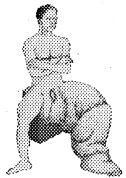
A
Ascariasis
B
Edema
C
Filariasis
D
Fungal infection
Solution
(C) The figure shows a person suffering from Filariasis (also known as Elephantiasis).
Filariasis is caused by filarial worms such as $Wuchereria$ $bancrofti$ and $Wuchereria$ $malayi$.
These worms cause chronic inflammation of the organs in which they live for many years, usually the lymphatic vessels of the lower limbs.
This leads to severe swelling of the legs, giving them an appearance similar to that of an elephant's leg, hence the name Elephantiasis.
Filariasis is caused by filarial worms such as $Wuchereria$ $bancrofti$ and $Wuchereria$ $malayi$.
These worms cause chronic inflammation of the organs in which they live for many years, usually the lymphatic vessels of the lower limbs.
This leads to severe swelling of the legs, giving them an appearance similar to that of an elephant's leg, hence the name Elephantiasis.
0 likes
View Solution94
MediumMCQ
Adults of $Wuchereria$ $bancrofti$ attack
A
Excretory system
B
Digestive system
C
Lymphatic system
D
Nervous system
Solution
(C) $Wuchereria$ $bancrofti$ is a digenetic human parasite that completes its life cycle in two hosts.
The human is the final host that harbours the adult worms in the lymphatic vessels and lymph nodes.
This infection leads to a chronic inflammation of the organs in which they live for many years, usually the lymphatic vessels of the lower limbs, causing elephantiasis.
The human is the final host that harbours the adult worms in the lymphatic vessels and lymph nodes.
This infection leads to a chronic inflammation of the organs in which they live for many years, usually the lymphatic vessels of the lower limbs, causing elephantiasis.
0 likes
View Solution95
EasyMCQ
The secondary host of $Wuchereria$,which transmits filariasis,is:
A
$Anopheles$
B
Sand fly
C
Tse-tse fly
D
$Culex$
Solution
(D) $Wuchereria$ $bancrofti$ and $Wuchereria$ $malayi$ are the causative agents of filariasis (elephantiasis).
These parasites require two hosts to complete their life cycle.
The primary host is human,and the secondary host (or vector) is the female $Culex$ mosquito.
The mosquito transmits the infective larvae to humans during a blood meal.
These parasites require two hosts to complete their life cycle.
The primary host is human,and the secondary host (or vector) is the female $Culex$ mosquito.
The mosquito transmits the infective larvae to humans during a blood meal.
0 likes
View Solution96
MediumMCQ
An individual bathing in an infected pool or coming in contact with contaminated water is liable to be infected with .................. The .................... larva stick to the surface of the skin of swimmer or bather,and penetrate the skin.
A
Ancylostoma,$II^{nd}$ Juvenile
B
Bilharzia,Cercaria
C
Schistosoma,Metacercariae
D
Bilharzia,Redia
Solution
(B) Schistosomiasis,also known as $Bilharzia$,is a disease caused by the parasitic trematode worm,$Schistosoma$.
This disease is transmitted when individuals come into contact with fresh water contaminated with the parasite.
The parasite is released from intermediate host snails into the water.
The $Cercaria$ larva is the infective stage of $Schistosoma$ that attaches to the skin of a swimmer or bather and penetrates it to enter the human body.
This disease is transmitted when individuals come into contact with fresh water contaminated with the parasite.
The parasite is released from intermediate host snails into the water.
The $Cercaria$ larva is the infective stage of $Schistosoma$ that attaches to the skin of a swimmer or bather and penetrates it to enter the human body.
0 likes
View Solution97
EasyMCQ
The disease filariasis is transmitted by
A
Tse-tse fly
B
Sand fly
C
Culex
D
Male Anopheles
Solution
(C) The disease filariasis (elephantiasis) is transmitted by the female $Culex$ mosquito.
$Wuchereria$ $bancrofti$ is the causative agent of filariasis, which is a helminthic disease.
$Wuchereria$ $bancrofti$ is the causative agent of filariasis, which is a helminthic disease.
0 likes
View Solution98
MediumMCQ
Which of the following diseases is caused due to helminth infection?
A
Ascariasis
B
Wuchereriasis
C
Both $(A)$ and $(B)$
D
None of these
Solution
(C) $Ascaris$ (the common roundworm) and $Wuchereria$ (the filarial worm) are helminths that are pathogenic to humans.
$Ascaris$ is an intestinal parasite that causes ascariasis.
$Wuchereria$ causes filariasis (also known as wuchereriasis).
Therefore,both diseases are caused by helminth infections.
$Ascaris$ is an intestinal parasite that causes ascariasis.
$Wuchereria$ causes filariasis (also known as wuchereriasis).
Therefore,both diseases are caused by helminth infections.
0 likes
View Solution99
MediumMCQ
$Wuchereria bancrofti$ is:
A
$A$ Platyhelminthes
B
Only host in man
C
Causing blockage of lymphatic vessels
D
None of the above
Solution
(C) $Wuchereria bancrofti$ is a filarial worm that causes filariasis (elephantiasis). It resides in the lymphatic vessels of humans and causes chronic inflammation and blockage of these vessels,leading to swelling in the lower limbs and other body parts.
0 likes
View SolutionHuman Health and Disease — Diseases caused by helminthes · Frequently Asked Questions
1Are these Human Health and Disease questions useful for JEE and NEET?
Yes. All questions in this section are mapped to JEE Main and NEET exam patterns. Previous year questions from JEE Main, NEET, GUJCET and state-level exams are included with full solutions.
2Can I switch to Hindi or Gujarati for these questions?
Yes. Use the language tabs in the hero section or the sidebar to view the same questions and solutions in English, Hindi or Gujarati.
3How do I generate a question paper from this subtopic?
Use the Vedclass Exam Paper Generator — select the chapter and subtopic, set difficulty, and generate Sets A, B, C, D automatically. First 3 chapters of every subject are free.
Vedclass Products
For Students
Vedclass Test Series
Mock tests in real JEE/NEET style with performance analysis. 5-day free trial.
Start Free TrialFor Teachers
Exam Paper Generator
Generate Set A/B/C/D papers from this chapter in 2 minutes. 3 chapters free.
Try FreeFor Institutes
Online Exam Module
Live online exams with unlimited students, 360° analytics & white-label branding.
See DemoFor Teachers & Institutes
Generate a Human Health and Disease Exam Paper in 2 Minutes
Select subtopic & difficulty — Sets A, B, C, D auto-generated with No Repeat logic.
First 3 chapters of every subject are free — no payment required.