
A English
Diseases caused by helminthes Questions in English
Class 12 Biology · Human Health and Disease · Diseases caused by helminthes
116+
Questions
English
Language
100%
With Solutions
Showing 16 of 116 questions in English
101
MediumMCQ
Which of the following diseases causes internal bleeding,muscular pain,fever,anaemia,and blockage of the intestinal passage?
A
Ascariasis
B
Filariasis
C
Amoebiasis
D
Trypanosomiasis
Solution
(A) The symptoms of $Ascariasis$ include internal bleeding,muscular pain,fever,anaemia,and blockage of the intestinal passage.
$Ascariasis$ is caused by an endoparasite of humans,$Ascaris$ $lumbricoides$,commonly known as the roundworm.
$Ascariasis$ is caused by an endoparasite of humans,$Ascaris$ $lumbricoides$,commonly known as the roundworm.
0 likes
View Solution102
EasyMCQ
Internal bleeding,muscular pain,fever,anaemia and blockage of the intestinal passage are the common symptoms of
A
Amoebiasis
B
Elephantiasis
C
Ascariasis
D
Typhoid
Solution
(C) Ascariasis is caused by the intestinal parasite $Ascaris$ $lumbricoides$.
Symptoms include internal bleeding,muscular pain,fever,anaemia,and blockage of the intestinal passage.
$Amoebiasis$ is characterized by abdominal pain,constipation,and stools with excess mucus and blood clots.
$Elephantiasis$ (Filariasis) involves chronic inflammation of the organs in which the parasites live,usually the lymphatic vessels of the lower limbs,leading to gross swelling.
$Typhoid$ is characterized by sustained high fever ($39^{\circ}C$ to $40^{\circ}C$),weakness,stomach pain,constipation,headache,and loss of appetite.
Symptoms include internal bleeding,muscular pain,fever,anaemia,and blockage of the intestinal passage.
$Amoebiasis$ is characterized by abdominal pain,constipation,and stools with excess mucus and blood clots.
$Elephantiasis$ (Filariasis) involves chronic inflammation of the organs in which the parasites live,usually the lymphatic vessels of the lower limbs,leading to gross swelling.
$Typhoid$ is characterized by sustained high fever ($39^{\circ}C$ to $40^{\circ}C$),weakness,stomach pain,constipation,headache,and loss of appetite.
0 likes
View Solution103
Medium
What causes Ascariasis? Mention its causative agent, symptoms, and mode of transmission.
Solution
(N/A) Ascariasis is caused by the intestinal parasite $Ascaris \text{ } lumbricoides$ (common roundworm).
Causative Agent: The pathogen responsible for Ascariasis is $Ascaris \text{ } lumbricoides$.
Symptoms: The symptoms of Ascariasis include internal bleeding, muscular pain, fever, anemia, and blockage of the intestinal passage.
Mode of Transmission: The eggs of the parasite are excreted along with the feces of infected persons, which contaminate soil, water, plants, etc. A healthy person acquires this infection through the consumption of contaminated water, vegetables, fruits, etc.
Causative Agent: The pathogen responsible for Ascariasis is $Ascaris \text{ } lumbricoides$.
Symptoms: The symptoms of Ascariasis include internal bleeding, muscular pain, fever, anemia, and blockage of the intestinal passage.
Mode of Transmission: The eggs of the parasite are excreted along with the feces of infected persons, which contaminate soil, water, plants, etc. A healthy person acquires this infection through the consumption of contaminated water, vegetables, fruits, etc.
0 likes
View Solution104
Medium
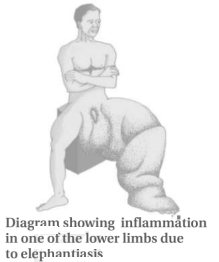
What is Elephantiasis or Filariasis? Mention its causative agent,symptoms,and mode of transmission.
Solution
(N/A) Elephantiasis or Filariasis is a disease caused by filarial worms,specifically $Wuchereria bancrofti$ and $Wuchereria malayi$.
Causative Agent: The pathogens are the filarial worms $Wuchereria bancrofti$ and $Wuchereria malayi$.
Symptoms: These worms cause a slowly developing chronic inflammation of the organs in which they live for many years. They usually reside in the lymphatic vessels of the lower limbs,obstructing the flow of lymph. This results in severe swelling of the lower limbs,which resembles the feet of an elephant,hence the name Elephantiasis. The genital organs are also often affected,leading to gross deformities.
Mode of Transmission: The pathogens are transmitted to a healthy person through the bite of female mosquito vectors,such as $Culex$ and $Aedes$ species.
Causative Agent: The pathogens are the filarial worms $Wuchereria bancrofti$ and $Wuchereria malayi$.
Symptoms: These worms cause a slowly developing chronic inflammation of the organs in which they live for many years. They usually reside in the lymphatic vessels of the lower limbs,obstructing the flow of lymph. This results in severe swelling of the lower limbs,which resembles the feet of an elephant,hence the name Elephantiasis. The genital organs are also often affected,leading to gross deformities.
Mode of Transmission: The pathogens are transmitted to a healthy person through the bite of female mosquito vectors,such as $Culex$ and $Aedes$ species.
0 likes
View Solution105
MediumMCQ
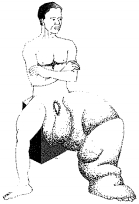
Which pathogen is responsible for the disease shown below?
A
Epidermophyton
B
Filarial worm
C
Plasmodium
D
Entamoeba histolytica
Solution
(B) The image shows a person suffering from elephantiasis (filariasis), which is characterized by chronic inflammation of the organs in which the worms live for many years, usually the lymphatic vessels of the lower limbs.
This disease is caused by filarial worms, specifically $Wuchereria$ $\text{bancrofti}$ and $Wuchereria$ $\text{malayi}$.
Therefore, the correct pathogen responsible for this condition is the filarial worm.
This disease is caused by filarial worms, specifically $Wuchereria$ $\text{bancrofti}$ and $Wuchereria$ $\text{malayi}$.
Therefore, the correct pathogen responsible for this condition is the filarial worm.
0 likes
View Solution106
MediumMCQ
In which disease does chronic inflammation of the lymphatic vessels occur?
A
Filariasis
B
Elephantiasis
C
Ascariasis
D
Both $A$ and $B$
Solution
(D) Filariasis, also known as Elephantiasis, is caused by the filarial worms $Wuchereria$ $\text{bancrofti}$ and $Wuchereria$ $\text{malayi}$.
These parasites live in the lymphatic vessels of the lower limbs, leading to chronic inflammation and swelling of these vessels.
Over many years, this results in the gross deformity of the limbs and genital organs, which is why the disease is commonly called Elephantiasis.
These parasites live in the lymphatic vessels of the lower limbs, leading to chronic inflammation and swelling of these vessels.
Over many years, this results in the gross deformity of the limbs and genital organs, which is why the disease is commonly called Elephantiasis.
0 likes
View Solution107
MediumMCQ
Which of the following diseases is not transmitted by a mosquito vector?
A
Malaria
B
Filariasis
C
Ascariasis
D
Chikungunya
Solution
(C) The correct answer is $C$.
$1$. Malaria is transmitted by the female $Anopheles$ mosquito.
$2$. Filariasis (Elephantiasis) is transmitted by the $Culex$ mosquito.
$3$. Chikungunya is transmitted by the $Aedes$ mosquito.
$4$. Ascariasis is an intestinal infection caused by the roundworm $Ascaris$ $lumbricoides$. It is transmitted through contaminated water,vegetables,and fruits containing eggs of the parasite,not by a mosquito vector.
$1$. Malaria is transmitted by the female $Anopheles$ mosquito.
$2$. Filariasis (Elephantiasis) is transmitted by the $Culex$ mosquito.
$3$. Chikungunya is transmitted by the $Aedes$ mosquito.
$4$. Ascariasis is an intestinal infection caused by the roundworm $Ascaris$ $lumbricoides$. It is transmitted through contaminated water,vegetables,and fruits containing eggs of the parasite,not by a mosquito vector.
0 likes
View Solution108
MediumMCQ
Match the symptoms of the diseases with their respective causative conditions:
Symptoms of Ascariasis $- P$
Symptoms of Filariasis $- Q$
$I -$ Chronic inflammation of lymphatic vessels
$II -$ Internal bleeding,muscular pain
$III -$ Fever,anemia,and blockage of the intestinal passage
$IV -$ Genital organs are often affected,leading to deformities
$\quad\quad P\quad Q$
Symptoms of Ascariasis $- P$
Symptoms of Filariasis $- Q$
$I -$ Chronic inflammation of lymphatic vessels
$II -$ Internal bleeding,muscular pain
$III -$ Fever,anemia,and blockage of the intestinal passage
$IV -$ Genital organs are often affected,leading to deformities
$\quad\quad P\quad Q$
A
$I, IV \quad II, III$
B
$II, III \quad I, IV$
C
$I, II \quad IV, III$
D
$III, IV \quad I, II$
Solution
(B) Ascariasis is caused by the roundworm $Ascaris$ $lumbricoides$. Its symptoms include internal bleeding,muscular pain,fever,anemia,and blockage of the intestinal passage. Thus,$P$ corresponds to $II$ and $III$.
Filariasis (Elephantiasis) is caused by $Wuchereria$ $bancrofti$ or $Wuchereria$ $malayi$. Its symptoms include chronic inflammation of the lymphatic vessels and,in many cases,the genital organs are also affected,leading to gross deformities. Thus,$Q$ corresponds to $I$ and $IV$.
Therefore,the correct matching is $P - (II, III)$ and $Q - (I, IV)$.
Filariasis (Elephantiasis) is caused by $Wuchereria$ $bancrofti$ or $Wuchereria$ $malayi$. Its symptoms include chronic inflammation of the lymphatic vessels and,in many cases,the genital organs are also affected,leading to gross deformities. Thus,$Q$ corresponds to $I$ and $IV$.
Therefore,the correct matching is $P - (II, III)$ and $Q - (I, IV)$.
0 likes
View Solution109
MediumMCQ
The human liver fluke depends on two intermediate hosts to complete its life cycle. Identify the names of these hosts.
A
Snail and fish
B
Bat and fish
C
Bat and chicken
D
Snail and chicken
Solution
(A) The human liver fluke,$Fasciola$ $hepatica$,is a digenetic trematode parasite. Its life cycle involves two intermediate hosts to complete its development. The first intermediate host is a snail (specifically of the genus $Lymnaea$),and the second intermediate host is a fish (specifically freshwater fish). Therefore,the correct option is $A$.
0 likes
View Solution110
EasyMCQ
Lymphedema, i.e., accumulation of lymph fluid in tissue causing swelling, is seen in . . . . . . .
A
Amoebiasis
B
Filariasis
C
Malaria
D
Ascariasis
Solution
(B) Lymphatic Filariasis, also known as Elephantiasis, is a disease caused by parasitic worms such as $Wuchereria \, bancrofti$, $Brugia \, malayi$, and $Brugia \, timori$.
These parasites infect the lymphatic vessels, leading to chronic inflammation and the obstruction of lymph flow.
This obstruction results in the accumulation of lymph fluid in the tissues, causing severe swelling (lymphedema), particularly in the lower limbs, which is a characteristic symptom of the disease.
These parasites infect the lymphatic vessels, leading to chronic inflammation and the obstruction of lymph flow.
This obstruction results in the accumulation of lymph fluid in the tissues, causing severe swelling (lymphedema), particularly in the lower limbs, which is a characteristic symptom of the disease.
0 likes
View Solution111
EasyMCQ
Anti-helminthic drugs like $Mebendazole$ are given to treat . . . . . . .
A
Typhoid
B
Pneumonia
C
Ascariasis
D
Elephantiasis
Solution
(C) Anti-helminthic drugs are medications used to treat infections caused by parasitic worms (helminths).
$Mebendazole$ is a broad-spectrum anthelmintic agent.
$Ascariasis$ is a disease caused by the roundworm $Ascaris$ $lumbricoides$,which is a helminth.
Therefore,$Mebendazole$ is used to treat $Ascariasis$.
Typhoid and Pneumonia are bacterial diseases,and Elephantiasis is caused by filarial worms,which are typically treated with different specific regimens like $Diethylcarbamazine$.
$Mebendazole$ is a broad-spectrum anthelmintic agent.
$Ascariasis$ is a disease caused by the roundworm $Ascaris$ $lumbricoides$,which is a helminth.
Therefore,$Mebendazole$ is used to treat $Ascariasis$.
Typhoid and Pneumonia are bacterial diseases,and Elephantiasis is caused by filarial worms,which are typically treated with different specific regimens like $Diethylcarbamazine$.
0 likes
View Solution112
EasyMCQ
Clinical examination of a patient's blood helps in the detection of the . . . . . . stage of $Wuchereria bancrofti$.
A
$L3$ larva
B
$L1$ larva
C
Microfilariae
D
Adult worm
Solution
(C) $Wuchereria bancrofti$ is a filarial nematode that causes filariasis (elephantiasis) in humans.
In the life cycle of $Wuchereria bancrofti$, the adult worms reside in the lymphatic vessels and lymph nodes of the human host.
The adult worms produce embryos known as microfilariae.
These microfilariae migrate into the peripheral blood circulation, where they can be detected through a clinical blood smear examination, typically performed at night when their concentration in the blood is highest (nocturnal periodicity).
Therefore, the diagnostic stage found in the blood is the microfilariae stage.
In the life cycle of $Wuchereria bancrofti$, the adult worms reside in the lymphatic vessels and lymph nodes of the human host.
The adult worms produce embryos known as microfilariae.
These microfilariae migrate into the peripheral blood circulation, where they can be detected through a clinical blood smear examination, typically performed at night when their concentration in the blood is highest (nocturnal periodicity).
Therefore, the diagnostic stage found in the blood is the microfilariae stage.
0 likes
View Solution113
EasyMCQ
Diethylcarbamazine is the drug useful in the treatment of:
A
Malaria
B
Ascariasis
C
Amoebiasis
D
Filariasis
Solution
(D) Diethylcarbamazine $(DEC)$ is an anthelmintic medication primarily used in the treatment of filariasis,a disease caused by parasitic filarial worms such as $Wuchereria$ $bancrofti$.
It works by killing the microfilariae and potentially the adult worms,thereby interrupting the transmission cycle of the parasite.
Malaria is typically treated with drugs like chloroquine,while ascariasis is treated with albendazole or mebendazole,and amoebiasis is treated with metronidazole.
It works by killing the microfilariae and potentially the adult worms,thereby interrupting the transmission cycle of the parasite.
Malaria is typically treated with drugs like chloroquine,while ascariasis is treated with albendazole or mebendazole,and amoebiasis is treated with metronidazole.
0 likes
View Solution114
EasyMCQ
If a person develops chronic swelling of the lymphatic vessels in the appendages and deformity of the genitals, which disease will the person have?
A
Amoebiasis
B
Ascariasis
C
Filariasis
D
Malaria
Solution
(C) The disease described is $Filariasis$ (also known as $Elephantiasis$).
It is caused by filarial worms such as $Wuchereria$ $bancrofti$ and $Wuchereria$ $malayi$.
These parasites live in the lymphatic vessels, causing chronic inflammation and obstruction, which leads to swelling of the limbs (appendages) and often results in gross deformities of the genital organs.
It is caused by filarial worms such as $Wuchereria$ $bancrofti$ and $Wuchereria$ $malayi$.
These parasites live in the lymphatic vessels, causing chronic inflammation and obstruction, which leads to swelling of the limbs (appendages) and often results in gross deformities of the genital organs.
0 likes
View Solution115
EasyMCQ
While examining a patient, the following symptoms are observed:
$(i)$ Chronic inflammation in the lymphatic vessels of the lower limbs.
$(ii)$ Genital organs are also affected.
What is the disease diagnosed by the doctor?
$(i)$ Chronic inflammation in the lymphatic vessels of the lower limbs.
$(ii)$ Genital organs are also affected.
What is the disease diagnosed by the doctor?
A
Ringworm
B
Filariasis
C
Amoebiasis
D
Ascariasis
Solution
(B) The symptoms described, such as chronic inflammation of the lymphatic vessels (often leading to swelling of the legs) and the involvement of genital organs, are characteristic of $Filariasis$ (also known as $Elephantiasis$).
This disease is caused by filarial worms, such as $Wuchereria$ $\text{bancrofti}$ and $Wuchereria$ $\text{malayi}$.
The parasites live for many years in the lymphatic vessels, causing blockage and severe swelling.
This disease is caused by filarial worms, such as $Wuchereria$ $\text{bancrofti}$ and $Wuchereria$ $\text{malayi}$.
The parasites live for many years in the lymphatic vessels, causing blockage and severe swelling.
0 likes
View Solution116
EasyMCQ
Internal bleeding,muscular pain,blockage of the intestinal passage,and anemia are some of the symptoms caused due to infection by:
A
Ascaris
B
Wuchereria
C
Plasmodium
D
Trichophyton
Solution
(A) $Ascaris$ is a common roundworm parasite that infects the human intestine.
Symptoms of ascariasis include internal bleeding,muscular pain,fever,anemia,and blockage of the intestinal passage due to the accumulation of a large number of worms.
Therefore,the correct option is $A$.
Symptoms of ascariasis include internal bleeding,muscular pain,fever,anemia,and blockage of the intestinal passage due to the accumulation of a large number of worms.
Therefore,the correct option is $A$.
0 likes
View SolutionHuman Health and Disease — Diseases caused by helminthes · Frequently Asked Questions
1Are these Human Health and Disease questions useful for JEE and NEET?
Yes. All questions in this section are mapped to JEE Main and NEET exam patterns. Previous year questions from JEE Main, NEET, GUJCET and state-level exams are included with full solutions.
2Can I switch to Hindi or Gujarati for these questions?
Yes. Use the language tabs in the hero section or the sidebar to view the same questions and solutions in English, Hindi or Gujarati.
3How do I generate a question paper from this subtopic?
Use the Vedclass Exam Paper Generator — select the chapter and subtopic, set difficulty, and generate Sets A, B, C, D automatically. First 3 chapters of every subject are free.
Vedclass Products
For Students
Vedclass Test Series
Mock tests in real JEE/NEET style with performance analysis. 5-day free trial.
Start Free TrialFor Teachers
Exam Paper Generator
Generate Set A/B/C/D papers from this chapter in 2 minutes. 3 chapters free.
Try FreeFor Institutes
Online Exam Module
Live online exams with unlimited students, 360° analytics & white-label branding.
See DemoFor Teachers & Institutes
Generate a Human Health and Disease Exam Paper in 2 Minutes
Select subtopic & difficulty — Sets A, B, C, D auto-generated with No Repeat logic.
First 3 chapters of every subject are free — no payment required.