
A English
Cancer Questions in English
Class 12 Biology · Human Health and Disease · Cancer
262+
Questions
English
Language
100%
With Solutions
Showing 49 of 262 questions in English
151
EasyMCQ
Leukemia is considered to be a .........
A
Cancer of lungs
B
Cancer of intestine
C
Cancer of liver
D
Cancer of blood
Solution
(D) Leukemia is a type of cancer that affects the blood and bone marrow.
It is characterized by the abnormal and uncontrolled production of white blood cells (leukocytes) in the body.
These abnormal cells crowd out healthy blood cells,leading to symptoms like anemia,frequent infections,and bleeding.
Therefore,it is commonly referred to as blood cancer.
It is characterized by the abnormal and uncontrolled production of white blood cells (leukocytes) in the body.
These abnormal cells crowd out healthy blood cells,leading to symptoms like anemia,frequent infections,and bleeding.
Therefore,it is commonly referred to as blood cancer.
0 likes
View Solution152
MediumMCQ
......... in animals have the ability to transform normal cells into cancerous cells.
A
Bacillus
B
Agrobacterium
C
Retroviruses
D
Salmonella
Solution
(C) Retroviruses are a group of viruses that have the ability to transform normal cells into cancerous cells in animals. They contain an enzyme called reverse transcriptase,which allows them to integrate their genetic material into the host cell's genome. This integration can disrupt normal cell cycle regulation,leading to uncontrolled cell division and cancer.
0 likes
View Solution153
MediumMCQ
Which of the following statements is $NOT$ true for retroviruses?
A
$DNA$ is not present at any stage of the retrovirus life cycle.
B
Retroviruses carry genes for $RNA$-dependent $DNA$ polymerase.
C
The genetic material in mature retroviruses is $RNA$.
D
Retroviruses are one of the cancer-causing agents in humans.
Solution
(A) Retroviruses are a group of viruses that contain $RNA$ as their genetic material.
During their life cycle,they use an enzyme called reverse transcriptase ($RNA$-dependent $DNA$ polymerase) to convert their $RNA$ genome into $DNA$ inside the host cell.
This newly synthesized $DNA$ is then integrated into the host genome.
Therefore,the statement that '$DNA$ is not present at any stage of the retrovirus life cycle' is false,as $DNA$ is a crucial intermediate in their replication process.
During their life cycle,they use an enzyme called reverse transcriptase ($RNA$-dependent $DNA$ polymerase) to convert their $RNA$ genome into $DNA$ inside the host cell.
This newly synthesized $DNA$ is then integrated into the host genome.
Therefore,the statement that '$DNA$ is not present at any stage of the retrovirus life cycle' is false,as $DNA$ is a crucial intermediate in their replication process.
0 likes
View Solution154
MediumMCQ
Retroviruses are involved in cancer in humans because they ...............
A
contain genes for reverse transcriptase.
B
contain cellular proto-oncogenes in their genome.
C
contain $v$-oncogenes in their genome.
D
have single-stranded $RNA$ as their genetic material.
Solution
(C) Retroviruses are known to cause cancer in humans and animals.
These viruses possess viral oncogenes,denoted as $v$-oncogenes,in their genome.
When these viruses infect a host cell,the $v$-oncogenes can transform normal cells into cancerous cells by disrupting the regulation of the cell cycle.
Therefore,the presence of $v$-oncogenes is the primary reason for their oncogenic potential.
These viruses possess viral oncogenes,denoted as $v$-oncogenes,in their genome.
When these viruses infect a host cell,the $v$-oncogenes can transform normal cells into cancerous cells by disrupting the regulation of the cell cycle.
Therefore,the presence of $v$-oncogenes is the primary reason for their oncogenic potential.
0 likes
View Solution155
MediumMCQ
Cancer cells are more easily damaged by radiation than normal cells because they have:
A
Rapid cell division
B
Lack of nutrition
C
Rapid mutation
D
Oxygen deficiency
Solution
(A) Cancer cells are characterized by uncontrolled and rapid cell division. Radiation therapy works by damaging the $DNA$ of cells. Because cancer cells are actively dividing and lack the efficient $DNA$ repair mechanisms found in normal,healthy cells,they are significantly more susceptible to radiation-induced damage. Therefore,the rapid rate of cell division makes them the primary target for radiation therapy.
0 likes
View Solution156
EasyMCQ
What is carcinoma (abnormal growth of epithelial tissue cells in the body)?
A
$A$ malignant tumor of the colon
B
$A$ benign tumor of connective tissue
C
$A$ malignant tumor of connective tissue
D
$A$ malignant tumor of the skin or mucous membrane
Solution
(D) Carcinoma is a type of cancer that starts in cells that make up the skin or the tissue lining organs,such as the liver or kidneys. These are known as epithelial cells.
Since carcinoma originates from epithelial tissue,it is classified as a malignant tumor of the skin or mucous membrane.
In contrast,sarcomas are cancers that arise from connective tissues (like bone,cartilage,fat,muscle,or blood vessels).
Therefore,the correct option is $D$.
Since carcinoma originates from epithelial tissue,it is classified as a malignant tumor of the skin or mucous membrane.
In contrast,sarcomas are cancers that arise from connective tissues (like bone,cartilage,fat,muscle,or blood vessels).
Therefore,the correct option is $D$.
0 likes
View Solution157
MediumMCQ
Which of the following statements is correct?
A
Cannabinoids are given to patients who have undergone surgery to relieve pain.
B
Benign tumors exhibit the property of metastasis.
C
Heroin accelerates the functions of the body.
D
Malignant tumors exhibit the property of metastasis.
Solution
(D) $1$. $A$ is incorrect: Cannabinoids are known for their effects on the cardiovascular system and are generally abused; they are not standard painkillers for post-surgery patients.
$2$. $B$ is incorrect: Benign tumors remain confined to their original location and do not spread to other parts of the body (they do not show metastasis).
$3$. $C$ is incorrect: Heroin is a depressant that slows down body functions.
$4$. $D$ is correct: Malignant tumors are cancerous growths that exhibit the property of metastasis,meaning they spread to distant sites in the body through blood or lymph.
$2$. $B$ is incorrect: Benign tumors remain confined to their original location and do not spread to other parts of the body (they do not show metastasis).
$3$. $C$ is incorrect: Heroin is a depressant that slows down body functions.
$4$. $D$ is correct: Malignant tumors are cancerous growths that exhibit the property of metastasis,meaning they spread to distant sites in the body through blood or lymph.
0 likes
View Solution158
MediumMCQ
Which of the following is $NOT$ a property of cancer cells, while the other three are?
A
They compete with normal cells for vital nutrients.
B
They do not remain confined to the area where they originated.
C
They divide in an uncontrolled manner.
D
They show contact inhibition.
Solution
(D) Cancer cells are characterized by the loss of $contact$ inhibition.
Normal cells show a property called $contact$ inhibition by virtue of which contact with other cells inhibits their uncontrolled growth.
Cancer cells appear to have lost this property.
As a result, they continue to divide, giving rise to masses of cells called tumors.
They also compete with normal cells for vital nutrients and can spread to distant sites (metastasis), which is not a property of normal cells.
Normal cells show a property called $contact$ inhibition by virtue of which contact with other cells inhibits their uncontrolled growth.
Cancer cells appear to have lost this property.
As a result, they continue to divide, giving rise to masses of cells called tumors.
They also compete with normal cells for vital nutrients and can spread to distant sites (metastasis), which is not a property of normal cells.
0 likes
View Solution159
MediumMCQ
Which of the following statements is $NOT$ correct regarding mutations in cancer cells?
A
Mutation destroys telomerase inhibitors.
B
Mutation inactivates cell cycle control.
C
Mutation inhibits the production of telomerase.
D
Mutation stimulates the cell cycle in proto-oncogenes.
Solution
(C) Cancer cells are characterized by uncontrolled cell division. Mutations play a critical role in this process by activating proto-oncogenes (which stimulate the cell cycle) and inactivating tumor suppressor genes (which control the cell cycle). Furthermore,cancer cells often exhibit unlimited replicative potential due to the activation of the enzyme telomerase,which maintains telomere length. Therefore,mutation does not inhibit the production of telomerase; rather,it often leads to its overexpression or activation to ensure the immortality of the cancer cell. Thus,option $C$ is incorrect.
0 likes
View Solution160
MediumMCQ
Assertion: Epstein-Barr virus is an oncovirus.
Reason: It stimulates the growth of cancer.
Reason: It stimulates the growth of cancer.
A
If both Assertion and Reason are correct and the Reason is a correct explanation of the Assertion.
B
If both Assertion and Reason are correct but Reason is not a correct explanation of the Assertion.
C
If the Assertion is correct but Reason is incorrect.
D
If both the Assertion and Reason are incorrect.
Solution
(A) Oncoviruses are cancer-causing viruses that can be either $DNA$ or $RNA$ viruses.
Examples include the Epstein-Barr virus,Hepatitis $B$ virus,and Human Papillomavirus.
These viruses contain oncogenes or stimulate the host cell's genes to promote uncontrolled cell division,leading to the development of cancerous tumors.
Therefore,the Epstein-Barr virus is classified as an oncovirus because it promotes the growth of cancer.
Examples include the Epstein-Barr virus,Hepatitis $B$ virus,and Human Papillomavirus.
These viruses contain oncogenes or stimulate the host cell's genes to promote uncontrolled cell division,leading to the development of cancerous tumors.
Therefore,the Epstein-Barr virus is classified as an oncovirus because it promotes the growth of cancer.
0 likes
View Solution161
MediumMCQ
Assertion : Cancer cells are virtually immortal until the body in which they reside dies.
Reason : Cancer is caused by damage to genes regulating the cell division cycle.
Reason : Cancer is caused by damage to genes regulating the cell division cycle.
A
If both Assertion and Reason are correct and the Reason is a correct explanation of the Assertion.
B
If both Assertion and Reason are correct but Reason is not a correct explanation of the Assertion.
C
If the Assertion is correct but Reason is incorrect.
D
If both the Assertion and Reason are incorrect.
Solution
(A) Cancer cells exhibit uncontrolled cell division and lack contact inhibition,making them virtually immortal as long as they receive nutrients from the host body. This uncontrolled proliferation is primarily caused by mutations in genes that regulate the cell cycle,such as proto-oncogenes and tumor suppressor genes. Therefore,the Reason correctly explains why cancer cells continue to divide indefinitely (immortality).
0 likes
View Solution162
Difficult
How is a cancerous cell different from a normal cell?
Solution
(N/A)
| Normal cell | Cancerous cell |
|---|---|
| $1$. Normal cells show the property of contact inhibition. Therefore,when these cells come into contact with other cells,they stop dividing. | $1$. Cancerous cells lack the property of contact inhibition. Therefore,they continue to divide,thereby forming a mass of cells or tumor. |
| $2$. They undergo differentiation after attaining a specific growth. | $2$. They do not undergo differentiation. |
| $3$. These cells remain confined at a particular location. | $3$. These cells do not remain confined at a particular location. They move into neighboring tissues and disturb their function. |
0 likes
View Solution163
Medium
Explain what is meant by metastasis.
Solution
(N/A) Metastasis is a characteristic property of malignant tumors. It is the pathological process by which cancerous cells spread from the primary site to other parts of the body. In this process,some cells from the tumor get detached and enter the bloodstream or lymphatic system. Through these circulatory systems,the cells reach distant organs,where they settle and divide uncontrollably to initiate the formation of new tumors,a process known as secondary tumor formation.
0 likes
View Solution164
Medium
Provide information about cancer,and explain the causes,detection,diagnosis,and treatment of cancer.
Solution
(A) Cancer is one of the most dreaded diseases of human beings and is a major cause of death all over the globe. More than a million Indians suffer from cancer and a large number of them die from it annually. The mechanisms that cause transformation of normal cells into cancerous neoplastic cells,treatment,and control of cancer are some of the most intense areas of research in biology and medicine.
In our body,cell growth and differentiation is highly controlled and regulated. Cancer cells lose this property of control. Normal cells show a property called $contact$ $inhibition$ by virtue of which contact with other cells inhibits their uncontrolled growth. Cancer cells appear to lose this property. As a result,cancerous cells just continue to divide giving rise to masses of cells called $tumors$.
$Tumors$ are of two types: $benign$ and $malignant$. $Benign$ $tumors$ normally remain confined to their original location and do not spread to other parts of the body and cause little damage. $Malignant$ $tumors$ are a mass of proliferating cells called $neoplastic$ or $tumor$ $cells$. These cells grow very rapidly,invading and damaging the surrounding normal tissues. As these cells actively divide and grow,they also starve the normal cells by competing for vital nutrients. Cells sloughed from such tumors reach distant sites through blood,and wherever they get lodged in the body,they start a new tumor there. This property called $metastasis$ is the most feared property of malignant tumors.
$Causes$ $of$ $Cancer$: Transformation of normal cells into cancerous neoplastic cells may be induced by physical,chemical,or biological agents. These agents are called $carcinogens$.
Ionizing radiations like $X-rays$ and $gamma$ $rays$ and non-ionizing radiations like $UV$ cause $DNA$ damage leading to neoplastic transformation. The chemical carcinogens present in tobacco smoke have been identified as a major cause of lung cancer. Cancer-causing viruses called $oncogenic$ $viruses$ have genes called $viral$ $oncogenes$.
Furthermore,several genes called $cellular$ $oncogenes$ $(c-onc)$ or $proto-oncogenes$ have been identified in normal cells which,when activated under certain conditions,could lead to oncogenic transformation of the cells.
$Cancer$ $detection$ $and$ $diagnosis$: Early detection of cancers is essential as it allows the disease to be treated successfully in many cases. Cancer detection is based on biopsy and histopathological studies of the tissue and blood and bone marrow tests for increased cell counts in the case of leukemias.
In biopsy,a piece of the suspected tissue cut into thin sections is stained and examined under a microscope (histopathological studies) by a pathologist. Techniques like radiography $(X-rays)$,$CT$ ($computed$ $tomography$),and $MRI$ ($magnetic$ $resonance$ $imaging$) are very useful to detect cancers of the internal organs.
$CT$ uses $X-rays$ to generate a three-dimensional image of the internals of an object. $MRI$ uses strong magnetic fields and non-ionizing radiations to accurately detect pathological and physiological changes in the living tissue.
Antibodies against cancer-specific antigens are also used for certain cancers. Techniques of molecular biology can be used to detect genes in individuals with inherited susceptibility to certain cancers. Identification of such genes,which predispose an individual to certain cancers,may be very helpful in prevention of cancers. Such individuals may be advised to avoid exposure to particular carcinogens to which they are susceptible (e.g.,tobacco smoke in case of lung cancer).
$Treatment$ $of$ $Cancer$: The common approaches for treatment of cancer are surgery,radiation therapy,and immunotherapy. In radiotherapy,tumor cells are irradiated lethally,taking proper care of the normal tissues surrounding the tumor mass. Several chemotherapeutic drugs are used to kill cancerous cells.
Some of these are specific for particular tumors. Majority of drugs have side effects like hair loss,anemia,etc. Most cancers are treated by combination of surgery,radiotherapy,and chemotherapy. Tumor cells have been shown to avoid detection and destruction by immune system. Therefore,the patients are given substances called biological response modifiers such as $\alpha-interferon$ which activates their immune system and helps in destroying the tumor.
In our body,cell growth and differentiation is highly controlled and regulated. Cancer cells lose this property of control. Normal cells show a property called $contact$ $inhibition$ by virtue of which contact with other cells inhibits their uncontrolled growth. Cancer cells appear to lose this property. As a result,cancerous cells just continue to divide giving rise to masses of cells called $tumors$.
$Tumors$ are of two types: $benign$ and $malignant$. $Benign$ $tumors$ normally remain confined to their original location and do not spread to other parts of the body and cause little damage. $Malignant$ $tumors$ are a mass of proliferating cells called $neoplastic$ or $tumor$ $cells$. These cells grow very rapidly,invading and damaging the surrounding normal tissues. As these cells actively divide and grow,they also starve the normal cells by competing for vital nutrients. Cells sloughed from such tumors reach distant sites through blood,and wherever they get lodged in the body,they start a new tumor there. This property called $metastasis$ is the most feared property of malignant tumors.
$Causes$ $of$ $Cancer$: Transformation of normal cells into cancerous neoplastic cells may be induced by physical,chemical,or biological agents. These agents are called $carcinogens$.
Ionizing radiations like $X-rays$ and $gamma$ $rays$ and non-ionizing radiations like $UV$ cause $DNA$ damage leading to neoplastic transformation. The chemical carcinogens present in tobacco smoke have been identified as a major cause of lung cancer. Cancer-causing viruses called $oncogenic$ $viruses$ have genes called $viral$ $oncogenes$.
Furthermore,several genes called $cellular$ $oncogenes$ $(c-onc)$ or $proto-oncogenes$ have been identified in normal cells which,when activated under certain conditions,could lead to oncogenic transformation of the cells.
$Cancer$ $detection$ $and$ $diagnosis$: Early detection of cancers is essential as it allows the disease to be treated successfully in many cases. Cancer detection is based on biopsy and histopathological studies of the tissue and blood and bone marrow tests for increased cell counts in the case of leukemias.
In biopsy,a piece of the suspected tissue cut into thin sections is stained and examined under a microscope (histopathological studies) by a pathologist. Techniques like radiography $(X-rays)$,$CT$ ($computed$ $tomography$),and $MRI$ ($magnetic$ $resonance$ $imaging$) are very useful to detect cancers of the internal organs.
$CT$ uses $X-rays$ to generate a three-dimensional image of the internals of an object. $MRI$ uses strong magnetic fields and non-ionizing radiations to accurately detect pathological and physiological changes in the living tissue.
Antibodies against cancer-specific antigens are also used for certain cancers. Techniques of molecular biology can be used to detect genes in individuals with inherited susceptibility to certain cancers. Identification of such genes,which predispose an individual to certain cancers,may be very helpful in prevention of cancers. Such individuals may be advised to avoid exposure to particular carcinogens to which they are susceptible (e.g.,tobacco smoke in case of lung cancer).
$Treatment$ $of$ $Cancer$: The common approaches for treatment of cancer are surgery,radiation therapy,and immunotherapy. In radiotherapy,tumor cells are irradiated lethally,taking proper care of the normal tissues surrounding the tumor mass. Several chemotherapeutic drugs are used to kill cancerous cells.
Some of these are specific for particular tumors. Majority of drugs have side effects like hair loss,anemia,etc. Most cancers are treated by combination of surgery,radiotherapy,and chemotherapy. Tumor cells have been shown to avoid detection and destruction by immune system. Therefore,the patients are given substances called biological response modifiers such as $\alpha-interferon$ which activates their immune system and helps in destroying the tumor.
0 likes
View Solution165
Easy
Differentiate between a malignant tumor and a benign tumor.
Solution
(N/A)
| Malignant tumor | Benign tumor |
| $(1)$ It is a cancerous tumor. | $(1)$ It is a non-cancerous tumor. |
| $(2)$ Cells are not adhered to each other. | $(2)$ Cells are adhered to each other. |
| $(3)$ Cells tend to move into the bloodstream. | $(3)$ Cells remain intact within the cell mass. |
| $(4)$ The tumor shows metastasis and thus invades different body parts. | $(4)$ The tumor does not show metastasis and other body parts are not affected. |
| $(5)$ The cells show indefinite growth. | $(5)$ Cells stop growth after attaining a certain size. |
| $(6)$ Malignant tumors are more fatal to the body. | $(6)$ Benign tumors are less fatal to the body. |
1 likes
View Solution166
Easy
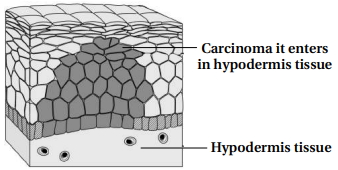
Name the pathological condition that occurs when uncontrolled cell division takes place.
Solution
(N/A) The pathological condition characterized by uncontrolled cell division is known as cancer.
In normal cells,cell division is strictly regulated by various checkpoints and signaling pathways.
When these regulatory mechanisms fail,cells begin to divide uncontrollably,leading to the formation of a mass of cells known as a tumor or neoplasm.
This uncontrolled proliferation disrupts the normal structure and function of the affected organ or tissue.
In normal cells,cell division is strictly regulated by various checkpoints and signaling pathways.
When these regulatory mechanisms fail,cells begin to divide uncontrollably,leading to the formation of a mass of cells known as a tumor or neoplasm.
This uncontrolled proliferation disrupts the normal structure and function of the affected organ or tissue.
0 likes
View Solution167
Easy
Give differences: Normal cell and cancerous cell.
Solution
(N/A)
| Normal cell | Cancerous cell |
| $(1)$ They show contact inhibition. | $(1)$ They lose the property of contact inhibition. |
| $(2)$ Cell division is strictly regulated. | $(2)$ Cell division is uncontrolled and unregulated. |
| $(3)$ They undergo differentiation after attaining a specific growth. | $(3)$ They do not undergo differentiation and remain in a proliferative state. |
| $(4)$ Cells remain confined to their specific location. | $(4)$ Cells can metastasize (transported to other locations) and cause damage to other body tissues. |
0 likes
View Solution168
EasyMCQ
Give scientific reasons: The property of metastasis in malignant tumors is very dangerous.
A
It allows cells to remain localized.
B
It enables cancer cells to spread to distant sites via blood or lymph.
C
It causes cells to stop dividing.
D
It makes the tumor benign.
Solution
(B) Malignant tumors are masses of proliferating cells called neoplastic or tumor cells. These cells grow very rapidly,invading and damaging the surrounding normal tissues. As these cells divide actively,they compete with normal cells for vital nutrients,effectively starving them. Cells shed from such tumors reach distant sites through the blood,and wherever they get lodged in the body,they start a new tumor. This property of metastasis is the most feared property of malignant tumors because it makes the cancer spread throughout the body.
0 likes
View Solution169
Medium
Define metastasis and viral oncogenes.
Solution
(N/A) Metastasis: The property of malignant tumors where cells slough off from the tumor and reach distant sites through the blood to form new tumors elsewhere is called metastasis. This is the most feared property of malignant tumors.
Viral Oncogenes: Cancer-causing viruses are called oncogenic viruses,and their genes are known as viral oncogenes. In normal cells,these genes are present as proto-oncogenes,which,upon activation under certain conditions,lead to oncogenic transformation of the cells.
Viral Oncogenes: Cancer-causing viruses are called oncogenic viruses,and their genes are known as viral oncogenes. In normal cells,these genes are present as proto-oncogenes,which,upon activation under certain conditions,lead to oncogenic transformation of the cells.
0 likes
View Solution170
Medium
What is cancer? How is a cancer cell different from a normal cell? How do normal cells attain cancerous nature?
Solution
(N/A) Cancer is defined as the abnormal and uncontrolled division of cells.
The differences between cancer cells and normal cells are as follows:
- In our body,the growth and differentiation of cells are highly controlled and regulated.
- Normal cells exhibit a property called contact inhibition,where contact with other cells inhibits their uncontrolled growth and division.
- Cancerous cells lose this property of contact inhibition,leading to continuous,uncontrolled division,which results in masses of cells known as tumors.
- The transformation of normal cells into cancerous cells is induced by physical,chemical,or biological agents known as carcinogens.
The differences between cancer cells and normal cells are as follows:
| Cancer Cells | Normal Cells |
|---|---|
| $(1)$ Cancer cells divide in an uncontrolled manner. | $(1)$ Normal cells divide in a controlled manner. |
| $(2)$ These cells do not show contact inhibition. | $(2)$ These cells show contact inhibition. |
| $(3)$ Life span is indefinite. | $(3)$ Life span is definite. |
- In our body,the growth and differentiation of cells are highly controlled and regulated.
- Normal cells exhibit a property called contact inhibition,where contact with other cells inhibits their uncontrolled growth and division.
- Cancerous cells lose this property of contact inhibition,leading to continuous,uncontrolled division,which results in masses of cells known as tumors.
- The transformation of normal cells into cancerous cells is induced by physical,chemical,or biological agents known as carcinogens.
0 likes
View Solution171
Medium
What are the methods of cancer detection? Describe the common approaches for treatment of cancer.
Solution
(N/A) Cancer detection and diagnosis: Early detection is essential for successful treatment. Detection is based on biopsy and histopathological studies of tissues,and blood and bone marrow tests for increased cell counts in leukemias. In a biopsy,a piece of suspected tissue is cut into thin sections,stained,and examined under a microscope by a pathologist.
Techniques like radiography ($X$-rays),$CT$ (computed tomography),and $MRI$ (magnetic resonance imaging) are useful for detecting internal organ cancers. $CT$ uses $X$-rays to generate a three-dimensional image of internal structures. $MRI$ uses strong magnetic fields and non-ionizing radiations to detect pathological and physiological changes in living tissues.
Antibodies against cancer-specific antigens are also used. Molecular biology techniques help detect genes in individuals with inherited susceptibility. Identifying such genes helps in cancer prevention by advising individuals to avoid specific carcinogens (e.g.,tobacco smoke for lung cancer).
Treatment of cancer: Common approaches include surgery,radiation therapy,and immunotherapy. In radiotherapy,tumor cells are irradiated lethally while protecting surrounding normal tissues.
Chemotherapeutic drugs are used to kill cancer cells,though many have side effects like hair loss and anemia. Most cancers are treated using a combination of surgery,radiotherapy,and chemotherapy. Since tumor cells often evade the immune system,patients are given biological response modifiers like $\alpha$-interferon,which activate the immune system to destroy the tumor.
Techniques like radiography ($X$-rays),$CT$ (computed tomography),and $MRI$ (magnetic resonance imaging) are useful for detecting internal organ cancers. $CT$ uses $X$-rays to generate a three-dimensional image of internal structures. $MRI$ uses strong magnetic fields and non-ionizing radiations to detect pathological and physiological changes in living tissues.
Antibodies against cancer-specific antigens are also used. Molecular biology techniques help detect genes in individuals with inherited susceptibility. Identifying such genes helps in cancer prevention by advising individuals to avoid specific carcinogens (e.g.,tobacco smoke for lung cancer).
Treatment of cancer: Common approaches include surgery,radiation therapy,and immunotherapy. In radiotherapy,tumor cells are irradiated lethally while protecting surrounding normal tissues.
Chemotherapeutic drugs are used to kill cancer cells,though many have side effects like hair loss and anemia. Most cancers are treated using a combination of surgery,radiotherapy,and chemotherapy. Since tumor cells often evade the immune system,patients are given biological response modifiers like $\alpha$-interferon,which activate the immune system to destroy the tumor.
0 likes
View Solution172
Easy
Define the following terms: Carcinogens and Tumour.
Solution
(N/A) Carcinogen: Any agent,chemical,physical,or biological,that causes cancer is known as a carcinogen. Examples include $UV$ radiation,tobacco smoke,and certain viruses.
Tumour: $A$ tumour is a mass of unorganized cells formed due to the uncontrolled and abnormal division of cells in the body.
Tumour: $A$ tumour is a mass of unorganized cells formed due to the uncontrolled and abnormal division of cells in the body.
0 likes
View Solution173
MediumMCQ
In which condition is chromosomal aberration common?
A
$AIDS$
B
Cancer
C
Recombination
D
Crossing over
Solution
(B) Chromosomal aberrations are commonly observed in cancer cells. Cancer is characterized by uncontrolled cell division,which is often associated with significant changes in the structure or number of chromosomes (chromosomal aberrations) within the affected cells. $AIDS$ is a viral disease,while recombination and crossing over are normal biological processes occurring during meiosis.
0 likes
View Solution174
MediumMCQ
Which of the following is a non-infectious disease that causes death?
A
$AIDS$
B
Cancer
C
Typhoid
D
Both $A$ and $B$
Solution
(B) $1$. $AIDS$ (Acquired Immuno Deficiency Syndrome) is an infectious disease caused by the Human Immunodeficiency Virus $(HIV)$.
$2$. Cancer is a non-infectious disease characterized by uncontrolled cell division, which can lead to death if not treated.
$3$. Typhoid is an infectious disease caused by the bacterium $Salmonella \text{ } typhi$.
$4$. Therefore, among the given options, only cancer is a non-infectious disease that can cause death.
$2$. Cancer is a non-infectious disease characterized by uncontrolled cell division, which can lead to death if not treated.
$3$. Typhoid is an infectious disease caused by the bacterium $Salmonella \text{ } typhi$.
$4$. Therefore, among the given options, only cancer is a non-infectious disease that can cause death.
0 likes
View Solution175
MediumMCQ
Which group of diseases cannot be classified as infectious diseases?
A
$AIDS$, $Cancer$, $Pneumonia$, $Common \text{ } cold$
B
$Polio$, $Tetanus$, $Diphtheria$, $Pneumonia$
C
$Common \text{ } cold$, $Amoebiasis$, $Filariasis$, $Typhoid$
D
$Measles$, $Chickenpox$, $Filariasis$, $Conjunctivitis$
Solution
(A) Infectious diseases are those that are easily transmitted from one person to another.
$AIDS$ is an infectious disease caused by the $HIV$ virus.
$Cancer$ is a non-infectious disease caused by uncontrolled cell division and is not transmitted from one person to another.
$Pneumonia$ and $Common \text{ } cold$ are infectious diseases.
Since $Cancer$ is non-infectious, the group containing $Cancer$ cannot be classified as purely infectious diseases.
$AIDS$ is an infectious disease caused by the $HIV$ virus.
$Cancer$ is a non-infectious disease caused by uncontrolled cell division and is not transmitted from one person to another.
$Pneumonia$ and $Common \text{ } cold$ are infectious diseases.
Since $Cancer$ is non-infectious, the group containing $Cancer$ cannot be classified as purely infectious diseases.
0 likes
View Solution176
MediumMCQ
In diseases like cancer,which process is inhibited,leading to the formation of tumors?
A
Contact inhibition
B
Decrease in growth factors
C
Cell division
D
All of the above
Solution
(A) In normal cells,growth and differentiation are highly controlled and regulated. Normal cells show a property called $Contact \ Inhibition$ by virtue of which contact with other cells inhibits their uncontrolled growth. Cancer cells appear to have lost this property. As a result of the loss of $Contact \ Inhibition$,cancerous cells continue to divide,giving rise to masses of cells called tumors.
0 likes
View Solution177
EasyMCQ
Which of the following can be included in non-ionizing radiations that act as carcinogens?
A
$X$-rays
B
$\gamma$-rays
C
$UV$ rays
D
Laser rays
Solution
(C) Carcinogens are agents that cause cancer. These can be physical,chemical,or biological.
Physical carcinogens include ionizing radiations (like $X$-rays and $\gamma$-rays) and non-ionizing radiations (like $UV$ rays).
$X$-rays and $\gamma$-rays are ionizing radiations because they have enough energy to remove electrons from atoms.
$UV$ rays are non-ionizing radiations that cause $DNA$ damage,leading to neoplastic transformation.
Therefore,$UV$ rays are the correct example of non-ionizing radiation among the given options.
Physical carcinogens include ionizing radiations (like $X$-rays and $\gamma$-rays) and non-ionizing radiations (like $UV$ rays).
$X$-rays and $\gamma$-rays are ionizing radiations because they have enough energy to remove electrons from atoms.
$UV$ rays are non-ionizing radiations that cause $DNA$ damage,leading to neoplastic transformation.
Therefore,$UV$ rays are the correct example of non-ionizing radiation among the given options.
0 likes
View Solution178
MediumMCQ
The type of tumor that spreads from one part of the body to another is called .....
A
Benign
B
Malignant
C
Rapidly spreading tumor
D
Both $A$ and $B$
Solution
(B) Tumors are generally classified into two types: $Benign$ and $Malignant$.
$Benign$ tumors normally remain confined to their original location and do not spread to other parts of the body.
$Malignant$ tumors are composed of mass of proliferating cells called neoplastic or tumor cells.
These cells grow very rapidly,invading and damaging the surrounding normal tissues.
As these cells are active,they reach distant sites through the blood,and wherever they get lodged in the body,they start a new tumor there.
This property of spreading to distant sites is called metastasis,which is the most feared property of $Malignant$ tumors.
$Benign$ tumors normally remain confined to their original location and do not spread to other parts of the body.
$Malignant$ tumors are composed of mass of proliferating cells called neoplastic or tumor cells.
These cells grow very rapidly,invading and damaging the surrounding normal tissues.
As these cells are active,they reach distant sites through the blood,and wherever they get lodged in the body,they start a new tumor there.
This property of spreading to distant sites is called metastasis,which is the most feared property of $Malignant$ tumors.
0 likes
View Solution179
MediumMCQ
Melanoma cancer of the skin can be classified under which type of cancer?
A
Leukemia
B
Sarcoma
C
Carcinoma
D
Lymphoma
Solution
(C) Cancer is classified based on the tissue of origin.
$1$. Carcinoma: Cancer arising from epithelial tissues (e.g.,skin,lining of organs). Melanoma is a cancer of melanocytes,which are epithelial-derived cells in the skin.
$2$. Sarcoma: Cancer arising from connective tissues (e.g.,bone,cartilage,fat).
$3$. Leukemia: Cancer of blood-forming tissues (e.g.,bone marrow).
$4$. Lymphoma: Cancer of the lymphatic system.
Since melanoma originates from the skin (epithelial tissue),it is classified as a carcinoma.
$1$. Carcinoma: Cancer arising from epithelial tissues (e.g.,skin,lining of organs). Melanoma is a cancer of melanocytes,which are epithelial-derived cells in the skin.
$2$. Sarcoma: Cancer arising from connective tissues (e.g.,bone,cartilage,fat).
$3$. Leukemia: Cancer of blood-forming tissues (e.g.,bone marrow).
$4$. Lymphoma: Cancer of the lymphatic system.
Since melanoma originates from the skin (epithelial tissue),it is classified as a carcinoma.
0 likes
View Solution180
EasyMCQ
Cancer originating mainly in the mesodermal tissue is classified as which of the following?
A
Carcinoma
B
Sarcoma
C
Leukemia
D
Both $B$ and $C$
Solution
(B) Cancer is classified based on the tissue of origin.
$1$. Carcinoma: Cancer originating from epithelial tissues (e.g.,skin,lining of organs).
$2$. Sarcoma: Cancer originating from mesodermal tissues (e.g.,bone,cartilage,muscle,fat,connective tissue).
$3$. Leukemia: Cancer of blood-forming tissues (e.g.,bone marrow) leading to an abnormal increase in white blood cells.
Since the question specifies cancer originating in mesodermal tissue,the correct classification is Sarcoma.
$1$. Carcinoma: Cancer originating from epithelial tissues (e.g.,skin,lining of organs).
$2$. Sarcoma: Cancer originating from mesodermal tissues (e.g.,bone,cartilage,muscle,fat,connective tissue).
$3$. Leukemia: Cancer of blood-forming tissues (e.g.,bone marrow) leading to an abnormal increase in white blood cells.
Since the question specifies cancer originating in mesodermal tissue,the correct classification is Sarcoma.
0 likes
View Solution181
MediumMCQ
Which of the following cannot be classified as a carcinogen?
A
Pollen grains with dust particles
B
Vehicle exhaust fumes
C
Smoke from cigarette smoking
D
$UV$ radiation
Solution
(A) Carcinogens are agents that cause cancer by inducing mutations in the $DNA$ of cells.
$UV$ radiation (physical agent),vehicle exhaust fumes (chemical agent),and cigarette smoke (chemical agent) are all well-known carcinogens.
Pollen grains with dust particles are generally considered allergens that trigger immune responses like asthma or hay fever,but they are not classified as carcinogens.
$UV$ radiation (physical agent),vehicle exhaust fumes (chemical agent),and cigarette smoke (chemical agent) are all well-known carcinogens.
Pollen grains with dust particles are generally considered allergens that trigger immune responses like asthma or hay fever,but they are not classified as carcinogens.
0 likes
View Solution182
EasyMCQ
Which type of cancer is most commonly found in women globally?
A
Cervical cancer
B
Prostate cancer
C
Breast cancer
D
Oral cancer
Solution
(C) Globally,breast cancer is the most frequently diagnosed cancer among women. According to the World Health Organization $(WHO)$ and global cancer statistics,it accounts for the highest incidence rate of all cancers in the female population worldwide.
0 likes
View Solution183
MediumMCQ
Which genes are inactivated in cancer cells?
A
Growth factor genes
B
Tumor suppressor genes
C
Genes preventing contact inhibition
D
Both $A$ and $B$
Solution
(B) Cancer is caused by the uncontrolled division of cells. This process is regulated by two main types of genes: proto-oncogenes (which promote cell growth) and tumor suppressor genes (which inhibit cell division).
In cancer cells,proto-oncogenes often mutate into oncogenes,leading to excessive cell growth.
Simultaneously,tumor suppressor genes (such as $p53$ or $Rb$) are inactivated or deleted,which removes the 'brakes' on the cell cycle,allowing the cells to divide uncontrollably.
Therefore,the inactivation of tumor suppressor genes is a critical step in the development of cancer.
In cancer cells,proto-oncogenes often mutate into oncogenes,leading to excessive cell growth.
Simultaneously,tumor suppressor genes (such as $p53$ or $Rb$) are inactivated or deleted,which removes the 'brakes' on the cell cycle,allowing the cells to divide uncontrollably.
Therefore,the inactivation of tumor suppressor genes is a critical step in the development of cancer.
0 likes
View Solution184
MediumMCQ
When a proto-oncogene is transformed into a cancer-causing gene by some factor,it is called .......?
A
$c-onc$
B
$v-onc$
C
Both $A$ and $B$
D
Apoptosis
Solution
(A) Proto-oncogenes are normal genes present in the cells of higher organisms that regulate cell growth and division.
When these genes are activated or mutated by certain physical,chemical,or biological agents (carcinogens),they are transformed into cancer-causing genes known as oncogenes.
Specifically,the cellular oncogenes are referred to as $c-onc$ (or proto-oncogenes),and when they are activated to cause cancer,they are often referred to as oncogenes. In the context of viral transformation,the viral oncogenes are called $v-onc$. However,the general term for the transformed cancer-causing gene derived from a proto-oncogene is an oncogene. Given the options,$c-onc$ represents the cellular proto-oncogene,and the transformation leads to an active oncogene state.
When these genes are activated or mutated by certain physical,chemical,or biological agents (carcinogens),they are transformed into cancer-causing genes known as oncogenes.
Specifically,the cellular oncogenes are referred to as $c-onc$ (or proto-oncogenes),and when they are activated to cause cancer,they are often referred to as oncogenes. In the context of viral transformation,the viral oncogenes are called $v-onc$. However,the general term for the transformed cancer-causing gene derived from a proto-oncogene is an oncogene. Given the options,$c-onc$ represents the cellular proto-oncogene,and the transformation leads to an active oncogene state.
0 likes
View Solution185
MediumMCQ
Which method can be used to collect a sample for breast cancer diagnosis?
A
Fine Needle Aspiration Cytology
B
$C$.$T$. Scan
C
$M$.$R$.$I$.
D
Pap smear
Solution
(A) Fine Needle Aspiration Cytology $(FNAC)$ is a diagnostic procedure used to investigate lumps or masses. In this technique,a thin,hollow needle is inserted into the mass to extract cells or fluid for microscopic examination. It is commonly used for the diagnosis of breast cancer. $C.T.$ scans and $M.R.I.$ are imaging techniques used for visualization,while a Pap smear is specifically used for cervical cancer screening.
0 likes
View Solution186
EasyMCQ
Which of the following methods is primarily used for the diagnosis of cervical cancer?
A
$Pap \, smear$
B
$Ag-Ab$ test
C
Biopsy
D
All of the above
Solution
(A) The $Pap \, smear$ (Papanicolaou test) is a screening procedure used to detect potentially precancerous and cancerous processes in the cervix.
While biopsy is used to confirm a diagnosis,the $Pap \, smear$ is the primary screening method used for early detection of cervical cancer.
Therefore,$Pap \, smear$ is the most appropriate answer in the context of primary diagnostic screening.
While biopsy is used to confirm a diagnosis,the $Pap \, smear$ is the primary screening method used for early detection of cervical cancer.
Therefore,$Pap \, smear$ is the most appropriate answer in the context of primary diagnostic screening.
0 likes
View Solution187
MediumMCQ
In the treatment of cancer,what characteristic is produced in the body when $\alpha$-interferons are administered?
A
Activation of the immune system increases.
B
Directly attacks cancer cells.
C
Binds to specific proteins of cancer-affected cells.
D
Side effects like anemia or hair loss are produced.
Solution
(A) In the treatment of cancer,biological response modifiers such as $\alpha$-interferons are used. These substances activate the patient's immune system and help in destroying the tumor. Therefore,the administration of $\alpha$-interferons leads to the activation of the immune system.
0 likes
View Solution188
EasyMCQ
Which of the following is used in the treatment of cancer?
A
Radiotherapy
B
Surgery
C
Chemotherapy
D
All of the above
Solution
(D) Cancer treatment involves a multidisciplinary approach to eliminate or control malignant cells.
$1$. Radiotherapy: Uses high-energy radiation to kill cancer cells or shrink tumors.
$2$. Surgery: Involves the physical removal of the tumor or cancerous tissue.
$3$. Chemotherapy: Uses specific drugs to destroy rapidly dividing cancer cells throughout the body.
Since all these methods are standard practices in oncology,the correct answer is $D$.
$1$. Radiotherapy: Uses high-energy radiation to kill cancer cells or shrink tumors.
$2$. Surgery: Involves the physical removal of the tumor or cancerous tissue.
$3$. Chemotherapy: Uses specific drugs to destroy rapidly dividing cancer cells throughout the body.
Since all these methods are standard practices in oncology,the correct answer is $D$.
0 likes
View Solution189
MediumMCQ
How do anti-cancer drugs affect the body?
A
Inhibit $DNA$ synthesis in cancerous cells
B
Kill the cancerous cells
C
Arrest the cell cycle of cancerous cells
D
Both $A$ and $C$
Solution
(D) Anti-cancer drugs,also known as chemotherapeutic agents,primarily target rapidly dividing cells.
They function by interfering with the cell cycle,often by inhibiting $DNA$ synthesis or replication,which prevents the cancer cells from proliferating.
By arresting the cell cycle at specific checkpoints,these drugs effectively stop the uncontrolled growth of tumors.
Therefore,both inhibiting $DNA$ synthesis and arresting the cell cycle are primary mechanisms of action for these drugs.
They function by interfering with the cell cycle,often by inhibiting $DNA$ synthesis or replication,which prevents the cancer cells from proliferating.
By arresting the cell cycle at specific checkpoints,these drugs effectively stop the uncontrolled growth of tumors.
Therefore,both inhibiting $DNA$ synthesis and arresting the cell cycle are primary mechanisms of action for these drugs.
0 likes
View Solution190
MediumMCQ
In which type of cancer is Alpha-fetoprotein $(AFP)$ produced?
A
Gastric cancer
B
Lung cancer
C
Liver cancer
D
Ulcer
Solution
(C) Alpha-fetoprotein $(AFP)$ is a protein normally produced by the fetal liver and yolk sac during development.
In adults,elevated levels of $AFP$ in the blood are often used as a tumor marker.
It is most commonly associated with hepatocellular carcinoma (liver cancer) and certain germ cell tumors.
Therefore,$AFP$ is a diagnostic marker for liver cancer.
In adults,elevated levels of $AFP$ in the blood are often used as a tumor marker.
It is most commonly associated with hepatocellular carcinoma (liver cancer) and certain germ cell tumors.
Therefore,$AFP$ is a diagnostic marker for liver cancer.
0 likes
View Solution191
EasyMCQ
Cobalt therapy and iodine therapy used in the treatment of cancer are included in which of the following?
A
Radiotherapy
B
Chemotherapy
C
Surgery
D
Biological therapy
Solution
(A) Cancer treatment involves various methods such as surgery,radiotherapy,chemotherapy,and immunotherapy.
In radiotherapy,ionizing radiation (such as $X$-rays,gamma rays,or radioactive isotopes like Cobalt-$60$ or Iodine-$131$) is used to kill cancer cells or shrink tumors by damaging their $DNA$.
Therefore,Cobalt therapy and Iodine therapy are specific types of radiotherapy.
In radiotherapy,ionizing radiation (such as $X$-rays,gamma rays,or radioactive isotopes like Cobalt-$60$ or Iodine-$131$) is used to kill cancer cells or shrink tumors by damaging their $DNA$.
Therefore,Cobalt therapy and Iodine therapy are specific types of radiotherapy.
0 likes
View Solution192
MediumMCQ
The process of metastasis in cancer is associated with which of the following?
A
Migration of cancer cells from one site to another to form secondary tumors
B
Formation of a benign tumor
C
Activation of an $oncogene$
D
$A$ type of leukemia
Solution
(A) Metastasis is the defining characteristic of malignant tumors.
It refers to the process where cancer cells break away from the primary site of origin,travel through the blood or lymphatic system,and invade other parts of the body to form secondary tumors.
This property makes malignant tumors much more dangerous than benign tumors,which remain localized at their site of origin.
It refers to the process where cancer cells break away from the primary site of origin,travel through the blood or lymphatic system,and invade other parts of the body to form secondary tumors.
This property makes malignant tumors much more dangerous than benign tumors,which remain localized at their site of origin.
0 likes
View Solution193
MediumMCQ
Biopsy can be used for the diagnosis of which of the following?
A
$AIDS$
B
$Cancer$
C
Typhoid
D
Allergy
Solution
(B) Biopsy is a medical procedure that involves taking a small sample of tissue from the body to examine it under a microscope.
It is primarily used to detect the presence of malignant cells,which is the hallmark of $Cancer$.
In this process,a piece of the suspected tissue is cut into thin sections,stained,and examined by a pathologist to determine if the cells are cancerous or benign.
It is primarily used to detect the presence of malignant cells,which is the hallmark of $Cancer$.
In this process,a piece of the suspected tissue is cut into thin sections,stained,and examined by a pathologist to determine if the cells are cancerous or benign.
0 likes
View Solution194
MediumMCQ
What type of cancer is a $Glioma$?
A
Carcinoma
B
Sarcoma
C
Leukemia
D
Lymphoma
Solution
(B) $Glioma$ is a type of tumor that occurs in the brain and spinal cord. It arises from glial cells. In the classification of cancers based on the tissue of origin,$Glioma$ is technically a type of sarcoma because it originates from tissues derived from the embryonic mesoderm or neuroectoderm (specifically,glial cells are supporting cells of the nervous system). However,it is often categorized separately in clinical oncology. Given the standard options provided in many biology textbooks,$Glioma$ is classified under the category of sarcomas (cancers of connective tissue or supporting tissues).
0 likes
View Solution195
MediumMCQ
$Kaposi \, Sarcoma$ is a type of cancer that affects which of the following?
A
Cancer of soft tissues
B
Cancer of the lymphatic system
C
Cancer of the brain
D
Both $A$ and $B$
Solution
(D) $Kaposi \, Sarcoma$ is a cancer that develops from the cells that line lymph or blood vessels. It typically appears as tumors on the skin or on mucosal surfaces such as inside the mouth,but tumors can also develop in other parts of the body,such as in the lymph nodes,lungs,or digestive tract. Therefore,it is considered a cancer of both soft tissues and the lymphatic system.
0 likes
View Solution196
MediumMCQ
Which of the following parts is most affected by radiation?
A
Thymus
B
Lymph nodes
C
Spleen
D
Bone marrow
Solution
(D) Radiation therapy and exposure primarily target cells that are rapidly dividing.
Among the given options,the bone marrow contains hematopoietic stem cells which undergo continuous and rapid cell division to produce blood cells.
Because these cells are highly proliferative,they are the most sensitive to ionizing radiation,leading to a decrease in blood cell production (myelosuppression).
Therefore,the bone marrow is the most affected part.
Among the given options,the bone marrow contains hematopoietic stem cells which undergo continuous and rapid cell division to produce blood cells.
Because these cells are highly proliferative,they are the most sensitive to ionizing radiation,leading to a decrease in blood cell production (myelosuppression).
Therefore,the bone marrow is the most affected part.
0 likes
View Solution197
MediumMCQ
What type of tumor is produced in $Osteosarcoma$ cancer?
A
Benign tumor
B
Malignant tumor
C
Metastasis
D
None of these
Solution
(B) Cancer is defined as the uncontrolled division of cells,which leads to the formation of a mass of cells known as a tumor.
Tumors are classified into two types: $Benign$ and $Malignant$.
$Benign$ tumors remain confined to their original location and do not spread to other parts of the body.
$Malignant$ tumors are cancerous; they invade surrounding tissues and can spread to distant sites through blood or lymph,a process known as $Metastasis$.
$Osteosarcoma$ is a type of bone cancer,which is a $Malignant$ tumor.
Tumors are classified into two types: $Benign$ and $Malignant$.
$Benign$ tumors remain confined to their original location and do not spread to other parts of the body.
$Malignant$ tumors are cancerous; they invade surrounding tissues and can spread to distant sites through blood or lymph,a process known as $Metastasis$.
$Osteosarcoma$ is a type of bone cancer,which is a $Malignant$ tumor.
0 likes
View Solution198
MediumMCQ
Identify the correct statement from the following:
A
Adolescence period - $12$ to $20$ years
B
$HIV$ envelope - $P-24, P-17$ proteins
C
Absent in normal cells - Oncogenes
D
Do not die due to negligence - Cancer
Solution
(C) The correct statement is that oncogenes are absent in normal cells.
$1$. Adolescence is generally defined as the period between $12$ to $18$ or $19$ years,not $20$.
$2$. The $HIV$ envelope contains glycoproteins like $gp120$ and $gp41$,while $p24$ and $p17$ are capsid and matrix proteins,respectively.
$3$. Oncogenes (or proto-oncogenes) are present in normal cells in an inactive form; when mutated or overexpressed,they become oncogenes that cause cancer. However,in the context of typical biology MCQs,the statement 'absent in normal cells' is often used to refer to the active oncogenic form.
$4$. Cancer is a disease that requires early detection and treatment; negligence often leads to advanced stages and death.
$1$. Adolescence is generally defined as the period between $12$ to $18$ or $19$ years,not $20$.
$2$. The $HIV$ envelope contains glycoproteins like $gp120$ and $gp41$,while $p24$ and $p17$ are capsid and matrix proteins,respectively.
$3$. Oncogenes (or proto-oncogenes) are present in normal cells in an inactive form; when mutated or overexpressed,they become oncogenes that cause cancer. However,in the context of typical biology MCQs,the statement 'absent in normal cells' is often used to refer to the active oncogenic form.
$4$. Cancer is a disease that requires early detection and treatment; negligence often leads to advanced stages and death.
0 likes
View Solution199
MediumMCQ
Identify the mismatched pair among the following options regarding cancer types.
A
Sarcoma - Cancer of mesodermal origin
B
Melanoma - Cancer of the skin
C
Lymphosarcoma - Cancer of the lymphatic system
D
Cartilage - Rarely develops cancer
Solution
(D) $1$. $Sarcoma$ is a type of cancer that arises from tissues of mesodermal origin, such as bones, muscles, and connective tissues.
$2$. $Melanoma$ is a type of cancer that develops from melanocytes, which are pigment-producing cells found in the skin.
$3$. $Lymphosarcoma$ is a cancer that originates in the lymphatic system.
$4$. The option $D$ states that cartilage rarely develops cancer. While cartilage is a connective tissue, it is not a specific type of cancer name like the others. The other three options describe specific types of cancers, whereas $D$ describes a tissue type and a general observation, making it the mismatched pair in the context of classifying cancer types.
$2$. $Melanoma$ is a type of cancer that develops from melanocytes, which are pigment-producing cells found in the skin.
$3$. $Lymphosarcoma$ is a cancer that originates in the lymphatic system.
$4$. The option $D$ states that cartilage rarely develops cancer. While cartilage is a connective tissue, it is not a specific type of cancer name like the others. The other three options describe specific types of cancers, whereas $D$ describes a tissue type and a general observation, making it the mismatched pair in the context of classifying cancer types.
0 likes
View SolutionHuman Health and Disease — Cancer · Frequently Asked Questions
1Are these Human Health and Disease questions useful for JEE and NEET?
Yes. All questions in this section are mapped to JEE Main and NEET exam patterns. Previous year questions from JEE Main, NEET, GUJCET and state-level exams are included with full solutions.
2Can I switch to Hindi or Gujarati for these questions?
Yes. Use the language tabs in the hero section or the sidebar to view the same questions and solutions in English, Hindi or Gujarati.
3How do I generate a question paper from this subtopic?
Use the Vedclass Exam Paper Generator — select the chapter and subtopic, set difficulty, and generate Sets A, B, C, D automatically. First 3 chapters of every subject are free.
Vedclass Products
For Students
Vedclass Test Series
Mock tests in real JEE/NEET style with performance analysis. 5-day free trial.
Start Free TrialFor Teachers
Exam Paper Generator
Generate Set A/B/C/D papers from this chapter in 2 minutes. 3 chapters free.
Try FreeFor Institutes
Online Exam Module
Live online exams with unlimited students, 360° analytics & white-label branding.
See DemoFor Teachers & Institutes
Generate a Human Health and Disease Exam Paper in 2 Minutes
Select subtopic & difficulty — Sets A, B, C, D auto-generated with No Repeat logic.
First 3 chapters of every subject are free — no payment required.