
A English
Adaptive Radiation Questions in English
Class 12 Biology · Evolution · Adaptive Radiation
113+
Questions
English
Language
100%
With Solutions
Showing 13 of 113 questions in English
101
EasyMCQ
The process of evolution of different species in a given geographical area starting from a point and radiating to other geographical areas is called .........
A
Natural selection
B
Adaptive radiation
C
Convergent evolution
D
Survival of the fittest
Solution
(B) Adaptive radiation is an evolutionary process in which organisms diversify rapidly from an ancestral species into a multitude of new forms,particularly when a change in the environment makes new resources available,creates new challenges,or opens new environmental niches. This phenomenon is often observed when species colonize new geographical areas from a single point of origin,such as Darwin's finches in the Galapagos Islands.
0 likes
View Solution102
MediumMCQ
Which of the following pairs is mismatched for convergent evolution?
A
Mole - Marsupial mole
B
Lemur - Spotted cuscus
C
Bobcat - Tasmanian tiger cat
D
Wolf - Tasmanian wolf
Solution
(B) Convergent evolution occurs when unrelated species evolve similar traits as a result of having to adapt to similar environments or ecological niches.
In the context of Australian marsupials and placental mammals,the following pairs represent convergent evolution:
$1$. Mole - Marsupial mole
$2$. Anteater - Numbat
$3$. Mouse - Marsupial mouse
$4$. Lemur - Spotted cuscus
$5$. Flying squirrel - Flying phalanger
$6$. Bobcat - Tasmanian tiger cat
$7$. Wolf - Tasmanian wolf
Option $B$ is mismatched because the correct placental counterpart for the Spotted cuscus is the Lemur,but the option provided in the original list was 'Lemur - Numbat'. Since the Numbat is the convergent counterpart of the Anteater,the pair 'Lemur - Numbat' is incorrect.
In the context of Australian marsupials and placental mammals,the following pairs represent convergent evolution:
$1$. Mole - Marsupial mole
$2$. Anteater - Numbat
$3$. Mouse - Marsupial mouse
$4$. Lemur - Spotted cuscus
$5$. Flying squirrel - Flying phalanger
$6$. Bobcat - Tasmanian tiger cat
$7$. Wolf - Tasmanian wolf
Option $B$ is mismatched because the correct placental counterpart for the Spotted cuscus is the Lemur,but the option provided in the original list was 'Lemur - Numbat'. Since the Numbat is the convergent counterpart of the Anteater,the pair 'Lemur - Numbat' is incorrect.
0 likes
View Solution103
MediumMCQ
When more than one adaptive radiation appears to have occurred in an isolated geographical area,it is called ...... .
A
Natural selection
B
Divergent evolution
C
Convergent evolution
D
Survival of the fittest
Solution
(C) When more than one adaptive radiation appears to have occurred in an isolated geographical area,it is called convergent evolution.
This phenomenon occurs when different species,originating from different ancestral lineages,evolve similar traits or adaptations to survive in similar environmental conditions.
Adaptive radiation refers to the process of evolution of different species in a given geographical area starting from a point and radiating to other areas of geography (habitats).
When two or more adaptive radiations occur in the same area,they lead to convergent evolution because the organisms adapt to similar niches.
This phenomenon occurs when different species,originating from different ancestral lineages,evolve similar traits or adaptations to survive in similar environmental conditions.
Adaptive radiation refers to the process of evolution of different species in a given geographical area starting from a point and radiating to other areas of geography (habitats).
When two or more adaptive radiations occur in the same area,they lead to convergent evolution because the organisms adapt to similar niches.
0 likes
View Solution104
MediumMCQ
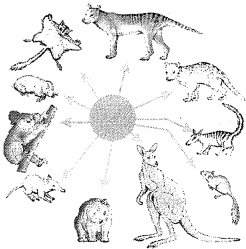
Select the correct option based on the figure given below.
A
Adaptive radiation of African marsupials
B
Adaptive radiation of Australian marsupials
C
Adaptive radiation of African primates
D
Adaptive radiation of Australian primates
Solution
(B) The provided figure illustrates the adaptive radiation of Australian marsupials. Adaptive radiation is an evolutionary process in which organisms diversify rapidly from an ancestral species into a multitude of new forms,particularly when a change in the environment makes new resources available,creates new challenges,or opens new environmental niches. In Australia,marsupials evolved into various forms such as the kangaroo,koala,wombat,and Tasmanian wolf,all originating from a common ancestral marsupial stock.
0 likes
View Solution105
MediumMCQ
Darwin's finches are found in .............
A
India
B
Australia
C
America
D
Galapagos Islands
Solution
(D) Darwin's finches are a classic example of adaptive radiation. Charles Darwin observed these small birds during his voyage on the $HMS$ Beagle. He noted that these birds,which were originally from the mainland of South America,had diversified into different species on the Galapagos Islands. This diversification occurred as they adapted to different ecological niches,such as different food sources (seeds,insects,cactus,etc.),leading to variations in their beak shapes and sizes.
0 likes
View Solution106
MediumMCQ
Marsupial mole and placental mole are examples of ........ .
A
Convergent evolution
B
Divergent evolution
C
Natural selection
D
Struggle for existence
Solution
(A) Convergent evolution occurs when different species independently evolve similar traits as a result of having to adapt to similar environments or ecological niches.
In this case,the marsupial mole (a marsupial mammal) and the placental mole (a placental mammal) have evolved similar body structures and features to adapt to a burrowing lifestyle,despite being distantly related.
This phenomenon,where different lineages evolve similar phenotypes,is a classic example of convergent evolution.
In this case,the marsupial mole (a marsupial mammal) and the placental mole (a placental mammal) have evolved similar body structures and features to adapt to a burrowing lifestyle,despite being distantly related.
This phenomenon,where different lineages evolve similar phenotypes,is a classic example of convergent evolution.
0 likes
View Solution107
MediumMCQ
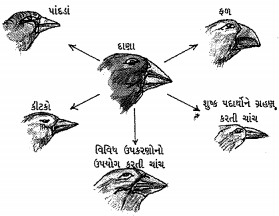
Select the correct option based on the given figure.
A
Adaptive radiation
B
Diversity in beaks is observed
C
Darwin's finches found on the Galapagos Islands
D
All of the above
Solution
(D) The figure illustrates the concept of adaptive radiation,specifically referring to Darwin's finches on the Galapagos Islands.
Adaptive radiation is the process of evolution of different species in a given geographical area starting from a point and literally radiating to other areas of geography (habitats).
Darwin observed that there were many varieties of finches in the same island.
All the varieties,he conjectured,evolved on the island itself.
From the original seed-eating features,many other forms with altered beaks arose,enabling them to become insectivorous and vegetarian finches.
Thus,the figure shows adaptive radiation,diversity in beaks,and represents Darwin's finches.
Therefore,all the given options are correct.
Adaptive radiation is the process of evolution of different species in a given geographical area starting from a point and literally radiating to other areas of geography (habitats).
Darwin observed that there were many varieties of finches in the same island.
All the varieties,he conjectured,evolved on the island itself.
From the original seed-eating features,many other forms with altered beaks arose,enabling them to become insectivorous and vegetarian finches.
Thus,the figure shows adaptive radiation,diversity in beaks,and represents Darwin's finches.
Therefore,all the given options are correct.
0 likes
View Solution108
MediumMCQ
Select the correct group/set of Australian Marsupials exhibiting adaptive radiation.
A
Lemur,Anteater,Wolf
B
Tasmanian wolf,Bobcat,Marsupial mole
C
Numbat,Spotted cuscus,Flying phalanger
D
Mole,Flying squirrel,Tasmanian tiger cat
Solution
(C) Option $C$ is the correct answer because Numbat,Spotted cuscus,and Flying phalanger are all Australian marsupials that exhibit adaptive radiation.
Adaptive radiation is the process of evolution of different species in a given geographical area starting from a point and literally radiating to other areas of geography (habitats).
Option $A$ is incorrect because Lemur,Anteater,and Wolf are placental mammals.
Option $B$ is incorrect because Bobcat is a placental mammal.
Option $D$ is incorrect because Mole and Flying squirrel are placental mammals.
Adaptive radiation is the process of evolution of different species in a given geographical area starting from a point and literally radiating to other areas of geography (habitats).
Option $A$ is incorrect because Lemur,Anteater,and Wolf are placental mammals.
Option $B$ is incorrect because Bobcat is a placental mammal.
Option $D$ is incorrect because Mole and Flying squirrel are placental mammals.
0 likes
View Solution109
EasyMCQ
Given below are two statements with respect to homologous organs.
Statement $I$: These organs are structurally similar but perform different functions.
Statement $II$: Differences in homologous organs are examples of adaptive radiation.
In the light of the above statements,choose the correct option from the list given below.
Statement $I$: These organs are structurally similar but perform different functions.
Statement $II$: Differences in homologous organs are examples of adaptive radiation.
In the light of the above statements,choose the correct option from the list given below.
A
Both statement $I$ and statement $II$ are correct.
B
Both statement $I$ and statement $II$ are incorrect.
C
Statement $I$ is correct but statement $II$ is incorrect.
D
Statement $I$ is incorrect but statement $II$ is correct.
Solution
(A) Homologous organs are defined as organs that share a common ancestral origin and similar basic structural plan,but they have evolved to perform different functions due to different environmental pressures.
Statement $I$ is correct because homologous organs exhibit structural similarity (due to common ancestry) but functional divergence.
Statement $II$ is correct because the process of evolution where species from a common ancestor diversify into different forms to adapt to different environments is known as adaptive radiation. Homologous organs are the result of divergent evolution,which is the mechanism behind adaptive radiation.
Therefore,both statements are correct.
Statement $I$ is correct because homologous organs exhibit structural similarity (due to common ancestry) but functional divergence.
Statement $II$ is correct because the process of evolution where species from a common ancestor diversify into different forms to adapt to different environments is known as adaptive radiation. Homologous organs are the result of divergent evolution,which is the mechanism behind adaptive radiation.
Therefore,both statements are correct.
0 likes
View Solution110
EasyMCQ
Select the $CORRECT$ statement.
A
Darwin's finches living on the Galapagos islands are different in only color from those found on main land.
B
Darwin's finches living on Galapagos island are different in only vegetarian food from those found on main land.
C
Darwin's finches living on Galapagos island are different in only shapes of beak.
D
Darwin's finches living on Galapagos island are different in size,colour,beak and food habits from those on main land.
Solution
(D) Darwin's finches are a classic example of adaptive radiation. When Charles Darwin visited the Galapagos Islands,he observed a variety of small black birds,now known as Darwin's finches. He noticed that these birds exhibited significant variations in their size,plumage (colour),beak structure,and feeding habits compared to their ancestral species on the mainland. These variations allowed them to exploit different ecological niches on the islands,such as eating seeds,insects,or cactus fruits. Therefore,option $D$ is the correct statement as it encompasses the diverse phenotypic differences observed.
0 likes
View Solution111
EasyMCQ
Which scientist explained adaptive radiation from his study on Galapagos Island?
A
Alfred Wallace
B
Lamarck
C
Hugo de Vries
D
Darwin
Solution
(D) Charles $Darwin$ observed a variety of small black birds in the Galapagos Islands,now known as $Darwin's$ finches. He realized that many varieties of finches existed on the same island. All the varieties,he conjectured,evolved on the island itself. From the original seed-eating features,many other forms with altered beaks arose,enabling them to become insectivorous and vegetarian finches. This process of evolution of different species in a given geographical area starting from a point and literally radiating to other areas of geography (habitats) is called adaptive radiation.
0 likes
View Solution112
EasyMCQ
Which of these is $NOT$ an example of adaptive radiation?
A
Long-necked Giraffe
B
Darwin's finches
C
Australian marsupials
D
Placental mammals
Solution
(A) Adaptive radiation is the process of evolution of different species in a given geographical area starting from a point and literally radiating to other areas of geography (habitats).
Darwin's finches,Australian marsupials,and placental mammals are classic examples of adaptive radiation as they show divergent evolution from a common ancestor.
The long-necked giraffe is not an example of adaptive radiation; its evolution is typically explained by the theory of natural selection (Lamarckism or Darwinism) regarding the adaptation of a specific trait within a lineage rather than the diversification of a common ancestor into multiple new species.
Darwin's finches,Australian marsupials,and placental mammals are classic examples of adaptive radiation as they show divergent evolution from a common ancestor.
The long-necked giraffe is not an example of adaptive radiation; its evolution is typically explained by the theory of natural selection (Lamarckism or Darwinism) regarding the adaptation of a specific trait within a lineage rather than the diversification of a common ancestor into multiple new species.
0 likes
View Solution113
EasyMCQ
Darwin's finches represent one of the best examples of . . . . . .
A
Chemical evolution
B
Genetic equilibrium
C
Seasonal migration
D
Adaptive radiation
Solution
(D) Darwin's finches are a classic example of $Adaptive \text{ } radiation$.
During his voyage to the Galapagos Islands, Charles Darwin observed a variety of small birds, now known as Darwin's finches.
He noted that these birds had evolved from a single ancestral species into various forms with different beak shapes, adapted to different feeding habits (such as eating seeds, insects, or nectar).
This process of evolution of different species in a given geographical area starting from a point and literally radiating to other areas of geography (habitats) is called $Adaptive \text{ } radiation$.
During his voyage to the Galapagos Islands, Charles Darwin observed a variety of small birds, now known as Darwin's finches.
He noted that these birds had evolved from a single ancestral species into various forms with different beak shapes, adapted to different feeding habits (such as eating seeds, insects, or nectar).
This process of evolution of different species in a given geographical area starting from a point and literally radiating to other areas of geography (habitats) is called $Adaptive \text{ } radiation$.
0 likes
View SolutionEvolution — Adaptive Radiation · Frequently Asked Questions
1Are these Evolution questions useful for JEE and NEET?
Yes. All questions in this section are mapped to JEE Main and NEET exam patterns. Previous year questions from JEE Main, NEET, GUJCET and state-level exams are included with full solutions.
2Can I switch to Hindi or Gujarati for these questions?
Yes. Use the language tabs in the hero section or the sidebar to view the same questions and solutions in English, Hindi or Gujarati.
3How do I generate a question paper from this subtopic?
Use the Vedclass Exam Paper Generator — select the chapter and subtopic, set difficulty, and generate Sets A, B, C, D automatically. First 3 chapters of every subject are free.
Vedclass Products
For Students
Vedclass Test Series
Mock tests in real JEE/NEET style with performance analysis. 5-day free trial.
Start Free TrialFor Teachers
Exam Paper Generator
Generate Set A/B/C/D papers from this chapter in 2 minutes. 3 chapters free.
Try FreeFor Institutes
Online Exam Module
Live online exams with unlimited students, 360° analytics & white-label branding.
See DemoFor Teachers & Institutes
Generate a Evolution Exam Paper in 2 Minutes
Select subtopic & difficulty — Sets A, B, C, D auto-generated with No Repeat logic.
First 3 chapters of every subject are free — no payment required.