
A English
Adaptive Radiation Questions in English
Class 12 Biology · Evolution · Adaptive Radiation
113+
Questions
English
Language
100%
With Solutions
Showing 48 of 113 questions in English
1
EasyMCQ
Kangaroo is a native of:
A
Africa
B
Australia
C
Austria
D
Mexico
Solution
(B) The $Kangaroo$ is a marsupial mammal that belongs to the family $Macropodidae$.
It is endemic to the continent of $Australia$, meaning it is naturally found only in that region and its surrounding islands.
It is endemic to the continent of $Australia$, meaning it is naturally found only in that region and its surrounding islands.
0 likes
View Solution2
MediumMCQ
Adaptive radiation in the case of insects is a result of:
A
Genetic divergence
B
Micro-evolution
C
Macro-evolution
D
Mega-evolution
Solution
(C) Adaptive radiation is an evolutionary process in which organisms diversify rapidly from an ancestral species into a multitude of new forms,particularly when a change in the environment makes new resources available,creates new challenges,or opens new environmental niches.
In the context of evolutionary biology,the diversification of insects into various ecological niches is considered an example of $Macro-evolution$,which refers to evolution on a grand scale,involving the origin of new species and higher taxonomic groups over long periods.
In the context of evolutionary biology,the diversification of insects into various ecological niches is considered an example of $Macro-evolution$,which refers to evolution on a grand scale,involving the origin of new species and higher taxonomic groups over long periods.
0 likes
View Solution3
MediumMCQ
The humming bird,hawk,and the humming moth illustrate:
A
Adaptive radiation
B
Homology
C
Convergent evolution
D
Divergent evolution
Solution
(C) The humming bird,hawk,and the humming moth are examples of analogous organs.
These organisms belong to different evolutionary lineages but have evolved similar structures (wings) for the same function (flight) due to similar environmental pressures.
This phenomenon,where different species independently evolve similar traits as a result of having to adapt to similar environments or ecological niches,is known as convergent evolution.
These organisms belong to different evolutionary lineages but have evolved similar structures (wings) for the same function (flight) due to similar environmental pressures.
This phenomenon,where different species independently evolve similar traits as a result of having to adapt to similar environments or ecological niches,is known as convergent evolution.
0 likes
View Solution4
MediumMCQ
Being all mammals,whales,dolphins,bats,monkeys,and horses have some common characters but they also show conspicuous differences. This is due to the phenomenon of
A
Normalisation
B
Genetic drift
C
Convergence
D
Divergence
Solution
(D) The correct answer is $D$.
Whales,dolphins,bats,monkeys,and horses are all mammals that share a common ancestor.
Despite sharing basic mammalian traits,they exhibit significant structural differences due to adaptation to different environments (e.g.,aquatic,aerial,terrestrial).
This process,where organisms with a common ancestry evolve different traits to adapt to diverse niches,is known as divergent evolution or adaptive radiation.
Homologous organs,which share a common structural origin but perform different functions,serve as evidence for this phenomenon.
Whales,dolphins,bats,monkeys,and horses are all mammals that share a common ancestor.
Despite sharing basic mammalian traits,they exhibit significant structural differences due to adaptation to different environments (e.g.,aquatic,aerial,terrestrial).
This process,where organisms with a common ancestry evolve different traits to adapt to diverse niches,is known as divergent evolution or adaptive radiation.
Homologous organs,which share a common structural origin but perform different functions,serve as evidence for this phenomenon.
0 likes
View Solution5
MediumMCQ
Who is associated with the 'Galapagos Islands' in the context of evolutionary studies?
A
Malthus
B
Darwin
C
Wallace
D
Lamarck
Solution
(B) Charles Darwin is famously associated with the 'Galapagos Islands'.
During his voyage on the $HMS$ Beagle,he visited these islands and observed a great diversity of species,particularly the finches.
His observations of the variations among these finches,which were adapted to different niches on the islands,provided crucial evidence for his theory of natural selection and the concept of adaptive radiation.
During his voyage on the $HMS$ Beagle,he visited these islands and observed a great diversity of species,particularly the finches.
His observations of the variations among these finches,which were adapted to different niches on the islands,provided crucial evidence for his theory of natural selection and the concept of adaptive radiation.
0 likes
View Solution6
MediumMCQ
Darwin's finches refers to
A
Fossils of birds collected by Darwin at Galapagos islands
B
$A$ type of birds present on Galapagos islands
C
Migratory birds collected by Darwin at Galapagos islands
D
Fossils of reptiles collected by Darwin at Galapagos island
Solution
(B) Darwin's finches are a group of small birds that Charles Darwin observed on the Galapagos Islands during his voyage on the $HMS$ Beagle.
These birds exhibited a remarkable diversity in their beak shapes and sizes,which were adapted to different feeding habits.
This phenomenon is a classic example of adaptive radiation,where species from a common ancestor evolve into different forms to occupy various ecological niches.
Therefore,they are a type of bird present on the Galapagos Islands.
These birds exhibited a remarkable diversity in their beak shapes and sizes,which were adapted to different feeding habits.
This phenomenon is a classic example of adaptive radiation,where species from a common ancestor evolve into different forms to occupy various ecological niches.
Therefore,they are a type of bird present on the Galapagos Islands.
0 likes
View Solution7
MediumMCQ
The diversity in the type of beaks of finches adapted to different feeding habits on the Galapagos Islands,as observed by Darwin,provides evidence for:
A
Origin of species by natural selection
B
Intraspecific variations
C
Intraspecific competition
D
Interspecific competition
Solution
(A) Darwin observed that there were many varieties of finches in the same island. All the varieties,he conjectured,evolved on the island itself. From the original seed-eating features,many other forms with altered beaks arose,enabling them to become insectivorous and vegetarian finches. This process of evolution of different species in a given geographical area starting from a point and literally radiating to other areas of geography (habitats) is called adaptive radiation. This phenomenon provides evidence for the origin of species by natural selection,as different beak shapes were selected based on the availability of food resources in their respective niches.
0 likes
View Solution8
MediumMCQ
Darwin's finches are related to which of the following evidences?
A
Fossils
B
Embryology
C
Anatomy
D
Geographical distribution
Solution
(D) Darwin's finches are a classic example of adaptive radiation.
Darwin observed that on the Galapagos Islands,there were many varieties of finches.
All these varieties evolved from a single original seed-eating ancestral species that migrated from the mainland.
This process of evolution of different species in a given geographical area starting from a point and radiating to other areas of geography is called adaptive radiation.
Therefore,they provide evidence based on geographical distribution.
Darwin observed that on the Galapagos Islands,there were many varieties of finches.
All these varieties evolved from a single original seed-eating ancestral species that migrated from the mainland.
This process of evolution of different species in a given geographical area starting from a point and radiating to other areas of geography is called adaptive radiation.
Therefore,they provide evidence based on geographical distribution.
0 likes
View Solution9
MediumMCQ
Development of unrelated groups of animals along parallel lines in adaptation to a similar environment is called:
A
Adaptive convergence
B
Adaptive radiation
C
Adaptive divergence
D
Adaptive induction
Solution
(A) When unrelated or distantly related organisms evolve similar traits as an adaptation to similar environmental pressures, it is known as $Adaptive \text{ } convergence$ or $Convergent \text{ } evolution$.
This process results in analogous structures, where organisms share similar functions despite having different evolutionary origins.
Therefore, the correct option is $A$.
This process results in analogous structures, where organisms share similar functions despite having different evolutionary origins.
Therefore, the correct option is $A$.
0 likes
View Solution10
MediumMCQ
Darwin's finches discovered from the Galapagos Islands are an example of:
A
Camouflage
B
Mimicry
C
Biogeographical evidence of evolution
D
Seasonal migration
Solution
(C) Darwin's finches are a classic example of adaptive radiation,which serves as biogeographical evidence of evolution.
Charles Darwin observed $13$ different species of finches on the Galapagos Islands.
These birds originated from a single ancestral species that migrated to the islands and subsequently diversified into different niches based on their feeding habits.
This process of evolution from a common ancestor in a new geographical area is known as adaptive radiation,providing strong evidence for the theory of evolution through natural selection.
Charles Darwin observed $13$ different species of finches on the Galapagos Islands.
These birds originated from a single ancestral species that migrated to the islands and subsequently diversified into different niches based on their feeding habits.
This process of evolution from a common ancestor in a new geographical area is known as adaptive radiation,providing strong evidence for the theory of evolution through natural selection.
0 likes
View Solution11
MediumMCQ
The classical example of adaptive radiation in the development of new species is:
A
Darwin's finches
B
Marsupials of Australia
C
Giant turtle
D
All of these
Solution
(D) Adaptive radiation is the process of evolution of different species in a given geographical area starting from a point and literally radiating to other areas of geography (habitats).
$1.$ Darwin's finches of the Galapagos Islands are a classic example where a single ancestral species evolved into various forms with different beak shapes to suit different diets.
$2.$ Australian marsupials represent another classic example of adaptive radiation,where a number of marsupials,each different from the other,evolved from an ancestral stock within the Australian island continent.
$3.$ While the limbs of mammals show homologous structures,the term 'adaptive radiation' is most classically associated with the diversification of Darwin's finches and Australian marsupials. Given the options provided,all listed examples are recognized in evolutionary biology as instances of adaptive radiation.
$1.$ Darwin's finches of the Galapagos Islands are a classic example where a single ancestral species evolved into various forms with different beak shapes to suit different diets.
$2.$ Australian marsupials represent another classic example of adaptive radiation,where a number of marsupials,each different from the other,evolved from an ancestral stock within the Australian island continent.
$3.$ While the limbs of mammals show homologous structures,the term 'adaptive radiation' is most classically associated with the diversification of Darwin's finches and Australian marsupials. Given the options provided,all listed examples are recognized in evolutionary biology as instances of adaptive radiation.
0 likes
View Solution12
EasyMCQ
Marsupials are found in:
A
Asia
B
Australia
C
America
D
Africa
Solution
(B) Marsupials are mammals that give birth to relatively undeveloped young,which then continue to develop in a pouch (marsupium) on the mother's body.
Most of the world's marsupials,such as kangaroos,koalas,and wallabies,are native to Australia due to its long period of geographical isolation,which allowed them to evolve without competition from placental mammals.
Most of the world's marsupials,such as kangaroos,koalas,and wallabies,are native to Australia due to its long period of geographical isolation,which allowed them to evolve without competition from placental mammals.
0 likes
View Solution13
MediumMCQ
Which evidence of evolution is related to Darwin's finches?
A
Evidence from biogeographical distribution
B
Evidence from comparative anatomy
C
Evidence from embryology
D
Evidence from paleontology
Solution
(A) Darwin's finches,observed by Charles Darwin in the Galapagos Islands,provide a classic example of adaptive radiation.
These birds evolved from a common ancestral species into various forms with different beak shapes to suit different food sources on different islands.
This phenomenon is a direct consequence of geographical isolation and environmental adaptation,which falls under the category of evidence from biogeographical distribution.
These birds evolved from a common ancestral species into various forms with different beak shapes to suit different food sources on different islands.
This phenomenon is a direct consequence of geographical isolation and environmental adaptation,which falls under the category of evidence from biogeographical distribution.
0 likes
View Solution14
MediumMCQ
On what basis do Darwin's finches differ from each other?
A
Feathers
B
Beaks
C
Eye color
D
Body color
Solution
(B) Darwin's finches,observed by Charles Darwin in the Galapagos Islands,are a classic example of adaptive radiation. These birds evolved from a common ancestral species into various forms to exploit different food sources available on the islands. The most significant morphological difference between these species is the shape and size of their beaks,which have adapted to specific diets such as seeds,insects,or nectar. Therefore,they differ from each other primarily based on their beaks.
0 likes
View Solution15
MediumMCQ
The Galapagos Islands are associated with which scientist?
A
Wallace
B
Lamarck
C
Malthus
D
Darwin
Solution
(D) Charles $Darwin$ visited the Galapagos Islands during his voyage on the $H.M.S.$ Beagle. He observed a great diversity of creatures, particularly the finches, which are now famously known as $Darwin's$ finches. These observations were crucial in the development of his theory of natural selection and adaptive radiation.
0 likes
View Solution16
EasyMCQ
Darwin's finches are excellent examples of:
A
Brood parasitism
B
Connecting links
C
Adaptive radiation
D
Seasonal migration
Solution
(C) Darwin's finches found in the Galapagos Islands are a classic example of adaptive radiation.
Adaptive radiation is the process of evolution of different species in a given geographical area starting from a point and literally radiating to other areas of geography (habitats).
Darwin observed that many varieties of finches were present on the same island,all evolving from an original seed-eating ancestor into different forms with varied beak shapes suited for different feeding habits.
Adaptive radiation is the process of evolution of different species in a given geographical area starting from a point and literally radiating to other areas of geography (habitats).
Darwin observed that many varieties of finches were present on the same island,all evolving from an original seed-eating ancestor into different forms with varied beak shapes suited for different feeding habits.
0 likes
View Solution17
MediumMCQ
The finches of Galapagos islands provide evidence in favor of which of the following?
A
Special creation
B
Evolution due to mutation
C
Retrogressive evolution
D
Biogeographical evolution
Solution
(D) The finches of the Galapagos islands are a classic example of $Adaptive \text{ } Radiation$.
Charles Darwin observed that many varieties of finches were present on the same island.
All these varieties evolved from a single original seed-eating ancestral species that migrated to the island from the mainland.
Over time, they underwent adaptive changes in their beak structures to suit different feeding habits (e.g., insectivorous, vegetarian).
This process of evolution of different species in a given geographical area starting from a point and radiating to other areas of geography is called $Adaptive \text{ } Radiation$.
This is a clear evidence of $Biogeographical \text{ } evolution$ as it demonstrates how species adapt to different ecological niches within a specific geographical region.
Charles Darwin observed that many varieties of finches were present on the same island.
All these varieties evolved from a single original seed-eating ancestral species that migrated to the island from the mainland.
Over time, they underwent adaptive changes in their beak structures to suit different feeding habits (e.g., insectivorous, vegetarian).
This process of evolution of different species in a given geographical area starting from a point and radiating to other areas of geography is called $Adaptive \text{ } Radiation$.
This is a clear evidence of $Biogeographical \text{ } evolution$ as it demonstrates how species adapt to different ecological niches within a specific geographical region.
0 likes
View Solution18
MediumMCQ
What does adaptive radiation refer to?
A
Adaptations due to geographical isolation
B
Evolution of different species from a common ancestor
C
Migration of members of a species to different geographical areas
D
The power of an individual to adapt to different environments
Solution
(B) Adaptive radiation is an evolutionary process in which organisms diversify rapidly from an ancestral species into a multitude of new forms,particularly when a change in the environment makes new resources available,creates new challenges,or opens new environmental niches. This phenomenon is best exemplified by Darwin's finches in the Galapagos Islands and Australian marsupials. Therefore,it refers to the evolution of different species from a common ancestor.
0 likes
View Solution19
MediumMCQ
What is common among whales, seals, and sharks?
A
Seasonal migration
B
Thick subcutaneous fat
C
Convergent evolution
D
Homeothermy
Solution
(C) Whales and seals are mammals, while sharks are cartilaginous fish. Despite belonging to different classes, they all possess streamlined bodies adapted for aquatic life. This phenomenon, where organisms with different evolutionary lineages develop similar traits due to adaptation to similar environmental pressures, is known as $Convergent \text{ evolution}$.
0 likes
View Solution20
MediumMCQ
Adaptation is a type of ......
A
Divergent evolution
B
Convergent evolution
C
Adaptive radiation
D
Speciation
Solution
(B) Adaptation refers to the process by which an organism becomes better suited to its environment. In evolutionary biology, when different species evolve similar traits independently to adapt to similar environmental pressures, it is known as $Convergent \ evolution$. For example, the wings of butterflies and birds are analogous organs that represent convergent evolution.
0 likes
View Solution21
EasyMCQ
What do Darwin's finches represent?
A
Convergent evolution
B
Divergent evolution
C
Adaptive radiation
D
Parallel evolution
Solution
(C) Darwin's finches are a classic example of $Adaptive \text{ } radiation$.
Adaptive radiation is an evolutionary process in which organisms diversify rapidly from an ancestral species into a multitude of new forms, particularly when a change in the environment makes new resources available, creates new challenges, or opens new environmental niches.
In the case of Darwin's finches on the Galapagos Islands, a single ancestral species of finch arrived on the islands and subsequently evolved into different species with varied beak shapes to exploit different food sources, representing a clear case of adaptive radiation.
Adaptive radiation is an evolutionary process in which organisms diversify rapidly from an ancestral species into a multitude of new forms, particularly when a change in the environment makes new resources available, creates new challenges, or opens new environmental niches.
In the case of Darwin's finches on the Galapagos Islands, a single ancestral species of finch arrived on the islands and subsequently evolved into different species with varied beak shapes to exploit different food sources, representing a clear case of adaptive radiation.
0 likes
View Solution22
MediumMCQ
What phenomenon is represented by the flying squirrel and the flying phalanger?
A
Divergent evolution
B
Convergent evolution
C
Adaptive radiation
D
Artificial selection
Solution
(B) The flying squirrel (a placental mammal) and the flying phalanger (a marsupial mammal) are two different species that have evolved similar adaptations for gliding in their respective environments.
This process, where unrelated species evolve similar traits due to similar environmental pressures, is known as $Convergent \text{ evolution}$.
Therefore, the correct answer is $B$.
This process, where unrelated species evolve similar traits due to similar environmental pressures, is known as $Convergent \text{ evolution}$.
Therefore, the correct answer is $B$.
0 likes
View Solution23
MediumMCQ
Marsupial mole,Koala,Bandicoot,and Wombat are examples of what?
A
Divergent evolution
B
Convergent evolution
C
Adaptive radiation
D
Both $A$ and $C$
Solution
(D) Adaptive radiation is an evolutionary process in which organisms diversify rapidly from an ancestral species into a multitude of new forms,particularly when a change in the environment makes new resources available.
In Australia,many marsupials,each different from the other (e.g.,Marsupial mole,Koala,Bandicoot,Wombat),evolved from an ancestral stock within the Australian continent.
This process is a classic example of adaptive radiation.
Since adaptive radiation is a type of divergent evolution (where species with a common ancestor evolve different traits),both $A$ and $C$ are correct.
In Australia,many marsupials,each different from the other (e.g.,Marsupial mole,Koala,Bandicoot,Wombat),evolved from an ancestral stock within the Australian continent.
This process is a classic example of adaptive radiation.
Since adaptive radiation is a type of divergent evolution (where species with a common ancestor evolve different traits),both $A$ and $C$ are correct.
0 likes
View Solution24
MediumMCQ
What phenomenon do Darwin's finches represent?
A
Adaptive radiation
B
Parallel evolution
C
Convergent evolution
D
Both $A$ and $B$
Solution
(A) Darwin's finches are a classic example of adaptive radiation.
Adaptive radiation is the process of evolution of different species in a given geographical area starting from a point and literally radiating to other areas of geography (habitats).
In the Galapagos Islands,Darwin observed many varieties of finches.
All these varieties evolved from a single original seed-eating ancestral species that migrated to the islands.
Over time,they diversified into different forms with varied beak structures to adapt to different food sources,such as insects,fruits,or seeds.
Adaptive radiation is the process of evolution of different species in a given geographical area starting from a point and literally radiating to other areas of geography (habitats).
In the Galapagos Islands,Darwin observed many varieties of finches.
All these varieties evolved from a single original seed-eating ancestral species that migrated to the islands.
Over time,they diversified into different forms with varied beak structures to adapt to different food sources,such as insects,fruits,or seeds.
0 likes
View Solution25
MediumMCQ
What did Darwin conclude after observing the variations in the beaks of birds on the Galapagos Islands?
A
Interspecific variation
B
Intraspecific variation
C
Natural selection based on food habits
D
Inheritance of acquired characters
Solution
(C) Darwin observed that the finches on the Galapagos Islands had different types of beaks, which were adapted to their specific feeding habits (e.g., seed-eating, insect-eating).
He concluded that these variations were a result of $Adaptive \text{ } Radiation$, where a common ancestor diversified into different forms to exploit different ecological niches.
This process is driven by $Natural \text{ } Selection$, where individuals with beak shapes best suited for their specific food sources survived and reproduced more successfully.
Therefore, the variations in beak structure are a direct consequence of natural selection based on their food habits.
He concluded that these variations were a result of $Adaptive \text{ } Radiation$, where a common ancestor diversified into different forms to exploit different ecological niches.
This process is driven by $Natural \text{ } Selection$, where individuals with beak shapes best suited for their specific food sources survived and reproduced more successfully.
Therefore, the variations in beak structure are a direct consequence of natural selection based on their food habits.
0 likes
View Solution26
MediumMCQ
Darwin's finches provide an excellent evidence in favour of organic evolution. This is related to:
A
Embryological
B
Palaeontological
C
Anatomical
D
Biogeographical
Solution
(D) Darwin's finches are a classic example of adaptive radiation,which is a process of evolution of different species in a given geographical area starting from a point and literally radiating to other areas of geography (habitats). Since these finches evolved from a common ancestor in the Galapagos Islands to adapt to different ecological niches,this phenomenon is primarily considered a piece of evidence from biogeographical distribution.
0 likes
View Solution27
MediumMCQ
When two species with different evolutionary lineages resemble each other,it is a result of adaptation. What is this phenomenon called?
A
Divergent evolution
B
Microevolution
C
Co-evolution
D
Convergent evolution
Solution
(D) Convergent evolution is the process where organisms that are not closely related independently evolve similar traits as a result of having to adapt to similar environments or ecological niches.
Examples include the wings of butterflies and birds,or the flippers of dolphins and penguins.
This phenomenon leads to the development of analogous organs,which perform similar functions but have different developmental origins.
Examples include the wings of butterflies and birds,or the flippers of dolphins and penguins.
This phenomenon leads to the development of analogous organs,which perform similar functions but have different developmental origins.
0 likes
View Solution28
MediumMCQ
Which of the following is a classic example of adaptive radiation?
A
Darwin's finches
B
Australian marsupials
C
Giant tortoises
D
All of the above
Solution
(D) Adaptive radiation is the process of evolution of different species in a given geographical area starting from a point and literally radiating to other areas of geography (habitats).
$1$. Darwin's finches in the Galapagos Islands are a classic example where many varieties of finches evolved from a single ancestral species.
$2$. Australian marsupials also represent adaptive radiation,where a number of marsupials,each different from the other,evolved from an ancestral stock within the Australian island continent.
$3$. Giant tortoises in the Galapagos Islands also show adaptive radiation,as different species evolved based on the specific island habitats.
Therefore,all the given options are classic examples of adaptive radiation.
$1$. Darwin's finches in the Galapagos Islands are a classic example where many varieties of finches evolved from a single ancestral species.
$2$. Australian marsupials also represent adaptive radiation,where a number of marsupials,each different from the other,evolved from an ancestral stock within the Australian island continent.
$3$. Giant tortoises in the Galapagos Islands also show adaptive radiation,as different species evolved based on the specific island habitats.
Therefore,all the given options are classic examples of adaptive radiation.
0 likes
View Solution29
MediumMCQ
In which biome can new plant species adapt most rapidly?
A
Tropical rainforests
B
Deserts
C
Mangroves
D
Oceanic islands
Solution
(D) The correct answer is $D$. Oceanic islands are known for their high rates of speciation and rapid adaptation of new plant species. This is primarily due to the phenomenon of adaptive radiation and the isolation of these islands,which allows species to evolve in response to unique ecological niches without significant competition from mainland species. In contrast,tropical rainforests,deserts,and mangroves have more established,complex ecosystems where niche space is already highly occupied,making rapid adaptation of new arrivals more difficult.
0 likes
View Solution30
MediumMCQ
The use of the tail as a fifth limb by a kangaroo is an example of:
A
Short-term adaptation
B
Homeostasis
C
Long-term adaptation
D
Energy conversion
Solution
(C) The use of the tail as a fifth limb by a kangaroo is a structural modification that has evolved over a long period to assist in balance and locomotion. Such permanent,heritable structural changes that enhance an organism's survival and reproductive success in its environment are classified as long-term adaptations. Therefore,it is an example of long-term adaptation.
0 likes
View Solution31
MediumMCQ
The finch species of Galapagos islands are grouped according to their food sources. Which of the following is not a finch food?
A
Carrion
B
Insects
C
Tree buds
D
Seeds
Solution
(A) : Darwin's finches exhibit adaptive radiation. This radiation occurred in response to the various food resources available on the Galapagos islands. These finches are known to feed on insects,tree buds,seeds,and cactus fruits. Carrion refers to the decaying flesh of dead animals,and finches do not feed on them.
0 likes
View Solution32
EasyMCQ
Evolution of different species in a given area starting from a point and spreading to other geographical areas is known as
A
adaptive radiation
B
natural selection
C
migration
D
divergent evolution
Solution
(A) Adaptive radiation is the process of evolution of different species in a given geographical area starting from a single point and radiating to other areas of geography.
This phenomenon is a type of divergent evolution where organisms diversify rapidly from an ancestral species into a multitude of new forms,particularly when a change in the environment makes new resources available or creates new challenges.
As the original population increases,it spreads from its center of origin to exploit new habitats and food sources.
Over time,these populations adapt to their specific habitats and eventually become distinct enough to be classified as new species.
This phenomenon is a type of divergent evolution where organisms diversify rapidly from an ancestral species into a multitude of new forms,particularly when a change in the environment makes new resources available or creates new challenges.
As the original population increases,it spreads from its center of origin to exploit new habitats and food sources.
Over time,these populations adapt to their specific habitats and eventually become distinct enough to be classified as new species.
0 likes
View Solution33
MediumMCQ
Darwin's finches are a good example of
A
industrial melanism
B
connecting link
C
adaptive radiation
D
convergent evolution
Solution
(C) Darwin's finches are a classic example of adaptive radiation.
Adaptive radiation is the process of evolution of different species in a given geographical area starting from a point and literally radiating to other areas of geography (habitats).
In the Galapagos Islands,Darwin observed that many varieties of finches evolved from a single ancestral species.
These finches adapted to different niches based on the availability of food resources such as insects,seeds,and cactus,leading to the diversification of their beak shapes and sizes.
Adaptive radiation is the process of evolution of different species in a given geographical area starting from a point and literally radiating to other areas of geography (habitats).
In the Galapagos Islands,Darwin observed that many varieties of finches evolved from a single ancestral species.
These finches adapted to different niches based on the availability of food resources such as insects,seeds,and cactus,leading to the diversification of their beak shapes and sizes.
0 likes
View Solution34
MediumMCQ
The finches of Galapagos islands provide an evidence in favour of
A
evolution due to mutation
B
retrogressive evolution
C
biogeographical evolution
D
special creation
Solution
(C) The finches of the Galapagos islands,famously studied by Charles Darwin,provide evidence for adaptive radiation,which is a type of biogeographical evolution. These birds evolved from a single ancestral species that migrated to the islands and subsequently diversified into different species to exploit various ecological niches. This process demonstrates how geographical isolation and environmental pressures drive evolutionary change.
0 likes
View Solution35
MediumMCQ
Adaptive radiation refers to
A
evolution of different species from a common ancestor
B
migration of members of a species to different geographical areas
C
power of adaptation in an individual to a variety of environments
D
adaptations due to geographical isolation.
Solution
(A) : Adaptive radiation (divergent evolution) is the process of evolution of different species from a common ancestor in a given geographical area,starting from a point and radiating to other areas of geography.
As the original population increases in size,it spreads out from its center of origin to exploit new habitats and food sources.
In time,this results in a number of populations,each adapted to its particular habitat.
Eventually,these populations will differ from each other sufficiently to become new species.
As the original population increases in size,it spreads out from its center of origin to exploit new habitats and food sources.
In time,this results in a number of populations,each adapted to its particular habitat.
Eventually,these populations will differ from each other sufficiently to become new species.
0 likes
View Solution36
MediumMCQ
Which of the following is an example of divergent evolution?
A
Bougainvillea and Cucurbita
B
Butterfly and bird
C
Octopus and mammals
D
Penguins and Dolphins
Solution
(A) Divergent evolution occurs when related species evolve different traits to adapt to different environments,resulting in homologous structures.
Homologous structures are organs that share a common evolutionary origin but perform different functions.
Bougainvillea thorns and Cucurbita tendrils are both modifications of the axillary bud,representing homologous structures.
Therefore,they are a classic example of divergent evolution.
In contrast,butterfly wings and bird wings,octopus eyes and mammalian eyes,and penguin flippers and dolphin flippers are examples of convergent evolution (analogous structures).
Homologous structures are organs that share a common evolutionary origin but perform different functions.
Bougainvillea thorns and Cucurbita tendrils are both modifications of the axillary bud,representing homologous structures.
Therefore,they are a classic example of divergent evolution.
In contrast,butterfly wings and bird wings,octopus eyes and mammalian eyes,and penguin flippers and dolphin flippers are examples of convergent evolution (analogous structures).
0 likes
View Solution37
MediumMCQ
Identify the odd one out.
A
Marsupial mole
B
Numbat
C
Marsupial mouse
D
Lemur
Solution
(D) The correct answer is $D$ (Lemur).
Adaptive radiation in Australia resulted in the evolution of various marsupial mammals from a common ancestor.
$A$ (Marsupial mole),$B$ (Numbat),and $C$ (Marsupial mouse) are all examples of Australian marsupials.
$D$ (Lemur) is a placental mammal found in Madagascar,not a marsupial,making it the odd one out.
Adaptive radiation in Australia resulted in the evolution of various marsupial mammals from a common ancestor.
$A$ (Marsupial mole),$B$ (Numbat),and $C$ (Marsupial mouse) are all examples of Australian marsupials.
$D$ (Lemur) is a placental mammal found in Madagascar,not a marsupial,making it the odd one out.
0 likes
View Solution38
MediumMCQ
Identify the animal shown in the figure.
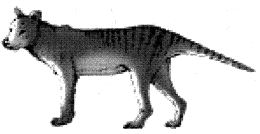
A
Tasmanian wolf
B
Tiger cat
C
Marsupial rat
D
Wombat
Solution
(A) The figure shows a Tasmanian wolf,also known as a Thylacine.
It is a classic example of adaptive radiation in Australian marsupials,where different marsupial species evolved from a common ancestor to fill various ecological niches.
The Tasmanian wolf exhibits convergent evolution with the placental wolf.
It is a classic example of adaptive radiation in Australian marsupials,where different marsupial species evolved from a common ancestor to fill various ecological niches.
The Tasmanian wolf exhibits convergent evolution with the placental wolf.
0 likes
View Solution39
MediumMCQ
The process of evolution of different species in a given geographical area starting from a point and literally radiating to other areas of geography (habitats) is called:
A
Anthropogenic action
B
Mutation
C
Panspermia
D
Adaptive radiation
Solution
(D) Adaptive radiation is an evolutionary process in which organisms diversify rapidly from an ancestral species into a multitude of new forms,particularly when a change in the environment makes new resources available,creates new challenges,or opens new environmental niches.
This phenomenon occurs when species from a single point of origin radiate into different geographical areas or habitats,adapting to the specific conditions of those environments.
Classic examples include Darwin's finches in the Galapagos Islands and Australian marsupials.
This phenomenon occurs when species from a single point of origin radiate into different geographical areas or habitats,adapting to the specific conditions of those environments.
Classic examples include Darwin's finches in the Galapagos Islands and Australian marsupials.
0 likes
View Solution40
MediumMCQ
Which of the following is not an example of Australian marsupials?
A
Lemur
B
Spotted cuscus
C
Marsupial mouse
D
Marsupial mole
Solution
(A) Adaptive radiation refers to the evolution of different species from a common ancestor in a given geographical area.
In Australia, many marsupials evolved from a common ancestor, showing adaptive radiation.
Examples of Australian marsupials include the $Spotted cuscus$, $Marsupial mouse$, $Marsupial mole$, $Tasmanian wolf$, and $Kangaroo$.
$Lemur$ is a placental mammal found in Madagascar, not an Australian marsupial.
Therefore, the correct answer is $A$.
In Australia, many marsupials evolved from a common ancestor, showing adaptive radiation.
Examples of Australian marsupials include the $Spotted cuscus$, $Marsupial mouse$, $Marsupial mole$, $Tasmanian wolf$, and $Kangaroo$.
$Lemur$ is a placental mammal found in Madagascar, not an Australian marsupial.
Therefore, the correct answer is $A$.
0 likes
View Solution41
MediumMCQ
Australian marsupials are examples of
A
Anthropogenic evolution
B
Adaptive radiation
C
Divergent evolution
D
None
Solution
(B) Australian marsupials are a classic example of $Adaptive \text{ } radiation$.
When more than one adaptive radiation appeared to have occurred in an isolated geographical area (representing different habitats), one can call this $Convergent \text{ } evolution$.
Australian marsupials, such as the Tasmanian wolf, sugar glider, and kangaroo, evolved from a common ancestral stock within the Australian continent, diversifying into various forms to occupy different ecological niches.
This process of evolution of different species in a given geographical area starting from a point and literally radiating to other areas of geography (habitats) is called $Adaptive \text{ } radiation$.
When more than one adaptive radiation appeared to have occurred in an isolated geographical area (representing different habitats), one can call this $Convergent \text{ } evolution$.
Australian marsupials, such as the Tasmanian wolf, sugar glider, and kangaroo, evolved from a common ancestral stock within the Australian continent, diversifying into various forms to occupy different ecological niches.
This process of evolution of different species in a given geographical area starting from a point and literally radiating to other areas of geography (habitats) is called $Adaptive \text{ } radiation$.
0 likes
View Solution42
MediumMCQ
Darwin's finches provide an excellent example in the context of evolution. From which field did this evidence come?
A
Biogeography
B
Anatomy
C
Embryology
D
Paleontology
Solution
(A) Darwin's finches are a classic example of adaptive radiation observed in the Galapagos Islands.
This evidence is based on the geographical distribution of species,which is known as Biogeography.
Darwin observed that different species of finches evolved from a common ancestor to adapt to different ecological niches on the islands,demonstrating how geographical isolation leads to speciation.
This evidence is based on the geographical distribution of species,which is known as Biogeography.
Darwin observed that different species of finches evolved from a common ancestor to adapt to different ecological niches on the islands,demonstrating how geographical isolation leads to speciation.
0 likes
View Solution43
MediumMCQ
The finches of Galapagos islands provide evidence in favor of:
A
Speciation
B
Evolution due to mutation
C
Retrogressive evolution
D
Biogeographical evolution
Solution
(A) The finches of the Galapagos islands,famously studied by Charles Darwin,are a classic example of adaptive radiation.
Adaptive radiation is a process of evolution of different species in a given geographical area starting from a point and literally radiating to other areas of geography (habitats).
This process leads to the formation of new species from a common ancestor,which is known as speciation.
Therefore,the Galapagos finches provide evidence in favor of speciation.
Adaptive radiation is a process of evolution of different species in a given geographical area starting from a point and literally radiating to other areas of geography (habitats).
This process leads to the formation of new species from a common ancestor,which is known as speciation.
Therefore,the Galapagos finches provide evidence in favor of speciation.
0 likes
View Solution44
MediumMCQ
Adaptive radiation refers to ..........
A
Adaptations due to geographical isolation
B
Evolution of different species from a common ancestor
C
Migration of members of a species to different geographical areas
D
Power of individuals to adapt to different environments
Solution
(B) Adaptive radiation is an evolutionary process in which organisms diversify rapidly from an ancestral species into a multitude of new forms,particularly when a change in the environment makes new resources available,creates new challenges,or opens new environmental niches.
This phenomenon is best exemplified by Darwin's finches in the Galapagos Islands and Australian marsupials,where a single common ancestor gave rise to various species adapted to different modes of life.
This phenomenon is best exemplified by Darwin's finches in the Galapagos Islands and Australian marsupials,where a single common ancestor gave rise to various species adapted to different modes of life.
0 likes
View Solution45
EasyMCQ
The specific example of $......$ is Darwin's finches.
A
Adaptive radiation
B
Seasonal variation
C
Brood parasitism
D
Connecting links
Solution
(A) Darwin's finches are a classic example of $Adaptive \text{ } radiation$.
When a species evolves from a single ancestral form into a variety of new forms to adapt to different environmental niches,it is known as adaptive radiation.
Charles Darwin observed these finches in the Galapagos Islands,where they had evolved different beak shapes to suit their specific diets,such as seeds,insects,or cactus fruits.
When a species evolves from a single ancestral form into a variety of new forms to adapt to different environmental niches,it is known as adaptive radiation.
Charles Darwin observed these finches in the Galapagos Islands,where they had evolved different beak shapes to suit their specific diets,such as seeds,insects,or cactus fruits.
0 likes
View Solution46
EasyMCQ
The process of evolution of different species in a given geographical area starting from a point and radiating to other areas of geography is called ................ .
A
Adaptive radiation
B
Natural selection
C
Migration
D
Divergent evolution
Solution
(A) The process of evolution of different species in a given geographical area starting from a point and radiating to other areas of geography is called $Adaptive \text{ } radiation$.
This phenomenon is best exemplified by Darwin's finches in the Galapagos Islands, where a single ancestral species evolved into various forms adapted to different ecological niches.
This phenomenon is best exemplified by Darwin's finches in the Galapagos Islands, where a single ancestral species evolved into various forms adapted to different ecological niches.
0 likes
View Solution47
EasyMCQ
Darwin's finches were a good example of
A
convergent evolution
B
adaptive radiation
C
mutation
D
none of the above
Solution
(B) During his voyage on the ship $H.M.S.$ Beagle,Charles Darwin visited the Galapagos Islands.
He observed a variety of small black birds,now known as Darwin's finches.
He realized that there were many varieties of finches in the same island.
All the varieties,he conjectured,evolved on the island itself from the original seed-eating features.
From the original insectivorous features,many other forms with altered beaks arose,enabling them to become insectivorous and vegetarian finches.
This process of evolution of different species in a given geographical area starting from a point and literally radiating to other areas of geography (habitats) is called adaptive radiation.
Therefore,Darwin's finches are a classic example of adaptive radiation.
He observed a variety of small black birds,now known as Darwin's finches.
He realized that there were many varieties of finches in the same island.
All the varieties,he conjectured,evolved on the island itself from the original seed-eating features.
From the original insectivorous features,many other forms with altered beaks arose,enabling them to become insectivorous and vegetarian finches.
This process of evolution of different species in a given geographical area starting from a point and literally radiating to other areas of geography (habitats) is called adaptive radiation.
Therefore,Darwin's finches are a classic example of adaptive radiation.
0 likes
View Solution48
MediumMCQ
Assertion : Darwin's finches show a variety of beaks suited for eating large seeds,flying insects and cactus seeds.
Reason : Ancestral seed-eating stock of Darwin's finches radiated out from South American mainland to different geographical areas of the Galapagos Islands,where they found competitor-free new habitats.
Reason : Ancestral seed-eating stock of Darwin's finches radiated out from South American mainland to different geographical areas of the Galapagos Islands,where they found competitor-free new habitats.
A
If both Assertion and Reason are correct and the Reason is a correct explanation of the Assertion.
B
If both Assertion and Reason are correct but Reason is not a correct explanation of the Assertion.
C
If the Assertion is correct but Reason is incorrect.
D
If both the Assertion and Reason are incorrect.
Solution
(A) Darwin's finches on the Galapagos Islands exhibit a remarkable diversity in beak morphology,which is an adaptation to the specific food sources available in their respective niches,such as large seeds,insects,or cactus fruits.
This phenomenon is a classic example of adaptive radiation,where a single ancestral species evolves into multiple new forms to exploit different ecological niches.
The ancestral seed-eating finches migrated from the South American mainland to the Galapagos Islands.
Upon arrival,they encountered various isolated habitats that were free from competitors,allowing them to diversify and adapt to different diets over time.
Therefore,the Reason correctly explains why the finches evolved different beak shapes as described in the Assertion.
This phenomenon is a classic example of adaptive radiation,where a single ancestral species evolves into multiple new forms to exploit different ecological niches.
The ancestral seed-eating finches migrated from the South American mainland to the Galapagos Islands.
Upon arrival,they encountered various isolated habitats that were free from competitors,allowing them to diversify and adapt to different diets over time.
Therefore,the Reason correctly explains why the finches evolved different beak shapes as described in the Assertion.
0 likes
View SolutionEvolution — Adaptive Radiation · Frequently Asked Questions
1Are these Evolution questions useful for JEE and NEET?
Yes. All questions in this section are mapped to JEE Main and NEET exam patterns. Previous year questions from JEE Main, NEET, GUJCET and state-level exams are included with full solutions.
2Can I switch to Hindi or Gujarati for these questions?
Yes. Use the language tabs in the hero section or the sidebar to view the same questions and solutions in English, Hindi or Gujarati.
3How do I generate a question paper from this subtopic?
Use the Vedclass Exam Paper Generator — select the chapter and subtopic, set difficulty, and generate Sets A, B, C, D automatically. First 3 chapters of every subject are free.
Vedclass Products
For Students
Vedclass Test Series
Mock tests in real JEE/NEET style with performance analysis. 5-day free trial.
Start Free TrialFor Teachers
Exam Paper Generator
Generate Set A/B/C/D papers from this chapter in 2 minutes. 3 chapters free.
Try FreeFor Institutes
Online Exam Module
Live online exams with unlimited students, 360° analytics & white-label branding.
See DemoFor Teachers & Institutes
Generate a Evolution Exam Paper in 2 Minutes
Select subtopic & difficulty — Sets A, B, C, D auto-generated with No Repeat logic.
First 3 chapters of every subject are free — no payment required.