
A English
Adaptive Radiation Questions in English
Class 12 Biology · Evolution · Adaptive Radiation
113+
Questions
English
Language
100%
With Solutions
Showing 50 of 113 questions in English
51
MediumMCQ
In Australia,marsupials and placental mammals have evolved to share many similar characteristics. This type of evolution may be referred to as
A
Adaptive Radiation
B
Divergent Evolution
C
Cyclical Evolution
D
Convergent Evolution
Solution
(D) When more than one adaptive radiation appeared to have occurred in an isolated geographical area (representing different habitats),one can call this convergent evolution.
In Australia,marsupials and placental mammals show many similar characteristics due to evolution in similar environmental conditions,despite being phylogenetically distinct.
This phenomenon,where unrelated species evolve similar traits as an adaptation to similar environments,is known as convergent evolution.
In Australia,marsupials and placental mammals show many similar characteristics due to evolution in similar environmental conditions,despite being phylogenetically distinct.
This phenomenon,where unrelated species evolve similar traits as an adaptation to similar environments,is known as convergent evolution.
0 likes
View Solution52
MediumMCQ
$A$ population of a species invades a new area. Which of the following conditions will lead to Adaptive Radiation?
A
Area with a large number of habitats having very low food supply
B
Area with a single type of vacant habitat
C
Area with many types of vacant habitats
D
Area with many habitats occupied by a large number of species
Solution
(C) Adaptive radiation is the process of evolution of different species in a given geographical area starting from a point and literally radiating to other areas of geography (habitats).
This phenomenon occurs when a population enters a new environment that offers multiple ecological niches (vacant habitats) with minimal competition.
As the population spreads into these diverse vacant habitats,they undergo natural selection and adapt to the specific conditions of each niche,eventually leading to the formation of new species.
Therefore,an area with many types of vacant habitats is the ideal condition for adaptive radiation to occur.
This phenomenon occurs when a population enters a new environment that offers multiple ecological niches (vacant habitats) with minimal competition.
As the population spreads into these diverse vacant habitats,they undergo natural selection and adapt to the specific conditions of each niche,eventually leading to the formation of new species.
Therefore,an area with many types of vacant habitats is the ideal condition for adaptive radiation to occur.
0 likes
View Solution53
Difficult
Describe one example of adaptive radiation.
Solution
(N/A) Adaptive radiation is an evolutionary process that produces new species from a single,rapidly diversifying lineage. This process occurs due to natural selection.
An example of adaptive radiation is Darwin's finches,found on the Galapagos Islands.
$A$ large variety of finches is present on the Galapagos Islands that arose from a single species,which reached this land accidentally.
As a result,many new species have evolved,diverged,and adapted to occupy new habitats.
These finches have developed different eating habits and different types of beaks to suit their feeding habits.
The insectivorous,blood-sucking,and other species of finches with varied dietary habits have evolved from a single seed-eating finch ancestor.
An example of adaptive radiation is Darwin's finches,found on the Galapagos Islands.
$A$ large variety of finches is present on the Galapagos Islands that arose from a single species,which reached this land accidentally.
As a result,many new species have evolved,diverged,and adapted to occupy new habitats.
These finches have developed different eating habits and different types of beaks to suit their feeding habits.
The insectivorous,blood-sucking,and other species of finches with varied dietary habits have evolved from a single seed-eating finch ancestor.
0 likes
View Solution54
MediumMCQ
Can we call human evolution as adaptive radiation?
A
Yes,it is a classic example.
B
No,it is not adaptive radiation.
C
Yes,but only in the early stages.
D
Maybe,depending on the definition.
Solution
(B) No,human evolution cannot be called adaptive radiation.
Adaptive radiation is an evolutionary process where organisms diversify rapidly from an ancestral species into a multitude of new forms,particularly when a change in the environment makes new resources available or creates new challenges.
Human evolution is a gradual process that occurred slowly over millions of years.
It represents an example of anagenesis,where a single lineage evolves into a new species without branching,rather than the rapid diversification seen in adaptive radiation.
Adaptive radiation is an evolutionary process where organisms diversify rapidly from an ancestral species into a multitude of new forms,particularly when a change in the environment makes new resources available or creates new challenges.
Human evolution is a gradual process that occurred slowly over millions of years.
It represents an example of anagenesis,where a single lineage evolves into a new species without branching,rather than the rapid diversification seen in adaptive radiation.
0 likes
View Solution55
Medium
What is adaptive radiation? Describe its types.
Solution
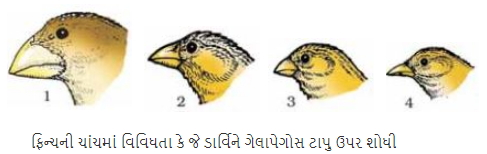
(N/A) During his voyage,Darwin visited the Galapagos Islands. There,he observed an amazing diversity of creatures. He was particularly amazed by small black birds,which were later called Darwin's Finches.
He observed many varieties of finches on the same island. He realized that all the varieties had evolved on the island itself. From the original seed-eating features,many other forms with altered beaks evolved,enabling them to become insectivorous and vegetarian finches.
The process of evolution of different species in a given geographical area starting from a point and literally radiating to other areas of geography (habitats) is called adaptive radiation.
Types of Adaptive Radiation:
$1$. Divergent Evolution: This occurs when species from a common ancestor evolve into different forms to adapt to different environments (e.g.,Darwin's Finches,Australian Marsupials).
$2$. Convergent Evolution: This occurs when different species,not closely related,evolve similar traits as a result of having to adapt to similar environments or ecological niches (e.g.,Australian Marsupials and Placental Mammals).
He observed many varieties of finches on the same island. He realized that all the varieties had evolved on the island itself. From the original seed-eating features,many other forms with altered beaks evolved,enabling them to become insectivorous and vegetarian finches.
The process of evolution of different species in a given geographical area starting from a point and literally radiating to other areas of geography (habitats) is called adaptive radiation.
Types of Adaptive Radiation:
$1$. Divergent Evolution: This occurs when species from a common ancestor evolve into different forms to adapt to different environments (e.g.,Darwin's Finches,Australian Marsupials).
$2$. Convergent Evolution: This occurs when different species,not closely related,evolve similar traits as a result of having to adapt to similar environments or ecological niches (e.g.,Australian Marsupials and Placental Mammals).
0 likes
View Solution56
MediumMCQ
What is the most important pre-condition for adaptive radiation?
A
Presence of a common ancestor
B
Pre-existing variations
C
Different geographical areas
D
Similar environmental conditions
Solution
(B) Adaptive radiation is the process of evolution of different species in a given geographical area starting from a point and literally radiating to other areas of geography (habitats).
Pre-existing variations within a population are the most important pre-condition for adaptive radiation.
These variations allow individuals to adapt to different ecological niches or habitats,leading to the divergence of species from a common ancestor.
Pre-existing variations within a population are the most important pre-condition for adaptive radiation.
These variations allow individuals to adapt to different ecological niches or habitats,leading to the divergence of species from a common ancestor.
0 likes
View Solution57
Medium
Explain divergent evolution in detail. What is the driving force behind it?
Solution
(N/A) Divergent evolution is a process where related species evolve different traits to adapt to different environmental pressures or functional requirements.
$1$. Example: The forelimbs of whales,bats,cheetahs,and humans (all mammals) share a similar anatomical pattern of bones,including the humerus,radius,ulna,carpals,metacarpals,and phalanges.
$2$. Despite having the same ancestral structural plan,these forelimbs have evolved to perform different functions,such as swimming,flying,running,or grasping.
$3$. This phenomenon is known as homology,where structures are derived from a common ancestor but diverge in function.
$4$. The driving force behind divergent evolution is adaptive radiation,where organisms diversify from an ancestral species into a multitude of new forms to exploit different ecological niches.
$1$. Example: The forelimbs of whales,bats,cheetahs,and humans (all mammals) share a similar anatomical pattern of bones,including the humerus,radius,ulna,carpals,metacarpals,and phalanges.
$2$. Despite having the same ancestral structural plan,these forelimbs have evolved to perform different functions,such as swimming,flying,running,or grasping.
$3$. This phenomenon is known as homology,where structures are derived from a common ancestor but diverge in function.
$4$. The driving force behind divergent evolution is adaptive radiation,where organisms diversify from an ancestral species into a multitude of new forms to exploit different ecological niches.
0 likes
View Solution58
Medium
Two organisms occupying a particular geographical area (say desert) show similar adaptive strategies. Taking examples,describe the phenomenon.
Solution
(N/A) The phenomenon where organisms from different evolutionary lineages develop similar adaptive features due to living in similar habitats is known as $Convergent Evolution$.
In desert environments,plants like $Opuntia$ and $Cactus$ have evolved spines,which are modified leaves,to minimize water loss through transpiration.
Similarly,animals like camels and kangaroo rats exhibit adaptive strategies to conserve water in arid conditions.
They produce highly concentrated (hypertonic) urine and dry,solidified feces because most of the water is reabsorbed in the nephrons and the large intestine.
Another example is the evolution of Australian marsupials and placental mammals. Despite being distinct groups,they show $Adaptive Radiation$ leading to similar forms (e.g.,the placental mouse and the marsupial mouse) because they occupy similar ecological niches.
In desert environments,plants like $Opuntia$ and $Cactus$ have evolved spines,which are modified leaves,to minimize water loss through transpiration.
Similarly,animals like camels and kangaroo rats exhibit adaptive strategies to conserve water in arid conditions.
They produce highly concentrated (hypertonic) urine and dry,solidified feces because most of the water is reabsorbed in the nephrons and the large intestine.
Another example is the evolution of Australian marsupials and placental mammals. Despite being distinct groups,they show $Adaptive Radiation$ leading to similar forms (e.g.,the placental mouse and the marsupial mouse) because they occupy similar ecological niches.
0 likes
View Solution59
Medium
Provide information about Darwin's Finches.
Solution
(N/A) During his voyage,$Charles \ Darwin$ visited the $Galapagos$ Islands.
He observed an amazing diversity of creatures there.
He was particularly amazed by small black birds,which were later called $Darwin's \ Finches$.
He observed many varieties of finches on the same island.
He conjectured that all the varieties had evolved on the island itself from an original seed-eating ancestor,a process known as $Adaptive \ Radiation$.
He observed an amazing diversity of creatures there.
He was particularly amazed by small black birds,which were later called $Darwin's \ Finches$.
He observed many varieties of finches on the same island.
He conjectured that all the varieties had evolved on the island itself from an original seed-eating ancestor,a process known as $Adaptive \ Radiation$.
0 likes
View Solution60
Easy
Explain the interpretation of Charles Darwin when he observed a variety of small black birds on the Galapagos Islands.
Solution
(N/A) Biogeographical evidence suggests that species restricted to widely separated regions show similarity of ancestry.
Habitat isolation had probably restricted these organisms to a particular geography on the Earth.
This can be explained with the help of the following process:
$\Rightarrow \quad$ Adaptive Radiation: The process of evolution of different species starting from a point in a geographical area and finally radiating to other areas of geography (habitats) is called adaptive radiation.
Examples of adaptive radiation include:
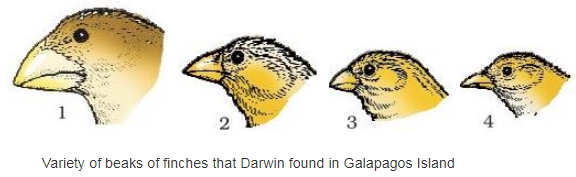
$(i)$ Darwin's Finches: Darwin observed an amazing diversity of creatures on the Galapagos Islands.
There,he saw small black birds that amazed him the most,later called Darwin's finches.
They represent one of the best examples of adaptive radiation.
He observed that there were many varieties of finches on the same island and all the varieties had evolved on the island itself from original seed-eating finches.
He explained that after originating from a common ancestral seed-eating stock,the finches must have radiated to different geographical areas and undergone adaptive changes,especially in the type of beaks.
Therefore,due to the gradual alterations in beaks,some became insectivorous and some vegetarian.
Living in isolation for a long time,new kinds of finches emerged that could function and survive in new habitats.
Habitat isolation had probably restricted these organisms to a particular geography on the Earth.
This can be explained with the help of the following process:
$\Rightarrow \quad$ Adaptive Radiation: The process of evolution of different species starting from a point in a geographical area and finally radiating to other areas of geography (habitats) is called adaptive radiation.
Examples of adaptive radiation include:
$(i)$ Darwin's Finches: Darwin observed an amazing diversity of creatures on the Galapagos Islands.
There,he saw small black birds that amazed him the most,later called Darwin's finches.
They represent one of the best examples of adaptive radiation.
He observed that there were many varieties of finches on the same island and all the varieties had evolved on the island itself from original seed-eating finches.
He explained that after originating from a common ancestral seed-eating stock,the finches must have radiated to different geographical areas and undergone adaptive changes,especially in the type of beaks.
Therefore,due to the gradual alterations in beaks,some became insectivorous and some vegetarian.
Living in isolation for a long time,new kinds of finches emerged that could function and survive in new habitats.
0 likes
View Solution61
Easy
Write a short note on Adaptive Radiation and the Marsupials of Australia.
Solution
(N/A) Biogeographical evidence suggests that species restricted to widely separated regions often share a common ancestry. Habitat isolation likely restricted these organisms to specific geographical areas.
This can be explained through the following processes:
$1$. Adaptive Radiation: The process of evolution of different species starting from a single point in a geographical area and radiating to other geographical areas (habitats) is called adaptive radiation.
Examples of adaptive radiation:
$(i)$ Darwin's Finches: Darwin observed an amazing diversity of creatures on the Galapagos Islands. He saw small black birds that fascinated him,later known as Darwin's finches. They represent one of the best examples of adaptive radiation. He observed many varieties of finches on the same island,all of which evolved from original seed-eating finches. He explained that after originating from a common ancestral seed-eating stock,the finches radiated to different geographical areas and underwent adaptive changes,especially in their beak types. Due to these gradual alterations,some became insectivorous and others vegetarian. Living in isolation for a long time,new kinds of finches emerged that could function and survive in new habitats.
(ii) Marsupials of Australia: Another example is the Australian marsupials. $A$ number of marsupials,each different from the other,evolved from an ancestral stock,but all within the Australian island continent. When more than one adaptive radiation appears to have occurred in an isolated geographical area (representing different habitats),one can call this convergent evolution. Placental mammals in Australia also exhibit adaptive radiation in evolving into varieties of such placental mammals each of which appears to be similar to a corresponding marsupial (e.g.,placental wolf and Tasmanian wolf-marsupial).
This can be explained through the following processes:
$1$. Adaptive Radiation: The process of evolution of different species starting from a single point in a geographical area and radiating to other geographical areas (habitats) is called adaptive radiation.
Examples of adaptive radiation:
$(i)$ Darwin's Finches: Darwin observed an amazing diversity of creatures on the Galapagos Islands. He saw small black birds that fascinated him,later known as Darwin's finches. They represent one of the best examples of adaptive radiation. He observed many varieties of finches on the same island,all of which evolved from original seed-eating finches. He explained that after originating from a common ancestral seed-eating stock,the finches radiated to different geographical areas and underwent adaptive changes,especially in their beak types. Due to these gradual alterations,some became insectivorous and others vegetarian. Living in isolation for a long time,new kinds of finches emerged that could function and survive in new habitats.
(ii) Marsupials of Australia: Another example is the Australian marsupials. $A$ number of marsupials,each different from the other,evolved from an ancestral stock,but all within the Australian island continent. When more than one adaptive radiation appears to have occurred in an isolated geographical area (representing different habitats),one can call this convergent evolution. Placental mammals in Australia also exhibit adaptive radiation in evolving into varieties of such placental mammals each of which appears to be similar to a corresponding marsupial (e.g.,placental wolf and Tasmanian wolf-marsupial).
0 likes
View Solution62
Easy
Write and explain the conclusion Darwin arrived at after observing the variation seen in the beaks of finches during his sea voyage.
Solution
(N/A) Biogeographical evidence suggests that species restricted to widely separated regions show similarity of ancestry.
Habitat isolation had probably restricted these organisms to a particular geography on the Earth.
This can be explained with the help of the following process:
$\Rightarrow$ Adaptive Radiation: The process of evolution of different species starting from a point in a geographical area and finally radiating to other areas of geography (habitats) is called adaptive radiation.
Examples of adaptive radiation include:
$(i)$ Darwin's Finches: Darwin observed an amazing diversity of creatures on the Galapagos Islands.
There,he saw small black birds that amazed him the most,later called Darwin's finches.
They represent one of the best examples of adaptive radiation.
He observed that there were many varieties of finches on the same island,and all the varieties had evolved on the island itself from original seed-eating finches.
He concluded that after originating from a common ancestral seed-eating stock,the finches must have radiated to different geographical areas and undergone adaptive changes,especially in the type of beaks.
Therefore,due to the gradual alterations in beaks,some became insectivorous and some vegetarian.
Living in isolation for a long time,new kinds of finches emerged that could function and survive in new habitats.
Habitat isolation had probably restricted these organisms to a particular geography on the Earth.
This can be explained with the help of the following process:
$\Rightarrow$ Adaptive Radiation: The process of evolution of different species starting from a point in a geographical area and finally radiating to other areas of geography (habitats) is called adaptive radiation.
Examples of adaptive radiation include:
$(i)$ Darwin's Finches: Darwin observed an amazing diversity of creatures on the Galapagos Islands.
There,he saw small black birds that amazed him the most,later called Darwin's finches.
They represent one of the best examples of adaptive radiation.
He observed that there were many varieties of finches on the same island,and all the varieties had evolved on the island itself from original seed-eating finches.
He concluded that after originating from a common ancestral seed-eating stock,the finches must have radiated to different geographical areas and undergone adaptive changes,especially in the type of beaks.
Therefore,due to the gradual alterations in beaks,some became insectivorous and some vegetarian.
Living in isolation for a long time,new kinds of finches emerged that could function and survive in new habitats.
0 likes
View Solution63
Easy
Marsupials and Australian placental mammals exhibit convergent evolution. Explain how?
Solution
(N/A) Convergent evolution occurs when different groups of organisms evolve similar traits independently as they adapt to similar environments.
In Australia,many marsupials (pouched mammals) and placental mammals have evolved to fill similar ecological niches,resulting in a striking resemblance between them despite being phylogenetically distant.
For example,the Australian marsupial 'Tasmanian wolf' and the placental 'Wolf' show remarkable similarities in their body structure and predatory habits,even though they belong to different mammalian lineages.
This phenomenon,where more than one adaptive radiation appears to have occurred in an isolated geographical area (Australia),is known as convergent evolution.
Essentially,because these two groups were subjected to similar selective pressures in their respective environments,they evolved analogous structures to survive,demonstrating that similar environmental conditions can lead to the evolution of similar phenotypic traits in unrelated species.
In Australia,many marsupials (pouched mammals) and placental mammals have evolved to fill similar ecological niches,resulting in a striking resemblance between them despite being phylogenetically distant.
For example,the Australian marsupial 'Tasmanian wolf' and the placental 'Wolf' show remarkable similarities in their body structure and predatory habits,even though they belong to different mammalian lineages.
This phenomenon,where more than one adaptive radiation appears to have occurred in an isolated geographical area (Australia),is known as convergent evolution.
Essentially,because these two groups were subjected to similar selective pressures in their respective environments,they evolved analogous structures to survive,demonstrating that similar environmental conditions can lead to the evolution of similar phenotypic traits in unrelated species.
0 likes
View Solution64
Easy
Describe various biogeographical evidences.
Solution
(N/A) Biogeographical evidence suggests that species restricted to widely separated regions show similarity of ancestry.
Habitat isolation likely restricted these organisms to particular geographical areas on Earth.
This can be explained with the help of the following processes:
$\Rightarrow$ Adaptive Radiation: The process of evolution of different species starting from a point in a geographical area and finally radiating to other areas of geography (habitats) is called adaptive radiation.
Examples of adaptive radiation are:
$(i)$ Darwin's Finches: Darwin observed an amazing diversity of creatures on the Galapagos Islands.
There,he saw small black birds that amazed him the most,later called Darwin's finches.
They represent one of the best examples of adaptive radiation.
He observed that there were many varieties of finches on the same island,and all the varieties had evolved on the island itself from original seed-eating finches.
He explained that after originating from a common ancestral seed-eating stock,the finches must have radiated to different geographical areas and undergone adaptive changes,especially in the type of beaks.
Therefore,due to gradual alterations in beaks,some became insectivorous and some vegetarian.
Living in isolation for a long time,new kinds of finches emerged that could function and survive in new habitats.
Habitat isolation likely restricted these organisms to particular geographical areas on Earth.
This can be explained with the help of the following processes:
$\Rightarrow$ Adaptive Radiation: The process of evolution of different species starting from a point in a geographical area and finally radiating to other areas of geography (habitats) is called adaptive radiation.
Examples of adaptive radiation are:
$(i)$ Darwin's Finches: Darwin observed an amazing diversity of creatures on the Galapagos Islands.
There,he saw small black birds that amazed him the most,later called Darwin's finches.
They represent one of the best examples of adaptive radiation.
He observed that there were many varieties of finches on the same island,and all the varieties had evolved on the island itself from original seed-eating finches.
He explained that after originating from a common ancestral seed-eating stock,the finches must have radiated to different geographical areas and undergone adaptive changes,especially in the type of beaks.
Therefore,due to gradual alterations in beaks,some became insectivorous and some vegetarian.
Living in isolation for a long time,new kinds of finches emerged that could function and survive in new habitats.
0 likes
View Solution65
Easy
Give an example where more than one adaptive radiation has occurred in an isolated geographic area. Name the type of evolution your example depicts and state why it is so named.
Solution
(N/A) An example of more than one adaptive radiation occurring in an isolated geographic area is the evolution of Australian marsupials and placental mammals.
In this case,a number of Australian marsupials,each different from the other,evolved from an ancestral stock,but all within the Australian island continent. Placental mammals in other parts of the world also exhibit adaptive radiation.
When more than one adaptive radiation appears to have occurred in an isolated geographical area,and two or more groups of unrelated animals come to resemble each other due to a similar mode of life or habitat,it is called $Convergent$ $Evolution$.
It is named $Convergent$ $Evolution$ because different evolutionary lineages 'converge' or come together to develop similar adaptive features to survive in similar environmental conditions.
In this case,a number of Australian marsupials,each different from the other,evolved from an ancestral stock,but all within the Australian island continent. Placental mammals in other parts of the world also exhibit adaptive radiation.
When more than one adaptive radiation appears to have occurred in an isolated geographical area,and two or more groups of unrelated animals come to resemble each other due to a similar mode of life or habitat,it is called $Convergent$ $Evolution$.
It is named $Convergent$ $Evolution$ because different evolutionary lineages 'converge' or come together to develop similar adaptive features to survive in similar environmental conditions.
0 likes
View Solution66
Easy
Define and explain the concepts of Homology and Adaptive radiation (divergent evolution).
Solution
(N/A) Homology refers to the similarity between organs of different animals based on common ancestry or common embryonic origin. These organs are built on the same fundamental structural pattern but perform varied functions and have different appearances. For example,the flippers of a seal,and the forelimbs of birds,bats,horses,and humans look different and perform different functions,but they exhibit the same underlying structural plan.
Adaptive radiation (divergent evolution) represents the evolution of new forms in several directions starting from a common ancestral type. This process leads to the development of diverse species adapted to different environments from a single common ancestor.
Adaptive radiation (divergent evolution) represents the evolution of new forms in several directions starting from a common ancestral type. This process leads to the development of diverse species adapted to different environments from a single common ancestor.
0 likes
View Solution67
MediumMCQ
On which island did Darwin observe many varieties of finches?
A
Malay Archipelago
B
Galapagos
C
Australia
D
Malaysia
Solution
(B) Charles Darwin,during his voyage on the $H$.$M$.$S$. Beagle,visited the Galapagos Islands. He observed that there were many varieties of finches in the same island. All the varieties,he conjectured,evolved on the island itself. From the original seed-eating features,many other forms with altered beaks arose,enabling them to become insectivorous and vegetarian finches. This process of evolution of different species in a given geographical area starting from a point and literally radiating to other areas of geography (habitats) is called adaptive radiation.
0 likes
View Solution68
MediumMCQ
The characteristic feature of the ancestral finch was:
A
Insectivorous
B
Herbivorous
C
Seed-eating
D
Carnivorous
Solution
(C) The ancestral finches that migrated to the Galapagos Islands were originally seed-eating birds. Over time,due to adaptive radiation,they evolved into various forms with different beak shapes suited for different diets (such as insectivorous,cactus-eating,etc.). Therefore,the original or ancestral characteristic feature was seed-eating.
0 likes
View Solution69
MediumMCQ
Which structure evolved in finches, allowing them to become insectivorous and vegetarian?
A
Beak
B
Forelimb
C
Hindlimb
D
Olfactory gland
Solution
(A) Darwin's finches in the Galapagos Islands are a classic example of adaptive radiation.
These birds originated from a single ancestral species and diversified into different forms based on their feeding habits.
The primary structural adaptation that allowed them to exploit different food sources, such as insects, seeds, or fruits, was the modification of their $beak$ shape and size.
Therefore, the evolution of the beak enabled them to become insectivorous, vegetarian, or granivorous.
These birds originated from a single ancestral species and diversified into different forms based on their feeding habits.
The primary structural adaptation that allowed them to exploit different food sources, such as insects, seeds, or fruits, was the modification of their $beak$ shape and size.
Therefore, the evolution of the beak enabled them to become insectivorous, vegetarian, or granivorous.
0 likes
View Solution70
EasyMCQ
What is the process of evolution of different species in a given geographical area starting from a point and radiating to other areas called?
A
Adaptive radiation
B
Recombination
C
Active radiation
D
Founder effect
Solution
(A) The process of evolution of different species in a given geographical area starting from a point and radiating to other geographical areas is called $Adaptive \text{ } radiation$.
This phenomenon is best exemplified by $Darwin's \text{ } finches$ in the $Galapagos \text{ } Islands$ and $Australian \text{ } marsupials$.
This phenomenon is best exemplified by $Darwin's \text{ } finches$ in the $Galapagos \text{ } Islands$ and $Australian \text{ } marsupials$.
0 likes
View Solution71
MediumMCQ
Darwin's finches are an example of which phenomenon?
A
Founder effect
B
Genetic drift
C
Recombination
D
Adaptive radiation
Solution
(D) Darwin's finches are a classic example of $Adaptive \text{ } radiation$.
Adaptive radiation is an evolutionary process in which organisms diversify rapidly from an ancestral species into a multitude of new forms, particularly when a change in the environment makes new resources available, creates new challenges, or opens new environmental niches.
In the case of Darwin's finches on the Galapagos Islands, the original seed-eating finches from the mainland evolved into various species with different beak shapes adapted to different feeding habits (e.g., insect-eating, cactus-eating, seed-crushing) to exploit available niches.
Adaptive radiation is an evolutionary process in which organisms diversify rapidly from an ancestral species into a multitude of new forms, particularly when a change in the environment makes new resources available, creates new challenges, or opens new environmental niches.
In the case of Darwin's finches on the Galapagos Islands, the original seed-eating finches from the mainland evolved into various species with different beak shapes adapted to different feeding habits (e.g., insect-eating, cactus-eating, seed-crushing) to exploit available niches.
0 likes
View Solution72
MediumMCQ
In which geographical region is marsupial radiation observed?
A
Galapagos Islands
B
Australia
C
Africa
D
America
Solution
(B) Marsupial radiation is a classic example of adaptive radiation.
When more than one adaptive radiation appeared to have occurred in an isolated geographical area (representing different habitats),one can call this convergent evolution.
Australia is the primary geographical region where marsupials evolved and diversified into various forms from an ancestral stock,filling different ecological niches.
Therefore,the correct option is $B$.
When more than one adaptive radiation appeared to have occurred in an isolated geographical area (representing different habitats),one can call this convergent evolution.
Australia is the primary geographical region where marsupials evolved and diversified into various forms from an ancestral stock,filling different ecological niches.
Therefore,the correct option is $B$.
0 likes
View Solution73
MediumMCQ
Select the odd one out.
A
Tiger cat
B
Koala
C
Wombat
D
Bobcat
Solution
(D) The correct answer is $D$ (Bobcat).
Adaptive radiation is the process of evolution of different species in a given geographical area starting from a point and radiating to other areas of geography (habitats).
Australian marsupials like the Tiger cat,Koala,and Wombat are examples of adaptive radiation within the Australian continent.
However,the Bobcat is a placental mammal found in North America,not a marsupial,and therefore does not belong to the same group of Australian marsupial adaptive radiation.
Adaptive radiation is the process of evolution of different species in a given geographical area starting from a point and radiating to other areas of geography (habitats).
Australian marsupials like the Tiger cat,Koala,and Wombat are examples of adaptive radiation within the Australian continent.
However,the Bobcat is a placental mammal found in North America,not a marsupial,and therefore does not belong to the same group of Australian marsupial adaptive radiation.
0 likes
View Solution74
MediumMCQ
Select the odd one out regarding adaptive radiation in Australian marsupials.
A
Lemur
B
Wolf
C
Banded anteater
D
Flying squirrel
Solution
(A) Adaptive radiation is the process of evolution of different species in a given geographical area starting from a point and literally radiating to other areas of geography (habitats).
Australian marsupials exhibit adaptive radiation,where a number of marsupials,each different from the other,evolved from an ancestral stock within the Australian island continent.
When more than one adaptive radiation appeared to have occurred in an isolated geographical area (representing different habitats),one can call this convergent evolution.
Placental mammals in Australia also exhibit adaptive radiation in evolving into varieties of such placental mammals each of which appears to be 'similar' to a corresponding marsupial (e.g.,Placental wolf and Tasmanian wolf-marsupial).
Lemur is a placental mammal (prosimian primate) and is not part of the Australian marsupial adaptive radiation series,whereas the others (Wolf,Banded anteater,Flying squirrel) have Australian marsupial counterparts (Tasmanian wolf,Numbat,Sugar glider) that are often compared in convergent evolution studies.
Australian marsupials exhibit adaptive radiation,where a number of marsupials,each different from the other,evolved from an ancestral stock within the Australian island continent.
When more than one adaptive radiation appeared to have occurred in an isolated geographical area (representing different habitats),one can call this convergent evolution.
Placental mammals in Australia also exhibit adaptive radiation in evolving into varieties of such placental mammals each of which appears to be 'similar' to a corresponding marsupial (e.g.,Placental wolf and Tasmanian wolf-marsupial).
Lemur is a placental mammal (prosimian primate) and is not part of the Australian marsupial adaptive radiation series,whereas the others (Wolf,Banded anteater,Flying squirrel) have Australian marsupial counterparts (Tasmanian wolf,Numbat,Sugar glider) that are often compared in convergent evolution studies.
0 likes
View Solution75
MediumMCQ
Which of the following exhibits adaptive radiation?
A
Darwin's finches
B
Placental mammals
C
Marsupials
D
All of the above
Solution
(D) Adaptive radiation is the process of evolution of different species in a given geographical area starting from a point and literally radiating to other areas of geography (habitats).
Darwin's finches in the Galapagos Islands are a classic example of adaptive radiation.
Similarly,Australian marsupials and placental mammals also exhibit adaptive radiation,where different species evolved from a common ancestor to adapt to different ecological niches.
Therefore,all the given options exhibit adaptive radiation.
Darwin's finches in the Galapagos Islands are a classic example of adaptive radiation.
Similarly,Australian marsupials and placental mammals also exhibit adaptive radiation,where different species evolved from a common ancestor to adapt to different ecological niches.
Therefore,all the given options exhibit adaptive radiation.
0 likes
View Solution76
MediumMCQ
Which pair shows convergent evolution?
A
Mole - Numbat
B
Tiger cat - Lemur
C
Wolf - Bobcat
D
Flying phalanger - Numbat
Solution
(A) Convergent evolution occurs when different species evolve similar traits independently as a result of having to adapt to similar environments or ecological niches.
In the context of Australian marsupials,adaptive radiation led to the development of various marsupials that resemble placental mammals from other parts of the world.
The pair $Mole$ (a placental mammal) and $Numbat$ (a marsupial) is a classic example of convergent evolution,as both have evolved similar adaptations for burrowing and feeding on insects despite being phylogenetically distinct.
In the context of Australian marsupials,adaptive radiation led to the development of various marsupials that resemble placental mammals from other parts of the world.
The pair $Mole$ (a placental mammal) and $Numbat$ (a marsupial) is a classic example of convergent evolution,as both have evolved similar adaptations for burrowing and feeding on insects despite being phylogenetically distinct.
0 likes
View Solution77
MediumMCQ
Select the pair that exhibits divergent evolution.
A
Bobcat - Wolf
B
Mouse - Marsupial mole
C
Lemur - Spotted cuscus
D
Flying squirrel - Flying phalanger
Solution
(A) Divergent evolution occurs when related species evolve different traits to adapt to different environments,often resulting in homologous structures.
Adaptive radiation is a type of divergent evolution where many species evolve from a single common ancestor in a specific geographical area.
In the given options,the 'Flying squirrel' (a placental mammal) and the 'Flying phalanger' (a marsupial mammal) are examples of convergent evolution,not divergent evolution,as they evolved similar traits independently in different lineages.
However,the question asks for a pair exhibiting divergent evolution. Among the choices,'Bobcat' and 'Wolf' are both placental mammals that share a common ancestor and have diverged into different ecological niches,representing divergent evolution.
Adaptive radiation is a type of divergent evolution where many species evolve from a single common ancestor in a specific geographical area.
In the given options,the 'Flying squirrel' (a placental mammal) and the 'Flying phalanger' (a marsupial mammal) are examples of convergent evolution,not divergent evolution,as they evolved similar traits independently in different lineages.
However,the question asks for a pair exhibiting divergent evolution. Among the choices,'Bobcat' and 'Wolf' are both placental mammals that share a common ancestor and have diverged into different ecological niches,representing divergent evolution.
0 likes
View Solution78
MediumMCQ
Out of the following animals: Tasmanian tiger cat,Numbat,Wolf,Bobcat,Tasmanian wolf,Flying phalanger,and Kangaroo,how many are Australian marsupials?
A
$5$
B
$4$
C
$6$
D
$3$
Solution
(A) The Australian marsupials listed are:
$1$. Tasmanian tiger cat (Dasyurus maculatus)
$2$. Numbat (Myrmecobius fasciatus)
$3$. Tasmanian wolf (Thylacinus cynocephalus)
$4$. Flying phalanger (Petaurus breviceps)
$5$. Kangaroo (Macropodidae)
Wolf and Bobcat are placental mammals,not marsupials.
Therefore,there are $5$ Australian marsupials in the given list.
$1$. Tasmanian tiger cat (Dasyurus maculatus)
$2$. Numbat (Myrmecobius fasciatus)
$3$. Tasmanian wolf (Thylacinus cynocephalus)
$4$. Flying phalanger (Petaurus breviceps)
$5$. Kangaroo (Macropodidae)
Wolf and Bobcat are placental mammals,not marsupials.
Therefore,there are $5$ Australian marsupials in the given list.
0 likes
View Solution79
MediumMCQ
How many of the following animals are placental mammals?
Mole,Kangaroo,Koala,Anteater,Lemur,Wolf,Tasmanian tiger cat,Sugar glider
Mole,Kangaroo,Koala,Anteater,Lemur,Wolf,Tasmanian tiger cat,Sugar glider
A
$5$
B
$4$
C
$3$
D
$6$
Solution
(B) To identify the placental mammals from the given list,we classify them based on their reproductive strategy:
$1$. Mole: Placental mammal.
$2$. Kangaroo: Marsupial (not placental).
$3$. Koala: Marsupial (not placental).
$4$. Anteater: Placental mammal.
$5$. Lemur: Placental mammal.
$6$. Wolf: Placental mammal.
$7$. Tasmanian tiger cat: Marsupial (not placental).
$8$. Sugar glider: Marsupial (not placental).
The placental mammals are: Mole,Anteater,Lemur,and Wolf.
Total count = $4$.
$1$. Mole: Placental mammal.
$2$. Kangaroo: Marsupial (not placental).
$3$. Koala: Marsupial (not placental).
$4$. Anteater: Placental mammal.
$5$. Lemur: Placental mammal.
$6$. Wolf: Placental mammal.
$7$. Tasmanian tiger cat: Marsupial (not placental).
$8$. Sugar glider: Marsupial (not placental).
The placental mammals are: Mole,Anteater,Lemur,and Wolf.
Total count = $4$.
0 likes
View Solution80
MediumMCQ
Which of the following pairs represents convergent evolution?
A
Koala and Kangaroo
B
Mouse and Flying Squirrel
C
Bobcat and Wolf
D
Flying Squirrel and Sugar Glider
Solution
(D) Convergent evolution occurs when unrelated species evolve similar traits as a result of having to adapt to similar environments or ecological niches.
In the given options,the Flying Squirrel (a placental mammal) and the Sugar Glider (a marsupial mammal) are unrelated species that have evolved similar adaptations for gliding,which is a classic example of convergent evolution.
Other pairs like Koala and Kangaroo,Mouse and Flying Squirrel,or Bobcat and Wolf represent adaptive radiation within the same lineage (marsupials or placentals),not convergent evolution between different lineages.
In the given options,the Flying Squirrel (a placental mammal) and the Sugar Glider (a marsupial mammal) are unrelated species that have evolved similar adaptations for gliding,which is a classic example of convergent evolution.
Other pairs like Koala and Kangaroo,Mouse and Flying Squirrel,or Bobcat and Wolf represent adaptive radiation within the same lineage (marsupials or placentals),not convergent evolution between different lineages.
0 likes
View Solution81
MediumMCQ
Why did Australian marsupials survive after continental drift?
A
They were more reproductive than North American animals.
B
They were dominant over South American animals.
C
They did not have to compete with other mammals.
D
All of the above.
Solution
(C) After the continental drift,Australia separated from the other landmasses.
Due to this isolation,the marsupials in Australia were protected from competition with placental mammals,which were more evolutionarily advanced and dominant in other parts of the world.
Consequently,the marsupials evolved and diversified in Australia without facing significant competition,allowing them to survive and thrive.
Due to this isolation,the marsupials in Australia were protected from competition with placental mammals,which were more evolutionarily advanced and dominant in other parts of the world.
Consequently,the marsupials evolved and diversified in Australia without facing significant competition,allowing them to survive and thrive.
0 likes
View Solution82
MediumMCQ
Match the following List-$I$ with List-$II$ regarding adaptive radiation in Australian marsupials:
| List-$I$ | List-$II$ |
|---|---|
| $(a)$ Anteater | $(i)$ Marsupial mouse |
| $(b)$ Mouse | $(ii)$ Spotted cuscus |
| $(c)$ Mole | $(iii)$ Marsupial mole |
| $(d)$ Lemur | $(iv)$ Numbat |
A
$a-iv, b-i, c-iii, d-ii$
B
$a-ii, b-i, c-iii, d-iv$
C
$a-iv, b-iii, c-i, d-ii$
D
$a-iii, b-ii, c-i, d-iv$
Solution
(A) Adaptive radiation is the process of evolution of different species in a given geographical area starting from a point and radiating to other areas of geography (habitats). In Australia,marsupials show adaptive radiation,where they evolved into various forms similar to placental mammals.
Matching the organisms:
- $(a)$ Anteater corresponds to $(iv)$ Numbat.
- $(b)$ Mouse corresponds to $(i)$ Marsupial mouse.
- $(c)$ Mole corresponds to $(iii)$ Marsupial mole.
- $(d)$ Lemur corresponds to $(ii)$ Spotted cuscus.
Therefore,the correct matching is $a-iv, b-i, c-iii, d-ii$.
Matching the organisms:
- $(a)$ Anteater corresponds to $(iv)$ Numbat.
- $(b)$ Mouse corresponds to $(i)$ Marsupial mouse.
- $(c)$ Mole corresponds to $(iii)$ Marsupial mole.
- $(d)$ Lemur corresponds to $(ii)$ Spotted cuscus.
Therefore,the correct matching is $a-iv, b-i, c-iii, d-ii$.
0 likes
View Solution83
MediumMCQ
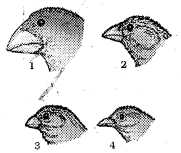
What is the name of the birds shown in the figure,and where was their diversity observed?
A
Archaeopteryx and Malay Archipelago
B
Darwin's finches and Galapagos Islands
C
Darwin's finches and Malay Archipelago
D
Archaeopteryx and Galapagos Islands
Solution
(B) The birds shown in the figure are known as Darwin's finches. Charles Darwin observed these birds during his voyage on the $HMS$ Beagle to the Galapagos Islands. He noticed that there were many varieties of finches in the same island,all evolving from a common ancestor. This phenomenon is a classic example of adaptive radiation,where species diversify from a common ancestral form into different forms adapted to specific environmental niches.
0 likes
View Solution84
MediumMCQ
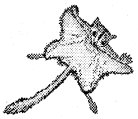
Identify the animal shown in the figure.
A
Bandicoot
B
Flying squirrel
C
Sugar glider
D
Lemur
Solution
(C) The animal shown in the figure is a Sugar glider.
Adaptive radiation is the process of evolution of different species in a given geographical area starting from a point and literally radiating to other areas of geography (habitats).
Australian marsupials exhibit adaptive radiation.
When more than one adaptive radiation appeared to have occurred in an isolated geographical area (representing different habitats),one can call this convergent evolution.
Placental mammals in Australia also exhibit adaptive radiation in evolving into varieties of such placental mammals each of which appears to be 'similar' to a corresponding marsupial (e.g.,Placental wolf and Tasmanian wolf-marsupial).
The Sugar glider is a marsupial that shows convergent evolution with the placental Flying squirrel.
Adaptive radiation is the process of evolution of different species in a given geographical area starting from a point and literally radiating to other areas of geography (habitats).
Australian marsupials exhibit adaptive radiation.
When more than one adaptive radiation appeared to have occurred in an isolated geographical area (representing different habitats),one can call this convergent evolution.
Placental mammals in Australia also exhibit adaptive radiation in evolving into varieties of such placental mammals each of which appears to be 'similar' to a corresponding marsupial (e.g.,Placental wolf and Tasmanian wolf-marsupial).
The Sugar glider is a marsupial that shows convergent evolution with the placental Flying squirrel.
0 likes
View Solution85
EasyMCQ
The phenomenon of evolution of different species in a given geographical area starting from a point and spreading to other habitats is called
A
Adaptive radiation
B
Saltation
C
Co-evolution
D
Natural selection
Solution
(A) The correct answer is option $A$ because the process of evolution of different species in a given geographical area starting from a point and literally radiating to other areas of geography is called adaptive radiation.
$Saltation$ is a single-step large mutation.
When one organism evolves with respect to evolution in another organism,it is called co-evolution. For example,the host-parasite relationship.
Natural selection is the process through which a population of living organisms that adapt are selected by nature based on reproductive fitness.
$Saltation$ is a single-step large mutation.
When one organism evolves with respect to evolution in another organism,it is called co-evolution. For example,the host-parasite relationship.
Natural selection is the process through which a population of living organisms that adapt are selected by nature based on reproductive fitness.
0 likes
View Solution86
MediumMCQ
An evolutionary process,giving rise to new species adapting to new habitats and ways of life is called
A
Adaptive radiation
B
Adaptation
C
Convergent evolution
D
Microevolution
Solution
(A) Adaptive radiation is an evolutionary process in which organisms diversify rapidly from an ancestral species into a multitude of new forms,particularly when a change in the environment makes new resources available,creates new challenges,or opens new environmental niches.
This process leads to the development of new species that are adapted to different habitats and ways of life,representing a form of divergent evolution.
This process leads to the development of new species that are adapted to different habitats and ways of life,representing a form of divergent evolution.
0 likes
View Solution87
MediumMCQ
The origin of different types of beaks occurs due to
A
Natural selection
B
Interspecific competition
C
Genetic drift
D
Interspecific variation
Solution
(A) The origin of different types of beaks,as famously observed by Charles Darwin in the Galapagos finches,is primarily driven by natural selection.
While variations exist within a population,the environment imposes specific pressures.
Individuals with beak shapes better suited to the available food sources in their specific habitat have a higher survival and reproductive success rate.
Over generations,these advantageous traits are selected and become more prevalent in the population,leading to adaptive radiation.
While variations exist within a population,the environment imposes specific pressures.
Individuals with beak shapes better suited to the available food sources in their specific habitat have a higher survival and reproductive success rate.
Over generations,these advantageous traits are selected and become more prevalent in the population,leading to adaptive radiation.
0 likes
View Solution88
MediumMCQ
Which one of the following aspects of evolution is shown by Darwin's finches?
A
Biogeographic evidence
B
Industrial melanism
C
Biochemical evidence
D
Embryological evidence
Solution
(A) Darwin's finches are a classic example of adaptive radiation,which serves as evidence for evolution through biogeographic distribution.
$(i)$ Darwin observed that different species of finches on the Galapagos Islands evolved from a single ancestral species that migrated from the mainland.
$(ii)$ The diversification occurred due to different environmental pressures in various habitats,leading to distinct beak adaptations.
$(iii)$ This pattern of distribution and diversification based on geographical isolation is a key component of biogeographic evidence for evolution.
$(i)$ Darwin observed that different species of finches on the Galapagos Islands evolved from a single ancestral species that migrated from the mainland.
$(ii)$ The diversification occurred due to different environmental pressures in various habitats,leading to distinct beak adaptations.
$(iii)$ This pattern of distribution and diversification based on geographical isolation is a key component of biogeographic evidence for evolution.
0 likes
View Solution89
MediumMCQ
Which phenomenon allowed the pouched mammals of Australia to survive due to a lack of competition from any other mammals?
A
Continental origination
B
Continental shifting
C
Continental drifting
D
Continental evolution
Solution
(C) Continental drift is the phenomenon that caused the separation of landmasses. Due to this,Australia became isolated from other continents. As a result,the pouched mammals (marsupials) of Australia survived and diversified in the absence of competition from placental mammals,which were evolving and dominating in other parts of the world.
0 likes
View Solution90
MediumMCQ
Darwin's finches represent:
A
Morphological variation
B
Geographical isolation
C
Climatic variation
D
Reproductive isolation
Solution
(B) Darwin's finches are a classic example of adaptive radiation. These birds evolved from a common ancestral species on the Galapagos Islands. Due to the separation of the islands,the populations became geographically isolated,leading to divergent evolution and the formation of distinct species adapted to different food sources.
0 likes
View Solution91
MediumMCQ
Development of similar adaptive functional structural features in an unrelated group of organisms is called:
A
Convergent evolution
B
Adaptive convergence
C
Both $(A)$ and $(B)$
D
Evolution
Solution
(C) When unrelated groups of organisms evolve similar adaptive functional or structural features due to similar environmental pressures,it is known as convergent evolution. This process is also referred to as adaptive convergence. Therefore,both terms describe the same phenomenon.
0 likes
View Solution92
MediumMCQ
The original birds were . . . . . . ,from which the various Darwin's finches arose.
A
Insectivorous
B
Cactus eating
C
Carnivores
D
Seed eating
Solution
(D) Darwin's finches are a classic example of adaptive radiation. The original ancestral species that migrated to the Galapagos Islands from the South American mainland were seed-eating birds. Over time,these birds evolved into various species with different beak shapes adapted to different food sources,such as insects,cactus fruits,or seeds.
0 likes
View Solution93
MediumMCQ
Lemur and Spotted cuscus exhibit:
A
Convergent evolution
B
Homology
C
Analogy
D
Hybridisation
Solution
(A) Lemurs are placental mammals found in Madagascar,while the Spotted cuscus is a marsupial mammal found in Australia.
These two organisms belong to different lineages but have evolved similar adaptive features to survive in similar ecological niches.
This phenomenon,where unrelated organisms evolve similar traits due to adaptation to similar environments,is known as convergent evolution.
Therefore,Lemur and Spotted cuscus exhibit convergent evolution.
These two organisms belong to different lineages but have evolved similar adaptive features to survive in similar ecological niches.
This phenomenon,where unrelated organisms evolve similar traits due to adaptation to similar environments,is known as convergent evolution.
Therefore,Lemur and Spotted cuscus exhibit convergent evolution.
0 likes
View Solution94
MediumMCQ
Which among the following are called the Darwin's finches?
A
Archaeopteryx
B
Pteranodon
C
Pavo cristatus
D
Small black birds
Solution
(D) Darwin's finches are a group of small black birds that Charles Darwin observed during his voyage to the Galapagos Islands. He noted that these birds had evolved different beak shapes adapted to various feeding habits,which provided significant evidence for the theory of adaptive radiation and natural selection.
0 likes
View Solution95
MediumMCQ
Tasmanian wolf and placental wolf appear similar due to
A
Chemical evolution
B
Divergent evolution
C
Biochemical evolution
D
Convergent evolution
Solution
(D) Tasmanian wolf (a marsupial) and placental wolf (a placental mammal) are examples of convergent evolution. Even though they belong to different lineages,they have evolved similar phenotypic traits due to adaptation to similar environmental niches.
0 likes
View Solution96
MediumMCQ
The evolutionary process that gives rise to new species adapted to new habitats and ways of life is called adaptive radiation. Which of the following is an example of this?
A
Darwin's Finches in Galapagos Islands
B
Australian marsupials that radiated to form new species
C
Wolf and Tasmanian Wolf
D
Both $(a)$ and $(b)$
Solution
(D) Adaptive radiation is the process of evolution of different species in a given geographical area starting from a point and literally radiating to other areas of geography (habitats).
Darwin's Finches in the Galapagos Islands are a classic example where many varieties of finches evolved from a single ancestral species.
Similarly,Australian marsupials represent adaptive radiation as they evolved into various forms from a common ancestral stock.
Wolf and Tasmanian Wolf are examples of convergent evolution,not adaptive radiation,as they are unrelated species that evolved similar traits independently.
Darwin's Finches in the Galapagos Islands are a classic example where many varieties of finches evolved from a single ancestral species.
Similarly,Australian marsupials represent adaptive radiation as they evolved into various forms from a common ancestral stock.
Wolf and Tasmanian Wolf are examples of convergent evolution,not adaptive radiation,as they are unrelated species that evolved similar traits independently.
0 likes
View Solution97
MediumMCQ
When more than one adaptive radiation appears to have occurred in an isolated geographical area,it is called:
A
Divergent evolution
B
Convergent evolution
C
Anthropogenic evolution
D
Saltation
Solution
(B) When more than one adaptive radiation occurs in an isolated geographical area (representing different habitats),it leads to the evolution of different groups of organisms that resemble each other due to similar environmental pressures. This phenomenon is known as $Convergent$ $evolution$. $A$ classic example is the evolution of $Placental$ $mammals$ and $Australian$ $marsupials$,which show striking similarities despite being evolutionarily distinct.
0 likes
View Solution98
MediumMCQ
$A$: During evolution,pouched mammals of Australia survived.
$R$: Due to lack of competition from any other mammal due to continental drift.
$R$: Due to lack of competition from any other mammal due to continental drift.
A
Assertion and Reason both are correct and Reason is the correct explanation of Assertion.
B
Assertion and Reason both are correct but Reason is not the correct explanation of Assertion.
C
Assertion is correct,but Reason is incorrect.
D
Both Assertion and Reason are incorrect.
Solution
(A) During the process of continental drift,Australia separated from other landmasses. This geographical isolation prevented the migration of placental mammals into Australia,thereby reducing competition for the pouched mammals (marsupials). As a result,marsupials evolved and diversified in Australia without significant competition from placental mammals. Therefore,both the Assertion and the Reason are correct,and the Reason provides the correct explanation for the Assertion.
0 likes
View Solution99
MediumMCQ
$A$: Placental wolf and Tasmanian wolf (a marsupial) show convergent evolution.
$R$: Like marsupials,placental mammals in other parts of the world also exhibit adaptive radiation in evolving into varieties of such placental mammals,each of which appears to be similar to a corresponding marsupial.
$R$: Like marsupials,placental mammals in other parts of the world also exhibit adaptive radiation in evolving into varieties of such placental mammals,each of which appears to be similar to a corresponding marsupial.
A
Assertion and Reason both are correct and Reason is the correct explanation of Assertion.
B
Assertion and Reason both are correct but Reason is not the correct explanation of Assertion.
C
Assertion is correct,but Reason is incorrect.
D
Both Assertion and Reason are incorrect.
Solution
(A) Adaptive radiation refers to the process of evolution of different species in a given geographical area starting from a point and radiating to other areas of geography (habitats).
When more than one adaptive radiation appears to have occurred in an isolated geographical area (representing different habitats),one can call this convergent evolution.
Placental mammals in Australia also exhibit adaptive radiation in evolving into varieties of such placental mammals,each of which appears to be similar to a corresponding marsupial (e.g.,Placental wolf and Tasmanian wolf).
Thus,both the Assertion and the Reason are correct,and the Reason provides the correct explanation for the Assertion.
When more than one adaptive radiation appears to have occurred in an isolated geographical area (representing different habitats),one can call this convergent evolution.
Placental mammals in Australia also exhibit adaptive radiation in evolving into varieties of such placental mammals,each of which appears to be similar to a corresponding marsupial (e.g.,Placental wolf and Tasmanian wolf).
Thus,both the Assertion and the Reason are correct,and the Reason provides the correct explanation for the Assertion.
0 likes
View Solution100
MediumMCQ
$A$: Spotted cuscus and marsupial mole are examples of marsupial radiation.
$R$: Both are found in the Australian region.
$R$: Both are found in the Australian region.
A
Assertion and Reason both are correct and Reason is the correct explanation of Assertion.
B
Assertion and Reason both are correct but Reason is not the correct explanation of Assertion.
C
Assertion is correct,but Reason is incorrect.
D
Both Assertion and Reason are incorrect.
Solution
(A) Adaptive radiation is the process of evolution of different species in a given geographical area starting from a point and radiating to other areas of geography (habitats).
Australian marsupials are a classic example of adaptive radiation,where a number of marsupials,each different from the other,evolved from an ancestral stock within the Australian island continent.
Both the spotted cuscus and the marsupial mole are native marsupials of Australia,confirming that they are products of this specific adaptive radiation.
Therefore,both the Assertion and the Reason are correct,and the Reason provides the correct context for the Assertion.
Australian marsupials are a classic example of adaptive radiation,where a number of marsupials,each different from the other,evolved from an ancestral stock within the Australian island continent.
Both the spotted cuscus and the marsupial mole are native marsupials of Australia,confirming that they are products of this specific adaptive radiation.
Therefore,both the Assertion and the Reason are correct,and the Reason provides the correct context for the Assertion.
0 likes
View SolutionEvolution — Adaptive Radiation · Frequently Asked Questions
1Are these Evolution questions useful for JEE and NEET?
Yes. All questions in this section are mapped to JEE Main and NEET exam patterns. Previous year questions from JEE Main, NEET, GUJCET and state-level exams are included with full solutions.
2Can I switch to Hindi or Gujarati for these questions?
Yes. Use the language tabs in the hero section or the sidebar to view the same questions and solutions in English, Hindi or Gujarati.
3How do I generate a question paper from this subtopic?
Use the Vedclass Exam Paper Generator — select the chapter and subtopic, set difficulty, and generate Sets A, B, C, D automatically. First 3 chapters of every subject are free.
Vedclass Products
For Students
Vedclass Test Series
Mock tests in real JEE/NEET style with performance analysis. 5-day free trial.
Start Free TrialFor Teachers
Exam Paper Generator
Generate Set A/B/C/D papers from this chapter in 2 minutes. 3 chapters free.
Try FreeFor Institutes
Online Exam Module
Live online exams with unlimited students, 360° analytics & white-label branding.
See DemoFor Teachers & Institutes
Generate a Evolution Exam Paper in 2 Minutes
Select subtopic & difficulty — Sets A, B, C, D auto-generated with No Repeat logic.
First 3 chapters of every subject are free — no payment required.