
A English
Pollution Questions in English
Class 12 Biology · Environmental Issues · Pollution
550+
Questions
English
Language
100%
With Solutions
Showing 50 of 550 questions in English
301
Medium
Describe the method of electrostatic precipitators for removing particulate matter with a diagram.
Solution
(N/A) Electrostatic precipitator is the most widely used method for removing particulate matter from industrial exhaust.
$1$. It can remove over $99$ percent of particulate matter present in the exhaust from a thermal power plant.
$2$. It consists of electrode wires that are maintained at several thousand volts,which produce a corona that releases electrons.
$3$. These electrons attach to dust particles,giving them a net negative charge.
$4$. The collecting plates are grounded and attract the charged dust particles.
$5$. The velocity of air between the plates is kept low enough to allow the dust to fall.
$6$. $A$ scrubber can remove gases like sulfur dioxide $(SO_2)$ by passing the exhaust through a spray of water or lime.
$1$. It can remove over $99$ percent of particulate matter present in the exhaust from a thermal power plant.
$2$. It consists of electrode wires that are maintained at several thousand volts,which produce a corona that releases electrons.
$3$. These electrons attach to dust particles,giving them a net negative charge.
$4$. The collecting plates are grounded and attract the charged dust particles.
$5$. The velocity of air between the plates is kept low enough to allow the dust to fall.
$6$. $A$ scrubber can remove gases like sulfur dioxide $(SO_2)$ by passing the exhaust through a spray of water or lime.
0 likes
View Solution302
MediumMCQ
According to the $CPCB$,what is the significance of particulate matter with a diameter of $2.5 \ \mu m$ or less?
A
They are easily removed by electrostatic precipitators.
B
They are responsible for causing significant respiratory problems.
C
They are harmless to human health.
D
They only affect the upper respiratory tract.
Solution
(B) According to the Central Pollution Control Board $(CPCB)$,particulate matter of size $2.5 \ \mu m$ or less in diameter (referred to as $PM_{2.5}$) are responsible for causing the greatest harm to human health.
These fine particulates cannot be removed by electrostatic precipitators.
Because of their small size,they can be inhaled deep into the lungs,causing breathing and respiratory symptoms,irritation,inflammation,and damage to the lungs,and premature deaths.
These fine particulates cannot be removed by electrostatic precipitators.
Because of their small size,they can be inhaled deep into the lungs,causing breathing and respiratory symptoms,irritation,inflammation,and damage to the lungs,and premature deaths.
0 likes
View Solution303
Medium
Explain pollution caused by automobiles and how the use of a catalytic converter in them reduces pollution.
Solution
(N/A) Automobiles are a major cause of atmospheric pollution in metropolitan cities.
Proper maintenance of automobiles,along with the use of lead-free petrol or diesel,can reduce the pollutants they emit.
Catalytic converters,which contain expensive metals like platinum-palladium and rhodium as catalysts,are fitted into automobiles to reduce the emission of poisonous gases.
As the exhaust passes through the catalytic converter,unburnt hydrocarbons are converted into carbon dioxide $(CO_2)$ and water $(H_2O)$,while carbon monoxide $(CO)$ and nitric oxide $(NO)$ are changed to carbon dioxide $(CO_2)$ and nitrogen gas $(N_2)$.
Vehicles fitted with catalytic converters must use unleaded petrol because lead in the petrol inactivates the catalyst.
In Delhi,the entire fleet of public transport was converted to Compressed Natural Gas $(CNG)$ mode to reduce the rapidly increasing pollution levels of the metro.
Proper maintenance of automobiles,along with the use of lead-free petrol or diesel,can reduce the pollutants they emit.
Catalytic converters,which contain expensive metals like platinum-palladium and rhodium as catalysts,are fitted into automobiles to reduce the emission of poisonous gases.
As the exhaust passes through the catalytic converter,unburnt hydrocarbons are converted into carbon dioxide $(CO_2)$ and water $(H_2O)$,while carbon monoxide $(CO)$ and nitric oxide $(NO)$ are changed to carbon dioxide $(CO_2)$ and nitrogen gas $(N_2)$.
Vehicles fitted with catalytic converters must use unleaded petrol because lead in the petrol inactivates the catalyst.
In Delhi,the entire fleet of public transport was converted to Compressed Natural Gas $(CNG)$ mode to reduce the rapidly increasing pollution levels of the metro.
0 likes
View Solution304
Medium
What is Noise? State the effects of it and mention the measures to control it.
Solution
(N/A) In India,the Air (Prevention and Control of Pollution) Act came into force in $1981$ and was amended in $1987$ to include noise as an air pollutant.
- Noise is an undesired high level of sound. $A$ high sound level greater than $150 \ dB$ or more,generated by the takeoff of a jet plane or rocket,may damage eardrums,thus permanently impairing hearing ability.
- Noise also causes sleeplessness,increased heart rate,and altered breathing patterns,thus causing considerable stress to humans.
- Control Measures:
$(i)$ Reduction of noise in industries can be achieved by using sound-absorbent materials or by muffling noise.
$(ii)$ Stringent adherence to laws laid down in relation to noise,such as the delimitation of horn-free zones around hospitals and schools.
$(iii)$ Setting permissible sound levels for firecrackers.
$(iv)$ Restricting the use of loudspeakers after a specific time.
- Noise is an undesired high level of sound. $A$ high sound level greater than $150 \ dB$ or more,generated by the takeoff of a jet plane or rocket,may damage eardrums,thus permanently impairing hearing ability.
- Noise also causes sleeplessness,increased heart rate,and altered breathing patterns,thus causing considerable stress to humans.
- Control Measures:
$(i)$ Reduction of noise in industries can be achieved by using sound-absorbent materials or by muffling noise.
$(ii)$ Stringent adherence to laws laid down in relation to noise,such as the delimitation of horn-free zones around hospitals and schools.
$(iii)$ Setting permissible sound levels for firecrackers.
$(iv)$ Restricting the use of loudspeakers after a specific time.
0 likes
View Solution305
Medium
Discuss Euro $III$ norms.
Solution
(N/A) The Government of India has implemented a new auto fuel policy to reduce vehicular pollution in Indian cities.
Euro $III$ norms are part of these strict regulations aimed at reducing the levels of sulphur and aromatic compounds in petrol and diesel fuels.
Specifically,Euro $III$ norms stipulate that sulphur levels must be controlled at $350 \ ppm$ in diesel and $150 \ ppm$ in petrol.
Furthermore,the content of aromatic hydrocarbons in these fuels must be contained at $42$ percent.
Euro $III$ norms are part of these strict regulations aimed at reducing the levels of sulphur and aromatic compounds in petrol and diesel fuels.
Specifically,Euro $III$ norms stipulate that sulphur levels must be controlled at $350 \ ppm$ in diesel and $150 \ ppm$ in petrol.
Furthermore,the content of aromatic hydrocarbons in these fuels must be contained at $42$ percent.
0 likes
View Solution306
Medium
Explain the new auto-fuel policy laid down by the Government of India.
Solution
(N/A) The Government of India has implemented stringent norms to reduce vehicular pollution,known as the Bharat Stage $(BS)$ Emission Standards. These standards are equivalent to the European emission norms. Currently,the country has transitioned to $BS-VI$ norms to further curb emissions.
Key features of the auto-fuel policy include:
$1$. Reduction in sulfur content in petrol and diesel to $50$ ppm (parts per million) and eventually to $10$ ppm in $BS-VI$ fuels.
$2$. Reduction in levels of aromatic hydrocarbons in fuel.
$3$. Mandatory use of catalytic converters in vehicles to reduce emission of poisonous gases like carbon monoxide and nitrogen oxides.
| Type of Vehicles | Norms | Implementation Status |
| $4$ Wheelers | Bharat Stage $VI$ | Nationwide since April $2020$ |
| $3$ Wheelers | Bharat Stage $VI$ | Nationwide since April $2020$ |
| $2$ Wheelers | Bharat Stage $VI$ | Nationwide since April $2020$ |
Key features of the auto-fuel policy include:
$1$. Reduction in sulfur content in petrol and diesel to $50$ ppm (parts per million) and eventually to $10$ ppm in $BS-VI$ fuels.
$2$. Reduction in levels of aromatic hydrocarbons in fuel.
$3$. Mandatory use of catalytic converters in vehicles to reduce emission of poisonous gases like carbon monoxide and nitrogen oxides.
0 likes
View Solution307
Medium
Explain the information about sewage and waste generated by houses.
Solution
(N/A) Water bodies are the lifeline of human beings as well as other animals.
Due to the disposal of all kinds of waste and other anthropogenic actions,ponds,lakes,streams,rivers,estuaries,and oceans are becoming polluted in several parts of the world.
The Government of India has passed the Water (Prevention and Control of Pollution) Act,$1974$ to protect water resources.
The sewage that comes out from houses and offices constitutes domestic sewage.
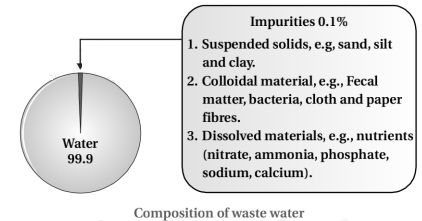
$A$ mere $0.1 \%$ of impurities make domestic sewage unfit for human use.
Solid wastes are relatively easy to remove,but dissolved salts like nitrates,phosphates,and other nutrients,as well as toxic metal ions and organic compounds present in domestic wastes,are comparatively difficult to remove.
Domestic sewage mainly contains biodegradable organic matter,which can be easily decomposed by microbes like bacteria and fungi.
These microbes use organic wastes as nutrients.
The composition of wastewater consists of $99.9 \%$ water and $0.1 \%$ impurities. These impurities include:
$1$. Suspended solids,e.g.,sand,silt,and clay.
$2$. Colloidal material,e.g.,fecal matter,bacteria,cloth,and paper fibers.
$3$. Dissolved materials,e.g.,nutrients (nitrate,ammonia,phosphate,sodium,calcium).
Due to the disposal of all kinds of waste and other anthropogenic actions,ponds,lakes,streams,rivers,estuaries,and oceans are becoming polluted in several parts of the world.
The Government of India has passed the Water (Prevention and Control of Pollution) Act,$1974$ to protect water resources.
The sewage that comes out from houses and offices constitutes domestic sewage.
$A$ mere $0.1 \%$ of impurities make domestic sewage unfit for human use.
Solid wastes are relatively easy to remove,but dissolved salts like nitrates,phosphates,and other nutrients,as well as toxic metal ions and organic compounds present in domestic wastes,are comparatively difficult to remove.
Domestic sewage mainly contains biodegradable organic matter,which can be easily decomposed by microbes like bacteria and fungi.
These microbes use organic wastes as nutrients.
The composition of wastewater consists of $99.9 \%$ water and $0.1 \%$ impurities. These impurities include:
$1$. Suspended solids,e.g.,sand,silt,and clay.
$2$. Colloidal material,e.g.,fecal matter,bacteria,cloth,and paper fibers.
$3$. Dissolved materials,e.g.,nutrients (nitrate,ammonia,phosphate,sodium,calcium).
0 likes
View Solution308
Medium
Write a short note on algal bloom.
Solution
(N/A) Algal bloom refers to the excessive growth of planktonic (free-floating) algae in water bodies,which imparts a distinct color to the water.
$1$. Causes: It is primarily caused by the presence of high levels of nutrients,such as nitrogen and phosphorus,in the water. This process is known as eutrophication.
$2$. Impact on Ecosystem: These blooms cause deterioration of water quality and fish mortality.
$3$. Toxicity: Some bloom-forming algae are extremely toxic to human beings and animals.
$4$. Oxygen Depletion: The decomposition of large amounts of algae consumes significant amounts of dissolved oxygen,leading to the death of aquatic organisms.
$1$. Causes: It is primarily caused by the presence of high levels of nutrients,such as nitrogen and phosphorus,in the water. This process is known as eutrophication.
$2$. Impact on Ecosystem: These blooms cause deterioration of water quality and fish mortality.
$3$. Toxicity: Some bloom-forming algae are extremely toxic to human beings and animals.
$4$. Oxygen Depletion: The decomposition of large amounts of algae consumes significant amounts of dissolved oxygen,leading to the death of aquatic organisms.
0 likes
View Solution309
Medium
Explain biomagnification and its effect in $DDT$.
Solution
(N/A) Biomagnification refers to the increase in concentration of toxic substances at successive trophic levels in a food chain.
This occurs because a toxic substance accumulated by an organism cannot be metabolized or excreted,and is thus passed on to the next higher trophic level.
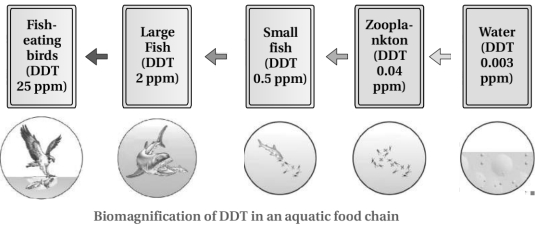
In an aquatic food chain,$DDT$ (Dichloro-Diphenyl-Trichloroethane) is a classic example of biomagnification. The concentration of $DDT$ increases from water $(0.003 \ ppm)$ to zooplankton $(0.04 \ ppm)$,small fish $(0.5 \ ppm)$,large fish $(2 \ ppm)$,and finally to fish-eating birds $(25 \ ppm)$.
High concentrations of $DDT$ disturb calcium metabolism in birds,which causes thinning of eggshells and their premature breaking,eventually leading to a decline in bird populations.
This occurs because a toxic substance accumulated by an organism cannot be metabolized or excreted,and is thus passed on to the next higher trophic level.
In an aquatic food chain,$DDT$ (Dichloro-Diphenyl-Trichloroethane) is a classic example of biomagnification. The concentration of $DDT$ increases from water $(0.003 \ ppm)$ to zooplankton $(0.04 \ ppm)$,small fish $(0.5 \ ppm)$,large fish $(2 \ ppm)$,and finally to fish-eating birds $(25 \ ppm)$.
High concentrations of $DDT$ disturb calcium metabolism in birds,which causes thinning of eggshells and their premature breaking,eventually leading to a decline in bird populations.
0 likes
View Solution310
Medium
Give information about Eutrophication.
Solution
(N/A) Eutrophication is the natural aging of a lake by biological enrichment of its water.
Due to the addition of nutrients such as nitrogen and phosphorus,which encourage the growth of aquatic organisms,the accumulation of organic remains over time leads to the shallowing of the lake.
Over the centuries,silt and organic debris pile up at the bottom of the lake,encouraging the growth of marsh plants in the shallow areas and beginning to fill in the original lake basin.
Eventually,large masses of floating plants grow,and the lake is finally converted into land.
The pollutants from human activities,such as effluents from industries and homes,radically accelerate the aging of the lake. This phenomenon is called Cultural or Accelerated Eutrophication.
Main contaminants include nitrates and phosphates that act as plant nutrients.
They increase the growth of algae,causing unsightly scum and unpleasant odours,and depleting the dissolved oxygen in the water,which is essential for other aquatic life.
Due to the addition of nutrients such as nitrogen and phosphorus,which encourage the growth of aquatic organisms,the accumulation of organic remains over time leads to the shallowing of the lake.
Over the centuries,silt and organic debris pile up at the bottom of the lake,encouraging the growth of marsh plants in the shallow areas and beginning to fill in the original lake basin.
Eventually,large masses of floating plants grow,and the lake is finally converted into land.
The pollutants from human activities,such as effluents from industries and homes,radically accelerate the aging of the lake. This phenomenon is called Cultural or Accelerated Eutrophication.
Main contaminants include nitrates and phosphates that act as plant nutrients.
They increase the growth of algae,causing unsightly scum and unpleasant odours,and depleting the dissolved oxygen in the water,which is essential for other aquatic life.
0 likes
View Solution311
MediumMCQ
What are the effects of thermal power plants on aquatic life?
A
They increase the oxygen content of water.
B
They cause thermal pollution by releasing heated wastewater,which kills sensitive organisms.
C
They promote the growth of all aquatic species equally.
D
They have no impact on aquatic ecosystems.
Solution
(B) Thermal power plants release heated wastewater into water bodies,which acts as a pollutant.
This rise in temperature reduces the dissolved oxygen levels in the water.
Sensitive organisms cannot survive in high-temperature environments,leading to a decline in their population.
While some species might grow faster in warmer water,it often disrupts the balance of the local flora and fauna,causing significant ecological damage.
This rise in temperature reduces the dissolved oxygen levels in the water.
Sensitive organisms cannot survive in high-temperature environments,leading to a decline in their population.
While some species might grow faster in warmer water,it often disrupts the balance of the local flora and fauna,causing significant ecological damage.
0 likes
View Solution312
Medium
Differentiate between Biological Magnification and Eutrophication.
Solution
(N/A)
| Biological Magnification | Eutrophication |
|---|---|
| $(1)$ The phenomenon in which persistent pollutants (e.g.,$DDT$) accumulate in tissues and increase in concentration along the food chain is called biological magnification. | $(1)$ The process of nutrient enrichment of water bodies,leading to excessive plant/algal growth and a subsequent loss of species diversity,is called eutrophication. |
0 likes
View Solution313
Difficult
Compare the lifestyle of people living in urban areas with those in rural areas and briefly describe how the lifestyle affects their health.
Solution
(N/A) Urban areas:
$(1)$ Social environment: Urban environments often experience higher rates of crime and violence,which can lead to stress and mental health issues.
$(2)$ Physical environment: Densely populated urban areas often lack adequate outdoor spaces for physical exercise.
$(3)$ Air quality: Urban areas frequently suffer from poor air quality due to pollution,contributing to chronic respiratory diseases like asthma.
$(4)$ Sanitation: In many developing regions,urban dwellers in slums face a lack of basic sanitation,clean water,and electricity.
$(5)$ Healthcare access: While urban areas have more hospitals,individuals with lower socioeconomic status may lack health insurance,creating a burden on the system.
Rural areas:
$(1)$ Social environment: Rural populations often face unique health challenges,sometimes reporting poorer health status compared to urban counterparts.
$(2)$ Lifestyle factors: Studies suggest that some rural residents may have less nutritional diets and lower levels of physical activity.
$(3)$ Physical environment: While air quality is generally better and crime rates are lower,the lack of built infrastructure makes it difficult to maintain healthy habits.
$(4)$ Healthcare access: Rural residents often face significant barriers to accessing specialized healthcare services due to distance and limited facilities.
$(1)$ Social environment: Urban environments often experience higher rates of crime and violence,which can lead to stress and mental health issues.
$(2)$ Physical environment: Densely populated urban areas often lack adequate outdoor spaces for physical exercise.
$(3)$ Air quality: Urban areas frequently suffer from poor air quality due to pollution,contributing to chronic respiratory diseases like asthma.
$(4)$ Sanitation: In many developing regions,urban dwellers in slums face a lack of basic sanitation,clean water,and electricity.
$(5)$ Healthcare access: While urban areas have more hospitals,individuals with lower socioeconomic status may lack health insurance,creating a burden on the system.
Rural areas:
$(1)$ Social environment: Rural populations often face unique health challenges,sometimes reporting poorer health status compared to urban counterparts.
$(2)$ Lifestyle factors: Studies suggest that some rural residents may have less nutritional diets and lower levels of physical activity.
$(3)$ Physical environment: While air quality is generally better and crime rates are lower,the lack of built infrastructure makes it difficult to maintain healthy habits.
$(4)$ Healthcare access: Rural residents often face significant barriers to accessing specialized healthcare services due to distance and limited facilities.
0 likes
View Solution314
Easy
Name the states involved in the Ganga Action Plan.
Solution
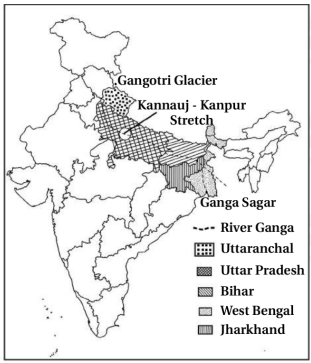
(N/A) The Ganga Action Plan was initiated by the Ministry of Environment and Forests to reduce the pollution load in the river Ganga. The states through which the river Ganga flows and which are involved in this plan are:
$1$. Uttarakhand (formerly Uttaranchal)
$2$. Uttar Pradesh
$3$. Bihar
$4$. Jharkhand
$5$. West Bengal
$1$. Uttarakhand (formerly Uttaranchal)
$2$. Uttar Pradesh
$3$. Bihar
$4$. Jharkhand
$5$. West Bengal
0 likes
View Solution315
MediumMCQ
Give scientific reasons: The use of $CNG$ is more advantageous than the use of petrol.
A
It is cheaper.
B
It burns more efficiently.
C
It is less polluting.
D
All of the above.
Solution
(D) $CNG$ (Compressed Natural Gas) is considered more advantageous than petrol for several reasons:
$1$. $CNG$ burns most efficiently,unlike petrol or diesel,which often leave behind unburnt residues.
$2$. It is a cleaner fuel that produces significantly lower levels of pollutants like carbon monoxide,hydrocarbons,and nitrogen oxides.
$3$. $CNG$ is cheaper and cannot be adulterated like petrol or diesel.
$4$. It is lighter than air,so in case of a leak,it disperses quickly into the atmosphere,reducing the risk of fire.
$5$. It is non-carcinogenic and non-corrosive.
$1$. $CNG$ burns most efficiently,unlike petrol or diesel,which often leave behind unburnt residues.
$2$. It is a cleaner fuel that produces significantly lower levels of pollutants like carbon monoxide,hydrocarbons,and nitrogen oxides.
$3$. $CNG$ is cheaper and cannot be adulterated like petrol or diesel.
$4$. It is lighter than air,so in case of a leak,it disperses quickly into the atmosphere,reducing the risk of fire.
$5$. It is non-carcinogenic and non-corrosive.
0 likes
View Solution316
Medium
Give scientific reasons: Noise is also considered a part of air pollution.
Solution
(N/A) In $1987$,the Air (Prevention and Control of Pollution) Act was amended to include noise as an air pollutant.
Noise is defined as an undesirable,high-level sound.
Sources like industrial machines,aircraft,and rockets often generate noise levels exceeding $150 \text{ dB}$.
Exposure to such high levels of noise causes physical and psychological distress,including loss of hearing,increased heart rate,altered breathing patterns,and high blood pressure.
Due to these harmful effects on human health and the environment,noise is classified as a form of air pollution.
Noise is defined as an undesirable,high-level sound.
Sources like industrial machines,aircraft,and rockets often generate noise levels exceeding $150 \text{ dB}$.
Exposure to such high levels of noise causes physical and psychological distress,including loss of hearing,increased heart rate,altered breathing patterns,and high blood pressure.
Due to these harmful effects on human health and the environment,noise is classified as a form of air pollution.
0 likes
View Solution317
Medium
Provide definitions and explanations for the following terms:
$(i)$ Pollution
$(ii)$ Greenhouse effect
$(i)$ Pollution
$(ii)$ Greenhouse effect
Solution
(N/A) $(i)$ Pollution: Pollution is defined as any undesirable change in the physical,chemical,or biological characteristics of air,land,water,or soil that adversely affects human life,industrial progress,living conditions,and cultural assets.
$(ii)$ Greenhouse effect: The greenhouse effect is a naturally occurring phenomenon that is responsible for heating of the Earth's surface and atmosphere. Without the greenhouse effect,the average temperature at the surface of the Earth would have been $-18^{\circ}C$ rather than the present average of $15^{\circ}C$.
$(ii)$ Greenhouse effect: The greenhouse effect is a naturally occurring phenomenon that is responsible for heating of the Earth's surface and atmosphere. Without the greenhouse effect,the average temperature at the surface of the Earth would have been $-18^{\circ}C$ rather than the present average of $15^{\circ}C$.
0 likes
View Solution318
Medium
Define/Explain the following terms:
$(i)$ Eutrophication
$(ii)$ Jhum cultivation
$(i)$ Eutrophication
$(ii)$ Jhum cultivation
Solution
(N/A) $(i)$ Eutrophication: The natural aging of a lake by biological enrichment of its water. In a young lake,the water is cold and clear,supporting little life. With time,streams draining into the lake introduce nutrients such as nitrogen and phosphorus,which encourage the growth of aquatic organisms. As the lake's fertility increases,plant and animal life burgeons,and organic remains begin to be deposited on the lake bottom. Over centuries,as silt and organic debris pile up,the lake grows shallower and warmer,with warm-water organisms supplanting those that thrive in a cold environment. Marsh plants take root in the shallows and begin to fill in the original lake basin. Eventually,the lake gives way to large masses of floating plants (bog),finally converting into land.
$(ii)$ Jhum cultivation: Also known as 'slash and burn' agriculture. In this practice,the farmers cut down the trees of the forest and burn the plant remains. The ash is used as a fertilizer and the land is then used for farming or cattle grazing. After cultivation,the area is left uncultivated for several years so as to allow its recovery.
$(ii)$ Jhum cultivation: Also known as 'slash and burn' agriculture. In this practice,the farmers cut down the trees of the forest and burn the plant remains. The ash is used as a fertilizer and the land is then used for farming or cattle grazing. After cultivation,the area is left uncultivated for several years so as to allow its recovery.
0 likes
View Solution319
EasyMCQ
Identify the year of establishment for the Central Pollution Control Board $(CPCB)$ based on the following context:
$(i)$ Environment (Protection) Act: $1986$
(ii) Central Pollution Control Board $(CPCB)$: ?
$(i)$ Environment (Protection) Act: $1986$
(ii) Central Pollution Control Board $(CPCB)$: ?
A
$1974$
B
$1981$
C
$1986$
D
$1987$
Solution
(A) The Central Pollution Control Board $(CPCB)$ was established in $1974$ under the Water (Prevention and Control of Pollution) Act,$1974$.
Therefore,the correct year is $1974$.
Therefore,the correct year is $1974$.
0 likes
View Solution320
Easy
Provide the full forms of the following abbreviations:
$(i)$ $GAIL$
$(ii)$ $BOD$
$(i)$ $GAIL$
$(ii)$ $BOD$
Solution
(N/A) $(i)$ $GAIL$: $Gas$ $Authority$ $of$ $India$ $Limited$
$(ii)$ $BOD$: $Biochemical$ $Oxygen$ $Demand$
$(ii)$ $BOD$: $Biochemical$ $Oxygen$ $Demand$
0 likes
View Solution321
EasyMCQ
What is the full form of the following terms?
$(i)$ $PPM$
$(ii)$ $PPB$
$(i)$ $PPM$
$(ii)$ $PPB$
A
Parts Per Million,Parts Per Billion
B
Parts Per Milli,Parts Per Billi
C
Percentage Per Million,Percentage Per Billion
D
Parts Per Meter,Parts Per Bar
Solution
(A) $(i)$ $PPM$ stands for Parts Per Million. It is a unit of concentration used to express the amount of a substance in a mixture,specifically one part of solute per million parts of solvent.
$(ii)$ $PPB$ stands for Parts Per Billion. It is a unit of concentration used to express the amount of a substance in a mixture,specifically one part of solute per billion parts of solvent.
$(ii)$ $PPB$ stands for Parts Per Billion. It is a unit of concentration used to express the amount of a substance in a mixture,specifically one part of solute per billion parts of solvent.
0 likes
View Solution322
Easy
What are the full forms of the following abbreviations?
$(i)$ $CNG$
$(ii)$ $DDT$
$(i)$ $CNG$
$(ii)$ $DDT$
Solution
(N/A) $(i)$ $CNG$ stands for Compressed Natural Gas. It is a cleaner fuel compared to petrol and diesel.
$(ii)$ $DDT$ stands for Dichlorodiphenyltrichloroethane. It is a synthetic chemical compound that was historically used as an insecticide.
$(ii)$ $DDT$ stands for Dichlorodiphenyltrichloroethane. It is a synthetic chemical compound that was historically used as an insecticide.
0 likes
View Solution323
MediumMCQ
What are the various components of domestic sewage? Discuss the effects of discharging sewage into a river.
A
Components: Suspended solids,colloidal materials,dissolved materials; Effects: Depletion of dissolved oxygen,$BOD$ increase,eutrophication,and death of aquatic organisms.
Solution
(A) Domestic sewage consists of $0.1\%$ impurities and $99.9\%$ water. It includes human excreta,food waste,detergents,and other household waste. The main components are:
$(i)$ Suspended solids: Sand,silt,and clay.
$(ii)$ Colloidal materials: Fecal matter,bacteria,paper,and cloth fibers.
$(iii)$ Dissolved materials: Inorganic nutrients like nitrates,ammonia,sodium,and calcium.
Effects of discharging sewage into a river:
$(i)$ Water contamination: Sewage introduces pathogenic microorganisms,leading to waterborne diseases.
$(ii)$ Increase in $BOD$: Microorganisms decompose organic matter,consuming large amounts of dissolved oxygen. This increases the $BOD$ (Biochemical Oxygen Demand),leading to the death of fish and other aquatic organisms.
$(iii)$ Eutrophication: Excess nutrients (nitrates and phosphates) cause algal blooms,which deplete oxygen and disrupt the aquatic ecosystem.
$(i)$ Suspended solids: Sand,silt,and clay.
$(ii)$ Colloidal materials: Fecal matter,bacteria,paper,and cloth fibers.
$(iii)$ Dissolved materials: Inorganic nutrients like nitrates,ammonia,sodium,and calcium.
Effects of discharging sewage into a river:
$(i)$ Water contamination: Sewage introduces pathogenic microorganisms,leading to waterborne diseases.
$(ii)$ Increase in $BOD$: Microorganisms decompose organic matter,consuming large amounts of dissolved oxygen. This increases the $BOD$ (Biochemical Oxygen Demand),leading to the death of fish and other aquatic organisms.
$(iii)$ Eutrophication: Excess nutrients (nitrates and phosphates) cause algal blooms,which deplete oxygen and disrupt the aquatic ecosystem.
0 likes
View Solution324
Medium
Discuss the following in brief:
$(a)$ Greenhouse gases
$(b)$ Catalytic converters
$(c)$ Ultraviolet-$B$ $(UV-B)$
$(a)$ Greenhouse gases
$(b)$ Catalytic converters
$(c)$ Ultraviolet-$B$ $(UV-B)$
Solution
(N/A) Greenhouse gases: Greenhouse gases are responsible for the greenhouse effect. They absorb infrared radiation from the earth and emit it again towards the earth,thus keeping the earth warm. Examples include $CO_2$,methane,and $CFCs$. Excessive emission of these gases leads to global warming and climate change.
$(b)$ Catalytic converters: These are fitted into automobiles to reduce the emission of poisonous gases. They contain expensive metals like platinum-palladium and rhodium as catalysts. As the exhaust passes through the catalytic converter,unburnt hydrocarbons are converted into $CO_2$ and water,and carbon monoxide and nitric oxide are changed to $CO_2$ and nitrogen gas,respectively.
$(c)$ Ultraviolet-$B$ $(UV-B)$: $UV-B$ radiation damages $DNA$ and causes mutations. It leads to skin aging,damage to skin cells,and various types of skin cancers. In human eyes,the cornea absorbs $UV-B$ radiation,and a high dose of $UV-B$ causes inflammation of the cornea,known as snow-blindness,cataract,etc. Such exposure may permanently damage the cornea.
$(b)$ Catalytic converters: These are fitted into automobiles to reduce the emission of poisonous gases. They contain expensive metals like platinum-palladium and rhodium as catalysts. As the exhaust passes through the catalytic converter,unburnt hydrocarbons are converted into $CO_2$ and water,and carbon monoxide and nitric oxide are changed to $CO_2$ and nitrogen gas,respectively.
$(c)$ Ultraviolet-$B$ $(UV-B)$: $UV-B$ radiation damages $DNA$ and causes mutations. It leads to skin aging,damage to skin cells,and various types of skin cancers. In human eyes,the cornea absorbs $UV-B$ radiation,and a high dose of $UV-B$ causes inflammation of the cornea,known as snow-blindness,cataract,etc. Such exposure may permanently damage the cornea.
0 likes
View Solution325
MediumMCQ
Use of lead-free petrol or diesel is recommended to reduce the pollutants emitted by automobiles. What role does lead play?
A
It increases the efficiency of the catalytic converter.
B
It inactivates the catalyst in the catalytic converter.
C
It helps in the complete combustion of fuel.
D
It reduces the emission of carbon monoxide.
Solution
(B) Catalytic converters,which contain expensive metals like platinum,palladium,and rhodium as catalysts,are fitted into automobiles to reduce the emission of poisonous gases.
These converters convert unburnt hydrocarbons into $CO_{2}$ and $H_{2}O$.
Motor vehicles equipped with catalytic converters must use unleaded petrol because lead in petrol inactivates the catalyst.
Inactivation of the catalyst leads to an increase in hydrocarbon emissions,which severely impacts the environment.
Furthermore,lead accumulates in bones,blood,and soft organs,adversely affecting the kidneys,liver,nervous system,and other vital organs.
These converters convert unburnt hydrocarbons into $CO_{2}$ and $H_{2}O$.
Motor vehicles equipped with catalytic converters must use unleaded petrol because lead in petrol inactivates the catalyst.
Inactivation of the catalyst leads to an increase in hydrocarbon emissions,which severely impacts the environment.
Furthermore,lead accumulates in bones,blood,and soft organs,adversely affecting the kidneys,liver,nervous system,and other vital organs.
0 likes
View Solution326
MediumMCQ
It is a common practice to undertake desilting of the overhead water tanks. What is the possible source of silt that gets deposited in the water tanks?
A
Atmospheric dust settling in the tank
B
Soil particles carried by water from the source of supply
C
Microbial growth within the tank
D
Chemical precipitation of minerals
Solution
(B) The silt deposited in overhead water tanks primarily consists of soil particles and fine sediments. These particles are carried by water from the original source of supply,such as deep borewells,rivers,or reservoirs,and settle at the bottom of the tanks over time due to gravity.
0 likes
View Solution327
Medium
What is cultural eutrophication?
Solution
(N/A) Accelerated or cultural eutrophication occurs due to the discharge of sewage,agricultural runoff,and industrial effluents into water bodies.
$\Rightarrow$ It causes the profuse growth of blue-green algae,which imparts a characteristic coloration to the water.
It radically accelerates the natural aging process of the aquatic ecosystem.
$\Rightarrow$ It causes the profuse growth of blue-green algae,which imparts a characteristic coloration to the water.
It radically accelerates the natural aging process of the aquatic ecosystem.
0 likes
View Solution328
Easy
List any two adverse effects of particulate matter on human health.
Solution
(N/A) Particulate matter,when inhaled deep into the lungs,causes the following adverse effects:
$(i)$ Breathing and respiratory symptoms.
$(ii)$ Irritation,inflammation,and damage to the lungs,leading to premature deaths.
$(i)$ Breathing and respiratory symptoms.
$(ii)$ Irritation,inflammation,and damage to the lungs,leading to premature deaths.
0 likes
View Solution329
MediumMCQ
Name an industry which can cause both air and thermal pollution as well as eutrophication.
A
Thermal power plant
B
Textile industry
C
Automobile industry
D
Cement industry
Solution
(A) thermal power plant is an industry that causes air pollution through the emission of particulate matter and gases like $SO_2$ and $NO_x$.
It causes thermal pollution because it uses large amounts of water for cooling purposes and releases the heated water back into water bodies,which raises the temperature and affects aquatic life.
It can also contribute to eutrophication if the wastewater contains nutrient-rich runoff or chemicals that promote excessive algal growth in the receiving water bodies.
It causes thermal pollution because it uses large amounts of water for cooling purposes and releases the heated water back into water bodies,which raises the temperature and affects aquatic life.
It can also contribute to eutrophication if the wastewater contains nutrient-rich runoff or chemicals that promote excessive algal growth in the receiving water bodies.
0 likes
View Solution330
Easy
What is an algal bloom?
Solution
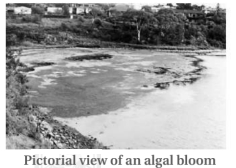
An algal bloom is the excessive growth of planktonic (free-floating) algae in water bodies.
This phenomenon is primarily caused by the presence of large amounts of nutrients,such as nitrogen and phosphorus,in the water.
These nutrients often enter water bodies through agricultural runoff or sewage discharge,leading to eutrophication.
This phenomenon is primarily caused by the presence of large amounts of nutrients,such as nitrogen and phosphorus,in the water.
These nutrients often enter water bodies through agricultural runoff or sewage discharge,leading to eutrophication.
0 likes
View Solution331
Medium
What do you understand by biomagnification? Explain it.
Solution
(N/A) Biomagnification refers to the increase in the concentration of toxic substances (such as non-biodegradable pollutants like $DDT$ or mercury) at successive trophic levels in a food chain.
This phenomenon occurs because the toxic substance accumulated by an organism cannot be metabolized or excreted,and is thus passed on to the next higher trophic level in a higher concentration.
For example,in an aquatic food chain,the concentration of $DDT$ increases from water to phytoplankton,then to zooplankton,small fish,large fish,and finally to fish-eating birds,where it reaches a toxic level that can interfere with calcium metabolism,leading to the thinning of eggshells.
This phenomenon occurs because the toxic substance accumulated by an organism cannot be metabolized or excreted,and is thus passed on to the next higher trophic level in a higher concentration.
For example,in an aquatic food chain,the concentration of $DDT$ increases from water to phytoplankton,then to zooplankton,small fish,large fish,and finally to fish-eating birds,where it reaches a toxic level that can interfere with calcium metabolism,leading to the thinning of eggshells.
0 likes
View Solution332
EasyMCQ
What are the three major kinds of impurities in domestic wastewater?
A
Suspended solids,colloidal materials,and dissolved materials
B
Heavy metals,pesticides,and radioactive waste
C
Oil,grease,and detergents
D
Pathogens,algae,and fungi
Solution
(A) The three major kinds of impurities in domestic wastewater are:
$1$. Suspended solids: These include materials like sand,silt,and clay.
$2$. Colloidal materials: These include fine particles such as faecal matter,bacteria,cloth,and paper fibres.
$3$. Dissolved materials: These include nutrients such as nitrate,ammonia,phosphate,sodium,and calcium.
$1$. Suspended solids: These include materials like sand,silt,and clay.
$2$. Colloidal materials: These include fine particles such as faecal matter,bacteria,cloth,and paper fibres.
$3$. Dissolved materials: These include nutrients such as nitrate,ammonia,phosphate,sodium,and calcium.
0 likes
View Solution333
Medium
Is it true that carpets and curtains/drapes placed on the floor or wall surfaces can reduce noise level? Explain briefly.
Solution
(N/A) Yes,it is true that carpets and curtains/drapes placed on the floor or wall surfaces can reduce noise levels. These materials are porous and soft,which makes them excellent sound absorbers. When sound waves strike these surfaces,the energy of the sound is dissipated within the fibers of the material rather than being reflected back into the room. Consequently,they act as muffling devices that help in reducing echo and overall noise pollution in an indoor environment.
0 likes
View Solution334
Medium
What is hybrid vehicle technology? Explain its advantages with a suitable example.
Solution
(N/A) Hybrid vehicle technology refers to vehicles that utilize two or more distinct power sources to move the vehicle. $A$ common example is a vehicle that can run on both petrol and $CNG$ (Compressed Natural Gas).
Advantages:
$1$. Conservation of fossil fuels: By using alternative fuels like $CNG$,the consumption of traditional petrol or diesel is reduced.
$2$. Reduction in environmental pollution: $CNG$ is considered a 'green fuel' because it burns more efficiently and produces significantly lower levels of harmful emissions like carbon monoxide,nitrogen oxides,and particulate matter compared to conventional fuels.
Advantages:
$1$. Conservation of fossil fuels: By using alternative fuels like $CNG$,the consumption of traditional petrol or diesel is reduced.
$2$. Reduction in environmental pollution: $CNG$ is considered a 'green fuel' because it burns more efficiently and produces significantly lower levels of harmful emissions like carbon monoxide,nitrogen oxides,and particulate matter compared to conventional fuels.
0 likes
View Solution335
Medium
Is it true that if the dissolved oxygen level drops to zero,the water will become septic? Give an example which could lower the dissolved oxygen content of an aquatic body.
Solution
(N/A) Yes,it is true that if the dissolved oxygen $(DO)$ level drops to zero,the water becomes septic (anaerobic). In such conditions,anaerobic bacteria thrive,leading to the decomposition of organic matter and the release of foul-smelling gases like hydrogen sulfide $(H_2S)$ and methane $(CH_4)$.
An example of a factor that lowers the $DO$ content is the discharge of untreated sewage or organic waste into an aquatic body. The microorganisms present in the water consume large amounts of oxygen to decompose this biodegradable organic matter,a process measured by Biochemical Oxygen Demand $(BOD)$. As $BOD$ increases,the $DO$ level in the water decreases significantly.
An example of a factor that lowers the $DO$ content is the discharge of untreated sewage or organic waste into an aquatic body. The microorganisms present in the water consume large amounts of oxygen to decompose this biodegradable organic matter,a process measured by Biochemical Oxygen Demand $(BOD)$. As $BOD$ increases,the $DO$ level in the water decreases significantly.
0 likes
View Solution336
MediumMCQ
It is a common practice to plant trees and shrubs near the boundary walls of buildings. What purpose do they serve?
A
They provide aesthetic beauty.
B
They act as barriers for sound pollution and dust catchers.
C
They provide shade and reduce temperature.
D
They prevent soil erosion.
Solution
(B) The plants growing near the boundary wall serve two primary purposes:
$(i)$ They act as barriers for sound pollution by absorbing or deflecting sound waves.
$(ii)$ They act as dust catchers,trapping particulate matter from the air on their leaves and stems,thereby improving air quality.
$(i)$ They act as barriers for sound pollution by absorbing or deflecting sound waves.
$(ii)$ They act as dust catchers,trapping particulate matter from the air on their leaves and stems,thereby improving air quality.
0 likes
View Solution337
Easy
What do you understand by Snow-blindness?
Solution
(N/A) In human eyes,the cornea absorbs $UV$-$B$ radiation.
$A$ high dose of $UV$-$B$ radiation causes inflammation of the cornea,a condition known as snow-blindness.
$A$ high dose of $UV$-$B$ radiation causes inflammation of the cornea,a condition known as snow-blindness.
0 likes
View Solution338
Medium
How has $DDT$ caused a decline in bird population?
Solution
(N/A) High concentrations of $DDT$ disturb calcium metabolism in birds.
- It causes thinning of eggshells and their premature breaking.
- This eventually leads to a decline in bird populations.
- It causes thinning of eggshells and their premature breaking.
- This eventually leads to a decline in bird populations.
0 likes
View Solution339
Medium
Water logging and soil salinity are some of the problems that have come in the wake of the Green Revolution. Discuss their causes and adverse effects to the environment.
Solution
(N/A) Water logging and soil salinity are significant environmental issues resulting from intensive agricultural practices associated with the Green Revolution.
Causes:
- Irrigation without proper drainage systems leads to the accumulation of excess water in the soil,known as water logging.
- As water accumulates,it brings dissolved salts from deeper soil layers to the surface through capillary action.
Adverse Effects:
- Water logging creates anaerobic conditions in the soil,which hinders root respiration and stunts plant growth.
- As the water evaporates,the salts are left behind,forming a thin crust on the land surface or accumulating around the root zone.
- This increased soil salinity makes it difficult for plants to absorb water via osmosis,eventually leading to crop failure and land degradation.
Causes:
- Irrigation without proper drainage systems leads to the accumulation of excess water in the soil,known as water logging.
- As water accumulates,it brings dissolved salts from deeper soil layers to the surface through capillary action.
Adverse Effects:
- Water logging creates anaerobic conditions in the soil,which hinders root respiration and stunts plant growth.
- As the water evaporates,the salts are left behind,forming a thin crust on the land surface or accumulating around the root zone.
- This increased soil salinity makes it difficult for plants to absorb water via osmosis,eventually leading to crop failure and land degradation.
0 likes
View Solution340
Medium
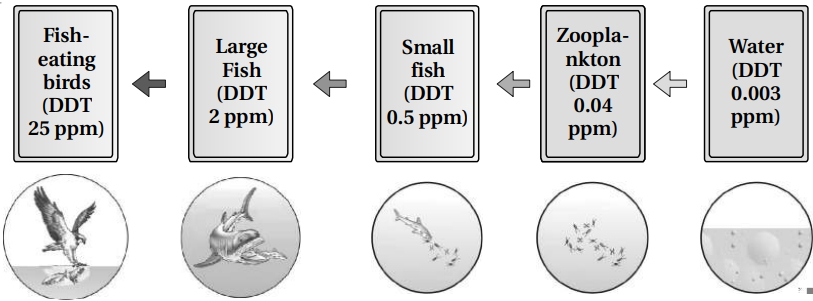
Observe the figure and answer the following questions.
$(i.)$ What ecological term is used to describe the $DDT$ accumulation at different trophic levels?
$(ii.)$ List any one effect of $DDT$ accumulation on birds.
$(iii.)$ Will $DDT$ accumulation lead to eutrophication?
$(iv.)$ Does it affect the $BOD$?
$(v.)$ Name a disease caused by the accumulation of any heavy metal.
$(i.)$ What ecological term is used to describe the $DDT$ accumulation at different trophic levels?
$(ii.)$ List any one effect of $DDT$ accumulation on birds.
$(iii.)$ Will $DDT$ accumulation lead to eutrophication?
$(iv.)$ Does it affect the $BOD$?
$(v.)$ Name a disease caused by the accumulation of any heavy metal.
Solution
(N/A) $(i)$ Biomagnification.
$(ii)$ High concentrations of $DDT$ disturb calcium metabolism in birds,which causes thinning of the eggshell and their premature breaking,eventually causing a decline in bird populations.
$(iii)$ No,$DDT$ accumulation does not directly lead to eutrophication. Eutrophication is primarily caused by nutrient enrichment (nitrogen and phosphorus) in water bodies.
$(iv)$ No,$DDT$ accumulation does not directly affect the $BOD$ (Biochemical Oxygen Demand). $BOD$ is a measure of organic matter pollution.
$(v)$ Diseases caused by heavy metal accumulation include:
$(1)$ Minamata disease: Caused by mercury $(Hg)$ poisoning.
$(2)$ Itai-itai disease: Caused by cadmium $(Cd)$ poisoning.
$(3)$ Black foot disease: Caused by arsenic $(As)$ poisoning.
$(ii)$ High concentrations of $DDT$ disturb calcium metabolism in birds,which causes thinning of the eggshell and their premature breaking,eventually causing a decline in bird populations.
$(iii)$ No,$DDT$ accumulation does not directly lead to eutrophication. Eutrophication is primarily caused by nutrient enrichment (nitrogen and phosphorus) in water bodies.
$(iv)$ No,$DDT$ accumulation does not directly affect the $BOD$ (Biochemical Oxygen Demand). $BOD$ is a measure of organic matter pollution.
$(v)$ Diseases caused by heavy metal accumulation include:
$(1)$ Minamata disease: Caused by mercury $(Hg)$ poisoning.
$(2)$ Itai-itai disease: Caused by cadmium $(Cd)$ poisoning.
$(3)$ Black foot disease: Caused by arsenic $(As)$ poisoning.
0 likes
View Solution341
MediumMCQ
What is the effect of eutrophication on water bodies?
A
Increase in dissolved oxygen
B
Decrease in dissolved oxygen
C
Increase in fish population
D
Improvement in water clarity
Solution
(B) Eutrophication leads to excessive growth of algae,forming a green scum on the water surface. This process causes a significant decrease in the level of dissolved $O_2$ in the water. Additionally,pollutants flowing into the lake can be toxic to fish populations. As these organisms decompose,the dissolved $O_2$ levels drop further,leading to the death of aquatic life and the eventual destruction of the lake's ecosystem.
0 likes
View Solution342
MediumMCQ
What is the new auto fuel policy?
A
$A$ policy to increase the speed of vehicles.
B
$A$ road map to reduce vehicular pollution in Indian cities.
C
$A$ policy to promote the use of leaded petrol.
D
$A$ policy to ban all private vehicles in cities.
Solution
(B) The new auto fuel policy is a road map laid out by the Government of India to reduce vehicular pollution in Indian cities.
It includes strict regulations for reducing the content of sulphur and aromatic hydrocarbons in petrol and diesel fuels.
For instance,Euro $II$ norms stipulate that sulphur levels should be controlled at $350 \text{ ppm}$ in diesel and $150 \text{ ppm}$ in petrol.
Additionally,aromatic hydrocarbons are to be contained at $42\%$ of the concerned fuel.
It includes strict regulations for reducing the content of sulphur and aromatic hydrocarbons in petrol and diesel fuels.
For instance,Euro $II$ norms stipulate that sulphur levels should be controlled at $350 \text{ ppm}$ in diesel and $150 \text{ ppm}$ in petrol.
Additionally,aromatic hydrocarbons are to be contained at $42\%$ of the concerned fuel.
0 likes
View Solution343
MediumMCQ
Snow-blindness in the Antarctic region is caused by:
A
Freezing of eye fluids due to low temperature
B
Inflammation of the cornea due to high dose of $UV-B$ radiation
C
High reflection of light from snow
D
Damage to the retina due to infrared radiations
Solution
(B) Snow-blindness is a condition caused by the inflammation of the cornea due to high doses of $UV-B$ radiation.
In the Antarctic region,the high reflection of $UV-B$ rays from the snow leads to their absorption by the cornea,causing inflammation and temporary blindness.
Therefore,the correct option is $B$.
In the Antarctic region,the high reflection of $UV-B$ rays from the snow leads to their absorption by the cornea,causing inflammation and temporary blindness.
Therefore,the correct option is $B$.
0 likes
View Solution344
MediumMCQ
Why do fish die in water bodies infested with water hyacinth ($Eichhornia$ $crassipes$)?
A
Due to depletion of oxygen
B
Due to addition of carbon dioxide
C
Due to addition of carbon monoxide
D
Due to sulfur dioxide
Solution
(A) Water hyacinth ($Eichhornia$ $crassipes$) is an invasive aquatic weed that grows rapidly in water bodies.
It covers the entire surface of the water,which prevents sunlight from penetrating and restricts the exchange of gases.
As the plant grows and decomposes,it consumes a large amount of dissolved oxygen from the water.
This leads to a severe depletion of dissolved oxygen,causing the death of aquatic organisms like fish.
It covers the entire surface of the water,which prevents sunlight from penetrating and restricts the exchange of gases.
As the plant grows and decomposes,it consumes a large amount of dissolved oxygen from the water.
This leads to a severe depletion of dissolved oxygen,causing the death of aquatic organisms like fish.
0 likes
View Solution345
EasyMCQ
What is the full form of $BOD$?
A
Biochemical Oxidation Degradation
B
Biological Oxidation Demand
C
Biochemical Oxygen Demand
D
Biological Optical Density
Solution
(C) $BOD$ stands for Biochemical Oxygen Demand. It refers to the amount of dissolved oxygen that would be consumed if all the organic matter in one liter of water were oxidized by bacteria. It is a key indicator of water pollution levels.
0 likes
View Solution346
MediumMCQ
What is the amount of oxygen consumed by bacteria to oxidize all the organic matter present in one liter of water called?
A
$BOD$
B
$COD$
C
$DO$
D
All of the above
Solution
(A) The amount of oxygen consumed by bacteria to oxidize all the organic matter present in one liter of water is known as Biochemical Oxygen Demand $(BOD)$.
$BOD$ is a measure of the organic matter present in water.
Greater $BOD$ indicates higher pollution levels in the water body.
$COD$ (Chemical Oxygen Demand) refers to the total oxygen required for both biodegradable and non-biodegradable organic matter,while $DO$ (Dissolved Oxygen) is the amount of oxygen dissolved in water.
$BOD$ is a measure of the organic matter present in water.
Greater $BOD$ indicates higher pollution levels in the water body.
$COD$ (Chemical Oxygen Demand) refers to the total oxygen required for both biodegradable and non-biodegradable organic matter,while $DO$ (Dissolved Oxygen) is the amount of oxygen dissolved in water.
0 likes
View Solution347
MediumMCQ
The following water samples are given with their $BOD$ values. Which sample has the lowest level of pollution?
Sample $w - 6 \ mg/L$,Sample $x - 6.5 \ mg/L$
Sample $y - 7 \ mg/L$,Sample $z - 10.3 \ mg/L$
Sample $w - 6 \ mg/L$,Sample $x - 6.5 \ mg/L$
Sample $y - 7 \ mg/L$,Sample $z - 10.3 \ mg/L$
A
Sample $x$
B
Sample $y$
C
Sample $w$
D
Sample $z$
Solution
(C) $BOD$ (Biochemical Oxygen Demand) refers to the amount of oxygen that would be consumed if all the organic matter in one liter of water were oxidized by bacteria.
Greater $BOD$ of waste water indicates higher pollution levels because more organic matter is present for decomposition.
Comparing the given values:
Sample $w = 6 \ mg/L$
Sample $x = 6.5 \ mg/L$
Sample $y = 7 \ mg/L$
Sample $z = 10.3 \ mg/L$
Since Sample $w$ has the lowest $BOD$ value $(6 \ mg/L)$,it contains the least amount of organic matter and therefore has the lowest level of pollution.
Greater $BOD$ of waste water indicates higher pollution levels because more organic matter is present for decomposition.
Comparing the given values:
Sample $w = 6 \ mg/L$
Sample $x = 6.5 \ mg/L$
Sample $y = 7 \ mg/L$
Sample $z = 10.3 \ mg/L$
Since Sample $w$ has the lowest $BOD$ value $(6 \ mg/L)$,it contains the least amount of organic matter and therefore has the lowest level of pollution.
0 likes
View Solution348
MediumMCQ
What does a high $BOD$ of water indicate?
A
High $DO$ in water
B
Low $CO_2$ in water
C
Low $DO$ in water
D
Water is less polluted
Solution
(C) $BOD$ stands for Biochemical Oxygen Demand. It represents the amount of dissolved oxygen that would be consumed if all the organic matter in one liter of water were oxidized by bacteria.
High $BOD$ indicates that there is a large amount of organic matter present in the water,which requires a significant amount of oxygen for decomposition by microorganisms.
As microorganisms consume this oxygen,the level of $DO$ (Dissolved Oxygen) in the water decreases significantly.
Therefore,a high $BOD$ is a direct indicator of high water pollution and low $DO$ levels.
High $BOD$ indicates that there is a large amount of organic matter present in the water,which requires a significant amount of oxygen for decomposition by microorganisms.
As microorganisms consume this oxygen,the level of $DO$ (Dissolved Oxygen) in the water decreases significantly.
Therefore,a high $BOD$ is a direct indicator of high water pollution and low $DO$ levels.
0 likes
View Solution349
MediumMCQ
If $O_2$ is consumed more by microorganisms in water,what does it indicate?
A
The water has low organic matter.
B
The water has low inorganic matter.
C
The water has high organic matter.
D
The water has high inorganic matter.
Solution
(C) The consumption of $O_2$ by microorganisms in water is measured as Biochemical Oxygen Demand $(BOD)$.
Microorganisms,such as bacteria,decompose organic matter present in water using dissolved oxygen.
If the water contains a high amount of organic matter,microorganisms will consume more $O_2$ to break it down.
Therefore,a higher $BOD$ value indicates a higher level of organic pollution in the water.
Microorganisms,such as bacteria,decompose organic matter present in water using dissolved oxygen.
If the water contains a high amount of organic matter,microorganisms will consume more $O_2$ to break it down.
Therefore,a higher $BOD$ value indicates a higher level of organic pollution in the water.
0 likes
View Solution350
EasyMCQ
What is the term for the undesirable change in the physical,chemical,or biological characteristics of air,water,or land?
A
Transformation
B
Modification
C
Pollution
D
Pollutant
Solution
(C) Pollution is defined as any undesirable change in the physical,chemical,or biological characteristics of air,land,water,or soil.
These changes are often harmful to human beings,other living organisms,industrial processes,living conditions,and cultural assets.
Agents that bring about such an undesirable change are called pollutants.
These changes are often harmful to human beings,other living organisms,industrial processes,living conditions,and cultural assets.
Agents that bring about such an undesirable change are called pollutants.
0 likes
View SolutionEnvironmental Issues — Pollution · Frequently Asked Questions
1Are these Environmental Issues questions useful for JEE and NEET?
Yes. All questions in this section are mapped to JEE Main and NEET exam patterns. Previous year questions from JEE Main, NEET, GUJCET and state-level exams are included with full solutions.
2Can I switch to Hindi or Gujarati for these questions?
Yes. Use the language tabs in the hero section or the sidebar to view the same questions and solutions in English, Hindi or Gujarati.
3How do I generate a question paper from this subtopic?
Use the Vedclass Exam Paper Generator — select the chapter and subtopic, set difficulty, and generate Sets A, B, C, D automatically. First 3 chapters of every subject are free.
Vedclass Products
For Students
Vedclass Test Series
Mock tests in real JEE/NEET style with performance analysis. 5-day free trial.
Start Free TrialFor Teachers
Exam Paper Generator
Generate Set A/B/C/D papers from this chapter in 2 minutes. 3 chapters free.
Try FreeFor Institutes
Online Exam Module
Live online exams with unlimited students, 360° analytics & white-label branding.
See DemoFor Teachers & Institutes
Generate a Environmental Issues Exam Paper in 2 Minutes
Select subtopic & difficulty — Sets A, B, C, D auto-generated with No Repeat logic.
First 3 chapters of every subject are free — no payment required.