
A English
Pollution Questions in English
Class 12 Biology · Environmental Issues · Pollution
550+
Questions
English
Language
100%
With Solutions
Showing 49 of 550 questions in English
201
MediumMCQ
The highest $DDT$ concentration in an aquatic food chain shall occur in:
A
phytoplankton
B
seagull
C
crab
D
eel
Solution
(B) $DDT$ is non-biodegradable and is not metabolized within the body of an organism. Instead,it accumulates in the fat tissues.
Therefore,its concentration increases from one trophic level to another in a food chain,with the highest amount being present in the top consumer,a process known as biomagnification.
In an aquatic food chain,the seagull is the top carnivore and therefore will possess the highest concentration of $DDT$.
Therefore,its concentration increases from one trophic level to another in a food chain,with the highest amount being present in the top consumer,a process known as biomagnification.
In an aquatic food chain,the seagull is the top carnivore and therefore will possess the highest concentration of $DDT$.
0 likes
View Solution202
MediumMCQ
$A$ river with an inflow of domestic sewage rich in organic waste may result in
A
an increased production of fish due to biodegradable nutrients
B
death of fish due to lack of oxygen
C
drying of the river very soon due to algal bloom
D
increased population of aquatic food web organisms.
Solution
(B) : High amount of organic waste in a river will trigger and activate decomposer microbes which will decompose the organic waste.
Biochemical Oxygen Demand $(BOD)$ of this river will shoot up,and decomposers will utilize most of the dissolved oxygen present in the water.
Consequently,the level of dissolved oxygen will decrease to an alarming extent.
Aquatic animals like fish,which depend on the oxygen dissolved in water,will ultimately die due to suffocation.
Biochemical Oxygen Demand $(BOD)$ of this river will shoot up,and decomposers will utilize most of the dissolved oxygen present in the water.
Consequently,the level of dissolved oxygen will decrease to an alarming extent.
Aquatic animals like fish,which depend on the oxygen dissolved in water,will ultimately die due to suffocation.
0 likes
View Solution203
EasyMCQ
Acid rain is caused by an increase in the atmospheric concentration of
A
$CO$ and $CO_2$
B
$O_3$ and dust
C
$SO_2$ and $NO_2$
D
$SO_3$ and $CO$
Solution
(C) The correct answer is $C$. Acid rain refers to rainfall or other forms of precipitation that have a $pH$ of less than $5.6$.
It is primarily caused by the large-scale emission of acidic gases into the atmosphere from thermal power plants,industries,and automobiles.
The most significant contributors are sulphur dioxide $(SO_2)$ and nitrogen oxides ($NO_x$,such as $NO_2$).
In the atmosphere,these gases react with oxygen and water vapor to form sulphuric acid $(H_2SO_4)$ and nitric acid $(HNO_3)$.
These acids then fall to the Earth's surface in the form of acid rain,which can cause significant damage to ecosystems,buildings,and soil health.
It is primarily caused by the large-scale emission of acidic gases into the atmosphere from thermal power plants,industries,and automobiles.
The most significant contributors are sulphur dioxide $(SO_2)$ and nitrogen oxides ($NO_x$,such as $NO_2$).
In the atmosphere,these gases react with oxygen and water vapor to form sulphuric acid $(H_2SO_4)$ and nitric acid $(HNO_3)$.
These acids then fall to the Earth's surface in the form of acid rain,which can cause significant damage to ecosystems,buildings,and soil health.
0 likes
View Solution204
MediumMCQ
Eutrophication of water bodies leading to the killing of fishes is mainly due to the non-availability of
A
essential minerals
B
oxygen
C
food
D
light
Solution
(B) : Eutrophication is the excessive growth of algae,plants,and animals in water bodies due to nutrient enrichment,particularly with nitrogen and phosphate. Nutrients present in sewage,agricultural wastes,and fertilizers cause dense growth of plants and planktonic algae. The excessive growth of planktonic algae that causes coloration of water is called algal bloom,which is toxic to animals and humans. Eutrophic water bodies also support excessive growth of floating plants. Algal blooms and floating plants cut off light from submerged plants,resulting in their death. There is a drastic decrease in oxygen replenishment inside the water. Non-availability of oxygen results in the death of aquatic animals such as fish,which further adds to the organic loading of water. Decomposition is replaced by putrefaction,which is anaerobic,leading to the absence of oxygen in water and the death of aquatic animals.
0 likes
View Solution205
EasyMCQ
Increase in concentration of the toxicant at successive trophic levels is known as
A
biotransformation
B
biogeochemical cycling
C
biomagnification
D
biodeterioration
Solution
(C) The increase in the concentration of toxic substances at successive trophic levels is known as biomagnification.
This occurs because a toxic substance accumulated by an organism cannot be metabolized or excreted,and thus is passed on to the next higher trophic level.
For example,$DDT$ is a persistent pesticide that accumulates in the fatty tissues of organisms.
As it moves up the food chain,its concentration increases significantly per unit weight of the organism.
For instance,the concentration of $DDT$ in water is $0.003 \ ppb$,which increases to $0.003 \ ppm$ in phytoplankton,$0.04 \ ppm$ in zooplankton,$0.5 \ ppm$ in small fish,$2.0 \ ppm$ in large fish,and reaches $25 \ ppm$ in fish-eating birds.
This occurs because a toxic substance accumulated by an organism cannot be metabolized or excreted,and thus is passed on to the next higher trophic level.
For example,$DDT$ is a persistent pesticide that accumulates in the fatty tissues of organisms.
As it moves up the food chain,its concentration increases significantly per unit weight of the organism.
For instance,the concentration of $DDT$ in water is $0.003 \ ppb$,which increases to $0.003 \ ppm$ in phytoplankton,$0.04 \ ppm$ in zooplankton,$0.5 \ ppm$ in small fish,$2.0 \ ppm$ in large fish,and reaches $25 \ ppm$ in fish-eating birds.
0 likes
View Solution206
MediumMCQ
High value of $BOD$ (Biochemical Oxygen Demand) indicates that
A
water is less polluted
B
consumption of organic matter in the water is higher by the microbes
C
water is highly polluted
D
Both $(b)$ and $(c)$
Solution
(D) $BOD$ (Biochemical Oxygen Demand) refers to the amount of dissolved oxygen that would be consumed if all the organic matter in one liter of water were oxidized by bacteria.
Greater $BOD$ indicates that there is a higher concentration of organic matter in the water,which requires more oxygen for microbial decomposition.
Therefore,a high $BOD$ value signifies that the water is highly polluted due to the presence of significant organic waste.
Greater $BOD$ indicates that there is a higher concentration of organic matter in the water,which requires more oxygen for microbial decomposition.
Therefore,a high $BOD$ value signifies that the water is highly polluted due to the presence of significant organic waste.
0 likes
View Solution207
EasyMCQ
Rachel Carson's famous book "Silent Spring" is related to
A
population explosion
B
ecosystem management
C
pesticide pollution
D
noise pollution
Solution
(C) Rachel Carson's book "Silent Spring", published in $1962$, is a landmark work in the environmental movement.
It documented the detrimental environmental effects caused by the indiscriminate use of pesticides, particularly $DDT$.
This book played a crucial role in raising public awareness about the hazards of chemical pesticides to wildlife and human health, eventually leading to changes in pesticide regulations.
It documented the detrimental environmental effects caused by the indiscriminate use of pesticides, particularly $DDT$.
This book played a crucial role in raising public awareness about the hazards of chemical pesticides to wildlife and human health, eventually leading to changes in pesticide regulations.
0 likes
View Solution208
MediumMCQ
$A$ location with luxuriant growth of lichens on the trees indicates that the
A
trees are very healthy
B
trees are heavily infested
C
location is highly polluted
D
location is not polluted.
Solution
(D) : Lichens are very sensitive to $SO_2$ pollution. They are completely destroyed at places where there is $SO_2$ pollution in the atmosphere. Therefore,they act as very good indicators of $SO_2$ pollution. $A$ luxuriant growth of lichens signifies that the air quality is good and the area is free from $SO_2$ contamination.
0 likes
View Solution209
MediumMCQ
$A$ scrubber in the exhaust of a chemical industrial plant removes
A
gases like sulphur dioxide
B
particulate matter of the size $5$ micrometer or above
C
gases like ozone and methane
D
particulate matter of the size $2.5$ micrometer or less
Solution
(A) The correct answer is $A$.
Scrubbers are pollution control devices used in industrial exhaust systems to remove harmful substances.
They are primarily used to remove gaseous pollutants,such as sulphur dioxide $(SO_2)$,from the exhaust gases of chemical industrial plants.
While scrubbers can also be used to separate particulate matter by passing the exhaust through dry or wet packing materials,their most common and significant application in industrial settings is the removal of acidic gases like $SO_2$ through a wet scrubbing process.
Scrubbers are pollution control devices used in industrial exhaust systems to remove harmful substances.
They are primarily used to remove gaseous pollutants,such as sulphur dioxide $(SO_2)$,from the exhaust gases of chemical industrial plants.
While scrubbers can also be used to separate particulate matter by passing the exhaust through dry or wet packing materials,their most common and significant application in industrial settings is the removal of acidic gases like $SO_2$ through a wet scrubbing process.
0 likes
View Solution210
MediumMCQ
Which one of the following is not correct with regard to the harmful effects of particulate matter of the size $2.5 \ \mu m$ or less?
A
It can cause respiratory problems.
B
It can directly enter into our circulatory system.
C
It can cause inflammation and damage to the lungs.
D
It can be inhaled into the lungs.
Solution
(B) $PM\ 2.5$ refers to particulate matter with a diameter of $2.5 \ \mu m$ or less. These particles are considered the most harmful to human health according to the Central Pollution Control Board $(CPCB)$.
They are small enough to be inhaled deep into the lungs,where they cause respiratory problems,irritation,inflammation,and damage to lung tissues,potentially leading to premature death.
While they significantly impact the respiratory system,they do not directly enter the circulatory system; their effects on the circulatory system are indirect,occurring through the respiratory pathway.
Therefore,the statement that they can directly enter the circulatory system is incorrect.
They are small enough to be inhaled deep into the lungs,where they cause respiratory problems,irritation,inflammation,and damage to lung tissues,potentially leading to premature death.
While they significantly impact the respiratory system,they do not directly enter the circulatory system; their effects on the circulatory system are indirect,occurring through the respiratory pathway.
Therefore,the statement that they can directly enter the circulatory system is incorrect.
0 likes
View Solution211
MediumMCQ
In an area where $DDT$ had been used extensively,the population of birds declined significantly because
A
birds stopped laying eggs
B
earthworms in the area got eradicated
C
cobras were feeding exclusively on birds
D
many of the birds eggs laid,did not hatch.
Solution
(D) $DDT$ undergoes biomagnification in the food chain. In birds,high concentrations of $DDT$ interfere with calcium metabolism. This leads to the thinning of eggshells. Consequently,these thin-shelled eggs break prematurely during incubation,preventing the embryos from developing fully and hatching. Thus,the population of birds declines significantly.
0 likes
View Solution212
MediumMCQ
Eutrophication is often seen in
A
deserts
B
fresh water lakes
C
ocean
D
mountains
Solution
(B) : Eutrophication is the excessive growth of algae,plants,and animals in water bodies due to nutrient enrichment,particularly with nitrogen and phosphate.
Nutrients present in sewage,agricultural wastes,and fertilizers cause dense growth of plants and planktonic algae.
The excessive growth of planktonic algae that causes coloration of water is called algal bloom,which is toxic to animals and humans.
Eutrophic water bodies also support excessive growth of floating plants.
Algal blooms and floating plants cut off light from submerged plants,resulting in their death.
There is a drastic decrease in oxygen replenishment inside the water.
Non-availability of oxygen results in the death of aquatic animals such as fish,which further adds to the organic loading of water.
Decomposition is replaced by putrefaction,which is anaerobic,leading to the absence of oxygen in water and the death of aquatic animals.
Nutrients present in sewage,agricultural wastes,and fertilizers cause dense growth of plants and planktonic algae.
The excessive growth of planktonic algae that causes coloration of water is called algal bloom,which is toxic to animals and humans.
Eutrophic water bodies also support excessive growth of floating plants.
Algal blooms and floating plants cut off light from submerged plants,resulting in their death.
There is a drastic decrease in oxygen replenishment inside the water.
Non-availability of oxygen results in the death of aquatic animals such as fish,which further adds to the organic loading of water.
Decomposition is replaced by putrefaction,which is anaerobic,leading to the absence of oxygen in water and the death of aquatic animals.
0 likes
View Solution213
EasyMCQ
$dB$ is a standard abbreviation used for the quantitative expression of
A
the density of bacteria in a medium
B
a particular pollutant
C
the dominant Bacillus in a culture
D
a certain pesticide
Solution
(B) $dB$ stands for decibel,which is a unit used to measure the intensity of sound.
In the context of environmental issues,noise is considered a form of pollution.
Unwanted or excessive sound is referred to as noise pollution and is measured in decibels $(dB)$.
Generally,sound levels above $80\ dB$ are considered to be noise pollution.
In the context of environmental issues,noise is considered a form of pollution.
Unwanted or excessive sound is referred to as noise pollution and is measured in decibels $(dB)$.
Generally,sound levels above $80\ dB$ are considered to be noise pollution.
0 likes
View Solution214
MediumMCQ
When domestic sewage mixes with river water,
A
small animals like rats will die after drinking river water.
B
the increased microbial activity releases micronutrients such as iron.
C
the increased microbial activity uses up dissolved oxygen.
D
the river water is still suitable for drinking as impurities are only about $0.1\%$.
Solution
(C) : When domestic sewage mixes with a water body,the microorganisms present in the sewage biodegrade the organic matter using the dissolved oxygen in the water.
This process leads to a sharp decline in the concentration of dissolved oxygen,which can cause the death of aquatic organisms like fish.
As the biodegradation of the organic sewage matter is completed,the concentration of dissolved oxygen in the water gradually increases again.
This process leads to a sharp decline in the concentration of dissolved oxygen,which can cause the death of aquatic organisms like fish.
As the biodegradation of the organic sewage matter is completed,the concentration of dissolved oxygen in the water gradually increases again.
0 likes
View Solution215
MediumMCQ
Biochemical oxygen demand $(BOD)$ in a river water
A
has no relationship with concentration of oxygen in the water
B
gives a measure of Salmonella in the water
C
increases when sewage gets mixed with river water
D
remains unchanged when algal bloom occurs.
Solution
(C) $(BOD)$ is the amount of dissolved oxygen that would be consumed if all the organic matter in one liter of water were oxidized by bacteria.
When sewage is mixed with river water,the amount of organic matter increases.
This leads to an increase in the population of decomposer microorganisms,which consume more oxygen for the decomposition process.
Therefore,the $(BOD)$ value increases as the organic pollution load increases.
When sewage is mixed with river water,the amount of organic matter increases.
This leads to an increase in the population of decomposer microorganisms,which consume more oxygen for the decomposition process.
Therefore,the $(BOD)$ value increases as the organic pollution load increases.
0 likes
View Solution216
MediumMCQ
In which one of the following have the $BOD$ (Biochemical Oxygen Demand) of sewage $(S)$,distillery effluent $(DE)$,paper mill effluent $(PE)$,and sugar mill effluent $(SE)$ been arranged in ascending order?
A
$SE < PE < S < DE$
B
$PE < S < SE < DE$
C
$S < DE < PE < SE$
D
$SE < S < PE < DE$
Solution
(B) The $BOD$ (Biochemical Oxygen Demand) is a measure of the organic matter present in water. Higher organic content leads to higher $BOD$.
- Paper mill effluent $(PE)$ typically has a lower $BOD$ compared to the others listed.
- Sewage $(S)$ has a moderate $BOD$.
- Sugar mill effluent $(SE)$ is rich in sugars,leading to a high $BOD$.
- Distillery effluent $(DE)$ contains high concentrations of organic waste from fermentation processes,resulting in the highest $BOD$ among these options.
Therefore,the correct ascending order is $PE < S < SE < DE$.
- Paper mill effluent $(PE)$ typically has a lower $BOD$ compared to the others listed.
- Sewage $(S)$ has a moderate $BOD$.
- Sugar mill effluent $(SE)$ is rich in sugars,leading to a high $BOD$.
- Distillery effluent $(DE)$ contains high concentrations of organic waste from fermentation processes,resulting in the highest $BOD$ among these options.
Therefore,the correct ascending order is $PE < S < SE < DE$.
0 likes
View Solution217
EasyMCQ
In a coal-fired power plant,electrostatic precipitators are installed to control the emission of:
A
$NO_X$
B
$SPM$
C
$CO$
D
$SO_2$
Solution
(B) The correct answer is $B$.
Electrostatic precipitators are used in coal-fired power plants to remove $SPM$ (Suspended Particulate Matter) from the exhaust gases.
$SPM$ consists of fine particles like dust,soot,and smoke that remain suspended in the air for long periods.
These devices use an electric field to charge the particles,which are then collected on grounded plates,preventing them from being released into the atmosphere.
Electrostatic precipitators are used in coal-fired power plants to remove $SPM$ (Suspended Particulate Matter) from the exhaust gases.
$SPM$ consists of fine particles like dust,soot,and smoke that remain suspended in the air for long periods.
These devices use an electric field to charge the particles,which are then collected on grounded plates,preventing them from being released into the atmosphere.
0 likes
View Solution218
MediumMCQ
Which one of the following statements is correct?
A
Both $Azotobacter$ and $Rhizobium$ fix atmospheric nitrogen in root nodules of plants.
B
Cyanobacteria such as $Anabaena$ and $Nostoc$ are important mobilizers of phosphates and for plant nutrition in soil.
C
At present it is not possible to grow maize without chemical fertilizers.
D
Extensive use of chemical fertilizers may lead to eutrophication of nearby water bodies.
Solution
(D) : Eutrophication is the excessive growth of algae, plants, and animals in water bodies due to nutrient enrichment, particularly with nitrogen and phosphate.
Nutrients present in sewage, agricultural wastes, and fertilizers cause dense growth of plants and planktonic algae.
The excessive growth of planktonic algae that causes coloration of water is called algal bloom, which is toxic to animals and humans.
Eutrophic water bodies also support the excessive growth of floating plants.
Algal blooms and floating plants cut off light from submerged plants, resulting in their death.
There is a drastic decrease in oxygen replenishment inside the water.
Non-availability of oxygen results in the death of aquatic animals such as fish, which further adds to the organic loading of water.
Decomposition is replaced by putrefaction, which is anaerobic, leading to the absence of oxygen in water and the death of aquatic animals.
Nutrients present in sewage, agricultural wastes, and fertilizers cause dense growth of plants and planktonic algae.
The excessive growth of planktonic algae that causes coloration of water is called algal bloom, which is toxic to animals and humans.
Eutrophic water bodies also support the excessive growth of floating plants.
Algal blooms and floating plants cut off light from submerged plants, resulting in their death.
There is a drastic decrease in oxygen replenishment inside the water.
Non-availability of oxygen results in the death of aquatic animals such as fish, which further adds to the organic loading of water.
Decomposition is replaced by putrefaction, which is anaerobic, leading to the absence of oxygen in water and the death of aquatic animals.
0 likes
View Solution219
MediumMCQ
Photochemical smog pollution does not contain
A
$PAN$ (peroxyacyl nitrate)
B
ozone
C
nitrogen dioxide
D
carbon dioxide
Solution
(D) Photochemical smog is a grey or yellow-brown opaque smog that creates an oxidizing environment.
It primarily contains secondary pollutants or photochemical oxidants.
Key components formed during its production include nitrogen dioxide $(NO_2)$,ozone $(O_3)$,and peroxyacyl nitrates $(PAN)$.
Carbon dioxide $(CO_2)$ is a greenhouse gas and a primary pollutant,but it is not a component of photochemical smog.
Therefore,the correct answer is $CO_2$.
It primarily contains secondary pollutants or photochemical oxidants.
Key components formed during its production include nitrogen dioxide $(NO_2)$,ozone $(O_3)$,and peroxyacyl nitrates $(PAN)$.
Carbon dioxide $(CO_2)$ is a greenhouse gas and a primary pollutant,but it is not a component of photochemical smog.
Therefore,the correct answer is $CO_2$.
0 likes
View Solution220
MediumMCQ
It refers to the amount of oxygen that would be consumed if all the organic matter in one liter of water were oxidized by bacteria.
A
$DOD$
B
$BOD$
C
$COD$
D
$STP$
Solution
(B) $BOD$ stands for Biochemical Oxygen Demand.
It is defined as the amount of oxygen that would be consumed if all the organic matter in one liter of water were oxidized by bacteria.
It is a measure of the organic matter present in the water.
Greater $BOD$ of waste water indicates more polluting potential.
It is defined as the amount of oxygen that would be consumed if all the organic matter in one liter of water were oxidized by bacteria.
It is a measure of the organic matter present in the water.
Greater $BOD$ of waste water indicates more polluting potential.
0 likes
View Solution221
MediumMCQ
Choose the incorrect sentence regarding an electrostatic precipitator.
A
The electrostatic precipitator can remove over $99$ percent of particulate matter present in the exhaust from a thermal power plant.
B
It has electrode wires that are maintained at several thousand volts.
C
The collecting plates are grounded and attract the charged dust particles.
D
The velocity of air between the plates must be high enough to allow the dust to fall.
Solution
(D) An electrostatic precipitator is a device used to remove particulate matter from industrial exhaust.
$1$. It consists of electrode wires maintained at several thousand volts,which produce a corona that releases electrons.
$2$. These electrons attach to dust particles,giving them a net negative charge.
$3$. The collecting plates are grounded and attract the charged dust particles.
$4$. The velocity of air between the plates must be low enough to allow the dust to fall,not high,as high velocity would prevent the particles from settling on the plates.
Therefore,option $D$ is the incorrect statement.
$1$. It consists of electrode wires maintained at several thousand volts,which produce a corona that releases electrons.
$2$. These electrons attach to dust particles,giving them a net negative charge.
$3$. The collecting plates are grounded and attract the charged dust particles.
$4$. The velocity of air between the plates must be low enough to allow the dust to fall,not high,as high velocity would prevent the particles from settling on the plates.
Therefore,option $D$ is the incorrect statement.
0 likes
View Solution222
EasyMCQ
In catalytic converters,.......... metal is used as a catalyst.
A
Iron
B
Rhodium
C
Copper
D
Gold
Solution
(B) Catalytic converters are used in automobiles to reduce the emission of poisonous gases.
They contain expensive metals like platinum,palladium,and rhodium as catalysts.
These metals facilitate the conversion of unburnt hydrocarbons into $CO_2$ and $H_2O$,and carbon monoxide $(CO)$ and nitric oxide $(NO)$ into $CO_2$ and $N_2$ gas,respectively.
Therefore,rhodium is the correct choice among the given options.
They contain expensive metals like platinum,palladium,and rhodium as catalysts.
These metals facilitate the conversion of unburnt hydrocarbons into $CO_2$ and $H_2O$,and carbon monoxide $(CO)$ and nitric oxide $(NO)$ into $CO_2$ and $N_2$ gas,respectively.
Therefore,rhodium is the correct choice among the given options.
0 likes
View Solution223
EasyMCQ
For $3$ wheelers vehicles,which emission norm was implemented throughout the country since October $2010$?
A
Euro - $II$
B
Euro - $III$
C
Euro - $IV$
D
Bharat Stage - $II$
Solution
(B) The Government of India implemented emission norms to control air pollution from vehicles.
For $3$-wheeler vehicles,the Bharat Stage-$III$ ($BS$-$III$) emission norms were implemented throughout the country starting from October $2010$.
These norms are equivalent to Euro-$III$ standards.
Therefore,the correct option is $B$.
For $3$-wheeler vehicles,the Bharat Stage-$III$ ($BS$-$III$) emission norms were implemented throughout the country starting from October $2010$.
These norms are equivalent to Euro-$III$ standards.
Therefore,the correct option is $B$.
0 likes
View Solution224
MediumMCQ
Choose the incorrect sentence regarding $BOD$.
A
The amount of dissolved oxygen in water increases, the $BOD$ increases.
B
It is possible to estimate the amount of biodegradable organic matter in sewage water by measuring biochemical oxygen demand $(BOD)$.
C
Micro-organisms involved in biodegradation of organic matter in the receiving water body consume a lot of oxygen and as a result there is a sharp decline in dissolved oxygen downstream from the point of sewage discharge.
D
Decline in dissolved oxygen in water causes mortality of fish and other aquatic creatures.
Solution
(A) $BOD$ (Biochemical Oxygen Demand) refers to the amount of oxygen that would be consumed if all the organic matter in one liter of water were oxidized by bacteria.
Greater $BOD$ indicates higher pollution levels due to organic matter.
When organic matter increases, microorganisms consume more oxygen for decomposition, leading to a decrease in dissolved oxygen.
Therefore, the statement "The amount of dissolved oxygen in water increases, the $BOD$ increases" is incorrect because an increase in $BOD$ actually leads to a decrease in dissolved oxygen.
Greater $BOD$ indicates higher pollution levels due to organic matter.
When organic matter increases, microorganisms consume more oxygen for decomposition, leading to a decrease in dissolved oxygen.
Therefore, the statement "The amount of dissolved oxygen in water increases, the $BOD$ increases" is incorrect because an increase in $BOD$ actually leads to a decrease in dissolved oxygen.
0 likes
View Solution225
EasyMCQ
Concentration of $DDT$ in small fishes is..... (in $, ppm$)
A
$0.04$
B
$0.5$
C
$0.05$
D
$2.0$
Solution
(B) Biomagnification refers to the increase in concentration of a toxicant at successive trophic levels.
In the aquatic food chain,the concentration of $DDT$ increases as it moves up the food chain.
The concentration of $DDT$ in water is $0.003 \, ppb$.
In zooplankton,it increases to $0.04 \, ppm$.
In small fishes,the concentration of $DDT$ is $0.5 \, ppm$.
In large fishes,it becomes $2.0 \, ppm$,and in fish-eating birds,it reaches $25 \, ppm$.
In the aquatic food chain,the concentration of $DDT$ increases as it moves up the food chain.
The concentration of $DDT$ in water is $0.003 \, ppb$.
In zooplankton,it increases to $0.04 \, ppm$.
In small fishes,the concentration of $DDT$ is $0.5 \, ppm$.
In large fishes,it becomes $2.0 \, ppm$,and in fish-eating birds,it reaches $25 \, ppm$.
0 likes
View Solution226
EasyMCQ
In the human eye,............. absorbs $UV-B$ radiation.
A
Sclera
B
Choroid
C
Cornea
D
Iris
Solution
(C) The $UV-B$ radiation is highly energetic and can cause damage to the human eye.
Specifically,the cornea of the human eye absorbs $UV-B$ radiation.
High doses of $UV-B$ cause inflammation of the cornea,a condition known as snow-blindness.
Therefore,the correct option is $C$.
Specifically,the cornea of the human eye absorbs $UV-B$ radiation.
High doses of $UV-B$ cause inflammation of the cornea,a condition known as snow-blindness.
Therefore,the correct option is $C$.
0 likes
View Solution227
MediumMCQ
$CNG$ is considered a more efficient fuel. Which of the following statements is incorrect regarding it?
A
It is cheaper than petrol and diesel.
B
$CNG$ burns completely.
C
It cannot be siphoned off by thieves and adulterated like petrol or diesel.
D
It is a non-polluting fuel.
Solution
(B) $CNG$ (Compressed Natural Gas) is considered an efficient fuel because it burns most efficiently,unlike petrol or diesel which often leave behind unburnt residues.
Option $B$ states that '$CNG$ remains unburnt',which is scientifically incorrect because $CNG$ is known for its high combustion efficiency and minimal residue.
Therefore,the statement '$CNG$ remains unburnt' is the incorrect sentence.
Option $B$ states that '$CNG$ remains unburnt',which is scientifically incorrect because $CNG$ is known for its high combustion efficiency and minimal residue.
Therefore,the statement '$CNG$ remains unburnt' is the incorrect sentence.
0 likes
View Solution228
EasyMCQ
Euro-$III$ norms stipulate that sulphur be controlled at ....... $PPM$ in diesel and $PPM$ in petrol.
A
$350$ and $150$
B
$150$ and $350$
C
$150$ and $200$
D
$300$ and $250$
Solution
(A) According to the Euro-$III$ emission norms,the sulphur content in fuel is strictly regulated to reduce air pollution.
Euro-$III$ norms stipulate that sulphur should be controlled at $350 \ PPM$ in diesel and $150 \ PPM$ in petrol.
These standards were implemented to ensure cleaner fuel combustion and reduce the emission of harmful pollutants like sulphur dioxide.
Euro-$III$ norms stipulate that sulphur should be controlled at $350 \ PPM$ in diesel and $150 \ PPM$ in petrol.
These standards were implemented to ensure cleaner fuel combustion and reduce the emission of harmful pollutants like sulphur dioxide.
0 likes
View Solution229
MediumMCQ
$A$ - Micro-organisms involved in the biodegradation of organic matter in the receiving water body consume a lot of oxygen,and as a result,there is a sharp decline in dissolved oxygen in the stream from the point of sewage discharge.
$R$ - $BOD$ decreases when the dissolved oxygen amount decreases in water.
$R$ - $BOD$ decreases when the dissolved oxygen amount decreases in water.
A
$A$ and $R$ are correct.
B
$A$ and $R$ are incorrect.
C
$A$ is incorrect,$R$ is correct.
D
$A$ is correct,$R$ is incorrect.
Solution
(D) Assertion $(A)$ is correct because when sewage is discharged into a water body,the microorganisms responsible for the decomposition of organic matter utilize a large amount of dissolved oxygen,leading to a significant drop in oxygen levels downstream from the discharge point.
Reason $(R)$ is incorrect because $BOD$ (Biochemical Oxygen Demand) is a measure of the amount of oxygen required by microorganisms to decompose organic matter. When the amount of organic matter increases,$BOD$ increases,not decreases. The decrease in dissolved oxygen is a consequence of high $BOD$,not the cause of $BOD$ decreasing.
Reason $(R)$ is incorrect because $BOD$ (Biochemical Oxygen Demand) is a measure of the amount of oxygen required by microorganisms to decompose organic matter. When the amount of organic matter increases,$BOD$ increases,not decreases. The decrease in dissolved oxygen is a consequence of high $BOD$,not the cause of $BOD$ decreasing.
0 likes
View Solution230
EasyMCQ
The presence of large amounts of nutrients in water causes excessive growth of planktonic algae,called.........
A
Algal bloom
B
Biological magnification
C
Ecosan
D
Acidification
Solution
(A) The presence of large amounts of nutrients in water,particularly nitrogen and phosphorus,leads to the excessive growth of planktonic algae. This phenomenon is known as $Algal \ bloom$. This process often results in the deterioration of water quality and fish mortality. Therefore,the correct option is $A$.
0 likes
View Solution231
MediumMCQ
If we continuously add sewage water into a river,the $BOD$ of the river will:
A
Decrease continuously
B
Increase continuously
C
Be higher before the addition of sewage water
D
Be lower after the addition of sewage water
Solution
(B) Sewage water is rich in organic matter,which serves as a food source for microorganisms like bacteria.
As more sewage is added to the river,the population of these microorganisms increases to decompose the organic matter.
These microorganisms consume a large amount of dissolved oxygen during the decomposition process.
$BOD$ (Biochemical Oxygen Demand) is defined as the amount of oxygen that would be consumed if all the organic matter in one liter of water were oxidized by bacteria.
Therefore,as the amount of organic waste (sewage) increases,the $BOD$ of the river increases continuously.
As more sewage is added to the river,the population of these microorganisms increases to decompose the organic matter.
These microorganisms consume a large amount of dissolved oxygen during the decomposition process.
$BOD$ (Biochemical Oxygen Demand) is defined as the amount of oxygen that would be consumed if all the organic matter in one liter of water were oxidized by bacteria.
Therefore,as the amount of organic waste (sewage) increases,the $BOD$ of the river increases continuously.
0 likes
View Solution232
EasyMCQ
$A$ scrubber in the exhaust of a chemical industrial plant removes.......
A
Gases like sulphur dioxide
B
Particulate matter of the size $5$ micrometre or above
C
Gases like $CO_2$ and methane
D
Particulate matter of the size $2.5$ micrometre or less
Solution
(A) scrubber is a pollution control device used in industrial exhaust systems to remove harmful gases from the emissions.
Specifically,scrubbers are highly effective at removing gases like sulphur dioxide $(SO_2)$ by spraying a liquid (usually water or a lime solution) through the exhaust stream to neutralize or absorb the acidic gases.
While electrostatic precipitators are used to remove particulate matter,scrubbers are primarily designed for gaseous pollutants.
Specifically,scrubbers are highly effective at removing gases like sulphur dioxide $(SO_2)$ by spraying a liquid (usually water or a lime solution) through the exhaust stream to neutralize or absorb the acidic gases.
While electrostatic precipitators are used to remove particulate matter,scrubbers are primarily designed for gaseous pollutants.
0 likes
View Solution233
MediumMCQ
Identify $X$ and $Y$ from the figure representing an Electrostatic Precipitator:
$X-Y$
$X-Y$
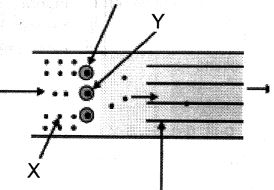
A
Dirty air - Discharged corona
B
Dust particles - Negatively charged wire
C
Clean air - Collection plate grounded
D
Negatively charged wire - Dirty air
Solution
(B) The figure represents an Electrostatic Precipitator $(ESP)$,which is used to remove particulate matter from industrial exhaust.
In this process,$X$ represents the dust particles present in the air stream.
$Y$ represents the negatively charged wires that emit electrons,creating a corona discharge that charges the dust particles.
These charged dust particles are then attracted to the grounded collection plates.
Therefore,$X$ is dust particles and $Y$ is the negatively charged wire.
In this process,$X$ represents the dust particles present in the air stream.
$Y$ represents the negatively charged wires that emit electrons,creating a corona discharge that charges the dust particles.
These charged dust particles are then attracted to the grounded collection plates.
Therefore,$X$ is dust particles and $Y$ is the negatively charged wire.
0 likes
View Solution234
MediumMCQ
Identify the correct pair:
A
Colloidal material - Cloth
B
Suspended solids - Paper fibres
C
Catalytic converter - Useful in electrostatic precipitates
D
Dissolved materials - Sand
Solution
(B) In the context of wastewater treatment and environmental pollution control:
$1$. Colloidal materials are very fine particles that do not settle easily,such as fecal matter,bacteria,and fine silt,not cloth.
$2$. Suspended solids include materials like sand,silt,and clay,but also organic matter like paper fibres,which can be removed by filtration or sedimentation.
$3$. $A$ catalytic converter is used in automobiles to reduce toxic gas emissions ($CO$,$NO_x$,and hydrocarbons),not in electrostatic precipitators.
$4$. Dissolved materials include nutrients like nitrates,phosphates,and salts,not sand (which is a suspended solid).
Therefore,the correct pair is $B$.
$1$. Colloidal materials are very fine particles that do not settle easily,such as fecal matter,bacteria,and fine silt,not cloth.
$2$. Suspended solids include materials like sand,silt,and clay,but also organic matter like paper fibres,which can be removed by filtration or sedimentation.
$3$. $A$ catalytic converter is used in automobiles to reduce toxic gas emissions ($CO$,$NO_x$,and hydrocarbons),not in electrostatic precipitators.
$4$. Dissolved materials include nutrients like nitrates,phosphates,and salts,not sand (which is a suspended solid).
Therefore,the correct pair is $B$.
0 likes
View Solution235
EasyMCQ
Concentration of $DDT$ in zooplankton is
A
$0.003\ ppb$
B
$0.03\ ppm$
C
$0.04\ ppm$
D
$0.004\ ppm$
Solution
(C) Biomagnification is the increase in concentration of a toxicant at successive trophic levels.
In an aquatic food chain,the concentration of $DDT$ increases as it moves from water to higher trophic levels.
The concentration of $DDT$ in water is $0.003\ ppb$.
In zooplankton,it increases to $0.04\ ppm$.
In small fish,it becomes $0.5\ ppm$,in large fish $2\ ppm$,and in fish-eating birds,it can reach up to $25\ ppm$.
In an aquatic food chain,the concentration of $DDT$ increases as it moves from water to higher trophic levels.
The concentration of $DDT$ in water is $0.003\ ppb$.
In zooplankton,it increases to $0.04\ ppm$.
In small fish,it becomes $0.5\ ppm$,in large fish $2\ ppm$,and in fish-eating birds,it can reach up to $25\ ppm$.
0 likes
View Solution236
EasyMCQ
What does snow-blindness refer to?
A
Destruction of skin pigments
B
Inflammation of the cornea
C
Cancer of the eyes
D
Skin cancer
Solution
(B) Snow-blindness is a condition caused by high exposure to ultraviolet-$B$ $(UV-B)$ radiation.
$UV-B$ radiation is absorbed by the cornea of the eye,which causes inflammation of the cornea.
This condition is known as snow-blindness,as it is commonly observed in high-altitude regions where snow reflects $UV$ rays,leading to significant eye damage.
$UV-B$ radiation is absorbed by the cornea of the eye,which causes inflammation of the cornea.
This condition is known as snow-blindness,as it is commonly observed in high-altitude regions where snow reflects $UV$ rays,leading to significant eye damage.
0 likes
View Solution237
MediumMCQ
Choose the correct statement.
A
According to $CPCB$,particulate matter of size $2.5 \ \mu m$ or less in diameter is responsible for causing the greatest harm to human health.
B
These particles can cause inflammation of the lungs,not the heart.
C
Catalytic converters use expensive metals,namely platinum,palladium,and rhodium,as catalysts.
D
All of the above are correct.
Solution
(C) $1$. According to the $CPCB$ (Central Pollution Control Board),particulate matter of size $2.5 \ \mu m$ or less in diameter $(PM_{2.5})$ is responsible for causing the greatest harm to human health.
$2$. These fine particulates can be inhaled deep into the lungs and cause respiratory problems,inflammation,and damage to the lungs,not the heart directly.
$3$. Catalytic converters,fitted into automobiles for reducing emission of poisonous gases,have expensive metals namely platinum-palladium and rhodium as the catalysts.
$4$. Since statement $A$ and $C$ are factually correct based on $NCERT$,and statement $B$ is a common misconception (it affects lungs),the question implies selecting the most accurate scientific statements. Given the options,$C$ is the most accurate description of catalytic converters.
$2$. These fine particulates can be inhaled deep into the lungs and cause respiratory problems,inflammation,and damage to the lungs,not the heart directly.
$3$. Catalytic converters,fitted into automobiles for reducing emission of poisonous gases,have expensive metals namely platinum-palladium and rhodium as the catalysts.
$4$. Since statement $A$ and $C$ are factually correct based on $NCERT$,and statement $B$ is a common misconception (it affects lungs),the question implies selecting the most accurate scientific statements. Given the options,$C$ is the most accurate description of catalytic converters.
0 likes
View Solution238
MediumMCQ
In eutrophication,dissolved $O_2$ ....... and $BOD$ ......
A
Increases,increases
B
Decreases,increases
C
Decreases,decreases
D
None
Solution
(B) Eutrophication is the process where water bodies become enriched with nutrients,leading to excessive growth of algae and aquatic plants.
As these organisms die,decomposers like bacteria break them down,consuming large amounts of dissolved oxygen $(O_2)$ in the process.
Consequently,the level of dissolved $O_2$ in the water decreases.
$BOD$ (Biochemical Oxygen Demand) is the amount of oxygen required by aerobic microorganisms to decompose the organic matter present in a water sample.
Since the organic matter increases due to the death of excessive aquatic life,the $BOD$ of the water increases significantly.
Therefore,in eutrophication,dissolved $O_2$ decreases and $BOD$ increases.
As these organisms die,decomposers like bacteria break them down,consuming large amounts of dissolved oxygen $(O_2)$ in the process.
Consequently,the level of dissolved $O_2$ in the water decreases.
$BOD$ (Biochemical Oxygen Demand) is the amount of oxygen required by aerobic microorganisms to decompose the organic matter present in a water sample.
Since the organic matter increases due to the death of excessive aquatic life,the $BOD$ of the water increases significantly.
Therefore,in eutrophication,dissolved $O_2$ decreases and $BOD$ increases.
0 likes
View Solution239
MediumMCQ
Which effect is caused by lead on catalytic converter?
A
Make process fast
B
Inactivates the catalyst
C
Activates the catalyst
D
None
Solution
(B) Catalytic converters are used in automobiles to reduce the emission of poisonous gases like carbon monoxide and nitrogen oxides.
These converters contain expensive metals like platinum,palladium,and rhodium as catalysts.
Lead $(Pb)$ present in petrol acts as a catalyst poison.
When lead enters the catalytic converter,it binds to the active sites of the catalyst,thereby inactivating it and rendering the converter ineffective.
These converters contain expensive metals like platinum,palladium,and rhodium as catalysts.
Lead $(Pb)$ present in petrol acts as a catalyst poison.
When lead enters the catalytic converter,it binds to the active sites of the catalyst,thereby inactivating it and rendering the converter ineffective.
0 likes
View Solution240
EasyMCQ
$2$-wheelers Bharat Stage-$III$ $(BS-III)$ norms were implemented throughout the country in:
A
$2010$
B
$2011$
C
$2013$
D
$2009$
Solution
(A) The Bharat Stage $(BS)$ emission standards are emission standards instituted by the Government of India to regulate the output of air pollutants from internal combustion engine equipment,including motor vehicles.
Bharat Stage-$III$ $(BS-III)$ norms for $2$-wheelers were implemented throughout the country in the year $2010$.
These norms were introduced to reduce the environmental impact of vehicular emissions.
Bharat Stage-$III$ $(BS-III)$ norms for $2$-wheelers were implemented throughout the country in the year $2010$.
These norms were introduced to reduce the environmental impact of vehicular emissions.
0 likes
View Solution241
EasyMCQ
Impurities of water are
A
Suspended solids
B
Colloidal material
C
Dissolved materials
D
All of the above
Solution
(D) Water impurities are classified based on their physical state and size.
$1$. Suspended solids: These are particles that do not dissolve and can be removed by filtration.
$2$. Colloidal material: These are fine particles that remain suspended in water and are difficult to remove by simple filtration.
$3$. Dissolved materials: These include salts,minerals,and gases that are completely dissolved in water.
Since all three categories represent common forms of water pollution/impurities,the correct answer is $D$.
$1$. Suspended solids: These are particles that do not dissolve and can be removed by filtration.
$2$. Colloidal material: These are fine particles that remain suspended in water and are difficult to remove by simple filtration.
$3$. Dissolved materials: These include salts,minerals,and gases that are completely dissolved in water.
Since all three categories represent common forms of water pollution/impurities,the correct answer is $D$.
0 likes
View Solution242
EasyMCQ
Presence of large amounts of nutrients in waters causes excessive growth of....
A
Algae
B
Oxygen
C
Fish
D
None
Solution
(A) The presence of large amounts of nutrients (such as nitrogen and phosphorus) in water bodies leads to a phenomenon known as eutrophication.
This excessive nutrient enrichment promotes the rapid and uncontrolled growth of aquatic plants,particularly algae,which is often referred to as an algal bloom.
These blooms can deplete dissolved oxygen levels in the water,which negatively impacts other aquatic life such as fish.
This excessive nutrient enrichment promotes the rapid and uncontrolled growth of aquatic plants,particularly algae,which is often referred to as an algal bloom.
These blooms can deplete dissolved oxygen levels in the water,which negatively impacts other aquatic life such as fish.
0 likes
View Solution243
EasyMCQ
Particulate matter with a diameter of $2.5$ micrometres or less and a sound level of $150$ $dB$ or more causes the greatest harm to human health.
A
$2.5, 150$
B
$150, 2.5$
C
$2.5, 160$
D
$1.5, 150$
Solution
(A) According to the Central Pollution Control Board $(CPCB)$,particulate matter of size $2.5$ micrometres or less in diameter $(PM_{2.5})$ is responsible for causing the greatest harm to human health as it can be inhaled deep into the lungs.
Additionally,sound levels of $150$ $dB$ or more (generated by jet planes or rockets) are extremely harmful to human health,as they can cause permanent damage to the eardrums and lead to hearing loss.
Additionally,sound levels of $150$ $dB$ or more (generated by jet planes or rockets) are extremely harmful to human health,as they can cause permanent damage to the eardrums and lead to hearing loss.
0 likes
View Solution244
EasyMCQ
What is the intensity of sound in normal conversation?
A
$10-20\, dB$
B
$35-60\, dB$
C
$70-90\, dB$
D
$120-150\, dB$
Solution
(B) The intensity of sound is measured in decibels $(dB)$.
Normal conversation typically occurs at an intensity level ranging from $35$ to $60\, dB$.
Sounds below $30\, dB$ are considered very quiet (like a whisper),while sounds above $80-90\, dB$ can be harmful to the human ear over prolonged exposure.
Normal conversation typically occurs at an intensity level ranging from $35$ to $60\, dB$.
Sounds below $30\, dB$ are considered very quiet (like a whisper),while sounds above $80-90\, dB$ can be harmful to the human ear over prolonged exposure.
0 likes
View Solution245
EasyMCQ
The dental disease characterized by mottling of teeth due to the presence of a specific chemical in drinking water is caused by which of the following elements?
A
Mercury
B
Chlorine
C
Fluorine
D
Boron
Solution
(C) The condition described is known as dental fluorosis.
It occurs due to the excessive intake of fluoride (a form of fluorine) through drinking water.
High concentrations of fluoride in water lead to the mottling (discoloration or pitting) of tooth enamel.
Therefore,the correct element is fluorine.
It occurs due to the excessive intake of fluoride (a form of fluorine) through drinking water.
High concentrations of fluoride in water lead to the mottling (discoloration or pitting) of tooth enamel.
Therefore,the correct element is fluorine.
0 likes
View Solution246
EasyMCQ
What is Agent Orange?
A
$A$ biodegradable insecticide
B
$A$ herbicide containing dioxin
C
$A$ dye used in fluorescent lamps
D
Harmful chemicals used in bright colors
Solution
(B) Agent Orange is a powerful herbicide and defoliant that was used by the $U$.$S$. military during the Vietnam War. It is notorious for containing a toxic contaminant known as $2,3,7,8$-tetrachlorodibenzo-p-dioxin $(TCDD)$,which is a type of dioxin. This chemical is highly toxic and has been linked to various health issues,including cancer and birth defects.
0 likes
View Solution247
MediumMCQ
Biochemical Oxygen Demand $(BOD)$ is not a good index for pollution in water bodies receiving effluents from which of the following?
A
Petroleum industries
B
Sugar industry
C
Domestic sewage
D
Dairy industry
Solution
(A) $BOD$ measures the amount of dissolved oxygen required by aerobic microorganisms to decompose the organic matter present in a water sample. It is an effective indicator for organic pollutants,such as those found in domestic sewage,sugar industry waste,and dairy industry waste,which are rich in biodegradable organic matter. However,petroleum industries release non-biodegradable or toxic chemical pollutants that cannot be easily broken down by microorganisms. Therefore,$BOD$ is not a suitable index for measuring pollution caused by petroleum industry effluents.
0 likes
View Solution248
MediumMCQ
What is the major drawback of $DDT$ as an insecticide?
A
It becomes ineffective after some time.
B
It is less effective than others.
C
It is not biodegradable in nature.
D
It is very expensive.
Solution
(C) $DDT$ (Dichlorodiphenyltrichloroethane) is a persistent organic pollutant.
It is not biodegradable,meaning it cannot be easily broken down by microorganisms in the environment.
Due to this property,it accumulates in the tissues of organisms and undergoes biomagnification through the food chain,causing long-term ecological damage.
It is not biodegradable,meaning it cannot be easily broken down by microorganisms in the environment.
Due to this property,it accumulates in the tissues of organisms and undergoes biomagnification through the food chain,causing long-term ecological damage.
0 likes
View Solution249
MediumMCQ
In which of the following aquatic ecosystems is the maximum biomagnification observed?
A
Fishes
B
Phytoplankton
C
Birds
D
Zooplankton
Solution
(C) Biomagnification refers to the increase in concentration of non-biodegradable substances (like $DDT$ or mercury) at successive trophic levels in a food chain.
In an aquatic ecosystem, the food chain typically follows the sequence: $Phytoplankton \rightarrow Zooplankton \rightarrow Small \ fish \rightarrow Large \ fish \rightarrow Fish-eating \ birds$.
Since the concentration of the toxicant increases as we move to higher trophic levels, the organism at the highest trophic level will accumulate the maximum concentration.
Among the given options, fish-eating birds occupy the highest trophic level, hence they exhibit the maximum biomagnification.
In an aquatic ecosystem, the food chain typically follows the sequence: $Phytoplankton \rightarrow Zooplankton \rightarrow Small \ fish \rightarrow Large \ fish \rightarrow Fish-eating \ birds$.
Since the concentration of the toxicant increases as we move to higher trophic levels, the organism at the highest trophic level will accumulate the maximum concentration.
Among the given options, fish-eating birds occupy the highest trophic level, hence they exhibit the maximum biomagnification.
0 likes
View SolutionEnvironmental Issues — Pollution · Frequently Asked Questions
1Are these Environmental Issues questions useful for JEE and NEET?
Yes. All questions in this section are mapped to JEE Main and NEET exam patterns. Previous year questions from JEE Main, NEET, GUJCET and state-level exams are included with full solutions.
2Can I switch to Hindi or Gujarati for these questions?
Yes. Use the language tabs in the hero section or the sidebar to view the same questions and solutions in English, Hindi or Gujarati.
3How do I generate a question paper from this subtopic?
Use the Vedclass Exam Paper Generator — select the chapter and subtopic, set difficulty, and generate Sets A, B, C, D automatically. First 3 chapters of every subject are free.
Vedclass Products
For Students
Vedclass Test Series
Mock tests in real JEE/NEET style with performance analysis. 5-day free trial.
Start Free TrialFor Teachers
Exam Paper Generator
Generate Set A/B/C/D papers from this chapter in 2 minutes. 3 chapters free.
Try FreeFor Institutes
Online Exam Module
Live online exams with unlimited students, 360° analytics & white-label branding.
See DemoFor Teachers & Institutes
Generate a Environmental Issues Exam Paper in 2 Minutes
Select subtopic & difficulty — Sets A, B, C, D auto-generated with No Repeat logic.
First 3 chapters of every subject are free — no payment required.